

ASTM G11-19
(Practice)Standard Practice for Effects of Outdoor Weathering on Pipeline Coatings
General Information
- Abstract
SIGNIFICANCE AND USE
4.1 Since coated pipe may be stored outdoors for long periods before burial, weathering tests described in this practice are needed to evaluate the stability of these coatings stored outdoors. The results obtained should be treated only as indicating the general effect of weathering. Exposure conditions vary greatly from year to year, from one part of a year to another, and from locality to locality. The results of short-term exposure tests in the north are more meaningful if exposure is started in the summer followed by a winter season. In southern areas where climatic conditions are more uniform throughout the year, the time of year when short-term exposure is started is less critical. In all localities, the longer the exposure period, the more reliable are the results obtained.
SCOPE
1.1 This practice is intended to define conditions for the exposure of coated metal pipe to weather.
1.2 This practice specifies qualifications for the samples, procedure to be followed in exposure to weather, and procedure for evaluating effects of exposure including visual examination and other tests.
1.3 The values stated in SI units to three significant decimals are to be regarded as the standard. The values given in parentheses are for information only.
1.4 This standard does not purport to address all of the safety concerns, if any, associated with its use. It is the responsibility of the user of this standard to establish appropriate safety, health, and environmental practices and determine the applicability of regulatory limitations prior to use.
1.5 This international standard was developed in accordance with internationally recognized principles on standardization established in the Decision on Principles for the Development of International Standards, Guides and Recommendations issued by the World Trade Organization Technical Barriers to Trade (TBT) Committee.
- Status
- Published
- Publication Date
- 14-Apr-2019
- Technical Committee
- D01 - Paint and Related Coatings, Materials, and Applications
- Drafting Committee
- D01.48 - Durability of Pipeline Coating and Linings


Overview
ASTM G11-19: Standard Practice for Effects of Outdoor Weathering on Pipeline Coatings provides recognized procedures for evaluating how pipeline coatings perform when exposed to outdoor weathering. Published by ASTM International, this standard is particularly significant for industries that manufacture, store, or utilize coated metal pipes, as these materials may be exposed to outdoor environments for extended periods before their intended use.
The standard outlines the required conditions for exposing coated pipe to weather, defines sampling best practices, describes exposure procedures, and details evaluation methods including visual inspection and additional testing. By adhering to ASTM G11-19, organizations can obtain important data on the durability and stability of pipeline coatings in real-world environmental conditions.
Key Topics
- Outdoor Weathering of Pipeline Coatings: Defines methodologies for exposing coated pipes to local climate conditions and assessing the impacts of ultraviolet radiation, precipitation, temperature fluctuations, and environmental contaminants.
- Sample Preparation and Qualification: Specifies how coated pipe samples should be selected and prepared to ensure they are representative of production lots and suitable for reproducibility across testing.
- Test Procedures: Details a stepwise process that includes initial qualification tests, periodic visual examination, measurement of coating thickness, and checking for defects (such as holidays, cracks, blistering, and corrosion). Follow-up impact and bend tests provide further insight into coating integrity post-exposure.
- Reporting and Documentation: Instructs users on documenting all relevant findings, including test conditions, environmental factors, appearance observations, and comparative performance between unexposed and weathered samples.
- Significance of Exposure Duration and Conditions: Recognizes that exposure duration (recommended periods of 6, 12, and 24 months) and geographic differences influence results, providing guidance on interpreting the findings.
Applications
ASTM G11-19 is highly relevant in sectors such as oil and gas, water transmission, construction, and infrastructure maintenance. Specific practical applications include:
- Quality Assurance: Enables manufacturers and specifiers to verify that protective coatings on steel and metal pipes maintain their integrity during outdoor storage prior to installation.
- Coating Development: Assists coating developers in evaluating new formulations for improved weather resistance and long-term durability in various climatic conditions.
- Asset Management: Provides asset owners with data on the expected weathering behavior of coated pipes, supporting effective inventory and lifecycle planning.
- Compliance and Risk Reduction: Helps ensure that pipeline coatings meet industry requirements and reduce the risk of premature coating failure, corrosion, or costly repairs once pipes are installed.
- Research and Development: Offers a standardized approach for laboratories and research teams to study the long-term environmental effects on pipeline coating systems.
Related Standards
ASTM G11-19 references and complements several related standards that provide further testing and evaluation guidance for pipeline coatings:
- ASTM G8: Test Methods for Cathodic Disbonding of Pipeline Coatings
- ASTM G10: Test Method for Specific Bendability of Pipeline Coatings
- ASTM G14: Test Method for Impact Resistance of Pipeline Coatings
- ASTM G62: Test Methods for Holiday Detection in Pipeline Coatings
- ASTM D7091: Practice for Nondestructive Measurement of Dry Film Thickness of Nonmagnetic Coatings
- ASTM G7: Practice for Atmospheric Environmental Exposure Testing of Nonmetallic Materials
These standards, when used in conjunction with ASTM G11-19, provide a comprehensive suite of tools for the assessment and qualification of pipeline coatings in demanding service environments.
Keywords: outdoor weathering, pipeline coatings, coated pipe storage, weather resistance, ASTM G11-19, coating durability, pipeline protection, coating testing standard.
Relations
- Replaces
ASTM G11-04(2012) - Standard Test Method for Effects of Outdoor Weathering on Pipeline Coatings - Effective Date
- 15-Apr-2019
- Effective Date
- 01-Feb-2024
- Refers
ASTM G62-23 - Standard Test Methods for Holiday Detection of Coatings used to Protect Pipelines - Effective Date
- 01-Oct-2023
- Effective Date
- 01-Oct-2019
- Effective Date
- 01-Dec-2015
- Effective Date
- 01-Jun-2013
- Effective Date
- 01-Apr-2012
- Effective Date
- 01-Dec-2010
- Effective Date
- 01-Dec-2010
- Effective Date
- 01-Jul-2007
- Effective Date
- 01-Dec-2006
- Effective Date
- 01-Aug-2005
- Effective Date
- 01-Jan-2005
- Refers
ASTM G14-04 - Standard Test Method for Impact Resistance of Pipeline Coatings (Falling Weight Test) - Effective Date
- 01-Nov-2004
- Effective Date
- 01-Dec-2003
Frequently Asked Questions
ASTM G11-19 is a standard published by ASTM International. Its full title is "Standard Practice for Effects of Outdoor Weathering on Pipeline Coatings". This standard covers: SIGNIFICANCE AND USE 4.1 Since coated pipe may be stored outdoors for long periods before burial, weathering tests described in this practice are needed to evaluate the stability of these coatings stored outdoors. The results obtained should be treated only as indicating the general effect of weathering. Exposure conditions vary greatly from year to year, from one part of a year to another, and from locality to locality. The results of short-term exposure tests in the north are more meaningful if exposure is started in the summer followed by a winter season. In southern areas where climatic conditions are more uniform throughout the year, the time of year when short-term exposure is started is less critical. In all localities, the longer the exposure period, the more reliable are the results obtained. SCOPE 1.1 This practice is intended to define conditions for the exposure of coated metal pipe to weather. 1.2 This practice specifies qualifications for the samples, procedure to be followed in exposure to weather, and procedure for evaluating effects of exposure including visual examination and other tests. 1.3 The values stated in SI units to three significant decimals are to be regarded as the standard. The values given in parentheses are for information only. 1.4 This standard does not purport to address all of the safety concerns, if any, associated with its use. It is the responsibility of the user of this standard to establish appropriate safety, health, and environmental practices and determine the applicability of regulatory limitations prior to use. 1.5 This international standard was developed in accordance with internationally recognized principles on standardization established in the Decision on Principles for the Development of International Standards, Guides and Recommendations issued by the World Trade Organization Technical Barriers to Trade (TBT) Committee.
SIGNIFICANCE AND USE 4.1 Since coated pipe may be stored outdoors for long periods before burial, weathering tests described in this practice are needed to evaluate the stability of these coatings stored outdoors. The results obtained should be treated only as indicating the general effect of weathering. Exposure conditions vary greatly from year to year, from one part of a year to another, and from locality to locality. The results of short-term exposure tests in the north are more meaningful if exposure is started in the summer followed by a winter season. In southern areas where climatic conditions are more uniform throughout the year, the time of year when short-term exposure is started is less critical. In all localities, the longer the exposure period, the more reliable are the results obtained. SCOPE 1.1 This practice is intended to define conditions for the exposure of coated metal pipe to weather. 1.2 This practice specifies qualifications for the samples, procedure to be followed in exposure to weather, and procedure for evaluating effects of exposure including visual examination and other tests. 1.3 The values stated in SI units to three significant decimals are to be regarded as the standard. The values given in parentheses are for information only. 1.4 This standard does not purport to address all of the safety concerns, if any, associated with its use. It is the responsibility of the user of this standard to establish appropriate safety, health, and environmental practices and determine the applicability of regulatory limitations prior to use. 1.5 This international standard was developed in accordance with internationally recognized principles on standardization established in the Decision on Principles for the Development of International Standards, Guides and Recommendations issued by the World Trade Organization Technical Barriers to Trade (TBT) Committee.
ASTM G11-19 is classified under the following ICS (International Classification for Standards) categories: 87.040 - Paints and varnishes. The ICS classification helps identify the subject area and facilitates finding related standards.
ASTM G11-19 has the following relationships with other standards: It is inter standard links to ASTM G11-04(2012), ASTM G8-24, ASTM G62-23, ASTM G10-10(2019), ASTM G10-10(2015), ASTM G62-07(2013), ASTM D7091-12, ASTM G10-10, ASTM G14-04(2010), ASTM G62-07, ASTM G8-96(2003)e1, ASTM D7091-05, ASTM G7-05, ASTM G14-04, ASTM G8-96(2003). Understanding these relationships helps ensure you are using the most current and applicable version of the standard.
ASTM G11-19 is available in PDF format for immediate download after purchase. The document can be added to your cart and obtained through the secure checkout process. Digital delivery ensures instant access to the complete standard document.
Standards Content (Sample)
This international standard was developed in accordance with internationally recognized principles on standardization established in the Decision on Principles for the
Development of International Standards, Guides and Recommendations issued by the World Trade Organization Technical Barriers to Trade (TBT) Committee.
Designation: G11 − 19
Standard Practice for
Effects of Outdoor Weathering on Pipeline Coatings
This standard is issued under the fixed designation G11; the number immediately following the designation indicates the year of original
adoption or, in the case of revision, the year of last revision.Anumber in parentheses indicates the year of last reapproval.Asuperscript
epsilon (´) indicates an editorial change since the last revision or reapproval.
1. Scope* G14 TestMethodforImpactResistanceofPipelineCoatings
(Falling Weight Test)
1.1 This practice is intended to define conditions for the
G62 Test Methods for Holiday Detection in Pipeline Coat-
exposure of coated metal pipe to weather.
ings
1.2 This practice specifies qualifications for the samples,
procedure to be followed in exposure to weather, and proce- 3. Summary of Practice
dure for evaluating effects of exposure including visual exami-
3.1 The effects of outdoor weathering on pipeline coatings
nation and other tests.
after 6, 12, and 24 months’ exposure are determined visually
1.3 The values stated in SI units to three significant deci-
and electrically by comparing exposed samples of coated pipe
mals are to be regarded as the standard. The values given in with unexposed samples of coated pipe before and after impact
parentheses are for information only. and bending tests. At the beginning of the test the unexposed
samples are qualified by a cathodic disbonding test.
1.4 This standard does not purport to address all of the
safety concerns, if any, associated with its use. It is the
4. Significance and Use
responsibility of the user of this standard to establish appro-
4.1 Since coated pipe may be stored outdoors for long
priate safety, health, and environmental practices and deter-
periods before burial, weathering tests described in this prac-
mine the applicability of regulatory limitations prior to use.
tice are needed to evaluate the stability of these coatings stored
1.5 This international standard was developed in accor-
outdoors. The results obtained should be treated only as
dance with internationally recognized principles on standard-
indicating the general effect of weathering. Exposure condi-
ization established in the Decision on Principles for the
tions vary greatly from year to year, from one part of a year to
Development of International Standards, Guides and Recom-
another, and from locality to locality. The results of short-term
mendations issued by the World Trade Organization Technical
exposure tests in the north are more meaningful if exposure is
Barriers to Trade (TBT) Committee.
started in the summer followed by a winter season. In southern
2. Referenced Documents
areas where climatic conditions are more uniform throughout
the year, the time of year when short-term exposure is started
2.1 ASTM Standards:
is less critical. In all localities, the longer the exposure period,
D7091 Practice for Nondestructive Measurement of Dry
the more reliable are the results obtained.
Film Thickness of Nonmagnetic Coatings Applied to
Ferrous Metals and Nonmagnetic, Nonconductive Coat-
5. Location of Test Sites
ings Applied to Non-Ferrous Metals
G7 Practice for Atmospheric Environmental Exposure Test- 5.1 Weathering racks shall be located in cleared areas
representative of local outdoor weather conditions.
ing of Nonmetallic Materials
G8 Test Methods for Cathodic Disbonding of Pipeline Coat-
6. Apparatus
ings
G10 Test Method for Specific Bendability of Pipeline Coat-
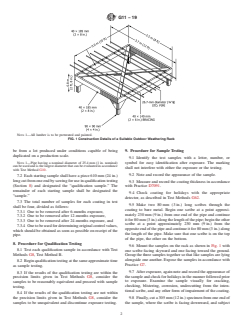
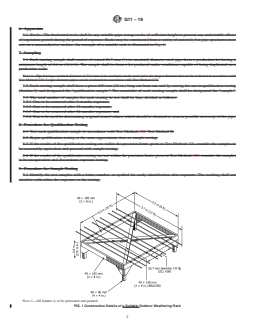
6.1 Racks—The horizontal racks shall be any suitable pipe
ings storage racks of sufficient height to prevent any undesirable
effects of vegetation growth during the period of exposure.
This practice is under the jurisdiction of ASTM Committee D01 on Paint and Racks may be constructed from a variety of materials, but pipe
Related Coatings, Materials, and Applications and is the direct responsibility of
specimens must rest on a nonconductive surface. An example
Subcommittee D01.48 on Durability of Pipeline Coating and Linings.
of a suitable rack is illustrated in Fig. 1.
Current edition approved April 15, 2019. Published May 2019. Originally
approved in 1969. Last previous edition approved in 2012 as G11 – 04 (2012). DOI:
7. Sampling
10.1520/G0011-19.
For referenced ASTM standards, visit the ASTM website, www.astm.org, or
7.1 Each starting sample shall consist of coated 19.1 mm
contact ASTM Customer Service at service@astm.org. For Annual Book of ASTM
( ⁄4 in. nominal) diameter steel pipe from a production lot
Standards volume information, refer to the standard’s Document Summary page on
the ASTM website. having a minimum length of 4.4 m (14.4 ft). The sample shall
*A Summary of Changes section appears at the end of this standard
Copyright © ASTM International, 100 Barr Harbor Drive, PO Box C700, West Conshohocken, PA 19428-2959. United States
G11−19
NOTE 1—All lumber is to be pretreated and painted.
FIG. 1 Construction Details of a Suitable Outdoor Weathering Rack
be from a lot produced under conditions capable of being 9. Procedure for Sample Testing
duplicated on a production scale.
9.1 Identify the test samples with a letter, number, or
NOTE 1—Pipe having a nominal diameter of 25.4 mm (1 in. nominal) symbol for easy identification after exposure. The marking
can be used and is the largest diameter that can be evaluated in accordance
shall not interfere with either the exposure or the testing.
with Test Method G10.
9.2 Note and record the appearance of the sample.
7.2 Each starting sample shall have a piece 610 mm (24 in.)
long cut from one end by sawing for use in quali
...
This document is not an ASTM standard and is intended only to provide the user of an ASTM standard an indication of what changes have been made to the previous version. Because
it may not be technically possible to adequately depict all changes accurately, ASTM recommends that users consult prior editions as appropriate. In all cases only the current version
of the standard as published by ASTM is to be considered the official document.
Designation: G11 − 04 (Reapproved 2012) G11 − 19
Standard Test Method Practice for
Effects of Outdoor Weathering on Pipeline Coatings
This standard is issued under the fixed designation G11; the number immediately following the designation indicates the year of original
adoption or, in the case of revision, the year of last revision. A number in parentheses indicates the year of last reapproval. A superscript
epsilon (´) indicates an editorial change since the last revision or reapproval.
1. Scope
1.1 This test method is intended to define conditions for the exposure of coated pipe to weather.
1.2 This test method specifies qualifications for the samples, procedure to be followed in exposure to weather, and procedure
for evaluating effects of exposure including visual examination and other tests.
1.3 The values stated in SI units to three significant decimals are to be regarded as the standard. The values given in parentheses
are for information only.
1.4 This standard does not purport to address all of the safety concerns, if any, associated with its use. It is the responsibility
of the user of this standard to establish appropriate safety and health practices and determine the applicability of regulatory
limitations prior to use.
2. Referenced Documents
2.1 ASTM Standards:
G8 Test Methods for Cathodic Disbonding of Pipeline Coatings
G10 Test Method for Specific Bendability of Pipeline Coatings
G12 Test Method for Nondestructive Measurement of Film Thickness of Pipeline Coatings on Steel (Withdrawn 2013)
G14 Test Method for Impact Resistance of Pipeline Coatings (Falling Weight Test)
G62 Test Methods for Holiday Detection in Pipeline Coatings
G70 Test Method for Ring Bendability of Pipeline Coatings (Squeeze Test) (Withdrawn 2013)
3. Summary of Test Method
3.1 The effects of outdoor weathering on pipeline coatings after 6, 12, and 24 months’ exposure are determined visually and
by electrical means by comparing exposed samples of coated pipe with unexposed samples of coated pipe before and after impact
and bending tests. At the beginning of the test the starting samples are qualified by a cathodic disbonding test.
4. Significance and Use
4.1 Since coated pipe may be stored outdoors for long periods before burial, weathering tests of the type described in this test
method are needed to evaluate the stability of these coatings stored outdoors. The results obtained should be treated only as
indicating the general effect of weathering. Exposure conditions vary greatly from year to year, from one part of a year to another,
and from locality to locality. The results of short-term exposure tests in the north are more meaningful if exposure is started in the
summer followed by a winter season. In southern areas where climatic conditions are more uniform throughout the year, the time
of year when short-term exposure is started is less critical. In all localities, the longer the exposure period, the more reliable are
the results obtained.
5. Location of Test Sites
5.1 Weathering racks shall be located in cleared areas representative of local outdoor weather conditions.
This test method practice is under the jurisdiction of ASTM Committee D01 on Paint and Related Coatings, Materials, and Applications and is the direct responsibility
of Subcommittee D01.48 on Durability of Pipeline Coating and Linings.
Current edition approved Nov. 1, 2012April 15, 2019. Published November 2012May 2019. Originally approved in 1969. Last previous edition approved in 20042012
as G11 – 04.G11 – 04 (2012). DOI: 10.1520/G0011-04R12.10.1520/G0011-19.
For referenced ASTM standards, visit the ASTM website, www.astm.org, or contact ASTM Customer Service at service@astm.org. For Annual Book of ASTM Standards
volume information, refer to the standard’s Document Summary page on the ASTM website.
Copyright © ASTM International, 100 Barr Harbor Drive, PO Box C700, West Conshohocken, PA 19428-2959. United States
G11 − 19
6. Apparatus
6.1 Racks—The horizontal racks shall be any suitable pipe storage racks of sufficient height to prevent any undesirable effects
of vegetation growth during the period of exposure. Racks may be constructed from a variety of materials, but pipe specimens must
rest on a nonconductive surface. An example of a suitable rack is illustrated in Fig. 1.
7. Sampling
7.1 Each starting sample shall consist of coated 26.7-mm ( ⁄4-in. nominal) diameter steel pipe from a production lot having a
minimum length of 4.4 m (14.4 ft). The sample shall be from a lot produced under conditions capable of being duplicated on a
production scale.
NOTE 1—Pipe having a nominal diameter of 33.4-mm (1-in. nominal) can be used and is the largest diameter that can be evaluated in accordance with
Test Method G10. Larger diameter pipes can be evaluated in accordance with Test Method G70.
7.2 Each starting sample shall have a piece 600 mm (24 in.) long cut from one end by sawing for use in qualification testing
(Section 8) and designated the “qualification sample.” The remainder of each starting sample shall be designated the “sample.”
7.3 The total number of samples for each coating in test shall be four, divided as follows:
7.3.1 One to be removed after 6-months exposure,
7.3.2 One to be removed after 12-months exposure,
7.3.3 One to be removed after 24-months exposure, and
7.3.4 One to be used for determining original control values, which should be obtained as soon as possible on receipt of the pipe.
8. Procedure for Qualification Testing
8.1 Test each qualification sample in accordance with Test Methods G8, Test Method B.
8.2 Begin qualification testing at the same approximate time as sample testing.
8.3 If the results of the qualification testing are within the precision limits given in Test Methods G8, consider the samples to
be reasonably equivalent and proceed with sample testing.
8.4 If the results of the qualification testing are not within the precision limits given in Test Methods G8, consider the samples
to be unequivalent and discontinue exposure testing.
9. Procedure for Sample Testing
9.1 Identify the test samples with a letter, number, or symbol for ready identification after exposure. The marking shall not
interfere with either the exposure or the testing.
NOTE 1—All lumber is to be pretreated and painted.
FIG. 1 Construction Details of a Suitable Outdoor Weathering Rack
G11 − 19
9.2 Note and record the appearance of the sample.
9.3 Measure and record the coating thickness in accordance with Test Method G12.
9.4 Check coating for holidays with the appropriate detector, as described in Test Methods G62.
9.5 Make two 80-mm (3-in.) long scribes through the coating to bare metal. Begin one scribe at a point approximately 230-mm
(9-in.) from one end of the pipe and continue it for 80 mm along the length of the pipe; begin the other scribe at a point
approximately 230 mm from the opposite end of the pipe and continue it for 80 mm along the length of the pipe. Make sure that
one scribe is on the top of the pipe, the other on the bottom.
9.6 Mount the samples on the rack as shown in Fig. 1 with one scribe facing skyward and one facing toward the ground. Group
the three samples together so that like samples are lying alongside one another.
9.7 After exposure, again note and record the appearance of the sample and check for holidays in the manner followed prior
to exposure. Next examine the sample visually for cracking, checking, blistering, corrosion, undercutting from the intentional
scribe, and any other form of impairment of the coating.
9.8 Finally, cut a 300-mm (12-in.) specimen from one end of the sample, where the scribe is facing downward, and subject to
an impact test in accordance with Test Method G14. In the impact test, position the specimen so that the scribe faces downward.
9.9 Subject the remaining 2.5 m (8.2 ft) to a bend test in accordance with Test Method G10. In the bend test, position the
skyward face of the sample as the outside of the bend.
9.10 Follow the procedure in 9.7, 9.8, and 9.9 on samples removed after each of the three exposure periods and compare results
with those obtained on the control sample in 7.3.
10. Report
10.1 Report the following information:
10.1.1 Results of qualification tests,
10.1.2 Sample number and description of coating system including: surface preparation, method of application, and coating
thickness,
10.1.3 Appearance of sample and presence or absence of holidays prior to exposure,
10.1.4 Appearance of sample, presence, or absence of holidays after exposure, and duration of exposure,
10.1.5 Visual evidence of coating failure as noted by 9.7,
10.1.6 Results of impact and bend tests after exposure as compared with those for the control sample, and
10.1.7 Type of environment and exposure.
11. Precision and Bias
11.1 The precision requirements for qualification testing in 8.3 of this test method and the precision requirements given in Test
Method G12 shall apply. Variations in samples and qualification samples shall be within respective precision limits for this test
method to be valid. Bias cannot be determined since no generally accepted standards are available. The results obtained should
be treated only as indicating the general effect of the weather directly effecting the test samples during the test period at the chosen
test site. Exposure conditions vary greatly from year to year, from one part of the year to another, and from locality to locality.
12. Keywords
12.1 coated pipe storage; outdoor weathering; pipeline coatings; weather resistance
ASTM International takes no position respecting the validity of any patent rights asserted in connection with any item mentioned
in this standard. Users of this standard are expressly advised that determination of the validity of any such patent rights, and the risk
of infringement of such rights, are entirely their own responsibility.
This standard is subject to revision at any time by the responsible technical committee and must be reviewed every five years and
if not revised, either reapproved or withdrawn. Your comments are invited either for revision of this standard or for additional standards
and should be addressed to ASTM International Headquarters. Your comments will receive careful consideration at a meeting of the
responsible technical committee, which you may attend. If you feel that your comments have not received a fair hearing you should
make your views known to the ASTM Committee on Standards, at th
...