

ASTM D2937-17e2
(Test Method)Standard Test Method for Density of Soil in Place by the Drive-Cylinder Method
General Information
- Abstract
SIGNIFICANCE AND USE
4.1 This test method can be used to determine the in-place density of soils which do not contain significant amounts of particles larger than 4.75 mm (3/16 in.), and which can be readily retained in the drive cylinder. This test method may also be used to determine the in-place density of compacted soils used in construction of structural fill, highway embankments, or earth dams. When the in-place density is to be used as a basis for acceptance, the drive cylinder volumes must be as large as practical and not less than 850 cm3 (0.030 ft3 ).
4.2 The general principles of this test method have been successfully used to obtain samples of various field compacted fine-grained soils having a maximum particle size of 4.75 mm (3/16 in.) for purposes other than density determinations, such as testing for engineering properties.
Note 1: Notwithstanding the statements on precision and bias contained in this standard: The precision of this test method is dependent on the competence of the personnel performing it and the suitability of the equipment and facilities used. Agencies which meet the criteria of Practice D3740 are generally considered capable of competent and objective testing. Users of this method are cautioned that compliance with Practice D3740 does not in itself assure reliable testing. Reliable testing depends on many factors; Practice D3740 provides a means of evaluating some of those factors.
SCOPE
1.1 This test method covers the determination of in-place density of soil by the drive-cylinder method. The test method involves obtaining an intact soil sample by driving a thin-walled cylinder into the soil and conducting specific measurements and calculations for the determination of in-place density. When sampling or in-place density is required at depth, Test Method D1587 should be used.
1.2 This test method is not recommended for sampling organic or friable soils which may compress during sampling. This test method may not be applicable for soft, organic, highly plastic, noncohesive, saturated or other soils which are easily deformed, compress during sampling, or which may not be retained in the drive cylinder sampler. This test may not be applicable with very hard natural soils or heavily compacted soils that may not be easily penetrated with the drive cylinder sampler. The use of this test method in soils containing an appreciable amount of particles larger than 4.75 mm (3/16 in.) may result in damage to the drive cylinder equipment. Soils containing particles larger than 4.75 mm (3/16 in.) may not yield valid results if voids are created along the wall of the cylinder during driving, or if particles are dislodged from the sample ends during trimming.
1.3 This test method is limited to the procedures necessary for obtaining specimens suitable for determining the in-place density and water content of certain soils. The procedures, precautions, and requirements necessary for selecting locations for obtaining intact samples, suitable for laboratory testing or otherwise determining engineering properties, is beyond the scope of this test method.
1.4 The values stated in SI units are to be regarded as standard. The values given in parentheses after SI units are provided for information only and are not considered standard.
1.4.1 It is common practice in the engineering/construction profession to concurrently use pounds to represent both a unit of mass (lbm) and a unit of force (lbf). This implicitly combines two separate systems of units; that is, the absolute system and the gravitational system. It is scientifically undesirable to combine the use of two separate sets of inch-pound units within a single standard. As stated, this standard includes the gravitational system of inch-pound units and does not use/present the slug unit for mass. However, the use of balances or scales recording pounds of mass (lbm) or the recording of density in lbm/ft3 shall not be regarded as no...
- Status
- Published
- Publication Date
- 31-Jan-2017
- Technical Committee
- D18 - Soil and Rock
- Drafting Committee
- D18.08 - Special and Construction Control Tests
Overview
ASTM D2937-17e2: Standard Test Method for Density of Soil in Place by the Drive-Cylinder Method establishes procedures for determining the in-place density of soils using a drive-cylinder sampler. Developed by ASTM International, this standard is widely recognized in geotechnical engineering and construction for field density testing of cohesive soils, particularly where accurate measurements of undisturbed sample density are critical.
The drive-cylinder method involves driving a thin-walled cylinder into the soil to extract an intact sample, followed by measurements and calculations to assess soil density. This method is ideal for cohesive and fine-grained soils containing minimal coarse particles, making it a key tool for quality control and verification of compacted soil fills in civil engineering projects.
Key Topics
- In-place soil density measurement: Determines the mass and volume of soil directly at the site for accurate assessment of soil compaction and structural suitability.
- Applicable soil types: Best suited for soils with particles smaller than 4.75 mm (3/16 in) that are cohesive and can retain shape when sampled. Not recommended for organic, highly plastic, noncohesive, saturated, or very hard soils.
- Test procedure outline:
- Preparation of sampling area
- Driving and extracting the cylinder
- Trimming and weighing the sample
- Calculating wet and dry density
- Determining water content using established laboratory procedures
- Sample size requirements: Drive cylinders should have a volume of at least 850 cm³ (0.030 ft³) for acceptance testing to minimize errors.
- Calibration and precision: Outlines the importance of properly calibrated equipment and trained personnel for reliable results.
- Reporting: Describes essential data to document, including sample identification, dimensions, mass, water content, dry density, and observations on sample quality.
Applications
The drive-cylinder method specified in ASTM D2937 is essential for:
- Compaction control: Verifying the density of compacted soil layers in projects such as highway embankments, earth dams, and structural fills.
- Earthwork quality assurance: Assessing whether field compaction meets project specifications and regulatory requirements.
- Geotechnical investigations: Obtaining intact samples for further laboratory testing of engineering properties, critical in foundation and infrastructure design.
- Project acceptance testing: Providing a basis for approval of constructed fills or embankments, ensuring that soil compaction meets performance standards.
- Comparative analysis: Expressing in-place density as a percentage of laboratory maximum density for compliance and comparison in civil engineering documentation.
Related Standards
ASTM D2937-17e2 references several important and widely used standards for soil testing and classification, including:
- ASTM D653: Standard Terminology Relating to Soil, Rock, and Contained Fluids
- ASTM D698: Laboratory Compaction Characteristics of Soil Using Standard Effort
- ASTM D1557: Laboratory Compaction Characteristics of Soil Using Modified Effort
- ASTM D1587: Thin-Walled Tube Sampling of Fine-Grained Soils
- ASTM D2216 / D4643 / D4944 / D4959: Methods for determining water (moisture) content of soil
- ASTM D2488: Practice for Description and Identification of Soils (Visual-Manual Procedures)
- ASTM D3740: Minimum Requirements for Agencies Engaged in Testing and/or Inspection of Soil and Rock in Engineering Design and Construction
- ASTM D6026: Practice for Using Significant Digits in Geotechnical Data
These related standards support comprehensive soil analysis, quality assurance, and adherence to best practices in field and laboratory environments.
Keywords: ASTM D2937, drive-cylinder method, in-place soil density, field density testing, compaction control, cohesive soils, geotechnical engineering, quality control, soil sampling, construction standards, ASTM soil testing, civil engineering soils.
Relations
- Replaces
ASTM D2937-17e1 - Standard Test Method for Density of Soil in Place by the Drive-Cylinder Method - Effective Date
- 01-Feb-2017
- Effective Date
- 01-Feb-2024
- Refers
ASTM D4959-24 - Standard Test Method for Determination of Water Content of Soil By Direct Heating - Effective Date
- 01-Feb-2024
- Effective Date
- 01-Nov-2023
- Effective Date
- 01-Oct-2019
- Effective Date
- 01-Mar-2019
- Effective Date
- 15-Feb-2018
- Effective Date
- 15-Jul-2017
- Effective Date
- 01-Feb-2017
- Refers
ASTM D4959-16 - Standard Test Method for Determination of Water Content of Soil By Direct Heating - Effective Date
- 01-Jan-2016
- Effective Date
- 01-May-2015
- Effective Date
- 01-Aug-2014
- Effective Date
- 15-May-2012
- Effective Date
- 01-May-2012
- Effective Date
- 01-May-2012
Get Certified
Connect with accredited certification bodies for this standard

Zavod za gradbeništvo Slovenije (ZAG) - Inšpekcija
ZAG inspection body for construction products, structures, and materials.
Sponsored listings
Frequently Asked Questions
ASTM D2937-17e2 is a standard published by ASTM International. Its full title is "Standard Test Method for Density of Soil in Place by the Drive-Cylinder Method". This standard covers: SIGNIFICANCE AND USE 4.1 This test method can be used to determine the in-place density of soils which do not contain significant amounts of particles larger than 4.75 mm (3/16 in.), and which can be readily retained in the drive cylinder. This test method may also be used to determine the in-place density of compacted soils used in construction of structural fill, highway embankments, or earth dams. When the in-place density is to be used as a basis for acceptance, the drive cylinder volumes must be as large as practical and not less than 850 cm3 (0.030 ft3 ). 4.2 The general principles of this test method have been successfully used to obtain samples of various field compacted fine-grained soils having a maximum particle size of 4.75 mm (3/16 in.) for purposes other than density determinations, such as testing for engineering properties. Note 1: Notwithstanding the statements on precision and bias contained in this standard: The precision of this test method is dependent on the competence of the personnel performing it and the suitability of the equipment and facilities used. Agencies which meet the criteria of Practice D3740 are generally considered capable of competent and objective testing. Users of this method are cautioned that compliance with Practice D3740 does not in itself assure reliable testing. Reliable testing depends on many factors; Practice D3740 provides a means of evaluating some of those factors. SCOPE 1.1 This test method covers the determination of in-place density of soil by the drive-cylinder method. The test method involves obtaining an intact soil sample by driving a thin-walled cylinder into the soil and conducting specific measurements and calculations for the determination of in-place density. When sampling or in-place density is required at depth, Test Method D1587 should be used. 1.2 This test method is not recommended for sampling organic or friable soils which may compress during sampling. This test method may not be applicable for soft, organic, highly plastic, noncohesive, saturated or other soils which are easily deformed, compress during sampling, or which may not be retained in the drive cylinder sampler. This test may not be applicable with very hard natural soils or heavily compacted soils that may not be easily penetrated with the drive cylinder sampler. The use of this test method in soils containing an appreciable amount of particles larger than 4.75 mm (3/16 in.) may result in damage to the drive cylinder equipment. Soils containing particles larger than 4.75 mm (3/16 in.) may not yield valid results if voids are created along the wall of the cylinder during driving, or if particles are dislodged from the sample ends during trimming. 1.3 This test method is limited to the procedures necessary for obtaining specimens suitable for determining the in-place density and water content of certain soils. The procedures, precautions, and requirements necessary for selecting locations for obtaining intact samples, suitable for laboratory testing or otherwise determining engineering properties, is beyond the scope of this test method. 1.4 The values stated in SI units are to be regarded as standard. The values given in parentheses after SI units are provided for information only and are not considered standard. 1.4.1 It is common practice in the engineering/construction profession to concurrently use pounds to represent both a unit of mass (lbm) and a unit of force (lbf). This implicitly combines two separate systems of units; that is, the absolute system and the gravitational system. It is scientifically undesirable to combine the use of two separate sets of inch-pound units within a single standard. As stated, this standard includes the gravitational system of inch-pound units and does not use/present the slug unit for mass. However, the use of balances or scales recording pounds of mass (lbm) or the recording of density in lbm/ft3 shall not be regarded as no...
SIGNIFICANCE AND USE 4.1 This test method can be used to determine the in-place density of soils which do not contain significant amounts of particles larger than 4.75 mm (3/16 in.), and which can be readily retained in the drive cylinder. This test method may also be used to determine the in-place density of compacted soils used in construction of structural fill, highway embankments, or earth dams. When the in-place density is to be used as a basis for acceptance, the drive cylinder volumes must be as large as practical and not less than 850 cm3 (0.030 ft3 ). 4.2 The general principles of this test method have been successfully used to obtain samples of various field compacted fine-grained soils having a maximum particle size of 4.75 mm (3/16 in.) for purposes other than density determinations, such as testing for engineering properties. Note 1: Notwithstanding the statements on precision and bias contained in this standard: The precision of this test method is dependent on the competence of the personnel performing it and the suitability of the equipment and facilities used. Agencies which meet the criteria of Practice D3740 are generally considered capable of competent and objective testing. Users of this method are cautioned that compliance with Practice D3740 does not in itself assure reliable testing. Reliable testing depends on many factors; Practice D3740 provides a means of evaluating some of those factors. SCOPE 1.1 This test method covers the determination of in-place density of soil by the drive-cylinder method. The test method involves obtaining an intact soil sample by driving a thin-walled cylinder into the soil and conducting specific measurements and calculations for the determination of in-place density. When sampling or in-place density is required at depth, Test Method D1587 should be used. 1.2 This test method is not recommended for sampling organic or friable soils which may compress during sampling. This test method may not be applicable for soft, organic, highly plastic, noncohesive, saturated or other soils which are easily deformed, compress during sampling, or which may not be retained in the drive cylinder sampler. This test may not be applicable with very hard natural soils or heavily compacted soils that may not be easily penetrated with the drive cylinder sampler. The use of this test method in soils containing an appreciable amount of particles larger than 4.75 mm (3/16 in.) may result in damage to the drive cylinder equipment. Soils containing particles larger than 4.75 mm (3/16 in.) may not yield valid results if voids are created along the wall of the cylinder during driving, or if particles are dislodged from the sample ends during trimming. 1.3 This test method is limited to the procedures necessary for obtaining specimens suitable for determining the in-place density and water content of certain soils. The procedures, precautions, and requirements necessary for selecting locations for obtaining intact samples, suitable for laboratory testing or otherwise determining engineering properties, is beyond the scope of this test method. 1.4 The values stated in SI units are to be regarded as standard. The values given in parentheses after SI units are provided for information only and are not considered standard. 1.4.1 It is common practice in the engineering/construction profession to concurrently use pounds to represent both a unit of mass (lbm) and a unit of force (lbf). This implicitly combines two separate systems of units; that is, the absolute system and the gravitational system. It is scientifically undesirable to combine the use of two separate sets of inch-pound units within a single standard. As stated, this standard includes the gravitational system of inch-pound units and does not use/present the slug unit for mass. However, the use of balances or scales recording pounds of mass (lbm) or the recording of density in lbm/ft3 shall not be regarded as no...
ASTM D2937-17e2 is classified under the following ICS (International Classification for Standards) categories: 93.020 - Earthworks. Excavations. Foundation construction. Underground works. The ICS classification helps identify the subject area and facilitates finding related standards.
ASTM D2937-17e2 has the following relationships with other standards: It is inter standard links to ASTM D2937-17e1, ASTM D4753-24, ASTM D4959-24, ASTM D3740-23, ASTM D3740-19, ASTM D2216-19, ASTM D4944-18, ASTM D2488-17, ASTM D4643-17, ASTM D4959-16, ASTM D4753-15, ASTM D653-14, ASTM D1587-08(2012)e1, ASTM D698-12, ASTM D698-12e1. Understanding these relationships helps ensure you are using the most current and applicable version of the standard.
ASTM D2937-17e2 is available in PDF format for immediate download after purchase. The document can be added to your cart and obtained through the secure checkout process. Digital delivery ensures instant access to the complete standard document.
Standards Content (Sample)
This international standard was developed in accordance with internationally recognized principles on standardization established in the Decision on Principles for the
Development of International Standards, Guides and Recommendations issued by the World Trade Organization Technical Barriers to Trade (TBT) Committee.
´2
Designation: D2937 − 17
Standard Test Method for
Density of Soil in Place by the Drive-Cylinder Method
This standard is issued under the fixed designation D2937; the number immediately following the designation indicates the year of
original adoption or, in the case of revision, the year of last revision. A number in parentheses indicates the year of last reapproval. A
superscript epsilon (´) indicates an editorial change since the last revision or reapproval.
This standard has been approved for use by agencies of the U.S. Department of Defense.
ε NOTE—Editorially corrected Example Data Sheet in Appendix X1 in April 2017.
ε NOTE—Editorially updated units of measurement statement in April 2018.
1. Scope* 1.4 The values stated in SI units are to be regarded as
standard. The values given in parentheses after SI units are
1.1 This test method covers the determination of in-place
provided for information only and are not considered standard.
density of soil by the drive-cylinder method. The test method
1.4.1 It is common practice in the engineering/construction
involves obtaining an intact soil sample by driving a thin-
profession to concurrently use pounds to represent both a unit
walled cylinder into the soil and conducting specific measure-
of mass (lbm) and a unit of force (lbf). This implicitly
ments and calculations for the determination of in-place
combines two separate systems of units; that is, the absolute
density. When sampling or in-place density is required at
system and the gravitational system. It is scientifically unde-
depth, Test Method D1587 should be used.
sirable to combine the use of two separate sets of inch-pound
1.2 This test method is not recommended for sampling
units within a single standard.As stated, this standard includes
organic or friable soils which may compress during sampling.
the gravitational system of inch-pound units and does not
Thistestmethodmaynotbeapplicableforsoft,organic,highly
use/present the slug unit for mass. However, the use of
plastic, noncohesive, saturated or other soils which are easily
balances or scales recording pounds of mass (lbm) or the
deformed, compress during sampling, or which may not be
recording of density in lbm/ft shall not be regarded as
retained in the drive cylinder sampler. This test may not be
nonconformance with this standard.
applicable with very hard natural soils or heavily compacted
1.5 All observed and calculated values shall conform to the
soils that may not be easily penetrated with the drive cylinder
guidelines for significant digits and rounding established in
sampler. The use of this test method in soils containing an
Practice D6026, unless superseded by this standard.
appreciable amount of particles larger than 4.75 mm ( ⁄16 in.)
1.5.1 Theproceduresusedtospecifyhowdataarecollected/
may result in damage to the drive cylinder equipment. Soils
recorded or calculated in this standard are regarded as the
containingparticleslargerthan4.75mm( ⁄16in.)maynotyield
industry standard. In addition, they are representative of the
valid results if voids are created along the wall of the cylinder
significant digits that generally should be retained. The proce-
during driving, or if particles are dislodged from the sample
dures used do not consider material variation, purpose for
ends during trimming.
obtaining the data, special purpose studies, or any consider-
1.3 This test method is limited to the procedures necessary
ations for the user’s objectives; and it is common practice to
for obtaining specimens suitable for determining the in-place
increase or reduce significant digits of reported data to be
density and water content of certain soils. The procedures,
commensuratewiththeseconsiderations.Itisbeyondthescope
precautions, and requirements necessary for selecting locations
of this standard to consider significant digits used in analysis
for obtaining intact samples, suitable for laboratory testing or
methods for engineering design.
otherwise determining engineering properties, is beyond the
1.6 This standard does not purport to address all of the
scope of this test method.
safety concerns, if any, associated with its use. It is the
responsibility of the user of this standard to establish appro-
priate safety, health, and environmental practices and deter-
ThistestmethodisunderthejurisdictionofASTMCommitteeD18onSoiland
Rock and is the direct responsibility of Subcommittee D18.08 on Special and
mine the applicability of regulatory limitations prior to use.
Construction Control Tests.
1.7 This international standard was developed in accor-
Current edition approved Feb. 1, 2017. Published February 2017. Originally
dance with internationally recognized principles on standard-
approved in 1971. Last previous edition approved in 2010 as D2937 – 10. DOI:
10.1520/D2937-17E02. ization established in the Decision on Principles for the
*A Summary of Changes section appears at the end of this standard
Copyright © ASTM International, 100 Barr Harbor Drive, PO Box C700, West Conshohocken, PA 19428-2959. United States
´2
D2937 − 17
Development of International Standards, Guides and Recom- ( ⁄16in.)forpurposesotherthandensitydeterminations,suchas
mendations issued by the World Trade Organization Technical testing for engineering properties.
Barriers to Trade (TBT) Committee.
NOTE 1—Notwithstanding the statements on precision and bias con-
tained in this standard: The precision of this test method is dependent on
2. Referenced Documents
the competence of the personnel performing it and the suitability of the
equipmentandfacilitiesused.AgencieswhichmeetthecriteriaofPractice
2.1 ASTM Standards:
D3740 are generally considered capable of competent and objective
D653 Terminology Relating to Soil, Rock, and Contained
testing. Users of this method are cautioned that compliance with Practice
Fluids
D3740 does not in itself assure reliable testing. Reliable testing depends
D698 Test Methods for Laboratory Compaction Character-
on many factors; Practice D3740 provides a means of evaluating some of
those factors.
istics of Soil Using Standard Effort (12,400 ft-lbf/ft (600
kN-m/m ))
5. Apparatus
D1557 Test Methods for Laboratory Compaction Character-
5.1 Drive Cylinders, of approximately 100 to 152 mm (4.00
istics of Soil Using Modified Effort (56,000 ft-lbf/ft
to 6.00 in.) diameter. Larger sizes may be used if desired or
(2,700 kN-m/m ))
required. Typical details of drive cylinders with outside diam-
D1587 Practice for Thin-Walled Tube Sampling of Fine-
eters of 100 mm (4.00 in.) are shown in Fig. 1 (see also Table
Grained Soils for Geotechnical Purposes
1). Drive cylinders of other diameters will require proportional
D2216 Test Methods for Laboratory Determination of Water
changes in the drive-cylinder tube and drive-head dimensions.
(Moisture) Content of Soil and Rock by Mass
The volume of the cylinders with the dimensions shown inFig.
D2488 Practice for Description and Identification of Soils
3 3
1isapproximately940cm (0.033ft ).Theapparatusshownin
(Visual-Manual Procedures)
Fig. 1 is of a design suitable for use at or near the surface.
D3740 Practice for Minimum Requirements for Agencies
5.1.1 When the in-place density is to be used as a basis for
Engaged in Testing and/or Inspection of Soil and Rock as
acceptance of compacted fill, the drive cylinders shall be as
Used in Engineering Design and Construction
large as practical to reduce the effects of errors and shall be
D4643 Test Method for Determination of Water Content of
3 3
equal to or greater than 850 cm (0.030 ft ).
Soil and Rock by Microwave Oven Heating
5.1.2 Thenumberofdrivecylindersrequiredwilldependon
D4753 Guide for Evaluating, Selecting, and Specifying Bal-
the number of samples to be taken and the anticipated rapidity
ances and Standard Masses for Use in Soil, Rock, and
by which the cylinders can be returned to service after
Construction Materials Testing
processing.
D4944 TestMethodforFieldDeterminationofWater(Mois-
5.1.3 ThecylindersshowninFig.1meettheclearanceratio,
ture)ContentofSoilbytheCalciumCarbideGasPressure
wall thickness and area-ratio requirements as set forth by
Tester
Hvorslev for drive cylinder samplers, and shall not exceed 10
D4959 Test Method for Determination of Water Content of
to 15 %, as defined by the following:
Soil By Direct Heating
2 2 2
D6026 Practice for Using Significant Digits in Geotechnical
A 5 Dw 2 De /De 3100 (1)
@~ ! #
r
Data
where:
3. Terminology
A = area ratio, %,
r
Dw = maximum external diameter of the drive cylinder, and
3.1 Definitions—For common terms found in this standard
De = effective (minimum) internal diameter of the drive
refer to Terminology D653.
sampler at the cutting edge after swaging.
4. Significance and Use
5.1.4 Except for very short drive cylinder samplers with no
clearance, the inside clearance ratio of the drive cylinders shall
4.1 This test method can be used to determine the in-place
be from 0.5 to 3.0 %, with increasing ratios as the plasticity
density of soils which do not contain significant amounts of
increases in the soil being sampled. Inside clearance ratio is
particles larger than 4.75 mm ( ⁄16 in.), and which can be
defined by the following:
readilyretainedinthedrivecylinder.Thistestmethodmayalso
be used to determine the in-place density of compacted soils
Di 2 De
C 5 3100 (2)
r
used in construction of structural fill, highway embankments,
De
or earth dams. When the in-place density is to be used as a
where:
basis for acceptance, the drive cylinder volumes must be as
3 3
C = inside clearance ratio, %
large as practical and not less than 850 cm (0.030 ft ). r
De = effective (minimum) internal diameter of the sampler
4.2 The general principles of this test method have been
at the cutting edge after swaging, and
successfully used to obtain samples of various field compacted
Di = internal diameter of the sampler.
fine-grained soils having a maximum particle size of 4.75 mm
5.1.5 Drive cylinders of other diameters shall conform to
these requirements.
For referenced ASTM standards, visit the ASTM website, www.astm.org, or
contact ASTM Customer Service at service@astm.org. For Annual Book of ASTM
Standards volume information, refer to the standard’s Document Summary page on Hvorslev, M. J., “Surface Exploration and Sampling of Soils for Engineering
the ASTM website. Purposes,” Engineering Foundation, 345 E. 47th St., New York, NY 10017.
´2
D2937 − 17
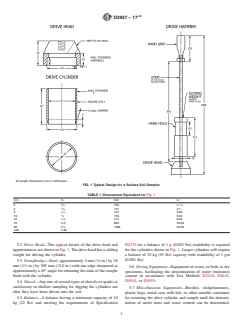
All length dimensions are in millimeters.
FIG. 1 Typical Design for a Surface Soil Sampler
TABLE 1 Dimensional Equivalent for Fig. 1
mm in. mm in.
5 1
2 ⁄64 103 4 ⁄16
5 1
4 ⁄32 115 4 ⁄2
5 ⁄16 127 5.00
19 ⁄4 155 6.00
44 1 ⁄4 212 8.00
76 3.0 865 36.00
98 3 ⁄8 1096 45.00
100 4.00
5.2 Drive Head—The typical details of the drive head and D4753 for a balance of 1 g (0.002 lbs) readability is required
appurtenancesareshowninFig.1.Thedriveheadhasasliding for the cylinders shown in Fig. 1. Larger cylinders will require
weight for driving the cylinder. a balance of 25 kg (55 lbs) capacity with readability of 1 gm
(0.002 lbs).
5.3 Straightedge—Steel, approximately 3 mm ( ⁄8 in.) by 38
mm (1 ⁄2 in.) by 305 mm (12.0 in.) with one edge sharpened at
5.6 Drying Equipment—Equipmentorovens,orboth,todry
approximately a 45° angle for trimming the ends of the sample
specimens, facilitating the determination of water (moisture)
flush with the cylinder.
content in accordance with Test Methods D2216, D4643,
D4944,or D4959.
5.4 Shovel—Anyoneofseveraltypesofshovelsorspadesis
satisfactory in shallow sampling for digging the cylinders out
5.7 Miscellaneous Equipment—Brushes, sledgehammers,
after they have been driven into the soil.
plastic bags, metal cans with lids, or other suitable containers
5.5 Balance—A balance having a minimum capacity of 10 for retaining the drive cylinder and sample until the determi-
kg (22 lbs) and meeting the requirements of Specification nation of moist mass and water content can be determined.
´2
D2937 − 17
Spoons, inside/outside caliper, or equivalent, accurate to 0.25 cylinder is not full or does not properly represent the in-situ
mm (0.01 in.) for calibration. soil, discard the soil and obtain another sample. If the drive
cylinder is deformed or otherwise damaged as a result of
5.8 Safety Equipment—Gloves and safety glasses. Steel-
driving it into or removing it from the ground, repair or replace
toed shoes or boots if required by agency.
the drive cylinder. Immediately determine the mass and water
content of the sample or place the drive cylinder and sample in
6. Procedure
a moisture proof container, which will prevent soil or water
6.1 Brush all loose particles from the surface. For near-
loss until mass and water determinations can be made.
surface sampling (not more than1m(3ft)in depth), sample
6.4 Record the mass of the drive cylinder and soil sample to
th
...