


ASTM D4800-94(2015)
(Guide)Standard Guide for Classifying and Specifying Adhesives
Standard Guide for Classifying and Specifying Adhesives
SIGNIFICANCE AND USE
4.1 The purpose of this classification system is to provide a method of identifying adhesives in order to give industry a system that can be used universally for materials. It further provides a means for specifying these materials by the use of the standards that are developed using this guide.
4.2 This classification system was developed to permit the addition of future adhesives.
SCOPE
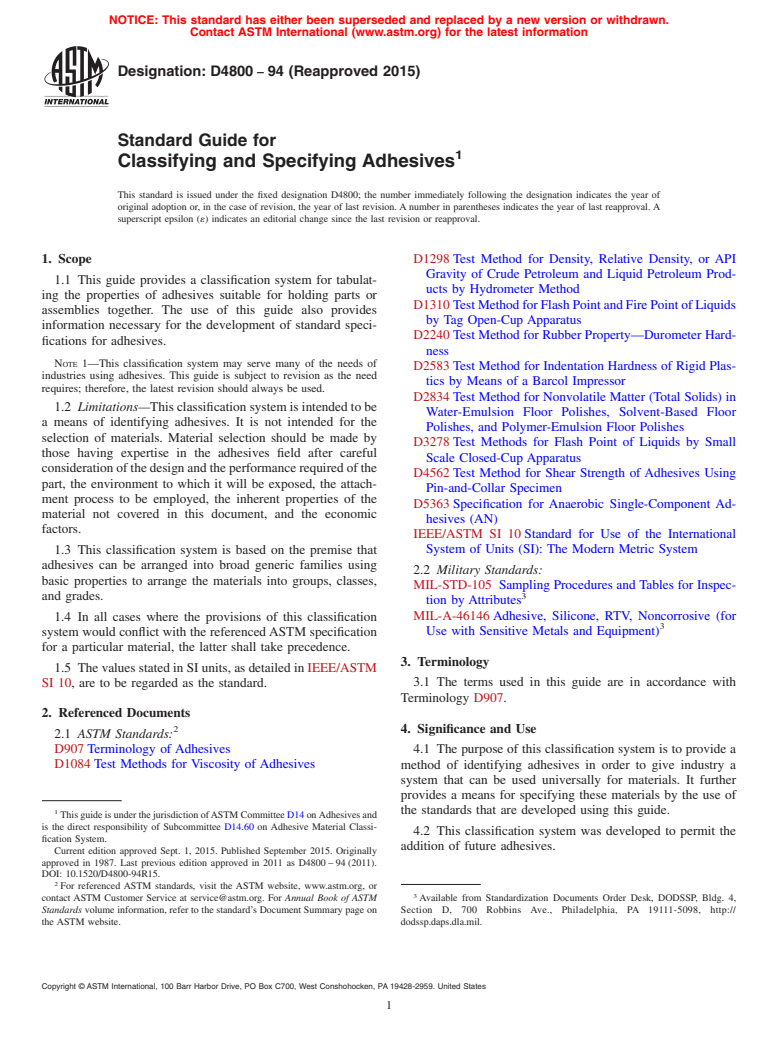
1.1 This guide provides a classification system for tabulating the properties of adhesives suitable for holding parts or assemblies together. The use of this guide also provides information necessary for the development of standard specifications for adhesives.
Note 1: This classification system may serve many of the needs of industries using adhesives. This guide is subject to revision as the need requires; therefore, the latest revision should always be used.
1.2 Limitations—This classification system is intended to be a means of identifying adhesives. It is not intended for the selection of materials. Material selection should be made by those having expertise in the adhesives field after careful consideration of the design and the performance required of the part, the environment to which it will be exposed, the attachment process to be employed, the inherent properties of the material not covered in this document, and the economic factors.
1.3 This classification system is based on the premise that adhesives can be arranged into broad generic families using basic properties to arrange the materials into groups, classes, and grades.
1.4 In all cases where the provisions of this classification system would conflict with the referenced ASTM specification for a particular material, the latter shall take precedence.
1.5 The values stated in SI units, as detailed in IEEE/ASTM SI 10, are to be regarded as the standard.
General Information
Buy Standard
Standards Content (Sample)
NOTICE: This standard has either been superseded and replaced by a new version or withdrawn.
Contact ASTM International (www.astm.org) for the latest information
Designation: D4800 − 94 (Reapproved 2015)
Standard Guide for
Classifying and Specifying Adhesives
This standard is issued under the fixed designation D4800; the number immediately following the designation indicates the year of
original adoption or, in the case of revision, the year of last revision. A number in parentheses indicates the year of last reapproval. A
superscript epsilon (´) indicates an editorial change since the last revision or reapproval.
1. Scope D1298 Test Method for Density, Relative Density, or API
Gravity of Crude Petroleum and Liquid Petroleum Prod-
1.1 This guide provides a classification system for tabulat-
ucts by Hydrometer Method
ing the properties of adhesives suitable for holding parts or
D1310 Test Method for Flash Point and Fire Point of Liquids
assemblies together. The use of this guide also provides
by Tag Open-Cup Apparatus
information necessary for the development of standard speci-
D2240 Test Method for Rubber Property—Durometer Hard-
fications for adhesives.
ness
NOTE 1—This classification system may serve many of the needs of
D2583 Test Method for Indentation Hardness of Rigid Plas-
industries using adhesives. This guide is subject to revision as the need
tics by Means of a Barcol Impressor
requires; therefore, the latest revision should always be used.
D2834 Test Method for Nonvolatile Matter (Total Solids) in
1.2 Limitations—This classification system is intended to be
Water-Emulsion Floor Polishes, Solvent-Based Floor
a means of identifying adhesives. It is not intended for the
Polishes, and Polymer-Emulsion Floor Polishes
selection of materials. Material selection should be made by
D3278 Test Methods for Flash Point of Liquids by Small
those having expertise in the adhesives field after careful
Scale Closed-Cup Apparatus
consideration of the design and the performance required of the
D4562 Test Method for Shear Strength of Adhesives Using
part, the environment to which it will be exposed, the attach-
Pin-and-Collar Specimen
ment process to be employed, the inherent properties of the
D5363 Specification for Anaerobic Single-Component Ad-
material not covered in this document, and the economic
hesives (AN)
factors.
IEEE/ASTM SI 10 Standard for Use of the International
1.3 This classification system is based on the premise that System of Units (SI): The Modern Metric System
adhesives can be arranged into broad generic families using
2.2 Military Standards:
basic properties to arrange the materials into groups, classes,
MIL-STD-105 Sampling Procedures and Tables for Inspec-
and grades. 3
tion by Attributes
MIL-A-46146 Adhesive, Silicone, RTV, Noncorrosive (for
1.4 In all cases where the provisions of this classification
system would conflict with the referenced ASTM specification Use with Sensitive Metals and Equipment)
for a particular material, the latter shall take precedence.
3. Terminology
1.5 The values stated in SI units, as detailed in IEEE/ASTM
3.1 The terms used in this guide are in accordance with
SI 10, are to be regarded as the standard.
Terminology D907.
2. Referenced Documents
2 4. Significance and Use
2.1 ASTM Standards:
D907 Terminology of Adhesives 4.1 The purpose of this classification system is to provide a
D1084 Test Methods for Viscosity of Adhesives method of identifying adhesives in order to give industry a
system that can be used universally for materials. It further
provides a means for specifying these materials by the use of
1 the standards that are developed using this guide.
This guide is under the jurisdiction of ASTM Committee D14 on Adhesives and
is the direct responsibility of Subcommittee D14.60 on Adhesive Material Classi-
4.2 This classification system was developed to permit the
fication System.
addition of future adhesives.
Current edition approved Sept. 1, 2015. Published September 2015. Originally
approved in 1987. Last previous edition approved in 2011 as D4800 – 94 (2011).
DOI: 10.1520/D4800-94R15.
For referenced ASTM standards, visit the ASTM website, www.astm.org, or
contact ASTM Customer Service at service@astm.org. For Annual Book of ASTM Available from Standardization Documents Order Desk, DODSSP, Bldg. 4,
Standards volume information, refer to the standard’s Document Summary page on Section D, 700 Robbins Ave., Philadelphia, PA 19111-5098, http://
the ASTM website. dodssp.daps.dla.mil.
Copyright © ASTM International, 100 Barr Harbor Drive, PO Box C700, West Conshohocken, PA 19428-2959. United States
D4800 − 94 (2015)
TABLE 1 Standard Symbols for Generic Families
5. Classification
Standard ASTM
5.1 Fig. 1 summarizes the classification system as detailed
Family Name
A B
Symbol Standard
in this guide.
B
AN Anaerobic (dimethacrylate) D5363
CA Cyanoacrylate
5.2 Adhesives shall be classified on the basis of their broad
C
CS Casein
generic family. The generic family is identified by letter
EP Epoxy
designations as found in Table 1.
HM Hot melt
MF Melamine-Formaldehyde
NOTE 2—For example: CA = Cyanoacrylate.
PF Phenol-Formaldehyde (phenolic)
PMMA Acrylic (other than AN or CA)
5.2.1 The generic family is based on the broad chemical
PUR Polyurethane
C
makeup of the base materials. By its designation, certain SI Silicone
A
inherent properties are specified.
Additional symbols will be added to this classification system as they are
requested or developed.
5.3 The generic family is classified into groups according, B
The standards listed are those in accordance with this classification system.
C
in general, to the chemical composition. These groups are
A standard is being developed.
further subdivided into classes and grades, as shown in the
basic property table that applies. The letter designation appli-
cable is followed by a four-digit number indicating group,
When a property is not to be specified, a zero is entered as the
class, and grade.
cell number. Likewise, when an acceptable value is not
5.3.1 The basic property tables have been developed to
available in the cell table, the number 9 should be used and a
identify the commercially available adhesives into groups,
suffix used indicating the specific value (see 7.1). Thus, the
classes, and grades. These tables are found in the standards
letter designation “A” for cell table and 3400 for property
listed in Table 1.
values shall always be written A3400.
5.3.1.1 Where a standard does not exist for this classifica-
NOTE 4—An example of an anaerobic adhesive identified by this
tion system the letter designation for the generic family will be
classification system is as follows. The designation AN0120A3400
followed by four 0’s and the use of the suffixes as needed (see
indicates the following with the material requirements from Cell Table A
7.1).
of material specification.
NOTE 3—Example: SI0000 indicates a Silicone (SI) from Table 1, with AN0120 = Anaerobic–Newtonian flow, thread locking
A = Table A for property requirements
0000 indicating no basic property table.
3 = Strength ASTM Test Method D4562, 6 MPa min
5.4 To facilitate the identification of new or special materi-
4 = Viscosity ASTM Test Methods D1084, Method B, 900
MPa·s min
als where basic property tables are not provided in a material
0 = Unspecified
specification, cell tables will be used. These tables shall appear
0 = Unspecified
in the material specifications. (See example of cell table in Fig.
2.) 6. Basic Requirements
5.4.1 Although the val
...
This document is not an ASTM standard and is intended only to provide the user of an ASTM standard an indication of what changes have been made to the previous version. Because
it may not be technically possible to adequately depict all changes accurately, ASTM recommends that users consult prior editions as appropriate. In all cases only the current version
of the standard as published by ASTM is to be considered the official document.
Designation: D4800 − 94 (Reapproved 2011) D4800 − 94 (Reapproved 2015)
Standard Guide for
Classifying and Specifying Adhesives
This standard is issued under the fixed designation D4800; the number immediately following the designation indicates the year of
original adoption or, in the case of revision, the year of last revision. A number in parentheses indicates the year of last reapproval. A
superscript epsilon (´) indicates an editorial change since the last revision or reapproval.
1. Scope
1.1 This guide provides a classification system for tabulating the properties of adhesives suitable for holding parts or assemblies
together. The use of this guide also provides information necessary for the development of standard specifications for adhesives.
NOTE 1—This classification system may serve many of the needs of industries using adhesives. This guide is subject to revision as the need requires;
therefore, the latest revision should always be used.
1.2 Limitations—This classification system is intended to be a means of identifying adhesives. It is not intended for the selection
of materials. Material selection should be made by those having expertise in the adhesives field after careful consideration of the
design and the performance required of the part, the environment to which it will be exposed, the attachment process to be
employed, the inherent properties of the material not covered in this document, and the economic factors.
1.3 This classification system is based on the premise that adhesives can be arranged into broad generic families using basic
properties to arrange the materials into groups, classes, and grades.
1.4 In all cases where the provisions of this classification system would conflict with the referenced ASTM specification for a
particular material, the latter shall take precedence.
1.5 The values stated in SI units, as detailed in IEEE/ASTM SI 10, are to be regarded as the standard.
2. Referenced Documents
2.1 ASTM Standards:
D907 Terminology of Adhesives
D1084 Test Methods for Viscosity of Adhesives
D1298 Test Method for Density, Relative Density, or API Gravity of Crude Petroleum and Liquid Petroleum Products by
Hydrometer Method
D1310 Test Method for Flash Point and Fire Point of Liquids by Tag Open-Cup Apparatus
D2240 Test Method for Rubber Property—Durometer Hardness
D2583 Test Method for Indentation Hardness of Rigid Plastics by Means of a Barcol Impressor
D2834 Test Method for Nonvolatile Matter (Total Solids) in Water-Emulsion Floor Polishes, Solvent-Based Floor Polishes, and
Polymer-Emulsion Floor Polishes
D3278 Test Methods for Flash Point of Liquids by Small Scale Closed-Cup Apparatus
D4562 Test Method for Shear Strength of Adhesives Using Pin-and-Collar Specimen
D5363 Specification for Anaerobic Single-Component Adhesives (AN)
IEEE/ASTM SI 10 Standard for Use of the International System of Units (SI): The Modern Metric System
2.2 Military Standards:
MIL-STD-105 Sampling Procedures and Tables for Inspection by Attributes
MIL-A-46146 Adhesive, Silicone, RTV, Noncorrosive (for Use with Sensitive Metals and Equipment)
3. Terminology
3.1 The terms used in this guide are in accordance with Terminology D907.
This guide is under the jurisdiction of ASTM Committee D14 on Adhesives and is the direct responsibility of Subcommittee D14.60 on Adhesive Material Classification
System.
Current edition approved Dec. 1, 2011Sept. 1, 2015. Published December 2011September 2015. Originally approved in 1987. Last previous edition approved in 20052011
as D4800 – 94 (2005).(2011). DOI: 10.1520/D4800-94R11.10.1520/D4800-94R15.
For referenced ASTM standards, visit the ASTM website, www.astm.org, or contact ASTM Customer Service at service@astm.org. For Annual Book of ASTM Standards
volume information, refer to the standard’sstandard’s Document Summary page on the ASTM website.
Available from Standardization Documents Order Desk, DODSSP, Bldg. 4, Section D, 700 Robbins Ave., Philadelphia, PA 19111-5098, http://dodssp.daps.dla.mil.
Copyright © ASTM International, 100 Barr Harbor Drive, PO Box C700, West Conshohocken, PA 19428-2959. United States
D4800 − 94 (2015)
4. Significance and Use
4.1 The purpose of this classification system is to provide a method of identifying adhesives in order to give industry a system
that can be used universally for materials. It further provides a means for specifying these materials by the use of the standards
that are developed using this guide.
4.2 This classification system was developed to permit the addition of future adhesives.
5. Classification
5.1 Fig. 1 summarizes the classification system as detailed in this guide.
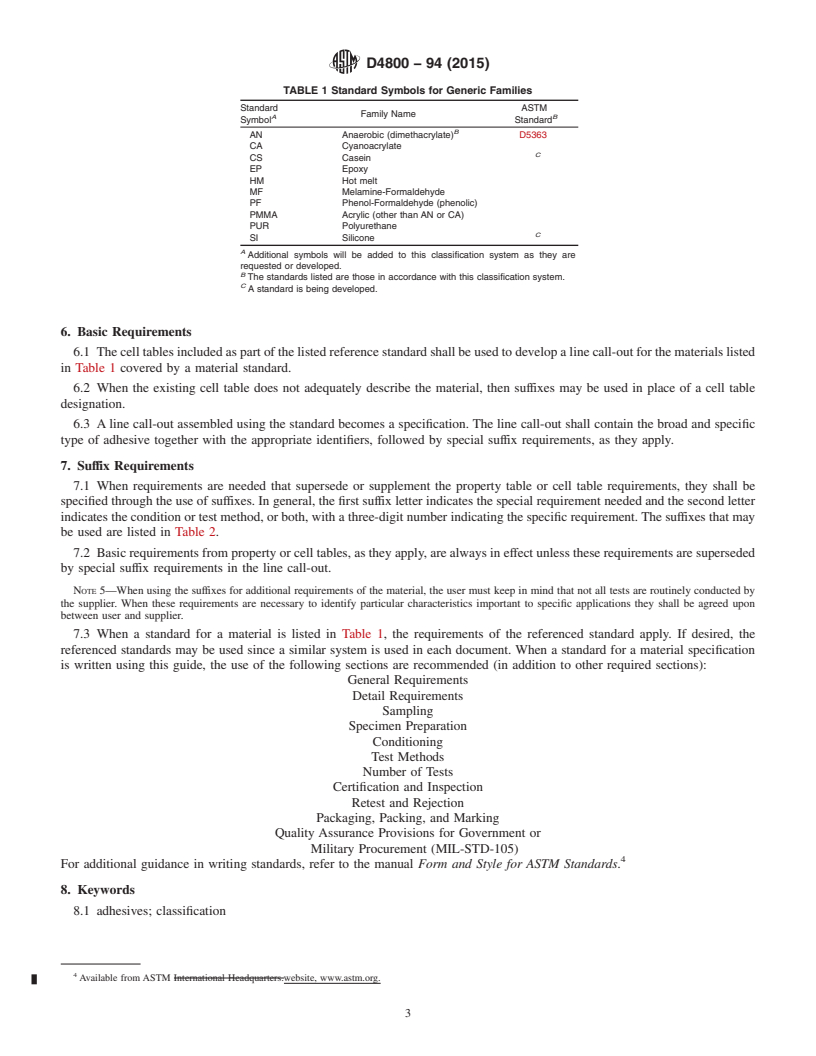
5.2 Adhesives shall be classified on the basis of their broad generic family. The generic family is identified by letter designations
as found in Table 1.
NOTE 2—For example: CA = Cyanoacrylate.
5.2.1 The generic family is based on the broad chemical makeup of the base materials. By its designation, certain inherent
properties are specified.
5.3 The generic family is classified into groups according, in general, to the chemical composition. These groups are further
subdivided into classes and grades, as shown in the basic property table that applies. The letter designation applicable is followed
by a four-digit number indicating group, class, and grade.
5.3.1 The basic property tables have been developed to identify the commercially available adhesives into groups, classes, and
grades. These tables are found in the standards listed in Table 1.
5.3.1.1 Where a standard does not exist for this classification system the letter designation for the generic family will be
followed by four 0’s and the use of the suffixes as needed (see 7.1).
NOTE 3—Example: SI0000 indicates a Silicone (SI) from Table 1, with 0000 indicating no basic property table.
5.4 To facilitate the identification of new or special materials where basic property tables are not provided in a material
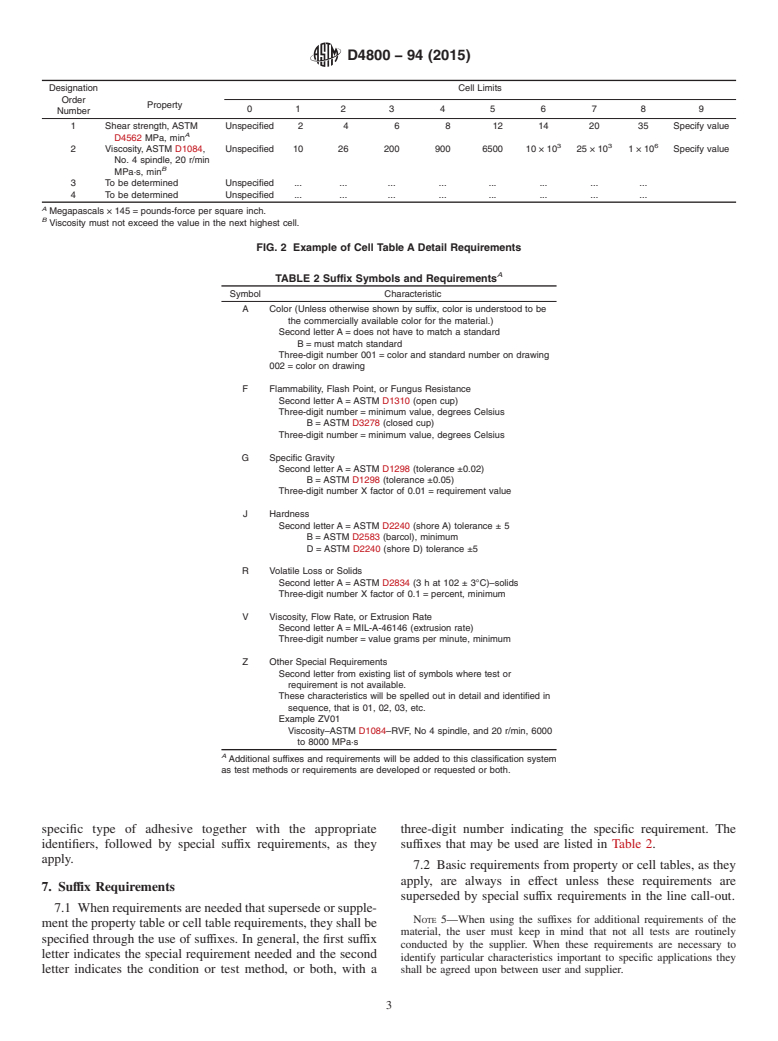
specification, cell tables will be used. These tables shall appear in the material specifications. (See example of cell table in Fig.
2.)
5.4.1 Although the values listed in the cell tables include the range of properties available in existing materials, users should
not infer that every possible combination of properties exists or can be obtained.
5.4.2 The requirements for special adhesives will use the classification system, as described, by the addition of a single letter
that indicates the proper cell table in which the properties are listed. A specific value is designated by the cell number for each
property in the order in which they are listed in the table. When a property is not to be specified, a zero is entered as the cell number.
Likewise, when an acceptable value is not available in the cell table, the number 9 should be used and a suffix used indicating the
specific value (see 7.1). Thus, the letter designation “A” for cell table and 3400 for property values shall always be written A3400.
NOTE 4—An example of an anaerobic adhesive identified by this classification system is as follows. The designation AN0120A3400 indicates the
following with the material requirements from Cell Table A of material specification.
AN0120 = Anaerobic–Newtonian flow, thread locking
A = Table A for property requirements
3 = Str
...
Questions, Comments and Discussion
Ask us and Technical Secretary will try to provide an answer. You can facilitate discussion about the standard in here.