

ASTM D5946-17
(Test Method)Standard Test Method for Corona-Treated Polymer Films Using Water Contact Angle Measurements
General Information
- Abstract
SIGNIFICANCE AND USE
5.1 The ability of polymer films to retain inks, coatings, adhesives, etc. is primarily dependent on the character of their surfaces and can be improved by one of several surface-treating techniques. The electrical discharge treatment, such as corona treatment, has been found to increase the wetting tension of a polymer film. The stronger the treatment, the more actively the surface reacts with different polar interfaces. It is therefore possible to relate the contact angle of a polymer film surface to its ability to accept and retain inks, coatings, adhesives, etc., if the ink, coating, or adhesive contains the polar functionalities. Contact angle in itself is not a completely acceptable measure of ink, coating, or adhesive adhesion.
5.2 The wetting tension of a polymer film belongs to a group of physical parameters for which no standard of accuracy exists. The wetting tension of a polymer cannot be measured directly because solids do not change shape measurably in reaction to surface energy. Many indirect methods have been proposed.5 Different test methods tend to produce different results on identical samples. Practical determination of a solid's surface energy uses this interaction of the solid with test liquids.
5.3 Although the level of surface treatment of polymer films has been traditionally defined in the industry in terms of dynes/cm (mN/m), these values are derived from a subjective interpretation of the observed test liquid behavior.
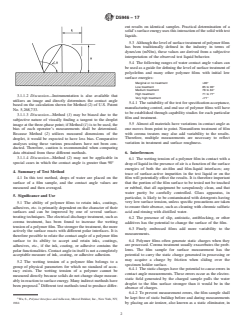
5.4 The following ranges of water contact angle values can be used as a guide for defining the level of surface treatment of polyolefins and many other polymer films with initial low surface energies:
Marginal or no treatment
>90°
Low treatment
85 to 90°
Medium treatment
78 to 84°
High treatment
71 to 77°
Very high treatment
5.4.1 The suitability of the test for specification acceptance, manufacturing control, and end use of polymer films will have to be established through c...
SCOPE
1.1 This test method covers measurement of the contact angle of water droplets on corona-treated polymer film surfaces.
Note 1: This standard is identical to ISO 15989.
1.2 The values stated in SI units are to be regarded as the standard. The values given in parentheses are for information only.
1.3 This standard does not purport to address all of the safety concerns, if any, associated with its use. It is the responsibility of the user of this standard to establish appropriate safety and health practices and determine the applicability of regulatory limitations prior to use.
1.4 This international standard was developed in accordance with internationally recognized principles on standardization established in the Decision on Principles for the Development of International Standards, Guides and Recommendations issued by the World Trade Organization Technical Barriers to Trade (TBT) Committee.
- Status
- Published
- Publication Date
- 30-Apr-2017
- Technical Committee
- D20 - Plastics
- Drafting Committee
- D20.19 - Film, Sheeting, and Molded Products
Buy Documents
ASTM D5946-17 - Standard Test Method for Corona-Treated Polymer Films Using Water Contact Angle Measurements
REDLINE ASTM D5946-17 - Standard Test Method for Corona-Treated Polymer Films Using Water Contact Angle Measurements
Overview
ASTM D5946-17, "Standard Test Method for Corona-Treated Polymer Films Using Water Contact Angle Measurements," is an internationally recognized procedure developed by ASTM International. This standard outlines a precise method for measuring the water contact angle on the surfaces of corona-treated polymer films. Understanding the contact angle is crucial, as it relates to a film's surface energy and its ability to accept inks, coatings, adhesives, and other materials-key properties in flexible packaging, labeling, and other converting operations.
This method is technically equivalent to ISO 15989, ensuring consistency for manufacturers and laboratories working with both ASTM and international standards. ASTM D5946-17 provides guidance on test procedure, equipment requirements, sample preparation, measurement, and reporting.
Key Topics
- Surface Treatment of Polymers: Enhances the adhesion of inks and coatings by increasing the surface energy of low-energy polymers like polyolefins through corona or other electrical discharge treatments.
- Water Contact Angle Measurement: Assesses the angle at which a water droplet meets the polymer surface. Lower contact angles generally indicate higher surface energy and better wettability.
- Wetting Tension Correlation: Offers guidance on correlating contact angle data with wetting tension-a parameter often used in converting and printing industries to judge surface treat levels.
- Procedural Consistency: The standard specifies test setup, sample handling, required equipment (such as a goniometer or contact angle meter), and key steps like using deionized water and avoiding surface contamination.
- Data Interpretation: Defines ranges for classifying treatment levels (e.g., "very high" treatment <71°, "marginal or no treatment" >90°) and emphasizes the need for multiple measurements to account for surface and treatment variability.
Applications
ASTM D5946-17 is widely used in industries that manufacture or convert polymer films, such as:
- Flexible Packaging: Ensures films are adequately treated to retain inks and adhesives required for product branding and protection.
- Labeling: Assists in verifying that surface treatment will support the adhesion of printed graphics or pressure-sensitive adhesives.
- Quality Control: Offers a quantitative method for monitoring and certifying treatment levels during production or process troubleshooting.
- Research and Development: Facilitates the comparison of different surface treatment technologies, polymer types, and the effectiveness of various process parameters.
- Specification Compliance: Useful for customer-supplier agreement in quality assurance, as well as verifying materials against purchase specifications.
By following ASTM D5946-17, organizations can ensure their corona-treated films meet demanding market and application requirements and that products are consistently fit for purpose.
Related Standards
- ISO 15989: Plastics-Film and Sheeting-Measurement of Water-Contact Angle of Corona-Treated Films (identical international standard).
- ASTM D618: Practice for Conditioning Plastics for Testing-details environmental conditioning for samples prior to testing.
- ASTM E691: Practice for Conducting an Interlaboratory Study to Determine the Precision of a Test Method.
- ASTM D724 (withdrawn): Test Method for Surface Wettability of Paper (Angle-of-Contact Method).
These related documents may provide supporting information or alternate methodologies for conditioning, interlaboratory testing, or different substrates.
Keywords: ASTM D5946-17, water contact angle, corona-treated polymer films, surface energy, wetting tension, goniometer, flexible packaging, surface treatment, ink adhesion, polymer film testing, quality control, ISO 15989
Relations
- Effective Date
- 01-May-2017
- Effective Date
- 01-May-2013
- Effective Date
- 01-Nov-2011
- Effective Date
- 01-Nov-2008
- Effective Date
- 01-Oct-2008
- Effective Date
- 01-Nov-2005
- Effective Date
- 01-Nov-2005
- Effective Date
- 10-Nov-2000
- Effective Date
- 10-May-1999
- Effective Date
- 01-May-2017
- Effective Date
- 01-May-2017
- Effective Date
- 01-May-2017
- Effective Date
- 01-May-2017
- Effective Date
- 01-May-2017
- Effective Date
- 01-May-2017
Buy Documents
ASTM D5946-17 - Standard Test Method for Corona-Treated Polymer Films Using Water Contact Angle Measurements
REDLINE ASTM D5946-17 - Standard Test Method for Corona-Treated Polymer Films Using Water Contact Angle Measurements
Get Certified
Connect with accredited certification bodies for this standard

DIN CERTCO
DIN Group product certification.

Smithers Quality Assessments
US management systems and product certification.
Sponsored listings
Frequently Asked Questions
ASTM D5946-17 is a standard published by ASTM International. Its full title is "Standard Test Method for Corona-Treated Polymer Films Using Water Contact Angle Measurements". This standard covers: SIGNIFICANCE AND USE 5.1 The ability of polymer films to retain inks, coatings, adhesives, etc. is primarily dependent on the character of their surfaces and can be improved by one of several surface-treating techniques. The electrical discharge treatment, such as corona treatment, has been found to increase the wetting tension of a polymer film. The stronger the treatment, the more actively the surface reacts with different polar interfaces. It is therefore possible to relate the contact angle of a polymer film surface to its ability to accept and retain inks, coatings, adhesives, etc., if the ink, coating, or adhesive contains the polar functionalities. Contact angle in itself is not a completely acceptable measure of ink, coating, or adhesive adhesion. 5.2 The wetting tension of a polymer film belongs to a group of physical parameters for which no standard of accuracy exists. The wetting tension of a polymer cannot be measured directly because solids do not change shape measurably in reaction to surface energy. Many indirect methods have been proposed.5 Different test methods tend to produce different results on identical samples. Practical determination of a solid's surface energy uses this interaction of the solid with test liquids. 5.3 Although the level of surface treatment of polymer films has been traditionally defined in the industry in terms of dynes/cm (mN/m), these values are derived from a subjective interpretation of the observed test liquid behavior. 5.4 The following ranges of water contact angle values can be used as a guide for defining the level of surface treatment of polyolefins and many other polymer films with initial low surface energies: Marginal or no treatment >90° Low treatment 85 to 90° Medium treatment 78 to 84° High treatment 71 to 77° Very high treatment 5.4.1 The suitability of the test for specification acceptance, manufacturing control, and end use of polymer films will have to be established through c... SCOPE 1.1 This test method covers measurement of the contact angle of water droplets on corona-treated polymer film surfaces. Note 1: This standard is identical to ISO 15989. 1.2 The values stated in SI units are to be regarded as the standard. The values given in parentheses are for information only. 1.3 This standard does not purport to address all of the safety concerns, if any, associated with its use. It is the responsibility of the user of this standard to establish appropriate safety and health practices and determine the applicability of regulatory limitations prior to use. 1.4 This international standard was developed in accordance with internationally recognized principles on standardization established in the Decision on Principles for the Development of International Standards, Guides and Recommendations issued by the World Trade Organization Technical Barriers to Trade (TBT) Committee.
SIGNIFICANCE AND USE 5.1 The ability of polymer films to retain inks, coatings, adhesives, etc. is primarily dependent on the character of their surfaces and can be improved by one of several surface-treating techniques. The electrical discharge treatment, such as corona treatment, has been found to increase the wetting tension of a polymer film. The stronger the treatment, the more actively the surface reacts with different polar interfaces. It is therefore possible to relate the contact angle of a polymer film surface to its ability to accept and retain inks, coatings, adhesives, etc., if the ink, coating, or adhesive contains the polar functionalities. Contact angle in itself is not a completely acceptable measure of ink, coating, or adhesive adhesion. 5.2 The wetting tension of a polymer film belongs to a group of physical parameters for which no standard of accuracy exists. The wetting tension of a polymer cannot be measured directly because solids do not change shape measurably in reaction to surface energy. Many indirect methods have been proposed.5 Different test methods tend to produce different results on identical samples. Practical determination of a solid's surface energy uses this interaction of the solid with test liquids. 5.3 Although the level of surface treatment of polymer films has been traditionally defined in the industry in terms of dynes/cm (mN/m), these values are derived from a subjective interpretation of the observed test liquid behavior. 5.4 The following ranges of water contact angle values can be used as a guide for defining the level of surface treatment of polyolefins and many other polymer films with initial low surface energies: Marginal or no treatment >90° Low treatment 85 to 90° Medium treatment 78 to 84° High treatment 71 to 77° Very high treatment 5.4.1 The suitability of the test for specification acceptance, manufacturing control, and end use of polymer films will have to be established through c... SCOPE 1.1 This test method covers measurement of the contact angle of water droplets on corona-treated polymer film surfaces. Note 1: This standard is identical to ISO 15989. 1.2 The values stated in SI units are to be regarded as the standard. The values given in parentheses are for information only. 1.3 This standard does not purport to address all of the safety concerns, if any, associated with its use. It is the responsibility of the user of this standard to establish appropriate safety and health practices and determine the applicability of regulatory limitations prior to use. 1.4 This international standard was developed in accordance with internationally recognized principles on standardization established in the Decision on Principles for the Development of International Standards, Guides and Recommendations issued by the World Trade Organization Technical Barriers to Trade (TBT) Committee.
ASTM D5946-17 is classified under the following ICS (International Classification for Standards) categories: 83.020 - Manufacturing processes in the rubber and plastics industries. The ICS classification helps identify the subject area and facilitates finding related standards.
ASTM D5946-17 has the following relationships with other standards: It is inter standard links to ASTM D5946-09, ASTM E691-13, ASTM E691-11, ASTM D618-08, ASTM E691-08, ASTM E691-05, ASTM D618-05, ASTM D618-00, ASTM E691-99, ASTM F22-21, ASTM D6105-04(2019), ASTM D8065/D8065M-16, ASTM F21-20, ASTM D8380-21, ASTM D2673-14(2022). Understanding these relationships helps ensure you are using the most current and applicable version of the standard.
ASTM D5946-17 is available in PDF format for immediate download after purchase. The document can be added to your cart and obtained through the secure checkout process. Digital delivery ensures instant access to the complete standard document.
Standards Content (Sample)
This international standard was developed in accordance with internationally recognized principles on standardization established in the Decision on Principles for the
Development of International Standards, Guides and Recommendations issued by the World Trade Organization Technical Barriers to Trade (TBT) Committee.
Designation: D5946 − 17
Standard Test Method for
Corona-Treated Polymer Films Using Water Contact Angle
Measurements
This standard is issued under the fixed designation D5946; the number immediately following the designation indicates the year of
original adoption or, in the case of revision, the year of last revision. A number in parentheses indicates the year of last reapproval. A
superscript epsilon (´) indicates an editorial change since the last revision or reapproval.
1. Scope* D724 Test Method for Surface Wettability of Paper (Angle-
of-Contact Method) (Withdrawn 2009)
1.1 This test method covers measurement of the contact
E691 Practice for Conducting an Interlaboratory Study to
angle of water droplets on corona-treated polymer film sur-
Determine the Precision of a Test Method
faces.
2.2 ISO Standard:
NOTE 1—This standard is identical to ISO 15989.
ISO 15989 Plastics—Film and Sheeting—Measurement of
1.2 The values stated in SI units are to be regarded as the
Water-Contact Angle of Corona-Treated Films
standard. The values given in parentheses are for information
3. Terminology
only.
1.3 This standard does not purport to address all of the 3.1 Definitions of Terms Specific to This Standard:
safety concerns, if any, associated with its use. It is the 3.1.1 staticcontactangle, θ(degrees),n—theanglebetween
responsibility of the user of this standard to establish appro- the substrate surface and the tangent line drawn to the droplet
priate safety and health practices and determine the applica- surface at the three-phase point, when a liquid drop is resting
bility of regulatory limitations prior to use. on a plane solid surface.
1.4 This international standard was developed in accor- 3.1.1.1 Discussion—Contact angle values can be deter-
dance with internationally recognized principles on standard- mined as follows: (1) by analyzing an image of a droplet using
ization established in the Decision on Principles for the various projection or reflective devices and measuring the
Development of International Standards, Guides and Recom- contact angle directly with a protractor by using tangential
mendations issued by the World Trade Organization Technical alignment of a cursor line or the use of reference alignment
Barriers to Trade (TBT) Committee.
procedures (Test Method D724); or (2) by analyzing an image
of a droplet using various projection or reflective devices and
2. Referenced Documents
measuring the height and width on the substrate surface to
calculate the contact angle as follows:
2.1 ASTM Standards:
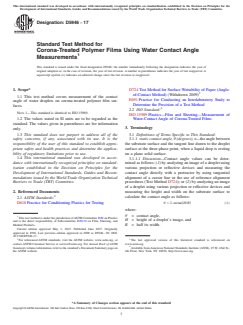
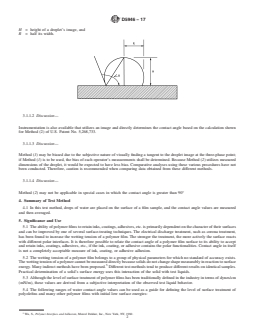
D618 Practice for Conditioning Plastics for Testing θ 5 2·arctan H/R (1)
~ !
where:
θ = contact angle,
This test method is under the jurisdiction ofASTM Committee D20 on Plastics
H = height of a droplet’s image, and
and is the direct responsibility of Subcommittee D20.19 on Film, Sheeting, and
R = half its width.
Molded Products.
Current edition approved May 1, 2017. Published June 2017. Originally
approved in 1996. Last previous edition approved in 2009 as D5946 - 09. DOI:
10.1520/D5946-17.
2 3
For referenced ASTM standards, visit the ASTM website, www.astm.org, or The last approved version of this historical standard is referenced on
contact ASTM Customer Service at service@astm.org. For Annual Book of ASTM www.astm.org.
Standards volume information, refer to the standard’s Document Summary page on Available fromAmerican National Standards Institute (ANSI), 25 W. 43rd St.,
the ASTM website. 4th Floor, New York, NY 10036, http://www.ansi.org.
*A Summary of Changes section appears at the end of this standard
Copyright © ASTM International, 100 Barr Harbor Drive, PO Box C700, West Conshohocken, PA 19428-2959. United States
D5946 − 17
ent results on identical samples. Practical determination of a
solid’ssurfaceenergyusesthisinteractionofthesolidwithtest
liquids.
5.3 Althoughthelevelofsurfacetreatmentofpolymerfilms
has been traditionally defined in the industry in terms of
dynes/cm (mN/m), these values are derived from a subjective
interpretation of the observed test liquid behavior.
5.4 The following ranges of water contact angle values can
be used as a guide for defining the level of surface treatment of
polyolefins and many other polymer films with initial low
surface energies:
Marginal or no treatment >90°
Low treatment 85 to 90°
Medium treatment 78 to 84°
High treatment 71 to 77°
3.1.1.2 Discussion—Instrumentation is also available that
Very high treatment <71°
utilizes an image and directly determines the contact angle
5.4.1 The suitability of the test for specification acceptance,
based on the calculation shown for Method (2) of U.S. Patent
manufacturing control, and end use of polymer films will have
No. 5,268,733.
to be established through capability studies for each particular
3.1.1.3 Discussion—Method (1) may be biased due to the
film and treatment.
subjective nature of visually finding a tangent to the droplet
5.5 Almost all materials have variations in contact angle as
image at the three-phase point; if Method (1) is to be used, the
one moves from point to point. Nonuniform treatment of film
bias of each operator’s measurements shall be determined.
with corona treaters may also add variability to the results.
Because Method (2) utilizes measured dimensions of the
Therefore, multiple measurements are necessary to reflect
droplet, it would be expected to have less bias. Comparative
variation in treatment and surface roughness.
analyses using these various procedures have not been con-
ducted. Therefore, caution is recommended when comparing
data obtained from these different methods. 6. Interferences
3.1.1.4 Discussion—Method (2) may not be applicable in
6.1 The wetting tension of a polymer film in contact with a
special cases in which the contact angle is greater than 90°
drop of liquid in the presence of air is a function of the surface
energies of both the air-film and film-liquid interfaces; any
4. Summary of Test Method
trace of surface-active impurities in the test liquid or on the
4.1 In this test method, drops of water are placed on the
film will potentially effect the results. It is therefore important
surface of a film sample, and the contact angle values are
that the portion of the film surface to be tested not be touched
measured and then averaged.
or rubbed, that all equipment be scrupulously clean, and that
water purity be carefully controlled. Glass apparatus, in
5. Significance and Use
particular, is likely to be contaminated with detergents having
very low surface tension, unless specific precautions are taken
5.1 The ability of polymer films to retain inks, coatings,
to ensure their absence, such as cleaning with chromic sulfuric
adhesives, etc. is primarily dependent on the character of their
acid and rinsing with distilled water.
surfaces and can be improved by one of several surface-
treating techniques. The electrical discharge treatment, such as
6.2 The presence of slip, antistatic, antiblocking, or other
corona treatment, has been found to increase the wetting
additives has the potential to change the surface of the film.
tension of a polymer film.The stronger the treatment, the more
6.3 Finely embossed films add more variability to the
actively the surface reacts with different polar interfaces. It is
measurements.
therefore possible to relate the contact angle of a polymer film
6.4 Polymer films often generate static charges when they
surface to its ability to accept and retain inks, coatings,
are processed. Corona treatment usually exacerbates the prob-
adhesives, etc., if the ink, coating, or adhesive contains the
polar functionalities. Contact angle in itself is not a completely lems. The film sample for surface measurement has the
potential to carry the static charge generated in processing or
acceptable measure of ink, coating, or adhesive adhesion.
may acquire a charge by friction when sliding over the
5.2 The wetting tension of a polymer film belongs to a
specimen holder surface.
group of physical parameters for which no standard of accu-
6.4.1 The static charges have the potential to cause errors in
racy exists. The wetting tension of a polymer cannot be
contact angle measurements. These errors occur as the electro-
measured directly because solids do not change shape measur-
static field generated by the charged sample pulls the water
ably in reaction to surface energy. Many indirect methods have
droplet to the film surface stronger than it would be in the
been proposed. Different test methods tend to produce differ-
absence of charges.
6.4.2 To prevent measurement errors, the film sample shall
be kept free of static buildup before and during measurements
Wu, S., Polymer Interface and Adhesion, Marcel Dekker, Inc., New York, NY,
1982. by placing an air ionizer, also known as a static eliminator, in
D5946 − 17
the vicinity of the specimen holder. These devices produce air 10. Conditioning
ionsofpositiveandnegativepolarity.Thechargedobjectinthe
10.1 Conditioning is not generally required for routine
vicinity of the ionizer will attract ions of the opposite polarity
quality assurance (QA) or process control measurements.
and will be neutralized.
Conditioning will potentially affect the measured value and
6.5 The transfer of a droplet onto the measured surface shall misrepresent the actual conditions.
be accomplished following the procedure described in Section
10.2 Conditioning is required for interlaboratory measure-
11. An improper transfer technique increases the variability of
ments intended to compare the results. Condition the test
measurements.
specimens at 23 6 2°C (73.4 6 3.6°F) and 50 6 10 % relative
6.6 The contact angle measuring method using tangential humidity for not less than 40 h prior to testing in accordance
alignment of the cursor line of a protractor, as described in with Procedure A of Practice D618 unless otherwise specified
3.1.1.1 (1), is biased due to the subjective nature of finding a by agreement or the relevant ASTM material specification. In
tangent to the droplet image at the three-phase point. The cases of disagreement, the tolerances shall be 61°C (61.8°F)
smaller the measured contact angle, the larger the error. The and 65 % relative humidity.
bias of each operator’s measurements shall be determined if
10.3 Test Conditions—Special test conditions are not gen-
this method is to be used.
erally required for routine QA or process control measure-
ments.
7. Apparatus
10.4 Test Conditions for Interlaboratory Studies—Conduct
7.1 ContactAngle Meter, or Goniometer—Theapparatusfor
tests in the standard laboratory atmosphere of 23 6 2°C (73.4
measuring contact angles shall contain the following: (1)a
6 3.6°F) and 50 6 10 % relative humidity, unless otherwise
liquid dispenser capable of suspending a precise droplet of the
specified by agreement or the relevant ASTM material speci-
specified volume from the tip of the dispenser, (2) if equipped,
fication.Incasesofdisagreement,thetolerancesshallbe 61°C
withasampleholderitneedstostretchthefilmtoprovideaflat
(61.8°F) and 65 % relative humidity.
surface without wrinkles and distortions, if unit does not have
a sample holder, care needs to be taken to provide a flat surface
11. Procedure
without wrinkles and distortions, (3) provisions for bringing
11.1 P
...
This document is not an ASTM standard and is intended only to provide the user of an ASTM standard an indication of what changes have been made to the previous version. Because
it may not be technically possible to adequately depict all changes accurately, ASTM recommends that users consult prior editions as appropriate. In all cases only the current version
of the standard as published by ASTM is to be considered the official document.
Designation: D5946 − 09 D5946 − 17
Standard Test Method for
Corona-Treated Polymer Films Using Water Contact Angle
Measurements
This standard is issued under the fixed designation D5946; the number immediately following the designation indicates the year of
original adoption or, in the case of revision, the year of last revision. A number in parentheses indicates the year of last reapproval. A
superscript epsilon (´) indicates an editorial change since the last revision or reapproval.
1. Scope*
1.1 This test method covers measurement of the contact angle of water droplets on corona-treated polymer film surfaces.
NOTE 1—This test method standard is identical to ISO 15989.
1.2 The values stated in SI units are to be regarded as the standard. The values given in parentheses are for information only.
1.3 This standard does not purport to address all of the safety concerns, if any, associated with its use. It is the responsibility
of the user of this standard to establish appropriate safety and health practices and determine the applicability of regulatory
limitations prior to use.
1.4 This international standard was developed in accordance with internationally recognized principles on standardization
established in the Decision on Principles for the Development of International Standards, Guides and Recommendations issued
by the World Trade Organization Technical Barriers to Trade (TBT) Committee.
2. Referenced Documents
2.1 ASTM Standards:
D618 Practice for Conditioning Plastics for Testing
D724 Test Method for Surface Wettability of Paper (Angle-of-Contact Method) (Withdrawn 2009)
E691 Practice for Conducting an Interlaboratory Study to Determine the Precision of a Test Method
2.2 ISO Standard:
ISO 15989 Plastics—Film and Sheeting—Measurement of Water-Contact Angle of Corona-Treated Films
3. Terminology
3.1 Definitions of Terms Specific to This Standard:
3.1.1 static contact angle, θ (degrees), n—the angle between the substrate surface and the tangent line drawn to the droplet
surface at the three-phase point, when a liquid drop is resting on a plane solid surface.
This test method is under the jurisdiction of ASTM Committee D20 on Plastics and is the direct responsibility of Subcommittee D20.19 on Film, Sheeting, and Molded
Products.
Current edition approved April 1, 2009May 1, 2017. Published April 2009June 2017. Originally approved in 1996. Last previous edition approved in 20042009 as
D5946 - 04.D5946 - 09. DOI: 10.1520/D5946-09.10.1520/D5946-17.
For referenced ASTM standards, visit the ASTM website, www.astm.org, or contact ASTM Customer Service at service@astm.org. For Annual Book of ASTM Standards
volume information, refer to the standard’s Document Summary page on the ASTM website.
The last approved version of this historical standard is referenced on www.astm.org.
Available from American National Standards Institute (ANSI), 25 W. 43rd St., 4th Floor, New York, NY 10036, http://www.ansi.org.
3.1.1.1 Discussion—
Contact angle values can be determined as follows: (1) by analyzing an image of a droplet using various projection or reflective
devices and measuring the contact angle directly with a protractor by using tangential alignment of a cursor line or the use of
reference alignment procedures (Test Method D724); or (2) by analyzing an image of a droplet using various projection or
reflective devices and measuring the height and width on the substrate surface to calculate the contact angle as follows:
θ5 2·arctan~H/R! (1)
where:
θ = contact angle,
*A Summary of Changes section appears at the end of this standard
Copyright © ASTM International, 100 Barr Harbor Drive, PO Box C700, West Conshohocken, PA 19428-2959. United States
D5946 − 17
H = height of a droplet’s image, and
R = half its width.
3.1.1.2 Discussion—
Instrumentation is also available that utilizes an image and directly determines the contact angle based on the calculation shown
for Method (2) of U.S. Patent No. 5,268,733.
3.1.1.3 Discussion—
Method (1) may be biased due to the subjective nature of visually finding a tangent to the droplet image at the three-phase point;
if Method (1) is to be used, the bias of each operator’s measurements shall be determined. Because Method (2) utilizes measured
dimensions of the droplet, it would be expected to have less bias. Comparative analyses using these various procedures have not
been conducted. Therefore, caution is recommended when comparing data obtained from these different methods.
3.1.1.4 Discussion—
Method (2) may not be applicable in special cases in which the contact angle is greater than 90°
4. Summary of Test Method
4.1 In this test method, drops of water are placed on the surface of a film sample, and the contact angle values are measured
and then averaged.
5. Significance and Use
5.1 The ability of polymer films to retain inks, coatings, adhesives, etc. is primarily dependent on the character of their surfaces
and can be improved by one of several surface-treating techniques. The electrical discharge treatment, such as corona treatment,
has been found to increase the wetting tension of a polymer film. The stronger the treatment, the more actively the surface reacts
with different polar interfaces. It is therefore possible to relate the contact angle of a polymer film surface to its ability to accept
and retain inks, coatings, adhesives, etc., if the ink, coating, or adhesive contains the polar functionalities. Contact angle in itself
is not a completely acceptable measure of ink, coating, or adhesive adhesion.
5.2 The wetting tension of a polymer film belongs to a group of physical parameters for which no standard of accuracy exists.
The wetting tension of a polymer cannot be measured directly because solids do not change shape measurably in reaction to surface
energy. Many indirect methods have been proposed. Different test methods tend to produce different results on identical samples.
Practical determination of a solid’s surface energy uses this interaction of the solid with test liquids.
5.3 Although the level of surface treatment of polymer films has been traditionally defined in the industry in terms of dynes/cm
(mN/m), these values are derived from a subjective interpretation of the observed test liquid behavior.
5.4 The following ranges of water contact angle values can be used as a guide for defining the level of surface treatment of
polyolefins and many other polymer films with initial low surface energies:
Wu, S., Polymer Interface and Adhesion, Marcel Dekker, Inc., New York, NY, 1982.
D5946 − 17
Marginal or no treatment >90°
Low treatment 85 to 90°
Medium treatment 78 to 84°
High treatment 71 to 77°
Very high treatment <71°
5.4.1 The suitability of the test for specification acceptance, manufacturing control, and end use of polymer films will have to
be established through capability studies for each particular film and treatment.
5.5 Almost all materials have variations in contact angle as one moves from point to point. Nonuniform treatment of film with
corona treaters may also add variability to the results. Therefore, multiple measurements are necessary to reflect variation in
treatment and surface roughness.
6. Interferences
6.1 The wetting tension of a polymer film in contact with a drop of liquid in the presence of air is a function of the surface
energies of both the air-film and film-liquid interfaces; any trace of surface-active impurities in the test liquid or on the film may
affect will potentially effect the results. It is therefore important that the portion of the film surface to be tested not be touched or
rubbed, that all equipment be scrupulously clean, and that water purity be carefully controlled. Glass apparatus, in particular, is
likely to be contaminated with detergents having very low surface tension, unless specific precautions are taken to ensure their
absence, such as cleaning with chromic sulfuric acid and rinsing with distilled water.
6.2 The presence of slip, antistatic, antiblocking, or other additives can has the potential to change the surface of the film.
6.3 Finely embossed films add more variability to the measurements.
6.4 Polymer films often generate static charges when they are processed. Corona treatment usually exacerbates the problems.
The film sample for surface measurement may has the potential to carry the static charge generated in processing or may acquire
a charge by friction when sliding over the specimen holder surface.
6.4.1 The static charges may have the potential to cause errors in contact angle measurements. These errors occur as the
electrostatic field generated by the charged sample pulls the water droplet to the film surface stronger than it would be in the
absence of charges.
6.4.2 To prevent measurement errors, the film sample shall be kept free of static buildup before and during measurements by
placing an air ionizer, also known as a static eliminator, in the vicinity of the specimen holder. These devices produce air ions of
positive and negative polarity. The charged object in the vicinity of the ionizer will attract ions of the opposite polarity and will
be neutralized.
6.5 The transfer of a droplet onto the measured surface shall be accomplished following the procedure described in Section 11.
An improper transfer technique increases the variability of measurements.
6.6 The contact angle measuring method using tangential alignment of the cursor line of a protractor, as described in 3.1.1.1
(1), is biased due to the subjective nature of finding a tangent to the droplet image at the three-phase point. The smaller the
measured contact angle, the larger the error. The bias of each operator’s measurements shall be determined if this method is to be
used.
7. Apparatus
7.1 Contact Angle Meter, or Goniometer—The apparatus for measuring contact angles shall contain the following: (1) a liquid
dispenser capable of suspending a precise droplet of the specified volume from the tip of the dispenser, (2) if equipped, with a
sample holder that can stretch a film sample flat it needs to stretch the film to provide a flat surface without wrinkles and distortions,
if unit does not have a sample holder, care needs to be taken to provide a flat surface without wrinkles and distortions, (3)
provisions for bringing the sample toward the suspended in contact with the droplet in a controlled manner to accomplish droplet
transfer onto the measured surface, and (4) means for projecting a “silhouette” image of the drop with minimal distortions. The
apparatus shall have means for direct angle measurements, such as a protractor, or direct measurements of the droplet’s dimensions,
such as a grid or scale, or both, or a suitable charge coupled device sensor and analysis hardware and software appropriate for
subsequent analysis.
8. Reagents and Materials
8.1 Purity of Water—Deionized It is suggested to use deionized ultra filtered water should be used for testing purposes. The test
liquid shall be kept in scrupulously clean containers.
9. Sampling
9.1 The minimum amount of film required for this test is an approximately 25-mm wide and 300-mm long sample strip. If a
sample is taken from a roll, the direction of the sample relative to the machine direction of the web shall be noted.
9.2 Extreme care shall be taken to prevent the surface of the film sample from being touched or handled in the areas upon which
the test is to be made.
D5946 − 17
9.3 The number of measurements per film sample can be determined using published tables for sampling plans. Complete tables
can be found in most books on quality control. The recommended number of readings per sample is ten.
NOTE 2—The number of measurements per film sample can be determined using published tables for sampling plans. Complete tables can be found
in most books on quality control.
9.4 For the purpose of determining the contact angle profile across the width of the roll, one contact angle measurement can
be taken every 25 mm [1 in.](1 in.) across the sample.
10.
...