

ASTM D4991-07(2023)
(Test Method)Standard Test Method for Leakage Testing of Empty Rigid Containers by Vacuum Method
General Information
- Abstract
SIGNIFICANCE AND USE
5.1 Containers may be pressurized in accordance with this test method without modification to the closure or to the body of the container. This test method may be used for testing rigid containers intended for the transportation of some liquids by air in accordance with the ICAO TIs or in accordance with the UN TDG.
5.2 This test method establishes the point at which leakage commences, with a limit of approximately 95 kPa (13.8 psi) differential. See Test Method D3078 for flexible packages.
5.3 This test method may not be suitable for some packages, such as packages with paper cap seals, where the test fluid may rapidly deteriorate the packaging.
SCOPE
1.1 This test method covers the testing of empty containers for resistance to leakage under differential pressure conditions such as those which can occur during air transport. It is suitable for testing rigid containers intended for the transportation of some hazardous liquids in accordance with the United Nations Recommendations On The Transport Of Dangerous Goods (UN TDG) and the International Civil Aviation Organization Technical Instructions For The Safe Transport Of Dangerous Goods By Air (ICAO TIs).
1.2 This standard does not purport to address all of the safety concerns, if any, associated with its use. It is the responsibility of the user of this standard to establish appropriate safety, health, and environmental practices and determine the applicability of regulatory limitations prior to use.
1.3 This international standard was developed in accordance with internationally recognized principles on standardization established in the Decision on Principles for the Development of International Standards, Guides and Recommendations issued by the World Trade Organization Technical Barriers to Trade (TBT) Committee.
- Status
- Published
- Publication Date
- 14-Mar-2023
- Technical Committee
- D10 - Packaging


Overview
ASTM D4991-07(2023), Standard Test Method for Leakage Testing of Empty Rigid Containers by Vacuum Method, is a key international standard developed by ASTM for evaluating the resistance of rigid packaging containers to leakage under differential pressure conditions. This method is particularly essential for containers used in the transport of hazardous liquids, where integrity during shipping, especially by air, is paramount. The test is suitable for rigid containers intended for compliance with the United Nations Recommendations on the Transport of Dangerous Goods (UN TDG) and the International Civil Aviation Organization Technical Instructions (ICAO TIs).
Key Topics
- Vacuum Test Method: Describes a procedure where empty rigid containers are immersed in a specific test fluid and subjected to a partial vacuum to simulate pressure differentials encountered during air transport.
- Leakage Detection: Defines the observation of continuous air bubbles or the presence of fluid inside the container as evidence of leakage. The differential pressure used is typically up to 95 kPa (13.8 psi).
- Container Types: Applies to rigid containers, including glass bottles and other non-flexible packaging used for hazardous and non-hazardous liquids.
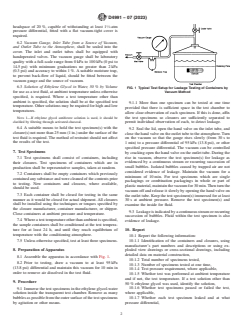
- Test Apparatus: Involves the use of a transparent vessel, vacuum system with accurate gauges, and a standardized ethylene glycol-water solution as the test medium.
- Limitations: Not recommended for packages with closures susceptible to rapid deterioration from the test fluid, such as paper cap seals.
Applications
The ASTM D4991 standard is widely used in various industries for:
- Packaging Quality Assurance: Ensuring that rigid containers meet required leak resistance criteria before they are used for shipping, especially for hazardous materials.
- Regulatory Compliance: Supporting manufacturers and shippers in conforming to international transport regulations like the UN TDG and ICAO TIs.
- Product Safety: Minimizing the risk of spillage, contamination, or environmental harm caused by package failure during air freight or other modes of transportation.
- Research and Development: Assisting packaging engineers in the evaluation and development of new rigid container designs.
- Routine Batch Testing: Facilitating ongoing quality control in production environments by spot testing representative samples from manufacturing lots.
Related Standards
- ASTM D3078: Test Method for Determination of Leaks in Flexible Packaging by Bubble Emission - suitable for flexible containers.
- ASTM D996: Terminology of Packaging and Distribution Environments - defines key terms used in packaging standards.
- UN TDG (United Nations Recommendations on the Transport of Dangerous Goods): Provides the regulatory framework governing the safe transport of dangerous materials.
- ICAO TIs (International Civil Aviation Organization Technical Instructions): Sets out recommended practices for air shipment of hazardous goods.
Practical Value
Implementing ASTM D4991 provides the following core benefits:
- Enhanced Supply Chain Safety: By identifying potential leaks before shipment, companies can prevent hazardous or costly spills during transit.
- Global Market Access: Compliance with this internationally recognized standard helps manufacturers ship products worldwide, meeting the requirements of multiple jurisdictions.
- Process Consistency: Using a standardized leakage testing method ensures repeatable, reliable outcomes across different facilities and batches.
- Risk Reduction: Early detection of container defects reduces liability, recall risks, and associated costs.
Conclusion
ASTM D4991-07(2023) is an essential standard for anyone involved in the design, manufacture, or testing of rigid containers used for transporting liquids, especially hazardous goods. By following this vacuum leakage test method, organizations can ensure regulatory compliance, improve product safety, and maintain supply chain integrity. For testing flexible packaging, refer to related standards such as ASTM D3078.
Relations
- Effective Date
- 01-Dec-2010
- Effective Date
- 01-Apr-2008
- Effective Date
- 01-Apr-2008
- Effective Date
- 01-Apr-2004
- Effective Date
- 10-Dec-2002
- Effective Date
- 10-Apr-2002
- Effective Date
- 10-Apr-2002
Get Certified
Connect with accredited certification bodies for this standard

Institut za varilstvo d.o.o. (Welding Institute)
Slovenia's leading welding institute since 1952. ISO 3834, EN 1090, pressure equipment certification, NDT personnel, welder qualification. Only IIW Au
Sponsored listings
Frequently Asked Questions
ASTM D4991-07(2023) is a standard published by ASTM International. Its full title is "Standard Test Method for Leakage Testing of Empty Rigid Containers by Vacuum Method". This standard covers: SIGNIFICANCE AND USE 5.1 Containers may be pressurized in accordance with this test method without modification to the closure or to the body of the container. This test method may be used for testing rigid containers intended for the transportation of some liquids by air in accordance with the ICAO TIs or in accordance with the UN TDG. 5.2 This test method establishes the point at which leakage commences, with a limit of approximately 95 kPa (13.8 psi) differential. See Test Method D3078 for flexible packages. 5.3 This test method may not be suitable for some packages, such as packages with paper cap seals, where the test fluid may rapidly deteriorate the packaging. SCOPE 1.1 This test method covers the testing of empty containers for resistance to leakage under differential pressure conditions such as those which can occur during air transport. It is suitable for testing rigid containers intended for the transportation of some hazardous liquids in accordance with the United Nations Recommendations On The Transport Of Dangerous Goods (UN TDG) and the International Civil Aviation Organization Technical Instructions For The Safe Transport Of Dangerous Goods By Air (ICAO TIs). 1.2 This standard does not purport to address all of the safety concerns, if any, associated with its use. It is the responsibility of the user of this standard to establish appropriate safety, health, and environmental practices and determine the applicability of regulatory limitations prior to use. 1.3 This international standard was developed in accordance with internationally recognized principles on standardization established in the Decision on Principles for the Development of International Standards, Guides and Recommendations issued by the World Trade Organization Technical Barriers to Trade (TBT) Committee.
SIGNIFICANCE AND USE 5.1 Containers may be pressurized in accordance with this test method without modification to the closure or to the body of the container. This test method may be used for testing rigid containers intended for the transportation of some liquids by air in accordance with the ICAO TIs or in accordance with the UN TDG. 5.2 This test method establishes the point at which leakage commences, with a limit of approximately 95 kPa (13.8 psi) differential. See Test Method D3078 for flexible packages. 5.3 This test method may not be suitable for some packages, such as packages with paper cap seals, where the test fluid may rapidly deteriorate the packaging. SCOPE 1.1 This test method covers the testing of empty containers for resistance to leakage under differential pressure conditions such as those which can occur during air transport. It is suitable for testing rigid containers intended for the transportation of some hazardous liquids in accordance with the United Nations Recommendations On The Transport Of Dangerous Goods (UN TDG) and the International Civil Aviation Organization Technical Instructions For The Safe Transport Of Dangerous Goods By Air (ICAO TIs). 1.2 This standard does not purport to address all of the safety concerns, if any, associated with its use. It is the responsibility of the user of this standard to establish appropriate safety, health, and environmental practices and determine the applicability of regulatory limitations prior to use. 1.3 This international standard was developed in accordance with internationally recognized principles on standardization established in the Decision on Principles for the Development of International Standards, Guides and Recommendations issued by the World Trade Organization Technical Barriers to Trade (TBT) Committee.
ASTM D4991-07(2023) is classified under the following ICS (International Classification for Standards) categories: 23.160 - Vacuum technology. The ICS classification helps identify the subject area and facilitates finding related standards.
ASTM D4991-07(2023) has the following relationships with other standards: It is inter standard links to ASTM D996-10a, ASTM D3078-02(2008), ASTM D3078-02(2008)e1, ASTM D996-04, ASTM D3078-02, ASTM D996-99, ASTM D996-02. Understanding these relationships helps ensure you are using the most current and applicable version of the standard.
ASTM D4991-07(2023) is available in PDF format for immediate download after purchase. The document can be added to your cart and obtained through the secure checkout process. Digital delivery ensures instant access to the complete standard document.
Standards Content (Sample)
This international standard was developed in accordance with internationally recognized principles on standardization established in the Decision on Principles for the
Development of International Standards, Guides and Recommendations issued by the World Trade Organization Technical Barriers to Trade (TBT) Committee.
Designation: D4991 − 07 (Reapproved 2023)
Standard Test Method for
Leakage Testing of Empty Rigid Containers by Vacuum
Method
This standard is issued under the fixed designation D4991; the number immediately following the designation indicates the year of
original adoption or, in the case of revision, the year of last revision. A number in parentheses indicates the year of last reapproval. A
superscript epsilon (´) indicates an editorial change since the last revision or reapproval.
1. Scope 2.3 International Civil Aviation Organization:
DOC 9284-AN/905 Technical Instructions For The Safe
1.1 This test method covers the testing of empty containers
Transport Of Dangerous Goods By Air
for resistance to leakage under differential pressure conditions
such as those which can occur during air transport. It is suitable
3. Terminology
for testing rigid containers intended for the transportation of
some hazardous liquids in accordance with the United Nations
3.1 Definitions: Terms and definitions used in this test
Recommendations On The Transport Of Dangerous Goods method may be found in Terminology D996.
(UN TDG) and the International Civil Aviation Organization
3.2 Definitions of Terms Specific to This Standard:
Technical Instructions For The Safe Transport Of Dangerous
3.2.1 rigid container—a container sufficiently rigid that
Goods By Air (ICAO TIs).
under a positive pressure of 100 kPa gauge the volumetric
1.2 This standard does not purport to address all of the
expansion does not exceed 0.5 %, such as a glass bottle.
safety concerns, if any, associated with its use. It is the
responsibility of the user of this standard to establish appro-
4. Summary of Test Method
priate safety, health, and environmental practices and deter-
4.1 An empty rigid container to be tested is pressurized by
mine the applicability of regulatory limitations prior to use.
immersion in an ethylene glycol-water solution in a transparent
1.3 This international standard was developed in accor-
test chamber and subjected to a gradually increasing partial
dance with internationally recognized principles on standard-
vacuum. The container is observed for signs of leakage, as
ization established in the Decision on Principles for the
evidenced by escaping air bubbles during depressurization or
Development of International Standards, Guides and Recom-
fluid in the container after re-pressurization.
mendations issued by the World Trade Organization Technical
Barriers to Trade (TBT) Committee.
5. Significance and Use
2. Referenced Documents
5.1 Containers may be pressurized in accordance with this
test method without modification to the closure or to the body
2.1 ASTM Standards:
of the container. This test method may be used for testing rigid
D996 Terminology of Packaging and Distribution Environ-
containers intended for the transportation of some liquids by air
ments
in accordance with the ICAO TIs or in accordance with the UN
D3078 Test Method for Determination of Leaks in Flexible
TDG.
Packaging by Bubble Emission
2.2 United Nations Document:
5.2 This test method establishes the point at which leakage
ST/SG/AC.10/1 Recommendations On The Transport Of commences, with a limit of approximately 95 kPa (13.8 psi)
Dangerous Goods
differential. See Test Method D3078 for flexible packages.
5.3 This test method may not be suitable for some packages,
such as packages with paper cap seals, where the test fluid may
This test method is under the jurisdiction of ASTM Committee D10 on
Packaging and is the direct responsibility of Subcommittee D10.21 on Shipping
rapidly deteriorate the packaging.
Containers and Systems - Application of Performance Test Methods.
Current edition approved March 15, 2023. Published March 2023. Originally
6. Apparatus
approved in 1994. Last previous edition approved in 2015 as D4991 – 07 (2015).
DOI: 10.1520/D4991-07R23.
6.1 Transparent Vessel, large enough to permit the test
For referenced ASTM standards, visit the ASTM website, www.astm.org, or
specimen(s) to be immersed in the test fluid with a minimum
contact ASTM Customer Service at service@astm.org. For Annual Book of ASTM
Standards volume information, refer to the standard’s Document Summary page on
the ASTM website.
Available from United Nations Sales Section, United Nations, New York, NY
10017. Available from Intereg Group, Inc., 5724 N. Pulaski Rd., Chicago, IL 60646.
Copyright © ASTM International, 100 Barr Harbor Drive, PO Box C700, West Conshohocken, PA 19428-2959. United States
D4991 − 07 (2023)
headspace of 20 %, capable of withstanding at least 1 ⁄2-atm
pressure differential, fitted with a flat vacuum-tight cover is
required.
6.2 Vacuum Gauge, Inlet Tube from a Source of Vacuum,
and Outlet Tube to the Atmosphere, shall be sealed into the
cover. The inlet and outlet tubes shall be equipped with
handoperated valves. The vacuum gauge shall be laboratory
quality with a full-scale range from 0 kPa to 100 kPa (0 psi to
14.5 psi) with minimum graduations no greater than 2 kPa
(0.3 psi) and accuracy to within 1 %. A suitable moisture trap,
to prevent back-flow of liquid, should be fitted between the
vacuum gauge and the source of vacuum.
6.3 Solution of Ethylene Glycol in Water, 50 % by Volume
FIG. 1 Typical Test Setup for Leakage Testing of Containers by
for use as a test fluid, at ambient temperature unless otherwise Vacuum Method
specified, is required. Where a test temperature other than
ambient is specified, the solution shall be at the specified test
9.1.1 More than one specimen can be tested at one time
temperature. Other solutions may be required for high and low
provided that there is sufficient space in the test chamber to
temperatures.
allow clear observation of each specimen. If this is done, affix
the test specimens so closures are sufficiently separated to
NOTE 1—If ethylene glycol antifreeze solution is used, it should be
clarified by filtering through activated charcoal.
permit individual observation of each, to detect leakage.
6.4 A suitable means to hold the test specimen(s) with the
9.2 Seal the lid, open the hand valve on the inlet tube, and
closure(s) n
...