

ASTM B599-20
(Specification)Standard Specification for Nickel-Iron-Chromium-Molybdenum-Niobium Stabilized Alloy Plate, Sheet, and Strip
General Information
- Abstract
ABSTRACT
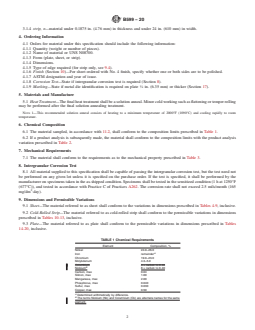
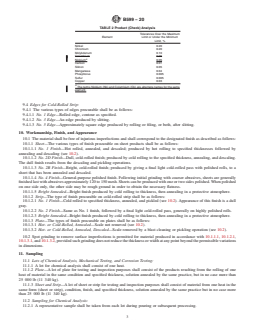
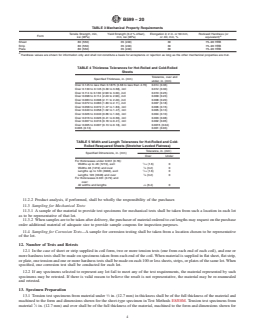
This specification covers nickel-iron-chromium-molybdenum-columbium stabilized alloy (UNS N08700) plate, sheet, and strip in the solution-annealed condition. Minor cold working such as flattening or temper rolling may be performed after the final solution annealing treatment. The material shall conform to the chemical requirements for nickel, iron, chromium, molybdenum, columbium, carbon, silicon, manganese, phosphorus, sulfur, and copper. The material shall conform to the mechanical property requirements for tensile strength, yield strength, elongation, and Rockwell hardness. The material shall be free of injurious imperfections and shall correspond to the designated finish for sheet, strip, and plate. Test methods (chemical analysis, tension test, corrosion test) for chemical composition and mechanical properties determination shall be performed in accordance to referenced ASTM documents itemized herein.
SCOPE
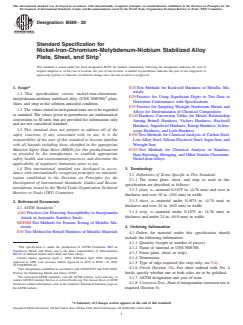
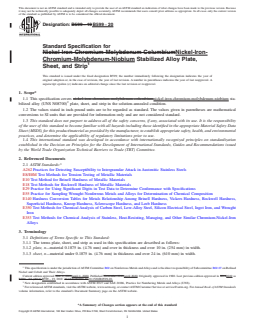
1.1 This specification covers nickel-iron-chromium-molybdenum-niobium stabilized alloy (UNS N08700)2 plate, sheet, and strip in the solution-annealed condition.
1.2 The values stated in inch-pound units are to be regarded as standard. The values given in parentheses are mathematical conversions to SI units that are provided for information only and are not considered standard.
1.3 This standard does not purport to address all of the safety concerns, if any, associated with its use. It is the responsibility of the user of this standard to become familiar with all hazards including those identified in the appropriate Material Safety Data Sheet (MSDS) for this product/material as provided by the manufacturer, to establish appropriate safety, health, and environmental practices, and determine the applicability of regulatory limitations prior to use.
1.4 This international standard was developed in accordance with internationally recognized principles on standardization established in the Decision on Principles for the Development of International Standards, Guides and Recommendations issued by the World Trade Organization Technical Barriers to Trade (TBT) Committee.
- Status
- Published
- Publication Date
- 31-Mar-2020
- Technical Committee
- B02 - Nonferrous Metals and Alloys
- Drafting Committee
- B02.07 - Refined Nickel and Cobalt and Their Alloys
Buy Documents
ASTM B599-20 - Standard Specification for Nickel-Iron-Chromium-Molybdenum-Niobium Stabilized Alloy Plate, Sheet, and Strip
REDLINE ASTM B599-20 - Standard Specification for Nickel-Iron-Chromium-Molybdenum-Niobium Stabilized Alloy Plate, Sheet, and Strip
Overview
ASTM B599-20: Standard Specification for Nickel-Iron-Chromium-Molybdenum-Niobium Stabilized Alloy Plate, Sheet, and Strip sets the comprehensive requirements for nickel-iron-chromium-molybdenum-niobium alloy (UNS N08700) flat products in the solution-annealed condition. These high-performance materials are commonly used where a combination of corrosion resistance, high strength, and durability is essential, especially in demanding industrial environments. The specification covers chemical composition, mechanical properties, permissible dimensions, finishing options, and appropriate test methods to ensure consistent quality and performance.
Key Topics
Material Scope: The standard applies to plate (≥0.1875 in. or 4.76 mm thick), sheet (<0.1875 in. thick and ≥24 in. wide), and strip (<0.1875 in. thick and <24 in. wide), all supplied in a solution-annealed state. Minor cold working following solution annealing, such as flattening or temper rolling, is permitted.
Chemical Composition: Ensures precise limits for nickel, iron (balance), chromium, molybdenum, niobium (or columbium - both names are acceptable), carbon, silicon, manganese, phosphorus, sulfur, and copper content to guarantee intended alloy performance.
Mechanical Properties: Includes requirements for tensile strength, yield strength, elongation, and Rockwell hardness, offering reliable mechanical resilience for engineering applications.
Surface Finish Types:
- For sheet: No. 1, No. 2D, No. 2B, No. 4, and Bright Annealed finishes.
- For strip: No. 1, No. 2, and Bright Annealed finishes.
- For plate: Hot or cold rolled, with various options for annealing and descaling.
- Specific finish should be designated when ordering.
Dimensional Tolerances: Specifies rigorous limits for thickness, width, length, flatness, camber, and weight, facilitating compatibility in manufacturing and installation.
Testing and Quality: Mandates mechanical and chemical tests using referenced ASTM protocols, with optional intergranular corrosion tests to ensure long-term service in corrosive conditions. Each batch must meet all requirements and include manufacturer certification.
Applications
ASTM B599-20 alloy materials are vital in industries requiring reliable corrosion resistance and strength at elevated temperatures. Typical applications include:
- Chemical processing equipment: Tanks, heat exchangers, piping, and reactors that must withstand corrosive chemicals.
- Petrochemical and refining plants: Components exposed to aggressive media and high temperatures.
- Power generation: Steam generator parts, turbine components, and high-stress environments.
- Aerospace and marine: Structural elements and exhaust components requiring durability under stress and corrosive conditions.
- Pharmaceutical manufacturing: Equipment needing cleanability and resistance to process chemicals.
Product forms (plate, sheet, strip) specified in this standard are easily fabricated, welded, and integrated into complex assemblies. The range of available finishes supports diverse applications, from heavy industrial to aesthetically demanding settings.
Related Standards
For full compliance, ASTM B599-20 references several related ASTM standards, including:
- ASTM A262: Detecting susceptibility to intergranular attack in austenitic stainless steels
- ASTM E8/E8M: Tension testing of metallic materials
- ASTM E10 & E18: Brinell and Rockwell hardness testing of metals
- ASTM E29: Practice for significant digits in test data
- ASTM E140: Hardness conversion tables
- ASTM E350 & E353: Chemical analysis of steels and nickel alloys
- ASTM E55: Sampling wrought nonferrous metals and alloys
These references underscore the standard’s role in the broader landscape of nickel alloys, high-performance materials, and quality assurance for industrial applications.
Keywords: ASTM B599-20, nickel-iron-chromium-molybdenum-niobium alloy, UNS N08700, alloy plate, sheet, strip, corrosion-resistant alloy, ASTM standards, mechanical properties, industrial materials, metal testing.
Relations
- Effective Date
- 01-Apr-2020
- Effective Date
- 01-Jan-2024
- Effective Date
- 15-Nov-2023
- Effective Date
- 01-Jul-2018
- Effective Date
- 01-Jul-2017
- Effective Date
- 15-Jul-2016
- Effective Date
- 01-Feb-2015
- Effective Date
- 15-Sep-2014
- Effective Date
- 01-May-2014
- Effective Date
- 01-Jun-2013
- Effective Date
- 01-May-2013
- Effective Date
- 01-Dec-2012
- Effective Date
- 01-Jan-2012
- Effective Date
- 01-Dec-2011
- Effective Date
- 01-Nov-2011
Buy Documents
ASTM B599-20 - Standard Specification for Nickel-Iron-Chromium-Molybdenum-Niobium Stabilized Alloy Plate, Sheet, and Strip
REDLINE ASTM B599-20 - Standard Specification for Nickel-Iron-Chromium-Molybdenum-Niobium Stabilized Alloy Plate, Sheet, and Strip
Get Certified
Connect with accredited certification bodies for this standard

Element Materials Technology
Materials testing and product certification.

Inštitut za kovinske materiale in tehnologije
Institute of Metals and Technology. Materials testing, metallurgical analysis, NDT.
Sponsored listings
Frequently Asked Questions
ASTM B599-20 is a technical specification published by ASTM International. Its full title is "Standard Specification for Nickel-Iron-Chromium-Molybdenum-Niobium Stabilized Alloy Plate, Sheet, and Strip". This standard covers: ABSTRACT This specification covers nickel-iron-chromium-molybdenum-columbium stabilized alloy (UNS N08700) plate, sheet, and strip in the solution-annealed condition. Minor cold working such as flattening or temper rolling may be performed after the final solution annealing treatment. The material shall conform to the chemical requirements for nickel, iron, chromium, molybdenum, columbium, carbon, silicon, manganese, phosphorus, sulfur, and copper. The material shall conform to the mechanical property requirements for tensile strength, yield strength, elongation, and Rockwell hardness. The material shall be free of injurious imperfections and shall correspond to the designated finish for sheet, strip, and plate. Test methods (chemical analysis, tension test, corrosion test) for chemical composition and mechanical properties determination shall be performed in accordance to referenced ASTM documents itemized herein. SCOPE 1.1 This specification covers nickel-iron-chromium-molybdenum-niobium stabilized alloy (UNS N08700)2 plate, sheet, and strip in the solution-annealed condition. 1.2 The values stated in inch-pound units are to be regarded as standard. The values given in parentheses are mathematical conversions to SI units that are provided for information only and are not considered standard. 1.3 This standard does not purport to address all of the safety concerns, if any, associated with its use. It is the responsibility of the user of this standard to become familiar with all hazards including those identified in the appropriate Material Safety Data Sheet (MSDS) for this product/material as provided by the manufacturer, to establish appropriate safety, health, and environmental practices, and determine the applicability of regulatory limitations prior to use. 1.4 This international standard was developed in accordance with internationally recognized principles on standardization established in the Decision on Principles for the Development of International Standards, Guides and Recommendations issued by the World Trade Organization Technical Barriers to Trade (TBT) Committee.
ABSTRACT This specification covers nickel-iron-chromium-molybdenum-columbium stabilized alloy (UNS N08700) plate, sheet, and strip in the solution-annealed condition. Minor cold working such as flattening or temper rolling may be performed after the final solution annealing treatment. The material shall conform to the chemical requirements for nickel, iron, chromium, molybdenum, columbium, carbon, silicon, manganese, phosphorus, sulfur, and copper. The material shall conform to the mechanical property requirements for tensile strength, yield strength, elongation, and Rockwell hardness. The material shall be free of injurious imperfections and shall correspond to the designated finish for sheet, strip, and plate. Test methods (chemical analysis, tension test, corrosion test) for chemical composition and mechanical properties determination shall be performed in accordance to referenced ASTM documents itemized herein. SCOPE 1.1 This specification covers nickel-iron-chromium-molybdenum-niobium stabilized alloy (UNS N08700)2 plate, sheet, and strip in the solution-annealed condition. 1.2 The values stated in inch-pound units are to be regarded as standard. The values given in parentheses are mathematical conversions to SI units that are provided for information only and are not considered standard. 1.3 This standard does not purport to address all of the safety concerns, if any, associated with its use. It is the responsibility of the user of this standard to become familiar with all hazards including those identified in the appropriate Material Safety Data Sheet (MSDS) for this product/material as provided by the manufacturer, to establish appropriate safety, health, and environmental practices, and determine the applicability of regulatory limitations prior to use. 1.4 This international standard was developed in accordance with internationally recognized principles on standardization established in the Decision on Principles for the Development of International Standards, Guides and Recommendations issued by the World Trade Organization Technical Barriers to Trade (TBT) Committee.
ASTM B599-20 is classified under the following ICS (International Classification for Standards) categories: 77.150.40 - Nickel and chromium products. The ICS classification helps identify the subject area and facilitates finding related standards.
ASTM B599-20 has the following relationships with other standards: It is inter standard links to ASTM B599-19, ASTM E8/E8M-24, ASTM E350-23, ASTM E18-18, ASTM E18-17, ASTM E8/E8M-16, ASTM E8/E8M-15, ASTM E353-14, ASTM E10-14, ASTM E8/E8M-13, ASTM A262-13, ASTM E18-12, ASTM E10-12, ASTM E8/E8M-11, ASTM E18-11. Understanding these relationships helps ensure you are using the most current and applicable version of the standard.
ASTM B599-20 is available in PDF format for immediate download after purchase. The document can be added to your cart and obtained through the secure checkout process. Digital delivery ensures instant access to the complete standard document.
Standards Content (Sample)
This international standard was developed in accordance with internationally recognized principles on standardization established in the Decision on Principles for the
Development of International Standards, Guides and Recommendations issued by the World Trade Organization Technical Barriers to Trade (TBT) Committee.
Designation:B599 −20
Standard Specification for
Nickel-Iron-Chromium-Molybdenum-Niobium Stabilized Alloy
Plate, Sheet, and Strip
This standard is issued under the fixed designation B599; the number immediately following the designation indicates the year of
original adoption or, in the case of revision, the year of last revision. A number in parentheses indicates the year of last reapproval. A
superscript epsilon (´) indicates an editorial change since the last revision or reapproval.
1. Scope* E18 Test Methods for Rockwell Hardness of Metallic Ma-
terials
1.1 This specification covers nickel-iron-chromium-
2 E29 Practice for Using Significant Digits in Test Data to
molybdenum-niobium stabilized alloy (UNS N08700) plate,
Determine Conformance with Specifications
sheet, and strip in the solution-annealed condition.
E55 Practice for Sampling Wrought Nonferrous Metals and
1.2 The values stated in inch-pound units are to be regarded
Alloys for Determination of Chemical Composition
as standard. The values given in parentheses are mathematical
E140 Hardness Conversion Tables for Metals Relationship
conversions to SI units that are provided for information only
Among Brinell Hardness, Vickers Hardness, Rockwell
and are not considered standard.
Hardness, Superficial Hardness, Knoop Hardness, Sclero-
1.3 This standard does not purport to address all of the scope Hardness, and Leeb Hardness
safety concerns, if any, associated with its use. It is the
E350 Test Methods for Chemical Analysis of Carbon Steel,
responsibility of the user of this standard to become familiar Low-Alloy Steel, Silicon Electrical Steel, Ingot Iron, and
with all hazards including those identified in the appropriate
Wrought Iron
Material Safety Data Sheet (MSDS) for this product/material E353 Test Methods for Chemical Analysis of Stainless,
as provided by the manufacturer, to establish appropriate
Heat-Resisting, Maraging, and Other Similar Chromium-
safety, health, and environmental practices, and determine the Nickel-Iron Alloys
applicability of regulatory limitations prior to use.
1.4 This international standard was developed in accor-
3. Terminology
dance with internationally recognized principles on standard-
3.1 Definitions of Terms Specific to This Standard:
ization established in the Decision on Principles for the
3.1.1 The terms plate, sheet, and strip as used in this
Development of International Standards, Guides and Recom-
specification are described as follows:
mendations issued by the World Trade Organization Technical
3.1.2 plate, n—material 0.1875 in. (4.76 mm) and over in
Barriers to Trade (TBT) Committee.
thickness and over 10 in. (254 mm) in width.
3.1.3 sheet, n—material under 0.1875 in. (4.76 mm) in
2. Referenced Documents
thickness and over 24 in. (610 mm) in width.
2.1 ASTM Standards:
3.1.4 strip, n—material under 0.1875 in. (4.76 mm) in
A262 Practices for Detecting Susceptibility to Intergranular
thickness and under 24 in. (610 mm) in width.
Attack in Austenitic Stainless Steels
E8/E8M Test Methods for Tension Testing of Metallic Ma-
4. Ordering Information
terials
E10 Test Method for Brinell Hardness of Metallic Materials
4.1 Orders for material under this specification should
include the following information:
4.1.1 Quantity (weight or number of pieces).
This specification is under the jurisdiction of ASTM Committee B02 on
4.1.2 Name of material or UNS N08700.
Nonferrous Metals and Alloys and is the direct responsibility of Subcommittee
4.1.3 Form (plate, sheet, or strip).
B02.07 on Refined Nickel and Cobalt and Their Alloys.
Current edition approved April 1, 2020. Published April 2020. Originally
4.1.4 Dimensions.
approved in 1980. Last previous edition approved in 2019 as B599 – 19. DOI:
4.1.5 Type of edge required (for strip only, see 9.4).
10.1520/B0599-20.
2 4.1.6 Finish (Section 10)—For sheet ordered with No. 4
New designation established in accordance with ASTM E527 and SAE J1086,
Practice for Numbering Metals and Alloys (UNS).
finish, specify whether one or both sides are to be polished.
For referenced ASTM standards, visit the ASTM website, www.astm.org, or
4.1.7 ASTM designation and year of issue.
contact ASTM Customer Service at service@astm.org. For Annual Book of ASTM
4.1.8 Corrosion Test—State if intergranular corrosion test is
Standards volume information, refer to the standard’s Document Summary page on
theASTM website. required (Section 8).
*A Summary of Changes section appears at the end of this standard
Copyright © ASTM International, 100 Barr Harbor Drive, PO Box C700, West Conshohocken, PA 19428-2959. United States
B599−20
TABLE 1 Chemical Requirements
7. Mechanical Requirements
Element Composition, %
7.1 The material shall conform to the requirements as to the
Nickel 24.0–26.0
mechanical property prescribed in Table 3.
A
Iron remainder
Chromium 19.0–23.0
Molybdenum 4.3–5.0
8. Intergranular Corrosion Test
B
Niobium 8 × carbon to 0.40
Carbon, max 0.04
8.1 All material supplied to this specification shall be
Silicon, max 1.00
capable of passing the intergranular corrosion test, but the test
Manganese, max 2.00
need not be performed on any given lot unless it is specified on
Phosphorus, max 0.040
Sulfur, max 0.030
the purchase order. If the test is specified, it shall be performed
Copper, max 0.50
by the manufacturer on specimens taken in the as-shipped
A
Determined arithmetically by difference.
condition. Specimens shall be tested in the sensitized condition
B
The terms Niobium (Nb) and Columbium (Cb) are alternate names for the same
(1hat1250°F(677°C)),andtestedinaccordancewithPractice
element.
C of Practices A262. The corrosion rate shall not exceed 2.5
mils/month (165 mg/dm ·day).
TABLE 2 Product (Check) Analysis
Tolerances Over the Maximum 9. Dimensions and Permissible Variations
Element Limit or Under the Minimum
9.1 Sheet—The material referred to as sheet shall conform
Limit, %
to the variations in dimensions prescribed in Tables 4-9,
Nickel 0.20
Chromium 0.20
inclusive.
Molybdenum 0.10
A
Niobium 0.05
9.2 Cold-Rolled Strip—The material referred to as cold-
Carbon 0.01
rolled strip shall conform to the permissible variations in
Silicon 0.05
dimensions prescribed in Tables 10-13, inclusive.
Manganese 0.04
Phosphorus 0.005
9.3 Plate—The material referred to as plate shall conform to
Sulfur 0.005
Copper 0.03 the permissible variations in dimensions prescribed in Tables
A
14-20, inclusive.
The terms Niobium (Nb) and Columbium (Cb) are alternate names for the same
element.
9.4 Edges for Cold-Rolled Strip:
9.4.1 The various types of edges procurable shall be as
follows:
9.4.1.1 No. 1 Edge—Rolled edge, contour as specified.
4.1.9 Marking—State if metal die identification is required
on plate ⁄4 in. (6.35 mm) or thicker (Section 17). 9.4.1.2 No. 3 Edge—An edge produced by slitting.
9.4.1.3 No. 5 Edge—Approximately square edge produced
5. Materials and Manufacture
by rolling or filing, or both, after slitting.
5.1 Heat Treatment—The final heat treatment shall be a
10. Workmanship, Finish, and Appearance
solution anneal. Minor cold working such as flattening or
temper rolling may be performed after the final solution
10.1 The material shall be free of injurious imperfections
annealing treatment.
and shall correspond to the designated finish as described as
follows:
NOTE 1—This recommended solution anneal consists of heating to a
minimum temperature of 2000°F (1090°C) and cooling rapidly to room
10.1.1 Sheet—The various types of finish procurable on
temperature.
sheet products shall be as follows:
10.1.1.1 No. 1 Finish—Hot rolled, annealed, and descaled;
6. Chemical Composition
produced by hot rolling to specified thicknesses followed by
6.1 The material sampled, in accordance with 11.2, shall
annealing and descaling (see 10.2).
conform to the composition limits prescribed in Table 1.
10.1.1.2 No. 2D Finish—Dull, cold-rolled finish; produced
6.2 If a product analysis is subsequently made, the material by cold rolling to the specified thickness, annealing, and
shall conform to the composition limits with the product descaling. The dull finish results from the descaling and
analysis variation prescribed in Table 2. pickling operations.
TABLE 3 Mechanical Property Requirements
Tensile Strength, min, Yield Strength (0.2 % offset), Elongation in 2 in. or 50 mm, Rockwell Hardness (or
Form
A
ksi (MPa) min, ksi (MPa) or 4D, min, % equivalent)
Sheet 80 (550) 35 (240) 30 75–90 HRB
Strip 80 (550) 35 (240) 30 75–90 HRB
Plate 80 (550) 35 (240) 30 75–90 HRB
A
Hardness values are shown for information only and shall not constitute a basis for acceptance or rejection as long as the other mechanical properties are met.
B599−20
TABLE 4 Thickness Tolerances for Hot-Rolled and Cold-Rolled
10.1.1.5 Bright Annealed—Bright finish produced by cold
Sheets
rolling to thickness, then annealing in a protective atmosphere.
Tolerance, over and
10.1.2 Strip—The type of finish procurable on cold-rolled
Specified Thickness, in. (mm)
under, in. (mm)
strip shall be as follows:
Over 0.145 to less than 0.1875 (3.68 to less than 4.76) 0.014 (0.36)
10.1.2.1 No. 1 Finish—Cold rolled to specified thickness,
Over 0.130 to 0.145 (3.30 to 3.68), incl 0.012 (0.30)
Over 0.114 to 0.130 (2.90 to 3.30), incl 0.010 (0.25) annealed, and pickled (see 10.2).Appearance of this finish is a
Over 0.098 to 0.114 (2.49 to 2.90), incl 0.009 (0.23)
dull gray.
Over 0.083 to 0.098 (2.11 to 2.49), incl 0.008 (0.20)
10.1.2.2 No. 2 Finish—Same as No. 1 finish, followed by a
Over 0.072 to 0.083 (1.83 to 2.11), incl 0.007 (0.18)
final light cold-rolled pass, generally on highly polished rolls.
Over 0.058 to 0.072 (1.47 to 1.83), incl 0.006 (0.15)
Over 0.040 to 0.058 (1.02 to 1.47), incl 0.005 (0.13)
10.1.2.3 Bright Annealed—Bright finish produced by cold
Over 0.026 to 0.040 (0.66 to 1.02), incl 0.004 (0.10)
rolling to thickness, then annealing in a protective atmosphere.
Over 0.016 to 0.026 (0.41 to 0.66), incl 0.003 (0.08)
Over 0.007 to 0.016 (0.18 to 0.41), incl 0.002 (0.05) 10.1.3 Plate—The types of finish procurable on plates shall
Over 0.005 to 0.007 (0.13 to 0.18), incl 0.0015 (0.04)
be as follows:
0.005 (0.13) 0.001 (0.03)
10.1.3.1 Hot- or Cold-Rolled, Annealed—Scale not re-
moved (see 10.2).
10.1.3.2 Hot- or Cold-Rolled, Annealed, Descaled—Scale
TABLE 5 Width and Length Tolerances for Hot-Rolled and Cold-
removed by a blast cleaning or pickling operation (see 10.2).
Rolled Resquared Sheets (Stretcher Leveled Flatness)
Tolerance, in. (mm)
10.2 Spot grinding to remove surface imperfections is
Specified Dimensions, in. (mm)
Over Under
permitted for material produced in accordance with 10.1.1.1,
For thicknesses under 0.031 (0.79): 10.1.2.1, 10.1.3.1, and 10.1.3.2, provided such grinding does
Widths up to 48 (1219), excl ⁄16 (1.6) 0
not reduce the thickness or width at any point beyond the
Widths 48 (1219) and over ⁄8 (3.2) 0
1 permissible variations in dimensions.
Lengths up to 120 (3048), excl ⁄16 (1.6) 0
Lengths 120 (3048) and over ⁄8 (3.2) 0
For thicknesses 0.031 (0.79) and
11. Sampling
over:
All widths and lengths ⁄4 (6.4) 0
11.1 Lots of Chemical Analysis, Mechanical Testing, and
Corrosion Testing:
11.1.1 A lot for chemical analysis shall consist of one heat.
TABLE 6 Width, Length, and Camber Tolerances for Hot-Rolled
11.1.2 Plate—A lot of plate for testing and inspection
and Cold-Rolled Sheets Not Resquared
purposes shall consist of the products resulting from the rolling
Width Tolerances
of one heat of material in the same condition and specified
Tolerance for Specified Width,
thickness, solution annealed by the same practice, but in no
in. (mm)
Specified Thickness, in. (mm)
24 to 48 (610 to 48 (1219) and
case more than 25 000 lb (11 340 kg).
1219), excl Over
11.1.3 Sheet and Strip—Alotofsheetorstripfortestingand
3 1 1
Less than ⁄16 (4.76) ⁄16 (1.6) over, ⁄8 in. (3.2)
inspection purposes shall consist of material from one heat in
0 under over,
0 under
the same form (sheet or strip), condition, finish, and specified
Length Tolerances
thickness,solutionannealedbythesamepracticebutinnocase
Tolerance, in. (mm)
Specified Length, ft (mm)
more than 25 000 lb (11 340 kg).
Over Under
Up to 10 (3050), incl ⁄4 (6.4) 0 (0)
11.2 Sampling for Chemical Analysis:
Over 10 to 20 (3050 to 6100), incl ⁄2 (12.7) 0 (0)
A
Camber Tolerances 11.2.1 A representative sample shall be taken from each lot
Tolerance per Unit Length of any
during pouring or subsequent processing.
Specified Width, in. (mm) 8ft
11.2.2 Product analysis, if performed, shall be wholly the
(2440 mm), in. (mm)
24 to 36 (610 to 914), incl ⁄8 (3.2) responsibility of the purchaser.
Over 36 (914) ⁄32 (2.4)
11.3 Sampling for Mechanical Tests:
A
Camber is the greatest deviation of a side edge from a straight line, and
11.3.1 A sample of the material to provide test specimens
measurement is taken by placing an 8-ft (2440-mm) straightedge on the concave
side and measuring the greatest distance between the sheet edge and the
for mechanical tests shall be taken from such a location in each
straightedge.
lot as to be representative of that lot.
11.3.2 When samples are to be taken after delivery, the
purchaser of material ordered to cut lengths may request on the
purchase order additional material of adequate size to provide
10.1.1.3 No.2BFinish—Bright,cold-rolledfinish;produced
sample coupons for inspection purposes.
by giving a final light cold-rolled pass with polished rolls, to a
11.4 Sampling for Corrosion Tests—Asample for corrosion
sheet that has been annealed and descaled.
testing shall be taken from a location chosen to be representa-
10.1.1.4 No. 4 Finish—General-purpose polished finish.
tive of the lot.
Following initial grinding with coarser abrasives, sheets are
generallyfinishedlastwithabrasivesapproximately120to150
12. Number of Tests and Retests
mesh. Sheets can be produced with one or two sides polished.
When polished on one side only, the other side may be rough 12.1 In the case of sheet or strip supplied in coil form, two
ground in order to obtain the necessary flatness. or more tension tests (one from each end of each coil), and one
B599−20
TABLE 7 Flatness Tolerances for Hot-Rolled and Cold-Rolled Sheets
Sheets not Specified to Stretcher Leveled Standard of Flatness
Flatness Tolerance (max Deviation from a
Specified Thickness, in. (mm) Width, in. (mm)
Horizontal Flat Surface), in. (mm)
0.062 (1.57) and over to 60 (1524), incl ⁄2 (12.7)
over 60 to 72 (1524 to ⁄4 (19.1)
1829), incl
over 72 (1829) 1 (25.4)
Under 0.062 (1.57) to 36 (914), incl ⁄2 (12.7)
over 36 to 60 (914 to ⁄4 (19.1)
1524), incl
over 60 (1524) 1 (25.4)
Sheets Specified to Stretcher Level Standard of Flatness
Specified Thickness, in. (mm) Width, in. (mm) Length, in. (mm) Flatness Tolerance, in. (mm)
Under (4.76) to 48 (1219), incl to 96 (2438), incl ⁄8 (3.2)
3 1
Under ⁄16 (4.76) to 48 (1219), incl over 96 (2438) ⁄4 (6.4)
3 1
Under ⁄16 (4.76) over 48 (1219) to 96 (2438), incl ⁄4 (6.4)
3 1
Under ⁄16 (4.76) over 48 (1219) over 96 (2438) ⁄4 (6.4)
TABLE 8 Diameter Tolerances for Hot-Rolled and Cold-Rolled
sheet-type specimen in Test Methods E8/E8M. Tension test
Sheets, Sheared Circles
specimens from material ⁄2 in. (12.7 mm) and over shall be of
Tolerance Over Specified Diameter (No
the full thickness of the material, machined to the form and
Specified
Tolerance Under), in. (mm)
Thickness, in.
dimensions shown for the plate-type specimen inTest Methods
30 to 48 (762
(mm) Under 30 (762) Over 48 (1219)
E8/E8M,orshallbethelargestpossibleroundspecimenshown
to 1219), incl
1 3 1
Over 0.097 ⁄8 (3.2) ⁄16 (4.8) ⁄4 (6.4)
in Test Methods E8/E8M. Tension test specimens shall be
(2.46)
taken from material after final heat treatment and shall be
3 5 7
Over 0.057 to ⁄32 (2.4) ⁄32 (4.0) ⁄32 (5.6)
selected in the transverse direction unless prohibited by width.
0.097 (1.45 to
2.46), incl
1 1 3 13.2 Corrosion test specimens shall be prepared so that at
0.057 (1.45) and ⁄16 (1.6) ⁄8 (3.2) ⁄16 (4.8)
under
least one major surface represents the as-supplied surface, with
only light surface grinding permitted on this surface.
TABLE 9 Weight Tolerances for Hot-Rolled and Cold-Rolled
14. Test Methods
Sheets
14.1 Determine the chemical composition and properties of
It is not practicable to produce hot-rolled and cold-rolled sheets to exact
the material as enumerated in this specification, in case of
theoretical weight. Sheets of any one item of a specified thickness and size in
any finish may be overweight to the following extent: disagreement, in accordance with the following methods:
(1) An item of five sheets or less, or an item estimated to weight 200 lb (90.7
Test ASTM Designations
kg) or less, may actually weigh as much as 10 % over the theoretical weight.
A,B
Chemical analysis E350, E353
(2) An item of more than five sheets and estimated to weigh more than 200
Tension E8/E8M
lb (90.7 kg) may actually weigh as much as 7 ⁄2 % over the theoretical weight.
Brinell hardness E10
(3) The underweight variations for sheets are limited by the under thickness
Rockwell hardness E18
tolerances shown in Table 4.
2 2 Hardness conversion E140
For determining theoretical weight the factor, 42 lb/ft ·in. (0.0008 kg/cm ·mm)
Rounding procedure E29
thickness may be used.
Method of sampling for product analysis E55
Intergranular corrosion test A262, Practice C
A
Iron shall be determined arithmetically by difference.
B
Test Methods E350 are to be used only for elements not covered by Test
or more hardness tests shall be made on specimens taken from
Methods E353.
eachendofthecoil.Whenmaterialissuppliedinflatsheet,flat
14.2 For purpose of determining compliance with the limits
strip, or plate, one tension and one or more hardness tests shall
bemadeoneach100orlesssheets,strips,orplatesofthesame in this specification, an observed value or a calculated value
shall be rounded as indicated in accordance with the rounding
lot. When specified, one corrosion
...
This document is not an ASTM standard and is intended only to provide the user of an ASTM standard an indication of what changes have been made to the previous version. Because
it may not be technically possible to adequately depict all changes accurately, ASTM recommends that users consult prior editions as appropriate. In all cases only the current version
of the standard as published by ASTM is to be considered the official document.
Designation: B599 − 19 B599 − 20
Standard Specification for
Nickel-Iron-Chromium-Molybdenum-ColumbiumNickel-Iron-
Chromium-Molybdenum-Niobium Stabilized Alloy Plate,
Sheet, and Strip
This standard is issued under the fixed designation B599; the number immediately following the designation indicates the year of
original adoption or, in the case of revision, the year of last revision. A number in parentheses indicates the year of last reapproval. A
superscript epsilon (´) indicates an editorial change since the last revision or reapproval.
1. Scope*
1.1 This specification covers nickel-iron-chromium-molybdenum-columbiumnickel-iron-chromium-molybdenum-niobium sta-
bilized alloy (UNS N08700) plate, sheet, and strip in the solution-annealed condition.
1.2 The values stated in inch-pound units are to be regarded as standard. The values given in parentheses are mathematical
conversions to SI units that are provided for information only and are not considered standard.
1.3 This standard does not purport to address all of the safety concerns, if any, associated with its use. It is the responsibility
of the user of this standard to become familiar with all hazards including those identified in the appropriate Material Safety Data
Sheet (MSDS) for this product/material as provided by the manufacturer, to establish appropriate safety, health, and environmental
practices, and determine the applicability of regulatory limitations prior to use.
1.4 This international standard was developed in accordance with internationally recognized principles on standardization
established in the Decision on Principles for the Development of International Standards, Guides and Recommendations issued
by the World Trade Organization Technical Barriers to Trade (TBT) Committee.
2. Referenced Documents
2.1 ASTM Standards:
A262 Practices for Detecting Susceptibility to Intergranular Attack in Austenitic Stainless Steels
E8/E8M Test Methods for Tension Testing of Metallic Materials
E10 Test Method for Brinell Hardness of Metallic Materials
E18 Test Methods for Rockwell Hardness of Metallic Materials
E29 Practice for Using Significant Digits in Test Data to Determine Conformance with Specifications
E55 Practice for Sampling Wrought Nonferrous Metals and Alloys for Determination of Chemical Composition
E140 Hardness Conversion Tables for Metals Relationship Among Brinell Hardness, Vickers Hardness, Rockwell Hardness,
Superficial Hardness, Knoop Hardness, Scleroscope Hardness, and Leeb Hardness
E350 Test Methods for Chemical Analysis of Carbon Steel, Low-Alloy Steel, Silicon Electrical Steel, Ingot Iron, and Wrought
Iron
E353 Test Methods for Chemical Analysis of Stainless, Heat-Resisting, Maraging, and Other Similar Chromium-Nickel-Iron
Alloys
3. Terminology
3.1 Definitions of Terms Specific to This Standard:
3.1.1 The terms plate, sheet, and strip as used in this specification are described as follows:
3.1.2 plate, n—material 0.1875 in. (4.76 mm) and over in thickness and over 10 in. (254 mm) in width.
3.1.3 sheet, n—material under 0.1875 in. (4.76 mm) in thickness and over 24 in. (610 mm) in width.
This specification is under the jurisdiction of ASTM Committee B02 on Nonferrous Metals and Alloys and is the direct responsibility of Subcommittee B02.07 on Refined
Nickel and Cobalt and Their Alloys.
Current edition approved Nov. 1, 2019April 1, 2020. Published November 2019April 2020. Originally approved in 1980. Last previous edition approved in 20142019 as
B599 – 92 (2014).B599 – 19. DOI: 10.1520/B0599-19.10.1520/B0599-20.
New designation established in accordance with ASTM E527 and SAE J1086, Practice for Numbering Metals and Alloys (UNS).
For referenced ASTM standards, visit the ASTM website, www.astm.org, or contact ASTM Customer Service at service@astm.org. For Annual Book of ASTM Standards
volume information, refer to the standard’s Document Summary page on the ASTM website.
*A Summary of Changes section appears at the end of this standard
Copyright © ASTM International, 100 Barr Harbor Drive, PO Box C700, West Conshohocken, PA 19428-2959. United States
B599 − 20
3.1.4 strip, n—material under 0.1875 in. (4.76 mm) in thickness and under 24 in. (610 mm) in width.
4. Ordering Information
4.1 Orders for material under this specification should include the following information:
4.1.1 Quantity (weight or number of pieces).
4.1.2 Name of material or UNS N08700.
4.1.3 Form (plate, sheet, or strip).
4.1.4 Dimensions.
4.1.5 Type of edge required (for strip only, see 9.4).
4.1.6 Finish (Section 10)—For sheet ordered with No. 4 finish, specify whether one or both sides are to be polished.
4.1.7 ASTM designation and year of issue.
4.1.8 Corrosion Test—State if intergranular corrosion test is required (Section 8).
4.1.9 Marking—State if metal die identification is required on plate ⁄4 in. (6.35 mm) or thicker (Section 17).
5. Materials and Manufacture
5.1 Heat Treatment—The final heat treatment shall be a solution anneal. Minor cold working such as flattening or temper rolling
may be performed after the final solution annealing treatment.
NOTE 1—This recommended solution anneal consists of heating to a minimum temperature of 2000°F (1090°C) and cooling rapidly to room
temperature.
6. Chemical Composition
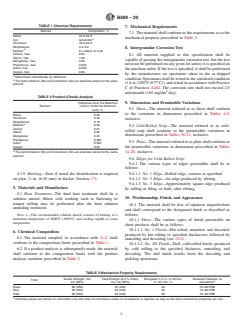
6.1 The material sampled, in accordance with 11.2, shall conform to the composition limits prescribed in Table 1.
6.2 If a product analysis is subsequently made, the material shall conform to the composition limits with the product analysis
variation prescribed in Table 2.
7. Mechanical Requirements
7.1 The material shall conform to the requirements as to the mechanical property prescribed in Table 3.
8. Intergranular Corrosion Test
8.1 All material supplied to this specification shall be capable of passing the intergranular corrosion test, but the test need not
be performed on any given lot unless it is specified on the purchase order. If the test is specified, it shall be performed by the
manufacturer on specimens taken in the as-shipped condition. Specimens shall be tested in the sensitized condition (1 h at 1250°F
(677°C)), and tested in accordance with Practice C of Practices A262. The corrosion rate shall not exceed 2.5 mils/month (165
mg/dm ·day).
9. Dimensions and Permissible Variations
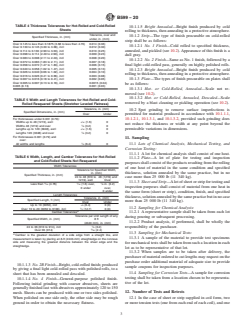
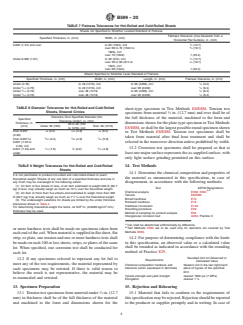
9.1 Sheet—The material referred to as sheet shall conform to the variations in dimensions prescribed in Tables 4-9, inclusive.
9.2 Cold-Rolled Strip—The material referred to as cold-rolled strip shall conform to the permissible variations in dimensions
prescribed in Tables 10-13, inclusive.
9.3 Plate—The material referred to as plate shall conform to the permissible variations in dimensions prescribed in Tables
14-20, inclusive.
TABLE 1 Chemical Requirements
Element Composition, %
Nickel 24.0–26.0
A
Iron remainder
Chromium 19.0–23.0
Molybdenum 4.3–5.0
Columbium 8 × carbon to 0.40
B
Niobium 8 × carbon to 0.40
Carbon, max 0.04
Silicon, max 1.00
Manganese, max 2.00
Phosphorus, max 0.040
Sulfur, max 0.030
Copper, max 0.50
A
Determined arithmetically by difference.
B
The terms Niobium (Nb) and Columbium (Cb) are alternate names for the same
element.
B599 − 20
TABLE 2 Product (Check) Analysis
Tolerances Over the Maximum
Element Limit or Under the Minimum
Limit, %
Nickel 0.20
Chromium 0.20
Molybdenum 0.10
Columbium 0.05
A
Niobium 0.05
Carbon 0.01
Silicon 0.05
Manganese 0.04
Phosphorus 0.005
Sulfur 0.005
Copper 0.03
A
The terms Niobium (Nb) and Columbium (Cb) are alternate names for the same
element.
9.4 Edges for Cold-Rolled Strip:
9.4.1 The various types of edges procurable shall be as follows:
9.4.1.1 No. 1 Edge—Rolled edge, contour as specified.
9.4.1.2 No. 3 Edge—An edge produced by slitting.
9.4.1.3 No. 5 Edge—Approximately square edge produced by rolling or filing, or both, after slitting.
10. Workmanship, Finish, and Appearance
10.1 The material shall be free of injurious imperfections and shall correspond to the designated finish as described as follows:
10.1.1 Sheet—The various types of finish procurable on sheet products shall be as follows:
10.1.1.1 No. 1 Finish—Hot rolled, annealed, and descaled; produced by hot rolling to specified thicknesses followed by
annealing and descaling (see 10.2).
10.1.1.2 No. 2D Finish—Dull, cold-rolled finish; produced by cold rolling to the specified thickness, annealing, and descaling.
The dull finish results from the descaling and pickling operations.
10.1.1.3 No. 2B Finish—Bright, cold-rolled finish; produced by giving a final light cold-rolled pass with polished rolls, to a
sheet that has been annealed and descaled.
10.1.1.4 No. 4 Finish—General-purpose polished finish. Following initial grinding with coarser abrasives, sheets are generally
finished last with abrasives approximately 120 to 150 mesh. Sheets can be produced with one or two sides polished. When polished
on one side only, the other side may be rough ground in order to obtain the necessary flatness.
10.1.1.5 Bright Annealed—Bright finish produced by cold rolling to thickness, then annealing in a protective atmosphere.
10.1.2 Strip—The type of finish procurable on cold-rolled strip shall be as follows:
10.1.2.1 No. 1 Finish—Cold rolled to specified thickness, annealed, and pickled (see 10.2). Appearance of this finish is a dull
gray.
10.1.2.2 No. 2 Finish—Same as No. 1 finish, followed by a final light cold-rolled pass, generally on highly polished rolls.
10.1.2.3 Bright Annealed—Bright finish produced by cold rolling to thickness, then annealing in a protective atmosphere.
10.1.3 Plate—The types of finish procurable on plates shall be as follows:
10.1.3.1 Hot- or Cold-Rolled, Annealed—Scale not removed (see 10.2).
10.1.3.2 Hot- or Cold-Rolled, Annealed, Descaled—Scale removed by a blast cleaning or pickling operation (see 10.2).
10.2 Spot grinding to remove surface imperfections is permitted for material produced in accordance with 10.1.1.1, 10.1.2.1,
10.1.3.1, and 10.1.3.2, provided such grinding does not reduce the thickness or width at any point beyond the permissible variations
in dimensions.
11. Sampling
11.1 Lots of Chemical Analysis, Mechanical Testing, and Corrosion Testing:
11.1.1 A lot for chemical analysis shall consist of one heat.
11.1.2 Plate—A lot of plate for testing and inspection purposes shall consist of the products resulting from the rolling of one
heat of material in the same condition and specified thickness, solution annealed by the same practice, but in no case more than
25 000 lb (11 340 kg).
11.1.3 Sheet and Strip—A lot of sheet or strip for testing and inspection purposes shall consist of material from one heat in the
same form (sheet or strip), condition, finish, and specified thickness, solution annealed by the same practice but in no case more
than 25 000 lb (11 340 kg).
11.2 Sampling for Chemical Analysis:
11.2.1 A representative sample shall be taken from each lot during pouring or subsequent processing.
B599 − 20
TABLE 3 Mechanical Property Requirements
Tensile Strength, min, Yield Strength (0.2 % offset), Elongation in 2 in. or 50 mm, Rockwell Hardness (or
Form
A
ksi (MPa) min, ksi (MPa) or 4D, min, % equivalent)
Sheet 80 (550) 35 (240) 30 75–90 HRB
Strip 80 (550) 35 (240) 30 75–90 HRB
Plate 80 (550) 35 (240) 30 75–90 HRB
A
Hardness values are shown for information only and shall not constitute a basis for acceptance or rejection as long as the other mechanical properties are met.
TABLE 4 Thickness Tolerances for Hot-Rolled and Cold-Rolled
Sheets
Tolerance, over and
Specified Thickness, in. (mm)
under, in. (mm)
Over 0.145 to less than 0.1875 (3.68 to less than 4.76) 0.014 (0.36)
Over 0.130 to 0.145 (3.30 to 3.68), incl 0.012 (0.30)
Over 0.114 to 0.130 (2.90 to 3.30), incl 0.010 (0.25)
Over 0.098 to 0.114 (2.49 to 2.90), incl 0.009 (0.23)
Over 0.083 to 0.098 (2.11 to 2.49), incl 0.008 (0.20)
Over 0.072 to 0.083 (1.83 to 2.11), incl 0.007 (0.18)
Over 0.058 to 0.072 (1.47 to 1.83), incl 0.006 (0.15)
Over 0.040 to 0.058 (1.02 to 1.47), incl 0.005 (0.13)
Over 0.026 to 0.040 (0.66 to 1.02), incl 0.004 (0.10)
Over 0.016 to 0.026 (0.41 to 0.66), incl 0.003 (0.08)
Over 0.007 to 0.016 (0.18 to 0.41), incl 0.002 (0.05)
Over 0.005 to 0.007 (0.13 to 0.18), incl 0.0015 (0.04)
0.005 (0.13) 0.001 (0.03)
TABLE 5 Width and Length Tolerances for Hot-Rolled and Cold-
Rolled Resquared Sheets (Stretcher Leveled Flatness)
Tolerance, in. (mm)
Specified Dimensions, in. (mm)
Over Under
For thicknesses under 0.031 (0.79):
Widths up to 48 (1219), excl ⁄16 (1.6) 0
Widths 48 (1219) and over ⁄8 (3.2) 0
Lengths up to 120 (3048), excl ⁄16 (1.6) 0
Lengths 120 (3048) and over ⁄8 (3.2) 0
For thicknesses 0.031 (0.79) and
over:
All widths and lengths ⁄4 (6.4) 0
11.2.2 Product analysis, if performed, shall be wholly the responsibility of the purchaser.
11.3 Sampling for Mechanical Tests:
11.3.1 A sample of the material to provide test specimens for mechanical tests shall be taken from such a location in each lot
as to be representative of that lot.
11.3.2 When samples are to be taken after delivery, the purchaser of material ordered to cut lengths may request on the purchase
order additional material of adequate size to provide sample coupons for inspection purposes.
11.4 Sampling for Corrosion Tests—A sample for corrosion testing shall be taken from a location chosen to be representative
of the lot.
12. Number of Tests and Retests
12.1 In the case of sheet or strip supplied in coil form, two or more tension tests (one from each end of each coil), and one or
more hardness tests shall be made on specimens taken from each end of the coil. When material is supplied in flat sheet, flat strip,
or plate, one tension and one or more hardness tests shall be made on each 100 or less sheets, strips, or plates of the same lot. When
specified, one corrosion test shall be conducted for each lot.
12.2 If any specimens selected to represent any lot fail to meet any of the test requirements, the material represented by such
specimens may be retested. If there is valid reason to believe the result is not representative, the material may be re-reannealed
and retested.
13. Specimen Preparation
13.1 Tension test specimens from material under ⁄2 in. (12.7 mm) in thickness shall be of the full thickness of the material and
machined to the form and dimensions shown for the sheet-type specimen in Test Methods E8/E8M. Tension test specimens from
material ⁄2 in. (12.7 mm) and over shall be of the full thickness of the material, machined to the form and dimensions shown for
B599 − 20
TABLE 6 Width, Length, and Camber Tolerances for Hot-Rolled
and Cold-Rolled Sheets Not Resquared
Width Tolerances
Tolerance for Specified Width,
in. (mm)
Specified Thickness, in. (mm)
24 to 48 (610 to 48 (1219) and
1219), excl Over
3 1 1
Less than ⁄16 (4.76) ⁄16 (1.6) over, ⁄8 in. (3.2)
0 under over,
0 under
Length Tolerances
Tolerance, in. (mm)
Specified Length, ft (mm)
Over Under
Up to 10 (3050), incl ⁄4 (6.4) 0 (0)
Over 10 to 20 (3050 to 6100), incl ⁄2 (12.7) 0 (0)
A
Camber Tolerances
Tolerance per Unit Length of any
Specified Width, in. (mm) 8 ft
(2440 mm), in. (mm)
24 to 36 (610 to 914), incl ⁄8 (3.2)
Over 36 (914) ⁄32 (2.4)
A
Camber is the greatest deviation of a side edge from a straight line, and
measurement is taken by placing an 8-ft (2440-mm) straightedge on the concave
side and measuring the greatest distance between the sheet edge and the
straightedge.
the plate-type specimen in Test Methods E8/E8M, or shall be the largest possible round specimen shown in Test Methods E8/E8M.
Tension test specimens shall be taken from material after final heat treatment and shall be selected in the transverse direction unless
prohibited by width.
13.2 Corrosion test specimens shall be prepared so that at least one major surface represents the as-supplied surface, with only
light surface grinding permitted on this surface.
14. Test Methods
14.1 Determine the chemical composition and properties of the material as enumerated in this specification, in case of
disagreement, in accordance with the following methods:
Test ASTM Designations
A,B
Chemical analysis E350, E353
Tension E8/E8M
Brinell hardness E10
Rockwell hardness E18
Hardness conversion E140
Rounding procedure E29
Method of sampling for product analysis E55
Intergranular corrosion test A262, Practice C
A
Iron shall be determined arithmetically by difference.
B
Test Methods E350 are to be used only for elements not covered by Test Methods E353.
14.2 For purpose of determining compliance with the limits in this specification, an observed value or a calculated value shall
be rounded as indicated in accordance with the rounding method of Practice E29.
Rounded Unit for Observed or
Requirements
Calculated Value
Chemical composition hardness and Nearest unit in the last right-hand
tolerance (when expressed in decimals) place of figures of the specified
limit
Tensile strength and yield strength nearest 1000 psi (7 MPa)
Elongation nearest 1 %
15. Rejection and Rehearing
15.1 Material that fails to conform to the requirements of this specification may be rejected. Rejection should be reported to the
producer or supplier promptly and in writing. In case of dissatisfaction with the results of the test, the producer or supplier may
make claim for a rehearing.
16. Certification
16.1 A manufacturer’s certification shall be furnished to the purchaser stating that material has been manufactured, tested, and
inspected in accordance with this specification, and that the test results on representative samples meet specification requirements.
A report of the test results shall be furnished.
B599 − 20
TABLE 7 Flatness Tolerances for Hot-Rolled and Cold-Rolled Sheets
Sheets not Specified to Stretcher Leveled Standard of Flatness
Flatness Tolerance (max Deviation from a
Specified Thickness, in. (mm) Width, in. (mm)
Horizontal Flat Surface), in. (mm)
0.062 (1.57) and over to 60 (1524), incl ⁄2 (12.7)
over 60 to 72 (1524 to ⁄4 (19.1)
1829), incl
over 72 (1829) 1 (25.4)
Under 0.062 (1.57) to 36 (914), in
...