

ASTM C1183/C1183M-13(2018)
(Test Method)Standard Test Method for Extrusion Rate of Elastomeric Sealants
General Information
- Abstract
SIGNIFICANCE AND USE
4.1 Sealants are supplied with various rheological properties ranging from pourable liquids to nonsagging pastes. Single-component sealants are supplied ready for use upon opening the container. Multicomponent sealants are supplied as a base component(s) and a curing agent separately packaged. After mixing the two or more parts, the sealant is ready for application. This test method is intended to provide a means to measure the extrusion rate spanning the range of rheological properties.
4.2 This test method also covers the option of measuring the freeze-thaw and heat stability of such sealants.
4.3 This test method provides for an option of either a metal or plastic nozzle. It is intended that the metal nozzle be used when greater precision is required, such as in ASTM specifications. The plastic nozzle may be used for general screening of sealant properties or for developmental purposes when a large number of test specimens are being tested.
4.4 This test method measures the volume of sealant extruded over a given period of time at a given pressure (kPa or psi).
SCOPE
1.1 This test method covers two laboratory procedures for determining the extrusion rate of elastomeric sealants for use in building construction.
1.2 The values stated in either SI units or inch-pound units are to be regarded separately as standard. The values stated in each system may not be exact equivalents; therefore, each system shall be used independently of the other. Combining values from the two systems may result in non-conformance with the standard.
1.3 This standard does not purport to address all of the safety concerns, if any, associated with its use. It is the responsibility of the user of this standard to establish appropriate safety, health, and environmental practices and determine the applicability of regulatory limitations prior to use.
1.4 There is no known ISO equivalent to this test method.
1.5 This international standard was developed in accordance with internationally recognized principles on standardization established in the Decision on Principles for the Development of International Standards, Guides and Recommendations issued by the World Trade Organization Technical Barriers to Trade (TBT) Committee.
- Status
- Published
- Publication Date
- 31-May-2018
- Technical Committee
- C24 - Building Seals and Sealants
- Drafting Committee
- C24.20 - General Test Methods


Overview
ASTM C1183/C1183M-13(2018) is the internationally recognized standard test method for determining the extrusion rate of elastomeric sealants. Developed and maintained by ASTM International, this standard specifies laboratory procedures that measure the rate at which different sealant materials - ranging from pourable liquids to non-sagging pastes - are extruded under controlled conditions. Its primary purpose is to help manufacturers, quality engineers, and construction professionals assess the consistency and application properties of building sealants used in construction and infrastructure projects.
This standard outlines procedures for both single-component and multicomponent elastomeric sealants and accommodates their broad range of rheological (flow) characteristics. By providing a reliable evaluation method, ASTM C1183/C1183M supports performance verification and quality control for sealants critical to building envelope integrity.
Key Topics
- Sealant Types: Single-component and multicomponent (mixed just before application) elastomeric sealants, including latex-based and non-sag formulas.
- Testing Procedures: Two distinct laboratory procedures for measuring sealant extrusion rates.
- Nozzle Options: Use of metal nozzles for precision testing, and plastic nozzles for routine screening or developmental testing with large sample sets.
- Measurement Parameters: Quantification of the volume of sealant extruded over a defined time at a specified air pressure.
- Rheological Range: Adaptability to sealants from highly fluid to very viscous.
- Stability Testing: Optional procedures for freeze-thaw and heat stability evaluations, simulating real-world storage and service conditions.
- Reporting Requirements: Detailed recordkeeping for trade names, test conditions, procedure type, specific gravity, nozzle used, and any deviations.
Applications
ASTM C1183/C1183M-13(2018) is widely utilized in the construction, infrastructure, and sealant manufacturing industries. It offers practical benefits in areas such as:
- Product Development: Enables manufacturers to develop and compare new sealant formulations by monitoring extrusion rates under standardized conditions.
- Quality Control: Supports in-process and finished product assessment, ensuring batch-to-batch consistency of elastomeric and latex sealants.
- Specification Compliance: Assists producers and buyers in verifying that sealants meet contractual or regulatory requirements for extrusion and application performance.
- Installation Assurance: Helps construction professionals select sealants with appropriate rheological properties to match specific project needs.
- Research and Testing Laboratories: Used as a benchmark method for comparative analysis and certification testing of sealant extrusion properties.
Related Standards
- ASTM C717: Terminology of Building Seals and Sealants
- ASTM D1475: Test Method for Density of Liquid Coatings, Inks, and Related Products
- ASTM D2452: Test Method for Extrudability of Oil-and-Resin-Base Caulking Compounds
Currently, there is no recognized ISO equivalent to ASTM C1183/C1183M, highlighting its unique role in the assessment of elastomeric sealant extrusion rates for the building and construction industry.
Professionals seeking excellence in sealant application, performance, and consistency rely on ASTM C1183/C1183M as a cornerstone for product testing, industry compliance, and project specification. Utilizing this standard helps ensure high-quality building seals, enhancing durability and performance of the built environment.
Relations
- Effective Date
- 01-Jun-2018
- Effective Date
- 01-Oct-2019
- Effective Date
- 01-Mar-2019
- Effective Date
- 01-Mar-2018
- Effective Date
- 01-Nov-2017
- Effective Date
- 01-Jan-2017
- Effective Date
- 15-Nov-2016
- Effective Date
- 01-Sep-2016
- Refers
ASTM D2452-15 - Standard Test Method for Extrudability of Oil- and Resin-Base Caulking Compounds - Effective Date
- 01-Jun-2015
- Effective Date
- 01-May-2014
- Effective Date
- 01-Feb-2014
- Effective Date
- 01-Nov-2013
- Effective Date
- 01-Dec-2012
- Effective Date
- 01-Nov-2012
- Effective Date
- 01-May-2012
Get Certified
Connect with accredited certification bodies for this standard

DIN CERTCO
DIN Group product certification.

Smithers Quality Assessments
US management systems and product certification.
Sponsored listings
Frequently Asked Questions
ASTM C1183/C1183M-13(2018) is a standard published by ASTM International. Its full title is "Standard Test Method for Extrusion Rate of Elastomeric Sealants". This standard covers: SIGNIFICANCE AND USE 4.1 Sealants are supplied with various rheological properties ranging from pourable liquids to nonsagging pastes. Single-component sealants are supplied ready for use upon opening the container. Multicomponent sealants are supplied as a base component(s) and a curing agent separately packaged. After mixing the two or more parts, the sealant is ready for application. This test method is intended to provide a means to measure the extrusion rate spanning the range of rheological properties. 4.2 This test method also covers the option of measuring the freeze-thaw and heat stability of such sealants. 4.3 This test method provides for an option of either a metal or plastic nozzle. It is intended that the metal nozzle be used when greater precision is required, such as in ASTM specifications. The plastic nozzle may be used for general screening of sealant properties or for developmental purposes when a large number of test specimens are being tested. 4.4 This test method measures the volume of sealant extruded over a given period of time at a given pressure (kPa or psi). SCOPE 1.1 This test method covers two laboratory procedures for determining the extrusion rate of elastomeric sealants for use in building construction. 1.2 The values stated in either SI units or inch-pound units are to be regarded separately as standard. The values stated in each system may not be exact equivalents; therefore, each system shall be used independently of the other. Combining values from the two systems may result in non-conformance with the standard. 1.3 This standard does not purport to address all of the safety concerns, if any, associated with its use. It is the responsibility of the user of this standard to establish appropriate safety, health, and environmental practices and determine the applicability of regulatory limitations prior to use. 1.4 There is no known ISO equivalent to this test method. 1.5 This international standard was developed in accordance with internationally recognized principles on standardization established in the Decision on Principles for the Development of International Standards, Guides and Recommendations issued by the World Trade Organization Technical Barriers to Trade (TBT) Committee.
SIGNIFICANCE AND USE 4.1 Sealants are supplied with various rheological properties ranging from pourable liquids to nonsagging pastes. Single-component sealants are supplied ready for use upon opening the container. Multicomponent sealants are supplied as a base component(s) and a curing agent separately packaged. After mixing the two or more parts, the sealant is ready for application. This test method is intended to provide a means to measure the extrusion rate spanning the range of rheological properties. 4.2 This test method also covers the option of measuring the freeze-thaw and heat stability of such sealants. 4.3 This test method provides for an option of either a metal or plastic nozzle. It is intended that the metal nozzle be used when greater precision is required, such as in ASTM specifications. The plastic nozzle may be used for general screening of sealant properties or for developmental purposes when a large number of test specimens are being tested. 4.4 This test method measures the volume of sealant extruded over a given period of time at a given pressure (kPa or psi). SCOPE 1.1 This test method covers two laboratory procedures for determining the extrusion rate of elastomeric sealants for use in building construction. 1.2 The values stated in either SI units or inch-pound units are to be regarded separately as standard. The values stated in each system may not be exact equivalents; therefore, each system shall be used independently of the other. Combining values from the two systems may result in non-conformance with the standard. 1.3 This standard does not purport to address all of the safety concerns, if any, associated with its use. It is the responsibility of the user of this standard to establish appropriate safety, health, and environmental practices and determine the applicability of regulatory limitations prior to use. 1.4 There is no known ISO equivalent to this test method. 1.5 This international standard was developed in accordance with internationally recognized principles on standardization established in the Decision on Principles for the Development of International Standards, Guides and Recommendations issued by the World Trade Organization Technical Barriers to Trade (TBT) Committee.
ASTM C1183/C1183M-13(2018) is classified under the following ICS (International Classification for Standards) categories: 83.140.50 - Seals. The ICS classification helps identify the subject area and facilitates finding related standards.
ASTM C1183/C1183M-13(2018) has the following relationships with other standards: It is inter standard links to ASTM C1183/C1183M-13, ASTM D2452-15(2019), ASTM C717-19, ASTM C717-18, ASTM C717-17a, ASTM C717-17, ASTM C717-16a, ASTM C717-16, ASTM D2452-15, ASTM C717-14a, ASTM C717-14, ASTM C717-13, ASTM C717-12b, ASTM D1475-98(2012), ASTM C717-12a. Understanding these relationships helps ensure you are using the most current and applicable version of the standard.
ASTM C1183/C1183M-13(2018) is available in PDF format for immediate download after purchase. The document can be added to your cart and obtained through the secure checkout process. Digital delivery ensures instant access to the complete standard document.
Standards Content (Sample)
This international standard was developed in accordance with internationally recognized principles on standardization established in the Decision on Principles for the
Development of International Standards, Guides and Recommendations issued by the World Trade Organization Technical Barriers to Trade (TBT) Committee.
Designation: C1183/C1183M − 13 (Reapproved 2018)
Standard Test Method for
Extrusion Rate of Elastomeric Sealants
ThisstandardisissuedunderthefixeddesignationC1183/C1183M;thenumberimmediatelyfollowingthedesignationindicatestheyear
of original adoption or, in the case of revision, the year of last revision.Anumber in parentheses indicates the year of last reapproval.
A superscript epsilon (´) indicates an editorial change since the last revision or reapproval.
1. Scope meric and nonsag sealant, sealant, latex sealant.
1.1 This test method covers two laboratory procedures for
4. Significance and Use
determiningtheextrusionrateofelastomericsealantsforusein
building construction. 4.1 Sealantsaresuppliedwithvariousrheologicalproperties
ranging from pourable liquids to nonsagging pastes. Single-
1.2 The values stated in either SI units or inch-pound units
component sealants are supplied ready for use upon opening
are to be regarded separately as standard. The values stated in
the container. Multicomponent sealants are supplied as a base
each system may not be exact equivalents; therefore, each
component(s) and a curing agent separately packaged. After
system shall be used independently of the other. Combining
mixing the two or more parts, the sealant is ready for
values from the two systems may result in non-conformance
application.This test method is intended to provide a means to
with the standard.
measure the extrusion rate spanning the range of rheological
1.3 This standard does not purport to address all of the
properties.
safety concerns, if any, associated with its use. It is the
4.2 Thistestmethodalsocoverstheoptionofmeasuringthe
responsibility of the user of this standard to establish appro-
freeze-thaw and heat stability of such sealants.
priate safety, health, and environmental practices and deter-
mine the applicability of regulatory limitations prior to use. 4.3 Thistestmethodprovidesforanoptionofeitherametal
1.4 There is no known ISO equivalent to this test method. or plastic nozzle. It is intended that the metal nozzle be used
when greater precision is required, such as in ASTM specifi-
1.5 This international standard was developed in accor-
cations. The plastic nozzle may be used for general screening
dance with internationally recognized principles on standard-
of sealant properties or for developmental purposes when a
ization established in the Decision on Principles for the
large number of test specimens are being tested.
Development of International Standards, Guides and Recom-
mendations issued by the World Trade Organization Technical
4.4 This test method measures the volume of sealant ex-
Barriers to Trade (TBT) Committee.
truded over a given period of time at a given pressure (kPa or
psi).
2. Referenced Documents
2.1 ASTM Standards:
5. Apparatus
C717Terminology of Building Seals and Sealants
5.1 High Density Polyethylene Cartridge, with plunger and
D1475Test Method for Density of Liquid Coatings, Inks,
cap, 177 mL[6 fluid oz] capacity, with the front end having an
and Related Products
inside diameter of 13.7 6 0.05 mm [0.540 6 0.002 in.].
D2452TestMethodforExtrudabilityofOil-andResin-Base
5.2 Nozzle.
Caulking Compounds
5.2.1 Metal Nozzle, threaded to fit threaded end of polyeth-
3. Terminology
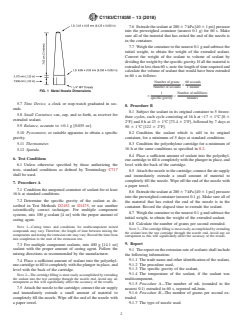
ylene cartridge with the dimensions given in Fig. 1.
5.2.2 Polyethylene Cartridge Nozzle, 64 mm [2 ⁄2 in.] in
3.1 Definitions—SeeTerminologyC717forapplicabledefi-
length with 3–mm [ ⁄8 –in.] orifice
nitions of the following terms: caulking, compound, elasto-
5.3 AirSupply,toprovide280 67kPa[40 61psi]pressure
ThistestmethodisunderthejurisdictionofASTMCommitteeC24onBuilding with appropriate fittings and air lines to attach to an air
Seals and Sealants and is the direct responsibility of Subcommittee C24.20 on
powered gun for convenience of use.
General Test Methods.
Current edition approved June 1, 2018. Published June 2018. Originally 5.4 Caulking Gun, 177 mL [6 fluid oz] capacity, air pow-
approved in 1991. Last previous edition approved in 2013 as C1183-13. DOI:
ered.
10.1520/C1183_C1183M-13R18.
For referenced ASTM standards, visit the ASTM website, www.astm.org, or 5.5 Freezer, capable of maintaining −17 6 1°C [0 6 2°F].
contact ASTM Customer Service at service@astm.org. For Annual Book of ASTM
5.6 Circulating Air Oven, capable of maintaining 50 6 1°C
Standards volume information, refer to the standard’s Document Summary page on
the ASTM website. [122 6 2°F].
Copyright © ASTM International, 100 Barr Harbor Drive, PO Box C700, West Conshohocken, PA 19428-2959. United States
C1183/C1183M − 13 (2018)
7.6 Extrudethesealantat280 67kPa[40 61psi]pressure
into the preweighed container (nearest 0.1 g) for 60 s. Make
sure all of the material that has exited the end of the nozzle is
in the container.
7.7 Weigh the container to the nearest 0.1 g and subtract the
initial weight, to obtain the weight of the extruded sealant.
Convert the weight of the sealant to volume of sealant by
dividing the weight by the specific gravity. If all the material is
extruded in less than 60 s, note the length of time required and
calculate the volume of sealant that would have been extruded
in 60 s as follows:
Numberofgrams 60seconds
Numberofseconds 1 minute
FIG. 1 Metal Nozzle Dimensions
1 Numberofmilliliters
3 5
specificgravity minutes
5.7 Time Device, a clock or stop-watch graduated in sec-
8. Procedure B
onds.
8.1 Subject the sealant in its original container to 5 freeze-
5.8 Small Container, can, cup, and so forth, as receiver for
thaw cycles, each cycle consisting of 16 h at −17 6 1°C [0 6
extruded sealant.
2°F] and8hat23 6 1°C [73.4 6 2°F], followed by 7 days at
5.9 Balance, accurate to 60.1 g [0.035 oz].
50 6 1°C [122 6 2°F].
5.10 Pycnometer, or suitable apparatus to obtain a specific
8.2 Condition the sealant which is still in its original
gravity.
container, for a minimum of 5 days at standard conditions.
5.11
...