

ASTM E561-23
(Test Method)Standard Test Method for KR Curve Determination
General Information
- Abstract
SIGNIFICANCE AND USE
5.1 The KR curve characterizes the resistance to fracture of materials during slow, stable crack extension and results from the growth of the plastic zone ahead of the crack as it extends from a fatigue precrack or sharp notch. It provides a record of the toughness development as a crack is driven stably under increasing applied stress intensity factor K. For a given material, KR curves are dependent upon specimen thickness, temperature, and strain rate. The amount of valid KR data generated in the test depends on the specimen type, size, method of loading, and, to a lesser extent, testing machine characteristics.
5.2 For an untested geometry, the KR curve can be matched with the applied-K curves (crack driving curves) to estimate the degree of stable crack extension and the conditions necessary to cause unstable crack propagation (2). In making this estimate, KR curves are regarded as being independent of initial crack size ao and the specimen configuration in which they are developed. For a given material, material thickness, and test temperature, KR curves appear to be a function of only the effective crack extension Δae (3).
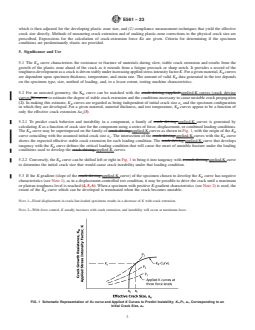
5.2.1 To predict crack behavior and instability in a component, a family of applied-K curves is generated by calculating K as a function of crack size for the component using a series of force, displacement, or combined loading conditions. The KR curve may be superimposed on the family of applied-K curves as shown in Fig. 1, with the origin of the KR curve coinciding with the assumed initial crack size ao. The intersection of the applied-K curves with the KR curve shows the expected effective stable crack extension for each loading condition. The applied-K curve that develops tangency with the KR curve defines the critical loading condition that will cause the onset of unstable fracture under the loading conditions used to develop the applied-K curves.
FIG. 1 Schematic Representation of KR curve and Applied K Curves to Predict Insta...
SCOPE
1.1 This test method covers the determination of the resistance to fracture of metallic materials under Mode I loading at static rates using either of the following notched and precracked specimens: the middle-cracked tension M(T) specimen or the compact tension C(T) specimen. A KR curve is a continuous record of toughness development (resistance to crack extension) in terms of KR plotted against crack extension in the specimen as a crack is driven under an increasing stress intensity factor, K. (1)2
1.2 Materials that can be tested for KR curve development are not limited by strength, thickness, or toughness, so long as specimens are of sufficient size to remain predominantly elastic to the effective crack extension value of interest.
1.3 Specimens of standard proportions are required, but size is variable, to be adjusted for yield strength and toughness of the materials.
1.4 Only two of the many possible specimen types that could be used to develop KR curves are covered in this method.
1.5 The test is applicable to conditions where a material exhibits slow, stable crack extension under increasing crack driving force, which may exist in relatively tough materials under plane stress crack tip conditions.
1.6 The values stated in SI units are to be regarded as standard. The values given in parentheses after SI units are provided for information only and are not considered standard.
1.7 This standard does not purport to address all of the safety concerns, if any, associated with its use. It is the responsibility of the user of this standard to establish appropriate safety, health, and environmental practices and determine the applicability of regulatory limitations prior to use.
1.8 This international standard was developed in accordance with internationally recognized principles on standardization established in the Decision on Principles for the Development of International Standards, Guides and Reco...
- Status
- Published
- Publication Date
- 30-Apr-2023
- Technical Committee
- E08 - Fatigue and Fracture
- Drafting Committee
- E08.07 - Fracture Mechanics
Buy Documents
ASTM E561-23 - Standard Test Method for <emph type="bdit">K<inf>R</inf></emph> Curve Determination
REDLINE ASTM E561-23 - Standard Test Method for <emph type="bdit">K<inf>R</inf></emph> Curve Determination
Overview
ASTM E561-23: Standard Test Method for KR Curve Determination specifies procedures for measuring the resistance to fracture of metallic materials during slow, stable crack extension. This test method utilizes either middle-cracked tension (M(T)) or compact tension (C(T)) specimens under Mode I loading (tensile opening) at static rates. The standard focuses on developing the KR curve, a continuous record of material toughness as the crack grows under increasing stress intensity.
This standard is published by ASTM International and is widely referenced for assessing fracture resistance and predicting crack behavior in metals engineering and safety-critical applications.
Key Topics
- KR Curve Development: Describes how to generate a KR curve by plotting resistance to crack extension against increasing stress intensity factor (K) as a precracked or sharply notched specimen is loaded.
- Specimen Types: Utilizes both M(T) (middle-cracked tension) and C(T) (compact tension) standard specimens to evaluate a wide range of material behaviors.
- Test Methodology:
- Pre-cracking the specimen using fatigue loading to ensure a sharp starter crack.
- Measuring crack size and resistance using a combination of direct physical measurement and compliance techniques.
- Recommendations for specimen dimensions and loading to maintain predominantly elastic behavior during testing.
- Significance of KR Curves:
- Characterizes material stability during slow crack growth.
- Provides insight into the toughness trajectory as cracks extend.
- Offers predictive capabilities for possible transitions from stable to unstable fracture behavior.
- Factors Affecting KR Data:
- Specimen thickness, temperature, material yield strength and strain rate.
- Test equipment precision and specimen configuration.
Applications
- Fracture Mechanics: Essential for engineers performing fracture mechanics analyses to predict material performance in critical components.
- Material Selection: Supports the comparison of different metallic materials based on their resistance to stable crack growth, vital for structural integrity and safety.
- Component Design & Failure Assessment: Enables overlay of KR curves with applied stress intensity curves (crack driving curves) to estimate:
- Degree of stable crack extension.
- Conditions that may promote sudden, unstable crack propagation.
- Minimum material toughness required to avoid catastrophic failure in service.
- Quality Assurance: Provides a framework for QA testing where consistent toughness and resistance to fracture are required.
- Research & Development: Facilitates comprehensive toughness characterization for new alloys or processing methods.
Related Standards
- ASTM E399: Test Method for Linear-Elastic Plane-Strain Fracture Toughness of Metallic Materials, focusing on singular, critical toughness values (KIc).
- ASTM E4: Practices for Force Calibration and Verification of Testing Machines, ensuring accuracy in load application.
- ASTM E1823: Terminology Relating to Fatigue and Fracture Testing, providing standardized definitions.
- ASTM E111: Test Method for Young’s Modulus, essential for elastic modulus determination in stress calculations.
- ASTM E3076: Practice for Determination of the Slope in the Linear Region of a Test Record.
- AISC Steel Construction Manual: Reference for verifying grip and fixture designs, particularly for large or nonstandard test setups.
Practical Value
ASTM E561-23 is a cornerstone standard for determining fracture resistance and ensuring structural safety in metallic components. It empowers materials engineers, quality assurance professionals, and design engineers to rigorously assess crack growth behavior and avoid catastrophic failures. The methodologies detailed in ASTM E561-23 are particularly valued in industries such as aerospace, automotive, pressure vessels, oil & gas infrastructure, and construction, where component reliability and human safety are paramount.
Keywords: ASTM E561-23, KR curve, fracture toughness, resistance curve, metallic materials, crack extension, Mode I loading, fracture mechanics, material testing, structural integrity, quality assurance, engineering standards.
Relations
- Effective Date
- 15-Feb-2024
- Effective Date
- 01-Feb-2024
- Effective Date
- 01-Feb-2020
- Effective Date
- 01-Jun-2014
- Effective Date
- 15-Dec-2012
- Effective Date
- 15-Nov-2012
- Effective Date
- 15-Nov-2012
- Effective Date
- 15-Nov-2012
- Effective Date
- 15-Nov-2012
- Effective Date
- 15-Nov-2012
- Effective Date
- 01-Sep-2012
- Effective Date
- 01-Aug-2012
- Effective Date
- 15-May-2012
- Effective Date
- 15-Mar-2012
- Effective Date
- 01-Jun-2011
Buy Documents
ASTM E561-23 - Standard Test Method for <emph type="bdit">K<inf>R</inf></emph> Curve Determination
REDLINE ASTM E561-23 - Standard Test Method for <emph type="bdit">K<inf>R</inf></emph> Curve Determination
Get Certified
Connect with accredited certification bodies for this standard

Element Materials Technology
Materials testing and product certification.

Inštitut za kovinske materiale in tehnologije
Institute of Metals and Technology. Materials testing, metallurgical analysis, NDT.
Sponsored listings
Frequently Asked Questions
ASTM E561-23 is a standard published by ASTM International. Its full title is "Standard Test Method for <emph type="bdit">K<inf>R</inf></emph> Curve Determination". This standard covers: SIGNIFICANCE AND USE 5.1 The KR curve characterizes the resistance to fracture of materials during slow, stable crack extension and results from the growth of the plastic zone ahead of the crack as it extends from a fatigue precrack or sharp notch. It provides a record of the toughness development as a crack is driven stably under increasing applied stress intensity factor K. For a given material, KR curves are dependent upon specimen thickness, temperature, and strain rate. The amount of valid KR data generated in the test depends on the specimen type, size, method of loading, and, to a lesser extent, testing machine characteristics. 5.2 For an untested geometry, the KR curve can be matched with the applied-K curves (crack driving curves) to estimate the degree of stable crack extension and the conditions necessary to cause unstable crack propagation (2). In making this estimate, KR curves are regarded as being independent of initial crack size ao and the specimen configuration in which they are developed. For a given material, material thickness, and test temperature, KR curves appear to be a function of only the effective crack extension Δae (3). 5.2.1 To predict crack behavior and instability in a component, a family of applied-K curves is generated by calculating K as a function of crack size for the component using a series of force, displacement, or combined loading conditions. The KR curve may be superimposed on the family of applied-K curves as shown in Fig. 1, with the origin of the KR curve coinciding with the assumed initial crack size ao. The intersection of the applied-K curves with the KR curve shows the expected effective stable crack extension for each loading condition. The applied-K curve that develops tangency with the KR curve defines the critical loading condition that will cause the onset of unstable fracture under the loading conditions used to develop the applied-K curves. FIG. 1 Schematic Representation of KR curve and Applied K Curves to Predict Insta... SCOPE 1.1 This test method covers the determination of the resistance to fracture of metallic materials under Mode I loading at static rates using either of the following notched and precracked specimens: the middle-cracked tension M(T) specimen or the compact tension C(T) specimen. A KR curve is a continuous record of toughness development (resistance to crack extension) in terms of KR plotted against crack extension in the specimen as a crack is driven under an increasing stress intensity factor, K. (1)2 1.2 Materials that can be tested for KR curve development are not limited by strength, thickness, or toughness, so long as specimens are of sufficient size to remain predominantly elastic to the effective crack extension value of interest. 1.3 Specimens of standard proportions are required, but size is variable, to be adjusted for yield strength and toughness of the materials. 1.4 Only two of the many possible specimen types that could be used to develop KR curves are covered in this method. 1.5 The test is applicable to conditions where a material exhibits slow, stable crack extension under increasing crack driving force, which may exist in relatively tough materials under plane stress crack tip conditions. 1.6 The values stated in SI units are to be regarded as standard. The values given in parentheses after SI units are provided for information only and are not considered standard. 1.7 This standard does not purport to address all of the safety concerns, if any, associated with its use. It is the responsibility of the user of this standard to establish appropriate safety, health, and environmental practices and determine the applicability of regulatory limitations prior to use. 1.8 This international standard was developed in accordance with internationally recognized principles on standardization established in the Decision on Principles for the Development of International Standards, Guides and Reco...
SIGNIFICANCE AND USE 5.1 The KR curve characterizes the resistance to fracture of materials during slow, stable crack extension and results from the growth of the plastic zone ahead of the crack as it extends from a fatigue precrack or sharp notch. It provides a record of the toughness development as a crack is driven stably under increasing applied stress intensity factor K. For a given material, KR curves are dependent upon specimen thickness, temperature, and strain rate. The amount of valid KR data generated in the test depends on the specimen type, size, method of loading, and, to a lesser extent, testing machine characteristics. 5.2 For an untested geometry, the KR curve can be matched with the applied-K curves (crack driving curves) to estimate the degree of stable crack extension and the conditions necessary to cause unstable crack propagation (2). In making this estimate, KR curves are regarded as being independent of initial crack size ao and the specimen configuration in which they are developed. For a given material, material thickness, and test temperature, KR curves appear to be a function of only the effective crack extension Δae (3). 5.2.1 To predict crack behavior and instability in a component, a family of applied-K curves is generated by calculating K as a function of crack size for the component using a series of force, displacement, or combined loading conditions. The KR curve may be superimposed on the family of applied-K curves as shown in Fig. 1, with the origin of the KR curve coinciding with the assumed initial crack size ao. The intersection of the applied-K curves with the KR curve shows the expected effective stable crack extension for each loading condition. The applied-K curve that develops tangency with the KR curve defines the critical loading condition that will cause the onset of unstable fracture under the loading conditions used to develop the applied-K curves. FIG. 1 Schematic Representation of KR curve and Applied K Curves to Predict Insta... SCOPE 1.1 This test method covers the determination of the resistance to fracture of metallic materials under Mode I loading at static rates using either of the following notched and precracked specimens: the middle-cracked tension M(T) specimen or the compact tension C(T) specimen. A KR curve is a continuous record of toughness development (resistance to crack extension) in terms of KR plotted against crack extension in the specimen as a crack is driven under an increasing stress intensity factor, K. (1)2 1.2 Materials that can be tested for KR curve development are not limited by strength, thickness, or toughness, so long as specimens are of sufficient size to remain predominantly elastic to the effective crack extension value of interest. 1.3 Specimens of standard proportions are required, but size is variable, to be adjusted for yield strength and toughness of the materials. 1.4 Only two of the many possible specimen types that could be used to develop KR curves are covered in this method. 1.5 The test is applicable to conditions where a material exhibits slow, stable crack extension under increasing crack driving force, which may exist in relatively tough materials under plane stress crack tip conditions. 1.6 The values stated in SI units are to be regarded as standard. The values given in parentheses after SI units are provided for information only and are not considered standard. 1.7 This standard does not purport to address all of the safety concerns, if any, associated with its use. It is the responsibility of the user of this standard to establish appropriate safety, health, and environmental practices and determine the applicability of regulatory limitations prior to use. 1.8 This international standard was developed in accordance with internationally recognized principles on standardization established in the Decision on Principles for the Development of International Standards, Guides and Reco...
ASTM E561-23 is classified under the following ICS (International Classification for Standards) categories: 77.040.10 - Mechanical testing of metals. The ICS classification helps identify the subject area and facilitates finding related standards.
ASTM E561-23 has the following relationships with other standards: It is inter standard links to ASTM E1823-24a, ASTM E1823-24, ASTM E1823-20, ASTM E4-14, ASTM E1823-12e, ASTM E1823-12d, ASTM E399-12e3, ASTM E399-12, ASTM E399-12e1, ASTM E399-12e2, ASTM E1823-12c, ASTM E1823-12b, ASTM E1823-12a, ASTM E1823-12, ASTM E1823-11. Understanding these relationships helps ensure you are using the most current and applicable version of the standard.
ASTM E561-23 is available in PDF format for immediate download after purchase. The document can be added to your cart and obtained through the secure checkout process. Digital delivery ensures instant access to the complete standard document.
Standards Content (Sample)
This international standard was developed in accordance with internationally recognized principles on standardization established in the Decision on Principles for the
Development of International Standards, Guides and Recommendations issued by the World Trade Organization Technical Barriers to Trade (TBT) Committee.
Designation: E561 − 23
Standard Test Method for
K Curve Determination
R
This standard is issued under the fixed designation E561; the number immediately following the designation indicates the year of
original adoption or, in the case of revision, the year of last revision. A number in parentheses indicates the year of last reapproval. A
superscript epsilon (´) indicates an editorial change since the last revision or reapproval.
1. Scope* Development of International Standards, Guides and Recom-
mendations issued by the World Trade Organization Technical
1.1 This test method covers the determination of the
Barriers to Trade (TBT) Committee.
resistance to fracture of metallic materials under Mode I
loading at static rates using either of the following notched and
2. Referenced Documents
precracked specimens: the middle-cracked tension M(T) speci-
2.1 ASTM Standards:
men or the compact tension C(T) specimen. A K curve is a
R
E4 Practices for Force Calibration and Verification of Test-
continuous record of toughness development (resistance to
ing Machines
crack extension) in terms of K plotted against crack extension
R
E111 Test Method for Young’s Modulus, Tangent Modulus,
in the specimen as a crack is driven under an increasing stress
and Chord Modulus
intensity factor, K. (1)
E399 Test Method for Linear-Elastic Plane-Strain Fracture
1.2 Materials that can be tested for K curve development
R
Toughness of Metallic Materials
are not limited by strength, thickness, or toughness, so long as
E1823 Terminology Relating to Fatigue and Fracture Testing
specimens are of sufficient size to remain predominantly elastic
E3076 Practice for Determination of the Slope in the Linear
to the effective crack extension value of interest.
Region of a Test Record
1.3 Specimens of standard proportions are required, but size
2.2 Other Document:
is variable, to be adjusted for yield strength and toughness of
AISC Steel Construction Manual
the materials.
3. Terminology
1.4 Only two of the many possible specimen types that
could be used to develop K curves are covered in this method. 3.1 Definitions:
R
3.1.1 Terminology E1823 is applicable to this method.
1.5 The test is applicable to conditions where a material
-2
3.1.2 effective modulus, E [FL ]—an elastic modulus that
eff
exhibits slow, stable crack extension under increasing crack
allows a theoretical (modulus normalized) compliance to
driving force, which may exist in relatively tough materials
match an experimentally measured compliance for an actual
under plane stress crack tip conditions.
initial crack size a .
o
1.6 The values stated in SI units are to be regarded as
3.2 Definitions of Terms Specific to This Standard:
standard. The values given in parentheses after SI units are
3.2.1 apparent fracture toughness, K
app
provided for information only and are not considered standard.
–3/2
[FL ]—The stress intensity factor, K, (under non-plane
1.7 This standard does not purport to address all of the
strain conditions of crack-tip stress) calculated using the initial
safety concerns, if any, associated with its use. It is the
crack size and the maximum force achieved during the test.
responsibility of the user of this standard to establish appro-
3.2.1.1 Discussion—K is an engineering estimate of
app
priate safety, health, and environmental practices and deter-
toughness that can be used to calculate residual strength. K
app
mine the applicability of regulatory limitations prior to use.
not only depends on the material, but also specimen type, size,
1.8 This international standard was developed in accor-
and thickness and as such is not a material property
dance with internationally recognized principles on standard-
3.2.1.2 Discussion—K has been historically referred to as
app
ization established in the Decision on Principles for the
apparent plane-stress fracture toughness, however in practice it
is used to describe apparent fracture toughness under non-plane
This test method is under the jurisdiction of ASTM Committee E08 on Fatigue
and Fracture and is the direct responsibility of Subcommittee E08.07 on Fracture
Mechanics. For referenced ASTM standards, visit the ASTM website, www.astm.org, or
Current edition approved May 1, 2023. Published May 2023. Originally contact ASTM Customer Service at service@astm.org. For Annual Book of ASTM
approved in 1974. Last previous edition approved in 2022 as E561 – 22. DOI: Standards volume information, refer to the standard’s Document Summary page on
10.1520/E0561-23. the ASTM website.
2 4
The boldface numbers in parentheses refer to the list of references at the end of Available from American Institute of Steel Construction (AISC), One E.
this standard. Wacker Dr., Suite 700, Chicago, IL 60601-1802, http://www.aisc.org.
*A Summary of Changes section appears at the end of this standard
Copyright © ASTM International, 100 Barr Harbor Drive, PO Box C700, West Conshohocken, PA 19428-2959. United States
E561 − 23
strain conditions, for example the transition region between material, K curves are dependent upon specimen thickness,
R
plane-strain and plane-stress. temperature, and strain rate. The amount of valid K data
R
generated in the test depends on the specimen type, size,
3.2.2 applied-K curve—a curve obtained from a fracture
method of loading, and, to a lesser extent, testing machine
mechanics analysis for a specific structural (or specimen)
characteristics.
configuration showing the relationship between crack size and
stress-intensity factor with either a fixed force or a fixed
5.2 For an untested geometry, the K curve can be matched
R
displacement applied to the structure (or specimen).
with the applied-K curves (crack driving curves) to estimate
3.2.2.1 Discussion—This is often plotted as a family of
the degree of stable crack extension and the conditions
curves for different levels of fixed force or fixed displacement
necessary to cause unstable crack propagation (2). In making
and superimposed on the K curve to predict stable crack
this estimate, K curves are regarded as being independent of
R
R
extension and fracture instability for that configuration.
initial crack size a and the specimen configuration in which
o
3.2.2.2 Discussion—This family of curves is often referred
they are developed. For a given material, material thickness,
to as crack driving curves.
and test temperature, K curves appear to be a function of only
R
–3/2
the effective crack extension Δa (3).
3.2.3 K [FL ]—The stress intensity factor, K , is mea-
e
c c
5.2.1 To predict crack behavior and instability in a
sured as the value of K (the crack extension resistance under
R
component, a family of applied-K curves is generated by
non-plane strain conditions of crack-tip stress) corresponding
calculating K as a function of crack size for the component
to the maximum force point in the test.
using a series of force, displacement, or combined loading
3.2.3.1 Discussion—K not only depends on the material,
c
conditions. The K curve may be superimposed on the family
but also specimen type, size, and thickness, and as such is not R
of applied-K curves as shown in Fig. 1, with the origin of the
a material property.
K curve coinciding with the assumed initial crack size a . The
3.2.3.2 Discussion—K is the value of K at the tangency R o
c R
intersection of the applied-K curves with the K curve shows
between the R-curve and the configuration-dependent
R
the expected effective stable crack extension for each loading
applied-K curve.
condition. The applied-K curve that develops tangency with
3.2.3.3 Discussion—K has been historically referred to as
c
the K curve defines the critical loading condition that will
plane-stress fracture toughness, however in practice it is used R
cause the onset of unstable fracture under the loading condi-
to describe fracture toughness under non-plane strain
tions used to develop the applied-K curves.
conditions, for example the transition region between plane-
5.2.2 Conversely, the K curve can be shifted left or right in
strain and plane-stress. R
Fig. 1 to bring it into tangency with applied-K curve to
determine the initial crack size that would cause crack insta-
4. Summary of Test Method
bility under that loading condition.
4.1 During slow-stable fracturing, the developing crack
5.3 If the K-gradient (slope of the applied-K curve) of the
extension resistance K is equal to the applied stress intensity
R
specimen chosen to develop the K curve has negative char-
factor K. The crack is driven forward by continuously or
R
acteristics (see Note 1), as in a displacement-controlled test
incrementally increasing force or displacement. Measurements
condition, it may be possible to drive the crack until a
are made periodically for determination of the effective crack
maximum or plateau toughness level is reached (4, 5, 6). When
size and for calculation of K values, which are individual data
a specimen with positive K-gradient characteristics (see Note
points that define the K curve for the material under those test
R
conditions.
4.2 The crack starter is a low-stress-level fatigue crack.
4.3 The method covers two techniques for determination of
effective crack size: (1) direct measurement of the physical
crack size which is then adjusted for the developing plastic
zone size, and (2) compliance measurement techniques that
yield the effective crack size directly. Methods of measuring
crack extension and of making plastic-zone corrections to the
physical crack size are prescribed. Expressions for the calcu-
lation of crack-extension force K are given. Criteria for
R
determining if the specimen conditions are predominantly
elastic are provided.
5. Significance and Use
5.1 The K curve characterizes the resistance to fracture of
R
materials during slow, stable crack extension and results from
the growth of the plastic zone ahead of the crack as it extends
from a fatigue precrack or sharp notch. It provides a record of
FIG. 1 Schematic Representation of K curve and Applied K
R
the toughness development as a crack is driven stably under
Curves to Predict Instability; K , P , a , Corresponding to an
c 3 c
increasing applied stress intensity factor K. For a given Initial Crack Size, a
o
E561 − 23
2) is used, the extent of the K curve which can be developed used. Grips should be carefully aligned to minimize the
R
is terminated when the crack becomes unstable. introduction of bending strain into the specimen. Pin or gimbal
connections can be located between the grips and testing
NOTE 1—Fixed displacement in crack-line-loaded specimens results in
machine to aid the symmetry of loading. If extra-heavy-gauge,
a decrease of K with crack extension.
NOTE 2—With force control, K usually increases with crack extension, high-toughness materials are to be tested, the suitability of the
and instability will occur at maximum force.
grip arrangement may be checked using the AISC Steel
Construction Manual.
6. Apparatus
6.3 Grips and Fixtures for Compact Tension (C(T))
6.1 Testing Machine—Machines used for K curve testing
R
Specimens—The grips and fixtures described in Test Method
shall conform to the requirements of Practices E4. The forces
E399 are recommended for K curve testing where C(T)-type
R
used in determining K values shall be within the verified force
R
specimens are loaded in tension.
application range of the testing machine as defined in Practices
E4.
6.4 Buckling Constraints—Buckling may develop in unsup-
ported specimens depending upon the specimen thickness,
6.2 Grips and Fixtures for Middle-Cracked Tension (M(T))
material toughness, crack size, and specimen size (7). Buckling
Specimens—In middle-cracked tension specimens, the grip
seriously affects the validity of a K analysis and is particularly
fixtures are designed to develop uniform stress distribution in
troublesome when using compliance techniques to determine
the central region of the specimen. Single pin grips can be used
crack size (8). It is therefore required that buckling constraints
on specimens less than 305 mm (12 in.) wide if the specimen
be affixed to the M(T) and C(T) specimens in critical regions
is long enough to ensure uniform stress distribution in the crack
when conditions for buckling are anticipated. A procedure for
plane (see 8.5.3.) For specimens wider than 305 mm (12 in.),
the detection of buckling is described in 9.8.3.
multiple-bolt grips such as those shown in Fig. 2 or wedge
grips that apply a uniform displacement along the entire width 6.4.1 For an M(T) specimen in tension, the regions above
of the specimen end shall be used if the stress intensity factor and below the notch are in transverse compression which can
and compliance equations in Section 11 are to be used. Other cause the specimen to buckle out of plane. The propensity for
gripping arrangements can be used if the appropriate stress buckling increases as W/B and 2a/W ratios increase and as the
intensity factor and compliance relationships are verified and force increases. Unless it can be shown by measurement or
FIG. 2 Middle-Cracked Tension (M(T)) Panel Test Setup
E561 − 23
analysis that buckling will not occur during a test, buckling
constraints shall be attached to the central portion of the
specimen. The guides shall be so designed to prevent sheet
kinking about the crack plane and sheet wrinkling along the
specimen width. Buckling constraints should provide a high
stiffness constraint against out-of-plane sheet displacements
while minimizing friction. Buckling constraints with additional
pressure adjustment capability near the center of the specimen
are recommended (7). Friction between the specimen and the
buckling constraints shall not interfere with the in-plane stress
distribution in the specimen. Friction can be minimized by
using a low-friction coating (such as thin TFE-fluorocarbon
sheet) on the contact surfaces of the constraints and by using
just enough clamping force to prevent buckling while allowing
free movement of the guides along the length of the specimen.
A suspension system to prevent the buckling constraint from
sliding down the specimen is recommended. Several buckling
constraint configurations for M(T) specimens are shown in (8)
and (9).
Dimensions
g d t h w
6.4.2 For C(T) specimens, the portion of the specimen arms
mm (in.) mm (in.) mm (in.) mm (in.) mm (in.)
and back edge which are in compression may need to be
23.3 (0.918) 12.7 (0.500) 1.6 (0.062) 86.4 (3.400) 7.6 (0.300)
restrained from buckling in thinner specimens of high tough-
FIG. 3 Enlarged Clip Gage for Compliance Measurements on
ness alloys. It is convenient to use a base plate and cover plate
Large Specimens
with ports cut at appropriate locations for attaching clip gages
and for crack size observations. Friction between buckling
restraints and specimen faces is detrimental and should be
minimized as much as possible.
6.4.3 Lubrication shall be provided between the face plates
and specimen. Care shall be taken to keep lubricants out of the
crack. Sheet TFE-fluorocarbon or heavy oils or both can be
used. The initial clamping forces between opposing plates
should be high enough to prevent buckling but not high enough
to change the stress distribution in the region of the crack tip at
any time during the test.
6.5 Displacement Gages—Displacement gages are used to
accurately measure the crack-mouth opening displacement
(CMOD) across the crack at a specified location and span. For
small C(T) specimens, the gage recommended in Test Method
E399 may have a sufficient linear working range to be used.
However, testing specimens with W greater than 127 mm (5
in.) may require gages with a larger working range, such as the
gage shown in Fig. 3.
6.5.1 A recommended gage for use in M(T) specimens is
shown in Fig. 4 (10). This gage is inserted into a machined hole
having a circular knife edge. The diameter d , is the gage span
i
2Y used in the calibration. Detail drawings of the gage are
given in Fig. 5. Radius of the attachment tip should be less than
FIG. 4 Recommended Gage for Use in Drilled Hole M(T) Panels
the radius of the circular knife edge in the specimen.
6.5.2 The gage recommended in 6.5.1 is preferred because
of its excellent linearity characteristics and ease of attachment. value to use with screw-on knife edges is the average distance
However, other types of gages used over different span lengths between attachment points across the notch. This is the actual
are equally acceptable provided the precision and accuracy deformation measurement point, not the gage length of the clip
requirements are retained. For example, the conventional clip gage itself.
gage of Test Method E399 may be used with screw attached 6.5.3 The use of point contacts eliminates error in the
knife edges spanning the crack at a chosen span 2Y. In M(T) readings from the hinge-type rotation of C(T) specimens. The
tests, the proper compliance calibration curve must be used precision of all types of gages shall be verified in accordance
because compliance is a function of Y/W. When using the with the procedure in Test Method E399. In addition, absolute
compliance calibration curve given in Eq 5, the proper 2Y accuracy within 2 % of reading over the working range of the
E561 − 23
6.8 Data Recording Equipment—When running a continu-
ous monotonic test, a system capable of recording force and
displacement signals with high fidelity at data rates to capture
at least 200 force-CMOD data pairs during the test should be
used. Appropriate data filtering can be used provided it does
not introduce errors into the data.
7. Specimen Compliance Measurement Requirements
7.1 In the K test, the effective crack size is determined
R
either by direct measurement of the physical crack size and
adjusting for the crack tip plastic zone, or by specimen
compliance techniques which can determine effective crack
size directly. This section provides background and require-
ments for the use of compliance techniques.
7.2 Specimen compliance is the ratio of the change in
specimen displacement to the change in force carried by the
specimen (Δv/ΔP) during the test. The loading (secant) com-
pliance technique and the calibration information are used to
determine effective crack size a directly (see Fig. 6). The
e
crack size is automatically corrected for the plastic-zone and
these values of a can be used directly in the appropriate stress
e
intensity factor solutions to determine K . Unloading compli-
R
ance can also be used to determine physical crack size a . In
p
this technique, the specimen compliance is measured during
periodic load reversals during the test. Specimen unloading
compliance values are substituted into the appropriate calibra-
tion curve or compliance expression to determine physical
crack size a . In this case, effective crack size can be computed
p
by adding the plastic zone size at each measurement point.
7.3 The compliance technique uses specimen displacement
measured at a single location, for example the front face mouth
opening for C(T) specimens or spanning the notch at the
specimen midplane for M(T) specimens.
FIG. 5 Detail Drawings of Clip Gage for Use with the
M(T) Specimen
gage is required for use with compliance measurements. Data
for compliance measurements must be taken within the verified
range of the gage. The gages shall be verified periodically.
6.6 Optical Equipment—If the material being tested is
sufficiently thin so that the crack-tip contour does not vary
significantly from surface to mid-thickness, crack extension
can be followed by surface observations using optical equip-
ment. If force is sustained at given increments so that the crack
stabilizes, physical crack size can be determined within 0.2 mm
(0.01 in.) using a 30 to 50-power traveling-stage microscope. A
digital image correlation system may also be useful for
determining in-plane strain distribution and out-of-plane dis-
placements (11).
6.7 Other Equipment—Other methods of measuring crack
size are available, such as eddy-current probes, which are most
useful with nonferrous material, or electrical-resistance
measurements, where the extension of the crack is determined
FIG. 6 Schematic Test Record and Secant Compliance Construc-
from electrical potential differences. tions for M(T) or C(T) Specimens
E561 − 23
7.4 Specimen compliance is measured by simultaneously thickness of interest that the machined notch root radius
recording the force and CMOD during the test. The effective effectively simulates the sharpness of a fatigue precrack. The
crack size can be determined directly by calculating Δv/ΔP in starter notch should be extended by fatigue precrack not less
the single compliance method. Crack size is determined from than 1.3 mm (0.05 in.) in length. The procedure for precracking
compliance measurements using the compliance equations or is given in Testing Procedures, Section 9.
tables for the specimen tested as described in Section 11.
8.5 Middle-Cracked Tension (M(T)) Specimen:
7.5 The compliance technique uses elastic characteristics of 8.5.1 The middle-cracked tension (M(T)) specimen is a
the specimen calibrated over a variety of crack sizes (12). rectangular specimen containing a centrally-located starter
Compliance calibration curves have been developed for vari- notch that is pulled in tension in the length direction of the
ous specimen geometries analytically using finite element specimen.
methods or experimentally using specimens containing various 8.5.2 The ends of the specimen may contain a single
crack sizes. The change in CMOD (Δv) of specific measure- pin-loading hole or may be configured for gripping with
ment points on the specimen is determined as a function of the multiple-bolt grips or wedge grips along the two ends of the
specimen as shown in
change in force (ΔP). The slopes are normalized for material Fig. 2.
thickness and elastic modulus and plotted against the ratio of 8.5.3 To ensure uniform stress entering the crack plane
crack size to specimen width, providing a calibration curve of when single-pin grips are used, the distance between the
EB~Δv/ΔP! as a function of a/W for the C(T) specimens or 2a/W loading pins shall be at least three specimen widths, 3W. For
for the M(T) specimen. Analytical expressions for the normal- specimens wider than 305 mm (12 in.), multiple-bolt grips such
ized compliance of the two specimen types covered in this as those shown in Fig. 2, or wedge grips that apply a uniform
method are given in Section 11 for specified displacement displacement along the entire width of the specimen end, shall
measurement points. be used. In this case, the minimum required distance between
the innermost gripping points is relaxed to 1.5W.
8. Specimen Configuration, Dimensions, and Preparation
8.5.4 A starter notch is machined perpendicular to the
8.1 Specimen Type—This method covers two specimen tension direction, centered at mid-width and located midway
types: M(T) and C(T). The choice of specimen type depends on along the length of the specimen. The machined notch shall be
the amount of material available, the type of test to be run, and centered with respect to the specimen width within 0.002W and
the type of equipment available. Ideally, the K curve should
its length shall be such that after precracking the required
R
not depend on the specimen type, although the amount of valid minimum amount, the initial crack size, 2a (machined notch
o
K curve generated will depend on the specimen type and size.
plus fatigue precrack) shall be within the range of 0.25 to
R
If the material is highly anisotropic, it may be preferable to use 0.40W. The machined notch must lie within the envelope
the M(T) specimen because the high stress gradient of the C(T)
shown in Fig. 7. A fatigue precrack shall be initiated from each
specimen may be more prone to exhibit crack deviation. The end of the starter notch using the procedure in 9.2. The fatigue
following sections provide information about each specimen
precrack shall extend from the starter notch by at least 1.3 mm
type. (0.05 in.) and must extend beyond the envelope shown in Fig.
NOTE 3—Difficulties in the interpretation of test records will be
7.
encountered if the specimens are not flat prior to testing or if the specimen
8.5.5 In the M(T) specimen, crack size a in the equations of
contains substantial residual stress.
Section 11 is the dimension from the specimen centerline to the
8.2 Number of Tests—Replicate K curves can be expected
R crack tip. This assumes that the crack is perfectly symmetrical
to vary as with other mechanical properties. Test-to-test vari-
with respect to the specimen centerline. In practice, this is
ability in K curves also depends on the material being tested.
R one-half of the average tip-to-tip crack length measurement.
It is recommended that at least duplicate tests on multiple lots
8.5.6 For specimen compliance determination, CMOD mea-
of material be performed when developing design data. For
surements are made between points spanning the machined
quality assurance testing, a single test can be performed.
notch at the mid-width of the specimen. This can be done by
attaching knife edges to the specimen with screws or cement to
8.3 Specimen Size—In order for a given calculated K value
R
accept a commercial clip gage or the one shown in Fig. 3. The
to be valid, the remaining uncracked ligament in the plane of
the crack must be predominantly elastic at the value of applied
force and physical crack size corresponding to that value of K .
R
Methods for estimating specimen size to ensure predominantly
elastic conditions over a wide range of Δa values are provided
e
for each specimen type below. Methods for determining invalid
data points are provided in subsequent sections of the method.
8.4 Starting Notch and Precrack—The machined starter
notch for either of the recommended specimens may be made
by electrical-discharge machining, end milling, or saw cutting.
It is advisable to have a root radius at the ends of the notch of
0.08 mm (0.003 in.) or less to facilitate fatigue precracking.
Fatigue precracking is highly recommended and may be
FIG. 7 Enlarged View of the Right Half of the Permitted Notch
omitted only if it has been demonstrated for the material and Envelope in M(T) Panels
E561 − 23
specimen can also be machined with integral knife edges using As an aid, the following table lists minimum recommended
beveled holes as shown in Fig. 4. The CMOD gage shown in M(T) sizes for assumed ratios of K to yield strength.
Rmax
Fig. 5 fits into these knife edges.
Table of Minimum M(T) Specimen Geometry for Given Conditions
A
K /σ Width 2a Length
8.5.7 To ensure predominantly elastic conditions in the Rmax YS o
=m =in. m in. m in. m in.
M(T) specimen, the net section stress based on the physical
0.08 0.5 0.076 3.0 0.025 1.0 0.229 9
crack size must be less than the yield strength of the material
0.16 1.0 0.152 6.0 0.051 2.0 0.457 18
0.24 1.5 0.305 12.0 0.102 4.0 0.914 36
at the test temperature. The M(T) specimen width W and initial
0.32 2.0 0.508 20.0 0.170 6.7 0.762 30
crack size a should be selected to provide valid K data up to
o R
0.48 3.0 1.219 48.0 0.406 16.0 1.829 72
effective crack extension values of interest. In general, a wider
A
specimen will provide valid data up to a larger value of
Distance between pin centers of single pin loaded M(T) specimens is nominally
3W. Specimens wider than 305 mm (12 in.) will require multiple pin grips or
effective crack extension than a narrow specimen.
full-width gripping and the length requirement for the distance between nearest
8.5.8 The required width to maintain predominantly elastic
gripping points is relaxed to 1.5W.
conditions for a given value of K may be estimated from the
R
8.6 Compact Tension (C(T)) Specimen:
maximum expected plastic-zone size, r (see Section 10),
Y
8.6.1 The recommended C(T) specimen is shown in Fig. 8.
which is directly proportional to the square of the material
The specimen is loaded in tension with clevis grips using pins
toughness-to-yield strength ratio. As a guide, a specimen 27r
Y
inserted through the loading holes. The loading hole size is
wide and with an initial crack size 2a of 0.33W is expected to
o
proportional to the specimen width.
fail at a net section stress equal to the yield strength (13). It
therefore is desirable to have an estimate of the maximum 8.6.2 Fig. 9 shows the allowable notch types and envelope
value of K expected in the test before designing the specimen. sizes for this specimen. The notch is machined perpendicular to
R
NOTE 1—Surface finishes in μm. 63 μin. = 1.6 μm. Surface finish requirements are maximum surface roughness (not to exceed).
NOTE 2—The intersection of the crack starter notch tip with the two specimen surfaces shall be equally distant from the top and bottom edges of the
specimen within 0.005 W.
NOTE 3—For starter notch and fatigue crack configuration see Fig. 9.
NOTE 4—Specimen thickness B shall not vary by more than 0.127 mm (0.005 in.) or 0.01 W, whichever is greater.
NOTE 5—Loading pins are of 0.24 W (+0.000 W / -0.005 W) diameter.
NOTE 6—Span of the gage (vertical distance between the two gage attach points at V or V ) is less than W/4 (see 8.6.4).
0 1
FIG. 8 Compact Tension (C(T)) Specimen
E561 − 23
pected or desired K for a test, an estimate of the required
R
specimen size can be made. As an aid, the following table
shows maximum final crack size to width ratios for several
normalized K values:
Rmax
Table of Minimum C(T) Specimen Width W for Given Conditions, m (in.)
K /σ Maximum a /W
Rmax YS p
=m =in. 0.4 0.5 0.6 0.7 0.8
0.10 0.6 0.02 0.03 0.03 0.04 0.06
(0.8) (1.0) (1.3) (1.7) (2.5)
0.20 1.3 0.08 0.10 0.13 0.17 0.25
(3.3) (4.0) (5.0) (6.7) (10.0)
0.30 1.9 0.19 0.23 0.29 0.38 0.57
(7.5) (9.0) (11.3) (15.0) (22.6)
0.40 2.5 0.34 0.40 0.51 0.67 1.01
(13.3) (15.9) (19.9) (26.5) (39.8)
0.50 3.1 0.53 0.64 0.80 1.06 1.59
(20.9) (25.1) (31.3) (41.8) (62.7)
9. Testing Procedures
9.1 Specimen Measurements—Measure specimen thickness
B to 60.5 % of B at two locations in the plane of the notch
between the notch tip and the specimen edge. Measure speci-
1 men width, W, to 60.5 % of W.
NOTE 1—h need not be less than 1.6 mm ( ⁄16 in.) but must not exceed
W/16.
9.2 Specimen Precracking—All specimens shall be pre-
NOTE 2—The intersection of the crack-starter tips with the two
cracked in the final heat-treated condition. The length of the
specimen faces shall be equidistant from the top and bottom edges of the
fatigue crack extension shall not be less than 1.3 mm (0.05 in.).
specimen within 0.005W.
The precrack must also extend beyond the applicable envelope
FIG. 9 Envelope for Crack-Starter Notches and Examples of
boundary shown in Fig. 7 or Fig. 9 depending on the specimen
Notches Extended with Fatigue Cracks
being tested. Precracking may be performed in one stage under
constant force or constant ΔK conditions.
the loading axis and is centered with respect to the top and
9.2.1 Precracking may include two or more stages: crack
bottom edges of the specimen. A fatigue precrack shall be
initiation, intermediate propagation, and finishing. To avoid
initiated from the notch tip using the procedure in 9.2. The
temporary growth retardation from a single step of load
fatigue precrack shall extend from the starter notch by at least
shedding, one or more intermediate levels may be added. The
1.3 mm (0.05 in.) and must extend beyond the envelope shown
reduction in maximum force from the final intermediate stage
in Fig. 9.
to the finishing stage is recommended to be no more than 30 %.
8.6.3 The initial crack size a (that is, machined notch plus
o
9.2.2 As a guide, crack initiation can be started in most
fatigue precrack) in the C(T) specimens shall be between 0.35
1/2
commercial materials at K /E = 0.00013 m (0.00083
max
and 0.55W.
1/2
in. ). Many commercial materials can be finished at K /E =
max
8.6.4 For specimen compliance determination, CMOD mea-
1/2 1/2
0.0001 m (0.0006 in. ). Stress ratio selection is optional,
surements are made across the notch at either location V or V
0 1
but R = 0.1 is recommended.
in Fig. 8 (0.25W 6 0.005W or 0.1576W 6 0.005W in advance
NOTE 4—Elastic (Young’s) modulus, E, in units of MPa will yield K
of the loading hole centerline). Span of the gage (that is,
max
in units of MPa·√m. Elastic (Young’s) modulus, E, in units of ksi will
vertical distance between the two gage attach points at V or
yield K in units of ksi·√in.
max
V ) is not critical so long as it is less than W/4. Alternative
9.2.3 Most aluminum alloys can be precracked at ΔK = 10
location of the gage is permitted but displacement values must
to 12 MPa·√m (9 to 11 ksi·√in.). During fatigue precracking,
be linearly extrapolated to 0.1576W in order to use the
the K for aluminum alloys shall not exceed 16.5 MPa·√m
expressions given in Section 11 for compliance measurement. max
(15 ksi·√in.).
8.6.5 To ensure that a given calculated value of K is
R
9.2.4 The finishing stage shall extend the precrack by at
considered valid for the C(T) specimen, the remaining un-
least 0.65 mm (0.025 in.). It is recommended that the finishing
cracked ligament must remain predominantly elastic. This
stage be completed in no less than 5 × 10 cycles.
condition is considered to be met in this method as long as the
length of the remaining uncracked ligament, W-a , at that point
p
NOTE 5—It may be advantageous, and is allowed in this method, to
in the test is greater than or equal to eight plastic zone sizes.
precrack the specimen in a different machine than that used to run the K
R
test. Because the maximum force required for precracking is substantially
This is met with the condition given in Eq 1 (see 11.3.4).
less than that required for the K test, a smaller test machine capable of
R
4 K
R
higher precracking frequency can be used.
~W 2 a ! $ (1)
S D
p
π σ
YS
9.3 Specimen Installation—Prior to gripping the specimen
8.6.5.1 In this expression, W is the specimen width as shown for running the K test, zero the load cell. Carefully align the
R
in Fig. 8, a is the physical crack size corresponding to the K precracked specimen in the testing machine to eliminate
p R
point being considered, and σ is the 0.2 % offset yield eccentricity of loading. Misalignment can result in uncon-
YS
strength of the material. By substituting the maximum ex- trolled or spurious stress distribution in the specimen which
E561 − 23
could be troublesome, particularly if compliance measure- 9.7.3.2 If it is desired to check for specimen buckling or
ments are used to determine crack extension. Fixtures for friction when using compliance techniques, slowly reduce the
measuring crack extension may be affixed to the specimen after specimen deformation to unload the specimen while recording
applying a small preload. Buckling constraints shall also be force and displacement. See discussion in 9.8.3.
installed if necessary. 9.7.4 At the conclusion of the test, carefully unload the
specimen and remove buckling constraints and measuring
9.4 Testing Machine Setup—The testing machine should be
instruments.
operated in displacement control to generate K curve data
R
points beyond maximum force. If using a servo-controlled 9.8 Procedure for Tests Using Compliance Measurement of
Effective Crack Size:
machine in force control, specimen fracture will occur at
maximum force and the machine will not be in control after 9.8.1 The test can be run by incremental deformation, but it
is permitted to apply a continuous monotonic deformation if
that point.
the force and displacement measurements can be recorded
9.4.1 If used, attach displacement transducers, apply
accurately and simultaneously.
excitation, and warm up instrumentation. Initialize and zero
instrumentation and start any data acquisition systems prior to 9.8.2 Begin recording data, if necessary, and apply defor-
mation to the specimen at a constant rate that meets the
starting the test.
requirements of 9.5. If incremental loading is used, periodi-
9.5 Testing Speed—To maintain a static deformation rate,
cally hold the deformation and record the force and displace-
the testing machine should be set up to apply a displacement
ment values after the crack has stabilized as described in 9.7.1.
rate during the initial linear portion of the force-CMOD curve
Otherwise, monitor and record the force versus CMOD while
that will result in a rate of change of K between 0.55 and 2.75
continuously applying deformation.
MPa·√m/s (0.50 to 2.5 ksi·√in./s), and this deformation rate
9.8.3 It may be possible to detect whether buckling or
should be used throughout the test.
friction are affecting the test by performing a periodic partial
NOTE 6—For an M(T) specimen with W = 400 mm (15.75 in.), 2a /W
o
unload of the specimen by reversing the deformation direction
from 0.25 to 0.33, and a length between grips of 815 mm (32 in.), a
as shown schematically in Fig. 10, unloading to about 80 % of
deformation rate of between 0.025 and 0.050 mm/s (0.001 and 0.002 in./s)
has been used to achieve the desired static deformation rates.
the test force at the time of the unload. The initial part of the
force-CMOD record should have a linear portion which can be
9.6 Crack Size Measurements—Depending on the crack
substantially retraced upon partial unloading. Should buckling
measurement technique chosen, perform the steps in either 9.7
or friction problems develop during the test, the unloading and
or 9.8. Complete the test procedure by performing the proce-
dure in 9.9 and subsequent sections.
9.7 Procedure for Tests Using Direct Measurement of Physi-
cal Crack Size:
9.7.1 Apply an increment of displacement to the specimen
at a rate that meets the requirements of 9.5, allowing time for
the crack to stabilize. Cracks stabilize in most materials within
a short time of stopping the deformation. However, when
stopping near an instability condition, the crack may take
several minutes to stabilize, depending upon the stiffness of the
loading frame and other factors.
NOTE 7—Static K cannot be determined when the crack is steadily
R
creeping or accelerating at or near instability.
9.7.2 After the crack stabilizes, measure and record the
physical crack size. For the M(T) or C(T) specimen, record the
force.
9.7.2.1 Measure the physical crack size accurately to 0.2
mm (0.01 in.) at each step using suitable measuring devices
described in Section 6.
9.7.2.2 Physical crack size can also be measured with
compliance techniques by partial unloading of the specimen
after each increment, a technique described in the Section 10.
9.7.3 Continue to apply increments of displacement, allow-
ing the crack to stabilize, and record physical crack size and
force or displacement, or both, until the specimen fractures or
until no useful data can be collected.
9.7.3.1 Number of Data Points—While K curves can be
R
DISPLACEMENT, v
developed with as few as four or five data points, ten to fifteen
give improved confidence, and tougher materials usually re-
FIG. 10 Detection of Buckling from Compliance Test Records of
quire more data points. M(T) and C(T) Specimens
E561 − 23
reloading slopes will tend to diverge. If the slopes differ by 9.10 Crack Deviation Measurements—When testing mate-
more than 2 %, or if one or both have no linear range, or if the rials with strong toughness anisotropy, the stable crack exten-
sion may deviate from the intended crack direction (14). This
unload-reload trace forms a loop, then buckling or friction may
be affecting the test results sufficiently to cause significant error usually occurs when the test is run in the higher-toughness
orientation. Accuracy of the specimen K solution and the
in compliance-measured crack sizes and calculated K value. If
elastic compliance relationships decrease with the amount of
this is observed, it shall be noted for all possibly affected
crack deviation from the intended crack direction. Therefore,
values in the report that buckling or friction may have affected
note any data points where the physical crack tip at the
the test results (see 12.1.14). Possibly affected values include
specimen midplane extends outside a 6 10° deviation enve-
all values calculated from the force-CMOD data obtained after
lope originating at machined notch tip.
the unload where evidence of buckling or friction was first
observed. It shall also be noted in the report on calculated
10. Calculation and Interpretation
values of K and K , when maximum applied load occurs
app c
after evidence of buckling is observed. Added confidence can
10.1 Construction of the K curve—The K curve deter-
R R
be obtained by comparing the crack sizes predicted from
mined in accordance with this method is a plot of crack
unloading slopes to physical crack size measured with other
extension resistance K as a function of effective crack
R
more direct methods.
extension Δa . Because the crack extension can be measured in
e
several ways, the following sections describe several proce-
NOTE 8—Buckling can also be detected in an M(T) specimen by
dures for determining data pairs of K and Δa from the test
R e
watching for a difference in the CMOD measured on both faces of the
record depending on the type of test run. The physical crack
specimen (indicating symmetric buckling) and by watching for clip gage
rotation (indicating anti-symmetric buckling).
size and plastic zone size also need to be determined for the net
NOTE 9—Buckling can be more significant at longer crack lengths. section stress validity criteria. A sample tabulation of analysis
Earlier unloads may not exhibit buckling outside the limits in 9.8.3 while
data is shown in Table 1.
buckling could occur in later unloads
10.1.1 There are three methods for determination of effec-
9.8.4 If desired, physical crack size can be determined by tive crack size, each requiring a slightly different calculation
approach: (1) Measurement of physical crack size by direct
partial unloading of the specimen at selected times during the
test. The unloading slope in the force-CMOD trace at any given observation and then calculating the effective crack size a by
e
adding the plastic zone size, (2) Measurement of physical crack
point represents the unloading compliance of the specimen
size by unloading compliance and calculating a by adding the
corresponding to the physical crack size. If the unloading
e
plastic zone size, and (3) Measurement of the effective crack
compliance is determined, the force reversal shall be only
size directly by secant compliance, then calculating the physi-
enough to establish the return slope accurately. Unloading to
cal crack size needed for determining validity.
about 80 % of the test force at the time of the unload has been
10.1.2 Depending on the measurement technique chosen,
used successfully. It is also common to perform multiple
perform the steps in either 10.2 for tests using direct measure-
unloads to determine physical crack length. Should the test
ment of physical crack size or 10.3 for tests using compliance
record not return linearly immediately upon unloading, as
methods. Use the appropriate sections of 10.3 for the particular
described 9.8.3, factors such as buckling or friction are
compliance method used. Complete the test analysis by using
influencing the test record and results should be considered
the procedures in 10.4 and subsequent sections. Equations and
suspect. If this is observed, it shall be noted for all possibly
tables for calculating the stress intensity factor, compliance,
affected values in the report that buckling or friction may have
force limits, and validity criteria for the three specimen types
affected the test results (see 9.8.3 and 12.1.14)
are described in Section 11.
9.8.5 At the conclusion of the test, carefully unload the
specimen and remove buckling constraints and measuring
10.2 Data Reduction Procedures for Tests Using Direct
instruments. Visual Measurement of Physical Crack Size:
10.2.1 For tests where the physical crack size a is measured
p
9.9 Initial Crack Size Measurement, a —After specimen
o
visually, the effective crack size a is determined by adding the
e
fracture, inspect the precrack
...
This document is not an ASTM standard and is intended only to provide the user of an ASTM standard an indication of what changes have been made to the previous version. Because
it may not be technically possible to adequately depict all changes accurately, ASTM recommends that users consult prior editions as appropriate. In all cases only the current version
of the standard as published by ASTM is to be considered the official document.
Designation: E561 − 22 E561 − 23
Standard Test Method for
K Curve Determination
R
This standard is issued under the fixed designation E561; the number immediately following the designation indicates the year of
original adoption or, in the case of revision, the year of last revision. A number in parentheses indicates the year of last reapproval. A
superscript epsilon (´) indicates an editorial change since the last revision or reapproval.
1. Scope*
1.1 This test method covers the determination of the resistance to fracture of metallic materials under Mode I loading at static
rates using either of the following notched and precracked specimens: the middle-cracked tension M(T) specimen or the compact
tension C(T) specimen. A K curve is a continuous record of toughness development (resistance to crack extension) in terms of
R
K plotted against crack extension in the specimen as a crack is driven under an increasing stress intensity factor, K.(1)
R
1.2 Materials that can be tested for K curve development are not limited by strength, thickness, or toughness, so long as
R
specimens are of sufficient size to remain predominantly elastic to the effective crack extension value of interest.
1.3 Specimens of standard proportions are required, but size is variable, to be adjusted for yield strength and toughness of the
materials.
1.4 Only two of the many possible specimen types that could be used to develop K curves are covered in this method.
R
1.5 The test is applicable to conditions where a material exhibits slow, stable crack extension under increasing crack driving force,
which may exist in relatively tough materials under plane stress crack tip conditions.
1.6 The values stated in SI units are to be regarded as standard. The values given in parentheses after SI units are provided for
information only and are not considered standard.
1.7 This standard does not purport to address all of the safety concerns, if any, associated with its use. It is the responsibility
of the user of this standard to establish appropriate safety, health, and environmental practices and determine the applicability of
regulatory limitations prior to use.
1.8 This international standard was developed in accordance with internationally recognized principles on standardization
established in the Decision on Principles for the Development of International Standards, Guides and Recommendations issued
by the World Trade Organization Technical Barriers to Trade (TBT) Committee.
2. Referenced Documents
2.1 ASTM Standards:
E4 Practices for Force Calibration and Verification of Testing Machines
This test method is under the jurisdiction of ASTM Committee E08 on Fatigue and Fracture and is the direct responsibility of Subcommittee E08.07 on Fracture
Mechanics.
Current edition approved May 1, 2022May 1, 2023. Published June 2022May 2023. Originally approved in 1974. Last previous edition approved in 20212022 as
E561 – 21.E561 – 22. DOI: 10.1520/E0561-22.10.1520/E0561-23.
The boldface numbers in parentheses refer to the list of references at the end of this standard.
For referenced ASTM standards, visit the ASTM website, www.astm.org, or contact ASTM Customer Service at service@astm.org. For Annual Book of ASTM Standards
volume information, refer to the standard’s Document Summary page on the ASTM website.
*A Summary of Changes section appears at the end of this standard
Copyright © ASTM International, 100 Barr Harbor Drive, PO Box C700, West Conshohocken, PA 19428-2959. United States
E561 − 23
E111 Test Method for Young’s Modulus, Tangent Modulus, and Chord Modulus
E399 Test Method for Linear-Elastic Plane-Strain Fracture Toughness of Metallic Materials
E1823 Terminology Relating to Fatigue and Fracture Testing
E3076 Practice for Determination of the Slope in the Linear Region of a Test Record
2.2 Other Document:
AISC Steel Construction Manual
3. Terminology
3.1 Definitions:
3.1.1 Terminology E1823 is applicable to this method.
-2
3.1.2 effective modulus, E [FL ]—an elastic modulus that allows a theoretical (modulus normalized) compliance to match an
eff
experimentally measured compliance for an actual initial crack size a .
o
3.2 Definitions of Terms Specific to This Standard:
3.2.1 apparent fracture toughness, K
app
–3/2
[FL ]—The stress intensity factor, K, (under non-plane strain conditions of crack-tip stress) calculated using the initial crack
size and the maximum force achieved during the test.
3.2.1.1 Discussion—
K is an engineering estimate of toughness that can be used to calculate residual strength. K not only depends on the material,
app app
but also specimen type, size, and thickness and as such is not a material property
3.2.1.2 Discussion—
K has been historically referred to as apparent plane-stress fracture toughness, however in practice it is used to describe apparent
app
fracture toughness under non-plane strain conditions, for example the transition region between plane-strain and plane-stress.
3.2.2 applied-K curve—a curve obtained from a fracture mechanics analysis for a specific structural (or specimen) configuration
showing the relationship between crack size and stress-intensity factor with either a fixed force or a fixed displacement applied to
the structure (or specimen).
3.2.2.1 Discussion—
This is often plotted as a family of curves for different levels of fixed force or fixed displacement and superimposed on the K
R
curve to predict stable crack extension and fracture instability for that configuration.
3.2.2.2 Discussion—
This family of curves is often referred to as crack driving curves.
–3/2
3.2.3 K [FL ]—The stress intensity factor, K , is measured as the value of K (the crack extension resistance under non-plane
c c R
strain conditions of crack-tip stress) corresponding to the maximum force point in the test.
3.2.3.1 Discussion—
K not only depends on the material, but also specimen type, size, and thickness, and as such is not a material property.
c
3.2.3.2 Discussion—
K is the value of K at the tangency between the R-curve and the configuration-dependent applied applied-K curve.
c R
3.2.3.3 Discussion—
K has been historically referred to as plane-stress fracture toughness, however in practice it is used to describe fracture toughness
c
under non-plane strain conditions, for example the transition region between plane-strain and plane-stress.
4. Summary of Test Method
4.1 During slow-stable fracturing, the developing crack extension resistance K is equal to the applied stress intensity factor K.
R
The crack is driven forward by continuously or incrementally increasing force or displacement. Measurements are made
periodically for determination of the effective crack size and for calculation of K values, which are individual data points that define
the K curve for the material under those test conditions.
R
4.2 The crack starter is a low-stress-level fatigue crack.
4.3 The method covers two techniques for determination of effective crack size: (1) direct measurement of the physical crack size
Available from American Institute of Steel Construction (AISC), One E. Wacker Dr., Suite 700, Chicago, IL 60601-1802, http://www.aisc.org.
E561 − 23
which is then adjusted for the developing plastic zone size, and (2) compliance measurement techniques that yield the effective
crack size directly. Methods of measuring crack extension and of making plastic-zone corrections to the physical crack size are
prescribed. Expressions for the calculation of crack-extension force K are given. Criteria for determining if the specimen
R
conditions are predominantly elastic are provided.
5. Significance and Use
5.1 The K curve characterizes the resistance to fracture of materials during slow, stable crack extension and results from the
R
growth of the plastic zone ahead of the crack as it extends from a fatigue precrack or sharp notch. It provides a record of the
toughness development as a crack is driven stably under increasing applied stress intensity factor K. For a given material, K curves
R
are dependent upon specimen thickness, temperature, and strain rate. The amount of valid K data generated in the test depends
R
on the specimen type, size, method of loading, and, to a lesser extent, testing machine characteristics.
5.2 For an untested geometry, the K curve can be matched with the crack driving (applied applied-K curves (crack driving
R
curves)K) curves to estimate the degree of stable crack extension and the conditions necessary to cause unstable crack propagation
(2). In making this estimate, K curves are regarded as being independent of initial crack size a and the specimen configuration
R o
in which they are developed. For a given material, material thickness, and test temperature, K curves appear to be a function of
R
only the effective crack extension Δa (3).
e
5.2.1 To predict crack behavior and instability in a component, a family of crack driving applied-K curves is generated by
calculating K as a function of crack size for the component using a series of force, displacement, or combined loading conditions.
The K curve may be superimposed on the family of crack driving applied-K curves as shown in Fig. 1, with the origin of the K
R R
curve coinciding with the assumed initial crack size a . The intersection of the crack driving applied-K curves with the K curve
o R
shows the expected effective stable crack extension for each loading condition. The crack driving applied-K curve that develops
tangency with the K curve defines the critical loading condition that will cause the onset of unstable fracture under the loading
R
conditions used to develop the crack driving applied-K curves.
5.2.2 Conversely, the K curve can be shifted left or right in Fig. 1 to bring it into tangency with a crack driving applied-K curve
R
to determine the initial crack size that would cause crack instability under that loading condition.
5.3 If the K-gradient (slope of the crack driving applied-K curve) of the specimen chosen to develop the K curve has negative
R
characteristics (see Note 1), as in a displacement-controlled test condition, it may be possible to drive the crack until a maximum
or plateau toughness level is reached (4, 5, 6). When a specimen with positive K-gradient characteristics (see Note 2) is used, the
extent of the K curve which can be developed is terminated when the crack becomes unstable.
R
NOTE 1—Fixed displacement in crack-line-loaded specimens results in a decrease of K with crack extension.
NOTE 2—With force control, K usually increases with crack extension, and instability will occur at maximum force.
FIG. 1 Schematic Representation of K curve and Applied K Curves to Predict Instability; K ,P , a , Corresponding to an
R c 3 c
Initial Crack Size, a
o
E561 − 23
6. Apparatus
6.1 Testing Machine—Machines used for K curve testing shall conform to the requirements of Practices E4. The forces used in
R
determining K values shall be within the verified force application range of the testing machine as defined in Practices E4.
R
6.2 Grips and Fixtures for Middle-Cracked Tension (M(T)) Specimens—In middle-cracked tension specimens, the grip fixtures are
designed to develop uniform stress distribution in the central region of the specimen. Single pin grips can be used on specimens
less than 305 mm (12 in.) wide if the specimen is long enough to ensure uniform stress distribution in the crack plane (see 8.5.3.)
For specimens wider than 305 mm (12 in.), multiple-bolt grips such as those shown in Fig. 2 or wedge grips that apply a uniform
displacement along the entire width of the specimen end shall be used if the stress intensity factor and compliance equations in
Section 11 are to be used. Other gripping arrangements can be used if the appropriate stress intensity factor and compliance
relationships are verified and used. Grips should be carefully aligned to minimize the introduction of bending strain into the
specimen. Pin or gimbal connections can be located between the grips and testing machine to aid the symmetry of loading. If
extra-heavy-gauge, high-toughness materials are to be tested, the suitability of the grip arrangement may be checked using the
AISC Steel Construction Manual.
6.3 Grips and Fixtures for Compact Tension (C(T)) Specimens—The grips and fixtures described in Test Method E399 are
recommended for K curve testing where C(T)-type specimens are loaded in tension.
R
6.4 Buckling Constraints—Buckling may develop in unsupported specimens depending upon the specimen thickness, material
toughness, crack size, and specimen size (7). Buckling seriously affects the validity of a K analysis and is particularly troublesome
when using compliance techniques to determine crack size (8). It is therefore required that buckling constraints be affixed to the
M(T) and C(T) specimens in critical regions when conditions for buckling are anticipated. A procedure for the detection of
buckling is described in 9.8.3.
FIG. 2 Middle-Cracked Tension (M(T)) Panel Test Setup
E561 − 23
6.4.1 For an M(T) specimen in tension, the regions above and below the notch are in transverse compression which can cause the
specimen to buckle out of plane. The propensity for buckling increases as W/B and 2a/W ratios increase and as the force increases.
Unless it can be shown by measurement or analysis that buckling will not occur during a test, buckling constraints shall be attached
to the central portion of the specimen. The guides shall be so designed to prevent sheet kinking about the crack plane and sheet
wrinkling along the specimen width. Buckling constraints should provide a high stiffness constraint against out-of-plane sheet
displacements while minimizing friction. Buckling constraints with additional pressure adjustment capability near the center of the
specimen are recommended (7). Friction between the specimen and the buckling constraints shall not interfere with the in-plane
stress distribution in the specimen. Friction can be minimized by using a low-friction coating (such as thin TFE-fluorocarbon sheet)
on the contact surfaces of the constraints and by using just enough clamping force to prevent buckling while allowing free
movement of the guides along the length of the specimen. A suspension system to prevent the buckling constraint from sliding
down the specimen is recommended. Several buckling constraint configurations for M(T) specimens are shown in (8) and (9).
6.4.2 For C(T) specimens, the portion of the specimen arms and back edge which are in compression may need to be restrained
from buckling in thinner specimens of high toughness alloys. It is convenient to use a base plate and cover plate with ports cut
at appropriate locations for attaching clip gages and for crack size observations. Friction between buckling restraints and specimen
faces is detrimental and should be minimized as much as possible.
6.4.3 Lubrication shall be provided between the face plates and specimen. Care shall be taken to keep lubricants out of the crack.
Sheet TFE-fluorocarbon or heavy oils or both can be used. The initial clamping forces between opposing plates should be high
enough to prevent buckling but not high enough to change the stress distribution in the region of the crack tip at any time during
the test.
6.5 Displacement Gages—Displacement gages are used to accurately measure the crack-mouth opening displacement (CMOD)
across the crack at a specified location and span. For small C(T) specimens, the gage recommended in Test Method E399 may have
a sufficient linear working range to be used. However, testing specimens with W greater than 127 mm (5 in.) may require gages
with a larger working range, such as the gage shown in Fig. 3.
6.5.1 A recommended gage for use in M(T) specimens is shown in Fig. 4 (10). This gage is inserted into a machined hole having
a circular knife edge. The diameter d , is the gage span 2Y used in the calibration. Detail drawings of the gage are given in Fig.
i
5. Radius of the attachment tip should be less than the radius of the circular knife edge in the specimen.
6.5.2 The gage recommended in 6.5.1 is preferred because of its excellent linearity characteristics and ease of attachment.
However, other types of gages used over different span lengths are equally acceptable provided the precision and accuracy
Dimensions
g d t h w
mm (in.) mm (in.) mm (in.) mm (in.) mm (in.)
23.3 (0.918) 12.7 (0.500) 1.6 (0.062) 86.4 (3.400) 7.6 (0.300)
FIG. 3 Enlarged Clip Gage for Compliance Measurements on Large Specimens
E561 − 23
FIG. 4 Recommended Gage for Use in Drilled Hole M(T) Panels
requirements are retained. For example, the conventional clip gage of Test Method E399 may be used with screw attached knife
edges spanning the crack at a chosen span 2Y. In M(T) tests, the proper compliance calibration curve must be used because
compliance is a function of Y/W. When using the compliance calibration curve given in Eq 5, the proper 2Y value to use with
screw-on knife edges is the average distance between attachment points across the notch. This is the actual deformation
measurement point, not the gage length of the clip gage itself.
6.5.3 The use of point contacts eliminates error in the readings from the hinge-type rotation of C(T) specimens. The precision of
all types of gages shall be verified in accordance with the procedure in Test Method E399. In addition, absolute accuracy within
2 % of reading over the working range of the gage is required for use with compliance measurements. Data for compliance
measurements must be taken within the verified range of the gage. The gages shall be verified periodically.
6.6 Optical Equipment—If the material being tested is sufficiently thin so that the crack-tip contour does not vary significantly
from surface to mid-thickness, crack extension can be followed by surface observations using optical equipment. If force is
sustained at given increments so that the crack stabilizes, physical crack size can be determined within 0.2 mm (0.01 in.) using
a 30 to 50-power traveling-stage microscope. A digital image correlation system may also be useful for determining in-plane strain
distribution and out-of-plane displacements (11).
6.7 Other Equipment—Other methods of measuring crack size are available, such as eddy-current probes, which are most useful
with nonferrous material, or electrical-resistance measurements, where the extension of the crack is determined from electrical
potential differences.
6.8 Data Recording Equipment—When running a continuous monotonic test, a system capable of recording force and
displacement signals with high fidelity at data rates to capture at least 200 force-CMOD data pairs during the test should be used.
Appropriate data filtering can be used provided it does not introduce errors into the data.
7. Specimen Compliance Measurement Requirements
7.1 In the K test, the effective crack size is determined either by direct measurement of the physical crack size and adjusting for
R
the crack tip plastic zone, or by specimen compliance techniques which can determine effective crack size directly. This section
provides background and requirements for the use of compliance techniques.
7.2 Specimen compliance is the ratio of the change in specimen displacement to the change in force carried by the specimen
E561 − 23
FIG. 5 Detail Drawings of Clip Gage for Use with the
M(T) Specimen
(Δv/ΔP) during the test. The loading (secant) compliance technique and the calibration information are used to determine effective
crack size a directly (see Fig. 6). The crack size is automatically corrected for the plastic-zone and these values of a can be used
e e
directly in the appropriate stress intensity factor solutions to determine K . Unloading compliance can also be used to determine
R
physical crack size a . In this technique, the specimen compliance is measured during periodic load reversals during the test.
p
Specimen unloading compliance values are substituted into the appropriate calibration curve or compliance expression to
determine physical crack size a . In this case, effective crack size can be computed by adding the plastic zone size at each
p
measurement point.
7.3 The compliance technique uses specimen displacement measured at a single location, for example the front face mouth
opening for C(T) specimens or spanning the notch at the specimen midplane for M(T) specimens.
7.4 Specimen compliance is measured by simultaneously recording the force and CMOD during the test. The effective crack size
can be determined directly by calculating Δv/ΔP in the single compliance method. Crack size is determined from compliance
measurements using the compliance equations or tables for the specimen tested as described in Section 11.
7.5 The compliance technique uses elastic characteristics of the specimen calibrated over a variety of crack sizes (12). Compliance
calibration curves have been developed for various specimen geometries analytically using finite element methods or
experimentally using specimens containing various crack sizes. The change in CMOD (Δv) of specific measurement points on the
specimen is determined as a function of the change in force (ΔP). The slopes are normalized for material thickness and elastic
E561 − 23
FIG. 6 Schematic Test Record and Secant Compliance Constructions for M(T) or C(T) Specimens
modulus and plotted against the ratio of crack size to specimen width, providing a calibration curve of EB~Δv/ΔP! as a function of
a/W for the C(T) specimens or 2a/W for the M(T) specimen. Analytical expressions for the normalized compliance of the two
specimen types covered in this method are given in Section 11 for specified displacement measurement points.
8. Specimen Configuration, Dimensions, and Preparation
8.1 Specimen Type—This method covers two specimen types: M(T) and C(T). The choice of specimen type depends on the amount
of material available, the type of test to be run, and the type of equipment available. Ideally, the K curve should not depend on
R
the specimen type, although the amount of valid K curve generated will depend on the specimen type and size. If the material
R
is highly anisotropic, it may be preferable to use the M(T) specimen because the high stress gradient of the C(T) specimen may
be more prone to exhibit crack deviation. The following sections provide information about each specimen type.
NOTE 3—Difficulties in the interpretation of test records will be encountered if the specimens are not flat prior to testing or if the specimen contains
substantial residual stress.
8.2 Number of Tests—Replicate K curves can be expected to vary as with other mechanical properties. Test-to-test variability in
R
K curves also depends on the material being tested. It is recommended that at least duplicate tests on multiple lots of material
R
be performed when developing design data. For quality assurance testing, a single test can be performed.
8.3 Specimen Size—In order for a given calculated K value to be valid, the remaining uncracked ligament in the plane of the crack
R
must be predominantly elastic at the value of applied force and physical crack size corresponding to that value of K . Methods
R
for estimating specimen size to ensure predominantly elastic conditions over a wide range of Δa values are provided for each
e
specimen type below. Methods for determining invalid data points are provided in subsequent sections of the method.
8.4 Starting Notch and Precrack—The machined starter notch for either of the recommended specimens may be made by
electrical-discharge machining, end milling, or saw cutting. It is advisable to have a root radius at the ends of the notch of 0.08
mm (0.003 in.) or less to facilitate fatigue precracking. Fatigue precracking is highly recommended and may be omitted only if
it has been demonstrated for the material and thickness of interest that the machined notch root radius effectively simulates the
sharpness of a fatigue precrack. The starter notch should be extended by fatigue precrack not less than 1.3 mm (0.05 in.) in length.
The procedure for precracking is given in Testing Procedures, Section 9.
8.5 Middle-Cracked Tension (M(T)) Specimen:
8.5.1 The middle-cracked tension (M(T)) specimen is a rectangular specimen containing a centrally-located starter notch that is
pulled in tension in the length direction of the specimen.
E561 − 23
8.5.2 The ends of the specimen may contain a single pin-loading hole or may be configured for gripping with multiple-bolt grips
or wedge grips along the two ends of the specimen as shown in Fig. 2.
8.5.3 To ensure uniform stress entering the crack plane when single-pin grips are used, the distance between the loading pins shall
be at least three specimen widths, 3W. For specimens wider than 305 mm (12 in.), multiple-bolt grips such as those shown in Fig.
2, or wedge grips that apply a uniform displacement along the entire width of the specimen end, shall be used. In this case, the
minimum required distance between the innermost gripping points is relaxed to 1.5W.
8.5.4 A starter notch is machined perpendicular to the tension direction, centered at mid-width and located midway along the
length of the specimen. The machined notch shall be centered with respect to the specimen width within 0.002W and its length
shall be such that after precracking the required minimum amount, the initial crack size, 2a (machined notch plus fatigue precrack)
o
shall be within the range of 0.25 to 0.40W. The machined notch must lie within the envelope shown in Fig. 7. A fatigue precrack
shall be initiated from each end of the starter notch using the procedure in 9.2. The fatigue precrack shall extend from the starter
notch by at least 1.3 mm (0.05 in.) and must extend beyond the envelope shown in Fig. 7.
8.5.5 In the M(T) specimen, crack size a in the equations of Section 11 is the dimension from the specimen centerline to the crack
tip. This assumes that the crack is perfectly symmetrical with respect to the specimen centerline. In practice, this is one-half of
the average tip-to-tip crack length measurement.
8.5.6 For specimen compliance determination, CMOD measurements are made between points spanning the machined notch at
the mid-width of the specimen. This can be done by attaching knife edges to the specimen with screws or cement to accept a
commercial clip gage or the one shown in Fig. 3. The specimen can also be machined with integral knife edges using beveled holes
as shown in Fig. 4. The CMOD gage shown in Fig. 5 fits into these knife edges.
8.5.7 To ensure predominantly elastic conditions in the M(T) specimen, the net section stress based on the physical crack size must
be less than the yield strength of the material at the test temperature. The M(T) specimen width W and initial crack size a should
o
be selected to provide valid K data up to effective crack extension values of interest. In general, a wider specimen will provide
R
valid data up to a larger value of effective crack extension than a narrow specimen.
8.5.8 The required width to maintain predominantly elastic conditions for a given value of K may be estimated from the
R
maximum expected plastic-zone size, r (see Section 10), which is directly proportional to the square of the material
Y
toughness-to-yield strength ratio. As a guide, a specimen 27r wide and with an initial crack size 2a of 0.33W is expected to fail
Y o
at a net section stress equal to the yield strength (13). It therefore is desirable to have an estimate of the maximum value of K
R
expected in the test before designing the specimen. As an aid, the following table lists minimum recommended M(T) sizes for
assumed ratios of K to yield strength.
Rmax
FIG. 7 Enlarged View of the Right Half of the Permitted Notch Envelope in M(T) Panels
E561 − 23
Table of Minimum M(T) Specimen Geometry for Given Conditions
A
K /σ Width 2a Length
Rmax YS o
=m =in. m in. m in. m in.
0.08 0.5 0.076 3.0 0.025 1.0 0.229 9
0.16 1.0 0.152 6.0 0.051 2.0 0.457 18
0.24 1.5 0.305 12.0 0.102 4.0 0.914 36
0.32 2.0 0.508 20.0 0.170 6.7 0.762 30
0.48 3.0 1.219 48.0 0.406 16.0 1.829 72
A
Distance between pin centers of single pin loaded M(T) specimens is nominally 3W. Specimens wider than 305 mm (12 in.) will require multiple pin grips or full-width
gripping and the length requirement for the distance between nearest gripping points is relaxed to 1.5W.
8.6 Compact Tension (C(T)) Specimen:
8.6.1 The recommended C(T) specimen is shown in Fig. 8. The specimen is loaded in tension with clevis grips using pins inserted
through the loading holes. The loading hole size is proportional to the specimen width.
8.6.2 Fig. 9 shows the allowable notch types and envelope sizes for this specimen. The notch is machined perpendicular to the
loading axis and is centered with respect to the top and bottom edges of the specimen. A fatigue precrack shall be initiated from
the notch tip using the procedure in 9.2. The fatigue precrack shall extend from the starter notch by at least 1.3 mm (0.05 in.) and
must extend beyond the envelope shown in Fig. 9.
NOTE 1—Surface finishes in μm. 63 μin. = 1.6 μmμm. Surface finish requirements are maximum surface roughness (not to exceed).
NOTE 2—The intersection of the crack starter notch tip with the two specimen surfaces shall be equally distant from the top and bottom edges of the
specimen within 0.005 W.
NOTE 3—For starter notch and fatigue crack configuration see Fig. 9.
NOTE 4—Specimen thickness B shall not vary by more than 0.127 mm (0.005 in.) or 0.010.01 W, whichever is greater.
NOTE 5—Loading pins are of 0.24 W (+0.000 W / -0.005 W) diameter.
NOTE 6—Span of the gage (vertical distance between the two gage attach points at V or V ) is less than W/4 (see 8.6.4).
0 1
FIG. 8 Compact Tension (C(T)) Specimen
E561 − 23
NOTE 1—h need not be less than 1.6 mm ( ⁄16 in.) but must not exceed W/16.
NOTE 2—The intersection of the crack-starter tips with the two specimen faces shall be equidistant from the top and bottom edges of the specimen
within 0.005W.
FIG. 9 Envelope for Crack-Starter Notches and Examples of Notches Extended with Fatigue Cracks
8.6.3 The initial crack size a (that is, machined notch plus fatigue precrack) in the C(T) specimens shall be between 0.35 and
o
0.55W.
8.6.4 For specimen compliance determination, CMOD measurements are made across the notch at either location V or V in Fig.
0 1
8 (0.25W 6 0.005W or 0.1576W 6 0.005W in advance of the loading hole centerline). Span of the gage (that is, vertical distance
between the two gage attach points at V or V ) is not critical so long as it is less than W/4. Alternative location of the gage is
0 1
permitted but displacement values must be linearly extrapolated to 0.1576W in order to use the expressions given in Section 11
for compliance measurement.
8.6.5 To ensure that a given calculated value of K is considered valid for the C(T) specimen, the remaining uncracked ligament
R
must remain predominantly elastic. This condition is considered to be met in this method as long as the length of the remaining
uncracked ligament, W-a , at that point in the test is greater than or equal to eight plastic zone sizes. This is met with the condition
p
given in Eq 1 (see 11.3.4).
4 K
R
~W 2 a ! $ (1)
S D
p
π σ
YS
8.6.5.1 In this expression, W is the specimen width as shown in Fig. 8, a is the physical crack size corresponding to the K point
p R
being considered, and σ is the 0.2 % offset yield strength of the material. By substituting the maximum expected or desired K
YS R
for a test, an estimate of the required specimen size can be made. As an aid, the following table shows maximum final crack size
to width ratios for several normalized K values:
Rmax
Table of Minimum C(T) Specimen Width W for Given Conditions, m (in.)
K /σ Maximum a /W
Rmax YS p
=m =in. 0.4 0.5 0.6 0.7 0.8
0.10 0.6 0.02 0.03 0.03 0.04 0.06
(0.8) (1.0) (1.3) (1.7) (2.5)
0.20 1.3 0.08 0.10 0.13 0.17 0.25
(3.3) (4.0) (5.0) (6.7) (10.0)
0.30 1.9 0.19 0.23 0.29 0.38 0.57
(7.5) (9.0) (11.3) (15.0) (22.6)
0.40 2.5 0.34 0.40 0.51 0.67 1.01
(13.3) (15.9) (19.9) (26.5) (39.8)
0.50 3.1 0.53 0.64 0.80 1.06 1.59
(20.9) (25.1) (31.3) (41.8) (62.7)
E561 − 23
9. Testing Procedures
9.1 Specimen Measurements—Measure specimen thickness B to 60.5 % of B at two locations in the plane of the notch between
the notch tip and the specimen edge. Measure specimen width, W, to 60.5 % of W.
9.2 Specimen Precracking—All specimens shall be precracked in the final heat-treated condition. The length of the fatigue crack
extension shall not be less than 1.3 mm (0.05 in.). The precrack must also extend beyond the applicable envelope boundary shown
in Fig. 7 or Fig. 9 depending on the specimen being tested. Precracking may be performed in one stage under constant force or
constant ΔK conditions.
9.2.1 Precracking may include two or more stages: crack initiation, intermediate propagation, and finishing. To avoid temporary
growth retardation from a single step of load shedding, one or more intermediate levels may be added. The reduction in maximum
force from the final intermediate stage to the finishing stage is recommended to be no more than 30 %.
1/2 1/2
9.2.2 As a guide, crack initiation can be started in most commercial materials at K /E = 0.00013 m (0.00083 in. ). Many
max
1/2 1/2
commercial materials can be finished at K /E = 0.0001 m (0.0006 in. ). Stress ratio selection is optional, but R = 0.1 is
max
recommended.
NOTE 4—Elastic (Young’s) modulus, E, in units of MPa will yield K in units of MPa·√m. Elastic (Young’s) modulus, E, in units of ksi will yield K
max max
in units of ksi·√in.
9.2.3 Most aluminum alloys can be precracked at ΔK = 10 to 12 MPa·√m (9 to 11 ksi·√in.). During fatigue precracking, the K
max
for aluminum alloys shall not exceed 16.5 MPa·√m (15 ksi·√in.).
9.2.4 The finishing stage shall extend the precrack by at least 0.65 mm (0.025 in.). It is recommended that the finishing stage be
completed in no less than 5 × 10 cycles.
NOTE 5—It may be advantageous, and is allowed in this method, to precrack the specimen in a different machine than that used to run the K test. Because
R
the maximum force required for precracking is substantially less than that required for the K test, a smaller test machine capable of higher precracking
R
frequency can be used.
9.3 Specimen Installation—Prior to gripping the specimen for running the K test, zero the load cell. Carefully align the
R
precracked specimen in the testing machine to eliminate eccentricity of loading. Misalignment can result in uncontrolled or
spurious stress distribution in the specimen which could be troublesome, particularly if compliance measurements are used to
determine crack extension. Fixtures for measuring crack extension may be affixed to the specimen after applying a small preload.
Buckling constraints shall also be installed if necessary.
9.4 Testing Machine Setup—The testing machine should be operated in displacement control to generate K curve data points
R
beyond maximum force. If using a servo-controlled machine in force control, specimen fracture will occur at maximum force and
the machine will not be in control after that point.
9.4.1 If used, attach displacement transducers, apply excitation, and warm up instrumentation. Initialize and zero instrumentation
and start any data acquisition systems prior to starting the test.
9.5 Testing Speed—To maintain a static deformation rate, the testing machine should be set up to apply a displacement rate during
the initial linear portion of the force-CMOD curve that will result in a rate of change of K between 0.55 and 2.75 MPa·√m/s (0.50
to 2.5 ksi·√in./s), and this deformation rate should be used throughout the test.
NOTE 6—For an M(T) specimen with W = 400 mm (15.75 in.), 2a /W from 0.25 to 0.33, and a length between grips of 815 mm (32 in.), a deformation
o
rate of between 0.025 and 0.050 mm/s (0.001 and 0.002 in./s) has been used to achieve the desired static deformation rates.
9.6 Crack Size Measurements—Depending on the crack measurement technique chosen, perform the steps in either 9.7 or 9.8.
Complete the test procedure by performing the procedure in 9.9 and subsequent sections.
9.7 Procedure for Tests Using Direct Measurement of Physical Crack Size:
E561 − 23
9.7.1 Apply an increment of displacement to the specimen at a rate that meets the requirements of 9.5, allowing time for the crack
to stabilize. Cracks stabilize in most materials within a short time of stopping the deformation. However, when stopping near an
instability condition, the crack may take several minutes to stabilize, depending upon the stiffness of the loading frame and other
factors.
NOTE 7—Static K cannot be determined when the crack is steadily creeping or accelerating at or near instability.
R
9.7.2 After the crack stabilizes, measure and record the physical crack size. For the M(T) or C(T) specimen, record the force.
9.7.2.1 Measure the physical crack size accurately to 0.2 mm (0.01 in.) at each step using suitable measuring devices described
in Section 6.
9.7.2.2 Physical crack size can also be measured with compliance techniques by partial unloading of the specimen after each
increment, a technique described in the Section 10.
9.7.3 Continue to apply increments of displacement, allowing the crack to stabilize, and record physical crack size and force or
displacement, or both, until the specimen fractures or until no useful data can be collected.
9.7.3.1 Number of Data Points—While K curves can be developed with as few as four or five data points, ten to fifteen give
R
improved confidence, and tougher materials usually require more data points.
9.7.3.2 If it is desired to check for specimen buckling or friction when using compliance techniques, slowly reduce the specimen
deformation to unload the specimen while recording force and displacement. See discussion in 9.8.3.
9.7.4 At the conclusion of the test, carefully unload the specimen and remove buckling constraints and measuring instruments.
9.8 Procedure for Tests Using Compliance Measurement of Effective Crack Size:
9.8.1 The test can be run by incremental deformation, but it is permitted to apply a continuous monotonic deformation if the force
and displacement measurements can be recorded accurately and simultaneously.
9.8.2 Begin recording data, if necessary, and apply deformation to the specimen at a constant rate that meets the requirements of
9.5. If incremental loading is used, periodically hold the deformation and record the force and displacement values after the crack
has stabilized as described in 9.7.1. Otherwise, monitor and record the force versus CMOD while continuously applying
deformation.
9.8.3 It may be possible to detect whether buckling or friction are affecting the test by performing a periodic partial unload of the
specimen by reversing the deformation direction as shown schematically in Fig. 10, unloading to about 80 % of the test force at
the time of the unload. The initial part of the force-CMOD record should have a linear portion which can be substantially retraced
upon partial unloading. Should buckling or friction problems develop during the test, the unloading and reloading slopes will tend
to diverge. If the slopes differ by more than 2 %, or if one or both have no linear range, or if the unload-reload trace forms a loop,
then buckling or friction may be affecting the test results sufficiently to cause significant error in compliance-measured crack sizes
and calculated K value. If this is observed, it shall be noted for all possibly affected values in the report that buckling or friction
may have affected the test results (see 12.1.14). Possibly affected values include all values calculated from the force-CMOD data
obtained after the unload where evidence of buckling or friction was first observed. It shall also be noted in the report on calculated
values of K and K , when maximum applied load occurs after evidence of buckling is observed. Added confidence can be
app 0c
obtained by comparing the crack sizes predicted from unloading slopes to physical crack size measured with other more direct
methods.
NOTE 8—Buckling can also be detected in an M(T) specimen by watching for a difference in the CMOD measured on both faces of the specimen
(indicating symmetric buckling) and by watching for clip gage rotation (indicating anti-symmetric buckling).
NOTE 9—Buckling can be more significant at longer crack lengths. Earlier unloads may not exhibit buckling outside the limits in 9.8.3 while buckling
could occur in later unloads
9.8.4 If desired, physical crack size can be determined by partial unloading of the specimen at selected times during the test. The
unloading slope in the force-CMOD trace at any given point represents the unloading compliance of the specimen corresponding
E561 − 23
DISPLACEMENT, v
FIG. 10 Detection of Buckling from Compliance Test Records of M(T) and C(T) Specimens
to the physical crack size. If the unloading compliance is determined, the force reversal shall be only enough to establish the return
slope accurately. Unloading to about 80 % of the test force at the time of the unload has been used successfully. It is also common
to perform multiple unloads to determine physical crack length. Should the test record not return linearly immediately upon
unloading, as described 9.8.3, factors such as buckling or friction are influencing the test record and results should be considered
suspect. If this is observed, it shall be noted for all possibly affected values in the report that buckling or friction may have affected
the test results (see 9.8.3 and 12.1.14)
9.8.5 At the conclusion of the test, carefully unload the specimen and remove buckling constraints and measuring instruments.
9.9 Initial Crack Size Measurement, a —After specimen fracture, inspect the precrack area of the fracture surfaces and determine
o
if excessive crack tunneling occurred. Determine the initial crack size a at the precrack mark as the average of three interior crack
o
size measurements taken at the specimen midplane and two quarter planes. Alternatively, the initial crack size a at the precrack
o
mark can be taken as the average surface crack size measurements if that value results in no more than a 1 % error in any of the
final results. Make crack size measurements to the nearest 0.2 mm (0.01 in.). Refer to the appropriate specimen drawing to
determine the reference plane from which the crack size is determined. If excessive tunneling occurred, correct any surface crack
measurements made during the test by that amount, so that the observations represent the average of the interior crack sizes.
9.10 Crack Deviation Measurements—When testing materials with strong toughness anisotropy, the stable crack extension may
deviate from the intended crack direction (14). This usually occurs when the test is run in the higher-toughness orientation.
Accuracy of the specimen K solution and the elastic compliance relationships decrease with the amount of crack deviation from
the intended crack direction. Therefore, note any data points where the physical crack tip at the specimen midplane extends outside
a 6 10° deviation envelope originating at machined notch tip.
10. Calculation and Interpretation
10.1 Construction of the K curve—The K curve determined in accordance with this method is a plot of crack extension
R R
resistance K as a function of effective crack extension Δa . Because the crack extension can be measured in several ways, the
R e
following sections describe several procedures for determining data pairs of K and Δa from the test record depending on the type
R e
E561 − 23
of test run. The physical crack size and plastic zone size also need to b
...