

ASTM E2789-10(2021)
(Guide)Standard Guide for Fretting Fatigue Testing
General Information
- Abstract
SIGNIFICANCE AND USE
4.1 Fretting fatigue tests are used to determine the effects of several fretting parameters on the fatigue lives of metallic materials. Some of these parameters include differing materials, relative displacement amplitudes, normal force at the fretting contact, alternating tangential force, the contact geometry, surface integrity parameters such as finish, and the environment. Comparative tests are used to determine the effectiveness of palliatives on the fatigue life of specimens with well-controlled boundary conditions so that the mechanics of the fretting fatigue test can be modeled. Generally, it is useful to compare the fretting fatigue response to plain fatigue to obtain knockdown or reduction factors from fretting fatigue. The results may be used as a guide in selecting material combinations, design stress levels, lubricants, and coatings to alleviate or eliminate fretting fatigue concerns in new or existing designs. However, due to the synergisms of fatigue, wear, and corrosion on the fretting fatigue parameters, extreme care should be exercised in the judgment to determine if the test conditions meet the design or system conditions.
4.2 For data to be comparable, reproducible, and correlated amongst laboratories and relevant to mimic fretting in an application, all parameters critical to the fretting fatigue life of the material in question will need to be replicated. Because alterations in environment, metallurgical properties, fretting loading (controlled forces and displacements), compliance of the test system, etc. can affect the response, no general guidelines exist to quantitatively ascertain what the effect will be on the specimen fretting fatigue life if a single parameter is varied. To assure test results can be correlated and reproduced, all material variables, testing information, physical procedures, and analytical procedures should be reported in a manner that is consistent with good current test practices.
4.3 Because of the wear phenome...
SCOPE
1.1 This guide defines terminology and covers general requirements for conducting fretting fatigue tests and reporting the results. It describes the general types of fretting fatigue tests and provides some suggestions on developing and conducting fretting fatigue test programs.
1.2 Fretting fatigue tests are designed to determine the effects of mechanical and environmental parameters on the fretting fatigue behavior of metallic materials. This guide is not intended to establish preference of one apparatus or specimen design over others, but will establish guidelines for adherence in the design, calibration, and use of fretting fatigue apparatus and recommend the means to collect, record, and reporting of the data.
1.3 The number of cycles to form a fretting fatigue crack is dependent on both the material of the fatigue specimen and fretting pad, the geometry of contact between the two, and the method by which the loading and displacement are imposed. Similar to wear behavior of materials, it is important to consider fretting fatigue as a system response, instead of a material response. Because of this dependency on the configuration of the system, quantifiable comparisons of various material combinations should be based on tests using similar fretting fatigue configurations and material couples.
1.4 This standard does not purport to address all of the safety concerns, if any, associated with its use. It is the responsibility of the user of this standard to establish appropriate safety, health, and environmental practices and determine the applicability of regulatory limitations prior to use.
1.5 This international standard was developed in accordance with internationally recognized principles on standardization established in the Decision on Principles for the Development of International Standards, Guides and Recommendations issued by the World Trade Organization Technical Barriers to Trade (TBT) Committee.
- Status
- Published
- Publication Date
- 30-Nov-2021
- Technical Committee
- E08 - Fatigue and Fracture
- Drafting Committee
- E08.05 - Cyclic Deformation and Fatigue Crack Formation
Overview
ASTM E2789-10(2021): Standard Guide for Fretting Fatigue Testing is an internationally recognized guide developed by ASTM International. This standard provides comprehensive guidance for the terminology, general requirements, and best practices for conducting fretting fatigue tests on metallic materials. Fretting fatigue is a critical phenomenon where small amplitude oscillatory motions between contacting surfaces result in premature crack initiation and failure under cyclic loads. Understanding and mitigating fretting fatigue is vital for enhancing the durability and safety of mechanical components in a broad array of industries.
Fretting fatigue testing evaluates the impact of different mechanical and environmental parameters-including material combinations, displacement amplitudes, normal forces, surface finish, and environmental conditions-on the fatigue life of metals. The guide emphasizes the importance of reproducible and comparable test data, careful reporting, and selection of parameters that realistically mimic service conditions.
Key Topics
Significance of Fretting Fatigue
Fretting fatigue is characterized by a sharp reduction in fatigue life due to the combined effects of cyclic loading and fretting damage at contact interfaces. Factors influencing fretting fatigue include:- Material properties of both the fatigue specimen and the fretting pad
- Contact geometry and surface finish
- Normal and tangential loading at the interface
- Environmental conditions (humidity, temperature, corrosive environments)
- System and apparatus compliance
Test Configurations
The standard describes several validated testing configurations, such as:- Bridge-type fretting fatigue tests
- Single clamp fretting fatigue tests
- Grip-type tests (where fretting occurs at the specimen grip section)
- Control of displacement amplitude, normal force application, and measurement of force and slip at interfaces
Data Reporting and Interpretation
To ensure reliable, comparable results, detailed reporting is required:- Complete description of specimens, surface preparation, and cleaning methods
- Schematic of contact geometry, dimensions, and locations of force/displacement measurements
- Controlled and monitored test parameters
- Recording of wear scar morphology and any material transfer or changes at the interface
- Environmental data (e.g., temperature and humidity at the testing site)
- Failure criteria and life measurements
Applications
Fretting fatigue testing based on ASTM E2789-10(2021) is crucial in engineering applications where safety and longevity of metallic components are paramount. Practical uses include:
Aerospace and Automotive Components:
Evaluating joint materials, fasteners, and high-stress assemblies subject to micro-motions and cyclic loads to prevent premature failure.Energy and Power Generation:
Assessing turbine blades, generator components, and drive shafts for resistance to fretting-induced crack initiation and propagation.Material Selection and Design:
Guiding engineers in choosing compatible material pairs, stress levels, surface coatings, and lubricants for new designs or failure mitigation in existing systems.Quality Control in Manufacturing:
Benchmarking materials and coatings by comparing fretting fatigue response to plain fatigue performance, supporting strategies to increase product reliability.
Related Standards
For thorough results and to maintain consistency in fretting fatigue testing, ASTM E2789-10(2021) should be used alongside several related standards:
- ASTM E3: Guide for Preparation of Metallographic Specimens
- ASTM E4: Practices for Force Calibration and Verification of Testing Machines
- ASTM E466: Practice for Conducting Force Controlled Constant Amplitude Axial Fatigue Tests of Metallic Materials
- ASTM E1012: Practice for Verification of Testing Frame and Specimen Alignment Under Tensile and Compressive Axial Force Application
- ASTM E468: Practice for Presentation of Constant Amplitude Fatigue Test Results for Metallic Materials
- ASTM E1942: Guide for Evaluating Data Acquisition Systems Used in Cyclic Fatigue and Fracture Mechanics Testing
Utilization of these standards ensures test uniformity, data reliability, and improved understanding of the complex interplay between fatigue, wear, and corrosion in critical engineering systems.
Keywords: fretting fatigue, ASTM E2789, metallic materials, fatigue testing, wear, surface integrity, test standard, mechanical testing, material selection, coatings, engineering durability.
Relations
- Effective Date
- 15-Feb-2024
- Effective Date
- 01-Feb-2024
- Effective Date
- 01-Feb-2020
- Effective Date
- 01-Jun-2018
- Effective Date
- 01-Nov-2015
- Effective Date
- 01-Jun-2014
- Effective Date
- 01-Jun-2013
- Effective Date
- 15-Dec-2012
- Effective Date
- 15-Nov-2012
- Effective Date
- 01-Sep-2012
- Effective Date
- 01-Aug-2012
- Effective Date
- 01-Jun-2012
- Effective Date
- 01-Jun-2012
- Effective Date
- 15-May-2012
- Effective Date
- 01-May-2012
Get Certified
Connect with accredited certification bodies for this standard

Element Materials Technology
Materials testing and product certification.

Inštitut za kovinske materiale in tehnologije
Institute of Metals and Technology. Materials testing, metallurgical analysis, NDT.
Sponsored listings
Frequently Asked Questions
ASTM E2789-10(2021) is a guide published by ASTM International. Its full title is "Standard Guide for Fretting Fatigue Testing". This standard covers: SIGNIFICANCE AND USE 4.1 Fretting fatigue tests are used to determine the effects of several fretting parameters on the fatigue lives of metallic materials. Some of these parameters include differing materials, relative displacement amplitudes, normal force at the fretting contact, alternating tangential force, the contact geometry, surface integrity parameters such as finish, and the environment. Comparative tests are used to determine the effectiveness of palliatives on the fatigue life of specimens with well-controlled boundary conditions so that the mechanics of the fretting fatigue test can be modeled. Generally, it is useful to compare the fretting fatigue response to plain fatigue to obtain knockdown or reduction factors from fretting fatigue. The results may be used as a guide in selecting material combinations, design stress levels, lubricants, and coatings to alleviate or eliminate fretting fatigue concerns in new or existing designs. However, due to the synergisms of fatigue, wear, and corrosion on the fretting fatigue parameters, extreme care should be exercised in the judgment to determine if the test conditions meet the design or system conditions. 4.2 For data to be comparable, reproducible, and correlated amongst laboratories and relevant to mimic fretting in an application, all parameters critical to the fretting fatigue life of the material in question will need to be replicated. Because alterations in environment, metallurgical properties, fretting loading (controlled forces and displacements), compliance of the test system, etc. can affect the response, no general guidelines exist to quantitatively ascertain what the effect will be on the specimen fretting fatigue life if a single parameter is varied. To assure test results can be correlated and reproduced, all material variables, testing information, physical procedures, and analytical procedures should be reported in a manner that is consistent with good current test practices. 4.3 Because of the wear phenome... SCOPE 1.1 This guide defines terminology and covers general requirements for conducting fretting fatigue tests and reporting the results. It describes the general types of fretting fatigue tests and provides some suggestions on developing and conducting fretting fatigue test programs. 1.2 Fretting fatigue tests are designed to determine the effects of mechanical and environmental parameters on the fretting fatigue behavior of metallic materials. This guide is not intended to establish preference of one apparatus or specimen design over others, but will establish guidelines for adherence in the design, calibration, and use of fretting fatigue apparatus and recommend the means to collect, record, and reporting of the data. 1.3 The number of cycles to form a fretting fatigue crack is dependent on both the material of the fatigue specimen and fretting pad, the geometry of contact between the two, and the method by which the loading and displacement are imposed. Similar to wear behavior of materials, it is important to consider fretting fatigue as a system response, instead of a material response. Because of this dependency on the configuration of the system, quantifiable comparisons of various material combinations should be based on tests using similar fretting fatigue configurations and material couples. 1.4 This standard does not purport to address all of the safety concerns, if any, associated with its use. It is the responsibility of the user of this standard to establish appropriate safety, health, and environmental practices and determine the applicability of regulatory limitations prior to use. 1.5 This international standard was developed in accordance with internationally recognized principles on standardization established in the Decision on Principles for the Development of International Standards, Guides and Recommendations issued by the World Trade Organization Technical Barriers to Trade (TBT) Committee.
SIGNIFICANCE AND USE 4.1 Fretting fatigue tests are used to determine the effects of several fretting parameters on the fatigue lives of metallic materials. Some of these parameters include differing materials, relative displacement amplitudes, normal force at the fretting contact, alternating tangential force, the contact geometry, surface integrity parameters such as finish, and the environment. Comparative tests are used to determine the effectiveness of palliatives on the fatigue life of specimens with well-controlled boundary conditions so that the mechanics of the fretting fatigue test can be modeled. Generally, it is useful to compare the fretting fatigue response to plain fatigue to obtain knockdown or reduction factors from fretting fatigue. The results may be used as a guide in selecting material combinations, design stress levels, lubricants, and coatings to alleviate or eliminate fretting fatigue concerns in new or existing designs. However, due to the synergisms of fatigue, wear, and corrosion on the fretting fatigue parameters, extreme care should be exercised in the judgment to determine if the test conditions meet the design or system conditions. 4.2 For data to be comparable, reproducible, and correlated amongst laboratories and relevant to mimic fretting in an application, all parameters critical to the fretting fatigue life of the material in question will need to be replicated. Because alterations in environment, metallurgical properties, fretting loading (controlled forces and displacements), compliance of the test system, etc. can affect the response, no general guidelines exist to quantitatively ascertain what the effect will be on the specimen fretting fatigue life if a single parameter is varied. To assure test results can be correlated and reproduced, all material variables, testing information, physical procedures, and analytical procedures should be reported in a manner that is consistent with good current test practices. 4.3 Because of the wear phenome... SCOPE 1.1 This guide defines terminology and covers general requirements for conducting fretting fatigue tests and reporting the results. It describes the general types of fretting fatigue tests and provides some suggestions on developing and conducting fretting fatigue test programs. 1.2 Fretting fatigue tests are designed to determine the effects of mechanical and environmental parameters on the fretting fatigue behavior of metallic materials. This guide is not intended to establish preference of one apparatus or specimen design over others, but will establish guidelines for adherence in the design, calibration, and use of fretting fatigue apparatus and recommend the means to collect, record, and reporting of the data. 1.3 The number of cycles to form a fretting fatigue crack is dependent on both the material of the fatigue specimen and fretting pad, the geometry of contact between the two, and the method by which the loading and displacement are imposed. Similar to wear behavior of materials, it is important to consider fretting fatigue as a system response, instead of a material response. Because of this dependency on the configuration of the system, quantifiable comparisons of various material combinations should be based on tests using similar fretting fatigue configurations and material couples. 1.4 This standard does not purport to address all of the safety concerns, if any, associated with its use. It is the responsibility of the user of this standard to establish appropriate safety, health, and environmental practices and determine the applicability of regulatory limitations prior to use. 1.5 This international standard was developed in accordance with internationally recognized principles on standardization established in the Decision on Principles for the Development of International Standards, Guides and Recommendations issued by the World Trade Organization Technical Barriers to Trade (TBT) Committee.
ASTM E2789-10(2021) is classified under the following ICS (International Classification for Standards) categories: 77.040.10 - Mechanical testing of metals. The ICS classification helps identify the subject area and facilitates finding related standards.
ASTM E2789-10(2021) has the following relationships with other standards: It is inter standard links to ASTM E1823-24a, ASTM E1823-24, ASTM E1823-20, ASTM E1942-98(2018)e1, ASTM G40-15, ASTM E4-14, ASTM G40-13, ASTM E1823-12e, ASTM E1823-12d, ASTM E1823-12c, ASTM E1823-12b, ASTM E1012-12e1, ASTM E1012-12, ASTM E1823-12a, ASTM G40-12. Understanding these relationships helps ensure you are using the most current and applicable version of the standard.
ASTM E2789-10(2021) is available in PDF format for immediate download after purchase. The document can be added to your cart and obtained through the secure checkout process. Digital delivery ensures instant access to the complete standard document.
Standards Content (Sample)
This international standard was developed in accordance with internationally recognized principles on standardization established in the Decision on Principles for the
Development of International Standards, Guides and Recommendations issued by the World Trade Organization Technical Barriers to Trade (TBT) Committee.
Designation: E2789 − 10 (Reapproved 2021)
Standard Guide for
Fretting Fatigue Testing
This standard is issued under the fixed designation E2789; the number immediately following the designation indicates the year of
original adoption or, in the case of revision, the year of last revision. A number in parentheses indicates the year of last reapproval. A
superscript epsilon (´) indicates an editorial change since the last revision or reapproval.
1. Scope 2. Referenced Documents
2.1 ASTM Standards:
1.1 This guide defines terminology and covers general
E3 Guide for Preparation of Metallographic Specimens
requirements for conducting fretting fatigue tests and reporting
E4 Practices for Force Calibration and Verification of Test-
the results. It describes the general types of fretting fatigue
ing Machines
tests and provides some suggestions on developing and con-
E466 Practice for Conducting Force Controlled Constant
ducting fretting fatigue test programs.
Amplitude Axial Fatigue Tests of Metallic Materials
1.2 Fretting fatigue tests are designed to determine the
E467 Practice for Verification of Constant Amplitude Dy-
effects of mechanical and environmental parameters on the
namic Forces in an Axial Fatigue Testing System
frettingfatiguebehaviorofmetallicmaterials.Thisguideisnot
E468 Practice for Presentation of Constant Amplitude Fa-
intended to establish preference of one apparatus or specimen
tigue Test Results for Metallic Materials
design over others, but will establish guidelines for adherence
E1012 Practice for Verification of Testing Frame and Speci-
in the design, calibration, and use of fretting fatigue apparatus
men Alignment Under Tensile and Compressive Axial
and recommend the means to collect, record, and reporting of
Force Application
the data.
E1823 TerminologyRelatingtoFatigueandFractureTesting
E1942 Guide for Evaluating DataAcquisition Systems Used
1.3 The number of cycles to form a fretting fatigue crack is
in Cyclic Fatigue and Fracture Mechanics Testing
dependent on both the material of the fatigue specimen and
G15 Terminology Relating to Corrosion and CorrosionTest-
fretting pad, the geometry of contact between the two, and the
ing (Withdrawn 2010)
method by which the loading and displacement are imposed.
G40 Terminology Relating to Wear and Erosion
Similar to wear behavior of materials, it is important to
G190 GuideforDevelopingandSelectingWearTests(With-
consider fretting fatigue as a system response, instead of a
drawn 2021)
material response. Because of this dependency on the configu-
ration of the system, quantifiable comparisons of various
3. Terminology
material combinations should be based on tests using similar
fretting fatigue configurations and material couples. 3.1 Definitions and symbols used in this guide are in
accordance with Terminology E1823. Relevant definitions
1.4 This standard does not purport to address all of the
from Terminology G15 or G40 are provided in 3.2.Additional
safety concerns, if any, associated with its use. It is the
definitions specific to this guide are provided in 3.3.
responsibility of the user of this standard to establish appro-
priate safety, health, and environmental practices and deter- 3.2 Definitions:
3.2.1 Terms from Terminologies G15 and G40.
mine the applicability of regulatory limitations prior to use.
3.2.2 coeffıcient of friction (COF)—The dimensionless ratio
1.5 This international standard was developed in accor-
of the tangential force, Q, between two bodies to the normal
dance with internationally recognized principles on standard-
force,P,pressingthesebodiestogetherwhenthetwobodiesare
ization established in the Decision on Principles for the
slipping with respect to each other, µ=Q/P.
Development of International Standards, Guides and Recom-
3.2.2.1 Discussion—Under partial slip conditions, the ratio
mendations issued by the World Trade Organization Technical
of the tangential force to the normal force is less than the COF.
Barriers to Trade (TBT) Committee.
In addition, when COF is defined as the ratio of Q to P, the
1 2
This guide is under the jurisdiction of ASTM Committee E08 on Fatigue and For referenced ASTM standards, visit the ASTM website, www.astm.org, or
Fracture and is the direct responsibility of Subcommittee E08.05 on Cyclic contact ASTM Customer Service at service@astm.org. For Annual Book of ASTM
Deformation and Fatigue Crack Formation. Standards volume information, refer to the standard’s Document Summary page on
Current edition approved Dec. 1, 2021. Published January 2022. Originally the ASTM website.
approved in 2010. Last previous edition approved in 2015 as E2789–10 (2015). The last approved version of this historical standard is referenced on
DOI: 10.1520/E2789–10R21. www.astm.org.
Copyright © ASTM International, 100 Barr Harbor Drive, PO Box C700, West Conshohocken, PA 19428-2959. United States
E2789 − 10 (2021)
measured COF is an average along the interface. In reality, the formacrackandtheaccelerationofthecrackgrowthunderthe
COF can vary along the interface. Hence, a local definition is coupling of the fretting and bulk cyclic stresses and strains.
often used, given by µ(x,y)=q(x,y)/p(x,y) where q(x,y) is the
3.3.4 fretting fatigue knockdown factor—The reduction in
shear traction distribution along the interface and p(x,y) is the
fatigue strength due to the presence of fretting, defined as the
normal pressure distribution. The COF is often greater in the
difference in the fatigue limit and fretting fatigue limit divided
slip regions of a partial slip interface compared to the stick
by the fatigue limit.
regions due to the disruptions in the surface caused by fretting.
3.3.4.1 Discussion—This knockdown factor may also be
G40
basedonthefrettingfatiguestrengthdefinedeitherasthestress
3.2.3 fretting—Small amplitude oscillatory motion, usually
level (maximum stress or stress amplitude for a given mean
tangential, between two solid surfaces in contact.
stressorstressratio)forfailureatacertainnumberofcyclesor
3.2.3.1 Discussion—The term fretting refers only to the
the stress level at which a percentage of the population would
nature of the motion without reference to the wear, corrosion,
survive a certain number of cycles.
fatigue, or other damage that may occur. It is discouraged to
3.3.5 fretting fatigue limit—The limiting value of the
use the term fretting to denote fretting corrosion or other forms
of fretting wear due to the ambiguity that may arise. As the median fatigue strength when fretting is present as the fatigue
amplitude of fretting increases, the condition eventually be- life becomes very large.
comes reciprocating sliding and the interaction should no
3.3.5.1 Discussion—The fretting fatigue limit strongly de-
longer be referred to as fretting.
pends on the fretting conditions.
3.2.4 fretting corrosion—The deterioration at the interface
3.3.6 fretting fatigue reduction factor—The reduction in
between contacting surfaces as the result of corrosion and
fatigue strength due to the presence of fretting, defined as the
slight oscillatory slip between the two surfaces. G15
ratio of the fretting fatigue limit and fatigue limit.
3.2.5 fretting wear—Wear that occurs as the result of
3.3.6.1 Discussion—This reduction factor may also be
fretting action. G40
basedonthefrettingfatiguestrengthdefinedeitherasthestress
3.3 Definitions of Terms Specific to This Standard: level (maximum stress or stress amplitude for a given mean
3.3.1 displacement amplitude—The peak-to-peak relative stressorstressratio)forfailureatacertainnumberofcyclesor
displacement divided by two or total cycle displacement the stress level at which a percentage of the population would
divided by four. survive a certain number of cycles.
3.3.1.1 Discussion—The displacement amplitude is typi-
3.3.7 fretting fatigue damage threshold—The combination
cally based on a remote reference location. Note that the
of fretting fatigue loading conditions and number of fretting
definition of displacement amplitude in the context of fretting
cycles that can be sustained before degradation of fatigue life
wear and tribosystems testing sometimes refers to the full
is observed.
peak-to-peak relative displacement, rather than the definition
3.3.7.1 Discussion—The fretting fatigue loading conditions
given here, which is consistent with the use of the term
may include combinations of the normal force, the displace-
amplitude in Terminology E1823. Hence, whenever the term
ment amplitude, the tangential force amplitude, and the bulk
displacement amplitude is used, it should be clearly defined or
fatigue loading. The concept of a fretting fatigue damage
a reference made to this guide.
threshold is related to the development of an initial crack
3.3.2 fretting damage—The pits, scarring, disruptions and
characterizedwithamaximumandrangeinstressintensitythat
material transfer on the surface due to fretting.
exceeds the threshold value for crack growth. Generally, after
3.3.2.1 Discussion—Cracks may be associated with the
the fretting fatigue damage threshold has been reached, remov-
fretting damage, though in many cases they may not be present
ing the source of fretting, while maintaining the fatigue
or be sufficiently small, such that the fatigue life is not
loading, in configurations where they can be separated, has
significantly degraded. Hence, the disturbed appearance and
minimal effect on the remaining life.
level of roughness of the fretting damage cannot be reliably
used to determine whether the fatigue life is reduced. In some 3.3.8 gross slip—The condition for which all points in
cases the directionality of roughness, also called the surface contact experience relative slip over a complete cycle, as
texture, can be determined via profilometry methods. This illustrated in Fig. 1.
texture may be correlated to the directionality of fretting and in
3.3.9 normal force—Force normal to the contact interface.
some cases the characteristics of the texture can provide a
3.3.9.1 Discussion—Due to the accumulation of debris
useful screening metric for fretting damage.
within the contact or wear in the slip regions, this force may
3.3.3 fretting fatigue—The process of crack formation at a
not remain constant but change during the test.
fretting damage site, progressive crack growth, possibly cul-
3.3.10 normal pressure—Resultant of the normal force di-
minating in complete fracture, occurring in a material sub-
vided by the contact area.
jected to concomitantly fretting and fluctuating stresses and
strains. 3.3.10.1 Discussion—Tobeconsideredanaverageonly.The
3.3.3.1 Discussion—Fretting fatigue is generally character- true distribution of pressure within the contact area depends on
the exact profile and roughness of the contacting surfaces.
ized by a sharp decrease in the fatigue life at the same stress
levelofastandardspecimen,attributedtotheshortenedtimeto Analyticalorcomputationalmethodsmaybeusedtodetermine
E2789 − 10 (2021)
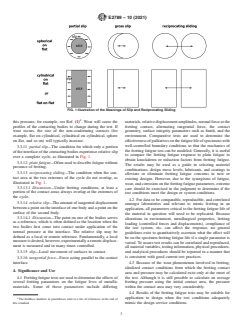
FIG. 1 Illustration of the Meanings of Slip and Reciprocating Sliding
this pressure; for example, see Ref. (1) . Wear will cause the materials,relativedisplacementamplitudes,normalforceatthe
profiles of the contacting bodies to change during the test. If fretting contact, alternating tangential force, the contact
wear occurs, the size of the non-conforming contacts (for geometry, surface integrity parameters such as finish, and the
example, flat on cylindrical, cylindrical on cylindrical, sphere environment. Comparative tests are used to determine the
on flat, and so on) will typically increase. effectivenessofpalliativesonthefatiguelifeofspecimenswith
well-controlled boundary conditions so that the mechanics of
3.3.11 partial slip—The condition for which only a portion
the fretting fatigue test can be modeled. Generally, it is useful
oftheinterfaceofthecontactingbodiesexperiencerelativeslip
to compare the fretting fatigue response to plain fatigue to
over a complete cycle, as illustrated in Fig. 1.
obtain knockdown or reduction factors from fretting fatigue.
3.3.12 plain fatigue—Often used to describe fatigue without
The results may be used as a guide in selecting material
presence of fretting.
combinations, design stress levels, lubricants, and coatings to
3.3.13 reciprocating sliding—The condition when the con-
alleviate or eliminate fretting fatigue concerns in new or
tact area at the two extremes of the cycle do not overlap, as
existing designs. However, due to the synergisms of fatigue,
illustrated in Fig. 1.
wear, and corrosion on the fretting fatigue parameters, extreme
3.3.13.1 Discussion—Under fretting conditions, at least a
care should be exercised in the judgment to determine if the
portion of the contact areas always overlap at the extremes of
test conditions meet the design or system conditions.
the cycle.
4.2 For data to be comparable, reproducible, and correlated
3.3.14 relative slip—The amount of tangential displacement
amongst laboratories and relevant to mimic fretting in an
between a point on the interface of one body and a point on the
application, all parameters critical to the fretting fatigue life of
surface of the second body.
the material in question will need to be replicated. Because
3.3.14.1 Discussion—The point on one of the bodies serves
alterations in environment, metallurgical properties, fretting
as a reference, which is often defined as the location when the
loading (controlled forces and displacements), compliance of
two bodies first come into contact under application of the
the test system, etc. can affect the response, no general
normal pressure at the interface. The relative slip may be
guidelines exist to quantitatively ascertain what the effect will
defined as a local or remote reference. Fundamentally, a local
be on the specimen fretting fatigue life if a single parameter is
measureisdesired,however,experimentallyaremotedisplace-
varied. To assure test results can be correlated and reproduced,
ment is measured and in many times controlled.
all material variables, testing information, physical procedures,
3.3.15 slip—Local movement of surfaces in contact. and analytical procedures should be reported in a manner that
is consistent with good current test practices.
3.3.16 tangential force—Force acting parallel to the contact
interface.
4.3 Because of the wear phenomenon involved in fretting,
idealized contact conditions from which the fretting contact
4. Significance and Use
area and pressure may be calculated exist only at the onset of
the test. Although it is still possible to calculate an average
4.1 Fretting fatigue tests are used to determine the effects of
several fretting parameters on the fatigue lives of metallic fretting pressure using the initial contact area, the pressure
within the contact area may vary considerably.
materials. Some of these parameters include differing
4.4 Results of the fretting fatigue tests may be suitable for
application to design when the test conditions adequately
The boldface numbers in parentheses refer to a list of references at the end of
this standard. mimic the design service conditions.
E2789 − 10 (2021)
5. Background wear regime, a fretting wear test may be more relevant. See
Guide G190 on developing and selecting wear tests.
5.1 Interfacial Conditions:
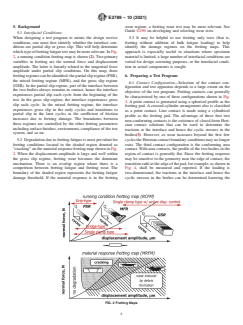
When designing a test program to mimic the design service 5.3 It may be helpful to use fretting only tests (that is,
conditions, one must first identify whether the interface con- fretting without addition of bulk fatigue loading) to help
ditions are partial slip or gross slip. This will help determine identify the damage regimes on the fretting maps. This
whichtypeoffrettingfatiguetestmaybemorerelevant.InFig. approach is especially useful in situations where specimen
2, a running condition fretting map is shown (2). Two primary material is limited, a large number of interfacial conditions are
variables in fretting are the normal force and displacement varied for design screening purposes, or the interfacial condi-
amplitude. The latter is linearly related to the tangential force tion in actual components is sought.
amplitude under partial slip conditions. On this map, three
frettingregimescanbeidentified:thepartialslipregime(PSR), 6. Preparing a Test Program
the mixed fretting regime (MFR), and the gross slip regime
6.1 Contact Configuration—Selection of the contact con-
(GSR). In the partial slip regime, part of the interface between
figuration and test apparatus depends to a large extent on the
the two bodies always remains in contact, hence the interface
objective of the test program. Fretting contacts can generally
experiences partial slip each cycle from the beginning of the
be characterized by one of three configurations shown in Fig.
test. In the gross slip regime, the interface experiences gross
3. A point contact is generated using a spherical profile as the
slip each cycle. In the mixed fretting regime, the interface
fretting pad. A crossed-cylinder arrangement also is classified
experiences gross slip in the early cycles and transitions to
as a point contact. Line contact is made using a cylindrical
partial slip in the later cycles as the coefficient of friction
profile as the fretting pad. The advantage of these first two
increases due to fretting damage. The boundaries between
non-conforming contacts is the existence of closed-form Hert-
these regimes are controlled by the other fretting parameters
zian contact solutions that can be used to determine the
including surface finishes, environment, compliance of the test
tractions at the interface and hence the cyclic stresses in the
system, and so on.
bodies(3). However, as wear increases beyond the first few
5.2 Degradation due to fretting fatigue is most prevalent for cyclestheHertziancontactboundaryconditionsmaynolonger
fretting conditions located in the shaded region denoted as exist. The third contact configuration is the conforming area
“cracking” on the material response fretting map shown in Fig. contact. With area contacts, the profile of the two bodies in the
2. When the displacement amplitude is large and well within region of contact is generally flat. Since the fretting response
the gross slip regime, fretting wear becomes the dominant may be sensitive to the geometry near the edge of contact, the
mechanism. There is an overlap region where there is a transition radii at the edge of the pad, for example, as shown in
competition between fretting fatigue and fretting wear. The Fig. 4, shall be measured and reported. If the loading is
boundary of the shaded region represents the fretting fatigue two-dimensional, the tractions at the interface and hence the
damage threshold. If the material response is in the fretting cyclic stresses in the bodies can be determined knowing the
FIG. 2 Fretting Maps
E2789 − 10 (2021)
FIG. 3 Fretting Contact Configurations
FIG. 4 Two Possible Fretting Pad Geometries with Area Contacts Showing Dimensions of Area Contact (c ) and Bending Radii (R )
o c
geometry of the pad (4).At the microscopic scale, the surfaces 6.2 Loading Configurations:
are not perfectly smooth, and hence the real tractions depend 6.2.1 Fretting fatigue tests are generally one of three types
on the roughness (3). of loading configurations, shown in Fig. 5. Each loading
6.1.1 It is recommended that in the case of line and area configuration targets specific regimes as noted on the fretting
contacts, the edges of the two bodies perpendicular to the map shown in Fig. 2. In this description, the fatigue specimen
direction of fretting be aligned, as illustrated in Fig. 3,to is designed to undergo axial loading similar to Practice E466.
minimize the concentration of pressure at this edge, unless the Themeritsofbendingloadingarediscussedlater.Adescription
purpose of the test is to investigate this edge effect. of the unique features of each configuration follows.
E2789 − 10 (2021)
FIG. 5 Fretting Fatigue Test Configurations
6.2.2 Bridge-type fretting fatigue test—This test typically (JSME) (6). Presently, there are no ASTM standard test
involves clamping two bridgeshaped fretting pads to the gage methods or standard practices for specific fretting fatigue test
section of a fatigue specimen as shown in Fig. 5(a) (5, 6). The configurations.
clampandfrettingpadsarenotattachedtotheframeandhence 6.2.2.2 The normal force is measured using an instrumented
are free of any additional external loading. The displacement proving ring (5), small force transducer, or instrumented bolt.
amplitude is generated when the fatigue specimen is cycled. The fretting clamping apparatus should have low mass to
The displacement amplitude depends on the differential be- reduce inertia loading if running the experiments at higher
tween the cyclic strain in the fatigue specimen between the frequencies. The fretting test should be operated at test
fretting pad feet and the cyclic strain induced in the fretting frequencies below this frequency-affected regime. The upper
pads from the frictional force at the contacting interfaces. limitontestfrequencymaybedeterminedbymodalanalysisor
Therefore, the displacement amplitude depends on the elastic it may be determined by increasing the frequency until the
properties of the fatigue specimen and pads as well as the tangential force – displacement hysteresis response signifi-
coefficientoffrictionatthecontactinginterface.Foragivenset cantly changes. Since displacement is proportional to axial
of materials and coefficient of friction, the displacement force in the bridge-type fretting fatigue test configuration,
amplitude
...