


ASTM D4215-21
(Specification)Standard Specification for Cold-Mixed, Cold-Laid Asphalt Paving Mixtures
Standard Specification for Cold-Mixed, Cold-Laid Asphalt Paving Mixtures
ABSTRACT
This specification covers cold-mixed, cold-laid and recycled cold-mixed, cold-laid bituminous paving mixtures for base, binder, leveling, and surface courses. The following shall conform to the specified requirements: coarse and fine aggregates, mineral filler, bitumen, and composition of bituminous paving mixtures. The equipment for mixing shall be one of the following: central plant, travel plant, and grand or drag. The mixing operations are detailed and includes: (1) aggregate storage, (2) old bituminous pavement, (3) preparation of bitumen, (4) preparation and handling of mineral aggregates, (5) preparation and handling of bitumen aggregates for recycling, (6) preparation of mixture, and (7) mixing plant inspection. The tests methods that shall be used to determine the properties are sieve analysis of aggregates, sieve analysis of mineral filler, determination of bitumen content, specific gravity of coarse aggregate, specific gravity of coarse aggregate, plasticity index, and percentage of coated particles.
SCOPE
1.1 This specification covers cold-mixed, cold-laid and recycled cold-mixed, cold-laid asphalt paving mixtures for base, binder, leveling, and surface courses.
1.2 This international standard was developed in accordance with internationally recognized principles on standardization established in the Decision on Principles for the Development of International Standards, Guides and Recommendations issued by the World Trade Organization Technical Barriers to Trade (TBT) Committee.
General Information
- Status
- Published
- Publication Date
- 30-Apr-2021
- Technical Committee
- D04 - Road and Paving Materials
- Drafting Committee
- D04.27 - Cold Mix Asphalts
Relations
- Effective Date
- 01-Dec-2023
- Effective Date
- 01-May-2020
- Effective Date
- 01-Dec-2019
- Effective Date
- 01-Nov-2019
- Effective Date
- 01-Nov-2019
- Effective Date
- 01-Nov-2019
- Effective Date
- 01-Nov-2019
- Effective Date
- 01-Aug-2019
- Effective Date
- 01-May-2019
- Effective Date
- 01-May-2019
- Effective Date
- 01-May-2019
- Effective Date
- 01-Mar-2019
- Effective Date
- 15-Dec-2018
- Effective Date
- 15-Aug-2018
- Effective Date
- 01-Jul-2018
Overview
ASTM D4215-21: Standard Specification for Cold-Mixed, Cold-Laid Asphalt Paving Mixtures is a widely recognized standard developed by ASTM International. This specification sets out requirements for cold-mixed, cold-laid, and recycled cold-mixed, cold-laid bituminous paving mixtures. These mixtures are used for base, binder, leveling, and surface courses in road and pavement construction. The standard addresses material requirements, composition, mixing operations, and applicable testing methods to ensure durable, high-quality pavement installations.
Key Topics
- Material Requirements:
- Specifies requirements for coarse and fine aggregates, mineral filler, and various types of bitumen including emulsion and cutback asphalts.
- Aggregates must conform to relevant ASTM specifications, such as D692 for coarse aggregate and D1073 for fine aggregate.
- Mixture Composition:
- Outlines the criteria for selecting and combining aggregates and bituminous materials.
- Allows for the use of recycled asphalt pavement in cold-mixed, cold-laid mixtures, provided quality standards are maintained.
- Mixing Operations:
- Details procedures for aggregate storage, handling recycled materials, preparation of bitumen, and the mixing process.
- Defines suitable equipment, including central plants, travel plants, and graders or drags.
- Testing Methods:
- Cites ASTM testing procedures for sieve analysis, specific gravity, bitumen content, plasticity index, and percentage of coated particles.
- Ensures compliance with gradation, binder content, and coating tolerances to maintain mixture performance.
- Quality Assurance:
- Emphasizes the importance of accurate sampling, testing, and plant inspection throughout construction.
Applications
The cold-mixed, cold-laid asphalt mixtures specified in ASTM D4215-21 play a vital role in modern infrastructure projects. Typical applications include:
- Road and Highway Construction:
- Suitable for use as base, binder, leveling, and surface courses in constructing new roads or rehabilitating existing pavements.
- Pavement Repairs:
- Used in maintenance operations for patching, overlays, and cold recycling of deteriorated pavement.
- Rural and Low-Volume Roads:
- Provides an economical paving solution in locations where hot mix asphalt production or placement may not be practical.
- Municipal and Utility Work:
- Ideal for utility trench reinstatements, parking lots, driveways, and minor surface repairs, especially in cooler climates or remote locations.
- Recycling Initiatives:
- Supports sustainable pavement practices by incorporating reclaimed asphalt pavement (RAP) into new cold-mix formulations.
Related Standards
A number of other ASTM standards are referenced in ASTM D4215-21 for ensuring quality and compatibility of materials and processes. Some key related standards include:
- ASTM D692 / D1073: Specifications for coarse and fine aggregates used in asphalt mixtures.
- ASTM D242: Specification for mineral filler for asphalt mixtures.
- ASTM D977 / D2397: Specifications for emulsified asphalt.
- ASTM C136 / D546: Test methods for sieve analysis of materials.
- ASTM D2172: Methods for quantifying asphalt binder content in mixtures.
- ASTM D4318: Test methods for soil plasticity properties important for certain aggregates.
- ASTM D2489: Procedures to determine the degree of particle coating in asphalt mixtures.
- ASTM D979: Practices for sampling bituminous paving mixtures.
For adherence to best practices and optimal performance, users should consult the most current versions of the referenced standards.
ASTM D4215-21 ensures that cold-mixed, cold-laid asphalt paving mixtures meet stringent performance requirements, supporting cost-effective, reliable, and sustainable road construction and maintenance practices worldwide.
Buy Documents

ASTM D4215-21 - Standard Specification for Cold-Mixed, Cold-Laid Asphalt Paving Mixtures
REDLINE ASTM D4215-21 - Standard Specification for Cold-Mixed, Cold-Laid Asphalt Paving Mixtures
Get Certified
Connect with accredited certification bodies for this standard

ICC Evaluation Service
Building products evaluation and certification.

QAI Laboratories
Building and construction product testing and certification.

Zavod za gradbeništvo Slovenije (ZAG) - Inšpekcija
ZAG inspection body for construction products, structures, and materials.
Sponsored listings
Frequently Asked Questions
ASTM D4215-21 is a technical specification published by ASTM International. Its full title is "Standard Specification for Cold-Mixed, Cold-Laid Asphalt Paving Mixtures". This standard covers: ABSTRACT This specification covers cold-mixed, cold-laid and recycled cold-mixed, cold-laid bituminous paving mixtures for base, binder, leveling, and surface courses. The following shall conform to the specified requirements: coarse and fine aggregates, mineral filler, bitumen, and composition of bituminous paving mixtures. The equipment for mixing shall be one of the following: central plant, travel plant, and grand or drag. The mixing operations are detailed and includes: (1) aggregate storage, (2) old bituminous pavement, (3) preparation of bitumen, (4) preparation and handling of mineral aggregates, (5) preparation and handling of bitumen aggregates for recycling, (6) preparation of mixture, and (7) mixing plant inspection. The tests methods that shall be used to determine the properties are sieve analysis of aggregates, sieve analysis of mineral filler, determination of bitumen content, specific gravity of coarse aggregate, specific gravity of coarse aggregate, plasticity index, and percentage of coated particles. SCOPE 1.1 This specification covers cold-mixed, cold-laid and recycled cold-mixed, cold-laid asphalt paving mixtures for base, binder, leveling, and surface courses. 1.2 This international standard was developed in accordance with internationally recognized principles on standardization established in the Decision on Principles for the Development of International Standards, Guides and Recommendations issued by the World Trade Organization Technical Barriers to Trade (TBT) Committee.
ABSTRACT This specification covers cold-mixed, cold-laid and recycled cold-mixed, cold-laid bituminous paving mixtures for base, binder, leveling, and surface courses. The following shall conform to the specified requirements: coarse and fine aggregates, mineral filler, bitumen, and composition of bituminous paving mixtures. The equipment for mixing shall be one of the following: central plant, travel plant, and grand or drag. The mixing operations are detailed and includes: (1) aggregate storage, (2) old bituminous pavement, (3) preparation of bitumen, (4) preparation and handling of mineral aggregates, (5) preparation and handling of bitumen aggregates for recycling, (6) preparation of mixture, and (7) mixing plant inspection. The tests methods that shall be used to determine the properties are sieve analysis of aggregates, sieve analysis of mineral filler, determination of bitumen content, specific gravity of coarse aggregate, specific gravity of coarse aggregate, plasticity index, and percentage of coated particles. SCOPE 1.1 This specification covers cold-mixed, cold-laid and recycled cold-mixed, cold-laid asphalt paving mixtures for base, binder, leveling, and surface courses. 1.2 This international standard was developed in accordance with internationally recognized principles on standardization established in the Decision on Principles for the Development of International Standards, Guides and Recommendations issued by the World Trade Organization Technical Barriers to Trade (TBT) Committee.
ASTM D4215-21 is classified under the following ICS (International Classification for Standards) categories: 91.100.50 - Binders. Sealing materials; 93.080.20 - Road construction materials. The ICS classification helps identify the subject area and facilitates finding related standards.
ASTM D4215-21 has the following relationships with other standards: It is inter standard links to ASTM D140/D140M-16(2023), ASTM D692/D692M-20, ASTM D2027/D2027M-19, ASTM D977-19ae1, ASTM D977-19a, ASTM D2397/D2397M-19a, ASTM D75/D75M-19, ASTM D8-19, ASTM D2397/D2397M-19, ASTM D242/D242M-19, ASTM D977-19, ASTM E145-19, ASTM D8-18c, ASTM D8-18b, ASTM D8-18a. Understanding these relationships helps ensure you are using the most current and applicable version of the standard.
ASTM D4215-21 is available in PDF format for immediate download after purchase. The document can be added to your cart and obtained through the secure checkout process. Digital delivery ensures instant access to the complete standard document.
Standards Content (Sample)
This international standard was developed in accordance with internationally recognized principles on standardization established in the Decision on Principles for the
Development of International Standards, Guides and Recommendations issued by the World Trade Organization Technical Barriers to Trade (TBT) Committee.
Designation: D4215 −21
Standard Specification for
Cold-Mixed, Cold-Laid Asphalt Paving Mixtures
This standard is issued under the fixed designation D4215; the number immediately following the designation indicates the year of
original adoption or, in the case of revision, the year of last revision. A number in parentheses indicates the year of last reapproval. A
superscript epsilon (´) indicates an editorial change since the last revision or reapproval.
1. Scope D1073 Specification for Fine Aggregate for Asphalt Paving
Mixtures
1.1 This specification covers cold-mixed, cold-laid and
D2026/D2026M Specification for Cutback Asphalt (Slow-
recycled cold-mixed, cold-laid asphalt paving mixtures for
Curing Type)
base, binder, leveling, and surface courses.
D2027/D2027M Specification for Cutback Asphalt
1.2 This international standard was developed in accor-
(Medium-Curing Type)
dance with internationally recognized principles on standard-
D2028/D2028M Specification for Cutback Asphalt (Rapid-
ization established in the Decision on Principles for the
Curing Type)
Development of International Standards, Guides and Recom-
D2172/D2172M TestMethodsforQuantitativeExtractionof
mendations issued by the World Trade Organization Technical
Asphalt Binder from Asphalt Mixtures
Barriers to Trade (TBT) Committee.
D2397/D2397M Specification for Cationic Emulsified As-
phalt
2. Referenced Documents
D2399 Practice for Selection of Cutback Asphalts
2.1 ASTM Standards:
D2489/D2489M Test Method for Estimating Degree of Par-
C127 Test Method for Relative Density (Specific Gravity)
ticle Coating of Asphalt Mixtures
and Absorption of Coarse Aggregate
D3515 Specification for Hot-Mixed, Hot-Laid Bituminous
C128 Test Method for Relative Density (Specific Gravity)
Paving Mixtures (Withdrawn 2009)
and Absorption of Fine Aggregate
D3628 PracticeforSelectionandUseofEmulsifiedAsphalts
C136/C136M Test Method for Sieve Analysis of Fine and
D4318 Test Methods for Liquid Limit, Plastic Limit, and
Coarse Aggregates
Plasticity Index of Soils
D8 Terminology Relating to Materials for Roads and Pave-
E145 Specification for Gravity-Convection and Forced-
ments
Ventilation Ovens
D75/D75M Practice for Sampling Aggregates
D140/D140M Practice for Sampling Asphalt Materials 3. Terminology
D242/D242M Specification for Mineral Filler for Asphalt
3.1 Definitions are in accordance with Terminology D8.
Mixtures
3.2 Definitions of Terms Specific to This Standard:
D448 Classification for Sizes of Aggregate for Road and
3.2.1 asphalt-aggregate for recycling—asphalt pavement or
Bridge Construction
paving mixture removed from its original location and reduced
D546 Test Method for Sieve Analysis of Mineral Filler for
by suitable means, after removal or in place, to such particle
Asphalt Paving Mixtures
size as may be required for use in cold-mixed, cold-laid
D692/D692M Specification for Coarse Aggregate for As-
recycled asphalt paving mixtures.
phalt Paving Mixtures
D977 Specification for Emulsified Asphalt 3.2.2 cold-mixed, cold-laid asphalt paving mixtures—
D979/D979M Practice for Sampling Bituminous Paving mixtures of coarse and fine aggregates, or coarse or fine
Mixtures aggregate alone, with or without mineral filler, uniformly
mixed and laid at or near ambient temperature.
3.2.3 cold-mixed, cold-laid recycled asphalt paving
This specification is under the jurisdiction of ASTM Committee D04 on Road
mixtures—mixtures of asphalt aggregate for recycling with
and Paving Materials and is the direct responsibility of Subcommittee D04.27 on
Cold Mix Asphalts.
additional mineral aggregate as necessary, with or without
Current edition approved May 1, 2021. Published May 2021. Originally
mineral filler, mixed at or near ambient temperatures with
approved in 1982. Last previous edition approved in 2013 as D4215 – 07 (2013).
additional asphalt.
DOI: 10.1520/D4215-21.
For referenced ASTM standards, visit the ASTM website, www.astm.org, or
contact ASTM Customer Service at service@astm.org. For Annual Book of ASTM
Standards volume information, refer to the standard’s Document Summary page on The last approved version of this historical standard is referenced on
the ASTM website. www.astm.org.
Copyright © ASTM International, 100 Barr Harbor Drive, PO Box C700, West Conshohocken, PA 19428-2959. United States
D4215 − 21
4. Ordering Information 7.3 When cold-mixed, cold-laid recycled mixtures are
produced, asphalt conforming to 7.1 or 7.2 shall be added to
4.1 Orders for cold asphalt paving mixtures under this
the asphalt aggregate for recycling as necessary.
specification shall include the following information:
4.1.1 Type of asphalt (emulsified asphalt, cutback asphalt),
NOTE 3—Various asphalt modifiers or recycling agents have been used
4.1.2 Grade of asphalt, on a number of cold-mixed, cold-laid recycled asphalt paving projects.
Specifications for these materials are being developed.
4.1.3 The composition of the asphalt paving mixture (dense
mixture and mix designation; open mixture and mix designa-
8. Composition of Asphalt Paving Mixtures
tion; open-graded friction course mixture and mix
designation),
8.1 The mixture shall conform to one of the compositions
4.1.4 The maximum percentage of asphalt aggregate for
by weight given in Table 1 of Specification D3515.
recycling permitted in the mixture, and
NOTE 4—The mix designation selected should be determined by the
4.1.5 The percentage of crushed particles required in the
intended use, thickness of paving courses, and desired texture. The
aggregate if different from that specified in 5.2.
required mix sbould be specified.
8.1.1 Compositions shown in Table 1 of Specification
5. Aggregates
D3515 are based on the use of fine and coarse aggregates
5.1 The aggregates shall be crushed stone, crushed slag,
having approximately the same bulk specific gravities; grading
crushed gravel, or sand conforming to the quality requirement
of the total aggregate, therefore, would be the same on either a
of the appropriate ASTM specifications as follows:
weight or bulk volume basis. If the bulk specific gravities of
5.1.1 Coarse Aggregate—Specification D692/D692M.
coarse and fine aggregates differ greatly, it may be desirable to
5.1.2 Fine Aggregate—Specification D1073.
change the grading limitations to compensate for these differ-
ences.
NOTE 1—Other mineral aggregates, such as uncrushed gravel and
crushed shell, may be specified, provided that local experience or tests
8.2 A job-mix formula shall be selected that comes within
have demonstrated their ability to produce satisfactory asphalt paving
the specification limits and that is suitable for the traffic,
mixtures.
climatic conditions, and specific gravities of the aggregates
5.2 The aggregates for open-graded friction course mixture
used. Below the No. 8 (2.36 mm) sieve size, the job-mix
described in Table 2 of Specification D3515 shall meet all the
formulagradingcurveshallbereasonablyparalleltothecurves
requirements of 5.1 with the added requirement that (1) the
of the grading limits as selected from Table 1 of Specification
coarse particles, retained on the No. 4 sieve, be crushed so that
D3515.
at least 90 weight percent have one or more fractured faces and
8.3 Any variation from the job-mix formula in the grading
75weightpercenthavetwoormorefracturedfaces;and(2)the
of the aggregate, as shown by the sieve analyses of materials
coarse aggregate, or if a blend is used, the coarsest fraction be
(Note 5), or any variation from the job-mix formula in the
of a type known to possess adequate resistance to the polishing
asphalt content, as indicated by extraction tests of the finished
action of the anticipated traffic.
mixture (Note 6) greater than the tolerances shown in Table 3
5.3 Recommended grading requirements for coarse and fine
of Specification D3515, shall be investigated and the condi-
aggregate may be selected from Classification D448 and
tions causing such variation shall be corrected (Note 7).
Specification D1073, respectively. Other aggregate gradations
may be used, provided that the combined coarse and fine NOTE 5—It is recognized that the extraction tes
...
This document is not an ASTM standard and is intended only to provide the user of an ASTM standard an indication of what changes have been made to the previous version. Because
it may not be technically possible to adequately depict all changes accurately, ASTM recommends that users consult prior editions as appropriate. In all cases only the current version
of the standard as published by ASTM is to be considered the official document.
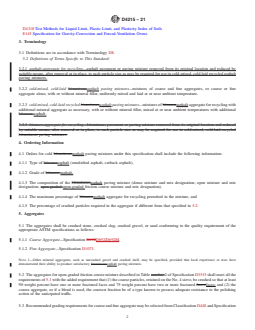
Designation: D4215 − 07 (Reapproved 2013) D4215 − 21
Standard Specification for
Cold-Mixed, Cold-Laid BituminousAsphalt Paving Mixtures
This standard is issued under the fixed designation D4215; the number immediately following the designation indicates the year of
original adoption or, in the case of revision, the year of last revision. A number in parentheses indicates the year of last reapproval. A
superscript epsilon (´) indicates an editorial change since the last revision or reapproval.
1. Scope
1.1 This specification covers cold-mixed, cold-laid and recycled cold-mixed, cold-laid bituminousasphalt paving mixtures for
base, binder, leveling, and surface courses.
1.2 This international standard was developed in accordance with internationally recognized principles on standardization
established in the Decision on Principles for the Development of International Standards, Guides and Recommendations issued
by the World Trade Organization Technical Barriers to Trade (TBT) Committee.
2. Referenced Documents
2.1 ASTM Standards:
C127 Test Method for Relative Density (Specific Gravity) and Absorption of Coarse Aggregate
C128 Test Method for Relative Density (Specific Gravity) and Absorption of Fine Aggregate
C136C136/C136M Test Method for Sieve Analysis of Fine and Coarse Aggregates
D8 Terminology Relating to Materials for Roads and Pavements
D75D75/D75M Practice for Sampling Aggregates
D140D140/D140M Practice for Sampling Asphalt Materials
D242D242/D242M Specification for Mineral Filler for Asphalt Mixtures
D448 Classification for Sizes of Aggregate for Road and Bridge Construction
D546 Test Method for Sieve Analysis of Mineral Filler for Asphalt Paving Mixtures
D692D692/D692M Specification for Coarse Aggregate for Asphalt Paving Mixtures
D977 Specification for Emulsified Asphalt
D979D979/D979M Practice for Sampling Bituminous Paving Mixtures
D1073 Specification for Fine Aggregate for Asphalt Paving Mixtures
D2026D2026/D2026M Specification for Cutback Asphalt (Slow-Curing Type)
D2027D2027/D2027M Specification for Cutback Asphalt (Medium-Curing Type)
D2028D2028/D2028M Specification for Cutback Asphalt (Rapid-Curing Type)
D2172D2172/D2172M Test Methods for Quantitative Extraction of Asphalt Binder from Asphalt Mixtures
D2397D2397/D2397M Specification for Cationic Emulsified Asphalt
D2399 Practice for Selection of Cutback Asphalts
D2489D2489/D2489M Test Method for Estimating Degree of Particle Coating of Asphalt Mixtures
D3515 Specification for Hot-Mixed, Hot-Laid Bituminous Paving Mixtures (Withdrawn 2009)
D3628 Practice for Selection and Use of Emulsified Asphalts
This specification is under the jurisdiction of ASTM Committee D04 on Road and Paving Materials and is the direct responsibility of Subcommittee D04.27 on Cold
Mix Asphalts.
Current edition approved June 1, 2013May 1, 2021. Published September 2013May 2021. Originally approved in 1982. Last previous edition approved in 20072013 as
D4215 – 07.D4215 – 07 (2013). DOI: 10.1520/D4215-07R13.10.1520/D4215-21.
For referenced ASTM standards, visit the ASTM website, www.astm.org, or contact ASTM Customer Service at service@astm.org. For Annual Book of ASTM Standards
volume information, refer to the standard’s Document Summary page on the ASTM website.
The last approved version of this historical standard is referenced on www.astm.org.
Copyright © ASTM International, 100 Barr Harbor Drive, PO Box C700, West Conshohocken, PA 19428-2959. United States
D4215 − 21
D4318 Test Methods for Liquid Limit, Plastic Limit, and Plasticity Index of Soils
E145 Specification for Gravity-Convection and Forced-Ventilation Ovens
3. Terminology
3.1 Definitions are in accordance with Terminology D8.
3.2 Definitions of Terms Specific to This Standard:
3.2.1 asphalt-aggregate for recycling—asphalt pavement or paving mixture removed from its original location and reduced by
suitable means, after removal or in place, to such particle size as may be required for use in cold-mixed, cold-laid recycled asphalt
paving mixtures.
3.2.2 cold-mixed, cold-laid bituminousasphalt paving mixtures—mixtures of coarse and fine aggregates, or coarse or fine
aggregate alone, with or without mineral filler, uniformly mixed and laid at or near ambient temperature.
3.2.3 cold-mixed, cold-laid recycled bituminousasphalt paving mixtures—mixtures of bitumenasphalt aggregate for recycling with
additional mineral aggregate as necessary, with or without mineral filler, mixed at or near ambient temperatures with additional
bitumen.asphalt.
3.2.3 bitumen-aggregate for recycling—bituminous pavement or paving mixture removed from its original location and reduced
by suitable means, after removal or in place, to such particle size as may be required for use in cold-mixed, cold-laid recycled
bituminous paving mixtures.
4. Ordering Information
4.1 Orders for cold bituminousasphalt paving mixtures under this specification shall include the following information:
4.1.1 Type of bitumenasphalt (emulsified asphalt, cutback asphalt),
4.1.2 Grade of bitumen,asphalt,
4.1.3 The composition of the bituminousasphalt paving mixture (dense mixture and mix designation; open mixture and mix
designation; open graded open-graded friction course mixture and mix designation),
4.1.4 The maximum percentage of bitumenasphalt aggregate for recycling permitted in the mixture, and
4.1.5 The percentage of crushed particles required in the aggregate if different from that specified in 5.2.
5. Aggregates
5.1 The aggregates shall be crushed stone, crushed slag, crushed gravel, or sand conforming to the quality requirement of the
appropriate ASTM specifications as follows:
5.1.1 Coarse Aggregate—Specification D692D692/D692M.
5.1.2 Fine Aggregate—Specification D1073.
NOTE 1—Other mineral aggregates, such as uncrushed gravel and crushed shell, may be specified, provided that local experience or tests have
demonstrated their ability to produce satisfactory bituminousasphalt paving mixtures.
5.2 The aggregates for open-graded friction course mixture described in Table number 2 of Specification D3515 shall meet all the
requirements of 5.1 with the added requirement that (1) the coarse particles, retained on the No. 4 sieve, be crushed so that at least
90 weight percent have one or more fractured faces and 75 weight percent have two or more fractured faces,faces; and (2) the
coarse aggregate, or if a blend is used, the coarsest fraction be of a type known to possess adequate resistance to the polishing
action of the anticipated traffic.
5.3 Recommended grading requirements for coarse and fine aggregate may be selected from Classification D448 and Specification
D4215 − 21
D1073, respectively. Other aggregate gradations may be used, provided that the combined coarse and fine aggregates, and filler,
when used, produce a mixture that conforms to the requirements for grading of total aggregate as described in Table number 1 of
Specification D3515.
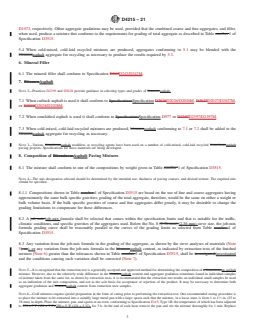
5.4 When cold-mixed, cold-laid recycled mixtures are produced, aggregates conforming to 5.1 may be blended with the
bitumenasphalt aggregate for recycling as necessary to produce the results required by 5.3.
6. Mineral Filler
6.1 The mineral filler shall conform to Specification D242D242/D242M.
7. BitumenAsphalt
NOTE 2—Practices D2399 and D3628 provide guidance in selecting types and grades of bitumen.asphalt.
7.1 When cutback asphalt is used it shall conform to SpecificationsSpecification D2026D2026/D2026M, D2027D2027/D2027M,
or D2028D2028/D2028M.
7.2 When emulsified asphalt is used it shall conform to SpecificationsSpecification D977 or D2397D2397/D2397M.
7.3 When cold-mixed, cold-laid recycled mixtures are produced, bitumenasphalt conforming to 7.1 or 7.2 shall be added to the
bitumenasphalt aggregate for recycling as necessary.
NOTE 3—Various bituminousasphalt modifiers or recycling agents have been used on a number of cold-mixed, cold-laid recycled bituminousasphalt
paving projects. Specifications for these materials are being developed.
8. Composition of BituminousAsphalt Paving Mixtures
8.1 The mixture shall conform to one of the compositions by weight given in Table number 1 of Specification D3515.
NOTE 4—The mix designation selected should be determined by the intended use, thickness of paving courses, and desired texture. The required mix
sbould be specified.
8.1.1 Compositions shown in Table number 1 of Specification D3515 are based on the use of fine and coarse aggregates having
approximately the same bulk specific gravities; grading of the total aggregate, therefore, would be the same on either a weight or
bulk volume basis. If the bulk specific gravities of coarse and fine a
...
Questions, Comments and Discussion
Ask us and Technical Secretary will try to provide an answer. You can facilitate discussion about the standard in here.
Loading comments...