

ASTM D5505-14(2020)
(Practice)Standard Practice for Classifying Emulsified Recycling Agents
General Information
- Abstract
SIGNIFICANCE AND USE
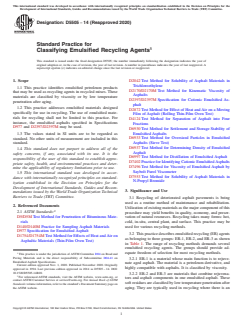
3.1 Recycling of deteriorated asphalt pavements is being used as a routine method of maintenance and rehabilitation. Utilization of existing materials as the major component of this procedure may yield benefits in quality, economy, and preservation of natural resources. Recycling takes many forms: hot, cold, in-situ, central plant, and surface. This practice may be used for various recycling methods.
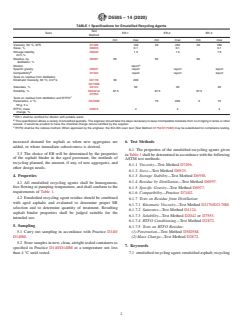
3.2 This practice describes emulsified recycling (ER) agents as belonging to three groups: ER-1, ER-2, and ER-3 as shown in Table 1. The range of recycling methods demands several emulsified recycling agents. The groups should provide adequate freedom of selection for most recycling methods. (A) ER-1 shall be certified for dilution with potable water.(B) This specification allows a variety of emulsified asphalts. The engineer should take the steps necessary to keep incompatible materials from co-mingling in tanks or other vessels. It would be prudent to have the chemical charge nature certified by the supplier.(C) RTFO shall be the referee method. When approved by the engineer, the thin-film oven test (Test Method D1754/D1754M) may be substituted for compliance testing.
3.2.1 ER-1 is a material whose main function is to rejuvenate aged asphalt. The material is a petroleum derivative, and highly compatible with asphalts. It is classified by viscosity.
3.2.2 ER-2 and ER-3 are materials that combine rejuvenators and asphalt components in one emulsified asphalt. These soft residues are classified by low temperature penetration after aging. They are typically used in recycling where there is an increased demand for asphalt as when new aggregates are added, or where immediate cohesiveness is desired.
3.3 The choice of ER will be determined by the properties of the asphalt binder in the aged pavement, the methods of recycling planned, the amount, if any, of new aggregates, and other design needs.
SCOPE
1.1 This practice identifies emulsified petroleum products that may be used as recycling agents in recycled mixes. These materials are classified by viscosity or by low temperature penetration after aging.
1.2 This practice addresses emulsified materials designed specifically for use in recycling. The use of emulsified materials for recycling shall not be limited to this practice. For instance, the emulsified asphalts specified in Specifications D977 and D2397/D2397M may be used.
1.3 The values stated in SI units are to be regarded as standard. No other units of measurement are included in this standard.
1.4 This standard does not purport to address all of the safety concerns, if any, associated with its use. It is the responsibility of the user of this standard to establish appropriate safety, health, and environmental practices and determine the applicability of regulatory limitations prior to use.
1.5 This international standard was developed in accordance with internationally recognized principles on standardization established in the Decision on Principles for the Development of International Standards, Guides and Recommendations issued by the World Trade Organization Technical Barriers to Trade (TBT) Committee.
- Status
- Published
- Publication Date
- 31-Oct-2020
- Technical Committee
- D04 - Road and Paving Materials
- Drafting Committee
- D04.41 - Emulsified Asphalt Specifications


Overview
ASTM D5505-14(2020): Standard Practice for Classifying Emulsified Recycling Agents is an international standard developed by ASTM International to provide guidelines for identifying and classifying emulsified petroleum products used as recycling agents in recycled asphalt mixes. The document supports the effective selection of emulsified recycling (ER) agents according to their properties, use cases, and performance requirements in pavement maintenance and rehabilitation projects.
With the increased focus on resource conservation and sustainability, recycling of deteriorated asphalt pavements has become a standard practice worldwide. This standard ensures proper classification and use of emulsified recycling agents, thus optimizing pavement quality, cost-efficiency, and preservation of natural resources.
Key Topics
Classification of ER Agents: The practice divides emulsified recycling agents into three main groups:
- ER-1: Primarily a rejuvenator for aged asphalt, classified by viscosity and highly compatible with existing asphalt materials.
- ER-2 and ER-3: Combine rejuvenators and asphalt components, classified by low-temperature penetration after aging. Ideal when additional asphalt or immediate cohesiveness is needed, especially with new aggregates.
Selection Criteria: The choice of ER agent depends on factors such as:
- Nature and condition of the asphalt binder in the existing pavement.
- Recycling method (hot, cold, in-situ, central plant, surface).
- Proportion and type of new aggregate materials.
- Specific project and design requirements.
Property Requirements: Emulsified recycling agents are evaluated for homogeneity, flow properties, compatibility, and standardized performance metrics such as viscosity, sieve residue, storage stability, kinematic viscosity, and low temperature penetration.
Testing and Compliance: The standard references multiple ASTM test methods (e.g., D7496 for viscosity, D6933 for sieve, D6997 for residue by distillation) to ensure consistent classification and compliance.
Applications
Asphalt Pavement Recycling: Emulsified recycling agents classified under this standard are used in several recycling techniques, including:
- Hot and cold in-place recycling
- Central plant recycling
- Surface recycling
Maintenance and Rehabilitation: These agents enable sustainable, cost-effective rehabilitation and preservation of asphalt roads by restoring flexibility and extending pavement service life.
Resource Conservation: By utilizing existing pavement materials and optimizing the type and quantity of recycling agents, the standard promotes substantial savings in natural resources and project costs.
Freedom of Selection: The classification system offers flexibility for engineers to choose suitable emulsified recycling agents for various field conditions and project requirements.
Related Standards
ASTM D5505-14(2020) cross-references several ASTM standards for testing and specification of asphalt and emulsified products, supporting holistic quality assurance in pavement recycling projects:
- ASTM D977 – Specification for Emulsified Asphalt
- ASTM D2397/D2397M – Specification for Cationic Emulsified Asphalt
- ASTM D5/D5M – Test Method for Penetration of Bituminous Materials
- ASTM D7496 – Test Method for Viscosity of Emulsified Asphalt by Saybolt Furol Viscometer
- ASTM D6997 – Test Method for Distillation of Emulsified Asphalt
- ASTM D2872 – Rolling Thin-Film Oven Test (RTFO) for asphalt aging
- ASTM D2042/D7553 – Test Methods for Solubility of Asphalt Materials
By following ASTM D5505-14(2020), agencies, engineers, and contractors can improve the efficacy of pavement recycling efforts while aligning with internationally recognized best practices.
Relations
- Effective Date
- 01-Dec-2023
- Effective Date
- 15-Dec-2019
- Effective Date
- 01-Nov-2019
- Effective Date
- 01-Nov-2019
- Effective Date
- 01-Nov-2019
- Refers
ASTM D6930-19 - Standard Test Method for Settlement and Storage Stability of Emulsified Asphalts - Effective Date
- 01-Jul-2019
- Effective Date
- 01-May-2019
- Effective Date
- 01-May-2019
- Refers
ASTM D7496-18 - Standard Test Method for Viscosity of Emulsified Asphalt by Saybolt Furol Viscometer - Effective Date
- 01-Dec-2018
- Effective Date
- 01-Jan-2018
- Effective Date
- 01-Oct-2017
- Refers
ASTM D7496-17 - Standard Test Method for Viscosity of Emulsified Asphalt by Saybolt Furol Viscometer - Effective Date
- 01-Sep-2017
- Effective Date
- 01-Jun-2017
- Effective Date
- 01-Jun-2017
- Effective Date
- 15-Sep-2016
Get Certified
Connect with accredited certification bodies for this standard

Element Materials Technology
Materials testing and product certification.

ABS Group Brazil
ABS Group certification services in Brazil.

ABS Quality Evaluations Inc.
American Bureau of Shipping quality certification.
Sponsored listings
Frequently Asked Questions
ASTM D5505-14(2020) is a standard published by ASTM International. Its full title is "Standard Practice for Classifying Emulsified Recycling Agents". This standard covers: SIGNIFICANCE AND USE 3.1 Recycling of deteriorated asphalt pavements is being used as a routine method of maintenance and rehabilitation. Utilization of existing materials as the major component of this procedure may yield benefits in quality, economy, and preservation of natural resources. Recycling takes many forms: hot, cold, in-situ, central plant, and surface. This practice may be used for various recycling methods. 3.2 This practice describes emulsified recycling (ER) agents as belonging to three groups: ER-1, ER-2, and ER-3 as shown in Table 1. The range of recycling methods demands several emulsified recycling agents. The groups should provide adequate freedom of selection for most recycling methods. (A) ER-1 shall be certified for dilution with potable water.(B) This specification allows a variety of emulsified asphalts. The engineer should take the steps necessary to keep incompatible materials from co-mingling in tanks or other vessels. It would be prudent to have the chemical charge nature certified by the supplier.(C) RTFO shall be the referee method. When approved by the engineer, the thin-film oven test (Test Method D1754/D1754M) may be substituted for compliance testing. 3.2.1 ER-1 is a material whose main function is to rejuvenate aged asphalt. The material is a petroleum derivative, and highly compatible with asphalts. It is classified by viscosity. 3.2.2 ER-2 and ER-3 are materials that combine rejuvenators and asphalt components in one emulsified asphalt. These soft residues are classified by low temperature penetration after aging. They are typically used in recycling where there is an increased demand for asphalt as when new aggregates are added, or where immediate cohesiveness is desired. 3.3 The choice of ER will be determined by the properties of the asphalt binder in the aged pavement, the methods of recycling planned, the amount, if any, of new aggregates, and other design needs. SCOPE 1.1 This practice identifies emulsified petroleum products that may be used as recycling agents in recycled mixes. These materials are classified by viscosity or by low temperature penetration after aging. 1.2 This practice addresses emulsified materials designed specifically for use in recycling. The use of emulsified materials for recycling shall not be limited to this practice. For instance, the emulsified asphalts specified in Specifications D977 and D2397/D2397M may be used. 1.3 The values stated in SI units are to be regarded as standard. No other units of measurement are included in this standard. 1.4 This standard does not purport to address all of the safety concerns, if any, associated with its use. It is the responsibility of the user of this standard to establish appropriate safety, health, and environmental practices and determine the applicability of regulatory limitations prior to use. 1.5 This international standard was developed in accordance with internationally recognized principles on standardization established in the Decision on Principles for the Development of International Standards, Guides and Recommendations issued by the World Trade Organization Technical Barriers to Trade (TBT) Committee.
SIGNIFICANCE AND USE 3.1 Recycling of deteriorated asphalt pavements is being used as a routine method of maintenance and rehabilitation. Utilization of existing materials as the major component of this procedure may yield benefits in quality, economy, and preservation of natural resources. Recycling takes many forms: hot, cold, in-situ, central plant, and surface. This practice may be used for various recycling methods. 3.2 This practice describes emulsified recycling (ER) agents as belonging to three groups: ER-1, ER-2, and ER-3 as shown in Table 1. The range of recycling methods demands several emulsified recycling agents. The groups should provide adequate freedom of selection for most recycling methods. (A) ER-1 shall be certified for dilution with potable water.(B) This specification allows a variety of emulsified asphalts. The engineer should take the steps necessary to keep incompatible materials from co-mingling in tanks or other vessels. It would be prudent to have the chemical charge nature certified by the supplier.(C) RTFO shall be the referee method. When approved by the engineer, the thin-film oven test (Test Method D1754/D1754M) may be substituted for compliance testing. 3.2.1 ER-1 is a material whose main function is to rejuvenate aged asphalt. The material is a petroleum derivative, and highly compatible with asphalts. It is classified by viscosity. 3.2.2 ER-2 and ER-3 are materials that combine rejuvenators and asphalt components in one emulsified asphalt. These soft residues are classified by low temperature penetration after aging. They are typically used in recycling where there is an increased demand for asphalt as when new aggregates are added, or where immediate cohesiveness is desired. 3.3 The choice of ER will be determined by the properties of the asphalt binder in the aged pavement, the methods of recycling planned, the amount, if any, of new aggregates, and other design needs. SCOPE 1.1 This practice identifies emulsified petroleum products that may be used as recycling agents in recycled mixes. These materials are classified by viscosity or by low temperature penetration after aging. 1.2 This practice addresses emulsified materials designed specifically for use in recycling. The use of emulsified materials for recycling shall not be limited to this practice. For instance, the emulsified asphalts specified in Specifications D977 and D2397/D2397M may be used. 1.3 The values stated in SI units are to be regarded as standard. No other units of measurement are included in this standard. 1.4 This standard does not purport to address all of the safety concerns, if any, associated with its use. It is the responsibility of the user of this standard to establish appropriate safety, health, and environmental practices and determine the applicability of regulatory limitations prior to use. 1.5 This international standard was developed in accordance with internationally recognized principles on standardization established in the Decision on Principles for the Development of International Standards, Guides and Recommendations issued by the World Trade Organization Technical Barriers to Trade (TBT) Committee.
ASTM D5505-14(2020) is classified under the following ICS (International Classification for Standards) categories: 75.080 - Petroleum products in general; 75.100 - Lubricants, industrial oils and related products. The ICS classification helps identify the subject area and facilitates finding related standards.
ASTM D5505-14(2020) has the following relationships with other standards: It is inter standard links to ASTM D140/D140M-16(2023), ASTM D5/D5M-19a, ASTM D977-19ae1, ASTM D2397/D2397M-19a, ASTM D977-19a, ASTM D6930-19, ASTM D2397/D2397M-19, ASTM D977-19, ASTM D7496-18, ASTM D4124-09(2018), ASTM D7402-09(2017), ASTM D7496-17, ASTM D2397/D2397M-17, ASTM D977-17, ASTM D6937-16. Understanding these relationships helps ensure you are using the most current and applicable version of the standard.
ASTM D5505-14(2020) is available in PDF format for immediate download after purchase. The document can be added to your cart and obtained through the secure checkout process. Digital delivery ensures instant access to the complete standard document.
Standards Content (Sample)
This international standard was developed in accordance with internationally recognized principles on standardization established in the Decision on Principles for the
Development of International Standards, Guides and Recommendations issued by the World Trade Organization Technical Barriers to Trade (TBT) Committee.
Designation: D5505 −14 (Reapproved 2020)
Standard Practice for
Classifying Emulsified Recycling Agents
This standard is issued under the fixed designation D5505; the number immediately following the designation indicates the year of
original adoption or, in the case of revision, the year of last revision. A number in parentheses indicates the year of last reapproval. A
superscript epsilon (´) indicates an editorial change since the last revision or reapproval.
1. Scope D2042 Test Method for Solubility of Asphalt Materials in
Trichloroethylene
1.1 This practice identifies emulsified petroleum products
D2170/D2170M Test Method for Kinematic Viscosity of
that may be used as recycling agents in recycled mixes. These
Asphalts
materials are classified by viscosity or by low temperature
D2397/D2397M Specification for Cationic Emulsified As-
penetration after aging.
phalt
1.2 This practice addresses emulsified materials designed
D2872 Test Method for Effect of Heat and Air on a Moving
specifically for use in recycling. The use of emulsified mate-
Film of Asphalt (Rolling Thin-Film Oven Test)
rials for recycling shall not be limited to this practice. For
D4124 Test Method for Separation of Asphalt into Four
instance, the emulsified asphalts specified in Specifications
Fractions
D977 and D2397/D2397M may be used.
D6930 Test Method for Settlement and Storage Stability of
Emulsified Asphalts
1.3 The values stated in SI units are to be regarded as
standard. No other units of measurement are included in this D6933 Test Method for Oversized Particles in Emulsified
Asphalts (Sieve Test)
standard.
D6937 Test Method for Determining Density of Emulsified
1.4 This standard does not purport to address all of the
Asphalt
safety concerns, if any, associated with its use. It is the
D6997 Test Method for Distillation of Emulsified Asphalt
responsibility of the user of this standard to establish appro-
D7402 Practice for Identifying Cationic EmulsifiedAsphalts
priate safety, health, and environmental practices and deter-
D7496 Test Method for Viscosity of Emulsified Asphalt by
mine the applicability of regulatory limitations prior to use.
Saybolt Furol Viscometer
1.5 This international standard was developed in accor-
D7553 Test Method for Solubility of Asphalt Materials in
dance with internationally recognized principles on standard-
N-Propyl Bromide
ization established in the Decision on Principles for the
Development of International Standards, Guides and Recom-
3. Significance and Use
mendations issued by the World Trade Organization Technical
Barriers to Trade (TBT) Committee.
3.1 Recycling of deteriorated asphalt pavements is being
used as a routine method of maintenance and rehabilitation.
2. Referenced Documents
Utilization of existing materials as the major component of this
2.1 ASTM Standards:
procedure may yield benefits in quality, economy, and preser-
D5/D5M Test Method for Penetration of Bituminous Mate- vation of natural resources. Recycling takes many forms: hot,
rials
cold, in-situ, central plant, and surface. This practice may be
D140/D140M Practice for Sampling Asphalt Materials used for various recycling methods.
D977 Specification for Emulsified Asphalt
3.2 This practice describes emulsified recycling (ER) agents
D1754/D1754M Test Method for Effects of Heat andAir on
as belonging to three groups: ER-1, ER-2, and ER-3 as shown
Asphaltic Materials (Thin-Film Oven Test)
in Table 1. The range of recycling methods demands several
emulsified recycling agents. The groups should provide ad-
equate freedom of selection for most recycling methods.
This practice is under the jurisdiction of ASTM Committee D04 on Road and
Paving Materials and is the direct responsibility of Subcommittee D04.41 on
3.2.1 ER-1 is a material whose main function is to rejuve-
Emulsified Asphalt Specifications.
nate aged asphalt. The material is a petroleum derivative, and
Current edition approved Nov. 1, 2020. Published November 2020. Originally
highly compatible with asphalts. It is classified by viscosity.
approved in 1994. Last previous edition approved in 2014 as D5505 – 14. DOI:
10.1520/D5505-14R20.
3.2.2 ER-2 and ER-3 are materials that combine rejuvena-
For referenced ASTM standards, visit the ASTM website, www.astm.org, or
tors and asphalt components in one emulsified asphalt. These
contact ASTM Customer Service at service@astm.org. For Annual Book of ASTM
soft residues are classified by low temperature penetration after
Standards volume information, ref
...