


ASTM F2218-02(2015)
(Guide)Standard Guide for Hardware Implementation for Computerized Systems
Standard Guide for Hardware Implementation for Computerized Systems
SIGNIFICANCE AND USE
3.1 This guide is aimed at providing a general understanding of the various types of hardware devices that form the core of information processing systems for ship and marine use. Ship and marine information processing systems require specific devices in order to perform automated tasks in a specialized environment. In addition to providing information services for each individual installation, these devices are often networked and are capable of supplementary functions that benefits ship and marine operations.
3.2 A variety of choices exists for deployment of information processing devices and greatly increases the complexity of the selection task for ship and marine systems. The choice of a particular device or system cannot be made solely on the singular requirements of one application or function. Modern information processing systems are usually installed in a complex environment where systems must be made to interact with each other. Ship and marine installations add an even further layer of complexity to the process of choosing adequate computerized systems. This guide aims to alleviate this task by giving users specific choices that are proven technologies that perform in a complex environment.
3.3 Hardware resources used in ship and marine installations are a result of careful consideration of utility and function. These resources may require some physical specialization in order to inhabit a particular environment, but they are in no way different from equipment used in shore-based situations. Ship and marine computer system configurations, interconnections, and support services are essentially the same as those found in a land-based network environment and as a result, the skill sets of ship and marine information processing system users, administrators, and support personnel are interchangeable with those of shore-based activities.
SCOPE
1.1 This guide provides assistance in the choice of computing hardware resources for ship and marine environments and describes:
1.1.1 The core characteristics of interoperable systems that can be incorporated into accepted concepts such as the Open System Interconnection (OSI) model;
1.1.2 Process-based models, such as the Technical Reference Model (TRM), that rely on interoperable computing hardware resources to provide the connection between the operator, network, application, and information; and,
1.1.3 The integrated architecture that can be used to meet minimum information processing requirements for ship and marine environments.
1.2 The use of models such as OSI and TRM provide a structured method for design and implementation of practical shipboard information processing systems and provides planners and architects with a roadmap that can be easily understood and conveyed to implementers. The use of such models permit functional capabilities to be embodied within concrete systems and equipment.
1.3 The information provided in this guide is understood to represent a set of concepts and technologies that have, over time, evolved into accepted standards that are proven in various functional applications. However, the one universal notion that still remains from the earliest days of information processing is that technological change is inevitable. Accordingly, the user of this guide must understand that such progress may rapidly invalidate or supersede the information contained herein. Nonetheless, the concept of implementing ship and marine computing systems based on these functional principles allows for logical and rational development and provides a sound process for eventual upgrade and improvement.
General Information
Buy Standard
Standards Content (Sample)
NOTICE: This standard has either been superseded and replaced by a new version or withdrawn.
Contact ASTM International (www.astm.org) for the latest information
Designation: F2218 − 02 (Reapproved 2015) An American National Standard
Standard Guide for
Hardware Implementation for Computerized Systems
This standard is issued under the fixed designation F2218; the number immediately following the designation indicates the year of
original adoption or, in the case of revision, the year of last revision.Anumber in parentheses indicates the year of last reapproval.A
superscript epsilon (´) indicates an editorial change since the last revision or reapproval.
1. Scope 2. Referenced Documents
2.1 ASTM Standards:
1.1 This guide provides assistance in the choice of comput-
E1013 Terminology Relating to Computerized Systems
ing hardware resources for ship and marine environments and
(Withdrawn 2000)
describes:
F1757GuideforDigitalCommunicationProtocolsforCom-
1.1.1 The core characteristics of interoperable systems that
puterized Systems
can be incorporated into accepted concepts such as the Open
2.2 ANSI Standards:
System Interconnection (OSI) model;
X3.131Information Systems—Small Computer Systems
1.1.2 Process-based models, such as the Technical Refer-
Interface-2 (SCSI-2)
ence Model (TRM), that rely on interoperable computing
X3.172American National Standard Dictionary for Infor-
hardware resources to provide the connection between the
mation Systems
operator, network, application, and information; and,
X3.230 Information Systems—Fibre Channel—Physical
and Signaling Interface (FC-PH)
1.1.3 The integrated architecture that can be used to meet
minimum information processing requirements for ship and X3.232Information Technology—SCSI-2 Common Access
Method Transport and SCSI Interface Module
marine environments.
X3.253 Information Systems—SCSI-3 Parallel Interface
1.2 The use of models such as OSI and TRM provide a
(SPI)
structured method for design and implementation of practical
X3.269Information Technology—Fibre Channel Protocol
shipboard information processing systems and provides plan-
for SCSI
ners and architects with a roadmap that can be easily under-
X3.270 Information Technology—SCSI-3 Architecture
stood and conveyed to implementers. The use of such models
Model (SAM)
permit functional capabilities to be embodied within concrete
X3.276Information Technology—SCSI-3 Controller Com-
systems and equipment.
mands (SCC)
X3.277Information Technology—SCSI-3 Fast-20
1.3 The information provided in this guide is understood to
X3.292Information Technology—SCSI-3 Interlocked Pro-
represent a set of concepts and technologies that have, over
tocol (SIP)
time, evolved into accepted standards that are proven in
X3.294 Information Technology—Serial Storage
various functional applications. However, the one universal
Architecture—SCSI-2 Protocol (SSA-S2P)
notion that still remains from the earliest days of information
X3.297 Information Systems—Fibre Channel—Physical
processing is that technological change is inevitable.
and Signaling Interface-2 (FC-PH2)
Accordingly, the user of this guide must understand that such
X3.301Information Technology—SCSI-3 Primary Com-
progress may rapidly invalidate or supersede the information
mands (SPC)
contained herein. Nonetheless, the concept of implementing
X3.304 Information Technology—SCSI-3 Multimedia
ship and marine computing systems based on these functional
Commands (MMC)
principles allows for logical and rational development and
MS58Information Technology—Standard Recommended
provides a sound process for eventual upgrade and improve-
Practice for Implementation of Small Computer Systems
ment.
For referenced ASTM standards, visit the ASTM website, www.astm.org, or
contact ASTM Customer Service at service@astm.org. For Annual Book of ASTM
This guide is under the jurisdiction of ASTM Committee F25 on Ships and Standards volume information, refer to the standard’s Document Summary page on
Marine Technology and is the direct responsibility of Subcommittee F25.05 on the ASTM website.
Computer Applications. The last approved version of this historical standard is referenced on
Current edition approved May 1, 2015. Published June 2015. Originally www.astm.org.
approved in 2002. Last previous edition approved in 2008 as F2218–08. DOI: Available fromAmerican National Standards Institute (ANSI), 25 W. 43rd St.,
10.1520/F2218-02R15. 4th Floor, New York, NY 10036, http://www.ansi.org.A
Copyright © ASTM International, 100 Barr Harbor Drive, PO Box C700, West Conshohocken, PA 19428-2959. United States
F2218 − 02 (2015)
Interface (SCSI-2), (X3.131.1994) for Scanners information processing systems are usually installed in a
NCITS 306 Information Technology—Serial Storage complex environment where systems must be made to interact
Architecture—SCSI-3 Protocol (SSA-S3P) with each other. Ship and marine installations add an even
NCITS 309Information Technology—SCSI-3 Block Com- furtherlayerofcomplexitytotheprocessofchoosingadequate
mands (SBC) computerizedsystems.Thisguideaimstoalleviatethistaskby
giving users specific choices that are proven technologies that
2.3 IEEE Standards:
perform in a complex environment.
100Standard Dictionary for Electrical and ElectronicTerms
488 Digital Interface for Programmable Instrumentation
3.3 Hardware resources used in ship and marine installa-
610.7Standard Glossary for Computer Networking Termi-
tions are a result of careful consideration of utility and
nology
function. These resources may require some physical special-
796Microcomputer System Bus
izationinordertoinhabitaparticularenvironment,buttheyare
802.11Wireless LAN MediumAccess Control and Physical
in no way different from equipment used in shore-based
Layer Specifications
situations. Ship and marine computer system configurations,
1003.2dPOSIX—Part 2 Shell and Utilities—Amendment:
interconnections, and support services are essentially the same
Batch Environment
as those found in a land-based network environment and as a
1003.5 Binding for System Application Program Interface
result, the skill sets of ship and marine information processing
(API)
system users, administrators, and support personnel are inter-
1003.bBinding for SystemApplication Programming Inter-
changeable with those of shore-based activities.
face (API)—Amendment 1: Real-time Extensions
4. Standards Profiles
1014Versatile Backplane Bus: VMEbus
1101.10Additional Mechanical Specifications for Micro-
4.1 Standards profiles are sets of specifications bundled
computers using the IEEE Std 1101.1 Equipment Practice
together to describe the technical standard for a function or a
1155VMEbus Extensions for Instrumentation: VXIbus
service (such as operating systems, network, and data inter-
1212.1Communicating Among Processors and Peripherals
change services), and will include minimum criteria for the
Using Shared Memory (Direct Memory Access DMA)
information and technology that support specific functional
1394High Performance Serial Bus
requirements. Profiles equate to the lowest level process, and
1496Chip and Module Interconnect Bus: Sbus
document agreed-to implementation requirements used in
139432-bit Microprocessor Architecture
building and operating systems. Systems using the same
2.4 ISO Standards: standards, but different options, will probably not interface
1155Portable Operating System Interface for Computer correctly. The Technical Reference Model (TRM) is useful for
Environments (POSIX) assembling standards profiles across technology categories of
9945-1System Application Program Interface (API) [C Computing Resources, Information Management, and Appli-
language] cations.
9945-2 Shell and Utilities 4.1.1 The TRM identifies and specifies the support services
(multimedia,communications,andsoforth)andinterfacesthat
2.5 TIA/EIA Standard:
provideacommonoperatingenvironmentandsupporttheflow
568-ACommercial Building Telecommunications Cabling
of information among enterprise and common support appli-
Standard
cations. This model represents the computer resources, infor-
3. Significance and Use
mationmanagement,andapplicationscategoriesandinterfaces
withthecommunicationandnetworkingtechnologycategories
3.1 This guide is aimed at providing a general understand-
that are appropriately represented by the ISO Open System
ing of the various types of hardware devices that form the core
Interconnect model. The TRM addresses standard profiles that
of information processing systems for ship and marine use.
provide seamless application support over widely distributed
Ship and marine information processing systems require spe-
computing resources and attendant interfaces between the
cific devices in order to perform automated tasks in a special-
computing resources and other technologies.
ized environment. In addition to providing information ser-
vices for each individual installation, these devices are often
4.2 Computing hardware resources represent generally con-
networked and are capable of supplementary functions that sists of Central Processing Unit(s) (CPU), Input and Output
benefits ship and marine operations.
(I/O) interfaces, main memory, buses, and peripherals. The
external environment considerations that affect computing
3.2 A variety of choices exists for deployment of informa-
hardware resource selection are security, communications,
tionprocessingdevicesandgreatlyincreasesthecomplexityof
real-time, and high availability. The computing hardware
the selection task for ship and marine systems.The choice of a
resource provides the environment necessary to support appli-
particular device or system cannot be made solely on the
cation software. From the perspective of the application
singular requirements of one application or function. Modern
software, services are provided by the computing resource,
whethertheparticularservicesareprovidedlocallyorremotely
Available from Institute of Electrical and Electronics Engineers, Inc. (IEEE), as part of a distributed system.
445 Hoes Ln., P.O. Box 1331, Piscataway, NJ 08854-1331, http://www.ieee.org.
4.3 The architecture needed to support a typical application
Available from Telecommunications Industry Association (TIA), 1320 North
Courthouse Road, Suite 200, Arlington, VA 22201, http://www.tiaonline.org. consists of computers that perform as clients and servers. The
F2218 − 02 (2015)
servers host the primary application software and contain the used.) Requiring servers to be homogeneous would restrict the
processing power necessary to support multiple users. Servers introductionofnewservertechnology,chokinginnovationand
also host the data needed to support the application. The preventing the installation from taking advantage of advances
standard 3-tiered application architecture consists of (1)an in computing such as massively parallel processors.
applicationserver,(2)adataserver,and(3)presentationclients
(see Fig. 1). 5. Computing Hardware
4.4 In the future, most application processing software will
5.1 Computing Resources—Computing resources consist of
be hosted on the server computers. Clients will use presenta-
many computing hardware components and configurations of
tion software that connects to the servers using a common
these components. This section covers the various hardware
interface. At that time, client computers will likely be less
components that make up a computing resource system and
expensive and tailored to the user’s individual preference
examines how these components are commonly configured.
because application interoperability will not be a significant
5.2 Component Technologies—The major hardware compo-
factor.
nents of Computing Resources are the Central Processing Unit
4.5 Today, however, most application software is hosted on
(CPU), one or more backplane buses, main memory (both
the client and interoperability among clients is a critical factor.
RAM and cache), Input/Output (I/O) interfaces, and peripher-
Even within the client-server application architecture, applica-
als. This section will examine each of these areas and provide
tion specific software resident on the client is still prevalent.
guidance on the selection of these component technologies as
This demands consistency of client workstations across an
part a computing resource system.
entire installation to achieve seamless interoperability. Table 1
5.2.1 CPU—The CPU is the “engine” of the computer
outlines a rationale for the client-server deployment strategy.
system and, combined with the OS (operating system), forms
the core of the computing resource. Since the OS drives many
4.6 Driven by the current state of client-server technology,
decisions concerning the computer resource, a CPU that is
the general philosophy for implementing computing resources
compatible with the OS becomes an overriding factor in
is the concept of homogeneous clients and heterogeneous
determining the type of CPU. Other than the OS, the main
servers. Homogeneous clients facilitate providing a consistent
factors to consider in determining the type of CPU for the
interface between the user and the system and make system
computer are processing speed (performance) and cost. For
support and maintenance less complex. Heterogeneous servers
computing resources, such as servers and multiprocessors,
support the various computing requirements of applications
scalability of the number of processors can be a significant
needed to support ship and marine operations. The same
factor in determining CPU.
advantages that homogeneous clients enjoy can be achieved if
servers are homogeneous as well. Independent of whether or 5.2.2 Bus—The computer bus connects the different com-
not the server suite employed is heterogeneous or ponents of the computer resource together and allows them to
homogeneous, it is important that they perform their function pass data between them at high speeds. Computer resource
transparently to the user (that is, the user neither knows nor configurations, such as personal workstations, often limit or
cares about the location, number, or vendor of the server being determine the type of bus that will be used. Often there are
FIG. 1 Three-Tiered Application Architecture
F2218 − 02 (2015)
TABLE 1 Client-Server Deployment Rationale
Rationale for Heterogeneous The server must be tailored to the specific application that may not be supportable by computers most prevalent in the
Servers marketplace.
Many applications work well in their current computing environment and it is not cost effective to change.
It is not practical to have all applications on a common server for multiple reasons including the need to maintain competition
between computer developers and vendors.
Encourages innovation by not restricting the type of computer used for the development of applicati
...
This document is not an ASTM standard and is intended only to provide the user of an ASTM standard an indication of what changes have been made to the previous version. Because
it may not be technically possible to adequately depict all changes accurately, ASTM recommends that users consult prior editions as appropriate. In all cases only the current version
of the standard as published by ASTM is to be considered the official document.
Designation: F2218 − 02 (Reapproved 2008) F2218 − 02 (Reapproved 2015)An American National Standard
Standard Guide for
Hardware Implementation for Computerized Systems
This standard is issued under the fixed designation F2218; the number immediately following the designation indicates the year of
original adoption or, in the case of revision, the year of last revision. A number in parentheses indicates the year of last reapproval. A
superscript epsilon (´) indicates an editorial change since the last revision or reapproval.
1. Scope
1.1 This guide provides assistance in the choice of computing hardware resources for ship and marine environments and
describes:
1.1.1 The core characteristics of interoperable systems that can be incorporated into accepted concepts such as the Open System
Interconnection (OSI) model;
1.1.2 Process-based models, such as the Technical Reference Model (TRM), that rely on interoperable computing hardware
resources to provide the connection between the operator, network, application, and information; and,
1.1.3 The integrated architecture that can be used to meet minimum information processing requirements for ship and marine
environments.
1.2 The use of models such as OSI and TRM provide a structured method for design and implementation of practical shipboard
information processing systems and provides planners and architects with a roadmap that can be easily understood and conveyed
to implementers. The use of such models permit functional capabilities to be embodied within concrete systems and equipment.
1.3 The information provided in this guide is understood to represent a set of concepts and technologies that have, over time,
evolved into accepted standards that are proven in various functional applications. However, the one universal notion that still
remains from the earliest days of information processing is that technological change is inevitable. Accordingly, the user of this
guide must understand that such progress may rapidly invalidate or supersede the information contained herein. Nonetheless, the
concept of implementing ship and marine computing systems based on these functional principles allows for logical and rational
development and provides a sound process for eventual upgrade and improvement.
2. Referenced Documents
2.1 ASTM Standards:
E1013 Terminology Relating to Computerized Systems (Withdrawn 2000)
F1757 Guide for Digital Communication Protocols for Computerized Systems
2.2 ANSI Standards:
X3.131 Information Systems—Small Computer Systems Interface-2 (SCSI-2)
X3.172 American National Standard Dictionary for Information Systems
X3.230 Information Systems—Fibre Channel—Physical and Signaling Interface (FC-PH)
X3.232 Information Technology—SCSI-2 Common Access Method Transport and SCSI Interface Module
X3.253 Information Systems—SCSI-3 Parallel Interface (SPI)
X3.269 Information Technology—Fibre Channel Protocol for SCSI
X3.270 Information Technology—SCSI-3 Architecture Model (SAM)
X3.276 Information Technology—SCSI-3 Controller Commands (SCC)
X3.277 Information Technology—SCSI-3 Fast-20
X3.292 Information Technology—SCSI-3 Interlocked Protocol (SIP)
X3.294 Information Technology—Serial Storage Architecture—SCSI-2 Protocol (SSA-S2P)
X3.297 Information Systems—Fibre Channel—Physical and Signaling Interface-2 (FC-PH2)
This guide is under the jurisdiction of ASTM Committee F25 on Ships and Marine Technology and is the direct responsibility of Subcommittee F25.05 on Computer
Applications.
Current edition approved May 1, 2008May 1, 2015. Published July 2008June 2015. Originally approved in 2002. Last previous edition approved in 20022008 as
F2218 - 02.F2218 – 08. DOI: 10.1520/F2218-02R08.10.1520/F2218-02R15.
For referenced ASTM standards, visit the ASTM website, www.astm.org, or contact ASTM Customer Service at service@astm.org. For Annual Book of ASTM Standards
volume information, refer to the standard’s Document Summary page on the ASTM website.
The last approved version of this historical standard is referenced on www.astm.org.
Available from American National Standards Institute (ANSI), 25 W. 43rd St., 4th Floor, New York, NY 10036, http://www.ansi.org.A
Copyright © ASTM International, 100 Barr Harbor Drive, PO Box C700, West Conshohocken, PA 19428-2959. United States
F2218 − 02 (2015)
X3.301 Information Technology—SCSI-3 Primary Commands (SPC)
X3.304 Information Technology—SCSI-3 Multimedia Commands (MMC)
MS58 Information Technology—Standard Recommended Practice for Implementation of Small Computer Systems Interface
(SCSI-2), (X3.131.1994) for Scanners
NCITS 306 Information Technology—Serial Storage Architecture—SCSI-3 Protocol (SSA-S3P)
NCITS 309 Information Technology—SCSI-3 Block Commands (SBC)
2.3 IEEE Standards:
100 Standard Dictionary for Electrical and Electronic Terms
488 Digital Interface for Programmable Instrumentation
610.7 Standard Glossary for Computer Networking Terminology
796 Microcomputer System Bus
802.11 Wireless LAN Medium Access Control and Physical Layer Specifications
1003.2d POSIX—Part 2 Shell and Utilities—Amendment: Batch Environment
1003.5 Binding for System Application Program Interface (API)
1003.b Binding for System Application Programming Interface (API)—Amendment 1: Real-time Extensions
1014 Versatile Backplane Bus: VMEbus
1101.10 Additional Mechanical Specifications for Microcomputers using the IEEE Std 1101.1 Equipment Practice
1155 VMEbus Extensions for Instrumentation: VXIbus
1212.1 Communicating Among Processors and Peripherals Using Shared Memory (Direct Memory Access DMA)
1394 High Performance Serial Bus
1496 Chip and Module Interconnect Bus: Sbus
1394 32-bit Microprocessor Architecture
2.4 ISO Standards:
1155 Portable Operating System Interface for Computer Environments (POSIX)
9945-1 System Application Program Interface (API) [C language]
9945-2 Shell and Utilities
2.5 TIA/EIA Standard:
568-A Commercial Building Telecommunications Cabling Standard
3. Significance and Use
3.1 This guide is aimed at providing a general understanding of the various types of hardware devices that form the core of
information processing systems for ship and marine use. Ship and marine information processing systems require specific devices
in order to perform automated tasks in a specialized environment. In addition to providing information services for each individual
installation, these devices are often networked and are capable of supplementary functions that benefits ship and marine operations.
3.2 A variety of choices exists for deployment of information processing devices and greatly increases the complexity of the
selection task for ship and marine systems. The choice of a particular device or system cannot be made solely on the singular
requirements of one application or function. Modern information processing systems are usually installed in a complex
environment where systems must be made to interact with each other. Ship and marine installations add an even further layer of
complexity to the process of choosing adequate computerized systems. This guide aims to alleviate this task by giving users
specific choices that are proven technologies that perform in a complex environment.
3.3 Hardware resources used in ship and marine installations are a result of careful consideration of utility and function. These
resources may require some physical specialization in order to inhabit a particular environment, but they are in no way different
from equipment used in shore-based situations. Ship and marine computer system configurations, interconnections, and support
services are essentially the same as those found in a land-based network environment and as a result, the skill sets of ship and
marine information processing system users, administrators, and support personnel are interchangeable with those of shore-based
activities.
4. Standards Profiles
4.1 Standards profiles are sets of specifications bundled together to describe the technical standard for a function or a service
(such as operating systems, network, and data interchange services), and will include minimum criteria for the information and
technology that support specific functional requirements. Profiles equate to the lowest level process, and document agreed-to
implementation requirements used in building and operating systems. Systems using the same standards, but different options, will
probably not interface correctly. The Technical Reference Model (TRM) is useful for assembling standards profiles across
technology categories of Computing Resources, Information Management, and Applications.
Available from Institute of Electrical and Electronics Engineers, Inc. (IEEE), 445 Hoes Ln., P.O. Box 1331, Piscataway, NJ 08854-1331, http://www.ieee.org.
Available from TIA, 2500 Wilson Boulevard, Suite 300, Arlington, VA 22201-3834.Telecommunications Industry Association (TIA), 1320 North Courthouse Road, Suite
200, Arlington, VA 22201, http://www.tiaonline.org.
F2218 − 02 (2015)
4.1.1 The TRM identifies and specifies the support services (multimedia, communications, and so forth) and interfaces that
provide a common operating environment and support the flow of information among enterprise and common support applications.
This model represents the computer resources, information management, and applications categories and interfaces with the
communication and networking technology categories that are appropriately represented by the ISO Open System Interconnect
model. The TRM addresses standard profiles that provide seamless application support over widely distributed computing
resources and attendant interfaces between the computing resources and other technologies.
4.2 Computing hardware resources represent generally consists of Central Processing Unit(s) (CPU), Input and Output (I/O)
interfaces, main memory, buses, and peripherals. The external environment considerations that affect computing hardware resource
selection are security, communications, real-time, and high availability. The computing hardware resource provides the
environment necessary to support application software. From the perspective of the application software, services are provided by
the computing resource, whether the particular services are provided locally or remotely as part of a distributed system.
4.3 The architecture needed to support a typical application consists of computers that perform as clients and servers. The
servers host the primary application software and contain the processing power necessary to support multiple users. Servers also
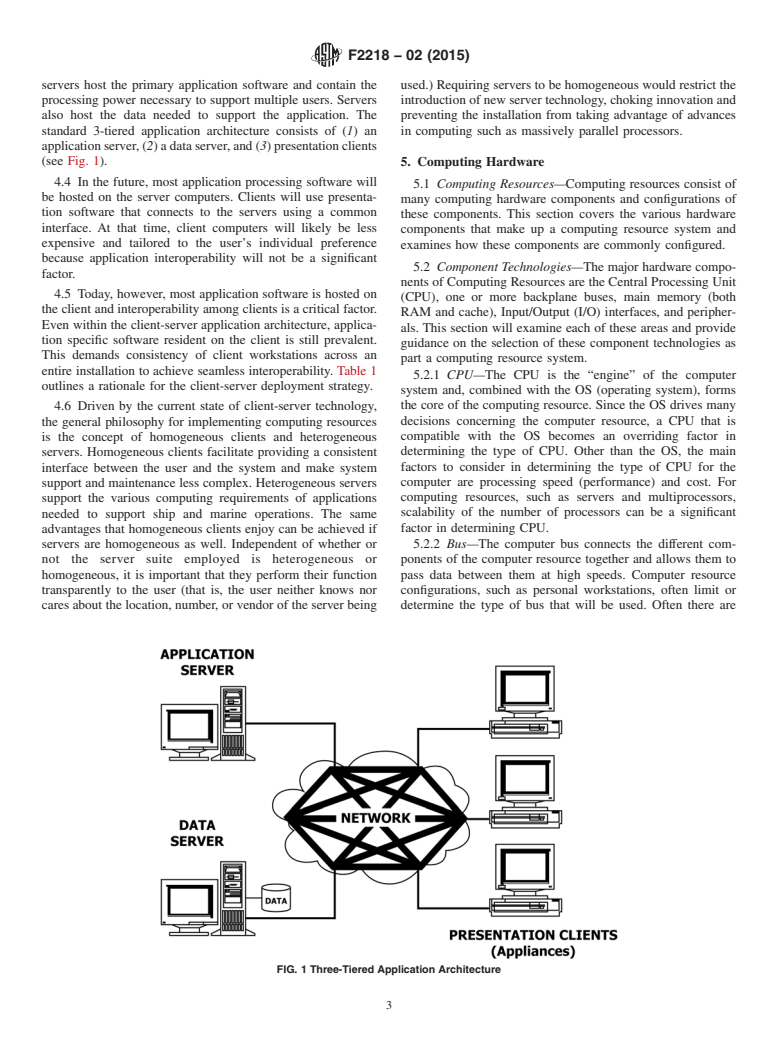
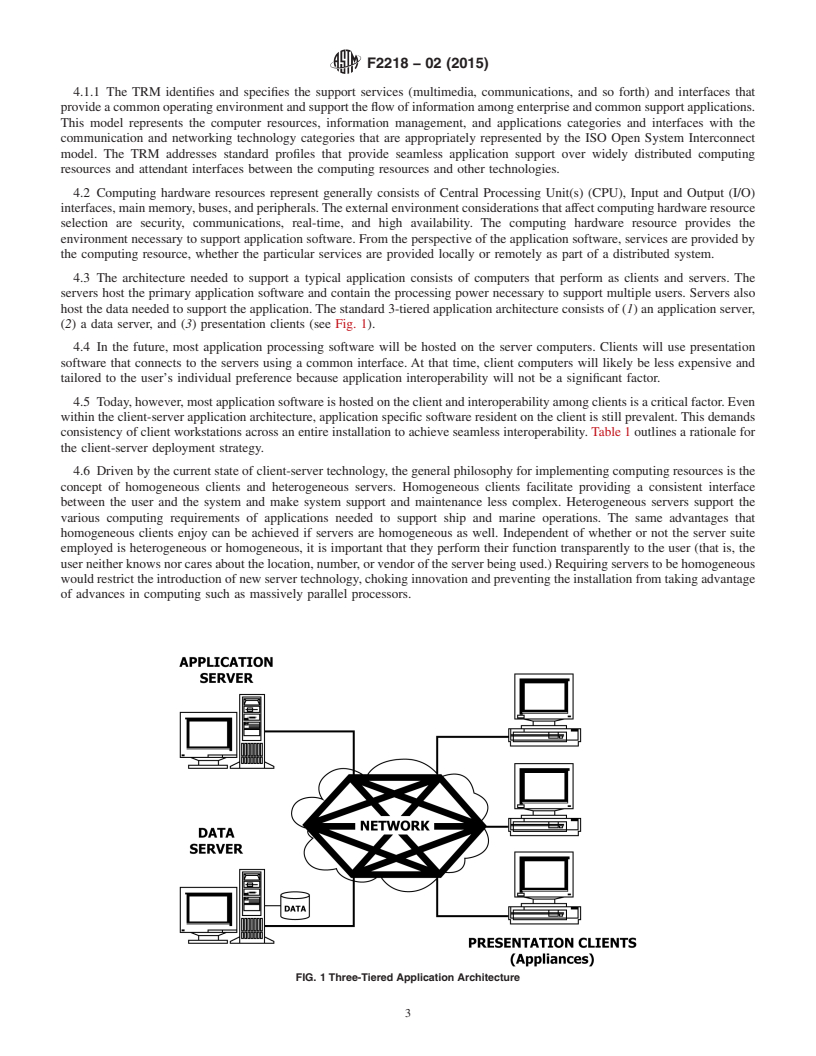
host the data needed to support the application. The standard 3-tiered application architecture consists of (1) an application server,
(2) a data server, and (3) presentation clients (see Fig. 1).
4.4 In the future, most application processing software will be hosted on the server computers. Clients will use presentation
software that connects to the servers using a common interface. At that time, client computers will likely be less expensive and
tailored to the user’s individual preference because application interoperability will not be a significant factor.
4.5 Today, however, most application software is hosted on the client and interoperability among clients is a critical factor. Even
within the client-server application architecture, application specific software resident on the client is still prevalent. This demands
consistency of client workstations across an entire installation to achieve seamless interoperability. Table 1 outlines a rationale for
the client-server deployment strategy.
4.6 Driven by the current state of client-server technology, the general philosophy for implementing computing resources is the
concept of homogeneous clients and heterogeneous servers. Homogeneous clients facilitate providing a consistent interface
between the user and the system and make system support and maintenance less complex. Heterogeneous servers support the
various computing requirements of applications needed to support ship and marine operations. The same advantages that
homogeneous clients enjoy can be achieved if servers are homogeneous as well. Independent of whether or not the server suite
employed is heterogeneous or homogeneous, it is important that they perform their function transparently to the user (that is, the
user neither knows nor cares about the location, number, or vendor of the server being used.) Requiring servers to be homogeneous
would restrict the introduction of new server technology, choking innovation and preventing the installation from taking advantage
of advances in computing such as massively parallel processors.
FIG. 1 Three-Tiered Application Architecture
F2218 − 02 (2015)
TABLE 1 Client-Server Deployment Rationale
Rationale for Heterogeneous The server must be tailored to the specific application that may not be supportable by computers most prevalent in the
Servers marketplace.
Many applications work well in their current computing environment and it is not cost effective to change.
It is not practical to have all applications on a common server for multiple reasons including the need to maintain competition
between computer developers and vendors.
Encourages innovation by not restricting the type of computer used for the development of applications.
Rationale for Homogeneous Allows for a common, consistent user interface.
Clients
Maximizes interoperability.
Minimizes re-training required as users transfer to different organizations within the enterprise.
Maximizes the ability to use common support and maintenance skills, parts and labor; thereby minimizing cost.
Maximizes portability of support for applications across the enterprise as well as portability of user skills.
Allows for economies of scale in both procurement (volume discounts) and support (more focused skill set for help desk
personnel).
5. Computing Hardware
5.1 Computing Resources—Computing resources consist of many computing hardware components and configurations of these
components. This section covers the various hardware components that make up a computing resource system and examines how
these components are commonly configured.
5.2 Component Technologies—The major hardware components of Computing Resources are the Central Processing Unit
(CPU), one or more backplane buses, main memory (both RAM and cache), Input/Output (I/O) interfaces, and peri
...
Questions, Comments and Discussion
Ask us and Technical Secretary will try to provide an answer. You can facilitate discussion about the standard in here.