

ASTM D2838-18
(Test Method)Standard Test Method for Shrink Tension and Orientation Release Stress of Plastic Film and Thin Sheeting
General Information
- Abstract
SIGNIFICANCE AND USE
5.1 As a result of the manufacturing process, internal stresses are locked into the film and these can be released by heating.
Note 3: For any given type of film or sheeting, the temperatures at which shrinkage will begin are related to processing techniques employed to manufacture the film and also may be related to a phase transition in the base resin.
5.2 Shrink tension affects the appearance and performance of a film in a shrink-packaging application. It is also used to determine the degree and direction of orientation. The orientation exerts a great influence upon important physical characteristics such as tensile strength, stiffness, tear resistance, and impact strength.
5.3 Data from Procedure A are most useful for determining the degree and direction of orientation, orientation release stress, and the maximum force that the film can exert at a given temperature.
5.4 Since, in actual applications, film is seldom, if ever, totally restrained, data from Procedure B are useful in estimating the force an item to be packaged will actually receive and in predicting the appearance of packaged items.
5.5 The characterization of shrink tension as a function of temperature, and the resultant determination of orientation release stress and its corresponding temperature, is usually carried out only for a particular material of specified thickness for a defined fabrication process. For product development purposes, quality control and determination of conformity be made to the specification of the material being tested. Any test specimen preparation, conditioning, dimensions, or testing parameters, or combination thereof, covered in the relevant ASTM material specification shall take precedence over those mentioned in this test method. If there are no relevant ASTM material specifications, then the default conditions apply. Table 1 of Classification Systems D4000 lists the ASTM material specifications that currently exist.
SCOPE
1.1 This test method covers the determination of the shrink tension and related characteristics, that is, shrink force and orientation release stress, of heat-shrinkable plastic film and sheeting of less than 1.0 mm (0.04 in.) thickness. Two procedures are described that permit the measurement of shrink forces at predetermined temperatures. They are as follows:
1.1.1 Procedure A is designed to measure the maximum force exerted by a specimen that is totally restrained from shrinking as it is heated rapidly to a specific temperature.
1.1.2 Procedure B is designed to measure the maximum force exerted by a specimen that is permitted to shrink a predetermined amount prior to restraint while being heated rapidly to a specific temperature.
1.2 Orientation release stress can be determined from the data obtained using Procedure A.
1.3 The values stated in SI units are to be regarded as the standard. The values in parentheses are for information only.
1.4 This standard does not purport to address all of the safety concerns, if any, associated with its use. It is the responsibility of the user of this standard to establish appropriate safety, health, and environmental practices and determine the applicability of regulatory limitations prior to use.
Note 1: Film has been arbitrarily defined as sheeting having nominal thickness not greater than 0.25 µm (0.010 in.).
Note 2: There is no known ISO equivalent to this test method.
1.5 This international standard was developed in accordance with internationally recognized principles on standardization established in the Decision on Principles for the Development of International Standards, Guides and Recommendations issued by the World Trade Organization Technical Barriers to Trade (TBT) Committee.
- Status
- Published
- Publication Date
- 31-Mar-2018
- Technical Committee
- D20 - Plastics
- Drafting Committee
- D20.19 - Film, Sheeting, and Molded Products
Overview
ASTM D2838-18 is the Standard Test Method for Shrink Tension and Orientation Release Stress of Plastic Film and Thin Sheeting, as published by ASTM International. This test method establishes procedures for determining the shrink tension, shrink force, and orientation release stress of heat-shrinkable plastic films and sheeting less than 1.0 mm in thickness. The standard describes two main procedures for measuring these properties at specific temperatures, supporting the evaluation of internal stresses that result from the manufacturing process and their impact on material performance.
The test evaluates how internal stresses, imparted during film manufacturing, are released by heating, influencing appearance, mechanical properties, and performance in shrink-packaging applications. It is a critical standard for manufacturers and end-users engaged in product development, quality control, and conformity assessment of shrinkable plastic films and thin sheeting.
Key Topics
Shrink Tension Measurement
The force per original cross-sectional area a film develops while attempting to shrink under restraint at a specific temperature.Orientation Release Stress
The maximum shrink tension developed in a specified direction (machine or transverse) during heating, signifying the release of internal orientation stresses.Shrink Force
The force per original unit width the film exerts in an attempt to shrink, measured in both restrained and partially free (pre-shrunk) conditions.Test Procedures
- Procedure A: Measures maximum force with the specimen totally restrained, ideal for determining orientation and maximum shrink force.
- Procedure B: Allows controlled shrinkage before restraint to estimate real-world packaging forces and predict the appearance of packaged goods.
Specimen Conditioning and Preparation Standardized conditioning, dimensions, and preparation ensure repeatable and comparable test results.
Applications
ASTM D2838-18 finds important use in the following areas:
Shrink Packaging:
Understanding shrink tension and orientation release stress helps predict the appearance, fit, and protection performance of films in shrink packaging applications for consumer goods, electronics, and food products.Material Development and Quality Control:
Provides critical data for developing new plastic films, optimizing manufacturing processes, and maintaining consistent product quality.Specification and Conformity Testing:
Used to verify that films and sheets conform to internal or client specifications regarding dimensional stability, mechanical properties, and shrinkage behavior.Process Optimization:
Data on orientation and shrink forces guide process adjustments for extrusion and film stretching, improving properties such as tensile strength, stiffness, tear resistance, and impact strength.Troubleshooting:
By quantifying the forces exerted by a shrinking film, manufacturers can diagnose problems related to shrinkage or stress distribution in end-use applications.
Related Standards
Testing according to ASTM D2838-18 may reference or be complemented by these ASTM international standards for plastics:
- ASTM D618: Practice for Conditioning Plastics for Testing
- ASTM D883: Terminology Relating to Plastics
- ASTM D4000: Classification System for Specifying Plastic Materials
- ASTM D5947: Test Methods for Physical Dimensions of Solid Plastics Specimens
- ASTM D6287: Practice for Cutting Film and Sheeting Test Specimens
- ASTM D6988: Guide for Determination of Thickness of Plastic Film Test Specimens
- ASTM E2251: Specification for Liquid-in-Glass ASTM Thermometers with Low-Hazard Precision Liquids
There is currently no known ISO equivalent to ASTM D2838-18. This standard was developed in line with the World Trade Organization’s principles for international standards, ensuring global acceptability and harmonization.
Keywords: ASTM D2838-18, shrink tension, orientation release stress, shrink force, plastic film, thin sheeting, shrink packaging, material specification, quality control, plastic testing standard.
Relations
- Effective Date
- 01-Apr-2018
- Effective Date
- 01-Feb-2024
- Effective Date
- 01-Nov-2023
- Effective Date
- 01-Jan-2020
- Effective Date
- 01-Aug-2019
- Effective Date
- 15-Apr-2019
- Effective Date
- 01-Feb-2019
- Effective Date
- 01-Dec-2018
- Effective Date
- 01-Nov-2018
- Effective Date
- 15-Dec-2017
- Effective Date
- 15-Aug-2017
- Effective Date
- 15-Nov-2012
- Effective Date
- 01-May-2012
- Effective Date
- 15-May-2011
- Effective Date
- 01-May-2011
Get Certified
Connect with accredited certification bodies for this standard

DIN CERTCO
DIN Group product certification.

Smithers Quality Assessments
US management systems and product certification.
Sponsored listings
Frequently Asked Questions
ASTM D2838-18 is a standard published by ASTM International. Its full title is "Standard Test Method for Shrink Tension and Orientation Release Stress of Plastic Film and Thin Sheeting". This standard covers: SIGNIFICANCE AND USE 5.1 As a result of the manufacturing process, internal stresses are locked into the film and these can be released by heating. Note 3: For any given type of film or sheeting, the temperatures at which shrinkage will begin are related to processing techniques employed to manufacture the film and also may be related to a phase transition in the base resin. 5.2 Shrink tension affects the appearance and performance of a film in a shrink-packaging application. It is also used to determine the degree and direction of orientation. The orientation exerts a great influence upon important physical characteristics such as tensile strength, stiffness, tear resistance, and impact strength. 5.3 Data from Procedure A are most useful for determining the degree and direction of orientation, orientation release stress, and the maximum force that the film can exert at a given temperature. 5.4 Since, in actual applications, film is seldom, if ever, totally restrained, data from Procedure B are useful in estimating the force an item to be packaged will actually receive and in predicting the appearance of packaged items. 5.5 The characterization of shrink tension as a function of temperature, and the resultant determination of orientation release stress and its corresponding temperature, is usually carried out only for a particular material of specified thickness for a defined fabrication process. For product development purposes, quality control and determination of conformity be made to the specification of the material being tested. Any test specimen preparation, conditioning, dimensions, or testing parameters, or combination thereof, covered in the relevant ASTM material specification shall take precedence over those mentioned in this test method. If there are no relevant ASTM material specifications, then the default conditions apply. Table 1 of Classification Systems D4000 lists the ASTM material specifications that currently exist. SCOPE 1.1 This test method covers the determination of the shrink tension and related characteristics, that is, shrink force and orientation release stress, of heat-shrinkable plastic film and sheeting of less than 1.0 mm (0.04 in.) thickness. Two procedures are described that permit the measurement of shrink forces at predetermined temperatures. They are as follows: 1.1.1 Procedure A is designed to measure the maximum force exerted by a specimen that is totally restrained from shrinking as it is heated rapidly to a specific temperature. 1.1.2 Procedure B is designed to measure the maximum force exerted by a specimen that is permitted to shrink a predetermined amount prior to restraint while being heated rapidly to a specific temperature. 1.2 Orientation release stress can be determined from the data obtained using Procedure A. 1.3 The values stated in SI units are to be regarded as the standard. The values in parentheses are for information only. 1.4 This standard does not purport to address all of the safety concerns, if any, associated with its use. It is the responsibility of the user of this standard to establish appropriate safety, health, and environmental practices and determine the applicability of regulatory limitations prior to use. Note 1: Film has been arbitrarily defined as sheeting having nominal thickness not greater than 0.25 µm (0.010 in.). Note 2: There is no known ISO equivalent to this test method. 1.5 This international standard was developed in accordance with internationally recognized principles on standardization established in the Decision on Principles for the Development of International Standards, Guides and Recommendations issued by the World Trade Organization Technical Barriers to Trade (TBT) Committee.
SIGNIFICANCE AND USE 5.1 As a result of the manufacturing process, internal stresses are locked into the film and these can be released by heating. Note 3: For any given type of film or sheeting, the temperatures at which shrinkage will begin are related to processing techniques employed to manufacture the film and also may be related to a phase transition in the base resin. 5.2 Shrink tension affects the appearance and performance of a film in a shrink-packaging application. It is also used to determine the degree and direction of orientation. The orientation exerts a great influence upon important physical characteristics such as tensile strength, stiffness, tear resistance, and impact strength. 5.3 Data from Procedure A are most useful for determining the degree and direction of orientation, orientation release stress, and the maximum force that the film can exert at a given temperature. 5.4 Since, in actual applications, film is seldom, if ever, totally restrained, data from Procedure B are useful in estimating the force an item to be packaged will actually receive and in predicting the appearance of packaged items. 5.5 The characterization of shrink tension as a function of temperature, and the resultant determination of orientation release stress and its corresponding temperature, is usually carried out only for a particular material of specified thickness for a defined fabrication process. For product development purposes, quality control and determination of conformity be made to the specification of the material being tested. Any test specimen preparation, conditioning, dimensions, or testing parameters, or combination thereof, covered in the relevant ASTM material specification shall take precedence over those mentioned in this test method. If there are no relevant ASTM material specifications, then the default conditions apply. Table 1 of Classification Systems D4000 lists the ASTM material specifications that currently exist. SCOPE 1.1 This test method covers the determination of the shrink tension and related characteristics, that is, shrink force and orientation release stress, of heat-shrinkable plastic film and sheeting of less than 1.0 mm (0.04 in.) thickness. Two procedures are described that permit the measurement of shrink forces at predetermined temperatures. They are as follows: 1.1.1 Procedure A is designed to measure the maximum force exerted by a specimen that is totally restrained from shrinking as it is heated rapidly to a specific temperature. 1.1.2 Procedure B is designed to measure the maximum force exerted by a specimen that is permitted to shrink a predetermined amount prior to restraint while being heated rapidly to a specific temperature. 1.2 Orientation release stress can be determined from the data obtained using Procedure A. 1.3 The values stated in SI units are to be regarded as the standard. The values in parentheses are for information only. 1.4 This standard does not purport to address all of the safety concerns, if any, associated with its use. It is the responsibility of the user of this standard to establish appropriate safety, health, and environmental practices and determine the applicability of regulatory limitations prior to use. Note 1: Film has been arbitrarily defined as sheeting having nominal thickness not greater than 0.25 µm (0.010 in.). Note 2: There is no known ISO equivalent to this test method. 1.5 This international standard was developed in accordance with internationally recognized principles on standardization established in the Decision on Principles for the Development of International Standards, Guides and Recommendations issued by the World Trade Organization Technical Barriers to Trade (TBT) Committee.
ASTM D2838-18 is classified under the following ICS (International Classification for Standards) categories: 83.140.10 - Films and sheets. The ICS classification helps identify the subject area and facilitates finding related standards.
ASTM D2838-18 has the following relationships with other standards: It is inter standard links to ASTM D2838-09, ASTM D883-24, ASTM D883-23, ASTM D883-20, ASTM D883-19c, ASTM D883-19a, ASTM D883-19, ASTM D883-18a, ASTM D883-18, ASTM D6287-17, ASTM D883-17, ASTM D883-12e1, ASTM D4000-12, ASTM D883-11, ASTM E2251-11. Understanding these relationships helps ensure you are using the most current and applicable version of the standard.
ASTM D2838-18 is available in PDF format for immediate download after purchase. The document can be added to your cart and obtained through the secure checkout process. Digital delivery ensures instant access to the complete standard document.
Standards Content (Sample)
This international standard was developed in accordance with internationally recognized principles on standardization established in the Decision on Principles for the
Development of International Standards, Guides and Recommendations issued by the World Trade Organization Technical Barriers to Trade (TBT) Committee.
Designation: D2838 − 18
Standard Test Method for
Shrink Tension and Orientation Release Stress of Plastic
Film and Thin Sheeting
This standard is issued under the fixed designation D2838; the number immediately following the designation indicates the year of
original adoption or, in the case of revision, the year of last revision.Anumber in parentheses indicates the year of last reapproval.A
superscript epsilon (´) indicates an editorial change since the last revision or reapproval.
1. Scope* 2. Referenced Documents
2.1 ASTM Standards:
1.1 This test method covers the determination of the shrink
D618Practice for Conditioning Plastics for Testing
tension and related characteristics, that is, shrink force and
D883Terminology Relating to Plastics
orientation release stress, of heat-shrinkable plastic film and
D4000Classification System for Specifying Plastic Materi-
sheeting of less than 1.0 mm (0.04 in.) thickness. Two
als
proceduresaredescribedthatpermitthemeasurementofshrink
D5947Test Methods for Physical Dimensions of Solid
forces at predetermined temperatures. They are as follows:
Plastics Specimens
1.1.1 Procedure A is designed to measure the maximum
D6287Practice for Cutting Film and Sheeting Test Speci-
force exerted by a specimen that is totally restrained from
mens
shrinking as it is heated rapidly to a specific temperature.
D6988GuideforDeterminationofThicknessofPlasticFilm
1.1.2 Procedure B is designed to measure the maximum
Test Specimens
force exerted by a specimen that is permitted to shrink a
E2251Specification for Liquid-in-Glass ASTM Thermom-
predetermined amount prior to restraint while being heated
eters with Low-Hazard Precision Liquids
rapidly to a specific temperature.
1.2 Orientation release stress can be determined from the 3. Terminology
data obtained using Procedure A.
3.1 Definitions of Terms Specific to This Standard:
3.1.1 orientation release stress, n—the maximum shrink
1.3 The values stated in SI units are to be regarded as the
tension developed by a film in a specified direction throughout
standard. The values in parentheses are for information only.
its range of shrink temperatures while totally restrained from
1.4 This standard does not purport to address all of the
shrinking.
safety concerns, if any, associated with its use. It is the
3.1.2 shrink force, n—the force per original unit width
responsibility of the user of this standard to establish appro-
developed by a film in a specified direction and at a specified
priate safety, health, and environmental practices and deter-
temperature in its attempt to shrink while under restraint.
mine the applicability of regulatory limitations prior to use.
3.1.3 shrink tension, n—the force per original average
NOTE 1—Film has been arbitrarily defined as sheeting having nominal
cross-sectionalareadevelopedbyafilminaspecifieddirection
thickness not greater than 0.25 µm (0.010 in.).
and at a specified temperature in its attempt to shrink while
NOTE 2—There is no known ISO equivalent to this test method.
under restraint.
1.5 This international standard was developed in accor-
3.2 Definitions:
dance with internationally recognized principles on standard-
3.2.1 For definitions of terms used in this test method, refer
ization established in the Decision on Principles for the
to Terminology D883.
Development of International Standards, Guides and Recom-
mendations issued by the World Trade Organization Technical
4. Summary of Test Method
Barriers to Trade (TBT) Committee.
4.1 A 25.4-mm (1-in.) wide strip of film or sheeting is
clampedinthearmsofashrinktensionholder(seeFig.1),one
armofwhichcontainsastraingage.Theholderisimmersedin
ThistestmethodisunderthejurisdictionofASTMCommitteeD20onPlastics
and is the direct responsibility of Subcommittee D20.19 on Film, Sheeting, and
Molded Products.
Current edition approved April 1, 2018. Published April 2018. Originally For referenced ASTM standards, visit the ASTM website, www.astm.org, or
ɛ1
approved in 1969. Last previous edition approved in 2009 as D2838-09 , which contact ASTM Customer Service at service@astm.org. For Annual Book of ASTM
was withdrawn January 2018 and reinstated in April 2018. DOI: 10.1520/D7399- Standards volume information, refer to the standard’s Document Summary page on
18. DOI: 10.1520/D2838-18. the ASTM website.
*A Summary of Changes section appears at the end of this standard
Copyright © ASTM International, 100 Barr Harbor Drive, PO Box C700, West Conshohocken, PA 19428-2959. United States
D2838 − 18
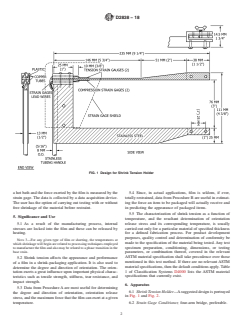
FIG. 1 Design for Shrink Tension Holder
a hot bath and the force exerted by the film is measured by the 5.4 Since, in actual applications, film is seldom, if ever,
strain gage. The data is collected by a data acquisition device. totally restrained, data from Procedure B are useful in estimat-
The user has the option of carrying out testing with or without ing the force an item to be packaged will actually receive and
free shrinkage of the material before restraint. in predicting the appearance of packaged items.
5.5 The characterization of shrink tension as a function of
5. Significance and Use
temperature, and the resultant determination of orientation
5.1 As a result of the manufacturing process, internal release stress and its corresponding temperature, is usually
stresses are locked into the film and these can be released by carried out only for a particular material of specified thickness
heating. for a defined fabrication process. For product development
purposes, quality control and determination of conformity be
NOTE 3—For any given type of film or sheeting, the temperatures at
made to the specification of the material being tested.Any test
whichshrinkagewillbeginarerelatedtoprocessingtechniquesemployed
specimen preparation, conditioning, dimensions, or testing
tomanufacturethefilmandalsomayberelatedtoaphasetransitioninthe
base resin.
parameters, or combination thereof, covered in the relevant
ASTM material specification shall take precedence over those
5.2 Shrink tension affects the appearance and performance
mentioned in this test method. If there are no relevant ASTM
of a film in a shrink-packaging application. It is also used to
materialspecifications,thenthedefaultconditionsapply.Table
determine the degree and direction of orientation. The orien-
1 of Classification Systems D4000 lists the ASTM material
tation exerts a great influence upon important physical charac-
specifications that currently exist.
teristics such as tensile strength, stiffness, tear resistance, and
impact strength.
6. Apparatus
5.3 Data from ProcedureAare most useful for determining
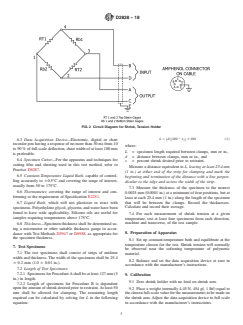
6.1 Shrink Tension Holder—Asuggesteddesignisportrayed
the degree and direction of orientation, orientation release
in Fig. 1 and Fig. 2.
stress,andthemaximumforcethatthefilmcanexertatagiven
temperature. 6.2 Strain Gage Conditioner, four-arm bridge, preferable.
D2838 − 18
FIG. 2 Circuit Diagram for Shrink, Tension Holder
6.3 Data Acquisition Device—Electronic, digital or chart L 5 d/ 100 2 s 3100 (1)
~ ~ !!
recorderpenhavingaresponseofnomorethan30msfrom10
where:
to 90% of full-scale deflection, chart width of at least 100 mm
L = specimen length required between clamps, mm or in.,
is preferable.
d = distance between clamps, mm or in., and
6.4 Specimen Cutter—For the apparatus and techniques for
s = percent shrink desired prior to restraint.
cutting film and sheeting used in this test method, refer to
Measureadistanceequivalentto L, leaving at least 25.4 mm
Practice D6287.
(1 in.) at either end of the strip for clamping and mark the
6.5 Constant-Temperature Liquid Bath, capable of control-
beginning and termination of the distance with a line perpen-
ling accurately to 60.5°C and covering the range of interest,
dicular to the edge and across the width of the strip.
usually from 50 to 175°C.
7.3 Measure the thickness of the specimen to the nearest
6.6 Thermometer, covering the range of interest and con-
0.0025 mm (0.0001 in.) at a minimum of four positions, but at
forming to the requirem
...