

ASTM D5111-12(2020)
(Guide)Standard Guide for Choosing Locations and Sampling Methods to Monitor Atmospheric Deposition at Non-Urban Locations
General Information
- Abstract
SIGNIFICANCE AND USE
4.1 The guide consolidates into one document, siting criteria and sampling strategies used routinely in various North American atmospheric deposition monitoring programs.
4.2 The guide leads the user through the steps of site selection, sampling frequency and sampling equipment selection, and presents quality assurance techniques and other considerations necessary to obtain a representative deposition sample for subsequent chemical analysis.
4.3 The guide extends Practice D1357 to include specific guidelines for sampling atmospheric deposition including acidic deposition.
SCOPE
1.1 This guide assists individuals or agencies in identifying suitable locations and choosing appropriate sampling strategies for monitoring atmospheric deposition at non-urban locations. It does not purport to discuss all aspects of designing atmospheric deposition monitoring networks.
1.2 The guide is suitable for use in obtaining estimates of the dominant inorganic constituents and trace metals found in acidic deposition. It addresses both wet and dry deposition and includes cloud water, fog and snow.
1.3 The guide is best used to determine estimates of atmospheric deposition in non-urban areas although many of the sampling methods presented can be applied to urban environments.
1.4 The values stated in SI units are to be regarded as standard. No other units of measurement are included in this standard.
1.5 This international standard was developed in accordance with internationally recognized principles on standardization established in the Decision on Principles for the Development of International Standards, Guides and Recommendations issued by the World Trade Organization Technical Barriers to Trade (TBT) Committee.
- Status
- Published
- Publication Date
- 31-Aug-2020
- Technical Committee
- D22 - Air Quality
- Drafting Committee
- D22.03 - Ambient Atmospheres and Source Emissions
Overview
ASTM D5111-12(2020), Standard Guide for Choosing Locations and Sampling Methods to Monitor Atmospheric Deposition at Non-Urban Locations, is an internationally recognized standard developed by ASTM International. This guide is designed to assist organizations, researchers, and environmental professionals in selecting representative monitoring sites and appropriate sampling strategies for atmospheric deposition, specifically in non-urban environments. The guide consolidates established siting criteria and sampling methods widely used in North American atmospheric deposition monitoring programs, focusing on both wet and dry deposition, including fog, cloud water, and snow.
Key Topics
- Site Selection Criteria: The guide provides a step-by-step approach to identifying suitable locations for atmospheric deposition monitoring. This includes assessment of population density, proximity to emission sources, land use stability, and site accessibility.
- Sampling Strategies: Users are introduced to diverse sampling methods such as cumulative, event, continuous, and sequential sampling. The guide outlines the advantages and limitations of each method based on monitoring goals, environmental conditions, and resource availability.
- Sampling Devices: Detailed guidance is given on the selection and use of wet and dry deposition collectors, surrogate surface techniques, filter packs, and fog/cloud water collectors, all geared towards collecting representative samples for chemical analysis.
- Quality Assurance: The standard emphasizes the need for rigorous quality control, including the preparation and maintenance of sample containers, regular calibration and maintenance of equipment, and the use of reference materials to ensure sample validity.
- Data Integrity: Recommendations are given for minimizing sample contamination, preserving chemical species, and ensuring the accuracy of analytical results.
Applications
ASTM D5111 is particularly valuable for:
- Environmental Monitoring Agencies: Facilitates the establishment of reliable atmospheric deposition monitoring programs to assess pollutant levels, acid deposition, and trace metal concentrations in rural and remote areas.
- Academic and Research Institutions: Supports studies on atmospheric chemistry, ecosystem health, and the long-range transport of air pollutants, providing a robust methodology for comparative and longitudinal studies.
- Policy and Regulatory Bodies: Aids in making informed policy decisions regarding air quality management, land use planning, and regulatory compliance by providing credible deposition data.
- Consulting and Industry: Enables consultants and industrial sectors to conduct environmental impact assessments and to monitor the effectiveness of emission controls in areas outside of urban influence.
- Cross-disciplinary Studies: The methods outlined are compatible with research involving agronomy, hydrology, forest management, and climate science, where atmospheric inputs are an important consideration.
The guide’s sampling methods, while primarily tailored for non-urban locations, are adaptable to some urban situations where applicable. Its comprehensive approach ensures that collected data accurately represent atmospheric deposition trends, supporting effective environmental protection and resource management initiatives.
Related Standards
To ensure a comprehensive approach to atmospheric deposition monitoring, the following ASTM standards are often referenced or applied in conjunction with ASTM D5111-12(2020):
- ASTM D1357: Practice for Planning the Sampling of the Ambient Atmosphere, a foundational guide for ambient air sampling strategies.
- ASTM D4841: Practice for Estimation of Holding Time for Water Samples Containing Organic and Inorganic Constituents, crucial for ensuring sample integrity.
- ASTM D5012: Practice for Preparation of Materials Used for Atmospheric Wet Deposition Collection, addressing the preparation of sampling containers and equipment.
- ASTM D3249: Practice for General Ambient Air Analyzer Procedures, providing protocols for continuous air monitoring instrumentation.
- ASTM D1356: Terminology Relating to Sampling and Analysis of Atmospheres, ensuring standardized vocabulary across air quality protocols.
By integrating these standards, users of ASTM D5111 can achieve high-quality, defensible, and internationally comparable data in atmospheric deposition studies.
Relations
- Effective Date
- 01-Sep-2020
- Effective Date
- 15-Mar-2020
- Effective Date
- 01-Oct-2019
- Effective Date
- 01-Aug-2019
- Effective Date
- 15-Oct-2015
- Effective Date
- 01-Jul-2015
- Effective Date
- 01-Dec-2014
- Effective Date
- 01-May-2014
- Effective Date
- 15-Jan-2014
- Effective Date
- 01-Jan-2013
- Effective Date
- 01-Jan-2013
- Effective Date
- 01-Oct-2011
- Effective Date
- 01-Oct-2011
- Effective Date
- 01-Apr-2010
- Effective Date
- 15-Jul-2008
Frequently Asked Questions
ASTM D5111-12(2020) is a guide published by ASTM International. Its full title is "Standard Guide for Choosing Locations and Sampling Methods to Monitor Atmospheric Deposition at Non-Urban Locations". This standard covers: SIGNIFICANCE AND USE 4.1 The guide consolidates into one document, siting criteria and sampling strategies used routinely in various North American atmospheric deposition monitoring programs. 4.2 The guide leads the user through the steps of site selection, sampling frequency and sampling equipment selection, and presents quality assurance techniques and other considerations necessary to obtain a representative deposition sample for subsequent chemical analysis. 4.3 The guide extends Practice D1357 to include specific guidelines for sampling atmospheric deposition including acidic deposition. SCOPE 1.1 This guide assists individuals or agencies in identifying suitable locations and choosing appropriate sampling strategies for monitoring atmospheric deposition at non-urban locations. It does not purport to discuss all aspects of designing atmospheric deposition monitoring networks. 1.2 The guide is suitable for use in obtaining estimates of the dominant inorganic constituents and trace metals found in acidic deposition. It addresses both wet and dry deposition and includes cloud water, fog and snow. 1.3 The guide is best used to determine estimates of atmospheric deposition in non-urban areas although many of the sampling methods presented can be applied to urban environments. 1.4 The values stated in SI units are to be regarded as standard. No other units of measurement are included in this standard. 1.5 This international standard was developed in accordance with internationally recognized principles on standardization established in the Decision on Principles for the Development of International Standards, Guides and Recommendations issued by the World Trade Organization Technical Barriers to Trade (TBT) Committee.
SIGNIFICANCE AND USE 4.1 The guide consolidates into one document, siting criteria and sampling strategies used routinely in various North American atmospheric deposition monitoring programs. 4.2 The guide leads the user through the steps of site selection, sampling frequency and sampling equipment selection, and presents quality assurance techniques and other considerations necessary to obtain a representative deposition sample for subsequent chemical analysis. 4.3 The guide extends Practice D1357 to include specific guidelines for sampling atmospheric deposition including acidic deposition. SCOPE 1.1 This guide assists individuals or agencies in identifying suitable locations and choosing appropriate sampling strategies for monitoring atmospheric deposition at non-urban locations. It does not purport to discuss all aspects of designing atmospheric deposition monitoring networks. 1.2 The guide is suitable for use in obtaining estimates of the dominant inorganic constituents and trace metals found in acidic deposition. It addresses both wet and dry deposition and includes cloud water, fog and snow. 1.3 The guide is best used to determine estimates of atmospheric deposition in non-urban areas although many of the sampling methods presented can be applied to urban environments. 1.4 The values stated in SI units are to be regarded as standard. No other units of measurement are included in this standard. 1.5 This international standard was developed in accordance with internationally recognized principles on standardization established in the Decision on Principles for the Development of International Standards, Guides and Recommendations issued by the World Trade Organization Technical Barriers to Trade (TBT) Committee.
ASTM D5111-12(2020) is classified under the following ICS (International Classification for Standards) categories: 07.060 - Geology. Meteorology. Hydrology. The ICS classification helps identify the subject area and facilitates finding related standards.
ASTM D5111-12(2020) has the following relationships with other standards: It is inter standard links to ASTM D1356-20a, ASTM D1356-20, ASTM D3249-95(2019), ASTM D1357-95(2019), ASTM D1356-15a, ASTM D1356-15, ASTM D1356-14b, ASTM D1356-14a, ASTM D1356-14, ASTM D4841-88(2013)e1, ASTM D4841-88(2013), ASTM D1357-95(2011), ASTM D3249-95(2011), ASTM D1356-05(2010), ASTM D4841-88(2008). Understanding these relationships helps ensure you are using the most current and applicable version of the standard.
ASTM D5111-12(2020) is available in PDF format for immediate download after purchase. The document can be added to your cart and obtained through the secure checkout process. Digital delivery ensures instant access to the complete standard document.
Standards Content (Sample)
This international standard was developed in accordance with internationally recognized principles on standardization established in the Decision on Principles for the
Development of International Standards, Guides and Recommendations issued by the World Trade Organization Technical Barriers to Trade (TBT) Committee.
Designation: D5111 − 12 (Reapproved 2020)
Standard Guide for
Choosing Locations and Sampling Methods to Monitor
Atmospheric Deposition at Non-Urban Locations
This standard is issued under the fixed designation D5111; the number immediately following the designation indicates the year of
original adoption or, in the case of revision, the year of last revision. A number in parentheses indicates the year of last reapproval. A
superscript epsilon (´) indicates an editorial change since the last revision or reapproval.
1. Scope D4841 Practice for Estimation of Holding Time for Water
Samples Containing Organic and Inorganic Constituents
1.1 This guide assists individuals or agencies in identifying
D5012 Practice for Preparation of Materials Used for the
suitablelocationsandchoosingappropriatesamplingstrategies
Collection and Preservation of Atmospheric Wet Deposi-
for monitoring atmospheric deposition at non-urban locations.
tion
It does not purport to discuss all aspects of designing atmo-
spheric deposition monitoring networks.
3. Terminology
1.2 The guide is suitable for use in obtaining estimates of
3.1 Definitions—For definitions of terms used in this guide,
the dominant inorganic constituents and trace metals found in
refer to Terminology D1356.
acidic deposition. It addresses both wet and dry deposition and
includes cloud water, fog and snow.
3.2 Definitions of Terms Specific to This Standard:
1.3 The guide is best used to determine estimates of 3.2.1 collocated sampling, n—the use of more than one
atmospheric deposition in non-urban areas although many of sampling device within a monitoring site.
the sampling methods presented can be applied to urban
3.2.2 event sampling, n—a special form of intermittent
environments.
sampling (Terminology D1356) where the duration of a sam-
1.4 The values stated in SI units are to be regarded as pling period is defined as a single, discrete occurrence of
standard. No other units of measurement are included in this
precipitation, dew, fog, or frost.
standard.
3.2.3 fetch, n—a vector within the local area which de-
1.5 This international standard was developed in accor-
scribesthedirectionandareaof,orwithin,anairmassthatwill
dance with internationally recognized principles on standard-
be sampled by a sampling device.
ization established in the Decision on Principles for the
3.2.4 filter-pack, n—a sampling device comprised of one or
Development of International Standards, Guides and Recom-
more filters in series where each filter is designed to sample an
mendations issued by the World Trade Organization Technical
atmospheric chemical species or remove interferences to a
Barriers to Trade (TBT) Committee.
subsequent filter. Filters may be of different design; material;
2. Referenced Documents or be coated or impregnated to obtain the specificity of
chemical species required.
2.1 ASTM Standards:
D1356 Terminology Relating to Sampling and Analysis of
3.2.5 inferential sampling, n—an indirect sampling method
Atmospheres thatutilizesamathematicalmodeltoquantifyanunmeasurable
D1357 Practice for Planning the Sampling of the Ambient
or difficult to measure property of atmospheric deposition.
Atmosphere
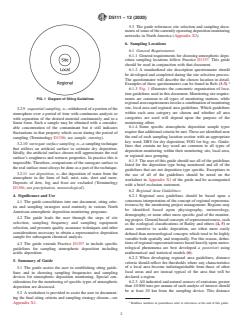
3.2.6 local area, n—an area of a few square kilometres
D3249 Practice for General Ambient Air Analyzer Proce-
which describes an area of common vegetation, land-surface
dures
form and land use surrounding the monitoring site and defines
the local characteristics surrounding the sampling device, see
This guide is under the jurisdiction of ASTM Committee D22 on Air Quality
Fig. 1.
and is the direct responsibility of Subcommittee D22.03 on Ambient Atmospheres
and Source Emissions.
3.2.7 monitoring site, n—a radius of a few decametres
Current edition approved Sept. 1, 2020. Published September 2020. Originally
which immediately surrounds the sampling device, see Fig. 1.
approved in 1990. Last previous edition approved in 2012 as D5111 – 12. DOI:
10.1520/D5111-12R20.
3.2.8 regional area, n—an area between the local area and a
For referenced ASTM standards, visit the ASTM website, www.astm.org, or
threshold that defines where any single local area characteristic
contact ASTM Customer Service at service@astm.org. For Annual Book of ASTM
can not be distinguished from regional characteristics, see Fig.
Standards volume information, refer to the standard’s Document Summary page on
the ASTM website. 1.
Copyright © ASTM International, 100 Barr Harbor Drive, PO Box C700, West Conshohocken, PA 19428-2959. United States
D5111 − 12 (2020)
5.3 The guide references site selection and sampling docu-
mentsofsomeofthecurrentlyoperatingdepositionmonitoring
networks in North America (Appendix X2).
6. Sampling Locations
6.1 General Requirements:
6.1.1 General requirements for choosing atmospheric depo-
sition sampling locations follow Practice D1357. This guide
should be used in conjunction with that document.
6.1.2 A standardized site description questionnaire should
be developed and completed during the site selection process.
The questionnaire will describe the chosen location in detail.
Examples of these questionnaires can be found in Refs (1-3).
6.1.3 Fig. 1 illustrates the concentric organization of loca-
tion guidelines used in this document. Monitoring site require-
ments are common to all types of monitoring stations, while
FIG. 1 Diagram of Siting Guidelines
regionalarearequirementsinvokeacombinationofmonitoring
site, local area and regional area guidelines. Which guidelines
3.2.9 sequential sampling, n—withdrawalofaportionofthe
within each area category are chosen and whether all area
atmosphere over a period of time with continuous analysis or
categories are used will depend upon the purpose of the
with separation of the desired material continuously and in a
monitoring effort.
linear form. Such a sample may be obtained with a consider-
6.1.4 Some specific atmospheric deposition sample types
able concentration of the contaminant but it still indicates
require that additional criteria be met.These are identified near
fluctuations in that property which occur during the period of
the end of each sampling location section with an appropriate
sampling (Terminology D1356; see sample, running).
key word; DRY for dry deposition; FOG for fog; etc. Guide-
3.2.10 surrogate surface sampling, n—asamplingtechnique
lines that contain no key word are common to all types of
that utilizes an artificial surface to estimate dry deposition.
deposition monitoring within their monitoring site, local area,
Ideally, the artificial surface chosen will approximate the real
or regional area grouping.
surface’s roughness and wetness properties. In practice this is
6.1.5 The user of this guide should use all of the guidelines
impossible. Therefore, comparisons of the surrogate surface to
listed for the deposition type being monitored and all of the
the real surface must always be done as a part of the technique.
guidelines that are not deposition type specific. Exceptions to
3.2.11 wet deposition, n—the deposition of water from the
the use of all of the guidelines should be noted on the
atmosphere in the form of hail, mist, rain, sleet and snow.
worksheet in Appendix X1 of the guide and be accompanied
Deposits of dew, fog and frost are excluded (Terminology
with a brief exclusion statement.
D1356; see precipitation, meteorological).
6.2 Regional Area Guidelines:
4. Significance and Use 6.2.1 Regional area guidelines should be based upon a
consensus interpretation of the concept of regional representa-
4.1 The guide consolidates into one document, siting crite-
tiveness by the monitoring project management. Regions may
ria and sampling strategies used routinely in various North
be identified based upon physiography, meteorology,
American atmospheric deposition monitoring programs.
demography, or some other more specific goal of the monitor-
4.2 The guide leads the user through the steps of site
ing project. Ground-based concepts of representativeness, such
selection, sampling frequency and sampling equipment
as the ecological classifications of Bailey and others (4, 5) or
selection, and presents quality assurance techniques and other
areas sensitive to acidic deposition, are often more easily
considerations necessary to obtain a representative deposition
defined than meteorological concepts which tend to be highly
sample for subsequent chemical analysis.
variable both spatially and temporally. For this reason, defini-
tions of regional representativeness based heavily upon meteo-
4.3 The guide extends Practice D1357 to include specific
rological phenomena are best developed a posteriori using
guidelines for sampling atmospheric deposition including
mathematical and statistical models (6).
acidic deposition.
6.2.2 When developing regional area guidelines, distance
5. Summary of Guide
criteria should reflect the thresholds where any characteristics
of a local area become indistinguishable from those of other
5.1 The guide assists the user in establishing siting guide-
local areas and are instead typical of the area that will be
lines and in choosing sampling frequencies and sampling
declared a region.
devices for atmospheric deposition monitoring. Special con-
6.2.3 All industrial and natural sources of emissions greater
siderations for the monitoring of specific types of atmospheric
than 10 000 tons per annum of each analyte of interest should
deposition are discussed.
be at least 20 km from the sampling device. This distance
5.2 Aworksheet is provided to assist the user in document-
ing the final siting criteria and sampling strategy chosen—see
Appendix X1. Boldface numbers in parentheses refer to references at the end of this guide.
D5111 − 12 (2020)
it approaches the point sampling then the distance requirements for fetch
should be increased if the sampling device is located down-
can sometimes be relaxed. If on the other hand deposition rate estimates
wind of the source in the prevailing wind direction.
are expected to be small, the fetch distance requirements may need to be
6.2.4 Complexterrainshouldbeavoidedunlessitsinfluence
increased ((7) see 9.2.3).
is necessary to meet the specific goal of the monitoring effort.
6.3.8 Dry—For methods employing the estimation of atmo-
6.3 Local Area Guidelines:
sphericfluxes,see9.2.3,thesamplingdeviceshouldbelocated
6.3.1 The local area surrounding a monitoring site should
at least 5 km from prominent discontinuities in terrain such as
describe a small geographic area where land use, topography
large bodies of water, isolated hills or valleys, and cliffs.
and meteorology are common and representative of the re-
6.4 Monitoring Site Guidelines:
gional area. No single emission source should dominate the air
6.4.1 Monitoring sites should be located on naturally veg-
quality at the site except as it typifies the common emission
etated or grassed, open, level areas. Ground cover should be
characteristicsoftheregionalarea.Idealsiteswillbelocatedin
homogeneous and the area should slope no more than 15 %.
areas where land use practices are not expected to change over
the course of the monitoring effort. 6.4.2 The distance from the sampling device to any object
6.3.2 Emission source amounts, their frequency and greaterthantheheightofthesamplingdeviceshouldbeatleast
intensity, and meteorological diversity will dominate the actual twice the height of the object (2:1). This will ensure that no
influence of each guideline on samples collected in any
object or structure will project onto the sampling device with
monitoring program. Because of this, local area guidelines are an angle greater than 30° from the horizontal plane measured
typically the portion of a site selection plan that is not met. A
from the sample orifice.
relaxationoftheguidelinescanbetoleratedwhentheimpactof
6.4.3 With the exception of wind shields, objects with
non-compliance on program objectives can be quantified.
sufficient mass to deflect the wind or otherwise change the
6.3.3 Monitoring sites should be classified according to the
aerodynamic properties of the sampling device should be
surrounding population density within 15 km radius of the site.
located no closer than 2 m from the sampling device.
See Table 1.
NOTE 2—Wind shields are considered to be an integral part of the
6.3.4 Intensive agricultural and waste treatment activities
sampling device in this guide.
should be more than 500 m from the sampling device. Dairy
6.4.4 Residential structures should be outside of a 30° cone
operations,cropcultivation,especiallyinareaswherechemical
of the prevailing wind direction measured from the sample
applications are used and solid waste and wastewater treatment
orifice.
facilities are of particular concern.
6.4.5 Sampling devices should be oriented towards the
6.3.5 Transportation related sources of emissions should be
annualaveragedprevailingwind.Intheabsenceofsitespecific
no closer than 100 m from the sampling device. Parking lots,
wind direction information projects should standardize the
unpaved roadways and high volume vehicular, railroad and
orientation of the device to one direction.
airplanetrafficareofparticularconcern.Onehundredmetresis
a minimum acceptable distance cited by some of the existing 6.4.6 Within5mofthe sampling device, vegetation should
atmospheric monitoring networks (see X2.3 – X2.5). The
be less than 0.6 m in height as measured from its base.
distanceshouldbeincreasedinproportiontoincreasesintraffic
6.4.7 Grazing animals and the cultivation of agricultural
volume and diversity. One kilometre is considered adequate
crops should not be permitted within the monitoring site.
under most conditions.
6.4.8 All activities not directly related to sampling should
6.3.6 The open or surface storage of agricultural or indus-
be discouraged within the monitoring site.
trial products should be kept at least 100 m from the sampling
6.4.9 Snow—The sampling device should be located in a
device. Examples of these products would include salt and
settingthatisshelteredfromthewind.Locatingthemonitoring
sand piles, fuels and chemicals.
site within a forest clearing or installing a wind shield around
6.3.7 Dry—For methods employing the estimation or use of
the sampling device improves snow capture (8).
atmospheric fluxes (see 9.2.3 and 9.2.9), the surface micro-
NOTE 3—Wind speeds in excess of 1 m/sec significantly reduce the
meteorology and surface composition should be as uniform as
efficiency of snow sampling devices (8). Light, dry snows are the most
possible within 500 m of the sampling device.
difficult to sample. Reducing or eliminating the wind around the sampling
device by either shielding the device or locating the device below the
NOTE 1—The success of tower based eddy correlation techniques and
vegetation canopy improves snow capture and eliminates re-entrainment
many other dry deposition techniques utilizing deposition velocity
of already collected samples.
estimates, are dependent upon the uniformity of the upwind surface
roughness and wetness. If the upwind micro-meteorology and surface
6.4.10 Dry—For methods utilizing towers in the estimation
characteristicsenhancetheturbulentmixingoftheparameterofinterestas
of atmospheric fluxes (9.2.3), the tower heights should be
standardized and be at least 5 m above the surface of interest
TABLE 1 Site Classification
(for example, forest canopy and agricultural crops). For mea-
Site Population within 15 km
surements over bare ground, this distance may need to be
Classification of the site (people/km )
doubled.
Isolated < 10
Rural 10 – 99 6.4.11 Dry—Methods utilizing micro-meteorological mea-
Suburban 100 – 399
surements in the estimation of atmospheric deposition require
Urban >400
stricter slope requirements of 5 % and stricter projection
Research not applicable
requirements of 5:1, see 6.4.1 and 6.4.2.
D5111 − 12 (2020)
7. General Sampling Requirements 8.2.2 When using cumulative sampling, attention must be
paid to the possibility of sample degradation that can occur
7.1 Once the goals of the monitoring effort have been
duringtheaccumulatingtimeperiod.Shortaccumulationtimes
established and site locations have been identified, sampling
are recommended, especially when samples are not preserved.
frequency and sampling equipment decisions can be made.
Both loss and transformation of chemical species have been
Location decisions should be made in advance of sampling
observed in cumulative samples (9, 10).
decisions since, in addition to cost, the latter are almost always
8.2.3 Cumulative sampling can be used to reduce the
limited by site availability and accessibility.
number of samples collected and analyzed along with their
7.2 The choice of a sampling method for atmospheric
associated costs, and to increase the sensitivity of a method by
deposition monitoring oftentimes will be a compromise
averaging over time. Filter packs, denuders and impingers all
broughtaboutbytheavailabilityofasuitablesite,theabilityof
use the principle of cumulative sampling.
a particular sampling device to selectively measure the depo-
8.3 Event Sampling:
sition type and chemical species of interest, and the differences
8.3.1 Event sampling is a special form of intermittent
in cost of implementing some of the available techniques. The
sampling used to collect liquid deposition from discrete occur-
selectionofsamplingintervalsandsamplingdevicesmaybean
rences of precipitation, dew, frost, and fog.
iterative exercise especially if a wide variety of chemical
8.3.2 Event sampling is used for studying atmospheric
species are of interest.
processes and for determining noncumulative effects of atmo-
7.3 Users of this guide should recognize that all of the
spheric deposition on agricultural and natural ecosystems.
sampling techniques mentioned in this guide are not directly
Event sampling is especially useful when monitoring objec-
comparable and may not be interchangeable. Comparability,
tives are associated with episodic phenomena such as storm
especially in the area of dry deposition, has only recently
types, direction or intensity, or when the tracking of a param-
begun. For projects requiring a wide variety of deposition
eter through time and space is required.
estimates or short sampling intervals, this often means select-
8.3.3 Event sampling is less susceptible to the sample
ing multiple methods.
integrityproblemsassociatedwithcumulativesampling (9,10).
7.4 Projects requiring comparability or additivity of esti- This is especially noticeable when events are of short duration
mates derived from more than one method should establish the (for example, less than days).
level of uncertainty in using this approach.
8.3.4 Event sampling is not an effective monitoring fre-
quency when the predominant sample collected contains too
8. Sampling Frequency small an amount of analyte mass for analysis or consistently
produces analyte concentrations below the method detection
8.1 Continuous Sampling:
limit. The cost of standby time (time waiting for events to
8.1.1 Continuous Sampling in the context of atmospheric
occur) should also be considered when selecting event sam-
deposition monitoring is a combination of both continuous and
pling frequencies.
instantaneous sampling (Terminology D1356). It is frequently
8.4 Sequential Sampling:
used for the estimation of ambient air concentrations in
sampling techniques which compute dry deposition rates. 8.4.1 Sequential sampling is used to characterize within
eventvariability.Sequentialsamplingstrategiestypicallybreak
Continuous measurements are typically the most expensive
formofmeasurementstoobtainsincetheymostalwaysrequire events into consecutive, equal-volume or equal-time sub-
samplesoftheevent.Likeeventsampling,sequentialsampling
sophisticated instrumentation and a high level of expertise to
minimize and troubleshoot periods of non-sampling. is limited to liquid deposition types and is used to study
atmospheric processes.
8.1.2 Continuous sampling should only be considered when
instantaneously sampled deposition data are necessary, as in 8.4.2 Sequential sampling should only be used when project
dose response types of effects studies, when averaged infor- goals emphasize within event variability as more or equally as
mationisnecessarytostatisticallyreduceerrorestimates,or,as important as between event variability. It is seldom considered
in the calculation of dry deposition rates, instantaneous sam- for long-term monitoring.
pling results must be paired with instantaneous meteorological 8.4.3 All of the cautions of event sampling – see 8.3.3 and
measurements.
8.3.4 – also apply to sequential sampling.
8.1.3 General recommendations for continuous ambient air
analyzers are given in Practice D3249. 9. Sampling Devices and Techniques
8.2 Cumulative Sampling:
9.1 Wet Deposition:
8.2.1 Cumulative samples represent a temporal composite 9.1.1 General Characteristics—Wet deposition sampling
or integration of the parameter being monitored. The length of devices typically consist of a precipitation detector or sensor
time a sample accumulates in the sampling device can be and a mechanically operated lid which covers a sample
adjusted to match the temporal resolution required in the container or inlet.The sensor detects the presence of water and
monitoring program. Intervals of days through months are activates the mechanical lid which exposes the sample con-
typical for wet deposition and hours through weeks are typical tainer or inlet to precipitation.At the cessation of precipitation
for dry deposition. Cumulative sampling is the most widely thelidreturnstoapositionwhichprotectsthesamplecontainer
used technique in both wet and dry deposition. from dry deposition. Any sampling system that has the ability
D5111 − 12 (2020)
to capture wet-only precipitation and protect the captured order to minimize the chance for sample degradation due to
sample from dry deposition can be used. evaporation, diffusion, thermal decomposition and wind-borne
9.1.2 A wet deposition collector is designed to capture a contamination. No device will perform ideally, but careful
representative sample of precipitation for subsequent chemical attention to the workings and materials of construction of the
analysis and prevent this captured precipitation from mixing lid will improve the representativeness of the wet deposition
with other forms of deposition. Because the emphasis of the sample collected.
design is towards representative chemistry and not necessarily
9.2 Dry Deposition:
on the quantification of precipitation amount, the collector
9.2.1 General Principles—Samplingtechniquesusedforthe
should not be relied upon for estimates of precipitation volume
measurement of dry deposition are as varied as the substances
(see 9.1.4).
they are designed to quantify. Each requires a different level
9.1.3 Precipitation Sensors—There are two common types
and area of expertise and has only limited flexibility for
of precipitation sensors: resistance, and optical. Sensors that
sampling a variety of chemical species and deposition types.
work on a resistance principle open an electrical circuit when
Most techniques represent innovative approaches to resolving
the sensor is dry, and close the circuit when wet. When the
the critical needs of dry deposition sampling in specific
circuitisclosed,thesurfaceofthesensorisheatedtoevaporate
locations (forests vs. grasslands) or for specific receptors (such
the accumulated precipitation and dry the sensor surface. The
as a plant species or blocks of marble).
sensitivity of the sensor is determined by
...