


ASTM F2149-16
(Test Method)Standard Test Method for Automated Analyses of Cells—the Electrical Sensing Zone Method of Enumerating and Sizing Single Cell Suspensions
Standard Test Method for Automated Analyses of Cells—the Electrical Sensing Zone Method of Enumerating and Sizing Single Cell Suspensions
SIGNIFICANCE AND USE
3.1 The electrical sensing zone method for cell counting is used in tissue culture, government research, and hospital, biomedical, and pharmaceutical laboratories for counting and sizing cells. The method may be applicable to a wide range of cells sizes and cell types, with appropriate validation (10).
3.2 The electrical sensing zone methodology was introduced in the mid-1950s (9). Since this time, there have been substantial improvements which have enhanced the operator's ease of use. Among these are the elimination of the mercury manometer, reduced size, greater automation, and availability of comprehensive statistical computer programs.
3.3 This instrumentation offers a rapid result as contrasted to the manual counting of cells using the hemocytometer standard counting chamber. The counting chamber is known to have an error of 10 to 30 %, as well as being time-consuming (11). In addition, when counting and sizing porcine hepatocytes, Stegemann et al concluded that the automated, electrical sensing zone method provided greater accuracy, precision, and speed, for both counts and size, compared to the conventional microscopic or the cell mass-based method (7).
SCOPE
1.1 This test method, provided the limitations are understood, covers a procedure for both the enumeration and measurement of size distribution of most all cell types. The instrumentation allows for user-selectable cell size settings and is applicable to a wide range of cell types. The method works best for spherical cells, and may be less accurate if cells are not spherical, such as for discoid cells or budding yeast. The method is appropriate for suspension as well as adherent cell cultures (1).2 Results may be reported as number of cells per milliliter or total number of cells per volume of cell suspension analyzed. Size distribution may be expressed in cell diameter or volume.
1.2 Cells commonly used in tissue-engineered medical products (2) are analyzed routinely. Examples are chondrocytes (3), fibroblasts (4), and keratinocytes (5). Szabo et al. used the method for both pancreatic islet number and volume measurements (6). In addition, instrumentation using the electrical sensing zone technology was used for both count and size distribution analyses of porcine hepatocytes placed into hollow fiber cartridge extracorporeal liver assist systems. In this study (7), and others (6, 8), the automated electrical sensing zone method was validated for precision when compared to the conventional visual cell counting under a microscope using a hemocytometer. Currently, it is not possible to validate cell counting devices for accuracy, since there not a way to produce a reference sample that has a known number of cells. The electrical sensing zone method shall be validated each time it is implemented in a new laboratory, it is used on a new cell type, or the cell counting procedure is modified.
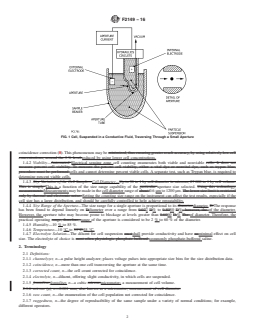
1.3 Electrical sensing zone instrumentation (commonly referred to as a Coulter counter) is manufactured by a variety of companies and is based upon electrical impedance. This test method, for cell counting and sizing, is based on the detection and measurement of changes in electrical resistance produced by a cell, suspended in a conductive liquid, traversing through a small aperture (see Fig. 1(9)). When cells are suspended in a conductive liquid, phosphate-buffered saline for instance, they function as discrete insulators. When the cell suspension is drawn through a small cylindrical aperture, the passage of each cell changes the impedance of the electrical path between two submerged electrodes located on each side of the aperture. An electrical pulse, suitable for both counting and sizing, results from the passage of each cell through the aperture. The path through the aperture, in which the cell is detected, is known as the “electronic sensing zone.” This test method permits the selective counting of cells within narrow size distrib...
General Information
- Status
- Published
- Publication Date
- 14-Jan-2016
- Technical Committee
- F04 - Medical and Surgical Materials and Devices
- Drafting Committee
- F04.43 - Cells and Tissue Engineered Constructs for TEMPs
Relations
- Effective Date
- 15-Jan-2016
- Effective Date
- 15-Jan-2016
- Effective Date
- 15-Jan-2016
- Effective Date
- 15-Jan-2016
Overview
ASTM F2149-16 sets forth the standard test method for automated analyses of cells by the electrical sensing zone method. This internationally recognized standard details procedures for the enumeration and sizing of single-cell suspensions using electrical impedance-based instrumentation, commonly referred to as a Coulter counter. The method enables precise and rapid determination of cell count and size distribution across a wide variety of cell types, making it highly valuable in tissue culture, biomedical research, clinical, and pharmaceutical laboratory applications.
The electrical sensing zone technique, which has evolved since its introduction in the mid-20th century, offers improved automation, smaller equipment size, and advanced statistical analysis capabilities compared to manual microscopic cell counting methods such as the hemocytometer.
Key Topics
Principle of Operation: The method relies on detecting changes in electrical resistance as cells suspended in a conductive solution pass through a small aperture between electrodes. Each cell is counted and sized based on the electrical pulse generated by its passage.
Accuracy and Precision: Automation significantly enhances accuracy, precision, and speed compared to manual methods, with common coefficient of variation (CV) values below 5% for various cell types.
Applicability: Suitable for both spherical and, with validation, some non-spherical cells. Works well with suspension and adherent cells but is optimized for single, non-aggregated cells within a narrow size range.
Reporting Results: Cell counts may be expressed as cells per milliliter or total cells per analyzed volume. Size distribution is typically reported in cell diameter or volume measurements.
Validation: Each implementation requires laboratory validation, especially when introducing new cell types, adjusting procedures, or using different instruments.
Limitations:
- Coincidence error (correctable within instruments)
- Inability to distinguish viable from nonviable cells
- Sensitivity to sample preparation, cell shape, and aperture selection
Applications
Tissue Culture: Reliable enumeration and sizing of chondrocytes, fibroblasts, keratinocytes, and other cells commonly used in tissue-engineered medical products.
Biomedical & Clinical Laboratories: Supports rapid quantification of red blood cells (RBC), white blood cells (WBC), pancreatic islet cells, and other clinically relevant samples, enabling prompt and accurate cell analysis for diagnostic and research purposes.
Pharmaceutical & Research Laboratories: Ideal for high-throughput cell suspension analyses, including assessment of cell yields, viability studies (with complementary viability assays), and process optimization in drug development and biological research.
Process Monitoring: Ensures quality control in bioprocessing and manufacturing environments where precise cell counts and size distributions are critical.
Related Standards
- ISO 13319 - Determination of particle size distributions by the electrical sensing zone method.
- International Council for Standardization in Hematology (ICSH) methods for enumerating blood cells.
- ASTM Standards for Cell and Tissue Engineered Constructs - Related method protocols and terminology used in regenerative medicine and cellular therapy.
ASTM F2149-16 remains an essential reference for laboratories and manufacturers seeking validated, standardized procedures for automated cell counting and sizing. By adhering to this standard, organizations ensure high-quality, reproducible results in cell-based analyses across diverse scientific and medical fields.
Buy Documents

ASTM F2149-16 - Standard Test Method for Automated Analyses of Cells—the Electrical Sensing Zone Method of Enumerating and Sizing Single Cell Suspensions
REDLINE ASTM F2149-16 - Standard Test Method for Automated Analyses of Cells—the Electrical Sensing Zone Method of Enumerating and Sizing Single Cell Suspensions
Frequently Asked Questions
ASTM F2149-16 is a standard published by ASTM International. Its full title is "Standard Test Method for Automated Analyses of Cells—the Electrical Sensing Zone Method of Enumerating and Sizing Single Cell Suspensions". This standard covers: SIGNIFICANCE AND USE 3.1 The electrical sensing zone method for cell counting is used in tissue culture, government research, and hospital, biomedical, and pharmaceutical laboratories for counting and sizing cells. The method may be applicable to a wide range of cells sizes and cell types, with appropriate validation (10). 3.2 The electrical sensing zone methodology was introduced in the mid-1950s (9). Since this time, there have been substantial improvements which have enhanced the operator's ease of use. Among these are the elimination of the mercury manometer, reduced size, greater automation, and availability of comprehensive statistical computer programs. 3.3 This instrumentation offers a rapid result as contrasted to the manual counting of cells using the hemocytometer standard counting chamber. The counting chamber is known to have an error of 10 to 30 %, as well as being time-consuming (11). In addition, when counting and sizing porcine hepatocytes, Stegemann et al concluded that the automated, electrical sensing zone method provided greater accuracy, precision, and speed, for both counts and size, compared to the conventional microscopic or the cell mass-based method (7). SCOPE 1.1 This test method, provided the limitations are understood, covers a procedure for both the enumeration and measurement of size distribution of most all cell types. The instrumentation allows for user-selectable cell size settings and is applicable to a wide range of cell types. The method works best for spherical cells, and may be less accurate if cells are not spherical, such as for discoid cells or budding yeast. The method is appropriate for suspension as well as adherent cell cultures (1).2 Results may be reported as number of cells per milliliter or total number of cells per volume of cell suspension analyzed. Size distribution may be expressed in cell diameter or volume. 1.2 Cells commonly used in tissue-engineered medical products (2) are analyzed routinely. Examples are chondrocytes (3), fibroblasts (4), and keratinocytes (5). Szabo et al. used the method for both pancreatic islet number and volume measurements (6). In addition, instrumentation using the electrical sensing zone technology was used for both count and size distribution analyses of porcine hepatocytes placed into hollow fiber cartridge extracorporeal liver assist systems. In this study (7), and others (6, 8), the automated electrical sensing zone method was validated for precision when compared to the conventional visual cell counting under a microscope using a hemocytometer. Currently, it is not possible to validate cell counting devices for accuracy, since there not a way to produce a reference sample that has a known number of cells. The electrical sensing zone method shall be validated each time it is implemented in a new laboratory, it is used on a new cell type, or the cell counting procedure is modified. 1.3 Electrical sensing zone instrumentation (commonly referred to as a Coulter counter) is manufactured by a variety of companies and is based upon electrical impedance. This test method, for cell counting and sizing, is based on the detection and measurement of changes in electrical resistance produced by a cell, suspended in a conductive liquid, traversing through a small aperture (see Fig. 1(9)). When cells are suspended in a conductive liquid, phosphate-buffered saline for instance, they function as discrete insulators. When the cell suspension is drawn through a small cylindrical aperture, the passage of each cell changes the impedance of the electrical path between two submerged electrodes located on each side of the aperture. An electrical pulse, suitable for both counting and sizing, results from the passage of each cell through the aperture. The path through the aperture, in which the cell is detected, is known as the “electronic sensing zone.” This test method permits the selective counting of cells within narrow size distrib...
SIGNIFICANCE AND USE 3.1 The electrical sensing zone method for cell counting is used in tissue culture, government research, and hospital, biomedical, and pharmaceutical laboratories for counting and sizing cells. The method may be applicable to a wide range of cells sizes and cell types, with appropriate validation (10). 3.2 The electrical sensing zone methodology was introduced in the mid-1950s (9). Since this time, there have been substantial improvements which have enhanced the operator's ease of use. Among these are the elimination of the mercury manometer, reduced size, greater automation, and availability of comprehensive statistical computer programs. 3.3 This instrumentation offers a rapid result as contrasted to the manual counting of cells using the hemocytometer standard counting chamber. The counting chamber is known to have an error of 10 to 30 %, as well as being time-consuming (11). In addition, when counting and sizing porcine hepatocytes, Stegemann et al concluded that the automated, electrical sensing zone method provided greater accuracy, precision, and speed, for both counts and size, compared to the conventional microscopic or the cell mass-based method (7). SCOPE 1.1 This test method, provided the limitations are understood, covers a procedure for both the enumeration and measurement of size distribution of most all cell types. The instrumentation allows for user-selectable cell size settings and is applicable to a wide range of cell types. The method works best for spherical cells, and may be less accurate if cells are not spherical, such as for discoid cells or budding yeast. The method is appropriate for suspension as well as adherent cell cultures (1).2 Results may be reported as number of cells per milliliter or total number of cells per volume of cell suspension analyzed. Size distribution may be expressed in cell diameter or volume. 1.2 Cells commonly used in tissue-engineered medical products (2) are analyzed routinely. Examples are chondrocytes (3), fibroblasts (4), and keratinocytes (5). Szabo et al. used the method for both pancreatic islet number and volume measurements (6). In addition, instrumentation using the electrical sensing zone technology was used for both count and size distribution analyses of porcine hepatocytes placed into hollow fiber cartridge extracorporeal liver assist systems. In this study (7), and others (6, 8), the automated electrical sensing zone method was validated for precision when compared to the conventional visual cell counting under a microscope using a hemocytometer. Currently, it is not possible to validate cell counting devices for accuracy, since there not a way to produce a reference sample that has a known number of cells. The electrical sensing zone method shall be validated each time it is implemented in a new laboratory, it is used on a new cell type, or the cell counting procedure is modified. 1.3 Electrical sensing zone instrumentation (commonly referred to as a Coulter counter) is manufactured by a variety of companies and is based upon electrical impedance. This test method, for cell counting and sizing, is based on the detection and measurement of changes in electrical resistance produced by a cell, suspended in a conductive liquid, traversing through a small aperture (see Fig. 1(9)). When cells are suspended in a conductive liquid, phosphate-buffered saline for instance, they function as discrete insulators. When the cell suspension is drawn through a small cylindrical aperture, the passage of each cell changes the impedance of the electrical path between two submerged electrodes located on each side of the aperture. An electrical pulse, suitable for both counting and sizing, results from the passage of each cell through the aperture. The path through the aperture, in which the cell is detected, is known as the “electronic sensing zone.” This test method permits the selective counting of cells within narrow size distrib...
ASTM F2149-16 is classified under the following ICS (International Classification for Standards) categories: 07.100.01 - Microbiology in general. The ICS classification helps identify the subject area and facilitates finding related standards.
ASTM F2149-16 has the following relationships with other standards: It is inter standard links to ASTM F2149-01(2007), ASTM F3209-16, ASTM F2739-19, ASTM E2805-18. Understanding these relationships helps ensure you are using the most current and applicable version of the standard.
ASTM F2149-16 is available in PDF format for immediate download after purchase. The document can be added to your cart and obtained through the secure checkout process. Digital delivery ensures instant access to the complete standard document.
Standards Content (Sample)
This international standard was developed in accordance with internationally recognized principles on standardization established in the Decision on Principles for the
Development of International Standards, Guides and Recommendations issued by the World Trade Organization Technical Barriers to Trade (TBT) Committee.
Designation: F2149 − 16
Standard Test Method for
Automated Analyses of Cells—the Electrical Sensing Zone
Method of Enumerating and Sizing Single Cell Suspensions
This standard is issued under the fixed designation F2149; the number immediately following the designation indicates the year of
original adoption or, in the case of revision, the year of last revision.Anumber in parentheses indicates the year of last reapproval.A
superscript epsilon (´) indicates an editorial change since the last revision or reapproval.
1. Scope and measurement of changes in electrical resistance produced
by a cell, suspended in a conductive liquid, traversing through
1.1 This test method, provided the limitations are
a small aperture (see Fig. 1(9)). When cells are suspended in a
understood, covers a procedure for both the enumeration and
conductive liquid, phosphate-buffered saline for instance, they
measurement of size distribution of most all cell types. The
function as discrete insulators. When the cell suspension is
instrumentationallowsforuser-selectablecellsizesettingsand
drawnthroughasmallcylindricalaperture,thepassageofeach
is applicable to a wide range of cell types. The method works
cell changes the impedance of the electrical path between two
bestforsphericalcells,andmaybelessaccurateifcellsarenot
submerged electrodes located on each side of the aperture.An
spherical, such as for discoid cells or budding yeast. The
electrical pulse, suitable for both counting and sizing, results
method is appropriate for suspension as well as adherent cell
2 from the passage of each cell through the aperture. The path
cultures (1). Results may be reported as number of cells per
through the aperture, in which the cell is detected, is known as
milliliterortotalnumberofcellspervolumeofcellsuspension
the “electronic sensing zone.” This test method permits the
analyzed. Size distribution may be expressed in cell diameter
selective counting of cells within narrow size distribution
or volume.
ranges by electronic selection of the generated pulses. While
1.2 Cells commonly used in tissue-engineered medical
the number of pulses indicates cell count, the amplitude of the
products (2) are analyzed routinely. Examples are chondro-
electrical pulse produced depends on the cell’s volume. The
cytes (3), fibroblasts (4), and keratinocytes (5). Szabo et al.
baseline resistance between the electrodes is due to the
used the method for both pancreatic islet number and volume
resistanceoftheconductiveliquidwithintheboundariesofthe
measurements (6). In addition, instrumentation using the elec-
aperture. The presence of cells within the “electronic sensing
tricalsensingzonetechnologywasusedforbothcountandsize
zone” raises the resistance of the conductive pathway that
distributionanalysesofporcinehepatocytesplacedintohollow
depends on the volume of the cell.Analyses of the behavior of
fiber cartridge extracorporeal liver assist systems. In this study
cells within the aperture demonstrates that the height of the
(7), and others (6, 8), the automated electrical sensing zone
pulse produced by the cell is the parameter that most nearly
method was validated for precision when compared to the
shows proportionality to the cell volume.
conventional visual cell counting under a microscope using a
1.4 Limitations are discussed as follows:
hemocytometer. Currently, it is not possible to validate cell
1.4.1 Coincidence—Occasionally, more than a single cell
countingdevicesforaccuracy,sincetherenotawaytoproduce
a reference sample that has a known number of cells. The transverses the aperture simultaneously. Only a single larger
pulse, as opposed to two individual pulses, is generated. The
electrical sensing zone method shall be validated each time it
is implemented in a new laboratory, it is used on a new cell result is a lower cell count and higher cell volume measure-
ment. The frequency of coincidence is a statistically predict-
type, or the cell counting procedure is modified.
able function of cell concentration that is corrected by the
1.3 Electrical sensing zone instrumentation (commonly re-
instrument. This is called coincidence correction (8). This
ferred to as a Coulter counter) is manufactured by a variety of
phenomenon may be reduced by using lower cell concentra-
companies and is based upon electrical impedance. This test
tions.
method, for cell counting and sizing, is based on the detection
1.4.2 Viability—Electrical sensing zone cell counting enu-
merates both viable and nonviable cells and cannot determine
ThistestmethodisunderthejurisdictionofASTMCommitteeF04onMedical
percent viable cells. A separate test, such as Trypan blue, is
andSurgicalMaterialsandDevicesandisthedirectresponsibilityofSubcommittee
required to determine percent viable cells.
F04.43 on Cells and Tissue Engineered Constructs for TEMPs.
Current edition approved Jan. 15, 2016. Published May 2016. Originally
1.4.3 Cell Diameter—This is a function of the size range
approved in 2001. Last previous edition approved in 2007 as F2149–01 (2007).
capability of the aperture size selected. Measurements may be
DOI: 10.1520/F2149-16.
made in the cell diameter range of 0.6 µm to 1200 µm. Setting
The boldface numbers in parentheses refers to the list of references at the end
of this standard. the counting size range on the instrument can affect the test
Copyright © ASTM International, 100 Barr Harbor Drive, PO Box C700, West Conshohocken, PA 19428-2959. United States
F2149 − 16
FIG. 1 Cell, Suspended in a Conductive Fluid, Traversing Through a Small Aperture
results, especially if the cell size has a large distribution, and 2.1.6 raw count, n—the enumeration of the cell population
should be carefully controlled to help achieve repeatability. not corrected for coincidence.
1.4.4 Size Range of the Aperture—The size range for a
2.1.7 ruggedness, n—the degree of reproducibility of the
singleapertureisproportionaltoitsdiameter.Theresponsehas
same sample under a variety of normal conditions; for
been found to depend linearly on diameter over a range from 2
example, different operators.
% to 80 % of the diameter. However, the aperture tube may
2.1.8 size thresholds, n—the instrument’s lower and upper
become prone to blockage at levels greater than 60 % of
size settings for the particular cell population; adjustable “size
diameter. Therefore, the practical operating range of the
gate.” Cells or fragments outside the size settings are excluded
aperture is considered to be2%to60%ofthe diameter.
from the analyses.
1.4.5 Humidity—10%to85%.
1.4.6 Temperature—10 °C to 35 °C.
3. Significance and Use
1.4.7 Electrolyte Solution—The diluent for cell suspension
3.1 The electrical sensing zone method for cell counting is
shallprovideconductivityandhaveminimaleffectoncellsize.
used in tissue culture, government research, and hospital,
The electrolyte of choice is commonly phosphate-buffered
biomedical, and pharmaceutical laboratories for counting and
saline.
sizing cells. The method may be applicable to a wide range of
cells sizes and cell types, with appropriate validation (10).
2. Terminology
3.2 The electrical sensing zone methodology was intro-
2.1 Definitions:
duced in the mid-1950s (9). Since this time, there have been
2.1.1 channelyzer, n—a pulse height analyzer; places volt-
substantial improvements which have enhanced the operator’s
age pulses into appropriate size bins for the size distribution
ease of use. Among these are the elimination of the mercury
data.
manometer, reduced size, greater automation, and availability
2.1.2 coincidence, n—more than one cell transversing the
of comprehensive statistical computer programs.
aperture at the same time.
3.3 This instrumentation offers a rapid result as contrasted
2.1.3 corrected count, n—the cell count corrected for coin-
to the manual counting of cells using the hemocytometer
cidence.
standardcountingchamber.Thecountingchamberisknownto
2.1.4 electrolyte, n—diluent, offering slight conductivity, in
have an error of 10 to 30%, as well as being time-consuming
which cells are suspended.
(11). In addition, when counting and sizing porcine
2.1.5 femtoliter, n—a cubic micrometer; a measurement of hepatocytes, Stegemann et al concluded that the automated,
cell volume. electrical sensing zone method provided greater accuracy,
F2149 − 16
precision,andspeed,forbothcountsandsize,comparedtothe types, a commercial calibrator of known volume should be
conventional microscopic or the cell mass-based method (7). used.Lightmicroscopycanbeusedtoverifyreferenceparticle
size or cell size.
4. Interferences
6.3 Dilute the cell suspension in the electrolyte, typically
4.1 Debris and Cellular Fragments—When these are in the phosphate-buffered saline. Gently mix the sample. The mixing
cellular size ranges, they will be analyzed. Correct cell size method should b
...
This document is not an ASTM standard and is intended only to provide the user of an ASTM standard an indication of what changes have been made to the previous version. Because
it may not be technically possible to adequately depict all changes accurately, ASTM recommends that users consult prior editions as appropriate. In all cases only the current version
of the standard as published by ASTM is to be considered the official document.
Designation: F2149 − 01 (Reapproved 2007) F2149 − 16
Standard Test Method for
Automated Analyses of Cells—the Electrical Sensing Zone
Method of Enumerating and Sizing Single Cell Suspensions
This standard is issued under the fixed designation F2149; the number immediately following the designation indicates the year of
original adoption or, in the case of revision, the year of last revision. A number in parentheses indicates the year of last reapproval. A
superscript epsilon (´) indicates an editorial change since the last revision or reapproval.
1. Scope
1.1 This test method, provided the limitations are understood, covers a procedure for both the enumeration and measurement
of size distribution of most all cell types. The instrumentation allows for user-selectable cell size settings, hence, this test method
is not restricted to specific settings and is applicable to a wide range of cell types. The method works best for spherical cells, and
may be less accurate if cells are not spherical, such as for discoid cells or budding yeast. The method is appropriate for suspension
as well as adherent cell cultures (1). This is a quantitative laboratory method not intended for on-line or field use. Results may
be reported as number of cells per millilitremilliliter or total number of cells per volume of cell suspension analyzed. Both count
and size Size distribution may be expressed in cell micron diameter or volume, femtolitres.volume.
1.2 Cells commonly used in tissue-engineered medical products (2) routinely are analyzed. analyzed routinely. Examples are
chondrocytes (3), fibroblasts (4), and keratinocytes (5). Szabo et alal. used the method for both pancreatic islet number and volume
measurements (6). In addition, instrumentation using the electrical sensing zone technology was used for both count and size
distribution analyses of porcine hepatocytes placed into hollow fiber cartridge extracorporeal liver assist systems. In this study (7),
and others (6, 8), the automated electrical sensing zone method was clearly validated for superior accuracy and precision when
compared to the conventional manual method, visual cell counting under a microscope using a hemocytometer. This validation has
been demonstrated over a wide variety of cell types. In addition, the automated procedure is rapid, rugged, and cost effective; it
also minimizes operator-to-operator variability inherent in manual techniques.Currently, it is not possible to validate cell counting
devices for accuracy, since there not a way to produce a reference sample that has a known number of cells. The electrical sensing
zone method shall be validated each time it is implemented in a new laboratory, it is used on a new cell type, or the cell counting
procedure is modified.
1.3 This instrumentation Electrical sensing zone instrumentation (commonly referred to as a Coulter counter) is manufactured
by a variety of companies; however, the principle used in all is companies and is based upon electrical impedance. This test
method, for cell counting and sizing, is based on the detection and measurement of changes in electrical resistance produced by
a cell, suspended in a conductive liquid, traversing through a small aperture (see Fig. 1(9)). When cells are suspended in a
conductive liquid, phosphate-buffered saline for instance, they function as discrete insulators. When the cell suspension is drawn
through a small cylindrical aperture, the passage of each cell changes the impedance of the electrical path between two submerged
electrodes located on each side of the aperture. An electrical pulse, suitable for both counting and sizing, results from the passage
of each cell through the aperture. The path through the aperture, in which the cell is detected, is known as the “electronic sensing
zone.” This test method permits the selective counting of cells within very narrow size distribution ranges by electronic selection
of the generated pulses. While the number of pulses indicates cell count, the amplitude of the electrical pulse produced depends
on the cell’s volume. The baseline resistance between the electrodes is due to the resistance of the conductive liquid within the
boundaries of the aperture. The presence of cells within the “electronic sensing zone” raises the resistance of the conductive
pathway that depends on the volume of the cell. Analyses of the behavior of cells within the aperture demonstrates that the height
of the pulse produced by the cell is the parameter that most nearly shows proportionality to the cell volume.
1.4 Limitations are discussed as follows:
1.4.1 Coincidence—Occasionally, more than a single cell transverses the aperture simultaneously. Only a single larger pulse, as
opposed to two individual pulses, is generated. The result is a lower cell count and higher cell volume measurement. The frequency
of coincidence is a statistically predictable function of cell concentration that is corrected by the instrument. This is called
This test method is under the jurisdiction of ASTM Committee F04 on Medical and Surgical Materials and Devices and is the direct responsibility of Subcommittee
F04.43 on Cells and Tissue Engineered Constructs for TEMPs.
Current edition approved Oct. 1, 2007Jan. 15, 2016. Published October 2007May 2016. Originally approved in 2001. Last previous edition approved in 20012007 as
F2149 – 01.F2149 – 01 (2007). DOI: 10.1520/F2149-01R07.10.1520/F2149-16.
The boldface numbers in parentheses refers to the list of references at the end of this standard.
Copyright © ASTM International, 100 Barr Harbor Drive, PO Box C700, West Conshohocken, PA 19428-2959. United States
F2149 − 16
FIG. 1 Cell, Suspended in a Conductive Fluid, Traversing Through a Small Aperture
coincidence correction (8). This phenomenon may be minimized, thus ensuring greater result accuracy, by using relatively low cell
concentrations, around the 5 % level.reduced by using lower cell concentrations.
1.4.2 Viability—Automated Electrical sensing zone cell counting enumerates both viable and nonviable cells. It does not
measure percent cell viability. To measure the percent cell viability, either a vital dye or nonvital dye, such as trypan blue,
procedure must be performed.cells and cannot determine percent viable cells. A separate test, such as Trypan blue, is required to
determine percent viable cells.
1.4.3 Size Variation of the Cell Sample—Cell Diameter—Up to 30 to 1 by cell diameter in microns; 27 000 to 1 by cell volume.
This is simply This is a function of the size range capability of the particular aperture size selected. Using this technology,
measurements Measurements may be made in the cell diameter range of about 0.6 μm to 1200 μm. The lower size limit is restricted
only by thermal and electronic noise. Setting the counting size range on the instrument can affect the test results, especially if the
cell size has a large distribution, and should be carefully controlled to help achieve repeatability.
1.4.4 Size Range of the Aperture—The size range for a single aperture is proportional to its diameter,diameter. D.The response
has been found to depend linearly on Ddiameter over a range from 0.022 D% to 0.8080 D%; however, the of the diameter.
However, the aperture tube may become prone to blockage at levels greater than 0.6060 D.% The of diameter. Therefore, the
practical operating range, therefore, range of the aperture is considered to be 2 % to 60 % of the diameter.
1.4.5 Humidity—10 % to 85 %.
1.4.6 Temperature—10 °C to 35°C.35 °C.
1.4.7 Electrolyte Solution—The diluent for cell suspension mustshall provide conductivity and have nominimal effect on cell
size. The electrolyte of choice is most often physiologic phosphate buffered commonly phosphate-buffered saline.
2. Terminology
2.1 Definitions:
2.1.1 channelyzer, n—a pulse height analyzer; places voltage pulses into appropriate size bins for the size distribution data.
2.1.2 coincidence, n—more than one cell transversing the aperture at the same time.
2.1.3 corrected count, n—the cell count corrected for coincidence.
2.1.4 electrolyte, n—diluent, offering slight conductivity, in which cells are suspended.
2.1.5 femtolitre,femtoliter, n—a cubic micron;micrometer; a measurement of cell volume.
2.1.6 micron (μ), n—0.001 mm, also known as a micrometre; measurement of cell diameter.
2.1.6 raw count, n—the enumeration of the cell population not corrected for coincidence.
2.1.7 ruggedness, n—the degree of reproducibility of the same sample under a variety of normal conditions; for example,
different operators.
F2149 − 16
2.1.8 size thresholds, n—the instrument’s lower and upper size settings for the particular cell population; adjustable “size gate.”
Cells or fragments outside the size settings are excluded from the analyses.
3. Significance and Use
3.1 This assay The electrical sensing zone method for cell counting is used in university tissue culture laboratories, culture,
government research, and hospital, biomedical, and pharmaceutical laboratories to automate cell counting and sizing. This
instrumentation provides very rapid, accurate, and precise results for any tissue culture facility. In addition, as noted, since the cell
sizes to be analyzed by the instrument are set by the user, the analyses may be done on virtually any species of cells and cell type;
it is notfor counting and sizing cells. The method may be applicable to a wide range of cells sizes and cell types, with appropriate
validation restricted (10to ).human cells or blood cells.
3.2 The electrical sensing zone methodology was introduced in the mid 1950s mid-1950s (9). Since this time, there have been
substantial improvements which have enhanced the operator’s ease of use. Among these are the elimination of the mercury
manometer, reduced size, greater automation, and availability of comprehensive statistical computer programs.
3.3 This instrumentation offers a rapid result as contrasted to the manual counting of cells using the hemocytometer standard
counting chamber, hemocytometer. chamber. The counting chamber is known to have an error of 10 to 30 %, as well as being very
time consuming time-consuming (1011). In addition, when counting and sizing porcine hepatocytes, Stegemann et al concluded
that the automated, electrical sensing zone method provided significantly greater accuracy, precision, and speed, for both counts
and size, compared to the conventional microscopic or the cell mass-based method (7).
4. Interferences
4.1 Debris and Cellular Fragments—When these are in the cellular size ranges, they will be analyzed. Correct cell siz
...
Questions, Comments and Discussion
Ask us and Technical Secretary will try to provide an answer. You can facilitate discussion about the standard in here.
Loading comments...