


ASTM A952/A952M-02(2016)
(Specification)Standard Specification for Forged Grade 80 and Grade 100 Steel Lifting Components and Welded Attachment Links
Standard Specification for Forged Grade 80 and Grade 100 Steel Lifting Components and Welded Attachment Links
ABSTRACT
This specification covers forged alloy steel lifting components and welded coupling and master links for Grade 80 and Grade 100 alloy chain slings. The steel materials shall be melt processed either by electric process or oxygen blown process. The steel shall be fully killed and shall conform to the required austenitic grain size. Product analysis shall be performed on and the steel specimens shall conform to the required chemical compositions of nickel, chromium, molybdenum, phosphorus and sulfur. Proof tests shall be performed and the materials shall conform to the required values of working load and breaking force. Deformation test, breaking force test and fatigue test shall be performed on the steel materials.
SCOPE
1.1 This specification covers the requirements for forged alloy steel lifting components and welded coupling and master links for Grade 80 and Grade 100 alloy chain slings as described in Specification A906/A906M.
1.2 Two grades of components and welded links are covered:
1.2.1 Grade 80.
1.2.2 Grade 100.
1.3 This specification is a performance standard. Other standards apply to use of these products. Some of these standards are: OSHA 1910.184, ASME B30.9, and ASME B30.10.
1.4 The values stated in either inch-pound or SI units are to be regarded separately as standard. Within the text, the SI units are shown in brackets. The values stated in each system are not exact equivalents; therefore, each system shall be used independently of the other. Combining values from the two systems may result in nonconformance with the specification.
General Information
Buy Standard
Standards Content (Sample)
NOTICE: This standard has either been superseded and replaced by a new version or withdrawn.
Contact ASTM International (www.astm.org) for the latest information
Designation:A952/A952M −02 (Reapproved 2016)
Standard Specification for
Forged Grade 80 and Grade 100 Steel Lifting Components
and Welded Attachment Links
This standard is issued under the fixed designationA952/A952M; the number immediately following the designation indicates the year
of original adoption or, in the case of revision, the year of last revision. A number in parentheses indicates the year of last reapproval.
A superscript epsilon (´) indicates an editorial change since the last revision or reapproval.
1. Scope E44 Definitions for Terms Relating to Heat Treatment of
Metals (Withdrawn 1993)
1.1 This specification covers the requirements for forged
E165/E165M Practice for Liquid Penetrant Testing for Gen-
alloy steel lifting components and welded coupling and master
eral Industry
links for Grade 80 and Grade 100 alloy chain slings as
E709 Guide for Magnetic Particle Testing
described in Specification A906/A906M.
2.2 Other Standards:
1.2 Two grades of components and welded links are cov-
OSHA 1910.184 Slings
ered:
ASME B30.9 Slings
1.2.1 Grade 80.
ASME B30.10 Hooks
1.2.2 Grade 100.
1.3 This specification is a performance standard. Other 3. Terminology
standards apply to use of these products. Some of these
3.1 Definitions of Terms Specific to This Standard:
standards are: OSHA 1910.184, ASME B30.9, and ASME
3.1.1 breaking force, minimum—the minimum force in
B30.10.
pounds or newtons at which the component has been found by
1.4 The values stated in either inch-pound or SI units are to verification testing to break when a constantly increasing force
was applied in direct tension. This test is a manufacturer’s
be regarded separately as standard.Within the text, the SI units
design verification test and shall not be used as criteria for
are shown in brackets.The values stated in each system are not
service.
exact equivalents; therefore, each system shall be used inde-
pendentlyoftheother.Combiningvaluesfromthetwosystems
3.1.2 chain sling—an assembly consisting of alloy steel
may result in nonconformance with the specification.
chain joined to upper and lower end components for attaching
loads to be lifted by a crane or lifting machine.
2. Referenced Documents
3.1.3 coupling link—a link fitted to the end of the chain to
2.1 ASTM Standards:
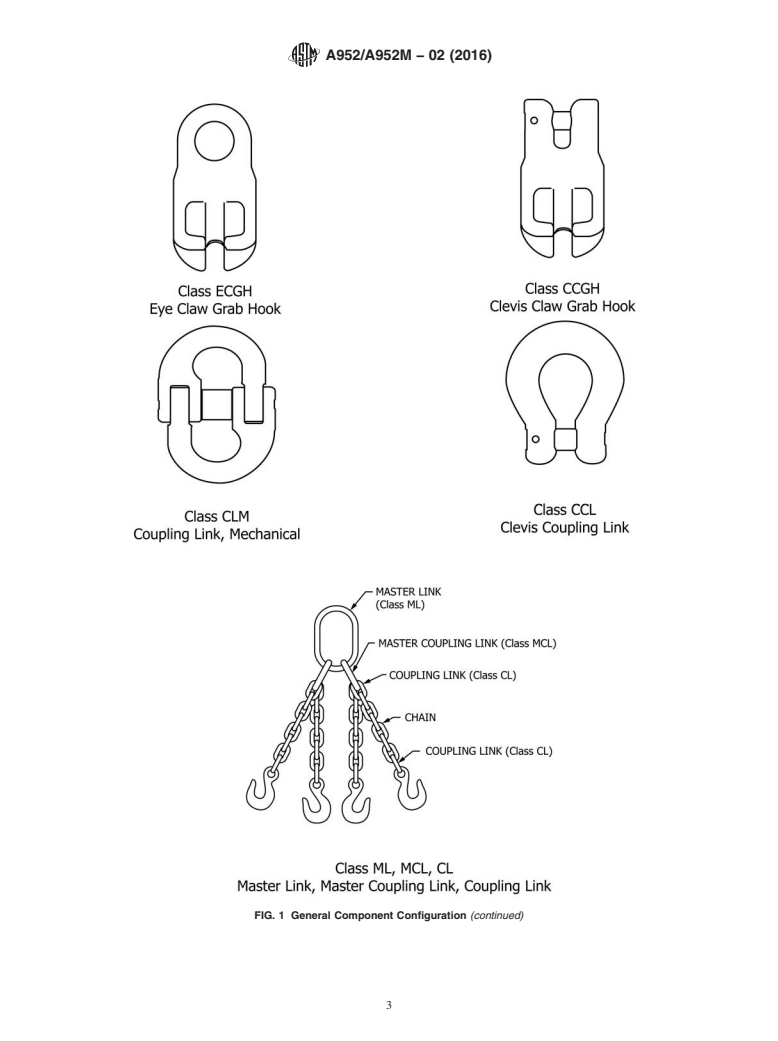
connect to another component of the sling. See Fig. 1.
A29/A29M SpecificationforGeneralRequirementsforSteel
3.1.4 masterlink—alinkusedasanupperendcomponentof
Bars, Carbon and Alloy, Hot-Wrought
a chain sling and by means of which the sling may be attached
A391/A391M Specification for Grade 80 Alloy Steel Chain
to a crane or other device. See Fig. 1.
A751 Test Methods and Practices for Chemical Analysis of
3.1.5 master coupling link (secondary or intermediate
Steel Products
link)—a link used on three and four leg slings to connect the
A906/A906M Specification for Grade 80 and Grade 100
legs to a master link. See Fig. 1.
Alloy Steel Chain Slings for Overhead Lifting
A973/A973M Specification for Grade 100Alloy Steel Chain 3.1.6 proof test—a quality control tensile test applied to
components for the purpose of verifying manufacturing and
E4 Practices for Force Verification of Testing Machines
material quality. It is the minimum force in pounds or newtons
which the component has withstood at the time it left the
This specification is under the jurisdiction ofASTM Committee A01 on Steel,
Stainless Steel and Related Alloys and is the direct responsibility of Subcommittee
A01.27 on Steel Chain. The last approved version of this historical standard is referenced on
Current edition approved Sept. 1, 2016. Published September 2016. Originally www.astm.org.
approved in 1996. Last previous edition approved in 2010 as A952/ Available from Occupational Safety and Health Administration (OSHA), 200
A952M–02(2010). DOI: 10.1520/A0952_A0952M-02R16. Constitution Ave., NW, Room Number N3626, Washington, DC 20210, http://
For referenced ASTM standards, visit the ASTM website, www.astm.org, or www.osha.gov.
contact ASTM Customer Service at service@astm.org. For Annual Book of ASTM Available from American Society of Mechanical Engineers (ASME), ASME
Standards volume information, refer to the standard’s Document Summary page on International Headquarters, Two Park Ave., New York, NY 10016-5990, http://
the ASTM website. www.asme.org.
Copyright © ASTM International, 100 Barr Harbor Drive, PO Box C700, West Conshohocken, PA 19428-2959. United States
A952/A952M−02 (2016)
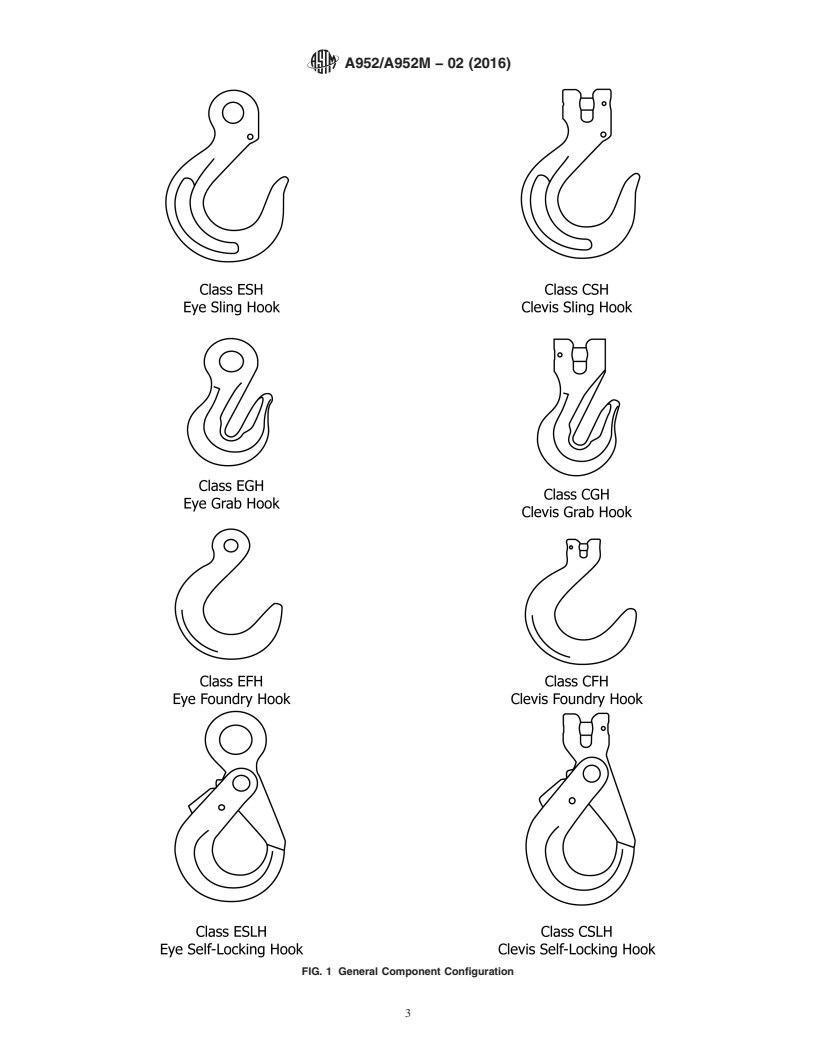
FIG. 1 General Component Configuration
A952/A952M−02 (2016)
FIG. 1 General Component Configuration (continued)
A952/A952M−02 (2016)
producer, under a test in which a constantly increasing force 6. Materials
has been applied in direct tension. Proof test loads are a
6.1 Quality—The selection of the type of steel is left to the
manufacturingintegritytestandshallnotbeusedascriteriafor
judgment of the manufacturer provided the material meets the
service.
requirements set forth in 6.2 and 6.3.
3.1.7 traceability code—a series of letters, or numbers, or
6.2 Melting Process—The steel used shall be produced by
both, marked on a component which enables its manufacturing
an electric process or by an oxygen blown process. The steel
history, including identity of the steel heat, to be traced.
shall be fully killed and have an austenitic grain size of 5 or
3.1.8 working load limit (WLL)—the maximum combined
finer.
static and dynamic load in pounds or kilograms that shall be
6.3 Chemical Requirements:
applied in direct tension to the component.
6.3.1 The alloy steel used shall contain at least two of the
three alloying agents in the minimum percentages as listed
4. Classification
below:
4.1 Only Grade 80 and Grade 100 components are covered
Nickel 0.40 % minimum
Chromium 0.40 % minimum
under this specification.
Molybdenum 0.15 % minimum
4.2 Sixteen classes of components are covered under this
6.3.2 The phosphorous and sulfur content of the steel shall
specification. The general configuration on these components
not exceed 0.025 % for each element.
are shown in Fig. 1.
6.3.3 Product Analysis—The steel used may be analyzed by
4.2.1 Class EGH—Eye Grab Hook.
the purchaser and shall conform to the requirements of 6.3.1
4.2.2 Class CGH—Clevis Grab Hook.
and 6.3.2 subject to the product analysis tolerances specified in
4.2.3 Class ESH—Eye Sling Hook.
Specification A29/A29M. Test samples may be taken from
4.2.4 Class CSH—Clevis Sling Hook.
rods, bars, or finished product.
4.2.5 Class EFH—Eye Foundry Hook.
6.3.4 Chemical analysis of material covered by this speci-
4.2.6 Class CFH—Clevis Foundry Hook.
fication for referee purposes shall be in accordance with Test
4.2.7 Class CLM—Coupling Link, Mechanical. Methods, Practices, and Terminology A751.
4.2.8 Class ESLH—Eye Self-Locking Hook.
7. Manufacture
4.2.9 Class CSLH—Clevis Self-Locking Hook.
7.1 The body of all components shall be forged hot in one
4.2.10 Class ECGH—Eye Claw Grab Hook.
piece, with the exception of Class ML, MCL and CL link
4.2.11 Class CCGH—Clevis Claw Grab Hook.
components.
4.2.12 Class ML—Master Link.
4.2.13 Class MCL—Master Coupling Link. 7.2 Excess metal flash shall be cleanly removed, leaving the
surface free from sharp edges.
4.2.14 Class CL—Coupling Link.
4.2.15 Class CCL—Clevis Coupling Link.
7.3 Class ML, MCL, and CL link components may be
4.2.16 Class OTH—Specialty components may be required
manufactured using the electric welding, gas welding, or
for certain applications.
forging process.
4.3 For the classes listed in 4.2, an “S” prefix denotes a
7.4 Ancillary components such as load pins, latches,
component with a swivel joint. bearings, and springs need not be forged components.
7.5 Welding shall not be used to repair forged components.
5. Ordering Information
Grindingofsurfacediscontinuitiesmaybecarefullyperformed
5.1 It shall be the responsibility of the purchaser to specify aslongasnodimensionisalteredoutsideofthemanufacturer’s
dimensions and tolerances for that component. All ground
all requirements that are necessary for material ordered under
this specification. Such requirements to be considered include, areas must blend in smoothly with the surface.
but are not limited to, the following:
7.6 Heat Treatment—After forging or welding is completed,
5.1.1 Product to conform to Specification A952 or Specifi-
each load bearing component shall be heat treated before
cation A952M and year of issue.
applying the proof test. Heat treatment shall include quenching
5.1.2 Nominal size of component, in. [mm] (see Note 1).
and tempering as defined in Definitions E44.
5.1.3 Grade of component.
7.7 After heat treatment, furnace scale shall be removed
5.1.4 Class of component.
from the component.
5.1.5 Quantity of components.
5.1.6 Finish, if required. 8. Performance Requirements
5.1.7 Certification, if required.
8.1 Proof Test—All components shall be proof tested as
5.1.8 Acceptance of inspection by purchaser, if required.
requiredper8.1.1through8.1.5.Alltestsshallbeperformedon
5.1.9 Supplementary requirements, if required.
equipment certifiable to Practices E4.
8.1.1 All components used on single legs of slings shall be
NOTE 1—Component size and working load limits are based on Grade
tested to at least the proof test load prescribed in Table 1 for
80 and Grade 100 alloy steel chain nominal sizes. See Specifications
A391/A391M and A973/A973M. Grade 80 components and Table 2 for Grade 100 components.
A952/A952M−02 (2016)
TABLE 1 Mechanical Requirements for Grade 80 Single Leg
8.3 Design Verification Tests:
Components
8.3.1 Deformation Test—Three samples shall be tested and
A
Nominal Size Working Load Proof Test , min Minimum
eachshallwithstandtheprooftestloadasprescribedin8.1.No
A
Limit, max Breaking Force
dimensionshallbealteredaftertheprooftestbymorethan1 %
in. mm lb kg lb kN lb kN
of the initial dimension. Class ML, MCL, and CL components
⁄32 5.5 2100 970 4200 19.0 8400 38.0
are exempt from the deformation requirement test.
⁄32 7.0 3500 1570 7000 30.8 14 000 61.6
⁄16 8.0 4500 2000 9000 40.3 18 000 80.6 8.3.2 Breaking Force Test:
⁄8 10.0 7100 3200 14 200 63.0 28 400 126.0
8.3.2.1 For single leg components, three samples shall be
⁄2 13.0 12 000 5400 24 000 107.0 48 000 214.0
5 tested and be capable of withstanding the relevant minimum
⁄8 16.0 18 000 8200 36 200 161.0 72 400 322
...
This document is not an ASTM standard and is intended only to provide the user of an ASTM standard an indication of what changes have been made to the previous version. Because
it may not be technically possible to adequately depict all changes accurately, ASTM recommends that users consult prior editions as appropriate. In all cases only the current version
of the standard as published by ASTM is to be considered the official document.
Designation: A952/A952M − 02 (Reapproved 2010) A952/A952M − 02 (Reapproved 2016)
Standard Specification for
Forged Grade 80 and Grade 100 Steel Lifting Components
and Welded Attachment Links
This standard is issued under the fixed designation A952/A952M; the number immediately following the designation indicates the year
of original adoption or, in the case of revision, the year of last revision. A number in parentheses indicates the year of last reapproval.
A superscript epsilon (´) indicates an editorial change since the last revision or reapproval.
1. Scope
1.1 This specification covers the requirements for forged alloy steel lifting components and welded coupling and master links
for Grade 80 and Grade 100 alloy chain slings as described in Specification A906/A906M.
1.2 Two grades of components and welded links are covered:
1.2.1 Grade 80.
1.2.2 Grade 100.
1.3 This specification is a performance standard. Other standards apply to use of these products. Some of these standards are:
OSHA 1910.184, ASME B30.9, and ASME B30.10.
1.4 The values stated in either inch-pound or SI units are to be regarded separately as standard. Within the text, the SI units are
shown in brackets. The values stated in each system are not exact equivalents; therefore, each system shall be used independently
of the other. Combining values from the two systems may result in nonconformance with the specification.
2. Referenced Documents
2.1 ASTM Standards:
A29/A29M Specification for General Requirements for Steel Bars, Carbon and Alloy, Hot-Wrought
A391/A391M Specification for Grade 80 Alloy Steel Chain
A751 Test Methods, Practices, and Terminology for Chemical Analysis of Steel Products
A906/A906M Specification for Grade 80 and Grade 100 Alloy Steel Chain Slings for Overhead Lifting
A973/A973M Specification for Grade 100 Alloy Steel Chain
E4 Practices for Force Verification of Testing Machines
E44 Definitions for Terms Relating to Heat Treatment of Metals (Withdrawn 1993)
E165E165/E165M Practice for Liquid Penetrant Examination for General Industry
E709 Guide for Magnetic Particle Testing
2.2 Other Standards:
OSHA 1910.184 Slings
ASME B30.9 Slings
ASME B30.10 Hooks
3. Terminology
3.1 Definitions of Terms Specific to This Standard:
This specification is under the jurisdiction of ASTM Committee A01 on Steel, Stainless Steel and Related Alloys and is the direct responsibility of Subcommittee A01.27
on Steel Chain.
Current edition approved April 1, 2010Sept. 1, 2016. Published May 2010September 2016. Originally approved in 1996. Last previous edition approved in 20022010 as
A952/A952MA952/A952M–02(2010). – 02. DOI: 10.1520/A0952_A0952M-02R10.10.1520/A0952_A0952M-02R16.
For referenced ASTM standards, visit the ASTM website, www.astm.org, or contact ASTM Customer Service at service@astm.org. For Annual Book of ASTM Standards
volume information, refer to the standard’sstandard’s Document Summary page on the ASTM website.
The last approved version of this historical standard is referenced on www.astm.org.
Available from Occupational Safety and Health Administration (OSHA), 200 Constitution Ave., NW, Room Number N3626, Washington, DC 20210, http://
www.osha.gov.
Available from American Society of Mechanical Engineers (ASME), ASME International Headquarters, ThreeTwo Park Ave., New York, NY 10016-5990,
http://www.asme.org.
Copyright © ASTM International, 100 Barr Harbor Drive, PO Box C700, West Conshohocken, PA 19428-2959. United States
A952/A952M − 02 (2016)
3.1.1 breaking force, minimum—the minimum force in pounds or newtons at which the component has been found by
verification testing to break when a constantly increasing force was applied in direct tension. This test is a
manufacturer’smanufacturer’s design verification test and shall not be used as criteria for service.
3.1.2 chain sling—an assembly consisting of alloy steel chain joined to upper and lower end components for attaching loads
to be lifted by a crane or lifting machine.
3.1.3 coupling link—a link fitted to the end of the chain to connect to another component of the sling. See Fig. 1.
3.1.4 master link—a link used as an upper end component of a chain sling and by means of which the sling may be attached
to a crane or other device. See Fig. 1.
3.1.5 master coupling link (secondary or intermediate link)—a link used on three and four leg slings to connect the legs to a
master link. See Fig. 1.
3.1.6 proof test—a quality control tensile test applied to components for the purpose of verifying manufacturing and material
quality. It is the minimum force in pounds or newtons which the component has withstood at the time it left the producer, under
a test in which a constantly increasing force has been applied in direct tension. Proof test loads are a manufacturing integrity test
and shall not be used as criteria for service.
3.1.7 traceability code—a series of letters, or numbers, or both, marked on a component which enables its manufacturing
history, including identity of the steel heat, to be traced.
3.1.8 working load limit (WLL)—the maximum combined static and dynamic load in pounds or kilograms that shall be applied
in direct tension to the component.
4. Classification
4.1 Only Grade 80 and Grade 100 components are covered under this specification.
4.2 Sixteen classes of components are covered under this specification. The general configuration on these components are
shown in Fig. 1.
4.2.1 Class EGH—Eye Grab Hook.
4.2.2 Class CGH—Clevis Grab Hook.
4.2.3 Class ESH—Eye Sling Hook.
4.2.4 Class CSH—Clevis Sling Hook.
4.2.5 Class EFH—Eye Foundry Hook.
4.2.6 Class CFH—Clevis Foundry Hook.
4.2.7 Class CLM—Coupling Link, Mechanical.
4.2.8 Class ESLH—Eye Self-Locking Hook.
4.2.9 Class CSLH—Clevis Self-Locking Hook.
4.2.10 Class ECGH—Eye Claw Grab Hook.
4.2.11 Class CCGH—Clevis Claw Grab Hook.
4.2.12 Class ML—Master Link.
4.2.13 Class MCL—Master Coupling Link.
4.2.14 Class CL—Coupling Link.
4.2.15 Class CCL—Clevis Coupling Link.
4.2.16 Class OTH—Specialty components may be required for certain applications.
4.3 For the classes listed in 4.2, an “S” prefix denotes a component with a swivel joint.
5. Ordering Information
5.1 It shall be the responsibility of the purchaser to specify all requirements that are necessary for material ordered under this
specification. Such requirements to be considered include, but are not limited to, the following:
5.1.1 Product to conform to Specification A952 or Specification A952M and year of issue.
5.1.2 Nominal size of component, in. [mm] (see Note 1).
5.1.3 Grade of component.
5.1.4 Class of component.
5.1.5 Quantity of components.
5.1.6 Finish, if required.
5.1.7 Certification, if required.
5.1.8 Acceptance of inspection by purchaser, if required.
5.1.9 Supplementary requirements, if required.
NOTE 1—Component size and working load limits are based on Grade 80 and Grade 100 alloy steel chain nominal sizes. See SpecificationSpecifications
A391/A391M and A973/A973M.
A952/A952M − 02 (2016)
FIG. 1 General Component Configuration
A952/A952M − 02 (2016)
FIG. 1 General Component Configuration (continued)
A952/A952M − 02 (2016)
6. Materials
6.1 Quality—The selection of the type of steel is left to the judgment of the manufacturer provided the material meets the
requirements set forth in 6.2 and 6.3.
6.2 Melting Process—The steel used shall be produced by an electric process or by an oxygen blown process. The steel shall
be fully killed and have an austenitic grain size of 5 or finer.
6.3 Chemical Requirements:
6.3.1 The alloy steel used shall contain at least two of the three alloying agents in the minimum percentages as listed below:
Nickel 0.40 % minimum
Chromium 0.40 % minimum
Molybdenum 0.15 % minimum
6.3.2 The phosphorous and sulfur content of the steel shall not exceed 0.025 % for each element.
6.3.3 Product Analysis—The steel used may be analyzed by the purchaser and shall conform to the requirements of 6.3.1 and
6.3.2 subject to the product analysis tolerances specified in Specification A29/A29M. Test samples may be taken from rods, bars,
or finished product.
6.3.4 Chemical analysis of material covered by this specification for referee purposes shall be in accordance with Test Methods,
Practices, and Terminology A751.
7. Manufacture
7.1 The body of all components shall be forged hot in one piece, with the exception of Class ML, MCL and CL link components.
7.2 Excess metal flash shall be cleanly removed, leaving the surface free from sharp edges.
7.3 Class ML, MCL, and CL link components may be manufactured using the electric welding, gas welding, or forging process.
7.4 Ancillary components such as load pins, latches, bearings, and springs need not be forged components.
7.5 Welding shall not be used to repair forged components. Grinding of surface discontinuities may be carefully performed as
long as no dimension is altered outside of the manufacturer’smanufacturer’s dimensions and tolerances for that component. All
ground areas must blend in smoothly with the surface.
7.6 Heat Treatment—After forging or welding is completed, each load bearing component shall be heat treated before applying
the proof test. Heat treatment shall include quenching and tempering as defined in Definitions E44.
7.7 After heat treatment, furnace scale shall be removed from the component.
8. Performance Requirements
8.1 Proof Test—All components shall be proof tested as required per 8.1.1 through 8.1.5. All tests shall be performed on
equipment certifiable to Practices E4.
8.1.1 All components used on single legs of slings shall be tested to at least the proof test load prescribed in Table 1 for Grade
80 components and Table 2 for Grade 100 components.
8.1.2 All components to which two legs of a sling are attached shall be proof tested to at least a load equal to four times the
working load limit of the relevant size single leg component shown in Table 1 for Grade 80 components and Table 2 for Grade
100 components.
8.1.3 All components to which three or four legs of a sling are attached shall be proof tested to at least a load equal to six times
the working load limit of the relevant size single leg component shown in Table 1 for Grade 80 components and Table 2 for Grade
100 components.
TABLE 1 Mechanical Requirements for Grade 80 Single Leg
Components
A
Nominal Size Working Load Proof Test , min Minimum
A
Limit, max Breaking Force
in. mm lb kg lb kN lb kN
⁄32 5.5 2100 970 4200 19.0 8400 3
...
Questions, Comments and Discussion
Ask us and Technical Secretary will try to provide an answer. You can facilitate discussion about the standard in here.