

ASTM F957-91(2023)
(Specification)Standard Specification for Gong, Sound Signaling
General Information
- Abstract
ABSTRACT
This specification covers gongs for use on ships of certain length, as required by International Regulations. The gong cylinder, brackets, clapper rod, "U" bracket, washers, and clapper support pin shall be made of stainless steel. The clapper mass shall be made of cast alloy steel. In addition, the support bolt, nut, flat washer, and cotter pins shall be made of stainless steel compatible with the other materials. The general arrangement of the assembled gong, as well as details of the gong cylinder, brackets, clapper, and miscellaneous fittings are presented. The sound characteristics of these gongs shall be determined by an acoustic test. These gongs shall be free from cracks, burrs, sharp cutting edges, and other defects affecting their life, appearance, and serviceability.
SCOPE
1.1 This specification covers gongs for use on ships 100 m or more in length, as required by International Regulations (see Appendix X1).
1.2 For consistency with International Regulations, all measurements are in SI units.
1.3 The values stated in SI units are to be regarded as standard. No other units of measurement are included in this standard.
1.4 This international standard was developed in accordance with internationally recognized principles on standardization established in the Decision on Principles for the Development of International Standards, Guides and Recommendations issued by the World Trade Organization Technical Barriers to Trade (TBT) Committee.
- Status
- Published
- Publication Date
- 30-Apr-2023
- Technical Committee
- F25 - Ships and Marine Technology
- Drafting Committee
- F25.07 - General Requirements
Overview
ASTM F957-91(2023): Standard Specification for Gong, Sound Signaling sets forth the requirements for gongs used as sound signal devices aboard ships of 100 meters or more in length, as mandated by international maritime regulations. This standard, developed and maintained by ASTM International, ensures that vessel gongs are constructed, tested, and marked in accordance with internationally recognized principles and technical criteria. It plays a critical role in helping shipbuilders, naval architects, and marine equipment suppliers ensure their products meet safety requirements for maritime navigation.
Key Topics
Material Requirements:
- Gong cylinders, brackets, clapper rods, supports, "U" brackets, washers, and clapper support pins must be constructed from stainless steel for maximum corrosion resistance and service life.
- The gong’s clapper mass is made from cast alloy steel to achieve the required sound characteristics.
- All fasteners such as bolts, nuts, washers, and cotter pins must be compatible stainless steel.
Manufacturing and Workmanship:
- All gongs must be free of cracks, burrs, sharp edges, and other defects that may affect their function, lifespan, or appearance.
- Welded assemblies must follow approved welding standards for marine environments.
Acoustic Performance:
- Each gong must produce a minimum sound pressure level of 110 dB at a distance of 1 meter to ensure effectiveness in marine signaling operations.
Dimensional Requirements:
- All components must meet precise dimensional and tolerance criteria, contributing to both fit and signaling performance.
Inspection and Testing:
- Sampling procedures for batch deliveries ensure product conformance.
- Regular inspection checks dimensions and sound output in appropriate acoustical environments.
Marking and Packaging:
- Each gong must be permanently marked with the “ASTM” designation and standard number, and optionally, the manufacturer’s mark.
- Packaging must meet the requirements for maritime shipment, with additional guidance for long-term storage and government procurement.
Applications
ASTM F957-91(2023) is essential for:
Shipbuilders and Marine Equipment Manufacturers:
Ensuring gongs meet international maritime safety regulations for vessels of 100 meters or longer, supporting compliance during construction and surveys.Ship Owners and Operators:
Verifying that installed gongs fulfill the International Regulations for Preventing Collisions at Sea (COLREGs) regarding sound signaling appliances.Regulatory Agencies and Inspectors:
Using the standard as a basis for approving and certifying sound signaling equipment for both domestic and international flagged vessels.Defense and Government Agencies:
Applying the specification for procurement, long-term storage, and overseas shipment requirements for naval and auxiliary vessels.
Related Standards
- ASTM A167: Specification for Stainless and Heat-Resisting Chromium-Nickel Steel Plate, Sheet, and Strip (withdrawn, but referenced for historical material criteria).
- ASTM A276: Specification for Stainless Steel Bars and Shapes, relevant for clapper rods and other bar-shaped components.
- AWS D1.1: Structural Welding Code, governing welding practices for the fabrication of gongs.
- ASTM D3951: Practice for Commercial Packaging, which sets standards for packaging materials for transport and storage.
- Military and Federal Specifications:
- MIL-STD-129 - Marking for Shipment and Storage
- Multiple PPP-B specifications - Fiberboard and wood box standards for packaging.
By adhering to ASTM F957-91(2023), maritime stakeholders ensure their sound signaling devices are reliable, durable, and compliant with international safety standards, supporting safe navigation and communication at sea.
Relations
- Effective Date
- 01-Oct-2023
- Effective Date
- 01-May-2018
- Effective Date
- 01-Dec-2015
- Effective Date
- 01-Nov-2013
- Effective Date
- 01-May-2013
- Effective Date
- 15-Aug-2010
- Effective Date
- 01-May-2010
- Effective Date
- 01-May-2009
- Effective Date
- 01-Oct-2008
- Effective Date
- 15-May-2008
- Effective Date
- 01-Mar-2006
- Effective Date
- 01-Sep-2005
- Effective Date
- 01-Mar-2005
- Effective Date
- 01-Sep-2004
- Effective Date
- 01-Feb-2004
Get Certified
Connect with accredited certification bodies for this standard

DNV
DNV is an independent assurance and risk management provider.

Lloyd's Register
Lloyd's Register is a global professional services organisation specialising in engineering and technology.

FSC International
Forest Stewardship Council certification.
Sponsored listings
Frequently Asked Questions
ASTM F957-91(2023) is a technical specification published by ASTM International. Its full title is "Standard Specification for Gong, Sound Signaling". This standard covers: ABSTRACT This specification covers gongs for use on ships of certain length, as required by International Regulations. The gong cylinder, brackets, clapper rod, "U" bracket, washers, and clapper support pin shall be made of stainless steel. The clapper mass shall be made of cast alloy steel. In addition, the support bolt, nut, flat washer, and cotter pins shall be made of stainless steel compatible with the other materials. The general arrangement of the assembled gong, as well as details of the gong cylinder, brackets, clapper, and miscellaneous fittings are presented. The sound characteristics of these gongs shall be determined by an acoustic test. These gongs shall be free from cracks, burrs, sharp cutting edges, and other defects affecting their life, appearance, and serviceability. SCOPE 1.1 This specification covers gongs for use on ships 100 m or more in length, as required by International Regulations (see Appendix X1). 1.2 For consistency with International Regulations, all measurements are in SI units. 1.3 The values stated in SI units are to be regarded as standard. No other units of measurement are included in this standard. 1.4 This international standard was developed in accordance with internationally recognized principles on standardization established in the Decision on Principles for the Development of International Standards, Guides and Recommendations issued by the World Trade Organization Technical Barriers to Trade (TBT) Committee.
ABSTRACT This specification covers gongs for use on ships of certain length, as required by International Regulations. The gong cylinder, brackets, clapper rod, "U" bracket, washers, and clapper support pin shall be made of stainless steel. The clapper mass shall be made of cast alloy steel. In addition, the support bolt, nut, flat washer, and cotter pins shall be made of stainless steel compatible with the other materials. The general arrangement of the assembled gong, as well as details of the gong cylinder, brackets, clapper, and miscellaneous fittings are presented. The sound characteristics of these gongs shall be determined by an acoustic test. These gongs shall be free from cracks, burrs, sharp cutting edges, and other defects affecting their life, appearance, and serviceability. SCOPE 1.1 This specification covers gongs for use on ships 100 m or more in length, as required by International Regulations (see Appendix X1). 1.2 For consistency with International Regulations, all measurements are in SI units. 1.3 The values stated in SI units are to be regarded as standard. No other units of measurement are included in this standard. 1.4 This international standard was developed in accordance with internationally recognized principles on standardization established in the Decision on Principles for the Development of International Standards, Guides and Recommendations issued by the World Trade Organization Technical Barriers to Trade (TBT) Committee.
ASTM F957-91(2023) is classified under the following ICS (International Classification for Standards) categories: 47.020.70 - Navigation and control equipment. The ICS classification helps identify the subject area and facilitates finding related standards.
ASTM F957-91(2023) has the following relationships with other standards: It is inter standard links to ASTM D3951-18(2023), ASTM D3951-18, ASTM D3951-15, ASTM A276-13a, ASTM A276-13, ASTM D3951-10, ASTM A276-10, ASTM A167-99(2009), ASTM A276-08a, ASTM A276-08, ASTM A276-06, ASTM A276-05a, ASTM A276-05, ASTM A167-99(2004), ASTM A276-04. Understanding these relationships helps ensure you are using the most current and applicable version of the standard.
ASTM F957-91(2023) is available in PDF format for immediate download after purchase. The document can be added to your cart and obtained through the secure checkout process. Digital delivery ensures instant access to the complete standard document.
Standards Content (Sample)
This international standard was developed in accordance with internationally recognized principles on standardization established in the Decision on Principles for the
Development of International Standards, Guides and Recommendations issued by the World Trade Organization Technical Barriers to Trade (TBT) Committee.
Designation: F957 − 91 (Reapproved 2023) An American National Standard
Standard Specification for
Gong, Sound Signaling
This standard is issued under the fixed designation F957; the number immediately following the designation indicates the year of original
adoption or, in the case of revision, the year of last revision. A number in parentheses indicates the year of last reapproval. A superscript
epsilon (´) indicates an editorial change since the last revision or reapproval.
This standard has been approved for use by agencies of the U.S. Department of Defense.
1. Scope PPP-B-591 Boxes, Fiberboard, Wood-cleated
PPP-B-601 Boxes, Wood, Cleated Plywood
1.1 This specification covers gongs for use on ships 100 m
PPP-B-621 Boxes, Wood, Nailed and Lock Corner
or more in length, as required by International Regulations (see
2.4 Military Standard:
Appendix X1).
MIL-STD-129 Marking for Shipment and Storage
1.2 For consistency with International Regulations, all mea-
surements are in SI units. 3. Ordering Information
1.3 The values stated in SI units are to be regarded as 3.1 Orders for gongs under this specification shall include
standard. No other units of measurement are included in this the following information:
standard. 3.1.1 ASTM designation and year of issue.
3.1.2 Number of gongs.
1.4 This international standard was developed in accor-
3.1.3 Packaging and marking, if other than commercial.
dance with internationally recognized principles on standard-
ization established in the Decision on Principles for the
4. Materials and Manufacture
Development of International Standards, Guides and Recom-
4.1 Materials:
mendations issued by the World Trade Organization Technical
4.1.1 The gong cylinder, brackets, clapper rod, “U” bracket,
Barriers to Trade (TBT) Committee.
washers, and clapper support pin shall be of stainless steel, in
2. Referenced Documents
accordance with Specification A167, UNS number S31600.
4.1.2 The clapper mass shall be of cast alloy steel in
2.1 ASTM Standards:
accordance with Specification A276, UNS S31600.
A167 Specification for Stainless and Heat-Resisting
4.1.3 The support bolt, nut, flat washer, and cotter pins shall
Chromium-Nickel Steel Plate, Sheet, and Strip (With-
be of stainless steel compatible with the other materials.
drawn 2014)
A276 Specification for Stainless Steel Bars and Shapes
4.2 Welding:
D3951 Practice for Commercial Packaging
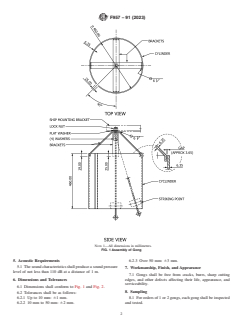
4.2.1 Welding shall be of the type and sizes shown in Fig. 1
2.2 American Welding Society Standard:
and Fig. 2, and in accordance with Standard AWS D1.1.
AWS D1.1 Structural Welding Code
4.3 Manufacture:
2.3 Federal Specifications:
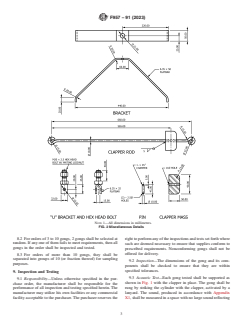
4.3.1 Fig. 1 shows the general arrangement of the assembled
PPP-B-576 Box, Wood, Cleated, Veneer, Paper Overlaid
gong, as well as details of the gong cylinder. Fig. 2 shows
PPP-B-585 Boxes, Wood, Wirebound
details of the brackets, clapper, and miscellaneous fittings.
4.3.2 The gong cylinder may be made from two pieces
This specification is under the jurisdiction of ASTM Committee F25 on Ships
welded together, instead of one piece. Two piece construction
and Marine Technology and is the direct responsibility of Subcommittee F25.07 on
shall be annealed to remove residual stresses.
General Requirements.
Current edition approved May 1, 2023. Published June 2023. Originally 4.3.3 Sharp corners and edges of the cylinder shall be
approved in 1985. Last previous edition approved in 2018 as F957 – 91 (2018).
broken.
DOI: 10.1520/F0957-23.
4.3.4 The two brackets shall be welded together before
For referenced ASTM standards, visit the ASTM website, www.astm.org, or
being welded to the cylinder. The flanged ends of the brackets
contact ASTM Customer Service at service@astm.org. For Annual Book of ASTM
Standards volume information, refer to the standard’s Document Summary page on
may be left straight and not shaped to the cylinder.
the ASTM website.
4.3.5 The clapper mass shall be welded to the clapper rod
The last approved version of this historical standard is referenced on
before forming the second eye.
www.astm.org.
Available from American Welding Society (AWS), 8669 NW 36 St., #130,
4.4 Extra Parts:
Miami, FL 33166-6672, http://www.aws.org.
5 4.4.1 Two extra supporting nuts and flat washers shall be
Available from DLA Document Services, Building 4/D, 700 Robbins Ave.,
Philadelphia, PA 19111-5094, http://quicksearch.dla.mil. furnished with each gong.
Copyright © ASTM International, 100 Barr Harbor Drive, PO Box C700, West Conshohocken, PA 19428-2959. United States
F957 − 91 (2023)
NOTE 1—All dimensions in millimetres.
FIG. 1 Assembly of Gong
5. Acoustic Requirements 6.2.3 Over 50 mm: 63 mm.
5.1 The sound characteristics shall produce a sound pressure
7. Workmanship, Finish, and Appearance
level of not less than 110 dB at a distance of 1 m.
7.1 Gongs shall be free from cracks, burrs, sharp cutting
edges, and other defects affecting their life, appearance, and
6. Dimensions and Tolerances
serviceability.
6.1 Dimensions shall conform to Fig. 1 and Fig. 2.
8. Sampling
6.2 Tolerances shall be as follows:
6.2.1 Up to 10 mm: 61 mm. 8.1 For orders of 1 or 2 gongs, each gong shall be inspected
6.2.2 10 mm to 50 mm: 62 mm. and tested.
F957 − 91 (2023)
NOTE 1—All dimensions in millimetres.
FIG. 2 Miscellaneous Details
8.2 For orders of 3 to 10 gongs, 2 gongs shall be selected at right to perform any of the inspections and tests set forth where
random. If any one of them fails to meet requirements, then all
such are deemed necessary to ensure that supplies conform to
gongs in the order shall be inspected and tested.
prescribed requirements. Nonconforming gongs shall not be
offered for delivery.
8.3 For orders of more than 10 gongs, they shall be
separated into groups of 10 (or fraction thereof) for sampling
9.2 Inspection—The dimensions of the gong and its com-
purposes.
ponents shall be checked to ensure that they are within
specified tolerances.
9. Inspection and Testing
9.3 Acoustic Test—Each gong tested shall be supported as
9.1 Responsibility—Unless otherwise specified in the pur-
shown in Fig. 1 with the clapper in place. The gong shall be
chase order, the manufacturer shall be responsible for the
rung by striking the cylinder with the clapper, activated by a
performance of all inspection and testing specified herein. The
manufacturer may utilize his own facilities or any commercial lanyard. The sound, produced in accordance with Appendix
facility acceptable to the purchaser. The purchaser reserves the X1, shall be measured in a space with no large sound reflecting
F957 − 91 (2023)
surfaces (except the floor) that are within 10 m. The sound shall 11.3 For government procurements for long-term storage or
be measured using a commercial sound level meter located at overseas shipment, the requirements of Annex A1 apply. In
a distance of 1 m and at a height abo
...