

ASTM A416/A416M-24
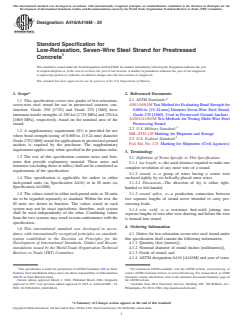
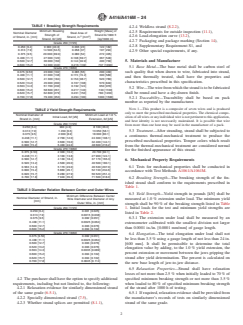
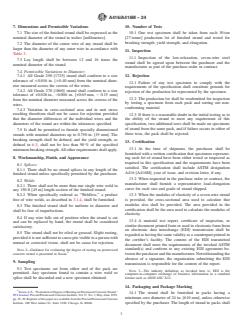
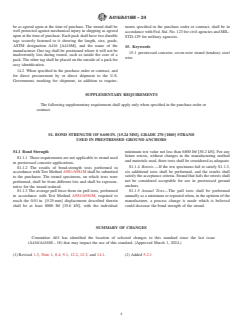
(Specification)Standard Specification for Low-Relaxation, Seven-Wire Steel Strand for Prestressed Concrete
General Information
- Abstract
ABSTRACT
This specification deals with the standard types and grade requirements of seven-wire, uncoated steel strands for use in the construction of pre-tensioned and post-tensioned pre-stressed concrete. The two types of strand are low-relaxation and stress-relieved (normal relaxation). The base metal shall be made of carbon steel and shall undergo stranding and continuous thermal and mechanical treatment. Mechanical testing methods shall be performed to determine the breaking strength, yield strength, elongation, and stress relaxation properties wherein the strand shall conform to the required mechanical attributes of the product. Final products shall be furnished on reels or in reelless packs for packaging and marked with two strong tags for identification. The requirements specified herein shall also be applicable for pre-stressed ground anchor construction.
SCOPE
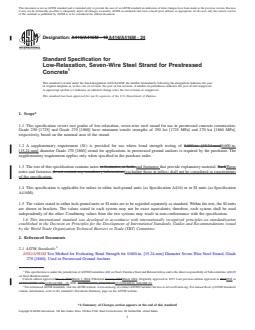
1.1 This specification covers two grades of low-relaxation, seven-wire steel strand for use in prestressed concrete construction. Grade 250 [1725] and Grade 270 [1860] have minimum tensile strengths of 250 ksi [1725 MPa] and 270 ksi [1860 MPa], respectively, based on the nominal area of the strand.
1.2 A supplementary requirement (S1) is provided for use where bond strength testing of 0.600 in. [15.24 mm] diameter Grade 270 [1860] strand for applications in prestressed ground anchors is required by the purchaser. The supplementary requirement applies only when specified in the purchase order.
1.3 The text of this specification contains notes and footnotes that provide explanatory material. These notes and footnotes (excluding those in tables) shall not be considered as requirements of the specification.
1.4 This specification is applicable for orders in either inch-pound units (as Specification A416) or in SI units (as Specification A416M).
1.5 The values stated in either inch-pound units or SI units are to be regarded separately as standard. Within the text, the SI units are shown in brackets. The values stated in each system may not be exact equivalents; therefore, each system shall be used independently of the other. Combining values from the two systems may result in non-conformance with the specification.
1.6 This international standard was developed in accordance with internationally recognized principles on standardization established in the Decision on Principles for the Development of International Standards, Guides and Recommendations issued by the World Trade Organization Technical Barriers to Trade (TBT) Committee.
- Status
- Published
- Publication Date
- 29-Feb-2024
- Technical Committee
- A01 - Steel, Stainless Steel and Related Alloys
- Drafting Committee
- A01.05 - Steel Reinforcement
Buy Documents
ASTM A416/A416M-24 - Standard Specification for Low-Relaxation, Seven-Wire Steel Strand for Prestressed Concrete
REDLINE ASTM A416/A416M-24 - Standard Specification for Low-Relaxation, Seven-Wire Steel Strand for Prestressed Concrete
Overview
ASTM A416/A416M-24 is the internationally recognized standard specification for low-relaxation, seven-wire steel strand used in the construction of prestressed concrete. Published by ASTM International, this standard details the requirements for uncoated steel strands primarily applied in pre-tensioned and post-tensioned prestressed concrete applications. Covering two grades-Grade 250 [1725] and Grade 270 [1860]-the standard ensures consistent mechanical properties, dimensional tolerances, performance, and identification for stranded steel reinforcement essential to robust, long-lasting concrete structures.
Key Topics
- Product Types and Grades: Specifies two types of seven-wire strand-low-relaxation and normal (stress-relieved)-and two grades based on minimum tensile strengths: 250 ksi [1725 MPa] and 270 ksi [1860 MPa].
- Material and Manufacture: Stipulates carbon steel as the base metal, with the strand produced by drawing wire, forming into a seven-wire structure, and subjecting to a continuous thermal and mechanical treatment to achieve targeted mechanical and relaxation properties.
- Mechanical Property Testing: Requires mechanical tests of breaking strength, yield strength, elongation, and relaxation properties to verify conformance to minimum requirements.
- Dimensional Requirements: Sets guidelines for nominal strand diameter, diameter relations between center and outer wires, and size tolerances to ensure uniformity.
- Workmanship and Finish: Addresses criteria for splices, welds, surface finish, handling of rust, and requirements for a clean, uniform appearance.
- Traceability and Certification: Packing must be traceable by reel/pack number. Each shipment is certified for compliance, with documentation including load-elongation curves and other properties as specified by the purchaser.
Applications
The ASTM A416/A416M-24 steel strand is integral to a variety of structural applications across civil and structural engineering sectors:
- Pre-tensioned Concrete: Used extensively in factories producing precast concrete components, such as beams, girders, and floor systems. The seven-wire strand is tensioned prior to pouring concrete to impart pre-compression, increasing load-carrying capacity and crack resistance.
- Post-tensioned Concrete: Employed on-site in bridges, parking structures, slabs, tanks, and silos. The steel strand is tensioned after the concrete has set, allowing flexibility in design and construction for large spans or specialized structural requirements.
- Prestressed Ground Anchors: Supplementary requirements are included for the bond strength of 0.600 in. [15.24 mm] Grade 270 [1860] strand used in ground anchoring applications such as foundation support, retaining walls, or slope stabilization.
- Infrastructure Projects: Ensures consistency and compliance for critical infrastructure, supporting performance and safety in highways, bridges, and buildings worldwide.
Related Standards
For a comprehensive approach to the specification, testing, and quality control of seven-wire steel strands, several other standards complement ASTM A416/A416M-24:
- ASTM A1061/A1061M: Test Methods for Testing Multi-Wire Steel Prestressing Strand
- ASTM A981/A981M: Test Method for Evaluating Bond Strength for 0.600-in [15.24-mm] Diameter Seven-Wire Steel Strand, Grade 270 [1860], Used in Prestressed Ground Anchors
- MIL-STD-129: Marking for Shipment and Storage (U.S. Military)
- Fed. Std. No. 123: Marking for Shipments (U.S. Federal Agencies)
Practical Value
Conformance to ASTM A416/A416M-24 assures engineers, manufacturers, and contractors that seven-wire steel strands used in prestressed concrete deliver predictable performance for demanding structural applications. Adherence guarantees:
- Reliable product quality and traceability
- Compliance with U.S. federal and international requirements
- Enhanced safety and durability in concrete structures
- Efficient procurement and project specification through standardized grades, packaging, and certification
Utilizing this standard is essential for projects where strength, durability, and compliance to recognized best practices in prestressed concrete construction are critical.
Relations
- Effective Date
- 01-Mar-2024
- Effective Date
- 01-Mar-2024
- Effective Date
- 01-Mar-2024
- Effective Date
- 01-Mar-2024
- Effective Date
- 01-Mar-2024
- Effective Date
- 01-Mar-2024
- Effective Date
- 01-Mar-2024
- Effective Date
- 01-Mar-2024
- Effective Date
- 01-Mar-2024
- Referred By
ASTM C913-23 - Standard Specification for Precast Concrete Water and Wastewater Structures - Effective Date
- 01-Mar-2024
- Effective Date
- 01-Mar-2024
Buy Documents
ASTM A416/A416M-24 - Standard Specification for Low-Relaxation, Seven-Wire Steel Strand for Prestressed Concrete
REDLINE ASTM A416/A416M-24 - Standard Specification for Low-Relaxation, Seven-Wire Steel Strand for Prestressed Concrete
Get Certified
Connect with accredited certification bodies for this standard

Element Materials Technology
Materials testing and product certification.

Inštitut za kovinske materiale in tehnologije
Institute of Metals and Technology. Materials testing, metallurgical analysis, NDT.
Sponsored listings
Frequently Asked Questions
ASTM A416/A416M-24 is a technical specification published by ASTM International. Its full title is "Standard Specification for Low-Relaxation, Seven-Wire Steel Strand for Prestressed Concrete". This standard covers: ABSTRACT This specification deals with the standard types and grade requirements of seven-wire, uncoated steel strands for use in the construction of pre-tensioned and post-tensioned pre-stressed concrete. The two types of strand are low-relaxation and stress-relieved (normal relaxation). The base metal shall be made of carbon steel and shall undergo stranding and continuous thermal and mechanical treatment. Mechanical testing methods shall be performed to determine the breaking strength, yield strength, elongation, and stress relaxation properties wherein the strand shall conform to the required mechanical attributes of the product. Final products shall be furnished on reels or in reelless packs for packaging and marked with two strong tags for identification. The requirements specified herein shall also be applicable for pre-stressed ground anchor construction. SCOPE 1.1 This specification covers two grades of low-relaxation, seven-wire steel strand for use in prestressed concrete construction. Grade 250 [1725] and Grade 270 [1860] have minimum tensile strengths of 250 ksi [1725 MPa] and 270 ksi [1860 MPa], respectively, based on the nominal area of the strand. 1.2 A supplementary requirement (S1) is provided for use where bond strength testing of 0.600 in. [15.24 mm] diameter Grade 270 [1860] strand for applications in prestressed ground anchors is required by the purchaser. The supplementary requirement applies only when specified in the purchase order. 1.3 The text of this specification contains notes and footnotes that provide explanatory material. These notes and footnotes (excluding those in tables) shall not be considered as requirements of the specification. 1.4 This specification is applicable for orders in either inch-pound units (as Specification A416) or in SI units (as Specification A416M). 1.5 The values stated in either inch-pound units or SI units are to be regarded separately as standard. Within the text, the SI units are shown in brackets. The values stated in each system may not be exact equivalents; therefore, each system shall be used independently of the other. Combining values from the two systems may result in non-conformance with the specification. 1.6 This international standard was developed in accordance with internationally recognized principles on standardization established in the Decision on Principles for the Development of International Standards, Guides and Recommendations issued by the World Trade Organization Technical Barriers to Trade (TBT) Committee.
ABSTRACT This specification deals with the standard types and grade requirements of seven-wire, uncoated steel strands for use in the construction of pre-tensioned and post-tensioned pre-stressed concrete. The two types of strand are low-relaxation and stress-relieved (normal relaxation). The base metal shall be made of carbon steel and shall undergo stranding and continuous thermal and mechanical treatment. Mechanical testing methods shall be performed to determine the breaking strength, yield strength, elongation, and stress relaxation properties wherein the strand shall conform to the required mechanical attributes of the product. Final products shall be furnished on reels or in reelless packs for packaging and marked with two strong tags for identification. The requirements specified herein shall also be applicable for pre-stressed ground anchor construction. SCOPE 1.1 This specification covers two grades of low-relaxation, seven-wire steel strand for use in prestressed concrete construction. Grade 250 [1725] and Grade 270 [1860] have minimum tensile strengths of 250 ksi [1725 MPa] and 270 ksi [1860 MPa], respectively, based on the nominal area of the strand. 1.2 A supplementary requirement (S1) is provided for use where bond strength testing of 0.600 in. [15.24 mm] diameter Grade 270 [1860] strand for applications in prestressed ground anchors is required by the purchaser. The supplementary requirement applies only when specified in the purchase order. 1.3 The text of this specification contains notes and footnotes that provide explanatory material. These notes and footnotes (excluding those in tables) shall not be considered as requirements of the specification. 1.4 This specification is applicable for orders in either inch-pound units (as Specification A416) or in SI units (as Specification A416M). 1.5 The values stated in either inch-pound units or SI units are to be regarded separately as standard. Within the text, the SI units are shown in brackets. The values stated in each system may not be exact equivalents; therefore, each system shall be used independently of the other. Combining values from the two systems may result in non-conformance with the specification. 1.6 This international standard was developed in accordance with internationally recognized principles on standardization established in the Decision on Principles for the Development of International Standards, Guides and Recommendations issued by the World Trade Organization Technical Barriers to Trade (TBT) Committee.
ASTM A416/A416M-24 is classified under the following ICS (International Classification for Standards) categories: 77.140.15 - Steels for reinforcement of concrete. The ICS classification helps identify the subject area and facilitates finding related standards.
ASTM A416/A416M-24 has the following relationships with other standards: It is inter standard links to ASTM A416/A416M-18, ASTM A1114/A1114M-20, ASTM A981/A981M-23, ASTM C825-19, ASTM C1804-20, ASTM F432-19, ASTM A882/A882M-20, ASTM C1089-19, ASTM C935-19, ASTM C913-23, ASTM A1081/A1081M-21. Understanding these relationships helps ensure you are using the most current and applicable version of the standard.
ASTM A416/A416M-24 is available in PDF format for immediate download after purchase. The document can be added to your cart and obtained through the secure checkout process. Digital delivery ensures instant access to the complete standard document.
Standards Content (Sample)
This international standard was developed in accordance with internationally recognized principles on standardization established in the Decision on Principles for the
Development of International Standards, Guides and Recommendations issued by the World Trade Organization Technical Barriers to Trade (TBT) Committee.
Designation: A416/A416M − 24
Standard Specification for
Low-Relaxation, Seven-Wire Steel Strand for Prestressed
Concrete
This standard is issued under the fixed designation A416/A416M; the number immediately following the designation indicates the year
of original adoption or, in the case of revision, the year of last revision. A number in parentheses indicates the year of last reapproval.
A superscript epsilon (´) indicates an editorial change since the last revision or reapproval.
This standard has been approved for use by agencies of the U.S. Department of Defense.
1. Scope* 2. Referenced Documents
2.1 ASTM Standards:
1.1 This specification covers two grades of low-relaxation,
A981/A981M Test Method for Evaluating Bond Strength for
seven-wire steel strand for use in prestressed concrete con-
0.600-in. [15.24-mm] Diameter Seven-Wire Steel Strand,
struction. Grade 250 [1725] and Grade 270 [1860] have
minimum tensile strengths of 250 ksi [1725 MPa] and 270 ksi Grade 270 [1860], Used in Prestressed Ground Anchors
A1061/A1061M Test Methods for Testing Multi-Wire Steel
[1860 MPa], respectively, based on the nominal area of the
strand. Prestressing Strand
2.2 U.S. Military Standard:
1.2 A supplementary requirement (S1) is provided for use
MIL-STD-129 Marking for Shipment and Storage
where bond strength testing of 0.600 in. [15.24 mm] diameter
2.3 U.S. Federal Standard:
Grade 270 [1860] strand for applications in prestressed ground
Fed. Std. No. 123 Marking for Shipments (Civil Agencies)
anchors is required by the purchaser. The supplementary
requirement applies only when specified in the purchase order.
3. Terminology
1.3 The text of this specification contains notes and foot-
3.1 Definition of Terms Specific to This Specification:
notes that provide explanatory material. These notes and
3.1.1 lay length, n—the axial distance required to make one
footnotes (excluding those in tables) shall not be considered as
complete revolution of any outer wire of a strand.
requirements of the specification.
3.1.2 strand, n—a group of wires having a center wire
1.4 This specification is applicable for orders in either
enclosed tightly by six helically placed outer wires.
inch-pound units (as Specification A416) or in SI units (as
3.1.2.1 Discussion—The direction of lay is either right-
Specification A416M).
handed or left-handed.
1.5 The values stated in either inch-pound units or SI units 3.1.3 strand splice, n—a production connection between
two separate lengths of strand never intended to carry pre-
are to be regarded separately as standard. Within the text, the
stressing loads.
SI units are shown in brackets. The values stated in each
system may not be exact equivalents; therefore, each system
3.1.4 wire weld, n—a resistance butt-weld joining two
shall be used independently of the other. Combining values
separate lengths of wire after wire drawing and before the wire
from the two systems may result in non-conformance with the
is formed into strand.
specification.
4. Ordering Information
1.6 This international standard was developed in accor-
4.1 Orders for low-relaxation seven-wire steel strand under
dance with internationally recognized principles on standard-
ization established in the Decision on Principles for the this specification shall contain the following information:
Development of International Standards, Guides and Recom- 4.1.1 Quantity (feet [metres]),
4.1.2 Nominal diameter of strand (inches [millimetres]),
mendations issued by the World Trade Organization Technical
Barriers to Trade (TBT) Committee. 4.1.3 Grade of strand, and
4.1.4 ASTM designation A416 [A416M] and year of issue.
1 2
This specification is under the jurisdiction of ASTM Committee A01 on Steel, For referenced ASTM standards, visit the ASTM website, www.astm.org, or
Stainless Steel and Related Alloys and is the direct responsibility of Subcommittee contact ASTM Customer Service at service@astm.org. For Annual Book of ASTM
A01.05 on Steel Reinforcement. Standards volume information, refer to the standard’s Document Summary page on
Current edition approved March 1, 2024. Published March 2024. Originally the ASTM website.
approved in 1957. Last previous edition approved in 2018 as A416/A416M – 18. Available from DLA Document Services, Building 4/D, 700 Robbins Ave.,
DOI: 10.1520/A0416_A0416M-24. Philadelphia, PA 19111-5094, http://quicksearch.dla.mil.
*A Summary of Changes section appears at the end of this standard
Copyright © ASTM International, 100 Barr Harbor Drive, PO Box C700, West Conshohocken, PA 19428-2959. United States
A416/A416M − 24
TABLE 1 Breaking Strength Requirements
4.2.4 Weldless strand (8.2.2),
Minimum Breaking Weight [Mass] of 4.2.5 Requirements for outside inspection (11.1),
Nominal Diameter Steel Area of
Strength of Strand lb/1000 ft
2 2
4.2.6 Load-elongation curve (13.2),
of Strand, in. [mm] Strand, in. [mm ]
Strand, lbf [kN] [kg/1000 m]
4.2.7 Packaging and package marking (Section 14),
Grade 250 [1725]
4.2.8 Supplementary Requirement S1, and
0.250 [6.4] 9 000 [40.0] 0.036 [23] 122 [182]
0.313 [7.9] 14 500 [64.5] 0.058 [37] 197 [294]
4.2.9 Other special requirements, if any.
0.375 [9.5] 20 000 [89.0] 0.080 [52] 272 [405]
0.438 [11.1] 27 000 [120] 0.108 [69.7] 367 [548]
5. Materials and Manufacture
0.500 [12.7] 36 000 [160] 0.144 [92.9] 490 [730]
0.600 [15.2] 54 000 [240] 0.216 [139] 737 [1090]
5.1 Base Metal—The base metal shall be carbon steel of
Grade 270 [1860]
0.375 [9.53] 23 000 [102] 0.085 [55] 290 [430] such quality that when drawn to wire, fabricated into strand,
0.438 [11.1] 31 000 [138] 0.115 [74.2] 390 [580]
and then thermally treated, shall have the properties and
0.500 [12.7] 41 300 [184] 0.153 [98.7] 520 [780]
characteristics prescribed in this specification.
0.520 [13.2] 45 000 [200] 0.167 [108] 570 [840]
0.563 [14.3] 51 700 [230] 0.192 [124] 650 [970]
5.2 Wire—The wire from which the strand is to be fabricated
0.600 [15.2] 58 600 [261] 0.217 [140] 740 [1100]
shall be round and have a dry-drawn finish.
0.620 [15.7] 62 800 [279] 0.231 [150] 780 [1200]
0.700 [17.8] 79 400 [353] 0.294 [190] 1000 [1500]
5.2.1 Traceability—Traceability shall be based on pack
number as reported by the manufacturer.
NOTE 1—This product is a composite of seven wires and is produced
TABLE 2 Yield Strength Requirements
only to meet the prescribed mechanical properties. The chemical compo-
Nominal Diameter of Minimum Load at 1.0 %
Initial Load, lbf [kN] sition of all wires or any individual wire is not pertinent to this application,
Strand in. [mm] Extension, lbf [kN]
and heat identity is not necessarily maintained. It is possible that wire
Grade 250 [1725]
from more than one heat may be used in the manufacture of a pack.
0.250 [6.4] 900 [4.0] 8 100 [36.0]
0.313 [7.9] 1 450 [6.5] 13 050 [58.1]
5.3 Treatment—After stranding, strand shall be subjected to
0.375 [9.5] 2 000 [8.9] 18 000 [80.1]
a continuous thermal-mechanical treatment to produce the
0.438 [11.1] 2 700 [12.0] 24 300 [108.1]
prescribed mechanical properties. Temper colors which result
0.500 [12.7] 3 600 [16.0] 32 400 [144.1]
0.600 [15.2] 5 400 [24.0] 48 600 [216.2]
from the thermal-mechanical treatment are considered normal
Grade 270 [1860]
for the finished appearance of this strand.
0.375 [9.53] 2 300 [10.2] 20 700 [92.1]
0.438 [11.1] 3 100 [13.8] 27 900 [124.1]
0.500 [12.7] 4 130 [18.4] 37 170 [165.3]
6. Mechanical Property Requirements
0.520 [13.2] 4 500 [20.0] 40 500 [180.1]
0.563 [14.3] 5 170 [23.0] 46 530 [207.0]
6.1 Tests for mechanical properties shall be conducted in
0.600 [15.2] 5 860 [26.1] 52 740 [234.6]
accordance with Test Methods A1061/A1061M.
0.620 [15.7] 6 280 [27.9] 56 520 [251.4]
0.700 [17.8] 7 940 [35.3] 71 500 [318.0]
6.2 Breaking Strength—The breaking strength of the fin-
ished strand shall conform to the requirements prescribed in
Table 1.
TABLE 3 Diameter Relation Between Center and Outer Wires
6.3 Yield Strength—Yield strength in pounds [kN] shall be
Minimum Difference Between Center
Nominal Diameter of Strand, in.
measured at 1.0 % extension under load. The minimum yield
Wire Diameter and Diameter of Any
[mm]
Outer Wire, in. [mm]
strength shall be 90 % of the breaking strength listed in Table
Grade 250 [1725]
1. Initial loads for the test and minimum yield strengths are
0.250 [6.4] 0.001 [0.025]
listed in Table 2.
0.313 [7.9] 0.0015 [0.038]
6.3.1 The extension under load shall be measured by an
0.375 [9.5] 0.002 [0.051]
0.438 [11.1] 0.0025 [0.064]
extensometer calibrated with the smallest division not larger
0.500 [12.7] 0.003 [0.076]
than 0.0001 in./in. [0.0001 mm/mm] of gauge length.
0.600 [15.2] 0.004 [0.102]
Grade 270 [1860]
6.4 Elongation—The total elongation under load shall not
0.375 [9.53] 0.002 [0.051]
be less than 3.5 % using a gauge length of not less than 24 in.
0.438 [11.1] 0.0025 [0.064]
0.500 [12.7] 0.003 [0.076]
[600 mm]. It shall be permissible to determine the total
0.520 [13.2] 0.003 [0.076]
elongation value by adding, to the 1.0 % yield extension, the
0.563 [14.3] 0.0035 [0.089]
percent extension or movement between the jaws gripping the
0.600 [15.2] 0.004 [0.102]
0.620 [15.7] 0.004 [0.102]
strand after yield determination. The percent is calculated on
0.700 [17.8] 0.0045 [0.114]
the new base length of jaw-to-jaw distance.
6.5 Relaxation Properties—Strand shall have relaxation
losses of not more than 2.5 % when initially loaded to 70 % of
specified minimum breaking strength or not more than 3.5 %
4.2 The purchaser shall have the option to specify additional
requirements, including but not limited to, the following: when loaded to 80 % of specified minimum breaking strength
of the strand after 1000 h of testing.
4.2.1 Relaxation evidence for similarly dimensioned strand
of the same grade (6.5.1), 6.5.1 If required, relaxation evidence shall be provided from
...
This document is not an ASTM standard and is intended only to provide the user of an ASTM standard an indication of what changes have been made to the previous version. Because
it may not be technically possible to adequately depict all changes accurately, ASTM recommends that users consult prior editions as appropriate. In all cases only the current version
of the standard as published by ASTM is to be considered the official document.
Designation: A416/A416M − 18 A416/A416M − 24
Standard Specification for
Low-Relaxation, Seven-Wire Steel Strand for Prestressed
Concrete
This standard is issued under the fixed designation A416/A416M; the number immediately following the designation indicates the year
of original adoption or, in the case of revision, the year of last revision. A number in parentheses indicates the year of last reapproval.
A superscript epsilon (´) indicates an editorial change since the last revision or reapproval.
This standard has been approved for use by agencies of the U.S. Department of Defense.
1. Scope*
1.1 This specification covers two grades of low-relaxation, seven-wire steel strand for use in prestressed concrete construction.
Grade 250 [1725] and Grade 270 [1860] have minimum tensile strengths of 250 ksi [1725 MPa] and 270 ksi [1860 MPa],
respectively, based on the nominal area of the strand.
1.2 A supplementary requirement (S1) is provided for use where bond strength testing of 0.600-in. [15.24-mm]0.600 in.
[15.24 mm] diameter Grade 270 [1860] strand for applications in prestressed ground anchors is required by the purchaser. The
supplementary requirement applies only when specified in the purchase order.
1.3 The text of this specification contains notes or footnotes, or both, and footnotes that provide explanatory material. SuchThese
notes and footnotes do not contain any mandatory information.(excluding those in tables) shall not be considered as requirements
of the specification.
1.4 This specification is applicable for orders in either inch-pound units (as Specification A416) or in SI units (as Specification
A416M).
1.5 The values stated in either inch-pound units or SI units are to be regarded separately as standard. Within the text, the SI units
are shown in brackets. The values stated in each system may not be exact equivalents; therefore, each system shall be used
independently of the other. Combining values from the two systems may result in non-conformance with the specification.
1.6 This international standard was developed in accordance with internationally recognized principles on standardization
established in the Decision on Principles for the Development of International Standards, Guides and Recommendations issued
by the World Trade Organization Technical Barriers to Trade (TBT) Committee.
2. Referenced Documents
2.1 ASTM Standards:
A981/A981M Test Method for Evaluating Bond Strength for 0.600-in. [15.24-mm] Diameter Seven-Wire Steel Strand, Grade
270 [1860], Used in Prestressed Ground Anchors
This specification is under the jurisdiction of ASTM Committee A01 on Steel, Stainless Steel and Related Alloys and is the direct responsibility of Subcommittee A01.05
on Steel Reinforcement.
Current edition approved Dec. 1, 2018March 1, 2024. Published January 2019March 2024. Originally approved in 1957. Last previous edition approved in 20172018 as
A416/A416M – 17a.A416/A416M – 18. DOI: 10.1520/A0416_A0416M-18.10.1520/A0416_A0416M-24.
For referenced ASTM standards, visit the ASTM website, www.astm.org, or contact ASTM Customer Service at service@astm.org. For Annual Book of ASTM Standards
volume information, refer to the standard’s Document Summary page on the ASTM website.
*A Summary of Changes section appears at the end of this standard
Copyright © ASTM International, 100 Barr Harbor Drive, PO Box C700, West Conshohocken, PA 19428-2959. United States
A416/A416M − 24
A1061/A1061M Test Methods for Testing Multi-Wire Steel Prestressing Strand
2.2 U.S. Military Standard:
MIL-STD-129 Marking for Shipment and Storage
2.3 U.S. Federal Standard:
Fed. Std. No. 123 Marking for Shipments (Civil Agencies)
3. Terminology
3.1 Definition of TermTerms Specific to This Specification:
3.1.1 lay length, n—the axial distance required to make one complete revolution of any outer wire of a strand.
3.1.2 strand, n—a group of wires having a center wire enclosed tightly by six helically placed outer wires.
3.1.2.1 Discussion—
The direction of lay is either right-handed or left-handed.
3.1.3 strand splice, n—a production connection between two separate lengths of strand never intended to carry prestressing loads.
3.1.4 wire weld, n—a resistance butt-weld joining two separate lengths of wire after wire drawing and before the wire is formed
into strand.
4. Ordering Information
4.1 Orders for low-relaxation seven-wire steel strand under this specification shall contain the following information:
4.1.1 Quantity (feet [metres]),
4.1.2 Nominal diameter of strand (inches [millimetres]),
4.1.3 Grade of strand, and
4.1.4 ASTM designation A416 [A416M] and year of issue.
4.2 The purchaser shall have the option to specify additional requirements, including but not limited to, the following:
4.2.1 Relaxation evidence for similarly dimensioned strand of the same grade (6.5.1),
4.2.2 Specially dimensioned strand (7.5),
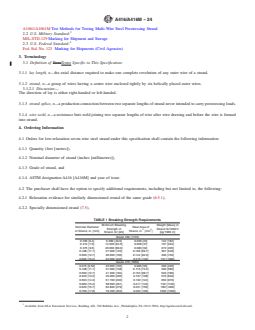
TABLE 1 Breaking Strength Requirements
Minimum Breaking Weight [Mass] of
Nominal Diameter Steel Area of
Strength of Strand lb/1000 ft
2 2
of Strand, in. [mm] Strand, in. [mm ]
Strand, lbf [kN] [kg/1000 m]
Grade 250 [1725]
0.250 [6.4] 9 000 [40.0] 0.036 [23] 122 [182]
0.313 [7.9] 14 500 [64.5] 0.058 [37] 197 [294]
0.375 [9.5] 20 000 [89.0] 0.080 [52] 272 [405]
0.438 [11.1] 27 000 [120] 0.108 [69.7] 367 [548]
0.500 [12.7] 36 000 [160] 0.144 [92.9] 490 [730]
0.600 [15.2] 54 000 [240] 0.216 [139] 737 [1090]
Grade 270 [1860]
0.375 [9.53] 23 000 [102] 0.085 [55] 290 [430]
0.438 [11.1] 31 000 [138] 0.115 [74.2] 390 [580]
0.500 [12.7] 41 300 [184] 0.153 [98.7] 520 [780]
0.520 [13.2] 45 000 [200] 0.167 [108] 570 [840]
0.563 [14.3] 51 700 [230] 0.192 [124] 650 [970]
0.600 [15.2] 58 600 [261] 0.217 [140] 740 [1100]
0.620 [15.7] 62 800 [279] 0.231 [150] 780 [1200]
0.700 [17.8] 79 400 [353] 0.294 [190] 1000 [1500]
Available from DLA Document Services, Building 4/D, 700 Robbins Ave., Philadelphia, PA 19111-5094, http://quicksearch.dla.mil.
A416/A416M − 24
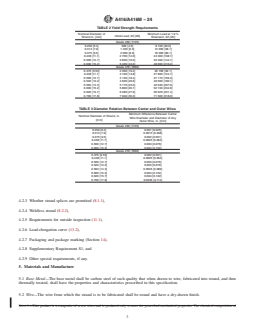
TABLE 2 Yield Strength Requirements
Nominal Diameter of Minimum Load at 1.0 %
Initial Load, lbf [kN]
Strand in. [mm] Extension, lbf [kN]
Grade 250 [1725]
0.250 [6.4] 900 [4.0] 8 100 [36.0]
0.313 [7.9] 1 450 [6.5] 13 050 [58.1]
0.375 [9.5] 2 000 [8.9] 18 000 [80.1]
0.438 [11.1] 2 700 [12.0] 24 300 [108.1]
0.500 [12.7] 3 600 [16.0] 32 400 [144.1]
0.600 [15.2] 5 400 [24.0] 48 600 [216.2]
Grade 270 [1860]
0.375 [9.53] 2 300 [10.2] 20 700 [92.1]
0.438 [11.1] 3 100 [13.8] 27 900 [124.1]
0.500 [12.7] 4 130 [18.4] 37 170 [165.3]
0.520 [13.2] 4 500 [20.0] 40 500 [180.1]
0.563 [14.3] 5 170 [23.0] 46 530 [207.0]
0.600 [15.2] 5 860 [26.1] 52 740 [234.6]
0.620 [15.7] 6 280 [27.9] 56 520 [251.4]
0.700 [17.8] 7 940 [35.3] 71 500 [318.0]
TABLE 3 Diameter Relation Between Center and Outer Wires
Minimum Difference Between Center
Nominal Diameter of Strand, in.
Wire Diameter and Diameter of Any
[mm]
Outer Wire, in. [mm]
Grade 250 [1725]
0.250 [6.4] 0.001 [0.025]
0.313 [7.9] 0.0015 [0.038]
0.375 [9.5] 0.002 [0.051]
0.438 [11.1] 0.0025 [0.064]
0.500 [12.7] 0.003 [0.076]
0.600 [15.2] 0.004 [0.102]
Grade 270 [1860]
0.375 [9.53] 0.002 [0.051]
0.438 [11.1] 0.0025 [0.064]
0.500 [12.7] 0.003 [0.076]
0.520 [13.2] 0.003 [0.076]
0.563 [14.3] 0.0035 [0.089]
0.600 [15.2] 0.004 [0.102]
0.620 [15.7] 0.004 [0.102]
0.700 [17.8] 0.0045 [0.114]
4.2.3 Whether strand splices are permitted (8.1.1),
4.2.4 Weldless strand (8.2.2),
4.2.5 Requirements for outside inspection (11.1),
4.2.6 Load-elongation curve (13.2),
4.2.7 Packaging and package marking (Section 14),
4.2.8 Supplementary Requirement S1, and
4.2.9 Other special requirements, if any.
5. Materials and Manufacture
5.1 Base Metal—The base metal shall be carbon steel of such quality that when drawn to wire, fabricated into strand, and then
thermally treated, shall have the properties and characteristics prescribed in this specification.
5.2 Wire—The wire from which the strand is to be fabricated shall be round and have a dry-drawn finish.
NOTE 1—This product is a composite of seven wires and is produced only to meet the prescribed mechanical properties. The chemical composition of
A416/A416M − 24
all wires or any individual wire is not pertinent to this application, and heat identity is not necessarily maintained. It is possible that wire from more than
one heat may be used in the manufacture of a reel or reelless pack. Traceability is based on identity of reels or reelless packs as maintained and reported
by the manufacturer.
5.2.1 Traceability—Traceability shall be based on pack number as reported by the manufacturer.
NOTE 1—This product is a composite of seven wires and is produced only to meet the prescribed mechanical properties. The chemical composition of
all wires or any individual wire is not pertinent to this application, and heat identity is not necessarily maintained. It is possible that wire from more than
one heat may be used in the manufacture of a pack.
5.3 Treatment—After stranding, strand shall be subjected to a continuous thermal-mechanical treatment to produce the prescribed
mechanical properties. Temper colors which result from the thermal-mechanical treatment are considered normal for the finished
appearance of this strand.
6. Mechanical Property Requirements
6.1 Tests for mechanical properties shall be conducted in accordance with Test Methods A1061/A1061M.
6.2 Breaking Strength—The breaking strength of the finished strand shall conform to the requirements prescribed in Table 1.
6.3 Yield Strength—Yield strength in pounds [kN] shall be measured at 1.0 % extension under load. The minimum yield strength
shall be 90 % of the breaking strength listed in Table 1. Initial loads for the test and minimum yield strengths are listed in Table
2.
6.3.1 The extension under load shall be measured by an extensometer calibrated with the smallest division not larger than 0.0001
in./in. [0.0001 mm/mm] of gagegauge length.
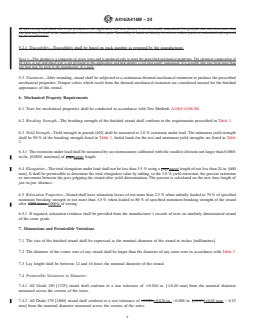
6.4 Elongation—The total elongation under load shall not be less than 3.5 % using a gagegauge length of not less than 24 in. [600
mm]. It shall be permissible to determine the total elongation value by adding, to the 1.0 % yield extension, the percent extension
or movement between the jaws gripping the strand after yield determination. The percent is calculated on the new base length of
jaw-to-jaw distance.
6.5 Relaxation Properties—Strand shall have relaxation losses of not more than 2.5 % when
...