

ASTM A1081/A1081M-21
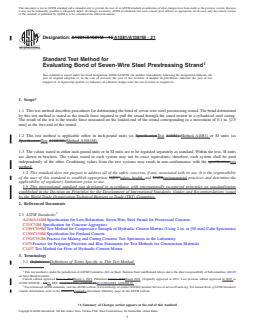
(Test Method)Standard Test Method for Evaluating Bond of Seven-Wire Steel Prestressing Strand
General Information
- Abstract
SIGNIFICANCE AND USE
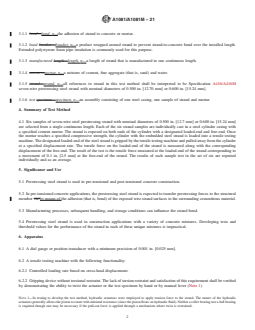
5.1 Prestressing steel strand is used in pre-tensioned and post-tensioned concrete construction.
5.2 In pre-tensioned concrete applications, the prestressing steel strand is expected to transfer prestressing forces to the structural member by means of the adhesion (that is, bond) of the exposed wire strand surfaces to the surrounding cementitous material.
5.3 Manufacturing processes, subsequent handling, and storage conditions can influence the strand bond.
5.4 Prestressing steel strand is used in construction applications with a variety of concrete mixtures. Developing tests and threshold values for the performance of the strand in each of these unique mixtures is impractical.
SCOPE
1.1 This test method describes procedures for determining the bond of seven-wire steel prestressing strand. The bond determined by this test method is stated as the tensile force required to pull the strand through the cured mortar in a cylindrical steel casing. The result of the test is the tensile force measured on the loaded-end of the strand corresponding to a movement of 0.1 in. [2.5 mm] at the free-end of the strand.
1.2 This test method is applicable either in inch-pound units (as Test Method A1081) or SI units (as Test Method A1081M).
1.3 The values stated in either inch-pound units or in SI units are to be regarded separately as standard. Within the text, SI units are shown in brackets. The values stated in each system may not be exact equivalents; therefore, each system shall be used independently of the other. Combining values from the two systems may result in non-conformance with the test method.
1.4 This standard does not purport to address all of the safety concerns, if any, associated with its use. It is the responsibility of the user of this standard to establish appropriate safety, health, and environmental practices and determine the applicability of regulatory limitations prior to use.
1.5 This international standard was developed in accordance with internationally recognized principles on standardization established in the Decision on Principles for the Development of International Standards, Guides and Recommendations issued by the World Trade Organization Technical Barriers to Trade (TBT) Committee.
- Status
- Published
- Publication Date
- 28-Feb-2021
- Technical Committee
- A01 - Steel, Stainless Steel and Related Alloys
- Drafting Committee
- A01.05 - Steel Reinforcement
Buy Documents
ASTM A1081/A1081M-21 - Standard Test Method for Evaluating Bond of Seven-Wire Steel Prestressing Strand
REDLINE ASTM A1081/A1081M-21 - Standard Test Method for Evaluating Bond of Seven-Wire Steel Prestressing Strand
Overview
ASTM A1081/A1081M-21: Standard Test Method for Evaluating Bond of Seven-Wire Steel Prestressing Strand is a key international standard developed by ASTM International. This standard outlines a test method used to determine the bond between seven-wire steel prestressing strand and cementitious materials, typically in pre-tensioned and post-tensioned concrete construction. By specifying a consistent procedure, ASTM A1081/A1081M-21 helps ensure the reliable transfer of prestressing forces in structural applications, addressing the impact of manufacturing, handling, storage, and construction variables on bond performance.
Key Topics
- Bond Evaluation Procedure: Defines the methodology for measuring the tensile force needed to pull a steel strand through cured mortar within a cylindrical steel casing.
- Applicable Units: Test results may be reported in either inch-pound (A1081) or SI units (A1081M), but systems must not be mixed.
- Specimen Preparation: Details requirements for sample collection, mortar composition, casting, curing, and consolidation of specimens to minimize variance and ensure accurate results.
- Testing Conditions: Specifies curing environments, displacement rates during testing, and criteria for recording results, notably the tensile force corresponding to 0.1 in. [2.5 mm] of strand movement.
- Reporting Requirements: Outlines required data such as strand identification, test dates, mortar strengths, individual and average results, and observation of any specimen cracking.
- Precision and Bias: Provides statistical expectations for repeatability and reproducibility, supporting confidence in inter-laboratory consistency.
- Safety and Compliance: Highlights the importance of user responsibility regarding safety, health, and environmental practices.
Applications
ASTM A1081/A1081M-21 plays a vital role in the construction industry by supporting quality assurance for:
- Pre-tensioned and Post-tensioned Concrete: Ensures that seven-wire steel prestressing strand achieves adequate bond with concrete, critical for effective force transfer in structural members including bridges, buildings, and infrastructure.
- Strand Manufacturer Qualification: Serves as a benchmark for assessing the performance of manufactured strand, verifying suitability for bonded applications.
- Construction Quality Control: Provides standardized test data for contractors, engineers, and quality control laboratories to confirm that materials meet project specifications.
- Research and Development: Useful for laboratories involved in testing new strand or mortar combinations, ensuring compatibility and performance in varied concrete mixtures.
By standardizing the test method, ASTM A1081/A1081M-21 helps minimize the risk of inadequate bonding due to variables such as surface conditions, manufacturing differences, or improper handling and storage of prestressing strands.
Related Standards
Professionals using ASTM A1081/A1081M-21 often refer to other complementary ASTM standards, including:
- ASTM A416/A416M: Specification for Low-Relaxation, Seven-Wire Steel Strand for Prestressed Concrete
- ASTM C33/C33M: Specification for Concrete Aggregates
- ASTM C109/C109M: Test Method for Compressive Strength of Hydraulic Cement Mortars
- ASTM C150/C150M: Specification for Portland Cement
- ASTM C192/C192M: Practice for Making and Curing Concrete Test Specimens in the Laboratory
- ASTM C670: Practice for Preparing Precision and Bias Statements for Test Methods for Construction Materials
- ASTM C1437: Test Method for Flow of Hydraulic Cement Mortar
By following ASTM A1081/A1081M-21 and referencing these related standards, industry professionals can confidently evaluate prestressing steel strand bond for high-quality, durable concrete construction projects.
Keywords: ASTM A1081, prestressing strand, seven-wire steel strand, bond test, concrete construction, standard test method, structural quality control, material testing.
Relations
- Effective Date
- 01-Mar-2024
- Effective Date
- 01-Feb-2024
- Effective Date
- 01-Jan-2024
- Effective Date
- 15-Dec-2023
- Effective Date
- 01-Apr-2019
- Effective Date
- 01-Dec-2017
- Effective Date
- 01-May-2017
- Effective Date
- 15-Mar-2016
- Effective Date
- 01-Mar-2016
- Effective Date
- 01-Feb-2016
- Effective Date
- 01-Feb-2016
- Effective Date
- 01-Jul-2015
- Effective Date
- 01-May-2015
- Effective Date
- 01-Aug-2014
- Effective Date
- 01-Jul-2013
Buy Documents
ASTM A1081/A1081M-21 - Standard Test Method for Evaluating Bond of Seven-Wire Steel Prestressing Strand
REDLINE ASTM A1081/A1081M-21 - Standard Test Method for Evaluating Bond of Seven-Wire Steel Prestressing Strand
Get Certified
Connect with accredited certification bodies for this standard

Element Materials Technology
Materials testing and product certification.

Inštitut za kovinske materiale in tehnologije
Institute of Metals and Technology. Materials testing, metallurgical analysis, NDT.
Sponsored listings
Frequently Asked Questions
ASTM A1081/A1081M-21 is a standard published by ASTM International. Its full title is "Standard Test Method for Evaluating Bond of Seven-Wire Steel Prestressing Strand". This standard covers: SIGNIFICANCE AND USE 5.1 Prestressing steel strand is used in pre-tensioned and post-tensioned concrete construction. 5.2 In pre-tensioned concrete applications, the prestressing steel strand is expected to transfer prestressing forces to the structural member by means of the adhesion (that is, bond) of the exposed wire strand surfaces to the surrounding cementitous material. 5.3 Manufacturing processes, subsequent handling, and storage conditions can influence the strand bond. 5.4 Prestressing steel strand is used in construction applications with a variety of concrete mixtures. Developing tests and threshold values for the performance of the strand in each of these unique mixtures is impractical. SCOPE 1.1 This test method describes procedures for determining the bond of seven-wire steel prestressing strand. The bond determined by this test method is stated as the tensile force required to pull the strand through the cured mortar in a cylindrical steel casing. The result of the test is the tensile force measured on the loaded-end of the strand corresponding to a movement of 0.1 in. [2.5 mm] at the free-end of the strand. 1.2 This test method is applicable either in inch-pound units (as Test Method A1081) or SI units (as Test Method A1081M). 1.3 The values stated in either inch-pound units or in SI units are to be regarded separately as standard. Within the text, SI units are shown in brackets. The values stated in each system may not be exact equivalents; therefore, each system shall be used independently of the other. Combining values from the two systems may result in non-conformance with the test method. 1.4 This standard does not purport to address all of the safety concerns, if any, associated with its use. It is the responsibility of the user of this standard to establish appropriate safety, health, and environmental practices and determine the applicability of regulatory limitations prior to use. 1.5 This international standard was developed in accordance with internationally recognized principles on standardization established in the Decision on Principles for the Development of International Standards, Guides and Recommendations issued by the World Trade Organization Technical Barriers to Trade (TBT) Committee.
SIGNIFICANCE AND USE 5.1 Prestressing steel strand is used in pre-tensioned and post-tensioned concrete construction. 5.2 In pre-tensioned concrete applications, the prestressing steel strand is expected to transfer prestressing forces to the structural member by means of the adhesion (that is, bond) of the exposed wire strand surfaces to the surrounding cementitous material. 5.3 Manufacturing processes, subsequent handling, and storage conditions can influence the strand bond. 5.4 Prestressing steel strand is used in construction applications with a variety of concrete mixtures. Developing tests and threshold values for the performance of the strand in each of these unique mixtures is impractical. SCOPE 1.1 This test method describes procedures for determining the bond of seven-wire steel prestressing strand. The bond determined by this test method is stated as the tensile force required to pull the strand through the cured mortar in a cylindrical steel casing. The result of the test is the tensile force measured on the loaded-end of the strand corresponding to a movement of 0.1 in. [2.5 mm] at the free-end of the strand. 1.2 This test method is applicable either in inch-pound units (as Test Method A1081) or SI units (as Test Method A1081M). 1.3 The values stated in either inch-pound units or in SI units are to be regarded separately as standard. Within the text, SI units are shown in brackets. The values stated in each system may not be exact equivalents; therefore, each system shall be used independently of the other. Combining values from the two systems may result in non-conformance with the test method. 1.4 This standard does not purport to address all of the safety concerns, if any, associated with its use. It is the responsibility of the user of this standard to establish appropriate safety, health, and environmental practices and determine the applicability of regulatory limitations prior to use. 1.5 This international standard was developed in accordance with internationally recognized principles on standardization established in the Decision on Principles for the Development of International Standards, Guides and Recommendations issued by the World Trade Organization Technical Barriers to Trade (TBT) Committee.
ASTM A1081/A1081M-21 is classified under the following ICS (International Classification for Standards) categories: 77.140.65 - Steel wire, wire ropes and link chains. The ICS classification helps identify the subject area and facilitates finding related standards.
ASTM A1081/A1081M-21 has the following relationships with other standards: It is inter standard links to ASTM A416/A416M-24, ASTM C670-24a, ASTM C670-24, ASTM C109/C109M-23, ASTM C150/C150M-19, ASTM A416/A416M-17a, ASTM A416/A416M-17, ASTM C150/C150M-16, ASTM A416/A416M-16, ASTM C192/C192M-16, ASTM C33/C33M-16e1, ASTM C150/C150M-15, ASTM A416/A416M-15, ASTM C192/C192M-14, ASTM C670-13. Understanding these relationships helps ensure you are using the most current and applicable version of the standard.
ASTM A1081/A1081M-21 is available in PDF format for immediate download after purchase. The document can be added to your cart and obtained through the secure checkout process. Digital delivery ensures instant access to the complete standard document.
Standards Content (Sample)
This international standard was developed in accordance with internationally recognized principles on standardization established in the Decision on Principles for the
Development of International Standards, Guides and Recommendations issued by the World Trade Organization Technical Barriers to Trade (TBT) Committee.
Designation: A1081/A1081M − 21
Standard Test Method for
Evaluating Bond of Seven-Wire Steel Prestressing Strand
This standard is issued under the fixed designation A1081/A1081M; the number immediately following the designation indicates the
year of original adoption or, in the case of revision, the year of last revision. A number in parentheses indicates the year of last
reapproval. A superscript epsilon (´) indicates an editorial change since the last revision or reapproval.
1. Scope* C33/C33MSpecification for Concrete Aggregates
C109/C109MTest Method for Compressive Strength of
1.1 This test method describes procedures for determining
Hydraulic Cement Mortars (Using 2-in. or [50 mm] Cube
the bond of seven-wire steel prestressing strand. The bond
Specimens)
determined by this test method is stated as the tensile force
C150/C150MSpecification for Portland Cement
required to pull the strand through the cured mortar in a
C192/C192MPractice for Making and Curing ConcreteTest
cylindricalsteelcasing.Theresultofthetestisthetensileforce
Specimens in the Laboratory
measured on the loaded-end of the strand corresponding to a
C670Practice for Preparing Precision and Bias Statements
movement of 0.1 in. [2.5 mm] at the free-end of the strand.
for Test Methods for Construction Materials
1.2 Thistestmethodisapplicableeitherininch-poundunits
C1437Test Method for Flow of Hydraulic Cement Mortar
(asTest MethodA1081) or SI units (asTest MethodA1081M).
3. Terminology
1.3 The values stated in either inch-pound units or in SI
units are to be regarded separately as standard.Within the text, 3.1 Definitions of Terms Specific to This Test Method:
3.1.1 bond, n—the adhesion of strand to concrete or mortar.
SI units are shown in brackets. The values stated in each
system may not be exact equivalents; therefore, each system
3.1.2 bond breaker, n—a product wrapped around strand to
shall be used independently of the other. Combining values
prevent strand-to-concrete bond over the installed length.
from the two systems may result in non-conformance with the
Extruded polystyrene foam pipe insulation is commonly used
test method.
for this purpose.
1.4 This standard does not purport to address all of the
3.1.3 manufactured length, n—a length of strand that is
safety concerns, if any, associated with its use. It is the
manufactured in one continuous length.
responsibility of the user of this standard to establish appro-
3.1.4 mortar,n—amixtureofcement,fineaggregate(thatis,
priate safety, health, and environmental practices and deter-
sand) and water.
mine the applicability of regulatory limitations prior to use.
3.1.5 strand, n—all references to strand in this test method
1.5 This international standard was developed in accor-
shall be interpreted to be Specification A416/A416M seven-
dance with internationally recognized principles on standard-
wire prestressing steel strand with nominal diameters of 0.500
ization established in the Decision on Principles for the
in. [12.70 mm] or 0.600 in. [15.24 mm].
Development of International Standards, Guides and Recom-
mendations issued by the World Trade Organization Technical
3.1.6 test specimen, n—an assembly consisting of one steel
Barriers to Trade (TBT) Committee. casing, one sample of strand and mortar.
4. Summary of Test Method
2. Referenced Documents
4.1 Six samples of seven-wire steel prestressing strand with
2.1 ASTM Standards:
nominal diameters of 0.500 in. [12.7 mm] or 0.600 in. [15.24
A416/A416M Specification for Low-Relaxation, Seven-
mm] are selected from a single continuous length. Each of the
Wire Steel Strand for Prestressed Concrete
six strand samples are individually cast in a steel cylinder
casingwithaspecifiedcementmortar.Thestrandisexposedon
This test method is under the jurisdiction of ASTM Committee A01 on Steel,
both ends of the cylinder with a designated loaded-end and
Stainless Steel and RelatedAlloys and is the direct responsibility of Subcommittee
free-end. Once the mortar reaches a specified compressive
A01.05 on Steel Reinforcement.
strength, the cylinder with the embedded steel strand is loaded
Current edition approved March 1, 2021. Published March 2021. Originally
into a tensile testing machine. The designated loaded-end of
approved in 2013. Last previous edition approved in 2015 as A1081/A1081M – 15.
DOI: 10.1520/A1081_A1081M-21.
the steel strand is gripped by the tensile testing machine and
For referenced ASTM standards, visit the ASTM website, www.astm.org, or
pulled away from the cylinder at a specified displacement rate.
contact ASTM Customer Service at service@astm.org. For Annual Book of ASTM
The tensile force on the loaded-end of the strand is measured
Standards volume information, refer to the standard’s Document Summary page on
the ASTM website. alongwiththecorrespondingdisplacementofthefree-end.The
*A Summary of Changes section appears at the end of this standard
Copyright © ASTM International, 100 Barr Harbor Drive, PO Box C700, West Conshohocken, PA 19428-2959. United States
A1081/A1081M − 21
resultofthetestisthetensileforcemeasuredattheloaded-end 8. Mortar Requirements
of the strand corresponding to a movement of 0.1 in. [2.5 mm]
8.1 Materials:
at the free-end of the strand. The results of each sample test in
8.1.1 Sand—The sand shall conform to Specification C33/
the set of six are reported individually and as an average.
C33M requirements for fine aggregate. The sand shall come
from natural sources. Manufactured sand shall not be permit-
5. Significance and Use
ted.
8.1.2 Cement—The cement shall conform to Specification
5.1 Prestressing steel strand is used in pre-tensioned and
C150/C150M requirements for Type III cement.
post-tensioned concrete construction.
8.1.3 Water—The water shall be potable.
5.2 In pre-tensioned concrete applications, the prestressing
8.2 Mortar Preparation—The preparation of the materials
steel strand is expected to transfer prestressing forces to the
and procedure used to mix the mortar shall be performed in
structural member by means of the adhesion (that is, bond) of
conformance with Practice C192/C192M (Note 2) with the
the exposed wire strand surfaces to the surrounding cementi-
following exceptions:
tous material.
8.2.1 Aggregates, other than sand, shall not be used.
5.3 Manufacturing processes, subsequent handling, and 8.2.2 Admixtures shall not be used.
storage conditions can influence the strand bond.
8.3 Mortar Performance Requirements—The mortar shall
be tested in conformance with Practice C192/C192M with the
5.4 Prestressing steel strand is used in construction applica-
following exceptions and additional requirements.
tions with a variety of concrete mixtures. Developing tests and
8.3.1 Slump—No measurements required.
threshold values for the performance of the strand in each of
8.3.2 Air Content—No measurements required.
these unique mixtures is impractical.
8.3.3 Flow—Mortar flow shall be measured in accordance
with the procedures inTest Method C1437.The flow rate shall
6. Apparatus
be greater than or equal to 100% but shall not exceed 125%.
6.1 A dial gauge or position transducer with a minimum
8.3.4 Strength—Mortar strength shall be evaluated in con-
precision of 0.001 in. [0.025 mm].
formance with Test Method C109/C109M using 2 in. [50 mm]
mortar cubes. Before starting the test and after a minimum of
6.2 A tensile testing machine with the following function-
22 hours curing time, mean mortar cube strength shall not be
ality:
lessthan4500psi[31MPa].Duringperformanceofthestrand
6.2.1 Controlled loading rate based on cross-head displace-
bond test and within 24 hours 6 2 hours of mortar mixing,
ment.
mean mortar cube strengths shall be between 4 500 psi [31
6.2.2 Gripping device without torsional restraint. The lack
MPa] and 5 000 psi [34.5 MPa] (Note 3).
of torsion restraint and satisfaction of this requirement shall be
NOTE2—PracticeC192/C192Misdescribedasastandardpracticetobe
verifiedbydemonstratingtheabilitytotwisttheactuatororthe
used for concrete test specimens.As outlined in 8.1, only fine aggregates
test specimen by hand or by manual lever (Note 1).
(that is, sand) are included in the mixture along with cement and water.
Because coarse aggregates are not included, this mixture is defined as
NOTE1—Intestingtodevelopthetestmethod,hydraulicactuatorswere
“mortar” and not “concrete.” Aside from this difference and a few other
employed to apply tension force to the strand.The nature of the hydraulic
exceptions noted in Section 8, the practices documented in Practice
actuators generally allows the piston to rotate with minimal resistance
C192/C192M are to be applied when making the mortar used in this test
(since the piston floats on hydraulic fluid). Neither a roller bearing nor a
method.
ball bearing is required though one may be necessary if the pull-out force
NOTE 3—The ability to consistently achieve the specified mortar
is applied through a mechanism where twist is restrained.
strengths can be a challenge for testing facilities with limited mortar
experience or limited mixing and curing facilities, or both, and multiple
7. Sampling of Strand
trial batches may be required to develop appropriate mixes. If mean
mortarstrengthsarelessthanthe4500psi[31MPa]whenthestrandbond
7.1 Six samples of prestressing steel strand are needed for
test is performed, the strand bond test results will be biased to provide
this test. Each sample shall be at least 32 in. [800 mm] long.
lower bond test values than if the mortar was within the specified range.
For the purpose of comparing the bond test results of this test method
7.2 Samplesshallbecollectedfromthesamereelorreelless
against a minimum threshold value, a bond test result that exceeds a
pack of strand (typically 3.5 tons [3 tonnes]) or the same
minimum threshold value with a mean mortar strength less than 4 500 psi
manufactured length of strand (typically 20–28 tons [18–25 [31 MPa] should be accepted as meeting a specified minimum threshold
value.
tonnes]).
If mortar strengths are greater than the 5 000 psi [34.5 MPa] when the
7.3 The surface condition of the strand samples shall be
strandbondtestisperformed,thestrandbondtestresultswillbebiasedto
providehigherbondtestvaluesthanifthemortarwaswithinthespecified
representative of the strand intended for use in bonded appli-
range. For the purpose of comparing the bond test results of this test
cations. Care shall be taken to prevent the introduction of
methodagainstaminimumthresholdvalue,abondtestresultthatisbelow
surfacecontaminantswhichmayalterthebondperformanceof
...
This document is not an ASTM standard and is intended only to provide the user of an ASTM standard an indication of what changes have been made to the previous version. Because
it may not be technically possible to adequately depict all changes accurately, ASTM recommends that users consult prior editions as appropriate. In all cases only the current version
of the standard as published by ASTM is to be considered the official document.
Designation: A1081/A1081M − 15 A1081/A1081M − 21
Standard Test Method for
Evaluating Bond of Seven-Wire Steel Prestressing Strand
This standard is issued under the fixed designation A1081/A1081M; the number immediately following the designation indicates the
year of original adoption or, in the case of revision, the year of last revision. A number in parentheses indicates the year of last
reapproval. A superscript epsilon (´) indicates an editorial change since the last revision or reapproval.
1. Scope*
1.1 This test method describes procedures for determining the bond of seven-wire steel prestressing strand. The bond determined
by this test method is stated as the tensile force required to pull the strand through the cured mortar in a cylindrical steel casing.
The result of the test is the tensile force measured on the loaded-end of the strand corresponding to a movement of 0.1 in. [2.5
mm] at the free-end of the strand.
1.2 This test method is applicable either in inch-pound units (as SpecificationTest A1081) Method A1081) or SI units (as
SpecificationTest A1081M).Method A1081M).
1.3 The values stated in either inch-pound units or in SI units are to be regarded separately as standard. Within the text, SI units
are shown in brackets. The values stated in each system may not be exact equivalents; therefore, each system shall be used
independently of the other. Combining values from the two systems may result in non-conformance with the specification.test
method.
1.4 This standard does not purport to address all of the safety concerns, if any, associated with its use. It is the responsibility
of the user of this standard to establish appropriate safety safety, health, and healthenvironmental practices and determine the
applicability of regulatory limitations prior to use.
1.5 This international standard was developed in accordance with internationally recognized principles on standardization
established in the Decision on Principles for the Development of International Standards, Guides and Recommendations issued
by the World Trade Organization Technical Barriers to Trade (TBT) Committee.
2. Referenced Documents
2.1 ASTM Standards:
A416/A416M Specification for Low-Relaxation, Seven-Wire Steel Strand for Prestressed Concrete
C33/C33M Specification for Concrete Aggregates
C109/C109M Test Method for Compressive Strength of Hydraulic Cement Mortars (Using 2-in. or [50 mm] Cube Specimens)
C150/C150M Specification for Portland Cement
C192/C192M Practice for Making and Curing Concrete Test Specimens in the Laboratory
C670 Practice for Preparing Precision and Bias Statements for Test Methods for Construction Materials
C1437 Test Method for Flow of Hydraulic Cement Mortar
3. Terminology
3.1 Definitions:Definitions of Terms Specific to This Test Method:
This test method is under the jurisdiction of ASTM Committee A01 on Steel, Stainless Steel and Related Alloys and is the direct responsibility of Subcommittee A01.05
on Steel Reinforcement.
Current edition approved Nov. 1, 2015March 1, 2021. Published January 2016March 2021. Originally approved in 2013. Last previous edition approved in 2015 as
A1081/A1081M – 13.15. DOI: 10.1520/A1081_A1081M-15.10.1520/A1081_A1081M-21.
For referenced ASTM standards, visit the ASTM website, www.astm.org, or contact ASTM Customer Service at service@astm.org. For Annual Book of ASTM Standards
volume information, refer to the standard’sstandard’s Document Summary page on the ASTM website.
*A Summary of Changes section appears at the end of this standard
Copyright © ASTM International, 100 Barr Harbor Drive, PO Box C700, West Conshohocken, PA 19428-2959. United States
A1081/A1081M − 21
3.1.1 bond—bond, n—the adhesion of strand to concrete or mortar.
3.1.2 bond breaker—breaker, n—a product wrapped around strand to prevent strand-to-concrete bond over the installed length.
Extruded polystyrene foam pipe insulation is commonly used for this purpose.
3.1.3 manufactured length—length, n—a length of strand that is manufactured in one continuous length.
3.1.4 mortar—mortar, n—a mixture of cement, fine aggregate (that is, sand) and water.
3.1.5 strand—strand, n—all references to strand in this test method shall be interpreted to be Specification A416/A416M
seven-wire prestressing steel strand with nominal diameters of 0.500 in. [12.70 mm] or 0.600 in. [15.24 mm].
3.1.6 test specimen—specimen, n—an assembly consisting of one steel casing, one sample of strand and mortar.
4. Summary of Test Method
4.1 Six samples of seven-wire steel prestressing strand with nominal diameters of 0.500 in. [12.7 mm] or 0.600 in. [15.24 mm]
are selected from a single continuous length. Each of the six strand samples are individually cast in a steel cylinder casing with
a specified cement mortar. The strand is exposed on both ends of the cylinder with a designated loaded-end and free-end. Once
the mortar reaches a specified compressive strength, the cylinder with the embedded steel strand is loaded into a tensile testing
machine. The designated loaded-end of the steel strand is gripped by the tensile testing machine and pulled away from the cylinder
at a specified displacement rate. The tensile force on the loaded-end of the strand is measured along with the corresponding
displacement of the free-end. The result of the test is the tensile force measured at the loaded-end of the strand corresponding to
a movement of 0.1 in. [2.5 mm] at the free-end of the strand. The results of each sample test in the set of six are reported
individually and as an average.
5. Significance and Use
5.1 Prestressing steel strand is used in pre-tensioned and post-tensioned concrete construction.
5.2 In pre-tensioned concrete applications, the prestressing steel strand is expected to transfer prestressing forces to the structural
member via by means of the adhesion (that is, bond) of the exposed wire strand surfaces to the surrounding cementitous material.
5.3 Manufacturing processes, subsequent handling, and storage conditions can influence the strand bond.
5.4 Prestressing steel strand is used in construction applications with a variety of concrete mixtures. Developing tests and
threshold values for the performance of the strand in each of these unique mixtures is impractical.
6. Apparatus
6.1 A dial gauge or position transducer with a minimum precision of 0.001 in. [0.025 mm].
6.2 A tensile testing machine with the following functionality:
6.2.1 Controlled loading rate based on cross-head displacement.
6.2.2 Gripping device without torsional restraint. The lack of torsion restraint and satisfaction of this requirement shall be verified
by demonstrating the ability to twist the actuator or the test specimen by hand or by manual lever (Note 1).
NOTE 1—In testing to develop the test method, hydraulic actuators were employed to apply tension force to the strand. The nature of the hydraulic
actuators generally allows the piston to rotate with minimal resistance (since the piston floats on hydraulic fluid). Neither a roller bearing nor a ball bearing
is required though one may be necessary if the pull-out force is applied through a mechanism where twist is restrained.
A1081/A1081M − 21
7. Sampling of Strand
7.1 Six samples of prestressing steel strand are needed for this test. Each sample shall be at least 32 in. [800 mm] long.
7.2 Samples shall be collected from the same reel or reelless pack of strand (typically 3.5 tons [3 metric tons]) tonnes]) or the same
manufactured length of strand (typically 20–28 tons [18–25 metric tons]).tonnes]).
7.3 The surface condition of the strand samples shall be representative of the strand intended for use in bonded applications. Care
shall be taken to prevent the introduction of surface contaminants which may alter the bond performance of the strand. For
qualification of a manufacturing process, the sample surface shall be in the as-manufactured condition.
A1081/A1081M − 21
8. Mortar Requirements
8.1 Materials:
8.1.1 Sand—The sand shall conform to Specification C33/C33M requirements for fine aggregate. The sand shall come from
natural sources. Manufactured sand shall not be permitted.
8.1.2 Cement—The cement shall conform to Specification C150/C150M requirements for Type III cement.
8.1.3 Water—The water shall be potable.
8.2 Mortar Preparation—The preparation of the materials and procedure used to mix the mortar shall be performed in
conformance with Practice C192/C192M (Note 2) with the following exceptions:
8.2.1 Aggregates, other than sand, shall not be used.
8.2.2 Admixtures shall not be used.
8.3 Mortar Performance Requirements—The mortar shall be tested in conformance with Practice C192/C192M with the following
exceptions and additional requirements.
8.3.1 Slump—No measurements required.
8.3.2 Air Content—No measurements required.
8.3.3 Flow—Mortar flow shall be measured in accordance with the procedures in Test Method C1437. The flow rate shall be
greater than or equal to 100 % but shall not exceed 125 %.
8.3.4 Strength—Mortar strength shall be evaluated in conformance with Test Method C109/C109M using 2 in. [50 mm] mortar
cubes. Before starting the test and after a minimum of 22 hours curing time, mean mortar cube strength shall not be less than 4
500 psi [31 MPa]. During performance of the strand bond test and within 24 hours 6 2 hours of mortar mixing, mean mortar cube
strengths shall be between 4 500 psi [31 MPa] and 5 000 psi [34.5 MPa] (Note 3).
NOTE 2—Practice C192/C192M is described as a standard practice to be used for concrete test specimens. As outlined in 8.1, only fine aggregates (that
is, sand) are included in the mixture along with cement and water. Because coarse aggregates are not included, this mixture is defined as “mortar” and
not “concrete.” Aside from this difference and a few other exceptions noted in Section 8, the practices documented in Practice C192/C192M are to be
applied when making the mortar used in this test method.
NOTE 3—The ability to consistently achieve the specified mortar strengths can be a challenge for testing facilities with limited mortar experience and/oror
limited mixing and curing facilities facilities, or both, and multiple trial batches may be required to develop appropriate mixes. If mean mortar strengths
are less than the 4 500 psi [31 MPa] when the strand bond test is performed, the strand bond test results will be biased to provide lower bond test values
than if the mortar was within the specified range. For the purpose of comparing the bond test results of this test method against a minimum threshold
value, a bond test result that exceeds a minimum threshold value with a mean mortar strength less than 4 500 psi [31 MPa] should be accepted as meeting
a specified minimum threshold value.
If mortar strengths are greater than the 5 000 psi [34.5 MPa] when the strand bond test is performed, the strand bond test results will be biased to
provide higher bond test values than if the mortar was within the specified range. For the purpose of comparing the bond test results of this test method
against a minimum threshold value, a bond test result that is below a minimum threshold value with a mean mortar strength greater than 5 000 psi [34.5
MPa] should be considered as failing to meet the
...