

ASTM F2882/F2882M-17
(Specification)Standard Specification for Screws, Alloy Steel, Heat Treated, 170 ksi and 1170 MPa Minimum Tensile Strength (Inch and Metric)
General Information
- Abstract
ABSTRACT
This specification covers the requirements for quenched and tempered alloy steel screws 0.060 through 1 1/2 inches in diameter having a minimum ultimate tensile strength of 170 KSI. High strength screws shall be heat treated by quenching in oil from above the transformation temperature and then tempered by reheating to at least 797°F to within the hardness range. One or more of the following alloying elements: chromium, nickel, molybdenum, or vanadium shall be present in sufficient quantity to ensure that the specified strength properties are met after oil quenching and tempering. The hardness limits shall be met anywhere on the cross section through the threads, one diameter from the screw point.
SCOPE
1.1 This specification covers the requirements for quenched and tempered alloy steel screws 0.060 through 11/2 in. and 1.6 through 48 mm in diameter having a minimum ultimate tensile strength of 170 KSI or 1170 MPa.
1.2 The values are stated in inch-pound units for inch fasteners and SI metric units for metric fasteners. The values stated in each system may not be exact equivalents; therefore each system shall be used independently of the other. Combining values from the two systems may result in non-conformance to the standard.
1.3 The following hazard caveat pertains only to the test method portion, Section 10, of this specification: This standard does not purport to address all of the safety concerns, if any, associated with its use. It is the responsibility of the user of this standard to establish appropriate safety and health practices and determine the applicability of regulatory limitations prior to use.
1.4 This international standard was developed in accordance with internationally recognized principles on standardization established in the Decision on Principles for the Development of International Standards, Guides and Recommendations issued by the World Trade Organization Technical Barriers to Trade (TBT) Committee.
- Status
- Published
- Publication Date
- 31-May-2017
- Technical Committee
- F16 - Fasteners
- Drafting Committee
- F16.02 - Steel Bolts, Studs and Nuts
Buy Documents
ASTM F2882/F2882M-17 - Standard Specification for Screws, Alloy Steel, Heat Treated, 170 ksi and 1170 MPa Minimum Tensile Strength (Inch and Metric)
REDLINE ASTM F2882/F2882M-17 - Standard Specification for Screws, Alloy Steel, Heat Treated, 170 ksi and 1170 MPa Minimum Tensile Strength (Inch and Metric)
Overview
ASTM F2882/F2882M-17 is an international standard specification developed by ASTM International for quenched and tempered alloy steel screws. This standard applies to screws with diameters ranging from 0.060 to 1 1/2 inches (1.6 to 48 mm) that require a minimum tensile strength of 170 ksi (1170 MPa). The standard covers both inch and metric units, catering to global markets and facilitating reliable sourcing for high-strength fastener applications.
Purpose
The specification outlines mechanical and chemical property requirements, along with manufacturing and testing procedures, to ensure the performance and safety of alloy steel screws used in critical load-bearing assemblies. It provides clear guidance for fastener manufacturers, distributors, engineers, and procurement professionals.
Key Topics
Scope and Coverage
- Applies to alloy steel screws, inch and metric sizes, quenched and tempered for high strength
- Minimum tensile strength: 170 ksi (1170 MPa)
- Size range: 0.060 to 1 1/2 inches (1.6 to 48 mm) in diameter
Material Requirements
- Alloy steel with specific chemical compositions
- Must include one or more of these elements: chromium, nickel, molybdenum, vanadium
- Restrictions on certain additives, such as bismuth or lead, for high performance and safety
Heat Treatment and Hardness
- Oil quenching above transformation temperature, followed by tempering to at least 797°F (425°C)
- Hardness requirements to be met across the screw cross-section
Mechanical Properties
- Proof load, wedge tensile, yield strength, elongation, and reduction of area specified
- Product hardness limits using Rockwell or Vickers testing
Dimension and Tolerances
- Conformance to referenced ASME fastener standards for threads and head designs
- Requirements for rolled, cut, or ground threads based on size and application
Workmanship and Finish
- Visual and dimensional inspection criteria
- Surface finish options include bright uncoated, thermal black oxide, or chemical black oxide
Marking and Packaging
- Permanent marking of grade and manufacturer for traceability
- Standard packaging and package labeling instructions
Applications
ASTM F2882/F2882M-17 screws are essential components in industries where high strength and reliability are non-negotiable. Practical applications include:
- Automotive and Transportation: Structural and load-bearing assemblies requiring guaranteed mechanical properties
- Aerospace: Applications demanding consistent performance under dynamic stress
- Industrial Equipment: Machinery, tools, and structural frames requiring high tensile strength
- Construction and Infrastructure: Steel frameworks, bridges, and heavy equipment
- Energy Sector: Fastening solutions for turbines, generators, and industrial plants
By specifying requirements for both inch and metric screws, this standard supports global supply chains and ensures compatibility across international projects.
Related Standards
The performance and manufacturing of screws under ASTM F2882/F2882M-17 are closely related to several other ASTM and ASME standards, including:
- ASTM A751: Methods for chemical analysis of steel products
- ASTM E112: Determining average grain size
- ASTM F606/F606M: Mechanical property testing methods for fasteners
- ASTM F788/F788M: Surface discontinuity requirements for bolts, screws, and studs
- ASTM F2328/F2328M: Decarburization and carburization testing
- ASME B18 Series: Detailed dimensions and design requirements for bolts, screws, and fasteners
These related standards help ensure the comprehensive assessment of material properties, dimensional conformance, and product quality, supporting end-user confidence in high-strength alloy steel screws.
Keywords: ASTM F2882/F2882M-17, alloy steel screws, heat treated screws, 170 ksi tensile strength, high strength fasteners, inch and metric screws, ASTM standard, mechanical properties, industrial fasteners, quenched and tempered screws, ASME B18.
Relations
- Effective Date
- 19-Jul-2017
- Effective Date
- 01-Jun-2017
- Effective Date
- 01-Jan-2024
- Effective Date
- 01-Nov-2023
- Effective Date
- 01-Aug-2019
- Effective Date
- 01-Sep-2018
- Effective Date
- 01-Feb-2018
- Effective Date
- 01-Sep-2016
- Effective Date
- 01-Dec-2015
- Effective Date
- 01-Jul-2015
- Effective Date
- 01-Nov-2014
- Effective Date
- 01-Aug-2014
- Effective Date
- 01-Aug-2014
- Effective Date
- 01-Aug-2014
- Effective Date
- 01-Mar-2014
Buy Documents
ASTM F2882/F2882M-17 - Standard Specification for Screws, Alloy Steel, Heat Treated, 170 ksi and 1170 MPa Minimum Tensile Strength (Inch and Metric)
REDLINE ASTM F2882/F2882M-17 - Standard Specification for Screws, Alloy Steel, Heat Treated, 170 ksi and 1170 MPa Minimum Tensile Strength (Inch and Metric)
Frequently Asked Questions
ASTM F2882/F2882M-17 is a technical specification published by ASTM International. Its full title is "Standard Specification for Screws, Alloy Steel, Heat Treated, 170 ksi and 1170 MPa Minimum Tensile Strength (Inch and Metric)". This standard covers: ABSTRACT This specification covers the requirements for quenched and tempered alloy steel screws 0.060 through 1 1/2 inches in diameter having a minimum ultimate tensile strength of 170 KSI. High strength screws shall be heat treated by quenching in oil from above the transformation temperature and then tempered by reheating to at least 797°F to within the hardness range. One or more of the following alloying elements: chromium, nickel, molybdenum, or vanadium shall be present in sufficient quantity to ensure that the specified strength properties are met after oil quenching and tempering. The hardness limits shall be met anywhere on the cross section through the threads, one diameter from the screw point. SCOPE 1.1 This specification covers the requirements for quenched and tempered alloy steel screws 0.060 through 11/2 in. and 1.6 through 48 mm in diameter having a minimum ultimate tensile strength of 170 KSI or 1170 MPa. 1.2 The values are stated in inch-pound units for inch fasteners and SI metric units for metric fasteners. The values stated in each system may not be exact equivalents; therefore each system shall be used independently of the other. Combining values from the two systems may result in non-conformance to the standard. 1.3 The following hazard caveat pertains only to the test method portion, Section 10, of this specification: This standard does not purport to address all of the safety concerns, if any, associated with its use. It is the responsibility of the user of this standard to establish appropriate safety and health practices and determine the applicability of regulatory limitations prior to use. 1.4 This international standard was developed in accordance with internationally recognized principles on standardization established in the Decision on Principles for the Development of International Standards, Guides and Recommendations issued by the World Trade Organization Technical Barriers to Trade (TBT) Committee.
ABSTRACT This specification covers the requirements for quenched and tempered alloy steel screws 0.060 through 1 1/2 inches in diameter having a minimum ultimate tensile strength of 170 KSI. High strength screws shall be heat treated by quenching in oil from above the transformation temperature and then tempered by reheating to at least 797°F to within the hardness range. One or more of the following alloying elements: chromium, nickel, molybdenum, or vanadium shall be present in sufficient quantity to ensure that the specified strength properties are met after oil quenching and tempering. The hardness limits shall be met anywhere on the cross section through the threads, one diameter from the screw point. SCOPE 1.1 This specification covers the requirements for quenched and tempered alloy steel screws 0.060 through 11/2 in. and 1.6 through 48 mm in diameter having a minimum ultimate tensile strength of 170 KSI or 1170 MPa. 1.2 The values are stated in inch-pound units for inch fasteners and SI metric units for metric fasteners. The values stated in each system may not be exact equivalents; therefore each system shall be used independently of the other. Combining values from the two systems may result in non-conformance to the standard. 1.3 The following hazard caveat pertains only to the test method portion, Section 10, of this specification: This standard does not purport to address all of the safety concerns, if any, associated with its use. It is the responsibility of the user of this standard to establish appropriate safety and health practices and determine the applicability of regulatory limitations prior to use. 1.4 This international standard was developed in accordance with internationally recognized principles on standardization established in the Decision on Principles for the Development of International Standards, Guides and Recommendations issued by the World Trade Organization Technical Barriers to Trade (TBT) Committee.
ASTM F2882/F2882M-17 is classified under the following ICS (International Classification for Standards) categories: 21.060.10 - Bolts, screws, studs. The ICS classification helps identify the subject area and facilitates finding related standards.
ASTM F2882/F2882M-17 has the following relationships with other standards: It is inter standard links to ASTM F2882M-12, ASTM F2882-12, ASTM F1470-24, ASTM F2282-23, ASTM F1940-07a(2019), ASTM F2282-18, ASTM F1470-18, ASTM F606/F606M-16, ASTM F2282-15, ASTM F2282-03(2015), ASTM F606/F606M-14a, ASTM F2328M-14, ASTM F2328-14, ASTM F1940-07a(2014), ASTM A751-14. Understanding these relationships helps ensure you are using the most current and applicable version of the standard.
ASTM F2882/F2882M-17 is available in PDF format for immediate download after purchase. The document can be added to your cart and obtained through the secure checkout process. Digital delivery ensures instant access to the complete standard document.
Standards Content (Sample)
This international standard was developed in accordance with internationally recognized principles on standardization established in the Decision on Principles for the
Development of International Standards, Guides and Recommendations issued by the World Trade Organization Technical Barriers to Trade (TBT) Committee.
Designation: F2882/F2882M −17
Standard Specification for
Screws, Alloy Steel, Heat Treated, 170 ksi and 1170 MPa
Minimum Tensile Strength (Inch and Metric)
ThisstandardisissuedunderthefixeddesignationF2882/F2882M;thenumberimmediatelyfollowingthedesignationindicatestheyear
of original adoption or, in the case of revision, the year of last revision.Anumber in parentheses indicates the year of last reapproval.
A superscript epsilon (´) indicates an editorial change since the last revision or reapproval.
1. Scope Fasteners, Washers, Direct Tension Indicators, and Rivets
F788/F788MSpecification for Surface Discontinuities of
1.1 This specification covers the requirements for quenched
Bolts, Screws, and Studs, Inch and Metric Series
and tempered alloy steel screws 0.060 through 1 ⁄2 in. and 1.6
F1470Practice for Fastener Sampling for Specified Me-
through48mmindiameterhavingaminimumultimatetensile
chanical Properties and Performance Inspection
strength of 170 KSI or 1170 MPa.
F1940Test Method for Process Control Verification to
1.2 The values are stated in inch-pound units for inch
Prevent Hydrogen Embrittlement in Plated or Coated
fasteners and SI metric units for metric fasteners. The values
Fasteners
stated in each system may not be exact equivalents; therefore
F2282SpecificationforQualityAssuranceRequirementsfor
each system shall be used independently of the other. Combin-
Carbon and Alloy Steel Wire, Rods, and Bars for Me-
ing values from the two systems may result in non-
chanical Fasteners
conformance to the standard.
F2328Test Method for Determining Decarburization and
1.3 The following hazard caveat pertains only to the test
Carburization in Hardened and Tempered Threaded Steel
method portion, Section 10, of this specification: This standard Bolts, Screws, Studs, and Nuts
does not purport to address all of the safety concerns, if any,
F2328MTest Method for Determining Decarburization and
associated with its use. It is the responsibility of the user of this Carburization in Hardened and Tempered Threaded Steel
standard to establish appropriate safety and health practices
Bolts, Screws, Studs, and Nuts (Metric)
and determine the applicability of regulatory limitations prior
2.2 ASME Standards:
to use.
B18.2.1Square and Hex Bolts and Screws
1.4 This international standard was developed in accor-
B18.2.3.3MMetric Heavy Hex Screws
dance with internationally recognized principles on standard-
B18.2.3.4MMetric Hex Flange Screws
ization established in the Decision on Principles for the
B18.2.3.5MMetric Hex Bolts
Development of International Standards, Guides and Recom-
B18.2.3.9MMetric Heavy Hex Hex Flange Screws
mendations issued by the World Trade Organization Technical
B18.2.512 Point Flange Screws
Barriers to Trade (TBT) Committee.
B18.2.5MMetric 12 Point Flange Screws
B18.2.7.1MMetric 12 Spline Flange Screws
2. Referenced Documents
B18.3Socket Cap, Shoulder, and Set Screws, Hex and
2.1 ASTM Standards:
Spline Keys (Inch Series)
A751Test Methods, Practices, and Terminology for Chemi- B18.3.1MSocket Head Cap Screws (Metric Series)
cal Analysis of Steel Products B18.24Part Identifying Number (PIN) Code System Stan-
E112Test Methods for Determining Average Grain Size dard for B18 Fastener Products
F606/F606MTest Methods for Determining the Mechanical
3. Ordering Information
Properties of Externally and Internally Threaded
3.1 Orders for high strength screws under this specification
shall include the following information:
This test method is under the jurisdiction of ASTM Committee F16 on
3.1.1 Quantity (number of screws),
Fasteners and is the direct responsibility of Subcommittee F16.02 on Steel Bolts,
3.1.2 Nominal dimensions, including diameter, thread
Nuts, Rivets and Washers.
CurrenteditionapprovedJune1,2017.PublishedJuly2017.Originallyapproved
designation, thread, pitch, and nominal screw length,
in 2012. Last previous edition approved in 2012 as F2882–12. DOI: 10.1520/F2882
3.1.3 Name of the screw including specification,
_F2882M-17.
For referenced ASTM standards, visit the ASTM website, www.astm.org, or
contact ASTM Customer Service at service@astm.org. For Annual Book of ASTM
Standards volume information, refer to the standard’s Document Summary page on Available from American Society of Mechanical Engineers (ASME), ASME
the ASTM website. International Headquarters, Three Park Ave., New York, NY 10016-5990.
Copyright © ASTM International, 100 Barr Harbor Drive, PO Box C700, West Conshohocken, PA 19428-2959. United States
F2882/F2882M − 17
3.1.3.1 ASME B18.2.1, Square and Hex Bolts and Screws, 4.3 Re-heat-treatment of screws for the purpose of carbon
3.1.3.2 ASME B18.2.5, 12 Point Flange Screws, restoration is not permitted except for set screws.
3.1.3.3 ASME B18.3, Socket Cap, Shoulder, and Set
4.4 Unless otherwise specified, threads of screws shall be
Screws, Hex and Spline Keys (Inch Series),
rolled for diameters through 0.625 in. or M20 and for screw
3.1.3.4 ASME B18.2.3.3M, Metric Heavy Hex Screws,
lengths through 6 in. or 150 mm. For diameters and lengths
3.1.3.5 ASME B18.2.3.4M, Metric Hex Flange Screws,
other than this, threads may be rolled, cut, or ground with the
3.1.3.6 ASME B18.2.3.5M, Metric Hex Bolts,
exception of socket set screws. Set screws with thread diam-
3.1.3.7 ASME B18.2.3.9M, Metric Heavy Hex Flange
eters up to and including #5 or M 3.5, and all other diameters
Screws,
with lengths less than seven thread pitches may be rolled, cut,
3.1.3.8 ASME B18.2.5M, Metric 12 Point Flange Screws,
or ground. Thread diameters #6 or M4 and larger with a
3.1.3.9 ASME B18.2.7.1M, Metric 12-Spline Flange
minimum of seven thread pitches in length shall be rolled.
Screws,
4.5 Standard Finishes—Unless otherwise specified, the
3.1.3.10 ASME B18.3.1M, Socket Head Cap Screws (Met-
screws shall be furnished with one of the following “standard
ric Series),
surfaces as manufactured,” at the option of the manufacturer;
3.1.4 ASTM designation and year of issue.
(1) bright uncoated, (2) thermal black oxide, or (3) chemical
3.2 Ordersforhighstrengthscrewsmayincludethefollow-
black oxide. Hydrogen embrittlement tests shall not be re-
ing optional requirements:
quired for screws furnished in these conditions.
3.2.1 Inspection at point of manufacture.
4.6 Protective Coatings:
3.2.2 Coating, if required (see 4.6).
4.6.1 When a protective finish other than as specified in 4.5
3.2.3 Additional Testing (see 11.1).
is required, it shall be specified on the purchase order with the
3.2.4 Special Packaging (see 14.1.2).
applicable finish specification.
3.2.5 Supplementary Requirement (see S1).
4.6.2 When protective or decorative coatings are applied to
3.2.6 Special Requirements.
the screws, precautions specified by the coating requirements
3.2.7 For establishment of a part identifying system, see
to minimize internal hydrogen embrittlement shall be exer-
ASME B18.24.
cised. When specified in the purchase order, testing shall be
conducted in accordance with Test Methods F606/F606M or
4. Materials and Manufacture
F1940. In the event that hardness reductions occur in test
4.1 The screws shall be fabricated from steel made to fine
specimens due to coating curing times and temperatures,
grain practice and shall have an austenitic grain size of 5 or
testingshallbeconductedalternativelyinaccordancewithTest
finer. In the event of controversy over grain size, referee tests
Method F1624.
onfinishedscrewsconductedinaccordancewithTestMethods
E112 shall prevail.
5. Chemical Composition
4.2 High strength screws shall be heat treated by quenching
5.1 The screws shall be alloy steel conforming to the
in oil from above the transformation temperature and then
chemical composition specified in Table 2 and the require-
temperedbyreheatingtoatleast797°For425°Ctoachievethe
mentsinSpecificationF2282.SeeSupplementaryRequirement
mechanical properties specified in Section 6 and Table 1.
S1 when additional alloy steel grades are required.
4.2.1 The minimum tempering temperature may be verified
5.2 One or more of the following alloying elements:
by submitting screws to 777°F or 415°C for 30 min at
chromium, nickel, molybdenum, or vanadium shall be present
temperature. The mean cross-section hardness of three read-
in sufficient quantity to ensure that the specified strength
ings on the screw before and after retempering shall not differ
properties are met after oil quenching and tempering. As a
by more than 2 points HRC.
guideforselectingmaterial,analloysteelshouldbecapableof
meeting the specified mechanical requirements if the “as oil
TABLE 1 Mechanical Requirements quenched” core hardness one diameter from the point is equal
to or exceeds 25 HRC + (55 × carbon content).
Grade 170 Property Class 11.9
Full-size screws:
5.3 When product analyses are made by the purchaser from
A
Tensile or wedge strength, min, 170 KSI 1170 MPa
finished screws representing each lot, the chemical composi-
Proof load (stress), min, 135 KSI 930 MPa
tion shall conform to the requirements for product analysis in
Machined test specimen:
Table 2.
Yield strength at 0.2 % offset, min, 153 KSI 1055 MPa
Tensile strength, min, KSI 170 KSI 1170 MPa
Elongation in 5D, min, % 10 10
TABLE 2 Chemical Requirements
Reduction of area, min, % 35 35
Composition, %
Element
Product hardness:
Heat Analysis Product Analysis
Rockwell 37 to 42 HRC 37 to 42 HRC
Carbon 0.33 to 0.48 0.31 to 0.50
Vickers 372 to 434 DPH 372 to 434 DPH
Manganese, max 1.25 1.25
A
Phosphorus, max 0.035 0.040
Not applicable to fasteners with reduced loadability due to head configuration
suchasflatcountersunkorbuttonheadscrews.SeeTable4orTable5forfull-size Sulfur, max 0.040 0.045
Alloying elements See 5.2
tensile requirements.
F2882/F2882M − 17
5.4 Steel to which bismuth, selenium, tellurium, or lead has 10. Test Methods
beenintentionallyaddedshallnotbepermittedforcoldheaded
10.1 Conduct tests for proof load, wedge tensile, and
parts.
ultimate tensile strength in accordance with Test Method
5.5 Chemical analyses shall be performed in accordance
F606/F606M.
with Test Methods, Practices, and Terminology A751.
10.2 Decarburization and carburization tests shall be con-
6. Mechanical Properties ducted in accordance with Test Method F2328 for inch
products and F2328M for metric products.
6.1 Screws shall be tested in accordance with mechanical
testing requirements specified in Table 3, and shall meet the
10.3 Surface discontinuities including thread lap inspection
mechanical requirements in Table 1, and either Table 4, Table
shall be conducted in accordance with Standard F788/F788M.
5 or Table 6.
6.2 The screws that are tested for wedge tensile strength 11. Inspection
shall utilize a wedge of the angle specified in Table 7.
11.1 If the additional tests described in 11.2 are required by
6.3 The hardness limits shall be met anywhere on the cross
the purchaser, it shall be specified in the inquiry, order, or
sectionthroughthethreads,onediameterfromthescrewpoint.
contract.
6.4 Mechanical properties shall be determined using Test
11.2 The inspector representing the purchaser, upon reason-
Methods F606/F606M.
able notice, shall have free entry to all parts of the manufac-
turer’s works that concern the manufacture of the material
7. Dimensions
ordered. The manufacturer shall afford t
...
This document is not an ASTM standard and is intended only to provide the user of an ASTM standard an indication of what changes have been made to the previous version. Because
it may not be technically possible to adequately depict all changes accurately, ASTM recommends that users consult prior editions as appropriate. In all cases only the current version
of the standard as published by ASTM is to be considered the official document.
Designation: F2882 − 12 F2882/F2882M − 17
Standard Specification for
Screws, Alloy Steel, Heat Treated, 170 ksi and 1170 MPa
Minimum Tensile Strength (Inch and Metric)
This standard is issued under the fixed designation F2882;F2882/F2882M; the number immediately following the designation indicates
the year of original adoption or, in the case of revision, the year of last revision. A number in parentheses indicates the year of last
reapproval. A superscript epsilon (´) indicates an editorial change since the last revision or reapproval.
1. Scope
1.1 This specification covers the requirements for quenched and tempered alloy steel screws 0.060 through 1 ⁄2 inches in. and
1.6 through 48 mm in diameter having a minimum ultimate tensile strength of 170 KSI.KSI or 1170 MPa.
NOTE 1—This specification is the inch companion of Specification F2882M.
1.2 The values are stated in inch-pound units for inch fasteners and SI metric units for metric fasteners. The values stated in
each system may not be exact equivalents; therefore each system shall be used independently of the other. Combining values from
the two systems may result in non-conformance to the standard.
1.3 The following hazard caveat pertains only to the test method portion, Section 10, of this specification: This standard does
not purport to address all of the safety concerns, if any, associated with its use. It is the responsibility of the user of this standard
to establish appropriate safety and health practices and determine the applicability of regulatory limitations prior to use.
1.4 This international standard was developed in accordance with internationally recognized principles on standardization
established in the Decision on Principles for the Development of International Standards, Guides and Recommendations issued
by the World Trade Organization Technical Barriers to Trade (TBT) Committee.
2. Referenced Documents
2.1 ASTM Standards:
A751 Test Methods, Practices, and Terminology for Chemical Analysis of Steel Products
E112 Test Methods for Determining Average Grain Size
F606F606/F606M Test Methods for Determining the Mechanical Properties of Externally and Internally Threaded Fasteners,
Washers, and Rivets (Metric) F0606_F0606M Direct Tension Indicators, and Rivets
F788/F788M Specification for Surface Discontinuities of Bolts, Screws, and Studs, Inch and Metric Series
F1470 Practice for Fastener Sampling for Specified Mechanical Properties and Performance Inspection
F1940 Test Method for Process Control Verification to Prevent Hydrogen Embrittlement in Plated or Coated Fasteners
F2282 Specification for Quality Assurance Requirements for Carbon and Alloy Steel Wire, Rods, and Bars for Mechanical
Fasteners
F2328 Test Method for Determining Decarburization and Carburization in Hardened and Tempered Threaded Steel Bolts,
Screws, Studs, and Nuts
F2328M Test Method for Determining Decarburization and Carburization in Hardened and Tempered Threaded Steel Bolts,
Screws, Studs, and Nuts (Metric)
2.2 ASME Standards:
B18.2.1 Square and Hex Bolts and Screws
B18.2.3.3M Metric Heavy Hex Screws
B18.2.3.4M Metric Hex Flange Screws
B18.2.3.5M Metric Hex Bolts
B18.2.3.9M Metric Heavy Hex Hex Flange Screws
This test method is under the jurisdiction of ASTM Committee F16 on Fasteners and is the direct responsibility of Subcommittee F16.02 on Steel Bolts, Nuts, Rivets
and Washers.
Current edition approved Oct. 1, 2012June 1, 2017. Published November 2012July 2017. Originally approved in 2012. Last previous edition approved in 2012 as
F2882–12. DOI: 10.1520/F2882-12.10.1520/F2882_F2882M-17.
For referenced ASTM standards, visit the ASTM website, www.astm.org, or contact ASTM Customer Service at service@astm.org. For Annual Book of ASTM Standards
volume information, refer to the standard’s Document Summary page on the ASTM website.
Available from American Society of Mechanical Engineers (ASME), ASME International Headquarters, Three Park Ave., New York, NY 10016-5990.
Copyright © ASTM International, 100 Barr Harbor Drive, PO Box C700, West Conshohocken, PA 19428-2959. United States
F2882/F2882M − 17
B18.2.5 12 Point Flange Screws
B18.2.5M Metric 12 Point Flange Screws
B18.2.7.1M Metric 12 Spline Flange Screws
B18.3 Socket Cap, Shoulder, and Set Screws, Hex and Spline Keys (Inch Series)
B18.3.1M Socket Head Cap Screws (Metric Series)
B18.24 Part Identifying Number (PIN) Code System Standard for B18 Fastener Products
3. Ordering Information
3.1 Orders for high strength screws under this specification shall include the following information:
3.1.1 Quantity (number of screws),
3.1.2 Nominal dimensions, including diameter, thread designation, thread, pitch, and nominal screw length,
3.1.3 Name of the screw including specification,
3.1.3.1 ASME B18.2.1, Square and Hex Bolts and Screws,
3.1.3.2 ASME B18.2.5, 12 Point Flange Screws,
3.1.3.3 ASME B18.3, Socket Cap, Shoulder, and Set Screws, Hex and Spline Keys (Inch Series),
3.1.3.4 ASME B18.2.3.3M, Metric Heavy Hex Screws,
3.1.3.5 ASME B18.2.3.4M, Metric Hex Flange Screws,
3.1.3.6 ASME B18.2.3.5M, Metric Hex Bolts,
3.1.3.7 ASME B18.2.3.9M, Metric Heavy Hex Flange Screws,
3.1.3.8 ASME B18.2.5M, Metric 12 Point Flange Screws,
3.1.3.9 ASME B18.2.7.1M, Metric 12-Spline Flange Screws,
3.1.3.10 ASME B18.3.1M, Socket Head Cap Screws (Metric Series),
3.1.4 ASTM designation and year of issue.
3.2 Orders for high strength screws may include the following optional requirements:
3.2.1 Inspection at point of manufacture.
3.2.2 Coating, if required (see 4.6).
3.2.3 Additional Testing (see 11.1).
3.2.4 Special Packaging (see 14.1.2).
3.2.5 Supplementary Requirement (see S1).
3.2.6 Special Requirements.
3.2.7 For establishment of a part identifying system, see ASME B18.24.
4. Materials and Manufacture
4.1 The screws shall be fabricated from steel made to fine grain practice and shall have an austenitic grain size of 5 or finer.
In the event of controversy over grain size, referee tests on finished screws conducted in accordance with Test Methods E112 shall
prevail.
4.2 High strength screws shall be heat treated by quenching in oil from above the transformation temperature and then tempered
by reheating to at least 797°F or 425°C to withinachieve the hardness rangemechanical properties specified in Section 6 and Table
1.
4.2.1 The minimum tempering temperature may be verified by submitting screws to 777°F or 415°C for 30 min at temperature.
The mean cross-section hardness of three readings on the screw before and after retempering shall not differ by more than 2 points
HRC.
4.3 Re-heat-treatment of screws for the purpose of carbon restoration is not permitted except for set screws.
4.4 Unless otherwise specified, threads of screws shall be rolled for diameters through 0.625 in. or M20 and for screw lengths
through 1.5 in. 6 in. or 150 mm. For diameters and lengths other than this, threads may be rolled, cut, or ground with the exception
of socket set screws. Set screws with thread diameters up to and including #5 or M 3.5, and all other diameters with lengths less
than seven thread pitches may be rolled, cut, or ground. Thread diameters #6 or M4 and larger with a minimum of seven thread
pitches in length shall be rolled.
4.5 Standard Finishes—Unless otherwise specified, the screws shall be furnished with one of the following “standard surfaces
as manufactured,” at the option of the manufacturer; (1) bright uncoated, (2) thermal black oxide, or (3) chemical black oxide.
Hydrogen embrittlement tests shall not be required for screws furnished in these conditions.
4.6 Protective Coatings:
4.6.1 When a protective finish other than as specified in 4.5 is required, it shall be specified on the purchase order with the
applicable finish specification.
4.6.2 When protective or decorative coatings are applied to the screws, precautions specified by the coating requirements to
minimize internal hydrogen embrittlement shall be exercised. When specified in the purchase order, testing shall be conducted in
F2882/F2882M − 17
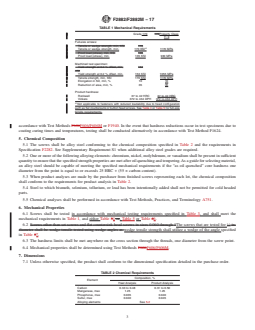
TABLE 1 Mechanical Requirements
Grade 170 170Property Class
11.9
Full-size screws:
Tensile or wedge strength, min, KSI 170
A
Tensile or wedge strength, min, 170 KSI 1170 MPa
Proof load (stress), min, KSI 135
Proof load (stress), min, 135 KSI 930 MPa
Machined test specimen:
Yield strength at 0.2 % offset, min, 153
KSI
Yield strength at 0.2 % offset, min, 153 KSI 1055 MPa
Tensile strength, min, KSI 170 KSI 1170 MPa
Elongation in 5D, min, % 10 10
Reduction of area, min, % 35 35
Product hardness:
Rockwell 37 to 42 HRC 37 to 42 HRC
Vickers 372 to 434 DPH 372 to 434 DPH
A
Not applicable to fasteners with reduced loadability due to head configuration
such as flat countersunk or button head screws. See Table 4 or Table 5 for full-size
tensile requirements.
accordance with Test Methods F606F606/F606M or F1940. In the event that hardness reductions occur in test specimens due to
coating curing times and temperatures, testing shall be conducted alternatively in accordance with Test Method F1624.
5. Chemical Composition
5.1 The screws shall be alloy steel conforming to the chemical composition specified in Table 2 and the requirements in
Specification F2282. See Supplementary Requirement S1 when additional alloy steel grades are required.
5.2 One or more of the following alloying elements: chromium, nickel, molybdenum, or vanadium shall be present in sufficient
quantity to ensure that the specified strength properties are met after oil quenching and tempering. As a guide for selecting material,
an alloy steel should be capable of meeting the specified mechanical requirements if the “as oil quenched” core hardness one
diameter from the point is equal to or exceeds 25 HRC + (55 × carbon content).
5.3 When product analyses are made by the purchaser from finished screws representing each lot, the chemical composition
shall conform to the requirements for product analysis in Table 2.
5.4 Steel to which bismuth, selenium, tellurium, or lead has been intentionally added shall not be permitted for cold headed
parts.
5.5 Chemical analyses shall be performed in accordance with Test Methods, Practices, and Terminology A751.
6. Mechanical Properties
6.1 Screws shall be tested in accordance with mechanical testing requirements specified in Table 3, and shall meet the
mechanical requirements in Table 1, and either Table 34 or, Table 5 or Table 46.
6.2 Screws other than set screws and flat countersink head screws in sizes 0.060 through 1The screws that are tested for ⁄2 in.
diameter shall be wedge tensile tested using wedge angles as wedge tensile strength shall utilize a wedge of the angle specified
in Table 57.
6.3 The hardness limits shall be met anywhere on the cross section through the threads, one diameter from the screw point.
6.4 Mechanical properties shall be determined using Test Methods F606F606/F606M.
7. Dimensions
7.1 Unless otherwise specified, the product shall conform to the dimensional specification detailed in the purchase order.
TABLE 2 Chemical Requirements
Composition, %
Element
Heat Analysis Product Analysis
Carbon 0.33 to 0.48 0.31 to 0.50
Manganese, max 1.25 1.25
Phosphorus, max 0.035 0.040
Sulfur, max 0.040 0.045
Alloying elements See 5.2
F2882/F2882M − 17
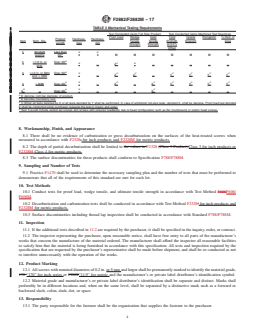
TABLE 3 Mechanical Testing Requirements
Test Conducted Using Full Size Product Test Conducted Using Machined Test Specimen
Proof Load Wedge Axial Yield Tensile Elongation % Red. of
Product Hardness, Hardness,
Item Nom. Dia. Tensile Tensile Strength Strength Area
Length max min
Strength Strength at 0.2%
Offset
1 All short Less than
B B
... ... ... ... ... ... ...
A
lengths 3D
A
2 #1.0 in. or Over 3D
B C B
... Z ... ... ... ... ...
M24
A
3 >1.0 in. or M24 Over 3D
B C C C C C C
... Z X ... Y Y Y Y
and # M36
A B C C C C C C
4 > M36 Over 3D . Z . X Y Y Y Y
D A B C
5 . Over 3D . . . X . . . .
A
D denotes nominal diameter of product.
B
B Denotes mandatory test.
C
C Either all tests denoted by X or all tests denoted by Y shall be performed. In case of arbitration full-size tests, denoted X, shall be decisive. Proof load test denoted
Z shall be conducted when purchaser requests the test in inquiry and order.
D
Item 5 would include socket set screws and screws with reduced loadability due to head configuration such as flat
...