

ASTM F949-20
(Specification)Standard Specification for Poly(Vinyl Chloride) (PVC) Corrugated Sewer Pipe With a Smooth Interior and Fittings
General Information
- Abstract
ABSTRACT
This specification covers the requirements, test methods, and materials for 4 to 36-in. diameter poly(vinyl chloride) (PVC) corrugated pipes, joints, and fittings that consist of an outer corrugated wall fused to a smooth inner wall, and are suitable for underground use in nonpressure applications for sanitary sewers, storm sewers, and perforated and unperforated pipes for subdrainage. When evaluated by the test procedures enumerated herein, the products shall conform to dimensional and performance requirements as specified for pipe stiffness, flattening resistance, impact strength, extrusion quality, heat reversion, bond strength, and joint tightness.
SCOPE
1.1 This specification covers requirements, test methods, and materials for 4 to 48 in. diameter poly(vinyl chloride) (PVC) corrugated pipe with a smooth interior. This profile wall pipe consists of an outer corrugated wall fused to a smooth inner wall providing pipe stiffness levels of 46 psi and 115 psi. Joints and fittings are included in this specification.
1.2 The requirements of this specification are intended to provide pipe and fittings suitable for underground use in nonpressure applications for sanitary sewers, storm sewers, and perforated and unperforated pipes for subdrainage.
Note 1: Industrial waste disposal lines should be installed only with the specific approval of the cognizant code authority, since chemicals not commonly found in drains and sewers and temperatures in excess of 140 °F (60 °C) may be encountered.
1.3 Pipe and fittings produced to this specification shall be installed in accordance with Practice D2321.
Note 2: For perforated pipe applications, the size of the embedment zone and permeability of the embedment material are important to the system's ability to provide the desired level of infiltration or exfiltration. The gradation of the embedment material must be compatible with the perforation slot size to avoid backfill migration into the pipe.
1.4 The values stated in inch-pound units are to be regarded as standard. The values given in parentheses are mathematical conversions to SI units that are provided for information only and are not considered standard.
1.5 The following precautionary caveat pertains only to the test method portion, Section 7, of this specification: This standard does not purport to address all of the safety concerns, if any, associated with its use. It is the responsibility of the user of this standard to establish appropriate safety, health, and environmental practices and determine the applicability of regulatory limitations prior to use.
1.6 This international standard was developed in accordance with internationally recognized principles on standardization established in the Decision on Principles for the Development of International Standards, Guides and Recommendations issued by the World Trade Organization Technical Barriers to Trade (TBT) Committee.
- Status
- Published
- Publication Date
- 14-Feb-2020
- Technical Committee
- F17 - Plastic Piping Systems
- Drafting Committee
- F17.62 - Sewer
Buy Documents
ASTM F949-20 - Standard Specification for Poly(Vinyl Chloride) (PVC) Corrugated Sewer Pipe With a Smooth Interior and Fittings
REDLINE ASTM F949-20 - Standard Specification for Poly(Vinyl Chloride) (PVC) Corrugated Sewer Pipe With a Smooth Interior and Fittings
Overview
ASTM F949-20 is the internationally recognized standard specification developed by ASTM for poly(vinyl chloride) (PVC) corrugated sewer pipe with a smooth interior and associated fittings. This standard outlines the requirements, test methods, and materials for manufacturing high-quality PVC corrugated pipes ranging from 4 to 48 inches in diameter, specifically for underground, nonpressure applications. These include use in sanitary sewers, storm sewers, and subdrainage systems, both perforated and unperforated.
The dual-wall profile design-an outer corrugated wall fused to a smooth inner wall-provides strength, flexibility, and efficient flow characteristics. Compliance with ASTM F949-20 ensures effective performance, durability, and safety in municipal, commercial, and construction drainage systems.
Key Topics
- Material Specifications: Pipes and fittings must be manufactured from PVC compound with a minimum cell classification as defined in ASTM D1784.
- Pipe Design: Dual-wall construction combines a corrugated exterior for strength with a smooth interior to optimize flow and facilitate cleaning.
- Sizes and Stiffness: Covers pipes from 4 to 48 inches, with standardized pipe stiffness levels available at 46 psi and 115 psi for various load requirements.
- Joints and Fittings: Includes details for gasketed and solvent-cemented joints to ensure leak-tight performance. Fittings may be molded or fabricated, ensuring compatibility and ease of installation.
- Testing and Quality Control: Specifies dimensional, physical, and performance tests, such as:
- Pipe stiffness
- Flattening resistance
- Impact strength
- Extrusion quality
- Heat reversion
- Bond strength between layers
- Joint tightness
- Manufacturing Tolerances: Ensures uniformity in dimensions, perforation sizes (for subdrainage pipes), and wall thickness for reliable system functionality.
- Marking and Identification: All pipes and fittings must display manufacturer information, pipe dimensions and classification, standard designation, material type, and production codes for full traceability.
Applications
ASTM F949-20 PVC corrugated sewer pipe delivers reliable solutions for a range of nonpressure, underground applications, including:
- Sanitary Sewer Systems: Used for transporting wastewater safely below ground, providing long-term corrosion resistance and smooth flow properties.
- Storm Sewer Infrastructure: Ideal for managing surface water runoff due to impact resistance and high structural integrity under soil loads.
- Subdrainage Systems: Available in perforated and unperforated varieties, these pipes effectively manage groundwater, helping to prevent soil saturation around foundations, roadways, and landscapes.
- Municipal and Commercial Installations: Frequently specified by utilities, DOTs, and civil engineers for new installations and rehabilitation of existing infrastructure.
- Environmentally Sensitive Sites: Non-corrosive material and leakproof joints reduce risk of environmental contamination.
- Special Considerations: For industrial waste lines, chemical resistance and temperature limits (up to 140°F/60°C) should be verified in consultation with local authorities.
ASTM F949-20 compliant pipes must be installed following ASTM D2321 to ensure long-term performance, especially regarding embedment material selection and proper backfill.
Related Standards
- ASTM D1784: Specification for rigid PVC compounds - establishes material requirements.
- ASTM D2321: Practice for the underground installation of thermoplastic pipe for sewers and gravity-flow applications.
- ASTM D3212: Specification for joints for drain and sewer plastic pipes using flexible elastomeric seals.
- ASTM F477: Specification for elastomeric seals (gaskets) for joining plastic pipe.
- ASTM D2444: Test method for impact resistance of thermoplastic pipe and fittings.
- ASTM D2122: Test method for determining dimensions of thermoplastic pipe and fittings.
These references ensure comprehensive compatibility, installation, and performance of piping systems using ASTM F949-20 PVC corrugated sewer pipe and fittings.
Keywords: ASTM F949-20, PVC corrugated sewer pipe, smooth interior, underground drainage, sanitary sewers, storm sewers, subdrainage, pipe fittings, profile wall pipe, ASTM standards, sewer system installation, leak-tight joints, pipe stiffness, nonpressure applications.
Relations
- Effective Date
- 15-Feb-2020
- Effective Date
- 01-Nov-2023
- Effective Date
- 01-Aug-2020
- Effective Date
- 01-Aug-2020
- Effective Date
- 01-Apr-2020
- Effective Date
- 15-Mar-2020
- Effective Date
- 15-Jan-2020
- Effective Date
- 01-Jan-2019
- Effective Date
- 01-Aug-2018
- Effective Date
- 01-Mar-2018
- Refers
ASTM D1600-18 - Standard Terminology for Abbreviated Terms Relating to Plastics (Withdrawn 2024) - Effective Date
- 01-Jan-2018
- Effective Date
- 15-Nov-2017
- Effective Date
- 01-Nov-2017
- Effective Date
- 01-Aug-2017
- Effective Date
- 15-Feb-2017
Buy Documents
ASTM F949-20 - Standard Specification for Poly(Vinyl Chloride) (PVC) Corrugated Sewer Pipe With a Smooth Interior and Fittings
REDLINE ASTM F949-20 - Standard Specification for Poly(Vinyl Chloride) (PVC) Corrugated Sewer Pipe With a Smooth Interior and Fittings
Get Certified
Connect with accredited certification bodies for this standard

Institut za varilstvo d.o.o. (Welding Institute)
Slovenia's leading welding institute since 1952. ISO 3834, EN 1090, pressure equipment certification, NDT personnel, welder qualification. Only IIW Au
Sponsored listings
Frequently Asked Questions
ASTM F949-20 is a technical specification published by ASTM International. Its full title is "Standard Specification for Poly(Vinyl Chloride) (PVC) Corrugated Sewer Pipe With a Smooth Interior and Fittings". This standard covers: ABSTRACT This specification covers the requirements, test methods, and materials for 4 to 36-in. diameter poly(vinyl chloride) (PVC) corrugated pipes, joints, and fittings that consist of an outer corrugated wall fused to a smooth inner wall, and are suitable for underground use in nonpressure applications for sanitary sewers, storm sewers, and perforated and unperforated pipes for subdrainage. When evaluated by the test procedures enumerated herein, the products shall conform to dimensional and performance requirements as specified for pipe stiffness, flattening resistance, impact strength, extrusion quality, heat reversion, bond strength, and joint tightness. SCOPE 1.1 This specification covers requirements, test methods, and materials for 4 to 48 in. diameter poly(vinyl chloride) (PVC) corrugated pipe with a smooth interior. This profile wall pipe consists of an outer corrugated wall fused to a smooth inner wall providing pipe stiffness levels of 46 psi and 115 psi. Joints and fittings are included in this specification. 1.2 The requirements of this specification are intended to provide pipe and fittings suitable for underground use in nonpressure applications for sanitary sewers, storm sewers, and perforated and unperforated pipes for subdrainage. Note 1: Industrial waste disposal lines should be installed only with the specific approval of the cognizant code authority, since chemicals not commonly found in drains and sewers and temperatures in excess of 140 °F (60 °C) may be encountered. 1.3 Pipe and fittings produced to this specification shall be installed in accordance with Practice D2321. Note 2: For perforated pipe applications, the size of the embedment zone and permeability of the embedment material are important to the system's ability to provide the desired level of infiltration or exfiltration. The gradation of the embedment material must be compatible with the perforation slot size to avoid backfill migration into the pipe. 1.4 The values stated in inch-pound units are to be regarded as standard. The values given in parentheses are mathematical conversions to SI units that are provided for information only and are not considered standard. 1.5 The following precautionary caveat pertains only to the test method portion, Section 7, of this specification: This standard does not purport to address all of the safety concerns, if any, associated with its use. It is the responsibility of the user of this standard to establish appropriate safety, health, and environmental practices and determine the applicability of regulatory limitations prior to use. 1.6 This international standard was developed in accordance with internationally recognized principles on standardization established in the Decision on Principles for the Development of International Standards, Guides and Recommendations issued by the World Trade Organization Technical Barriers to Trade (TBT) Committee.
ABSTRACT This specification covers the requirements, test methods, and materials for 4 to 36-in. diameter poly(vinyl chloride) (PVC) corrugated pipes, joints, and fittings that consist of an outer corrugated wall fused to a smooth inner wall, and are suitable for underground use in nonpressure applications for sanitary sewers, storm sewers, and perforated and unperforated pipes for subdrainage. When evaluated by the test procedures enumerated herein, the products shall conform to dimensional and performance requirements as specified for pipe stiffness, flattening resistance, impact strength, extrusion quality, heat reversion, bond strength, and joint tightness. SCOPE 1.1 This specification covers requirements, test methods, and materials for 4 to 48 in. diameter poly(vinyl chloride) (PVC) corrugated pipe with a smooth interior. This profile wall pipe consists of an outer corrugated wall fused to a smooth inner wall providing pipe stiffness levels of 46 psi and 115 psi. Joints and fittings are included in this specification. 1.2 The requirements of this specification are intended to provide pipe and fittings suitable for underground use in nonpressure applications for sanitary sewers, storm sewers, and perforated and unperforated pipes for subdrainage. Note 1: Industrial waste disposal lines should be installed only with the specific approval of the cognizant code authority, since chemicals not commonly found in drains and sewers and temperatures in excess of 140 °F (60 °C) may be encountered. 1.3 Pipe and fittings produced to this specification shall be installed in accordance with Practice D2321. Note 2: For perforated pipe applications, the size of the embedment zone and permeability of the embedment material are important to the system's ability to provide the desired level of infiltration or exfiltration. The gradation of the embedment material must be compatible with the perforation slot size to avoid backfill migration into the pipe. 1.4 The values stated in inch-pound units are to be regarded as standard. The values given in parentheses are mathematical conversions to SI units that are provided for information only and are not considered standard. 1.5 The following precautionary caveat pertains only to the test method portion, Section 7, of this specification: This standard does not purport to address all of the safety concerns, if any, associated with its use. It is the responsibility of the user of this standard to establish appropriate safety, health, and environmental practices and determine the applicability of regulatory limitations prior to use. 1.6 This international standard was developed in accordance with internationally recognized principles on standardization established in the Decision on Principles for the Development of International Standards, Guides and Recommendations issued by the World Trade Organization Technical Barriers to Trade (TBT) Committee.
ASTM F949-20 is classified under the following ICS (International Classification for Standards) categories: 23.040.20 - Plastics pipes; 23.040.45 - Plastics fittings. The ICS classification helps identify the subject area and facilitates finding related standards.
ASTM F949-20 has the following relationships with other standards: It is inter standard links to ASTM F949-15(2019), ASTM D2152-23, ASTM D2855-20, ASTM D2564-20, ASTM F412-20, ASTM D2321-20, ASTM D1784-20, ASTM F412-19, ASTM D2564-12(2018), ASTM D2321-18, ASTM D1600-18, ASTM D2444-17, ASTM D2152-17, ASTM F412-17a, ASTM F1057-17. Understanding these relationships helps ensure you are using the most current and applicable version of the standard.
ASTM F949-20 is available in PDF format for immediate download after purchase. The document can be added to your cart and obtained through the secure checkout process. Digital delivery ensures instant access to the complete standard document.
Standards Content (Sample)
This international standard was developed in accordance with internationally recognized principles on standardization established in the Decision on Principles for the
Development of International Standards, Guides and Recommendations issued by the World Trade Organization Technical Barriers to Trade (TBT) Committee.
Designation:F949 −20
Standard Specification for
Poly(Vinyl Chloride) (PVC) Corrugated Sewer Pipe With a
Smooth Interior and Fittings
ThisstandardisissuedunderthefixeddesignationF949;thenumberimmediatelyfollowingthedesignationindicatestheyearoforiginal
adoptionor,inthecaseofrevision,theyearoflastrevision.Anumberinparenthesesindicatestheyearoflastreapproval.Asuperscript
epsilon (´) indicates an editorial change since the last revision or reapproval.
This standard has been approved for use by agencies of the U.S. Department of Defense.
1. Scope* ization established in the Decision on Principles for the
Development of International Standards, Guides and Recom-
1.1 This specification covers requirements, test methods,
mendations issued by the World Trade Organization Technical
and materials for 4 to 48 in. diameter poly(vinyl chloride)
Barriers to Trade (TBT) Committee.
(PVC)corrugatedpipewithasmoothinterior.Thisprofilewall
pipe consists of an outer corrugated wall fused to a smooth
2. Referenced Documents
inner wall providing pipe stiffness levels of 46 psi and 115psi.
2.1 ASTM Standards:
Joints and fittings are included in this specification.
D618Practice for Conditioning Plastics for Testing
1.2 The requirements of this specification are intended to
D1600TerminologyforAbbreviatedTermsRelatingtoPlas-
provide pipe and fittings suitable for underground use in
tics
nonpressureapplicationsforsanitarysewers,stormsewers,and
D1784Specification for Rigid Poly(Vinyl Chloride) (PVC)
perforated and unperforated pipes for subdrainage.
Compounds and Chlorinated Poly(Vinyl Chloride)
NOTE 1—Industrial waste disposal lines should be installed only with
(CPVC) Compounds
the specific approval of the cognizant code authority, since chemicals not
D2122Test Method for Determining Dimensions of Ther-
commonly found in drains and sewers and temperatures in excess of
moplastic Pipe and Fittings
140°F (60°C) may be encountered.
D2152Test Method for Adequacy of Fusion of Extruded
1.3 Pipe and fittings produced to this specification shall be
Poly(Vinyl Chloride) (PVC) Pipe and Molded Fittings by
installed in accordance with Practice D2321.
Acetone Immersion
NOTE 2—For perforated pipe applications, the size of the embedment D2321PracticeforUndergroundInstallationofThermoplas-
zone and permeability of the embedment material are important to the
tic Pipe for Sewers and Other Gravity-Flow Applications
system’s ability to provide the desired level of infiltration or exfiltration.
D2412Test Method for Determination of External Loading
The gradation of the embedment material must be compatible with the
Characteristics of Plastic Pipe by Parallel-Plate Loading
perforation slot size to avoid backfill migration into the pipe.
D2444Practice for Determination of the Impact Resistance
1.4 The values stated in inch-pound units are to be regarded
of Thermoplastic Pipe and Fittings by Means of a Tup
as standard. The values given in parentheses are mathematical
(Falling Weight)
conversions to SI units that are provided for information only
D2564Specification for Solvent Cements for Poly(Vinyl
and are not considered standard.
Chloride) (PVC) Plastic Piping Systems
1.5 The following precautionary caveat pertains only to the
D2855Practice for the Two-Step (Primer and Solvent Ce-
test method portion, Section 7, of this specification: This
ment) Method of Joining Poly (Vinyl Chloride) (PVC) or
standard does not purport to address all of the safety concerns,
Chlorinated Poly (Vinyl Chloride) (CPVC) Pipe and
if any, associated with its use. It is the responsibility of the user
Piping Components with Tapered Sockets
of this standard to establish appropriate safety, health, and
D3034Specification for Type PSM Poly(Vinyl Chloride)
environmental practices and determine the applicability of
(PVC) Sewer Pipe and Fittings
regulatory limitations prior to use.
D3212Specification for Joints for Drain and Sewer Plastic
1.6 This international standard was developed in accor-
Pipes Using Flexible Elastomeric Seals
dance with internationally recognized principles on standard-
F412Terminology Relating to Plastic Piping Systems
This specification is under the jurisdiction ofASTM Committee F17 on Plastic
Piping Systems and is the direct responsibility of Subcommittee F17.62 on Sewer. For referenced ASTM standards, visit the ASTM website, www.astm.org, or
Current edition approved Feb. 15, 2020. Published February 2020. Originally contact ASTM Customer Service at service@astm.org. For Annual Book of ASTM
approvedin1985.Lastpreviouseditionapprovedin2019asF949–15(2019).DOI: Standards volume information, refer to the standard’s Document Summary page on
10.1520/F0949-20. theASTM website.
*A Summary of Changes section appears at the end of this standard
Copyright © ASTM International, 100 Barr Harbor Drive, PO Box C700, West Conshohocken, PA 19428-2959. United States
F949−20
F477Specification for Elastomeric Seals (Gaskets) for Join- 5. Requirements
ing Plastic Pipe
5.1 Workmanship—The pipe and fittings shall be homoge-
F679Specification for Poly(Vinyl Chloride) (PVC) Large-
neous throughout and free from visible cracks, holes, foreign
Diameter Plastic Gravity Sewer Pipe and Fittings
inclusions, or other injurious defects. The pipe shall be as
F1057Practice for Estimating the Quality of Extruded Poly
uniform as commercially practical in color, opacity, density,
(Vinyl Chloride) (PVC) Pipe by the Heat Reversion
and other physical properties. Slots deliberately placed in pipe
Technique
for perforations for subdrainage, etc., applications are accept-
2.2 American Water Works Association (AWWA) Document:
able.
AWWA Manual M45,Fiberglass Pipe Design
5.2 Dimensions and Tolerances:
2.3 Federal Standard:
5.2.1 Pipe—Pipe dimensions shall meet the requirements
Fed. Std. No. 123Marking for Shipments (CivilAgencies)
given in Table 1 when measured in accordance with 7.3.
2.4 Military Standard:
5.2.2 Sockets—All sockets (bells), dimensions on pipe, and
MIL-STD-129Marking for Shipment and Storage
fittings shall meet the requirements given in Table 2 when
measuredinaccordancewith7.4.Inthecaseofbelledpipe,the
3. Terminology
thickness of wall in the bell shall be considered satisfactory if
the pipe meets the minimum thicknesses listed in Table 1.
3.1 Definitions are in accordance with Terminology F412
and abbreviations are in accordance with Terminology D1600, 5.2.3 Fittings—Molded fitting dimensions shall meet the
requirements of Table 3 when measured in accordance with
unless otherwise specified. The abbreviation for poly(vinyl
chloride) plastic is PVC. 7.4. The wall thickness of molded fittings shall meet the
requirements given in Table 4, when measured in accordance
3.2 parting line—a slight mark or surface irregularity in the
with7.4.Fittingsmayalsobefabricatedfrompipe,meetingthe
pipe or fitting surface as a result of a mold separation at that
requirements of this specification or from pipe meeting the
location.
requirements of Specification D3034 or F679. In the case of a
fabricated fitting with a formed bell, the thickness of the bell
4. Materials and Manufacture
shall be considered satisfactory if it was formed from pipe
4.1 Material Specification—The pipe shall be made of PVC
meetingtherequirementsofthestandardtowhichthepipewas
compound having a minimum cell classification of 12454 in
produced.Forreducingfittingsorthosewithsmallerinlets,the
accordance with Specification D1784. The fittings shall be
minimum wall thickness of each inlet shall be no less than the
made of PVC compound having a cell classification of 12454,
minimum wall thickness for that size pipe.
or 13343 as defined in Specification D1784. Compounds that
5.2.4 Perforations—Perforation slots shall be clearly cut
have different cell classifications because one or more proper-
and uniformly spaced along the length of pipe. Slots shall be
ties are superior to those of the specified compounds are also
centeredinthecorrugationvalleys.Dimensionsandspacingof
acceptable.
theslotsshallbeaslistedinTable5.Otherslotdimensionsand
4.2 Rework Material—Clean rework material, generated
spacing may be provided to meet the needs of the specifier.
from the manufacturer’s own pipe or fitting production, or
Alternatively, where the valley is large enough to accommo-
both, may be used by the same manufacturer provided that the
dateasuitablysizedroundholeperforationwithoutpenetrating
reworkmaterialmeetstherequirementsof4.1andthatthepipe
the void under the corrugation, round hole perforations of a
and fittings produced meet the requirements of this specifica-
size, pattern, and open area agreed upon by the specifier may
tion.
be provided. All measurements shall be made in accordance
with 7.9.
4.3 Pipe shall be manufactured by simultaneous extrusion
of the smooth and corrugated walls with the smooth inner wall
5.3 Performance Requirements:
fused to the outer corrugated wall.
5.3.1 Pipe Stiffness—Pipe stiffness shall be a minimum of
46 psi or 115 psi when tested in accordance with 7.5. Pipe
4.4 Fittings shall be molded or fabricated.
stiffness shall be marked on pipe as per 11.2.3.
4.5 Joining Materials:
NOTE 3—This test is intended only for use as a quality control test and
4.5.1 Gaskets—Elastomeric seals (gaskets) shall be in ac-
not as a simulated service test.
cordance with the requirements of Specification F477.
5.3.2 Flattening—There shall be no evidence of splitting,
4.5.2 Lubricant—The lubricant used for assembly shall be
as recommended by the manufacturer and shall have no cracking, breaking, or separation of the two walls when the
pipe is tested in accordance with 7.5 (see Note 4).
detrimental effect on the gasket or on the pipe and fittings.
4.5.3 Solvent Cement—The PVC cement shall comply with 5.3.3 Impact Strength—Pipeshallhavetheminimumimpact
SpecificationD2564.Thesolventcementshallbeusedonlyfor strengths listed in Table 6, when tested in accordance with 7.6.
bushings and saddle connections (see Fig. 1). Failure of the test specimen shall be any crack, split, or
shattering of either the waterway or corrugation wall. Separa-
tion of the ribs of the exterior corrugation from the waterway
Available fromAmericanWaterWorksAssociation (AWWA), 6666W. Quincy
wall constitutes a failure.
Ave., Denver, CO 80235, http://www.awwa.org.
DLA Document Services Building 4/D 700 Robbins Avenue Philadelphia, PA NOTE 4—This test is intended only for use as a quality control test at
19111-5094 http://quicksearch.dla.mil/ time of manufacture, and not as a simulated service test.
F949−20
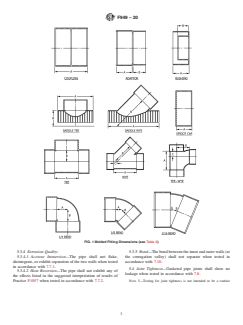
FIG. 1Molded Fitting Dimensions (see Table 3)
5.3.4 Extrusion Quality: 5.3.5 Bond—Thebondbetweentheinnerandouterwalls(at
5.3.4.1 Acetone Immersion—The pipe shall not flake, the corrugation valley) shall not separate when tested in
disintegrate, or exhibit separation of the two walls when tested accordance with 7.10.
in accordance with 7.7.1.
5.4 Joint Tightness—Gasketed pipe joints shall show no
5.3.4.2 Heat Reversion—The pipe shall not exhibit any of
leakage when tested in accordance with 7.8.
the effects listed in the suggested interpretation of results of
Practice F1057 when tested in accordance with 7.7.2. NOTE 5—Testing for joint tightness is not intended to be a routine
F949−20
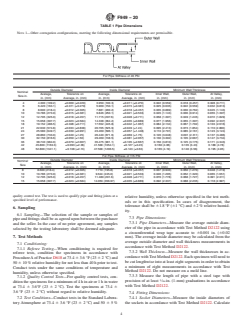
TABLE 1 Pipe Dimensions
NOTE 1—Other corrugation configurations, meeting the following dimensional requirements are permissible.
For Pipe Stiffness of 46 PSI
Outside Diameter Inside Diameter Minimum Wall Thickness
Nominal
Average, Tolerance on Average, Tolerance on Inner Wall, Outer Wall, At Valley,
Size in.
in. (mm) Average, in. (mm) in. (mm) Average, in. (mm) in. (mm) in. (mm) in. (mm)
4 4.300 (109.2) ±0.009 (±0.229) 3.950 (100.3) ±0.011 (±0.279) 0.022 (0.559) 0.018 (0.457) 0.028 (0.711)
6 6.420 (163.1) ±0.011 (±0.279) 5.909 (150.1) ±0.015 (±0.381) 0.025 (0.635) 0.022 (0.559) 0.032 (0.813)
8 8.600 (218.4) ±0.012 (±0.305) 7.881 (200.2) ±0.018 (±0.457) 0.035 (0.889) 0.030 (0.762) 0.045 (1.143)
10 10.786 (273.9) ±0.015 (±0.381) 9.846 (250.1) ±0.021 (±0.533) 0.045 (1.143) 0.036 (0.914) 0.055 (1.397)
12 12.795 (325.0) ±0.018 (±0.457) 11.715 (297.6) ±0.028 (±0.711) 0.058 (1.397) 0.049 (1.245) 0.072 (1.829)
15 15.658 (397.7) ±0.023 (±0.584) 14.338 (364.2) ±0.035 (±0.889) 0.077 (1.956) 0.055 (1.397) 0.092 (2.337)
18 19.152 (486.5) ±0.028 (±0.711) 17.552 (445.8) ±0.042 (±1.067) 0.084 (2.134) 0.067 (1.702) 0.103 (2.616)
21 22.630 (574.8) ±0.033 (±0.838) 20.705 (525.9) ±0.049 (±1.24) 0.095 (2.413) 0.073 (1.854) 0.110 (2.800)
24 25.580 (649.7) ±0.039 (±0.991) 23.469 (596.1) ±0.057 (±1.448) 0.110 (2.791) 0.085 (2.161) 0.123 (3.124)
27 28.860 (733.0) ±0.049 (±1.25) 26.440 (671.6) ±0.069 (±1.75) 0.120 (3.048) 0.091 (2.311) 0.137 (3.486)
30 32.150 (816.6) ±0.059 (±1.50) 29.469 (748.5) ±0.081 (±2.057) 0.130 (3.302) 0.105 (2.667) 0.147 (3.734)
36 38.740 (984.0) ±0.079 (±2.007) 35.475 (901.1) ±0.105 (±2.667) 0.150 (3.810) 0.125 (3.175) 0.171 (4.343)
42 45.800 (1163.3) ±0.093 (±2.36) 41.500 (1054.1) ±0.127 (±3.23) 0.160 (4.06) 0.135 (3.43) 0.188 (4.78)
48 52.800 (1341.1) ±0.108 (±2.74) 47.500 (1206.5) ±0.143 (±3.63) 0.165 (4.19) 0.140 (3.56) 0.195 (4.95)
For Pipe Stiffness of 115 PSI
Outside Diameter Inside Diameter Minimum Wall Thickness
Nominal
Average, Tolerance on Average, Tolerance on Inner Wall, Outer Wall, At Valley,
Size
in. (mm) Average, in. (mm) in. (mm) Average, in. (mm) in. (mm) in. (mm) in. (mm)
8 8.600 (218.4) ±0.012 (±0.305) 7.710 (195.8) ±0.018 (±0.457) 0.037 (0.940) 0.050 (1.270) 0.048 (1.219)
10 10.786 (273.9) ±0.015 (±0.381) 9.644 (245.0) ±0.021 (±0.533) 0.046 (1.295) 0.052 (1.320) 0.065 (1.651)
12 12.795 (325.0) ±0.018 (±0.457) 11.480 (291.6) ±0.028 (±0.711) 0.070 (1.778) 0.068 (1.727) 0.091 (2.311)
15 15.658 (397.7) ±0.023 (±0.584) 14.053 (356.97) ±0.035 (±0.889) 0.092 (2.337) 0.088 (2.235) 0.118 (2.997)
quality control test. The test is used to qualify pipe and fitting joints at a
relative humidity, unless otherwise specified in the test meth-
specified level of performance.
ods or in this specification. In cases of disagreement, the
tolerance shall be 61.8°F (61°C) and 62% relative humid-
6. Sampling
ity.
6.1 Sampling—The selection of the sample or samples of
7.3 Pipe Dimensions:
pipeandfittingsshallbeasagreeduponbetweenthepurchaser
7.3.1 Pipe Diameters—Measure the average outside diam-
and the seller. In the case of no prior agreement, any samples
eter of the pipe in accordance with Test Method D2122 using
selected by the testing laboratory shall be deemed adequate.
a circumferential wrap tape accurate to 60.001 in. (60.02
7. Test Methods mm). The average inside diameter may be calculated from the
average outside diameter and wall thickness measurements in
7.1 Conditioning:
accordance with Test Method D2122.
7.1.1 Referee Testing—When conditioning is required for
7.3.2 Wall Thickness—Measure the wall thicknesses in ac-
referee tests, condition the specimens in accordance with
cordancewithTestMethodD2122.Eachspecimenwillneedto
ProcedureAofPracticeD618at73.4 63.6°F(23 62°C)and
becutlengthwiseintoatleasteightsegmentsinordertoobtain
50 610%relativehumidityfornotlessthan40hpriortotest.
a minimum of eight measurements in accordance with Test
Conduct tests under the same conditions of temperature and
Method D2122. Do not measure on a mold line.
humidity, unless otherwise specified.
7.3.3 Measure the length of pipe with a steel tape with
7.1.2 Quality Control Tests—For quality control tests, con-
precision of at least ⁄16-in. (1-mm) graduations in accordance
ditionthespecimensforaminimumof4hinairor1hinwater
with Test Method D2122.
at 73.4 6 3.6°F (23 6 2°C). Test the specimens at 73.4 6
3.6°F (23 6 2°C) without regard to relative humidity.
7.4 Fitting Dimensions:
7.2 Test Conditions—Conduct tests in the Standard Labora- 7.4.1 Socket Diameters—Measure the inside diameters of
tory Atmosphere at 73.4 6 3.6°F (23 6 2°C) and 50 65% the sockets in accordance with Test Method D2122. Calculate
F949−20
TABLE 2 Bell (Socket) Dimensions for Gasketed Joints
A A
Nominal C
A B
in. (mm) in. (mm)
Diameter in. (mm)
4 4.362 ± 0.025 4.372 ± 0.025 1.75
(110.79 ± 0.64) (111.05 ± 0.64) (44.5)
6 6.492 ± 0.030 6.512 ± 0.030 2.75
(164.90 ± 0.76) (165.40 ± 0.76) (69.9)
8 8.680 ± 0.035 8.700 ± 0.035 3.75
(220.47 ± 0.89) (220.98 ± 0.84) (95.3)
10 10.876 ± 0.045 10.900± 0.045 4.75
(276.26 ± 1.14) (276.86 ± 1.14) (120.7)
12 12.873 ± 0.055 12.898± 0.055 5.75
(326.97 ± 1.40) (327.61 ± 1.40) (146.1)
15 15.751 ± 0.065 15.776± 0.065 6.75
(400.08 ± 1.65) (400.71 ± 1.65) (171.5)
18 19.260 ± 0.075 19.285± 0.075 6.75
(489.20 ± 1.91) (489.84 ± 1.91) (171.5)
21 22.751 ± 0.080 22.781± 0.080 8.5
(577.88 ± 2.032) (578.64 ± 2.032) (215.9)
24 25.758 ± 0.085 25.788± 0.085 8.5
(654.25 ± 2.159) (655.02 ± 2.159) (215.9)
27 29.058 ± 0.090 29.088± 0.090 8.5
(738.07 ± 2.286) (738.84 ± 2.286) (215.9)
30 32.368 ± 0.095 32.398± 0.095 8.5
(822.15 ± 2.413) (822.91 ± 2.413) (215.9)
36 38.998 ± 0.105 39.028± 0.105 8.5
(990.55 ± 2.667) (991.31 ± 2.667) (215.9)
42 45.965 ± 0.130 45.995 ± 0.130 12.5
(1167.51 ± 3.3) (1168.27 ± 3.3) (317.5)
48 52.970 ± 0.130 53.000 ± 0.130 15.9
(1345.44 ± 3.3) (1346.20 ± 3.3) (403.9)
A
Some sockets, dependent on the method of the manufacturer, do not have taper on inside diameter of socket. Total bell inside diameter is equal to “A” dimension.
the average inside diameters of the socket as the arithmetic 7.5 Pipe Stiffness and Flattening:
mean of all of the diameters measured at each cross section.
7.5.1 For purposes of conducting pipe stiffness and flatten-
7.4.2 Socket Depth—Measurethefittingssocketdepthusing
ing tests, the pipe inside diameter shall be considered as the
a good commercial quality scale calibrated in ⁄32-in. (1-mm)
nominal diameter and the ∆Y shall be the plate travel of the
increments in accordance with Test Method D2122.
apparatus.
7.4.3 Wall Thickness—Measure the wall thickness in accor-
7.5.2 Pipe Stiffness—Determine the pipe stiffness at 5%
dance with Test Method D2122. Make sufficient readings, a
deflection in accordance with Test Method D2412. For diam-
minimum of 8, to ensure that the minimum thickness has been
eters4through18in.,testthreespecimens,eachaminimumof
determined. Use a ball anvil or a cylindrical anvil tubing
6 in. (152 mm) in length. For diameters 21 through 48 in., test
micrometer accurate to 60.001 in. (60.02 mm).
threespecimens,eachaminimumof12in.(305mm)inlength.
7.4.4 Laying Lengths—Measurethelayinglengthofmolded
1 Specimens shall be cut in corrugation valley. All three speci-
fittings with a good commercial steel scale calibrated in ⁄32-in.
mens must pass.
(1-mm) increments in accordance with Test Method D2122.
F949−20
TABLE 3 Minimum Molded Fitting Dimensions (see Fig. 1)
NOTE 1—Fittings 10 in. and larger are typically fabricated. Contact the manufacturer for details on fittings. Bell dimensions meet the requirements of
Table 2.
Fitting, A B Fitting, A B C
in. in. (mm) in. (mm) in. in. (mm) i
...
This document is not an ASTM standard and is intended only to provide the user of an ASTM standard an indication of what changes have been made to the previous version. Because
it may not be technically possible to adequately depict all changes accurately, ASTM recommends that users consult prior editions as appropriate. In all cases only the current version
of the standard as published by ASTM is to be considered the official document.
Designation: F949 − 15 (Reapproved 2019) F949 − 20
Standard Specification for
Poly(Vinyl Chloride) (PVC) Corrugated Sewer Pipe With a
Smooth Interior and Fittings
This standard is issued under the fixed designation F949; the number immediately following the designation indicates the year of original
adoption or, in the case of revision, the year of last revision. A number in parentheses indicates the year of last reapproval. A superscript
epsilon (´) indicates an editorial change since the last revision or reapproval.
This standard has been approved for use by agencies of the U.S. Department of Defense.
1. Scope*
1.1 This specification covers requirements, test methods, and materials for 4 to 48 in. diameter poly(vinyl chloride) (PVC)
corrugated pipe with a smooth interior. This profile wall pipe consists of an outer corrugated wall fused to a smooth inner wall
providing pipe stiffness levels of 46 psi and 115psi.115 psi. Joints and fittings are included in this specification.
1.2 The requirements of this specification are intended to provide pipe and fittings suitable for underground use in nonpressure
applications for sanitary sewers, storm sewers, and perforated and unperforated pipes for subdrainage.
NOTE 1—Industrial waste disposal lines should be installed only with the specific approval of the cognizant code authority, since chemicals not
commonly found in drains and sewers and temperatures in excess of 140°F (60°C)140 °F (60 °C) may be encountered.
1.3 Pipe and fittings produced to this specification shall be installed in accordance with Practice D2321.
NOTE 2—For perforated pipe applications, the size of the embedment zone and permeability of the embedment material are important to the system’s
ability to provide the desired level of infiltration or exfiltration. The gradation of the embedment material must be compatible with the perforation slot
size to avoid backfill migration into the pipe.
1.4 The values stated in inch-pound units are to be regarded as standard. The values given in parentheses are mathematical
conversions to SI units that are provided for information only and are not considered standard.
1.5 The following precautionary caveat pertains only to the test method portion, Section 7, of this specification: This standard
does not purport to address all of the safety concerns, if any, associated with its use. It is the responsibility of the user of this
standard to establish appropriate safety, health, and environmental practices and determine the applicability of regulatory
limitations prior to use.
1.6 This international standard was developed in accordance with internationally recognized principles on standardization
established in the Decision on Principles for the Development of International Standards, Guides and Recommendations issued
by the World Trade Organization Technical Barriers to Trade (TBT) Committee.
2. Referenced Documents
2.1 ASTM Standards:
D618 Practice for Conditioning Plastics for Testing
D1600 Terminology for Abbreviated Terms Relating to Plastics
D1784 Specification for Rigid Poly(Vinyl Chloride) (PVC) Compounds and Chlorinated Poly(Vinyl Chloride) (CPVC)
Compounds
D2122 Test Method for Determining Dimensions of Thermoplastic Pipe and Fittings
D2152 Test Method for Adequacy of Fusion of Extruded Poly(Vinyl Chloride) (PVC) Pipe and Molded Fittings by Acetone
Immersion
D2321 Practice for Underground Installation of Thermoplastic Pipe for Sewers and Other Gravity-Flow Applications
D2412 Test Method for Determination of External Loading Characteristics of Plastic Pipe by Parallel-Plate Loading
D2444 Practice for Determination of the Impact Resistance of Thermoplastic Pipe and Fittings by Means of a Tup (Falling
Weight)
This specification is under the jurisdiction of ASTM Committee F17 on Plastic Piping Systems and is the direct responsibility of Subcommittee F17.62 on Sewer.
Current edition approved Aug. 1, 2019Feb. 15, 2020. Published September 2019February 2020. Originally approved in 1985. Last previous edition approved in 20152019
as F949 – 15.F949 – 15(2019). DOI: 10.1520/F0949-15R19.10.1520/F0949-20.
For referenced ASTM standards, visit the ASTM website, www.astm.org, or contact ASTM Customer Service at service@astm.org. For Annual Book of ASTM Standards
volume information, refer to the standard’s Document Summary page on the ASTM website.
*A Summary of Changes section appears at the end of this standard
Copyright © ASTM International, 100 Barr Harbor Drive, PO Box C700, West Conshohocken, PA 19428-2959. United States
F949 − 20
D2564 Specification for Solvent Cements for Poly(Vinyl Chloride) (PVC) Plastic Piping Systems
D2855 Practice for the Two-Step (Primer and Solvent Cement) Method of Joining Poly (Vinyl Chloride) (PVC) or Chlorinated
Poly (Vinyl Chloride) (CPVC) Pipe and Piping Components with Tapered Sockets
D3034 Specification for Type PSM Poly(Vinyl Chloride) (PVC) Sewer Pipe and Fittings
D3212 Specification for Joints for Drain and Sewer Plastic Pipes Using Flexible Elastomeric Seals
F412 Terminology Relating to Plastic Piping Systems
F477 Specification for Elastomeric Seals (Gaskets) for Joining Plastic Pipe
F679 Specification for Poly(Vinyl Chloride) (PVC) Large-Diameter Plastic Gravity Sewer Pipe and Fittings
F1057 Practice for Estimating the Quality of Extruded Poly (Vinyl Chloride) (PVC) Pipe by the Heat Reversion Technique
2.2 American Water Works Association (AWWA) Document:
AWWA Manual M45, Fiberglass Pipe Design
2.3 Federal Standard:
Fed. Std. No. 123 Marking for Shipments (Civil Agencies)
2.4 Military Standard:
MIL-STD-129 Marking for Shipment and Storage
3. Terminology
3.1 Definitions are in accordance with Terminology F412 and abbreviations are in accordance with Terminology D1600, unless
otherwise specified. The abbreviation for poly(vinyl chloride) plastic is PVC.
3.2 parting line—a slight mark or surface irregularity in the pipe or fitting surface as a result of a mold separation at that
location.
4. Materials and Manufacture
4.1 Material Specification—The pipe shall be made of PVC compound having a minimum cell classification of 12454 in
accordance with Specification D1784. The fittings shall be made of PVC compound having a cell classification of 12454, or 13343
as defined in Specification D1784. Compounds that have different cell classifications because one or more properties are superior
to those of the specified compounds are also acceptable.
4.2 Rework Material—Clean rework material, generated from the manufacturer’s own pipe or fitting production, or both, may
be used by the same manufacturer provided that the rework material meets the requirements of 4.1 and that the pipe and fittings
produced meet the requirements of this specification.
4.3 Pipe shall be manufactured by simultaneous extrusion of the smooth and corrugated walls with the smooth inner wall fused
to the outer corrugated wall.
4.4 Fittings shall be molded or fabricated.
4.5 Joining Materials:
4.5.1 Gaskets—Elastomeric seals (gaskets) shall be in accordance with the requirements of Specification F477.
4.5.2 Lubricant—The lubricant used for assembly shall be as recommended by the manufacturer and shall have no detrimental
effect on the gasket or on the pipe and fittings.
4.5.3 Solvent Cement—The PVC cement shall comply with Specification D2564. The solvent cement shall be used only for
bushings and saddle connections (see Fig. 1).
5. Requirements
5.1 Workmanship—The pipe and fittings shall be homogeneous throughout and free from visible cracks, holes, foreign
inclusions, or other injurious defects. The pipe shall be as uniform as commercially practical in color, opacity, density, and other
physical properties. Slots deliberately placed in pipe for perforations for subdrainage, etc., applications are acceptable.
5.2 Dimensions and Tolerances:
5.2.1 Pipe—Pipe—Pipe dimensions shall meet the requirements given in Table 1 when measured in accordance with 7.3.
5.2.2 Sockets—AllSockets—All sockets (bells), dimensions on pipe, and fittings shall meet the requirements given in Table 2
when measured in accordance with 7.4. In the case of belled pipe, the thickness of wall in the bell shall be considered satisfactory
if the pipe meets the minimum thicknesses listed in Table 1.
5.2.3 Fittings—MoldedFittings—Molded fitting dimensions shall meet the requirements of Table 3 when measured in
accordance with 7.4. The wall thickness of molded fittings shall meet the requirements given in Table 4, when measured in
accordance with 7.4. Fittings may also be fabricated from pipe, meeting the requirements of this specification or from pipe meeting
the requirements of Specification D3034 or F679. In the case of a fabricated fitting with a formed bell, the thickness of the bell
Available from American Water Works Association (AWWA), 6666 W. Quincy Ave., Denver, CO 80235, http://www.awwa.org.
DLA Document Services Building 4/D 700 Robbins Avenue Philadelphia, PA 19111-5094 http://quicksearch.dla.mil/
F949 − 20
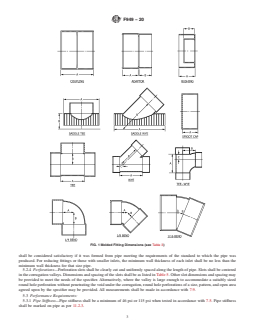
FIG. 1 Molded Fitting Dimensions (see Table 3)
shall be considered satisfactory if it was formed from pipe meeting the requirements of the standard to which the pipe was
produced. For reducing fittings or those with smaller inlets, the minimum wall thickness of each inlet shall be no less than the
minimum wall thickness for that size pipe.
5.2.4 Perforations—Perforation slots shall be clearly cut and uniformly spaced along the length of pipe. Slots shall be centered
in the corrugation valleys. Dimensions and spacing of the slots shall be as listed in Table 5. Other slot dimensions and spacing may
be provided to meet the needs of the specifier. Alternatively, where the valley is large enough to accommodate a suitably sized
round hole perforation without penetrating the void under the corrugation, round hole perforations of a size, pattern, and open area
agreed upon by the specifier may be provided. All measurements shall be made in accordance with 7.9.
5.3 Performance Requirements:
5.3.1 Pipe Stiffness—Pipe stiffness shall be a minimum of 46 psi or 115 psi when tested in accordance with 7.5. Pipe stiffness
shall be marked on pipe as per 11.2.3.
F949 − 20
TABLE 1 Pipe Dimensions
NOTE 1—Other corrugation configurations, meeting the following dimensional requirements are permissible.
For Pipe Stiffness of 46 PSI
Outside Diameter Inside Diameter Minimum Wall Thickness
Nominal
Average, Tolerance on Average, Tolerance on Inner Wall, Outer Wall, At Valley,
Size in.
in. (mm) Average, in. (mm) in. (mm) Average, in. (mm) in. (mm) in. (mm) in. (mm)
4 4.300 (109.2) ±0.009 (±0.229) 3.950 (100.3) ±0.011 (±0.279) 0.022 (0.559) 0.018 (0.457) 0.028 (0.711)
6 6.420 (163.1) ±0.011 (±0.279) 5.909 (150.1) ±0.015 (±0.381) 0.025 (0.635) 0.022 (0.559) 0.032 (0.813)
8 8.600 (218.4) ±0.012 (±0.305) 7.881 (200.2) ±0.018 (±0.457) 0.035 (0.889) 0.030 (0.762) 0.045 (1.143)
10 10.786 (273.9) ±0.015 (±0.381) 9.846 (250.1) ±0.021 (±0.533) 0.045 (1.143) 0.036 (0.914) 0.055 (1.397)
12 12.795 (325.0) ±0.018 (±0.457) 11.715 (297.6) ±0.028 (±0.711) 0.058 (1.397) 0.049 (1.245) 0.072 (1.829)
15 15.658 (397.7) ±0.023 (±0.584) 14.338 (364.2) ±0.035 (±0.889) 0.077 (1.956) 0.055 (1.397) 0.092 (2.337)
18 19.152 (486.5) ±0.028 (±0.711) 17.552 (445.8) ±0.042 (±1.067) 0.084 (2.134) 0.067 (1.702) 0.103 (2.616)
21 22.630 (574.8) ±0.033 (±0.838) 20.705 (525.9) ±0.049 (±1.24) 0.095 (2.413) 0.073 (1.854) 0.110 (2.800)
24 25.580 (649.7) ±0.039 (±0.991) 23.469 (596.1) ±0.057 (±1.448) 0.110 (2.791) 0.085 (2.161) 0.123 (3.124)
27 28.860 (733.0) ±0.049 (±1.25) 26.440 (671.6) ±0.069 (±1.75) 0.120 (3.048) 0.091 (2.311) 0.137 (3.486)
30 32.150 (816.6) ±0.059 (±1.50) 29.469 (748.5) ±0.081 (±2.057) 0.130 (3.302) 0.105 (2.667) 0.147 (3.734)
36 38.740 (984.0) ±0.079 (±2.007) 35.475 (901.1) ±0.105 (±2.667) 0.150 (3.810) 0.125 (3.175) 0.171 (4.343)
42 45.800 (1163.3) ±0.093 (±2.36) 41.500 (1054.1) ±0.127 (±3.23) 0.160 (4.06) 0.135 (3.43) 0.188 (4.78)
48 52.800 (1341.1) ±0.108 (±2.74) 47.500 (1206.5) ±0.143 (±3.63) 0.165 (4.19) 0.140 (3.56) 0.195 (4.95)
For Pipe Stiffness of 115 PSI
Outside Diameter Inside Diameter Minimum Wall Thickness
Nominal
Average, Tolerance on Average, Tolerance on Inner Wall, Outer Wall, At Valley,
Size
in. (mm) Average, in. (mm) in. (mm) Average, in. (mm) in. (mm) in. (mm) in. (mm)
8 8.600 (218.4) ±0.012 (±0.305) 7.710 (195.8) ±0.018 (±0.457) 0.037 (0.940) 0.050 (1.270) 0.048 (1.219)
10 10.786 (273.9) ±0.015 (±0.381) 9.644 (245.0) ±0.021 (±0.533) 0.046 (1.295) 0.052 (1.320) 0.065 (1.651)
12 12.795 (325.0) ±0.018 (±0.457) 11.480 (291.6) ±0.028 (±0.711) 0.070 (1.778) 0.068 (1.727) 0.091 (2.311)
15 15.658 (397.7) ±0.023 (±0.584) 14.053 (356.97) ±0.035 (±0.889) 0.092 (2.337) 0.088 (2.235) 0.118 (2.997)
NOTE 3—This test is intended only for use as a quality control test and not as a simulated service test.
5.3.2 Flattening—There shall be no evidence of splitting, cracking, breaking, or separation of the two walls when the pipe is
tested in accordance with 7.5 (see Note 4).
5.3.3 Impact Strength—Pipe shall have the minimum impact strengths listed in Table 6, when tested in accordance with 7.6.
Failure of the test specimen shall be any crack, split, or shattering of either the waterway or corrugation wall. Separation of the
ribs of the exterior corrugation from the waterway wall constitutes a failure.
NOTE 4—This test is intended only for use as a quality control test at time of manufacture, and not as a simulated service test.
5.3.4 Extrusion Quality:
5.3.4.1 Acetone Immersion—The pipe shall not flake, disintegrate, or exhibit separation of the two walls when tested in
accordance with 7.7.1.
5.3.4.2 Heat Reversion—The pipe shall not exhibit any of the effects listed in the suggested interpretation of results of Practice
F1057 when tested in accordance with 7.7.2.
5.3.5 Bond—The bond between the inner and outer walls (at the corrugation valley) shall not separate when tested in accordance
with 7.10.
5.4 Joint Tightness—Gasketed pipe joints shall show no leakage when tested in accordance with 7.8.
NOTE 5—Testing for joint tightness is not intended to be a routine quality control test. The test is used to qualify pipe and fitting joints at a specified
level of performance.
6. Sampling
6.1 Sampling—The selection of the sample or samples of pipe and fittings shall be as agreed upon between the purchaser and
the seller. In the case of no prior agreement, any samples selected by the testing laboratory shall be deemed adequate.
F949 − 20
TABLE 2 Bell (Socket) Dimensions for Gasketed Joints
A A
Nominal C
A B
in. (mm) in. (mm)
Diameter in. (mm)
4 4.362 ± 0.025 4.372 ± 0.025 1.75
(110.79 ± 0.64) (111.05 ± 0.64) (44.5)
6 6.492 ± 0.030 6.512 ± 0.030 2.75
(164.90 ± 0.76) (165.40 ± 0.76) (69.9)
8 8.680 ± 0.035 8.700 ± 0.035 3.75
(220.47 ± 0.89) (220.98 ± 0.84) (95.3)
10 10.876 ± 0.045 10.900± 0.045 4.75
(276.26 ± 1.14) (276.86 ± 1.14) (120.7)
12 12.873 ± 0.055 12.898± 0.055 5.75
(326.97 ± 1.40) (327.61 ± 1.40) (146.1)
15 15.751 ± 0.065 15.776± 0.065 6.75
(400.08 ± 1.65) (400.71 ± 1.65) (171.5)
18 19.260 ± 0.075 19.285± 0.075 6.75
(489.20 ± 1.91) (489.84 ± 1.91) (171.5)
21 22.751 ± 0.080 22.781± 0.080 8.5
(577.88 ± 2.032) (578.64 ± 2.032) (215.9)
24 25.758 ± 0.085 25.788± 0.085 8.5
(654.25 ± 2.159) (655.02 ± 2.159) (215.9)
27 29.058 ± 0.090 29.088± 0.090 8.5
(738.07 ± 2.286) (738.84 ± 2.286) (215.9)
30 32.368 ± 0.095 32.398± 0.095 8.5
(822.15 ± 2.413) (822.91 ± 2.413) (215.9)
36 38.998 ± 0.105 39.028± 0.105 8.5
(990.55 ± 2.667) (991.31 ± 2.667) (215.9)
42 45.965 ± 0.130 45.995 ± 0.130 12.5
(1167.51 ± 3.3) (1168.27 ± 3.3) (317.5)
48 52.970 ± 0.130 53.000 ± 0.130 15.9
(1345.44 ± 3.3) (1346.20 ± 3.3) (403.9)
A
Some sockets, dependent on the method of the manufacturer, do not have taper on inside diameter of socket. Total bell inside diameter is equal to “A” dimension.
7. Test Methods
7.1 Conditioning:
7.1.1 Referee Testing—When conditioning is required for referee tests, condition the specimens in accordance with Procedure
A of Practice D618 at 73.4 6 3.6 °F (23 6 2 °C) and 50 6 10 % relative humidity for not less than 40 h prior to test. Conduct
tests under the same conditions of temperature and humidity, unless otherwise specified.
7.1.2 Quality Control Tests—For quality control tests, condition the specimens for a minimum of 4 h in air or 1 h in water at
73.4 6 3.6°F (23 6 2 °C). Test the specimens at 73.4 6 3.6 °F (23 6 2 °C) without regard to relative humidity.
7.2 Test Conditions—Conduct tests in the Standard Laboratory Atmosphere at 73.4 6 3.6 °F (23 6 2 °C) and 50 6 5 % relative
humidity, unless otherwise specified in the test methods or in this specification. In cases of disagreement, the tolerance shall be
61.8 °F (61 °C) and 62 % relative humidity.
7.3 Pipe Dimensions:
F949 − 20
TABLE 3 Minimum Molded Fitting Dimensions (see Fig. 1)
NOTE 1—Fittings 10 in. and larger are typically fabricated. Contact the manufacturer for details on fittings. Bell dimensions meet the requirements of
Table 2.
Fitting, A B Fitting, A B C
in. in. (mm) in. (mm) in. in. (mm) in. (mm) in. (mm)
Couplings Tees
4 4.0 (102) 4 × 4 × 4 4.6 (117) 2.1 (53)
6 6.0 (152) 6 × 6 × 4 6.7 (170) 3.1 (79)
8 8.0 (203) 6 × 6 × 6 6.7 (170) 3.0 (7)
10 10.0 (254) 8 × 8 × 4 8.5 (216) 5.0 (127)
Saddle Tees 8 × 8 × 6 10.2 (259) 5.3 (135)
6 × 4 8.0 (203) 3.3 (84) 8 × 8 × 8 9.0 (229) 4.1 (104)
8 × 4 10.3 (262) 4.6 (117) Wyes
8 × 6 10.3 (262) 4.5 (114) 4 × 4 × 4 6.5 (165) 5.6 (142) 1.0 (25)
10 × 4 10.7 (272) 5.6 (137) 6 × 6 × 4 9.5 (241) 8.2 (208) 1.3 (33)
10 × 6 10.7 (272) 5.4 (137) 6 × 6 × 6 9.5 (241) 8.1 (206) 1.3 (33)
Saddle Wyes 8 × 8 × 4 11.5 (292) 7.5 (191) 0.7 (18)
6 × 4 9.0 (229) 6.5 (168) 8 × 8 × 6 13.3 (338) 8.0 (203) 1.7 (43)
8 × 4 14.5 (368) 10.3 (262) 8 × 8 × 8 17.0 (432) 8.3 (211) 3.5 (89)
8 × 6 14.5 (368) 10.2 (259) Tee-Wye
10 × 4 15.1 (384) 11.5 (292) 8 × 8 × 4 5.4 (137) 6.3 (160) 2.8 (71)
10 × 6 15.1 (384) 11.4 (290) 8 × 8 × 6 5.4 (137) 6.2 (157) 2.8 (71)
Spigot Caps Bushing
4 2.0 (51) 6 × 4 3.0 (76) 2.0 (51)
6 3.0 (76) 8 × 6 4.0 (102) 3.0 (76)
8 4.0 (102) Adaptors
10 5.0 (127) 4 2.0 (51) 2.0 (51)
⁄4 Bend 6 3.0 (76) 2.5 (63)
4 2.1 (53) 2.3 (58)
6 3.1 (79) 2.4 (86)
⁄8 Bend
4 1.1 (28) 1.1 (28)
6 1.6 (41) 1.6 (41)
8 2.2 (56) 2.2 (56)
⁄16 Bend
4 0.5 (13) 0.5 (13)
6 0.7 (18) 0.7 (18)
TABLE 4 Molded Fittings
A,B
Nominal Diameter Minimum Wall Thickness, in.
4 0.120
6 0.180
8 0.240
10 0.300
12 0.360
15 0.437
18 0.499
A
The skirts on saddle fittings have a minimum wall thickness of 0.180 in.
B
The wall thickness is a minimum value except that a ±10 % variation resulting
from core shift is allowable. In such a case, the average of two opposite wall
thicknesses shall equal or exceed the value shown in the table.
7.3.1 Pipe Diameters—Measure the average outside diameter of the pipe in accordance with Test Method D2122 using a
circumferential wrap tape accurate to 60.001 in. (60.02 mm). The average inside diameter may be calculated from the average
outside diameter and wall thickness measurements in accordance with Test Method D2122.
7.3.2 Wall Thickness—Measure the wall thicknesses in accordance with Test Method D2122. Each specimen will need to be cut
lengthwise into at least eight segments in order to obtain a minimum of eight measurements in accordance with Test Method
D21
...