

ASTM D2855-20
(Practice)Standard Practice for the Two-Step (Primer and Solvent Cement) Method of Joining Poly (Vinyl Chloride) (PVC) or Chlorinated Poly (Vinyl Chloride) (CPVC) Pipe and Piping Components with Tapered Sockets
General Information
- Abstract
SIGNIFICANCE AND USE
5.1 A solvent cement bonder/installer must follow all procedures to produce consistently strong and leak-free joints, either in shop operations or in the field.
SCOPE
1.1 This practice describes a two-step (primer and solvent cement) method of joining poly(vinyl chloride) (PVC) or chlorinated poly(vinyl chloride) (CPVC) pipe and piping components with tapered sockets.
Note 1: Simplified procedures may be allowed in non-pressure applications where local codes permit.
Note 2: Where conflicts occur between the code and the manufacturer’s installation instructions, the more restrictive provisions apply.
1.2 The products covered by this practice are intended for use with the distribution of pressured liquids only, which are chemically compatible with the piping materials. Due to inherent hazards associated with testing components and systems with compressed air or other compressed gases, some manufacturers do not allow pneumatic testing of their products. Consult with specific product/component manufacturers for their specific testing procedures prior to pneumatic testing.
Note 3: Pressurized (compressed) air or other compressed gases contain large amounts of stored energy which present serious safety hazards should a system fail for any reason.
1.3 This standard practice does not address the one-step method of joining pipe and piping components with tapered sockets with solvent cement without the use of primer. For the one-step method see Practice F3328.
1.4 The techniques covered are applicable to joining PVC to PVC or CPVC to CPVC pipe and piping components with tapered sockets. In the remainder of this standard practice, the term “piping components with tapered sockets”, whether it be bell end pipe, spigot connections, or any other type of tapered connections, will be referred to as “fittings.”
1.5 A partial list of standards for PVC and CPVC pipe, piping components, and solvent cements suitable for use in joining pipe and fittings is given in Appendix X1.
1.6 The values stated in inch-pound units are to be regarded as standard. The values given in parentheses are mathematical conversions to SI units that are provided for information only and are not considered standard.
1.7 The text of this practice references notes and footnotes that provide explanatory material. These notes and footnotes (excluding those in tables and figures) shall not be considered as requirements of the practice.
1.8 This standard does not purport to address all of the safety concerns, if any, associated with its use. It is the responsibility of the user of this standard to establish appropriate safety, health, and environmental practices and determine the applicability of regulatory limitations prior to use.
1.9 This international standard was developed in accordance with internationally recognized principles on standardization established in the Decision on Principles for the Development of International Standards, Guides and Recommendations issued by the World Trade Organization Technical Barriers to Trade (TBT) Committee.
- Status
- Published
- Publication Date
- 31-Jul-2020
- Technical Committee
- F17 - Plastic Piping Systems
- Drafting Committee
- F17.20 - Joining
Buy Documents
ASTM D2855-20 - Standard Practice for the Two-Step (Primer and Solvent Cement) Method of Joining Poly (Vinyl Chloride) (PVC) or Chlorinated Poly (Vinyl Chloride) (CPVC) Pipe and Piping Components with Tapered Sockets
REDLINE ASTM D2855-20 - Standard Practice for the Two-Step (Primer and Solvent Cement) Method of Joining Poly (Vinyl Chloride) (PVC) or Chlorinated Poly (Vinyl Chloride) (CPVC) Pipe and Piping Components with Tapered Sockets
Overview
ASTM D2855-20 is the recognized international standard for the two-step (primer and solvent cement) process of joining poly(vinyl chloride) (PVC) and chlorinated poly(vinyl chloride) (CPVC) pipes and fittings with tapered sockets. Published by ASTM International, this standard specifies the procedures required to achieve strong, leak-free joints for pressured liquid distribution systems. Compliance with these guidelines ensures the longevity, reliability, and safety of thermoplastic piping systems and aligns with industry regulations and best practices.
Key Topics
Two-Step Joining Method
ASTM D2855-20 describes a two-step process:- Application of a primer to soften and prepare the surfaces
- Application of solvent cement to bond the pipe and fittings
Materials Covered
- Rigid PVC and CPVC pipes and fittings with tapered sockets
- Use of certified primers meeting ASTM F656 and solvent cements meeting ASTM D2564 (PVC) or F493 (CPVC)
Intended Use
- Systems conveying pressured, chemically compatible liquids only
- Not for use with compressed air or gases due to safety hazards
Preparation and Assembly
- Clean, chamfer, and deburr pipe ends to maximize bonding area
- Conduct a dry-fit test to ensure proper interference fit
- Apply primer and solvent cement with correctly sized applicators
- Insert and assemble the joint while surfaces are wet and semi-fluid
Safety Guidance
- Use flammable materials (solvent cement and primer) in well-ventilated areas away from ignition sources
- Follow product manufacturers’ recommendations at all times
Applications
ASTM D2855-20 is widely used in industries and settings where durable PVC or CPVC piping systems are critical to the safe distribution of pressurized liquids:
Water Distribution Systems:
Municipal, commercial, and residential potable water supply linesIndustrial Process Piping:
Chemical processing, wastewater treatment, and other industrial liquid conveyance systemsIrrigation and Agriculture:
Piping networks for irrigation and chemical distributionUnderground Infrastructure:
Drainage, sewage, and other buried systems requiring solvent-welded jointsHVAC and Plumbing:
Hot and cold water supply, and specialized fluid transport in buildings
Key practical benefits include:
- Consistently leak-free joints
- Long-lasting, reliable connections
- Adherence to plumbing codes and regulatory requirements
Related Standards
Implementing ASTM D2855-20 often requires reference to additional ASTM standards related to PVC/CPVC materials and joining techniques:
- ASTM D1784: Specification for Rigid PVC and CPVC Compounds
- ASTM D1785/D2241: PVC Plastic Pipe, Schedules 40, 80, 120, and SDR Series
- ASTM D2466/D2467: PVC Plastic Pipe Fittings (Schedule 40 & 80)
- ASTM D2564: Solvent Cements for PVC Plastic Piping Systems
- ASTM F493: Solvent Cements for CPVC Plastic Pipe and Fittings
- ASTM F656: Primers for Solvent Cement Joints of PVC Pipe and Fittings
- ASTM F402: Safe Handling of Solvent Cements
Also compare to:
- ASTM F3328: Practice for One-Step (Solvent Cement Only) Method for Joining PVC or CPVC components
Understanding and adhering to ASTM D2855-20 as well as these related standards is essential for professionals installing solvent-welded PVC and CPVC piping systems in any industry or application. This standard provides a framework for creating high-performance, safe, and code-compliant piping systems, ensuring strong and leak-resistant joints when proper procedures and materials are used.
Relations
- Effective Date
- 01-Aug-2020
- Effective Date
- 01-Apr-2024
- Effective Date
- 01-Apr-2024
- Effective Date
- 01-Apr-2024
- Effective Date
- 01-Apr-2024
- Effective Date
- 15-Jan-2024
- Effective Date
- 01-Sep-2023
- Effective Date
- 01-Aug-2020
- Effective Date
- 01-Aug-2020
- Effective Date
- 01-Aug-2020
- Effective Date
- 01-Aug-2020
- Effective Date
- 01-Apr-2020
- Effective Date
- 15-Jan-2020
- Effective Date
- 01-Nov-2019
- Effective Date
- 01-Aug-2019
Buy Documents
ASTM D2855-20 - Standard Practice for the Two-Step (Primer and Solvent Cement) Method of Joining Poly (Vinyl Chloride) (PVC) or Chlorinated Poly (Vinyl Chloride) (CPVC) Pipe and Piping Components with Tapered Sockets
REDLINE ASTM D2855-20 - Standard Practice for the Two-Step (Primer and Solvent Cement) Method of Joining Poly (Vinyl Chloride) (PVC) or Chlorinated Poly (Vinyl Chloride) (CPVC) Pipe and Piping Components with Tapered Sockets
Get Certified
Connect with accredited certification bodies for this standard

DIN CERTCO
DIN Group product certification.

Smithers Quality Assessments
US management systems and product certification.
Sponsored listings
Frequently Asked Questions
ASTM D2855-20 is a standard published by ASTM International. Its full title is "Standard Practice for the Two-Step (Primer and Solvent Cement) Method of Joining Poly (Vinyl Chloride) (PVC) or Chlorinated Poly (Vinyl Chloride) (CPVC) Pipe and Piping Components with Tapered Sockets". This standard covers: SIGNIFICANCE AND USE 5.1 A solvent cement bonder/installer must follow all procedures to produce consistently strong and leak-free joints, either in shop operations or in the field. SCOPE 1.1 This practice describes a two-step (primer and solvent cement) method of joining poly(vinyl chloride) (PVC) or chlorinated poly(vinyl chloride) (CPVC) pipe and piping components with tapered sockets. Note 1: Simplified procedures may be allowed in non-pressure applications where local codes permit. Note 2: Where conflicts occur between the code and the manufacturer’s installation instructions, the more restrictive provisions apply. 1.2 The products covered by this practice are intended for use with the distribution of pressured liquids only, which are chemically compatible with the piping materials. Due to inherent hazards associated with testing components and systems with compressed air or other compressed gases, some manufacturers do not allow pneumatic testing of their products. Consult with specific product/component manufacturers for their specific testing procedures prior to pneumatic testing. Note 3: Pressurized (compressed) air or other compressed gases contain large amounts of stored energy which present serious safety hazards should a system fail for any reason. 1.3 This standard practice does not address the one-step method of joining pipe and piping components with tapered sockets with solvent cement without the use of primer. For the one-step method see Practice F3328. 1.4 The techniques covered are applicable to joining PVC to PVC or CPVC to CPVC pipe and piping components with tapered sockets. In the remainder of this standard practice, the term “piping components with tapered sockets”, whether it be bell end pipe, spigot connections, or any other type of tapered connections, will be referred to as “fittings.” 1.5 A partial list of standards for PVC and CPVC pipe, piping components, and solvent cements suitable for use in joining pipe and fittings is given in Appendix X1. 1.6 The values stated in inch-pound units are to be regarded as standard. The values given in parentheses are mathematical conversions to SI units that are provided for information only and are not considered standard. 1.7 The text of this practice references notes and footnotes that provide explanatory material. These notes and footnotes (excluding those in tables and figures) shall not be considered as requirements of the practice. 1.8 This standard does not purport to address all of the safety concerns, if any, associated with its use. It is the responsibility of the user of this standard to establish appropriate safety, health, and environmental practices and determine the applicability of regulatory limitations prior to use. 1.9 This international standard was developed in accordance with internationally recognized principles on standardization established in the Decision on Principles for the Development of International Standards, Guides and Recommendations issued by the World Trade Organization Technical Barriers to Trade (TBT) Committee.
SIGNIFICANCE AND USE 5.1 A solvent cement bonder/installer must follow all procedures to produce consistently strong and leak-free joints, either in shop operations or in the field. SCOPE 1.1 This practice describes a two-step (primer and solvent cement) method of joining poly(vinyl chloride) (PVC) or chlorinated poly(vinyl chloride) (CPVC) pipe and piping components with tapered sockets. Note 1: Simplified procedures may be allowed in non-pressure applications where local codes permit. Note 2: Where conflicts occur between the code and the manufacturer’s installation instructions, the more restrictive provisions apply. 1.2 The products covered by this practice are intended for use with the distribution of pressured liquids only, which are chemically compatible with the piping materials. Due to inherent hazards associated with testing components and systems with compressed air or other compressed gases, some manufacturers do not allow pneumatic testing of their products. Consult with specific product/component manufacturers for their specific testing procedures prior to pneumatic testing. Note 3: Pressurized (compressed) air or other compressed gases contain large amounts of stored energy which present serious safety hazards should a system fail for any reason. 1.3 This standard practice does not address the one-step method of joining pipe and piping components with tapered sockets with solvent cement without the use of primer. For the one-step method see Practice F3328. 1.4 The techniques covered are applicable to joining PVC to PVC or CPVC to CPVC pipe and piping components with tapered sockets. In the remainder of this standard practice, the term “piping components with tapered sockets”, whether it be bell end pipe, spigot connections, or any other type of tapered connections, will be referred to as “fittings.” 1.5 A partial list of standards for PVC and CPVC pipe, piping components, and solvent cements suitable for use in joining pipe and fittings is given in Appendix X1. 1.6 The values stated in inch-pound units are to be regarded as standard. The values given in parentheses are mathematical conversions to SI units that are provided for information only and are not considered standard. 1.7 The text of this practice references notes and footnotes that provide explanatory material. These notes and footnotes (excluding those in tables and figures) shall not be considered as requirements of the practice. 1.8 This standard does not purport to address all of the safety concerns, if any, associated with its use. It is the responsibility of the user of this standard to establish appropriate safety, health, and environmental practices and determine the applicability of regulatory limitations prior to use. 1.9 This international standard was developed in accordance with internationally recognized principles on standardization established in the Decision on Principles for the Development of International Standards, Guides and Recommendations issued by the World Trade Organization Technical Barriers to Trade (TBT) Committee.
ASTM D2855-20 is classified under the following ICS (International Classification for Standards) categories: 83.180 - Adhesives. The ICS classification helps identify the subject area and facilitates finding related standards.
ASTM D2855-20 has the following relationships with other standards: It is inter standard links to ASTM D2855-15, ASTM F891-24, ASTM F439-24, ASTM D2665-24, ASTM D2241-24, ASTM F512-19(2024), ASTM F891-23, ASTM D2564-20, ASTM D2665-20, ASTM D2241-20, ASTM D2467-20, ASTM F412-20, ASTM D1784-20, ASTM F512-19, ASTM F439-19. Understanding these relationships helps ensure you are using the most current and applicable version of the standard.
ASTM D2855-20 is available in PDF format for immediate download after purchase. The document can be added to your cart and obtained through the secure checkout process. Digital delivery ensures instant access to the complete standard document.
Standards Content (Sample)
This international standard was developed in accordance with internationally recognized principles on standardization established in the Decision on Principles for the
Development of International Standards, Guides and Recommendations issued by the World Trade Organization Technical Barriers to Trade (TBT) Committee.
Designation: D2855 − 20 An American National Standard
Standard Practice for
the Two-Step (Primer and Solvent Cement) Method of
Joining Poly (Vinyl Chloride) (PVC) or Chlorinated Poly
(Vinyl Chloride) (CPVC) Pipe and Piping Components with
Tapered Sockets
This standard is issued under the fixed designation D2855; the number immediately following the designation indicates the year of
original adoption or, in the case of revision, the year of last revision.Anumber in parentheses indicates the year of last reapproval.A
superscript epsilon (´) indicates an editorial change since the last revision or reapproval.
This standard has been approved for use by agencies of the U.S. Department of Defense.
1. Scope* 1.5 A partial list of standards for PVC and CPVC pipe,
piping components, and solvent cements suitable for use in
1.1 This practice describes a two-step (primer and solvent
joining pipe and fittings is given in Appendix X1.
cement) method of joining poly(vinyl chloride) (PVC) or
1.6 The values stated in inch-pound units are to be regarded
chlorinated poly(vinyl chloride) (CPVC) pipe and piping
as standard. The values given in parentheses are mathematical
components with tapered sockets.
conversions to SI units that are provided for information only
NOTE 1—Simplified procedures may be allowed in non-pressure appli-
and are not considered standard.
cations where local codes permit.
1.7 The text of this practice references notes and footnotes
NOTE 2—Where conflicts occur between the code and the manufactur-
er’s installation instructions, the more restrictive provisions apply. that provide explanatory material. These notes and footnotes
(excluding those in tables and figures) shall not be considered
1.2 The products covered by this practice are intended for
as requirements of the practice.
use with the distribution of pressured liquids only, which are
1.8 This standard does not purport to address all of the
chemically compatible with the piping materials. Due to
safety concerns, if any, associated with its use. It is the
inherent hazards associated with testing components and sys-
responsibility of the user of this standard to establish appro-
tems with compressed air or other compressed gases, some
priate safety, health, and environmental practices and deter-
manufacturersdonotallowpneumatictestingoftheirproducts.
mine the applicability of regulatory limitations prior to use.
Consult with specific product/component manufacturers for
1.9 This international standard was developed in accor-
their specific testing procedures prior to pneumatic testing.
dance with internationally recognized principles on standard-
NOTE 3—Pressurized (compressed) air or other compressed gases
ization established in the Decision on Principles for the
contain large amounts of stored energy which present serious safety
Development of International Standards, Guides and Recom-
hazards should a system fail for any reason.
mendations issued by the World Trade Organization Technical
1.3 This standard practice does not address the one-step
Barriers to Trade (TBT) Committee.
method of joining pipe and piping components with tapered
sockets with solvent cement without the use of primer. For the
2. Referenced Documents
one-step method see Practice F3328. 2
2.1 ASTM Standards:
D1600TerminologyforAbbreviatedTermsRelatingtoPlas-
1.4 ThetechniquescoveredareapplicabletojoiningPVCto
tics
PVC or CPVC to CPVC pipe and piping components with
D1784Classification System and Basis for Specification for
tapered sockets. In the remainder of this standard practice, the
Rigid Poly(Vinyl Chloride) (PVC) Compounds and Chlo-
term “piping components with tapered sockets”, whether it be
rinated Poly(Vinyl Chloride) (CPVC) Compounds
bell end pipe, spigot connections, or any other type of tapered
D1785Specification for Poly(Vinyl Chloride) (PVC) Plastic
connections, will be referred to as “fittings.”
Pipe, Schedules 40, 80, and 120
This practice is under the jurisdiction of ASTM Committee F17 on Plastic
Piping Systems and is the direct responsibility of Subcommittee F17.20 on Joining. For referenced ASTM standards, visit the ASTM website, www.astm.org, or
Current edition approved Aug. 1, 2020. Published August 2020. Originally contact ASTM Customer Service at service@astm.org. For Annual Book of ASTM
approved in 1970. Last previous edition approved in 2015 as D2855–15. DOI: Standards volume information, refer to the standard’s Document Summary page on
10.1520/D2855-20. the ASTM website.
*A Summary of Changes section appears at the end of this standard
Copyright © ASTM International, 100 Barr Harbor Drive, PO Box C700, West Conshohocken, PA 19428-2959. United States
D2855 − 20
D2241 Specification for Poly(Vinyl Chloride) (PVC) 3. Terminology
Pressure-Rated Pipe (SDR Series)
3.1 Definitions—Definitions are in accordance with Termi-
D2466Specification for Poly(Vinyl Chloride) (PVC) Plastic
nology F412, and abbreviations are in accordance with Termi-
Pipe Fittings, Schedule 40
nology D1600, unless otherwise specified.
D2467Specification for Poly(Vinyl Chloride) (PVC) Plastic
Pipe Fittings, Schedule 80
4. Summary of Practice
D2564Specification for Solvent Cements for Poly(Vinyl
4.1 In order to achieve consistently strong and leak-free
Chloride) (PVC) Plastic Piping Systems
joiningofpoly(vinylchloride)(PVC)orchlorinatedpoly(vinyl
D2665Specification for Poly(Vinyl Chloride) (PVC) Plastic
chloride) (CPVC) pipe and fittings, the following principles
Drain, Waste, and Vent Pipe and Fittings
need to be clearly understood and followed:
D2672Specification for Joints for IPS PVC Pipe Using
4.1.1 The joining surfaces must be softened (dissolved) and
Solvent Cement
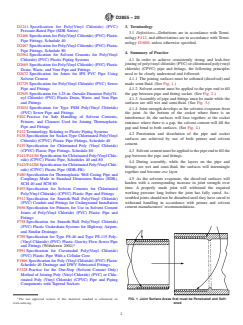
made semi-fluid. (See Fig. 1.)
D2729Specification for Poly(Vinyl Chloride) (PVC) Sewer
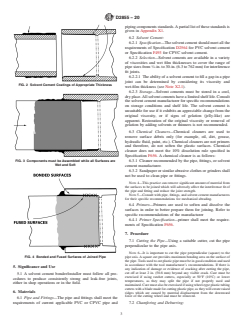
Pipe and Fittings 4.1.2 Solvent cement must be applied to the pipe end to fill
D2949Specification for 3.25-in. Outside Diameter Poly(Vi- the gap between pipe and fitting socket. (See Fig. 2.)
nyl Chloride) (PVC) Plastic Drain, Waste, and Vent Pipe
4.1.3 Assembly of pipe and fittings must be made while the
and Fittings
surfaces are still wet and semi-fluid. (See Fig. 3.)
D3034Specification for Type PSM Poly(Vinyl Chloride)
4.1.4 Joint strength develops as the solvents evaporate from
(PVC) Sewer Pipe and Fittings
the joint. At the bottom of the socket where there is an
F402 Practice for Safe Handling of Solvent Cements,
interference fit, the surfaces will fuse together; at the socket
Primers, and Cleaners Used for Joining Thermoplastic
entrance where there is a gap, the solvent cement will fill the
Pipe and Fittings
gap and bond to both surfaces. (See Fig. 4.)
F412Terminology Relating to Plastic Piping Systems
4.2 Penetration and dissolution of the pipe and socket
F438Specification for Socket-Type Chlorinated Poly(Vinyl
surfaces are achieved by use of both primer and solvent
Chloride) (CPVC) Plastic Pipe Fittings, Schedule 40
cement.
F439Specification for Chlorinated Poly (Vinyl Chloride)
(CPVC) Plastic Pipe Fittings, Schedule 80 4.3 Solventcementmustbeappliedtothepipeendtofillthe
F441/F441MSpecificationforChlorinatedPoly(VinylChlo- gap between the pipe and fittings.
ride) (CPVC) Plastic Pipe, Schedules 40 and 80
4.4 During assembly, while the layers on the pipe and
F442/F442MSpecificationforChlorinatedPoly(VinylChlo-
fittings are wet and semi-fluid, the surfaces will intermingle
ride) (CPVC) Plastic Pipe (SDR–PR)
together and become one layer
F480Specification for Thermoplastic Well Casing Pipe and
4.5 As the solvents evaporate, the dissolved surfaces will
Couplings Made in Standard Dimension Ratios (SDR),
harden with a corresponding increase in joint strength over
SCH 40 and SCH 80
time. A properly made joint will withstand the required
F493Specification for Solvent Cements for Chlorinated
working pressure long before the joint has fully cured. As-
Poly(Vinyl Chloride) (CPVC) Plastic Pipe and Fittings
sembled joints should not be disturbed until they have cured to
F512Specification for Smooth-Wall Poly(Vinyl Chloride)
withstand handling in accordance with primer and solvent
(PVC) Conduit and Fittings for Underground Installation
cement manufacturers’ recommendations.
F656Specification for Primers for Use in Solvent Cement
Joints of Poly(Vinyl Chloride) (PVC) Plastic Pipe and
Fittings
F758Specification for Smooth-Wall Poly(Vinyl Chloride)
(PVC) Plastic Underdrain Systems for Highway, Airport,
and Similar Drainage
F789Specification for Type PS-46 and Type PS-115 Poly-
(Vinyl Chloride) (PVC) Plastic Gravity Flow Sewer Pipe
and Fittings (Withdrawn 2004)
F891Specification for Coextruded Poly(Vinyl Chloride)
(PVC) Plastic Pipe With a Cellular Core
F1866Specification for Poly (Vinyl Chloride) (PVC) Plastic
Schedule 40 Drainage and DWV Fabricated Fittings
F3328Practice for the One-Step (Solvent Cement Only)
Method of Joining Poly (Vinyl Chloride) (PVC) or Chlo-
rinated Poly (Vinyl Chloride) (CPVC) Pipe and Piping
Components with Tapered Sockets
The last approved version of this historical standard is referenced on FIG. 1 Joint Surface Areas that must be Penetrated and Soft-
www.astm.org. ened
D2855 − 20
pipingcomponentsstandards.Apartiallistofthesestandardsis
given in Appendix X1.
6.2 Solvent Cement:
6.2.1 Specification—Thesolventcementshouldmeetallthe
requirements of Specification D2564 for PVC solvent cement
or Specification F493 for CPVC solvent cement.
6.2.2 Selection—Solvent cements are available in a variety
of viscosities and wet film thicknesses to cover the range of
pipesizesfrom ⁄4-in.to30-in.(6.3to762mm)forinterference
fit joints.
6.2.2.1 The ability of a solvent cement to fill a gap in a pipe
joint can be determined by considering its viscosity and
FIG. 2 Solvent Cement Coatings of Appropriate Thickness
wet-film thickness (see Note X2.1).
6.2.3 Storage—Solvent cements must be stored in a cool,
dryplace.Allsolventcementshavealimitedshelflife.Consult
the solvent cement manufacturer for specific recommendations
on storage conditions and shelf life. The solvent cement is
unsuitable for use if it exhibits an appreciable change from the
original viscosity, or if signs of gelation (jelly-like) are
apparent. Restoration of the original viscosity or removal of
gelation by adding solvents or thinners is not recommended.
6.3 Chemical Cleaners—Chemical cleaners are used to
remove surface debris only (for example, oil, dirt, grease,
hydraulic fluid, paint, etc.). Chemical cleaners are not primers
and therefore, do not soften the plastic surfaces. Chemical
cleaner does not meet the 10% dissolution rule specified in
Specification F656. A chemical cleaner is as follows:
FIG. 3 Components must be Assembled while all Surfaces are 6.3.1 Cleaner recommended by the pipe, fittings, or solvent
Wet and Soft
cement manufacturer.
6.3.2 Sandpaperorsimilarabrasiveclothesorgrindersshall
not be used to clean pipe or fittings.
NOTE 4—This practice can remove significant amount of material from
the surfaces to be joined which will adversely affect the interference fit of
the pipe and fitting and reduce the joint strength.
NOTE 5—Consult with pipe, fittings, and solvent cement manufacturers
for their specific recommendations for mechanical abrading.
6.4 Primers—Primers are used to soften and dissolve the
surfaces in order to better prepare them for joining. Refer to
specific recommendations of the manufacturer
6.4.1 Primer Specification—primer shall meet the require-
ments of Specification F656.
7. Procedure
7.1 Cutting the Pipe—Using a suitable cutter, cut the pipe
perpendicular to the pipe axis.
NOTE 6—It is important to cut the pipe perpendicular (square) to the
FIG. 4 Bonded and Fused Surfaces of Joined Pipe
pipe axis.Asquare cut provides maximum bonding area on the surface of
thepipe.Toolsusedtocutplasticpipemustbeingoodconditionandused
in accordance with the tool manufacturer’s recommendations. If there is
5. Significance and Use
any indication of damage or evidence of cracking after cutting the pipe,
cut off at least 2 in. (50.8 mm) beyond any visible crack. Care must be
5.1 A solvent cement bonder/installer must follow all pro-
exercised if using ratchet cutters, especially at 50°F (10°C) or lower
cedures to produce consistently strong and leak-free joints,
temperatures, as they may split the pipe if not properly used and
either in shop operations or in the field.
maintained.Caremustalsobeexercisedifusingwheel-typeplastictubing
cutterswithablademadeforcuttingplasticpipe,astheywillcreateraised
6. Materials
ridges which are caused by material displacement from the downward
force of the cutting wheel and must be removed.
6.1 Pipe and Fittings—The pipe and fittings shall meet the
requirements of current applicable PVC or CPVC pipe and 7.2 Chamfering and Deburring:
D2855 − 20
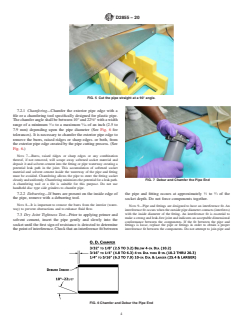
FIG. 5 Cut the pipe straight at a 90° angle.
7.2.1 Chamfering—Chamfer the exterior pipe edge with a
file or a chamfering tool specifically designed for plastic pipe.
Thechamferangleshallbebetween10°and22½°withawidth
3 5
range of a minimum ⁄32 to a maximum ⁄16 of an inch (2.5 to
7.9 mm) depending upon the pipe diameter (See Fig. 6 for
tolerances). It is necessary to chamfer the exterior pipe edge to
remove the burrs, raised ridges or sharp edges. or both, from
the exterior pipe edge created by the pipe cutting process. (See
Fig. 6.)
NOTE 7—Burrs, raised ridges or sharp edges or any combination
thereof, if not removed, will scrape away softened socket material and
deposit it and solvent cement into the fitting or pipe waterway creating a
potential leak path in the joint. This accumulation of softened socket
material and solvent cement inside the waterway of the pipe and fitting
must be avoided. Chamfering allows the pipe to enter the fitting socket
cleanlyanduniformly.Chamferingminimizesthepotentialforaleakpath.
FIG. 7 Debur and Chamfer the Pipe End
A chamfering tool or a file is suitable for this purpose. Do not use
handheld disc type side grinders to chamfer pipe.
1 2
7.2.2 Deburring—If burrs are present on the inside edge of
the pipe and fitting occurs at approximately ⁄3 to ⁄3 of the
the pipe, remove with a deburring tool.
socket depth. Do not force components together.
NOTE 8—It is important to remove the burrs from the interior (water-
NOTE 9—Pipe and fittings are designed to have an interference fit. An
way) to prevent obstructions and to enhance fluid flow.
interferencefitoccurswhentheoutsidepipediametercontacts(interferes)
with the inside diameter of the fitting. An interference fit is essential to
7.3 Dry Joint Tightness Test—Prior to applying primer and
make a strong and leak-free joint and indicates an acceptable dimensional
solvent cement, insert the pipe gently and slowly into the
conformance between the components. If the fit between the pipe and
socket until the first sign of resistance is detected to determine
fittings is loose, replace the pipe or fittings in order to obtain a proper
thepointofinterference.Checkthataninterferencefitbetween interference fit between the components. Do not attempt to join pipe and
FIG. 6 Chamfer and Debur the Pipe End
D2855 − 20
fittings that do not have an interference fit.
7.4 Cleaning—Useaclean,dryclothtocleanthesurfacesof
pipe and fittings and to remove all foreign materials.
NOTE 10—Proper surface preparation is required to maximize the
integrity of the joint. Foreign materials can impede the chemical joining
process. Surfaces to be joined must be free of foreign materials (for
example, oil, dirt, grease, hydraulic fluid, paint, etc.). If joining surfaces
cannot be cleaned by wiping with a clean, dry cloth, a chemical cleaner
must be used.
NOTE 11—Check chemical cleaners for compatibility with plastic
material. Chemical cleaners only clean the pipe and fittings and will not
soften the joining surfaces. Softening of surfaces is only accomplished by
primer and solvent cement. If pipe and fittings are not properly cleaned,
primer and solvent cement will not soften the joining surfaces. Follow the
proper handling procedures provided by the chemical cleaner manufac-
turer.
7.5 Mark the Pipe: Measure the socket depth and transfer
FIG. 9 Clean the pipe end and the fitting socket.
this measurement to the pipe O.D. with a mark. From this
mark, place a second mark 2 in. (50.8 mm) further up the pipe,
where possible.
NOTE 12—The first mark is the primer and solvent cement application
area. The second (“witness”) mark is a reference point used after joint
assembly to verify that the pipe has fully bottomed out in the socket and
has not backed out.
7.6 Applicator Size—Use an applicator that is approxi-
mately half ( ⁄2) the size of the nominal pipe diameter being
joined. (Example: Use a 1- ⁄2 in. (38.1 mm) applicator on
nominal pipe size 3 and fittings.)
NOTE 13—Use of an applicator that is properly sized for the pipe will
completely coat the surfaces of the pipe and fittings with primer and
solvent cement in a timely manner. Dauber-type applicators will give
adequate coverage on pipe diameters that are approximately twice the
diameterofthedauber-balluptonominalpipesize3.Swabapplicatorsare
requiredonlargerdiameterpipesurfacesofnominalpipesize4andabove
FIG. 10 Mark the socket depth on the pipe end and place a sec-
(See 7.7.1.10 for large diameter).
ond mark 2 inches (50.8 mm) from the first mark
NOTE 14—The can-lid dauber included in the can may not be of
appropriate size for the specific diameter of pipe and fittings being joined.
A variety of applicator sizes are commercially available.
This will tell the operator if a primer has been applied for a long enough
NOTE 15—The purpose of a primer is to penetrate and soften the
period of time to soften the pipe and fitting.Apply primer to a spare piece
surfaces so they can
...
This document is not an ASTM standard and is intended only to provide the user of an ASTM standard an indication of what changes have been made to the previous version. Because
it may not be technically possible to adequately depict all changes accurately, ASTM recommends that users consult prior editions as appropriate. In all cases only the current version
of the standard as published by ASTM is to be considered the official document.
Designation: D2855 − 15 D2855 − 20 An American National Standard
Standard Practice for
the Two-Step (Primer and Solvent Cement) Method of
Joining Poly (Vinyl Chloride) (PVC) or Chlorinated Poly
(Vinyl Chloride) (CPVC) Pipe and Piping Components with
Tapered Sockets
This standard is issued under the fixed designation D2855; the number immediately following the designation indicates the year of
original adoption or, in the case of revision, the year of last revision. A number in parentheses indicates the year of last reapproval. A
superscript epsilon (´) indicates an editorial change since the last revision or reapproval.
This standard has been approved for use by agencies of the U.S. Department of Defense.
1. Scope*
1.1 This practice describes a two-step (primer and solvent cement) method of joining poly(vinyl chloride) (PVC) or chlorinated
poly(vinyl chloride) (CPVC) pipe and piping components with tapered sockets.
NOTE 1—Simplified procedures may be allowed in non-pressure applications where local codes permit.
NOTE 2—Where conflicts occur between the code and the manufacturer’s installation instructions, the more restrictive provisions apply.
1.2 The products covered by this practice are intended for use with the distribution of pressured liquids only, which are chemically
compatible with the piping materials. Due to inherent hazards associated with testing components and systems with compressed
air or other compressed gases, some manufacturers do not allow pneumatic testing of their products. Consult with specific
product/component manufacturers for their specific testing procedures prior to pneumatic testing.
NOTE 3—Pressurized (compressed) air or other compressed gases contain large amounts of stored energy which present serious safety hazards should a
system fail for any reason.
1.3 This standard practice does not address the one-step method of joining pipe and piping components with tapered sockets with
solvent cement without the use of primer. For the one-step method see Practice F3328.
1.4 The techniques covered are applicable to joining PVC to PVC or CPVC to CPVC pipe and piping components with tapered
sockets. In the remainder of this standard practice, the term “piping components with tapered sockets”, whether it be bell end pipe,
spigot connections, or any other type of tapered connections, will be referred to as “fittings.”
1.5 A partial list of standards for PVC and CPVC pipe, piping components, and solvent cements suitable for use in joining pipe
and fittings is given in Appendix X1.
1.6 The values stated in inch-pound units are to be regarded as standard. The values given in parentheses are mathematical
conversions to SI units that are provided for information only and are not considered standard.
This practice is under the jurisdiction of ASTM Committee F17 on Plastic Piping Systems and is the direct responsibility of Subcommittee F17.20 on Joining.
Current edition approved Nov. 1, 2015Aug. 1, 2020. Published January 2016August 2020. Originally approved in 1970. Last previous edition approved in 20102015 as
D2855 – 96D2855 – 15.(2010). DOI: 10.1520/D2855-15.10.1520/D2855-20.
*A Summary of Changes section appears at the end of this standard
Copyright © ASTM International, 100 Barr Harbor Drive, PO Box C700, West Conshohocken, PA 19428-2959. United States
D2855 − 20
1.7 The text of this practice references notes and footnotes that provide explanatory material. These notes and footnotes (excluding
those in tables and figures) shall not be considered as requirements of the practice.
1.8 This standard does not purport to address all of the safety concerns, if any, associated with its use. It is the responsibility
of the user of this standard to establish appropriate safety safety, health, and healthenvironmental practices and determine the
applicability of regulatory limitations prior to use.
1.9 This international standard was developed in accordance with internationally recognized principles on standardization
established in the Decision on Principles for the Development of International Standards, Guides and Recommendations issued
by the World Trade Organization Technical Barriers to Trade (TBT) Committee.
2. Referenced Documents
2.1 ASTM Standards:
D1600 Terminology for Abbreviated Terms Relating to Plastics
D1784 Classification System and Basis for Specification for Rigid Poly(Vinyl Chloride) (PVC) Compounds and Chlorinated
Poly(Vinyl Chloride) (CPVC) Compounds
D1785 Specification for Poly(Vinyl Chloride) (PVC) Plastic Pipe, Schedules 40, 80, and 120
D2241 Specification for Poly(Vinyl Chloride) (PVC) Pressure-Rated Pipe (SDR Series)
D2466 Specification for Poly(Vinyl Chloride) (PVC) Plastic Pipe Fittings, Schedule 40
D2467 Specification for Poly(Vinyl Chloride) (PVC) Plastic Pipe Fittings, Schedule 80
D2564 Specification for Solvent Cements for Poly(Vinyl Chloride) (PVC) Plastic Piping Systems
D2665 Specification for Poly(Vinyl Chloride) (PVC) Plastic Drain, Waste, and Vent Pipe and Fittings
D2672 Specification for Joints for IPS PVC Pipe Using Solvent Cement
D2729 Specification for Poly(Vinyl Chloride) (PVC) Sewer Pipe and Fittings
D2949 Specification for 3.25-in. Outside Diameter Poly(Vinyl Chloride) (PVC) Plastic Drain, Waste, and Vent Pipe and Fittings
D3034 Specification for Type PSM Poly(Vinyl Chloride) (PVC) Sewer Pipe and Fittings
F402 Practice for Safe Handling of Solvent Cements, Primers, and Cleaners Used for Joining Thermoplastic Pipe and Fittings
F412 Terminology Relating to Plastic Piping Systems
F438 Specification for Socket-Type Chlorinated Poly(Vinyl Chloride) (CPVC) Plastic Pipe Fittings, Schedule 40
F439 Specification for Chlorinated Poly (Vinyl Chloride) (CPVC) Plastic Pipe Fittings, Schedule 80
F441/F441M Specification for Chlorinated Poly(Vinyl Chloride) (CPVC) Plastic Pipe, Schedules 40 and 80
F442/F442M Specification for Chlorinated Poly(Vinyl Chloride) (CPVC) Plastic Pipe (SDR–PR)
F480 Specification for Thermoplastic Well Casing Pipe and Couplings Made in Standard Dimension Ratios (SDR), SCH 40 and
SCH 80
F493 Specification for Solvent Cements for Chlorinated Poly(Vinyl Chloride) (CPVC) Plastic Pipe and Fittings
F512 Specification for Smooth-Wall Poly(Vinyl Chloride) (PVC) Conduit and Fittings for Underground Installation
F656 Specification for Primers for Use in Solvent Cement Joints of Poly(Vinyl Chloride) (PVC) Plastic Pipe and Fittings
F758 Specification for Smooth-Wall Poly(Vinyl Chloride) (PVC) Plastic Underdrain Systems for Highway, Airport, and Similar
Drainage
F789 Specification for Type PS-46 and Type PS-115 Poly(Vinyl Chloride) (PVC) Plastic Gravity Flow Sewer Pipe and Fittings
(Withdrawn 2004)
F891 Specification for Coextruded Poly(Vinyl Chloride) (PVC) Plastic Pipe With a Cellular Core
F1866 Specification for Poly (Vinyl Chloride) (PVC) Plastic Schedule 40 Drainage and DWV Fabricated Fittings
F3328 Practice for the One-Step (Solvent Cement Only) Method of Joining Poly (Vinyl Chloride) (PVC) or Chlorinated Poly
(Vinyl Chloride) (CPVC) Pipe and Piping Components with Tapered Sockets
3. Terminology
3.1 Definitions—Definitions are in accordance with Terminology F412, and abbreviations are in accordance with Terminology
D1600, unless otherwise specified.
4. Summary of Practice
4.1 In order to achieve consistently strong and leak-free joining of poly(vinyl chloride) (PVC) or chlorinated poly(vinyl chloride)
(CPVC) pipe and fittings, the following principles need to be clearly understood and followed:
For referenced ASTM standards, visit the ASTM website, www.astm.org, or contact ASTM Customer Service at service@astm.org. For Annual Book of ASTM Standards
volume information, refer to the standard’s Document Summary page on the ASTM website.
The last approved version of this historical standard is referenced on www.astm.org.
D2855 − 20
4.1.1 The joining surfaces must be softened (dissolved) and made semi-fluid. (See Fig. 1.)
4.1.2 Solvent cement must be applied to the pipe end to fill the gap between pipe and fitting socket. (See Fig. 2.)
4.1.3 Assembly of pipe and fittings must be made while the surfaces are still wet and semi-fluid. (See Fig. 3.)
4.1.4 Joint strength develops as the solvents evaporate from the joint. At the bottom of the socket where there is an interference
fit, the surfaces will fuse together; at the socket entrance where there is a gap, the solvent cement will fill the gap and bond to both
surfaces. (See Fig. 4.)
4.2 Penetration and dissolution of the pipe and socket surfaces are achieved by use of both primer and solvent cement.
4.3 Solvent cement must be applied to the pipe end to fill the gap between the pipe and fittings.
4.4 During assembly, while the layers on the pipe and fittings are wet and semi-fluid, the surfaces will intermingle together and
become one layer
4.5 As the solvents evaporate, the dissolved surfaces will harden with a corresponding increase in joint strength over time. A
properly made joint will withstand the required working pressure long before the joint has fully cured. Assembled joints should
not be disturbed until they have cured to withstand handling in accordance with primer and solvent cement manufacturers’
recommendations.
5. Significance and Use
5.1 A solvent cement bonder/installer must follow all procedures to produce consistently strong and leak-free joints, either in shop
operations or in the field.
6. Materials
6.1 Pipe and Fittings—The pipe and fittings shall meet the requirements of current applicable PVC or CPVC pipe and piping
components standards. A partial list of these standards is given in Appendix X1.
6.2 Solvent Cement:
6.2.1 Specification—The solvent cement should meet all the requirements of Specification D2564 for PVC solvent cement or
Specification F493 for CPVC solvent cement.
6.2.2 Selection—Solvent cements are available in a variety of viscosities and wet film thicknesses to cover the range of pipe sizes
from ⁄4-in. to 30-in. (6.3 to 762 mm) for interference fit joints.
FIG. 1 Joint Surface Areas that must be Penetrated and Softened
D2855 − 20
FIG. 2 Solvent Cement Coatings of Appropriate Thickness
FIG. 3 Components must be Assembled while all Surfaces are Wet and Soft
FIG. 4 Bonded and Fused Surfaces of Joined Pipe
6.2.2.1 The ability of a solvent cement to fill a gap in a pipe joint can be determined by considering its viscosity and wet-film
thickness (see Note X2.1).
6.2.3 Storage—Solvent cements must be stored in a cool, dry place. All solvent cements have a limited shelf life. Consult the
solvent cement manufacturer for specific recommendations on storage conditions and shelf life. The solvent cement is unsuitable
for use if it exhibits an appreciable change from the original viscosity, or if signs of gelation (jelly-like) are apparent. Restoration
of the original viscosity or removal of gelation by adding solvents or thinners is not recommended.
D2855 − 20
6.3 Chemical Cleaners—Chemical cleaners are used to remove surface debris only (for example, oil, dirt, grease, hydraulic fluid,
paint, etc.). Chemical cleaners are not primers and therefore, do not soften the plastic surfaces. Chemical cleaner does not meet
the 10% dissolution rule specified in Specification F656. A chemical cleaner is as follows:
6.3.1 Cleaner recommended by the pipe, fittings, or solvent cement manufacturer.
6.3.2 Sandpaper or similar abrasive clothes or grinders shall not be used to clean pipe or fittings.
NOTE 4—This practice can remove significant amount of material from the surfaces to be joined which will adversely affect the interference fit of the pipe
and fitting and reduce the joint strength.
NOTE 5—Consult with pipe, fittings, and solvent cement manufacturers for their specific recommendations for mechanical abrading.
6.4 Primers—Primers are used to soften and dissolve the surfaces in order to better prepare them for joining. Refer to specific
recommendations of the manufacturer
6.4.1 Primer Specification—primer shall meet the requirements of Specification F656.
7. Procedure
7.1 Cutting the Pipe—Using a suitable cutter, cut the pipe perpendicular to the pipe axis.
NOTE 6—It is important to cut the pipe perpendicular (square) to the pipe axis. A square cut provides maximum bonding area on the surface of the pipe.
Tools used to cut plastic pipe must be in good condition and used in accordance with the tool manufacturer’s recommendations. If there is any indication
of damage or evidence of cracking after cutting the pipe, cut off at least 2 in. (50.8 mm) beyond any visible crack. Care must be exercised if using ratchet
cutters, especially at 50°F (10°C) or lower temperatures, as they may split the pipe if not properly used and maintained. Care must also be exercised if
using wheel-type plastic tubing cutters with a blade made for cutting plastic pipe, as they will create raised ridges which are caused by material
displacement from the downward force of the cutting wheel and must be removed.
7.2 Chamfering and Deburring:
7.2.1 Chamfering.—Chamfering—Chamfer the exterior pipe edge with a file or a chamfering tool specifically designed for plastic
3 5
pipe. The chamfer angle shall be between 10° and 22½° with a width range of a minimum ⁄32 to a maximum ⁄16 of an inch (2.5
to 7.9 mm) depending upon the pipe diameter (See Fig. 6 for tolerances). It is necessary to chamfer the exterior pipe edge to remove
the burrs, raised ridges or sharp edges. or both, from the exterior pipe edge created by the pipe cutting process. (See Fig. 6.)
NOTE 7—Burrs, raised ridges or sharp edges or any combination thereof, if not removed, will scrape away softened socket material and deposit it and
solvent cement into the fitting or pipe waterway creating a potential leak path in the joint. This accumulation of softened socket material and solvent
cement inside the waterway of the pipe and fitting must be avoided. Chamfering allows the pipe to enter the fitting socket cleanly and uniformly.
FIG. 5 Cut the pipe straight at a 90° angle.
D2855 − 20
FIG. 6 Chamfer and Debur the Pipe End
Chamfering minimizes the potential for a leak path. A chamfering tool or a file is suitable for this purpose. Do not use handheld disc type side grinders
to chamfer pipe.
7.2.2 Deburring—If burrs are present on the inside edge of the pipe, remove with a deburring tool.
NOTE 8—It is important to remove the burrs from the interior (waterway) to prevent obstructions and to enhance fluid flow.
7.3 Dry Joint Tightness Test—Prior to applying primer and solvent cement, insert the pipe gently and slowly into the socket until
the first sign of resistance is detected to determine the point of interference. Check that an interference fit between the pipe and
1 2
fitting occurs at approximately ⁄3 to ⁄3 of the socket depth. Do not force components together.
NOTE 9—Pipe and fittings are designed to have an interference fit. An interference fit occurs when the outside pipe diameter contacts (interferes) with
the inside diameter of the fitting. An interference fit is essential to make a strong and leak-free joint and indicates an acceptable dimensional conformance
between the components. If the fit between the pipe and fittings is loose, replace the pipe or fittings in order to obtain a proper interference fit between
the components. Do not attempt to join pipe and fittings that do not have an interference fit.
7.4 Cleaning—Use a clean, dry cloth to clean the surfaces of pipe and fittings and to remove all foreign materials.
NOTE 10—Proper surface preparation is required to maximize the integrity of the joint. Foreign materials can impede the chemical joining process.
Surfaces to be joined must be free of foreign materials (for example, oil, dirt, grease, hydraulic fluid, paint, etc.). If joining surfaces cannot be cleaned
by wiping with a clean, dry cloth, a chemical cleaner must be used.
NOTE 11—Check chemical cleaners for compatibility with plastic material. Chemical cleaners only clean the pipe and fittings and will not soften the
joining surfaces. Softening of surfaces is only accomplished by primer and solvent cement. If pipe and fittings are not properly cleaned, primer and solvent
cement will not soften the joining surfaces. Follow the proper handling procedures provided by the chemical cleaner manufacturer.
FIG. 7 Debur and Chamfer the Pipe End
D2855 − 20
FIG. 8 Dry Joint Tightness Test for an Interference Fit
FIG. 9 Clean the pipe end and the fitting socket.
7.5 Mark the Pipe: Measure the socket depth and transfer this measurement to the pipe O.D. with a mark. From this mark, place
a second mark 2 in. (50.8 mm) further up the pipe, where possible.
NOTE 12—The first mark is the primer and solvent cement application area. The second (“witness”) mark is a reference point used after joint assembly
to verify that the pipe has fully bottomed out in the socket and has not backed out.
FIG. 10 Mark the socket depth on the pipe end and place a second mark 2 inches (50.8 mm) from the first mark
D2855 − 20
7.6 Applicator Size—Use an applicator that is approximately half ( ⁄2) the size of the nominal pipe diameter being joined.
(Example: Use a 1- ⁄2 in. (38.1 mm) applicator on nominal pipe size 3 and fittings.)
NOTE 13—Use of an applicator that is properly sized for the pipe will completely coat the surfaces of the pipe and fittings with primer and solvent cement
in a timely manner. Dauber-type applicators will give adequate coverage on pipe diameters that are approximately twice the diameter of the dauber-ball
up to nominal pipe size 3. Swab applicators are required on larger diameter pipe surfaces of nominal pipe size 4 and above (See 7.7.1.10 for large
diameter).
NOTE 14—The can-lid dauber included in the can may not be of appropriate size for the specific diameter of pipe and fittings being joined. A variety of
applicator sizes are commercially available.
NOTE 15—The purpose of a primer is to penetrate and soften the surfaces so they can properly fuse together. Ambient temperature has a large effect on
the ability of primer to soften and penetrate. Colder temperatures require longer application time for primer, whereas warmer temperatures require less
application time. Because ambient temperature plays a large role in the amount of time req
...