

ASTM F1938-98(2017)
(Guide)Standard Guide for Safer Use of Movable Soccer Goals
General Information
- Abstract
ABSTRACT
This guide presents directions for the installation, use, and storage of full-size or nearly full-size movable soccer goals. It is expected that these guidelines can help prevent deaths and serious injuries resulting from soccer goal tipover. These guidelines are intended for use by parks and recreation personnel, school officials, sports equipment purchasers, parents, coaches, and any other members of the general public concerned with soccer goal safety. These guidelines are intended to address the risk of movable soccer goal tipover. In designing soccer goal, the following may be considered: use of a counterbalancing strategy by lengthening the over all depth of the goal to effectively place more mass further from the goal's front posts, selection of light materials for the goal's front posts and crossbar and provides much heavier materials for the rear ground bar and frame members, use of a heavy rear framework and folds flat when not in use, making the goal much less likely to tip over. Securing soccer goals may be done in several ways. The number and type of anchors to be used will depend on a number of factors, such as types of playing surface, soil type, soil moisture content, and total goal weight. These anchor types shall include: Auger-Style Stake which is helical in shape and is screwed into the ground, Peg- or Stake-Style Stake which varies in lengths and diameters, J-Hook-Shaped-Stake Style which varies in lengths and diameters and its curved-top portion is designed to fit over goal members to secure it to the ground, and All-Stakes styles in which a minimum of two stakes must be used for each goal. Sandbags or other counterweights could be an effective alternative to anchors on hard surfaces, such as artificial turf, where the surface cannot be penetrated by a conventional anchor, that is, an indoor practice facility. Also a semipermanent anchor type may be used which is usually comprised of two or more functional components. The main support requires a permanently secured base that is buried underground. One type of semipermanent anchor connects the underground base to the soccer goal by means of two tethers. Another design utilizes a buried anchor tube with a threaded opening at ground level. Net pegs may be tapered, metal or plastic stakes, or both, and should only be used to secure the net to the ground.
SCOPE
1.1 This guide presents directions for the installation, use, and storage of full-size or nearly full-size movable soccer goals. It is expected that these guidelines can help prevent deaths and serious injuries resulting from soccer goal tipover.
1.2 These guidelines are intended for use by parks and recreation personnel, school officials, sports equipment purchasers, parents, coaches, and any other members of the general public concerned with soccer goal safety.
1.3 These guidelines are intended to address the risk of movable soccer goal tipover.
1.4 The values stated in inch-pound units are to be regarded as standard. The values given in parentheses are mathematical conversions to SI units that are provided for information only and are not considered standard.
1.5 This international standard was developed in accordance with internationally recognized principles on standardization established in the Decision on Principles for the Development of International Standards, Guides and Recommendations issued by the World Trade Organization Technical Barriers to Trade (TBT) Committee.
- Status
- Published
- Publication Date
- 31-Oct-2017
- Technical Committee
- F15 - Consumer Products
- Drafting Committee
- F15.43 - Soccer Goal Safety
Overview
ASTM F1938-98(2017) - Standard Guide for Safer Use of Movable Soccer Goals provides comprehensive safety guidelines for the installation, use, and storage of full-size or nearly full-size movable soccer goals. Issued by ASTM International, this standard is designed to mitigate the risk of soccer goal tipover and prevent serious injuries or fatalities. It targets a broad audience, including parks and recreation personnel, school officials, sports equipment purchasers, coaches, parents, and anyone involved in youth and amateur soccer programs.
Movable soccer goals pose significant safety hazards if improperly designed, manufactured, anchored, or maintained. This standard outlines practical steps and best practices to ensure the safe deployment and management of these goals on various playing surfaces.
Key Topics
1. Design and Construction
- Counterbalancing strategies: Emphasis on goal stability by increasing depth or using heavier rear materials, making tipover less likely.
- Material selection: Light materials for the front posts and crossbar, with heavier components at the rear, enhance structural safety.
- Collapsible frameworks: Some designs incorporate mechanisms to fold flat when not in use, further reducing tipover risks.
2. Anchoring and Securing Methods
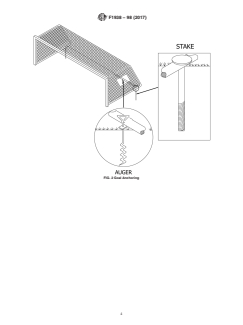
- Auger-style stakes: Helical-shaped anchors screwed into the ground for strong retention.
- Peg, stake, and J-hook anchors: Multiple shapes and sizes adaptable to soil and goal type, ensuring versatile, site-specific anchoring.
- Sandbags and counterweights: Used as alternatives on artificial turf or hard surfaces where traditional anchors cannot be deployed.
- Semipermanent anchors: Bases buried underground and connected to goal frames, providing lasting stability.
3. Safety in Use and Storage
- Inspection protocols: Regular checks for structural integrity and missing parts before each use.
- Clear warning labels: Placement at strategic locations to warn and inform users about potential hazards.
- Supervised movement: Only trained personnel should move goals, and always with sufficient manpower.
- Proper securing when not in use: Chain or lock unused goals, or store them in secure locations inaccessible to children.
4. Prohibitions and Precautions
- No climbing allowed: Strict instructions to prevent climbing or hanging on the goal or net.
- Net pegs usage: Net pegs should never be used as primary anchors for the goal itself-only for securing the net.
Applications
The ASTM F1938-98(2017) standard is widely applicable across multiple environments:
- Schools and Educational Facilities: Ensures safe use of soccer goals in playgrounds and sports fields.
- Public Parks and Recreation Centers: Guides municipal staff in the safe setup of community sports facilities.
- Sports Clubs and Leagues: Provides a framework for consistent safety practices at both amateur and semi-professional levels.
- Sports Equipment Manufacturers and Purchasers: Informs product selection and purchasing decisions, promoting compliance with best practices for soccer goal safety.
- Maintenance and Facility Managers: Supports the development of regular inspection, anchoring, and maintenance protocols to reduce liability and injury risk.
Compliance with this standard helps organizations actively prevent tipover accidents, foster a safer sports environment, and protect players and bystanders.
Related Standards
- ASTM F2950: Standard Guide for Field Safety and Security for Outdoor Soccer Goals
- ASTM F2673: Standard Specification for Paint and Related Coating Materials for Aluminum Soccer Goals
- CPSC Guidelines: U.S. Consumer Product Safety Commission recommendations for soccer goal safety
- EN 748: European standard covering safety and performance requirements for football goals
Adhering to ASTM F1938-98(2017) along with these related standards ensures comprehensive risk management and reinforces a culture of safety in all soccer environments.
Keywords: movable soccer goals, soccer goal safety, goal tipover prevention, ASTM F1938, soccer field safety, anchoring soccer goals, sports equipment standards.
Relations
- Effective Date
- 01-Nov-2017
Frequently Asked Questions
ASTM F1938-98(2017) is a guide published by ASTM International. Its full title is "Standard Guide for Safer Use of Movable Soccer Goals". This standard covers: ABSTRACT This guide presents directions for the installation, use, and storage of full-size or nearly full-size movable soccer goals. It is expected that these guidelines can help prevent deaths and serious injuries resulting from soccer goal tipover. These guidelines are intended for use by parks and recreation personnel, school officials, sports equipment purchasers, parents, coaches, and any other members of the general public concerned with soccer goal safety. These guidelines are intended to address the risk of movable soccer goal tipover. In designing soccer goal, the following may be considered: use of a counterbalancing strategy by lengthening the over all depth of the goal to effectively place more mass further from the goal's front posts, selection of light materials for the goal's front posts and crossbar and provides much heavier materials for the rear ground bar and frame members, use of a heavy rear framework and folds flat when not in use, making the goal much less likely to tip over. Securing soccer goals may be done in several ways. The number and type of anchors to be used will depend on a number of factors, such as types of playing surface, soil type, soil moisture content, and total goal weight. These anchor types shall include: Auger-Style Stake which is helical in shape and is screwed into the ground, Peg- or Stake-Style Stake which varies in lengths and diameters, J-Hook-Shaped-Stake Style which varies in lengths and diameters and its curved-top portion is designed to fit over goal members to secure it to the ground, and All-Stakes styles in which a minimum of two stakes must be used for each goal. Sandbags or other counterweights could be an effective alternative to anchors on hard surfaces, such as artificial turf, where the surface cannot be penetrated by a conventional anchor, that is, an indoor practice facility. Also a semipermanent anchor type may be used which is usually comprised of two or more functional components. The main support requires a permanently secured base that is buried underground. One type of semipermanent anchor connects the underground base to the soccer goal by means of two tethers. Another design utilizes a buried anchor tube with a threaded opening at ground level. Net pegs may be tapered, metal or plastic stakes, or both, and should only be used to secure the net to the ground. SCOPE 1.1 This guide presents directions for the installation, use, and storage of full-size or nearly full-size movable soccer goals. It is expected that these guidelines can help prevent deaths and serious injuries resulting from soccer goal tipover. 1.2 These guidelines are intended for use by parks and recreation personnel, school officials, sports equipment purchasers, parents, coaches, and any other members of the general public concerned with soccer goal safety. 1.3 These guidelines are intended to address the risk of movable soccer goal tipover. 1.4 The values stated in inch-pound units are to be regarded as standard. The values given in parentheses are mathematical conversions to SI units that are provided for information only and are not considered standard. 1.5 This international standard was developed in accordance with internationally recognized principles on standardization established in the Decision on Principles for the Development of International Standards, Guides and Recommendations issued by the World Trade Organization Technical Barriers to Trade (TBT) Committee.
ABSTRACT This guide presents directions for the installation, use, and storage of full-size or nearly full-size movable soccer goals. It is expected that these guidelines can help prevent deaths and serious injuries resulting from soccer goal tipover. These guidelines are intended for use by parks and recreation personnel, school officials, sports equipment purchasers, parents, coaches, and any other members of the general public concerned with soccer goal safety. These guidelines are intended to address the risk of movable soccer goal tipover. In designing soccer goal, the following may be considered: use of a counterbalancing strategy by lengthening the over all depth of the goal to effectively place more mass further from the goal's front posts, selection of light materials for the goal's front posts and crossbar and provides much heavier materials for the rear ground bar and frame members, use of a heavy rear framework and folds flat when not in use, making the goal much less likely to tip over. Securing soccer goals may be done in several ways. The number and type of anchors to be used will depend on a number of factors, such as types of playing surface, soil type, soil moisture content, and total goal weight. These anchor types shall include: Auger-Style Stake which is helical in shape and is screwed into the ground, Peg- or Stake-Style Stake which varies in lengths and diameters, J-Hook-Shaped-Stake Style which varies in lengths and diameters and its curved-top portion is designed to fit over goal members to secure it to the ground, and All-Stakes styles in which a minimum of two stakes must be used for each goal. Sandbags or other counterweights could be an effective alternative to anchors on hard surfaces, such as artificial turf, where the surface cannot be penetrated by a conventional anchor, that is, an indoor practice facility. Also a semipermanent anchor type may be used which is usually comprised of two or more functional components. The main support requires a permanently secured base that is buried underground. One type of semipermanent anchor connects the underground base to the soccer goal by means of two tethers. Another design utilizes a buried anchor tube with a threaded opening at ground level. Net pegs may be tapered, metal or plastic stakes, or both, and should only be used to secure the net to the ground. SCOPE 1.1 This guide presents directions for the installation, use, and storage of full-size or nearly full-size movable soccer goals. It is expected that these guidelines can help prevent deaths and serious injuries resulting from soccer goal tipover. 1.2 These guidelines are intended for use by parks and recreation personnel, school officials, sports equipment purchasers, parents, coaches, and any other members of the general public concerned with soccer goal safety. 1.3 These guidelines are intended to address the risk of movable soccer goal tipover. 1.4 The values stated in inch-pound units are to be regarded as standard. The values given in parentheses are mathematical conversions to SI units that are provided for information only and are not considered standard. 1.5 This international standard was developed in accordance with internationally recognized principles on standardization established in the Decision on Principles for the Development of International Standards, Guides and Recommendations issued by the World Trade Organization Technical Barriers to Trade (TBT) Committee.
ASTM F1938-98(2017) is classified under the following ICS (International Classification for Standards) categories: 97.220.10 - Sports facilities. The ICS classification helps identify the subject area and facilitates finding related standards.
ASTM F1938-98(2017) has the following relationships with other standards: It is inter standard links to ASTM F1938-98(2009). Understanding these relationships helps ensure you are using the most current and applicable version of the standard.
ASTM F1938-98(2017) is available in PDF format for immediate download after purchase. The document can be added to your cart and obtained through the secure checkout process. Digital delivery ensures instant access to the complete standard document.
Standards Content (Sample)
This international standard was developed in accordance with internationally recognized principles on standardization established in the Decision on Principles for the
Development of International Standards, Guides and Recommendations issued by the World Trade Organization Technical Barriers to Trade (TBT) Committee.
Designation: F1938 − 98 (Reapproved 2017)
Standard Guide for
Safer Use of Movable Soccer Goals
This standard is issued under the fixed designation F1938; the number immediately following the designation indicates the year of
original adoption or, in the case of revision, the year of last revision. A number in parentheses indicates the year of last reapproval. A
superscript epsilon (´) indicates an editorial change since the last revision or reapproval.
INTRODUCTION
Thereareapproximately225000to500000soccergoalsintheUnitedStates.Manyofthesesoccer
goals are unsafe because they are improperly designed, manufactured, or installed (unstable and are
either unanchored or not properly anchored or counter-balanced). These soccer goals pose an
unnecessary risk of tipover to children who climb on goals (or nets) or hang from the crossbar.
The U.S. Consumer Product Safety Commission (CPSC) knows of four deaths in 1990 alone and
at least 21 deaths during the past 16 years (1979–1994) associated with movable soccer goals. In
addition, an estimated 120 injuries involving falling goals were treated each year in U.S. hospital
emergency rooms during the period 1989 through 1993. Many of the serious incidents occurred when
the soccer goals tipped over onto the victim. Almost all of the goals involved in these tipovers
appeared to be “homemade” by high school shop classes, custodial members, or local welders, not
professionally manufactured. These “homemade” goals often are very heavy and unstable.
Themajorityofmovablesoccergoalsareconstructedofmetal,typicallyweighing150–500lbs.The
serious injuries and deaths are a result of blunt force trauma to the head, neck, chest, and limbs of the
victims. In most cases injuries or death occurred when the goal tipped or was accidentally tipped onto
the victim. In one case, an 8-year-old child was fatally injured when the movable soccer goal he was
climbing tipped over and struck him on the head. In another case, a 20-year-old male died from a
massive head trauma when he pulled a goal down on himself while attempting to do chin-ups. In a
third case, while attempting to tighten a net to its goal post, the victim’s father lifted the back base of
the goal, causing it to tip over, striking his 3-year-old child on the head, causing a fatal injury.
High winds also can cause movable soccer goals to fall over. For example, a 9-year-old was fatally
injured when a goal was tipped over by a gust of wind. In another incident, a 19-year-old goalie
suffered stress fractures to both legs when the soccer goal was blown on top of her.
1. Scope 1.4 The values stated in inch-pound units are to be regarded
as standard. The values given in parentheses are mathematical
1.1 This guide presents directions for the installation, use,
conversions to SI units that are provided for information only
and storage of full-size or nearly full-size movable soccer
and are not considered standard.
goals. It is expected that these guidelines can help prevent
deaths and serious injuries resulting from soccer goal tipover.
1.5 This international standard was developed in accor-
dance with internationally recognized principles on standard-
1.2 These guidelines are intended for use by parks and
ization established in the Decision on Principles for the
recreation personnel, school officials, sports equipment
Development of International Standards, Guides and Recom-
purchasers, parents, coaches, and any other members of the
mendations issued by the World Trade Organization Technical
general public concerned with soccer goal safety.
Barriers to Trade (TBT) Committee.
1.3 These guidelines are intended to address the risk of
movable soccer goal tipover.
2. Design and Construction
2.1 While a movable soccer goal appears to be a simple
structure, a correctly-designed goal is constructed carefully
This provisional standard is under the jurisdiction ofASTM Committee F15 on
with counterbalancing measures incorporated into the product.
Consumer Products and is the direct responsibility of Subcommittee F15.43 on
Soccer Goal Safety.
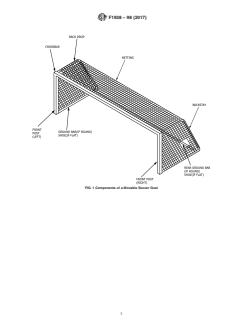
2.2 The common dimensions of a full-size goal are approxi-
Current edition approved Nov. 1, 2017. Published December 2017. Originally
mately 24 ft (7.3 m) in width by 8 ft (2.4 m) in height, and
approved in 1998. Last previous edition approved in 2004 as F1938 – 98 (2009).
DOI: 10.1520/F1938-98R17. depth equal to or exceeding the height of the goal (see Fig. 1).
Copyright © ASTM International, 100 Barr Harbor Drive, PO Box C700, West Conshohocken, PA 19428-2959. United States
F1938 − 98 (2017)
2.3 The stability of a soccer goal depends on several factors. 3.4.6.2 The main support requires a permanently secured
2.3.1 One effective design alternative uses a counterbalanc- base that is buried underground.
ing strategy by lengthening the overall depth of the goal to
3.4.6.3 One type (see Fig. 5) of semipermanent anchor
effectively place more mass further from the goal’s front posts connects the underground base to the soccer goal by means of
(more mass at the back of the goal).
two tethers.
2.3.2 A second design selects light materials for the goal’s 3.4.6.4 Another design (see Fig. 6) utilizes a buried anchor
front posts and crossbar and provides much heavier materials
tube with a threaded opening at ground level.
for the rear ground bar and frame members. This design tends
3.4.6.5 The goal is positioned over the buried tube and the
to counterbalance the forces working to tip the goal forward.
bolt is passed through the goal ground shoes (bar) and rear
2.3.3 Another design uses a heavy rear framework and folds
ground shoe (bar) and screwed into the threaded hole of the
flat when not in use, making the goal much less likely to tip
buried tube.
over.
3.5 Net Pegs—These tapered, metal or plastic stakes, or
2.3.4 No matter what counterbalancing strategy is used, it is
both, should only be used to secure the net to the ground (see
imperati
...