

ASTM F2950-14(2021)
(Specification)Standard Safety and Performance Specification for Soccer Goals
General Information
- Abstract
SCOPE
1.1 This standard specifies safety and performance requirements aimed at providing safer soccer goals and thereby reducing injuries and fatalities.
1.2 This specification applies to all soccer goals with a total weight greater than 40 lb when weighed in accordance with 7.1.1 and 7.1.2.
1.3 This specification supersedes Specification F2056 – 09.
1.4 This specification supersedes Specification F2673 – 08.
1.5 The values stated in inch-pound units are to be regarded as standard. No other units of measurement are included in this standard.
1.6 This standard does not purport to address all of the safety concerns, if any, associated with its use. It is the responsibility of the user of this standard to establish appropriate safety, health, and environmental practices and determine the applicability of regulatory limitations prior to use.
1.7 This international standard was developed in accordance with internationally recognized principles on standardization established in the Decision on Principles for the Development of International Standards, Guides and Recommendations issued by the World Trade Organization Technical Barriers to Trade (TBT) Committee.
- Status
- Published
- Publication Date
- 31-Dec-2020
- Technical Committee
- F15 - Consumer Products
- Drafting Committee
- F15.43 - Soccer Goal Safety
Overview
ASTM F2950-14(2021): Standard Safety and Performance Specification for Soccer Goals provides comprehensive safety and performance requirements for soccer goals. Developed by ASTM International, this specification is designed to prevent injuries and fatalities associated with soccer goal accidents by governing the design, construction, labeling, and installation of soccer goals. It applies to all soccer goals with a total weight greater than 40 lb, ensuring enhanced safety in public spaces, schools, parks, and sports facilities.
This standard supersedes previous specifications F2056-09 and F2673-08, reflecting updated internationally recognized best practices in accordance with the World Trade Organization Technical Barriers to Trade (TBT) Committee’s principles.
Key Topics
1. Scope and Definitions
- Covers soccer goals weighing over 40 lb
- Applies to movable, permanent, and semi-permanent soccer goals
- Includes essential terminology such as base frame, crush or shear points, and upright frame
2. Design and Construction
- Requires materials to withstand outdoor conditions for five years
- Mandates rounded edges on frames and covered tubing ends to minimize injury risks
- Prohibits protrusions and crush/shear points in accessible areas
3. Safety and Stability
- Details requirements for anchoring and counterbalance to prevent tipping
- Describes head and neck entrapment prevention using specific probe clearances
- Defines robust testing procedures for both anchored and unanchored goals, including swing and balanced stability tests
4. Labeling and Instructions
- Specifies permanent warning labels at key locations (crossbar and uprights)
- Requires clear assembly, installation, and safety instructions to accompany all products
- Mandates manufacturer contact information to be marked on each goal
5. Compliance
- Prohibits labeling any goal as “tip resistant” or “tilt resistant”
- Goals must not claim ASTM F2950-14 compliance unless they meet all requirements
Applications
ASTM F2950-14(2021) is crucial for:
- Manufacturers of soccer goals, ensuring products meet rigorous safety and performance criteria
- Facility managers and sports field operators, providing a framework for the safe installation and ongoing maintenance of goals in schools, sports clubs, municipal parks, and recreational areas
- Purchasers and procurement officials who require verified compliance with international soccer goal safety standards
- Coaches, teachers, and maintenance staff involved in daily goal setup, takedown, and risk assessments
Proper application of this specification helps significantly reduce the risk of tipping, entrapment, and impact injuries, making soccer environments safer for youth and adult players alike.
Related Standards
- ASTM F1487 – Consumer Safety Performance Specification for Playground Equipment for Public Use
- EN 748 – Playing field equipment – Football goals – Functional and safety requirements, test methods
- ANSI Z535.4 – Guidelines for design and safety signs/labels for product application
ASTM F2950-14(2021) aligns with these leading safety standards, supporting global best practices in soccer goal safety and performance.
By incorporating ASTM F2950-14(2021) into your organization's safety strategy, you affirm a commitment to player safety, product quality, and regulatory compliance in the field of sports equipment.
Relations
- Effective Date
- 15-Oct-2011
- Refers
ASTM F2056-09 - Standard Safety and Performance Specification for Soccer Goals (Withdrawn 2018) - Effective Date
- 01-Nov-2009
- Effective Date
- 01-Feb-2008
- Effective Date
- 15-Mar-2007
- Effective Date
- 15-Mar-2007
- Effective Date
- 01-Mar-2007
- Effective Date
- 15-Aug-2005
- Effective Date
- 10-Jun-2001
- Effective Date
- 10-Jun-2001
- Refers
ASTM F2056-00 - Standard Safety and Performance Specification for Soccer Goals (Withdrawn 2009) - Effective Date
- 10-Oct-2000
Frequently Asked Questions
ASTM F2950-14(2021) is a technical specification published by ASTM International. Its full title is "Standard Safety and Performance Specification for Soccer Goals". This standard covers: SCOPE 1.1 This standard specifies safety and performance requirements aimed at providing safer soccer goals and thereby reducing injuries and fatalities. 1.2 This specification applies to all soccer goals with a total weight greater than 40 lb when weighed in accordance with 7.1.1 and 7.1.2. 1.3 This specification supersedes Specification F2056 – 09. 1.4 This specification supersedes Specification F2673 – 08. 1.5 The values stated in inch-pound units are to be regarded as standard. No other units of measurement are included in this standard. 1.6 This standard does not purport to address all of the safety concerns, if any, associated with its use. It is the responsibility of the user of this standard to establish appropriate safety, health, and environmental practices and determine the applicability of regulatory limitations prior to use. 1.7 This international standard was developed in accordance with internationally recognized principles on standardization established in the Decision on Principles for the Development of International Standards, Guides and Recommendations issued by the World Trade Organization Technical Barriers to Trade (TBT) Committee.
SCOPE 1.1 This standard specifies safety and performance requirements aimed at providing safer soccer goals and thereby reducing injuries and fatalities. 1.2 This specification applies to all soccer goals with a total weight greater than 40 lb when weighed in accordance with 7.1.1 and 7.1.2. 1.3 This specification supersedes Specification F2056 – 09. 1.4 This specification supersedes Specification F2673 – 08. 1.5 The values stated in inch-pound units are to be regarded as standard. No other units of measurement are included in this standard. 1.6 This standard does not purport to address all of the safety concerns, if any, associated with its use. It is the responsibility of the user of this standard to establish appropriate safety, health, and environmental practices and determine the applicability of regulatory limitations prior to use. 1.7 This international standard was developed in accordance with internationally recognized principles on standardization established in the Decision on Principles for the Development of International Standards, Guides and Recommendations issued by the World Trade Organization Technical Barriers to Trade (TBT) Committee.
ASTM F2950-14(2021) is classified under the following ICS (International Classification for Standards) categories: 97.220.10 - Sports facilities; 97.220.40 - Outdoor and water sports equipment. The ICS classification helps identify the subject area and facilitates finding related standards.
ASTM F2950-14(2021) has the following relationships with other standards: It is inter standard links to ASTM F1487-11, ASTM F2056-09, ASTM F2673-08, ASTM F1487-07ae1, ASTM F1487-07a, ASTM F1487-07, ASTM F1487-05, ASTM F1487-01, ASTM F1487-01e1, ASTM F2056-00. Understanding these relationships helps ensure you are using the most current and applicable version of the standard.
ASTM F2950-14(2021) is available in PDF format for immediate download after purchase. The document can be added to your cart and obtained through the secure checkout process. Digital delivery ensures instant access to the complete standard document.
Standards Content (Sample)
This international standard was developed in accordance with internationally recognized principles on standardization established in the Decision on Principles for the
Development of International Standards, Guides and Recommendations issued by the World Trade Organization Technical Barriers to Trade (TBT) Committee.
Designation:F2950 −14 (Reapproved 2021)
Standard Safety and Performance Specification for
Soccer Goals
This standard is issued under the fixed designation F2950; the number immediately following the designation indicates the year of
original adoption or, in the case of revision, the year of last revision. A number in parentheses indicates the year of last reapproval. A
superscript epsilon (´) indicates an editorial change since the last revision or reapproval.
1. Scope F2673 Safety Specification for Special Tip-Resistant Mov-
able Soccer Goals (Withdrawn 2017)
1.1 This standard specifies safety and performance require-
2.2 Other Standards:
ments aimed at providing safer soccer goals and thereby
ANSI Z535.4 Guidelines for the Design and Safety Signs
reducing injuries and fatalities.
and labels for Application to Products
1.2 This specification applies to all soccer goals with a total
EN 748 Playing field equipment – Football goals – Func-
weight greater than 40 lb when weighed in accordance with
tional and safety requirements, test 57 methods
7.1.1 and 7.1.2.
3. Terminology
1.3 This specification supersedes Specification F2056 – 09.
3.1 Definitions:
1.4 This specification supersedes Specification F2673 – 08.
3.1.1 base frame, n—portion of the goal frame consisting of
1.5 The values stated in inch-pound units are to be regarded
the left base, right base, and back bottom bar.
as standard. No other units of measurement are included in this
3.1.2 crush or shear point, n—any point that entraps at one
standard.
or more positions a 0.62 in. diameter rod.
1.6 This standard does not purport to address all of the
3.1.3 movable goal, n—any free-standing soccer goal de-
safety concerns, if any, associated with its use. It is the
signed to be readily moved from location of use to location of
responsibility of the user of this standard to establish appro-
use.Ifagoalisabletofunctionasasoccergoalwithouttheuse
priate safety, health, and environmental practices and deter-
of anchors or support of other structure, it must be considered
mine the applicability of regulatory limitations prior to use.
a movable goal.
1.7 This international standard was developed in accor-
3.1.4 permanent goal, n—any goal fixed by concrete or
dance with internationally recognized principles on standard-
other material to ground or floor, with or without net supports.
ization established in the Decision on Principles for the
Cannot be relocated for use.
Development of International Standards, Guides and Recom-
mendations issued by the World Trade Organization Technical
3.1.5 semi permanent goal, n—any goal designed to be
Barriers to Trade (TBT) Committee.
insertedintoagroundsleeveorreadilyfastenedtoasupporting
structure and thereby able to be removed from the location of
2. Referenced Documents
use.
2.1 ASTM Standards:
3.1.6 upright frame, n—portion of the goal frame consisting
F1487 ConsumerSafetyPerformanceSpecificationforPlay- of the left upright, right upright, crossbar and backstays.
ground Equipment for Public Use
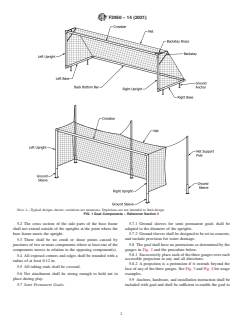
3.2 See Fig. 1 for goal component definitions.
F2056 Safety and Performance Specification for Soccer
Goals (Withdrawn 2018)
4. Material
4.1 The goal frame may be made of any material, provided
the requirements of this standard are fulfilled.
This specification is under the jurisdiction of ASTM Committee F15 on
4.2 All materials related to the construction of the goal
Consumer Products and is the direct responsibility of Subcommittee F15.43 on
Soccer Goal Safety. frames (net excluded) shall be designed to maintain their
Current edition approved Jan. 1, 2021. Published January 2021. Originally
integrity for outdoor use for a minimum period of five years
approved in 2014. Last previous edition approved in 2014 as F2950 – 14. DOI:
when maintained according to manufacturer’s instruction and
10.1520/F2950-14R21.
2 schedule.
For referenced ASTM standards, visit the ASTM website, www.astm.org, or
contact ASTM Customer Service at service@astm.org. For Annual Book of ASTM
Standards volume information, refer to the standard’s Document Summary page on 5. Design
the ASTM website.
5.1 The uprights and the crossbar shall have the same cross
The last approved version of this historical standard is referenced on
www.astm.org. section.
Copyright © ASTM International, 100 Barr Harbor Drive, PO Box C700, West Conshohocken, PA 19428-2959. United States
F2950−14 (2021)
NOTE 1—Typical designs shown; variations are numerous. Depictions are not intended to limit design.
FIG. 1Goal Components – Reference Section 3
5.2 The cross section of the side parts of the base frame 5.7.1 Ground sleeves for semi permanent goals shall be
shall not extend outside of the uprights at the point where the adapted to the diameter of the uprights.
base frame meets the upright. 5.7.2 Ground sleeves shall be designed to be set in concrete,
and include provision for water drainage.
5.3 There shall be no crush or shear points caused by
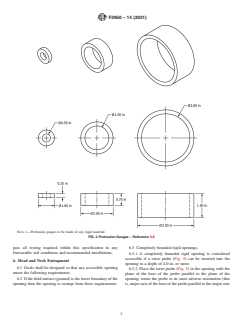
junctures of two or more components where at least one of the 5.8 The goal shall have no protrusions as determined by the
components moves in relation to the opposing component(s).
gauges in Fig. 2 and the procedure below.
5.8.1 Successively place each of the three gauges over each
5.4 All exposed corners and edges shall be rounded with a
accessible projection in any and all directions.
radius of at least 0.12 in.
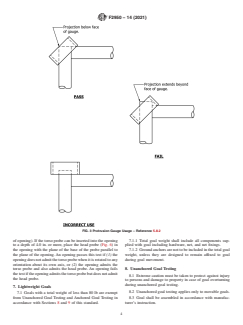
5.8.2 A projection is a protrusion if it extends beyond the
5.5 All tubing ends shall be covered.
face of any of the three gauges. See Fig. 3 and Fig. 4 for usage
5.6 Net attachment shall be strong enough to hold net in examples.
place during play.
5.9 Anchors, hardware, and installation instruction shall be
5.7 Semi Permanent Goals: included with goal and shall be sufficient to enable the goal to
F2950−14 (2021)
NOTE 1—Protrusion gauges to be made of any rigid material.
FIG. 2Protrusion Gauges – Reference 5.8
pass all testing required within this specification in any 6.3 Completely bounded rigid openings.
foreseeable soil conditions and recommended installations.
6.3.1 A completely bounded rigid opening is considered
accessible if a torso probe (Fig. 5) can be inserted into the
6. Head and Neck Entrapment
opening to a depth of 4.0 in. or more.
6.1 Goals shall be designed so that any accessible opening
6.3.2 Place the torso probe (Fig. 5) in the opening with the
meets the following requirements.
plane of the base of the probe parallel to the plane of the
6.2 If the field surface (ground) is the lower boundary of the opening; rotate the probe to its most adverse orientation (that
opening then the opening is exempt from these requirements. is, major axis of the base of the probe parallel to the major axis
F2950−14 (2021)
FIG. 3Protrusion Gauge Usage – Reference 5.8.2
of opening). If the torso probe can be inserted into the opening 7.1.1 Total goal weight shall include all components sup-
to a depth of 4.0 in. or more, place the head probe (Fig. 6)in plied with goal including hardware, net, and net fixings.
the opening with the plane of the base of the probe parallel to 7.1.2 Ground anchors are not to be included in the total goal
the plane of the opening. An opening passes this test if (1) the weight, unless they are designed to remain affixed to goal
openingdoesnotadmitthetorsoprobewhenitisrotatedtoany during goal movement.
orientation about its own axis, or (2) the opening admits the
torso probe and also admits the head probe. An opening fails 8. Unanchored Goal Testing
thetestiftheopeningadmitsthetorsoprobebutdoesnotadmit
8.1 Extreme caution must be taken to protect against injury
the head probe.
to persons and damage to property in case of goal overturning
during unanchored goal testing.
7. Lightweight Goals
8.2 Unanchored goal testing applies only to movable goals.
7.1 Goals with a total weight of less than 80 lb are exempt
from Unanchored Goal Testing and Anchored Goal Testing in 8.3 Goal shall be assembled in accordance with manufac-
accordance with Sections 8 and 9 of this standard. turer’s instruction.
F2950−14 (2021)
FIG. 4Protrusion Gauge Usage – Reference 5.8.2
8.4 Separate anchors from goal at location designed by 8.9 Swing Stability Test—See Fig. 9 and Fig. 10.
manufacturer. 8.9.1 A stop shall be placed in front of goal uprights to
prevent goal from sliding forward during testing.
8.5 Testing shall be conducted at temperatures between 50
8.9.1.1 Stop shall have maximum thickness of 0.25 in. and
and 90°F.
be affixed to the concrete floor.
8.6 Testing shall be conducted on a flat, level, concrete
8.9.2 A vertical stop shall be placed behind the goal to
surface.
prevent goal from sliding backwards during testing.
8.7 Goal passes Unanchored Goal Testing if it passes either
8.9.2.1 Vertical stop shall be set at a distance of 0.50 6 0.25
the Swing Stability Test or the Balanced Goal Test.
in. from goal frame prior to commencing test.
8.
...