

ASTM F2208-08(2019)
(Specification)Standard Safety Specification for Residential Pool Alarms
General Information
- Abstract
ABSTRACT
This specification deals with the performance requirements for pool alarms for residential swimming pools and spas. This specification covers devices that provide for rapid and automatic detection and alarm in cases of unintentional, unsupervised or accidental entry of a child one year of age or older into the water of swimming pools or spas. This specification is not intended to replace other standard safety requirements that should be in place, that is, adult supervision, fences, gates, locks, and so forth. This specification covers four different types of alarms: Type A, Surface—Pool alarm floating on water surface; Type B, Subsurface—Pool alarm located below the water surface; Type C, Pool Perimeter—Pool alarm located such as to detect movement at the perimeter of or above the water surface; and Type D, Personal Immersion Alarm—Pool alarm device located on the person(s).
SCOPE
1.1 This safety specification covers safety and performance requirements for pool alarms for residential swimming pools and spas.
1.2 This safety specification describes devices intended to improve personal safety and reduce injuries or deaths.
1.3 This safety specification covers devices that provide for rapid and automatic detection and alarm in cases of unintentional, unsupervised or accidental entry of a child one year of age or older into the water of swimming pools or spas.
1.4 This safety specification is not intended to replace other standard safety requirements that should be in place, that is, adult supervision, fences, gates, locks, and so forth.
1.5 This safety specification covers four different types of alarms.
1.6 The detection criteria for this safety specification is for a child one year of age and older.
1.7 The values stated in inch-pound units are to be regarded as standard. The values given in parentheses are mathematical conversions to SI units that are provided for information only and are not considered standard.
1.8 This standard does not purport to address all of the safety concerns, if any, associated with its use. It is the responsibility of the user of this standard to establish appropriate safety, health, and environmental practices and determine the applicability of regulatory limitations prior to use.
1.9 This international standard was developed in accordance with internationally recognized principles on standardization established in the Decision on Principles for the Development of International Standards, Guides and Recommendations issued by the World Trade Organization Technical Barriers to Trade (TBT) Committee.
- Status
- Published
- Publication Date
- 30-Sep-2019
- Technical Committee
- F15 - Consumer Products
- Drafting Committee
- F15.49 - Pool Safety Standards

Overview
ASTM F2208-08(2019), titled Standard Safety Specification for Residential Pool Alarms, provides critical safety and performance requirements for pool alarm devices used in residential swimming pools and spas. Developed by ASTM International, this safety standard aims to enhance child protection and reduce injuries or fatalities by specifying rapid and automatic alert mechanisms triggered by unauthorized or accidental entry into pool or spa water. The standard applies to pool alarms designed to detect entry by children aged one year or older, but does not replace essential safeguards like adult supervision, pool fencing, gates, or locks.
Key Topics
Types of Residential Pool Alarms:
ASTM F2208 classifies alarms as follows:- Surface Alarms (Type A): Devices that float on the water and detect surface disturbance.
- Subsurface Alarms (Type B): Devices located under the water to monitor subsurface movement.
- Pool Perimeter Alarms (Type C): Positioned to sense movement at or above the pool perimeter.
- Personal Immersion Alarms (Type D): Worn on a person and activated upon water immersion.
Performance Requirements:
To ensure effective detection and reliable operation, the standard specifies:- Alarms must sound at the pool and inside the adjacent residence within 20 seconds of intrusion detection.
- Minimum sound pressure of 85 dBA at 10 feet for at least 3 minutes.
- Visible indicators for device operability and low battery status.
- Automatic reset function after alarm activation.
- Compliance with radio frequency regulations for wireless models (FCC Part-15).
Test Methods:
Consistent and representative intrusion simulations with standardized child simulators ("Rescue Timmy") are required. Tests assess response to both vertical and horizontal entry, resistance to false alarms (e.g., wind or pool cleaners), and performance under typical pool conditions.Marking and User Instructions:
Alarms conforming to this standard must be labeled as meeting ASTM F2208. Clear installation, operation, maintenance, and troubleshooting instructions must be provided, following ANSI Z535.6 guidance.
Applications
Residential Swimming Pools and Spas:
This standard is directly applicable to manufacturers, homeowners, and pool safety professionals seeking to improve child safety in residential aquatic environments. Pool alarms conforming to ASTM F2208 add an effective layer to existing preventive measures.Product Certification and Compliance:
Manufacturers use ASTM F2208 as a benchmark for designing pool alarms and demonstrating compliance to regulators, retailers, and consumers. Certification to this standard is a key requirement for many building codes and insurance policies relating to pool safety.Pool Safety Advocacy and Consumer Guidance:
Organizations promoting pool safety rely on this specification to educate consumers about effective alarm solutions and to encourage adoption of products that meet recognized safety benchmarks.
Related Standards
- ANSI Z535.4: Product Safety Signs and Labels-Guidance for designing clear safety labels on pool alarms.
- ANSI Z535.6: Product Safety Information in Manuals and Instructions-Ensures comprehensive user guidance is provided.
- ASTM Pool and Spa Safety Standards: Other related ASTM standards address topics like pool barriers, covers, and entrapment protection, providing a holistic approach to swimming pool safety in residential environments.
For further information and the most recent version of this standard, visit the ASTM International website.
Keywords: pool alarm standard, ASTM F2208-08, residential swimming pool safety, spa safety, child protection, pool alarm requirements, pool alarm types, pool safety standard, ANSI Z535, personal immersion alarm.
Relations
- Effective Date
- 01-Oct-2019
Get Certified
Connect with accredited certification bodies for this standard

CIS Institut d.o.o.
Personal Protective Equipment (PPE) certification body. Notified Body NB-2890 for EU Regulation 2016/425 PPE.

Kiwa BDA Testing
Building and construction product certification.
Kmetijski inštitut Slovenije
Agricultural Institute of Slovenia. Soil testing, plant health, agricultural product analysis.
Sponsored listings
Frequently Asked Questions
ASTM F2208-08(2019) is a technical specification published by ASTM International. Its full title is "Standard Safety Specification for Residential Pool Alarms". This standard covers: ABSTRACT This specification deals with the performance requirements for pool alarms for residential swimming pools and spas. This specification covers devices that provide for rapid and automatic detection and alarm in cases of unintentional, unsupervised or accidental entry of a child one year of age or older into the water of swimming pools or spas. This specification is not intended to replace other standard safety requirements that should be in place, that is, adult supervision, fences, gates, locks, and so forth. This specification covers four different types of alarms: Type A, Surface—Pool alarm floating on water surface; Type B, Subsurface—Pool alarm located below the water surface; Type C, Pool Perimeter—Pool alarm located such as to detect movement at the perimeter of or above the water surface; and Type D, Personal Immersion Alarm—Pool alarm device located on the person(s). SCOPE 1.1 This safety specification covers safety and performance requirements for pool alarms for residential swimming pools and spas. 1.2 This safety specification describes devices intended to improve personal safety and reduce injuries or deaths. 1.3 This safety specification covers devices that provide for rapid and automatic detection and alarm in cases of unintentional, unsupervised or accidental entry of a child one year of age or older into the water of swimming pools or spas. 1.4 This safety specification is not intended to replace other standard safety requirements that should be in place, that is, adult supervision, fences, gates, locks, and so forth. 1.5 This safety specification covers four different types of alarms. 1.6 The detection criteria for this safety specification is for a child one year of age and older. 1.7 The values stated in inch-pound units are to be regarded as standard. The values given in parentheses are mathematical conversions to SI units that are provided for information only and are not considered standard. 1.8 This standard does not purport to address all of the safety concerns, if any, associated with its use. It is the responsibility of the user of this standard to establish appropriate safety, health, and environmental practices and determine the applicability of regulatory limitations prior to use. 1.9 This international standard was developed in accordance with internationally recognized principles on standardization established in the Decision on Principles for the Development of International Standards, Guides and Recommendations issued by the World Trade Organization Technical Barriers to Trade (TBT) Committee.
ABSTRACT This specification deals with the performance requirements for pool alarms for residential swimming pools and spas. This specification covers devices that provide for rapid and automatic detection and alarm in cases of unintentional, unsupervised or accidental entry of a child one year of age or older into the water of swimming pools or spas. This specification is not intended to replace other standard safety requirements that should be in place, that is, adult supervision, fences, gates, locks, and so forth. This specification covers four different types of alarms: Type A, Surface—Pool alarm floating on water surface; Type B, Subsurface—Pool alarm located below the water surface; Type C, Pool Perimeter—Pool alarm located such as to detect movement at the perimeter of or above the water surface; and Type D, Personal Immersion Alarm—Pool alarm device located on the person(s). SCOPE 1.1 This safety specification covers safety and performance requirements for pool alarms for residential swimming pools and spas. 1.2 This safety specification describes devices intended to improve personal safety and reduce injuries or deaths. 1.3 This safety specification covers devices that provide for rapid and automatic detection and alarm in cases of unintentional, unsupervised or accidental entry of a child one year of age or older into the water of swimming pools or spas. 1.4 This safety specification is not intended to replace other standard safety requirements that should be in place, that is, adult supervision, fences, gates, locks, and so forth. 1.5 This safety specification covers four different types of alarms. 1.6 The detection criteria for this safety specification is for a child one year of age and older. 1.7 The values stated in inch-pound units are to be regarded as standard. The values given in parentheses are mathematical conversions to SI units that are provided for information only and are not considered standard. 1.8 This standard does not purport to address all of the safety concerns, if any, associated with its use. It is the responsibility of the user of this standard to establish appropriate safety, health, and environmental practices and determine the applicability of regulatory limitations prior to use. 1.9 This international standard was developed in accordance with internationally recognized principles on standardization established in the Decision on Principles for the Development of International Standards, Guides and Recommendations issued by the World Trade Organization Technical Barriers to Trade (TBT) Committee.
ASTM F2208-08(2019) is classified under the following ICS (International Classification for Standards) categories: 13.320 - Alarm and warning systems; 97.220.10 - Sports facilities. The ICS classification helps identify the subject area and facilitates finding related standards.
ASTM F2208-08(2019) has the following relationships with other standards: It is inter standard links to ASTM F2208-08(2014). Understanding these relationships helps ensure you are using the most current and applicable version of the standard.
ASTM F2208-08(2019) is available in PDF format for immediate download after purchase. The document can be added to your cart and obtained through the secure checkout process. Digital delivery ensures instant access to the complete standard document.
Standards Content (Sample)
This international standard was developed in accordance with internationally recognized principles on standardization established in the Decision on Principles for the
Development of International Standards, Guides and Recommendations issued by the World Trade Organization Technical Barriers to Trade (TBT) Committee.
Designation: F2208 −08 (Reapproved 2019)
Standard Safety Specification for
Residential Pool Alarms
This standard is issued under the fixed designation F2208; the number immediately following the designation indicates the year of
original adoption or, in the case of revision, the year of last revision. A number in parentheses indicates the year of last reapproval. A
superscript epsilon (´) indicates an editorial change since the last revision or reapproval.
INTRODUCTION
According to Consumer Product Safety Commission (CPSC) data, it is estimated that each year on
average 256 children under 5 years of age drown in swimming pools, with most deaths occurring in
residential settings. Additionally, each year on average over 2000 children under 5 years of age are
treated in hospital emergency rooms for pool submersion injuries.
1. Scope ization established in the Decision on Principles for the
Development of International Standards, Guides and Recom-
1.1 This safety specification covers safety and performance
mendations issued by the World Trade Organization Technical
requirements for pool alarms for residential swimming pools
Barriers to Trade (TBT) Committee.
and spas.
1.2 This safety specification describes devices intended to
2. Referenced Documents
improve personal safety and reduce injuries or deaths.
2.1 ANSI Standards:
1.3 This safety specification covers devices that provide for
ANSI Z535.4 Product Safety Signs and Labels
rapid and automatic detection and alarm in cases of
ANSI Z535.6 Product Safety Information and Product
unintentional, unsupervised or accidental entry of a child one
Manuals, Instructions, and Other Collateral Materials
year of age or older into the water of swimming pools or spas.
3. Terminology
1.4 This safety specification is not intended to replace other
standard safety requirements that should be in place, that is, 3.1 Definitions of Terms Specific to This Standard:
adult supervision, fences, gates, locks, and so forth. 3.1.1 lot, n—normal production run or in the case of
imports, a shipment of items produced in the same time frame.
1.5 This safety specification covers four different types of
3.1.2 pool alarm, n—device designed to provide a rapid
alarms.
detection and automatic alarm in incidents of accidental,
1.6 The detection criteria for this safety specification is for
unintentional or unsupervised entry of a child one year of age
a child one year of age and older.
or older into the water of a swimming pool or spa.
1.7 The values stated in inch-pound units are to be regarded
as standard. The values given in parentheses are mathematical 4. Classification
conversions to SI units that are provided for information only
4.1 Types:
and are not considered standard.
4.1.1 TypeA, Surface—Poolalarmfloatingonwatersurface.
1.8 This standard does not purport to address all of the
4.1.2 Type B, Subsurface—Pool alarm located below the
safety concerns, if any, associated with its use. It is the
water surface.
responsibility of the user of this standard to establish appro-
4.1.3 Type C, Pool Perimeter—Pool alarm located such as
priate safety, health, and environmental practices and deter-
to detect movement at the perimeter of or above the water
mine the applicability of regulatory limitations prior to use.
surface.
1.9 This international standard was developed in accor-
4.1.4 Type D, Personal Immersion Alarm—Pool alarm de-
dance with internationally recognized principles on standard-
vice located on the person(s).
5. Performance Requirements
This specification is under the jurisdiction of ASTM Committee F15 on
5.1 General:
Consumer Products and is the direct responsibility of Subcommittee F15.49 on Pool
Safety Standards.
Current edition approved Oct. 1, 2019. Published October 2019. Originally
approved in 2002. Last previous edition approved in 2014 as F2208 – 08 (2014). Available from American National Standards Institute (ANSI), 25 W. 43rd St.,
DOI: 10.1520/F2208-08R19. 4th Floor, New York, NY 10036, http://www.ansi.org.
Copyright © ASTM International, 100 Barr Harbor Drive, PO Box C700, West Conshohocken, PA 19428-2959. United States
F2208 − 08 (2019)
5.1.1 Alarms shall sound both at poolside and inside any lator (CIS) is 20 6 0.5 lb (9.07 6 0.23 kg) and shall be filled
adjacent residence or building of occupancy via a remote with water.The CIS to meet these criteria shall be a mannequin
receiver within 20 s or less when tested in accordance with called Rescue Timmy. Rescue Timmy meets the requirements
Section 6. of the National Center(s) for Disease Control for a one-year-
5.1.2 The operational condition of a swimming pool alarm, old child. All testing shall be done in a 16-by-32 ft (4.87-by-
either on or off, shall be indicated with an energized lamp or 9.75 m) swimming pool with a minimum depth of 36 in. (91
other distinctive indicator, visible from a distance of 10 61ft cm). Any pool shape is sufficient as long as the pool measures
(3 6 0.3 m) at angles of 45 6 5° perpendicular to the unit to at some point 16 by 32 ft (4.87 by 9.75 m). During all drop
indicate the operability of the product. tests, both fans shall be operating as described in 6.3. During
5.1.3 Pool alarms shall have a minimum sound pressure all drop tests, the pump and filter shall be on and operating.
rating of 85 dBA at 10 ft (3.5 m) for 3 min.
6.2 To begin each drop test the pool shall be in a non-
5.1.4 If the device is battery operated, there shall be a
operational state, that is, pump, filter, and fans off for a
low-battery indicator. A low-battery condition is defined as an
minimum of 10 min. All drop tests are conducted two times
inability to meet the requirements of 5.1.3.
with the second drop test following the completion of the first
5.1.5 Pool alarms shall automatically reset.
drop test using the testing sequence A, B, C, as described
5.1.6 Pool alarm manufacturers who employ wireless com-
below.
munication (RF) shall comply with all relevant provisions of
A. Turn pump, filter, and both fans on for 2 min.
FCC Part-15 rules for unlicensed radio frequency devices
B. Initiate any one of the five (5) the drop tests.
including the required compliance labeling and statement.
C.Twominutesafterinitiatingthedroptestturnpump,filter,
5.1.7 If the alarm deactivates or has reduced sensitivity due
and fans off for 10 min, repeat test.
to environmental factors, the alarm shall indicate this in both a
D. Each of the two drop tests shall follow the same sequence
visual and audible manner.
(A, B, C).
5.2 Type A, Surface Alarm: 6.2.1 Vertical Drop Test:
5.2.1 TypeAalarmsshallprovidefortheautomaticsoundof 6.2.1.1 Position of the pool alarm shall be in accordance
the alarm when tested in accordance with 6.1. For alarms with with manufacturer’s specifications.
variable sensitivity, the setting shall be set at the least sensitive, 6.2.1.2 All vertical drop tests shall be conducted using a
according to manufacturer’s instructions. ramp (see Fig. 1). Material for the ramp shall be 10- to 20-mm
5.2.2 Type A alarms shall not alarm when tested in accor- thick polytetrafluoroethylene (PTFE) or fluorinated ethylene
dance with 6.3. For alarms with variable sensitivity, the setting propylene (FEP), approximately 2 ft (0.6 m) wide and 4 ft (1.2
shall be set at the most sensitive, according to manufacturer’s m) in length. A sheet of polypropylene precision woven mesh
instructions. that is 12 in. in width and 30 in. in length with 20.3 by 20.3
openings per square inch and a thread diameter of .0173 in.
5.3 Type B, Subsurface Alarm:
shall be placed between Rescue Timmy and the ramp to enable
5.3.1 Type B alarms shall provide for the automatic sound
Rescue Timmy to slide off the ramp in a consistent manner.
of the alarm when tested in accordance with 6.1. For alarms
The ramp shall be located on the 16-ft (4.87-m) side of the pool
with variable sensitivity, the setting shall be set at the least
between the two fans approximately in the middle.
sensitive, according to manufacturer’s instructions.
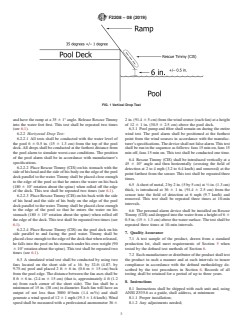
6.2.1.3 Place and secure Rescue Timmy (CIS) on his stom-
5.3.2 Type B alarms shall not alarm when tested in accor-
ach at the lower end of the ramp with the head even with the
dance with 6.3. For alarms with variable sensitivity, the setting
end of the ramp for a head-first intrusion. Use a string and
shall be set at the most sensitive, according to manufacturer’s
sinker to maintain the ramp 6 6 0.5 in. (15 6 1.3 cm) above
instructions.
the water and have the ramp at a 35 6 1° angle. Release
5.4 Type C, Pool Perimeter Alarm:
Rescue Timmy into the water head first. This test shall be
5.4.1 Type C alarms shall provide for the automatic sound
repeated two times (see 6.1).
of the alarm when tested in accordance with 6.4, according to
6.2.1.4 Place and secure RescueTimmy (CIS) on his back at
manufacturer’s instructions.
the end of the ramp with the feet even with the lower end of the
5.4.2 Type C alarms shall not
...