


ASTM F1264-16e1
(Specification)Standard Specification and Test Methods for Intramedullary Fixation Devices
Standard Specification and Test Methods for Intramedullary Fixation Devices
SIGNIFICANCE AND USE
A1.4 Significance and Use
A1.4.1 This test method describes a static bending test to determine the bending stiffness and bending strength of the central and uniform portions of an IMFD.
A1.4.2 This test method may not be appropriate for all types of implant applications (that is, in proximal or distal extremity of an IMFD where screw holes exist). The user is cautioned to consider the appropriateness of the method in view of the devices being tested and their potential applications.
SCOPE
1.1 This specification is intended to provide a characterization of the design and mechanical function of intramedullary fixation devices (IMFDs), specify labeling and material requirements, provide test methods for characterization of IMFD mechanical properties, and identify needs for further development of test methods and performance criteria. The ultimate goal is to develop a standard which defines performance criteria and methods for measurement of performance-related mechanical characteristics of IMFDs and their fixation to bone. It is not the intention of this specification to define levels of performance or case-specific clinical performance of these devices, as insufficient knowledge to predict the consequences of the use of any of these devices in individual patients for specific activities of daily living is available. It is not the intention of this specification to describe or specify specific designs for IMFDs.
1.2 This specification describes IMFDs for surgical fixation of the skeletal system. It provides basic IMFD geometrical definitions, dimensions, classification, and terminology; labeling and material specifications; performance definitions; test methods and characteristics determined to be important to in-vivo performance of the device.
1.3 Multiple test methods are included in this standard. However, the user is not necessarily obligated to test using all of the described methods. Instead, the user should only select, with justification, test methods that are appropriate for a particular device design. This may be only a subset of the herein described test methods.
1.4 This specification includes four standard test methods:
1.4.1 Static Four-Point Bend Test Method—Annex A1 and
1.4.2 Static Torsion Test Method—Annex A2.
1.4.3 Bending Fatigue Test Method—Annex A3.
1.4.4 Test Method for Bending Fatigue of IMFD Locking Screws—Annex A4.
1.5 A rationale is given in Appendix X1.
1.6 The values stated in SI units are to be regarded as standard. No other units of measurement are included in this standard.
General Information
- Status
- Published
- Publication Date
- 30-Apr-2016
- Technical Committee
- F04 - Medical and Surgical Materials and Devices
- Drafting Committee
- F04.21 - Osteosynthesis
Relations
- Effective Date
- 01-May-2016
- Effective Date
- 15-Feb-2024
- Effective Date
- 01-Feb-2024
- Effective Date
- 01-Nov-2023
- Effective Date
- 01-Apr-2023
- Effective Date
- 01-Feb-2020
- Effective Date
- 01-Dec-2019
- Effective Date
- 01-May-2019
- Effective Date
- 01-Sep-2018
- Effective Date
- 01-Sep-2018
- Effective Date
- 01-Feb-2018
- Effective Date
- 01-Jul-2017
- Effective Date
- 01-Dec-2015
- Effective Date
- 01-Dec-2015
- Effective Date
- 01-May-2015
Overview
ASTM F1264-16e1 is a globally recognized standard published by ASTM International that specifies requirements and test methods for intramedullary fixation devices (IMFDs) used in orthopedic surgery. These devices are essential for stabilizing fractures by providing internal structural support within the bone, commonly in long bones such as femur, tibia, and humerus. The standard ensures that IMFDs meet essential criteria for design, material specifications, labeling, and mechanical performance through both descriptive requirements and a set of test methods.
Key Topics
- Scope and Purpose: ASTM F1264-16e1 outlines the minimum requirements for the characterization of IMFDs, including device geometry, dimensions, and materials. It defines terminology relevant to IMFDs and designates mechanical properties that should be evaluated for clinical safety and effectiveness.
- Test Methods: The standard incorporates multiple mechanical test methods that measure key aspects of device performance:
- Static Four-Point Bend Test: Measures the bending stiffness and bending strength of the device’s uniform working length.
- Static Torsion Test: Evaluates the device's resistance to torsional (twisting) forces.
- Bending Fatigue Test: Assesses the device's durability under repeated bending loads.
- Bending Fatigue Test for Locking Screws: Ensures that locking screws associated with IMFDs meet durability requirements.
- Material and Labeling Requirements: Devices must comply with specified ASTM material standards to ensure biocompatibility and structural integrity. Proper marking and labeling are required for device identification, including manufacturer, catalog number, lot or serial number, and dimensional information.
- Applicability and Limitations: While ASTM F1264-16e1 provides comprehensive guidance for device evaluation, it does not prescribe specific device designs or performance thresholds. It also clarifies that some test methods may not be suitable for all device sections, especially at the proximal or distal ends where features such as screw holes may exist.
Applications
- Device Development and Verification: Orthopedic manufacturers and product designers use this standard to test the mechanical properties of intramedullary nails, rods, and associated fixation screws, ensuring devices possess adequate strength and fatigue resistance for clinical use.
- Quality Assurance: Testing in accordance with ASTM F1264-16e1 helps establish consistency in device performance, supporting quality assurance processes and regulatory submissions.
- Clinical Safety: By adhering to standardized test methods, manufacturers can provide clear evidence of device performance, contributing to improved surgical outcomes and patient safety.
- Custom and Novel Devices: The standard’s guidance for selective test application allows for innovation in device design while still meeting fundamental safety and performance checks.
Related Standards
ASTM F1264-16e1 references and aligns with several other ASTM and industry standards to comprehensively cover material selection, device marking, and test procedures, including:
- ASTM F86 – Practice for Surface Preparation and Marking of Metallic Surgical Implants
- ASTM D790 – Test Methods for Flexural Properties of Unreinforced and Reinforced Plastics and Electrical Insulating Materials
- ASTM F138 – Specification for Wrought 18Chromium-14Nickel-2.5Molybdenum Stainless Steel Bar and Wire for Surgical Implants
- ASTM F1611 – Specification for Intramedullary Reamers
- ASTM F2503 – Practice for Marking Medical Devices for Safety in the MR Environment
Practical Value
Implementing ASTM F1264-16e1 in the design, testing, and labeling of intramedullary fixation devices ensures standardized assessment of critical properties such as bending stiffness, strength, and fatigue life, which directly impact patient outcomes. By setting clear requirements for device characterization and mechanical evaluation, this standard supports global device reliability in trauma fixation, helps regulatory compliance, and encourages ongoing development of safer, more effective orthopedic implants.
Keywords: ASTM F1264, intramedullary fixation device, IMFD, orthopedic implant, mechanical testing, bend test, fatigue test, torsion test, device labeling, surgical fixation.
Get Certified
Connect with accredited certification bodies for this standard

BSI Group
BSI (British Standards Institution) is the business standards company that helps organizations make excellence a habit.

TÜV Rheinland
TÜV Rheinland is a leading international provider of technical services.

TÜV SÜD
TÜV SÜD is a trusted partner of choice for safety, security and sustainability solutions.
Sponsored listings
Frequently Asked Questions
ASTM F1264-16e1 is a technical specification published by ASTM International. Its full title is "Standard Specification and Test Methods for Intramedullary Fixation Devices". This standard covers: SIGNIFICANCE AND USE A1.4 Significance and Use A1.4.1 This test method describes a static bending test to determine the bending stiffness and bending strength of the central and uniform portions of an IMFD. A1.4.2 This test method may not be appropriate for all types of implant applications (that is, in proximal or distal extremity of an IMFD where screw holes exist). The user is cautioned to consider the appropriateness of the method in view of the devices being tested and their potential applications. SCOPE 1.1 This specification is intended to provide a characterization of the design and mechanical function of intramedullary fixation devices (IMFDs), specify labeling and material requirements, provide test methods for characterization of IMFD mechanical properties, and identify needs for further development of test methods and performance criteria. The ultimate goal is to develop a standard which defines performance criteria and methods for measurement of performance-related mechanical characteristics of IMFDs and their fixation to bone. It is not the intention of this specification to define levels of performance or case-specific clinical performance of these devices, as insufficient knowledge to predict the consequences of the use of any of these devices in individual patients for specific activities of daily living is available. It is not the intention of this specification to describe or specify specific designs for IMFDs. 1.2 This specification describes IMFDs for surgical fixation of the skeletal system. It provides basic IMFD geometrical definitions, dimensions, classification, and terminology; labeling and material specifications; performance definitions; test methods and characteristics determined to be important to in-vivo performance of the device. 1.3 Multiple test methods are included in this standard. However, the user is not necessarily obligated to test using all of the described methods. Instead, the user should only select, with justification, test methods that are appropriate for a particular device design. This may be only a subset of the herein described test methods. 1.4 This specification includes four standard test methods: 1.4.1 Static Four-Point Bend Test Method—Annex A1 and 1.4.2 Static Torsion Test Method—Annex A2. 1.4.3 Bending Fatigue Test Method—Annex A3. 1.4.4 Test Method for Bending Fatigue of IMFD Locking Screws—Annex A4. 1.5 A rationale is given in Appendix X1. 1.6 The values stated in SI units are to be regarded as standard. No other units of measurement are included in this standard.
SIGNIFICANCE AND USE A1.4 Significance and Use A1.4.1 This test method describes a static bending test to determine the bending stiffness and bending strength of the central and uniform portions of an IMFD. A1.4.2 This test method may not be appropriate for all types of implant applications (that is, in proximal or distal extremity of an IMFD where screw holes exist). The user is cautioned to consider the appropriateness of the method in view of the devices being tested and their potential applications. SCOPE 1.1 This specification is intended to provide a characterization of the design and mechanical function of intramedullary fixation devices (IMFDs), specify labeling and material requirements, provide test methods for characterization of IMFD mechanical properties, and identify needs for further development of test methods and performance criteria. The ultimate goal is to develop a standard which defines performance criteria and methods for measurement of performance-related mechanical characteristics of IMFDs and their fixation to bone. It is not the intention of this specification to define levels of performance or case-specific clinical performance of these devices, as insufficient knowledge to predict the consequences of the use of any of these devices in individual patients for specific activities of daily living is available. It is not the intention of this specification to describe or specify specific designs for IMFDs. 1.2 This specification describes IMFDs for surgical fixation of the skeletal system. It provides basic IMFD geometrical definitions, dimensions, classification, and terminology; labeling and material specifications; performance definitions; test methods and characteristics determined to be important to in-vivo performance of the device. 1.3 Multiple test methods are included in this standard. However, the user is not necessarily obligated to test using all of the described methods. Instead, the user should only select, with justification, test methods that are appropriate for a particular device design. This may be only a subset of the herein described test methods. 1.4 This specification includes four standard test methods: 1.4.1 Static Four-Point Bend Test Method—Annex A1 and 1.4.2 Static Torsion Test Method—Annex A2. 1.4.3 Bending Fatigue Test Method—Annex A3. 1.4.4 Test Method for Bending Fatigue of IMFD Locking Screws—Annex A4. 1.5 A rationale is given in Appendix X1. 1.6 The values stated in SI units are to be regarded as standard. No other units of measurement are included in this standard.
ASTM F1264-16e1 is classified under the following ICS (International Classification for Standards) categories: 11.040.40 - Implants for surgery, prosthetics and orthotics. The ICS classification helps identify the subject area and facilitates finding related standards.
ASTM F1264-16e1 has the following relationships with other standards: It is inter standard links to ASTM F1264-16, ASTM E1823-24a, ASTM E1823-24, ASTM A450/A450M-23, ASTM F2503-23e1, ASTM E1823-20, ASTM F138-19, ASTM A214/A214M-19, ASTM A450/A450M-18, ASTM A214/A214M-96(2018), ASTM F1611-00(2018), ASTM D790-17, ASTM D790-15, ASTM D790-15e1, ASTM A450/A450M-15. Understanding these relationships helps ensure you are using the most current and applicable version of the standard.
ASTM F1264-16e1 is available in PDF format for immediate download after purchase. The document can be added to your cart and obtained through the secure checkout process. Digital delivery ensures instant access to the complete standard document.
Standards Content (Sample)
This international standard was developed in accordance with internationally recognized principles on standardization established in the Decision on Principles for the
Development of International Standards, Guides and Recommendations issued by the World Trade Organization Technical Barriers to Trade (TBT) Committee.
´1
Designation: F1264 −16
Standard Specification and Test Methods for
Intramedullary Fixation Devices
This standard is issued under the fixed designation F1264; the number immediately following the designation indicates the year of
original adoption or, in the case of revision, the year of last revision.Anumber in parentheses indicates the year of last reapproval.A
superscript epsilon (´) indicates an editorial change since the last revision or reapproval.
ε NOTE—Editorial changes were made throughout in November 2016.
1. Scope 1.5 A rationale is given in Appendix X1.
1.1 This specification is intended to provide a characteriza-
1.6 The values stated in SI units are to be regarded as
tion of the design and mechanical function of intramedullary
standard. No other units of measurement are included in this
fixation devices (IMFDs), specify labeling and material
standard.
requirements, provide test methods for characterization of
IMFD mechanical properties, and identify needs for further
2. Referenced Documents
development of test methods and performance criteria. The
ultimate goal is to develop a standard which defines perfor- 2.1 ASTM Standards:
mance criteria and methods for measurement of performance- A214/A214MSpecification for Electric-Resistance-Welded
related mechanical characteristics of IMFDs and their fixation
Carbon Steel Heat-Exchanger and Condenser Tubes
to bone. It is not the intention of this specification to define
A450/A450MSpecification for General Requirements for
levels of performance or case-specific clinical performance of
Carbon and Low Alloy Steel Tubes
these devices, as insufficient knowledge to predict the conse-
D790Test Methods for Flexural Properties of Unreinforced
quencesoftheuseofanyofthesedevicesinindividualpatients
and Reinforced Plastics and Electrical Insulating Materi-
for specific activities of daily living is available. It is not the
als
intention of this specification to describe or specify specific
E4Practices for Force Verification of Testing Machines
designs for IMFDs.
E691Practice for Conducting an Interlaboratory Study to
1.2 This specification describes IMFDs for surgical fixation Determine the Precision of a Test Method
of the skeletal system. It provides basic IMFD geometrical F86Practice for Surface Preparation and Marking of Metal-
definitions, dimensions, classification, and terminology; label-
lic Surgical Implants
ing and material specifications; performance definitions; test
F138 Specification for Wrought 18Chromium-14Nickel-
methods and characteristics determined to be important to
2.5MolybdenumStainlessSteelBarandWireforSurgical
in-vivo performance of the device.
Implants (UNS S31673)
F339 Specification for Cloverleaf Intramedullary Pins
1.3 Multiple test methods are included in this standard.
However, the user is not necessarily obligated to test using all (Withdrawn 1998)
F383Practice for Static Bend and Torsion Testing of In-
of the described methods. Instead, the user should only select,
with justification, test methods that are appropriate for a tramedullary Rods (Withdrawn 1996)
particular device design. This may be only a subset of the F565PracticeforCareandHandlingofOrthopedicImplants
herein described test methods.
and Instruments
F1611Specification for Intramedullary Reamers
1.4 This specification includes four standard test methods:
F2503Practice for Marking Medical Devices and Other
1.4.1 Static Four-Point Bend Test Method—Annex A1 and
Items for Safety in the Magnetic Resonance Environment
1.4.2 Static Torsion Test Method—Annex A2.
F2809Terminology Relating to Medical and Surgical Mate-
1.4.3 Bending Fatigue Test Method—Annex A3.
rials and Devices
1.4.4 Test Method for Bending Fatigue of IMFD Locking
Screws—Annex A4.
1 2
This specification is under the jurisdiction of ASTM Committee F04 on For referenced ASTM standards, visit the ASTM website, www.astm.org, or
Medical and Surgical Materials and Devices and is the direct responsibility of contact ASTM Customer Service at service@astm.org. For Annual Book of ASTM
Subcommittee F04.21 on Osteosynthesis. Standards volume information, refer to the standard’s Document Summary page on
Current edition approved May 1, 2016. Published June 2016. Originally the ASTM website.
approved in 1989. Last previous edition approved in 2014 as F1264–14. DOI: The last approved version of this historical standard is referenced on
10.1520/F1264-16E01. www.astm.org.
Copyright © ASTM International, 100 Barr Harbor Drive, PO Box C700, West Conshohocken, PA 19428-2959. United States
´1
F1264 − 16
2.2 AMS Standard: failure criteria, as defined and measured according to the test
AMS 5050SteelTubing, Seamless, 0.15 Carbon, Maximum conducted. (See Note 1.)
Annealed
NOTE 1—No present testing standard exists related to this term for
2.3 SAE Standard:
IMFDs.
SAE J524Seamless Low-Carbon SteelTubingAnnealed for
4 3.2.3 fatigue strength at N cycles, n—the maximum cyclic
Bending and Flaring
forceparameter(forexample,load,moment,torque,stress,and
so forth) for a given load ratio, which produces device
3. Terminology
structural damage or meets some other failure criterion in no
3.1 Definitions for Geometric:
lessthanNcyclesasdefinedandmeasuredaccordingtothetest
3.1.1 closed section, n—any cross section perpendicular to
conducted.
the longitudinal axis of a solid or hollow IMFD in which there
3.2.4 N—a variable representing a specified number of
is no discontinuity of the outer wall.
cycles.
3.1.1.1 Discussion—To orient the IMFD for testing and for
3.2.5 no load motion—relative motion between the IMFD
insertion, the desired relationship of any irregularities,
andthebonethatoccurswithnoelasticstraininthedeviceand
asymmetries,andsoforth,tothesagittalandcoronalplanesfor
no (or minimal) change in load. (See Note 1.)
the intended applications should be described.
3.2.6 structural stiffness, n—the maximum slope of the
3.1.2 IMFD curvature, n—dimensions of size and locations
elastic portion of the load-displacement curve as defined and
of arcs of the curvature, or mathematical description of the
measured according to the test conducted.
curvature, or other quantitative descriptions to which the
3.2.6.1 Discussion—For bending in a specified plane, this
curvature is manufactured along with tolerances.
termisdefinedanddeterminedinthestaticfour-pointbendtest
3.1.2.1 Discussion—To orient the IMFD for testing and for
described in Annex A1.
insertion, the desired relationship of the curvature to the
3.2.7 ultimate strength, n—maximum force parameter (for
sagittalandcoronalplanesfortheintendedapplicationsshould
be described. example, load, moment, torque, stress, and so forth) which the
structure can support, defined and measured according to the
3.1.3 IMFD diameter, n—diameter of the circumscribed
circle that envelops the IMFD’s cross section when measured test conducted.
along its working length. If the diameter is not constant along 3.2.8 yield strength, n—the force parameter (for example,
the working length, then the site of measurement should be
load, moment, torque, stress, and so forth) which initiates
indicated. permanent deformation as defined and measured according to
3.1.4 IMFD length, n—length of a straight line between the
the test conducted.
most proximal and distal ends of the IMFD.
3.1.5 open section, n—any cross section perpendicular to
4. Classification
the longitudinal axis of a hollow IMFD in which there is a
4.1 ThefollowingIMFDsmaybeusedsingly,multiply,and
discontinuity of the outer wall.
with or without attached supplemental fixation: solid cross
3.1.5.1 Discussion—To orient the IMFD for testing and
section, hollow cross section (open, closed, or a combination).
insertion, the desired relationship of the discontinuity to the
sagittalandcoronalplanesfortheintendedapplicationsshould 4.2 IntendedapplicationoruseforparticularIMFDdesigns:
be described. 4.2.1 Preferred Orientation:
3.1.6 potential critical stress concentrator (CSC), n—any
4.2.1.1 Right versus left,
change in section modulus, material property, discontinuity, or
4.2.1.2 Sagittal versus coronal plane,
other feature of a design expected to cause a concentration of
4.2.1.3 Proximal versus distal, and
stress in a region of the IMFD expected to be highly stressed
4.2.1.4 Universal or multiple options.
under the normal anticipated loading conditions.
4.2.2 Preferred Anatomic Location:
3.1.7 tolerance, n—acceptable deviations from the nominal
4.2.2.1 Specific bone,
size of any dimension describing the IMFD.
4.2.2.2 Proximal versus distal versus midshaft, and
3.1.8 working length, n—length of uniform cross section of
4.2.2.3 Universal or multiple options.
the IMFD intended to obtain some type of fit to the medullary
4.2.3 Preferred Use Limited to Specific Procedures:
canal in the area of the diaphysis.
4.2.3.1 Acute care of fractures,
3.2 Definitions—Mechanical/Structural:
(1)Specific types,
3.2.1 bending compliance, n—reciprocal of the stiffness of
(2)Specific locations,
the IMFD under a bending load in a specified plane as defined
4.2.3.2 Reconstructive procedures, and
and determined in the static four-point bend test described in
4.2.3.3 Universal or multiple options.
Annex A1.
3.2.2 failure strength, n—the force parameter (for example,
5. Material
load,moment,torque,stress,andsoforth)requiredtomeetthe
5.1 All IMFDs made of materials that have an ASTM
standard shall meet those requirements given in the ASTM
Available from Society of Automotive Engineers (SAE), 400 Commonwealth
Dr., Warrendale, PA 15096-0001, http://www.sae.org. standard (2.1).
´1
F1264 − 16
6. Performance Considerations and Test Methods 7.4 PackagingshallbeadequatetoprotecttheIMFDduring
shipment.
6.1 Cross Section Dimensional Tolerances affect matching
7.5 The following shall be included on package labeling for
thebonepreparationinstruments(thatis,reamers)totheIMFD
IMFDs:
diameter, and the IMFD in the bone.
7.5.1 Manufacturer and product name,
6.1.1 Terminology related to sizing of IMFD devices and
7.5.2 Catalog number,
instruments is provided in Specification F1611.
7.5.3 Lot or serial number,
6.2 Longitudinal Contour Tolerances (along with bending
7.5.4 IMFD diameter (3.1.3), and
compliance) affect the fit and fixation of IMFDs in the bone.
7.5.5 IMFD length (3.1.4).
6.3 FatigueStrengthaffectsthechoiceofimplantincasesin
7.6 IMFDs should be cared for and handled in accordance
which delayed healing is anticipated (that is, infected
with Practice F565.
nonunions, allografts, segmental loss, multiple trauma, and so
7.7 See Practice F2503 to identify potential hazards pro-
forth).
duced by interactions between the device and the MR environ-
6.3.1 ThefatiguestrengthorfatiguelivesorbothforIMFDs
ment and for terms that may be used to label the device for
subjectedtocyclebendingforcesshallbedeterminedusingthe
safety in the MR environment.
cyclic bending fatigue test method in Annex A3.
6.3.2 The fatigue strength or fatigue lives or both for IMFD
8. Means for Insertion and Extraction
locking screws subjected to cyclic bending forces shall be
8.1 For IMFDs that are to be extracted using a hook device,
determined using the cyclic bending fatigue test method for
the following requirements apply:
locking screws in Annex A4.
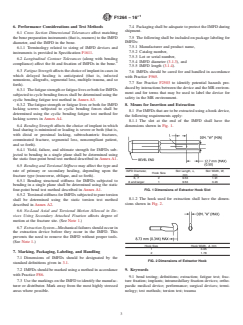
8.1.1 The slot at the end of the IMFD shall have the
6.4 Bending Strength affects the choice of implant in which dimensions shown in Fig. 1.
load sharing is minimized or loading is severe or both (that is,
with distal or proximal locking, subtrochanteric fractures,
comminuted fracture, segmental loss, noncompliant patient,
and so forth).
6.4.1 Yield, failure, and ultimate strength for IMFDs sub-
jected to bending in a single plane shall be determined using
the static four-point bend test method described in AnnexA1.
6.5 Bending and Torsional Stiffness may affect the type and
rate of primary or secondary healing, depending upon the IMFD Diameter, Slot Length, L, Slot Width, W,
Hook Size
mm mm mm
fracture type (transverse, oblique, and so forth).
6, 7 2 9.53 1.91
6.5.1 Bending structural stiffness for IMFDs subjected to
8 and larger 1 9.53 3.23
bending in a single plane shall be determined using the static
FIG. 1 Dimensions of Extractor Hook Slot
four-point bend test method described in Annex A1.
6.5.2 TorsionalstiffnessforIMFDssubjectedtopuretorsion
8.1.2 The hook used for extraction shall have the dimen-
shall be determined using the static torsion test method
sions shown in Fig. 2.
described in Annex A2.
6.6 No-Load Axial and Torsional Motion Allowed in De-
vices Using Secondary Attached Fixation affects degree of
motion at the fracture site. (See Note 1.)
6.7 Extraction System—Mechanicalfailuresshouldoccurin
the extraction device before they occur in the IMFD. This
prevents the need to remove the IMFD without proper tools.
(See Note 1.)
Hook Size Hook Width, A,mm
1 3.05
7. Marking, Packaging, Labeling, and Handling
2 1.78
7.1 Dimensions of IMFDs should be designated by the
FIG. 2 Dimensions of Extractor Hook
standard definitions given in 3.1.
7.2 IMFDs should be marked using a method in accordance
9. Keywords
with Practice F86.
9.1 bend testing; definitions; extraction; fatigue test; frac-
7.3 Use the markings on the IMFD to identify the manufac-
ture fixation; implants; intramedullary fixation devices; ortho-
turer or distributor. Mark away from the most highly stressed paedic medical device; performance; surgical devices; termi-
areas where possible. nology; test methods; torsion test; trauma
´1
F1264 − 16
ANNEXES
(Mandatory Information)
A1. TEST METHOD FOR STATIC FOUR-POINT BEND TEST
A1.1. Scope A1.1.9 This standard does not purport to address all of the
safety concerns, if any, associated with its use. It is the
A1.1.1 This test method describes methods for static four-
responsibility of the user of this standard to establish appro-
point bend testing of intrinsic, structural properties of in-
priate safety and health practices and determine the applica-
tramedullary fixation devices (IMFDs) for surgical fixation of
bility of regulatory limitations prior to use.
theskeletalsystem.Thistestmethodincludesbendtestingina
variety of planes relative to the major anatomic planes. The
A1.2. Terminology
purpose is to measure bending strength and bending stiffness
intrinsic to the design and materials of IMFDs.
A1.2.1 Definitions:
A1.1.2 This test method is designed specifically to test
A1.2.1.1 bending compliance, n—reciprocal of the stiffness
IMFDdesignsthathaveawelldefinedworkinglength(WL)of
of the IMFD under a bending load in a specified plane (1/EI
e
uniform open or closed cross section throughout the majority
for the IMFD, y/F for the system tested).
of its length (WL ≥ 10× diameter) and shall be applied to the
A1.2.1.2 bending moment, n—moment required to meet
full length of the diaphysis of a femur, tibia, humerus, radius,
predetermined failure criteria.
or ulna. This is not applicable to IMFDs that are used to fix
A1.2.1.2.1 Discussion—Failure may be defined as perma-
only a short portion of the diaphysis of any of the long bones
nent deformation, breakage, or buckling.
or the diaphysis of small bones such as the metacarpals,
A1.2.1.3 bending moment to yield, n—moment which pro-
metatarsals, phalanges, and so forth.
duces plastic deformation as defined by the 0.2% strain offset
A1.1.3 This test method is not intended to test the extrinsic
method from the load-displacement curve.
properties (that is, the interaction of the device with bone or
A1.2.1.4 bending structural stiffness, n—resistance to bend-
other biologic materials), of any IMFD.
ingofanIMFD,normalizedtothecross-sectionalpropertiesof
A1.1.4 This test method is not intended to define case-
the working length without regard to the length of IMFD
specific clinical performance of these devices, as insufficient
tested, by the calculations described in A1.5.1.8 (the effective
knowledge to predict the consequences of the use of any of
EI for the region tested).
e
these devices in individual patients is available.
A1.2.1.5 fixture/device compliance, n—measurement of the
A1.1.5 Thistestmethodisnotintendedtoserveasaquality
combined compliance of the IMFD on the test fixture with
assurance document, and thus, statistical sampling techniques
co-aligned load-support points (such as A1.7.2). This value is
for batches from production of IMFDs are not addressed.
dependentuponIMFDorientation,loaddirection,andloadand
A1.1.6 Thistestmethodmaynotbeappropriateforalltypes support spans.
of implant applications. The user is cautioned to consider the
A1.2.1.6 ultimate bending moment, n—momentatthemaxi-
appropriateness of the method in view of the devices being
mum or ultimate load as measured on the load-displacement
tested, the material of their manufacture, and their potential
curve for any test in accordance with A1.6.1.
applications.
A1.2.2 Definitions of Terms Specific to This Standard:
A1.1.7 This test method is intended to evaluate the bending
A1.2.2.1 The testing mode shall consist of an applied
strength or bending stiffness of the working length of the
compression load cycle, at a constant displacement rate, to a
IMFD, and may not be appropriate for all situations.When the
defined failure.
structurally critical region of the IMFD is shown to be located
A1.2.2.2 The testing mode shall be single cycle with the
at the proximal or distal extremity of the IMFD, it may be
load applied at least three diameters of the IMFD from the
necessary to evaluate the bending strength or bending stiffness
nearest critical stress concentration point (CSC) unless other-
of this region of the IMFD using a different test method. This
wise specified or unless the CSC is a characteristic of the
is because it may not be physically possible to fit the proximal
normal cross section in the working length.
or distal extremity between the inner rollers of a four-point
bend test. Structurally critical regions may be identified
A1.3 Classification
through such methods as hand calculations, finite element
analysis, etc. Screw holes or other interlocking features are
A1.3.1 Types of Test Covered by This Specification Are:
typically located at the proximal and distal extremities of an
A1.3.1.1 Measurement of structural mechanical behavior
IMFD, and may result in structurally critical regions at these
inherent to IMFDs—intrinsic properties.
locations.
A1.3.1.2 Measurement of single-cycle elastic stiffness and
strength in four-point bending.
A1.1.8 The values stated in SI units are to be regarded as
standard. No other units of measurement are included in this A1.3.1.3 Measurement of a single-cycle fixture/device elas-
standard. tic compliance.
´1
F1264 − 16
A1.4. Significance and Use
A1.4.1 This test method describes a static bending test to
determine the bending stiffness and bending strength of the
central and uniform portions of an IMFD.
A1.4.2 Thistestmethodmaynotbeappropriateforalltypes
of implant applications (that is, in proximal or distal extremity
of an IMFD where screw holes exist).The user is cautioned to
consider the appropriateness of the method in view of the
devices being tested and their potential applications.
A1.5. Procedure
A1.5.1 Bending Test for Intrinsic Properties of the Working
Length (WL):
A1.5.1.1 Determine the spans to be used as described in
A1.5.1.2 and A1.5.1.3 and set the spans, s, c, and L to within
1% of the determined values.
A1.5.1.2 Conduct the four-point bending test at room atmo-
spheric conditions as shown in Fig. A1.1, using two rolling
supports spaced from 10 to 50 cm apart, L, with the span
between the loading points, c, no greater than L/3.The loading
FIG. A1.2 Four-Point Bend Test with Guide Shoes
points should also be of the rolling type, and the diameter of
boththeloadingandsupportrollersshouldbebetween1.0and
2.6 cm. The choice of spans should be made based upon the
ment no greater than 1 mm/s. Measure the relative deflections
guidelines given in A1.7.2.
between the support and loading points (inner versus outer), y.
A1.5.1.3 A recommendation for load and support spans is
For devices made of strain-rate-sensitive materials, the dis-
provided below to minimize interlaboratory variability and
placement rate for a given strain rate may be estimated by
provide consistency with the previous ASTM standard for
using the following approximations:
four-point bend testing of IMFDs.The suggested long or short
y 5 S , and c 5 L 22s (A1.1)
1 t 1%
span should be used whenever possible, provided the general
guidelinesofA1.7.2areachieved.Theshortspanisidenticalto
y 5 s L12c / 300 D (A1.2)
~ ! ~ !
1% IMFD
that used in the previous standard, Practice F383, and the long
5s~3L 24s!/~300 D !
span is based upon the experience of several laboratories
IMFD
testing a broad range of designs and sizes of current (1995)
or
IMFD designs.
5s 3c12s / 300 D
~ ! ~ !
IMFD
Short span s=c=38mm L = 114 mm
Long span s=c=76mm L = 228 mm
where:
A1.5.1.4 Apply equal loads at each of the loading points (a
S = the desired strain rate,
t
singleloadcenteredovertheloadpointsasshowninFigs.A1.1
y = the deflection at the loading point for an estimated
1%
and A1.2 is the usual method) at a constant rate of displace-
1% maximum strain in the IMFD,
s = the span from a load point to the nearest support,
c = the center span,
L = the total span (c+2s), and
D = the diameter of the IMFD.
IMFD
NOTE A1.1—The deflection rate that corresponds to the desired strain
rate is only a rough estimate based upon the assumptions of plane strain
for closed-section tubes or solid rods so that the neutral axis of the cross
section lies uniformly throughout the working length in the center of the
circumscribed circle of the cross section and there is material in the cross
section touching the circumscribed circle where it intersects the plane of
bending.
A1.5.1.5 Compute the bending moment, M, as used in
A1.2.1 as follows:
M 5 Fs/2 (A1.3)
where:
F = the force applied to the system (two times the force
applied to each of the loading points) and
s = the span from a load point to the nearest support.
FIG. A1.1 Four-Point Bend Test Setup
´1
F1264 − 16
A1.5.1.6 Compute an estimate for the maximum strain in M 5 F s/2 seeFig.A1.3 (A1.7)
~ !
y y
the IMFD as follows:
Likewise, the ultimate bending moment, M , may be
MAX
S 5 FS D 4 EI (A1.4)
~ !
MAX IMFD e determined from the load-deflection curve as follows:
2 21
y 5 Fs ~L12c!~12 EI ! (A1.5)
e M 5 F s/2 seeFig.A1.3 (A1.8)
~ !
MAX MAX
NOTE A1.2—The estimate of the deflection that corresponds to the
where:
0.2% desired strain is only a rough estimate based upon the assumptions
S = estimate of maximum strain in the IMFD,
MAX ofplanestrainforclosedsectiontubesorsolidrodssothattheneutralaxis
F = force on the system, of the cross section lies uniformly throughout the working length in the
center of the circumscribed circle of the cross section and that there is
s = span from a load point to the nearest support point,
material in the cross section touching the circumscribed circle where it
EI = effective structural stiffness of the IMFD portion
e
intersects the plane of bending.
tested,
A1.5.1.8 Compute the bending structural stiffness, EI,as
D = diameter of the IMFD,
IMFD e
L = the total span between supports (2s + c), and
follows:
c = the center span.
EI 5 s L12c F/y /12 (A1.9)
~ !~ !
e
A1.5.1.7 Compute the bending moment to yield by estimat-
or
ing the load at 0.2% maximum plastic strain. This can be
EI 5 s ~3L 24s!~F/y!/12 (A1.10)
approximated by calculating as follows:
e
y 5 s~L12c!/~1500 D ! (A1.6)
where:
0.2% IMFD
F/y = the slope of the elastic portion of the load-
where:
displacement curve,
y = the permanent deflection at the loading point for
0.2%
s = the span from a load point to the nearest support,
0.2% maximum plastic strain (estimated by mea-
c = the center span, and
suring the offset displacement from the linear
L = the total span (c+2s).
region of the load-displacement curve),
NOTE A1.3—If no linear range can be easily approximated from the
s = the span from a load point to the nearest support,
load-displacement curve, the ratio of the bending load to yield to the total
c = the center span,
deflection produced by that load at the loading point can be used to
estimate the average slope of the elastic range of bending.
L = the total span (c+2s), and
D = the diameter of the IMFD.
IMFD
A1.5.1.9 Bending should be applied in the planes of maxi-
At this point on the load-deflection curve, read the yield mum (I ) and minimum (I ) area moments of inertia of the
max min
force, F . From F the bending moment to yield is computed working length cross section, and the orientation of the
y y
from:
principal inertia axes relative to the medial-lateral (ML) and
anterior-posterior (AP) anatomic planes should be reported. If
theworkinglengthoftheIMFDdoesnothaveauniformcross
section, or is twisted such that the orientation of the principal
inertial axes are not constant along its length, then the IMFD
should be loaded to the ML and AP anatomic planes, with the
IMFD oriented relative to the anatomic planes as for its
intended clinical application.
A1.5.1.10 ForIMFDsthathaverotationalinstabilityforany
givenbendingmode,theendsshouldbegrippedbythefixtures
shown in Fig. A1.2. This fixture will allow the IMFD to be
constrained outside the actively loaded region by plates that
prevent rotation of the IMFD while allowing in-plane bending
with supported, free ends in such a manner that the ends are
stable when the IMFD rests on the outer support rollers. The
use of guide shoes will produce a mixed loading condition as
a result of friction in the portion of the system that resists
rotation and this will contribute to the bending resistance. The
magnitudeofthiseffectisnoteasilymeasuredorestimatedbut
should be noted in the report.
NOTE1—Anestimateofa0.2%yieldpointcanbemadefromthe“load
A1.5.2 Fixture/Device Compliance Test for the Intrinsic
cell versus ram displacement” measurements. Load represents the total
Properties of the Working Length:
load on the system (2× the load at each support) and the displacement
A1.5.2.1 Align both of the supports directly in line with the
represents the deflection at the load point(s) relative to the supports in the
y (or vertical) direction. Setting S = 0.002 in the strain estimate
MAX load points (see Fig. A1.4).
equation (A1.5.1.6) and substituting into y gives:
A1.5.2.2 PlacetheworkinglengthoftheIMFDbetweenthe
–1 –3
y =2 s (L+2c)(3D ) ×10
0.2% IMFD
load point and support. Orient the IMFD so that the load is
where: y = an estimate of the deflection at the load point which
0.2%
applied in the desired plane (AP, ML, or another specified
corresponds to 0.2% strain.
FIG. A1.3 Load Cell Versus Ram Displacement Graph direction).
´1
F1264 − 16
linearly dependent on c. Therefore, maximizing s and mini-
mizing c within the guidelines of A1.6.1 will reduce stiffness
measurement errors.
A1.8.1.3 Shear Load Errors—Test Methods D790 recom-
mends a 16:1 support span-to-depth (such as, specimen thick-
ness) ratio to minimize the effects of shear and compressive
loads at the load and support points on the structural bending
strength. This ratio should be used within the guidelines of
A1.5.1.2, unless the device has insufficient working length to
provide such spans.
A1.8.1.4 Compensating for Fixture/Device Compliance—
Fixture/device compliance can be measured by setting the
supports and load points coincident (so that s=0,c=L as
describedinA1.5.2).Anelasticmeasureinthissetupgivesthe
combined device/fixture compliance, y/F . By subtracting
F+D
FIG. A1.4 Fixture/Device Compliance Test Setup
this measurement from the system compliance measurements,
y/F , during the bending tests, one is left with the bending
SYS
compliance, y/F .
A1.5.2.3 Load the IMFD in compression at a constant
BEND
displacement rate of 0.1 mm/s. Record the slope of the
y/F 5 y/F 2 y/F (A1.11)
BEND SYS F1D
load-displacement curve.
The reciprocal of the bending compliance is the bending
A1.5.2.4 Calculate the fixture/device compliance by calcu-
stiffness for the setup, which should be used in A1.5.1 to
lating the reciprocal of the slope of the load-displacement
compute the structural bending stiffness of the IMFD, EI.By
e
curve in the elastic region and express in mm/N.
using this technique of compensating for the effect of local
A1.6 Number of Specimens compliance, shear loading, and fixture compliance, it is pos-
sibletokeeptheseartifactswithinreasonablelimitsforsupport
A1.6.1 At least three specimens shall be tested for each
span-to-IMFD diameter ratios of less than 20. This helps to
sample of IMFD of uniform working length within the test
ensure that the bending test, in fact, measures bending. Note
span of the same design, size, material, and so forth tested.
that the fixture/device and fixture compliances may not be
linear for all load ranges; thus, these measurements should be
A1.7 Apparatus
carried out within the load ranges used for IMFD testing.
A1.7.1 Machines used for the bending tests should conform
A1.8.1.5 Toe Region Compensation—Toeregioncompensa-
to the requirements of Practices E4.
tion may be necessary to determine system, device, or fixture
A1.7.2 Thepurposeofallowingavarietyofspansandroller
compliance/stiffness measurements. If a toe region exists, or if
diametersforthebendingtestsistoallowonetoaccommodate
a true linear region cannot be identified, compliance/stiffness
the design differences of devices while maintaining standard
measures can be estimated by use of standard techniques such
techniques. For hollow and open-section IMFDs, long spans
as in Test Methods D790, Appendix X1, Toe Compensation.
and large-diameter rollers will minimize local artifacts at the
A1.8.2 TablesA1.1-A1.4 provide the precision statistics for
load and support points as much as possible. For long,
the following test parameters: load-displacement slope, bend-
small-diameter, solid section IMFDs, much smaller rollers and
ing structural stiffness, bending moment to yield, and ultimate
smaller spans are adequate to measure the bending of the
bending moment, respectively. These results are based on a
IMFD (see A1.5.1.2).
round robin interlaboratory study (ILS) conducted during the
Fall of 1997 in accordance with Practice E691. The precision
A1.8. Precision and Bias
statistics were determined using the Practice E691 software
A1.8.1 Minimizing and Correcting for Test Errors:
(Version 2).
A1.8.1.1 Because of differences in cross-sectional shapes,
A1.8.3 IntheILS,specimensfromthreetypesofcylindrical
areas, working lengths, and so forth, sensitivity to potential
steel tubes were used with the characteristics described in
sourcesofmeasurementerrorwillbedifferentforeachdevice.
Typical sources of error include: (1) span measurements, (2)
complianceoftheIMFDatthesupport,(3)fixturecompliance, TABLE A1.1 Precision Statistics for Load-Displacement Slope,
F/y
and (4) shear load produced at the load and support points in
Specimen Mean No. of
proportion to bending produced.
A B C D
S S r R
r R
Group (N/mm) Labs
A1.8.1.2 Span Measurement—In general, longer spans
A 905.23 9.03 28.15 25.28 78.81 8
minimize the effect of measurement error. However, the effect
B 1667.63 59.11 127.34 165.51 356.56 8
C 132.20 4.02 11.18 11.26 31.32 8
of particular measurement errors can be minimized by proper
A
selection of the support and load spans. For example, calcu- S = intralaboratory standard deviation of the mean.
r
B
S = interlaboratories standard deviation of the mean.
R
lated structural stiffness, EI , is more sensitive to errors in
e
C
r = 2.83 S .
r
measurement of load-to-support point distance, s, than in the D
R = 2.83 S .
R
center span, c, because stiffness is dependent on s and only
´1
F1264 − 16
TABLE A1.2 Precision Statistics for Bending Structural Stiffness,
if they provided results for all three specimen groups. For the
EI
e
four parameters investigated, a minimum of six labs were
Specimen Mean No. of
A B C D included, satisfying the Practice E691 requirements.
S S r R
2 r R
Group (N/m ) Labs
A 179.59 2.16 7.82 6.04 21.89 6
A1.8.5 Repeatability, r—In comparing two test results for
B 396.49 17.56 41.47 49.16 116.13 6
the same material, obtained by the same operator using the
C 25.30 0.73 1.05 2.04 2.95 6
sameequipmentonthesameday,thetwotestresultsshouldbe
A
S = intralaboratory standard deviation of the mean.
r
judgednotequivalentiftheydifferbymorethanthe rvaluefor
B
S = interlaboratories standard deviation of the mean.
R
C
r = 2.83 S . that material.
r
D
R = 2.83 S .
R
A1.8.6 Reproducibility,R—Incomparingtwotestresultsfor
the same material, obtained by different operators using differ-
ent equipment on different days, the two test results should be
TABLE A1.3 Precision Statistics for Bending Moment to Yield, M
y
judged not equivalent if they differ by more than the R value
Specimen Mean No. of
A B C D
S S r R
r R
for that material.
Group (N-m) Labs
A 183.47 3.26 12.78 9.12 35.77 8
NOTEA1.4—Theexplanationsfor rand R(A1.8.5andA1.8.6)areonly
B 79.13 1.44 6.85 4.02 19.19 8
C 11.03 0.30 0.58 0.83 1.62 8 intended to present a meaningful way of considering the approximate
precision of this test method. The data in TablesA1.1-A1.4 should not be
A
S = intralaboratory standard deviation of the mean.
r
B applied rigorously to acceptance or rejection of a material, as those data
S = interlaboratories standard deviation of the mean.
R
C
arespecifictotheroundrobinandmaynotberepresentativeofotherlots,
r = 2.83 S .
r
D
materials, or laboratories. Users of this test method should apply the
R = 2.83 S .
R
principles outlined in Practice E691 to generate data specific to their
laboratory and materials.
TABLE A1.4 Precision Statistics for Ultimate Bending Moment,
A1.8.7 AnyjudgmentinaccordancewithA1.8.5andA1.8.6
M
MAX
should have at least an approximate 95% (0.95) probability of
Specimen Mean No. of
A B C D being correct.
S S r R
r R
Group (N-m) Labs
A 237.22 1.75 2.77 4.90 7.76 7 A1.8.8 Bias—No statement may be made about bias of
B 107.15 1.44 4.15 4.04 11.61 7
these test methods since there is no standard reference device
C 12.75 0.18 0.27 0.49 0.75 7
or material that is applicable.
A
S = intralaboratory standard deviation of the mean.
r
B
S = interlaboratories standard deviation of the mean.
R
A1.9 Report
C
r = 2.83 S .
r
D
R = 2.83 S .
A1.9.1 Purpose—Reports of results should be aimed at
R
providing as much relevant information as necessary for other
investigators, designers or manufacturers to be able to dupli-
Table A1.5. The strength, stiffness, and geometry of the three cate the tests being reported. Thus the choices for all relevant
specimengroupswereintendedtorepresenttherangeoflikely parameters from the methods shall be reported. Other relevant
values for IMFDs. For each specimen group, the samples were observations that influence the interpretation of results such as
cut from a single length of bar stock. distortionofcrosssection,localizedbucklingatsupportpoints,
cracks at stress concentration points, and so forth should also
A1.8.4 A total of eight laboratories participated in the
be reported. Criteria for failure and observed modes of failure
testing. Three samples from specimen GroupAwere typically
should also be reported.
tested by each laboratory, and five samples from specimen
Groups B and C were typically tested. To have a balanced A1.9.2 Report—Report the following information:
statisticalstudyandmeettherequirementsofthePracticeE691
A1.9.2.1 Complete identification of the device(s) tested
software, four replicates were used for the statistical analysis. including type, manufacturer, catalogue number(s), lot
If only two or three specimen results were available from a number(s), material specifications, principal dimensions (and
particularlaboratory,thentheaveragefromthatlaboratorywas precision of measurements of those dimensions), and previous
used to make up for the missing data points. Likewise, if five history (if applicable).
specimen results were available from a particular lab, then the A1.9.2.2 Direction and location of the loading of the speci-
farthestoutlyingresultwasdiscarded.Labswereonlyincluded mens.
TABLE A1.5 Description of Specimen Groups in ILS
Material Material
Specimen Yield Tensile Material
Outer Diameter, in. Inner Diameter, in. Material
Group Strength Strength Elongation, %
ksi ksi
A 0.472 ± 0.003 0.199 ± 0.002 316LVM stainless steel 100 min 125 min 12 min
(Specification F138, Grade 2)
B 0.625 ± 0.004 0.495 carbon steel 39.5 51.6 51
(Specification A450/A450M) (Specification A450/A450M) (Specification A214/A214M)
C 0.313 0.243 carbon steel 36.1 54.2 40
(SAE J524) (SAE J524) (AMS 5050)
´1
F1264 − 16
A1.9.2.3 Conditioning procedure, if any. A1.10.2 The bending stiffness of IMFDs throughout the
A1.9.2.4 Total support span, L; load to support span, s; and working length is known to have an effect upon the level of
precision of each measurement made.
load transfer and level of stress in the surrounding bone and
A1.9.2.5 Fixture/device compliance measured in mm/N.
callus and to influence the rate and strength of healing of the
A1.9.2.6 Support span-to-depth ratio and methods of com-
bone as well as long-term remodeling. The specific level of
pensation chosen for small ratios or radially compliant devices
stress and load in the bone related to a specific bending
or both.
stiffness is unknown and dependent upon multiple factors such
A1.9.2.7 Use of outriggers or supports for control of rota-
as level and type of activity of the patient, condition of the
tion during testing.
surrounding bone and soft tissue, stability of the fracture
A1.9.2.8 Methodstocompensatefortoeregionsorcompen-
pattern and its fixation, size of the bone, weight of the patient,
sationforanyotherphenomenaencountered(seeTestMethods
and so forth. Thus, measurements of structural bending stiff-
D790).
ness using this standard testing technique are only of value for
A1.9.2.9 Radiusofsupportsandloadingrollerandprecision
comparative purposes between devices of different sizes,
of those measurements.
designs, and materials.
A1.9.2.10 Rate of crosshead motion.
A1.9.2.11 Slope of the linear portion of the load-
A1.10.3 The single-cycle bending strength of IMFDs is
displacement curve, F/y, in N/mm; estimate of structural
knowntobeanimportantfactorincasesinwhichbonesupport
stiffness of the IMFD, EI,inN-m , fromF/y,s,c and L; and
is minimal and a secondary trauma occurs. In such cases, a
e
an explanation of adjustments for fixture/device compliance.
plastic deformation (load beyond the yield moment) may
A1.9.2.12 Loadatyield,F,inNandtheestimateofmoment
occur, necessitating a secondary surgical procedure for correc-
at yield, M , in N-m; and any other failure criteria/measures
y tion of any anatomic deformity that is clinically unacceptable.
made.
Since secondary trauma is uncontrollable and unpredictable,
thereisnoacceptablelimitthatcanbesetforbendingstrength
A1.9.3 Statistical Report:
A1.9.3.1 The mean value, number of specimens in the in any plane. Thus, measurements of structural bending
sample and the sample deviations should be reported for each strength using this standard testing technique are only of value
measurement and calculation of values so that the precision
for comparative purposes between devices of different sizes,
and accuracy of the test method as well as the behavior of the
designs, and materials. The separation between the bending
specific IMFD design and size can be established.
moment to yield and the ultimate bending moment reflects the
A1.9.3.2 Thereportshallincludetheresultsandmethodsof
ductility of a given design. This may be important in cases in
tests used to determine outliers and normality of the data.
which a single event of secondary trauma has created plastic
deformityintheIMFDwhichrequiresreversebendingbeyond
A1.10 Rationale (Nonmandatory Information)
yield to straighten the IMFD sufficiently for removal. An
A1.10.1 IMFDs are bone fracture fixation devices intended
IMFD with minimal ductility is at increased risk of breaking
foruseastemporary,adjunctivestabilizingdevicesforskeletal
instead of bending during either secondary trauma or an
parts with a limited mechanical service life only until the
intraoperativecorrectionmaneuvermayresultingreaterriskto
injured hard or soft tissue parts or both have healed. These
some patients.
devices are not designed to support the skeletal parts indefi-
A1.10.4 Recommended load and support spans are based
nitely if the injured parts do not heal.This is far different from
upon consistency with the old PracticeF383 for short spans,
prosthetic devices that are intended to replace the mechanical
function of a skeletal or soft tissue part permanently and serve laboratory experiences with larger hollow femoral devices for
as the sole load-bearing member. the long spans, and reflects common practice.
A2. TEST METHOD FOR STATIC TORSIONAL TESTING OF INTRAMEDULLARY FIXATION DEVICES
A2.1. Scope and uniform cross-section and away from screw holes or other
interlocking features, is tested in a static test.
A2.1.1 This test method covers the test procedure for
determining the torsional stiffness of intramedullary fixation A2.1.2 IMFDs are indicated for surgical fixation of the
devices(IMFDs).ThecentralpartoftheIMFD,withastraight skeletal system and are typically used in the femur, tibia,
´1
F1264 − 16
humerus, radius, or ulna. Devices that meet the IMFD speci- appropriateness of the method in view of the devices being
ficationsofSection4,andothersimilardevices,arecoveredby tested and their potential application.
this test method.
A2.5. Apparatus
A2.1.3 This test method does not intend to test or provide
A2.5.1 Torsional Load Frame, a testing machine capable of
information that will necessarily relate to the properties of
applyingtorsionalloadsataconstantangulardisplacementrate
fixation that an IMFD may achieve in a bone or any other
and capable of either applying axial loads in load control or
connection with other devices.
being free to move in axial displacement.
A2.1.4 This test method is not intended to define case-
A2.5.2 Axial Load Frame, a testing machine capable of
specific clinical performance of these devices, as insufficient
applying tensile or compressive loads at a constant displace-
knowledge to predict the consequences of the use of any of
ment rate.
these devices in individual patients is available.
A2.5.3 Test Fixture, a fixture capable of gripping both ends
A2.1.5 Thistestmethodisnotintendedtoserveasaquality
of the IMFD and ensuring that only torsional moments are
assurance document. Thus, statistical sampling techniques for
applied to the IMFD. If the fixture is used with an axial load
batches from the production of IMFDs are not addressed.
frame, the fixture shall be free to slide in the longitudinal
A2.1.6 The values stated in SI units are to be regarded as
direction of the test specimen. The test fixture should be
standard. No other units of measurement are included in this
sufficiently rigid so that its rotational deformation under the
standard.
maximumtorqueislessthan1%ofthedeformationofthetest
A2.1.7 Thistestmethodisintendedtoevaluatethetorsional
specimen.
stiffness of the working length of the IMFD, and may not be
A2.5.4 Torque Transducer, a calibrated device capable of
appropriate for all situations. When the structurally critical
measuring torsional moments with an accuracy of 61% of its
region of the IMFD is shown to be located at the proximal or
rated full-scale capacity and providing output readable by a
distal extremities of the IMFD, it may be appropriate to
suitable recording device.
evaluate the torsional stiffness of the IMFD using a different
A2.5.5 Rotational Transducer, a calibrated device capable
test method. Structurally critical regions may be identified
of measuring angular displacement with an accuracy of 61%
through such methods as hand calculations, finite element
ofitsratedfull-scalecapacityandprovidingoutputreadableby
analysis, etc. Screw holes or other interlocking features are
a suitable recording device.
typically located at the proximal and distal extremities of an
IMFD, and may result in structurally critical regions at these
A2.5.6 Recording Device, a recording device capable of
locations. It may also be appropriate to use a diff
...
Questions, Comments and Discussion
Ask us and Technical Secretary will try to provide an answer. You can facilitate discussion about the standard in here.
Loading comments...