

ASTM D3438-19
(Practice)Standard Practice for Sampling and Handling Naphthalene, Maleic Anhydride, and Phthalic Anhydride
General Information
- Abstract
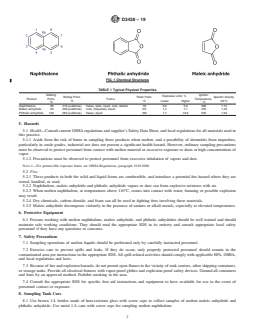
SIGNIFICANCE AND USE
3.1 This practice is issued to provide information useful in establishing sampling procedures. It is expected that this information will only be utilized in conjunction with an existing health and safety program and consultation with the appropriate SDS. The information provided herein cannot be used as a substitute for expert safety and medical advice, but rather as a supplement to such advice.
SCOPE
1.1 This practice covers procedures for sampling and handling naphthalene, maleic anhydride, and phthalic anhydride in various solid forms, and as liquids at elevated temperatures in a safe manner that represents and preserves quality.
1.2 Any person sampling or handling these products should consult the applicable Safety Data Sheet (SDS) for specific first aid instructions and information on the proper equipment to have available for use in the event of personal contact or exposure.
1.3 The values stated in SI units are to be regarded as standard. No other units of measurement are included in this standard.
1.4 This standard does not purport to address all of the safety concerns, if any, associated with its use. It is the responsibility of the user of this standard to establish appropriate safety, health, and environmental practices and determine the applicability of regulatory limitations prior to use. For specific hazard statements, see Sections 3, 4, 5, 6, and 7 and an appropriate SDS.
1.5 This international standard was developed in accordance with internationally recognized principles on standardization established in the Decision on Principles for the Development of International Standards, Guides and Recommendations issued by the World Trade Organization Technical Barriers to Trade (TBT) Committee.
- Status
- Published
- Publication Date
- 31-Oct-2019
- Technical Committee
- D16 - Aromatic, Industrial, Specialty and Related Chemicals
- Drafting Committee
- D16.08 - Handling and Sampling Aromatic and Cyclic Hydrocarbons
Buy Documents

ASTM D3438-19 - Standard Practice for Sampling and Handling Naphthalene, Maleic Anhydride, and Phthalic Anhydride

REDLINE ASTM D3438-19 - Standard Practice for Sampling and Handling Naphthalene, Maleic Anhydride, and Phthalic Anhydride
Overview
ASTM D3438-19 is the internationally recognized standard practice for the sampling and handling of naphthalene, maleic anhydride, and phthalic anhydride. Published by ASTM International, this document outlines reliable procedures to ensure accurate and safe collection and management of these industrial chemicals in both solid and liquid forms. By establishing standardized methods, ASTM D3438-19 helps users preserve the integrity and quality of chemical samples while maintaining stringent safety and environmental controls.
Key Topics
- Handling Procedures: The standard describes processes for working with naphthalene, maleic anhydride, and phthalic anhydride, including both solids (flakes, balls, rods, tablets) and liquids at elevated temperatures.
- Sampling Guidance: Instructions are provided for collecting representative samples from tank cars, metal drums, cans, and bags. Emphasis is placed on preventing contamination and ensuring that samples reflect the true quality of the bulk material.
- Safety Requirements: The document emphasizes the importance of robust health and safety programs, consultation of Safety Data Sheets (SDS), and compliance with local, national, and international regulations such as those set by OSHA and the Department of Transportation.
- Use of Protective Equipment: Guidance is included on personal protective equipment (PPE) and training for personnel involved in chemical sampling or handling.
- Risk Mitigation: Addresses fire, explosion, and chemical exposure hazards, providing recommended practices to reduce workplace incidents.
Applications
ASTM D3438-19 is regularly used in industries where naphthalene, maleic anhydride, and phthalic anhydride are produced, transported, or processed, such as:
- Chemical Manufacturing: Ensures quality control during production by providing precise sample collection methods.
- Quality Assurance Laboratories: Facilitates consistent and reliable analysis of chemical samples.
- Transportation and Logistics: Assures safe handling and regulatory compliance when transferring or delivering chemicals in bulk containers including tank cars, drums, and bags.
- Environmental Health & Safety (EHS) Programs: Informs risk assessments, emergency response plans, and training on the hazards of these chemical compounds.
- Compliance and Regulatory Audits: Satisfies OSHA and Department of Transportation requirements for the safe handling and accurate labeling of hazardous materials.
Related Standards
For comprehensive application and cross-referencing, consider these associated standards:
- ASTM E300: Standard Practice for Sampling Industrial Chemicals - General procedures for the sampling of chemicals, referenced extensively within ASTM D3438-19.
- OSHA 29 CFR 1910.1000 and 1910.1200: U.S. regulations regarding permissible exposure limits and hazard communication.
- Safety Data Sheets (SDS): Mandatory documentation for health and first aid procedures when handling hazardous chemicals.
- DOT Regulations: Requirements for the transportation of hazardous materials, including corrosion and flammability classifications.
Practical Value
Using ASTM D3438-19 ensures organizations can:
- Achieve reliable and reproducible sampling results for accurate chemical analysis.
- Maintain worker safety through standardized protective measures and hazard communication.
- Comply with regulatory requirements and industry best practices, reducing the risk of legal liability.
- Preserve sample integrity, preventing contamination and ensuring product quality during handling and transportation.
By adhering to ASTM D3438-19, professionals handling naphthalene, maleic anhydride, and phthalic anhydride benefit from a robust framework that balances operational efficiency with critical safety and regulatory priorities.
Relations
- Effective Date
- 01-Nov-2019
- Effective Date
- 01-Nov-2019
- Effective Date
- 01-Nov-2019
- Effective Date
- 01-Nov-2019
- Effective Date
- 01-Nov-2019
- Effective Date
- 01-Nov-2019
- Effective Date
- 01-Nov-2019
Buy Documents
ASTM D3438-19 - Standard Practice for Sampling and Handling Naphthalene, Maleic Anhydride, and Phthalic Anhydride
REDLINE ASTM D3438-19 - Standard Practice for Sampling and Handling Naphthalene, Maleic Anhydride, and Phthalic Anhydride
Get Certified
Connect with accredited certification bodies for this standard

ECOCERT
Organic and sustainability certification.

Eurofins Food Testing Global
Global leader in food, environment, and pharmaceutical product testing.

Intertek Bangladesh
Intertek certification and testing services in Bangladesh.
Sponsored listings
Frequently Asked Questions
ASTM D3438-19 is a standard published by ASTM International. Its full title is "Standard Practice for Sampling and Handling Naphthalene, Maleic Anhydride, and Phthalic Anhydride". This standard covers: SIGNIFICANCE AND USE 3.1 This practice is issued to provide information useful in establishing sampling procedures. It is expected that this information will only be utilized in conjunction with an existing health and safety program and consultation with the appropriate SDS. The information provided herein cannot be used as a substitute for expert safety and medical advice, but rather as a supplement to such advice. SCOPE 1.1 This practice covers procedures for sampling and handling naphthalene, maleic anhydride, and phthalic anhydride in various solid forms, and as liquids at elevated temperatures in a safe manner that represents and preserves quality. 1.2 Any person sampling or handling these products should consult the applicable Safety Data Sheet (SDS) for specific first aid instructions and information on the proper equipment to have available for use in the event of personal contact or exposure. 1.3 The values stated in SI units are to be regarded as standard. No other units of measurement are included in this standard. 1.4 This standard does not purport to address all of the safety concerns, if any, associated with its use. It is the responsibility of the user of this standard to establish appropriate safety, health, and environmental practices and determine the applicability of regulatory limitations prior to use. For specific hazard statements, see Sections 3, 4, 5, 6, and 7 and an appropriate SDS. 1.5 This international standard was developed in accordance with internationally recognized principles on standardization established in the Decision on Principles for the Development of International Standards, Guides and Recommendations issued by the World Trade Organization Technical Barriers to Trade (TBT) Committee.
SIGNIFICANCE AND USE 3.1 This practice is issued to provide information useful in establishing sampling procedures. It is expected that this information will only be utilized in conjunction with an existing health and safety program and consultation with the appropriate SDS. The information provided herein cannot be used as a substitute for expert safety and medical advice, but rather as a supplement to such advice. SCOPE 1.1 This practice covers procedures for sampling and handling naphthalene, maleic anhydride, and phthalic anhydride in various solid forms, and as liquids at elevated temperatures in a safe manner that represents and preserves quality. 1.2 Any person sampling or handling these products should consult the applicable Safety Data Sheet (SDS) for specific first aid instructions and information on the proper equipment to have available for use in the event of personal contact or exposure. 1.3 The values stated in SI units are to be regarded as standard. No other units of measurement are included in this standard. 1.4 This standard does not purport to address all of the safety concerns, if any, associated with its use. It is the responsibility of the user of this standard to establish appropriate safety, health, and environmental practices and determine the applicability of regulatory limitations prior to use. For specific hazard statements, see Sections 3, 4, 5, 6, and 7 and an appropriate SDS. 1.5 This international standard was developed in accordance with internationally recognized principles on standardization established in the Decision on Principles for the Development of International Standards, Guides and Recommendations issued by the World Trade Organization Technical Barriers to Trade (TBT) Committee.
ASTM D3438-19 is classified under the following ICS (International Classification for Standards) categories: 71.080.15 - Aromatic hydrocarbons. The ICS classification helps identify the subject area and facilitates finding related standards.
ASTM D3438-19 has the following relationships with other standards: It is inter standard links to ASTM D3438-15, ASTM D2232-23, ASTM D8087-18, ASTM D3366-18, ASTM D6621-21, ASTM D1686-19, ASTM D6875-23. Understanding these relationships helps ensure you are using the most current and applicable version of the standard.
ASTM D3438-19 is available in PDF format for immediate download after purchase. The document can be added to your cart and obtained through the secure checkout process. Digital delivery ensures instant access to the complete standard document.
Standards Content (Sample)
This international standard was developed in accordance with internationally recognized principles on standardization established in the Decision on Principles for the
Development of International Standards, Guides and Recommendations issued by the World Trade Organization Technical Barriers to Trade (TBT) Committee.
Designation: D3438 − 19
Standard Practice for
Sampling and Handling Naphthalene, Maleic Anhydride, and
Phthalic Anhydride
This standard is issued under the fixed designation D3438; the number immediately following the designation indicates the year of
original adoption or, in the case of revision, the year of last revision. A number in parentheses indicates the year of last reapproval. A
superscript epsilon (´) indicates an editorial change since the last revision or reapproval.
1. Scope* 2.2 Other Documents:
OSHA Regulations, 29 CFR paragraphs 1910.1000 and
1.1 This practice covers procedures for sampling and han-
1910.1200
dling naphthalene, maleic anhydride, and phthalic anhydride in
various solid forms, and as liquids at elevated temperatures in
3. Significance and Use
a safe manner that represents and preserves quality.
3.1 This practice is issued to provide information useful in
1.2 Any person sampling or handling these products should
establishing sampling procedures. It is expected that this
consulttheapplicableSafetyDataSheet(SDS)forspecificfirst
information will only be utilized in conjunction with an
aid instructions and information on the proper equipment to
existing health and safety program and consultation with the
have available for use in the event of personal contact or
appropriate SDS. The information provided herein cannot be
exposure.
used as a substitute for expert safety and medical advice, but
1.3 The values stated in SI units are to be regarded as
rather as a supplement to such advice.
standard. No other units of measurement are included in this
standard.
4. Description of Products (See Table 1)
1.4 This standard does not purport to address all of the
4.1 Phthalic anhydride is classified as hazardous by the
safety concerns, if any, associated with its use. It is the
Department of Transportation as a corrosive material and is
responsibility of the user of this standard to establish appro-
therefore subject to DOT regulations governing the transpor-
priate safety, health, and environmental practices and deter-
tation of hazardous materials. Maleic anhydride and naphtha-
mine the applicability of regulatory limitations prior to use.
lene are classified as hazardous by the Department of Trans-
For specific hazard statements, see Sections 3, 4, 5, 6, and 7
portationandaresubjecttoDOTregulations.Maleicanhydride
and an appropriate SDS.
has the classification corrosive material, and naphthalene has
1.5 This international standard was developed in accor-
the classification flammable solid.
dance with internationally recognized principles on standard-
4.1.1 These products are normally transported in several
ization established in the Decision on Principles for the
types of containers, including cartons, barrels, bags, cans,
Development of International Standards, Guides and Recom-
metal and fiber drums, tank trucks, tank cars, and barges.
mendations issued by the World Trade Organization Technical
Barriers to Trade (TBT) Committee.
5. Hazards
5.1 Health—Consult current OSHA regulations and suppli-
2. Referenced Documents
er’s Safety Data Sheet, and local regulations for all materials
2.1 ASTM Standards:
used in this practice.
E300 Practice for Sampling Industrial Chemicals
5.1.1 Aside from the risk of burns in sampling these
products when molten, and a possibility of dermatitis from
impurities, particularly in crude grades, industrial use does not
This practice is under the jurisdiction of ASTM Committee D16 on Aromatic, present a significant health hazard. However, ordinary sam-
Industrial, Specialty and Related Chemicals and is the direct responsibility of
pling precautions must be observed to protect personnel from
Subcommittee D16.08 on Handling and Sampling Aromatic and Cyclic Hydrocar-
contact with molten material or excessive exposure to dusts or
bons.
high concentrations of vapor.
Current edition approved Nov. 1, 2019. Published December 2019. Originally
approved in 1975. Last previous edition approved in 2015 as D3438 – 15. DOI:
10.1520/D3438-19.
For referenced ASTM standards, visit the ASTM website, www.astm.org, or
contact ASTM Customer Service at service@astm.org. For Annual Book of ASTM Available from U.S. Government Printing Office, Superintendent of
Standards volume information, refer to the standard’s Document Summary page on Documents, 732 N. Capitol St., NW, Washington, DC 20401-0001, http://
the ASTM website. www.access.gpo.gov.
*A Summary of Changes section appears at the end of this standard
Copyright © ASTM International, 100 Barr Harbor Drive, PO Box C700, West Conshohocken, PA 19428-2959. United States
D3438 − 19
FIG. 1 Chemical Structures
TABLE 1 Typical Physical Properties
Melting Ignition
Explosive Limit, %
Boiling Point, Flash Point, Specific Gravity,
Product Point, Forms Temperature,
°C °C 20°C
Lower Higher
°C °C
Naphthalene 80 218 (sublimes) flakes, balls, liquid, rods, tablets 78 0.9 5.9 526 1.15
Maleic anhydride 53 200 (sublimes) rods, briquettes, liquid 101 1.4 7.1 470 1.43
Phthalic anhydride 130 284 (sublimes) flakes, liquid 165 1.7 10.5 570 1.53
5.1.2 Precautions must be observed to protect personnel 7.3 Because of fire and explosion hazards, do not permit
from excessive inhalation of vapors and dust. open flames in the vicinity of tank carriers, other shipping
containers, or storage tanks. Provide all electrical fixtures with
NOTE 1—For permissible exposure limits see OSHA Regulations,
vapor-proof globes and explosion-proof safety devices.
paragraph 1910.1000.
Ground all containers and lines by an approved method.
5.2 Fire:
Prohibit smoking in the area.
5.2.1 These products in both the solid and liquid forms are
7.4 Consult the appropriate SDS for specific first aid in-
combustible, and introduce a potential fire hazard where they
structions and equipment to have available for use in the event
are stored, handled, or used.
of personnel contact or exposure.
5.2.2 Naphthalene,maleicanhydrideandphthalicanhydride
vapors or dust can form explosive mixtures with air.
8. Sampling Tank Cars
5.2.3 When molten naphthalene, at temperatures above
8.1 Use brown 1-L bottles made of heat-resistant glass with
110°C, comes into contact with water, foaming or possible
screw caps to collect samples of molten maleic anhydride and
explosion may result.
phthalic anhydride. Use metal 1-L cans with screw caps for
5.2.4 Dry chemicals, carbon dioxide, and foam can all be
sampling molten naphthalene.
used in fighting fires involving these materials.
5.2.5 Maleic anhydride decomposes violently in the pres-
NOTE 2—Caps must have aluminum foil liners.
ence of amines or alkali metals, especially at elev
...
This document is not an ASTM standard and is intended only to provide the user of an ASTM standard an indication of what changes have been made to the previous version. Because
it may not be technically possible to adequately depict all changes accurately, ASTM recommends that users consult prior editions as appropriate. In all cases only the current version
of the standard as published by ASTM is to be considered the official document.
Designation: D3438 − 15 D3438 − 19
Standard Practice for
Sampling and Handling Naphthalene, Maleic Anhydride, and
Phthalic Anhydride
This standard is issued under the fixed designation D3438; the number immediately following the designation indicates the year of
original adoption or, in the case of revision, the year of last revision. A number in parentheses indicates the year of last reapproval. A
superscript epsilon (´) indicates an editorial change since the last revision or reapproval.
1. Scope*
1.1 This practice covers procedures for sampling and handling naphthalene, maleic anhydride, and phthalic anhydride in various
solid forms, and as liquids at elevated temperatures in a safe manner that represents and preserves quality.
1.2 Any person sampling or handling these products should consult the applicable Safety Data Sheet (SDS) for specific first aid
instructions and information on the proper equipment to have available for use in the event of personal contact or exposure.
1.3 The values stated in SI units are to be regarded as standard. No other units of measurement are included in this standard.
1.4 This standard does not purport to address all of the safety concerns, if any, associated with its use. It is the responsibility
of the user of this standard to establish appropriate safety safety, health, and healthenvironmental practices and determine the
applicability of regulatory limitations prior to use. For specific hazard statements, see Sections 3, 4, 5, 6, and 7 and an appropriate
SDS.
1.5 This international standard was developed in accordance with internationally recognized principles on standardization
established in the Decision on Principles for the Development of International Standards, Guides and Recommendations issued
by the World Trade Organization Technical Barriers to Trade (TBT) Committee.
2. Referenced Documents
2.1 ASTM Standards:
E300 Practice for Sampling Industrial Chemicals
2.2 Other Documents:
OSHA Regulations, 29 CFR paragraphs 1910.1000 and 1910.1200
3. Significance and Use
3.1 This practice is issued to provide information useful in establishing sampling procedures. It is expected that this information
will only be utilized in conjunction with an existing health and safety program and consultation with the appropriate SDS. The
information provided herein cannot be used as a substitute for expert safety and medical advice, but rather as a supplement to such
advice.
4. Description of Products (See Table 1)
4.1 Phthalic anhydride is classified as hazardous by the Department of Transportation as a corrosive material and is therefore
subject to DOT regulations governing the transportation of hazardous materials. Maleic anhydride and naphthalene are classified
as hazardous by the Department of Transportation and are subject to DOT regulations. Maleic anhydride has the classification
corrosive material, and naphthalene has the classification flammable solid.
4.1.1 These products are normally transported in several types of containers, including cartons, barrels, bags, cans, metal and
fiber drums, tank trucks, tank cars, and barges.
This practice is under the jurisdiction of ASTM Committee D16 on Aromatic Hydrocarbons Aromatic, Industrial, Specialty and Related Chemicals and is the direct
responsibility of Subcommittee D16.08 on Handling and Sampling Aromatic and Cyclic Hydrocarbons.
Current edition approved June 1, 2015Nov. 1, 2019. Published July 2015December 2019. Originally approved in 1975. Last previous edition approved in 20102015 as
D3438 – 10.D3438 – 15. DOI: 10.1520/D3438-15.10.1520/D3438-19.
For referenced ASTM standards, visit the ASTM website, www.astm.org, or contact ASTM Customer Service at service@astm.org. For Annual Book of ASTM Standards
volume information, refer to the standard’s Document Summary page on the ASTM website.
Available from U.S. Government Printing Office, Superintendent of Documents, 732 N. Capitol St., NW, Mail Stop: SDE, Washington, DC 20401, http://www/ecfr/
gov.20401-0001, http://www.access.gpo.gov.
*A Summary of Changes section appears at the end of this standard
Copyright © ASTM International, 100 Barr Harbor Drive, PO Box C700, West Conshohocken, PA 19428-2959. United States
D3438 − 19
FIG. 1 Chemical Structures
TABLE 1 Typical Physical Properties
Melting Ignition
Explosive Limit, %
Boiling Point, Flash Point, Specific Gravity,
Product Point, Forms Temperature,
°C °C 20°C
Lower Higher
°C °C
Naphthalene 80 218 (sublimes) flakes, balls, liquid, rods, tablets 78 0.9 5.9 526 1.15
Maleic anhydride 53 200 (sublimes) rods, briquettes, liquid 101 1.4 7.1 470 1.43
Phthalic anhydride 130 284 (sublimes) flakes, liquid 165 1.7 10.5 570 1.53
5. Hazards
5.1 Health—Consult current OSHA regulations and supplier’s Safety Data Sheet, and local regulations for all materials used in
this practice.
5.1.1 Aside from the risk of burns in sampling these products when molten, and a possibility of dermatitis from impurities,
particularly in crude grades, industrial use does not present a significant health hazard. However, ordinary sampling precautions
must be observed to protect personnel from contact with molten material or excessive exposure to dusts or high concentrations of
vapor.
5.1.2 Precautions must be observed to protect personnel from excessive inhalation of vapors and dust.
NOTE 1—For permissible exposure limits see OSHA Regulations, paragraph 1910.1000.
5.2 Fire:
5.2.1 These products in both the solid and liquid forms are combustible, and introduce a potential fire hazard where they are
stored, handled, or used.
5.2.2 Naphthalene, maleic anhydride and phthalic anhydride vapors or dust can form explosive mixtures with air.
5.2.3 When molten naphthalene, at temperatures above 110°C, comes into contact with water, foaming or possible explosion
may result.
5.2.4 Dry chemicals, carbon dioxide, and foam can all be used in fighting fires involving these materials.
5.2.5 Maleic anhydride decomposes violently in the presence of amines or alkali metals, especially at elevated temperatures.
6. Protective Equipment
6.1 Persons working with molten naphthalene, maleic anhydride, and phthalic anhydrides should be well trained and should
maintain safe working conditions. They should read the appropriate SDS in its entirety and consult appropriate local safety
personnel if they have any questions or concerns.
7. Safety Precautions
7.1 Sampling operations of molten liquids should be performed only by carefully instructed personnel.
7.2 Exercise care to prevent spills and leaks. If they do occur, only properly protected personnel should remain in the
contaminated area per instructions in the appropriate SDS. All spill-related activities shou
...