

ASTM D6875-23
(Test Method)Standard Test Method for Solidification Point of Industrial Organic Chemicals by Thermistor
General Information
- Abstract
SIGNIFICANCE AND USE
5.1 This test method may be used for process control during the manufacture of organic chemicals described in Section 1, for setting specifications, for development and research work, and to determine if contamination was introduced during shipment.
SCOPE
1.1 This test method covers a general procedure for determining the solidification point of most organic chemicals having appreciable heats of fusion and solidification points between 4 °C and 41 °C.
Note 1: Other test methods for determining freeze point and solidification point of aromatic hydrocarbons include Test Methods D852, D1015, D1016, D3799, D4493, and D6269.
1.2 This test method is applicable to relatively pure compounds only. Solidification point depression is dependent on impurity concentrations.
1.3 The following applies to all specified limits in this test method: for purposes of determining conformance with applicable specifications using this test method, an observed value or a calculated value shall be rounded off “to the nearest unit” in the last right hand digit used in expressing the specification limit, in accordance with the “rounding-off method” of Practice E29.
1.4 The values stated in SI units are to be regarded as standard. No other units of measurement are included in this standard.
1.5 This standard does not purport to address all of the safety concerns, if any, associated with its use. It is the responsibility of the user of this standard to establish appropriate safety, health, and environmental practices and determine the applicability of regulatory limitations prior to use. For a specific hazard statement, see Section 8, Hazards.
1.6 This international standard was developed in accordance with internationally recognized principles on standardization established in the Decision on Principles for the Development of International Standards, Guides and Recommendations issued by the World Trade Organization Technical Barriers to Trade (TBT) Committee.
- Status
- Published
- Publication Date
- 31-Mar-2023
- Technical Committee
- D16 - Aromatic, Industrial, Specialty and Related Chemicals
- Drafting Committee
- D16.04 - Instrumental Analysis
Buy Documents

ASTM D6875-23 - Standard Test Method for Solidification Point of Industrial Organic Chemicals by Thermistor
REDLINE ASTM D6875-23 - Standard Test Method for Solidification Point of Industrial Organic Chemicals by Thermistor
Overview
ASTM D6875-23: Standard Test Method for Solidification Point of Industrial Organic Chemicals by Thermistor provides a precise method for determining the solidification (or freezing) point of relatively pure organic chemicals. Using a thermistor for temperature measurement, this test method supports quality control in industrial chemical processes, research, and specification compliance. It applies to organic compounds with appreciable heats of fusion and solidification points between 4 °C and 41 °C, primarily aromatic hydrocarbons such as benzene, cyclohexane, and p-xylene.
Key Topics
Scope and Applicability
- Designed for organic chemicals with solidification points between 4 °C and 41 °C
- Suitable for process control, research, and setting product specifications
- Applicable to relatively pure chemicals; impurity levels can affect results
Test Method Summary
- A cooled sample is monitored with a thermistor to identify the solidification point
- Measurement focuses on the maximum temperature after the initial formation of a solid phase during cooling
Precision and Reproducibility
- High repeatability and reproducibility for key chemicals such as benzene, cyclohexane, and p-xylene
- Results are reported to the nearest 0.01 °C following significant digit guidelines (ASTM E29)
Safety and Compliance
- Users are responsible for implementing suitable safety, health, and environmental practices
- Considers OSHA regulations and the necessity for protective equipment and fume hoods in handling hazardous substances
Applications
Quality Control in Manufacturing
- Ensures the purity and integrity of industrial organic chemicals during production and before shipment
- Quickly detects contamination introduced in storage or transport, maintaining product standards
Specification Setting
- Objective temperature data supports the development and enforcement of specification limits for chemicals
Research and Development
- Enables consistent measurement of phase transition properties, crucial for chemical process optimization and product development
Laboratory and Process Verification
- Validates conformance to internal or external standards for customers, suppliers, and regulatory bodies
- Facilitates participation in interlaboratory proficiency programs, ensuring global comparability and confidence in test results
Related Standards
ASTM D6875-23 is part of a broader suite of ASTM methods relevant to the measurement of solidification or freezing points in industrial chemicals. Other important referenced standards include:
- ASTM D852: Standard Test Method for Solidification Point of Benzene
- ASTM D1015: Test Method for Freezing Points of High-Purity Hydrocarbons (Withdrawn 2019)
- ASTM D1016: Test Method for Purity of Hydrocarbons from Freezing Points (Withdrawn 2019)
- ASTM D3799: Test Method for Purity of Styrene by Freezing Point Method (Withdrawn 2000)
- ASTM D4493: Test Method for Solidification Point of Bisphenol A
- ASTM D6269: Test Method for Solidification Point of p-Xylene (Withdrawn 2004)
- ASTM D3437, D3438, D3852, D4297: Various sampling and handling practices for chemicals
- ASTM E29: Practice for Using Significant Digits in Test Data to Determine Conformance with Specifications
Practical Value
By standardizing the measurement of solidification points using thermistor technology, ASTM D6875-23 helps laboratories and manufacturers ensure chemical purity, safety, and product quality. Its precision, relevance to common industrial organics, and alignment with international standardization practices make it essential for process engineers, QC chemists, and regulatory compliance professionals in the chemical industry.
Keywords: ASTM D6875-23, solidification point, organic chemicals, thermistor, industrial chemicals, quality control, chemical purity, benzene, cyclohexane, p-xylene, freeze point, ASTM standards
Relations
- Refers
ASTM D3852-20 - Standard Practice for Sampling and Handling Phenol, Cresols, and Cresylic Acid - Effective Date
- 01-Jun-2020
- Effective Date
- 01-Jan-2020
- Effective Date
- 01-Nov-2019
- Effective Date
- 01-Nov-2016
- Refers
ASTM D3852-16 - Standard Practice for Sampling and Handling Phenol, Cresols, and Cresylic Acid - Effective Date
- 01-Jun-2016
- Effective Date
- 01-Jun-2016
- Effective Date
- 01-Jun-2015
- Effective Date
- 01-Jun-2015
- Effective Date
- 01-Apr-2015
- Effective Date
- 01-Jul-2013
- Effective Date
- 01-Jun-2012
- Refers
ASTM D3852-07(2012) - Standard Practice for Sampling and Handling Phenol, Cresols, and Cresylic Acid - Effective Date
- 01-Jun-2012
- Effective Date
- 01-Jan-2011
- Effective Date
- 01-Jun-2010
- Effective Date
- 01-Jun-2010
Buy Documents
ASTM D6875-23 - Standard Test Method for Solidification Point of Industrial Organic Chemicals by Thermistor
REDLINE ASTM D6875-23 - Standard Test Method for Solidification Point of Industrial Organic Chemicals by Thermistor
Get Certified
Connect with accredited certification bodies for this standard

ECOCERT
Organic and sustainability certification.

Eurofins Food Testing Global
Global leader in food, environment, and pharmaceutical product testing.

Intertek Bangladesh
Intertek certification and testing services in Bangladesh.
Sponsored listings
Frequently Asked Questions
ASTM D6875-23 is a standard published by ASTM International. Its full title is "Standard Test Method for Solidification Point of Industrial Organic Chemicals by Thermistor". This standard covers: SIGNIFICANCE AND USE 5.1 This test method may be used for process control during the manufacture of organic chemicals described in Section 1, for setting specifications, for development and research work, and to determine if contamination was introduced during shipment. SCOPE 1.1 This test method covers a general procedure for determining the solidification point of most organic chemicals having appreciable heats of fusion and solidification points between 4 °C and 41 °C. Note 1: Other test methods for determining freeze point and solidification point of aromatic hydrocarbons include Test Methods D852, D1015, D1016, D3799, D4493, and D6269. 1.2 This test method is applicable to relatively pure compounds only. Solidification point depression is dependent on impurity concentrations. 1.3 The following applies to all specified limits in this test method: for purposes of determining conformance with applicable specifications using this test method, an observed value or a calculated value shall be rounded off “to the nearest unit” in the last right hand digit used in expressing the specification limit, in accordance with the “rounding-off method” of Practice E29. 1.4 The values stated in SI units are to be regarded as standard. No other units of measurement are included in this standard. 1.5 This standard does not purport to address all of the safety concerns, if any, associated with its use. It is the responsibility of the user of this standard to establish appropriate safety, health, and environmental practices and determine the applicability of regulatory limitations prior to use. For a specific hazard statement, see Section 8, Hazards. 1.6 This international standard was developed in accordance with internationally recognized principles on standardization established in the Decision on Principles for the Development of International Standards, Guides and Recommendations issued by the World Trade Organization Technical Barriers to Trade (TBT) Committee.
SIGNIFICANCE AND USE 5.1 This test method may be used for process control during the manufacture of organic chemicals described in Section 1, for setting specifications, for development and research work, and to determine if contamination was introduced during shipment. SCOPE 1.1 This test method covers a general procedure for determining the solidification point of most organic chemicals having appreciable heats of fusion and solidification points between 4 °C and 41 °C. Note 1: Other test methods for determining freeze point and solidification point of aromatic hydrocarbons include Test Methods D852, D1015, D1016, D3799, D4493, and D6269. 1.2 This test method is applicable to relatively pure compounds only. Solidification point depression is dependent on impurity concentrations. 1.3 The following applies to all specified limits in this test method: for purposes of determining conformance with applicable specifications using this test method, an observed value or a calculated value shall be rounded off “to the nearest unit” in the last right hand digit used in expressing the specification limit, in accordance with the “rounding-off method” of Practice E29. 1.4 The values stated in SI units are to be regarded as standard. No other units of measurement are included in this standard. 1.5 This standard does not purport to address all of the safety concerns, if any, associated with its use. It is the responsibility of the user of this standard to establish appropriate safety, health, and environmental practices and determine the applicability of regulatory limitations prior to use. For a specific hazard statement, see Section 8, Hazards. 1.6 This international standard was developed in accordance with internationally recognized principles on standardization established in the Decision on Principles for the Development of International Standards, Guides and Recommendations issued by the World Trade Organization Technical Barriers to Trade (TBT) Committee.
ASTM D6875-23 is classified under the following ICS (International Classification for Standards) categories: 71.080.01 - Organic chemicals in general. The ICS classification helps identify the subject area and facilitates finding related standards.
ASTM D6875-23 has the following relationships with other standards: It is inter standard links to ASTM D3852-20, ASTM D4297-15(2020), ASTM D3438-19, ASTM D6809-02(2016), ASTM D3852-16, ASTM D4493-16, ASTM D1015-05(2015), ASTM D4297-15, ASTM D1016-05(2015), ASTM D852-13, ASTM D4493-12, ASTM D3852-07(2012), ASTM D3437-11, ASTM D3437-10, ASTM D3438-10. Understanding these relationships helps ensure you are using the most current and applicable version of the standard.
ASTM D6875-23 is available in PDF format for immediate download after purchase. The document can be added to your cart and obtained through the secure checkout process. Digital delivery ensures instant access to the complete standard document.
Standards Content (Sample)
This international standard was developed in accordance with internationally recognized principles on standardization established in the Decision on Principles for the
Development of International Standards, Guides and Recommendations issued by the World Trade Organization Technical Barriers to Trade (TBT) Committee.
Designation: D6875 − 23
Standard Test Method for
Solidification Point of Industrial Organic Chemicals by
Thermistor
This standard is issued under the fixed designation D6875; the number immediately following the designation indicates the year of
original adoption or, in the case of revision, the year of last revision. A number in parentheses indicates the year of last reapproval. A
superscript epsilon (´) indicates an editorial change since the last revision or reapproval.
1. Scope* 2. Referenced Documents
1.1 This test method covers a general procedure for deter- 2.1 ASTM Standards:
mining the solidification point of most organic chemicals D852 Test Method for Solidification Point of Benzene
having appreciable heats of fusion and solidification points D1015 Test Method for Freezing Points of High-Purity
between 4 °C and 41 °C. Hydrocarbons (Withdrawn 2019)
D1016 Test Method for Purity of Hydrocarbons from Freez-
NOTE 1—Other test methods for determining freeze point and solidifi-
cation point of aromatic hydrocarbons include Test Methods D852, ing Points (Withdrawn 2019)
D1015, D1016, D3799, D4493, and D6269.
D3437 Practice for Sampling and Handling Liquid Cyclic
Products
1.2 This test method is applicable to relatively pure com-
D3438 Practice for Sampling and Handling Naphthalene,
pounds only. Solidification point depression is dependent on
Maleic Anhydride, and Phthalic Anhydride
impurity concentrations.
D3799 Test Method for Purity of Styrene by Freezing Point
1.3 The following applies to all specified limits in this test
Method (Withdrawn 2000)
method: for purposes of determining conformance with appli-
D3852 Practice for Sampling and Handling Phenol, Cresols,
cable specifications using this test method, an observed value
and Cresylic Acid
or a calculated value shall be rounded off “to the nearest unit”
D4297 Practice for Sampling and Handling Bisphenol A(4,4'
in the last right hand digit used in expressing the specification
-Isopropylidinediphenol)
limit, in accordance with the “rounding-off method” of Practice
D4493 Test Method for Solidification Point of Bisphenol
E29.
A(4,4'-Isopropylidenediphenol)
D6269 Test Method for Solidification Point of p-Xylene
1.4 The values stated in SI units are to be regarded as
(Withdrawn 2004)
standard. No other units of measurement are included in this
D6809 Guide for Quality Control and Quality Assurance
standard.
Procedures for Aromatic Hydrocarbons and Related Ma-
1.5 This standard does not purport to address all of the
terials
safety concerns, if any, associated with its use. It is the
E29 Practice for Using Significant Digits in Test Data to
responsibility of the user of this standard to establish appro-
Determine Conformance with Specifications
priate safety, health, and environmental practices and deter-
2.2 Other Documents:
mine the applicability of regulatory limitations prior to use.
OSHA Regulations, 29 CFR paragraphs 1910.1000 and
For a specific hazard statement, see Section 8, Hazards.
1910.1200
1.6 This international standard was developed in accor-
dance with internationally recognized principles on standard-
3. Terminology
ization established in the Decision on Principles for the
3.1 Definitions:
Development of International Standards, Guides and Recom-
mendations issued by the World Trade Organization Technical
Barriers to Trade (TBT) Committee.
For referenced ASTM standards, visit the ASTM website, www.astm.org, or
contact ASTM Customer Service at service@astm.org. For Annual Book of ASTM
Standards volume information, refer to the standard’s Document Summary page on
This test method is under the jurisdiction of ASTM Committee D16 on the ASTM website.
Aromatic, Industrial, Specialty and Related Chemicals and is the direct responsi- The last approved version of this historical standard is referenced on
bility of Subcommittee D16.04 on Instrumental Analysis. www.astm.org.
Current edition approved April 1, 2023. Published April 2023. Originally Available from U.S. Government Printing Office Superintendent of Documents,
approved in 2003. Last previous edition approved in 2018 as D6875 – 18. DOI: 732 N. Capitol St., NW, Mail Stop: SDE, Washington, DC 20401, http://
10.1520/D6875-23. www.access.gpo.gov.
*A Summary of Changes section appears at the end of this standard
Copyright © ASTM International, 100 Barr Harbor Drive, PO Box C700, West Conshohocken, PA 19428-2959. United States
D6875 − 23
3.1.1 solidification point, n—an empirical constant defined 8.3 A fume hood should be used when performing the test
as the temperature at which the liquid phase of a substance is method on hazardous chemicals (OSHA 1910.1450 definition).
in approximate equilibrium with a relatively small portion of
9. Sampling and Handling
the solid phase.
3.1.1.1 Discussion—Solidification point as distinguished
9.1 Sample the material in accordance with Practices
from freezing point is described in Test Method D1015. An
D3437, D3438, D3852, and D4297.
interpretation of mole percent in terms of freezing point is
given in Test Method D1016. 10. Preparation of Apparatus
10.1 Fit the sample container with a two-hole stopper.
4. Summary of Test Method
Through one hole insert the thermistor. Through the other hole
4.1 The solidification point is measured by noting the
insert the shaft of the stirrer. (See Fig. 1).
maximum temperature reached during a cooling cycle after the
10.2 Set temperature bath at 5 °C 6 1 °C below the ex-
appearance of a solid phase.
pected solidification point of the sample.
5. Significance and Use
11. Calibration of Thermistor
5.1 This test method may be used for process control during
the manufacture of organic chemicals described in Section 1,
11.1 Thermistor should be calibrated by the factory at a
for setting specifications, for development and research work,
minimum every two years.
and to determine if contamination was introduced during
11.2 The thermistor may be checked by determining the ice
shipment.
point of water 0.00 °C.
6. Apparatus
12. Sample Preparation
6.1 Ohmmeter, capable of measuring resistance to the near-
12.1 Solids at Room Temperature—Melt the entire sample
est 0.1 ohm in the range of 1000 ohms to 10 000 ohms with
by heating it to about 10 °C above its solidification point and
direct temperature readout.
swirl it for homogeneity.
6.2 Specimen Container, thick walled test tube with 18 mm
12.2 Drying Samples—If required by specifications or
outside diameter and 14 mm inside diameter and 150 mm long.
agreement with customer.
6.3 Stirrer, consisting of a 1 mm stainless steel wire bent
12.2.1 p-Xylene should be dried before testing by placing
into a circular form at right angles to the shaft so it will move
about 100 g of the material in a 400 mL Erlenmeyer flask and
freely in the annular space between the thermistor and the wall
adding about 50 g of 3A molecular sieve.
of the test tube.
12.3 Benzene is a special case and should be saturated with
6.4 Stirring Apparatus (Optional)—The apparatus illus-
water as follows:
trated in Fig. 1 has been demonstrated to be an acceptable
12.3.1 Place 7 mL to 8 mL of the specimen in the sample
replacement for manual stirring.
container.
6.5 Temperature Bath, capable of being controlled at 5 °C 6
12.3.2 Add 1 drop of water to the specimen.
1 °C below the expected solidification point.
12.3.3 Shake the sample tube vigorously.
6.6 Thermistor, in stainless steel housing with resistance
13. Procedure
greater than 2K ohms at 25 °C. Calibration accuracy 60.01 °C.
Drift in resistance equivalent to less than 60.01 °C ⁄year.
13.1 Place 7 mL to
...
This document is not an ASTM standard and is intended only to provide the user of an ASTM standard an indication of what changes have been made to the previous version. Because
it may not be technically possible to adequately depict all changes accurately, ASTM recommends that users consult prior editions as appropriate. In all cases only the current version
of the standard as published by ASTM is to be considered the official document.
Designation: D6875 − 18 D6875 − 23
Standard Test Method for
Solidification Point of Industrial Organic Chemicals by
Thermistor
This standard is issued under the fixed designation D6875; the number immediately following the designation indicates the year of
original adoption or, in the case of revision, the year of last revision. A number in parentheses indicates the year of last reapproval. A
superscript epsilon (´) indicates an editorial change since the last revision or reapproval.
1. Scope*
1.1 This test method covers a general procedure for determining the solidification point of most organic chemicals having
appreciable heats of fusion and solidification points between 4 and 41°C.4 °C and 41 °C.
NOTE 1—Other test methods for determining freeze point and solidification point of aromatic hydrocarbons include Test Methods D852, D1015, D1016,
D3799, D4493, and D6269.
1.2 This test method is applicable to relatively pure compounds only. Solidification point depression is dependent on impurity
concentrations.
1.3 The following applies to all specified limits in this test method: for purposes of determining conformance with applicable
specifications using this test method, an observed value or a calculated value shall be rounded off “to the nearest unit” in the last
right hand digit used in expressing the specification limit, in accordance with the “rounding-off method” of Practice E29.
1.4 The values stated in SI units are to be regarded as standard. No other units of measurement are included in this standard.
1.5 This standard does not purport to address all of the safety concerns, if any, associated with its use. It is the responsibility
of the user of this standard to establish appropriate safety, health, and environmental practices and determine the applicability of
regulatory limitations prior to use. For a specific hazard statement, see Section 8, Hazards.
1.6 This international standard was developed in accordance with internationally recognized principles on standardization
established in the Decision on Principles for the Development of International Standards, Guides and Recommendations issued
by the World Trade Organization Technical Barriers to Trade (TBT) Committee.
2. Referenced Documents
2.1 ASTM Standards:
D852 Test Method for Solidification Point of Benzene
D1015 Test Method for Freezing Points of High-Purity Hydrocarbons (Withdrawn 2019)
D1016 Test Method for Purity of Hydrocarbons from Freezing Points (Withdrawn 2019)
D3437 Practice for Sampling and Handling Liquid Cyclic Products
D3438 Practice for Sampling and Handling Naphthalene, Maleic Anhydride, and Phthalic Anhydride
This test method is under the jurisdiction of ASTM Committee D16 on Aromatic, Industrial, Specialty and Related Chemicals and is the direct responsibility of
Subcommittee D16.04 on Instrumental Analysis.
Current edition approved Jan. 1, 2018April 1, 2023. Published January 2018April 2023. Originally approved in 2003. Last previous edition approved in 20122018 as
D6875 – 12.D6875 – 18. DOI: 10.1520/D6875-18.10.1520/D6875-23.
For referenced ASTM standards, visit the ASTM website, www.astm.org, or contact ASTM Customer Service at service@astm.org. For Annual Book of ASTM Standards
volume information, refer to the standard’s Document Summary page on the ASTM website.
The last approved version of this historical standard is referenced on www.astm.org.
*A Summary of Changes section appears at the end of this standard
Copyright © ASTM International, 100 Barr Harbor Drive, PO Box C700, West Conshohocken, PA 19428-2959. United States
D6875 − 23
D3799 Test Method for Purity of Styrene by Freezing Point Method (Withdrawn 2000)
D3852 Practice for Sampling and Handling Phenol, Cresols, and Cresylic Acid
D4297 Practice for Sampling and Handling Bisphenol A(4,4' -Isopropylidinediphenol)
D4493 Test Method for Solidification Point of Bisphenol A(4,4'-Isopropylidenediphenol)
D6269 Test Method for Solidification Point of p-Xylene (Withdrawn 2004)
D6809 Guide for Quality Control and Quality Assurance Procedures for Aromatic Hydrocarbons and Related Materials
E29 Practice for Using Significant Digits in Test Data to Determine Conformance with Specifications
2.2 Other Documents:
OSHA Regulations, 29 CFR paragraphs 1910.1000 and 1910.1200
3. Terminology
3.1 Definitions:
3.1.1 solidification point, n—an empirical constant defined as the temperature at which the liquid phase of a substance is in
approximate equilibrium with a relatively small portion of the solid phase.
3.1.1.1 Discussion—
Solidification point as distinguished from freezing point is described in Test Method D1015. An interpretation of mole percent in
terms of freezing point is given in Test Method D1016.
4. Summary of Test Method
4.1 The solidification point is measured by noting the maximum temperature reached during a cooling cycle after the appearance
of a solid phase.
5. Significance and Use
5.1 This test method may be used for process control during the manufacture of organic chemicals described in Section 1, for
setting specifications, for development and research work, and to determine if contamination was introduced during shipment.
6. Apparatus
6.1 Ohmmeter, capable of measuring resistance to the nearest 0.1 ohm in the range of 1000 to 10 000 ohms 1000 ohms to
10 000 ohms with direct temperature readout.
6.2 Specimen Container, thick walled test tube with 18 mm outside diameter and 14 mm inside diameter and 150 mm long.
6.3 Stirrer, consisting of a 1-mm1 mm stainless steel wire bent into a circular form at right angles to the shaft so it will move freely
in the annular space between the thermistor and the wall of the test tube.
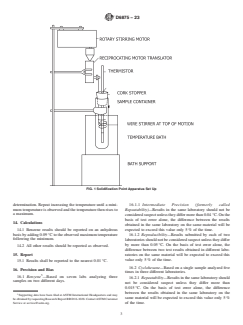
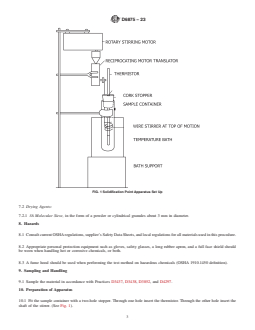
6.4 Stirring Apparatus (Optional)—The apparatus illustrated in Fig. 1 has been demonstrated to be an acceptable replacement for
manual stirring.
6.5 Temperature Bath, capable of being controlled at 5 6 1°C5 °C 6 1 °C below the expected solidification point.
6.6 Thermistor, in stainless steel housing with resistance greater than 2K ohms at 25°C.25 °C. Calibration accuracy
60.01°C.60.01 °C. Drift in resistance equivalent to less than 60.01°C/year.60.01 °C ⁄year. Thermistor shall be calibrated to cover
the range it is used.
7. Reagents and Materials
7.1 Cooling Media:
7.1.1 Water is recommended for solidification points between 4 and 30°C.4 °C and 30 °C.
Available from U.S. Government Printing Office Superintendent of Documents, 732 N. Capitol St., NW, Mail Stop: SDE, Washington, DC 20401, http://
www.access.gpo.gov.
D6875 − 23
FIG. 1 Solidification Point Apparatus Set Up
7.2 Drying Agents:
7.2.1 3A Molecular Sieve, in the form of a powder or cylindrical granules about 3 mm in diameter.
8. Hazards
8.1 Consult current OSHA regulations, supplier’s Safety Data Sheets, and local regulations for all materials used in this procedure.
8.2 Appropriate personal protection equipment such as gloves, safety glasses, a long rubber apron, and a full face shield should
be worn when handling hot or corrosive chemicals, or both.
8.3 A fume hood should be used when performing the test method on hazardous chemicals (OSHA 1910.1450 definition).
9. Sampling and Handling
9.1 Sample the material in accordance with Practices D3437, D3438, D3852, and D4297.
10. Preparation of Apparatus
10.1 Fit the sample container with a two-hole stopper. Through one hole insert the thermistor. Through the other hole insert the
shaft of the stirrer. (See Fig. 1).
D6875 − 23
10.2 Set temperature bath at 5 6 1°C.5 °C 6 1 °C below the expected solidification point of the sample.
11. Calibration of Thermistor
11.1 Thermistor should be calibrated by the factory at
...