

ASTM D4326-21
(Test Method)Standard Test Method for Major and Minor Elements in Coal Ash By X-Ray Fluorescence
General Information
- Abstract
SIGNIFICANCE AND USE
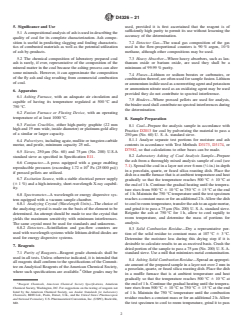
5.1 A compositional analysis of ash is used in describing the quality of coal for its complete characterization. Ash composition is useful in predicting slagging and fouling characteristics of combusted materials as well as the potential utilization of ash by-products.
5.2 The chemical composition of laboratory prepared coal ash is rarely, if ever, representative of the composition of the mineral matter in the coal because the ashing process can alter some minerals. However, it can approximate the composition of the fly ash and slag resulting from commercial combustion of coal.
SCOPE
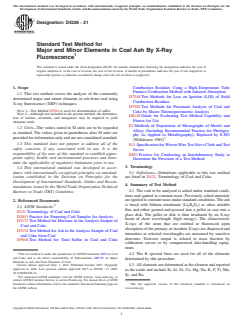
1.1 This test method covers the analysis of the commonly determined major and minor elements in ash from coal using X-ray fluorescence (XRF) techniques.
Note 1: Test Method D5016 is used for determination of sulfur.
Note 2: Although not included in the present method, the determination of barium, strontium, and manganese may be required to yield adequate totals.
1.2 Units—The values stated in SI units are to be regarded as standard. The values given in parentheses after SI units are provided for information only and are not considered standard.
1.3 This standard does not purport to address all of the safety concerns, if any, associated with its use. It is the responsibility of the user of this standard to establish appropriate safety, health, and environmental practices and determine the applicability of regulatory limitations prior to use.
1.4 This international standard was developed in accordance with internationally recognized principles on standardization established in the Decision on Principles for the Development of International Standards, Guides and Recommendations issued by the World Trade Organization Technical Barriers to Trade (TBT) Committee.
- Status
- Published
- Publication Date
- 31-Aug-2021
- Technical Committee
- D05 - Coal and Coke
- Drafting Committee
- D05.29 - Major Elements in Ash and Trace Elements of Coal
Buy Documents
ASTM D4326-21 - Standard Test Method for Major and Minor Elements in Coal Ash By X-Ray Fluorescence
REDLINE ASTM D4326-21 - Standard Test Method for Major and Minor Elements in Coal Ash By X-Ray Fluorescence
Overview
ASTM D4326-21 is the internationally recognized standard test method for quantifying major and minor elements in coal ash using X-ray fluorescence (XRF). Published by ASTM International, this method provides a robust framework for compositional analysis of coal and coke ash, supporting quality assessment and facilitating decisions on utilization, combustion performance, and environmental impact.
Compositional analysis delivered by this method informs predictions of slagging and fouling during coal combustion, as well as potential applications for ash by-products such as in construction materials. While ash produced in the laboratory may differ from mineral matter in raw coal, it closely approximates commercially generated fly ash and slag, making the results highly valuable for industrial practice.
Key Topics
- Elements Analyzed: The method covers the commonly determined major and minor elements in coal and coke ash, including silica (Si), alumina (Al), iron (Fe), calcium (Ca), magnesium (Mg), sodium (Na), potassium (K), phosphorus (P), titanium (Ti), strontium (Sr), barium (Ba), and manganese (Mn).
- Test Principle: Samples are fused with a suitable flux and molded into glass disks or pressed into pellets, then irradiated by high-energy X-rays. Emitted characteristic X-rays are measured, and element concentrations are calculated via calibration.
- Sample Preparation: Standardized procedures for ashing, grinding, fusing, and mounting samples ensure consistency and reliability.
- Calibration and Calculations: Results depend on accurate calibration with certified reference materials and strict adherence to the procedure.
- Precision and Bias: The method delivers clearly defined repeatability and reproducibility guidelines, resulting from extensive interlaboratory studies.
Applications
The ASTM D4326-21 test method is widely employed in:
- Power Generation: Predicting the slagging and fouling potential of coal to prevent boiler maintenance issues.
- Ash Utilization: Supporting the characterization and specification of fly ash for use in cement, concrete, and other building materials.
- Environmental Compliance: Monitoring the elemental composition of combustion residues to ensure regulatory requirements are met.
- Quality Assurance: Enabling consistent evaluation of coal ash for trading, procurement, and research purposes.
- Research and Development: Providing accurate data for developing improved combustion processes, emission control methods, and new ash-based materials.
Related Standards
ASTM D4326-21 should be used in conjunction with other applicable standards to ensure comprehensive coal ash analysis:
- ASTM D121: Terminology of Coal and Coke
- ASTM D346: Collection and Preparation of Coke Samples for Laboratory Analysis
- ASTM D2013: Preparing Coal Samples for Analysis
- ASTM D3173 / D3174 / D7582: Methods for Moisture, Ash, and Proximate Analysis of Coal and Coke
- ASTM D5016: Determination of Total Sulfur in Coal and Coke Combustion Residues
- ASTM D7348: Loss on Ignition of Solid Combustion Residues
- ASTM D8146: Guide for Evaluating Test Method Capability and Fitness for Use
- ASTM E691: Practice for Interlaboratory Studies
Practical Value
Adhering to ASTM D4326-21 assures accuracy and comparability in coal ash elemental analysis, supporting industrial, regulatory, and environmental objectives. The method enables informed decision-making for power producers, material recyclers, environmental managers, and researchers, making it a cornerstone of coal quality and by-product management.
Keywords: ASTM D4326-21, coal ash analysis, X-ray fluorescence, XRF, major elements, minor elements, fly ash, slag, power generation, ash utilization, environmental compliance, coal quality, combustion residues.
Relations
- Effective Date
- 01-Apr-2024
- Effective Date
- 01-Mar-2024
- Effective Date
- 01-Dec-2023
- Effective Date
- 01-Sep-2016
- Effective Date
- 01-Sep-2015
- Effective Date
- 01-Oct-2013
- Effective Date
- 01-May-2013
- Refers
ASTM D3174-12 - Standard Test Method for Ash in the Analysis Sample of Coal and Coke from Coal - Effective Date
- 01-Nov-2012
- Effective Date
- 01-Nov-2011
- Refers
ASTM D3174-11 - Standard Test Method for Ash in the Analysis Sample of Coal and Coke from Coal - Effective Date
- 01-Apr-2011
- Effective Date
- 01-Apr-2011
- Refers
ASTM D3174-04(2010) - Standard Test Method for Ash in the Analysis Sample of Coal and Coke from Coal - Effective Date
- 01-Dec-2010
- Effective Date
- 01-Jun-2010
- Effective Date
- 01-Jun-2010
- Effective Date
- 01-Nov-2009
Buy Documents
ASTM D4326-21 - Standard Test Method for Major and Minor Elements in Coal Ash By X-Ray Fluorescence
REDLINE ASTM D4326-21 - Standard Test Method for Major and Minor Elements in Coal Ash By X-Ray Fluorescence
Get Certified
Connect with accredited certification bodies for this standard

Element Materials Technology
Materials testing and product certification.

ABS Group Brazil
ABS Group certification services in Brazil.

ABS Quality Evaluations Inc.
American Bureau of Shipping quality certification.
Sponsored listings
Frequently Asked Questions
ASTM D4326-21 is a standard published by ASTM International. Its full title is "Standard Test Method for Major and Minor Elements in Coal Ash By X-Ray Fluorescence". This standard covers: SIGNIFICANCE AND USE 5.1 A compositional analysis of ash is used in describing the quality of coal for its complete characterization. Ash composition is useful in predicting slagging and fouling characteristics of combusted materials as well as the potential utilization of ash by-products. 5.2 The chemical composition of laboratory prepared coal ash is rarely, if ever, representative of the composition of the mineral matter in the coal because the ashing process can alter some minerals. However, it can approximate the composition of the fly ash and slag resulting from commercial combustion of coal. SCOPE 1.1 This test method covers the analysis of the commonly determined major and minor elements in ash from coal using X-ray fluorescence (XRF) techniques. Note 1: Test Method D5016 is used for determination of sulfur. Note 2: Although not included in the present method, the determination of barium, strontium, and manganese may be required to yield adequate totals. 1.2 Units—The values stated in SI units are to be regarded as standard. The values given in parentheses after SI units are provided for information only and are not considered standard. 1.3 This standard does not purport to address all of the safety concerns, if any, associated with its use. It is the responsibility of the user of this standard to establish appropriate safety, health, and environmental practices and determine the applicability of regulatory limitations prior to use. 1.4 This international standard was developed in accordance with internationally recognized principles on standardization established in the Decision on Principles for the Development of International Standards, Guides and Recommendations issued by the World Trade Organization Technical Barriers to Trade (TBT) Committee.
SIGNIFICANCE AND USE 5.1 A compositional analysis of ash is used in describing the quality of coal for its complete characterization. Ash composition is useful in predicting slagging and fouling characteristics of combusted materials as well as the potential utilization of ash by-products. 5.2 The chemical composition of laboratory prepared coal ash is rarely, if ever, representative of the composition of the mineral matter in the coal because the ashing process can alter some minerals. However, it can approximate the composition of the fly ash and slag resulting from commercial combustion of coal. SCOPE 1.1 This test method covers the analysis of the commonly determined major and minor elements in ash from coal using X-ray fluorescence (XRF) techniques. Note 1: Test Method D5016 is used for determination of sulfur. Note 2: Although not included in the present method, the determination of barium, strontium, and manganese may be required to yield adequate totals. 1.2 Units—The values stated in SI units are to be regarded as standard. The values given in parentheses after SI units are provided for information only and are not considered standard. 1.3 This standard does not purport to address all of the safety concerns, if any, associated with its use. It is the responsibility of the user of this standard to establish appropriate safety, health, and environmental practices and determine the applicability of regulatory limitations prior to use. 1.4 This international standard was developed in accordance with internationally recognized principles on standardization established in the Decision on Principles for the Development of International Standards, Guides and Recommendations issued by the World Trade Organization Technical Barriers to Trade (TBT) Committee.
ASTM D4326-21 is classified under the following ICS (International Classification for Standards) categories: 75.160.10 - Solid fuels. The ICS classification helps identify the subject area and facilitates finding related standards.
ASTM D4326-21 has the following relationships with other standards: It is inter standard links to ASTM D7582-24, ASTM D121-15(2024), ASTM D7582-15(2023), ASTM D5016-16, ASTM D121-15, ASTM E11-13, ASTM E691-13, ASTM D3174-12, ASTM E691-11, ASTM D3174-11, ASTM D3173-11, ASTM D3174-04(2010), ASTM D7582-10, ASTM D7582-10e1, ASTM D7582-09. Understanding these relationships helps ensure you are using the most current and applicable version of the standard.
ASTM D4326-21 is available in PDF format for immediate download after purchase. The document can be added to your cart and obtained through the secure checkout process. Digital delivery ensures instant access to the complete standard document.
Standards Content (Sample)
This international standard was developed in accordance with internationally recognized principles on standardization established in the Decision on Principles for the
Development of International Standards, Guides and Recommendations issued by the World Trade Organization Technical Barriers to Trade (TBT) Committee.
Designation: D4326 − 21
Standard Test Method for
Major and Minor Elements in Coal Ash By X-Ray
Fluorescence
This standard is issued under the fixed designation D4326; the number immediately following the designation indicates the year of
original adoption or, in the case of revision, the year of last revision.Anumber in parentheses indicates the year of last reapproval.A
superscript epsilon (´) indicates an editorial change since the last revision or reapproval.
1. Scope Combustion Residues Using a High-Temperature Tube
Furnace Combustion Method with Infrared Absorption
1.1 This test method covers the analysis of the commonly
D7348Test Methods for Loss on Ignition (LOI) of Solid
determined major and minor elements in ash from coal using
Combustion Residues
X-ray fluorescence (XRF) techniques.
D7582Test Methods for Proximate Analysis of Coal and
NOTE 1—Test Method D5016 is used for determination of sulfur.
Coke by Macro Thermogravimetric Analysis
NOTE 2—Although not included in the present method, the determina-
D8146Guide for Evaluating Test Method Capability and
tion of barium, strontium, and manganese may be required to yield
Fitness for Use
adequate totals.
E2Methods of Preparation of Micrographs of Metals and
1.2 Units—The values stated in SI units are to be regarded
Alloys (Including Recommended Practice for Photogra-
as standard. The values given in parentheses after SI units are
phy As Applied to Metallography); Replaced by E883
provided for informationonlyandarenotconsideredstandard.
(Withdrawn 1983)
1.3 This standard does not purport to address all of the
E11Specification forWovenWireTest Sieve Cloth andTest
safety concerns, if any, associated with its use. It is the
Sieves
responsibility of the user of this standard to establish appro-
E691Practice for Conducting an Interlaboratory Study to
priate safety, health, and environmental practices and deter-
Determine the Precision of a Test Method
mine the applicability of regulatory limitations prior to use.
3. Terminology
1.4 This international standard was developed in accor-
dance with internationally recognized principles on standard- 3.1 Definitions—Definitions applicable to this test method
ization established in the Decision on Principles for the are listed in D121, Terminology of Coal and Coke.
Development of International Standards, Guides and Recom-
4. Summary of Test Method
mendations issued by the World Trade Organization Technical
4.1 The coal to be analyzed is ashed under standard condi-
Barriers to Trade (TBT) Committee.
tions and ignited to constant mass. Previously ashed materials
2. Referenced Documents areignitedtoconstantmassunderstandardconditions.Theash
is fused with lithium tetraborate (Li B O ) or other suitable
2 4 7
2.1 ASTM Standards:
flux and either ground and pressed into a pellet or cast into a
D121Terminology of Coal and Coke
glass disk. The pellet or disk is then irradiated by an X-ray
D2013Practice for Preparing Coal Samples for Analysis
beam of short wavelength (high energy). The characteristic
D3173Test Method for Moisture in theAnalysis Sample of
X-rays of the atom that are emitted or fluoresced upon
Coal and Coke
absorption of the primary or incident X-rays are dispersed and
D3174Test Method forAsh in theAnalysis Sample of Coal
intensities at selected wavelengths are measured by sensitive
and Coke from Coal
detectors. Detector output is related to mass fraction by
D5016Test Method for Total Sulfur in Coal and Coke
calibration curves or by computerized data-handling equip-
ment.
This test method is under the jurisdiction of ASTM Committee D05 on Coal 4.2 The K spectral lines are used for all of the elements
and Coke and is the direct responsibility of Subcommittee D05.29 on Major
determined by this procedure.
Elements in Ash and Trace Elements of Coal.
4.3 Allelementsaredeterminedastheelementandreported
Current edition approved Sept. 1, 2021. Published October 2021. Originally
approved in 1984. Last previous edition approved 2013 as D4326–13. DOI:
as the oxide and include Si,Al, Fe, Ca, Mg, Na, K, P, Ti, Mn,
10.1520/D4326-21.
Sr, and Ba.
For referenced ASTM standards, visit the ASTM website, www.astm.org, or
contact ASTM Customer Service at service@astm.org. For Annual Book of ASTM
Standards volume information, refer to the standard’s Document Summary page on The last approved version of this historical standard is referenced on
the ASTM website. www.astm.org.
Copyright © ASTM International, 100 Barr Harbor Drive, PO Box C700, West Conshohocken, PA 19428-2959. United States
D4326 − 21
5. Significance and Use used, provided it is first ascertained that the reagent is of
sufficiently high purity to permit its use without lessening the
5.1 Acompositionalanalysisofashisusedindescribingthe
accuracy of the determination.
quality of coal for its complete characterization. Ash compo-
sition is useful in predicting slagging and fouling characteris- 7.2 Detector Gas—The usual gas composition of the gas
tics of combusted materials as well as the potential utilization used in the flow-proportional counters is 90% argon, 10%
of ash by-products. methane, although other compositions may be used.
5.2 The chemical composition of laboratory prepared coal 7.3 Heavy Absorber—Where heavy absorbers, such as lan-
ash is rarely, if ever, representative of the composition of the thanum oxide or barium oxide, are used they shall be a
mineral matter in the coal because the ashing process can alter minimum of 99.99% purity.
some minerals. However, it can approximate the composition
7.4 Fluxes—Lithium or sodium borates or carbonates, or
of the fly ash and slag resulting from commercial combustion
combinationthereof,areoftenusedforsamplefusion.Lithium
of coal.
orammoniumiodideusedasanonwettingagentandpotassium
or ammonium nitrate used as an oxidizing agent may be used
6. Apparatus
provided they do not contribute to spectral interference.
6.1 Ashing Furnace, with an adequate air circulation and
7.5 Binders—Where pressed pellets are used for analysis,
capable of having its temperature regulated at 500°C and
thebinderusedshallcontributenospectralinterferencesduring
750°C.
the determination.
6.2 Fusion Furnace or Fluxing Device, with an operating
temperature of at least 1000°C.
8. Sample Preparation
6.3 Fusion Crucibles, either high-purity graphite (22 mm
8.1 Coal—Prepare the analysis sample in accordance with
high and 19 mm wide, inside diameter) or platinum-gold alloy
Practice D2013 for coal by pulverizing the material to pass a
of a similar or larger capacity.
250µm (No. 60) U. S. A. standard sieve.
8.1.1 Analyze separate test portions for moisture and ash
6.4 Pulverizers, including agate, mullite or tungsten carbide
contents in accordance with Test Methods D3173, D3174,or
mortar, and pestle, minimum capacity 25 mL.
D7582, so that calculations to other bases can be made.
6.5 Sieves, 250µm (No. 60) and 75µm (No. 200) U.S.A
standard sieve as specified in Specification E11. 8.2 Laboratory Ashing of Coal Analysis Sample—Prepare
the ash from a thoroughly mixed analysis sample of coal (see
6.6 Compactor—A press equipped with a gauge enabling
8 7.1). Spread the coal in a layer not over 6 mm ( ⁄4in.) in depth
reproducible pressures (exceeding 1.72×10 Pa (25000 psi))
in a porcelain, quartz, or fused silica roasting dish. Place the
if pressed pellets are utilized.
dishinamufflefurnacethatisatambienttemperatureandheat
6.7 Excitation Source, with a stable electrical power supply
gradually so that the temperature reaches 500°C 6 10°C at
(61%) and a high-intensity, short-wavelength X-ray capabil-
the end of 1h. Continue the gradual heating until the tempera-
ity.
ture rises from 500°C 6 10°C to 750°C 6 15°C at the end
of1h.Maintainthe750°Ctemperatureuntilthetestspecimen
6.8 Spectrometer—A wavelength or energy dispersive sys-
reachesaconstantmassorforanadditional2h.Allowthedish
tem equipped with a vacuum sample chamber.
tocooltoroomtemperature,transfertheashtoanagatemortar,
6.8.1 Analyzing Crystal (Wavelength Units)—The choice of
and grind it to pass a 75µm (No. 200) U. S.A. standard sieve.
the analyzing crystal is made on the basis of the element to be
Reignite the ash at 750°C for 1h, allow to cool rapidly to
determined.An attempt should be made to use the crystal that
room temperature, and determine the mass of portions for
yields the maximum sensitivity with minimum interferences.
analysis.
The same crystal must be used for standards and unknowns.
6.8.2 Detectors—Scintillation and gas-flow counters are
8.3 Solid Combustion Residue—Dry a representative por-
used with wavelength systems while lithium-drifted diodes are
tion of the solid residue to constant mass at 107°C 6 3°C.
used for energy dispersive systems.
Determine the moisture loss during this drying step if it is
desirable to calculate results to an as-received basis. Crush the
7. Reagents
dried portion of the sample to pass a 75µm (No. 200) U. S.A.
7.1 Purity of Reagents—Reagent grade chemicals shall be
standardsieve.Useamillthatminimizesmetalcontamination.
used in all tests. Unless otherwise indicated, it is intended that
8.4 Ashing Solid Combustion Residue—Spread an appropri-
all reagents shall conform to the specifications of the Commit-
ate amount of the prepared sample in a layer not over 2 mm in
tee onAnalytical Reagents of theAmerican Chemical Society,
a porcelain, quartz, or fused silica roasting dish. Place the dish
where such specifications are available. Other grades may be
in a muffle furnace that is at ambient temperature and heat
gradually so that the temperature reaches 500°C 6 10°C at
the end of 1h. Continue the gradual heating until the tempera-
Reagent Chemicals, American Chemical Society Specifications, American
Chemical Society, Washington, DC. For suggestions on the testing of reagents not
ture rises from 500°C 6 10°C to 750°C 6 15°C at the end
listed by the American Chemical Society, see Analar Standards for Laboratory
of 1 h. Maintain the 750°C temperature until the combustion
Chemicals, BDH Ltd., Poole, Dorset, U.K., and the United States Pharmacopeia
residue reaches a constant mass or for an additional 2h.Allow
and National Formulary, U.S. Pharmaceutical Convention, Inc. (USPC), Rockville,
MD. the test specimen to cool to room temperature, grind it to pass
D4326 − 21
a 75µm (No. 200) U. S. A. standard sieve, and reignite it at 9.4 The glass disk must be cooled at a rate that is fast
750°C for 1h and allow to cool to room temperature. enough to prevent any segregation occurring and, at the same
time, slowly enough to prevent stresses that will crack the
8.5 If previously ignited samples are stored and the absorp-
glass. Cracked glass disks may be refused and recast without
tionofmoistureofCO ,orboth,isinquestion,reignitetheash
loss of precision.
at 750°C before use.Alternatively, determine loss on ignition
using Test Method D7348 on a separate sample whose mass is 9.5 Whichever method of preparation of the analytical
determined at the same time as the test portion and make the mount is used, it is essential that a smooth, uniform, and flat
necessary corrections. Thoroughly mix each sample before surface is exposed to the exciting radiation.
determining its mass.
9.6 It is essential that the entire sample preparation proce-
dure (including sample mass, flux mass and ratio, grinding,
9. Preparation of Analytical Sample
casting, and so forth) be followed precisely for all analytical
9.1 Mix the powdered sample, determine the mass of a
mounts and standards. Even a small change in the selected
portion of the sample, and mix with a suitable amount of flux
procedures will require remaking of all standards to match the
(2g to 10 g of flux per gram of sample) (Note 3). When a
changedprocedure.Allcalibrationstandardsandtheunknowns
heavy absorber is used (Note 5), it is added at this point in an
to be used with them must be prepared in exactly the same
amount equal to the amount of sample and thoroughly blended
manner with all mass determinations to be made to the nearest
with the mix. A portion of the flux used as a cap on the mix
1 mg.
ensureswashingdownanyofthematerialfromthesidesofthe
crucible. Add all fluxes and other additives in an appropriate
10. Preparation of XRF Spectrometer
manner at the time of sample preparation.
10.1 Follow the manufacturer’s instruction for the initial
NOTE 3—The amount of sample and flux used are determined by the
assembly, conditioning, and preparation of the XRF unit.
necessity of forming a disk or pellet of 2mm thickness to fit the sample
10.2 Follow the manufacturer’s instructions with respect to
holder of the spectrometer used.
NOTE 4—Beads thinner than 5mm might not be infinitely thick for Sr control setting and operation.
K-L radiation. If the specimen (in this case the bead) is not infinitely
2,3
thickforoneormoreanalytes,thentheintensityofthoseanalytesdepends
11. Excitation and Exposure
notonlyonthecompositionbutalsoonthethickness.Unlessthethickness
11.1 Position the sample in the chamber provided for this
istakenintoaccountexplicitly,determinationofthemassfractionsisthen
purpose. Avoid touching or otherwise contaminating the
much more difficult. In this case, it is important that the mass of sample
and flux is strictly controlled and that loss of ignition (LOI) during fusion
samplesurface.Produceandrecordthespectrumatthesettings
is kept to a minimum.An alternative is to use thicker beads by increasing
recommended for the instrument. Prepare and analyze dupli-
the masses of sample and flux.
cate mounts for all samples with duplicate readings on each
9.1.1 Fluxing materials commonly available are not consis-
mount.Forin-houselaboratories,singledeterminationsmaybe
tent and can vary in volatile losses upon fusing. In order to
performed as long as the precision and bias limits are met.
eliminate errors caused by this loss, use one of the following
12. Safety Precautions
two methods. First, a sample of known mass from each lot of
flux is fused and a loss on fusion is determined, which is then
12.1 It is necessary to obtain training before using X-ray
applied as a correction for each sample prepared from that lot
fluorescence equipment and important to understand com-
of flux. Or, alternatively, the entire mass of each sample
pletely the operation of the instrument to ensure that the
prepared (flux, sample, and heavy absorber, if used) may be
provisions of 1.3 are met.
determined and an independent fusion loss calculated.
13. Calculations and Calibration
NOTE5—Useofaheavyabsorberhastheadvantageofallowingtheuse
of a much smaller sample mass to reach infinite thickness and allows for
13.1 Standards for calibration may be prepared from stan-
calculation of mass fractions using a simple linear regression coefficient.
dard reference materials or synthetically blended pure com-
Itdoes,however,preventdeterminationofanumberoftraceelementsand
pounds. It is required that the range of mass fractions repre-
may be impractical for energy dispersive systems where its addition may
sented by the standards exceeds that of any unknown.
cause increased detector dead time and complicate correction procedures.
The use of a heavy absorber is recommended only when its absence is
13.2 Calculationofelementalmassfractionsmaybeaccom-
impractical or inconvenient.
plished by empirical fundamental parameter or linear regres-
9.2 The sample mix is fused at approximately 1000°C, in a
sion in accordance with Practice E2.
fusion furnace of fluxing device, for a length of time sufficient
to guarantee complete dissolution of the sample. Some type of 14. Precision and Bias
agitation of the crucible, such as swirling or shaking, must be
14.1 Precision—The relative precision of this test method
used in order to ensure a uniform melt.
for the determination of major and minor elements in coal
combustion residues was calculated from data obtained from
9.3 The fusion melt will then be made into a suitable mount
bycastingtheliquidintoamoldandformingaglassdiskorby ashes with the mass fraction ranges shown in Table 1.
allowing the pellet to cool, grinding to a fine powder with 2%
of a plasticizer or binder, and pressing into a pellet at a
Supporting data have been filed atASTM International Headquarters and may
minimum of 1.72×10 Pa pressure with a suitable backing as
beobtainedbyrequestingResearchReportRR:D05-2003.ContactASTMCustomer
added support. Service at service@astm.org.
D4326 − 21
TABLE 1 Mass Fraction Range and Limits for Repeatability and
Reproducibility for Major and Minor Elemental Oxides in Ash
A,B
(Dry Basis) from Combustion Residues
Parameter Mass Fraction Repeatability Reproducibility
Range, % Limit, Limit,
r R
SiO 30.12 to 63.95 0.818 1.736
Al O 11.87 to 33.76 0.020x¯ + 0.173 0.049x¯ + 0.577
2 3
Fe O 3.09 to 42.26 0.009x¯ + 0.137 0.041x¯ + 0.416
2 3
TiO 0.50 to 3.66 0.017x¯ + 0.038 0.091x¯ + 0.092
CaO 1.50 to 25.77 0.016x¯ + 0.083 0.056x¯ + 0.076
MgO 0.75 to 7.27 0.014x¯ + 0.095 0.056x¯ + 0.242
Na O 1.16 to 7.31 0.008x¯ + 0.152 0.108x¯ + 0.282
K O 0.28 to 3.08 0.075x¯ - 0.0
...
This document is not an ASTM standard and is intended only to provide the user of an ASTM standard an indication of what changes have been made to the previous version. Because
it may not be technically possible to adequately depict all changes accurately, ASTM recommends that users consult prior editions as appropriate. In all cases only the current version
of the standard as published by ASTM is to be considered the official document.
Designation: D4326 − 13 D4326 − 21
Standard Test Method for
Major and Minor Elements in Coal and Coke Ash By X-Ray
Fluorescence
This standard is issued under the fixed designation D4326; the number immediately following the designation indicates the year of
original adoption or, in the case of revision, the year of last revision. A number in parentheses indicates the year of last reapproval. A
superscript epsilon (´) indicates an editorial change since the last revision or reapproval.
1. Scope
1.1 This test method covers the analysis of the commonly determined major and minor elements in ash from coal or coke using
X-ray fluorescence (XRF) techniques.
NOTE 1—Test Method D5016 is used for determination of sulfur.
NOTE 2—Although not included in the present method, the determination of barium, strontium, and manganese may be required to yield adequate totals.
1.2 Units—The values stated in SI units are to be regarded as standard. No other units of measurement are included in this The
values given in parentheses after SI units are provided for information only and are not considered standard.
1.3 This standard does not purport to address all of the safety concerns, if any, associated with its use. It is the responsibility
of the user of this standard to establish appropriate safety safety, health, and healthenvironmental practices and determine the
applicability of regulatory limitations prior to use.
1.4 This international standard was developed in accordance with internationally recognized principles on standardization
established in the Decision on Principles for the Development of International Standards, Guides and Recommendations issued
by the World Trade Organization Technical Barriers to Trade (TBT) Committee.
2. Referenced Documents
2.1 ASTM Standards:
D121 Terminology of Coal and Coke
D346 Practice for Collection and Preparation of Coke Samples for Laboratory Analysis
D2013 Practice for Preparing Coal Samples for Analysis
D3173 Test Method for Moisture in the Analysis Sample of Coal and Coke
D3174 Test Method for Ash in the Analysis Sample of Coal and Coke from Coal
D5016 Test Method for Total Sulfur in Coal and Coke Combustion Residues Using a High-Temperature Tube Furnace
Combustion Method with Infrared Absorption
D7348 Test Methods for Loss on Ignition (LOI) of Solid Combustion Residues
D7582 Test Methods for Proximate Analysis of Coal and Coke by Macro Thermogravimetric Analysis
D8146 Guide for Evaluating Test Method Capability and Fitness for Use
This test method is under the jurisdiction of ASTM Committee D05 on Coal and Coke and is the direct responsibility of Subcommittee D05.29 on Major Elements in
Ash and Trace Elements of Coal.
Current edition approved Sept. 1, 2013Sept. 1, 2021. Published September 2013October 2021. Originally approved in 1984. Last previous edition approved 20112013 as
D4326 – 11.D4326 – 13. DOI: 10.1520/D4326-13.10.1520/D4326-21.
For referenced ASTM standards, visit the ASTM website, www.astm.org, or contact ASTM Customer Service at service@astm.org. For Annual Book of ASTM Standards
volume information, refer to the standard’s Document Summary page on the ASTM website.
Copyright © ASTM International, 100 Barr Harbor Drive, PO Box C700, West Conshohocken, PA 19428-2959. United States
D4326 − 21
E2 Methods of Preparation of Micrographs of Metals and Alloys (Including Recommended Practice for Photography As Applied
to Metallography); Replaced by E 883 (Withdrawn 1983)
E11 Specification for Woven Wire Test Sieve Cloth and Test Sieves
E691 Practice for Conducting an Interlaboratory Study to Determine the Precision of a Test Method
3. Terminology
3.1 Definitions—Definitions applicable to this test method are listed in D121, Terminology of Coal and Coke.
4. Summary of Test Method
4.1 The coal or coke to be analyzed is ashed under standard conditions and ignited to constant weight.mass. Previously ashed
materials are ignited to constant weightmass under standard conditions. The ash is fused with lithium tetraborate (Li B O ) or other
2 4 7
suitable flux and either ground and pressed into a pellet or cast into a glass disk. The pellet or disk is then irradiated by an X-ray
beam of short wavelength (high energy). The characteristic X-rays of the atom that are emitted or fluoresced upon absorption of
the primary or incident X-rays are dispersed and intensities at selected wavelengths are measured by sensitive detectors. Detector
output is related to concentration mass fraction by calibration curves or by computerized data-handling equipment.
4.2 The K spectral lines are used for all of the elements determined by this procedure.
4.3 All elements are determined as the element and reported as the oxide and include Si, Al, Fe, Ca, Mg, Na, K, P, Ti, Mn, Sr,
and Ba.
5. Significance and Use
5.1 A compositional analysis of ash is used in describing the quality of coal for its complete characterization. Ash composition
is useful in predicting slagging and fouling characteristics of combusted materials as well as the potential utilization of ash
by-products.
5.2 The chemical composition of laboratory prepared coal or coke ash is rarely, if ever, representative of the composition of the
mineral matter in the coal because the ashing process can alter some minerals. However, it can approximate the composition of
the fly ash and slag resulting from commercial combustion of coal or coke.coal.
6. Apparatus
6.1 Ashing Furnace, with an adequate air circulation and capable of having its temperature regulated at 500°C500 °C and
750°C.750 °C.
6.2 Fusion Furnace or Fluxing Device, with an operating temperature of at least 1000°C.1000 °C.
6.3 Fusion Crucibles, either high-purity graphite (22 mm high and 19 mm wide, inside diameter) or platinum-gold alloy of a
similar or larger capacity.
6.4 Pulverizers, including agate, mullite or tungsten carbide mortar, and pestle, minimum capacity 25 mL.
6.5 Sieves, 250-μm250 μm (No. 60) and 75-μm75 μm (No. 200) U.S.A standard sieve as specified in Specification E11.
6.6 Compactor—A press equipped with a gagegauge enabling reproducible pressures (exceeding 1.72 × 10 Pa (25 000 psi)) if
pressed pellets are utilized.
6.7 Excitation Source, with a stable electrical power supply (61 %)(6 1 %) and a high-intensity, short-wavelength X-ray
capability.
The last approved version of this historical standard is referenced on www.astm.org.
D4326 − 21
6.8 Spectrometer—A wavelength or energy dispersive system equipped with a vacuum sample chamber.
6.8.1 Analyzing Crystal (Wavelength Units)—The choice of the analyzing crystal is made on the basis of the element to be
determined. An attempt should be made to use the crystal that yields the maximum sensitivity with minimum interferences. The
same crystal must be used for standards and unknowns.
6.8.2 Detectors—Scintillation and gas-flow counters are used with wavelength systems while lithium-drifted diodes are used for
energy dispersive systems.
7. Reagents
7.1 Purity of Reagents—Reagent grade chemicals shall be used in all tests. Unless otherwise indicated, it is intended that all
reagents shall conform to the specifications of the Committee on Analytical Reagents of the American Chemical Society, where
such specifications are available. Other grades may be used, provided it is first ascertained that the reagent is of sufficiently high
purity to permit its use without lessening the accuracy of the determination.
7.2 Detector Gas—The usual gas composition of the gas used in the flow-proportional counters is 90 % argon, 10 % methane,
although other compositions may be used.
7.3 Heavy Absorber—Where heavy absorbers, such as lanthanum oxide or barium oxide, are used they shall be a minimum of
99.99 % purity.
7.4 Fluxes—Lithium or sodium borates or carbonates, or combination thereof, are often used for sample fusion. Lithium or
ammonium iodide used as a nonwetting agent and potassium or ammonium nitrate used as an oxidizing agent may be used
provided they do not contribute to spectral interference.
7.5 Binders—Where pressed pellets are used for analysis, the binder used shall contribute no spectral interferences during the
determination.
8. Sample Preparation
8.1 Coal and Coke—Coal—Prepare the analysis sample in accordance with Practice D2013 for coal or Practice D346 for coke by
pulverizing the material to pass a 250-μm250 μm (No. 60) U. S. A. standard sieve.
8.1.1 Analyze separate test portions for moisture and ash contents in accordance with Test Methods D3173, D3174, or D7582, so
that calculations to other bases can be made.
8.2 Laboratory Ashing of Coal and Coke Analysis Sample—Prepare the ash from a thoroughly mixed analysis sample of coal or
coke (see 7.1). Spread the coal and coke in a layer not over 6 mm (1/4( ⁄4 in.) in.) in depth in a porcelain, quartz, or fused silica
roasting dish. Place the dish in a muffle furnace that is at ambient temperature and heat gradually so that the temperature reaches
500500 °C 6 10°C10 °C at the end of 1 h. 1 h. Continue the gradual heating until the temperature rises from 500500 °C 6
10°C10 °C to 750750 °C 6 15°C15 °C at the end of 1 h. 1 h. Maintain the 750°C750 °C temperature until the test specimen
reaches a constant mass or for an additional two hours.2 h. Allow the dish to cool, transfer cool to room temperature, transfer the
ash to an agate mortar, and grind it to pass a 75-μm75 μm (No. 200) U. S. A. standard sieve. Reignite the ash at 750°C for 1 h,
cool rapidly, and weigh 750 °C for 1 h, allow to cool rapidly to room temperature, and determine the mass of portions for analysis.
8.3 Solid Combustion Residue—Dry a representative portion of the solid residue to constant mass at 107107 °C 6 3°C.3 °C.
Determine the moisture loss during this drying step if it is desirable to calculate results to an as-received basis. Crush the dried
portion of the sample to pass a 75-μm75 μm (No. 200) U. S. A. standard sieve. Use a mill that minimizes metal contamination.
8.4 Ashing Solid Combustion Residue—Spread an appropriate amount of the prepared sample in a layer not over 2 mm in a
Reagent Chemicals, American Chemical Society Specifications, American Chemical Society, Washington, DC. For suggestions on the testing of reagents not listed by
the American Chemical Society, see Analar Standards for Laboratory Chemicals, BDH Ltd., Poole, Dorset, U.K., and the United States Pharmacopeia and National
Formulary, U.S. Pharmaceutical Convention, Inc. (USPC), Rockville, MD.
D4326 − 21
porcelain, quartz, or fused silica roasting dish. Place the dish in a muffle furnace that is at ambient temperature and heat gradually
so that the temperature reaches 500500 °C 6 10°C10 °C at the end of 1 h. 1 h. Continue the gradual heating until the temperature
rises from 500500 °C 6 10°C10 °C to 750750 °C 6 15°C15 °C at the end of 1 h. Maintain the 750°C750 °C temperature until
the combustion residue reaches a constant mass or for an additional two h. Cool the test specimen, grind 2 h. Allow the test
specimen to cool to room temperature, grind it to pass a 75-μm75 μm (No. 200) U. S. A. standard sieve, and reignite it at 750°C
for 1 h.750 °C for 1 h and allow to cool to room temperature.
8.5 If previously ignited samples are stored and the absorption of moisture of CO , or both, is in question, reignite the ash at
750°C750 °C before use. Alternatively, determine loss on ignition using Test Method D7348 on a separate sample weighed out
whose mass is determined at the same time as the test portion and make the necessary corrections. Thoroughly mix each sample
before weighing.determining its mass.
9. Preparation of Analytical Sample
9.1 Mix the powdered sample, weigh determine the mass of a portion of the sample, and mix with a suitable amount of flux (2(2 g
to 10 g of flux per gram of sample) (Note 3). When a heavy absorber is used (Note 45), it is added at this point in an amount equal
to the amount of sample and thoroughly blended with the mix. A portion of the flux used as a cap on the mix ensures washing down
any of the material from the sides of the crucible. Add all fluxes and other additives in an appropriate manner at the time of sample
preparation.
NOTE 3—The amount of sample and flux used are determined by the necessity of forming a disk or pellet of 2-mm2 mm thickness to fit the sample holder
of the spectrometer used. All fluxes and other additives should be added in an appropriate manner at the time of sample preparation.
NOTE 4—Beads thinner than 5 mm might not be infinitely thick for Sr K-L radiation. If the specimen (in this case the bead) is not infinitely thick for
2,3
one or more analytes, then the intensity of those analytes depends not only on the composition but also on the thickness. Unless the thickness is taken
into account explicitly, determination of the mass fractions is then much more difficult. In this case, it is important that the mass of sample and flux is
strictly controlled and that loss of ignition (LOI) during fusion is kept to a minimum. An alternative is to use thicker beads by increasing the masses of
sample and flux.
9.1.1 Fluxing materials commonly available are not consistent and can vary in volatile losses upon fusing. In order to eliminate
errors caused by this loss, use one of three methods must be employed. First, the entire bottle of flux may be heated to the fused
state, then cooled, reground, and stored in a desiccator. Second, a weighed sample from each bottle the following two methods.
First, a sample of known mass from each lot of flux is fused and a loss on fusion is determined, which is then applied as a correction
for each sample prepared from that bottle. Third, lot of flux. Or, alternatively, the entire mass of each sample prepared (flux,
sample, and heavy absorber, if used) may be weigheddetermined and an independent fusion loss calculated.
NOTE 5—Use of a heavy absorber has the advantage of allowing the use of a much smaller sample weightmass to reach infinite thickness and allows for
calculation of concentrations mass fractions using a simple linear regression coefficient. It does, however, prevent determination of a number of trace
elements and may be impractical for energy dispersive systems where its addition may cause increased detector dead time and complicate correction
procedures. The use of a heavy absorber is recommended only when its absence is impractical or inconvenient.
9.2 The sample mix is fused at approximately 1000°C,1000 °C, in a fusion furnace of fluxing device, for a length of time sufficient
to guarantee complete dissolution of the sample. Some type of agitation of the crucible, such as swirling or shaking, must be used
in order to ensure a uniform melt.
9.3 The fusion melt will then be made into a suitable mount by casting the liquid into a mold and forming a glass disk or by
allowing the pellet to cool, grinding to a fine powder with 2 % of a plasticizer or binder, and pressing into a pellet at a minimum
of 1.72 × 10 Pa pressure with a suitable backing as added support.
9.4 The glass disk must be cooled at a rate that is fast enough to prevent any segregation occurring and, at the same time, slowly
enough to prevent stresses that will crack the glass. Cracked glass disks may be refused and recast without loss of precision.
9.5 Whichever method of preparation of the analytical mount is used, it is essential that a smooth, uniform, and flat surface is
exposed to the exciting radiation.
9.6 It is essential that the entire sample preparation procedure (including sample weight,mass, flux weightmass and ratio, grinding,
casting, and so forth) be followed precisely for all analytical mounts and standards. Even a small change in the selected procedures
D4326 − 21
will require remaking of all standards to match the changed procedure. All calibration standards and the unknowns to be used with
them must be prepared in exactly the same manner with all weighings mass determinations to be made to the nearest 1 mg.
10. Preparation of XRF Spectrometer
10.1 Follow the manufacturer’s instruction for the initial assembly, conditioning, and preparation of the XRF unit.
10.2 Follow the manufacturer’s instructions with respect to control setting and operation.
11. Excitation and Exposure
11.1 Position the sample in the chamber provided for this purpose. Avoid touching or otherwise contaminating the sample surface.
Produce and record the spectrum at the settings recommended for the instrument. Prepare and analyze duplicate mounts for all
samples with duplicate readings on each mount. For in-house laboratories, single determinations may be performed as long as the
precision and bias limits are met.
12. Safety Precautions
12.1 It is necessary to obtain training before using X-ray fluorescence equipment and important to understand completely the
operation of the instrument to ensure that the provisions of 1.3 are met.
13. Calculations and Calibration
13.1 Standards for calibration may be prepared from standard reference materials or synthetically blended pure compounds. It is
required that the range of concentrations mass fractions represented by the standards exceeds that of any unknown.
13.2 Calculation of elemental concentrations mass fractions may be accomplished by empirical fundamental parameter or linear
regression in accordance with Practice E2.
14. Precision and Bias
14.1 Precision—The relative precision of this test method for the determination of major and minor elements in coal and coke ash
combustion residues was calculated from data obtained from ashes with the concentration mass fraction ranges shown in Table 1.
TABLE 1 Mass Fraction Range and Limits for Repeatability and
Reproducibility for Major and Minor Elemental Oxides in Ash
A,B
(Dry Basis) from Combustion Residues
Parameter Mass Fraction Repeatability Reproducibility
Range, % Limit, Limit,
r R
SiO 30.12 to 63.95 0.818 1.736
Al O 11.87 to 33.76 0.020x¯ + 0.173 0.049x¯ + 0.577
2 3
Fe O 3.09 to 42.26 0.009x¯ + 0.137 0.041x¯ + 0.416
2 3
TiO 0.50 to 3.66 0.017x¯ + 0.038 0.091x¯ + 0.092
CaO 1.50 to 25.77 0.016x¯ + 0.083 0.056x¯ + 0.076
MgO 0.75 to 7.27 0.014x¯ + 0.095 0.056x¯ + 0.242
Na O 1.16 to 7.31 0.008x¯ + 0.152 0.108x¯ + 0.282
K O 0.28 to 3.08 0.075x¯ - 0.015 0.102x¯ + 0.020
BaO 0.38 to 2.84 0.006x¯ + 0.052 0.206x¯ + 0.078
SrO 0.13 to 0.58 0.020x¯ + 0.016 0.206x¯ + 0.032
P O 0.25 to 3.40 0.043x¯+ 0.024 0.130x¯ + 0.098
2 5
...