

ASTM D6357-21b
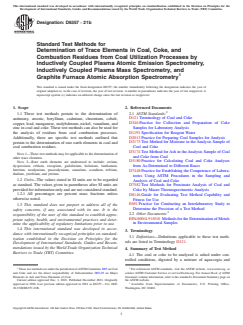
(Test Method)Standard Test Methods for Determination of Trace Elements in Coal, Coke, and Combustion Residues from Coal Utilization Processes by Inductively Coupled Plasma Atomic Emission Spectrometry, Inductively Coupled Plasma Mass Spectrometry, and Graphite Furnace Atomic Absorption Spectrometry
General Information
- Abstract
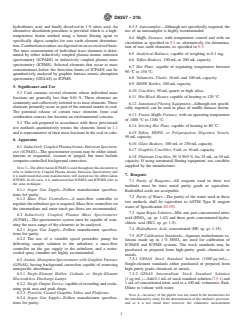
SIGNIFICANCE AND USE
5.1 Coal contains several elements whose individual mass fractions are generally less than 0.01 %. These elements are commonly and collectively referred to as trace elements. These elements primarily occur as part of the mineral matter in coal. The potential release of certain trace elements from coal combustion sources has become an environmental concern.
5.2 The ash prepared in accordance with these provisional test methods quantitatively retains the elements listed in 1.1 and is representative of their mass fractions in the coal or coke.
SCOPE
1.1 These test methods pertain to the determination of antimony, arsenic, beryllium, cadmium, chromium, cobalt, copper, lead, manganese, molybdenum, nickel, vanadium, and zinc in coal and coke. These test methods can also be used for the analysis of residues from coal combustion processes. Additionally, there are specific test methods outlined that pertain to the determination of rare earth elements in coal and coal combustion residues.
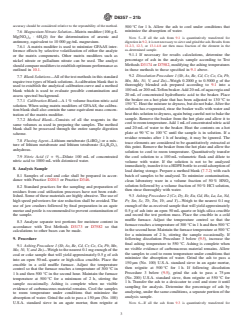
Note 1: These test methods may be applicable to the determination of other trace elements.
Note 2: Rare earth elements are understood to include: cerium, dysprosium, erbium, europium, gadolinium, holmium, lanthanum, lutetium, neodymium, praseodymium, samarium, scandium, terbium, thulium, ytterbium, and yttrium.
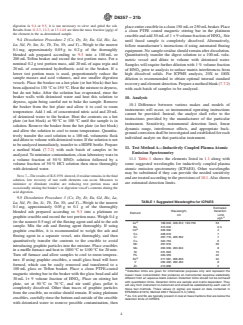
1.2 Units—The values stated in SI units are to be regarded as standard. The values given in parentheses after SI units are provided for information only and are not considered standard.
1.2.1 All percentages are percent mass fractions unless otherwise noted.
1.3 This standard does not purport to address all of the safety concerns, if any, associated with its use. It is the responsibility of the user of this standard to establish appropriate safety, health, and environmental practices and determine the applicability of regulatory limitations prior to use.
1.4 This international standard was developed in accordance with internationally recognized principles on standardization established in the Decision on Principles for the Development of International Standards, Guides and Recommendations issued by the World Trade Organization Technical Barriers to Trade (TBT) Committee.
- Status
- Published
- Publication Date
- 30-Nov-2021
- Technical Committee
- D05 - Coal and Coke
- Drafting Committee
- D05.29 - Major Elements in Ash and Trace Elements of Coal
Buy Documents
ASTM D6357-21b - Standard Test Methods for Determination of Trace Elements in Coal, Coke, and Combustion Residues from Coal Utilization Processes by Inductively Coupled Plasma Atomic Emission Spectrometry, Inductively Coupled Plasma Mass Spectrometry, and Graphite Furnace Atomic Absorption Spectrometry
REDLINE ASTM D6357-21b - Standard Test Methods for Determination of Trace Elements in Coal, Coke, and Combustion Residues from Coal Utilization Processes by Inductively Coupled Plasma Atomic Emission Spectrometry, Inductively Coupled Plasma Mass Spectrometry, and Graphite Furnace Atomic Absorption Spectrometry
Overview
ASTM D6357-21b specifies standard test methods for the determination of trace elements in coal, coke, and combustion residues from coal utilization processes. These methods are fundamental for laboratories analyzing environmental and operational impacts associated with trace metals and rare earth elements in coal-derived materials. The standard outlines procedures using Inductively Coupled Plasma Atomic Emission Spectrometry (ICPAES), Inductively Coupled Plasma Mass Spectrometry (ICPMS), and Graphite Furnace Atomic Absorption Spectrometry (GFAAS), ensuring reliable measurement of various trace metals and rare earth elements.
Key Topics
- Trace Element Analysis: The standard covers the detection and quantification of elements including antimony, arsenic, beryllium, cadmium, chromium, cobalt, copper, lead, manganese, molybdenum, nickel, vanadium, and zinc.
- Rare Earth Elements Determination: Specific test methods are outlined for analyzing rare earth elements such as cerium, dysprosium, erbium, europium, gadolinium, holmium, lanthanum, lutetium, neodymium, praseodymium, samarium, scandium, terbium, thulium, ytterbium, and yttrium.
- Sample Preparation and Ashing: Procedures are provided for preparing coal and coke samples, as well as residues from combustion, to ensure representative and accurate analyses.
- Analytical Techniques: Detailed instructions for using ICPAES, ICPMS, and GFAAS, including calibration, calculation, and reporting protocols.
- Precision and Quality Control: Guidance on establishing repeatability, reproducibility, and the use of reference materials, enhancing confidence in analytical results.
- Environmental Relevance: Addresses the growing environmental concern over trace element release from coal combustion, highlighting the need for accurate monitoring.
Applications
The ASTM D6357-21b standard is applied in several key areas:
- Environmental Monitoring: Essential for assessing potential environmental contamination from trace elements released during coal combustion. Supports compliance with regulatory limits on emissions and residue disposal.
- Industrial Quality Control: Used by coal and coke producers, utilities, and laboratories to control the quality of raw materials and by-products, ensuring product consistency and adherence to environmental standards.
- Research and Development: Facilitates geochemical and energy research by enabling the accurate determination of trace and rare earth elements in coal and residue samples.
- Regulatory Compliance: Helps meet the requirements of governmental and international guidelines concerning hazardous trace element emissions from coal-fired power plants and related industries.
Related Standards
ASTM D6357-21b is closely connected to several other ASTM and international standards that support coal, coke, and residue analysis:
- ASTM D121: Terminology of Coal and Coke
- ASTM D2013: Practice for Preparing Coal Samples for Analysis
- ASTM D346: Collection and Preparation of Coke Samples for Laboratory Analysis
- ASTM D3173/D7582: Determination of Moisture in Coal and Coke
- ASTM D3174: Determination of Ash in Coal and Coke
- ASTM D3180: Calculating Coal and Coke Analyses from As-Determined to Different Bases
- ASTM D1193: Specification for Reagent Water
- ASTM D7448: Establishing Laboratory Competence for Coal and Coke Analysis
- EPA Methods (e.g., EPA/600/4-91/010): Relevant for determination of metals in environmental samples
Practical Value
By setting clear, standardized methods for trace elements and rare earths determination, ASTM D6357-21b enables laboratories and industry stakeholders to:
- Achieve consistent, reproducible analysis across different laboratories and operators
- Monitor and minimize environmental impacts of coal combustion processes
- Enhance the reliability of compliance data for regulatory and contractual purposes
- Support research into coal chemistry and its environmental effects
Adherence to ASTM D6357-21b ensures high-quality, traceable results, supporting both operational efficiency and environmental stewardship in coal-related industries.
Relations
- Effective Date
- 01-Apr-2024
- Effective Date
- 01-Mar-2024
- Effective Date
- 01-Dec-2023
- Effective Date
- 01-Dec-2023
- Effective Date
- 01-Mar-2016
- Effective Date
- 01-Sep-2015
- Effective Date
- 01-Jan-2015
- Effective Date
- 01-May-2013
- Refers
ASTM D3174-12 - Standard Test Method for Ash in the Analysis Sample of Coal and Coke from Coal - Effective Date
- 01-Nov-2012
- Effective Date
- 01-Apr-2012
- Effective Date
- 01-Nov-2011
- Refers
ASTM D3174-11 - Standard Test Method for Ash in the Analysis Sample of Coal and Coke from Coal - Effective Date
- 01-Apr-2011
- Effective Date
- 01-Apr-2011
- Refers
ASTM D3174-04(2010) - Standard Test Method for Ash in the Analysis Sample of Coal and Coke from Coal - Effective Date
- 01-Dec-2010
- Effective Date
- 01-Jun-2010
Buy Documents
ASTM D6357-21b - Standard Test Methods for Determination of Trace Elements in Coal, Coke, and Combustion Residues from Coal Utilization Processes by Inductively Coupled Plasma Atomic Emission Spectrometry, Inductively Coupled Plasma Mass Spectrometry, and Graphite Furnace Atomic Absorption Spectrometry
REDLINE ASTM D6357-21b - Standard Test Methods for Determination of Trace Elements in Coal, Coke, and Combustion Residues from Coal Utilization Processes by Inductively Coupled Plasma Atomic Emission Spectrometry, Inductively Coupled Plasma Mass Spectrometry, and Graphite Furnace Atomic Absorption Spectrometry
Get Certified
Connect with accredited certification bodies for this standard

Element Materials Technology
Materials testing and product certification.

ABS Group Brazil
ABS Group certification services in Brazil.

ABS Quality Evaluations Inc.
American Bureau of Shipping quality certification.
Sponsored listings
Frequently Asked Questions
ASTM D6357-21b is a standard published by ASTM International. Its full title is "Standard Test Methods for Determination of Trace Elements in Coal, Coke, and Combustion Residues from Coal Utilization Processes by Inductively Coupled Plasma Atomic Emission Spectrometry, Inductively Coupled Plasma Mass Spectrometry, and Graphite Furnace Atomic Absorption Spectrometry". This standard covers: SIGNIFICANCE AND USE 5.1 Coal contains several elements whose individual mass fractions are generally less than 0.01 %. These elements are commonly and collectively referred to as trace elements. These elements primarily occur as part of the mineral matter in coal. The potential release of certain trace elements from coal combustion sources has become an environmental concern. 5.2 The ash prepared in accordance with these provisional test methods quantitatively retains the elements listed in 1.1 and is representative of their mass fractions in the coal or coke. SCOPE 1.1 These test methods pertain to the determination of antimony, arsenic, beryllium, cadmium, chromium, cobalt, copper, lead, manganese, molybdenum, nickel, vanadium, and zinc in coal and coke. These test methods can also be used for the analysis of residues from coal combustion processes. Additionally, there are specific test methods outlined that pertain to the determination of rare earth elements in coal and coal combustion residues. Note 1: These test methods may be applicable to the determination of other trace elements. Note 2: Rare earth elements are understood to include: cerium, dysprosium, erbium, europium, gadolinium, holmium, lanthanum, lutetium, neodymium, praseodymium, samarium, scandium, terbium, thulium, ytterbium, and yttrium. 1.2 Units—The values stated in SI units are to be regarded as standard. The values given in parentheses after SI units are provided for information only and are not considered standard. 1.2.1 All percentages are percent mass fractions unless otherwise noted. 1.3 This standard does not purport to address all of the safety concerns, if any, associated with its use. It is the responsibility of the user of this standard to establish appropriate safety, health, and environmental practices and determine the applicability of regulatory limitations prior to use. 1.4 This international standard was developed in accordance with internationally recognized principles on standardization established in the Decision on Principles for the Development of International Standards, Guides and Recommendations issued by the World Trade Organization Technical Barriers to Trade (TBT) Committee.
SIGNIFICANCE AND USE 5.1 Coal contains several elements whose individual mass fractions are generally less than 0.01 %. These elements are commonly and collectively referred to as trace elements. These elements primarily occur as part of the mineral matter in coal. The potential release of certain trace elements from coal combustion sources has become an environmental concern. 5.2 The ash prepared in accordance with these provisional test methods quantitatively retains the elements listed in 1.1 and is representative of their mass fractions in the coal or coke. SCOPE 1.1 These test methods pertain to the determination of antimony, arsenic, beryllium, cadmium, chromium, cobalt, copper, lead, manganese, molybdenum, nickel, vanadium, and zinc in coal and coke. These test methods can also be used for the analysis of residues from coal combustion processes. Additionally, there are specific test methods outlined that pertain to the determination of rare earth elements in coal and coal combustion residues. Note 1: These test methods may be applicable to the determination of other trace elements. Note 2: Rare earth elements are understood to include: cerium, dysprosium, erbium, europium, gadolinium, holmium, lanthanum, lutetium, neodymium, praseodymium, samarium, scandium, terbium, thulium, ytterbium, and yttrium. 1.2 Units—The values stated in SI units are to be regarded as standard. The values given in parentheses after SI units are provided for information only and are not considered standard. 1.2.1 All percentages are percent mass fractions unless otherwise noted. 1.3 This standard does not purport to address all of the safety concerns, if any, associated with its use. It is the responsibility of the user of this standard to establish appropriate safety, health, and environmental practices and determine the applicability of regulatory limitations prior to use. 1.4 This international standard was developed in accordance with internationally recognized principles on standardization established in the Decision on Principles for the Development of International Standards, Guides and Recommendations issued by the World Trade Organization Technical Barriers to Trade (TBT) Committee.
ASTM D6357-21b is classified under the following ICS (International Classification for Standards) categories: 75.160.10 - Solid fuels. The ICS classification helps identify the subject area and facilitates finding related standards.
ASTM D6357-21b has the following relationships with other standards: It is inter standard links to ASTM D7582-24, ASTM D121-15(2024), ASTM D3180-15(2023), ASTM D7582-15(2023), ASTM D7448-16, ASTM D121-15, ASTM D3180-15, ASTM E691-13, ASTM D3174-12, ASTM D3180-12, ASTM E691-11, ASTM D3174-11, ASTM D3173-11, ASTM D3174-04(2010), ASTM D7582-10. Understanding these relationships helps ensure you are using the most current and applicable version of the standard.
ASTM D6357-21b is available in PDF format for immediate download after purchase. The document can be added to your cart and obtained through the secure checkout process. Digital delivery ensures instant access to the complete standard document.
Standards Content (Sample)
This international standard was developed in accordance with internationally recognized principles on standardization established in the Decision on Principles for the
Development of International Standards, Guides and Recommendations issued by the World Trade Organization Technical Barriers to Trade (TBT) Committee.
Designation: D6357 − 21b
Standard Test Methods for
Determination of Trace Elements in Coal, Coke, and
Combustion Residues from Coal Utilization Processes by
Inductively Coupled Plasma Atomic Emission Spectrometry,
Inductively Coupled Plasma Mass Spectrometry, and
Graphite Furnace Atomic Absorption Spectrometry
This standard is issued under the fixed designation D6357; the number immediately following the designation indicates the year of
original adoption or, in the case of revision, the year of last revision. A number in parentheses indicates the year of last reapproval. A
superscript epsilon (´) indicates an editorial change since the last revision or reapproval.
1. Scope 2. Referenced Documents
2.1 ASTM Standards:
1.1 These test methods pertain to the determination of
D121 Terminology of Coal and Coke
antimony, arsenic, beryllium, cadmium, chromium, cobalt,
D346 Practice for Collection and Preparation of Coke
copper, lead, manganese, molybdenum, nickel, vanadium, and
Samples for Laboratory Analysis
zinc in coal and coke. These test methods can also be used for
D1193 Specification for Reagent Water
the analysis of residues from coal combustion processes.
D2013 Practice for Preparing Coal Samples for Analysis
Additionally, there are specific test methods outlined that
D3173 Test Method for Moisture in the Analysis Sample of
pertain to the determination of rare earth elements in coal and
Coal and Coke
coal combustion residues.
D3174 Test Method forAsh in theAnalysis Sample of Coal
NOTE 1—These test methods may be applicable to the determination of
and Coke from Coal
other trace elements.
D3180 Practice for Calculating Coal and Coke Analyses
NOTE 2—Rare earth elements are understood to include: cerium,
dysprosium, erbium, europium, gadolinium, holmium, lanthanum, from As-Determined to Different Bases
lutetium, neodymium, praseodymium, samarium, scandium, terbium,
D7448 Practice for Establishing the Competence of Labora-
thulium, ytterbium, and yttrium.
tories Using ASTM Procedures in the Sampling and
1.2 Units—The values stated in SI units are to be regarded
Analysis of Coal and Coke
as standard. The values given in parentheses after SI units are
D7582 Test Methods for Proximate Analysis of Coal and
provided for information only and are not considered standard.
Coke by Macro Thermogravimetric Analysis
1.2.1 All percentages are percent mass fractions unless
D8146 Guide for Evaluating Test Method Capability and
otherwise noted.
Fitness for Use
E691 Practice for Conducting an Interlaboratory Study to
1.3 This standard does not purport to address all of the
Determine the Precision of a Test Method
safety concerns, if any, associated with its use. It is the
2.2 Other Documents:
responsibility of the user of this standard to establish appro-
EPA/600/4-91/010 MethodsfortheDeterminationofMetals
priate safety, health, and environmental practices and deter-
in Environmental Samples
mine the applicability of regulatory limitations prior to use.
1.4 This international standard was developed in accor-
3. Terminology
dance with internationally recognized principles on standard-
3.1 Definitions—Definitions applicable to these test meth-
ization established in the Decision on Principles for the
ods are listed in Terminology D121.
Development of International Standards, Guides and Recom-
mendations issued by the World Trade Organization Technical
4. Summary of Test Method
Barriers to Trade (TBT) Committee.
4.1 The coal or coke to be analyzed is ashed under con-
trolled conditions, digested by a mixture of aqua-regia and
1 2
ThesetestmethodsareunderthejurisdictionofASTMCommitteeD05onCoal For referenced ASTM standards, visit the ASTM website, www.astm.org, or
and Coke and are the direct responsibility of Subcommittee D05.29 on Major contact ASTM Customer Service at service@astm.org. For Annual Book of ASTM
Elements in Ash and Trace Elements of Coal. Standards volume information, refer to the standard’s Document Summary page on
Current edition approved Dec. 1, 2021. Published December 2021. Originally the ASTM website.
approved in 1996. Last previous edition approved in 2021 as D6357 – 21a. DOI: Available from Superintendent of Documents, U.S. Printing Office,
10.1520/D6357-21B. Washington, DC 20402.
Copyright © ASTM International, 100 Barr Harbor Drive, PO Box C700, West Conshohocken, PA 19428-2959. United States
D6357 − 21b
hydrofluoric acid, and finally dissolved in 1 % nitric acid. An 6.3.5 Autosampler—Although not specifically required, the
alternative dissolution procedure is provided which is a high- use of an autosampler is highly recommended.
temperature fusion method using a borate fluxing agent to
6.4 Muffle Furnace, with temperature control and with air
specifically digest samples for rare earth element determina-
circulation as specified in 9.1 or, alternatively, for determina-
tion.Combustionresiduesaredigestedonanas-receivedbasis.
tion of rare earth elements, as specified in 9.3.
The mass concentration of individual trace elements is deter-
6.5 Analytical Balance, capable of weighing to 0.1 mg.
mined by either inductively coupled plasma atomic emission
spectrometry (ICPAES) or inductively coupled plasma mass 6.6 Teflon Beakers, 100 mL or 200 mL capacity.
spectrometry (ICPMS). Selected elements that occur at mass
6.7 Hot Plate, capable of regulating temperature between
concentrations below the detection limits of ICPAES can be
90 °C to 150 °C.
quantitatively analyzed by graphite furnace atomic absorption
6.8 Volumetric Flasks, 10 mL and 100 mL capacity.
spectrometry (GFAAS) or ICPMS.
6.9 HDPE Bottles, 100 mL capacity.
5. Significance and Use
6.10 Crucibles, 50 mL quartz or high silica.
5.1 Coal contains several elements whose individual mass
6.11 Hot Block Heater, capable of heating to 120 °C.
fractions are generally less than 0.01 %. These elements are
commonlyandcollectivelyreferredtoastraceelements.These
6.12 Automated Fluxing Equipment—Although not specifi-
elements primarily occur as part of the mineral matter in coal.
cally required, can be used in place of muffle furnace fusion.
The potential release of certain trace elements from coal
6.13 Fusion Muffle Furnace, with an operating temperature
combustion sources has become an environmental concern.
of 1000 °C to 1100 °C.
5.2 The ash prepared in accordance with these provisional
6.14 Stirring Hot Plate, capable of heating to 80 °C.
test methods quantitatively retains the elements listed in 1.1
6.15 Teflon, HDPE, or Polypropylene Digestion Vessels,
and is representative of their mass fractions in the coal or coke.
50 mL capacity.
6. Apparatus
6.16 Glass Beakers, 100 mL or 250 mL capacity.
6.1 Inductively Coupled Plasma Atomic Emission Spectrom-
6.17 Graphite Crucibles, 8 mL or 10 mL capacity.
eter (ICPAES)—The spectrometer system may be either simul-
taneous or sequential, vacuum or purged, but must include
6.18 Platinum Crucibles,95 %Pt/5 %Au,25 mL,or30 mL
computer-controlled background correction.
capacity. If using automated fluxing equipment, use crucibles
supplied by the manufacturer.
NOTE3—TheabbreviationICPAESisusedthroughoutthisdocumentto
refer to Inductively Coupled Plasma Atomic Emission Spectrometry and
7. Reagents
it is understood that some manufacturers will instead use the abbreviation
ICPOES. In all cases, it is understood that ICPAES and ICPOES refer to
7.1 Purity of Reagents—All reagents used in these test
the same technique.
methods must be trace metal purity grade or equivalent.
6.1.1 Argon Gas Supply—Follow manufacturer specifica-
Redistilled acids are acceptable.
tions for purity.
7.2 Purity of Water—The purity of the water used in these
6.1.2 Mass Flow Controllers—A mass-flow controller to
test methods shall be equivalent to ASTM Type II reagent
regulate the nebulizer gas is required. Mass flow controllers on
water of Specification D1193.
the intermediate and outer torch gas flows are recommended.
7.3 Aqua Regia Solution—Mix one part concentrated nitric
6.2 Inductively Coupled Plasma Mass Spectrometer
acid (HNO , sp. gr. 1.42) and three parts concentrated hydro-
(ICPMS)—The spectrometer system must be capable of scan-
chloric acid (HCl, sp. gr. 1.9).
ning the mass range of the elements to be analyzed.
7.4 Hydrofluoric Acid, concentrated (HF, sp. gr. 1.15).
6.2.1 Argon Gas Supply—Follow manufacturer specifica-
tions for purity.
7.5 ICP Calibration Standards—Aqueous multielement so-
6.2.2 The use of a variable speed peristaltic pump for
lutions made up in 1 % HNO are used for calibration of
delivering sample solution to the nebulizer, a mass-flow
ICPAES and ICPMS systems. The stock standards may be
controller on the gas supply to the nebulizer, and a water-
purchased or prepared from high-purity grade chemicals or
cooled spray chamber are highly recommended.
metals.
7.5.1 GFAAS Stock Standard Solution (1000 µg ⁄mL)—
6.3 Atomic Absorption Spectrometer with Graphite Furnace
Single-element standards either purchased or prepared from
(GFAAS), having background correction capable of removing
high-purity grade chemicals or metals.
nonspecific absorbance.
7.5.2 GFAAS Intermediate Stock Standard Solution
6.3.1 Single-Element Hollow Cathode or Single-Element
(1 µg ⁄mL )—Add 0.1 mLof stock standard solution (7.5.1) and
Electrodeless Discharge Lamps.
1 mL of concentrated nitric acid to a 100 mL volumetric flask.
6.3.2 Single-Output Device, capable of recording and evalu-
Dilute to volume with water.
ating peak area and peak shape.
6.3.3 Pyrolytic Coated Graphite Tubes and Platforms.
NOTE 4—Accuracy of the pipette was not stated in the instructions for
6.3.4 Argon Gas Supply—Follow manufacturer specifica-
the interlaboratory study for the determination of this method’s precision,
tions for purity. and so it is not stated here; however, the volumetric measurement
D6357 − 21b
accuracy should be considered relative to the repeatability of the method.
500 °C for 1 h. Allow the ash to cool under conditions that
minimize the absorption of water.
7.6 Magnesium Nitrate Solution—Matrix modifier (106 g⁄L
Mg(NO ) ·6H O) for the determination of arsenic and
NOTE 5—If all the ash from 9.1 is quantitatively transferred for
3 2 2
digestionin9.2,itisnotnecessarytosieveandgrindtheash.Resultsfrom
antimony, equivalent to 10 000 µg⁄mL magnesium.
11.2.3, 12.3,or 13.1.4.8 are then mass fraction of the element in the
7.6.1 A matrix modifier is used to minimize GFAAS inter-
as-determined sample.
ference effects by selective volatilization of either the analyte
9.1.1 If necessary for results calculations, determine the
or the matrix components. Other matrix modifiers such as
percentage of ash in the analysis sample according to Test
nickel nitrate or palladium nitrate can be used. The analyst
Methods D3174 or D7582, modifying the ashing temperatures
shouldcomparemodifierstoestablishoptimumperformanceas
in those methods to those specified in 9.1 above.
outlined in 10.1.
9.2 Dissolution Procedure 1 (Sb, As, Be, Cd, Cr, Co, Cu, Pb,
7.7 Blank Solutions—Allofthetestmethodsinthisstandard
Mn, Mo, Ni, V, and Zn)—Weigh 0.2000 g to 0.5000 g of the
require two types of blank solutions.Acalibration blank that is
thoroughly blended ash prepared according to 9.1 into a
used to establish the analytical calibration curve and a method
100 mLor200 mLTeflonbeaker.Add20 mLofaquaregiaand
blank which is used to evaluate possible contamination and
20 mL of concentrated hydrofluoric acid to the beaker. Place
assess spectral background.
the beaker on a hot plate that has been adjusted to 130 °C to
7.7.1 Calibration Blank—A1 % volume fraction nitric acid
150 °C. Heat the mixture to dryness, but do not bake.After the
solution. When using matrix modifiers of GFAAS, the calibra-
solution has evaporated, rinse the beaker walls with water and
tion blank shall also contain the same equivalent mass concen-
heatthissolutiontodryness,againbeingcarefulnottobakethe
tration of the matrix modifier.
sample. Remove the beaker from the hot plate and allow it to
7.7.2 Method Blank—Consists of all the reagents in the
cooltoroomtemperature.Add1mLofconcentratednitricacid
same volumes as used in preparing the samples. The method
and 20 mL of water to the beaker. Heat the contents on a hot
blank shall be processed through the entire sample digestion
plate at 90 °C to 100 °C until the sample is in solution. If a
scheme.
residue remains after1hof heating, it may be ignored. The
7.8 Fluxing Agent—Lithium metaborate (LiBO ) or a mix-
trace elements are considered to be quantitatively extracted at
ture of lithium metaborate and lithium tetraborate (Li B O ),
2 4 7
this point. Remove the beaker from the hot plate and allow the
anhydrous.
solution to cool to room temperature. Quantitatively transfer
7.9 Nitric Acid (1 + 9)—Dilute 100 mL of concentrated the cool solution to a 100 mL volumetric flask and dilute to
nitric acid to 1000 mL with deionized water.
volume with water. If the solution is not to be analyzed
immediately,transferittoaHDPEbottletoavoidadsorptionof
8. Analysis Sample
lead during storage. Prepare a method blank (7.7.2) with each
8.1 Samples of coal and coke shall be prepared in accor-
batch of samples to be analyzed. To minimize contamination,
dance with Practice D2013 or Practice D346.
clean laboratory ware in a volume fraction of 50 % HNO
solution followed by a volume fraction of 50 % HCl solution,
8.2 Standard practices for the sampling and preparation of
then rinse thoroughly with water.
residues from coal utilization processes have not been estab-
lished. Some of these materials are highly abrasive. The use of 9.3 Ashing Procedure 2 (Ce, Dy, Er, Eu, Gd, Ho, La, Lu, Nd,
high speed pulverizers for size reduction shall be avoided. The Pr, Sm, Sc, Tb, Tm, Yb, and Y)—Weigh to the nearest 0.1 mg
use of jaw crushers followed by final preparation in an agate enough of the as-received sample that will yield approximately
mortar and pestle is recommended to prevent contamination of 0.5 g of ash into an open 50 mL quartz or high-silica crucible
the sample. and record the test portion mass. Place the crucible in a cold
muffle furnace. Adjust the temperature control so that the
8.3 Analyze separate test portions for moisture content in
furnacereachesatemperatureof300 °Cin1 handthen500 °C
accordance with Test Methods D3173 or D7582 so that
in the second hour. Maintain the furnace temperature at 500 °C
calculations to other bases can be made.
for a minimum of 2 h, stirring the sample occasionally. If
9. Procedure following dissolution Procedure 3 below (9.5), increase the
final ashing temperature to 550 °C. Ashing is complete when
9.1 Ashing Procedure 1 (Sb, As, Be, Cd, Cr, Co, Cu, Pb, Mn,
no visible evidence of carbonaceous material remains. Allow
Mo, Ni, V, and Zn)—Weigh to the nearest 0.1 mg enough of the
the samples to cool to room temperature under conditions that
coal or coke sample that will yield approximately 0.5 g of ash
minimize the absorption of water. Grind the ash to pass a
into an open 50 mL quartz or high-silica crucible. Place the
150 µm (No. 100) U.S.A. standard sieve in an agate mortar,
crucible in a cold muffle furnace. Adjust the temperature
then reignite at 500 °C for 1 h. If following dissolution
control so that the furnace reaches a temperature of 300 °C in
Procedure 3 below (9.5), grind the ash to pass a 75 µm
1 h and then 500 °C in the second hour. Maintain the furnace
(No. 200) U.S.A. standard sieve, then reignite at 550 °C for
temperature at 500 °C for a minimum of 2 h, stirring the
1 h. Transfer the ash to a desiccator to cool and store it until
sample occasionally. Ashing is complete when no visible
sampling for analysis. Determine the percentage of ash by
evidence of carbonaceous material remains. Cool the samples
analyzing, under the same conditions, a separate portion of the
to room temperature under conditions that minimize the
analysis sample.
absorption of water. Grind the ash to pass a 150 µm (No. 100)
U.S.A. standard sieve in an agate mortar, then reignite at NOTE 6—If all the ash from 9.3 is quantitatively transferred for
D6357 − 21b
digestion in 9.4 or 9.5, it is not necessary to sieve and grind the ash.
placeentirecrucibleinaclean150 mLor250 mLbeaker.Place
Results from 11.2.3, 12.3,or 13.1.4.8 are then the mass fraction (µg/g) of
a clean PTFE coated magnetic stirring bar in the platinum
the element in the as-determined sample.
crucible and add 30 mLof1+9 volume fraction of HNO . Stir
9.4 Dissolution Procedure 2 (Ce, Dy, Er, Eu, Gd, Ho, La,
until fused sample is completely dissolved. Alternatively,
Lu, Nd, Pr, Sm, Sc, Tb, Tm, Yb, and Y)—Weigh to the nearest
follow manufacturer’s instructions if using automated fluxing
0.1 mg, approximately 0.05 g to 0.2 g of the thoroughly
equipment. No sample residue should remain after dissolution.
blended ash prepared according to 9.3 into a 100 mL or
Quantitatively transfer the digest solution to a 100 mL volu-
200 mL Teflon beaker and record the test portion mass. For a
metric vessel and dilute to volume with deionized water.
nominal 0.2 g test portion mass, add 20 mL of aqua regia and
Samples will require further dilution with 1 % volume fraction
20 mL of concentrated hydrofluoric acid to the beaker. If a
of HNO prior to analysis to reduce matrix interferences from
lower test portion mass is used, proportionately reduce the
high dissolved solids. For ICPMS analysis, 20X to 100X
sample masses and acid volumes, and use smaller digestion
dilution is recommended to obtain optimal internal standard
vessels. Place the beaker on a hot plate (or hot block) that has
recoveryandelementdetection.Prepareamethodblank(7.7.2)
beenadjustedto130 °Cto150 °C.Heatthemixturetodryness,
with each batch of samples to be analyzed.
but do not bake. After the solution has evaporated, rinse the
beaker walls with deionized water and heat this solution to
10. Analysis
dryness, again being careful not to bake the sample. Remove
10.1 Difference between various makes and models of
the beaker from the hot plate and allow it to cool to room
instruments will occur, so instrumental operating instructions
temperature. Add 1 mL of concentrated nitric acid and 20 mL
cannot be provided. Instead, the analyst shall refer to the
of deionized water to the beaker. Heat the contents on a hot
instructions provided by the manufacturer of the particular
plate (or hot block) at 90 °C to 100 °C until the sample is in
instrument. Sensitivity, instrumental detection limit, linear
solution. Remove the beaker from the hot plate (or hot block)
dynamic range, interference effects, and appropriate back-
and allow the solution to cool to room temperature. Quantita-
groundcorrectionshallbeinvestigatedandestablishedforeach
tively transfer the cool solution to a 100 mL volumetric flask
individual analyte on that particular instrument.
anddilutetovolumewithdeionizedwater.Ifthesolutionisnot
to be analyzed immediately, transfer to a HDPE bottle. Prepare
11. Test Method A—Inductively Coupled Plasma Atomic
a method blank (7.7.2) with each batch of samples to be
Emission Spectrometry
analyzed.Tominimizecontamination,cleanlaboratorywarein
11.1 Table 1 shows the elements listed in 1.1 along with
a volume fraction of 50 % HNO solution followed by a
some suggested wavelengths for inductively coupled plasma
volume fraction of 50 % HCl solution then rinse thoroughly
atomic emission spectrometry (ICPAES). Other wavelengths
with deionized water.
may be substituted if they can provide the needed sensitivity
NOTE7—TheresultsofILS1591showed,ifresidueremainsinthefinal
and are treated according to the provisions of 10.1.Also shown
solution, low recovery of rare earth elements can occur. Measures to
are estimated detection limits.
minimize or eliminate residue are reducing test portion mass and
occasionally mixing the beaker’s or digestion vessel’s contents during the
acid digestion.
9.5 Dissolution Procedure 3 (Ce, Dy, Er, Eu, Gd, Ho, La,
TABLE 1 Suggested Wavelengths for ICPAES
Lu, Nd, Pr, Sm, Sc, Tb, Tm, Yb, and Y)—Weigh to the nearest
0.1 mg, approximately 0.05 g to 0.1 g of the thoroughly Estimated
Wavelength, Detection
blended ash prepared according to 9.3 into a platinum or
Element
nm Limit,
graphite crucible and record the test portion mass. Weigh 0.4 g A
µg/L
(to the nearest 0.5 mg) of the fluxing agent and add to the ash
B
As 189.042, 228.812, 193.759 53
sample. Mix the ash and fluxing agent thoroughly. If using
Be 313.042 0.3
B
Cd 226.502 4
graphite crucibles, it is recommended to weigh the ash and
Co 228.616 7
fluxing agent in a separate vessel, mix thoroughly, and then
Cr 267.716, 205.552 7
quantitatively transfer the contents to the crucible to avoid Cu 324.754 6
Mn 257.610 30
introducing graphite particles into the mixture. Place crucibles
Mo 202.030, 203.844 8
in a muffle furnace and heat to 1000 °C to 1100 °C for 20 min.
Ni 231.604 15
Turn off furnace and allow samples to cool to room tempera- Pb 220.353 42
B
Sb 217.581, 206.833 32
ture. If using graphite crucibles, a small glass bead will have
V 292.402, 292.464 8
formed, which can be easily removed and transferred to a
Zn 213.856 2
100 mL glass or Teflon beaker. Place a clean PTFE-coated
A
Detection limits are given for informational purposes only and represent the
magnetic stirring bar in the beaker with the glass bead and add
lowest mass concentration that produces an instrumental response statistically
different from an aqueous blank solution. Detection limits should not be confused
30 mL 1+ 9 volume fraction of HNO . Place on stirring hot
with quantitation limits. Detection limits are sample and matrix dependent. They
plate, set at 50 °C to 70 °C, and stir until glass pellet is
will vary from instrument to instrument and should be established by each user of
completely dissolved. Other than traces of graphite particles these test methods. These values (3 sigma) are based on data contained in
EPA/600/4-91/010, Method 200.7 Revision 5.4 (1994).
from the crucible, no residue should remain. If using platinum
B
As, Cd, and Sb are typically present in coal at mass fractions that are below the
crucibles, carefully rinse the bottom and outside of the crucible
detection limits of ICPAES.
with deionized water to remove possible contamination, then
D6357 − 21b
TABLE 2 Isotopes Used for ICPMS Trace and Rare Earth Element
11.2 Calibration Procedure—Calibrate the instrument ac-
Determinations
cording to the procedure recommended by the manufacturer
Estimated
using a calibration blank and aqueous multielement standards
Detection
Element Isotope Abundance Interferant
made up in a volume fraction of 1 % trace metal grade HNO .
Limit,
A
All calibration solutions must also contain an internal standard µg/L
40 35
(seeNote8).Recordsforallcalibrationsmustbeinaccordance As 75 100 Ar Cl+ 0.9
Be 9 100 0.1
with Practice D7448. Internal standards need to be added to all
96 16
Cd 114 28.8 Mo O+ 0.1
analytical solutions, samples, calibration standards, and quality
Co 59 100 0.03
control samples. Addition of an internal standard can be done Cr 52 83.8 0.07
47 16
Cu 63 69.1 Ti O+ 0.03
either online or manually.
Mn 55 100 0.1
Mo 98 23.8 0.1
NOTE 8—An internal standard is needed to compensate for:
Ni 60 26.1 0.2
1. Differences in physical properties (such as viscosity) between the
Pb 206 52.4 0.08
calibration standard and the test samples,
Sb 121 57.3 0.08
35 16
2. Drift caused by thermal changes in the laboratory which will affect V 51 99.8 Cl O+ 0.02
36 16 16
the instrument optics, and Zn 68 18.6 S O O+ 0.2
Ce 140 88.5
3.Driftcausedbychangesinthesampleintroductionsystem,including
Dy 163 24.9
tubing wear and nebulizer performance.
Er 166 33.6
An appropriate internal standard element should:
Eu 153 52.2
(i) not be naturally present in the test samples in appreciable mass
Gd 157 15.6
fractions,
Ho 165 100
(ii) not present spectral interferences with any analyte,
La 139 99.9
(iii) be a strong emitter so that its relative mass concentration can be
Lu 175 97.4
kept low, and Nd 146 17.2
Pr 141 100
(iv) be as chemically similar to the analyte as possible.
Sm 147 15.0
11.2.1 Initial Calibration Verification—Before analyzing Sc 45 100
Tb 159 100
test samples, analyze the method blank and verify the proper
Tm 169 100
calibration of the instrument by analyzing a reference material
Yb 172 21.9
Y 89 100
that has traceability to an internationally recognized certifying
A
agency such as NIST. Results for the reference material must
Detection limits are given for informational purposes only and represent the
lowest mass concentration that produces an instrument response statistically
be within the stated uncertainty limits or the calibration
different from an aqueous blank solution. Detection limits should not be confused
procedure must be repeated.
with quantitation limits. Detection limits are sample and matrix dependent. They
will vary from instrument to instrument and should be established by each user of
11.2.2 Periodic Calibration Verification and
these test methods. The values (3 sigma) are based on data contained in
Recalibration—In accordance with Practice D7448, analyze a
EPA/600/4-91/010, Table 1, Method 200.8, Revision 5.4 (1994). The rare earth
control sample on a periodic basis. Results obtained for the elements are not included in the EPA method table referenced.
control sample must be within established limits or all results
obtained since the last successful control check of that element
must be rejected and the calibration procedure repeated.
12.2 Calibration—In conjunction with 11.2, calibrate the
11.2.3 Calculation—Calculate the mass fraction of the ele-
instrument by analyzing a blank consisting of water and
ment (dry basis) in the ash as follows:
appropriate internal standards in a volume fraction of 1 %
cVD
solution of HNO containing 0 ng/mL of the elements to be
w 5 (1)
S D
a
m analyzed and internal standards. Continue the calibration by
analyzing three solutions that cover the expected mass concen-
where:
tration range of the elements to be analyzed. The mass
w = mass fraction of the element in the ash (dry basis),
a
concentrations of the calibration standards should bracket the
µg/g,
expected mass concentrations of the analytes. Suggested mass
c = mass concentration of the element in solution, µg/mL,
concentration ranges are 10 ng⁄mL, 50 ng⁄mL, and
V = final volume of the 100 mL flask containing the dis-
250 ng⁄mL.
solved solution of the ash, mL,
12.2.1 Internal Standards—Internal standards are needed
D = analytical dilution factor (if used), dimensionless, and
for the reasons stated in 11.2. Drift associated with ICPMS
m = mass of the ash sample, g.
instruments can in part be mass dependent. Therefore, it is
recommended that the analyst use a series of internal standards
12. Test Method B—Inductively Coupled Plasma Mass
that covers the mass range and ionization potentials of the
Spectrometry
elements to be analyzed. Elements used as internal standards
12.1 Table 2 shows the elements listed in 1.1, the isotope,
should not be present in the samples to be analyzed in
anditsabundanceusedforICPMSdeterminations.Alsoshown appreciable quantities. Refer to the manufacturer for recom-
aresomepotentialmolecularinterferences.Mostelements,and
mendations of internal standards for the list of elements in 1.1.
especially the lanthanides, require kinetic energy discrimina- If Li is used as an internal standard, an enriched (95 % or
tion (KED) mode to get the most accurate and reproducible better) Li must be used because of the significant mass
results. fraction of naturally occurring Li in most coals. Because they
D6357 − 21b
are not present in coal in appreciable mass fractions, isotopes 13.1.4.2 Ashing Temperature—Astheashingstepbegins,no
of Ge, In, and Bi may be used. sizzle or popping sounds should be heard.The ashing tempera-
ture should be high enough to eliminate most of the back-
12.2.2 Initial Calibration Verification—Before analyzing
ground but not so hot as to volatilize the analyte. A high flow
test samples, analyze the method blank and verify the proper
rateofinertgasisrequiredduringtheashingstagetosweepthe
calibration of the instrument by analyzing a reference material
furnace of unwanted background material.
that has traceability to an internationally recognized certifying
13.1.4.3 Atomization Temperature—Adjust the atomization
agency such as NIST. Results for the reference material must
temperature as necessary to eliminate low, broad, misshapen,
be within the stated uncertainty limits or the calibration
or doublet peaks. Adjustments should be made in 100 °C
procedure must be repeated.
increments. Peak shape may also dictate the mode of measure-
12.2.3 Periodic Calibration Verification and
ment(peakheightorpeakarea)andthechoiceofgraphitetube
Recalibration—In accordance with Practice D7448, analyze a
and platforms. Graphite platforms significantly improve instru-
control sample on a periodic basis. Results obtained for the
ment performance for the determination of Cd, Pb,As, and Sb.
control sample must be within established limits or all results
It is strongly recommended that they be tried as part of
obtainedsincethelastsuccessfulcontrolcheckforthatelement
optimizing instrument performance for each element to be
must be rejected and the calibration procedure repeated.
determined.
12.3 Calculation—Calculate the mass fraction of the ele-
13.1.4.4 Refer to the instrument manufacturer’s instructions
ment in the ash according to Eq 1 in 11.2.3.
for further information on optimizing performance.
13.1.4.5 Repeat the steps in 13.1 through 13.1.4 for each
13. Test Method C—Graphite Furnace Atomic
element to be determined.
Absorption Spectrometry
13.1.4.6 Initial Calibration Verification—Before analyzing
test samples, analyze the method blank and verify the proper
13.1 Calibration and Sample Solution Preparation:
calibration of the instrument by analyzing a reference material
13.1.1 Use the intermediate stock standard solution (7.5.2)
that has traceability to an internationally recognized certifying
to prepare at least five working standards to cover the optimum
agency such as NIST. Results for the reference material must
mass concentration ranges specified by the instrument manu-
be within the stated uncertainty limits or the calibration
facturer for the element to be analyzed. Add an aliquot of
procedure must be repeated.
concentratednitricacidtoobtainafinalvolumefractionof1 %
HNO . When preparing arsenic or antimony working
NOTE 9—Caution: Matrix problems are prevalent when analyzing the
types of samples described in 1.1 by GFAAS. If the sample matrix varies
standards, add 2 mL of magnesium nitrate solution (7.6) per
significantly from that of the reference material, validation of the test
10 mL of working standard solution.
methods with the reference material may lead to an incorrect assumption
13.1.2 Sample Aliquot—Add an aliquot of the sample solu-
that the test methods are applicable to other matrices.
tion (9.2 or 9.4) in the optimum mass concentration range for
13.1.4.7 Periodic Calibration, Verification, and
the element to be determined to a 10 mL volumetric flask. To
Recalibration—In accordance with Practice D7448, analyze a
estimate the aliquot of sample solution, it may be necessary to
control sample on a periodic basis. Results obtained for the
analyzetheoriginalsamplesolution(9.2or9.4).Insomecases,
control sample must be within established limits or all results
only by trial and error can the correct aliquot of sample be
obtainedsincethelastsuccessfulcontrolcheckforthatelement
determined. Alternatively, ICPAES can be used to screen
must be rejected and the calibration procedure repeated.
samples to determine which elements may require analysis by
13.1.4.8 Calculation—Calculate the mass fraction of the
GFAAS.
element according to Eq 1 in 11.2.3.
13.1.3 Add nitric acid so that the 10 mL of solution will
have a final volume fraction of 1 % nitric acid. The determi-
nation of arsenic and antimony require the addition of 2 mLof
TABLE 3 Mass Fraction Range and Limits for Repeatability and
magnesium nitrate solution (7.6) per 10 mL of working stan-
Reproducibility for Priority Trace Elements in Coal, Coke, and
dard solution. Dilute to volume with water.
Solid Combustion Residues
13.1.4 Instrument Parameters—As stated in 10.1, because
Priority Mass Fraction Repeatability Limit, Reproducibility Limit,
of differences in equipment, it is impossible to specify instru-
Element Range, µg/g r R
mentoperatingparameters(forexample,wavelength,slit,lamp
A A
Sb 0.17 to 5.71 −0.06 + 0.29x¯ 0.08 + 0.44x¯
A A
power, drying, ashing and atomization temperatures, and so
As 0.56 to 138.79 0.42 + 0.13x¯ 1.73 + 0.23x¯
A A
Be 0.42 to 13.11 0.08 + 0.08x¯ 0.14 + 0.30x¯
forth). Instead, the analyst shall initially program the system
A A
Cd 0.02 to 0.84 0.03 + 0.16x¯ 0.04 + 0.43x¯
according to the instrument manufacturer’s instructions for a
A A
Co 0.76 to 47.18 0.28 + 0.11x¯ 1.26 + 0.18x¯
A A
particular analyte. Optimize instrument performance for each
Cr 2.37 to 221 1.03 + 0.09x¯ 1.50 + 0.18x¯
A A
Cu 3.43 to 107.06 0.62 + 0.10x¯ −0.31 + 0.28x¯
analyte according to the following sections.
A A
Mn 11.69 to 419.61 0.98 + 0.10x¯ 8.12 + 0.15x¯
A A
13.1.4.1 Drying Temperature—Make an injection of both a
Mo 0.40 to 20.52 0.23 + 0.11x¯ 0.80 + 0.18x¯
A A
Ni 2.00 to 113.32 0.35 + 0.13x¯ 1.26 + 0.19x¯
sample and a working standard solution according to 13.1.4.
A A
Pb 1.57 to 66.99 0.26 + 0.16x¯ 0.13 + 0.30x¯
Use a mirror to observe the samples through the introduction
A A
Zn 3.76 to 202.31 0.70 + 0.10x¯ 2.98 + 0.18x¯
A A
port. The drying temperature should be high enough to
V 4.50 to 293.17 0.75 + 0.13x¯ 2.02 + 0.21x¯
evaporate the sample smoothly but not so hot that the sample A
Where x¯ is the average of two single test results.
begins to boil or spatter.
D6357 − 21b
TABLE 4 Comparison of Certified Values (µg/g) for Standard
100 = conversion factor to convert A from % to a dimen-
Reference Material SRM 1632b with Interlaboratory Study Values
sionless value, %.
for Priority Trace Elements in Coal, Coke, and Solid Combustion
A
Residues
14.2 For reporting analyses to other than the as-determined
Elemental RR:D05-1029 Significant (95 %
basis, refer to Practice D3180.
SRM Value Bias, %
Oxide Value Confidence Level)
As 3.64 ± 0.21 3.72 ± 0.09 -2.15 no
15. Precision and Bias
Cd 0.065 ± 0.01 0.057 ± 0.0027 14.04 yes
Co 2.18 ± 0.15 2.29 ± 0.17 -4.80 no
15.1 Precision—The precision of this test method for the
Cu 6.31 ± 0.36 6.28 ± 0.30 0.48 no
Mn 11.7 ± 0.64 12.4 ± 1.0 -5.65 no determinationofprioritytraceelementsincoal,coke,andsolid
Ni 6.20 ± 0.37 6.10 ± 0.27 1.64 no
combustion residues are shown in Table 3. The precision
Pb 3.74 ± 0.33 3.67 ± 0.26 1.91 no
characterized by the repeatability (S,r) and reproducibility
r
Zn 11.30 ± 0.52 11.89 ± 0.78 -4.96 no
(S ,R) is described in Table A1.1.
A
R
The ± values associated with the RR:D05-1029 values are the values for r.
15.1.1 Repeatability Limit (r)—The value below which the
absolute difference between two test results of separate and
consecutive test determinations, carried out on identical test
TABLE 5 Comparison of Certified Values (µg/g) for Standard
Reference Material SRM 1635 with Interlaboratory Study Values items in the same laboratory by the same operator using the
for Priority Trace Elements in Coal, Coke, and Solid Combustion
same equipment within short intervals of time on identical test
A
Residues
items taken at random from a single quantity of homogeneous
Significant (95 %
Elemental RR:D05-1029
material, may be expected to occur with a probability of
SRM Value Bias, % Confidence
Oxide Value
approximately 95 %.
Level)
As 0.56 ± 0.11 0.42 ± 0.15 33.3 no
15.1.2 Reproducibility Limit (R)—The value below which
Cd 0.03 ± 0.01 0.03 ± 0.01 0.0 no
the absolute difference between two test results, carried out in
Cr 2.4 ± 0.2 2.5 ± 0.3 -4.00 no
Cu 3.4 ± 0.3 3.6 ± 0.3 -5.56 no different laboratories, with different operators using different
Mn 20.4 ± 1.2 21.4 ± 1.5 -4.67 no
equipment, using identical test items taken at random from a
Ni 2.00 ± 0.28 1.74 ± 0.10 14.94 no
single quantity of material that is as nearly homogeneous as
Pb 1.6 ± 0.1 1.9 ± 0.2 -15.79 yes
V 4.5 ± 0.2 5.2 ± 0.5 -13.46 yes possible, may be expected to occur with a probability of
Zn 5.00 ± 0.7 4.7 ± 0.5 6.38 no
approximately 95 %.
A
The ± values associated with the RR:D05-1029 values are the values for r.
15.2 Bias—The NIST standard reference materials SRM
1632b, SRM 1635, and SRM 1633b were included in the
priority trace element interlaboratory study to ascertain pos-
TABLE 6 Comparison of Certified Values (µg/g) for Standard
sible bias between reference material values and those deter-
Reference Material SRM 1633b with Interlaboratory Study Values
for Priority Trace Elements in Coal, Coke, and Solid Combustion
mined by the new method. A comparison of the NIST values
A
Residues
and those obtained in the interlaboratory study are given in
Significant (95 %
Tables 4-6. Trace element values are not certified for the
Elemental RR:D05-1029
SRM Value Bias, % Confidence
Oxide Value
elements beryllium, molybdenum, and antimony; therefore,
Level)
As 138.8 ± 6.5 136.2 ± 2.6 1.91 no bias cannot be determined for these elements at this time.
Cd 0.845 ± 0.080 0.784 ± 0.006 7.78 no
15.3 An interlaboratory study, designed consistent with
Cr 184.1 ± 7.7 198.2 ± 4.7 -7.11 yes
Cu 107.1 ± 3.8 112.8 ± 2.6 -5.05 yes
Practice E691, was conducted in 1997 for the priority trace
Mn 130.6 ± 4.2 131.8 ± 1.7 -0.91 no
elements (Sb,As, Be, Cd, Cr, Co, Cu, Pb, Mn, Mo, Ni, V, and
Ni 113.3 ± 6.0 120.6 ± 1.8 -6.05 yes
Zn). Twelve laboratories participated; however, data from only
Pb 67.0 ± 3.8 68.2 ± 1.1 1.76 no
V 293.2 ± 11.1 295.7 ± 3.6 -0.85 no
six labs was used. The details of the study and supporting data
A
The ± values associated with the RR:D05-1029 values are the values for r. are given in ASTM Research Report RR:D05-1029.
15.4 Precision (Ce, Dy, Er, Eu, Gd, Ho, La, Lu, Nd, Pr, Sm,
Sc, Tb, Tm, Yb, and Y)—The precision of this test method for
the determination of rare earth elements in coal and solid
combustion residues is shown in Table 7. The precision
14. Report
characterized by the repeatability (S , r) and reproducibility
r
14.1 Convert mass fraction of the element in the ash to the
(S , R) is described in Table A2.1.
R
whole coal basis for reporting as follows:
15.5 Bias (Ce, Dy, Er, Eu, Gd, Ho, La, Lu, Nd, Pr, Sm, Sc,
w 5 Aw ⁄ 100 (2)
c a
Tb, Tm, Yb, and Y)—The NIST standard reference materials
SRM 1635a, SRM 1632e, and SRM 1633c, were included in
where:
the rare earth element interlaboratory study along with USGS
w = mass fraction of the element in the coal (dry basis),
c
SBC-1 to compare the reference material values and those
µg/g,
A = mass fraction of the ash in the coal (dry basis) as
determined by Test Methods D3174 or D7582,%,
Supporting data have been filed at ASTM International Headquarters and may
w = mass fraction of the element in the ash, dry basis,
a
beobtainedbyrequestingResearchReportRR:D05-1029.ContactASTMCustomer
µg/g, and,
Service at service@astm.org.
D6357 − 21b
TABLE 7 Mass Fraction Range and Limits for Repeatability and Reproducibility for Rare Earth Elements in Coal and Solid Combustion
A,B
Residues
Rare Earth Element Mass Fraction Range, µg/g Repeatability Limit, Reproducibility Limit,
r R
Ce 5.350 to 203.078 0.0370x¯ + 0.717 0.153x¯ + 0.849
Dy 0.438 to 22.108 0.0546x¯ - 0.0231 0.134x¯ + 0.241
Er 0.271 to 13.016 0.0356x¯ + 0.0358 0.182x¯ + 0.0798
Eu 0.126 to 4.658 0.0398x¯ + 0.0172 0.139x¯ + 0.0701
Gd 0.471 to 21.434 0.0572x¯ - 0.0123 0.214x¯ + 0.0667
Ho 0.089 to 4.439 0.0353x¯ + 0.0132 0.180x¯ + 0.0320
La 2.904 to 97.580 0.0461x¯ + 0.320 0.118x¯ + 1.01
Lu 0.042 to 1.666 0.0374x¯ + 0.00467 0.193x¯ - 0.00576
Nd 2.368 to 94.866 0.0476x¯ + 0.0628 0.131x¯ + 0.719
Pr 0.609 to 24.207 0.0350x¯ + 0.0955 0.140x¯+ 0.246
Sm 0.478 to 21.081 0.0436x¯ + 0.0411 0.132x¯ + 0.209
Sc 1.498 to 56.643 0.0735x¯ - 0.173 0.235x¯ + 0.313
Tb 0.071 to 3.543 0.0334x¯ + 0.0100 0.194x¯ + 0.0567
Tm 0.051 to 1.807 0.0293x¯ + 0.0129 0.199x¯ + 0.00568
Yb 0.261 to 11.595 0.0371x¯ + 0.0173 0.163x¯ - 0.00745
Y 2.579 to 135.192 0.0471x¯ + 0.0118 0.122x¯ + 1.13
A
Where x¯ is the average of three single test results.
B
Where the lower scope limit is the larger of the following: the lowest sample mean tested in the Interlaboratory Study (ILS) or the test level where the ratio of the test
level to the within laboratory standard deviation (S ) is ten. The latter is calculated from the relationship expressing the repeatability limit for the test method as r
r intercept
/(0.28 - r ); see Guide D8146.
slope
determined by the method. A comparison of the reference 16. Keywords
material values and those obtained in the interlaboratory study
16.1 coal; coal ash; graphite furnace atomic absorption
isgiveninTable8.Nocalculationorstatementofbiashasbeen
spectrometer; inductively coupled plasma atomic emission
determined at this time.
spectrometer; inductively coupled plasma mass spectrometer;
15.6 An interlaboratory study, designed consistent with
rare earth elements; trace elements
Practice E691, was conducted in 2019 and 2020 for the rare
earth elements. The number of participating laboratories was
twelve(12);however,somelaboratories’resultswereexcluded
for some materials, and the average number of participating
laboratories for a given element and material was seven (7).
ThedetailsofthestudyandsupportingdataaregiveninASTM
Research Report RR:D05-2002.
Supporting data have been filed at ASTM International Headquarters and may
beobtainedbyrequestingResearchReportRR:D05-2002.ContactASTMCustomer
Service at service@astm.org.
D6357 − 21b
TABLE 8 Comparison of Certified Values (µg/g) for Standard Reference Materials SRM 1635a, SRM 1632e, SRM 1633c, and USGS SBC-1
with Interlaboratory Study Values for Rare Earth Elements in Coal, and Solid Combustion Residues
D D
Rare Earth SRM 1635a SRM 1635a Value SRM 1632e SRM 1632e Value SRM 1633c SRM 1633c USGS SBC-1 USGS SBC-1
D E
Element RR:D05-2002 RR:D05-2002 RR:D05-2002 SRM Value RR:D05-2002 Value
Value Value Value Value
A A B C
Ce 5.3498 5.45 ± 0.10 12.1732 12.24 ± 0,27 186.8941 180 111.3551 108 ± 0.9
B A C
Dy 1.0455 1 18.9822 18.70 ± 0.30 6.7546 7.1 ± 0.09
B C
Er 0.6238 0.7 3.8164 3.8 ± 0.05
A A A C
Eu 0.1255 0.1115 ± 0.0021 0.2497 0.2457 ± 0.0063 4.6576 4.67 ± 0.07 2.0341 1.98 ± 0.02
B C
Gd 1.1312 1 8.7184 8.5 ± 0.1
B C
Ho 0.2086 0.2 1.3100 1.4 ± 0.02
B A C
La 5.9927 7 83.6282 87.0 ± 2.6 52.8177 52.5 ± 0.6
B A C
Lu 0.0848 0.1 1.3145 1.32 ± 0.03 0.5284 0.54 ± 0.01
B B C
Nd 5.5343 6 91.3889 87 50.5292 49.2 ± 0.5
B C
Pr 1.4097 1.5 12.9022 12.6 ± 0.1
A B B C
Sm 0.4784 0.483 ± 0.017 1.1357 1 20.7108 19 10.0886 9.6 ± 0.1
A A A C
Sc 1.4977 1.240 ± 0.017 3.5702 3.583 ± 0.088 39.2990 37.6 ± 0.6 22.0176 20 ± 0.2
B C
Tb 0.1677 0.2 1.2273 1.2 ± 0.02
B C
Tm 0.0874 0.1 0.5406 0.56 ± 0.01
B B C
Yb 0.5780 0.6 8.9775 7.7 3.5616 3.64 ± 0.04
B C
Y 6.1942 6 33.5863 36.5 ± 0.3
A
These are indicated as reference values on the certificate.
B
These are indicated as information values on the certificate.
C
These are indicated as certified values on the certificate.
D
Each “±” for the certificate values for SRM 1635a, SRM 1632e, and SRM 1633c represents an expanded uncertainty.
E
Each “±” for the certificate values for USGS SBC-1 represents a standard deviation.
ANNEXES
(Mandatory Information)
A1. PRECISION STATISTICS: Sb, As, Be, Cd, Cr, Co, Cu, Pb, Mn, Mo, Ni, V, and Zn
A1.1 The precision of these test methods, characterized by A1.1.2 Reproducibility Standard Deviation (S )—The stan-
R
repeatability (S,r) and reproducibility (S ,R) has been
dard deviation of test results obtained under reproducibility
r R
determined for the following materials as listed in TableA1.1.
conditions.
A1.1.1 Repeatability Standard Deviation (S )—The stan-
r
dard deviation of test results obtained under repeatability
conditions.
D6357 − 21b
TABLE A1.1 Repeatability (S,r) and Reproducibility (S ,R) Parameters Used for Calculation of Precision Statement (µg/g)
r R
Sb As
Material Average S S rR Material Average S S rR
r R r R
SRM 1635 0.169 79 0.021 22 0.037 39 0.059 42 0.1
...
This document is not an ASTM standard and is intended only to provide the user of an ASTM standard an indication of what changes have been made to the previous version. Because
it may not be technically possible to adequately depict all changes accurately, ASTM recommends that users consult prior editions as appropriate. In all cases only the current version
of the standard as published by ASTM is to be considered the official document.
Designation: D6357 − 21a D6357 − 21b
Standard Test Methods for
Determination of Trace Elements in Coal, Coke, and
Combustion Residues from Coal Utilization Processes by
Inductively Coupled Plasma Atomic Emission Spectrometry,
Inductively Coupled Plasma Mass Spectrometry, and
Graphite Furnace Atomic Absorption Spectrometry
This standard is issued under the fixed designation D6357; the number immediately following the designation indicates the year of
original adoption or, in the case of revision, the year of last revision. A number in parentheses indicates the year of last reapproval. A
superscript epsilon (´) indicates an editorial change since the last revision or reapproval.
NOTE—The Repeatability and Reproducibility Limits in Table 3, Table 7, and Table X1.1 were corrected editorially and the year date
changed on June 11, 2021.
1. Scope
1.1 These test methods pertain to the determination of antimony, arsenic, beryllium, cadmium, chromium, cobalt, copper, lead,
manganese, molybdenum, nickel, vanadium, and zinc in coal and coke. These test methods can also be used for the analysis of
residues from coal combustion processes. Additionally, there are specific test methods outlined that pertain to the determination
of rare earth elements in coal and coal combustion residues.
NOTE 1—These test methods may be applicable to the determination of other trace elements.
NOTE 2—Rare earth elements are understood to include: cerium, dysprosium, erbium, europium, gadolinium, holmium, lanthanum, lutetium, neodymium,
praseodymium, samarium, scandium, terbium, thulium, ytterbium, and yttrium.
1.2 Units—The values stated in SI units are to be regarded as standard. The values given in parentheses after SI units are provided
for information only and are not considered standard.
1.2.1 All percentages are percent mass fractions unless otherwise noted.
1.3 This standard does not purport to address all of the safety concerns, if any, associated with its use. It is the responsibility
of the user of this standard to establish appropriate safety, health, and environmental practices and determine the applicability of
regulatory limitations prior to use.
1.4 This international standard was developed in accordance with internationally recognized principles on standardization
established in the Decision on Principles for the Development of International Standards, Guides and Recommendations issued
by the World Trade Organization Technical Barriers to Trade (TBT) Committee.
These test methods are under the jurisdiction of ASTM Committee D05 on Coal and Coke and are the direct responsibility of Subcommittee D05.29 on Major Elements
in Ash and Trace Elements of Coal.
Current edition approved June 11, 2021Dec. 1, 2021. Published July 2021December 2021. Originally approved in 1996. Last previous edition approved in 2021 as
D6357 – 21.D6357 – 21a. DOI: 10.1520/D6357-21A.10.1520/D6357-21B.
Copyright © ASTM International, 100 Barr Harbor Drive, PO Box C700, West Conshohocken, PA 19428-2959. United States
D6357 − 21b
2. Referenced Documents
2.1 ASTM Standards:
D121 Terminology of Coal and Coke
D346 Practice for Collection and Preparation of Coke Samples for Laboratory Analysis
D1193 Specification for Reagent Water
D2013 Practice for Preparing Coal Samples for Analysis
D3173 Test Method for Moisture in the Analysis Sample of Coal and Coke
D3174 Test Method for Ash in the Analysis Sample of Coal and Coke from Coal
D3180 Practice for Calculating Coal and Coke Analyses from As-Determined to Different Bases
D7448 Practice for Establishing the Competence of Laboratories Using ASTM Procedures in the Sampling and Analysis of Coal
and Coke
D7582 Test Methods for Proximate Analysis of Coal and Coke by Macro Thermogravimetric Analysis
D8146 Guide for Evaluating Test Method Capability and Fitness for Use
E691 Practice for Conducting an Interlaboratory Study to Determine the Precision of a Test Method
2.2 Other Documents:
EPA/600/4-91/010 Methods for the Determination of Metals in Environmental Samples
3. Terminology
3.1 Definitions—Definitions applicable to these test methods are listed in Terminology D121.
4. Summary of Test Method
4.1 The coal or coke to be analyzed is ashed under controlled conditions, digested by a mixture of aqua-regia and hydrofluoric
acid, and finally dissolved in 1 % nitric acid. An alternative dissolution procedure is provided which is a high- temperature fusion
method using a borate fluxing agent to specifically digest samples for rare earth element determination. Combustion residues are
digested on an as-received basis. The mass concentration of individual trace elements is determined by either inductively coupled
plasma atomic emission spectrometry (ICPAES) or inductively coupled plasma mass spectrometry (ICPMS). Selected elements
that occur at mass concentrations below the detection limits of ICPAES can be quantitatively analyzed by graphite furnace atomic
absorption spectrometry (GFAAS) or ICPMS.
5. Significance and Use
5.1 Coal contains several elements whose individual mass fractions are generally less than 0.01 %. These elements are commonly
and collectively referred to as trace elements. These elements primarily occur as part of the mineral matter in coal. The potential
release of certain trace elements from coal combustion sources has become an environmental concern.
5.2 The ash prepared in accordance with these provisional test methods quantitatively retains the elements listed in 1.1 and is
representative of their mass fractions in the coal or coke.
6. Apparatus
6.1 Inductively Coupled Plasma Atomic Emission Spectrometer (ICPAES)—The spectrometer system may be either simultaneous
or sequential, vacuum or purged, but must include computer-controlled background correction.
NOTE 3—The abbreviation ICPAES is used throughout this document to refer to Inductively Coupled Plasma Atomic Emission Spectrometry and it is
understood that some manufacturers will instead use the abbreviation ICPOES. In all cases, it is understood that ICPAES and ICPOES refer to the same
technique.
6.1.1 Argon Gas Supply—Follow manufacturer specifications for purity.
6.1.2 Mass Flow Controllers—A mass-flow controller to regulate the nebulizer gas is required. Mass flow controllers on the
intermediate and outer torch gas flows are recommended.
For referenced ASTM standards, visit the ASTM website, www.astm.org, or contact ASTM Customer Service at service@astm.org. For Annual Book of ASTM Standards
volume information, refer to the standard’s Document Summary page on the ASTM website.
Available from Superintendent of Documents, U.S. Printing Office, Washington, DC 20402.
D6357 − 21b
6.2 Inductively Coupled Plasma Mass Spectrometer (ICPMS)—The spectrometer system must be capable of scanning the mass
range of the elements to be analyzed.
6.2.1 Argon Gas Supply—Follow manufacturer specifications for purity.
6.2.2 The use of a variable speed peristaltic pump for delivering sample solution to the nebulizer, a mass-flow controller on the
gas supply to the nebulizer, and a water-cooled spray chamber are highly recommended.
6.3 Atomic Absorption Spectrometer with Graphite Furnace (GFAAS), having background correction capable of removing
nonspecific absorbance.
6.3.1 Single-Element Hollow Cathode or Single-Element Electrodeless Discharge Lamps.
6.3.2 Single-Output Device, capable of recording and evaluating peak area and peak shape.
6.3.3 Pyrolytic Coated Graphite Tubes and Platforms.
6.3.4 Argon Gas Supply—Follow manufacturer specifications for purity.
6.3.5 Autosampler—Although not specifically required, the use of an autosampler is highly recommended.
6.4 Muffle Furnace, with temperature control and with air circulation as specified in 9.1 or, alternatively, for determination of rare
earth elements, as specified in 9.3.
6.5 Analytical Balance, capable of weighing to 0.1 mg.
6.6 Teflon Beakers, 100 mL or 200 mL capacity.
6.7 Hot Plate, capable of regulating temperature between 90 °C to 150 °C.
6.8 Volumetric Flasks, 10 mL and 100 mL capacity.
6.9 HDPE Bottles, 100 mL capacity.
6.10 Crucibles, 50 mL quartz or high silica.
6.11 Hot Block Heater, capable of heating to 120 °C.
6.12 Automated Fluxing Equipment—Although not specifically required, can be used in place of muffle furnace fusion.
6.13 Fusion Muffle Furnace, with an operating temperature of 1000 °C to 1100 °C.
6.14 Stirring Hot Plate, capable of heating to 80 °C.
6.15 Teflon, HDPE, or Polypropylene Digestion Vessels, 50 mL capacity.
6.16 Glass Beakers, 100 mL or 250 mL capacity.
6.17 Graphite Crucibles, 8 mL or 10 mL capacity.
D6357 − 21b
6.18 Platinum Crucibles, 95 % Pt/5 % Au, 25 mL, or 30 mL capacity. If using automated fluxing equipment, use crucibles
supplied by the manufacturer.
7. Reagents
7.1 Purity of Reagents—All reagents used in these test methods must be trace metal purity grade or equivalent. Redistilled acids
are acceptable.
7.2 Purity of Water—The purity of the water used in these test methods shall be equivalent to ASTM Type II reagent water of
Specification D1193.
7.3 Aqua Regia Solution—Mix one part concentrated nitric acid (HNO , sp. gr. 1.42) and three parts concentrated hydrochloric
acid (HCl, sp. gr. 1.9).
7.4 Hydrofluoric Acid, concentrated (HF, sp. gr. 1.15).
7.5 ICP Calibration Standards—Aqueous multielement solutions made up in 1 % HNO are used for calibration of ICPAES and
ICPMS systems. The stock standards may be purchased or prepared from high-purity grade chemicals or metals.
7.5.1 GFAAS Stock Standard Solution (1000 μg ⁄mL)—Single-element standards either purchased or prepared from high-purity
grade chemicals or metals.
7.5.2 GFAAS Intermediate Stock Standard Solution (1 μg ⁄mL )—Add 0.1 mL of stock standard solution (7.5.1) and 1 mL of
concentrated nitric acid to a 100 mL volumetric flask. Dilute to volume with water.
NOTE 4—Accuracy of the pipette was not stated in the instructions for the interlaboratory study for the determination of this method’s precision, and so
it is not stated here; however, the volumetric measurement accuracy should be considered relative to the repeatability of the method.
7.6 Magnesium Nitrate Solution—Matrix modifier (106 g ⁄L Mg(NO ) · 6H O) for the determination of arsenic and antimony,
3 2 2
equivalent to 10 000 μg ⁄mL magnesium.
7.6.1 A matrix modifier is used to minimize GFAAS interference effects by selective volatilization of either the analyte or the
matrix components. Other matrix modifiers such as nickel nitrate or palladium nitrate can be used. The analyst should compare
modifiers to establish optimum performance as outlined in 10.1.
7.7 Blank Solutions—All of the test methods in this standard require two types of blank solutions. A calibration blank that is used
to establish the analytical calibration curve and a method blank which is used to evaluate possible contamination and assess
spectral background.
7.7.1 Calibration Blank—A 1 % volume fraction nitric acid solution. When using matrix modifiers of GFAAS, the calibration
blank shall also contain the same equivalent mass concentration of the matrix modifier.
7.7.2 Method Blank—Consists of all the reagents in the same volumes as used in preparing the samples. The method blank shall
be processed through the entire sample digestion scheme.
7.8 Fluxing Agent—Lithium metaborate (LiBO ) or a mixture of lithium metaborate and lithium tetraborate (Li B O ), anhydrous.
2 2 4 7
7.9 Nitric Acid (1 + 9)—Dilute 100 mL of concentrated nitric acid to 1000 mL with deionized water.
8. Analysis Sample
8.1 Samples of coal and coke shall be prepared in accordance with Practice D2013 or Practice D346.
8.2 Standard practices for the sampling and preparation of residues from coal utilization processes have not been established.
D6357 − 21b
Some of these materials are highly abrasive. The use of high speed pulverizers for size reduction shall be avoided. The use of jaw
crushers followed by final preparation in an agate mortar and pestle is recommended to prevent contamination of the sample.
8.3 Analyze separate test portions for moisture content in accordance with Test Methods D3173 or D7582 so that calculations to
other bases can be made.
9. Procedure
9.1 Ashing Procedure 1 (Sb, As, Be, Cd, Cr, Co, Cu, Pb, Mn, Mo, Ni, V, and Zn)—Weigh to the nearest 0.1 mg enough of the coal
or coke sample that will yield approximately 0.5 g of ash into an open 50 mL quartz or high-silica crucible. Place the crucible in
a cold muffle furnace. Adjust the temperature control so that the furnace reaches a temperature of 300 °C in 1 h and then 500 °C
in the second hour. Maintain the furnace temperature at 500 °C for a minimum of 2 h, stirring the sample occasionally. Ashing is
complete when no visible evidence of carbonaceous material remains. Cool the samples to room temperature under conditions that
minimize the absorption of water. Grind the ash to pass a 150 μm (No. 100) U.S.A. standard sieve in an agate mortar, then reignite
at 500 °C for 1 h. Allow the ash to cool under conditions that minimize the absorption of water.
NOTE 5—If all the ash from 9.1 is quantitatively transferred for digestion in 9.2, it is not necessary to sieve and grind the ash. Results from 11.2.3, 12.3,
or 13.1.4.8 are then mass fraction of the element in the as-determined sample.
9.1.1 If necessary for results calculations, determine the percentage of ash in the analysis sample according to Test Methods D3174
or D7582, modifying the ashing temperatures in those methods to those specified in 9.1 above.
9.2 Dissolution Procedure 1 (Sb, As, Be, Cd, Cr, Co, Cu, Pb, Mn, Mo, Ni, V, and Zn)—Weigh 0.2000 g to 0.5000 g of the
thoroughly blended ash prepared according to 9.1 into a 100 mL or 200 mL Teflon beaker. Add 20 mL of aqua regia and 20 mL
of concentrated hydrofluoric acid to the beaker. Place the beaker on a hot plate that has been adjusted to 130 °C to 150 °C. Heat
the mixture to dryness, but do not bake. After the solution has evaporated, rinse the beaker walls with water and heat this solution
to dryness, again being careful not to bake the sample. Remove the beaker from the hot plate and allow it to cool to room
temperature. Add 1 mL of concentrated nitric acid and 20 mL of water to the beaker. Heat the contents on a hot plate at 90 °C to
100 °C until the sample is in solution. If a residue remains after 1 h of heating, it may be ignored. The trace elements are considered
to be quantitatively extracted at this point. Remove the beaker from the hot plate and allow the solution to cool to room
temperature. Quantitatively transfer the cool solution to a 100 mL volumetric flask and dilute to volume with water. If the solution
is not to be analyzed immediately, transfer it to a HDPE bottle to avoid adsorption of lead during storage. Prepare a method blank
(7.7.2) with each batch of samples to be analyzed. To minimize contamination, clean laboratory ware in a volume fraction of 50 %
HNO solution followed by a volume fraction of 50 % HCl solution, then rinse thoroughly with water.
9.3 Ashing Procedure 2 (Ce, Dy, Er, Eu, Gd, Ho, La, Lu, Nd, Pr, Sm, Sc, Tb, Tm, Yb, and Y)—Weigh to the nearest 0.1 mg enough
of the as-received sample that will yield approximately 0.5 g of ash into an open 50 mL quartz or high-silica crucible and record
the test portion mass. Place the crucible in a cold muffle furnace. Adjust the temperature control so that the furnace reaches a
temperature of 300 °C in 1 h and then 500 °C in the second hour. Maintain the furnace temperature at 500 °C for a minimum of
2 h, stirring the sample occasionally. If following dissolution Procedure 3 below (9.5), increase the final ashing temperature to
550 °C. Ashing is complete when no visible evidence of carbonaceous material remains. Allow the samples to cool to room
temperature under conditions that minimize the absorption of water. Grind the ash to pass a 150 μm (No. 100) U.S.A. standard
sieve in an agate mortar, then reignite at 500 °C for 1 h. If following dissolution Procedure 3 below (9.5), grind the ash to pass
a 75 μm (No. 200) U.S.A. standard sieve, then reignite at 550 °C for 1 h. Transfer the ash to a desiccator to cool and store it until
sampling for analysis. Determine the percentage of ash by analyzing, under the same conditions, a separate portion of the analysis
sample.
NOTE 6—If all the ash from 9.3 is quantitatively transferred for digestion in 9.4 or 9.5, it is not necessary to sieve and grind the ash. Results from 11.2.3,
12.3, or 13.1.4.8 are then the mass fraction (μg/g) of the element in the as-determined sample.
9.4 Dissolution Procedure 2 (Ce, Dy, Er, Eu, Gd, Ho, La, Lu, Nd, Pr, Sm, Sc, Tb, Tm, Yb, and Y)—Weigh to the nearest 0.1 mg,
approximately 0.05 g to 0.2 g of the thoroughly blended ash prepared according to 9.3 into a 100 mL or 200 mL Teflon beaker and
record the test portion mass. For a nominal 0.2 g test portion mass, add 20 mL of aqua regia and 20 mL of concentrated
hydrofluoric acid to the beaker. If a lower test portion mass is used, proportionately reduce the sample masses and acid volumes,
and use smaller digestion vessels. Place the beaker on a hot plate (or hot block) that has been adjusted to 130 °C to 150 °C. Heat
the mixture to dryness, but do not bake. After the solution has evaporated, rinse the beaker walls with deionized water and heat
this solution to dryness, again being careful not to bake the sample. Remove the beaker from the hot plate and allow it to cool to
D6357 − 21b
room temperature. Add 1 mL of concentrated nitric acid and 20 mL of deionized water to the beaker. Heat the contents on a hot
plate (or hot block) at 90 °C to 100 °C until the sample is in solution. Remove the beaker from the hot plate (or hot block) and
allow the solution to cool to room temperature. Quantitatively transfer the cool solution to a 100 mL volumetric flask and dilute
to volume with deionized water. If the solution is not to be analyzed immediately, transfer to a HDPE bottle. Prepare a method
blank (7.7.2) with each batch of samples to be analyzed. To minimize contamination, clean laboratory ware in a volume fraction
of 50 % HNO solution followed by a volume fraction of 50 % HCl solution then rinse thoroughly with deionized water.
NOTE 7—The results of ILS 1591 showed, if residue remains in the final solution, low recovery of rare earth elements can occur. Measures to minimize
or eliminate residue are reducing test portion mass and occasionally mixing the beaker’s or digestion vessel’s contents during the acid digestion.
9.5 Dissolution Procedure 3 (Ce, Dy, Er, Eu, Gd, Ho, La, Lu, Nd, Pr, Sm, Sc, Tb, Tm, Yb, and Y)—Weigh to the nearest 0.1 mg,
approximately 0.05 g to 0.20.1 g of the thoroughly blended ash prepared according to 9.3 into a platinum or graphite crucible and
record the test portion mass. Weigh 0.4 g (to the nearest 0.5 mg) of the fluxing agent and add to the ash sample. Mix the ash and
fluxing agent thoroughly. If using graphite crucibles, it is recommended to weigh the ash and fluxing agent in a separate vessel,
mix thoroughly, and then quantitatively transfer the contents to the crucible to avoid introducing graphite particles into the mixture.
Place crucibles in a muffle furnace and heat to 1000 °C to 1100 °C for 20 min. Turn off furnace and allow samples to cool to room
temperature. If using graphite crucibles, a small glass bead will have formed, which can be easily removed and transferred to a
100 mL glass or Teflon beaker. Place a clean PTFE-coated magnetic stirring bar in the beaker with the glass bead and add 30 mL
1+ 9 volume fraction of HNO . Place on stirring hot plate, set at 50 °C to 70 °C, and stir until glass pellet is completely dissolved.
Other than traces of graphite particles from the crucible, no residue should remain. If using platinum crucibles, carefully rinse the
bottom and outside of the crucible with deionized water to remove possible contamination, then place entire crucible in a clean
150 mL or 250 mL beaker. Place a clean PTFE coated magnetic stirring bar in the platinum crucible and add 30 mL of 1 + 9 volume
fraction of HNO . Stir until fused sample is completely dissolved. Alternatively, follow manufacturer’s instructions if using
automated fluxing equipment. No sample residue should remain after dissolution. Quantitatively transfer the digest solution to a
100 mL volumetric vessel and dilute to volume with deionized water. Samples will require further dilution with 1 % volume
fraction of HNO prior to analysis to reduce matrix interferences from high dissolved solids. For ICPMS analysis, 20X to 100X
dilution is recommended to obtain optimal internal standard recovery and element detection. Prepare a method blank (7.7.2) with
each batch of samples to be analyzed.
10. Analysis
10.1 Difference between various makes and models of instruments will occur, so instrumental operating instructions cannot be
provided. Instead, the analyst shall refer to the instructions provided by the manufacturer of the particular instrument. Sensitivity,
instrumental detection limit, linear dynamic range, interference effects, and appropriate background correction shall be investigated
and established for each individual analyte on that particular instrument.
11. Test Method A—Inductively Coupled Plasma Atomic Emission Spectrometry
11.1 Table 1 shows the elements listed in 1.1 along with some suggested wavelengths for inductively coupled plasma atomic
emission spectrometry (ICPAES). Other wavelengths may be substituted if they can provide the needed sensitivity and are treated
according to the provisions of 10.1. Also shown are estimated detection limits.
11.2 Calibration Procedure—Calibrate the instrument according to the procedure recommended by the manufacturer using a
calibration blank and aqueous multielement standards made up in a volume fraction of 1 % trace metal grade HNO . All calibration
solutions must also contain an internal standard (see Note 8). Records for all calibrations must be in accordance with Practice
D7448. Internal standards need to be added to all analytical solutions, samples, calibration standards, and quality control samples.
Addition of an internal standard can be done either online or manually.
NOTE 8—An internal standard is needed to compensate for:
1. Differences in physical properties (such as viscosity) between the calibration standard and the test samples,
2. Drift caused by thermal changes in the laboratory which will affect the instrument optics, and
3. Drift caused by changes in the sample introduction system, including tubing wear and nebulizer performance.
An appropriate internal standard element should:
(i) not be naturally present in the test samples in appreciable mass fractions,
(ii) not present spectral interferences with any analyte,
(iii) be a strong emitter so that its relative mass concentration can be kept low, and
(iv) be as chemically similar to the analyte as possible.
11.2.1 Initial Calibration Verification—Before analyzing test samples, analyze the method blank and verify the proper calibration
D6357 − 21b
TABLE 1 Suggested Wavelengths for ICPAES
Estimated
Wavelength, Detection
Element
nm Limit,
A
μg/L
B
As 189.042, 228.812, 193.759 53
Be 313.042 0.3
B
Cd 226.502 4
Co 228.616 7
Cr 267.716, 205.552 7
Cu 324.754 6
Mn 257.610 30
Mo 202.030, 203.844 8
Ni 231.604 15
Pb 220.353 42
B
Sb 217.581, 206.833 32
V 292.402, 292.464 8
Zn 213.856 2
A
Detection limits are given for informational purposes only and represent the
lowest mass concentration that produces an instrumental response statistically
different from an aqueous blank solution. Detection limits should not be confused
with quantitation limits. Detection limits are sample and matrix dependent. They
will vary from instrument to instrument and should be established by each user of
these test methods. These values (3 sigma) are based on data contained in
EPA/600/4-91/010, Method 200.7 Revision 5.4 (1994).
B
As, Cd, and Sb are typically present in coal at mass fractions that are below the
detection limits of ICPAES.
of the instrument by analyzing a reference material that has traceability to an internationally recognized certifying agency such as
NIST. Results for the reference material must be within the stated uncertainty limits or the calibration procedure must be repeated.
11.2.2 Periodic Calibration Verification and Recalibration—In accordance with Practice D7448, analyze a control sample on a
periodic basis. Results obtained for the control sample must be within established limits or all results obtained since the last
successful control check of that element must be rejected and the calibration procedure repeated.
11.2.3 Calculation—Calculate the mass fraction of the element (dry basis) in the ash as follows:
cVD
w 5 (1)
S D
a
m
where:
w = mass fraction of the element in the ash (dry basis), μg/g,
a
c = mass concentration of the element in solution, μg/mL,
V = final volume of the 100 mL flask containing the dissolved solution of the ash, mL,
D = analytical dilution factor (if used), dimensionless, and
m = mass of the ash sample, g.
12. Test Method B—Inductively Coupled Plasma Mass Spectrometry
12.1 Table 2 shows the elements listed in 1.1, the isotope, and its abundance used for ICPMS determinations. Also shown are some
potential molecular interferences. Most elements, and especially the lanthanides, require kinetic energy discrimination (KED)
mode to get the most accurate and reproducible results.
12.2 Calibration—In conjunction with 11.2, calibrate the instrument by analyzing a blank consisting of water and appropriate
internal standards in a volume fraction of 1 % solution of HNO containing 0 ng/mL of the elements to be analyzed and internal
standards. Continue the calibration by analyzing three solutions that cover the expected mass concentration range of the elements
to be analyzed. The mass concentrations of the calibration standards should bracket the expected mass concentrations of the
analytes. Suggested mass concentration ranges are 10 ng ⁄mL, 50 ng ⁄mL, and 250 ng ⁄mL.
12.2.1 Internal Standards—Internal standards are needed for the reasons stated in 11.2. Drift associated with ICPMS instruments
can in part be mass dependent. Therefore, it is recommended that the analyst use a series of internal standards that covers the mass
range and ionization potentials of the elements to be analyzed. Elements used as internal standards should not be present in the
samples to be analyzed in appreciable quantities. Refer to the manufacturer for recommendations of internal standards for the list
D6357 − 21b
TABLE 2 Isotopes Used for ICPMS Trace and Rare Earth Element
Determinations
Estimated
Detection
Element Isotope Abundance Interferant
Limit,
A
μg/L
40 35
As 75 100 Ar Cl+ 0.9
Be 9 100 0.1
96 16
Cd 114 28.8 Mo O+ 0.1
Co 59 100 0.03
Cr 52 83.8 0.07
47 16
Cu 63 69.1 Ti O+ 0.03
Mn 55 100 0.1
Mo 98 23.8 0.1
Ni 60 26.1 0.2
Pb 206 52.4 0.08
Sb 121 57.3 0.08
35 16
V 51 99.8 Cl O+ 0.02
36 16 16
Zn 68 18.6 S O O+ 0.2
Ce 140 88.5
Dy 163 24.9
Er 166 33.6
Eu 153 52.2
Gd 157 15.6
Ho 165 100
La 139 99.9
Lu 175 97.4
Nd 146 17.2
Pr 141 100
Sm 147 15.0
Sc 45 100
Tb 159 100
Tm 169 100
Yb 172 21.9
Y 89 100
A
Detection limits are given for informational purposes only and represent the
lowest mass concentration that produces an instrument response statistically
different from an aqueous blank solution. Detection limits should not be confused
with quantitation limits. Detection limits are sample and matrix dependent. They
will vary from instrument to instrument and should be established by each user of
these test methods. The values (3 sigma) are based on data contained in
EPA/600/4-91/010, Table 1, Method 200.8, Revision 5.4 (1994). The rare earth
elements are not included in the EPA method table referenced.
of elements in 1.1. If Li is used as an internal standard, an enriched (95 % or better) Li must be used because of the significant
mass fraction of naturally occurring Li in most coals. Because they are not present in coal in appreciable mass fractions, isotopes
of Ge, In, and Bi may be used.
12.2.2 Initial Calibration Verification—Before analyzing test samples, analyze the method blank and verify the proper calibration
of the instrument by analyzing a reference material that has traceability to an internationally recognized certifying agency such as
NIST. Results for the reference material must be within the stated uncertainty limits or the calibration procedure must be repeated.
12.2.3 Periodic Calibration Verification and Recalibration—In accordance with Practice D7448, analyze a control sample on a
periodic basis. Results obtained for the control sample must be within established limits or all results obtained since the last
successful control check for that element must be rejected and the calibration procedure repeated.
12.3 Calculation—Calculate the mass fraction of the element in the ash according to Eq 1 in 11.2.3.
13. Test Method C—Graphite Furnace Atomic Absorption Spectrometry
13.1 Calibration and Sample Solution Preparation:
13.1.1 Use the intermediate stock standard solution (7.5.2) to prepare at least five working standards to cover the optimum mass
concentration ranges specified by the instrument manufacturer for the element to be analyzed. Add an aliquot of concentrated nitric
acid to obtain a final volume fraction of 1 % HNO . When preparing arsenic or antimony working standards, add 2 mL of
magnesium nitrate solution (7.6) per 10 mL of working standard solution.
D6357 − 21b
13.1.2 Sample Aliquot—Add an aliquot of the sample solution (9.2 or 9.4) in the optimum mass concentration range for the
element to be determined to a 10 mL volumetric flask. To estimate the aliquot of sample solution, it may be necessary to analyze
the original sample solution (9.2 or 9.4). In some cases, only by trial and error can the correct aliquot of sample be determined.
Alternatively, ICPAES can be used to screen samples to determine which elements may require analysis by GFAAS.
13.1.3 Add nitric acid so that the 10 mL of solution will have a final volume fraction of 1 % nitric acid. The determination of
arsenic and antimony require the addition of 2 mL of magnesium nitrate solution (7.6) per 10 mL of working standard solution.
Dilute to volume with water.
13.1.4 Instrument Parameters—As stated in 10.1, because of differences in equipment, it is impossible to specify instrument
operating parameters (for example, wavelength, slit, lamp power, drying, ashing and atomization temperatures, and so forth).
Instead, the analyst shall initially program the system according to the instrument manufacturer’s instructions for a particular
analyte. Optimize instrument performance for each analyte according to the following sections.
13.1.4.1 Drying Temperature—Make an injection of both a sample and a working standard solution according to 13.1.4. Use a
mirror to observe the samples through the introduction port. The drying temperature should be high enough to evaporate the sample
smoothly but not so hot that the sample begins to boil or spatter.
13.1.4.2 Ashing Temperature—As the ashing step begins, no sizzle or popping sounds should be heard. The ashing temperature
should be high enough to eliminate most of the background but not so hot as to volatilize the analyte. A high flow rate of inert
gas is required during the ashing stage to sweep the furnace of unwanted background material.
13.1.4.3 Atomization Temperature—Adjust the atomization temperature as necessary to eliminate low, broad, misshapen, or
doublet peaks. Adjustments should be made in 100 °C increments. Peak shape may also dictate the mode of measurement (peak
height or peak area) and the choice of graphite tube and platforms. Graphite platforms significantly improve instrument
performance for the determination of Cd, Pb, As, and Sb. It is strongly recommended that they be tried as part of optimizing
instrument performance for each element to be determined.
13.1.4.4 Refer to the instrument manufacturer’s instructions for further information on optimizing performance.
13.1.4.5 Repeat the steps in 13.1 through 13.1.4 for each element to be determined.
13.1.4.6 Initial Calibration Verification—Before analyzing test samples, analyze the method blank and verify the proper
calibration of the instrument by analyzing a reference material that has traceability to an internationally recognized certifying
agency such as NIST. Results for the reference material must be within the stated uncertainty limits or the calibration procedure
must be repeated.
NOTE 9—Caution: Matrix problems are prevalent when analyzing the types of samples described in 1.1 by GFAAS. If the sample matrix varies
significantly from that of the reference material, validation of the test methods with the reference material may lead to an incorrect assumption that the
test methods are applicable to other matrices.
13.1.4.7 Periodic Calibration, Verification, and Recalibration—In accordance with Practice D7448, analyze a control sample on
a periodic basis. Results obtained for the control sample must be within established limits or all results obtained since the last
successful control check for that element must be rejected and the calibration procedure repeated.
13.1.4.8 Calculation—Calculate the mass fraction of the element according to Eq 1 in 11.2.3.
14. Report
14.1 Convert mass fraction of the element in the ash to the whole coal basis for reporting as follows:
w 5 Aw ⁄ 100 (2)
c a
where:
w = mass fraction of the element in the coal (dry basis), μg/g,
c
A = mass fraction of the ash in the coal (dry basis) as determined by Test Methods D3174 or D7582, %,
w = mass fraction of the element in the ash, dry basis, μg/g, and,
a
D6357 − 21b
TABLE 3 Mass Fraction Range and Limits for Repeatability and
Reproducibility for Priority Trace Elements in Coal, Coke, and
Solid Combustion Residues
Priority Mass Fraction Repeatability Limit, Reproducibility Limit,
Element Range, μg/g r R
A A
Sb 0.17 to 5.71 −0.06 + 0.29x¯ 0.08 + 0.44x¯
A A
As 0.56 to 138.79 0.42 + 0.13x¯ 1.73 + 0.23x¯
A A
Be 0.42 to 13.11 0.08 + 0.08x¯ 0.14 + 0.30x¯
A A
Cd 0.02 to 0.84 0.03 + 0.16x¯ 0.04 + 0.43x¯
A A
Co 0.76 to 47.18 0.28 + 0.11x¯ 1.26 + 0.18x¯
A A
Cr 2.37 to 221 1.03 + 0.09x¯ 1.50 + 0.18x¯
A A
Cu 3.43 to 107.06 0.62 + 0.10x¯ −0.31 + 0.28x¯
A A
Mn 11.69 to 419.61 0.98 + 0.10x¯ 8.12 + 0.15x¯
A A
Mo 0.40 to 20.52 0.23 + 0.11x¯ 0.80 + 0.18x¯
A A
Ni 2.00 to 113.32 0.35 + 0.13x¯ 1.26 + 0.19x¯
A A
Pb 1.57 to 66.99 0.26 + 0.16x¯ 0.13 + 0.30x¯
A A
Zn 3.76 to 202.31 0.70 + 0.10x¯ 2.98 + 0.18x¯
A A
V 4.50 to 293.17 0.75 + 0.13x¯ 2.02 + 0.21x¯
A
Where x¯ is the average of two single test results.
TABLE 4 Comparison of Certified Values (μg/g) for Standard
Reference Material SRM 1632b with Interlaboratory Study Values
for Priority Trace Elements in Coal, Coke, and Solid Combustion
A
Residues
Elemental RR:D05-1029 Significant (95 %
SRM Value Bias, %
Oxide Value Confidence Level)
As 3.64 ± 0.21 3.72 ± 0.09 -2.15 no
Cd 0.065 ± 0.01 0.057 ± 0.0027 14.04 yes
Co 2.18 ± 0.15 2.29 ± 0.17 -4.80 no
Cu 6.31 ± 0.36 6.28 ± 0.30 0.48 no
Mn 11.7 ± 0.64 12.4 ± 1.0 -5.65 no
Ni 6.20 ± 0.37 6.10 ± 0.27 1.64 no
Pb 3.74 ± 0.33 3.67 ± 0.26 1.91 no
Zn 11.30 ± 0.52 11.89 ± 0.78 -4.96 no
A
The ± values associated with the RR:D05-1029 values are the values for r.
TABLE 5 Comparison of Certified Values (μg/g) for Standard
Reference Material SRM 1635 with Interlaboratory Study Values
for Priority Trace Elements in Coal, Coke, and Solid Combustion
A
Residues
Significant (95 %
Elemental RR:D05-1029
SRM Value Bias, % Confidence
Oxide Value
Level)
As 0.56 ± 0.11 0.42 ± 0.15 33.3 no
Cd 0.03 ± 0.01 0.03 ± 0.01 0.0 no
Cr 2.4 ± 0.2 2.5 ± 0.3 -4.00 no
Cu 3.4 ± 0.3 3.6 ± 0.3 -5.56 no
Mn 20.4 ± 1.2 21.4 ± 1.5 -4.67 no
Ni 2.00 ± 0.28 1.74 ± 0.10 14.94 no
Pb 1.6 ± 0.1 1.9 ± 0.2 -15.79 yes
V 4.5 ± 0.2 5.2 ± 0.5 -13.46 yes
Zn 5.00 ± 0.7 4.7 ± 0.5 6.38 no
A
The ± values associated with the RR:D05-1029 values are the values for r.
100 = conversion factor to convert A from % to a dimensionless value, %.
14.2 For reporting analyses to other than the as-determined basis, refer to Practice D3180.
15. Precision and Bias
15.1 Precision—The precision of this test method for the determination of priority trace elements in coal, coke, and solid
combustion residues are shown in Table 3. The precision characterized by the repeatability (S , r) and reproducibility (S , R) is
r R
described in Table A1.1.
D6357 − 21b
TABLE 6 Comparison of Certified Values (μg/g) for Standard
Reference Material SRM 1633b with Interlaboratory Study Values
for Priority Trace Elements in Coal, Coke, and Solid Combustion
A
Residues
Significant (95 %
Elemental RR:D05-1029
SRM Value Bias, % Confidence
Oxide Value
Level)
As 138.8 ± 6.5 136.2 ± 2.6 1.91 no
Cd 0.845 ± 0.080 0.784 ± 0.006 7.78 no
Cr 184.1 ± 7.7 198.2 ± 4.7 -7.11 yes
Cu 107.1 ± 3.8 112.8 ± 2.6 -5.05 yes
Mn 130.6 ± 4.2 131.8 ± 1.7 -0.91 no
Ni 113.3 ± 6.0 120.6 ± 1.8 -6.05 yes
Pb 67.0 ± 3.8 68.2 ± 1.1 1.76 no
V 293.2 ± 11.1 295.7 ± 3.6 -0.85 no
A
The ± values associated with the RR:D05-1029 values are the values for r.
15.1.1 Repeatability Limit (r)—The value below which the absolute difference between two test results of separate and consecutive
test determinations, carried out on identical test items in the same laboratory by the same operator using the same equipment within
short intervals of time on identical test items taken at random from a single quantity of homogeneous material, may be expected
to occur with a probability of approximately 95 %.
15.1.2 Reproducibility Limit (R)—The value below which the absolute difference between two test results, carried out in different
laboratories, with different operators using different equipment, using identical test items taken at random from a single quantity
of material that is as nearly homogeneous as possible, may be expected to occur with a probability of approximately 95 %.
15.2 Bias—The NIST standard reference materials SRM 1632b, SRM 1635, and SRM 1633b were included in the priority trace
element interlaboratory study to ascertain possible bias between reference material values and those determined by the new
method. A comparison of the NIST values and those obtained in the interlaboratory study are given in Tables 4-6. Trace element
values are not certified for the elements beryllium, molybdenum, and antimony; therefore, bias cannot be determined for these
elements at this time.
15.3 An interlaboratory study, designed consistent with Practice E691, was conducted in 1997 for the priority trace elements (Sb,
As, Be, Cd, Cr, Co, Cu, Pb, Mn, Mo, Ni, V, and Zn). Twelve laboratories participated; however, data from only six labs was used.
The details of the study and supporting data are given in ASTM Research Report RR:D05-1029.
TABLE 7 Mass Fraction Range and Limits for Repeatability and Reproducibility for Rare Earth Elements in Coal and Solid Combustion
A,B
Residues
Rare Earth Element Mass Fraction Range, μg/g Repeatability Limit, Reproducibility Limit,
r R
Ce 5.350 to 203.078 0.0370x¯ + 0.717 0.153x¯ + 0.849
Dy 0.438 to 22.108 0.0546x¯ - 0.0231 0.134x¯ + 0.241
Er 0.271 to 13.016 0.0356x¯ + 0.0358 0.182x¯ + 0.0798
Eu 0.126 to 4.658 0.0398x¯ + 0.0172 0.139x¯ + 0.0701
Gd 0.471 to 21.434 0.0572x¯ - 0.0123 0.214x¯ + 0.0667
Ho 0.089 to 4.439 0.0353x¯ + 0.0132 0.180x¯ + 0.0320
La 2.904 to 97.580 0.0461x¯ + 0.320 0.118x¯ + 1.01
Lu 0.042 to 1.666 0.0374x¯ + 0.00467 0.193x¯ - 0.00576
Nd 2.368 to 94.866 0.0476x¯ + 0.0628 0.131x¯ + 0.719
Pr 0.609 to 24.207 0.0350x¯ + 0.0955 0.140x¯+ 0.246
Sm 0.478 to 21.081 0.0436x¯ + 0.0411 0.132x¯ + 0.209
Sc 1.498 to 56.643 0.0735x¯ - 0.173 0.235x¯ + 0.313
Tb 0.071 to 3.543 0.0334x¯ + 0.0100 0.194x¯ + 0.0567
Tm 0.051 to 1.807 0.0293x¯ + 0.0129 0.199x¯ + 0.00568
Yb 0.261 to 11.595 0.0371x¯ + 0.0173 0.163x¯ - 0.00745
Y 2.579 to 135.192 0.0471x¯ + 0.0118 0.122x¯ + 1.13
A
Where x¯ is the average of twothree single test results.
B
Where the lower scope limit is the larger of the following: the lowest sample mean tested in the Interlaboratory Study (ILS) or the test level where the ratio of the test
level to the within laboratory standard deviation (S ) is ten. The latter is calculated from the relationship expressing the repeatability limit for the test method as r
r intercept
/(0.28 - r ); see Guide D8146.
slope
Supporting data have been filed at ASTM International Headquarters and may be obtained by requesting Research Report RR:D05-1029. Contact ASTM Customer
Service at service@astm.org.
D6357 − 21b
15.4 Precision (Ce, Dy, Er, Eu, Gd, Ho, La, Lu, Nd, Pr, Sm, Sc, Tb, Tm, Yb, and Y)—The precision of this test method for the
determination of rare earth elements in coal and solid combustion residues is shown in Table 7. The precision characterized by the
repeatability (S ,r) and reproducibility (S ,R) is described in Table A2.1.
r R
15.5 Bias (Ce, Dy, Er, Eu, Gd, Ho, La, Lu, Nd, Pr, Sm, Sc, Tb, Tm, Yb, and Y)—The NIST standard reference materials SRM 1635a,
SRM 1632e, and SRM 1633c, were included in the rare earth element interlaboratory study along with USGS SBC-1 to compare
the reference material values and those determined by the method. A comparison of the reference material values and those
obtained in the interlaboratory study is given in Table 8. No calculation or statement of bias has been determined at this time.
15.6 An interlaboratory study, designed consistent with Practice E691, was conducted in 2019 and 2020 for the rare earth
elements. The number of participating laboratories was twelve (12); however, some laboratories’ results were excluded for some
materials, and the average number of participating laboratories for a given element and material was seven (7). The details of the
study and supporting data are given in ASTM Research Report RR:D05-2002.
16. Keywords
16.1 coal; coal ash; graphite furnace atomic absorption spectrometer; inductively coupled plasma atomic emission spectrometer;
inductively coupled plasma mass spectrometer; rare earth elements; trace elements
ANNEXES
(Mandatory Information)
A1. PRECISION STATISTICS: Sb, As, Be, Cd, Cr, Co, Cu, Pb, Mn, Mo, Ni, V, and Zn
A1.1 The precision of these test methods, characterized by repeatability (S , r) and reproducibility (S , R) has been determined
r R
for the following materials as listed in Table A1.1.
TABLE 8 Comparison of Certified Values (μg/g) for Standard Reference Materials SRM 1635a, SRM 1632e, SRM 1633c, and USGS SBC-1
with Interlaboratory Study Values for Rare Earth Elements in Coal, and Solid Combustion Residues
D D
Rare Earth SRM 1635a SRM 1635a Value SRM 1632e SRM 1632e Value SRM 1633c SRM 1633c USGS SBC-1 USGS SBC-1
D E
Element RR:D05-2002 RR:D05-2002 RR:D05-2002 SRM Value RR:D05-2002 Value
Value Value Value Value
A A B C
Ce 5.3498 5.45 ± 0.10 12.1732 12.24 ± 0,27 186.8941 180 111.3551 108 ± 0.9
B A C
Dy 1.0455 1 18.9822 18.70 ± 0.30 6.7546 7.1 ± 0.09
B C
Er 0.6238 0.7 3.8164 3.8 ± 0.05
A A A C
Eu 0.1255 0.1115 ± 0.0021 0.2497 0.2457 ± 0.0063 4.6576 4.67 ± 0.07 2.0341 1.98 ± 0.02
B C
Gd 1.1312 1 8.7184 8.5 ± 0.1
B C
Ho 0.2086 0.2 1.3100 1.4 ± 0.02
B A C
La 5.9927 7 83.6282 87.0 ± 2.6 52.8177 52.5 ± 0.6
B A C
Lu 0.0848 0.1 1.3145 1.32 ± 0.03 0.5284 0.54 ± 0.01
B B C
Nd 5.5343 6 91.3889 87 50.5292 49.2 ± 0.5
B C
Pr 1.4097 1.5 12.9022 12.6 ± 0.1
A B B C
Sm 0.4784 0.483 ± 0.017 1.1357 1 20.7108 19 10.0886 9.6 ± 0.1
A A A C
Sc 1.4977 1.240 ± 0.017 3.5702 3.583 ± 0.088 39.2990 37.6 ± 0.6 22.0176 20 ± 0.2
B C
Tb 0.1677 0.2 1.2273 1.2 ± 0.02
B C
Tm 0.0874 0.1 0.5406 0.56 ± 0.01
B B C
Yb 0.5780 0.6 8.9775 7.7 3.5616 3.64 ± 0.04
B C
Y 6.1942 6 33.5863 36.5 ± 0.3
A
These are indicated as reference values on the certificate.
B
These are indicated as information values on the certificate.
C
These are indicated as certified values on the certificate.
D
Each “±” for the certificate values for SRM 1635a, SRM 1632e, and SRM 1633c represents an
...