

ASTM D3302/D3302M-22a
(Test Method)Standard Test Method for Total Moisture in Coal
General Information
- Abstract
SIGNIFICANCE AND USE
5.1 The collection and treatment of the sample as specified for the referee method is intended for the express purpose of determining the total moisture in coal. The standard is available to producers, sellers, and consumers as a method of determination when other techniques or modifications are not mutually agreed upon.
5.2 The commercial method, which determines total moisture content of the crushed and divided sample, is designated as the method for total moisture for routine commercial practice.
SCOPE
1.1 This test method covers the measurement of the total moisture in coal as it exists at the site, at the time, and under the conditions it is sampled. It is applicable to coals as mined, processed, shipped, or used in normal commercial pursuits. It is not applicable to coal-water slurries, sludges, or pulverized products under 0.5 mm-diameter sieve size. It is applicable to coals of all ranks within the recognized limitations imposed by oxidation and decomposition characteristics of lower rank coals. Because of its empirical nature, strict adherence to basic principles and permissive procedures are required for valid results (see Appendix X1). This complete standard is available to producers, sellers, and consumers as a total moisture method when other procedures or modifications are not mutually agreed on.
1.2 Since coal can vary from extremely wet (water-saturated) to completely dry, special emphasis must be placed on the sampling, sample preparation, and the moisture determination itself to ensure total reliability of measurement. Therefore, this standard entails collection of the gross sample, sample preparation, and the method of determination.
1.3 While it is recognized that such a standard may be unwieldy for routine usage in commercial operations, it can provide a common base for agreement in cases of dispute or arbitration. The complete standard is referred to as the referee method. Embodied in the standard is the commercial method starting with the crushed and divided sample when the gross sample is not too wet to crush and divide. See Practice D2961/D2961M and Test Method D3173 for other moisture methods.
1.4 Units—The values stated in either SI units or inch-pound units are to be regarded separately as standard. The values stated in each system are not necessarily exact equivalents; therefore, to ensure conformance with the standard, each system shall be used independently of the other, and values from the two systems shall not be combined.
1.5 This standard does not purport to address all of the safety concerns, if any, associated with its use. It is the responsibility of the user of this standard to establish appropriate safety, health, and environmental practices and determine the applicability of regulatory limitations prior to use.
1.6 This international standard was developed in accordance with internationally recognized principles on standardization established in the Decision on Principles for the Development of International Standards, Guides and Recommendations issued by the World Trade Organization Technical Barriers to Trade (TBT) Committee.
- Status
- Published
- Publication Date
- 14-Dec-2022
- Technical Committee
- D05 - Coal and Coke
- Drafting Committee
- D05.21 - Methods of Analysis
Overview
ASTM D3302/D3302M-22a - Standard Test Method for Total Moisture in Coal is a widely recognized standard developed by ASTM International for determining total moisture content in coal. Accurate measurement of moisture is essential for producers, sellers, and consumers engaged in the mining, processing, shipping, and utilization of coal. The standard provides both a precise “referee” method for dispute resolution or arbitration and a commercial method suited for routine operations, making it a valuable tool in coal quality assurance and commercial transactions.
Key Topics
- Scope of Application:
- Applicable to coal as mined, processed, shipped, or used in routine commercial practices.
- Not suitable for coal-water slurries, sludges, or finely pulverized coal products passing a 0.5 mm sieve.
- Addresses coal of all ranks, within limitations posed by oxidation or decomposition, especially for lower rank coals.
- Sampling and Preparation:
- Stresses the importance of careful sample collection, handling, and preparation to prevent unmeasured moisture loss or gain.
- Requires air-tight, non-absorptive containers to maintain sample integrity.
- Refers to designated ASTM practices for gross sample collection and sample preparation.
- Test Methods:
- Referee Method: A detailed, strictly controlled process intended to establish a common base for agreement in case of disputes. Involves complete documentation of mass losses at different preparation stages.
- Commercial Method: Used for daily operations, this method starts with crushed and divided samples unless the sample is too wet for such processing.
- Moisture Determination:
- Based on the mass loss of a coal sample after controlled air-drying and further oven drying to ascertain residual moisture.
- Stipulates repeatability and reproducibility expectations for precision in results.
Applications
- Quality Control:
- Enables coal producers, sellers, and end-users to accurately determine moisture content-a critical parameter affecting coal’s calorific value, handling, shipping cost, and end-use performance.
- Commercial Transactions:
- Serves as a mutual basis for agreements in contracts, pricing, or quantity disputes, supporting fair and transparent coal trade.
- Regulatory Compliance:
- Provides a consistent framework for compliance with international trade and coal quality regulations.
- Laboratory and Field Measurements:
- Used by laboratories, utilities, and coal facilities to support blending, stockpile monitoring, shipment assessment, and process optimization.
Related Standards
To ensure comprehensive and standardized coal moisture measurement, ASTM D3302/D3302M-22a references several related ASTM and ISO standards:
- ASTM D121: Terminology of Coal and Coke
- ASTM D388: Classification of Coals by Rank
- ASTM D2013: Practice for Preparing Coal Samples for Analysis
- ASTM D2234/D2234M: Collection of a Gross Sample of Coal
- ASTM D2961/D2961M: Single-Stage Total Moisture in Reduced Coal Samples
- ASTM D3173: Moisture in Analysis Sample of Coal and Coke
- ASTM D5865: Gross Calorific Value of Coal and Coke
- ASTM D7430: Mechanical Sampling of Coal
- ISO 13909-4: Hard Coal and Coke - Mechanical Sampling - Preparation of Test Samples
Practical Value
- Improved Accuracy in Coal Testing: By following this standard, organizations can minimize unmeasured moisture changes, ensuring reliable measurement for both operational and contractual needs.
- Support for Dispute Resolution: The referee method detailed in ASTM D3302/D3302M-22a serves as an authoritative procedure in case of disagreements between parties.
- Enhanced Operational Efficiency: The commercial method addresses practical laboratory and field workflows, providing flexibility in routine analysis while upholding measurement integrity.
ASTM D3302/D3302M-22a is crucial for any entity involved in the coal industry, offering a unified approach to measuring total moisture in coal and supporting robust quality assurance, compliance, and commercial integrity.
Relations
- Effective Date
- 01-Mar-2024
- Effective Date
- 01-Dec-2019
- Effective Date
- 01-Jun-2019
- Effective Date
- 01-Dec-2018
- Effective Date
- 01-Nov-2018
- Effective Date
- 01-Sep-2018
- Effective Date
- 15-Apr-2018
- Effective Date
- 01-Mar-2018
- Effective Date
- 01-Feb-2018
- Effective Date
- 01-Nov-2017
- Effective Date
- 01-Nov-2017
- Effective Date
- 15-Oct-2017
- Effective Date
- 01-Jul-2017
- Effective Date
- 01-Feb-2017
- Effective Date
- 15-Sep-2016
Get Certified
Connect with accredited certification bodies for this standard

Element Materials Technology
Materials testing and product certification.

ABS Group Brazil
ABS Group certification services in Brazil.

ABS Quality Evaluations Inc.
American Bureau of Shipping quality certification.
Sponsored listings
Frequently Asked Questions
ASTM D3302/D3302M-22a is a standard published by ASTM International. Its full title is "Standard Test Method for Total Moisture in Coal". This standard covers: SIGNIFICANCE AND USE 5.1 The collection and treatment of the sample as specified for the referee method is intended for the express purpose of determining the total moisture in coal. The standard is available to producers, sellers, and consumers as a method of determination when other techniques or modifications are not mutually agreed upon. 5.2 The commercial method, which determines total moisture content of the crushed and divided sample, is designated as the method for total moisture for routine commercial practice. SCOPE 1.1 This test method covers the measurement of the total moisture in coal as it exists at the site, at the time, and under the conditions it is sampled. It is applicable to coals as mined, processed, shipped, or used in normal commercial pursuits. It is not applicable to coal-water slurries, sludges, or pulverized products under 0.5 mm-diameter sieve size. It is applicable to coals of all ranks within the recognized limitations imposed by oxidation and decomposition characteristics of lower rank coals. Because of its empirical nature, strict adherence to basic principles and permissive procedures are required for valid results (see Appendix X1). This complete standard is available to producers, sellers, and consumers as a total moisture method when other procedures or modifications are not mutually agreed on. 1.2 Since coal can vary from extremely wet (water-saturated) to completely dry, special emphasis must be placed on the sampling, sample preparation, and the moisture determination itself to ensure total reliability of measurement. Therefore, this standard entails collection of the gross sample, sample preparation, and the method of determination. 1.3 While it is recognized that such a standard may be unwieldy for routine usage in commercial operations, it can provide a common base for agreement in cases of dispute or arbitration. The complete standard is referred to as the referee method. Embodied in the standard is the commercial method starting with the crushed and divided sample when the gross sample is not too wet to crush and divide. See Practice D2961/D2961M and Test Method D3173 for other moisture methods. 1.4 Units—The values stated in either SI units or inch-pound units are to be regarded separately as standard. The values stated in each system are not necessarily exact equivalents; therefore, to ensure conformance with the standard, each system shall be used independently of the other, and values from the two systems shall not be combined. 1.5 This standard does not purport to address all of the safety concerns, if any, associated with its use. It is the responsibility of the user of this standard to establish appropriate safety, health, and environmental practices and determine the applicability of regulatory limitations prior to use. 1.6 This international standard was developed in accordance with internationally recognized principles on standardization established in the Decision on Principles for the Development of International Standards, Guides and Recommendations issued by the World Trade Organization Technical Barriers to Trade (TBT) Committee.
SIGNIFICANCE AND USE 5.1 The collection and treatment of the sample as specified for the referee method is intended for the express purpose of determining the total moisture in coal. The standard is available to producers, sellers, and consumers as a method of determination when other techniques or modifications are not mutually agreed upon. 5.2 The commercial method, which determines total moisture content of the crushed and divided sample, is designated as the method for total moisture for routine commercial practice. SCOPE 1.1 This test method covers the measurement of the total moisture in coal as it exists at the site, at the time, and under the conditions it is sampled. It is applicable to coals as mined, processed, shipped, or used in normal commercial pursuits. It is not applicable to coal-water slurries, sludges, or pulverized products under 0.5 mm-diameter sieve size. It is applicable to coals of all ranks within the recognized limitations imposed by oxidation and decomposition characteristics of lower rank coals. Because of its empirical nature, strict adherence to basic principles and permissive procedures are required for valid results (see Appendix X1). This complete standard is available to producers, sellers, and consumers as a total moisture method when other procedures or modifications are not mutually agreed on. 1.2 Since coal can vary from extremely wet (water-saturated) to completely dry, special emphasis must be placed on the sampling, sample preparation, and the moisture determination itself to ensure total reliability of measurement. Therefore, this standard entails collection of the gross sample, sample preparation, and the method of determination. 1.3 While it is recognized that such a standard may be unwieldy for routine usage in commercial operations, it can provide a common base for agreement in cases of dispute or arbitration. The complete standard is referred to as the referee method. Embodied in the standard is the commercial method starting with the crushed and divided sample when the gross sample is not too wet to crush and divide. See Practice D2961/D2961M and Test Method D3173 for other moisture methods. 1.4 Units—The values stated in either SI units or inch-pound units are to be regarded separately as standard. The values stated in each system are not necessarily exact equivalents; therefore, to ensure conformance with the standard, each system shall be used independently of the other, and values from the two systems shall not be combined. 1.5 This standard does not purport to address all of the safety concerns, if any, associated with its use. It is the responsibility of the user of this standard to establish appropriate safety, health, and environmental practices and determine the applicability of regulatory limitations prior to use. 1.6 This international standard was developed in accordance with internationally recognized principles on standardization established in the Decision on Principles for the Development of International Standards, Guides and Recommendations issued by the World Trade Organization Technical Barriers to Trade (TBT) Committee.
ASTM D3302/D3302M-22a is classified under the following ICS (International Classification for Standards) categories: 75.160.10 - Solid fuels. The ICS classification helps identify the subject area and facilitates finding related standards.
ASTM D3302/D3302M-22a has the following relationships with other standards: It is inter standard links to ASTM D121-15(2024), ASTM D2234/D2234M-19, ASTM D388-19, ASTM D2961/D2961M-18a, ASTM D388-18a, ASTM D2961/D2961M-18, ASTM D7430-18a, ASTM D7430-18, ASTM D388-18, ASTM D388-17a, ASTM D7430-17, ASTM D2234/D2234M-17, ASTM D388-17, ASTM D2961/D2961M-17, ASTM D7430-16b. Understanding these relationships helps ensure you are using the most current and applicable version of the standard.
ASTM D3302/D3302M-22a is available in PDF format for immediate download after purchase. The document can be added to your cart and obtained through the secure checkout process. Digital delivery ensures instant access to the complete standard document.
Standards Content (Sample)
This international standard was developed in accordance with internationally recognized principles on standardization established in the Decision on Principles for the
Development of International Standards, Guides and Recommendations issued by the World Trade Organization Technical Barriers to Trade (TBT) Committee.
Designation: D3302/D3302M − 22a
Standard Test Method for
Total Moisture in Coal
This standard is issued under the fixed designation D3302/D3302M; the number immediately following the designation indicates the
year of original adoption or, in the case of revision, the year of last revision. A number in parentheses indicates the year of last
reapproval. A superscript epsilon (´) indicates an editorial change since the last revision or reapproval.
1. Scope 1.5 This standard does not purport to address all of the
safety concerns, if any, associated with its use. It is the
1.1 This test method covers the measurement of the total
responsibility of the user of this standard to establish appro-
moisture in coal as it exists at the site, at the time, and under
priate safety, health, and environmental practices and deter-
the conditions it is sampled. It is applicable to coals as mined,
mine the applicability of regulatory limitations prior to use.
processed, shipped, or used in normal commercial pursuits. It
1.6 This international standard was developed in accor-
is not applicable to coal-water slurries, sludges, or pulverized
dance with internationally recognized principles on standard-
products under 0.5 mm-diameter sieve size. It is applicable to
ization established in the Decision on Principles for the
coals of all ranks within the recognized limitations imposed by
Development of International Standards, Guides and Recom-
oxidation and decomposition characteristics of lower rank
mendations issued by the World Trade Organization Technical
coals. Because of its empirical nature, strict adherence to basic
Barriers to Trade (TBT) Committee.
principles and permissive procedures are required for valid
results (see Appendix X1). This complete standard is available
2. Referenced Documents
to producers, sellers, and consumers as a total moisture method
when other procedures or modifications are not mutually 2.1 ASTM Standards:
agreed on. D121 Terminology of Coal and Coke
D388 Classification of Coals by Rank
1.2 Since coal can vary from extremely wet (water-
D2013 Practice for Preparing Coal Samples for Analysis
saturated) to completely dry, special emphasis must be placed
D2234/D2234M Practice for Collection of a Gross Sample
on the sampling, sample preparation, and the moisture deter-
of Coal
mination itself to ensure total reliability of measurement.
D2961/D2961M Practice for Single-Stage Total Moisture
Therefore, this standard entails collection of the gross sample,
Lessthan15%inCoalReducedto2.36 mm[No.8Sieve]
sample preparation, and the method of determination.
Topsize
1.3 While it is recognized that such a standard may be
D3173 Test Method for Moisture in the Analysis Sample of
unwieldy for routine usage in commercial operations, it can
Coal and Coke
provide a common base for agreement in cases of dispute or
D5865 Test Method for Gross Calorific Value of Coal and
arbitration. The complete standard is referred to as the referee
Coke
method. Embodied in the standard is the commercial method
D7430 Practice for Mechanical Sampling of Coal
starting with the crushed and divided sample when the gross
2.2 ISO Standard:
sample is not too wet to crush and divide. See Practice
ISO 13909-4 Hard Coal and Coke - Mechanical Sampling -
D2961/D2961M and Test Method D3173 for other moisture
Part 4: Coal - Preparation of Test Samples
methods.
1.4 Units—The values stated in either SI units or inch-
3. Terminology
pound units are to be regarded separately as standard. The
3.1 Definitions—For additional definitions of terms used in
values stated in each system are not necessarily exact equiva-
this test method, refer to Terminology D121.
lents; therefore, to ensure conformance with the standard, each
system shall be used independently of the other, and values 3.2 Definitions of Terms Specific to This Standard:
from the two systems shall not be combined.
For referenced ASTM standards, visit the ASTM website, www.astm.org, or
This test method is under the jurisdiction of ASTM Committee D05 on Coal contact ASTM Customer Service at service@astm.org. For Annual Book of ASTM
and Coke and is the direct responsibility of Subcommittee D05.21 on Methods of Standards volume information, refer to the standard’s Document Summary page on
Analysis. the ASTM website.
Current edition approved Dec. 15, 2022. Published January 2023. Originally Available from International Organization for Standardization (ISO), ISO
approved in 1974. Last previous edition approved in 2022 as D3302/D3302M – 22. Central Secretariat, BIBC II, Chemin de Blandonnet 8, CP 401, 1214 Vernier,
DOI: 10.1520/D3302_D3302M-22A. Geneva, Switzerland, http://www.iso.org.
Copyright © ASTM International, 100 Barr Harbor Drive, PO Box C700, West Conshohocken, PA 19428-2959. United States
D3302/D3302M − 22a
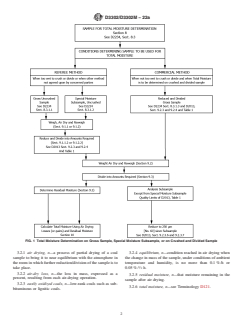
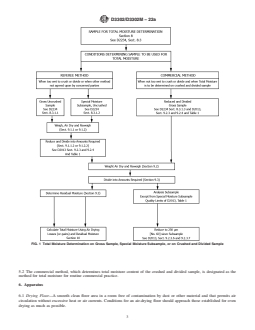
FIG. 1 Total Moisture Determination on Gross Sample, Special Moisture Subsample, or on Crushed and Divided Sample
3.2.1 air drying, n—a process of partial drying of a coal 3.2.4 equilibrium, n—condition reached in air drying when
sample to bring it to near equilibrium with the atmosphere in the change in mass of the sample, under conditions of ambient
theroominwhichfurtherreduction/divisionofthesampleisto
temperature and humidity, is no more than 0.1 %⁄h or
take place.
0.05 %⁄ ⁄2 h.
3.2.2 air-dry loss, n—the loss in mass, expressed as a
3.2.5 residual moisture, n—that moisture remaining in the
percent, resulting from each air-drying operation.
sample after air drying.
3.2.3 easily oxidized coals, n—low-rank coals such as sub-
3.2.6 total moisture, n—see Terminology D121.
bituminous or lignitic coals.
D3302/D3302M − 22a
4. Summary of Test Method (See Fig. 1)
4.1 This test method is based on the loss in mass of a coal
sampleinanairatmosphereunderrigidlycontrolledconditions
of temperature, time, and airflow.
4.2 Alternative Methods:
4.2.1 Referee Method, which may be used in cases of
dispute or arbitration.The gross moisture sample is air dried to
equilibrate it with the atmosphere at each stage of division and
reduction. No air drying is necessary if the sample is already at
equilibrium with the atmosphere as indicated by stable mass.
4.2.2 Commercial Method, which may be used in routine
commercial practice or when the concerned parties agree upon
this method. The crushed and divided moisture sample is air
dried to equilibrate it with the atmosphere in which further
division and reduction are to occur.
4.2.3 Residual moisture determination is made in a heated
forced-air circulation oven under rigidly defined conditions.
4.3 Total moisture is calculated from loss (or gains) in air
drying and the residual moisture.
5. Significance and Use
5.1 The collection and treatment of the sample as specified
for the referee method is intended for the express purpose of
determining the total moisture in coal. The standard is avail-
able to producers, sellers, and consumers as a method of
determination when other techniques or modifications are not
mutually agreed upon.
5.2 The commercial method, which determines total mois-
turecontentofthecrushedanddividedsample,isdesignatedas
the method for total moisture for routine commercial practice.
6. Apparatus
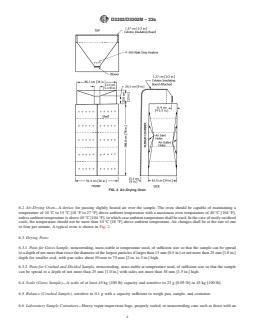
FIG. 2 Air-Drying Oven
6.1 Drying Floor—Asmooth clean floor area in a room free
of contamination by dust or other material and that permits air
circulation without excessive heat or air currents. Conditions
sample can be spread to a depth of not more than 25 mm
for an air-drying floor should approach those established for
[1.0 in.] with sides not more than 38 mm [1.5 in.] high.
oven drying as much as possible.
6.4 Scale (Gross Sample)—Ascale of at least 45 kg [100 lb]
6.2 Air-Drying Oven—A device for passing slightly heated
capacity and sensitive to 23 g [0.05 lb] in 45 kg [100 lb].
airoverthesample.Theovenshouldbecapableofmaintaining
atemperatureof10 °Cto15 °C[18 °Fto27 °F]aboveambient 6.5 Balance (Crushed Sample), sensitive to 0.1 g with a
temperature with a maximum oven temperature of 40 °C capacity sufficient to weigh pan, sample, and container.
[104 °F], unless ambient temperature is above 40 °C [104 °F],
6.6 Laboratory Sample Containers—Heavy vapor-
in which case ambient temperature shall be used. In the case of
imperviousbags,properlysealed,ornoncorrodingcanssuchas
easily oxidized coals, the temperature should not be more than
those with an airtight, friction top or screw top sealed with a
10 °C [18 °F] above ambient temperature.Air changes shall be
rubber gasket and pressure-sensitive tape for use in storage and
at the rate of one to four per minute. A typical oven is shown
transport of the laboratory sample. Glass containers, sealed
in Fig. 2.
with rubber gaskets, can be used, but care must be taken to
6.3 Drying Pans: avoid breakage in transport.
6.3.1 Pans for Gross Sample, noncorroding, mass-stable at
6.7 Drying Oven (for residual moisture on 250 µm [No. 60]
temperature used, of sufficient size so that the sample can be
sieve by 0 sample)—This oven is described in Test Method
spread to a depth of not more than twice the diameter of the
D3173 and can be of the form illustrated in Fig. 1 in Test
largest particles if larger than 13 mm [0.5 in.] or not more than
Method D3173.
25 mm [1.0 in.] depth for smaller coal, with pan sides about
6.8 Analytical Balance, sensitive to 0.1 mg (for residual
50 mm to 75 mm [2 in. to 3 in.] high.
moisture on 250 µm [No. 60] by 0 sample).
6.3.2 Pans for Crushed and Divided Sample, noncorroding,
mass-stable at temperature used, of sufficient size so that the 6.9 Capsules,withcovers,describedinTestMethodD3173.
D3302/D3302M − 22a
7. Precautions attention is directed to Section 8 of Practice D2234/D2234M
andSection7ofPracticeD7430.Theincrementsasestablished
7.1 In collecting, handling, reducing, and dividing any
in Table 2 of Practice D2234/D2234M or Table 1 of Practice
moisture sample, all operations shall be done rapidly and in as
D7430 for mechanically cleaned coal are deemed adequate for
few operations as possible, since moisture loss depends on
general purpose sampling for total moisture.
several factors other than total moisture content, such as time
required for crushing, atmospheric temperature and humidity, 8.2 Sampling of Coal for Total Moisture Determinations:
and type of crushing equipment.
8.2.1 Types of Moisture Samples—Moisture determinations
as specified in the method to be used are to be made on the
7.2 While awaiting preparation, the uncrushed gross mois-
following kinds of samples.
ture sample shall be sealed in appropriate containers in order
8.2.1.1 Entire Gross Sample—For referee tests, air dry the
that it be protected from moisture change as a result of
entire gross sample and measure the mass loss from the entire
exposure to ambient air, rain, snow, wind, and sun, or contact
gross sample during this drying. This procedure can be carried
with absorbent materials.
out on the entire gross sample as a single batch or on groups of
7.3 If the gross sample requires air drying, then the initial
primary increments or as separate operations on the individual
mass of the original gross moisture sample and container shall
primary increments; obtain, by one of these means, the total
be recorded, and the moisture loss or gain of sample and
mass loss from the entire gross sample. After this air drying,
containers shall be determined before the sample is reduced.
the sample can be crushed or divided, or both, as required by
7.4 Whenever a distinct change of humidity occurs during
the referee test for moisture.
the course of preparation of an air-dried sample, the subsample
8.2.1.2 Special Moisture Subsample—For moisture testing,
should be weighed and equilibrated with the new atmosphere
a special subsample can be taken from a gross sample before
and the mass loss or gain used in the calculation of total
any operations of air drying or crushing. Take this subsample
moisture content.
from the gross sample in accordance with the requirements of
8.2 of Practice D2234/D2234M or 8.2 of Practice D7430.
7.5 Whenever subsamples are stored or transported and
8.2.1.3 Other Subsamples for Moisture Testing—For mois-
moisture condenses on the container, then the container and
ture testing, a subsample can be used that is collected after the
subsample shall be weighed, equilibrated to the new atmo-
initial crushing and dividing of a gross sample.The procedures
sphere by air drying, and the mass loss or gain shall be used in
for the crushing and dividing, and for this subsequent subsam-
the calculation of total moisture content.
pling for moisture, are given in Practice D2013.
7.6 Sincemostcoalshaveatendencytooxidizeonexposure
8.2.2 Special Precautions—Collect samples and subsamples
to air, the air-drying procedure should not be prolonged past
for moisture in such a manner that there is no unmeasured loss
the time necessary to bring the sample to equilibrium with the
of moisture of significant amount. Make adequate weighings
temperature and humidity of the air in the room in which
before and after drying or other operations to measure all
further reduction and division are to be made. Easily oxidized
significant mass losses.
coals must not be air dried at a temperature exceeding 10 °C
8.2.3 Mass of Increments—The minimum mass of each
[18 °F] above ambient temperature. In no case shall the air
increment must be that which is sufficient as to be free of bias.
drying be done at a temperature over 40 °C [104 °F]. Air
This depends on the top size of the coal in the stream being
drying of low-rank coals should not exceed 18 h because of
sampled, the dimensions of the collection device, and other
oxidation. In the case of lignite, the goal of reaching equilib-
factors of the withdrawal of the increment. Since much of the
rium should be weighed against the possibility of oxidation.
moisture tends to be distributed uniformly across the surface,
7.7 Protect crushed, divided, pulverized, or pulverizing
moisture bias is present when the size consist of the sample is
samples from atmospheric changes affecting surface moisture
not the same as the size consist of the lot sampled. In addition,
or otherwise affecting sample integrity.
when there is no knowledge of the sampling characteristics for
7.7.1 Procedures useful in maintaining uniform temperature
moisture,eachincrementshallnotweighlessthanthevaluesin
and humidity conditions and minimum airflow in moisture
Table 2 of Practice D2234/D2234M or Table 1 of Practice
determination and sample preparation area include the follow-
D7430.
ing: (1) closed dust control system, recycling filtered air; (2)
8.2.4 Number of Increments—The number of increments
hood over dust-producing equipment to minimize airflow
requiredforagivendegreeofprecisiondependsonthemassof
required to remove dust; and (3) pulling makeup air from
the increments, the distribution of the moisture, and the total
within the building to replace exhausted air or using tempered
amount of moisture. The distribution of moisture, however, is
or conditioned makeup air.
not easily evaluated independent of total moisture;
7.7.2 Avoid heatup of pulverizer by: (1) using pulverizer
consequently, the combined effects can be measured by deter-
large enough to process sample quickly and (2) allowing time
mining the sampling characteristics for moisture.
for pulverizer to come to room temperature before reuse.
8.2.4.1 Moisture Sampling Based Only on Size—Whenthere
is no knowledge of the sampling characteristics for moisture,
8. Sampling
collect at least the number of increments from the lot of coal as
8.1 The principles, terms, organization, and collection as set those given in Table 2 of Practice D2234/D2234M or Table 1
forth in Practice D2234/D2234M and Practice D7430 shall ofPracticeD7430.Whenaspecialmoisturesubsampleistaken
apply to the collection of the total moisture sample. Particular from the gross sample before any drying or crushing
D3302/D3302M − 22a
operations, collect the number of increments for the subsample 9.1.2.2 Proceed with sample reduction and division in
as specified in 8.2 of Practice D2234/D2234M or 8.2 of accordance with Practice D2013, subsections 9.2.3 or 9.2.4,
observing precautions of Practice D2013, Section 7. Use
Practice D7430.
enclosed equipment where possible to minimize moisture
change.
9. Procedure
9.2 Air-Drying Loss on Crushed and Divided Coal Sample,
9.1 Air-Drying Loss on Gross Sample—Referee Method:
Referee and Commercial Method:
9.1.1 Procedure A, Drying Floor—This procedure is par-
9.2.1 Proceed with determination of air-drying losses (or
ticularly applicable if the gross moisture sample is too large an
gains) without unnecessary delay under either of the following
amount to ship reasonably or is too wet to handle or ship
conditions:
without loss of moisture.
9.2.1.1 When the air-drying loss has been determined on the
9.1.1.1 Weigh and record the mass of the gross moisture
gross sample (9.1) and it has been crushed and divided in
sample. Spread the sample on the drying floor to a depth of not
accordance with 9.1.1.2 or 9.1.2.2. (See Note 1.)
more than twice the top size of the coal. Mix or stir the coal
9.2.1.2 When the gross sample is not too wet to crush and
from time to time, being careful not to lose any of the coal
has been crushed and divided to 4.75 mm [No. 4] or 2.36 mm
particles. Continue the air drying and mixing until the surface
[No. 8] top sieve size. However, when the gross sample was
of the sample appears dry. Weigh the entire sample and
collected by a mechanical coal-sampling system, and therefore
redistribute over the floor for additional drying. Continue the the final accumulation of crushed and divided increments is a
drying and stirring, weighing at 1 h to 2 h intervals until the system sample, the requirement to proceed with initial air
drying may not always be appropriate since the following must
mass loss of the total sample becomes no more than 0.1 %⁄h.
be given consideration.
If the sample surface appears dry, and the time required for
(1) For cases where a system sample contains no visible
reduction and division is well established, air drying can be
surface moisture and has a mass substantially in excess of the
stopped when the mass loss is less than 0.1 % per twice the
minimum specified in Practice D2013, Table 1—for example,
required time for processing. Example: If reduction and divi-
20 kg of 4.75 mm [No. 4] sieve size—(Note 2), it is expected
sion of the sample is expected to require 20 min, the air-drying
that reduction and division—for example, to 1000 g of
procedure can be stopped when the rate of moisture loss is less
2.36 mm [No. 8] sieve size—of the entire sample using appro-
than 0.1 %⁄40 min. If this procedure is used, a second air
priately sized equipment can be performed prior to air drying
drying is required to establish the 0.1 %⁄h rate before the final
without noticeably affecting the total moisture content (Note
preparation of the laboratory sample. Record the mass of the
3).
air dry sample. Avoid excess drying.
(2) For cases where a system sample does contain visible
9.1.1.2 Proceed with sample reduction and division in
surface moisture or is close to or below the specified minimum
accordance with Practice D2013, subsections 9.2.3 or 9.2.4,
mass,aninitialairdryingisadvisabletobestaccountforallthe
observing precautions of Practice D2013, Section 7. Use
moisture.
enclosed equipment where possible to minimize moisture
(3) For cases where there is concern that initial air drying
change.
followed by reduction and division could facilitate moisture
loss due to increased surface area or newly opened pore spaces
9.1.2 Procedure B, Air Drying Oven:
in the coal, or both – for example, when 2.36 mm [No. 8] sieve
9.1.2.1 Distribute the gross moisture sample over the re-
size has been produced from some larger size—a second air
quired number of tared pans. Weigh each pan with sample as it
drying could be performed. (See Note 1 regarding air drying of
is filled from the gross sample. Place in an air-drying oven that
samples more than once.)
has been adjusted to maintain temperature no more than 10 °C
[18 °F] above ambient temperature for easily oxidized coals or NOTE 1—Common laboratory work flow often involves testing samples
for analytes in addition to moisture. Multiple air-drying periods can have
no more than 15 °C [27 °F] above ambient temperature for
deleterious effects on some test results for those additional analytes—for
other coals (oven temperature not to exceed 40 °C [104 °F]).
example,calorificvalueandrheologicalproperties.AppendixX2contains
Ambient air may be used with no heating. Maintain air
a workaround for such situations.
circulation through the oven at a rate of one to four air
NOTE 2—For guidance on minimum sample mass when top sizes are
greater than specified in Table 1 of Practice D2013, it is advisable to
exchanges per minute, but in no case should it be sufficiently
consult Table 1 in Part 4 of ISO 13909.
hightoblowfineparticlesfromthepans.Gentlystirthesample
NOTE 3—Appendix X2 presents important considerations regarding
from time to time to ensure uniform drying throughout the
unmeasured changes in moisture when processing bias test reference
sample.Continuedryingwithintermittentstirringuntilthecoal
samples. Information contained there relating to sample mass and equip-
ment capacities also applies to working with system samples.
surfaces appear to be dry. Remove from oven, weigh, and
record the mass. Return the pans with sample to the oven and
9.2.2 The sample must remain in an airtight container with
continue the operation. Calculate the percent mass loss. Repeat
minimum unused volume until testing is started. Preparation of
the drying and weighing process at 1 h to 2 h intervals until the
top-sievesize2.36 mm[No. 8]by0samplesisdescribedinthe
mass loss is less than 0.1 %⁄h. Allow the sample to reach
followingmethod,but4.75 mm[No. 4]by0samplescanbeair
equilibrium with ambient temperature and humidity before the
dried by this method as a stage in the determination of total
final air dry mass is recorded. Avoid excess drying. moisture, using the appropriate quantity.
D3302/D3302M − 22a
9.2.3 Weigh and record the tare mass of the air-drying pan is estimated, the calculation performed in Eq 1 will need to be
or pans. Quickly empty the sample from its airtight container repeated when the actual tare mass is determined at the end of
into the tared pan or pans and weigh with container (Note 4), air-drying.
recording to the nearest 0.1 g. Spread the sample evenly to a 9.2.4.3 Determine the mass of the sample and pan(s) to the
depth of no more than 25 mm [1.0 in.], preferably less for nearest 0.1 gram. Record this mass (W ) and the exact time of
shorter drying time, unless the coal is subbituminous C or day (T ) to the nearest minute.
lignite rank (Classification D388), or the rank is not known, 9.2.4.4 Allow ambient air to circulate over the sample and
and the nominal top size is 2.36 mm [No. 8] in which case, pan(s) for a period of at least 20 min.
spread the sample evenly (using a strike plate) to a depth less 9.2.4.5 Re-determine the mass of the sample and pan(s) to
than 19.1 mm [0.75 in.] but no less than 12.7 mm [0.50 in.] the nearest 0.1 gram. Record this mass (W ) and the exact time
(1). Place both the pan containing the sample and emptied of day (T ) to the nearest minute. Calculate the rate of mass
sample container in the air-drying oven that has been adjusted change per hour according to the following:
to maintain temperature no more than 10 °C [18 °F] above
6000~W 2 W !
1 0
W 5 (1)
ambient temperature for easily oxidized coals or no more than
r
W 2 W T 2 T
~ !~ !
0 t 1 0
15 °C [27 °F] above ambient temperature for other coals.
where:
Ambient air can be used with no heating. Air changes in the
W = rate of mass fraction change over time, %/hour,
oven must be at the rate of one to four per minute. (The sample
r
W = gross mass of sample and pan(s) at time T,g,
maybestirredgentlyfromtimetotimetopromoteuniforma
...
This document is not an ASTM standard and is intended only to provide the user of an ASTM standard an indication of what changes have been made to the previous version. Because
it may not be technically possible to adequately depict all changes accurately, ASTM recommends that users consult prior editions as appropriate. In all cases only the current version
of the standard as published by ASTM is to be considered the official document.
Designation: D3302/D3302M − 22 D3302/D3302M − 22a
Standard Test Method for
Total Moisture in Coal
This standard is issued under the fixed designation D3302/D3302M; the number immediately following the designation indicates the
year of original adoption or, in the case of revision, the year of last revision. A number in parentheses indicates the year of last
reapproval. A superscript epsilon (´) indicates an editorial change since the last revision or reapproval.
1. Scope
1.1 This test method covers the measurement of the total moisture in coal as it exists at the site, at the time, and under the
conditions it is sampled. It is applicable to coals as mined, processed, shipped, or used in normal commercial pursuits. It is not
applicable to coal-water slurries, sludges, or pulverized products under 0.5 mm-diameter sieve size. It is applicable to coals of all
ranks within the recognized limitations imposed by oxidation and decomposition characteristics of lower rank coals. Because of
its empirical nature, strict adherence to basic principles and permissive procedures are required for valid results (see Appendix X1).
This complete standard is available to producers, sellers, and consumers as a total moisture method when other procedures or
modifications are not mutually agreed on.
1.2 Since coal can vary from extremely wet (water-saturated) to completely dry, special emphasis must be placed on the sampling,
sample preparation, and the moisture determination itself to ensure total reliability of measurement. Therefore, this standard entails
collection of the gross sample, sample preparation, and the method of determination.
1.3 While it is recognized that such a standard may be unwieldy for routine usage in commercial operations, it can provide a
common base for agreement in cases of dispute or arbitration. The complete standard is referred to as the referee method.
Embodied in the standard is the commercial method starting with the crushed and divided sample when the gross sample is not
too wet to crush and divide. See Practice D2961/D2961M and Test Method D3173 for other moisture methods.
1.4 Units—The values stated in either SI units or inch-pound units are to be regarded separately as standard. The values stated in
each system are not necessarily exact equivalents; therefore, to ensure conformance with the standard, each system shall be used
independently of the other, and values from the two systems shall not be combined.
1.5 This standard does not purport to address all of the safety concerns, if any, associated with its use. It is the responsibility
of the user of this standard to establish appropriate safety, health, and environmental practices and determine the applicability of
regulatory limitations prior to use.
1.6 This international standard was developed in accordance with internationally recognized principles on standardization
established in the Decision on Principles for the Development of International Standards, Guides and Recommendations issued
by the World Trade Organization Technical Barriers to Trade (TBT) Committee.
2. Referenced Documents
2.1 ASTM Standards:
D121 Terminology of Coal and Coke
This test method is under the jurisdiction of ASTM Committee D05 on Coal and Coke and is the direct responsibility of Subcommittee D05.21 on Methods of Analysis.
Current edition approved Sept. 1, 2022Dec. 15, 2022. Published September 2022January 2023. Originally approved in 1974. Last previous edition approved in 20192022
as D3302/D3302M – 19.D3302/D3302M – 22. DOI: 10.1520/D3302_D3302M-22.10.1520/D3302_D3302M-22A.
For referenced ASTM standards, visit the ASTM website, www.astm.org, or contact ASTM Customer Service at service@astm.org. For Annual Book of ASTM Standards
volume information, refer to the standard’s Document Summary page on the ASTM website.
Copyright © ASTM International, 100 Barr Harbor Drive, PO Box C700, West Conshohocken, PA 19428-2959. United States
D3302/D3302M − 22a
D388 Classification of Coals by Rank
D2013 Practice for Preparing Coal Samples for Analysis
D2234/D2234M Practice for Collection of a Gross Sample of Coal
D2961/D2961M Practice for Single-Stage Total Moisture Less than 15 % in Coal Reduced to 2.36 mm [No. 8 Sieve] Topsize
D3173 Test Method for Moisture in the Analysis Sample of Coal and Coke
D5865 Test Method for Gross Calorific Value of Coal and Coke
D7430 Practice for Mechanical Sampling of Coal
2.2 ISO Standard:
ISO 13909-4 Hard Coal and Coke - Mechanical Sampling - Part 4: Coal - Preparation of Test Samples
3. Terminology
3.1 Definitions—For additional definitions of terms used in this test method, refer to Terminology D121.
3.2 Definitions of Terms Specific to This Standard:
3.2.1 air drying, n—a process of partial drying of a coal sample to bring it to near equilibrium with the atmosphere in the room
in which further reduction/division of the sample is to take place.
3.2.2 air-dry loss, n—the loss in mass, expressed as a percent, resulting from each air-drying operation.
3.2.3 easily oxidized coals, n—low-rank coals such as subbituminous or lignitic coals.
3.2.4 equilibrium, n—condition reached in air drying when the change in mass of the sample, under conditions of ambient
temperature and humidity, is no more than 0.1 % ⁄h or 0.05 % ⁄ ⁄2 h.
3.2.5 residual moisture, n—that moisture remaining in the sample after air drying.
3.2.6 total moisture, n—see Terminology D121.
4. Summary of Test Method (See Fig. 1)
4.1 This test method is based on the loss in mass of a coal sample in an air atmosphere under rigidly controlled conditions of
temperature, time, and airflow.
4.2 Alternative Methods:
4.2.1 Referee Method, which may be used in cases of dispute or arbitration. The gross moisture sample is air dried to equilibrate
it with the atmosphere at each stage of division and reduction. No air drying is necessary if the sample is already at equilibrium
with the atmosphere as indicated by stable mass.
4.2.2 Commercial Method, which may be used in routine commercial practice or when the concerned parties agree upon this
method. The crushed and divided moisture sample is air dried to equilibrate it with the atmosphere in which further division and
reduction are to occur.
4.2.3 Residual moisture determination is made in a heated forced-air circulation oven under rigidly defined conditions.
4.3 Total moisture is calculated from loss (or gains) in air drying and the residual moisture.
5. Significance and Use
5.1 The collection and treatment of the sample as specified for the referee method is intended for the express purpose of
determining the total moisture in coal. The standard is available to producers, sellers, and consumers as a method of determination
when other techniques or modifications are not mutually agreed upon.
Available from International Organization for Standardization (ISO), ISO Central Secretariat, BIBC II, Chemin de Blandonnet 8, CP 401, 1214 Vernier, Geneva,
Switzerland, http://www.iso.org.
D3302/D3302M − 22a
FIG. 1 Total Moisture Determination on Gross Sample, Special Moisture Subsample, or on Crushed and Divided Sample
5.2 The commercial method, which determines total moisture content of the crushed and divided sample, is designated as the
method for total moisture for routine commercial practice.
6. Apparatus
6.1 Drying Floor—A smooth clean floor area in a room free of contamination by dust or other material and that permits air
circulation without excessive heat or air currents. Conditions for an air-drying floor should approach those established for oven
drying as much as possible.
D3302/D3302M − 22a
FIG. 2 Air-Drying Oven
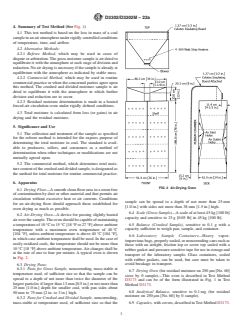
6.2 Air-Drying Oven—A device for passing slightly heated air over the sample. The oven should be capable of maintaining a
temperature of 10 °C to 15 °C [18 °F to 27 °F] above ambient temperature with a maximum oven temperature of 40 °C [104 °F],
unless ambient temperature is above 40 °C [104 °F], in which case ambient temperature shall be used. In the case of easily oxidized
coals, the temperature should not be more than 10 °C [18 °F] above ambient temperature. Air changes shall be at the rate of one
to four per minute. A typical oven is shown in Fig. 2.
6.3 Drying Pans:
6.3.1 Pans for Gross Sample, noncorroding, mass-stable at temperature used, of sufficient size so that the sample can be spread
to a depth of not more than twice the diameter of the largest particles if larger than 13 mm [0.5 in.] or not more than 25 mm [1.0 in.]
depth for smaller coal, with pan sides about 50 mm to 75 mm [2 in. to 3 in.] high.
6.3.2 Pans for Crushed and Divided Sample, noncorroding, mass-stable at temperature used, of sufficient size so that the sample
can be spread to a depth of not more than 25 mm [1.0 in.] with sides not more than 38 mm [1.5 in.] high.
6.4 Scale (Gross Sample)—A scale of at least 45 kg [100 lb] capacity and sensitive to 23 g [0.05 lb] in 45 kg [100 lb].
6.5 Balance (Crushed Sample), sensitive to 0.1 g with a capacity sufficient to weigh pan, sample, and container.
6.6 Laboratory Sample Containers—Heavy vapor-impervious bags, properly sealed, or noncorroding cans such as those with an
D3302/D3302M − 22a
airtight, friction top or screw top sealed with a rubber gasket and pressure-sensitive tape for use in storage and transport of the
laboratory sample. Glass containers, sealed with rubber gaskets, can be used, but care must be taken to avoid breakage in transport.
6.7 Drying Oven (for residual moisture on 250 μm [No. 60] sieve by 0 sample)—This oven is described in Test Method D3173
and can be of the form illustrated in Fig. 1 in Test Method D3173.
6.8 Analytical Balance, sensitive to 0.1 mg (for residual moisture on 250 μm [No. 60] by 0 sample).
6.9 Capsules, with covers, described in Test Method D3173.
7. Precautions
7.1 In collecting, handling, reducing, and dividing any moisture sample, all operations shall be done rapidly and in as few
operations as possible, since moisture loss depends on several factors other than total moisture content, such as time required for
crushing, atmospheric temperature and humidity, and type of crushing equipment.
7.2 While awaiting preparation, the uncrushed gross moisture sample shall be sealed in appropriate containers in order that it be
protected from moisture change as a result of exposure to ambient air, rain, snow, wind, and sun, or contact with absorbent
materials.
7.3 If the gross sample requires air drying, then the initial mass of the original gross moisture sample and container shall be
recorded, and the moisture loss or gain of sample and containers shall be determined before the sample is reduced.
7.4 Whenever a distinct change of humidity occurs during the course of preparation of an air-dried sample, the subsample should
be weighed and equilibrated with the new atmosphere and the mass loss or gain used in the calculation of total moisture content.
7.5 Whenever subsamples are stored or transported and moisture condenses on the container, then the container and subsample
shall be weighed, equilibrated to the new atmosphere by air drying, and the mass loss or gain shall be used in the calculation of
total moisture content.
7.6 Since most coals have a tendency to oxidize on exposure to air, the air-drying procedure should not be prolonged past the time
necessary to bring the sample to equilibrium with the temperature and humidity of the air in the room in which further reduction
and division are to be made. Easily oxidized coals must not be air dried at a temperature exceeding 10 °C [18 °F] above ambient
temperature. In no case shall the air drying be done at a temperature over 40 °C [104 °F]. Air drying of low-rank coals should not
exceed 18 h because of oxidation. In the case of lignite, the goal of reaching equilibrium should be weighed against the possibility
of oxidation.
7.7 Protect crushed, divided, pulverized, or pulverizing samples from atmospheric changes affecting surface moisture or otherwise
affecting sample integrity.
7.7.1 Procedures useful in maintaining uniform temperature and humidity conditions and minimum airflow in moisture
determination and sample preparation area include the following: (1) closed dust control system, recycling filtered air; (2) hood
over dust-producing equipment to minimize airflow required to remove dust; and (3) pulling makeup air from within the building
to replace exhausted air or using tempered or conditioned makeup air.
7.7.2 Avoid heatup of pulverizer by: (1) using pulverizer large enough to process sample quickly and (2) allowing time for
pulverizer to come to room temperature before reuse.
8. Sampling
8.1 The principles, terms, organization, and collection as set forth in Practice D2234/D2234M and Practice D7430 shall apply to
the collection of the total moisture sample. Particular attention is directed to Section 8 of Practice D2234/D2234M and Section
7 of Practice D7430. The increments as established in Table 2 of Practice D2234/D2234M or Table 1 of Practice D7430 for
mechanically cleaned coal are deemed adequate for general purpose sampling for total moisture.
D3302/D3302M − 22a
8.2 Sampling of Coal for Total Moisture Determinations:
8.2.1 Types of Moisture Samples—Moisture determinations as specified in the method to be used are to be made on the following
kinds of samples.
8.2.1.1 Entire Gross Sample—For referee tests, air dry the entire gross sample and measure the mass loss from the entire gross
sample during this drying. This procedure can be carried out on the entire gross sample as a single batch or on groups of primary
increments or as separate operations on the individual primary increments; obtain, by one of these means, the total mass loss from
the entire gross sample. After this air drying, the sample can be crushed or divided, or both, as required by the referee test for
moisture.
8.2.1.2 Special Moisture Subsample—For moisture testing, a special subsample can be taken from a gross sample before any
operations of air drying or crushing. Take this subsample from the gross sample in accordance with the requirements of 8.2 of
Practice D2234/D2234M or 8.2 of Practice D7430.
8.2.1.3 Other Subsamples for Moisture Testing—For moisture testing, a subsample can be used that is collected after the initial
crushing and dividing of a gross sample. The procedures for the crushing and dividing, and for this subsequent subsampling for
moisture, are given in Practice D2013.
8.2.2 Special Precautions—Collect samples and subsamples for moisture in such a manner that there is no unmeasured loss of
moisture of significant amount. Make adequate weighings before and after drying or other operations to measure all significant
mass losses.
8.2.3 Mass of Increments—The minimum mass of each increment must be that which is sufficient as to be free of bias. This
depends on the top size of the coal in the stream being sampled, the dimensions of the collection device, and other factors of the
withdrawal of the increment. Since much of the moisture tends to be distributed uniformly across the surface, moisture bias is
present when the size consist of the sample is not the same as the size consist of the lot sampled. In addition, when there is no
knowledge of the sampling characteristics for moisture, each increment shall not weigh less than the values in Table 2 of Practice
D2234/D2234M or Table 1 of Practice D7430.
8.2.4 Number of Increments—The number of increments required for a given degree of precision depends on the mass of the
increments, the distribution of the moisture, and the total amount of moisture. The distribution of moisture, however, is not easily
evaluated independent of total moisture; consequently, the combined effects can be measured by determining the sampling
characteristics for moisture.
8.2.4.1 Moisture Sampling Based Only on Size—When there is no knowledge of the sampling characteristics for moisture, collect
at least the number of increments from the lot of coal as those given in Table 2 of Practice D2234/D2234M or Table 1 of Practice
D7430. When a special moisture subsample is taken from the gross sample before any drying or crushing operations, collect the
number of increments for the subsample as specified in 8.2 of Practice D2234/D2234M or 8.2 of Practice D7430.
9. Procedure
9.1 Air-Drying Loss on Gross Sample—Referee Method:
9.1.1 Procedure A, Drying Floor—This procedure is particularly applicable if the gross moisture sample is too large an amount
to ship reasonably or is too wet to handle or ship without loss of moisture.
9.1.1.1 Weigh and record the mass of the gross moisture sample. Spread the sample on the drying floor to a depth of not more
than twice the top size of the coal. Mix or stir the coal from time to time, being careful not to lose any of the coal particles. Continue
the air drying and mixing until the surface of the sample appears dry. Weigh the entire sample and redistribute over the floor for
additional drying. Continue the drying and stirring, weighing at 1 h to 2 h intervals until the mass loss of the total sample becomes
no more than 0.1 % ⁄h. If the sample surface appears dry, and the time required for reduction and division is well established, air
drying can be stopped when the mass loss is less than 0.1 % per twice the required time for processing. Example: If reduction and
division of the sample is expected to require 20 min, the air-drying procedure can be stopped when the rate of moisture loss is less
than 0.1 % ⁄40 min. If this procedure is used, a second air drying is required to establish the 0.1 % ⁄h rate before the final preparation
of the laboratory sample. Record the mass of the air dry sample. Avoid excess drying.
D3302/D3302M − 22a
9.1.1.2 Proceed with sample reduction and division in accordance with Practice D2013, subsections 9.2.3 or 9.2.4, observing
precautions of Practice D2013, Section 7. Use enclosed equipment where possible to minimize moisture change.
9.1.2 Procedure B, Air Drying Oven:
9.1.2.1 Distribute the gross moisture sample over the required number of tared pans. Weigh each pan with sample as it is filled
from the gross sample. Place in an air-drying oven that has been adjusted to maintain temperature no more than 10 °C [18 °F]
above ambient temperature for easily oxidized coals or no more than 15 °C [27 °F] above ambient temperature for other coals
(oven temperature not to exceed 40 °C [104 °F]). Ambient air may be used with no heating. Maintain air circulation through the
oven at a rate of one to four air exchanges per minute, but in no case should it be sufficiently high to blow fine particles from the
pans. Gently stir the sample from time to time to ensure uniform drying throughout the sample. Continue drying with intermittent
stirring until the coal surfaces appear to be dry. Remove from oven, weigh, and record the mass. Return the pans with sample to
the oven and continue the operation. Calculate the percent mass loss. Repeat the drying and weighing process at 1 h to 2 h intervals
until the mass loss is less than 0.1 % ⁄h. Allow the sample to reach equilibrium with ambient temperature and humidity before the
final air dry mass is recorded. Avoid excess drying.
9.1.2.2 Proceed with sample reduction and division in accordance with Practice D2013, subsections 9.2.3 or 9.2.4, observing
precautions of Practice D2013, Section 7. Use enclosed equipment where possible to minimize moisture change.
9.2 Air-Drying Loss on Crushed and Divided Coal Sample, Referee and Commercial Method:
9.2.1 Proceed with determination of air-drying losses (or gains) without unnecessary delay under either of the following
conditions:
9.2.1.1 When the air-drying loss has been determined on the gross sample (9.1) and it has been crushed and divided in accordance
with 9.1.1.2 or 9.1.2.2. (See Note 1.)
9.2.1.2 When the gross sample is not too wet to crush and has been crushed and divided to 4.75 mm [No. 4] or 2.36 mm [No. 8]
top sieve size. However, when the gross sample was collected by a mechanical coal-sampling system, and therefore the final
accumulation of crushed and divided increments is a system sample, the requirement to proceed with initial air drying may not
always be appropriate since the following must be given consideration.
(1) For cases where a system sample contains no visible surface moisture and has a mass substantially in excess of the
minimum specified in Practice D2013, Table 1—for example, 20 kg of 4.75 mm [No. 4] sieve size—(Note 2), it is expected that
reduction and division—for example, to 1000 g of 2.36 mm [No. 8] sieve size—of the entire sample using appropriately sized
equipment can be performed prior to air drying without noticeably affecting the total moisture content (Note 3).
(2) For cases where a system sample does contain visible surface moisture or is close to or below the specified minimum mass,
an initial air drying is advisable to best account for all the moisture.
(3) For cases where there is concern that initial air drying followed by reduction and division could facilitate moisture loss due
to increased surface area or newly opened pore spaces in the coal, or both – for example, when 2.36 mm [No. 8] sieve size has
been produced from some larger size—a second air drying could be performed. (See Note 1 regarding air drying of samples more
than once.)
NOTE 1—Common laboratory work flow often involves testing samples for analytes in addition to moisture. Multiple air-drying periods can have
deleterious effects on some test results for those additional analytes—for example, calorific value and rheological properties. Appendix X2 contains a
workaround for such situations.
NOTE 2—For guidance on minimum sample mass when top sizes are greater than specified in Table 1 of Practice D2013, it is advisable to consult Table
1 in Part 4 of ISO 13909.
NOTE 3—Appendix X2 presents important considerations regarding unmeasured changes in moisture when processing bias test reference samples.
Information contained there relating to sample mass and equipment capacities also applies to working with system samples.
9.2.2 The sample must remain in an airtight container with minimum unused volume until testing is started. Preparation of
top-sieve size 2.36 mm [No. 8] by 0 samples is described in the following method, but 4.75 mm [No. 4] by 0 samples can be air
dried by this method as a stage in the determination of total moisture, using the appropriate quantity.
9.2.3 Weigh and record the tare mass of the air-drying pan or pans. Quickly empty the sample from its airtight container into the
tared pan or pans and weigh with container (Note 4), recording to the nearest 0.1 g. Spread the sample evenly to a depth of no more
D3302/D3302M − 22a
than 25 mm [1.0 in.], preferably less for shorter drying time, unless the coal is subbituminous C or lignite rank (Classification
D388), or the rank is not known, and the nominal top size is 2.36 mm [No. 8] in which case, spread the sample evenly (using a
strike plate) to a depth less than 19.1 mm [0.75 in.] but no less than 12.7 mm [0.50 in.] (1). Place both the pan containing the
sample and emptied sample container in the air-drying oven that has been adjusted to maintain temperature no more than 10 °C
[18 °F] above ambient temperature for easily oxidized coals or no more than 15 °C [27 °F] above ambient temperature for other
coals. Ambient air can be used with no heating. Air changes in the oven must be at the rate of one to four per minute. (The sample
may be stirred gently from time to time to promote uniform and quicker drying.) Continue drying until the coal surfaces appear
to be dry. Remove the pan and container from the oven and weigh together. Carefully transfer residual coal from the dried sample
container to the sample in the pan. Weigh the empty container and subtract its mass from the combined mass of pan, sample, and
container recorded both before and after the first air-drying period. Calculate the percent mass loss of the sample. Return the pan
or pans with sample to the oven and continue drying. Weigh at 1 h to 2 h intervals until the mass loss drops to a level near the
0.1 % ⁄h target (about 0.2 % ⁄h to 0.3 % ⁄h). Complete the air drying at ambient temperature, allowing the sample to reach
equilibrium (0.1 % loss per hour or 0.05 % loss per half hour) with both ambient temperature and humidity before the final air-dry
mass is recorded (Note 5). When this point is reached, record the final air-dry mass. Calculate the percent air-drying loss. Strictly
observe the cautions of Section 7.
NOTE 4—If the moisture determination is to be made without delay in the immediate vicinity of sample preparation, the sample need not be placed in
a container, but can be weighed directly in a tared drying pan.
NOTE 5—This final air-drying phase may be accomplished by leaving the sample in the oven, cutting off the heat, but continuin
...