

ASTM E1302-23
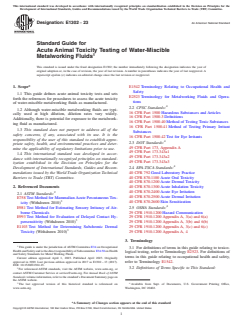
(Guide)Standard Guide for Acute Animal Toxicity Testing of Water-Miscible Metalworking Fluids
General Information
- Abstract
SIGNIFICANCE AND USE
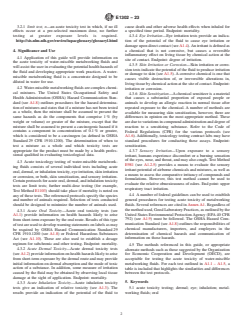
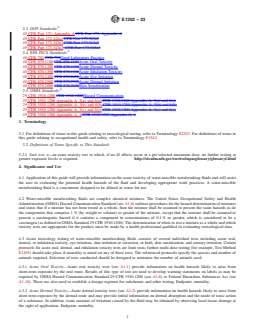
4.1 Application of this guide will provide information on the acute toxicity of water-miscible metalworking fluids and will assist the user in evaluating the potential health hazards of the fluid and developing appropriate work practices. A water-miscible metalworking fluid is a concentrate designed to be diluted in water for use.
4.2 Water-miscible metalworking fluids are complex chemical mixtures. The United States Occupational Safety and Health Administration (OSHA) Hazard Communication Standard (see A1.8) outlines procedures for the hazard determination of mixtures and states that if a mixture has not been tested as a whole, then the mixture shall be assumed to present the same hazards as do the components that comprise 1 % (by weight or volume) or greater of the mixture, except that the mixture shall be assumed to present a carcinogenic hazard if it contains a component in concentrations of 0.1 % or greater, which is considered to be a carcinogen (as defined in OSHA Standard 29 CFR 1910.1200). The determination of when to test a mixture as a whole and which toxicity tests are appropriate for the product must be made by a health professional qualified in evaluating toxicological data.
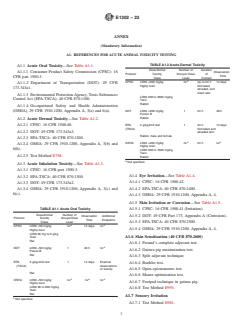
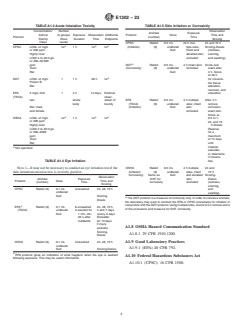
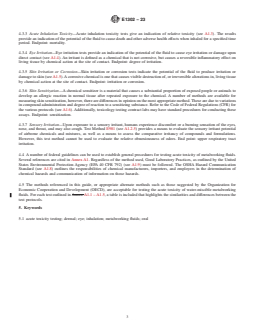
4.3 Acute toxicology testing of water-miscible metalworking fluids consists of several individual tests including acute oral, dermal, or inhalation toxicity, eye irritation, skin irritation or corrosion, or both, skin sensitization, and sensory irritation. Certain protocols for acute oral, dermal, and inhalation toxicity tests are limit tests; further multi-dose testing (for example, Test Method E1103) should take place if mortality is noted on any of these tests. The referenced protocols specify the species and number of animals required. Selection of tests conducted should be designed to minimize the number of animals used.
4.3.1 Acute Oral Toxicity—Acute oral toxicity tests (see A1.1) provide information on health hazards likely to arise from short-term exposure by the ...
SCOPE
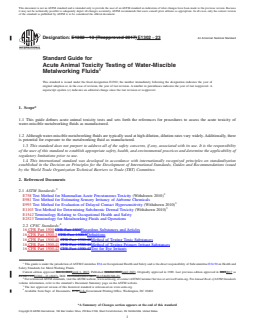
1.1 This guide defines acute animal toxicity tests and sets forth the references for procedures to assess the acute toxicity of water-miscible metalworking fluids as manufactured.
1.2 Although water-miscible metalworking fluids are typically used at high dilution, dilution rates vary widely. Additionally, there is potential for exposure to the metalworking fluid as manufactured.
1.3 This standard does not purport to address all of the safety concerns, if any, associated with its use. It is the responsibility of the user of this standard to establish appropriate safety, health, and environmental practices and determine the applicability of regulatory limitations prior to use.
1.4 This international standard was developed in accordance with internationally recognized principles on standardization established in the Decision on Principles for the Development of International Standards, Guides and Recommendations issued by the World Trade Organization Technical Barriers to Trade (TBT) Committee.
- Status
- Published
- Publication Date
- 31-Mar-2023
- Technical Committee
- E34 - Occupational Health and Safety
- Drafting Committee
- E34.50 - Health and Safety Standards for Metal Working Fluids
Buy Documents
ASTM E1302-23 - Standard Guide for Acute Animal Toxicity Testing of Water-Miscible Metalworking Fluids
REDLINE ASTM E1302-23 - Standard Guide for Acute Animal Toxicity Testing of Water-Miscible Metalworking Fluids
Overview
ASTM E1302-23: Standard Guide for Acute Animal Toxicity Testing of Water-Miscible Metalworking Fluids provides a comprehensive framework for assessing the potential acute health hazards presented by water-miscible metalworking fluids. These fluids, typically supplied as concentrates for dilution in water, are widely used in metalworking operations for lubrication and cooling. Because these fluids are complex chemical mixtures, acute toxicity testing is vital for workplace safety, regulatory compliance, and proper product labeling.
This ASTM guide helps users evaluate the risks associated with both the manufactured fluids and their diluted forms, ensuring the adoption of effective occupational health and safety practices. It references federal regulatory standards, such as those from OSHA and the EPA, and aligns with international standardization principles.
Key Topics
- Acute Toxicity Testing: Covers procedures for evaluating short-term toxicity of water-miscible metalworking fluids as manufactured, including oral, dermal, inhalation, eye, and skin exposure.
- Test Categories: Includes limit tests and protocols for evaluating:
- Acute oral toxicity
- Acute dermal toxicity
- Acute inhalation toxicity
- Eye irritation potential
- Skin irritation or corrosion
- Skin sensitization
- Sensory irritation (nose, throat, and respiratory tract)
- Hazard Determination: Incorporates OSHA requirements for mixtures, stating that any component at or above specific concentrations must be considered hazardous, especially carcinogens at ≥0.1%.
- Regulatory References: Integrates U.S. regulations (e.g., 29 CFR 1910.1200, 40 CFR 792, 16 CFR 1500) and supports good laboratory practices.
- Animal Welfare: Recommends minimizing the number of test animals and combining protocols where feasible to reduce animal use.
Applications
The guide is essential for manufacturers, importers, industrial hygienists, and occupational safety professionals involved in metalworking operations and product safety compliance. Practical uses include:
- Hazard Evaluation: Determining the acute toxicity profiles of metalworking fluids helps establish safe handling procedures and necessary protective equipment.
- Product Labeling and Communication: Provides data needed to comply with OSHA's Hazard Communication Standard and produce accurate safety data sheets (SDSs).
- Regulatory Compliance: Ensures testing meets requirements under U.S. and international regulations, facilitating market acceptance and minimizing liability.
- Work Practice Development: Helps users create tailored safety protocols for handling, storage, and accidental exposure to metalworking fluids.
- Testing Standardization: Offers harmonized testing methods, reducing variability in toxicity data and supporting reliable product comparisons.
Related Standards
ASTM E1302-23 references several standards and regulatory protocols for acute toxicity evaluation, including:
- ASTM Standards:
- E758: Mammalian Acute Percutaneous Toxicity
- E981: Sensory Irritancy of Airborne Chemicals
- E1103: Subchronic Dermal Toxicity
- E1542: Terminology Relating to Occupational Health and Safety
- E2523: Terminology for Metalworking Fluids and Operations
- CPSC Standards: 16 CFR 1500 (Hazardous Substances and Articles)
- EPA-TSCA Standards: 40 CFR 792, 870.1100–870.2600 (Good Laboratory Practice, Acute Toxicity Methods)
- DOT Standards: 49 CFR 173 (Regulation for Hazardous Materials)
- OSHA Standards: 29 CFR 1910.1200 (Hazard Communication)
By providing structured and referenced toxicity testing guidelines, ASTM E1302-23 supports safer workplaces, regulatory compliance, and effective communication of hazards associated with water-miscible metalworking fluids.
Keywords: acute toxicity testing, metalworking fluids, water-miscible fluids, occupational health, hazard communication, OSHA, EPA, safety data sheets, industrial hygiene, workplace safety.
Relations
- Effective Date
- 01-Nov-2023
- Effective Date
- 01-Jan-2020
- Effective Date
- 01-Feb-2019
- Effective Date
- 01-Oct-2018
- Effective Date
- 01-Feb-2018
- Effective Date
- 01-Apr-2013
- Refers
ASTM E981-04(2012) - Standard Test Method for Estimating Sensory Irritancy of Airborne Chemicals - Effective Date
- 01-Dec-2012
- Effective Date
- 01-Jan-2011
- Effective Date
- 01-Aug-2010
- Effective Date
- 15-Apr-2007
- Effective Date
- 01-Dec-2006
- Effective Date
- 01-Apr-2004
- Effective Date
- 01-Jan-2000
- Effective Date
- 01-Jan-1998
Buy Documents
ASTM E1302-23 - Standard Guide for Acute Animal Toxicity Testing of Water-Miscible Metalworking Fluids
REDLINE ASTM E1302-23 - Standard Guide for Acute Animal Toxicity Testing of Water-Miscible Metalworking Fluids
Get Certified
Connect with accredited certification bodies for this standard

BSI Group
BSI (British Standards Institution) is the business standards company that helps organizations make excellence a habit.

TÜV Rheinland
TÜV Rheinland is a leading international provider of technical services.

TÜV SÜD
TÜV SÜD is a trusted partner of choice for safety, security and sustainability solutions.
Sponsored listings
Frequently Asked Questions
ASTM E1302-23 is a guide published by ASTM International. Its full title is "Standard Guide for Acute Animal Toxicity Testing of Water-Miscible Metalworking Fluids". This standard covers: SIGNIFICANCE AND USE 4.1 Application of this guide will provide information on the acute toxicity of water-miscible metalworking fluids and will assist the user in evaluating the potential health hazards of the fluid and developing appropriate work practices. A water-miscible metalworking fluid is a concentrate designed to be diluted in water for use. 4.2 Water-miscible metalworking fluids are complex chemical mixtures. The United States Occupational Safety and Health Administration (OSHA) Hazard Communication Standard (see A1.8) outlines procedures for the hazard determination of mixtures and states that if a mixture has not been tested as a whole, then the mixture shall be assumed to present the same hazards as do the components that comprise 1 % (by weight or volume) or greater of the mixture, except that the mixture shall be assumed to present a carcinogenic hazard if it contains a component in concentrations of 0.1 % or greater, which is considered to be a carcinogen (as defined in OSHA Standard 29 CFR 1910.1200). The determination of when to test a mixture as a whole and which toxicity tests are appropriate for the product must be made by a health professional qualified in evaluating toxicological data. 4.3 Acute toxicology testing of water-miscible metalworking fluids consists of several individual tests including acute oral, dermal, or inhalation toxicity, eye irritation, skin irritation or corrosion, or both, skin sensitization, and sensory irritation. Certain protocols for acute oral, dermal, and inhalation toxicity tests are limit tests; further multi-dose testing (for example, Test Method E1103) should take place if mortality is noted on any of these tests. The referenced protocols specify the species and number of animals required. Selection of tests conducted should be designed to minimize the number of animals used. 4.3.1 Acute Oral Toxicity—Acute oral toxicity tests (see A1.1) provide information on health hazards likely to arise from short-term exposure by the ... SCOPE 1.1 This guide defines acute animal toxicity tests and sets forth the references for procedures to assess the acute toxicity of water-miscible metalworking fluids as manufactured. 1.2 Although water-miscible metalworking fluids are typically used at high dilution, dilution rates vary widely. Additionally, there is potential for exposure to the metalworking fluid as manufactured. 1.3 This standard does not purport to address all of the safety concerns, if any, associated with its use. It is the responsibility of the user of this standard to establish appropriate safety, health, and environmental practices and determine the applicability of regulatory limitations prior to use. 1.4 This international standard was developed in accordance with internationally recognized principles on standardization established in the Decision on Principles for the Development of International Standards, Guides and Recommendations issued by the World Trade Organization Technical Barriers to Trade (TBT) Committee.
SIGNIFICANCE AND USE 4.1 Application of this guide will provide information on the acute toxicity of water-miscible metalworking fluids and will assist the user in evaluating the potential health hazards of the fluid and developing appropriate work practices. A water-miscible metalworking fluid is a concentrate designed to be diluted in water for use. 4.2 Water-miscible metalworking fluids are complex chemical mixtures. The United States Occupational Safety and Health Administration (OSHA) Hazard Communication Standard (see A1.8) outlines procedures for the hazard determination of mixtures and states that if a mixture has not been tested as a whole, then the mixture shall be assumed to present the same hazards as do the components that comprise 1 % (by weight or volume) or greater of the mixture, except that the mixture shall be assumed to present a carcinogenic hazard if it contains a component in concentrations of 0.1 % or greater, which is considered to be a carcinogen (as defined in OSHA Standard 29 CFR 1910.1200). The determination of when to test a mixture as a whole and which toxicity tests are appropriate for the product must be made by a health professional qualified in evaluating toxicological data. 4.3 Acute toxicology testing of water-miscible metalworking fluids consists of several individual tests including acute oral, dermal, or inhalation toxicity, eye irritation, skin irritation or corrosion, or both, skin sensitization, and sensory irritation. Certain protocols for acute oral, dermal, and inhalation toxicity tests are limit tests; further multi-dose testing (for example, Test Method E1103) should take place if mortality is noted on any of these tests. The referenced protocols specify the species and number of animals required. Selection of tests conducted should be designed to minimize the number of animals used. 4.3.1 Acute Oral Toxicity—Acute oral toxicity tests (see A1.1) provide information on health hazards likely to arise from short-term exposure by the ... SCOPE 1.1 This guide defines acute animal toxicity tests and sets forth the references for procedures to assess the acute toxicity of water-miscible metalworking fluids as manufactured. 1.2 Although water-miscible metalworking fluids are typically used at high dilution, dilution rates vary widely. Additionally, there is potential for exposure to the metalworking fluid as manufactured. 1.3 This standard does not purport to address all of the safety concerns, if any, associated with its use. It is the responsibility of the user of this standard to establish appropriate safety, health, and environmental practices and determine the applicability of regulatory limitations prior to use. 1.4 This international standard was developed in accordance with internationally recognized principles on standardization established in the Decision on Principles for the Development of International Standards, Guides and Recommendations issued by the World Trade Organization Technical Barriers to Trade (TBT) Committee.
ASTM E1302-23 is classified under the following ICS (International Classification for Standards) categories: 11.100.99 - Other standards related to laboratory medicine. The ICS classification helps identify the subject area and facilitates finding related standards.
ASTM E1302-23 has the following relationships with other standards: It is inter standard links to ASTM E2523-23, ASTM E1542-20, ASTM E981-19, ASTM E2523-13(2018), ASTM E1542-18, ASTM E2523-13, ASTM E981-04(2012), ASTM E2523-11, ASTM E1542-10, ASTM E2523-07, ASTM E2523-06, ASTM E1542-93(2004), ASTM E1103-96, ASTM E1542-93(1998). Understanding these relationships helps ensure you are using the most current and applicable version of the standard.
ASTM E1302-23 is available in PDF format for immediate download after purchase. The document can be added to your cart and obtained through the secure checkout process. Digital delivery ensures instant access to the complete standard document.
Standards Content (Sample)
This international standard was developed in accordance with internationally recognized principles on standardization established in the Decision on Principles for the
Development of International Standards, Guides and Recommendations issued by the World Trade Organization Technical Barriers to Trade (TBT) Committee.
Designation: E1302 − 23 An American National Standard
Standard Guide for
Acute Animal Toxicity Testing of Water-Miscible
Metalworking Fluids
This standard is issued under the fixed designation E1302; the number immediately following the designation indicates the year of
original adoption or, in the case of revision, the year of last revision. A number in parentheses indicates the year of last reapproval. A
superscript epsilon (´) indicates an editorial change since the last revision or reapproval.
1. Scope* E1542 Terminology Relating to Occupational Health and
Safety
1.1 This guide defines acute animal toxicity tests and sets
E2523 Terminology for Metalworking Fluids and Opera-
forth the references for procedures to assess the acute toxicity
tions
of water-miscible metalworking fluids as manufactured.
2.2 CPSC Standards:
1.2 Although water-miscible metalworking fluids are typi-
16 CFR Part 1500 Hazardous Substances and Articles
cally used at high dilution, dilution rates vary widely.
16 CFR Part 1500.3 Definitions
Additionally, there is potential for exposure to the metalwork-
16 CFR Part 1500.40 Method of Testing Toxic Substances
ing fluid as manufactured.
16 CFR Part 1500.41 Method of Testing Primary Irritant
1.3 This standard does not purport to address all of the
Substances
safety concerns, if any, associated with its use. It is the
16 CFR Part 1500.42 Test for Eye Irritants
responsibility of the user of this standard to establish appro-
2.3 DOT Standards:
priate safety, health, and environmental practices and deter-
49 CFR Part 173, Appendix A
mine the applicability of regulatory limitations prior to use.
49 CFR Part 173.343a1
1.4 This international standard was developed in accor-
49 CFR Part 173.343a2
dance with internationally recognized principles on standard-
49 CFR Part 173.343a3
ization established in the Decision on Principles for the
2.4 EPA-TSCA Standards:
Development of International Standards, Guides and Recom-
mendations issued by the World Trade Organization Technical 40 CFR 792 Good Laboratory Practice
40 CFR 870.1100 Acute Oral Toxicity
Barriers to Trade (TBT) Committee.
40 CFR 870.1200 Acute Dermal Toxicity
2. Referenced Documents 40 CFR 870.1300 Acute Inhalation Toxicity
40 CFR 870.2400 Acute Eye Irritation
2.1 ASTM Standards:
40 CFR 870.2500 Acute Dermal Irritation
E758 Test Method for Mammalian Acute Percutaneous Tox-
40 CFR 870.2600 Skin Sensitization
icity (Withdrawn 2010)
E981 Test Method for Estimating Sensory Irritancy of Air- 2.5 OSHA Standards:
borne Chemicals 29 CFR 1910.1200 Hazard Communication
E993 Test Method for Evaluation of Delayed Contact Hy- 29 CFR 1910.1200 Appendix A, 3(a) and 6(a)
persensitivity (Withdrawn 2010) 29 CFR 1910.1200 Appendix A, 3(b) and 6(b)
E1103 Test Method for Determining Subchronic Dermal 29 CFR 1910.1200 Appendix A, 3(c) and 6(c)
Toxicity (Withdrawn 2010) 29 CFR 1910.1200 Appendix A, 4
3. Terminology
This guide is under the jurisdiction of ASTM Committee E34 on Occupational
3.1 For definitions of terms in this guide relating to toxico-
Health and Safety and is the direct responsibility of Subcommittee E34.50 on Health
logical testing, refer to Terminology E2523. For definitions of
and Safety Standards for Metal Working Fluids.
terms in this guide relating to occupational health and safety,
Current edition approved April 1, 2023. Published April 2023. Originally
approved in 1989. Last previous edition approved in 2017 as E1302 – 13 (2017).
refer to Terminology E1542.
DOI: 10.1520/E1302-23.
2 3.2 Definitions of Terms Specific to This Standard:
For referenced ASTM standards, visit the ASTM website, www.astm.org, or
contact ASTM Customer Service at service@astm.org. For Annual Book of ASTM
Standards volume information, refer to the standard’s Document Summary page on
the ASTM website.
3 4
The last approved version of this historical standard is referenced on Available from Supt. of Documents, U.S. Government Printing Office,
www.astm.org. Washington, DC 20402.
*A Summary of Changes section appears at the end of this standard
Copyright © ASTM International, 100 Barr Harbor Drive, PO Box C700, West Conshohocken, PA 19428-2959. United States
E1302 − 23
3.2.1 limit test, n—an acute toxicity test in which, if no ill cause death and other adverse health effects when inhaled for
effects occur at a pre-selected maximum dose, no further a specified time period. Endpoint: mortality.
testing at greater exposure levels is required. 4.3.4 Eye Irritation—Eye irritation tests provide an indica-
http://sis.nlm.nih.gov/enviro/iupacglossary/glossaryl.html tion of the potential of the fluid to cause eye irritation or
damage upon direct contact (see A1.4). An irritant is defined as
4. Significance and Use a chemical that is not corrosive, but causes a reversible
inflammatory effect on living tissue by chemical action at the
4.1 Application of this guide will provide information on
site of contact. Endpoint: degree of irritation.
the acute toxicity of water-miscible metalworking fluids and
4.3.5 Skin Irritation or Corrosion—Skin irritation or corro-
will assist the user in evaluating the potential health hazards of
sion tests indicate the potential of the fluid to produce irritation
the fluid and developing appropriate work practices. A water-
or damage to skin (see A1.5). A corrosive chemical is one that
miscible metalworking fluid is a concentrate designed to be
causes visible destruction of, or irreversible alterations in,
diluted in water for use.
living tissue by chemical action at the site of contact. Endpoint:
4.2 Water-miscible metalworking fluids are complex chemi-
irritation or corrosion.
cal mixtures. The United States Occupational Safety and
4.3.6 Skin Sensitization—A chemical sensitizer is a material
Health Administration (OSHA) Hazard Communication Stan- that causes a substantial proportion of exposed people or
dard (see A1.8) outlines procedures for the hazard determina-
animals to develop an allergic reaction in normal tissue after
tion of mixtures and states that if a mixture has not been tested repeated exposure to the chemical. A number of methods are
as a whole, then the mixture shall be assumed to present the
available for measuring skin sensitization, however, there are
same hazards as do the components that comprise 1 % (by differences in opinion on the most appropriate method. These
weight or volume) or greater of the mixture, except that the
are due to variations in compound administration and degree of
mixture shall be assumed to present a carcinogenic hazard if it reaction to a sensitizing substance. Refer to the Code of
contains a component in concentrations of 0.1 % or greater,
Federal Regulations (CFR) for the various protocols (see
which is considered to be a carcinogen (as defined in OSHA A1.6). Additionally, toxicology testing contract labs may have
Standard 29 CFR 1910.1200). The determination of when to
standard procedures for conducting these assays. Endpoint:
test a mixture as a whole and which toxicity tests are sensitization.
appropriate for the product must be made by a health profes-
4.3.7 Sensory Irritation—Upon exposure to a sensory
sional qualified in evaluating toxicological data. irritant, humans experience discomfort or a burning sensation
of the eyes, nose, and throat, and may also cough. Test Method
4.3 Acute toxicology testing of water-miscible metalwork-
E981 (see A1.2.5) provides a means to evaluate the sensory
ing fluids consists of several individual tests including acute
irritant potential of airborne chemicals and mixtures, as well as
oral, dermal, or inhalation toxicity, eye irritation, skin irritation
a means to assess the comparative irritancy of compounds and
or corrosion, or both, skin sensitization, and sensory irritation.
formulations. However, this test method cannot be used to
Certain protocols for acute oral, dermal, and inhalation toxicity
evaluate the relative obnoxiousness of odors. End point: upper
tests are limit tests; further multi-dose testing (for example,
respiratory tract irritation.
Test Method E1103) should take place if mortality is noted on
4.4 A number of federal guidelines can be used to establish
any of these tests. The referenced protocols specify the species
general procedures for testing acute toxicity of metalworking
and number of animals required. Selection of tests conducted
fluids. Several references are cited in Annex A1. Regardless of
should be designed to minimize the number of animals used.
the method used, Good Laboratory Practices, as outlined by the
4.3.1 Acute Oral Toxicity—Acute oral toxicity tests (see
United States Environmental Protection Agency (EPA 40 CFR
...
This document is not an ASTM standard and is intended only to provide the user of an ASTM standard an indication of what changes have been made to the previous version. Because
it may not be technically possible to adequately depict all changes accurately, ASTM recommends that users consult prior editions as appropriate. In all cases only the current version
of the standard as published by ASTM is to be considered the official document.
Designation: E1302 − 13 (Reapproved 2017) E1302 − 23 An American National Standard
Standard Guide for
Acute Animal Toxicity Testing of Water-Miscible
Metalworking Fluids
This standard is issued under the fixed designation E1302; the number immediately following the designation indicates the year of
original adoption or, in the case of revision, the year of last revision. A number in parentheses indicates the year of last reapproval. A
superscript epsilon (´) indicates an editorial change since the last revision or reapproval.
1. Scope*
1.1 This guide defines acute animal toxicity tests and sets forth the references for procedures to assess the acute toxicity of
water-miscible metalworking fluids as manufactured.
1.2 Although water-miscible metalworking fluids are typically used at high dilution, dilution rates vary widely. Additionally, there
is potential for exposure to the metalworking fluid as manufactured.
1.3 This standard does not purport to address all of the safety concerns, if any, associated with its use. It is the responsibility
of the user of this standard to establish appropriate safety, health, and environmental practices and determine the applicability of
regulatory limitations prior to use.
1.4 This international standard was developed in accordance with internationally recognized principles on standardization
established in the Decision on Principles for the Development of International Standards, Guides and Recommendations issued
by the World Trade Organization Technical Barriers to Trade (TBT) Committee.
2. Referenced Documents
2.1 ASTM Standards:
E758 Test Method for Mammalian Acute Percutaneous Toxicity (Withdrawn 2010)
E981 Test Method for Estimating Sensory Irritancy of Airborne Chemicals
E993 Test Method for Evaluation of Delayed Contact Hypersensitivity (Withdrawn 2010)
E1103 Test Method for Determining Subchronic Dermal Toxicity (Withdrawn 2010)
E1542 Terminology Relating to Occupational Health and Safety
E2523 Terminology for Metalworking Fluids and Operations
2.2 CPSC Standards:
16 CFR Part 1500 CFR Part 1500Hazardous Substances and Articles
16 CFR Part 1500.3 CFR Part 1500.3Definitions
16 CFR Part 1500.40 CFR Part 1500.40Method of Testing Toxic Substances
16 CFR Part 1500.41 CFR Part 1500.41Method of Testing Primary Irritant Substances
16 CFR Part 1500.42 CFR Part 1500.42Test for Eye Irritants
This guide is under the jurisdiction of ASTM Committee E34 on Occupational Health and Safety and is the direct responsibility of Subcommittee E34.50 on Health and
Safety Standards for Metal Working Fluids.
Current edition approved Oct. 1, 2017April 1, 2023. Published October 2017April 2023. Originally approved in 1989. Last previous edition approved in 20132017 as
E1302 – 13.E1302 – 13 (2017). DOI: 10.1520/E1302-13R17.10.1520/E1302-23.
For referenced ASTM standards, visit the ASTM website, www.astm.org, or contact ASTM Customer Service at service@astm.org. For Annual Book of ASTM Standards
volume information, refer to the standard’s Document Summary page on the ASTM website.
The last approved version of this historical standard is referenced on www.astm.org.
Available from Supt. of Documents, U. S. U.S. Government Printing Office, Washington, DC 20402.
*A Summary of Changes section appears at the end of this standard
Copyright © ASTM International, 100 Barr Harbor Drive, PO Box C700, West Conshohocken, PA 19428-2959. United States
E1302 − 23
2.3 DOT Standards:
49 CFR Part 173, Appendix A CFR Part 173, Appendix A
49 CFR Part 173.343a1 CFR Part 173.343a1
49 CFR Part 173.343a2 CFR Part 173.343a2
49 CFR Part 173.343a3 CFR Part 173.343a3
2.4 EPA-TSCA Standards:
40 CFR 792 CFR 792Good Laboratory Practice
40 CFR 870.1100 CFR 870.1100Acute Oral Toxicity
40 CFR 870.1200 CFR 870.1200Acute Dermal Toxicity
40 CFR 870.1300 CFR 870.1300Acute Inhalation Toxicity
40 CFR 870.2400 CFR 870.2400Acute Eye Irritation
40 CFR 870.2500 CFR 870.2500Acute Dermal Irritation
40 CFR 870.2600 CFR 870.2600Skin Sensitization
2.5 OSHA Standards:
29 CFR 1910.1200 CFR 1910.1200Hazard Communication
29 CFR 1910.1200 Appendix A, 3(a) and 6(a) CFR 1910.1200 Appendix A, 3(a) and 6(a)
29 CFR 1910.1200 Appendix A, 3(b) and 6(b) CFR 1910.1200 Appendix A, 3(b) and 6(b)
29 CFR 1910.1200 Appendix A, 3(c) and 6(c) CFR 1910.1200 Appendix A, 3(c) and 6(c)
29 CFR 1910.1200 Appendix A, 4 CFR 1910.1200 Appendix A, 4
3. Terminology
3.1 For definitions of terms in this guide relating to toxicological testing, refer to Terminology E2523. For definitions of terms in
this guide relating to occupational health and safety, refer to Terminology E1542.
3.2 Definitions of Terms Specific to This Standard:
3.2.1 limit test, n—an acute toxicity test in which, if no ill effects occur at a pre-selected maximum dose, no further testing at
greater exposure levels is required. http://sis.nlm.nih.gov/enviro/iupacglossary/glossaryl.html
4. Significance and Use
4.1 Application of this guide will provide information on the acute toxicity of water-miscible metalworking fluids and will assist
the user in evaluating the potential health hazards of the fluid and developing appropriate work practices. A water-miscible
metalworking fluid is a concentrate designed to be diluted in water for use.
4.2 Water-miscible metalworking fluids are complex chemical mixtures. The United States Occupational Safety and Health
Administration (OSHA) Hazard Communication Standard (see A1.8) outlines procedures for the hazard determination of mixtures
and states that if a mixture has not been tested as a whole, then the mixture shall be assumed to present the same hazards as do
the components that comprise 1 % (by weight or volume) or greater of the mixture, except that the mixture shall be assumed to
present a carcinogenic hazard if it contains a component in concentrations of 0.1 % or greater, which is considered to be a
carcinogen (as defined in OSHA Standard 29 CFR 1910.1200). The determination of when to test a mixture as a whole and which
toxicity tests are appropriate for the product must be made by a health professional qualified in evaluating toxicological data.
4.3 Acute toxicology testing of water-miscible metalworking fluids consists of several individual tests including acute oral,
dermal, or inhalation toxicity, eye irritation, skin irritation or corrosion, or both, skin sensitization, and sensory irritation. Certain
protocols for acute oral, dermal, and inhalation toxicity tests are limit tests; further multi-dose testing (for example, Test Method
E1103) should take place if mortality is noted on any of these tests. The referenced protocols specify the species and number of
animals required. Selection of tests conducted should be designed to minimize the number of animals used.
4.3.1 Acute Oral Toxicity—Acute oral toxicity tests (see A1.1) provide information on health hazards likely to arise from
short-term exposure by the oral route. Results of this type of test are used to develop warning statements on labels as may be
required by OSHA Hazard Communication Standard 29 CFR 1910.1200 (see A1.8) or Federal Hazardous Substances Act (see
A1.10). These are also used to establish a dosage regimen for subchronic and other testing. Endpoint: mortality.
4.3.2 Acute Dermal Toxicity—Acute dermal toxicity tests (see A1.2) provide information on health hazards likely to arise from
short-term exposure by the dermal route and may provide initial information on dermal absorption and the mode of toxic action
of a substance. In addition, some measure of irritation caused by the fluid may be obtained by observing local tissue damage at
the sight of application. Endpoint: mortality.
E1302 − 23
4.3.3 Acute Inhalation Toxicity—Acute inhalation toxicity tests give an indication of relative toxicity (see A1.3). The results
provide an indication of the potential of the fluid to cause death and other adverse health effects when inhaled for a specified time
period. Endpoint: mortality.
4.3.4 Eye Irritation—Eye irritation tests provide an indication of the potential of the fluid to cause eye irritation or damage upon
direct contact (see A1.4). An irritant is defined as a chemical that is not corrosive, but causes a reversible inflammatory effect on
living tissue by chemical action at the site of contact. Endpoint: degree of irritation.
4.3.5 Skin Irritation or Corrosion—Skin irritation or corrosion tests indicate the potential of the fluid to produce irritation or
damage to skin (see A1.5). A corrosive chemical is one that causes visible destruction of, or irreversible alterations in, living tissue
by chemical action at the site of contact. Endpoint: irritation or corrosion.
4.3.6 Skin Sensitization—A chemical sensitizer is a material that causes a substantial proportion of exposed people or animals to
develop an allergic reaction in normal tissue after repeated exposure to the chemical. A number of methods are available for
measuring skin sensitization, however, there are differences in opinion o
...