

ASTM F2433-05(2018)
(Test Method)Standard Test Method for Determining Thermoplastic Pipe Wall Stiffness
General Information
- Abstract
SIGNIFICANCE AND USE
5.1 The performance under bending and compression load of a thermoplastic plastic pipe wall design obtained by this method can be used for the following:
5.1.1 To determine the stiffness of the pipe wall section. This is a function of the pipe dimensions, the wall design, the arc length tested, and the physical properties of the material of which the pipe is made.
5.1.2 To compare the characteristics of various thermoplastic pipe wall designs.
5.1.3 To compare the characteristics of various plastics in pipe form.
5.1.4 To study the interrelations of dimensions, materials, and deformation properties of thermoplastic pipe designs.
5.1.5 To measure the deformation and load-resistance at any of several significant events which may occur during the test.
5.1.6 To provide a reasonable quality control/quality assurance test for very large diameter plastic pipes.
5.2 The time-dependent pipe wall stiffness of a thermoplastic pipe obtained by this test method may used for the following:
5.2.1 To predict the residual stiffness of the pipe wall in bending and compression at all times after initial loading.
5.2.2 For purposes of design, to determine a modulus of relaxation under sustained loads.
5.2.3 To quantify the influence of material formulations of thermoplastics on the modulus of relaxation.
5.2.4 To study the influence of geometric patterns of wall profiles on the modulus of relaxation.
5.3 The time-independent reduction of wall thickness at springline may be used for the following:
5.3.1 For pipe wall stiffness, to quantify the efficiency of all wall profiles of any material composition and a given geometry with that of a solid uniform thickness wall.
SCOPE
1.1 This test method covers the determination of the load-deflection behavior of thermoplastic pipe wall sections under parallel plate loading conditions.
Note 1: These are not full pipe section tests, but pipe wall segment tests. The results of these tests will be different from pipe stiffness tests per Test Method D2412, although they may be proportional. This test provides quite different information, including stress relaxation under constant strain, and comparisons of the function and stiffness of different pipe wall designs or materials.
1.2 This test method covers a loading test for determining the wall stiffness of a thermoplastic-pipe wall under a combined load of bending and compression. Changes in pipe wall profile geometry under load may also be determined.
1.3 This test method covers thermoplastic pipe.
1.4 The characteristics determined by this test method are wall stiffness and changes in profile wall dimensions at specific deformations.
1.5 The characteristics determined by this test method are wall stiffness, profile wall efficiency, and for some wall elements stability at specific Strain levels.
1.6 The values stated in SI units are to be regarded as the standard. The values given in parentheses are for information only.
1.7 The text of this specification references notes and footnotes that provide explanatory material. These notes and footnotes (excluding those in tables and figures) shall not be considered as requirements of the specification.
1.8 This standard does not purport to address all of the safety concerns, if any, associated with its use. It is the responsibility of the user of this standard to establish appropriate safety and health practices and determine the applicability of regulatory limitations prior to use.
This standard does not purport to address all of the safety concerns, if any, associated with its use. It is the responsibility of the user of this standard to establish appropriate safety, health, and environmental practices and determine the applicability of regulatory limitations prior to use.
1.9 This international standard was developed in accordance with internationally recognized principles on standardization established in the De...
- Status
- Published
- Publication Date
- 31-Jan-2018
- Technical Committee
- F17 - Plastic Piping Systems
- Drafting Committee
- F17.40 - Test Methods
Overview
ASTM F2433-05(2018): Standard Test Method for Determining Thermoplastic Pipe Wall Stiffness establishes procedures for evaluating the load-deflection behavior of thermoplastic pipe wall sections under parallel plate loading conditions. This test method helps in identifying the mechanical performance of pipe wall sections under both bending and compressive forces, providing essential information on stiffness, wall thickness changes at deformation, and the efficiency of different pipe wall profiles. The results are valuable for product development, material comparison, quality assurance, and design purposes within the plastic piping industry.
Key Topics
- Pipe Wall Stiffness Determination: The standard outlines how to measure the stiffness of thermoplastic pipe wall sections, a critical property indicating resistance to deformation under applied loads. This includes time-independent (immediate) and time-dependent (over time) stiffness characteristics.
- Comparison of Materials and Designs: It enables the comparison of different wall designs and thermoplastic materials, supporting better material selection and design optimization for specific piping applications.
- Behavior Under Combined Loads: The method addresses the impact of both bending and compressive loads, replicating real-world forces encountered in installation and service.
- Deformation and Efficiency Evaluation: The test captures details such as wall thickness reduction, profile efficiency, and structural stability at defined strain levels.
- Stress Relaxation and Long-Term Performance: The procedure allows for the assessment of modulus of relaxation and residual stiffness over time, aiding long-term performance prediction of thermoplastic pipe products.
- Quality Control and Assurance: The standard provides a quality control method, especially for large-diameter plastic pipes, to support consistent manufacturing and performance standards.
Applications
- Pipe Product Development: Manufacturers can use this method to test new pipe designs, compare various material formulations, and refine wall profiles for enhanced strength and durability.
- Material Comparison: Engineers gain quantitative measures for selecting appropriate thermoplastic materials based on stiffness and relaxation properties for specific project needs.
- Design Optimization: Results from the test help optimize pipe geometries, ensuring pipes meet required efficiency and stability criteria under expected load conditions.
- Quality Assurance on Large Diameter Pipes: The method is especially helpful for verifying the structural performance of large-diameter thermoplastic pipes used in demanding applications.
- Predictive Maintenance and Lifecycle Assessment: By studying time-dependent behavior and residual stiffness, asset managers can better forecast pipe performance, maintenance cycles, and replacement timing in infrastructure projects.
Related Standards
- ASTM D2412 - Test Method for Determination of External Loading Characteristics of Plastic Pipe by Parallel-Plate Loading. While both ASTM F2433 and ASTM D2412 assess pipe stiffness, F2433 focuses on wall segments and provides additional insights into profile efficiency and long-term relaxation properties.
- ASTM D695 - Test Method for Compressive Properties of Rigid Plastics. Relevant for understanding the compressive behavior of the tested materials.
- ASTM D618 - Practice for Conditioning Plastics for Testing. Specifies specimen conditioning prior to testing for consistent results.
- ASTM F412 - Terminology Relating to Plastic Piping Systems. Provides definitions for terms used within the standard.
- AASHTO M 252 and AASHTO M 294 - Specifications for corrugated polyethylene pipes often referenced for specimen preparation and measurement.
Practical Value
ASTM F2433-05(2018) is a vital tool for the thermoplastic piping industry, delivering a standardized approach for assessing and ensuring the mechanical integrity, reliability, and quality compliance of plastic pipe products. Using this test method, manufacturers, engineers, and quality professionals can make informed decisions on product design, material selection, and long-term maintenance strategies, ensuring safe and efficient piping infrastructure across a range of applications.
Keywords: thermoplastic pipe stiffness, ASTM F2433, pipe wall efficiency, plastic pipe testing, modulus of relaxation, parallel plate loading, quality assurance, pipe material comparison
Relations
- Replaces
ASTM F2433-05(2013) - Standard Test Method for Determining Thermoplastic Pipe Wall Stiffness - Effective Date
- 01-Feb-2018
- Effective Date
- 01-Feb-2024
- Effective Date
- 01-Nov-2023
- Effective Date
- 01-Apr-2020
- Effective Date
- 01-Jan-2020
- Effective Date
- 01-Aug-2019
- Effective Date
- 15-Apr-2019
- Effective Date
- 01-Feb-2019
- Effective Date
- 01-Jan-2019
- Effective Date
- 01-Dec-2018
- Effective Date
- 01-Nov-2018
- Refers
ASTM D1600-18 - Standard Terminology for Abbreviated Terms Relating to Plastics (Withdrawn 2024) - Effective Date
- 01-Jan-2018
- Effective Date
- 15-Aug-2017
- Effective Date
- 01-Aug-2017
- Effective Date
- 01-Feb-2017
Get Certified
Connect with accredited certification bodies for this standard

Institut za varilstvo d.o.o. (Welding Institute)
Slovenia's leading welding institute since 1952. ISO 3834, EN 1090, pressure equipment certification, NDT personnel, welder qualification. Only IIW Au
Sponsored listings
Frequently Asked Questions
ASTM F2433-05(2018) is a standard published by ASTM International. Its full title is "Standard Test Method for Determining Thermoplastic Pipe Wall Stiffness". This standard covers: SIGNIFICANCE AND USE 5.1 The performance under bending and compression load of a thermoplastic plastic pipe wall design obtained by this method can be used for the following: 5.1.1 To determine the stiffness of the pipe wall section. This is a function of the pipe dimensions, the wall design, the arc length tested, and the physical properties of the material of which the pipe is made. 5.1.2 To compare the characteristics of various thermoplastic pipe wall designs. 5.1.3 To compare the characteristics of various plastics in pipe form. 5.1.4 To study the interrelations of dimensions, materials, and deformation properties of thermoplastic pipe designs. 5.1.5 To measure the deformation and load-resistance at any of several significant events which may occur during the test. 5.1.6 To provide a reasonable quality control/quality assurance test for very large diameter plastic pipes. 5.2 The time-dependent pipe wall stiffness of a thermoplastic pipe obtained by this test method may used for the following: 5.2.1 To predict the residual stiffness of the pipe wall in bending and compression at all times after initial loading. 5.2.2 For purposes of design, to determine a modulus of relaxation under sustained loads. 5.2.3 To quantify the influence of material formulations of thermoplastics on the modulus of relaxation. 5.2.4 To study the influence of geometric patterns of wall profiles on the modulus of relaxation. 5.3 The time-independent reduction of wall thickness at springline may be used for the following: 5.3.1 For pipe wall stiffness, to quantify the efficiency of all wall profiles of any material composition and a given geometry with that of a solid uniform thickness wall. SCOPE 1.1 This test method covers the determination of the load-deflection behavior of thermoplastic pipe wall sections under parallel plate loading conditions. Note 1: These are not full pipe section tests, but pipe wall segment tests. The results of these tests will be different from pipe stiffness tests per Test Method D2412, although they may be proportional. This test provides quite different information, including stress relaxation under constant strain, and comparisons of the function and stiffness of different pipe wall designs or materials. 1.2 This test method covers a loading test for determining the wall stiffness of a thermoplastic-pipe wall under a combined load of bending and compression. Changes in pipe wall profile geometry under load may also be determined. 1.3 This test method covers thermoplastic pipe. 1.4 The characteristics determined by this test method are wall stiffness and changes in profile wall dimensions at specific deformations. 1.5 The characteristics determined by this test method are wall stiffness, profile wall efficiency, and for some wall elements stability at specific Strain levels. 1.6 The values stated in SI units are to be regarded as the standard. The values given in parentheses are for information only. 1.7 The text of this specification references notes and footnotes that provide explanatory material. These notes and footnotes (excluding those in tables and figures) shall not be considered as requirements of the specification. 1.8 This standard does not purport to address all of the safety concerns, if any, associated with its use. It is the responsibility of the user of this standard to establish appropriate safety and health practices and determine the applicability of regulatory limitations prior to use. This standard does not purport to address all of the safety concerns, if any, associated with its use. It is the responsibility of the user of this standard to establish appropriate safety, health, and environmental practices and determine the applicability of regulatory limitations prior to use. 1.9 This international standard was developed in accordance with internationally recognized principles on standardization established in the De...
SIGNIFICANCE AND USE 5.1 The performance under bending and compression load of a thermoplastic plastic pipe wall design obtained by this method can be used for the following: 5.1.1 To determine the stiffness of the pipe wall section. This is a function of the pipe dimensions, the wall design, the arc length tested, and the physical properties of the material of which the pipe is made. 5.1.2 To compare the characteristics of various thermoplastic pipe wall designs. 5.1.3 To compare the characteristics of various plastics in pipe form. 5.1.4 To study the interrelations of dimensions, materials, and deformation properties of thermoplastic pipe designs. 5.1.5 To measure the deformation and load-resistance at any of several significant events which may occur during the test. 5.1.6 To provide a reasonable quality control/quality assurance test for very large diameter plastic pipes. 5.2 The time-dependent pipe wall stiffness of a thermoplastic pipe obtained by this test method may used for the following: 5.2.1 To predict the residual stiffness of the pipe wall in bending and compression at all times after initial loading. 5.2.2 For purposes of design, to determine a modulus of relaxation under sustained loads. 5.2.3 To quantify the influence of material formulations of thermoplastics on the modulus of relaxation. 5.2.4 To study the influence of geometric patterns of wall profiles on the modulus of relaxation. 5.3 The time-independent reduction of wall thickness at springline may be used for the following: 5.3.1 For pipe wall stiffness, to quantify the efficiency of all wall profiles of any material composition and a given geometry with that of a solid uniform thickness wall. SCOPE 1.1 This test method covers the determination of the load-deflection behavior of thermoplastic pipe wall sections under parallel plate loading conditions. Note 1: These are not full pipe section tests, but pipe wall segment tests. The results of these tests will be different from pipe stiffness tests per Test Method D2412, although they may be proportional. This test provides quite different information, including stress relaxation under constant strain, and comparisons of the function and stiffness of different pipe wall designs or materials. 1.2 This test method covers a loading test for determining the wall stiffness of a thermoplastic-pipe wall under a combined load of bending and compression. Changes in pipe wall profile geometry under load may also be determined. 1.3 This test method covers thermoplastic pipe. 1.4 The characteristics determined by this test method are wall stiffness and changes in profile wall dimensions at specific deformations. 1.5 The characteristics determined by this test method are wall stiffness, profile wall efficiency, and for some wall elements stability at specific Strain levels. 1.6 The values stated in SI units are to be regarded as the standard. The values given in parentheses are for information only. 1.7 The text of this specification references notes and footnotes that provide explanatory material. These notes and footnotes (excluding those in tables and figures) shall not be considered as requirements of the specification. 1.8 This standard does not purport to address all of the safety concerns, if any, associated with its use. It is the responsibility of the user of this standard to establish appropriate safety and health practices and determine the applicability of regulatory limitations prior to use. This standard does not purport to address all of the safety concerns, if any, associated with its use. It is the responsibility of the user of this standard to establish appropriate safety, health, and environmental practices and determine the applicability of regulatory limitations prior to use. 1.9 This international standard was developed in accordance with internationally recognized principles on standardization established in the De...
ASTM F2433-05(2018) is classified under the following ICS (International Classification for Standards) categories: 23.040.20 - Plastics pipes. The ICS classification helps identify the subject area and facilitates finding related standards.
ASTM F2433-05(2018) has the following relationships with other standards: It is inter standard links to ASTM F2433-05(2013), ASTM D883-24, ASTM D883-23, ASTM F412-20, ASTM D883-20, ASTM D883-19c, ASTM D883-19a, ASTM D883-19, ASTM F412-19, ASTM D883-18a, ASTM D883-18, ASTM D1600-18, ASTM D883-17, ASTM F412-17a, ASTM F412-17. Understanding these relationships helps ensure you are using the most current and applicable version of the standard.
ASTM F2433-05(2018) is available in PDF format for immediate download after purchase. The document can be added to your cart and obtained through the secure checkout process. Digital delivery ensures instant access to the complete standard document.
Standards Content (Sample)
This international standard was developed in accordance with internationally recognized principles on standardization established in the Decision on Principles for the
Development of International Standards, Guides and Recommendations issued by the World Trade Organization Technical Barriers to Trade (TBT) Committee.
Designation: F2433 − 05 (Reapproved 2018)
Standard Test Method for
Determining Thermoplastic Pipe Wall Stiffness
This standard is issued under the fixed designation F2433; the number immediately following the designation indicates the year of
original adoption or, in the case of revision, the year of last revision. A number in parentheses indicates the year of last reapproval. A
superscript epsilon (´) indicates an editorial change since the last revision or reapproval.
1. Scope mental practices and determine the applicability of regulatory
limitations prior to use.
1.1 This test method covers the determination of the load-
1.9 This international standard was developed in accor-
deflection behavior of thermoplastic pipe wall sections under
dance with internationally recognized principles on standard-
parallel plate loading conditions.
ization established in the Decision on Principles for the
NOTE 1—These are not full pipe section tests, but pipe wall segment
Development of International Standards, Guides and Recom-
tests.Theresultsofthesetestswillbedifferentfrompipestiffnesstestsper
TestMethodD2412,althoughtheymaybeproportional.Thistestprovides
mendations issued by the World Trade Organization Technical
quite different information, including stress relaxation under constant
Barriers to Trade (TBT) Committee.
strain, and comparisons of the function and stiffness of different pipe wall
designs or materials.
2. Referenced Documents
1.2 This test method covers a loading test for determining
2.1 ASTM Standards:
the wall stiffness of a thermoplastic-pipe wall under a com-
D618 Practice for Conditioning Plastics for Testing
bined load of bending and compression. Changes in pipe wall
D695 Test Method for Compressive Properties of Rigid
profile geometry under load may also be determined.
Plastics
1.3 This test method covers thermoplastic pipe.
D883 Terminology Relating to Plastics
D1600 Terminology forAbbreviatedTerms Relating to Plas-
1.4 The characteristics determined by this test method are
tics
wallstiffnessandchangesinprofilewalldimensionsatspecific
D2122 Test Method for Determining Dimensions of Ther-
deformations.
moplastic Pipe and Fittings
1.5 The characteristics determined by this test method are
D2412 Test Method for Determination of External Loading
wall stiffness, profile wall efficiency, and for some wall
Characteristics of Plastic Pipe by Parallel-Plate Loading
elements stability at specific Strain levels.
F412 Terminology Relating to Plastic Piping Systems
1.6 The values stated in SI units are to be regarded as the
2.2 AASHTO Standards:
standard. The values given in parentheses are for information
M 252 Standard Specification for Corrugated Polyethylene
only.
Drainage Pipe
1.7 The text of this specification references notes and M 294 Standard Specification for Corrugated Polyethylene
Pipe, 300- to 1500-mm Diameter
footnotes that provide explanatory material. These notes and
footnotes (excluding those in tables and figures) shall not be
3. Terminology
considered as requirements of the specification.
3.1 Definitions—Definitions are in accordance with Termi-
1.8 This standard does not purport to address all of the
nology F412, and abbreviations are in accordance with Termi-
safety concerns, if any, associated with its use. It is the
nology D1600, unless otherwise specified.
responsibility of the user of this standard to establish appro-
priate safety and health practices and determine the applica-
3.2 Definitions of Terms Specific to This Standard:
bility of regulatory limitations prior to use.This standard does
3.2.1 chord shortening, n—the ratio of the reduction in pipe
not purport to address all of the safety concerns, if any,
sectionchordshorteningtotheinitialchordlengthexpressedas
associated with its use. It is the responsibility of the user of this
a percentage.
standard to establish appropriate safety, health, and environ-
For referenced ASTM standards, visit the ASTM website, www.astm.org, or
This test method is under the jurisdiction of ASTM Committee F17 on Plastic contact ASTM Customer Service at service@astm.org. For Annual Book of ASTM
Piping Systems and is the direct responsibility of Subcommittee F17.40 on Test Standards volume information, refer to the standard’s Document Summary page on
Methods. the ASTM website.
CurrenteditionapprovedFeb.1,2018.PublishedJuly2018.Originallyapproved Available from American Association of State Highway and Transportation
in 2005. Last previous edition approved in 2013 as F2433–05(2013). DOI: Officials (AASHTO), 444 N. Capitol St., NW, Suite 249, Washington, DC 20001,
10.1520/F2433-05R18. http://www.transportation.org.
Copyright © ASTM International, 100 Barr Harbor Drive, PO Box C700, West Conshohocken, PA 19428-2959. United States
F2433 − 05 (2018)
3.2.2 ∆y, n—measured change in chord length (in the rate of approach to one another. Load-deflection data of the
directionofloadapplication)expressedinmillimeters(inches). wall section in combined bending and compression are ob-
tained. Change in pipe wall thickness at the center of the
3.2.2.1 compressive deformation, n—the measured change
section (springline) is determined. If cracking, crazing,
of the inside diameter in the direction of load application
delamination, rupture, or buckling occurs, the corresponding
expressed in millimeters (or inches).
load, deflection, and/or time are recorded.
3.2.3 load (F), n—the force applied to the wall section to
NOTE 2—If this test method is incorporated in a product standard it
produce or maintain a given percent chord length shortening at
would be necessary to define the arc length to be tested. There are,
any given unit of time; expressed as Newtons per meter however, many reasons various arc lengths might be tested, especially as
a research or product development tool. Large arc lengths are primarily in
(pounds-force per linear inch).
bending, while short arc lengths are primarily in compression.
3.2.4 meanradius(r),n—themid-wallradiusdeterminedby
subtractingtheaveragewallthicknessfromtheaverageoutside
5. Significance and Use
diameter and dividing the difference by two; expressed in
5.1 The performance under bending and compression load
millimeters (or inches).
of a thermoplastic plastic pipe wall design obtained by this
3.2.5 time-independent pipe stiffness K(0), n—the value
method can be used for the following:
obtained by dividing the force per unit length on the curved
5.1.1 To determine the stiffness of the pipe wall section.
beam specimen by the resulting deflection in the same units at
This is a function of the pipe dimensions, the wall design, the
the % deflection prescribed and extrapolating the linear portion
arc length tested, and the physical properties of the material of
of the curve of stiffness versus % deflection to the moment of
which the pipe is made.
application of load.
5.1.2 To compare the characteristics of various thermoplas-
3.2.6 time-dependent residual curved beam stiffness K(t)
tic pipe wall designs.
and residual pipe stiffness K(t), n—the value obtained by
5.1.3 To compare the characteristics of various plastics in
dividing the force per unit length on the curved beam specimen
pipe form.
by the constant target deflection in the same units, at any time
5.1.4 To study the interrelations of dimensions, materials,
t, t>0.
and deformation properties of thermoplastic pipe designs.
5.1.5 To measure the deformation and load-resistance at any
3.2.7 modulus of relaxation, n—the residual pipe stiffness
of several significant events which may occur during the test.
versus log(time).
5.1.6 To provide a reasonable quality control/quality assur-
3.2.8 residual pipe stiffness K(50y), n—the value obtained
ance test for very large diameter plastic pipes.
by extrapolating values of residual pipe stiffness versus time to
5.2 The time-dependent pipe wall stiffness of a thermoplas-
50 years.
tic pipe obtained by this test method may used for the
3.2.9 compliance C(t), n—the inverse of stiffness K(t).
following:
3.2.10 liner cracking or crazing, n—the occurrence of a
5.2.1 To predict the residual stiffness of the pipe wall in
break or network of fine breaks in the liner visible to the
bending and compression at all times after initial loading.
unaided eye.
5.2.2 For purposes of design, to determine a modulus of
3.2.11 wall cracking, n—the occurrence of a break in the
relaxation under sustained loads.
pipe wall visible to the unaided eye.
5.2.3 To quantify the influence of material formulations of
thermoplastics on the modulus of relaxation.
3.2.12 wall delamination, n—the occurrence of any separa-
tion in the components of the pipe wall visible to the unaided 5.2.4 To study the influence of geometric patterns of wall
profiles on the modulus of relaxation.
eye.
3.2.13 rupture, n—a crack or break extending entirely or
5.3 The time-independent reduction of wall thickness at
partly through the pipe wall. springline may be used for the following:
5.3.1 For pipe wall stiffness, to quantify the efficiency of all
4. Summary of Test Method wallprofilesofanymaterialcompositionandagivengeometry
with that of a solid uniform thickness wall.
4.1 The test is conducted by applying a controlled, nearly
instantaneous, load to the longitudinally cut edges of curved
6. Apparatus
beam sections cut from short lengths of pipe until a prescribed
shortening of the chord connecting the longitudinal edges is 6.1 Testing Machine—A properly calibrated compression
achieved and held constant for prescribed intervals. Load and testing machine of the constant-rate-of-crosshead movement
deformation data establish the time-independent measure of type meeting the requirements of Test Method D695 shall be
curvedbeamwallstiffnessattheinstantofloadapplication,the used to make the tests. The rate of head approach shall be 63.5
measure of efficiency of the profile wall geometry, stability of 6 2.5 mm (2.5 6 0.1 in.)/s. The machines must be capable of
the profile wall, a modulus of relaxation and long-term holding a required percent chord shorting for an extended
estimates of residual pipe wall stiffness. period of time.
4.2 Alengthofa10to120°arcsegmentofapipewall,from 6.2 Loading Grips—The load shall be applied to the speci-
onediameterlengthtoonemeterlongisloadedacrossitschord men through two parallel-axis grips. These assemblies shall be
length between two freely rotating end plates at a controlled flat, smooth, and clean. Specimen contact surfaces of platen
F2433 − 05 (2018)
shall be coated with a PTFE spray lubricant. The thickness of 6.6 Reaction Frame—The reaction frame shall be suffi-
theplatensshallbesufficientsothatnobendingordeformation ciently rigid such that the movement of the stationery platen
shall not exceed 0.05 % of the displacement of the moving
occurs during the test, but it shall not be less than 12 mm (0.5
platen.
in.). The nominal length of each grip shall equal or exceed the
specimen length but shall not be less than 1040 mm (41 in.).
7. Test Specimens
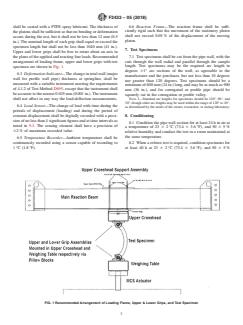
Upper and lower grips shall be free to rotate about an axis in
the plane of the applied and reacting line loads. Recommended
7.1 Test specimens shall be cut from the pipe wall, with the
arrangement of loading frame, upper and lower grips with test cuts through the wall radial and parallel through the sample
specimen are shown in Fig. 1. length. Test specimens may be the required arc length in
degrees 61° arc sections of the wall, as agreeable to the
6.3 Deformation Indicator—The change in total wall (major
manufacturer and the purchaser, but not less than 10 degrees
wall for profile wall pipe) thickness at springline, shall be
nor greater than 120 degrees. Test specimens should be a
measured with a suitable instrument meeting the requirements
minimum of 600 mm (24 in.) long, and may be as much as 900
of 4.1.2 of Test Method D695, except that the instrument shall
mm (36 in.), and for corrugated or profile pipe should be
beaccuratetothenearest0
...