

ASTM C1043-24
(Practice)Standard Practice for Guarded-Hot-Plate Design Using Circular Line-Heat Sources
General Information
- Abstract
SIGNIFICANCE AND USE
4.1 This practice describes the design of a guarded hot plate with circular line-heat sources and provides guidance in determining the mean temperature of the meter plate. It provides information and calculation procedures for: (1) control of edge heat loss or gain (Annex A1); (2) location and installation of line-heat sources (Annex A2); (3) design of the gap between the meter and guard plates (Appendix X1); and (4) location of heater leads for the meter plate (Appendix X2).
4.2 A circular guarded hot plate with one or more line-heat sources is amenable to mathematical analysis so that the mean surface temperature is calculated from the measured power input and the measured temperature(s) at one or more known locations. Further, a circular plate geometry simplifies the mathematical analysis of errors resulting from heat gains or losses at the edges of the specimens (see Refs (15, 16)).
4.3 The line-heat source(s) is (are) placed in the meter plate at a prescribed radius (radii) such that the temperature at the outer edge of the meter plate is equal to the mean surface temperature over the meter area. Thus, the determination of the mean temperature of the meter plate is accomplished with a small number of temperature sensors placed near the gap.
4.4 A guarded hot plate with one or more line-heat sources will have a radial temperature variation, with the maximum temperature differences being quite small compared to the average temperature drop across the specimens. Provided guarding is adequate, only the mean surface temperature of the meter plate enters into calculations of thermal transmission properties.
4.5 Care shall be taken to design a circular line-heat-source guarded hot plate so that the electric-current leads to each heater either do not significantly alter the temperature distributions in the meter and guard plates or else affect these temperature distributions in a known way so that appropriate corrections are applied.
4.6 The use of one o...
SCOPE
1.1 This practice covers the design of a circular line-heat-source guarded hot plate for use in accordance with Test Method C177.
Note 1: Test Method C177 describes the guarded-hot-plate apparatus and the application of such equipment for determining thermal transmission properties of flat-slab specimens. In principle, the test method includes apparatus designed with guarded hot plates having either distributed- or line-heat sources.
1.2 The guarded hot plate with circular line-heat sources is a design in which the meter and guard plates are circular plates having a relatively small number of heaters, each embedded along a circular path at a fixed radius. In operation, the heat from each line-heat source flows radially into the plate and is transmitted axially through the test specimens.
1.3 The meter and guard plates are fabricated from a continuous piece of thermally conductive material. The plates are made sufficiently thick that, for typical specimen thermal conductances, the radial and axial temperature variations in the guarded hot plate are quite small. By proper location of the line-heat source(s), the temperature at the edge of the meter plate is made equal to the mean temperature of the meter plate, thus facilitating temperature measurements and thermal guarding.
1.4 The line-heat-source guarded hot plate has been used successfully over a mean temperature range from − 10 to + 65°C, with circular metal plates and a single line-heat source in the meter plate. The chronological development of the design for circular line-heat-source guarded hot plates having a single line-heat source in the meter plate is given in Refs (1-9).2
1.5 For high-temperature applications, the line-heat-source guarded hot plate has been used successfully over a mean temperature from 7 to 160°C, with circular metal plates and multiple line-heat sources in the meter plate. The chronological development for circular line-heat-...
- Status
- Published
- Publication Date
- 29-Feb-2024
- Technical Committee
- C16 - Thermal Insulation
- Drafting Committee
- C16.30 - Thermal Measurement
Buy Documents
ASTM C1043-24 - Standard Practice for Guarded-Hot-Plate Design Using Circular Line-Heat Sources
REDLINE ASTM C1043-24 - Standard Practice for Guarded-Hot-Plate Design Using Circular Line-Heat Sources
Overview
ASTM C1043-24: Standard Practice for Guarded-Hot-Plate Design Using Circular Line-Heat Sources provides comprehensive guidance for designing and constructing guarded hot plate apparatus using circular line-heat sources. This standard, developed by ASTM International, is crucial for laboratories and professionals engaged in thermal transmission testing of flat-slab specimens, typically involving insulation and building materials.
ASTM C1043-24 focuses on best practices for ensuring highly accurate and reliable measurements when using the guarded-hot-plate method, as detailed in ASTM C177. The document includes information on the placement and installation of line-heat sources, minimizing edge heat loss or gain, designing the gap between plates, and accurate temperature measurements, thereby supporting precise thermal conductivity testing.
Key Topics
- Guarded Hot Plate Design: Outlines construction of circular meter and guard plates, each made from conductive materials, and typically featuring one or more embedded line-heat sources at fixed radii. This configuration enables controlled, one-dimensional heat flow through test specimens.
- Heat Source Placement: Provides criteria for locating and installing line-heat sources so that the mean surface temperature of the meter plate is easily measurable, reducing uncertainty in thermal transmission data.
- Edge Heat Loss Control: Describes calculation methods and best practices (Annex A1) for controlling edge heat loss or gain, a major source of error in thermal transmission tests.
- Temperature Measurement: Recommends sensor types and placement to ensure precise measurement of mean meter plate temperature and addresses calibration standards for improved measurement reliability.
- Gap Design: Guidance on the optimal width, structure, and treatment of the gap between the meter and guard plates, minimizing parasitic heat flows.
- Heater Lead Effects: Guidance on heater lead placement and design to minimize or compensate for their influence on plate temperature distributions.
Applications
ASTM C1043-24 is widely used in research and quality assurance labs for thermal conductivity testing and thermal insulation characterization. Its applications include:
- Building and Construction Materials: Evaluating the thermal performance of insulation panels, boards, and other flat-slab building materials for energy efficiency.
- Industrial Insulation: Testing of high- or low-temperature insulative materials used in equipment, pipelines, and industrial enclosures.
- Material Development: Supporting R&D for advanced insulating materials or composites by providing accurate and repeatable thermal transmission data.
- Academic Research: Used as a methodological reference in academic studies requiring precision heat flow measurement and characterization.
This standard practice ensures that measurements are consistent, traceable, and reproducible across different laboratories and over time, essential for regulatory compliance and product certification.
Related Standards
ASTM C1043-24 is designed to work in tandem with other key ASTM standards:
- ASTM C177 - Test Method for Steady-State Heat Flux Measurements and Thermal Transmission Properties by Means of the Guarded-Hot-Plate Apparatus.
- ASTM C168 - Terminology Relating to Thermal Insulation.
- ASTM C1044 - Practice for Using a Guarded-Hot-Plate Apparatus in the Single-Sided Mode.
- ASTM E230 - Specification for Temperature–EMF Tables for Standardized Thermocouples.
Practical Value
Using the circular line-heat-source guarded hot plate design described in ASTM C1043-24 enables:
- Reduced Measurement Uncertainty: Optimized geometry and sensor placement simplify mathematical analysis and limit error sources.
- Efficient Calibration and Maintenance: Fewer heaters and simplified gap design facilitate apparatus setup, calibration, and repair.
- Versatile Testing Range: Applicable for mean temperatures from −10°C to 160°C and with various plate materials including metals and ceramics.
- Standardization: Ensures consistent testing methodology and facilitates data comparison across the insulation and materials science community.
In summary, ASTM C1043-24 is essential for anyone involved in precise measurement of thermal transmission properties, supporting robust, standards-based results in insulation and materials testing.
Relations
- Replaces
ASTM C1043-19 - Standard Practice for Guarded-Hot-Plate Design Using Circular Line-Heat Sources - Effective Date
- 01-Mar-2024
- Effective Date
- 15-Apr-2024
- Effective Date
- 01-Mar-2024
- Effective Date
- 01-May-2022
- Effective Date
- 01-Oct-2020
- Effective Date
- 01-Mar-2024
- Effective Date
- 01-Mar-2024
- Effective Date
- 01-Mar-2024
Buy Documents
ASTM C1043-24 - Standard Practice for Guarded-Hot-Plate Design Using Circular Line-Heat Sources
REDLINE ASTM C1043-24 - Standard Practice for Guarded-Hot-Plate Design Using Circular Line-Heat Sources
Get Certified
Connect with accredited certification bodies for this standard

BSMI (Bureau of Standards, Metrology and Inspection)
Taiwan's standards and inspection authority.
Sponsored listings
Frequently Asked Questions
ASTM C1043-24 is a standard published by ASTM International. Its full title is "Standard Practice for Guarded-Hot-Plate Design Using Circular Line-Heat Sources". This standard covers: SIGNIFICANCE AND USE 4.1 This practice describes the design of a guarded hot plate with circular line-heat sources and provides guidance in determining the mean temperature of the meter plate. It provides information and calculation procedures for: (1) control of edge heat loss or gain (Annex A1); (2) location and installation of line-heat sources (Annex A2); (3) design of the gap between the meter and guard plates (Appendix X1); and (4) location of heater leads for the meter plate (Appendix X2). 4.2 A circular guarded hot plate with one or more line-heat sources is amenable to mathematical analysis so that the mean surface temperature is calculated from the measured power input and the measured temperature(s) at one or more known locations. Further, a circular plate geometry simplifies the mathematical analysis of errors resulting from heat gains or losses at the edges of the specimens (see Refs (15, 16)). 4.3 The line-heat source(s) is (are) placed in the meter plate at a prescribed radius (radii) such that the temperature at the outer edge of the meter plate is equal to the mean surface temperature over the meter area. Thus, the determination of the mean temperature of the meter plate is accomplished with a small number of temperature sensors placed near the gap. 4.4 A guarded hot plate with one or more line-heat sources will have a radial temperature variation, with the maximum temperature differences being quite small compared to the average temperature drop across the specimens. Provided guarding is adequate, only the mean surface temperature of the meter plate enters into calculations of thermal transmission properties. 4.5 Care shall be taken to design a circular line-heat-source guarded hot plate so that the electric-current leads to each heater either do not significantly alter the temperature distributions in the meter and guard plates or else affect these temperature distributions in a known way so that appropriate corrections are applied. 4.6 The use of one o... SCOPE 1.1 This practice covers the design of a circular line-heat-source guarded hot plate for use in accordance with Test Method C177. Note 1: Test Method C177 describes the guarded-hot-plate apparatus and the application of such equipment for determining thermal transmission properties of flat-slab specimens. In principle, the test method includes apparatus designed with guarded hot plates having either distributed- or line-heat sources. 1.2 The guarded hot plate with circular line-heat sources is a design in which the meter and guard plates are circular plates having a relatively small number of heaters, each embedded along a circular path at a fixed radius. In operation, the heat from each line-heat source flows radially into the plate and is transmitted axially through the test specimens. 1.3 The meter and guard plates are fabricated from a continuous piece of thermally conductive material. The plates are made sufficiently thick that, for typical specimen thermal conductances, the radial and axial temperature variations in the guarded hot plate are quite small. By proper location of the line-heat source(s), the temperature at the edge of the meter plate is made equal to the mean temperature of the meter plate, thus facilitating temperature measurements and thermal guarding. 1.4 The line-heat-source guarded hot plate has been used successfully over a mean temperature range from − 10 to + 65°C, with circular metal plates and a single line-heat source in the meter plate. The chronological development of the design for circular line-heat-source guarded hot plates having a single line-heat source in the meter plate is given in Refs (1-9).2 1.5 For high-temperature applications, the line-heat-source guarded hot plate has been used successfully over a mean temperature from 7 to 160°C, with circular metal plates and multiple line-heat sources in the meter plate. The chronological development for circular line-heat-...
SIGNIFICANCE AND USE 4.1 This practice describes the design of a guarded hot plate with circular line-heat sources and provides guidance in determining the mean temperature of the meter plate. It provides information and calculation procedures for: (1) control of edge heat loss or gain (Annex A1); (2) location and installation of line-heat sources (Annex A2); (3) design of the gap between the meter and guard plates (Appendix X1); and (4) location of heater leads for the meter plate (Appendix X2). 4.2 A circular guarded hot plate with one or more line-heat sources is amenable to mathematical analysis so that the mean surface temperature is calculated from the measured power input and the measured temperature(s) at one or more known locations. Further, a circular plate geometry simplifies the mathematical analysis of errors resulting from heat gains or losses at the edges of the specimens (see Refs (15, 16)). 4.3 The line-heat source(s) is (are) placed in the meter plate at a prescribed radius (radii) such that the temperature at the outer edge of the meter plate is equal to the mean surface temperature over the meter area. Thus, the determination of the mean temperature of the meter plate is accomplished with a small number of temperature sensors placed near the gap. 4.4 A guarded hot plate with one or more line-heat sources will have a radial temperature variation, with the maximum temperature differences being quite small compared to the average temperature drop across the specimens. Provided guarding is adequate, only the mean surface temperature of the meter plate enters into calculations of thermal transmission properties. 4.5 Care shall be taken to design a circular line-heat-source guarded hot plate so that the electric-current leads to each heater either do not significantly alter the temperature distributions in the meter and guard plates or else affect these temperature distributions in a known way so that appropriate corrections are applied. 4.6 The use of one o... SCOPE 1.1 This practice covers the design of a circular line-heat-source guarded hot plate for use in accordance with Test Method C177. Note 1: Test Method C177 describes the guarded-hot-plate apparatus and the application of such equipment for determining thermal transmission properties of flat-slab specimens. In principle, the test method includes apparatus designed with guarded hot plates having either distributed- or line-heat sources. 1.2 The guarded hot plate with circular line-heat sources is a design in which the meter and guard plates are circular plates having a relatively small number of heaters, each embedded along a circular path at a fixed radius. In operation, the heat from each line-heat source flows radially into the plate and is transmitted axially through the test specimens. 1.3 The meter and guard plates are fabricated from a continuous piece of thermally conductive material. The plates are made sufficiently thick that, for typical specimen thermal conductances, the radial and axial temperature variations in the guarded hot plate are quite small. By proper location of the line-heat source(s), the temperature at the edge of the meter plate is made equal to the mean temperature of the meter plate, thus facilitating temperature measurements and thermal guarding. 1.4 The line-heat-source guarded hot plate has been used successfully over a mean temperature range from − 10 to + 65°C, with circular metal plates and a single line-heat source in the meter plate. The chronological development of the design for circular line-heat-source guarded hot plates having a single line-heat source in the meter plate is given in Refs (1-9).2 1.5 For high-temperature applications, the line-heat-source guarded hot plate has been used successfully over a mean temperature from 7 to 160°C, with circular metal plates and multiple line-heat sources in the meter plate. The chronological development for circular line-heat-...
ASTM C1043-24 is classified under the following ICS (International Classification for Standards) categories: 17.200.10 - Heat. Calorimetry. The ICS classification helps identify the subject area and facilitates finding related standards.
ASTM C1043-24 has the following relationships with other standards: It is inter standard links to ASTM C1043-19, ASTM C168-24, ASTM C1044-24, ASTM C168-22, ASTM C1044-16(2020), ASTM C1114-06(2019), ASTM C1045-19, ASTM C177-19e1. Understanding these relationships helps ensure you are using the most current and applicable version of the standard.
ASTM C1043-24 is available in PDF format for immediate download after purchase. The document can be added to your cart and obtained through the secure checkout process. Digital delivery ensures instant access to the complete standard document.
Standards Content (Sample)
This international standard was developed in accordance with internationally recognized principles on standardization established in the Decision on Principles for the
Development of International Standards, Guides and Recommendations issued by the World Trade Organization Technical Barriers to Trade (TBT) Committee.
Designation: C1043 − 24
Standard Practice for
Guarded-Hot-Plate Design Using Circular Line-Heat
Sources
This standard is issued under the fixed designation C1043; the number immediately following the designation indicates the year of
original adoption or, in the case of revision, the year of last revision. A number in parentheses indicates the year of last reapproval. A
superscript epsilon (´) indicates an editorial change since the last revision or reapproval.
1. Scope temperature from 7 to 160°C, with circular metal plates and
multiple line-heat sources in the meter plate. The chronological
1.1 This practice covers the design of a circular line-heat-
development for circular line-heat-source guarded hot plates
source guarded hot plate for use in accordance with Test
having multiple line-heat sources in the meter plate is given in
Method C177.
Refs (10-14).
NOTE 1—Test Method C177 describes the guarded-hot-plate apparatus
NOTE 2—Detailed drawings and descriptions for the construction of two
and the application of such equipment for determining thermal transmis-
line-heat-source guarded-hot-plate apparatuses are available in the ad-
sion properties of flat-slab specimens. In principle, the test method
junct.
includes apparatus designed with guarded hot plates having either
distributed- or line-heat sources.
1.6 This practice does not preclude (1) lower or higher
1.2 The guarded hot plate with circular line-heat sources is temperatures; (2) plate geometries other than circular; (3)
a design in which the meter and guard plates are circular plates line-heat-source geometries other than circular; or (4) the use
having a relatively small number of heaters, each embedded of plates fabricated from ceramics, composites, or other
along a circular path at a fixed radius. In operation, the heat materials.
from each line-heat source flows radially into the plate and is
1.7 The values stated in SI units are to be regarded as
transmitted axially through the test specimens.
standard. No other units of measurement are included in this
1.3 The meter and guard plates are fabricated from a standard.
continuous piece of thermally conductive material. The plates
1.8 This standard does not purport to address all of the
are made sufficiently thick that, for typical specimen thermal
safety concerns, if any, associated with its use. It is the
conductances, the radial and axial temperature variations in the
responsibility of the user of this standard to establish appro-
guarded hot plate are quite small. By proper location of the
priate safety, health, and environmental practices and deter-
line-heat source(s), the temperature at the edge of the meter
mine the applicability of regulatory limitations prior to use.
plate is made equal to the mean temperature of the meter plate,
1.9 This international standard was developed in accor-
thus facilitating temperature measurements and thermal guard-
dance with internationally recognized principles on standard-
ing.
ization established in the Decision on Principles for the
Development of International Standards, Guides and Recom-
1.4 The line-heat-source guarded hot plate has been used
mendations issued by the World Trade Organization Technical
successfully over a mean temperature range from − 10
Barriers to Trade (TBT) Committee.
to + 65°C, with circular metal plates and a single line-heat
source in the meter plate. The chronological development of
2. Referenced Documents
the design for circular line-heat-source guarded hot plates
having a single line-heat source in the meter plate is given in
2.1 ASTM Standards:
Refs (1-9).
C168 Terminology Relating to Thermal Insulation
C177 Test Method for Steady-State Heat Flux Measure-
1.5 For high-temperature applications, the line-heat-source
ments and Thermal Transmission Properties by Means of
guarded hot plate has been used successfully over a mean
the Guarded-Hot-Plate Apparatus
C1044 Practice for Using a Guarded-Hot-Plate Apparatus or
Thin-Heater Apparatus in the Single-Sided Mode
This practice is under the jurisdiction of ASTM Committee C16 on Thermal
Insulation and is the direct responsibility of Subcommittee C16.30 on Thermal
Measurement.
Current edition approved March 1, 2024. Published March 2024. Originally Available from ASTM Headquarters. Order Adjunct: ADJC1043.
approved in 1985. Last previous edition approved in 2019 as C1043 – 19. DOI: For referenced ASTM standards, visit the ASTM website, www.astm.org, or
10.1520/C1043-24. contact ASTM Customer Service at service@astm.org. For Annual Book of ASTM
The boldface numbers in parentheses refer to a list of references at the end of Standards volume information, refer to the standard’s Document Summary page on
this practice. the ASTM website.
Copyright © ASTM International, 100 Barr Harbor Drive, PO Box C700, West Conshohocken, PA 19428-2959. United States
C1043 − 24
E230 Specification for Temperature-Electromotive Force temperature differences being quite small compared to the
(emf) Tables for Standardized Thermocouples average temperature drop across the specimens. Provided
guarding is adequate, only the mean surface temperature of the
2.2 ASTM Adjuncts:
Line-Heat-Source Guarded-Hot-Plate Apparatus meter plate enters into calculations of thermal transmission
properties.
3. Terminology
4.5 Care shall be taken to design a circular line-heat-source
3.1 Definitions—For definitions of terms and symbols used
guarded hot plate so that the electric-current leads to each
in this practice, refer to Terminology C168. For definitions of
heater either do not significantly alter the temperature distri-
terms relating to the guarded-hot-plate apparatus refer to Test
butions in the meter and guard plates or else affect these
Method C177.
temperature distributions in a known way so that appropriate
3.2 Definitions of Terms Specific to This Standard:
corrections are applied.
3.2.1 gap, n—a separation between the meter plate and
4.6 The use of one or a few circular line-heat sources in a
guard plate, usually filled with a gas or thermal insulation.
guarded hot plate simplifies construction and repair. For
3.2.2 guard plate, n—the outer ring of the guarded hot plate
room-temperature operation, the plates are typically of one-
that encompasses the meter plate and promotes one-
piece metal construction and thus are easily fabricated to the
dimensional heat flow normal to the meter plate.
required thickness and flatness. The design of the gap is also
3.2.3 guarded hot plate, n—an assembly, consisting of a
simplified, relative to gap designs for distributed-heat-source
meter plate and a co-planar, concentric guard plate that
hot plates.
provides the heat input to the specimens.
4.7 In the single-sided mode of operation (see Practice
3.2.4 line-heat-source, n—a thin or fine electrical heating
C1044), the symmetry of the line-heat-source design in the
element that provides uniform heat generation per unit length.
axial direction minimizes errors due to undesired heat flow
3.2.5 meter area, n—the mathematical area through which across the gap.
the heat input to the meter plate flows normally under ideal
guarding conditions into the meter section of the specimen.
5. Design of a Guarded Hot Plate with Circular Line-
Heat Source(s)
3.2.6 meter plate, n—the inner disk of the guarded hot plate
that contains one or more line-heat sources embedded in a
5.1 General—The general features of a circular guarded-
circular profile and provides the heat input to the meter section
hot-plate apparatus with line-heat sources are illustrated in Fig.
of the specimens.
1. For the double-sided mode of operation, there are two
3.2.7 meter section, n—the portion of the test specimen specimens, two cold plates, and a guarded hot plate with a gap
between the meter and guard plates. The meter and guard plates
through which the heat input to the meter plate flows under
ideal guarding conditions. are each provided with one (or a few) circular line-heat
sources.
4. Significance and Use
5.2 Summary—To design the meter and guard plates, use the
4.1 This practice describes the design of a guarded hot plate
following suggested procedure: (1) establish the specifications
with circular line-heat sources and provides guidance in
and priorities for the design criteria; (2) select an appropriate
determining the mean temperature of the meter plate. It
material for the plates; (3) determine the dimensions of the
provides information and calculation procedures for: (1) con-
plates; (4) determine the type, number, and location of the
trol of edge heat loss or gain (Annex A1); (2) location and
line-heat source(s); (5) design the support system for the plates;
installation of line-heat sources (Annex A2); (3) design of the
and (6) determine the type, number, and location of the
gap between the meter and guard plates (Appendix X1); and
temperature sensors.
(4) location of heater leads for the meter plate (Appendix X2).
5.3 Design Criteria—Establish specifications for the follow-
4.2 A circular guarded hot plate with one or more line-heat
ing parameters of the guarded hot-plate apparatus: (1) speci-
sources is amenable to mathematical analysis so that the mean
men diameter; (2) range of specimen thicknesses; (3 ) range of
surface temperature is calculated from the measured power
specimen thermal conductances; (4) characteristics of speci-
input and the measured temperature(s) at one or more known
men materials (for example, stiffness, mechanical compliance,
locations. Further, a circular plate geometry simplifies the
density, hardness); (5) range of hot-side and cold-side test
mathematical analysis of errors resulting from heat gains or
temperatures; (6) orientation of apparatus (vertical or horizon-
losses at the edges of the specimens (see Refs (15, 16)).
tal heat flow); and (7) required measurement precision.
4.3 The line-heat source(s) is (are) placed in the meter plate
NOTE 3—The priority assigned to the design parameters depends on the
at a prescribed radius (radii) such that the temperature at the
application. For example, an apparatus for high-temperature will neces-
outer edge of the meter plate is equal to the mean surface
sitate a different precision specification than that for a room-temperature
temperature over the meter area. Thus, the determination of the apparatus.
mean temperature of the meter plate is accomplished with a
5.4 Material—Select the material for the guarded hot plate
small number of temperature sensors placed near the gap.
by considering the following criteria:
4.4 A guarded hot plate with one or more line-heat sources 5.4.1 Ease of Fabrication—Fabricate the guarded hot plate
will have a radial temperature variation, with the maximum from a material that has suitable thermal and mechanical
C1043 − 24
FIG. 1 Schematic of a Line-Heat-Source Guarded-Hot-Plate Apparatus
requires that the heat input to the meter plate flows normally through the
properties and which is readily fabricated to the desired shapes
specimens to the cold plates. One-dimensional heat flow is attained by
and tolerances, as well as facilitate assembly.
proper selection of the diameter of the meter plate relative to the diameter
5.4.2 Thermal Stability—For the intended range of
of the guard plate while also considering (1) the specimen thermal
temperature, select a material for the guarded hot plate that is
conductivities; (2) specimen thicknesses; (3) edge insulation; and, (4)
dimensionally stable, resistant to oxidation, and capable of
secondary guarding, if any.
supporting its own weight, the test specimens, and accommo-
5.5.1 Meter Plate and Guard Plate Diameters—Use Annex
dating the applied clamping forces without significant distor-
A1 to determine either the diameter of the guard plate for a
tion. The coefficient of thermal expansion shall be known in
given meter plate diameter, or the diameter of the meter plate
order to calculate the meter area at different temperatures.
for a given guard plate diameter. Specifically, determine the
5.4.3 Thermal Conductivity—To reduce the (small) radial
combinations of diameters of the meter plate and guard plate
temperature variations across the guarded hot plate, select a
that will be required so that the edge-heat-loss error will not be
material having a high thermal conductivity. For cryogenic or
excessive for the thickest specimens, with the highest lateral
modest temperatures, select a metal such as copper, aluminum,
thermal conductances. If necessary, calculate the edge heat loss
silver, gold or nickel. For high-temperature (up to 600 or
for different edge insulation and secondary-guarding condi-
700°C) use in air, select nickel or a single-compound ceramic,
tions.
such as aluminum oxide, aluminum nitride, or cubic boron
nitride.
NOTE 5—For example, when testing relatively thin specimens of
insulation, maintain the ambient temperature at essentially the mean
5.4.4 Heat Capacity—To achieve thermal equilibrium
temperature of the specimens and to use minimal edge insulation without
quickly, select a material having a low volumetric heat capacity
secondary guarding. However, for thicker conductive specimens, edge
(product of density and specific heat). Although aluminum,
insulation and secondary guarding are necessary to achieve the desired test
silver, and gold, for example, have volumetric heat capacities
accuracy.
lower than copper, as a practical matter, either copper or
5.5.2 Guarded-Hot-Plate Thickness—The plate thickness
aluminum is satisfactory.
shall provide proper structural rigidity, and have a large lateral
5.4.5 Emittance—To achieve a uniform, high emittance,
thermal conductance, thus minimizing radial temperature
select a plate material that will accept a suitable surface
variations in the plate. A large thickness, however, will increase
treatment. The treatment shall also provide good oxidation
the heat capacitance of the plate and thus adversely affect the
resistance. For modest temperatures, various high emittance
(rapid) achievement of thermal equilibrium, and reduce the
paints are used for copper, silver, gold, or nickel. For
thermal isolation between the meter plate and the guard plate.
aluminum, a black anodized treatment provides a uniformly
5.5.3 Gap Width—The gap shall have a uniform width such
high emittance. For high-temperature, most ceramics have an
that the gap area, in the plane of the surface of the guarded hot
inherently high emittance. Nickel and its alloys form a fairly
plate, shall be less than 3 % of the meter area. In any case, the
stable oxide coating at higher temperatures.
width of the gap shall not exceed the limitations given in Test
5.5 Guarded-Hot-Plate Dimensions—Select the geometrical
Method C177. The width of the gap is a compromise between
dimensions of the guarded hot plate to provide an accurate
increasing the separation in order to reduce lateral heat flow
determination of the thermal transmission properties.
and distorting the heat flow into the specimen and increasing
NOTE 4—The accurate determination of thermal transmission properties the uncertainty in the determination of the meter area.
C1043 − 24
NOTE 6—The gap provides a significant thermal resistance between the
5.5.6 Surface Emittances:
meter and guard plates. The temperature difference across the gap shall be
5.5.6.1 Guarded Hot Plate—Treat the surfaces of the
maintained at a very small value, thereby minimizing the heat transfer
guarded hot plate to maintain a total hemispherical emittance
between the meter and guard plates, both directly across the gap and also
greater than 0.8. In any case, the hot plate surface emittance
through adjacent portions of the specimens.
shall meet the requirements of Test Method C177.
5.5.4 Gap Configuration—Refer to Fig. 2 in selecting an
5.5.6.2 Gap—To minimize the heat flow across the gap,
appropriate design for the gap cross-section. Designs (b) and
either treat the surfaces of the gap (by polishing or electroplat-
(c) permit a narrow gap at the surfaces, in the plane of the plate,
ing) to reduce their emittance, or fill the gap with thermal
while maintaining a fairly high thermal resistance between the
insulation.
meter and guard plates. For a small temperature difference
across the gap, calculate the corresponding heat flow using 5.6 Heater Design—Select the radius of each circular line-
heat source for the meter plate and the guard plate as follows.
guidelines in Appendix X1.
5.5.5 Plate Flatness: 5.6.1 Location of Heaters:
5.5.5.1 When assembled, the guarded hot plate shall have 5.6.1.1 Meter Plate—If the meter plate has a single line-heat
the surfaces of both the meter and guard plates flat to within
source, locate the heat source at a radius equal to =2/2 times
0.025 % of the outer diameter of the guard plate.
the radius to the center of the gap. If it is desired to have
heaters at more than one radius, select these radii by using the
NOTE 7—For example, a guarded hot plate with a 600-mm diameter
criteria given in Annex A2.
guard plate will be flat over its entire surface to within 0.15 mm.
5.5.5.2 During fabrication, assembly, and installation of the 5.6.1.2 Guard Plate—For a guarded hot plate with the outer
guarded hot plate, care shall be taken to achieve this flatness
radius of the guard plate equal to 2.5 times the radius to the
tolerance. For a metal plate, it will be necessary to anneal the center of the gap, locate the line-heat source at a radius equal
plate to relieve stresses introduced during machining and then
to 1.29 times the radius to the center of the gap. If another
grind the plate(s) to final tolerances. Continued checking is line-heat source is required in the guard plate, locate the heat
necessary to ensure the flatness tolerance is maintained after
source at a radius of 1.97 times the radius to the center of the
temperature cycling. gap. Use the criteria given in Annex A2 for determining other
radii of line-heat sources in the guard plate.
NOTE 8—The location(s) of the line-heat sources in the guard plate is
(are) less critical than is the case for the meter plate.
5.6.2 Type of Heater—Select the line-heat source from one
of the following types of heater elements: (1) thin ribbon; (2)
sheathed; or (3) any other stable type that provides a uniform
heat output per unit length, for example, fine resistance wire
with dielectric insulation.
5.6.2.1 Ribbon Heater—A thin ribbon heater consists of an
etched foil or wire-wound heating element sandwiched be-
tween two layers of electrical insulation. Select the type of
electrical insulation based on the temperatures of interest.
5.6.2.2 Sheathed Heater—A sheathed heater, sometimes
known as a cable heater or a swaged heater, consists of a
straight or coiled heater element insulated from its surrounding
metal sheath by compacted ceramic powder. This type of
heater is suitable for high temperatures, depending upon the
type of resistance wire and sheath that are selected.
5.6.3 Installation of Heaters:
5.6.3.1 Install the ribbon heater(s) by fabricating the plate
(meter or guard) in two concentric sections and placing the
heater between the sections by either an interference fit or a
tapered fit. Prepare the interference fit by applying a moderate
temperature difference to the two concentric sections as de-
scribed in the adjunct.
5.6.3.2 Install the sheathed heater(s) by pressing the heater
into circular grooves that have been cut into one (or more)
surface(s) of the plate (meter or guard). The grooves shall be
sufficiently deep that the heater will be below the surface of the
plate. Fill the remainder of the groove with either conductive
epoxy, solder, or braze.
5.6.4 Lead Wires for Heater—In order to minimize unde-
FIG. 2 Designs for the Cross-section of the Gap Between the
Meter and Guard Plates sired heat generation from the heater leads, select lead wires
C1043 − 24
precautions require minimizing spurious voltages by locating junctions of
that have a lower electrical resistance per unit length than the
dissimilar metals in regions of low thermal gradients and using high
heater element(s). The heater elements shall have either inte-
quality low-thermal emf switches. For further guidelines, consult Test
gral electrical lead wires, or individual insulated lead wires
Method C177.
attached to the heater elements with the junctions electrically
5.8.3 Location in Meter Plate—If the line-heat source is
insulated (with, for example, epoxy or ceramic cement). Secure
located per 5.6.1 in the meter plate, locate the temperature
the electrical connections so they are reliable and insulated
sensor at the outer radius of the meter plate. Consult Appendix
electrically from the guarded hot plate.
X2 for the angular location of the temperature sensor. For other
NOTE 9—Since some heat will be generated by the wire leads, thereby
cases with multiple radii, locate the temperature sensor at the
perturbing the temperature profile, consideration shall be given to where
center plane of the meter plate.
the leads are located and how they are installed. Refer to Appendix X2 for
guidance on locating the wire heater leads. 5.8.4 Location in Gap—Use a thermopile to detect directly
the temperature difference across the gap, rather than separate
5.7 Support Structures:
measurements of the absolute temperature of the meter and
5.7.1 Support for Meter Plate—Design the support system
guard-sides. In order to reduce heat conduction through the
for the meter plate to:
thermopile wires, select (1) wires of small diameter and low
5.7.1.1 Facilitate assembly of the meter and guard plates so
thermal conductivity; (2) the minimum number of thermo-
that the two plates are co-planar (per 5.5.5) and concentric with
couple junction pairs necessary for adequate sensitivity; and
a uniform gap width (per 5.5.3),
(3) an oblique (rather than radial) path for the wires to cross the
5.7.1.2 Support the mass of the meter plate as well as the
gap.
forces from clamping the test specimens,
5.8.4.1 Thermoelements—Select thermoelements that have
5.7.1.3 Account for the effects of thermal expansion of the
a high thermopower (μV/K) and relatively low thermal con-
meter and guard plates,
ductivity of both alloys, such as Type E thermocouple wire,
5.7.1.4 Minimize heat conduction between the meter and
having a diameter no greater than 0.3 mm. Thermopiles
guard plates, and
constructed from copper thermoelements shall not be used.
5.7.1.5 Facilitate installation and repair of the line-heat
5.8.4.2 Sensitivity—If the line-heat source is located per
sources, lead wires, and sensors.
5.6.1 in the meter plate, locate the minimum number of
NOTE 10—Extraneous heat flows caused by the support system will
thermocouple junctions relative to the heater leads as described
disturb the desired temperature distribution in the meter plate. One
in Appendix X2.
successful technique consists of a system of three small pins with both
ends tapered that are installed in radially drilled holes in the guard plate.
NOTE 13—Different designs for guarded hot plates have used anywhere
A tapered-end screw pushed against the outer end of each pin presses the
from a few pairs of thermocouple junctions to several dozen pairs to
other end of the pin into a circumferential groove in the outer edge of the
achieve both adequate sensitivity and adequate sampling of the tempera-
meter plate. This system will center the meter plate accurately so that the
ture on either side of the gap. The number of thermocouple junctions
gap width is uniform (per 5.5.3).
needs to provide the desired resolution of the temperature difference
5.7.2 Support for Guard Plate—Design the support system across the gap. For example, if thermocouple wire with a nominal
thermopower of 60 μV/K is used, a thermopile with 16 pairs of junctions
for the guard plate to maintain the guarded hot plate in the
will have a thermopower of 960 μV/K. For such a thermopile, measure-
desired orientation (usually the plane of the hot plate will be
ment of the thermopile output to a resolution of 1 μV will correspond to
either horizontal or vertical), and, minimize conductive heat
a resolution in the temperature difference across the gap of approximately
losses from the guard plate.
1 mK.
NOTE 11—Extraneous heat flows caused by the support structure will
5.8.4.3 Installation—Place all thermocouple junctions in
disturb the desired temperature distribution in the guard plate. One
good thermal contact with the meter plate or guard plate and
successful technique for supporting the guard plate is wire cables (at three
secure, when necessary, by mechanical fasteners. Insulate
or four locations) at the periphery of the guard plate. A second technique
electrically all thermocouple junctions from the meter plate and
is to rigidly support the underside of the guard plate at the periphery either
from above or below. guard plate.
5.8.5 Location in Guard Plate—Measure the temperatures
5.8 Temperature Sensors:
of the primary guard using thermocouples, (platinum) resis-
5.8.1 Type—Select temperature sensors for the guarded hot
tance thermometers, or thermistors, or indirectly using differ-
plate that provide adequate sensitivity and do not significantly
ential thermocouples.
change the temperatures that are to be measured. At modest
temperatures, select sensors from the following types: (1)
NOTE 14—Temperatures in the guard plate do not enter directly into the
thermocouples (either Type T or Type E wire being the most
calculation of thermal transmission properties. However, it is important to
commonly used); (2) small, accurate (platinum) resistance measure temperatures at selected locations in the guard plate to verify
correct operation of the guarded hot plate.
thermometers; or (3) stable thermistors. At extreme tempera-
tures (high or cryogenic), consult Specification E230 or Ref
6. Design Precautions
(17) for the use of thermocouples for temperature measure-
ment.
6.1 Error in the measurement of the temperature of the
5.8.2 Calibration—Temperature sensors shall be calibrated
guarded hot plate is introduced from several sources, includ-
with standards traceable to a national standards laboratory.
ing: (1) improper design of the guarded hot plate; (2) location
of the temperature sensor; and (3) calibration of the tempera-
NOTE 12—The overall uncertainty depends not only on the type of
sensor and its calibration, but also on the measurement system. Normal ture sensor as well as the measurement system (see 5.8.2).
C1043 − 24
6.2 A basic premise in the design of the guarded hot plate is 6.4 Angular perturbations in the temperature profile are due
the location of the line-heat source at a prescribed radius as to heating from the heater leads crossing the gap. In this case,
described in Annex A2. This ensures that the mean temperature
additional temperature sensors will be necessary to determine
of the surface of the meter plate is equal to the temperature at
adequately the mean temperature of the surface of the meter
the edge of the meter plate. The radial temperature profile is
plate.
affected by the thermal conductivity of the plate. Consequently,
the thermal conductivity of the plate shall be high relative to
7. Keywords
the specimen (see Annex A2).
7.1 guarded hot plate apparatus; heat flow; line source
6.3 Experimental checks to verify the radial temperature
heater; steady state; thermal conductivity ; thermal insulation;
distribution include independent temperature measurements of
thermal resistance
the guarded hot plate with thermocouples, for example, as
described in Refs (5), (8).
ANNEXES
(Mandatory Information)
A1. CONTROL OF EDGE HEAT LOSS OR GAIN
A1.1 Scope 4 hL γL I ~nπb/γL!
W 5
2 S D S D 2
n
π λ b n I nπd/γL 1 hL/nπλ I nπd/γL
@ ~ ! ~ ! ~ !#
1 0
A1.1.1 This annex provides a procedure for determining the
(A1.5)
diameter of the guard plate and ambient temperature conditions
required to reduce the edge effects to negligible proportions.
where I and I are modified Bessel functions of the first kind
0 1
Alternative procedures are allowed, but it is the responsibility
of order 0 and 1, respectively, b is the radius to the center of the
of the user to determine that those procedures yield equivalent
gap, d is the outer radius of the guard plate, L is the thickness
results.
of the specimen, and h is the heat transfer coefficient at the
circumference of the specimen. The anisotropy ratio for the
A1.2 Theoretical Analysis
specimen is γ = λ /λ where λ and λ are the thermal conduc-
r z r z
tivities in the radial and axial directions, respectively. The
A1.2.1 For an apparatus with an isothermal guarded hot
1/2
plate and cold plate(s), the error due to edge heat loss or gain geometrical mean of the thermal conductivities is λ = (λ λ ) .
r z
has been derived for both circular and square plates by Peavy
A1.2.3 For the range of parameters that provide appropriate
and Rennex (15), for the case of the specimen being
guarding, Eq A1.3 and Eq A1.4 are convergent and require
anisotropic, and by Bode (16), for the isotropic case. The error
only a few terms to obtain accurate results. Peavy and Rennex
due to edge heat transfer in a guarded hot plate apparatus is
(15) provide plots of A and B as functions of geometry and of
given by:
the ratio of heat transfer coefficient, h, to specimen conductiv-
ε 5 A1BX (A1.1) ity.
A1.2.4 For relatively small values of A and B, approximate
where:
universal curves are obtained by writing:
2~T 2 T !
m a
X 5 (A1.2)
hL
T 2 T
h c
λ
A 5 A' (A1.6)
Here, T is the guarded hot plate temperature, and T , the
γL hL
h c
11 11
S D
cold plate temperature. The mean temperature of the specimen
4πd 2πλ
is T = (T + T )/2, and T is the ambient temperature at the
m h c a
hL
edge of the specimen.
λ
B 5 B' (A1.7)
γL hL
A1.2.2 For a circular plate geometry, the coefficients A and
11 11
S D
2πd πλ
B are given by:
`
where A and B are computed from Eq A1.3 and Eq A1.4 and
A 5 W (A1.3)
( 2n
A' and B' are then computed using Eq A1.6 and Eq A1.7. Fig.
n51
` A1.1 and Fig. A1.2 present parametric curves of A' and B',
B 5 W (A1.4)
respectively, as functions of γL/d. The values computed for A'
( 2n21
n51
and B' are also weak functions of hd/λ. The widths of the lines
The terms in the summations are given by: shown in Fig. A1.1 and Fig. A1.2 correspond to the variations
C1043 − 24
1/2
4 γL d 2π d 2 b
~ !
B', exp (A1.9)
S D S D S D
π2 b b γL
A1.3 Application
A1.3.1 A review of Eq A1.6 and Eq A1.7 and Fig. A1.1 and
Fig. A1.2 indicates that A' and B' are, aside from a very small
dependence on hL/λ, functions of γL/d and d/b, or,
equivalently, some other ratio of these geometrical quantities.
For a given guarded hot plate, b and d are fixed and the values
of A' and B' are functions only of γL (again, neglecting the
weak dependence on hL/γ). The quantities multiplying A' and
B' in Eq A1.6 and Eq A1.7 are, aside from a small dependence
on γL/d, functions only of hL/λ and thus do not depend on the
meter area or guard plate diameters. For fixed hot- and
cold-plate temperatures, the quantity X in Eq A1.1 and Eq A1.2
is a function of T , the ambient temperature. Thus, for a given
a
guarded hot plate, with fixed b and d, the error due to edge heat
losses or gains is dependent upon γL, hL/λ, and T .
a
A1.3.2 From Eq A1.1 and Eq A1.2, it is seen that A
represents the error when the ambient temperature T is equal
a
FIG. A1.1 The Coefficient A' as a Function of γL/d with d/b as a to the mean temperature of the specimen. Under ideal
Parameter
conditions, the temperature of half of each specimen next to the
guarded hot plate is higher than the ambient resulting in a heat
loss along half the specimen edge. Conversely, the other half of
the specimen (next to the cold plate) experiences a heat gain
from the ambient. In effect, a small fraction of the heat input to
the meter plate bypasses the meter section of the specimen,
resulting in an error in the computed thermal transmission
properties.
A1.3.3 The quantity BX in Eq A1.1 and Eq A1.2 represents
the additional error when the ambient temperature differs from
the mean temperature of the test specimen. In principle, the
error due to edge heat losses or gains is eliminated by selecting
an ambient temperature such that BX = −A, which occurs when
the ambient temperature is somewhat hotter than the mean
temperature of the specimen:
A T 2 T
h c
T 5 T 1 (A1.10)
a m
B 2
A1.3.4 While this value of T is a good choice, relying on
a
this selection alone as a means of adequately controlling edge
heat loss or gain is usually insufficient. Simply controlling the
ambient temperature to the value given by Eq A1.10 cannot
adequately eliminate edge heat losses or gains unless the guard
FIG. A1.2 The Coefficient B' as a Function of γL/d with d/b as a
plate is sufficiently wide and the value of hL/λ is sufficiently
Parameter
low to ensure that both A and B are small.
NOTE A1.1—The analytical models used by Peavy and Rennex (15) and
Bode (16) assume that edge heat transfer occurs across an infinitesimally
due to hd/λ being varied from 0.1 to infinity. Fig. A1.1 and Fig.
thin boundary with a uniform film coefficient h and a uniform ambient
A1.2 are used to obtain values of A' and B', from which A and
temperature T . In actuality, the following conditions cause the assump-
a
B are computed using Eq A1.6 and Eq A1.7.
tions to be invalid: (1) if edge insulation is used and h is taken as the
thermal conductance in the radial direction, the assumption of an
A1.2.5 For values of d/b not shown, or for values of γL/d
infinitesimally thin boundary is not satisfied; and (2) if a secondary guard
larger than unity, A and B are obtained from Peavy and Rennex
is used (see Test Method C177) and there are heat flows in the edge
(15) or computed directly from Eq A1.3 and Eq A1.4.
insulation to regions at temperatures different than that of the secondary
Alternatively, upper limits on A' and B' are computed simply guard, the assumption of a uniform film coefficient h is not satisfied.
from the expressions:
A1.3.5 In designing a guarded hot plate, b and d are varied
1/2
1 γL d 22π d 2 b
~ ! in order to obtain acceptably small edge-effect errors for the
A', exp (A1.8)
S D S D S D
π b b γL specimen thermal conductivities and thicknesses of interest.
C1043 − 24
Fig. A1.1 and Fig. A1.2 reveal that, for any given value of d/b, insulation is h = λ /E and accordingly, hL/λ = (λ /λ)(L/E).
e e
both A' and B' increase rapidly as γL/d increases beyond 0.3. Assume that the edge insulation and specimen have the same
Reducing b, the radius of the meter area, relative to d, the guard
thermal conductivity (λ = λ) so that hL/λ = L/E. Based upon
e
plate outer radius, significantly lowers the values of A' and B'
A1.4.6, the thickness of the edge insulation shall be at least
as d/b increases from 1.5 to 2.0. However, further reduction in
one-third the thickness of the specimen in order to reduce
b does not provide much additional reduction in A' and B'.
significantly the edge effects.
From these observations, the value of d/b shall be equal to 2.0
NOTE A1.2—For example, a specimen 0.15 m thick requires at least
or greater, but little additional benefit will be gained by
0.050 m of edge insulation.
selecting d/b greater than 2.5.
A1.3.8 Example—Given a guarded hot plate with d/b = 2.0,
A1.3.6 Eq A1.6 and Eq A1.7 reveal that when hL/λ « 1.0, A
and B are approximately equal to (hL/λ)A' and (hL/λ)B', an isotropic specimen (γ = 1) of thickness L = 0.8d, and edge
insulation such that hL/λ = 3, the edge effects are estimated as
respectively. When hL/λ is very large, A is approximately 2πA'
and B is approximately πB', corresponding to the situation follows. From Fig. A1.1 and Fig. A1.2, A' = 0.0043 and B'
where the circumferential edge of the specimen is essentially = 0.11. From these values, using Eq A1.6 and Eq A1.7, A
isothermal at the same temperature as that of the ambient. For
= 1.99A' = 0.0086 and B = 1.44B' = 0.16. Thus, from Eq
these limiting values, fixed values of b and d, and a given
A1.1, ε = 0.0086 + 0.16X. From Eq A1.10, taking T − T = 20
h c
ambient temperature T , hL/λ needs to be less than 3.0 in order
a K, the ideal choice for the ambient temperature will be T = T
a m
to reduce the edge heat loss effects to less than half of what
+ 0.54 K. Assuming that the ambient temperature is main-
they will be if hL/π was quite large.
tained within 61 K of this value, the edge heat loss error, from
Eq A1.1 and Eq A1.2, will be ε = 60.016. Thus, for the above
A1.3.7 Using edge insulation having a thermal conductivity
λ and thickness E, the equivalent film coefficient for the edge assumptions, the edge effects are 61.6 %.
e
A2. LOCATION OF LINE-HEAT SOURCES
A2.1 Scope the temperature at the guard gap, r = b, will be equal to the
mean temperature averaged over the entire meter plate pro-
A2.1.1 This annex provides procedures based on analyses
vided that:
by Flynn et al. (12) for determining the radial locations of the
n
2πa q' 2a
line-heat sources. Alternative procedures are allowed for se- k k k
2 1 5 0 (A2.1)
S D
( 2
Q b
k51
lecting these locations, but it is the responsibility of the user to
determine what, if any, corrections shall be applied to mea-
where the k-th heater, located at r = a , produces q ' W per
k k
sured temperatures in order to compute thermal transmission
unit length. The total power input to the meter plate is given by:
properties of test specimens. This annex provides for two
n
general cases for the meter plate: (1) the mean temperature of
Q 5 2πa q' (A2.2)
( k k
k51
the meter plate equal to the gap temperature; and (2) the mean
temperature of the meter plate maximally isothermal and
A2.2.3 If all of the heaters carry the same current, q ' in Eq
k
greater than the gap temperature. Analogous procedures are
A2.1 is replaced by the electrical resistance per unit length of
provided for the guard plate.
the k-th heater and Q is replaced by the total combined
electrical resistance of all of the heaters. Further, if all of the
A2.2 Meter Plate: Case 1
heaters have the same electrical resistance per unit length, the
temperature at the guard gap is made equal to the mean
A2.2.1 The procedure in this section provides the means for
multiple heaters in the meter plate to be located so that the temperature of the meter plate by selecting heater locations
such that:
temperature at the gap will be equal to the mean temperature of
the meter plate. The special case of one circular line-heat n
a 2a
k k
2 1 5 0 (A2.3)
source in the meter plate is also discussed. S 2 D
(
b b
k51
NOTE A2.1—The latter represents the case for two plates built at the
A2.2.4 For only one heater, the location is a = a = b=2/2 .
National Institute of Standards and Technology as described in the
If there are multiple heaters, Eq A2.3 does not have a unique
adjunct.
solution. However, if half of the power input to each heater is
A2.2.2 The meter plate is assumed to have n circular
constrained to flow radially inward in the meter plate and half
heaters. If the effects of heater leads are neglected and the to flow outward and the power input to the region of the meter
thermal conductance of the test specimens is not too high, the
plate between two heaters is provided only by those two
temperature distribution in the meter plate is assumed to be a heaters, a unique solution to Eq A2.3 is available. With these
function only of radial position and the heat flux from the plate constraints, when the heaters are of equal strength (that is, have
into the specimens is assumed uniform. For these assumptions, the same power output per unit length), they shall be located at:
C1043 − 24
a k
k
5 , for k 5 1, 2, … n (A2.4)
b 2
=n 1n
Values for a /b obtained from Eq A2.4 for n ≤ 6 are listed in
k
Table A2.1.
A2.2.5 When the heater locations have been selected such
that the mean temperature of the meter plate is equal to the
temperature at the gap, the radial temperature distribution v(r)
is given by:
v~r! 2 V b
5 ·F n,r/b (A2.5)
~ !
V 2λ mR
p
Here, V = T − T is the mean temperature of the meter plate
h c
measured relative to the cold plates, λ is the thermal conduc-
p
tivity of the material of which the meter plate is constructed, m
is the thickness of the meter plate, and R is the thermal
resistance of the specimens. The function F is given by:
n
r 4 r
k
F n,r/b 5 2 1 2 kln (A2.6)
~ !
2 2 S D
(
b n 1n b
k51
where r is the greater of r or a (that is, r = a when r <
k> k k> k
FIG. A2.1 The Function F(n,r/b) for the Meter Plate, Plotted ver-
a and r = r when r > a ). Eq A2.5 requires two specimens
k k> k sus r/b with n as a Parameter
each having the same thermal resistance. If the specimens have
different resistances R and R , R in Eq A2.5 becomes
1 2
2R R /(R + R ). If the guarded-hot-plate apparatus is operated
location. If three heaters were used, the center temperature will
1 2 1 2
in the single-sided mode, with only one specimen, the right
be 0.08 % colder and the maximum temperature 0.04 % hotter
hand side of Eq A2.5 is divided by two.
than the mean temperature.
A2.2.6 Fig. A2.1 shows the function F(n,r/b) for values of n
A2.2.8 Example 2—Given a meter plate having a radius of
ranging from 1 to 4. For each value of n this function has its
0.05 m, a thickness of 0.005 m, and a thermal conductivity of
lowest value, F , at the center of the meter plate and local
50 W/m·K used to test specimens having a thermal resistance
min
maxima at the location of each heater, with the highest value,
of only 0.05 m ·K/W, the factor multiplying F in Eq A2.5 will
F , being at the outermost heater. The values of F and
be 0.1. If a single heater was used, the temperature at the center
max min
F are included in Table A2.1. These values are used in
of the meter plate will be 3.1 % colder than the mean
max
conjunction with Eq A2.5 to compute the range of temperature
temperature and the temperature at the location of the heater
variation for a given meter plate and specimens.
will be 1.9 % hotter. Thus, for high-conductance specimens,
the user will decide to build the meter plate with four line-heat
A2.2.7 Example 1—Assume that the meter plate has a radius
sources so that the extreme temperatures will be only −0.5 %
of 0.1 m, a thickness of 0.005 m, and a thermal conductivity of
and +0.2 % different from the mean temperature.
200 W/m·K. For a pair of specimens, each having a thermal
resistance of 0.5 m ·K/W, Eq A2.5 yields:
A2.3 Meter Plate: Case 2
v r 2 V
~ !
A2.3.1 The procedure in this section provides the means for
5 0.01·F n,r/b (A2.7)
~ !
V
heater locations that result in the meter plate being more
For a meter plate with a single line-heat source and this set isothermal than if heater locations had been determined using
of parameters, the temperature of the meter plate, relative to the the procedure in A2.2. However, this improved temperature
temperature of the cold plates, will be 0.3 % colder than the uniformity is obtained at the expense of either locating the
mean temperature in the center and 0.2 % hotter at the heater temperature sensors somewhat inboard of the outer edge of the
TABLE A2.1 Radial Locations for Line-heat Sources in the Meter Plate, Selected so that the Gap is Equal to the Mean Temperature of
the Meter Plate
n a /b a /b a /b a /b a /b a /b a /b a /b a /b a /b F F
1 2 3 4 5 6 7 8 9 10 min max
1 0.7071 . . . . . . . . . −0.3069 0.1931
2 0.4082 0.8165 . . . . . . . . −0.1324 0.0721
3 0.2887 0.5774 0.8660 . . . . . . . −0.0758 0.0377
4 0.2236 0.4472 0.6708 0.8944 . . . . . . −0.0497 0.0231
5 0.1826 0.3651 0.5477 0.7303 0.9129 . . . . . −0.0354 0.0157
6 0.1543 0.3086 0.4629 0.6172 0.7715 0.9258 . . . . −0.0266 0.0113
7 0.1336 0.2673 0.4009 0.5345 0.6682 0.8018 0.9354 . . . −0.0208 0.0085
8 0.1179 0.2357 0.3536 0.4714 0.5893 0.7071 0.8250 0.9428 . . −0.0168 0.0067
9 0.1054 0.2108 0.3162 0.4216 0.5270 0.6325 0.7379 0.8433 0.9487 . −0.0138 0.0054
10 0.953 0.1907 0.2860 0.3814 0.4767 0.5721 0.6674 0.7628 0.8581 0.9535 −0.0116 0.0044
C1043 − 24
meter plate or else making a small correction to the gap
temperature in order to obtain the mean temperature of the
meter plate.
...
This document is not an ASTM standard and is intended only to provide the user of an ASTM standard an indication of what changes have been made to the previous version. Because
it may not be technically possible to adequately depict all changes accurately, ASTM recommends that users consult prior editions as appropriate. In all cases only the current version
of the standard as published by ASTM is to be considered the official document.
Designation: C1043 − 19 C1043 − 24
Standard Practice for
Guarded-Hot-Plate Design Using Circular Line-Heat
Sources
This standard is issued under the fixed designation C1043; the number immediately following the designation indicates the year of
original adoption or, in the case of revision, the year of last revision. A number in parentheses indicates the year of last reapproval. A
superscript epsilon (´) indicates an editorial change since the last revision or reapproval.
1. Scope
1.1 This practice covers the design of a circular line-heat-source guarded hot plate for use in accordance with Test Method C177.
NOTE 1—Test Method C177 describes the guarded-hot-plate apparatus and the application of such equipment for determining thermal transmission
properties of flat-slab specimens. In principle, the test method includes apparatus designed with guarded hot plates having either distributed- or line-heat
sources.
1.2 The guarded hot plate with circular line-heat sources is a design in which the meter and guard plates are circular plates having
a relatively small number of heaters, each embedded along a circular path at a fixed radius. In operation, the heat from each
line-heat source flows radially into the plate and is transmitted axially through the test specimens.
1.3 The meter and guard plates are fabricated from a continuous piece of thermally conductive material. The plates are made
sufficiently thick that, for typical specimen thermal conductances, the radial and axial temperature variations in the guarded hot
plate are quite small. By proper location of the line-heat source(s), the temperature at the edge of the meter plate is made equal
to the mean temperature of the meter plate, thus facilitating temperature measurements and thermal guarding.
1.4 The line-heat-source guarded hot plate has been used successfully over a mean temperature range from − 10 to + 65°C, with
circular metal plates and a single line-heat source in the meter plate. The chronological development of the design offor circular
line-heat-source guarded hot plates having a single line-heat source in the meter plate is given in Refs (1-9).
NOTE 2—Detailed drawings and descriptions for the construction of two line-heat-source guarded-hot-plate apparatuses are available in the adjunct.
1.5 For high-temperature applications, the line-heat-source guarded hot plate has been used successfully over a mean temperature
from 7 to 160°C, with circular metal plates and multiple line-heat sources in the meter plate. The chronological development for
circular line-heat-source guarded hot plates having multiple line-heat sources in the meter plate is given in Refs (10-14).
NOTE 2—Detailed drawings and descriptions for the construction of two line-heat-source guarded-hot-plate apparatuses are available in the adjunct.
1.6 This practice does not preclude (1) lower or higher temperatures; (2) plate geometries other than circular; (3) line-heat-source
This practice is under the jurisdiction of ASTM Committee C16 on Thermal Insulation and is the direct responsibility of Subcommittee C16.30 on Thermal Measurement.
Current edition approved March 1, 2019March 1, 2024. Published March 2019March 2024. Originally approved in 1985. Last previous edition approved in 20162019 as
C1043 – 16.C1043 – 19. DOI: 10.1520/C1043-19.10.1520/C1043-24.
The boldface numbers in parentheses refer to a list of references at the end of this practice.
Available from ASTM Headquarters. Order Adjunct: ADJC1043.
Copyright © ASTM International, 100 Barr Harbor Drive, PO Box C700, West Conshohocken, PA 19428-2959. United States
C1043 − 24
geometries other than circular; or (4) the use of plates fabricated from ceramics, composites, or other materials; or (materials.5)
the use of multiple line-heat sources in both the meter and guard plates.
1.7 The values stated in SI units are to be regarded as standard. No other units of measurement are included in this standard.
1.8 This standard does not purport to address all of the safety concerns, if any, associated with its use. It is the responsibility
of the user of this standard to establish appropriate safety, health, and environmental practices and determine the applicability of
regulatory limitations prior to use.
1.9 This international standard was developed in accordance with internationally recognized principles on standardization
established in the Decision on Principles for the Development of International Standards, Guides and Recommendations issued
by the World Trade Organization Technical Barriers to Trade (TBT) Committee.
2. Referenced Documents
2.1 ASTM Standards:
C168 Terminology Relating to Thermal Insulation
C177 Test Method for Steady-State Heat Flux Measurements and Thermal Transmission Properties by Means of the
Guarded-Hot-Plate Apparatus
C1044 Practice for Using a Guarded-Hot-Plate Apparatus or Thin-Heater Apparatus in the Single-Sided Mode
E230 Specification for Temperature-Electromotive Force (emf) Tables for Standardized Thermocouples
2.2 ASTM Adjuncts:
Line-Heat-Source Guarded-Hot-Plate Apparatus
3. Terminology
3.1 Definitions—For definitions of terms and symbols used in this practice, refer to Terminology C168. For definitions of terms
relating to the guarded-hot-plate apparatus refer to Test Method C177.
3.2 Definitions of Terms Specific to This Standard:
3.2.1 gap, n—a separation between the meter plate and guard plate, usually filled with a gas or thermal insulation.
3.2.2 guard plate, n—the outer ring of the guarded hot plate that encompasses the meter plate and promotes one-dimensional heat
flow normal to the meter plate.
3.2.3 guarded hot plate, n—an assembly, consisting of a meter plate and a co-planar, concentric guard plate that provides the heat
input to the specimens.
3.2.4 line-heat-source, n—a thin or fine electrical heating element that provides uniform heat generation per unit length.
3.2.5 meter area, n—the mathematical area through which the heat input to the meter plate flows normally under ideal guarding
conditions into the meter section of the specimen.
3.2.6 meter plate, n—the inner disk of the guarded hot plate that contains one or more line-heat sources embedded in a circular
profile and provides the heat input to the meter section of the specimens.
3.2.7 meter section, n—the portion of the test specimen through which the heat input to the meter plate flows under ideal guarding
conditions.
4. Significance and Use
4.1 This practice describes the design of a guarded hot plate with circular line-heat sources and provides guidance in determining
the mean temperature of the meter plate. It provides information and calculation procedures for: (1) control of edge heat loss or
gain (Annex A1); (2) location and installation of line-heat sources (Annex A2); (3) design of the gap between the meter and guard
plates (Appendix X1); and (4) location of heater leads for the meter plate (Appendix X2).
For referenced ASTM standards, visit the ASTM website, www.astm.org, or contact ASTM Customer Service at service@astm.org. For Annual Book of ASTM Standards
volume information, refer to the standard’s Document Summary page on the ASTM website.
C1043 − 24
4.2 A circular guarded hot plate with one or more line-heat sources is amenable to mathematical analysis so that the mean surface
temperature is calculated from the measured power input and the measured temperature(s) at one or more known locations. Further,
a circular plate geometry simplifies the mathematical analysis of errors resulting from heat gains or losses at the edges of the
specimens (see Refs (1015, 1116)).
4.3 The line-heat source(s) is (are) placed in the meter plate at a prescribed radius (radii) such that the temperature at the outer
edge of the meter plate is equal to the mean surface temperature over the meter area. Thus, the determination of the mean
temperature of the meter plate is accomplished with a small number of temperature sensors placed near the gap.
4.4 A guarded hot plate with one or more line-heat sources will have a radial temperature variation, with the maximum
temperature differences being quite small compared to the average temperature drop across the specimens. Provided guarding is
adequate, only the mean surface temperature of the meter plate enters into calculations of thermal transmission properties.
4.5 Care shall be taken to design a circular line-heat-source guarded hot plate so that the electric-current leads to each heater either
do not significantly alter the temperature distributions in the meter and guard plates or else affect these temperature distributions
in a known way so that appropriate corrections are applied.
4.6 The use of one or a few circular line-heat sources in a guarded hot plate simplifies construction and repair. For
room-temperature operation, the plates are typically of one-piece metal construction and thus are easily fabricated to the required
thickness and flatness. The design of the gap is also simplified, relative to gap designs for distributed-heat-source hot plates.
4.7 In the single-sided mode of operation (see Practice C1044), the symmetry of the line-heat-source design in the axial direction
minimizes errors due to undesired heat flow across the gap.
5. Design of a Guarded Hot Plate with Circular Line-Heat Source(s)
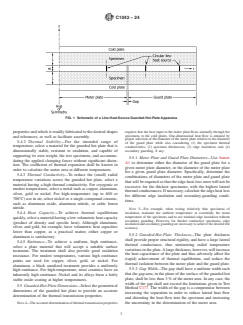
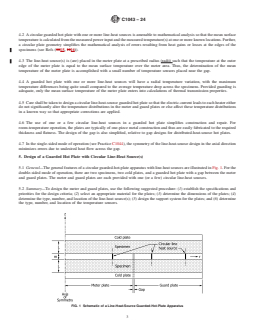
5.1 General—The general features of a circular guarded-hot-plate apparatus with line-heat sources are illustrated in Fig. 1. For the
double-sided mode of operation, there are two specimens, two cold plates, and a guarded hot plate with a gap between the meter
and guard plates. The meter and guard plates are each provided with one (or a few) circular line-heat sources.
5.2 Summary—To design the meter and guard plates, use the following suggested procedure: (1) establish the specifications and
priorities for the design criteria; (2) select an appropriate material for the plates; (3) determine the dimensions of the plates; (4)
determine the type, number, and location of the line-heat source(s); (5) design the support system for the plates; and (6) determine
the type, number, and location of the temperature sensors.
FIG. 1 Schematic of a Line-Heat-Source Guarded-Hot-Plate Apparatus
C1043 − 24
5.3 Design Criteria—Establish specifications for the following parameters of the guarded hot-plate apparatus: (1) specimen
diameter; (2) range of specimen thicknesses; (3 ) range of specimen thermal conductances; (4) characteristics of specimen
materials (for example, stiffness, mechanical compliance, density, hardness); (5) range of hot-side and cold-side test temperatures;
(6) orientation of apparatus (vertical or horizontal heat flow); and (7) required measurement precision.
NOTE 3—The priority assigned to the design parameters depends on the application. For example, an apparatus for high-temperature will necessitate a
different precision specification than that for a room-temperature apparatus.
5.4 Material—Select the material for the guarded hot plate by considering the following criteria:
5.4.1 Ease of Fabrication—Fabricate the guarded hot plate from a material that has suitable thermal and mechanical properties
and which is readily fabricated to the desired shapes and tolerances, as well as facilitate assembly.
5.4.2 Thermal Stability—For the intended range of temperature, select a material for the guarded hot plate that is dimensionally
stable, resistant to oxidation, and capable of supporting its own weight, the test specimens, and accommodating the applied
clamping forces without significant distortion. The coefficient of thermal expansion shall be known in order to calculate the meter
area at different temperatures.
5.4.3 Thermal Conductivity—To reduce the (small) radial temperature variations across the guarded hot plate, select a material
having a high thermal conductivity. For cryogenic or modest temperatures, select a metal such as copper, aluminum, silver, gold
or nickel. For high-temperature (up to 600 or 700°C) use in air, select nickel or a single-compound ceramic, such as aluminum
oxide, aluminum nitride, or cubic boron nitride.
5.4.4 Heat Capacity—To achieve thermal equilibrium quickly, select a material having a low volumetric heat capacity (product
of density and specific heat). Although aluminum, silver, and gold, for example, have volumetric heat capacities lower than copper,
as a practical matter, either copper or aluminum is satisfactory.
5.4.5 Emittance—To achieve a uniform, high emittance, select a plate material that will accept a suitable surface treatment. The
treatment shall also provide good oxidation resistance. For modest temperatures, various high emittance paints are used for copper,
silver, gold, or nickel. For aluminum, a black anodized treatment provides a uniformly high emittance. For high-temperature, most
ceramics have an inherently high emittance. Nickel and its alloys form a fairly stable oxide coating at higher temperatures.
5.5 Guarded-Hot-Plate Dimensions—Select the geometrical dimensions of the guarded hot plate to provide an accurate
determination of the thermal transmission properties.
NOTE 4—The accurate determination of thermal transmission properties requires that the heat input to the meter plate flows normally through the
specimens to the cold plates. One-dimensional heat flow is attained by proper selection of the diameter of the meter plate relative to the diameter of the
guard plate while also considering (1) the specimen thermal conductivities; (2) specimen thicknesses; (3) edge insulation; and, (4) secondary guarding,
if any.
5.5.1 Meter Plate and Guard Plate Diameters—Use Annex A1 to determine either the diameter of the guard plate for a given meter
plate diameter, or the diameter of the meter plate for a given guard plate diameter. Specifically, determine the combinations of
diameters of the meter plate and guard plate that will be required so that the edge-heat-loss error will not be excessive for the
thickest specimens, with the highest lateral thermal conductances. If necessary, calculate the edge heat loss for different edge
insulation and secondary-guarding conditions.
NOTE 5—For example, when testing relatively thin specimens of insulation, maintain the ambient temperature at essentially the mean temperature of the
specimens and to use minimal edge insulation without secondary guarding. However, for thicker conductive specimens, edge insulation and secondary
guarding are necessary to achieve the desired test accuracy.
5.5.2 Guarded-Hot-Plate Thickness—The plate thickness shall provide proper structural rigidity, and have a large lateral thermal
conductance, thus minimizing radial temperature variations in the plate. A large thickness, however, will increase the heat
capacitance of the plate and thus adversely affect the (rapid) achievement of thermal equilibrium, and reduce the thermal isolation
between the meter plate and the guard plate.
5.5.3 Gap Width—The gap shall have a uniform width such that the gap area, in the plane of the surface of the guarded hot plate,
C1043 − 24
shall be less than 3 % of the meter area. In any case, the width of the gap shall not exceed the limitations given in Test Method
C177. The width of the gap is a compromise between increasing the separation in order to reduce lateral heat flow and distorting
the heat flow into the specimen and increasing the uncertainty in the determination of the meter area.
NOTE 6—The gap provides a significant thermal resistance between the meter and guard plates. The temperature difference across the gap shall be
maintained at a very small value, thereby minimizing the heat transfer between the meter and guard plates, both directly across the gap and also through
adjacent portions of the specimens.
5.5.4 Gap Configuration—Refer to Fig. 2 in selecting an appropriate design for the gap cross-section. Designs (b) and (c) permit
a narrow gap at the surfaces, in the plane of the plate, while maintaining a fairly high thermal resistance between the meter and
guard plates. For a small temperature difference across the gap, calculate the corresponding heat flow using guidelines in Appendix
X1.
5.5.5 Plate Flatness:
5.5.5.1 When assembled, the guarded hot plate shall have the surfaces of both the meter and guard plates flat to within 0.025 %
of the outer diameter of the guard plate.
NOTE 7—For example, a guarded hot plate with a 600-mm diameter guard plate will be flat over its entire surface to within 0.15 mm.
5.5.5.2 During fabrication, assembly, and installation of the guarded hot plate, care shall be taken to achieve this flatness tolerance.
For a metal plate, it will be necessary to anneal the plate to relieve stresses introduced during machining and then grind the plate(s)
to final tolerances. Continued checking is necessary to ensure the flatness tolerance is maintained after temperature cycling.
FIG. 2 Designs for the Cross-section of the Gap Between the Meter and Guard Plates
C1043 − 24
5.5.6 Surface Emittances:
5.5.6.1 Guarded Hot Plate—Treat the surfaces of the guarded hot plate to maintain a total hemispherical emittance greater than
0.8. In any case, the hot plate surface emittance shall meet the requirements of Test Method C177.
5.5.6.2 Gap—To minimize the heat flow across the gap, either treat the surfaces of the gap (by polishing or electroplating) to
reduce their emittance, or fill the gap with thermal insulation.
5.6 Heater Design—Select the radius of each circular line-heat source for the meter plate and the guard plate as follows.
5.6.1 Location of Heaters:
5.6.1.1 Meter Plate—If the meter plate has a single line-heat source, locate the heat source at a radius equal to =2/2 times the
radius to the center of the gap. If it is desired to have heaters at more than one radius, select these radii by using the criteria given
in Annex A2.
5.6.1.2 Guard Plate—For a guarded hot plate with the outer radius of the guard plate equal to 2.5 times the radius to the center
of the gap, locate the line-heat source at a radius equal to 1.29 times the radius to the center of the gap. If another line-heat source
is required in the guard plate, locate the heat source at a radius of 1.97 times the radius to the center of the gap. Use the criteria
given in Annex A2 for determining other radii of line-heat sources in the guard plate.
NOTE 8—The location(s) of the line-heat sources in the guard plate is (are) less critical than is the case for the meter plate.
5.6.2 Type of Heater—Select the line-heat source from one of the following types of heater elements: (1) thin ribbon; (2) sheathed;
or (3) any other stable type that provides a uniform heat output per unit length, for example, fine resistance wire with dielectric
insulation.
5.6.2.1 Ribbon Heater—A thin ribbon heater consists of an etched foil or wire-wound heating element sandwiched between two
layers of electrical insulation. Select the type of electrical insulation based on the temperatures of interest.
5.6.2.2 Sheathed Heater—A sheathed heater, sometimes known as a cable heater or a swaged heater, consists of a straight or coiled
heater element insulated from its surrounding metal sheath by compacted ceramic powder. This type of heater is suitable for high
temperatures, depending upon the type of resistance wire and sheath that are selected.
5.6.3 Installation of Heaters:
5.6.3.1 Install the ribbon heater(s) by fabricating the plate (meter or guard) in two concentric sections and placing the heater
between the sections by either an interference fit or a tapered fit. Prepare the interference fit by applying a moderate temperature
difference to the two concentric sections as described in the adjunct.
5.6.3.2 Install the sheathed heater(s) by pressing the heater into circular grooves that have been cut into one (or more) surface(s)
of the plate (meter or guard). The grooves shall be sufficiently deep that the heater will be below the surface of the plate. Fill the
remainder of the groove with either conductive epoxy, solder, or braze.
5.6.4 Lead Wires for Heater—In order to minimize undesired heat generation from the heater leads, select lead wires that have
a lower electrical resistance per unit length than the heater element(s). The heater elements shall have either integral electrical lead
wires, or individual insulated lead wires attached to the heater elements with the junctions electrically insulated (with, for example,
epoxy or ceramic cement). Secure the electrical connections so they are reliable and insulated electrically from the guarded hot
plate.
NOTE 9—Since some heat will be generated by the wire leads, thereby perturbing the temperature profile, consideration shall be given to where the leads
are located and how they are installed. Refer to Appendix X2 for guidance on locating the wire heater leads.
5.7 Support Structures:
5.7.1 Support for Meter Plate—Design the support system for the meter plate to:
C1043 − 24
5.7.1.1 Facilitate assembly of the meter and guard plates so that the two plates are co-planar (per 5.5.5) and concentric with a
uniform gap width (per 5.5.3),
5.7.1.2 Support the mass of the meter plate as well as the forces from clamping the test specimens,
5.7.1.3 Account for the effects of thermal expansion of the meter and guard plates,
5.7.1.4 Minimize heat conduction between the meter and guard plates, and
5.7.1.5 Facilitate installation and repair of the line-heat sources, lead wires, and sensors.
NOTE 10—Extraneous heat flows caused by the support system will disturb the desired temperature distribution in the meter plate. One successful
technique consists of a system of three small pins with both ends tapered that are installed in radially drilled holes in the guard plate. A tapered-end screw
pushed against the outer end of each pin presses the other end of the pin into a circumferential groove in the outer edge of the meter plate. This system
will center the meter plate accurately so that the gap width is uniform (per 5.5.3).
5.7.2 Support for Guard Plate—Design the support system for the guard plate to maintain the guarded hot plate in the desired
orientation (usually the plane of the hot plate will be either horizontal or vertical), and, minimize conductive heat losses from the
guard plate.
NOTE 11—Extraneous heat flows caused by the support structure will disturb the desired temperature distribution in the guard plate. One successful
technique for supporting the guard plate is wire cables (at three or four locations) at the periphery of the guard plate. A second technique is to rigidly
support the underside of the guard plate at the periphery either from above or below.
5.8 Temperature Sensors:
5.8.1 Type—Select temperature sensors for the guarded hot plate that provide adequate sensitivity and do not significantly change
the temperatures that are to be measured. At modest temperatures, select sensors from the following types: (1) thermocouples
(either Type T or Type E wire being the most commonly used); (2) small, accurate (platinum) resistance thermometers; or (3) stable
thermistors. At extreme temperatures (high or cryogenic), consult Specification E230 or Ref (1217) for the use of thermocouples
for temperature measurement.
5.8.2 Calibration—Temperature sensors shall be calibrated with standards traceable to a national standards laboratory.
NOTE 12—The overall uncertainty depends not only on the type of sensor and its calibration, but also on the measurement system. Normal precautions
require minimizing spurious voltages by locating junctions of dissimilar metals in regions of low thermal gradients and using high quality low-thermal
emf switches. For further guidelines, consult Test Method C177.
5.8.3 Location in Meter Plate—If the line-heat source is located per 5.6.1 in the meter plate, locate the temperature sensor at the
outer radius of the meter plate. Consult Appendix X2 for the angular location of the temperature sensor. For other cases with
multiple radii, locate the temperature sensor at the center plane of the meter plate.
5.8.4 Location in Gap—Use a thermopile to detect directly the temperature difference across the gap, rather than separate
measurements of the absolute temperature of the meter and guard-sides. In order to reduce heat conduction through the thermopile
wires, select (1) wires of small diameter and low thermal conductivity; (2) the minimum number of thermocouple junction pairs
necessary for adequate sensitivity; and (3) an oblique (rather than radial) path for the wires to cross the gap.
5.8.4.1 Thermoelements—Select thermoelements that have a high thermopower (μV/K) and relatively low thermal conductivity of
both alloys, such as Type E thermocouple wire, having a diameter no greater than 0.3 mm. Thermopiles constructed from copper
thermoelements shall not be used.
5.8.4.2 Sensitivity—If the line-heat source is located per 5.6.1 in the meter plate, locate the minimum number of thermocouple
junctions relative to the heater leads as described in Appendix X2.
NOTE 13—Different designs for guarded hot plates have used anywhere from a few pairs of thermocouple junctions to several dozen pairs to achieve both
adequate sensitivity and adequate sampling of the temperature on either side of the gap. The number of thermocouple junctions needs to provide the
desired resolution of the temperature difference across the gap. For example, if thermocouple wire with a nominal thermopower of 60 μV/K is used, a
C1043 − 24
thermopile with 16 pairs of junctions will have a thermopower of 960 μV/K. For such a thermopile, measurement of the thermopile output to a resolution
of 1 μV will correspond to a resolution in the temperature difference across the gap of approximately 1 mK.
5.8.4.3 Installation—Place all thermocouple junctions in good thermal contact with the meter plate or guard plate and secure,
when necessary, by mechanical fasteners. Insulate electrically all thermocouple junctions from the meter plate and guard plate.
5.8.5 Location in Guard Plate—Measure the temperatures of the primary guard using thermocouples, (platinum) resistance
thermometers, or thermistors, or indirectly using differential thermocouples.
NOTE 14—Temperatures in the guard plate do not enter directly into the calculation of thermal transmission properties. However, it is important to measure
temperatures at selected locations in the guard plate to verify correct operation of the guarded hot plate.
6. Design Precautions
6.1 Error in the measurement of the temperature of the guarded hot plate is introduced from several sources, including: (1)
improper design of the guarded hot plate; (2) location of the temperature sensor; and (3) calibration of the temperature sensor as
well as the measurement system (see 5.8.2).
6.2 A basic premise in the design of the guarded hot plate is the location of the line-heat source at a prescribed radius as described
in Annex A2. This ensures that the mean temperature of the surface of the meter plate is equal to the temperature at the edge of
the meter plate. The radial temperature profile is affected by the thermal conductivity of the plate. Consequently, the thermal
conductivity of the plate shall be high relative to the specimen (see Annex A2).
6.3 Experimental checks to verify the radial temperature distribution include independent temperature measurements of the
guarded hot plate with thermocouples, for example, as described in Refs (5), (8).
6.4 Angular perturbations in the temperature profile are due to heating from the heater leads crossing the gap. In this case,
additional temperature sensors will be necessary to determine adequately the mean temperature of the surface of the meter plate.
7. Keywords
7.1 guarded hot plate apparatus; heat flow; line source heater; steady state; thermal conductivity ; thermal insulation; thermal
resistance
ANNEXES
(Mandatory Information)
A1. CONTROL OF EDGE HEAT LOSS OR GAIN
A1.1 Scope
A1.1.1 This annex provides a procedure for determining the diameter of the guard plate and ambient temperature conditions
required to reduce the edge effects to negligible proportions. Alternative procedures are allowed, but it is the responsibility of the
user to determine that those procedures yield equivalent results.
A1.2 Theoretical Analysis
A1.2.1 For an apparatus with an isothermal guarded hot plate and cold plate(s), the error due to edge heat loss or gain has been
C1043 − 24
derived for both circular and square plates by Peavy and Rennex (1015), for the case of the specimen being anisotropic, and by
Bode (1116), for the isotropic case. The error due to edge heat transfer in a guarded hot plate apparatus is given by:
ε5 A1BX (A1.1)
where:
2~T 2 T !
m a
X 5 (A1.2)
T 2 T
h c
Here, T is the guarded hot plate temperature, and T , the cold plate temperature. The mean temperature of the specimen is T
h c m
= (T + T )/2, and T is the ambient temperature at the edge of the specimen.
h c a
A1.2.2 For a circular plate geometry, the coefficients A and B are given by:
`
A 5 W (A1.3)
( 2n
n51
`
B 5 W (A1.4)
( 2n21
n51
The terms in the summations are given by:
4 hL γL I ~nπb/γL!
W 5 (A1.5)
S DS D
2 2
n
π λ b n I nπd/γL 1 hL/nπλ I nπd/γL
@ ~ ! ~ ! ~ !#
1 0
where I and I are modified Bessel functions of the first kind of order 0 and 1, respectively, b is the radius to the center of the
0 1
gap, d is the outer radius of the guard plate, L is the thickness of the specimen, and h is the heat transfer coefficient at the
circumference of the specimen. The anisotropy ratio for the specimen is γ = λ /λ where λ and λ are the thermal conductivities
r z r z
1/2
in the radial and axial directions, respectively. The geometrical mean of the thermal conductivities is λ = (λ λ ) .
r z
A1.2.3 For the range of parameters that provide appropriate guarding, Eq A1.3 and Eq A1.4 are convergent and require only a few
terms to obtain accurate results. Peavy and Rennex (1015) provide plots of A and B as functions of geometry and of the ratio of
heat transfer coefficient, h, to specimen conductivity.
A1.2.4 For relatively small values of A and B, approximate universal curves are obtained by writing:
hL
λ
A 5 A' (A1.6)
γL hL
11 11
S D
4πd 2πλ
hL
λ
B 5 B' (A1.7)
γL hL
11 11
S D
2πd πλ
where A and B are computed from Eq A1.3 and Eq A1.4 and A' and B' are then computed using Eq A1.6 and Eq A1.7. Fig. A1.1
and Fig. A1.2 present parametric curves of A' and B', respectively, as functions of γL/d. The values computed for A' and B' are also
weak functions of hd/λ. The widths of the lines shown in Fig. A1.1 and Fig. A1.2 correspond to the variations due to hd/λ being
varied from 0.1 to infinity. Fig. A1.1 and Fig. A1.2 are used to obtain values of A' and B', from which A and B are computed using
Eq A1.6 and Eq A1.7.
A1.2.5 For values of d/b not shown, or for values of γL/d larger than unity, A and B are obtained from Peavy and Rennex (1015)
or computed directly from Eq A1.3 and Eq A1.4. Alternatively, upper limits on A' and B' are computed simply from the expressions:
1/2
1 γL d 22π d 2 b
~ !
A', exp (A1.8)
S D S D S D
π b b γL
1/2
4 γL d 2π~d 2 b!
B', exp (A1.9)
S D S D S D
π2 b b γL
C1043 − 24
FIG. A1.1 The Coefficient A' as a Function of γL/d withd/b as a Parameter
FIG. A1.2 The Coefficient B' as a Function of γL/d withd/b as a Parameter
A1.3 Application
A1.3.1 A review of Eq A1.6 and Eq A1.7 and Fig. A1.1 and Fig. A1.2 indicates that A' and B' are, aside from a very small
dependence on hL/λ, functions of γL/d and d/b, or, equivalently, some other ratio of these geometrical quantities. For a given
guarded hot plate, b and d are fixed and the values of A' and B' are functions only of γL (again, neglecting the weak dependence
on hL/γ). The quantities multiplying A' and B' in Eq A1.6 and Eq A1.7 are, aside from a small dependence on γL/d, functions only
of hL/λ and thus do not depend on the meter area or guard plate diameters. For fixed hot- and cold-plate temperatures, the quantity
X in Eq A1.1 and Eq A1.2 is a function of T , the ambient temperature. Thus, for a given guarded hot plate, with fixed b and d,
a
the error due to edge heat losses or gains is dependent upon γL,hL/λ, and T .
a
C1043 − 24
A1.3.2 From Eq A1.1 and Eq A1.2, it is seen that A represents the error when the ambient temperature T is equal to the mean
a
temperature of the specimen. Under ideal conditions, the temperature of half of each specimen next to the guarded hot plate is
higher than the ambient resulting in a heat loss along half the specimen edge. Conversely, the other half of the specimen (next to
the cold plate) experiences a heat gain from the ambient. In effect, a small fraction of the heat input to the meter plate bypasses
the meter section of the specimen, resulting in an error in the computed thermal transmission properties.
A1.3.3 The quantity BX in Eq A1.1 and Eq A1.2 represents the additional error when the ambient temperature differs from the
mean temperature of the test specimen. In principle, the error due to edge heat losses or gains is eliminated by selecting an ambient
temperature such that BX = −A, which occurs when the ambient temperature is somewhat hotter than the mean temperature of the
specimen:
A T 2 T
h c
T 5 T 1 (A1.10)
a m
B 2
A1.3.4 While this value of T is a good choice, relying on this selection alone as a means of adequately controlling edge heat loss
a
or gain is usually insufficient. Simply controlling the ambient temperature to the value given by Eq A1.10 cannot adequately
eliminate edge heat losses or gains unless the guard plate is sufficiently wide and the value of hL/λ is sufficiently low to ensure
that both A and B are small.
NOTE A1.1—The analytical models used by Peavy and Rennex (1015) and Bode (1116) assume that edge heat transfer occurs across an infinitesimally
thin boundary with a uniform film coefficient h and a uniform ambient temperature T . In actuality, the following conditions cause the assumptions to
a
be invalid: (1) if edge insulation is used and h is taken as the thermal conductance in the radial direction, the assumption of an infinitesimally thin
boundary is not satisfied; and (2) if a secondary guard is used (see Test Method C177) and there are heat flows in the edge insulation to regions at
temperatures different than that of the secondary guard, the assumption of a uniform film coefficient h is not satisfied.
A1.3.5 In designing a guarded hot plate, b and d are varied in order to obtain acceptably small edge-effect errors for the specimen
thermal conductivities and thicknesses of interest. Fig. A1.1 and Fig. A1.2 reveal that, for any given value of d/b, both A' and B'
increase rapidly as γL/d increases beyond 0.3. Reducing b, the radius of the meter area, relative to d, the guard plate outer radius,
significantly lowers the values of A' and B' as d/b increases from 1.5 to 2.0. However, further reduction in b does not provide much
additional reduction in A' and B'. From these observations, the value of d/b shall be equal to 2.0 or greater, but little additional
benefit will be gained by selecting d/b greater than 2.5.
A1.3.6 Eq A1.6 and Eq A1.7 reveal that when hL/λ « 1.0, A and B are approximately equal to (hL/λ)A' and (hL/λ)B', respectively.
When hL/λ is very large, A is approximately 2πA' and B is approximately πB', corresponding to the situation where the
circumferential edge of the specimen is essentially isothermal at the same temperature as that of the ambient. For these limiting
values, fixed values of b and d, and a given ambient temperature T ,hL/λ needs to be less than 3.0 in order to reduce the edge heat
a
loss effects to less than half of what they will be if hL/π was quite large.
A1.3.7 Using edge insulation having a thermal conductivity λ and thickness E, the equivalent film coefficient for the edge
e
insulation is h = λ /E and accordingly, hL/λ = (λ /λ)(L/E). Assume that the edge insulation and specimen have the same thermal
e e
conductivity (λ = λ) so that hL/λ = L/E. Based upon A1.4.6, the thickness of the edge insulation shall be at least one-third the
e
thickness of the specimen in order to reduce significantly the edge effects.
NOTE A1.2—For example, a specimen 0.15 m thick requires at least 0.050 m of edge insulation.
A1.3.8 Example—Given a guarded hot plate with d/b = 2.0, an isotropic specimen (γ = 1) of thickness L = 0.8d, and edge
insulation such that hL/λ = 3, the edge effects are estimated as follows. From Fig. A1.1 and Fig. A1.2, A' = 0.0043 and B' = 0.11.
C1043 − 24
From these values, using Eq A1.6 and Eq A1.7, A = 1.99A' = 0.0086 and B = 1.44B' = 0.16. Thus, from Eq A1.1,
ε = 0.0086 + 0.16X. From Eq A1.10, taking T − T = 20 K, the ideal choice for the ambient temperature will be T = T + 0.54
h c a m
K. Assuming that the ambient temperature is maintained within 61 K of this value, the edge heat loss error, from Eq A1.1 and
Eq A1.2, will be ε = 60.016. Thus, for the above assumptions, the edge effects are 61.6 %.
A2. LOCATION OF LINE-HEAT SOURCES
A2.1 Scope
A2.1.1 This annex provides procedures based on analyses by Flynn et al. (1312) for determining the radial locations of the
line-heat sources. Alternative procedures are allowed for selecting these locations, but it is the responsibility of the user to
determine what, if any, corrections shall be applied to measured temperatures in order to compute thermal transmission properties
of test specimens. This annex provides for two general cases for the meter plate: (1) the mean temperature of the meter plate equal
to the gap temperature; and (2) the mean temperature of the meter plate maximally isothermal and greater than the gap temperature.
Analogous procedures are provided for the guard plate.
A2.2 Meter Plate: Case 1
A2.2.1 The procedure in this section provides the means for multiple heaters in the meter plate to be located so that the
temperature at the gap will be equal to the mean temperature of the meter plate. The special case of one circular line-heat source
in the meter plate is also discussed.
NOTE A2.1—The latter represents the case for two plates built at the National Institute of Standards and Technology as described in the adjunct.
A2.2.2 The meter plate is assumed to have n circular heaters. If the effects of heater leads are neglected and the thermal
conductance of the test specimens is not too high, the temperature distribution in the meter plate is assumed to be a function only
of radial position and the heat flux from the plate into the specimens is assumed uniform. For these assumptions, the temperature
at the guard gap, r = b, will be equal to the mean temperature averaged over the entire meter plate provided that:
n 2
2πa q' 2a
k k k
2 1 5 0 (A2.1)
S D
( 2
Q b
k51
where the k-th heater, located at r = a , produces q ' W per unit length. The total power input to the meter plate is given by:
k k
n
Q 5 2πa q' (A2.2)
( k k
k51
A2.2.3 If all of the heaters carry the same current, q ' in Eq A2.1 is replaced by the electrical resistance per unit length of the k-th
k
heater and Q is replaced by the total combined electrical resistance of all of the heaters. Further, if all of the heaters have the same
electrical resistance per unit length, the temperature at the guard gap is made equal to the mean temperature of the meter plate by
selecting heater locations such that:
n 2
a 2a
k k
2 1 5 0 (A2.3)
S D
( 2
b b
k51
A2.2.4 For only one heater, the location is a = a = b=2/2 . If there are multiple heaters, Eq A2.3 does not have a unique solution.
However, if half of the power input to each heater is constrained to flow radially inward in the meter plate and half to flow outward
C1043 − 24
and the power input to the region of the meter plate between two heaters is provided only by those two heaters, a unique solution
to Eq A2.3 is available. With these constraints, when the heaters are of equal strength (that is, have the same power output per unit
length), they shall be located at:
a k
k
5 , for k 5 1, 2, … n (A2.4)
b 2
=n 1n
Values for a /b obtained from Eq A2.4 for n ≤ 6 are listed in Table A2.1.
k
A2.2.5 When the heater locations have been selected such that the mean temperature of the meter plate is equal to the temperature
at the gap, the radial temperature distribution v(r) is given by:
v~r! 2V b
5 ·F n,r/b (A2.5)
~ !
V 2λ mR
p
Here, V = T − T is the mean temperature of the meter plate measured relative to the cold plates, λ is the thermal conductivity
h c p
of the material of which the meter plate is constructed, m is the thickness of the meter plate, and R is the thermal resistance of the
specimens. The function F is given by:
n
r 4 r
k
F~n,r/b! 5 2 12 kln (A2.6)
2 2 S D
(
b n 1n b
k51
where r is the greater of r or a (that is, r = a when r < a and r = r when r > a ). Eq A2.5 requires two specimens each
k> k k> k k k> k
having the same thermal resistance. If the specimens have different resistances R and R , R in Eq A2.5 becomes 2R R /(R + R ).
1 2 1 2 1 2
If the guarded-hot-plate apparatus is operated in the single-sided mode, with only one specimen, the right hand side of Eq A2.5
is divided by two.
A2.2.6 Fig. A2.1 shows the function F(n,r/b) for values of n ranging from 1 to 4. For each value of n this function has its lowest
value, F , at the center of the meter plate and local maxima at the location of each heater, with the highest value, F , being
min max
at the outermost heater. The values of F and F are included in Table A2.1. These values are used in conjunction with Eq A2.5
min max
to compute the range of temperature variation for a given meter plate and specimens.
A2.2.7 Example 1—Assume that the meter plate has a radius of 0.1 m, a thickness of 0.005 m, and a thermal conductivity of 200
W/m·K. For a pair of specimens, each having a thermal resistance of 0.5 m ·K/W, Eq A2.5 yields:
v r 2V
~ !
5 0.01·F~n,r/b! (A2.7)
V
For a meter plate with a single line-heat source and this set of parameters, the temperature of the meter plate, relative to the
temperature of the cold plates, will be 0.3 % colder than the mean temperature in the center and 0.2 % hotter at the heater location.
If three heaters were used, the center temperature will be 0.08 % colder and the maximum temperature 0.04 % hotter than the mean
temperature.
A2.2.8 Example 2—Given a meter plate having a radius of 0.05 m, a thickness of 0.005 m, and a thermal conductivity of 50
W/m·K used to test specimens having a thermal resistance of only 0.05 m ·K/W, the factor multiplying F in Eq A2.5 will be 0.1.
TABLE A2.1 Radial Locations for Line-heat Sources in the Meter Plate, Selected so that the Gap is Equal to the Mean Temperature of
the Meter Plate
n a /b a /b a /b a /b a /b a /b a /b a /b a /b a /b F F
1 2 3 4 5 6 7 8 9 10 min max
1 0.7071 . . . . . . . . . −0.3069 0.1931
2 0.4082 0.8165 . . . . . . . . −0.1324 0.0721
3 0.2887 0.5774 0.8660 . . . . . . . −0.0758 0.0377
4 0.2236 0.4472 0.6708 0.8944 . . . . . . −0.0497 0.0231
5 0.1826 0.3651 0.5477 0.7303 0.9129 . . . . . −0.0354 0.0157
6 0.1543 0.3086 0.4629 0.6172 0.7715 0.9258 . . . . −0.0266 0.0113
7 0.1336 0.2673 0.4009 0.5345 0.6682 0.8018 0.9354 . . . −0.0208 0.0085
8 0.1179 0.2357 0.3536 0.4714 0.5893 0.7071 0.8250 0.9428 . . −0.0168 0.0067
9 0.1054 0.2108 0.3162 0.4216 0.5270 0.6325 0.7379 0.8433 0.9487 . −0.0138 0.0054
10 0.953 0.1907 0.2860 0.3814 0.4767 0.5721 0.6674 0.7628 0.8581 0.9535 −0.0116 0.0044
C1043 − 24
FIG. A2.1 The Function F(n,r/b) for the Meter Plate, Plotted versus r/b withn as a Parameter
If a single heater was used, the temperature at the center of the meter plate will be 3.1 % colder than the mean temperature and
the temperature at the location of the heater will be 1.9 % hotter. Thus, for high-conductance specimens, the user will decide to
build the meter plate with four lin
...