

ASTM F3613-22
(Practice)Standard Practice for Recording the Exoskeleton Fit to the User
General Information
- Abstract
SIGNIFICANCE AND USE
5.1 The significance of the information to be recorded in a test report allows for exoskeleton safety and performance to be contextualized with the exoskeleton fit to the user. Exoskeleton tests can also be replicated across similar or different exoskeletons by using this practice to record the exoskeleton fit to the user for a test in a standardized way.
5.2 Limitations of the practice are that not all exoskeletons have the same connections to the body and fit to all users, and therefore, fit to the user may change the exoskeleton capabilities. For example, as users vary in size, shape, gender, etc., an exoskeleton that is fit to one user may allow an increase or decrease in torque applied to the arms, legs, etc. as compared to another user, especially users at the upper and lower limits of manufacturer-suggested exoskeleton sizing. Another example is that an exoskeleton that is not fit properly to a user may be uncomfortable, and as a result the user may not perform tasks as long, as fast, as strong/delicately, or many other possible outcomes.
5.3 It is expected that all exoskeleton tests require the exoskeleton to be fit properly to the user according to manufacturer specifications. However, as testing exoskeletons can vary, so can fit to the user, and variations in fit may also be tested. For example, a test may be performed with the exoskeleton not fit properly to the users’ legs (for example, longer fit on shorter legs) to evaluate performance changes when the task requires the user to stand on their toes. Should exoskeleton tests be performed with the exoskeleton not fit properly to the user, the test requestor should verify with the manufacturer that the exoskeleton will not harm the user as a result of a bad fit, and provide this information to the test administrator to record on the test report.
5.4 Additional fit and measurement information may be found in Terminology D5219, Practice E3003, and Practice F1731.
SCOPE
1.1 This practice describes a means to record the exoskeleton fit to the user when testing. The practice provides a method for recording exoskeleton: alignment to the user, component distances from the body, sizing, and subjective comfort using a standard recording method.
1.2 This practice is intended to be used with other exoskeleton test methods and practices to provide a clear representation of the exoskeleton fit to the user measured along body planes; provides a basis for comparison of the test circumstances across different exoskeletons or tests, or both; and allows a test to be recreated.
1.3 The values stated in SI units are to be regarded as the standard. The values given in parentheses are not precise mathematical conversions to imperial units. They are close approximate equivalents for the purpose of specifying exoskeleton characteristics while maintaining repeatability and reproducibility of the test method results. These values given in parentheses are provided for information only and are not considered standard.
1.4 This standard does not purport to address all of the safety concerns, if any, associated with its use. It is the responsibility of the user of this standard to establish appropriate safety, health, and environmental practices and determine the applicability of regulatory limitations prior to use.
1.5 This international standard was developed in accordance with internationally recognized principles on standardization established in the Decision on Principles for the Development of International Standards, Guides and Recommendations issued by the World Trade Organization Technical Barriers to Trade (TBT) Committee.
- Status
- Published
- Publication Date
- 14-Nov-2022
- Technical Committee
- F48 - Exoskeletons and Exosuits
- Drafting Committee
- F48.03 - Task Performance and Environmental Considerations
Overview
ASTM F3613-22 is a standard practice developed by ASTM International for recording the exoskeleton fit to a user during testing. The main goal of this practice is to provide a consistent, repeatable method to document how an exoskeleton aligns, attaches, and conforms to individual users. By standardizing the way fit is recorded, this practice enables meaningful comparisons of safety and performance in exoskeleton testing across different users, devices, and test environments.
Fit is a critical factor in the performance, comfort, and safety of wearable exoskeletons and exosuits. Differences in body shape, size, and other user-specific characteristics can influence how an exoskeleton performs and feels. ASTM F3613-22 ensures that these factors are documented and that exoskeleton test results are contextualized by providing clear fit data.
Key Topics
Standardized Fit Documentation
- Specifies procedures for recording exoskeleton alignment, sizing, and distances between device components and the user's body.
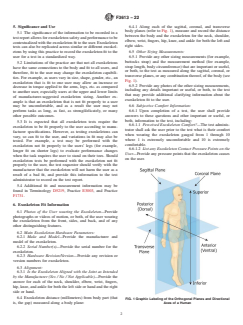
- Includes guidance for measuring fit along key body planes (sagittal, coronal, transverse) for multiple anatomical points such as the neck, shoulders, elbows, wrists, hips, knees, and ankles.
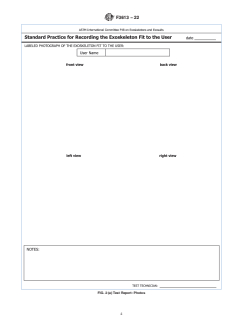
- Recommends capturing photographs or videos from several angles to visually document fit.
Reporting Subjective Comfort
- Requires users to rate their perceived comfort while wearing the exoskeleton.
- Mandates the identification and recording of any contact pressure points and discomfort.
Recording Hardware Details
- Captures manufacturer, model, serial number, and hardware revision/version of the exoskeleton used in testing.
Fit Variability and Testing
- Recognizes that variations in user size, gender, and shape can affect exoskeleton fit and, therefore, its capabilities and performance.
- Provides methodology for documenting both proper and intentionally improper fits, contributing to comprehensive performance analysis.
Replication and Reproducibility
- Facilitates the recreation of exoskeleton tests by providing detailed fit data, supporting reliable comparisons across different studies and environments.
Applications
The use of ASTM F3613-22 is essential in various areas where exoskeletons are tested for human interaction, including:
Research and Development
- Enables exoskeleton designers and engineers to assess fit outcomes, identify design improvements, and ensure safety across diverse user populations.
Product Testing and Certification
- Ensures compliance with safety, comfort, and performance standards by providing a repeatable record of exoskeleton fit, supporting regulatory and certification processes.
Occupational and Industrial Testing
- Assists safety professionals and ergonomists in evaluating exoskeleton suitability and fit for workplace tasks, helping prevent injuries and optimize task performance.
Clinical and Rehabilitation Settings
- Facilitates the documentation and assessment of exoskeleton fit for individuals with varying physical abilities, ensuring that therapeutic and assistive devices are tailored to user needs.
User Trials and Comparative Studies
- Supports reliable benchmarking of multiple exoskeleton designs or configurations by standardizing fit documentation across user samples.
Related Standards
ASTM F3613-22 references and complements several other important ASTM standards that further support accurate measurement and fit assessment for body-worn devices:
ASTM D5219 - Terminology Relating to Body Dimensions for Apparel Sizing
Provides standardized definitions and terms for human body measurements.ASTM E3003 - Practice for Body Armor Wearer Measurement and Fitting of Armor
Outlines procedures for measuring and fitting personal protective equipment.ASTM F1731 - Practice for Body Measurements and Sizing of Fire and Rescue Services Uniforms and Other Thermal Hazard Protective Clothing
Details methods for measuring and sizing specialized protective garments.ASTM F3323 - Terminology for Exoskeletons and Exosuits
Defines key terms used throughout the exoskeleton industry and in related standards.
By following ASTM F3613-22, organizations can ensure that exoskeleton fit data is recorded in a way that supports safety, reproducibility, and reliable performance assessment-key goals in advancing exoskeleton technology and its applications across industries.
Relations
- Effective Date
- 01-Aug-2020
- Effective Date
- 01-Oct-2019
- Effective Date
- 01-Apr-2019
- Effective Date
- 01-Sep-2018
- Effective Date
- 01-Dec-2015
- Effective Date
- 15-Feb-2015
- Effective Date
- 15-Jan-2009
- Effective Date
- 15-Jan-2009
- Effective Date
- 15-Jun-2008
- Effective Date
- 15-Jul-2007
- Effective Date
- 01-Mar-2007
- Effective Date
- 10-Sep-2002
- Effective Date
- 10-Aug-1996
- Effective Date
- 10-Aug-1996
- Effective Date
- 01-Jan-1996
Get Certified
Connect with accredited certification bodies for this standard

BSI Group
BSI (British Standards Institution) is the business standards company that helps organizations make excellence a habit.

TÜV Rheinland
TÜV Rheinland is a leading international provider of technical services.

TÜV SÜD
TÜV SÜD is a trusted partner of choice for safety, security and sustainability solutions.
Sponsored listings
Frequently Asked Questions
ASTM F3613-22 is a standard published by ASTM International. Its full title is "Standard Practice for Recording the Exoskeleton Fit to the User". This standard covers: SIGNIFICANCE AND USE 5.1 The significance of the information to be recorded in a test report allows for exoskeleton safety and performance to be contextualized with the exoskeleton fit to the user. Exoskeleton tests can also be replicated across similar or different exoskeletons by using this practice to record the exoskeleton fit to the user for a test in a standardized way. 5.2 Limitations of the practice are that not all exoskeletons have the same connections to the body and fit to all users, and therefore, fit to the user may change the exoskeleton capabilities. For example, as users vary in size, shape, gender, etc., an exoskeleton that is fit to one user may allow an increase or decrease in torque applied to the arms, legs, etc. as compared to another user, especially users at the upper and lower limits of manufacturer-suggested exoskeleton sizing. Another example is that an exoskeleton that is not fit properly to a user may be uncomfortable, and as a result the user may not perform tasks as long, as fast, as strong/delicately, or many other possible outcomes. 5.3 It is expected that all exoskeleton tests require the exoskeleton to be fit properly to the user according to manufacturer specifications. However, as testing exoskeletons can vary, so can fit to the user, and variations in fit may also be tested. For example, a test may be performed with the exoskeleton not fit properly to the users’ legs (for example, longer fit on shorter legs) to evaluate performance changes when the task requires the user to stand on their toes. Should exoskeleton tests be performed with the exoskeleton not fit properly to the user, the test requestor should verify with the manufacturer that the exoskeleton will not harm the user as a result of a bad fit, and provide this information to the test administrator to record on the test report. 5.4 Additional fit and measurement information may be found in Terminology D5219, Practice E3003, and Practice F1731. SCOPE 1.1 This practice describes a means to record the exoskeleton fit to the user when testing. The practice provides a method for recording exoskeleton: alignment to the user, component distances from the body, sizing, and subjective comfort using a standard recording method. 1.2 This practice is intended to be used with other exoskeleton test methods and practices to provide a clear representation of the exoskeleton fit to the user measured along body planes; provides a basis for comparison of the test circumstances across different exoskeletons or tests, or both; and allows a test to be recreated. 1.3 The values stated in SI units are to be regarded as the standard. The values given in parentheses are not precise mathematical conversions to imperial units. They are close approximate equivalents for the purpose of specifying exoskeleton characteristics while maintaining repeatability and reproducibility of the test method results. These values given in parentheses are provided for information only and are not considered standard. 1.4 This standard does not purport to address all of the safety concerns, if any, associated with its use. It is the responsibility of the user of this standard to establish appropriate safety, health, and environmental practices and determine the applicability of regulatory limitations prior to use. 1.5 This international standard was developed in accordance with internationally recognized principles on standardization established in the Decision on Principles for the Development of International Standards, Guides and Recommendations issued by the World Trade Organization Technical Barriers to Trade (TBT) Committee.
SIGNIFICANCE AND USE 5.1 The significance of the information to be recorded in a test report allows for exoskeleton safety and performance to be contextualized with the exoskeleton fit to the user. Exoskeleton tests can also be replicated across similar or different exoskeletons by using this practice to record the exoskeleton fit to the user for a test in a standardized way. 5.2 Limitations of the practice are that not all exoskeletons have the same connections to the body and fit to all users, and therefore, fit to the user may change the exoskeleton capabilities. For example, as users vary in size, shape, gender, etc., an exoskeleton that is fit to one user may allow an increase or decrease in torque applied to the arms, legs, etc. as compared to another user, especially users at the upper and lower limits of manufacturer-suggested exoskeleton sizing. Another example is that an exoskeleton that is not fit properly to a user may be uncomfortable, and as a result the user may not perform tasks as long, as fast, as strong/delicately, or many other possible outcomes. 5.3 It is expected that all exoskeleton tests require the exoskeleton to be fit properly to the user according to manufacturer specifications. However, as testing exoskeletons can vary, so can fit to the user, and variations in fit may also be tested. For example, a test may be performed with the exoskeleton not fit properly to the users’ legs (for example, longer fit on shorter legs) to evaluate performance changes when the task requires the user to stand on their toes. Should exoskeleton tests be performed with the exoskeleton not fit properly to the user, the test requestor should verify with the manufacturer that the exoskeleton will not harm the user as a result of a bad fit, and provide this information to the test administrator to record on the test report. 5.4 Additional fit and measurement information may be found in Terminology D5219, Practice E3003, and Practice F1731. SCOPE 1.1 This practice describes a means to record the exoskeleton fit to the user when testing. The practice provides a method for recording exoskeleton: alignment to the user, component distances from the body, sizing, and subjective comfort using a standard recording method. 1.2 This practice is intended to be used with other exoskeleton test methods and practices to provide a clear representation of the exoskeleton fit to the user measured along body planes; provides a basis for comparison of the test circumstances across different exoskeletons or tests, or both; and allows a test to be recreated. 1.3 The values stated in SI units are to be regarded as the standard. The values given in parentheses are not precise mathematical conversions to imperial units. They are close approximate equivalents for the purpose of specifying exoskeleton characteristics while maintaining repeatability and reproducibility of the test method results. These values given in parentheses are provided for information only and are not considered standard. 1.4 This standard does not purport to address all of the safety concerns, if any, associated with its use. It is the responsibility of the user of this standard to establish appropriate safety, health, and environmental practices and determine the applicability of regulatory limitations prior to use. 1.5 This international standard was developed in accordance with internationally recognized principles on standardization established in the Decision on Principles for the Development of International Standards, Guides and Recommendations issued by the World Trade Organization Technical Barriers to Trade (TBT) Committee.
ASTM F3613-22 is classified under the following ICS (International Classification for Standards) categories: 11.180.10 - Aids and adaptation for moving; 25.040.30 - Industrial robots. Manipulators. The ICS classification helps identify the subject area and facilitates finding related standards.
ASTM F3613-22 has the following relationships with other standards: It is inter standard links to ASTM E3003-20, ASTM F3323-19a, ASTM F3323-19, ASTM F3323-18, ASTM E3003-15, ASTM D5219-15, ASTM D5219-09e1, ASTM D5219-09, ASTM F1731-96(2008), ASTM D5219-07a, ASTM D5219-07, ASTM D5219-02, ASTM F1731-96(2002), ASTM F1731-96, ASTM D5219-99. Understanding these relationships helps ensure you are using the most current and applicable version of the standard.
ASTM F3613-22 is available in PDF format for immediate download after purchase. The document can be added to your cart and obtained through the secure checkout process. Digital delivery ensures instant access to the complete standard document.
Standards Content (Sample)
This international standard was developed in accordance with internationally recognized principles on standardization established in the Decision on Principles for the
Development of International Standards, Guides and Recommendations issued by the World Trade Organization Technical Barriers to Trade (TBT) Committee.
Designation: F3613 − 22
Standard Practice for
Recording the Exoskeleton Fit to the User
This standard is issued under the fixed designation F3613; the number immediately following the designation indicates the year of
original adoption or, in the case of revision, the year of last revision. A number in parentheses indicates the year of last reapproval. A
superscript epsilon (´) indicates an editorial change since the last revision or reapproval.
1. Scope F1731 Practice for Body Measurements and Sizing of Fire
and Rescue Services Uniforms and Other Thermal Hazard
1.1 This practice describes a means to record the exoskel-
Protective Clothing
eton fit to the user when testing. The practice provides a
F3323 Terminology for Exoskeletons and Exosuits
method for recording exoskeleton: alignment to the user,
component distances from the body, sizing, and subjective
3. Terminology
comfort using a standard recording method.
3.1 Terms used within this standard refer to Terminology
1.2 This practice is intended to be used with other exoskel-
F3323 and Terminology D5219.
eton test methods and practices to provide a clear representa-
tion of the exoskeleton fit to the user measured along body
4. Summary of Practice
planes; provides a basis for comparison of the test circum-
4.1 This practice describes a method for recording the
stances across different exoskeletons or tests, or both; and
exoskeleton fit to the user when performing tests described in
allows a test to be recreated.
exoskeleton test methods. Considering the variability of users,
1.3 The values stated in SI units are to be regarded as the
exoskeletons can have a series of adjustments that can affect
standard. The values given in parentheses are not precise
how well the exoskeleton fits the user and in turn, can cause
mathematical conversions to imperial units. They are close
varying performance. For example:
approximate equivalents for the purpose of specifying exoskel-
4.1.1 Loose fit straps can cause the exoskeleton to be
eton characteristics while maintaining repeatability and repro-
misaligned with body limbs and cause chafing, impact, or
ducibility of the test method results. These values given in
lower than expected exoskeleton performance, or any combi-
parentheses are provided for information only and are not
nation thereof; or
considered standard.
4.1.2 Not following the manufacturer-suggested exoskel-
eton component alignment to the body can cause user
1.4 This standard does not purport to address all of the
instability, lower than expected exoskeleton performance, or
safety concerns, if any, associated with its use. It is the
responsibility of the user of this standard to establish appro- other unexpected test results.
priate safety, health, and environmental practices and deter-
4.2 This practice also provides a standard method to report
mine the applicability of regulatory limitations prior to use.
theexoskeletonfittotheuserwhichcontextualizesexoskeleton
1.5 This international standard was developed in accor-
test results. For example, the result of a timed test could be
dance with internationally recognized principles on standard-
dependent upon exoskeleton comfort due to fit to the user on
ization established in the Decision on Principles for the
walking speed up to 0.5 m/s or knee angle rotation limitation
Development of International Standards, Guides and Recom-
from 0° through 120°. As such, comparing exoskeletons fit to
mendations issued by the World Trade Organization Technical
two different users could allude to which parameters affect
Barriers to Trade (TBT) Committee.
exoskeleton performance.
2. Referenced Documents
4.3 This practice does not consider the user information (for
example, age, exoskeleton experience) nor the hardware and
2.1 ASTM Standards:
software configuration of the exoskeleton. There are also two
D5219 Terminology Relating to Body Dimensions for Ap-
important exoskeleton safety and performance areas that are
parel Sizing
currently being developed in the Standard Practice for Record-
E3003 Practice for Body Armor Wearer Measurement and
ing the Exoskeleton User Information and the Standard Prac-
Fitting of Armor
ticeforRecordingtheExoskeletonTestConfiguration, respec-
tively.
This practice is under the jurisdiction of ASTM Committee F48 on Exoskel-
etons and Exosuits and is the direct responsibility of Subcommittee F48.03 on Task
Performance and Environmental Considerations.
Current edition approved Nov. 15, 2022. Published December 2022. DOI: Standard designations for these practices are to be added after the standards are
10.1520/F3613-22. approved and published.
Copyright © ASTM International, 100 Barr Harbor Drive, PO Box C700, West Conshohocken, PA 19428-2959. United States
F3613 − 22
5. Significance and Use 6.4.1 Along each of the sagittal, coronal, and transverse
body planes (refer to Fig. 1), measure and record the distance
5.1 The significance of the information to be recorded in a
between the body and the exoskeleton for the neck, shoulder,
test report allows for exoskeleton safety and performance to be
elbow, wrist, fingers, hip, knee, and ankle for both the left and
contextualized with the exoskeleton fit to the user. Exoskeleton
right sides.
tests can also be replicated across similar or different exoskel-
etons by using this practice to record the exoskeleton fit to the 6.5 Other Sizing Measurements:
user for a test in a standardized way. 6.5.1 Provide any other sizing measurements (for example,
buttocks strap) and the measurement method (for example,
5.2 Limitations of the practice are that not all exoskeletons
strap length, body circumference) that are important or useful,
have the same connections to the body and fit to all users, and
or both, to the test as measured along the sagittal, coronal, or
therefore, fit to the user may change the exoskeleton capabili-
transverse planes, or any combination thereof, of the body (see
ties. For example, as users vary in size, shape, gender, etc., an
Fig. 1).
exoskeleton that is fit to one user may allow an increase or
6.5.2 Provide any photos of the other sizing measurements,
decrease in torque applied to the arms, legs, etc. as compared
including any details important or useful, or both, to the test
to another user, especially users at the upper and lower limits
that may provide additional clarifying information about the
of manufacturer-suggested exoskeleton sizing. Another ex-
exoskeleton fit to the user.
ample is that an exoskeleton that is not fit properly to a user
may be uncomfortable, and as a result the user may not 6.6 Subjective Comfort Information:
perform tasks as long, as fast, as strong/delicately, or many 6.6.1 Upon completion of a test, the user shall provide
other possible outcomes. answers to these questions and other important or useful, or
both, information to the test, including:
5.3 It is expected that all exoskeleton tests requ
...