

ASTM A580/A580M-23
(Specification)Standard Specification for Stainless Steel Wire
General Information
- Abstract
ABSTRACT
This specification covers stainless steel wire, except the free-machining types. It includes round, square, octagon, hexagon, and shape wire in coils only for the more commonly used types of stainless steels for general corrosion resistance and high-temperature service. The steel specimens shall undergo the following conditions: (1) annealed as a final heat treatment; (2) cold worked to higher strength; (3) heat treated to an intermediate temper; or (4) heat treated to a hard temper by austenitizing, quenching, and tempering at a relatively low temperature. The materials shall be cold drawn, annealed, and pickled. The steel wires shall conform to the required chemical compositions of carbon, manganese, phosphorus, sulfur, silicon, chromium, nickel, molybdenum, nitrogen, and other elements such as niobium , vanadium, copper, tantalum, titanium and cobalt. Mechanical test shall be performed wherein in the steel specimens shall conform to the required values of tensile strength, yield strength, and elongation. The martensitic grades shall conform to the required values of hardness after heat treatment.
SCOPE
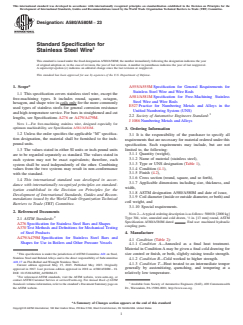
1.1 This specification covers stainless steel wire, except the free-machining types. It includes round, square, octagon, hexagon, and shape wire in coils only for the more commonly used types of stainless steels for general corrosion resistance and high-temperature service. For bars in straightened and cut lengths, see Specifications A276 or A479/A479M.
Note 1: For free-machining stainless wire, designed especially for optimum machinability, see Specification A581/A581M.
1.2 Unless the order specifies the applicable “M” specification designation, the material shall be furnished to the inch-pound units.
1.3 The values stated in either SI units or inch-pound units are to be regarded separately as standard. The values stated in each system may not be exact equivalents; therefore, each system shall be used independently of the other. Combining values from the two systems may result in non-conformance with the standard.
1.4 This international standard was developed in accordance with internationally recognized principles on standardization established in the Decision on Principles for the Development of International Standards, Guides and Recommendations issued by the World Trade Organization Technical Barriers to Trade (TBT) Committee.
- Status
- Published
- Publication Date
- 14-May-2023
- Technical Committee
- A01 - Steel, Stainless Steel and Related Alloys
- Drafting Committee
- A01.17 - Flat-Rolled and Wrought Stainless Steel
Overview
ASTM A580/A580M-23 is the internationally recognized standard specification developed by ASTM International for stainless steel wire, excluding free-machining types. This standard applies to wire produced in coil form with a range of cross-sectional geometries, including round, square, hexagon, octagon, and custom shapes. ASTM A580/A580M-23 specifically addresses stainless steels most commonly used for general corrosion resistance and high-temperature service.
This specification details requirements for the manufacturing, chemical composition, mechanical properties, and heat treatment of stainless steel wire, ensuring consistency and quality across applications in various industries that depend on robust, corrosion-resistant wire products.
Key Topics
- Material Coverage: Stainless steel wire in coils, excluding free-machining types, and available in various shapes for widespread use.
- Specified Grades: Austenitic, ferritic, martensitic, and duplex stainless steel grades recognized for their corrosion resistance and heat tolerance.
- Heat Treatments and Conditions:
- Annealed (Condition A) for ductility and formability
- Cold worked (Condition B) for enhanced strength
- Intermediate temper heat treated (Condition T)
- Hard temper heat treated (Condition H)
- Required Properties:
- Chemical composition: Control of elements such as carbon, manganese, chromium, nickel, molybdenum, nitrogen, and others
- Mechanical properties: Defined minimum requirements for tensile strength, yield strength, and elongation
- Hardness requirements for martensitic grades post heat treatment
- Manufacturing Requirements: Cold drawn, annealed, and pickled finishes. Specifics about coil diameter, weight, and final finish as per order requirements.
- Measurement Units: Allows for specification and supply in either inch-pound or SI units, but systems must not be mixed in a single order.
- Ordering Information: Purchasers must specify all essential details, such as grade, dimensions, condition, finish, and any special requirements.
Applications
ASTM A580/A580M-23 stainless steel wire is widely used in industries where corrosion resistance, strength, and high performance at elevated temperatures are critical. Principal applications include:
- Automotive Components: Springs, fasteners, wire forms, and exhaust system elements demanding both high strength and resistance to harsh environments.
- Aerospace: Structural wire, control cables, and safety-critical components.
- Industrial Equipment: Basketry, screens, conveyors, and filtration systems operating under corrosive or high-temperature conditions.
- Medical Devices: Surgical instruments, orthodontic wire, and medical appliance components requiring stringent material purity and performance.
- Construction: Wire for reinforcement, architectural features, and structural ties.
- Consumer Products: Kitchenware, hardware, and decorative applications demanding durability and aesthetic appeal.
Related Standards
- ASTM A276: Standard Specification for Stainless Steel Bars and Shapes, applicable for bars in straightened and cut lengths.
- ASTM A479/A479M: Standard Specification for Stainless Steel Bars and Shapes for Boiler and Pressure Vessel Use.
- ASTM A581/A581M: Specification for Free-Machining Stainless Steel Wire and Wire Rods.
- ASTM A555/A555M: General Requirements for Stainless Steel Wire and Wire Rods, referenced for additional delivery and quality requirements.
- ASTM A370: Mechanical Testing of Steel Products.
- SAE J1086: Numbering Metals and Alloys in the Unified Numbering System (UNS).
- ASTM E527: Practice for Numbering Metals and Alloys in the Unified Numbering System.
These standards are often referenced together for comprehensive requirements in the procurement, manufacture, and testing of stainless steel wire products.
Keywords: ASTM A580, stainless steel wire, coil wire, corrosion resistant wire, high temperature wire, ASTM wire standards, mechanical properties, material specification, wire manufacturing, industrial wire, heat treatment, UNS designation.
Relations
- Effective Date
- 01-Mar-2024
- Effective Date
- 01-Sep-2019
- Effective Date
- 01-Jul-2019
- Effective Date
- 01-Jan-2018
- Refers
ASTM A370-17a - Standard Test Methods and Definitions for Mechanical Testing of Steel Products - Effective Date
- 15-Nov-2017
- Effective Date
- 15-Mar-2017
- Effective Date
- 01-Jan-2017
- Effective Date
- 01-May-2016
- Effective Date
- 01-Jan-2016
- Effective Date
- 01-Jan-2016
- Effective Date
- 01-Nov-2015
- Effective Date
- 15-Jul-2015
- Effective Date
- 15-May-2014
- Effective Date
- 01-May-2014
- Effective Date
- 01-Mar-2014
Get Certified
Connect with accredited certification bodies for this standard

Element Materials Technology
Materials testing and product certification.

Inštitut za kovinske materiale in tehnologije
Institute of Metals and Technology. Materials testing, metallurgical analysis, NDT.
Sponsored listings
Frequently Asked Questions
ASTM A580/A580M-23 is a technical specification published by ASTM International. Its full title is "Standard Specification for Stainless Steel Wire". This standard covers: ABSTRACT This specification covers stainless steel wire, except the free-machining types. It includes round, square, octagon, hexagon, and shape wire in coils only for the more commonly used types of stainless steels for general corrosion resistance and high-temperature service. The steel specimens shall undergo the following conditions: (1) annealed as a final heat treatment; (2) cold worked to higher strength; (3) heat treated to an intermediate temper; or (4) heat treated to a hard temper by austenitizing, quenching, and tempering at a relatively low temperature. The materials shall be cold drawn, annealed, and pickled. The steel wires shall conform to the required chemical compositions of carbon, manganese, phosphorus, sulfur, silicon, chromium, nickel, molybdenum, nitrogen, and other elements such as niobium , vanadium, copper, tantalum, titanium and cobalt. Mechanical test shall be performed wherein in the steel specimens shall conform to the required values of tensile strength, yield strength, and elongation. The martensitic grades shall conform to the required values of hardness after heat treatment. SCOPE 1.1 This specification covers stainless steel wire, except the free-machining types. It includes round, square, octagon, hexagon, and shape wire in coils only for the more commonly used types of stainless steels for general corrosion resistance and high-temperature service. For bars in straightened and cut lengths, see Specifications A276 or A479/A479M. Note 1: For free-machining stainless wire, designed especially for optimum machinability, see Specification A581/A581M. 1.2 Unless the order specifies the applicable “M” specification designation, the material shall be furnished to the inch-pound units. 1.3 The values stated in either SI units or inch-pound units are to be regarded separately as standard. The values stated in each system may not be exact equivalents; therefore, each system shall be used independently of the other. Combining values from the two systems may result in non-conformance with the standard. 1.4 This international standard was developed in accordance with internationally recognized principles on standardization established in the Decision on Principles for the Development of International Standards, Guides and Recommendations issued by the World Trade Organization Technical Barriers to Trade (TBT) Committee.
ABSTRACT This specification covers stainless steel wire, except the free-machining types. It includes round, square, octagon, hexagon, and shape wire in coils only for the more commonly used types of stainless steels for general corrosion resistance and high-temperature service. The steel specimens shall undergo the following conditions: (1) annealed as a final heat treatment; (2) cold worked to higher strength; (3) heat treated to an intermediate temper; or (4) heat treated to a hard temper by austenitizing, quenching, and tempering at a relatively low temperature. The materials shall be cold drawn, annealed, and pickled. The steel wires shall conform to the required chemical compositions of carbon, manganese, phosphorus, sulfur, silicon, chromium, nickel, molybdenum, nitrogen, and other elements such as niobium , vanadium, copper, tantalum, titanium and cobalt. Mechanical test shall be performed wherein in the steel specimens shall conform to the required values of tensile strength, yield strength, and elongation. The martensitic grades shall conform to the required values of hardness after heat treatment. SCOPE 1.1 This specification covers stainless steel wire, except the free-machining types. It includes round, square, octagon, hexagon, and shape wire in coils only for the more commonly used types of stainless steels for general corrosion resistance and high-temperature service. For bars in straightened and cut lengths, see Specifications A276 or A479/A479M. Note 1: For free-machining stainless wire, designed especially for optimum machinability, see Specification A581/A581M. 1.2 Unless the order specifies the applicable “M” specification designation, the material shall be furnished to the inch-pound units. 1.3 The values stated in either SI units or inch-pound units are to be regarded separately as standard. The values stated in each system may not be exact equivalents; therefore, each system shall be used independently of the other. Combining values from the two systems may result in non-conformance with the standard. 1.4 This international standard was developed in accordance with internationally recognized principles on standardization established in the Decision on Principles for the Development of International Standards, Guides and Recommendations issued by the World Trade Organization Technical Barriers to Trade (TBT) Committee.
ASTM A580/A580M-23 is classified under the following ICS (International Classification for Standards) categories: 77.140.65 - Steel wire, wire ropes and link chains. The ICS classification helps identify the subject area and facilitates finding related standards.
ASTM A580/A580M-23 has the following relationships with other standards: It is inter standard links to ASTM A370-24, ASTM A479/A479M-19, ASTM A370-19, ASTM A479/A479M-18, ASTM A370-17a, ASTM A479/A479M-17, ASTM A370-17, ASTM A479/A479M-16a, ASTM A479/A479M-16, ASTM A555/A555M-16, ASTM A370-15, ASTM A479/A479M-15, ASTM A370-14, ASTM A479/A479M-14, ASTM A555/A555M-05(2014). Understanding these relationships helps ensure you are using the most current and applicable version of the standard.
ASTM A580/A580M-23 is available in PDF format for immediate download after purchase. The document can be added to your cart and obtained through the secure checkout process. Digital delivery ensures instant access to the complete standard document.
Standards Content (Sample)
This international standard was developed in accordance with internationally recognized principles on standardization established in the Decision on Principles for the
Development of International Standards, Guides and Recommendations issued by the World Trade Organization Technical Barriers to Trade (TBT) Committee.
Designation: A580/A580M − 23
Standard Specification for
Stainless Steel Wire
This standard is issued under the fixed designation A580/A580M; the number immediately following the designation indicates the year
of original adoption or, in the case of revision, the year of last revision. A number in parentheses indicates the year of last reapproval.
A superscript epsilon (´) indicates an editorial change since the last revision or reapproval.
This standard has been approved for use by agencies of the U.S. Department of Defense.
1. Scope* A555/A555M Specification for General Requirements for
Stainless Steel Wire and Wire Rods
1.1 This specification covers stainless steel wire, except the
A581/A581M Specification for Free-Machining Stainless
free-machining types. It includes round, square, octagon,
Steel Wire and Wire Rods
hexagon, and shape wire in coils only for the more commonly
E527 Practice for Numbering Metals and Alloys in the
used types of stainless steels for general corrosion resistance
Unified Numbering System (UNS)
and high-temperature service. For bars in straightened and cut
2.2 Society of Automotive Engineers Standard:
lengths, see Specifications A276 or A479/A479M.
J 1086 Numbering Metals and Alloys
NOTE 1—For free-machining stainless wire, designed especially for
optimum machinability, see Specification A581/A581M.
3. Ordering Information
1.2 Unless the order specifies the applicable “M” specifica-
3.1 It is the responsibility of the purchaser to specify all
tion designation, the material shall be furnished to the inch-
requirements that are necessary for material ordered under this
pound units.
specification. Such requirements may include, but are not
limited to, the following:
1.3 The values stated in either SI units or inch-pound units
3.1.1 Quantity (weight),
are to be regarded separately as standard. The values stated in
3.1.2 Name of material (stainless steel),
each system may not be exact equivalents; therefore, each
3.1.3 Type or UNS designation (Table 1),
system shall be used independently of the other. Combining
3.1.4 Condition (4.1),
values from the two systems may result in non-conformance
3.1.5 Finish (4.2),
with the standard.
3.1.6 Cross section (round, square, and so forth),
1.4 This international standard was developed in accor-
3.1.7 Applicable dimensions including size, thickness, and
dance with internationally recognized principles on standard-
width,
ization established in the Decision on Principles for the
3.1.8 ASTM designation A580/A580M and date of issue,
Development of International Standards, Guides and Recom-
3.1.9 Coil diameter (inside or outside diameter, or both) and
mendations issued by the World Trade Organization Technical
coil weight, and
Barriers to Trade (TBT) Committee.
3.1.10 Special requirements.
2. Referenced Documents
NOTE 2—A typical ordering description is as follows: 5000 lb [2000 kg]
Type 304, wire, annealed and cold drawn, ⁄2 in. [13 mm] round, ASTM
2.1 ASTM Standards:
Specification A580/A580M dated . End use: machined hydraulic
A276 Specification for Stainless Steel Bars and Shapes
coupling parts.
A370 Test Methods and Definitions for Mechanical Testing
of Steel Products 4. Manufacture
A479/A479M Specification for Stainless Steel Bars and
4.1 Condition (Table 2):
Shapes for Use in Boilers and Other Pressure Vessels
4.1.1 Condition A—Annealed as a final heat treatment.
Material in Condition A may be given a final cold drawing for
This specification is under the jurisdiction of ASTM Committee A01 on Steel, size control or finish, or both, slightly raising tensile strength.
Stainless Steel and Related Alloys and is the direct responsibility of Subcommittee
4.1.2 Condition B—Cold worked to higher strength.
A01.17 on Flat-Rolled and Wrought Stainless Steel.
4.1.3 Condition T—Heat treated to an intermediate temper
Current edition approved May 15, 2023. Published May 2023. Originally
generally by austenitizing, quenching, and tempering at a
approved in 1967. Last previous edition approved in 2018 as A580/A580M – 18.
DOI: 10.1520/A0580_A0580M-23.
relatively low temperature.
For referenced ASTM standards, visit the ASTM website, www.astm.org, or
contact ASTM Customer Service at service@astm.org. For Annual Book of ASTM
Standards volume information, refer to the standard’s Document Summary page on Available from Society of Automotive Engineers (SAE), 400 Commonwealth
the ASTM website. Dr., Warrendale, PA 15096-0001, http://www.sae.org.
*A Summary of Changes section appears at the end of this standard
Copyright © ASTM International, 100 Barr Harbor Drive, PO Box C700, West Conshohocken, PA 19428-2959. United States
A580/A580M − 23
A
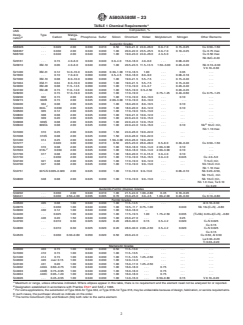
TABLE 1 Chemical Requirements
Composition, %
UNS
Desig- Type
Manga-
B Carbon Phosphorus Sulfur Silicon Chromium Nickel Molybdenum Nitrogen Other Elements
nation
nese
Austenitic Grades
N08926 . . . 0.020 2.00 0.030 0.010 0.50 19.0–21.0 24.0–26.0 6.0–7.0 0.15–0.25 Cu 0.50–1.50
N08367 . . . 0.030 2.00 0.040 0.030 1.00 20.0–22.0 23.5–25.5 6.0–7.0 0.18–0.25 Cu 0.75 max
N08700 . . . 0.040 2.00 0.040 0.030 1.00 19.0–23.0 24.0–26.0 4.3–5.0 . . . Cu 0.50 max
Nb 8xC–0.40
S20161 . . . 0.15 4.0–6.0 0.040 0.040 3.0–4.0 15.0–18.0 4.0–6.0 . . . 0.08–0.20 . . .
S20910 XM-19 0.06 4.0–6.0 0.040 0.030 1.00 20.5–23.5 11.5–13.5 1.50–3.00 0.20–0.40 Nb 0.10–0.30
V 0.10–0.30
S21400 XM-31 0.12 14.0–16.0 0.045 0.030 0.30–1.00 17.0–18.5 1.00 . . . 0.35 . . .
S21800 . . . 0.10 7.0–9.0 0.060 0.030 3.5–4.5 16.0–18.0 8.0–9.0 . . . 0.08–0.18 . . .
S21900 XM-10 0.08 8.0–10.0 0.060 0.030 1.00 19.0–21.5 5.5–7.5 . . . 0.15–0.40 . . .
S21904 XM-11 0.04 8.0–10.0 0.060 0.030 1.00 19.0–21.5 5.5–7.5 . . . 0.15–0.40 . . .
S24000 XM-29 0.08 11.5–14.5 0.060 0.030 1.00 17.0–19.0 2.3–3.7 . . . 0.20–0.40 . . .
S24100 XM-28 0.15 11.0–14.0 0.040 0.030 1.00 16.5–19.0 0.5–2.50 0.20–0.45
S28200 . . . 0.15 17.0–19.0 0.045 0.030 1.00 17.0–19.0 . . . 0.75–1.25 0.40–0.60 Cu 0.75–1.25
S30200 302 0.15 2.00 0.045 0.030 1.00 17.0–19.0 8.0–10.0 . . . 0.10 . . .
S30215 302B 0.15 2.00 0.045 0.030 2.00–3.00 17.0–19.0 8.0–10.0 . . . . . . . . .
S30400 304 0.08 2.00 0.045 0.030 1.00 18.0–20.0 8.0–10.5 . . . 0.10 . . .
C
S30403 304L 0.030 2.00 0.045 0.030 1.00 18.0–20.0 8.0–12.0 . . . 0.10 . . .
S30500 305 0.12 2.00 0.045 0.030 1.00 17.0–19.0 10.5–13.0 . . . . . . . . .
S30800 308 0.08 2.00 0.045 0.030 1.00 19.0–21.0 10.0–12.0 . . . . . . . . .
S30900 309 0.20 2.00 0.045 0.030 1.00 22.0–24.0 12.0–15.0 . . . . . . . . .
S30908 309S 0.08 2.00 0.045 0.030 1.00 22.0–24.0 12.0–15.0 . . . . . . . . .
D
S30940 309Cb 0.08 2.00 0.045 0.030 1.00 22.0–24.0 12.0–16.0 . . . 0.10 Nb 10×C min,
Nb 1.10 max
S31000 310 0.25 2.00 0.045 0.030 1.50 24.0–26.0 19.0–22.0 . . . . . . . . .
S31008 310S 0.08 2.00 0.045 0.030 1.50 24.0–26.0 19.0–22.0 . . . . . . . . .
S31400 314 0.25 2.00 0.045 0.030 1.50–3.00 23.0–26.0 19.0–22.0
S31277 . . . 0.020 3.00 0.030 0.010 0.50 20.5–23.0 26.0–28.0 6.5–8.0 0.30–0.40 Cu 0.50–1.50
S31600 316 0.08 2.00 0.045 0.030 1.00 16.0–18.0 10.0–14.0 2.00–3.00 0.10 . . .
C
S31603 316L 0.030 2.00 0.045 0.030 1.00 16.0–18.0 10.0–14.0 2.00–3.00 0.10 . . .
S31700 317 0.08 2.00 0.045 0.030 1.00 18.0–20.0 11.0–15.0 3.0–4.0 0.10 . . .
S31730 . . . 0.030 2.00 0.040 0.010 1.00 17.0–19.0 15.0–16.5 3.0–4.0 0.045 Cu 4.0–5.0
S32100 321 0.08 2.00 0.045 0.030 1.00 17.0–19.0 9.0–12.0 . . . . . . Ti 5×C min
S34700 347 0.08 2.00 0.045 0.030 1.00 17.0–19.0 9.0–13.0 . . . . . . Nb 10×C min
Nb 1.10 max
S34751 347LN 0.005–0.020 2.00 0.045 0.030 1.00 17.0–19.0 9.0–13.0 . . . 0.06–0.10 Nb 0.20–0.50,
Nb 15×C, min
S34800 348 0.08 2.00 0.045 0.030 1.00 17.0–19.0 9.0–13.0 . . . . . . Nb 10×C min,
Nb 1.0 max, Ta 0.10
Co 0.20
Austenitic-Ferritic (Duplex) Grades
S32202 . . . 0.030 2.00 0.040 0.010 1.00 21.5–24.0 1.00–2.80 0.45 0.18–0.26 . . .
S82441 . . . 0.030 2.50–4.00 0.035 0.005 0.70 23.0–25.0 3.0–4.5 1.00–2.00 0.20–0.30 Cu 0.10–0.80
Ferritic Grades
S40500 405 0.08 1.00 0.040 0.030 1.00 11.5–14.5 . . . . . . Al 0.10–0.30
S40976 . . . 0.030 1.00 0.040 0.030 1.00 10.5–11.7 0.75–1.00 0.040 Nb 10×(C+N) −0.80
S43000 430 0.12 1.00 0.040 0.030 1.00 16.0–18.0 .
S44400 . . . 0.025 1.00 0.040 0.030 1.00 17.5–19.5 1.00 1.75–2.50 0.035 (Ti+Nb) 0.20+4(C+N) –0.80
S44600 446 0.20 1.50 0.040 0.030 1.00 23.0–27.0 . . . 0.25 . . .
S44700 . . . 0.010 0.30 0.025 0.020 0.20 28.0–30.0 0.15 3.5–4.2 0.020 C+N 0.025
Cu 0.15
S44800 . . . 0.010 0.30 0.025 0.020 0.20 28.0–30.0 2.00–2.50 3.5–4.2 0.020 C+N 0.025
Cu 0.15
S44535 . . . 0.030 0.30–0.80 0.050 0.020 0.50 20.0–24.0 . . . . . . . . . Cu 0.50, Al 0.50
La 0.04–0.20
Ti 0.03–0.20
Martensitic Grades
S40300 403 0.15 1.00
...
This document is not an ASTM standard and is intended only to provide the user of an ASTM standard an indication of what changes have been made to the previous version. Because
it may not be technically possible to adequately depict all changes accurately, ASTM recommends that users consult prior editions as appropriate. In all cases only the current version
of the standard as published by ASTM is to be considered the official document.
Designation: A580/A580M − 18 A580/A580M − 23
Standard Specification for
Stainless Steel Wire
This standard is issued under the fixed designation A580/A580M; the number immediately following the designation indicates the year
of original adoption or, in the case of revision, the year of last revision. A number in parentheses indicates the year of last reapproval.
A superscript epsilon (´) indicates an editorial change since the last revision or reapproval.
This standard has been approved for use by agencies of the U.S. Department of Defense.
1. Scope*
1.1 This specification covers stainless steel wire, except the free-machining types. It includes round, square, octagon, hexagon, and
shape wire in coils only for the more commonly used types of stainless steels for general corrosion resistance and high-temperature
service. For bars in straightened and cut lengths, see Specifications A276 or A479/A479M.
NOTE 1—For free-machining stainless wire, designed especially for optimum machinability, see Specification A581/A581M.
1.2 Unless the order specifies the applicable “M” specification designation, the material shall be furnished to the inch-pound units.
1.3 The values stated in either SI units or inch-pound units are to be regarded separately as standard. The values stated in each
system may not be exact equivalents; therefore, each system shall be used independently of the other. Combining values from the
two systems may result in non-conformance with the standard.
1.4 This international standard was developed in accordance with internationally recognized principles on standardization
established in the Decision on Principles for the Development of International Standards, Guides and Recommendations issued
by the World Trade Organization Technical Barriers to Trade (TBT) Committee.
2. Referenced Documents
2.1 ASTM Standards:
A276 Specification for Stainless Steel Bars and Shapes
A370 Test Methods and Definitions for Mechanical Testing of Steel Products
A479/A479M Specification for Stainless Steel Bars and Shapes for Use in Boilers and Other Pressure Vessels
A555/A555M Specification for General Requirements for Stainless Steel Wire and Wire Rods
A581/A581M Specification for Free-Machining Stainless Steel Wire and Wire Rods
E527 Practice for Numbering Metals and Alloys in the Unified Numbering System (UNS)
2.2 Society of Automotive Engineers Standard:
J 1086 Numbering Metals and Alloys
This specification is under the jurisdiction of ASTM Committee A01 on Steel, Stainless Steel and Related Alloys and is the direct responsibility of Subcommittee A01.17
on Flat-Rolled and Wrought Stainless Steel.
Current edition approved March 1, 2018May 15, 2023. Published March 2018May 2023. Originally approved in 1967. Last previous edition approved in 20162018 as
A580/A580M – 16.A580/A580M – 18. DOI: 10.1520/A0580_A0580M-18.10.1520/A0580_A0580M-23.
For referenced ASTM standards, visit the ASTM website, www.astm.org, or contact ASTM Customer Service at service@astm.org. For Annual Book of ASTM Standards
volume information, refer to the standard’s Document Summary page on the ASTM website.
Available from Society of Automotive Engineers (SAE), 400 Commonwealth Dr., Warrendale, PA 15096-0001, http://www.sae.org.
*A Summary of Changes section appears at the end of this standard
Copyright © ASTM International, 100 Barr Harbor Drive, PO Box C700, West Conshohocken, PA 19428-2959. United States
A580/A580M − 23
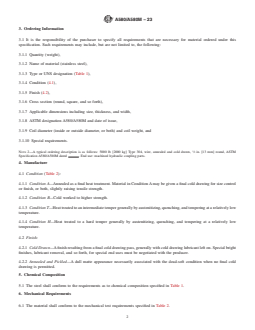
3. Ordering Information
3.1 It is the responsibility of the purchaser to specify all requirements that are necessary for material ordered under this
specification. Such requirements may include, but are not limited to, the following:
3.1.1 Quantity (weight),
3.1.2 Name of material (stainless steel),
3.1.3 Type or UNS designation (Table 1),
3.1.4 Condition (4.1),
3.1.5 Finish (4.2),
3.1.6 Cross section (round, square, and so forth),
3.1.7 Applicable dimensions including size, thickness, and width,
3.1.8 ASTM designation A580/A580M and date of issue,
3.1.9 Coil diameter (inside or outside diameter, or both) and coil weight, and
3.1.10 Special requirements.
NOTE 2—A typical ordering description is as follows: 5000 lb [2000 kg] Type 304, wire, annealed and cold drawn, ⁄2 in. [13 mm] round, ASTM
Specification A580/A580M dated . End use: machined hydraulic coupling parts.
4. Manufacture
4.1 Condition (Table 2):
4.1.1 Condition A—Annealed as a final heat treatment. Material in Condition A may be given a final cold drawing for size control
or finish, or both, slightly raising tensile strength.
4.1.2 Condition B—Cold worked to higher strength.
4.1.3 Condition T—Heat treated to an intermediate temper generally by austenitizing, quenching, and tempering at a relatively low
temperature.
4.1.4 Condition H—Heat treated to a hard temper generally by austenitizing, quenching, and tempering at a relatively low
temperature.
4.2 Finish:
4.2.1 Cold Drawn—A finish resulting from a final cold drawing pass, generally with cold drawing lubricant left on. Special bright
finishes, lubricant removal, and so forth, for special end uses must be negotiated with the producer.
4.2.2 Annealed and Pickled—A dull matte appearance necessarily associated with the dead-soft condition when no final cold
drawing is permitted.
5. Chemical Composition
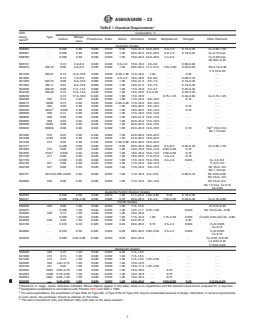
5.1 The steel shall conform to the requirements as to chemical composition specified in Table 1.
6. Mechanical Requirements
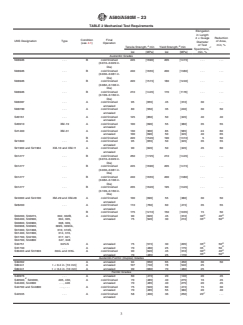
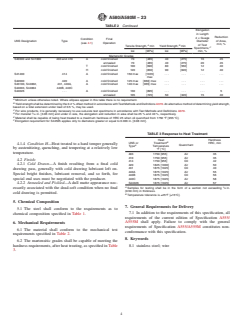
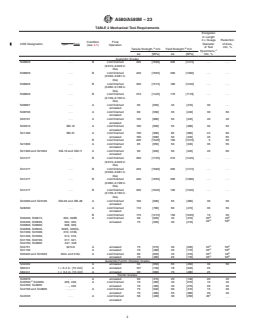
6.1 The material shall conform to the mechanical test requirements specified in Table 2.
A580/A580M − 23
A
TABLE 1 Chemical Requirements
Composition, %
UNS
Desig- Type
Manga-
B Carbon Phosphorus Sulfur Silicon Chromium Nickel Molybdenum Nitrogen Other Elements
nation
nese
Austenitic Grades
N08926 . . . 0.020 2.00 0.030 0.010 0.50 19.0–21.0 24.0–26.0 6.0–7.0 0.15–0.25 Cu 0.50–1.50
N08367 . . . 0.030 2.00 0.040 0.030 1.00 20.0–22.0 23.5–25.5 6.0–7.0 0.18–0.25 Cu 0.75 max
N08700 . . . 0.040 2.00 0.040 0.030 1.00 19.0–23.0 24.0–26.0 4.3–5.0 . . . Cu 0.50 max
Nb 8xC–0.40
S20161 . . . 0.15 4.0–6.0 0.040 0.040 3.0–4.0 15.0–18.0 4.0–6.0 . . . 0.08–0.20 . . .
S20910 XM-19 0.06 4.0–6.0 0.040 0.030 1.00 20.5–23.5 11.5–13.5 1.50–3.00 0.20–0.40 Nb 0.10–0.30
V 0.10–0.30
S21400 XM-31 0.12 14.0–16.0 0.045 0.030 0.30–1.00 17.0–18.5 1.00 . . . 0.35 . . .
S21800 . . . 0.10 7.0–9.0 0.060 0.030 3.5–4.5 16.0–18.0 8.0–9.0 . . . 0.08–0.18 . . .
S21900 XM-10 0.08 8.0–10.0 0.060 0.030 1.00 19.0–21.5 5.5–7.5 . . . 0.15–0.40 . . .
S21904 XM-11 0.04 8.0–10.0 0.060 0.030 1.00 19.0–21.5 5.5–7.5 . . . 0.15–0.40 . . .
S24000 XM-29 0.08 11.5–14.5 0.060 0.030 1.00 17.0–19.0 2.3–3.7 . . . 0.20–0.40 . . .
S24100 XM-28 0.15 11.0–14.0 0.040 0.030 1.00 16.5–19.0 0.5–2.50 0.20–0.45
S28200 . . . 0.15 17.0–19.0 0.045 0.030 1.00 17.0–19.0 . . . 0.75–1.25 0.40–0.60 Cu 0.75–1.25
S30200 302 0.15 2.00 0.045 0.030 1.00 17.0–19.0 8.0–10.0 . . . 0.10 . . .
S30215 302B 0.15 2.00 0.045 0.030 2.00–3.00 17.0–19.0 8.0–10.0 . . . . . . . . .
S30400 304 0.08 2.00 0.045 0.030 1.00 18.0–20.0 8.0–10.5 . . . 0.10 . . .
C
S30403 304L 0.030 2.00 0.045 0.030 1.00 18.0–20.0 8.0–12.0 . . . 0.10 . . .
S30500 305 0.12 2.00 0.045 0.030 1.00 17.0–19.0 10.5–13.0 . . . . . . . . .
S30800 308 0.08 2.00 0.045 0.030 1.00 19.0–21.0 10.0–12.0 . . . . . . . . .
S30900 309 0.20 2.00 0.045 0.030 1.00 22.0–24.0 12.0–15.0 . . . . . . . . .
S30908 309S 0.08 2.00 0.045 0.030 1.00 22.0–24.0 12.0–15.0 . . . . . . . . .
D
S30940 309Cb 0.08 2.00 0.045 0.030 1.00 22.0–24.0 12.0–16.0 . . . 0.10 Nb 10×C min,
Nb 1.10 max
S31000 310 0.25 2.00 0.045 0.030 1.50 24.0–26.0 19.0–22.0 . . . . . . . . .
S31008 310S 0.08 2.00 0.045 0.030 1.50 24.0–26.0 19.0–22.0 . . . . . . . . .
S31400 314 0.25 2.00 0.045 0.030 1.50–3.00 23.0–26.0 19.0–22.0
S31277 . . . 0.020 3.00 0.030 0.010 0.50 20.5–23.0 26.0–28.0 6.5–8.0 0.30–0.40 Cu 0.50–1.50
S31600 316 0.08 2.00 0.045 0.030 1.00 16.0–18.0 10.0–14.0 2.00–3.00 0.10 . . .
C
S31603 316L 0.030 2.00 0.045 0.030 1.00 16.0–18.0 10.0–14.0 2.00–3.00 0.10 . . .
S31700 317 0.08 2.00 0.045 0.030 1.00 18.0–20.0 11.0–15.0 3.0–4.0 0.10 . . .
S31730 . . . 0.030 2.00 0.040 0.010 1.00 17.0–19.0 15.0–16.5 3.0–4.0 0.045 Cu 4.0–5.0
S32100 321 0.08 2.00 0.045 0.030 1.00 17.0–19.0 9.0–12.0 . . . . . . Ti 5×C min
S34700 347 0.08 2.00 0.045 0.030 1.00 17.0–19.0 9.0–13.0 . . . . . . Nb 10×C min
Nb 1.10 max
S34751 347LN 0.005–0.020 2.00 0.045 0.030 1.00 17.0–19.0 9.0–13.0 . . . 0.06–0.10 Nb 0.20–0.50,
Nb 15×C, min
S34800 348 0.08 2.00 0.045 0.030 1.00 17.0–19.0 9.0–13.0 . . . . . . Nb 10×C min,
Nb 1.0 max, Ta 0.10
Co 0.20
Austenitic-Ferritic (Duplex) Grades
S32202 . . . 0.030 2.00 0.040 0.010 1.00 21.5–24.0 1.00–2.80 0.45 0.18–0.26 . . .
S82441 . . . 0.030 2.50–4.00 0.035 0.005 0.70 23.0–25.0 3.0–4.5 1.00–2.00 0.20–0.30 Cu 0.10–0.80
Ferritic Grades
S40500 405 0.08 1.00 0.040 0.030 1.00 11.5–14.5 . . . . . . Al 0.10–0.30
S40976 . . . 0.030 1.00 0.040 0.030 1.00 10.5–11.7 0.75–1.00 0.040 Nb 10×(C+N) −0.80
S43000 430 0.12 1.00 0.040 0.030 1.00 16.0–18.0 .
S44400 . . . 0.025 1.00 0.04
...