

ASTM A1096/A1096M-22
(Test Method)Standard Test Method for Evaluating Bond of Individual Steel Wire, Indented or Plain, for Concrete Reinforcement
General Information
- Abstract
SIGNIFICANCE AND USE
5.1 Steel wire for concrete reinforcement is used in various applications wherein the wire is expected to transfer passive or prestressing forces to the structural member via the bond of the exposed wire surfaces to the surrounding concrete.
5.2 Wire manufacturing processes, subsequent handling, and storage conditions can influence the wire bond.
5.3 Steel wire for concrete reinforcement is used in construction applications with a variety of concrete mixtures. Developing test methods and threshold values for the performance of the wire in each of these unique mixtures is impractical.
SCOPE
1.1 This test method describes procedures for evaluating bond of individual steel wire, indented or plain, for concrete reinforcement. The bond determined by this test method is stated as the tensile force needed to pull the wire through the cured mortar in a cylindrical steel casing.
1.2 The result of the test is the maximum tensile force measured on the loaded end of the wire recorded at a free-end slip less than or equal to 0.10 in. [2.5 mm].
1.3 Units—The values stated in either inch-pound units or SI units are to be regarded separately as standard. Within the text, the SI units are shown in brackets. The values stated in each system may not be exact equivalents; therefore, each system shall be used independently of the other. Combining values from the two systems may result in non-conformance with the standard.
1.4 This standard does not purport to address all of the safety concerns, if any, associated with its use. It is the responsibility of the user of this standard to establish appropriate safety, health, and environmental practices and determine the applicability of regulatory limitations prior to use.
1.5 This international standard was developed in accordance with internationally recognized principles on standardization established in the Decision on Principles for the Development of International Standards, Guides and Recommendations issued by the World Trade Organization Technical Barriers to Trade (TBT) Committee.
- Status
- Published
- Publication Date
- 30-Jun-2022
- Technical Committee
- A01 - Steel, Stainless Steel and Related Alloys
- Drafting Committee
- A01.05 - Steel Reinforcement
Buy Documents
ASTM A1096/A1096M-22 - Standard Test Method for Evaluating Bond of Individual Steel Wire, Indented or Plain, for Concrete Reinforcement
REDLINE ASTM A1096/A1096M-22 - Standard Test Method for Evaluating Bond of Individual Steel Wire, Indented or Plain, for Concrete Reinforcement
Overview
ASTM A1096/A1096M-22: Standard Test Method for Evaluating Bond of Individual Steel Wire, Indented or Plain, for Concrete Reinforcement provides a systematic procedure for determining the bond strength of steel wire used as concrete reinforcement. This standard is essential for ensuring that steel wire, whether indented or plain, can effectively transfer passive or prestressing forces to concrete structures through adequate bonding.
Steel wire reinforcement is widely used in structural construction, including prestressed and non-prestressed concrete applications. The reliability of force transfer from wire reinforcement to concrete depends largely on the bond performance, which can be influenced by the wire's manufacturing processes, surface geometry, and storage conditions.
Key Topics
- Test Methodology: Specifies the process for assessing the bond strength of individual steel wires. The test measures the maximum tensile force required to pull a wire through cured mortar contained in a cylindrical steel casing.
- Result Recording: The outcome is defined as the maximum force sustained by the wire at a free-end slip of 0.10 in. [2.5 mm] or less.
- Sample Preparation: Illustrates procedures for making mortar mixtures, wire sampling, and specimen assembly, including strict requirements for materials and specimen curing to ensure repeatable results.
- Units and Reporting: Outlines that results can be stated in either inch-pound or SI units, which must be used separately to avoid non-conformance.
- Precision and Bias: Highlights that while the test method provides conformance verification, statistical measures of precision and bias are not established due to the inherent variability of specimen preparation and material properties.
- Safety and Compliance: Emphasizes the user's responsibility to adhere to appropriate safety, health, and environmental practices when applying this standard.
Applications
- Quality Control in Manufacturing: Used by steel wire manufacturers and concrete product producers to verify the bond characteristics of reinforcement wire, ensuring that products meet industry standards before use in construction.
- Construction and Civil Engineering: Critical for structural engineers and contractors to confirm that reinforcement wire provides adequate bond strength, which is fundamental to the integrity and durability of reinforced and prestressed concrete members.
- Research and Development: Valuable in the assessment and optimization of new steel wire designs or coatings intended to enhance bond performance with various concrete mixtures.
- Regulatory and Compliance Testing: Supports compliance with local, national, and international building codes that require objective evidence of reinforcement bond performance.
Related Standards
- ASTM A421/A421M - Specification for Stress-Relieved Steel Wire for Prestressed Concrete
- ASTM A881/A881M - Specification for Indented, Low-Relaxation Steel Wire for Prestressed Concrete
- ASTM C109/C109M - Test Method for Compressive Strength of Hydraulic Cement Mortars
- ASTM C150/C150M - Specification for Portland Cement
- ASTM C192/C192M - Practice for Making and Curing Concrete Test Specimens in the Laboratory
- ASTM C511 - Specification for Mixing Rooms, Moist Cabinets, and Water Storage Tanks Used in Cement and Concrete Testing
- ASTM C778 - Specification for Standard Sand
Practical Value
ASTM A1096/A1096M-22 ensures that steel wire used in concrete reinforcement meets necessary bond performance criteria for safe, durable construction. By providing a repeatable standard test method, it assists stakeholders-including manufacturers, engineers, and regulatory bodies-in evaluating and documenting compliance, supporting robust structural design and construction quality. The standard is regularly updated in line with international standardization best practices and should be referenced whenever evaluating the bond strength of individual reinforcing wires in concrete applications.
Relations
- Effective Date
- 15-Dec-2023
- Effective Date
- 01-Apr-2019
- Effective Date
- 15-Mar-2016
- Effective Date
- 01-Mar-2016
- Effective Date
- 01-Feb-2016
- Effective Date
- 01-Nov-2015
- Effective Date
- 01-Jul-2015
- Effective Date
- 01-Aug-2014
- Effective Date
- 01-Dec-2013
- Effective Date
- 01-Jun-2013
- Effective Date
- 15-Dec-2012
- Effective Date
- 01-Dec-2012
- Effective Date
- 01-May-2012
- Effective Date
- 15-Apr-2012
- Effective Date
- 01-Oct-2011
Buy Documents
ASTM A1096/A1096M-22 - Standard Test Method for Evaluating Bond of Individual Steel Wire, Indented or Plain, for Concrete Reinforcement
REDLINE ASTM A1096/A1096M-22 - Standard Test Method for Evaluating Bond of Individual Steel Wire, Indented or Plain, for Concrete Reinforcement
Get Certified
Connect with accredited certification bodies for this standard

Element Materials Technology
Materials testing and product certification.

Inštitut za kovinske materiale in tehnologije
Institute of Metals and Technology. Materials testing, metallurgical analysis, NDT.
Sponsored listings
Frequently Asked Questions
ASTM A1096/A1096M-22 is a standard published by ASTM International. Its full title is "Standard Test Method for Evaluating Bond of Individual Steel Wire, Indented or Plain, for Concrete Reinforcement". This standard covers: SIGNIFICANCE AND USE 5.1 Steel wire for concrete reinforcement is used in various applications wherein the wire is expected to transfer passive or prestressing forces to the structural member via the bond of the exposed wire surfaces to the surrounding concrete. 5.2 Wire manufacturing processes, subsequent handling, and storage conditions can influence the wire bond. 5.3 Steel wire for concrete reinforcement is used in construction applications with a variety of concrete mixtures. Developing test methods and threshold values for the performance of the wire in each of these unique mixtures is impractical. SCOPE 1.1 This test method describes procedures for evaluating bond of individual steel wire, indented or plain, for concrete reinforcement. The bond determined by this test method is stated as the tensile force needed to pull the wire through the cured mortar in a cylindrical steel casing. 1.2 The result of the test is the maximum tensile force measured on the loaded end of the wire recorded at a free-end slip less than or equal to 0.10 in. [2.5 mm]. 1.3 Units—The values stated in either inch-pound units or SI units are to be regarded separately as standard. Within the text, the SI units are shown in brackets. The values stated in each system may not be exact equivalents; therefore, each system shall be used independently of the other. Combining values from the two systems may result in non-conformance with the standard. 1.4 This standard does not purport to address all of the safety concerns, if any, associated with its use. It is the responsibility of the user of this standard to establish appropriate safety, health, and environmental practices and determine the applicability of regulatory limitations prior to use. 1.5 This international standard was developed in accordance with internationally recognized principles on standardization established in the Decision on Principles for the Development of International Standards, Guides and Recommendations issued by the World Trade Organization Technical Barriers to Trade (TBT) Committee.
SIGNIFICANCE AND USE 5.1 Steel wire for concrete reinforcement is used in various applications wherein the wire is expected to transfer passive or prestressing forces to the structural member via the bond of the exposed wire surfaces to the surrounding concrete. 5.2 Wire manufacturing processes, subsequent handling, and storage conditions can influence the wire bond. 5.3 Steel wire for concrete reinforcement is used in construction applications with a variety of concrete mixtures. Developing test methods and threshold values for the performance of the wire in each of these unique mixtures is impractical. SCOPE 1.1 This test method describes procedures for evaluating bond of individual steel wire, indented or plain, for concrete reinforcement. The bond determined by this test method is stated as the tensile force needed to pull the wire through the cured mortar in a cylindrical steel casing. 1.2 The result of the test is the maximum tensile force measured on the loaded end of the wire recorded at a free-end slip less than or equal to 0.10 in. [2.5 mm]. 1.3 Units—The values stated in either inch-pound units or SI units are to be regarded separately as standard. Within the text, the SI units are shown in brackets. The values stated in each system may not be exact equivalents; therefore, each system shall be used independently of the other. Combining values from the two systems may result in non-conformance with the standard. 1.4 This standard does not purport to address all of the safety concerns, if any, associated with its use. It is the responsibility of the user of this standard to establish appropriate safety, health, and environmental practices and determine the applicability of regulatory limitations prior to use. 1.5 This international standard was developed in accordance with internationally recognized principles on standardization established in the Decision on Principles for the Development of International Standards, Guides and Recommendations issued by the World Trade Organization Technical Barriers to Trade (TBT) Committee.
ASTM A1096/A1096M-22 is classified under the following ICS (International Classification for Standards) categories: 77.140.65 - Steel wire, wire ropes and link chains. The ICS classification helps identify the subject area and facilitates finding related standards.
ASTM A1096/A1096M-22 has the following relationships with other standards: It is inter standard links to ASTM C109/C109M-23, ASTM C150/C150M-19, ASTM C150/C150M-16, ASTM A881/A881M-16, ASTM C192/C192M-16, ASTM A881/A881M-15, ASTM C150/C150M-15, ASTM C192/C192M-14, ASTM C511-13, ASTM C778-13, ASTM C109/C109M-12, ASTM C192/C192M-12a, ASTM C778-12, ASTM C150/C150M-12, ASTM C109/C109M-11a. Understanding these relationships helps ensure you are using the most current and applicable version of the standard.
ASTM A1096/A1096M-22 is available in PDF format for immediate download after purchase. The document can be added to your cart and obtained through the secure checkout process. Digital delivery ensures instant access to the complete standard document.
Standards Content (Sample)
This international standard was developed in accordance with internationally recognized principles on standardization established in the Decision on Principles for the
Development of International Standards, Guides and Recommendations issued by the World Trade Organization Technical Barriers to Trade (TBT) Committee.
Designation: A1096/A1096M − 22
Standard Test Method for
Evaluating Bond of Individual Steel Wire, Indented or Plain,
for Concrete Reinforcement
This standard is issued under the fixed designation A1096/A1096M; the number immediately following the designation indicates the
year of original adoption or, in the case of revision, the year of last revision. A number in parentheses indicates the year of last
reapproval. A superscript epsilon (´) indicates an editorial change since the last revision or reapproval.
1. Scope* A881/A881MSpecification for Steel Wire, Indented, Low-
Relaxation for Prestressed Concrete
1.1 This test method describes procedures for evaluating
C109/C109MTest Method for Compressive Strength of
bond of individual steel wire, indented or plain, for concrete
Hydraulic Cement Mortars (Using 2-in. or [50 mm] Cube
reinforcement. The bond determined by this test method is
Specimens)
stated as the tensile force needed to pull the wire through the
C150/C150MSpecification for Portland Cement
cured mortar in a cylindrical steel casing.
C192/C192MPractice for Making and Curing ConcreteTest
1.2 The result of the test is the maximum tensile force
Specimens in the Laboratory
measured on the loaded end of the wire recorded at a free-end
C511Specification for Mixing Rooms, Moist Cabinets,
slip less than or equal to 0.10 in. [2.5 mm].
Moist Rooms, and Water Storage Tanks Used in the
1.3 Units—The values stated in either inch-pound units or Testing of Hydraulic Cements and Concretes
C778Specification for Standard Sand
SI units are to be regarded separately as standard. Within the
text, the SI units are shown in brackets. The values stated in
3. Terminology
each system may not be exact equivalents; therefore, each
system shall be used independently of the other. Combining
3.1 Definitions:
values from the two systems may result in non-conformance
3.1.1 bond, n—longitudinal components of adhesion,
with the standard.
friction, and mechanical interlock between wire and mortar or
concrete.
1.4 This standard does not purport to address all of the
safety concerns, if any, associated with its use. It is the
3.1.2 bond breaker, n—product wrapped around wire to
responsibility of the user of this standard to establish appro-
prevent wire-to-mortar bond over a certain length.
priate safety, health, and environmental practices and deter-
3.1.2.1 Discussion—Duct tape is commonly used for this
mine the applicability of regulatory limitations prior to use.
purpose.
1.5 This international standard was developed in accor-
3.1.3 mortar, n—mixture of cement, fine aggregate, and
dance with internationally recognized principles on standard-
water.
ization established in the Decision on Principles for the
3.1.4 test specimen, n—assembly consisting of one steel
Development of International Standards, Guides and Recom-
casing, one sample of wire, and mortar.
mendations issued by the World Trade Organization Technical
Barriers to Trade (TBT) Committee.
4. Summary of Test Method
2. Referenced Documents
4.1 Six samples of 0.2 – 0.3 in. [5 – 8 mm] diameter (see
Note 1) steel wire are selected from a single continuous length
2.1 ASTM Standards:
for testing. Each wire sample is cast into a steel casing with a
A421/A421MSpecification for Stress-Relieved Steel Wire
bonded length of 6 in. [150 mm].
for Prestressed Concrete
4.2 Amortarmixture,includingthefineaggregatesource,is
prescribed, but the cement source is not.
This test method is under the jurisdiction of ASTM Committee A01 on Steel,
Stainless Steel and RelatedAlloys and is the direct responsibility of Subcommittee
4.3 Testing of the six specimens begins shortly after the
A01.05 on Steel Reinforcement.
mortar-cubecompressivestrengthreaches4500psi[31.0MPa]
CurrenteditionapprovedJuly1,2022.PublishedJuly2022.Originallyapproved
and ends before the strength reaches 5000 psi [34.5 MPa]. A
in 2015. Last previous edition approved in 2015 as A1096/A1096M–15. DOI:
10.1520/A1096_A1096M-22.
specified, force-controlled loading rate is applied at the bottom
For referenced ASTM standards, visit the ASTM website, www.astm.org, or
of the wire while the applied load and free-end slip at the
contact ASTM Customer Service at service@astm.org. For Annual Book of ASTM
opposite (top) end is continuously monitored and recorded.
Standards volume information, refer to the standard’s Document Summary page on
the ASTM website. The maximum pullout force occurring at an end slip less than
*A Summary of Changes section appears at the end of this standard
Copyright © ASTM International, 100 Barr Harbor Drive, PO Box C700, West Conshohocken, PA 19428-2959. United States
A1096/A1096M − 22
or equal to 0.10 in. [2.5 mm] is recorded as the “test result.” 8.1.5 Aggregates—No aggregates other than sand as speci-
One complete test is comprised of the average of these six fied in 8.1.1 shall be used.
specimens.
8.2 Mixing Procedure—The mixing procedure shall con-
form to Practice C192/C192M except no coarse aggregates or
NOTE 1—This test method was developed specifically to correlate
pullout values with transfer lengths for 0.208 in. [5.28 mm] diameter steel
admixtures are allowed.
wire conforming to Specification A881/A881M for prestressed concrete
8.3 Strength—Mortar strength shall be evaluated according
railroad ties but may be modified or adapted to accommodate smaller or
to Test Method C109/C109M using 2 in. [50 mm] mortar
larger wire sizes and in prestressing or other non-prestressed concrete
reinforcement applications. cubes. Brass molds shall be used. Testing of the pullout
specimens should begin as soon as practical after the 2 in. [50
5. Significance and Use
mm] mortar cube compressive strength reaches 4500 psi [31.0
MPa]. This mortar strength is defined as the average compres-
5.1 Steel wire for concrete reinforcement is used in various
sive strength of at least two individual 2 in. [50 mm] mortar
applications wherein the wire is expected to transfer passive or
cubes. If the mortar strength exceeds 5000 psi [34.5 MPa]
prestressingforcestothestructuralmemberviathebondofthe
before the end of the test, then the test shall be considered
exposed wire surfaces to the surrounding concrete.
invalid and shall be repeated.
5.2 Wire manufacturing processes, subsequent handling,
NOTE3—PracticeC192/C192Misdescribedasastandardpracticetobe
and storage conditions can influence the wire bond.
used for concrete test specimens.As outlined in 8.1, only fine aggregates
5.3 Steel wire for concrete reinforcement is used in con-
(that is, sand) are included in the mixture along with cement and water.
struction applications with a variety of concrete mixtures. Because coarse aggregates are not included, this mixture is defined as
“mortar” and not “concrete.” Aside from this difference and a few other
Developing test methods and threshold values for the perfor-
exceptions noted in Section 8, the practices documented in Practice
mance of the wire in each of these unique mixtures is
C192/C192M are to be applied when making the mortar used in this test
impractical.
method.
8.4 Mixture Proportions:
6. Apparatus
8.4.1 The mixture proportions and batch weights listed in
6.1 A position transducer having a minimum precision of
Table 1 shall be used (Note 4).
0.001 in. [0.025 mm] is used.
NOTE 4—In Table 1, a mortar with a water-to-cement ratio (w/c) of
6.2 A tensile testing machine is used with the following
0.425 and an oven-dry sand-to-cement (s/c) ratio of 2.0 is shown.
functionality:
9. Preparation of Test Specimens
6.2.1 Force-controlled loading rate;
9.1 Materials:
6.2.2 Gripping Device without Torsional Restraint—This
9.1.1 Wire Samples—Requirements as defined in Section 7.
may be accomplished by providing a thrust bearing to allow
9.1.2 Mortar—Requirements as defined in Section 8.
rotation; other similar methods may be used (see Note 2).
9.1.3 Bottom Bond Breaker—A 1.0-in. [25-mm] wide 6
6.2.3 Rigid Testing Frame—An example of the frame used
0.125-in. [3.0-mm] strip of woven cloth adhesive tape (duct
for conducting the test is shown in Fig. 1. Other similar test
tape) shall be used as a bottom bond breaker. The length of
frame setups may be used.
bond breaker should not be less than 5 in. [130 mm] before
NOTE2—Thistestmethodwasdevelopedwithouttorsionalrestraint.In
application. Wrap the bond breaker around the wire snugly.
the case of some particular wire geometries (for instance, helical-
9.1.4 Top Bond Breaker—Use a 2.0-in. [50-mm] wide 6
deformed wire), wire behavior during test method development indicated
0.125-in.[3.0-mm]stripofwovenadhesivecloth(ducttape)as
a tendency for the frame to rotate.
a top bond breaker. The length of bond breaker should not be
7. Wire Sampling less than 3.0 in. [75 mm] before application. Wrap the bond
breaker around the wire snugly. The top bond breaker extends
7.1 The wire shall conform to Specifications A421/A421M
below the top mortar surface
...
This document is not an ASTM standard and is intended only to provide the user of an ASTM standard an indication of what changes have been made to the previous version. Because
it may not be technically possible to adequately depict all changes accurately, ASTM recommends that users consult prior editions as appropriate. In all cases only the current version
of the standard as published by ASTM is to be considered the official document.
Designation: A1096/A1096M − 15 A1096/A1096M − 22
Standard Test Method for
Evaluating Bond of Individual Steel Wire, Indented or Plain,
for Concrete Reinforcement
This standard is issued under the fixed designation A1096/A1096M; the number immediately following the designation indicates the
year of original adoption or, in the case of revision, the year of last revision. A number in parentheses indicates the year of last
reapproval. A superscript epsilon (´) indicates an editorial change since the last revision or reapproval.
1. Scope Scope*
1.1 This test method describes procedures for evaluating bond of individual steel wire, indented or plain, for concrete
reinforcement. The bond determined by this test method is stated as the tensile force needed to pull the wire through the cured
mortar in a cylindrical steel casing.
1.2 The result of the test is the maximum tensile force measured on the loaded end of the wire recorded at a free-end slip less than
or equal to 0.10 in. [2.5 mm].
1.3 Units—The values stated in either inch-pound units or SI units are to be regarded separately as standard. Within the text, the
SI units are shown in brackets. The values stated in each system may not be exact equivalents; therefore, each system shall be used
independently of the other. Combining values from the two systems may result in non-conformance with the standard.
1.4 This standard does not purport to address all of the safety concerns, if any, associated with its use. It is the responsibility
of the user of this standard to establish appropriate safety, health, and environmental practices and determine the applicability of
regulatory limitations prior to use.
1.5 This international standard was developed in accordance with internationally recognized principles on standardization
established in the Decision on Principles for the Development of International Standards, Guides and Recommendations issued
by the World Trade Organization Technical Barriers to Trade (TBT) Committee.
2. Referenced Documents
2.1 ASTM Standards:
A421/A421M Specification for Stress-Relieved Steel Wire for Prestressed Concrete
A881/A881M Specification for Steel Wire, Indented, Low-Relaxation for Prestressed Concrete
C109/C109M Test Method for Compressive Strength of Hydraulic Cement Mortars (Using 2-in. or [50 mm] Cube Specimens)
C150/C150M Specification for Portland Cement
C192/C192M Practice for Making and Curing Concrete Test Specimens in the Laboratory
C511 Specification for Mixing Rooms, Moist Cabinets, Moist Rooms, and Water Storage Tanks Used in the Testing of Hydraulic
Cements and Concretes
C778 Specification for Standard Sand
This test method is under the jurisdiction of ASTM Committee A01 on Steel, Stainless Steel and Related Alloys and is the direct responsibility of Subcommittee A01.05
on Steel Reinforcement.
Current edition approved Dec. 1, 2015July 1, 2022. Published January 2016July 2022. Originally approved in 2015. Last previous edition approved in 2015 as
A1096/A1096M – 15. DOI: 10.1520/A1096_A1096M-15.10.1520/A1096_A1096M-22.
For referenced ASTM standards, visit the ASTM website, www.astm.org, or contact ASTM Customer Service at service@astm.org. For Annual Book of ASTM Standards
volume information, refer to the standard’s Document Summary page on the ASTM website.
*A Summary of Changes section appears at the end of this standard
Copyright © ASTM International, 100 Barr Harbor Drive, PO Box C700, West Conshohocken, PA 19428-2959. United States
A1096/A1096M − 22
3. Terminology
3.1 Definitions:
3.1.1 bond, n—longitudinal components of adhesion, friction, and mechanical interlock between wire and mortar or concrete.
3.1.2 bond breaker, n—product wrapped around wire to prevent wire-to-mortar bond over a certain length.
3.1.2.1 Discussion—
Duct tape is commonly used for this purpose.
3.1.3 mortar, n—mixture of cement, fine aggregate, and water.
3.1.4 test specimen, n—assembly consisting of one steel casing, one sample of wire, and mortar.
4. Summary of Test Method
4.1 Six samples of 0.2 – 0.3 in. [5 – 8 mm] diameter (see Note 1) steel wire are selected from a single continuous length for testing.
Each wire sample is cast into a steel casing with a bonded length of 6 in. [150 mm].
4.2 A mortar mixture, including the fine aggregate source, is prescribed, but the cement source is not.
4.3 Testing of the six specimens begins shortly after the mortar-cube compressive strength reaches 4500 psi [31.0 MPa] and ends
before the strength reaches 5000 psi [34.5 MPa]. A specified, force-controlled loading rate is applied at the bottom of the wire while
the applied load and free-end slip at the opposite (top) end is continuously monitored and recorded. The maximum pullout force
occurring at an end slip less than or equal to 0.10 in. [2.5 mm] is recorded as the “test result.” One complete test is comprised of
the average of these six specimens.
NOTE 1—This test method was developed specifically to correlate pullout values with transfer lengths for 0.208 in. [5.28 mm] diameter steel wire
conforming to Specification A881/A881M for prestressed concrete railroad ties but may be modified or adapted to accommodate smaller or larger wire
sizes and in prestressing or other non-prestressed concrete reinforcement applications.
5. Significance and Use
5.1 Steel wire for concrete reinforcement is used in various applications wherein the wire is expected to transfer passive or
prestressing forces to the structural member via the bond of the exposed wire surfaces to the surrounding concrete.
5.2 Wire manufacturing processes, subsequent handling, and storage conditions can influence the wire bond.
5.3 Steel wire for concrete reinforcement is used in construction applications with a variety of concrete mixtures. Developing test
methods and threshold values for the performance of the wire in each of these unique mixtures is impractical.
6. Apparatus
6.1 A position transducer having a minimum precision of 0.001 in. [0.025 mm] is used.
6.2 A tensile testing machine is used with the following functionality:
6.2.1 Force-controlled loading rate;
6.2.2 Gripping Device without Torsional Restraint—This may be accomplished by providing a thrust bearing to allow rotation;
other similar methods may be used (see Note 2).
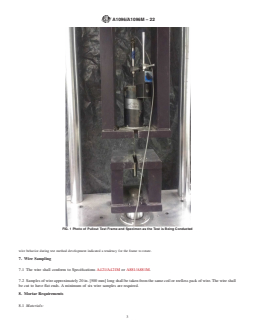
6.2.3 Rigid Testing Frame—An example of the frame used for conducting the test is shown in Fig. 1. Other similar test frame
setups may be used.
NOTE 2—This test method was developed without torsional restraint. In the case of some particular wire geometries (for instance, helical-deformed wire),
A1096/A1096M − 22
FIG. 1 Photo of Pullout Test Frame and Specimen as the Test is Being Conducted
wire behavior during test method development indicated a tendency for the frame to rotate.
7. Wire Sampling
7.1 The wire shall conform to Specifications A421/A421M or A881/A881M.
7.2 Samples of wire approximately 20 in. [500 mm] long shall be taken from the same coil or reelless pack of wire. The wire shall
be cut to have flat ends. A minimum of six wire samples are required.
8. Mortar Requirements
8.1 Materials:
A1096/A1096M − 22
8.1.1 Sand—The sand shall be silica sand from the Ottawa, Illinois region and shall be Graded Sand conforming to Specification
C778.
8.1.2 Cement—The cement shall conform to Specification C150/C150M requirements for Type III cement.
8.1.3 Water—The water shall be potable.
8.1.4 Admixtures—Admixtures shall not be used.
8.1.5 Aggregates—No aggregates other than sand as specified in 8.1.1 shall be used.
8.2 Mixing Procedure—The mixing procedure shall conform to Practice C192/C192M except no coarse aggregates or admixtures
are allowed.
8.3 Strength—Mortar strength shall be evaluated according to Test Method C109/C109M using 2 in. [50 mm] mortar cubes. Brass
molds shall be used. Testing of the pullout specimens should begin as soon as practical after the 2 in. [50 mm] mortar cube
compressive strength reaches 4500 psi [31.0 MPa]. This mortar strength is defined as the average compressive strength of at least
two individual 2 in. [50 mm] mortar cubes. If the mortar strength exceeds 5000 psi [34.5 MPa] before the end of the test, then
the test shall be considered invalid and shall be repeated.
NOTE 3—Practice C192/C192M is described as a standard practice to be used for concrete test specimens. As outlined in 8.1, only fine aggregates (that
is, sand) are included in the mixture along with cement and water. Because coarse aggregates are not included, this mixture is defined as “mortar” and
not “concrete.” Aside from this difference and a few other exceptions noted in Section 8, the practices documented in Practice C192/C192M are to be
applied when making the mortar used in this test method.
8.4 Mixture Proportions:
8.4.1 The mixture proportions and batch weights listed in Table 1 shall be used (Note 4).
NOTE 4—In Table 1, a mortar with a water-to-cement ratio (w/c) of 0.425 and an oven-dry sand-to-cement (s/c) ratio of 2.0 is shown.
9. Preparation of Test Specimens
9.1 Materials:
9.1.1 Wire Samples—Requirements as defined in Section 7.
9.1.2 Mortar—Requirements as defined in Section 8.
9.1.3 Bottom Bond Breaker—A 1.0-in. [25-mm] wide 6 0.125-in. [3.0-mm] strip of woven cloth adhesive tape (duct tape) shall
be used as a bottom bond breaker. The length of bond breaker should not be less than 5 in. [130 mm] before application
...