

ASTM D7332/D7332M-23
(Test Method)Standard Test Method for Measuring the Fastener Pull-Through Resistance of a Fiber-Reinforced Polymer Matrix Composite
General Information
- Abstract
SIGNIFICANCE AND USE
5.1 Refer to Guide D8509.
SCOPE
1.1 This test method determines the fastener pull-through resistance of multidirectional polymer matrix composites reinforced by high-modulus fibers. Fastener pull-through resistance is characterized by the force-versus-displacement response exhibited when a mechanical fastener is pulled through a composite plate, with the force applied perpendicular to the plane of the plate. The composite material forms are limited to continuous-fiber or discontinuous-fiber (tape or fabric, or both) reinforced composites for which the laminate is symmetric and balanced with respect to the test direction. The range of acceptable test laminates and thicknesses is defined in 8.2.
1.2 Two test procedures and configurations are provided. The first, Procedure A, is suitable for screening and fastener development purposes. The second, Procedure B, is configuration-dependent and is suitable for establishing design values. Both procedures can be used to perform comparative evaluations of candidate fasteners/fastener system designs.
1.3 The specimens described herein may not be representative of actual joints which may contain one or more free edges adjacent to the fastener, or may contain multiple fasteners that can change the actual boundary conditions.
1.4 This test method is consistent with the recommendations of CMH-17, which describes the desirable attributes of a fastener pull-through test method.
1.5 Units—The values stated in either SI units or inch-pound units are to be regarded separately as standard. The values stated in each system are not necessarily exact equivalents; therefore, to ensure conformance with the standard, each system shall be used independently of the other, and values from the two systems shall not be combined.
1.5.1 Within the text, the inch-pound units are shown in brackets.
1.6 This standard does not purport to address all of the safety concerns, if any, associated with its use. It is the responsibility of the user of this standard to establish appropriate safety, health, and environmental practices and determine the applicability of regulatory limitations prior to use.
1.7 This international standard was developed in accordance with internationally recognized principles on standardization established in the Decision on Principles for the Development of International Standards, Guides and Recommendations issued by the World Trade Organization Technical Barriers to Trade (TBT) Committee.
- Status
- Published
- Publication Date
- 31-Aug-2023
- Technical Committee
- D30 - Composite Materials
- Drafting Committee
- D30.05 - Structural Test Methods
Buy Documents
ASTM D7332/D7332M-23 - Standard Test Method for Measuring the Fastener Pull-Through Resistance of a <brk/>Fiber-Reinforced Polymer Matrix Composite
REDLINE ASTM D7332/D7332M-23 - Standard Test Method for Measuring the Fastener Pull-Through Resistance of a <brk/>Fiber-Reinforced Polymer Matrix Composite
Overview
ASTM D7332/D7332M-23, titled "Standard Test Method for Measuring the Fastener Pull-Through Resistance of a Fiber-Reinforced Polymer Matrix Composite," is an internationally recognized ASTM standard. Developed by ASTM Committee D30, this test method evaluates the pull-through resistance of multidirectional polymer matrix composites reinforced with high-modulus fibers. By defining how to measure the force required for a mechanical fastener to be pulled through a composite plate, it supports quality assurance, design validation, and comparative assessment of fasteners and fastener systems in the composites industry.
The standard applies to continuous or discontinuous fiber-reinforced composites (such as those reinforced with fabric or tape), where the laminate is both symmetric and balanced in relation to the test direction. This test is vital in aerospace, automotive, and civil infrastructure sectors using advanced composite structures.
Key Topics
- Test Method Scope: Provides two primary procedures:
- Procedure A: Ideal for fastener screening and development during early-phase material research.
- Procedure B: Suitable for design validation, accommodating configuration-dependent factors to establish design values.
- Specimen Configuration: Defines laminate stacking requirements (symmetric, balanced layups), dimensions, thickness, and hole geometry to standardize testing and enable meaningful comparisons.
- Testing Apparatus & Setup: Details the fixturing, loading mechanisms, and calibration criteria for reliable, repeatable results.
- Data Collection: Outlines how to continuously record force and displacement during testing, and how to identify key failure points and failure modes.
- Units & Reporting: Permits use of either SI or inch-pound units, requiring consistent usage within each test to avoid errors in reporting.
- Safety & Compliance: Identifies user responsibility for safety, health, and environmental considerations in accordance with local regulations and best practices.
Applications
- Composite Material Qualification: Ensures reliable performance of structural composites where through-thickness loads from bolted or pinned joints are significant.
- Fastener Selection & Comparative Analysis: Supports engineers in evaluating and comparing various fasteners, washer configurations, and joint designs for use in demanding environments such as aerospace assemblies.
- Design and Specification: Assists in establishing design allowables for composite structures by providing standardized, configuration-dependent test data.
- Quality Assurance & Process Validation: Provides manufacturers with a repeatable method to verify laminate fabrication, joint preparation, and fastener installation quality.
- Research and Development: Facilitates innovation in polymer matrix composites by enabling controlled study of new materials and fastener systems under uniform testing conditions.
Related Standards
- ASTM D8509: Guide for selecting test methods and specimen design for bolted joint-related properties.
- ASTM D792: Test methods for density and specific gravity (relative density) of plastics by displacement.
- ASTM D2584 / D2734 / D3171: Test methods for constituent content and void analysis in reinforced plastics.
- ASTM D3410/D3410M: Compressive properties of polymer matrix composites by shear loading.
- ASTM D5229/D5229M: Moisture absorption and equilibrium conditioning of polymer matrix composites.
- CMH-17-1G: Composite Materials Handbook - standard industry guidance for composite material characterization.
- ASTM E4: Calibration and verification of testing machines.
By following ASTM D7332/D7332M-23, organizations ensure internationally recognized, consistent, and reliable measurement of fastener pull-through resistance in fiber-reinforced polymer composites. This enhances material integrity, supports global trade, and contributes to safety in critical structural applications.
Relations
- Effective Date
- 01-Sep-2023
- Effective Date
- 01-Feb-2024
- Effective Date
- 01-Nov-2023
- Effective Date
- 01-Oct-2023
- Effective Date
- 01-Nov-2022
- Effective Date
- 01-Apr-2022
- Effective Date
- 01-Apr-2022
- Effective Date
- 01-Sep-2016
- Effective Date
- 01-Sep-2023
- Effective Date
- 01-Sep-2023
- Effective Date
- 01-Sep-2023
Buy Documents
ASTM D7332/D7332M-23 - Standard Test Method for Measuring the Fastener Pull-Through Resistance of a <brk/>Fiber-Reinforced Polymer Matrix Composite
REDLINE ASTM D7332/D7332M-23 - Standard Test Method for Measuring the Fastener Pull-Through Resistance of a <brk/>Fiber-Reinforced Polymer Matrix Composite
Get Certified
Connect with accredited certification bodies for this standard

DIN CERTCO
DIN Group product certification.

Smithers Quality Assessments
US management systems and product certification.
Sponsored listings
Frequently Asked Questions
ASTM D7332/D7332M-23 is a standard published by ASTM International. Its full title is "Standard Test Method for Measuring the Fastener Pull-Through Resistance of a <brk/>Fiber-Reinforced Polymer Matrix Composite". This standard covers: SIGNIFICANCE AND USE 5.1 Refer to Guide D8509. SCOPE 1.1 This test method determines the fastener pull-through resistance of multidirectional polymer matrix composites reinforced by high-modulus fibers. Fastener pull-through resistance is characterized by the force-versus-displacement response exhibited when a mechanical fastener is pulled through a composite plate, with the force applied perpendicular to the plane of the plate. The composite material forms are limited to continuous-fiber or discontinuous-fiber (tape or fabric, or both) reinforced composites for which the laminate is symmetric and balanced with respect to the test direction. The range of acceptable test laminates and thicknesses is defined in 8.2. 1.2 Two test procedures and configurations are provided. The first, Procedure A, is suitable for screening and fastener development purposes. The second, Procedure B, is configuration-dependent and is suitable for establishing design values. Both procedures can be used to perform comparative evaluations of candidate fasteners/fastener system designs. 1.3 The specimens described herein may not be representative of actual joints which may contain one or more free edges adjacent to the fastener, or may contain multiple fasteners that can change the actual boundary conditions. 1.4 This test method is consistent with the recommendations of CMH-17, which describes the desirable attributes of a fastener pull-through test method. 1.5 Units—The values stated in either SI units or inch-pound units are to be regarded separately as standard. The values stated in each system are not necessarily exact equivalents; therefore, to ensure conformance with the standard, each system shall be used independently of the other, and values from the two systems shall not be combined. 1.5.1 Within the text, the inch-pound units are shown in brackets. 1.6 This standard does not purport to address all of the safety concerns, if any, associated with its use. It is the responsibility of the user of this standard to establish appropriate safety, health, and environmental practices and determine the applicability of regulatory limitations prior to use. 1.7 This international standard was developed in accordance with internationally recognized principles on standardization established in the Decision on Principles for the Development of International Standards, Guides and Recommendations issued by the World Trade Organization Technical Barriers to Trade (TBT) Committee.
SIGNIFICANCE AND USE 5.1 Refer to Guide D8509. SCOPE 1.1 This test method determines the fastener pull-through resistance of multidirectional polymer matrix composites reinforced by high-modulus fibers. Fastener pull-through resistance is characterized by the force-versus-displacement response exhibited when a mechanical fastener is pulled through a composite plate, with the force applied perpendicular to the plane of the plate. The composite material forms are limited to continuous-fiber or discontinuous-fiber (tape or fabric, or both) reinforced composites for which the laminate is symmetric and balanced with respect to the test direction. The range of acceptable test laminates and thicknesses is defined in 8.2. 1.2 Two test procedures and configurations are provided. The first, Procedure A, is suitable for screening and fastener development purposes. The second, Procedure B, is configuration-dependent and is suitable for establishing design values. Both procedures can be used to perform comparative evaluations of candidate fasteners/fastener system designs. 1.3 The specimens described herein may not be representative of actual joints which may contain one or more free edges adjacent to the fastener, or may contain multiple fasteners that can change the actual boundary conditions. 1.4 This test method is consistent with the recommendations of CMH-17, which describes the desirable attributes of a fastener pull-through test method. 1.5 Units—The values stated in either SI units or inch-pound units are to be regarded separately as standard. The values stated in each system are not necessarily exact equivalents; therefore, to ensure conformance with the standard, each system shall be used independently of the other, and values from the two systems shall not be combined. 1.5.1 Within the text, the inch-pound units are shown in brackets. 1.6 This standard does not purport to address all of the safety concerns, if any, associated with its use. It is the responsibility of the user of this standard to establish appropriate safety, health, and environmental practices and determine the applicability of regulatory limitations prior to use. 1.7 This international standard was developed in accordance with internationally recognized principles on standardization established in the Decision on Principles for the Development of International Standards, Guides and Recommendations issued by the World Trade Organization Technical Barriers to Trade (TBT) Committee.
ASTM D7332/D7332M-23 is classified under the following ICS (International Classification for Standards) categories: 83.120 - Reinforced plastics. The ICS classification helps identify the subject area and facilitates finding related standards.
ASTM D7332/D7332M-23 has the following relationships with other standards: It is inter standard links to ASTM D7332/D7332M-22, ASTM D883-24, ASTM D883-23, ASTM D2734-23, ASTM D883-22, ASTM E456-13a(2022)e1, ASTM E456-13a(2022), ASTM D2734-16, ASTM D7745-19, ASTM D8509/D8509M-23, ASTM D4762-23. Understanding these relationships helps ensure you are using the most current and applicable version of the standard.
ASTM D7332/D7332M-23 is available in PDF format for immediate download after purchase. The document can be added to your cart and obtained through the secure checkout process. Digital delivery ensures instant access to the complete standard document.
Standards Content (Sample)
This international standard was developed in accordance with internationally recognized principles on standardization established in the Decision on Principles for the
Development of International Standards, Guides and Recommendations issued by the World Trade Organization Technical Barriers to Trade (TBT) Committee.
Designation: D7332/D7332M − 23
Standard Test Method for
Measuring the Fastener Pull-Through Resistance of a
Fiber-Reinforced Polymer Matrix Composite
This standard is issued under the fixed designation D7332/D7332M; the number immediately following the designation indicates the
year of original adoption or, in the case of revision, the year of last revision. A number in parentheses indicates the year of last
reapproval. A superscript epsilon (´) indicates an editorial change since the last revision or reapproval.
1. Scope responsibility of the user of this standard to establish appro-
priate safety, health, and environmental practices and deter-
1.1 This test method determines the fastener pull-through
mine the applicability of regulatory limitations prior to use.
resistance of multidirectional polymer matrix composites rein-
1.7 This international standard was developed in accor-
forced by high-modulus fibers. Fastener pull-through resis-
dance with internationally recognized principles on standard-
tance is characterized by the force-versus-displacement re-
ization established in the Decision on Principles for the
sponse exhibited when a mechanical fastener is pulled through
Development of International Standards, Guides and Recom-
a composite plate, with the force applied perpendicular to the
mendations issued by the World Trade Organization Technical
plane of the plate. The composite material forms are limited to
Barriers to Trade (TBT) Committee.
continuous-fiber or discontinuous-fiber (tape or fabric, or both)
reinforced composites for which the laminate is symmetric and
2. Referenced Documents
balanced with respect to the test direction. The range of
acceptable test laminates and thicknesses is defined in 8.2. 2.1 ASTM Standards:
D792 Test Methods for Density and Specific Gravity (Rela-
1.2 Two test procedures and configurations are provided.
tive Density) of Plastics by Displacement
The first, Procedure A, is suitable for screening and fastener
D883 Terminology Relating to Plastics
development purposes. The second, Procedure B, is
D2584 Test Method for Ignition Loss of Cured Reinforced
configuration-dependent and is suitable for establishing design
Resins
values. Both procedures can be used to perform comparative
D2734 Test Methods for Void Content of Reinforced Plastics
evaluations of candidate fasteners/fastener system designs.
D3171 Test Methods for Constituent Content of Composite
1.3 The specimens described herein may not be representa-
Materials
tive of actual joints which may contain one or more free edges
D3410/D3410M Test Method for Compressive Properties of
adjacent to the fastener, or may contain multiple fasteners that
Polymer Matrix Composite Materials with Unsupported
can change the actual boundary conditions.
Gage Section by Shear Loading
1.4 This test method is consistent with the recommendations D3878 Terminology for Composite Materials
D5229/D5229M Test Method for Moisture Absorption Prop-
of CMH-17, which describes the desirable attributes of a
fastener pull-through test method. erties and Equilibrium Conditioning of Polymer Matrix
Composite Materials
1.5 Units—The values stated in either SI units or inch-
D5687/D5687M Guide for Preparation of Flat Composite
pound units are to be regarded separately as standard. The
Panels with Processing Guidelines for Specimen Prepara-
values stated in each system are not necessarily exact equiva-
tion
lents; therefore, to ensure conformance with the standard, each
D8509 Guide for Test Method Selection and Test Specimen
system shall be used independently of the other, and values
Design for Bolted Joint Related Properties
from the two systems shall not be combined.
E4 Practices for Force Calibration and Verification of Test-
1.5.1 Within the text, the inch-pound units are shown in
ing Machines
brackets.
E6 Terminology Relating to Methods of Mechanical Testing
1.6 This standard does not purport to address all of the
E18 Test Methods for Rockwell Hardness of Metallic Ma-
safety concerns, if any, associated with its use. It is the
terials
This test method is under the jurisdiction of ASTM Committee D30 on
Composite Materials and is the direct responsibility of Subcommittee D30.05 on
Structural Test Methods. For referenced ASTM standards, visit the ASTM website, www.astm.org, or
Current edition approved Sept. 1, 2023. Published October 2023. Originally contact ASTM Customer Service at service@astm.org. For Annual Book of ASTM
approved in 2007. Last previous edition approved in 2022 as D7332/D7332M – 22. Standards volume information, refer to the standard’s Document Summary page on
DOI: 10.1520/D7332_D7332M-23. the ASTM website.
Copyright © ASTM International, 100 Barr Harbor Drive, PO Box C700, West Conshohocken, PA 19428-2959. United States
D7332/D7332M − 23
E122 Practice for Calculating Sample Size to Estimate, With P = force carried by test specimen at initial failure
i
Specified Precision, the Average for a Characteristic of a P = maximum force carried by test specimen during test
m
Lot or Process s = standard deviation statistic of a sample population for
n-1
E177 Practice for Use of the Terms Precision and Bias in a given property
ASTM Test Methods w = specimen width
E456 Terminology Relating to Quality and Statistics x = test result for an individual specimen from the sample
i
population for a given property
2.2 Industry Documents:
CMH-17-1G Composite Materials Handbook, Volume x¯5 mean or average (estimate of mean) of a sample
population for a given property
1—Polymer Matrix Composites Guidelines for Character-
ization of Structural Materials
δ = displacement at initial failure
i
δ = displacement at rupture
r
3. Terminology
3.1 Definitions—Terminology D3878 defines terms relating 4. Summary of Test Method
to composite materials. Terminology D883 defines terms
4.1 Procedure A, Compressive-Loaded Fixture:
relating to plastics. Terminology E6 defines terms relating to
4.1.1 Two flat square, constant rectangular cross-section
mechanical testing. Terminology E456 and Practice E177
composite plates, each containing a centrally located fastener
define terms relating to statistics. In the event of a conflict
hole, are placed in a multi-piece fixture that has been aligned to
between terms, Terminology D3878 shall have precedence
minimize loading eccentricities. Each plate contains four
over the other standards.
additional holes on the periphery to accommodate the test
fixture components. The two plates are joined together by the
NOTE 1—If the term represents a physical quantity, its analytical
dimensions are stated immediately following the term (or letter symbol) in fastener, with one plate being rotated 45° with respect to the
fundamental dimension form, using the following ASTM standard sym-
second plate.
bology for fundamental dimensions, shown within square brackets: [M]
4.1.2 The plates are pried apart by the application of
for mass, [L] for length, [T] for time, [θ] for thermodynamic temperature,
compressive force transmitted through the fixture, producing a
and [nd] for non-dimensional quantities. Use of these symbols is restricted
tensile loading through the fastener and a compressive loading
to analytical dimensions when used with square brackets, as the symbols
may have other definitions when used without the brackets.
through the composite plates. Force is applied until failure of
the composite specimen, the fastener, or both occurs. Applied
3.2 Definitions of Terms Specific to This Standard:
force and crosshead displacement are recorded while loading.
3.2.1 Refer to Guide D8509.
3.2.2 failure force, n—the maximum force magnitude
4.2 Procedure B, Tensile-Loaded Fixture:
achieved prior to the first significant (greater than 10 %) drop
4.2.1 A flat square, constant rectangular cross-section com-
in applied force, as observed in force versus displacement data.
posite plate containing a centrally located fastener hole is
3.2.3 initial sub-critical failure, n—discontinuity observed placed in a multi-piece fixture that has been aligned to
minimize loading eccentricities. The plate is joined by the
in force versus displacement data prior to attaining the failure
fastener to a yoke, which is designed to rotate as to avoid
force. Sub-critical failures are characterized by minor (less
imparting a moment to the fastener.
than 10 %) drops in applied force, or by compliance changes
4.2.2 A uniaxial tensile force is applied to the yoke, impart-
(greater than 10 % change in slope), prior to attaining the
ing a tensile loading on the fastener and an out-of-plane
failure force.
compressive loading on the composite plate. Force is applied
3.2.4 rupture, n—separation of the fastener and test
until failure of the composite specimen, the fastener, or both
laminate, caused by failure of the fastener, the composite plate,
occurs. Applied force and crosshead displacement are recorded
or both. Rupture is characterized by an extreme force drop,
while loading.
such that the specimen is incapable of carrying significant
applied force. 4.3 Refer to Guide D8509 for additional test details and
acceptable failure modes.
3.3 Symbols:
A = cross-sectional area of a specimen
5. Significance and Use
CV = coefficient of variation statistic of a sample population
5.1 Refer to Guide D8509.
for a given property (in percent)
d = fastener or pin shank diameter
6. Interferences
d = countersink depth
csk
D = specimen hole diameter
6.1 Refer to Guide D8509.
h = specimen thickness
l = specimen length 7. Apparatus
n = number of specimens per sample population
7.1 Micrometers and Calipers—A micrometer with a 4 mm
N = number of plies in laminate under test
to 8 mm [0.16 in. to 0.32 in.] nominal diameter ball-interface
P = failure force
f
or a flat anvil interface shall be used to measure the specimen
thickness. A ball interface is recommended for thickness
measurements when at least one surface is irregular (for
Available from SAE International (SAE), 400 Commonwealth Dr., Warrendale,
PA 15096, http://www.sae.org. example, a coarse peel ply surface, which is neither smooth nor
D7332/D7332M − 23
flat). A micrometer or caliper with a flat anvil interface shall be composite plates are assembled within the fixture, the applica-
used for measuring length, width, and other machined surface tion of compressive force to the fixture imparts a compressive
dimensions. The use of alternative measurement devices is loading to the plates and tensile loading to the fastener.
permitted if specified (or agreed to) by the test requestor and
7.4.2 Procedure B—The test fixture for Procedure B, shown
reported by the testing laboratory. The accuracy of the instru-
in Fig. 2, consists of a rigid base plate, a channel section with
ments shall be suitable for reading to within 1 % of the sample
a clearance hole, fasteners to secure the channel section to the
dimensions. For typical specimen geometries, an instrument
base, and a loading yoke. When the composite specimen is
with an accuracy of 60.0025 mm [60.0001 in.] is adequate for
placed within the fixture, the application of tensile force to the
thickness measurements, while an instrument with an accuracy
loading yoke imparts a compressive loading to the specimen
of 60.025 mm [60.001 in.] is adequate for measurement of
and tensile loading to the fastener.
length, width, and other machined surface dimensions.
7.4.3 Support Fixture Details—The support fixture shall be
constructed of sufficient stiffness and precision as to satisfy the
7.2 Loading Fasteners or Pins—The fastener type shall be
loading uniformity requirements of this test method. The
specified as an initial test parameter and reported. Fastener grip
following general notes apply to these figures:
lengths shall be selected to ensure that the threads do not
7.4.3.1 Machine surfaces to a 3.2 [125] rms surface finish
contact the laminate after pin installation. The assembly torque
unless otherwise specified.
(if applicable) shall be specified as an initial test parameter and
reported. This value may be a measured torque or a specifica- 7.4.3.2 Break all edges.
tion torque for fasteners with lock-setting features. If washers
7.4.3.3 The test fixture shall be made of steel. It may be
are utilized, the washer type, number of washers, and washer
made of low carbon steel for ambient temperature testing. For
location(s) shall be specified as initial test parameters and
non-ambient environmental conditions, the recommended fix-
reported. The reuse of fasteners is not recommended due to
ture material is a nonheat-treated ferritic or precipitation
potential differences in through-thickness clamp-up for a given
hardened stainless steel (heat treatment for improved durability
torque level, caused by wear of the threads or deformation of
is acceptable but not required).
the locking features.
NOTE 2—Experience has shown that fixtures may be damaged due to
7.3 Torque Wrench—If using a torqued fastener, a torque
handling in use, thus periodic re-inspection of the fixture dimensions and
tolerances is important.
wrench used to tighten the fastener shall be capable of
determining the applied torque to within 610 % of the desired
7.5 Testing Machine—The testing machine shall be in con-
value.
formance with Practices E4, and shall satisfy the following
requirements:
7.4 Support Fixture:
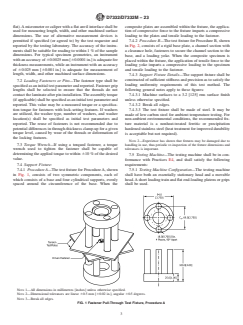
7.4.1 Procedure A—The test fixture for Procedure A, shown 7.5.1 Testing Machine Configuration—The testing machine
in Fig. 1, consists of two symmetric components, each of shall have both an essentially stationary head and a movable
which consists of a base and four cylindrical supports, evenly head. A short loading train and flat end-loading platens or grips
shall be used.
spaced around the circumference of the base. When the
NOTE 1—All dimensions in millimetres [inches] unless otherwise specified.
NOTE 2—Dimensional tolerances are linear 60.5 mm [60.02 in.], angular 60.5 degrees.
NOTE 3—Break all edges.
FIG. 1 Fastener Pull-Through Test Fixture, Procedure A
D7332/D7332M − 23
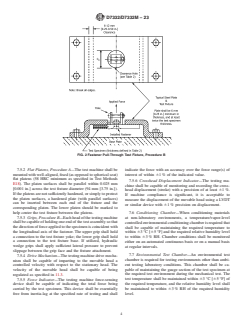
FIG. 2 Fastener Pull-Through Test Fixture, Procedure B
7.5.2 Flat Platens, Procedure A—The test machine shall be indicate the force with an accuracy over the force range(s) of
mounted with well-aligned, fixed (as opposed to spherical seat) interest of within 61 % of the indicated value.
flat platens (58 HRC minimum as specified in Test Methods
7.5.6 Crosshead Displacement Indicator—The testing ma-
E18). The platen surfaces shall be parallel within 0.025 mm
chine shall be capable of monitoring and recording the cross-
[0.001 in.] across the test fixture diameter (94 mm [3.75 in.]).
head displacement (stroke) with a precision of at least 61 %.
If the platens are not sufficiently hardened, or simply to protect
If machine compliance is significant, it is acceptable to
the platen surfaces, a hardened plate (with parallel surfaces)
measure the displacement of the movable head using a LVDT
can be inserted between each end of the fixture and the
or similar device with 61 % precision on displacement.
corresponding platen. The lower platen should be marked to
7.6 Conditioning Chamber—When conditioning materials
help center the test fixture between the platens.
7.5.3 Grips, Procedure B—Each head of the testing machine at non-laboratory environments, a temperature/vapor-level
shall be capable of holding one end of the test assembly so that controlled environmental conditioning chamber is required that
the direction of force applied to the specimen is coincident with
shall be capable of maintaining the required temperature to
the longitudinal axis of the fastener. The upper grip shall hold
within 63 °C [65 °F] and the required relative humidity level
a connection to the test fixture yoke; the lower grip shall hold
to within 63 % RH. Chamber conditions shall be monitored
a connection to the test fixture base. If utilized, hydraulic
either on an automated continuous basis or on a manual basis
wedge grips shall apply sufficient lateral pressure to prevent
at regular intervals.
slippage between the grip face and the fixture attachment.
7.7 Environmental Test Chamber—An environmental test
7.5.4 Drive Mechanism—The testing machine drive mecha-
chamber is required for testing environments other than ambi-
nism shall be capable of imparting to the movable head a
ent testing laboratory conditions. This chamber shall be ca-
controlled velocity with respect to the stationary head. The
pable of maintaining the gauge section of the test specimen at
velocity of the movable head shall be capable of being
the required test environment during the mechanical test. The
regulated as specified in 11.3.
7.5.5 Force Indicator—The testing machine force-sensing test temperature shall be maintained within 63 °C [65 °F] of
the required temperature, and the relative humidity level shall
device shall be capable of indicating the total force being
carried by the test specimen. This device shall be essentially be maintained to within 63 % RH of the required humidity
free from inertia-lag at the specified rate of testing and shall level.
D7332/D7332M − 23
failures are not observed, although such tests shall be considered non-
7.8 Data Acquisition Equipment—Equipment capable of
standard.
recording force and crosshead displacement data is required.
8.2.2 Specimen Configuration—Specimen geometry is
8. Sampling and Test Specimens
shown in Figs. 3 and 4 for Procedure A and in Fig. 5 for
Procedure B; dimensional data for Procedure B specimens are
8.1 Sampling—Test at least five specimens per test condi-
provided in Guide D8509 Table 5.
tion unless valid results can be gained through the use of fewer
specimens, as in the case of a designed experiment. For
8.3 Specimen Preparation—Guide D5687/D5687M pro-
statistically significant data the procedures outlined in Practice
vides recommended specimen preparation practices and should
E122 should be consulted. The method of sampling shall be
be followed where practical.
reported.
8.3.1 Panel Fabrication—Control of fiber alignment is criti-
cal. Improper fiber alignment will reduce the measured prop-
8.2 Geometry:
erties. The panel must be flat and of uniform thickness to assure
8.2.1 Stacking Sequence—The standard tape and fabric
even loading. Erratic fiber alignment will also increase the
laminates shall have multidirectional fiber orientations (fibers
coefficient of variation. Report the panel fabrication method.
oriented in a minimum of three directions for tape laminates,
8.3.2 Machining Methods—Specimen preparation is ex-
and a minimum of two ply orientations for fabric laminates),
tremely important for this specimen. Take precautions when
and balanced and symmetric stacking sequences. Minimum
cutting specimens from large panels to avoid notches,
thicknesses for carbon-fiber reinforced composites are defined
undercuts, rough or uneven surfaces, or delaminations due to
in Guide D8509 Table 4 for Procedure A and Procedure B
inappropriate machining methods. Obtain final dimensions by
specimens; thicker specimens may be required for composites
water-lubricated precision sawing, milling, or grinding. The
reinforced using lower modulus fibers (for example, fiberglass
use of diamond-tipped tooling (as well as water-jet cutting) has
or aramid fibers) to prevent laminate flexural failures. Fabric
been found to be extremely effective for many material
laminates containing satin-type weaves shall have symmetric
systems. Edges should be flat and parallel within the specified
warp surfaces, unless otherwise specified and noted in the
tolerances. Holes should be drilled undersized and reamed to
report.
final dimensions. Take special care to ensure that creation of
NOTE 3—Typically a [45 /0 /-45 /90 ] tape or [45 /0 ] fabric lami-
i j i k ms i j ms
the specimen hole does not delaminate or otherwise damage
nate should be selected such that a minimum of 5 % of the fibers lay in
the material surrounding the hole. Machining tolerances are as
each of the four principal orientations. This laminate design has been
noted in Figs. 3-5. Record and report the specimen cutting
found to yield the highest likelihood of acceptable failure modes.
Alternative layups may be tested using these procedures as long as flexural methods.
NOTE 1—All dimensions in millimetres [inches] unless otherwise specified.
NOTE 2—Dimensional tolerances are linear 60.5 mm [60.02 in.], angular 60.5 degrees.
NOTE 3—Thicknesses defined in Guide D8509 Table 4 are suggested minimum specimen thicknesses for tensile testing 100° and 130° flush head
fasteners. Thickness dimensions represent standard design criteria that allow the countersink to penetrate a maximum depth equal to 70 % of the test plate
thickness.
FIG. 3 Composite Test Plates, Procedure A
D7332/D7332M − 23
8.3.3 If specific gravity, d
...
This document is not an ASTM standard and is intended only to provide the user of an ASTM standard an indication of what changes have been made to the previous version. Because
it may not be technically possible to adequately depict all changes accurately, ASTM recommends that users consult prior editions as appropriate. In all cases only the current version
of the standard as published by ASTM is to be considered the official document.
Designation: D7332/D7332M − 22 D7332/D7332M − 23
Standard Test Method for
Measuring the Fastener Pull-Through Resistance of a
Fiber-Reinforced Polymer Matrix Composite
This standard is issued under the fixed designation D7332/D7332M; the number immediately following the designation indicates the
year of original adoption or, in the case of revision, the year of last revision. A number in parentheses indicates the year of last
reapproval. A superscript epsilon (´) indicates an editorial change since the last revision or reapproval.
1. Scope
1.1 This test method determines the fastener pull-through resistance of multidirectional polymer matrix composites reinforced by
high-modulus fibers. Fastener pull-through resistance is characterized by the force-versus-displacement response exhibited when
a mechanical fastener is pulled through a composite plate, with the force applied perpendicular to the plane of the plate. The
composite material forms are limited to continuous-fiber or discontinuous-fiber (tape or fabric, or both) reinforced composites for
which the laminate is symmetric and balanced with respect to the test direction. The range of acceptable test laminates and
thicknesses is defined in 8.2.
1.2 Two test procedures and configurations are provided. The first, Procedure A, is suitable for screening and fastener development
purposes. The second, Procedure B, is configuration-dependent and is suitable for establishing design values. Both procedures can
be used to perform comparative evaluations of candidate fasteners/fastener system designs.
1.3 The specimens described herein may not be representative of actual joints which may contain one or more free edges adjacent
to the fastener, or may contain multiple fasteners that can change the actual boundary conditions.
1.4 This test method is consistent with the recommendations of CMH-17, which describes the desirable attributes of a fastener
pull-through test method.
1.5 Units—The values stated in either SI units or inch-pound units are to be regarded separately as standard. The values stated in
each system are not necessarily exact equivalents; therefore, to ensure conformance with the standard, each system shall be used
independently of the other, and values from the two systems shall not be combined.
1.5.1 Within the text, the inch-pound units are shown in brackets.
1.6 This standard does not purport to address all of the safety concerns, if any, associated with its use. It is the responsibility
of the user of this standard to establish appropriate safety, health, and environmental practices and determine the applicability of
regulatory limitations prior to use.
1.7 This international standard was developed in accordance with internationally recognized principles on standardization
established in the Decision on Principles for the Development of International Standards, Guides and Recommendations issued
by the World Trade Organization Technical Barriers to Trade (TBT) Committee.
This test method is under the jurisdiction of ASTM Committee D30 on Composite Materials and is the direct responsibility of Subcommittee D30.05 on Structural Test
Methods.
Current edition approved May 1, 2022Sept. 1, 2023. Published May 2022October 2023. Originally approved in 2007. Last previous edition approved in 20162022 as
D7332/D7332M – 16.D7332/D7332M – 22. DOI: 10.1520/D7332_D7332M-22.10.1520/D7332_D7332M-23.
Copyright © ASTM International, 100 Barr Harbor Drive, PO Box C700, West Conshohocken, PA 19428-2959. United States
D7332/D7332M − 23
2. Referenced Documents
2.1 ASTM Standards:
D792 Test Methods for Density and Specific Gravity (Relative Density) of Plastics by Displacement
D883 Terminology Relating to Plastics
D2584 Test Method for Ignition Loss of Cured Reinforced Resins
D2734 Test Methods for Void Content of Reinforced Plastics
D3171 Test Methods for Constituent Content of Composite Materials
D3410/D3410M Test Method for Compressive Properties of Polymer Matrix Composite Materials with Unsupported Gage
Section by Shear Loading
D3878 Terminology for Composite Materials
D5229/D5229M Test Method for Moisture Absorption Properties and Equilibrium Conditioning of Polymer Matrix Composite
Materials
D5687/D5687M Guide for Preparation of Flat Composite Panels with Processing Guidelines for Specimen Preparation
D8509 Guide for Test Method Selection and Test Specimen Design for Bolted Joint Related Properties
E4 Practices for Force Calibration and Verification of Testing Machines
E6 Terminology Relating to Methods of Mechanical Testing
E18 Test Methods for Rockwell Hardness of Metallic Materials
E122 Practice for Calculating Sample Size to Estimate, With Specified Precision, the Average for a Characteristic of a Lot or
Process
E177 Practice for Use of the Terms Precision and Bias in ASTM Test Methods
E456 Terminology Relating to Quality and Statistics
E1309 Guide for Identification of Fiber-Reinforced Polymer-Matrix Composite Materials in Databases (Withdrawn 2015)
E1434 Guide for Recording Mechanical Test Data of Fiber-Reinforced Composite Materials in Databases (Withdrawn 2015)
2.2 Industry Documents:
CMH-17-1G Composite Materials Handbook, Volume 1—Polymer Matrix Composites Guidelines for Characterization of
Structural Materials
3. Terminology
3.1 Definitions—Terminology D3878 defines terms relating to composite materials. Terminology D883 defines terms relating to
plastics. Terminology E6 defines terms relating to mechanical testing. Terminology E456 and Practice E177 define terms relating
to statistics. In the event of a conflict between terms, Terminology D3878 shall have precedence over the other standards.
NOTE 1—If the term represents a physical quantity, its analytical dimensions are stated immediately following the term (or letter symbol) in fundamental
dimension form, using the following ASTM standard symbology for fundamental dimensions, shown within square brackets: [M] for mass, [L] for length,
[T] for time, [θ] for thermodynamic temperature, and [nd] for non-dimensional quantities. Use of these symbols is restricted to analytical dimensions when
used with square brackets, as the symbols may have other definitions when used without the brackets.
3.2 Definitions of Terms Specific to This Standard:
3.2.1 diameter-to-thickness ratio, D/h [nd], n—the ratio of the hole diameter to the specimen thickness.
3.2.1.1 Discussion—
The diameter-to-thickness ratio may be either a nominal value determined from nominal dimensions or an actual value determined
from measured dimensions.
3.2.1 Refer to Guide D8509.
3.2.2 failure force, n—the maximum force magnitude achieved prior to the first significant (greater than 10 %) drop in applied
force, as observed in force versus displacement data.
3.2.3 initial sub-critical failure, n—discontinuity observed in force versus displacement data prior to attaining the failure force.
Sub-critical failures are characterized by minor (less than 10 %) drops in applied force, or by compliance changes (greater than
10 % change in slope), prior to attaining the failure force.
For referenced ASTM standards, visit the ASTM website, www.astm.org, or contact ASTM Customer Service at service@astm.org. For Annual Book of ASTM Standards
volume information, refer to the standard’s Document Summary page on the ASTM website.
Available from SAE International (SAE), 400 Commonwealth Dr., Warrendale, PA 15096, http://www.sae.org.
D7332/D7332M − 23
3.2.4 nominal value, n—a value, existing in name only, assigned to a measurable property for the purpose of convenient
designation. Tolerances may be applied to a nominal value to define an acceptable range for the property.
3.2.4 rupture, n—separation of the fastener and test laminate, caused by failure of the fastener, the composite plate, or both.
Rupture is characterized by an extreme force drop, such that the specimen is incapable of carrying significant applied force.
3.3 Symbols:
A = cross-sectional area of a specimen
CV = coefficient of variation statistic of a sample population for a given property (in percent)
d = fastener or pin shank diameter
d = countersink depth
csk
D = specimen hole diameter
h = specimen thickness
l = specimen length
n = number of specimens per sample population
N = number of plies in laminate under test
P = failure force
f
P = force carried by test specimen at initial failure
i
P = maximum force carried by test specimen during test
m
s = standard deviation statistic of a sample population for a given property
n-1
w = specimen width
x = test result for an individual specimen from the sample population for a given property
i
x¯5 mean or average (estimate of mean) of a sample population for a given property
δ = displacement at initial failure
i
δ = displacement at rupture
r
4. Summary of Test Method
4.1 Procedure A, Compressive-Loaded Fixture:
4.1.1 Two flat square, constant rectangular cross-section composite plates, each containing a centrally located fastener hole, are
placed in a multi-piece fixture that has been aligned to minimize loading eccentricities. Each plate contains four additional holes
on the periphery to accommodate the test fixture components. The two plates are joined together by the fastener, with one plate
being rotated 45° with respect to the second plate.
4.1.2 The plates are pried apart by the application of compressive force transmitted through the fixture, producing a tensile loading
through the fastener and a compressive loading through the composite plates. Force is applied until failure of the composite
specimen, the fastener, or both occurs. Applied force and crosshead displacement are recorded while loading.
4.2 Procedure B, Tensile-Loaded Fixture:
4.2.1 A flat square, constant rectangular cross-section composite plate containing a centrally located fastener hole is placed in a
multi-piece fixture that has been aligned to minimize loading eccentricities. The plate is joined by the fastener to a yoke, which
is designed to rotate as to avoid imparting a moment to the fastener.
4.2.2 A uniaxial tensile force is applied to the yoke, imparting a tensile loading on the fastener and an out-of-plane compressive
loading on the composite plate. Force is applied until failure of the composite specimen, the fastener, or both occurs. Applied force
and crosshead displacement are recorded while loading.
4.3 For both procedures, preferredRefer to Guide D8509 failure modes are those associated with failure of the composite at the
fastener hole. Unacceptable failure modes include those associated with the fastener (such as head, shank, or thread failure) or
failure of the composite away from the fastener hole.for additional test details and acceptable failure modes.
5. Significance and Use
5.1 This test method is designed to produceRefer to Guide D8509fastener pull-through resistance data for structural design
D7332/D7332M − 23
allowables, research and development. The procedures may be used to assess pull-through resistance for a variety of composite
laminate thicknesses, fastener diameters, and fastener head styles. However, the flexibility of test parameters allowed by the
variants makes meaningful comparison between datasets difficult if the datasets were not generated using identical test parameters.
5.2 Early composite pull-through tests using fasteners common to metal structures led to premature joint failures, and resulted in
the development of fasteners specific for composite applications. These fasteners have larger heads and tails to reduce
through-thickness compression stresses on the composite laminate.
5.3 General factors that influence the mechanical response of composite laminates and should therefore be reported include the
following: material, methods of material preparation and lay-up, specimen stacking sequence, specimen preparation, specimen
conditioning, environment of testing, specimen alignment, speed of testing, time at temperature, void content, and volume percent
reinforcement.
5.4 Specific factors that influence the pull-through resistance of composite laminates and should therefore be reported include the
following: hole diameter, fastener diameter, fastener head diameter, loading bar spacing to fastener hole diameter ratio (Procedure
A), clearance hole diameter to fastener hole diameter ratio (Procedure B), diameter to thickness ratio, fastener torque, fastener or
pin material, fastener or pin clearance, countersink angle and depth of countersink, type of grommet (if used), and type of support
fixture. Fastener pull-through resistance properties which may be determined from this test method include initial sub-critical
failure force/displacement, failure force, maximum force, and rupture displacement.
6. Interferences
6.1 Material and Specimen Preparation—Poor material fabrication practices, lack of control of fiber alignment, and damage
induced by improper specimen machining are known causes of high material data scatter in composites in general. Important
aspects of specimen preparation that contribute to data scatterRefer to Guide D8509 include thickness variation, out-of-plane
curvature, surface roughness, and failure to meet the dimensional tolerances specified in 8.2.2.
6.2 Hole Preparation—Because of the dominating presence of the filled hole, results from this test method are relatively
insensitive to parameters that would be of concern in an unnotched tensile, compressive, or flexural property test. However, since
the filled hole dominates the strength, consistent preparation of the hole, without damage to the laminate, is important to
meaningful results. Damage caused by hole preparation will affect strength results and can reduce the calculated strength.
6.3 Fastener Head Style and Countersink—Results are affected by the head style of the fastener utilized. In general, specimens
containing protruding head fasteners exhibit the highest pull-through resistance forces, followed by (in order of decreasing
pull-through resistance forces) 100° tension head fasteners, 100° shear head fasteners, and 130° shear head fasteners. Results may
also be affected by the ratio of countersunk (flush) head depth to thickness; the preferred ratio is the range from 0.0 to 0.7 unless
the experiment is investigating the influence of this ratio.
6.4 Fastener-Hole Clearance—Results are affected by the clearance arising from the difference between hole and fastener
diameters. Excess clearance can change the observed specimen behavior by promoting the onset of sub-critical failures, due to a
decrease in the effective area of the composite which reacts the pull-through load. Damage due to insufficient clearance during
fastener installation will affect strength results. For these reasons, both the hole and fastener diameters must be accurately measured
and recorded. A typical aerospace tolerance on fastener-hole clearance is +75/-0 μm [+0.003/-0.000 in.] for structural fastener
holes.
6.5 Countersink Flushness—Countersink flushness (depth or protrusion of the fastener head in a countersunk hole) will affect
strength results and may affect the observed failure mode. Countersunk head fasteners shall be installed within 60.1 mm
[60.005 in.] from the composite surface, unless otherwise specified.
6.6 Thickness—Results are affected by the thickness of the specimen and the ratio of hole diameter to thickness. Fastener
pull-through resistance is typically proportional to the thickness of the specimen. The preferred ratio of hole diameter to thickness
is the range from 1.5 to 3.0 unless the experiment is investigating the influence of this ratio. Additionally, for both procedures the
composite plate(s) must have sufficient thickness, flexural stiffness and flexural strength to transmit the fixture loading without
excessive plate bending, flexural failure or bearing damage.
D7332/D7332M − 23
6.7 Fastener Torque/Pre-load—Results are affected by the installed fastener pre-load (clamping pressure), as this force must be
overcome initially by the application of tensile loading to the fastener.
6.8 Geometry—Results are affected by the ratio of loading bar spacing to fastener hole diameter for Procedure A tests, and by the
ratio of clearance hole diameter to fastener hole diameter for Procedure B tests. The ratio should be maintained as specified in
Tables 1 and 2, unless the experiment is investigating the influence of this ratio.
6.9 Test Fixture Characteristics—The configuration of the test fixture can have a significant effect on test results. For Procedure
A, friction between the composite plates and loading posts (resulting from plate flexure or hole misalignment) can cause force
measurement errors and affect test results. For Procedure B, the configuration of the yoke, and its ability to minimize the applied
moment to the test specimen, can affect test results. Additionally, for Procedure B the diameter of the clearance hole can affect the
degree of bending in the composite plate.
6.10 System Alignment—Errors can result if the test fixture is not centered with respect to the loading axis of the test machine.
7. Apparatus
7.1 Micrometers and Calipers—A micrometer with a 44 mm to 8 mm [0.16 to 0.32 in.] [0.16 in. to 0.32 in.] nominal diameter
ball-interface or a flat anvil interface shall be used to measure the specimen thickness. A ball interface is recommended for
thickness measurements when at least one surface is irregular (for example, a coarse peel ply surface, which is neither smooth nor
flat). A micrometer or caliper with a flat anvil interface shall be used for measuring length, width, and other machined surface
dimensions. The use of alternative measurement devices is permitted if specified (or agreed to) by the test requestor and reported
by the testing laboratory. The accuracy of the instruments shall be suitable for reading to within 1 % of the sample dimensions.
For typical specimen geometries, an instrument with an accuracy of 60.0025 mm [60.0001 in.] is adequate for thickness
measurements, while an instrument with an accuracy of 60.025 mm [60.001 in.] is adequate for measurement of length, width,
and other machined surface dimensions.
7.2 Loading Fasteners or Pins—The fastener type shall be specified as an initial test parameter and reported. Fastener grip lengths
shall be selected to ensure that the threads do not contact the laminate after pin installation. The assembly torque (if applicable)
shall be specified as an initial test parameter and reported. This value may be a measured torque or a specification torque for
fasteners with lock-setting features. If washers are utilized, the washer type, number of washers, and washer location(s) shall be
specified as initial test parameters and reported. The reuse of fasteners is not recommended due to potential differences in
through-thickness clamp-up for a given torque level, caused by wear of the threads or deformation of the locking features.
7.3 Torque Wrench—If using a torqued fastener, a torque wrench used to tighten the fastener shall be capable of determining the
applied torque to within 610 % of the desired value.
7.4 Support Fixture:
7.4.1 Procedure A—The test fixture for Procedure A, shown in Fig. 1, consists of two symmetric components, each of which
consists of a base and four cylindrical supports, evenly spaced around the circumference of the base. When the composite plates
are assembled within the fixture, the application of compressive force to the fixture imparts a compressive loading to the plates
and tensile loading to the fastener.
7.4.2 Procedure B—The test fixture for Procedure B, shown in Fig. 2, consists of a rigid base plate, a channel section with a
clearance hole, fasteners to secure the channel section to the base, and a loading yoke. When the composite specimen is placed
within the fixture, the application of tensile force to the loading yoke imparts a compressive loading to the specimen and tensile
loading to the fastener.
7.4.3 Support Fixture Details—The support fixture shall be constructed of sufficient stiffness and precision as to satisfy the loading
uniformity requirements of this test method. The following general notes apply to these figures:
7.4.3.1 Machine surfaces to a 3.2 [125] rms surface finish unless otherwise specified.
7.4.3.2 Break all edges.
D7332/D7332M − 23
NOTE 1—All dimensions in millimetres [inches] unless otherwise specified.
NOTE 2—Dimensional tolerances are linear 60.5 mm [60.02 in.], angular 60.5 degrees.
NOTE 3—Break all edges.
FIG. 1 Fastener Pull-Through Test Fixture, Procedure A
FIG. 2 Fastener Pull-Through Test Fixture, Procedure B
7.4.3.3 The test fixture shall be made of steel. It may be made of low carbon steel for ambient temperature testing. For non-ambient
environmental conditions, the recommended fixture material is a nonheat-treated ferritic or precipitation hardened stainless steel
(heat treatment for improved durability is acceptable but not required).
D7332/D7332M − 23
NOTE 2—Experience has shown that fixtures may be damaged due to handling in use, thus periodic re-inspection of the fixture dimensions and tolerances
is important.
7.5 Testing Machine—The testing machine shall be in conformance with Practices E4, and shall satisfy the following
requirements:
7.5.1 Testing Machine Configuration—The testing machine shall have both an essentially stationary head and a movable head. A
short loading train and flat end-loading platens or grips shall be used.
7.5.2 Flat Platens, Procedure A—The test machine shall be mounted with well-aligned, fixed (as opposed to spherical seat) flat
platens (58 HRC minimum as specified in Test Methods E18). The platen surfaces shall be parallel within 0.025 mm [0.001 in.]
across the test fixture diameter (94 mm [3.75 in.]). If the platens are not sufficiently hardened, or simply to protect the platen
surfaces, a hardened plate (with parallel surfaces) can be inserted between each end of the fixture and the corresponding platen.
The lower platen should be marked to help center the test fixture between the platens.
7.5.3 Grips, Procedure B—Each head of the testing machine shall be capable of holding one end of the test assembly so that the
direction of force applied to the specimen is coincident with the longitudinal axis of the fastener. The upper grip shall hold a
connection to the test fixture yoke; the lower grip shall hold a connection to the test fixture base. If utilized, hydraulic wedge grips
shall apply sufficient lateral pressure to prevent slippage between the grip face and the fixture attachment.
7.5.4 Drive Mechanism—The testing machine drive mechanism shall be capable of imparting to the movable head a controlled
velocity with respect to the stationary head. The velocity of the movable head shall be capable of being regulated as specified in
11.3.
7.5.5 Force Indicator—The testing machine force-sensing device shall be capable of indicating the total force being carried by the
test specimen. This device shall be essentially free from inertia-lag at the specified rate of testing and shall indicate the force with
an accuracy over the force range(s) of interest of within 61 % of the indicated value.
7.5.6 Crosshead Displacement Indicator—The testing machine shall be capable of monitoring and recording the crosshead
displacement (stroke) with a precision of at least 61 %. If machine compliance is significant, it is acceptable to measure the
displacement of the movable head using a LVDT or similar device with 61 % precision on displacement.
7.6 Conditioning Chamber—When conditioning materials at non-laboratory environments, a temperature/vapor-level controlled
environmental conditioning chamber is required that shall be capable of maintaining the required temperature to within 63 °C
[65 °F] and the required relative humidity level to within 63 % RH. Chamber conditions shall be monitored either on an
automated continuous basis or on a manual basis at regular intervals.
7.7 Environmental Test Chamber—An environmental test chamber is required for testing environments other than ambient testing
laboratory conditions. This chamber shall be capable of maintaining the gauge section of the test specimen at the required test
environment during the mechanical test. The test temperature shall be maintained within 63 °C [65 °F] of the required
temperature, and the relative humidity level shall be maintained to within 63 % RH of the required humidity level.
7.8 Data Acquisition Equipment—Equipment capable of recording force and crosshead displacement data is required.
8. Sampling and Test Specimens
8.1 Sampling—Test at least five specimens per test condition unless valid results can be gained through the use of fewer specimens,
as in the case of a designed experiment. For statistically significant data the procedures outlined in Practice E122 should be
consulted. The method of sampling shall be reported.
8.2 Geometry:
8.2.1 Stacking Sequence—The standard tape and fabric laminates shall have multidirectional fiber orientations (fibers oriented in
a minimum of three directions for tape laminates, and a minimum of two ply orientations for fabric laminates), and balanced and
symmetric stacking sequences. Minimum thicknesses for carbon-fiber reinfo
...