

ASTM F1483-23
(Specification)Standard Specification for Oriented Poly(Vinyl Chloride), PVCO, Pressure Pipe
General Information
- Abstract
ABSTRACT
This specification covers requirements for materials, dimensions, sustained pressure, accelerated regression testing, burst pressure, flattening, impact resistance, workmanship, and methods of marking for oriented poly (vinyl chloride) (PVCO) pipe for pressure applications. PVCO pipe shall be joined using elastomeric seals (gaskets). The joint shall meet the requirements of a certain specification and the elastomeric seal shall meet the requirements of another specification. The PVCO shall not be joined by solvent cementing. Poly (vinyl chloride) plastics used to make PVCO pipe meeting the requirements of this specification are categorized by means of two criteria, namely (1) short-term strength tests; and (2) long-term strength tests. The pipe shall be homogeneous throughout and free from visible cracks, holes, foreign inclusions, or other defects. The pipe shall be as uniform as commercially practicable in color, opacity, density, and other physical properties.
SCOPE
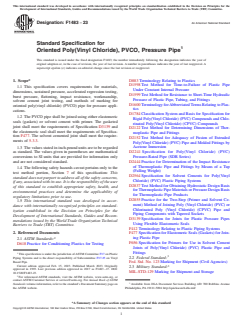
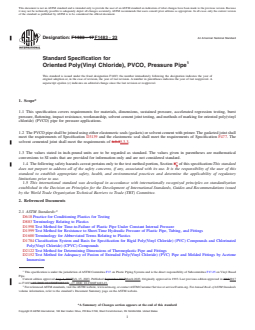
1.1 This specification covers requirements for materials, dimensions, sustained pressure, accelerated regression testing, burst pressure, flattening, impact resistance, workmanship, solvent cement joint testing, and methods of marking for oriented poly(vinyl chloride) (PVCO) pipe for pressure applications.
1.2 The PVCO pipe shall be joined using either elastomeric seals (gaskets) or solvent cement with primer. The gasketed joint shall meet the requirements of Specification D3139 and the elastomeric seal shall meet the requirements of Specification F477. The solvent cemented joint shall meet the requirements of 5.3.3.
1.3 The values stated in inch-pound units are to be regarded as standard. The values given in parentheses are mathematical conversions to SI units that are provided for information only and are not considered standard.
1.4 The following safety hazards caveat pertains only to the test method portion, Section 7 of this specification: This standard does not purport to address all of the safety concerns, if any, associated with its use. It is the responsibility of the user of this standard to establish appropriate safety, health, and environmental practices and determine the applicability of regulatory limitations prior to use.
1.5 This international standard was developed in accordance with internationally recognized principles on standardization established in the Decision on Principles for the Development of International Standards, Guides and Recommendations issued by the World Trade Organization Technical Barriers to Trade (TBT) Committee.
- Status
- Published
- Publication Date
- 14-Feb-2023
- Technical Committee
- F17 - Plastic Piping Systems
- Drafting Committee
- F17.25 - Vinyl Based Pipe
Buy Documents
ASTM F1483-23 - Standard Specification for Oriented Poly(Vinyl Chloride), PVCO, Pressure Pipe
REDLINE ASTM F1483-23 - Standard Specification for Oriented Poly(Vinyl Chloride), PVCO, Pressure Pipe
Overview
ASTM F1483-23, titled "Standard Specification for Oriented Poly(Vinyl Chloride), PVCO, Pressure Pipe," is an internationally recognized standard developed by ASTM International. This specification outlines the requirements for materials, manufacturing processes, dimensional criteria, mechanical performance, and quality assurance for PVCO pressure pipes. PVCO (oriented polyvinyl chloride) pressure pipes are widely used in water distribution, irrigation, and other pressure pipe applications where high strength, durability, and corrosion resistance are necessary.
The standard covers requirements for dimensions, sustained pressure, accelerated regression testing, burst pressure, flattening, impact resistance, workmanship, marking, and joining methods for PVCO pipe. It specifies acceptable joining methods, either by elastomeric seals (gaskets) or solvent cement with primer, ensuring joint reliability. The document also references key safety, health, and environmental considerations associated with test methods and use.
Key Topics
Critical topics addressed in ASTM F1483-23 include:
- Material Requirements: Specifies the use of rigid poly(vinyl chloride) (PVC) compounds with minimum properties for starting stock, including hydrostatic design basis (HDB) and long-term strength.
- Dimensional and Mechanical Properties: Outlines nominal sizes, wall thicknesses, diameters, and tolerances for both IPS (Iron Pipe Size) and CIOD (Cast Iron Outside Diameter) systems.
- Qualification and Quality Control Testing: Specifies tests such as sustained pressure, regression, burst pressure, flattening, and impact resistance to ensure pipe durability and service life.
- Joining Methods: Requires joints either by elastomeric seals (complying with ASTM D3139 and F477) or with solvent cement and primer (complying with ASTM D2564 and F656), with proper marking indicating permissible joining methods.
- Workmanship and Marking: Pipes must be free of visible defects and marked with essential identifiers such as size, pressure rating, type, manufacturer, and relevant standards for potable water use.
- Safety and Compliance: Emphasizes establishing appropriate safety, health, and environmental practices during product use and testing.
Applications
ASTM F1483-23 compliant PVCO pipes are used in a variety of pressure applications, including:
- Municipal Water Distribution Systems: Providing corrosion-resistant and high-strength pipes for potable water transmission.
- Irrigation Systems: Ensuring reliable delivery of water under high pressure in agricultural settings.
- Industrial Pressure Piping: Suitable for transporting pressurized fluids where durability and resistance to internal pressure are critical.
- Infrastructure and Utility Projects: Used in construction for water mains and other pressure pipe installations due to their lightweight, ease of installation, and long-term performance.
PVCO pipes manufactured to ASTM F1483-23 are recognized for their high hoop strength, resistance to impact, and reduced potential for leakage thanks to rigorous joining and marking requirements.
Related Standards
Several other standards are referenced in support of ASTM F1483-23, ensuring consistency and compatibility across plastic piping systems:
- ASTM D3139: Joints for plastic pressure pipes using flexible elastomeric seals.
- ASTM F477: Elastomeric seals (gaskets) for joining plastic pipe.
- ASTM D2564 & F656: Specifications for solvent cements and primers for PVC pipe and fittings.
- ASTM D1784: Rigid PVC compounds and classification requirements.
- ASTM D1598 & D1599: Test methods for time-to-failure and burst pressure of plastic pipe.
- ANSI/NSF 61: Drinking water system components - health effects certification.
- Federal and Military Marking Standards: Requirements for shipment and storage marking for government projects.
By adhering to ASTM F1483-23, manufacturers, designers, and engineers can ensure that their PVCO pressure piping applications meet recognized international standards for quality, reliability, and safety.
Relations
- Effective Date
- 01-Apr-2024
- Effective Date
- 01-Feb-2024
- Effective Date
- 01-Nov-2023
- Effective Date
- 01-Nov-2023
- Effective Date
- 01-Aug-2020
- Effective Date
- 01-Aug-2020
- Effective Date
- 01-Aug-2020
- Effective Date
- 01-Apr-2020
- Effective Date
- 15-Jan-2020
- Effective Date
- 01-Jan-2020
- Effective Date
- 01-Nov-2019
- Effective Date
- 01-Aug-2019
- Effective Date
- 15-Apr-2019
- Effective Date
- 01-Feb-2019
- Effective Date
- 01-Jan-2019
Buy Documents
ASTM F1483-23 - Standard Specification for Oriented Poly(Vinyl Chloride), PVCO, Pressure Pipe
REDLINE ASTM F1483-23 - Standard Specification for Oriented Poly(Vinyl Chloride), PVCO, Pressure Pipe
Get Certified
Connect with accredited certification bodies for this standard

Institut za varilstvo d.o.o. (Welding Institute)
Slovenia's leading welding institute since 1952. ISO 3834, EN 1090, pressure equipment certification, NDT personnel, welder qualification. Only IIW Au
Sponsored listings
Frequently Asked Questions
ASTM F1483-23 is a technical specification published by ASTM International. Its full title is "Standard Specification for Oriented Poly(Vinyl Chloride), PVCO, Pressure Pipe". This standard covers: ABSTRACT This specification covers requirements for materials, dimensions, sustained pressure, accelerated regression testing, burst pressure, flattening, impact resistance, workmanship, and methods of marking for oriented poly (vinyl chloride) (PVCO) pipe for pressure applications. PVCO pipe shall be joined using elastomeric seals (gaskets). The joint shall meet the requirements of a certain specification and the elastomeric seal shall meet the requirements of another specification. The PVCO shall not be joined by solvent cementing. Poly (vinyl chloride) plastics used to make PVCO pipe meeting the requirements of this specification are categorized by means of two criteria, namely (1) short-term strength tests; and (2) long-term strength tests. The pipe shall be homogeneous throughout and free from visible cracks, holes, foreign inclusions, or other defects. The pipe shall be as uniform as commercially practicable in color, opacity, density, and other physical properties. SCOPE 1.1 This specification covers requirements for materials, dimensions, sustained pressure, accelerated regression testing, burst pressure, flattening, impact resistance, workmanship, solvent cement joint testing, and methods of marking for oriented poly(vinyl chloride) (PVCO) pipe for pressure applications. 1.2 The PVCO pipe shall be joined using either elastomeric seals (gaskets) or solvent cement with primer. The gasketed joint shall meet the requirements of Specification D3139 and the elastomeric seal shall meet the requirements of Specification F477. The solvent cemented joint shall meet the requirements of 5.3.3. 1.3 The values stated in inch-pound units are to be regarded as standard. The values given in parentheses are mathematical conversions to SI units that are provided for information only and are not considered standard. 1.4 The following safety hazards caveat pertains only to the test method portion, Section 7 of this specification: This standard does not purport to address all of the safety concerns, if any, associated with its use. It is the responsibility of the user of this standard to establish appropriate safety, health, and environmental practices and determine the applicability of regulatory limitations prior to use. 1.5 This international standard was developed in accordance with internationally recognized principles on standardization established in the Decision on Principles for the Development of International Standards, Guides and Recommendations issued by the World Trade Organization Technical Barriers to Trade (TBT) Committee.
ABSTRACT This specification covers requirements for materials, dimensions, sustained pressure, accelerated regression testing, burst pressure, flattening, impact resistance, workmanship, and methods of marking for oriented poly (vinyl chloride) (PVCO) pipe for pressure applications. PVCO pipe shall be joined using elastomeric seals (gaskets). The joint shall meet the requirements of a certain specification and the elastomeric seal shall meet the requirements of another specification. The PVCO shall not be joined by solvent cementing. Poly (vinyl chloride) plastics used to make PVCO pipe meeting the requirements of this specification are categorized by means of two criteria, namely (1) short-term strength tests; and (2) long-term strength tests. The pipe shall be homogeneous throughout and free from visible cracks, holes, foreign inclusions, or other defects. The pipe shall be as uniform as commercially practicable in color, opacity, density, and other physical properties. SCOPE 1.1 This specification covers requirements for materials, dimensions, sustained pressure, accelerated regression testing, burst pressure, flattening, impact resistance, workmanship, solvent cement joint testing, and methods of marking for oriented poly(vinyl chloride) (PVCO) pipe for pressure applications. 1.2 The PVCO pipe shall be joined using either elastomeric seals (gaskets) or solvent cement with primer. The gasketed joint shall meet the requirements of Specification D3139 and the elastomeric seal shall meet the requirements of Specification F477. The solvent cemented joint shall meet the requirements of 5.3.3. 1.3 The values stated in inch-pound units are to be regarded as standard. The values given in parentheses are mathematical conversions to SI units that are provided for information only and are not considered standard. 1.4 The following safety hazards caveat pertains only to the test method portion, Section 7 of this specification: This standard does not purport to address all of the safety concerns, if any, associated with its use. It is the responsibility of the user of this standard to establish appropriate safety, health, and environmental practices and determine the applicability of regulatory limitations prior to use. 1.5 This international standard was developed in accordance with internationally recognized principles on standardization established in the Decision on Principles for the Development of International Standards, Guides and Recommendations issued by the World Trade Organization Technical Barriers to Trade (TBT) Committee.
ASTM F1483-23 is classified under the following ICS (International Classification for Standards) categories: 23.040.20 - Plastics pipes. The ICS classification helps identify the subject area and facilitates finding related standards.
ASTM F1483-23 has the following relationships with other standards: It is inter standard links to ASTM D2241-24, ASTM D883-24, ASTM D883-23, ASTM D2152-23, ASTM D2855-20, ASTM D2241-20, ASTM D2564-20, ASTM F412-20, ASTM D1784-20, ASTM D883-20, ASTM D3139-19, ASTM D883-19c, ASTM D883-19a, ASTM D883-19, ASTM F412-19. Understanding these relationships helps ensure you are using the most current and applicable version of the standard.
ASTM F1483-23 is available in PDF format for immediate download after purchase. The document can be added to your cart and obtained through the secure checkout process. Digital delivery ensures instant access to the complete standard document.
Standards Content (Sample)
This international standard was developed in accordance with internationally recognized principles on standardization established in the Decision on Principles for the
Development of International Standards, Guides and Recommendations issued by the World Trade Organization Technical Barriers to Trade (TBT) Committee.
Designation: F1483 − 23 An American National Standard
Standard Specification for
Oriented Poly(Vinyl Chloride), PVCO, Pressure Pipe
This standard is issued under the fixed designation F1483; the number immediately following the designation indicates the year of
original adoption or, in the case of revision, the year of last revision. A number in parentheses indicates the year of last reapproval. A
superscript epsilon (´) indicates an editorial change since the last revision or reapproval.
1. Scope* D883 Terminology Relating to Plastics
D1598 Test Method for Time-to-Failure of Plastic Pipe
1.1 This specification covers requirements for materials,
Under Constant Internal Pressure
dimensions, sustained pressure, accelerated regression testing,
D1599 Test Method for Resistance to Short-Time Hydraulic
burst pressure, flattening, impact resistance, workmanship,
Pressure of Plastic Pipe, Tubing, and Fittings
solvent cement joint testing, and methods of marking for
D1600 Terminology for Abbreviated Terms Relating to Plas-
oriented poly(vinyl chloride) (PVCO) pipe for pressure appli-
tics
cations.
D1784 Classification System and Basis for Specification for
1.2 The PVCO pipe shall be joined using either elastomeric
Rigid Poly(Vinyl Chloride) (PVC) Compounds and Chlo-
seals (gaskets) or solvent cement with primer. The gasketed
rinated Poly(Vinyl Chloride) (CPVC) Compounds
joint shall meet the requirements of Specification D3139 and
D2122 Test Method for Determining Dimensions of Ther-
the elastomeric seal shall meet the requirements of Specifica-
moplastic Pipe and Fittings
tion F477. The solvent cemented joint shall meet the require-
D2152 Test Method for Adequacy of Fusion of Extruded
ments of 5.3.3.
Poly(Vinyl Chloride) (PVC) Pipe and Molded Fittings by
1.3 The values stated in inch-pound units are to be regarded Acetone Immersion
D2241 Specification for Poly(Vinyl Chloride) (PVC)
as standard. The values given in parentheses are mathematical
conversions to SI units that are provided for information only Pressure-Rated Pipe (SDR Series)
D2444 Practice for Determination of the Impact Resistance
and are not considered standard.
of Thermoplastic Pipe and Fittings by Means of a Tup
1.4 The following safety hazards caveat pertains only to the
(Falling Weight)
test method portion, Section 7 of this specification: This
D2564 Specification for Solvent Cements for Poly(Vinyl
standard does not purport to address all of the safety concerns,
Chloride) (PVC) Plastic Piping Systems
if any, associated with its use. It is the responsibility of the user
D2837 Test Method for Obtaining Hydrostatic Design Basis
of this standard to establish appropriate safety, health, and
for Thermoplastic Pipe Materials or Pressure Design Basis
environmental practices and determine the applicability of
for Thermoplastic Pipe Products
regulatory limitations prior to use.
D2855 Practice for the Two-Step (Primer and Solvent Ce-
1.5 This international standard was developed in accor-
ment) Method of Joining Poly (Vinyl Chloride) (PVC) or
dance with internationally recognized principles on standard-
Chlorinated Poly (Vinyl Chloride) (CPVC) Pipe and
ization established in the Decision on Principles for the
Piping Components with Tapered Sockets
Development of International Standards, Guides and Recom-
D3139 Specification for Joints for Plastic Pressure Pipes
mendations issued by the World Trade Organization Technical
Using Flexible Elastomeric Seals
Barriers to Trade (TBT) Committee.
F412 Terminology Relating to Plastic Piping Systems
2. Referenced Documents
F477 Specification for Elastomeric Seals (Gaskets) for Join-
ing Plastic Pipe
2.1 ASTM Standards:
F656 Specification for Primers for Use in Solvent Cement
D618 Practice for Conditioning Plastics for Testing
Joints of Poly(Vinyl Chloride) (PVC) Plastic Pipe and
Fittings
This specification is under the jurisdiction of ASTM Committee F17 on Plastic
2.2 Federal Standard:
Piping Systems and is the direct responsibility of Subcommittee F17.25 on Vinyl
Based Pipe.
Fed. Std. No. 123 Marking for Shipment (Civil Agencies)
Current edition approved Feb. 15, 2023. Published March 2023. Originally
2.3 Military Standard:
approved in 1993. Last previous edition approved in 2017 as F1483 –17. DOI:
MIL-STD-129 Marking for Shipment and Storage
10.1520/F1483-23.
For referenced ASTM standards, visit the ASTM website, www.astm.org, or
contact ASTM Customer Service at service@astm.org. For Annual Book of ASTM
Standards volume information, refer to the standard’s Document Summary page on Available from DLA Document Services Building 4/D 700 Robbins Avenue
the ASTM website. Philadelphia, PA 19111-5094 http://quicksearch.dla.mil/
*A Summary of Changes section appears at the end of this standard
Copyright © ASTM International, 100 Barr Harbor Drive, PO Box C700, West Conshohocken, PA 19428-2959. United States
F1483 − 23
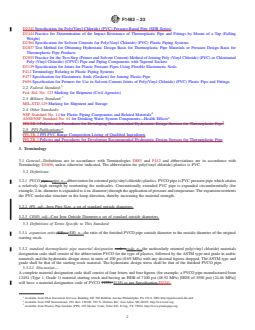
2.4 Other Standards: 3.3.4 wall-thickness-ratio (WTR), n—the ratio of the fin-
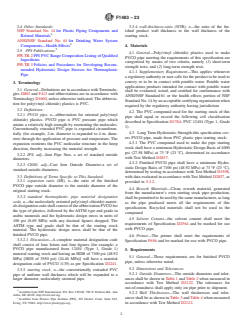
NSF Standard No. 14 for Plastic Piping Components and ished product wall thickness to the wall thickness of the
Related Materials starting stock.
ANSI/NSF Standard No. 61 for Drinking Water System
Components—Health Effects
4. Materials
2.5 PPI Publications:
4.1 General—Poly(vinyl chloride) plastics used to make
PPI-TR 2 PPI PVC Range Composition Listing of Qualified
PVCO pipe meeting the requirements of this specification are
Ingredients
categorized by means of two criteria, namely (1) short-term
PPI-TR 3 Policies and Procedures for Developing Recom-
strength tests; and (2) long-term strength tests.
mended Hydrostatic Design Stresses for Thermoplastic
4.1.1 Supplementary Requirement—This applies whenever
Pipe
a regulatory authority or user calls for the product to be used to
convey or to be in contact with potable water. Potable water
3. Terminology
applications products intended for contact with potable water
3.1 General—Definitions are in accordance with Terminolo-
shall be evaluated, tested, and certified for conformance with
gies D883 and F412 and abbreviations are in accordance with
ANSI/NSF Standard 61 or the health effects portion of NSF
Terminology D1600, unless otherwise indicated. The abbrevia-
Standard No. 14 by an acceptable certifying organization when
tion for poly(vinyl chloride) plastics is PVC.
required by the regulatory authority having jurisdiction.
3.2 Definitions:
4.2 The PVC compound used for the starting stock of this
3.2.1 PVCO pipe, n—abbreviation for oriented poly(vinyl
pipe shall equal or exceed the following cell classification
chloride) plastics. PVCO pipe is PVC pressure pipe which
described in Specification D1784: PVC 12454 (Type 1, Grade
attains a relatively high strength by reorienting the molecules.
1).
Conventionally extruded PVC pipe is expanded circumferen-
4.3 Long Term Hydrostatic Strength-this specification cov-
tially (for example, 2-in. diameter is expanded to 4-in. diam-
ers PVCO pipe, made from PVC plastic pipe starting stock:
eter) through the application of pressure and temperature. The
4.3.1 The PVC compound used to make the pipe starting
expansion reorients the PVC molecular structure in the hoop
stock shall have a minimum Hydrostatic Design Basis of 4000
direction, thereby increasing the material strength.
psi (27.58 MPa) at 73 °F (23 °C), determined in accordance
3.2.2 IPS, adj—Iron Pipe Size, a set of standard outside
with Test Method D2837.
diameters.
4.3.2 Finished PVCO pipe shall have a minimum Hydro-
3.2.3 CIOD, adj—Cast Iron Outside Diameter-a set of
static Design Basis of 7100 psi (48.92 MPa) at 73 °F (23 °C),
standard outside diameters.
determined by testing in accordance with Test Method D1598,
3.3 Definitions of Terms Specific to This Standard:
with data evaluated in accordance with Test Method D2837, as
3.3.1 expansion ratio (ER), n—the ratio of the finished
provided in 5.3.2.
PVCO pipe outside diameter to the outside diameter of the
4.4 Rework Materials—Clean, rework material, generated
original starting stock.
from the manufacturer’s own starting stock pipe production,
3.3.2 standard thermoplastic pipe material designation
shall be permitted to be used by the same manufacturer, as long
code, n—the molecularly oriented poly(vinyl chloride) materi-
as the pipe produced meets all the requirements of this
als designation code shall consist of the abbreviation PVCO for
specification. Recycled materials shall not be used in the
the type of plastics, followed by the ASTM type and grade in
compound
arabic numerals and the hydrostatic design stress in units of
4.5 Solvent Cement—the solvent cement shall meet the
100 psi (0.69 MPa) with any decimal figures dropped. The
requirements of Specification D2564 and be marked for use
ASTM type and grade shall be that of the starting stock
with PVCO pipe.
material. The hydrostatic design stress shall be that of the
finished PVCO pipe.
4.6 Primer—The primer shall meet the requirements of
3.3.2.1 Discussion—A complete material designation code
Specification F656 and be marked for use with PVCO pipe.
shall consist of four letters and four figures (for example; a
PVCO pipe manufactured from 12454 (Type 1, Grade 1)
5. Requirements
material starting stock and having an HDB of 7100 psi (48.92
5.1 General—These requirements are for finished PVCO
MPa) [HDS of 3550 psi) (24.46 MPa)] will have a material
pipe, unless otherwise noted.
designation code of PVCO 1135) as per Specification D2241.
5.2 Dimensions and Tolerances:
3.3.3 starting stock, n—the conventionally extruded PVC
5.2.1 Outside Diameters—The outside diameters and toler-
pipe of uniform wall thickness which will be expanded to a
ances shall be shown in Table 1 and Table 2 when measured in
larger diameter, molecularly oriented pipe.
accordance with Test Method D2122. The tolerances for
out-of-roundness shall apply only on pipe prior to shipment.
Available from NSF International, P.O. Box 130140, 789 N. Dixboro Rd., Ann
5.2.2 Wall Thicknesses—The wall thicknesses and toler-
Arbor, MI 48105, http://www.nsf.org.
ances shall be as shown in Table 3 and Table 4 when measured
Available from Plastics Pipe Institute (PPI), 105 Decker Court, Suite 825,
Irving, TX 75062, http://www.plasticpipe.org. in accordance with Test Method D2122.
F1483 − 23
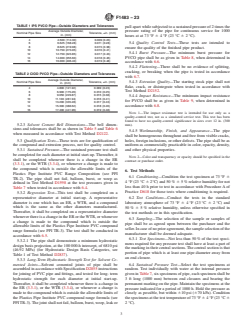
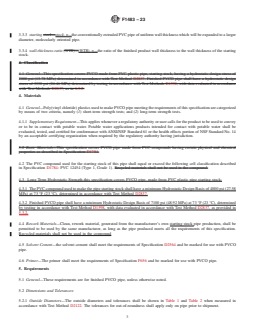
TABLE 1 IPS PVCO Pipe—Outside Diameters and Tolerances
pull apart while subjected to a sustained pressure of 2 times the
Average Outside Diameter, pressure rating of the pipe for continuous service for 1000
Nominal Pipe Size Tolerance, ±in. (mm)
in. (mm)
hours at at 73 °F 6 4 °F (23 °C 6 2 °C).
4 4.500 (114.30) 0.009 (0.23)
5.4 Quality Control Tests—These tests are intended to
6 6.625 (168.28) 0.011 (0.28)
8 8.625 (219.08) 0.015 (0.38)
ensure the quality of the finished pipe product.
10 10.750 (273.05) 0.016 (0.41)
5.4.1 Burst Pressure—The minimum burst pressure for
12 12.750 (323.85) 0.017 (0.43)
PVCO pipe shall be as given in Table 8, when determined in
14 14.000 (355.60) 0.018 (0.46)
16 16.000 (406.40) 0.019 (0.48)
accordance with 6.6.
5.4.2 Flattening—There shall be no evidence of splitting,
cracking, or breaking when the pipe is tested in accordance
TABLE 2 CIOD PVCO Pipe—Outside Diameters and Tolerances
with 6.7.
Average Outside Diameter,
Nominal Pipe Size Tolerance, ±in. (mm)
5.4.3 Extrusion Quality—The starting stock pipe shall not
in. (mm)
flake, crack, or disintegrate when tested in accordance with
4 4.800 (121.92) 0.009 (0.23)
Test Method D2152.
6 6.900 (175.26) 0.010 (0.25)
8 9.050 (229.87) 0.015 (0.38)
5.4.4 Impact Resistance—The minimum impact resistance
10 11.100 (281.94) 0.016 (0.41)
for PVCO shall be as given in Table 9, when determined in
12 13.200 (335.28) 0.017 (0.43)
14 15.300 (388.62) 0.018 (0.46) accordance with 6.8.
16 17.400 (441.96) 0.019 (0.48)
NOTE 1—The impact resistance test is intended for use only as a
quality-control test, not as a simulated service test. This test has been
found to have no quality-control significance in sizes over 12 in. (300
5.2.3 Solvent Cement Bell Dimensions—The bell dimen- mm).
sions and tolerances shall be as shown in Table 5 and Table 6
5.4.5 Workmanship, Finish, and Appearance—The pipe
when measured in accordance with Test Method D2122.
shall be homogeneous throughout and free from visible cracks,
5.3 Qualification Tests—These tests are for qualification of holes, foreign inclusions, or other defects. The pipe shall be as
the compound and extrusion process, not for quality control.
uniform as commercially practicable in color, opacity, density,
5.3.1 Sustained Pressure—The sustained pressure test shall and other physical properties.
be completed for each diameter at initial start-up. Thereafter, it
NOTE 2—Color and transparency or opacity should be specified in the
shall be completed whenever there is a change in the ER
contract or purchase order.
(3.3.1), or the WTR (3.3.4), or whenever a change is made to
the compound which is outside the allowable limits of the
6. Test Methods
Plastics Pipe Institute PVC Range Composition (see PPI
6.1 Conditioning—Condition the test specimen at 73 °F 6
TR-2). The pipe shall not fail, balloon, burst, or weep as
4 °F (23 °C 6 2°C) and 50 % 6 5 % relative humidity for not
defined in Test Method D1598 at the test pressures given in
less than 40 h prior to test in accordance with Procedure A of
Table 7 when tested in accordance with 6.4.
Practice D618 for those tests where conditioning is required.
5.3.2 Regression Test—This test shall be completed on a
representative diameter at initial start-up. A representative
6.2 Test Conditions—Conduct the tests in the standard
diameter is one which has an ER, a WTR, and a compound
laboratory atmosphere of 73 °F 6 4 °F (23 °C 6 2 °C) and
which is the same as the other diameters manufactured.
50 % 6 5 % relative hu
...
This document is not an ASTM standard and is intended only to provide the user of an ASTM standard an indication of what changes have been made to the previous version. Because
it may not be technically possible to adequately depict all changes accurately, ASTM recommends that users consult prior editions as appropriate. In all cases only the current version
of the standard as published by ASTM is to be considered the official document.
Designation: F1483 − 17 F1483 − 23 An American National Standard
Standard Specification for
Oriented Poly(Vinyl Chloride), PVCO, Pressure Pipe
This standard is issued under the fixed designation F1483; the number immediately following the designation indicates the year of
original adoption or, in the case of revision, the year of last revision. A number in parentheses indicates the year of last reapproval. A
superscript epsilon (´) indicates an editorial change since the last revision or reapproval.
1. Scope*
1.1 This specification covers requirements for materials, dimensions, sustained pressure, accelerated regression testing, burst
pressure, flattening, impact resistance, workmanship, solvent cement joint testing, and methods of marking for oriented poly(vinyl
chloride) (PVCO) pipe for pressure applications.
1.2 The PVCO pipe shall be joined using either elastomeric seals (gaskets) or solvent cement with primer. The gasketed joint shall
meet the requirements of Specification D3139 and the elastomeric seal shall meet the requirements of Specification F477. The
solvent cemented joint shall meet the requirements of 6.3.35.3.3.
1.3 The values stated in inch-pound units are to be regarded as standard. The values given in parentheses are mathematical
conversions to SI units that are provided for information only and are not considered standard.
1.4 The following safety hazards caveat pertains only to the test method portion, Section 87 of this specification:This standard
does not purport to address all of the safety concerns, if any, associated with its use. It is the responsibility of the user of this
standard to establish appropriate safety, health, and environmental practices and determine the applicability of regulatory
limitations prior to use.
1.5 This international standard was developed in accordance with internationally recognized principles on standardization
established in the Decision on Principles for the Development of International Standards, Guides and Recommendations issued
by the World Trade Organization Technical Barriers to Trade (TBT) Committee.
2. Referenced Documents
2.1 ASTM Standards:
D618 Practice for Conditioning Plastics for Testing
D883 Terminology Relating to Plastics
D1598 Test Method for Time-to-Failure of Plastic Pipe Under Constant Internal Pressure
D1599 Test Method for Resistance to Short-Time Hydraulic Pressure of Plastic Pipe, Tubing, and Fittings
D1600 Terminology for Abbreviated Terms Relating to Plastics
D1784 Classification System and Basis for Specification for Rigid Poly(Vinyl Chloride) (PVC) Compounds and Chlorinated
Poly(Vinyl Chloride) (CPVC) Compounds
D2122 Test Method for Determining Dimensions of Thermoplastic Pipe and Fittings
D2152 Test Method for Adequacy of Fusion of Extruded Poly(Vinyl Chloride) (PVC) Pipe and Molded Fittings by Acetone
Immersion
This specification is under the jurisdiction of ASTM Committee F17 on Plastic Piping Systems and is the direct responsibility of Subcommittee F17.25 on Vinyl Based
Pipe.
Current edition approved Aug. 1, 2017Feb. 15, 2023. Published September 2017March 2023. Originally approved in 1993. Last previous edition approved in 20152017
as F1483 –15. DOI: 10.1520/F1483-17. –17. DOI: 10.1520/F1483-23.
For referenced ASTM standards, visit the ASTM website, www.astm.org, or contact ASTM Customer Service at service@astm.org. For Annual Book of ASTM Standards
volume information, refer to the standard’s Document Summary page on the ASTM website.
*A Summary of Changes section appears at the end of this standard
Copyright © ASTM International, 100 Barr Harbor Drive, PO Box C700, West Conshohocken, PA 19428-2959. United States
F1483 − 23
D2241 Specification for Poly(Vinyl Chloride) (PVC) Pressure-Rated Pipe (SDR Series)
D2444 Practice for Determination of the Impact Resistance of Thermoplastic Pipe and Fittings by Means of a Tup (Falling
Weight)
D2564 Specification for Solvent Cements for Poly(Vinyl Chloride) (PVC) Plastic Piping Systems
D2837 Test Method for Obtaining Hydrostatic Design Basis for Thermoplastic Pipe Materials or Pressure Design Basis for
Thermoplastic Pipe Products
D2855 Practice for the Two-Step (Primer and Solvent Cement) Method of Joining Poly (Vinyl Chloride) (PVC) or Chlorinated
Poly (Vinyl Chloride) (CPVC) Pipe and Piping Components with Tapered Sockets
D3139 Specification for Joints for Plastic Pressure Pipes Using Flexible Elastomeric Seals
F412 Terminology Relating to Plastic Piping Systems
F477 Specification for Elastomeric Seals (Gaskets) for Joining Plastic Pipe
F656 Specification for Primers for Use in Solvent Cement Joints of Poly(Vinyl Chloride) (PVC) Plastic Pipe and Fittings
2.2 Federal Standard:
Fed. Std. No. 123 Marking for Shipment (Civil Agencies)
2.3 Military Standard:
MIL-STD-129 Marking for Shipment and Storage
2.4 Other Standards:
NSF Standard No. 14 for Plastic Piping Components and Related Materials
ANSI/NSF Standard No. 61 for Drinking Water System Components—Health Effects
PPI-TR 3 Policies and Procedures for Developing Recommended Hydrostatic Design Stresses for Thermoplastic Pipe
2.5 PPI Publications:
PPI-TR 2 PPI PVC Range Composition Listing of Qualified Ingredients
PPI-TR 3 Policies and Procedures for Developing Recommended Hydrostatic Design Stresses for Thermoplastic Pipe
3. Terminology
3.1 General—Definitions are in accordance with Terminologies D883 and F412 and abbreviations are in accordance with
Terminology D1600, unless otherwise indicated. The abbreviation for poly(vinyl chloride) plastics is PVC.
3.2 Definitions:
3.2.1 PVCO pipe—pipe, n—abbreviation for oriented poly(vinyl chloride) plastics. PVCO pipe is PVC pressure pipe which attains
a relatively high strength by reorienting the molecules. Conventionally extruded PVC pipe is expanded circumferentially (for
example, 2-in. diameter is expanded to 4-in. diameter) through the application of pressure and temperature. The expansion reorients
the PVC molecular structure in the hoop direction, thereby increasing the material strength.
3.2.2 IPS, adj—Iron Pipe Size, a set of standard outside diameters.
3.2.3 CIOD, adj—Cast Iron Outside Diameter-a set of standard outside diameters.
3.3 Definitions of Terms Specific to This Standard:
3.3.1 expansion ratio (ER)—(ER), n—the ratio of the finished PVCO pipe outside diameter to the outside diameter of the original
starting stock.
3.3.2 standard thermoplastic pipe material designation code—code, n—the molecularly oriented poly(vinyl chloride) materials
designation code shall consist of the abbreviation PVCO for the type of plastics, followed by the ASTM type and grade in arabic
numerals and the hydrostatic design stress in units of 100 psi (0.69 MPa) with any decimal figures dropped. The ASTM type and
grade shall be that of the starting stock material. The hydrostatic design stress shall be that of the finished PVCO pipe.
3.3.2.1 Discussion—
A complete material designation code shall consist of four letters and four figures (for example; a PVCO pipe manufactured from
12454 (Type 1, Grade 1) material starting stock and having an HDB of 7100 psi (48.92 MPa) [HDS of 3550 psi) (24.46 MPa)]
will have a material designation code of PVCO 1135). 1135) as per Specification D2241.
Available from DLA Document Services Building 4/D 700 Robbins Avenue Philadelphia, PA 19111-5094 http://quicksearch.dla.mil/
Available from NSF International, P.O. Box 130140, 789 N. Dixboro Rd., Ann Arbor, MI 48105, http://www.nsf.org.
Available from Plastics Pipe Institute (PPI), 105 Decker Court, Suite 825, Irving, TX 75062, http://www.plasticpipe.org.
F1483 − 23
3.3.3 starting stock—stock, n—the conventionally extruded PVC pipe of uniform wall thickness which will be expanded to a larger
diameter, molecularly oriented pipe.
3.3.4 wall-thickness-ratio (WTR)—(WTR), n—the ratio of the finished product wall thickness to the wall thickness of the starting
stock.
4. Classification
4.1 General—This specification covers PVCO made from PVC plastic pipe, starting stock, having a hydrostatic design stress of
2000 psi (13.78 MPa) determined in accordance with Test Method D2837. Finished PVCO pipe shall have a hydrostatic design
stress of 3550 psi (24.46 MPa) determined by testing in accordance with Test Methods D1598, with data evaluated in accordance
with Test Methods D2837, as in 6.3.2.
4. Materials
4.1 General—Poly(vinyl chloride) plastics used to make PVCO pipe meeting the requirements of this specification are categorized
by means of two criteria, namely (1) short-term strength tests; and (2) long-term strength tests.
4.1.1 Supplementary Requirement—This applies whenever a regulatory authority or user calls for the product to be used to convey
or to be in contact with potable water. Potable water applications products intended for contact with potable water shall be
evaluated, tested, and certified for conformance with ANSI/NSF Standard 61 or the health effects portion of NSF Standard No. 14
by an acceptable certifying organization when required by the regulatory authority having jurisdiction.
5.2 Basic Materials—This specification covers PVCO pipe made from PVC compounds having certain physical and chemical
properties as described in Specification D1784.
4.2 The PVC compound used for the starting stock of this pipe shall equal or exceed the following cell classification described
in Specification D1784: PVC 12454 (Type 1, Grade 1). Recycled materials shall not be used in the compound.
4.3 Long Term Hydrostatic Strength-this specification covers PVCO pipe, made from PVC plastic pipe starting stock:
4.3.1 The PVC compound used to make the pipe starting stock shall have a minimum Hydrostatic Design Basis of 4000 psi (27.58
MPa) at 73 °F (23 °C), determined in accordance with Test Method D2837.
4.3.2 Finished PVCO pipe shall have a minimum Hydrostatic Design Basis of 7100 psi (48.92 MPa) at 73 °F (23 °C), determined
by testing in accordance with Test Method D1598, with data evaluated in accordance with Test Method D2837, as provided in
5.3.2.
4.4 Rework Materials—Clean, rework material, generated from the manufacturer’s own starting stock pipe production, shall be
permitted to be used by the same manufacturer, as long as the pipe produced meets all the requirements of this specification.
Recycled materials shall not be used in the compound
4.5 Solvent Cement—the solvent cement shall meet the requirements of Specification D2564 and be marked for use with PVCO
pipe.
4.6 Primer—The primer shall meet the requirements of Specification F656 and be marked for use with PVCO pipe.
5. Requirements
5.1 General—These requirements are for finished PVCO pipe, unless otherwise noted.
5.2 Dimensions and Tolerances:
5.2.1 Outside Diameters—The outside diameters and tolerances shall be shown in Table 1 and Table 2 when measured in
accordance with Test Method D2122. The tolerances for out-of-roundness shall apply only on pipe prior to shipment.
F1483 − 23
TABLE 1 IPS PVCO Pipe—Outside Diameters and Tolerances
Nominal Pipe Size, in. Average Outside Diameter,
Tolerance, ±in. (mm)
Size in. (mm)
4 4.500 (114.30) 0.009 (0.23)
6 6.625 (168.28) 0.011 (0.28)
8 8.625 (219.08) 0.015 (0.38)
10 10.750 (273.05) 0.016 (0.41)
12 12.750 (323.85) 0.017 (0.43)
14 14.000 (355.60) 0.018 (0.46)
16 16.000 (406.40) 0.019 (0.48)
TABLE 2 CIOD PVCO Pipe—Outside Diameters and Tolerances
Nominal Pipe Size, in. Average Outside Diameter,
Tolerance, ±in. (mm)
Size in. (mm)
4 4.800 (121.92) 0.009 (0.23)
6 6.900 (175.26) 0.010 (0.25)
8 9.050 (229.87) 0.015 (0.38)
10 11.100 (281.94) 0.016 (0.41)
12 13.200 (335.28) 0.017 (0.43)
14 15.300 (388.62) 0.018 (0.46)
16 17.400 (441.96) 0.019 (0.48)
5.2.2 Wall Thicknesses—The wall thicknesses and tolerances shall be as shown in Table 3 and Table 4 when measured in
accordance with Test Method D2122.
5.2.3 Solvent Cement Bell Dimensions—The bell dimensions and tolerances shall be as shown in Table 5 and Table 6 when
measured in accordance with Test Method D2122.
5.3 Qualification Tests—These tests are for qualification of the compound and extrusion process, not for quality control.
5.3.1 Sustained Pressure—The sustained pressure test shall be completed for each diameter at initial start-up. Thereafter, it shall
be completed whenever there is a change in the ER (3.3.1), or the WTR (3.3.4), or whenever a change is made to the compound
which is outside the allowable limits of the Plastics Pipe Institute PVC compound range formula Range Composition (see PPI
TR-3).TR-2). The pipe shall not fail, balloon, burst, or weep as defined in Test Method D1598 at the test pressures given in Table
7 when tested in accordance with 7.46.4.
5.3.2 Regression Test—This test shall be completed on a representative diameter at initial start-up. A representative diameter is one
which has an ER, a WTR, and a compound which is the same as the other diameters manufactured. Thereafter, it shall be completed
on a representative diameter whenever there is a change in the ER or the WTR, or whenever a change is made to the compound
which is outside the allowable limits of the Plastics Pipe Institute PVC compound range formula (see PPI TR-3). The test shall
be conducted in accordance with 7.56.5.
5.3.2.1 The pipe shall demonstrate a minimum hydrostatic design basis projection, at the 100 000-h intercept, of 6810 psi (46.92
MPa) (for Hydrostatic Design Basis Categories, see Table 1 of Test Method D2837).
5.3.3 Long-Term Hydrostatic Strength Test for Solvent Cemented Joints—Solvent cemented joints of pipe shall be assembled in
accordance with Specification D2855 and instructions for joining of PVC pipe and fittings, and tested for long- term hydrostatic
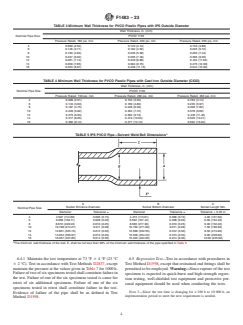
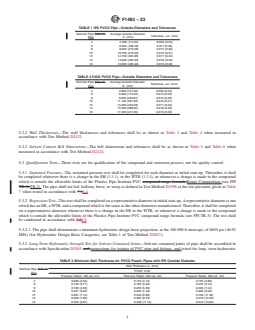
TABLE 3 Minimum Wall Thickness for PVCO Plastic Pipes with IPS Outside Diameter
Wall Thickness, in. (mm)
Nominal Pipe Size, in.
PVCO 1135
Size
Pressure Rated, 160 psi, min Pressure Rated, 200 psi, min Pressure Rated, 250 psi, min
4 0.099 (2.52) 0.123 (3.12) 0.153 (3.89)
6 0.146 (3.71) 0.182 (4.62) 0.225 (5.72)
8 0.190 (4.83) 0.236 (5.99) 0.293 (7.44)
10 0.237 (6.02) 0.295 (7.49) 0.366 (9.30)
12 0.281 (7.14) 0.349 (8.86) 0.434 (11.02)
14 0.309 (7.85) 0.384 (9.75) 0.476 (12.09)
16 0.353 (8.97) 0.438 (11.13) 0.544 (13.82)
F1483 − 23
TABLE 4 Minimum Wall Thickness for PVCO Plastic Pipes with Cast Iron Outside Diameter (CIOD)
Wall Thickness, in. (mm)
Nominal Pipe Size, in.
PVCO 1135
Size
Pressure Rated, 150 psi, min Pressure Rated, 200 psi, min Pressure Rated, 250 psi, min
4 0.099 (2.51) 0.132 (3.35) 0.163 (4.14)
6 0.143 (3.63) 0.189 (4.80) 0.235 (5.97)
8 0.187 (4.75) 0.248 (6.30) 0.308 (7.82)
10 0.229 (5.82) 0.304 (7.72) 0.378 (9.60)
12 0.273 (6.93) 0.362 (9.19) 0.449 (11.40)
14 0.317 (8.05) 0.419 (10.64) 0.520 (13.21)
16 0.360 (
...