

ASTM D2241-24
(Specification)Standard Specification for Poly(Vinyl Chloride) (PVC) Pressure-Rated Pipe (SDR Series)
General Information
- Abstract
ABSTRACT
This specification covers poly(vinyl chloride) (PVC) pipe made in standard thermoplastic pipe dimension ratios and pressure rated for water. Poly(vinyl chloride) plastics used to make pipe meeting the requirements of this specification are categorized in two criteria: short-term strength tests, and long-term strength tests. The products covered by this specification are intended for use with the distribution of pressurized liquids only, which are chemically compatible with the piping materials. The material shall conform to the required wall thickness, sustained pressure, burst pressure, flattening, extrusion quality, and impact resistance. It shall be subject to an accelerated regression test.
SCOPE
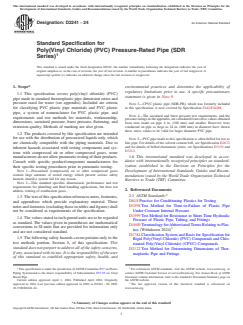
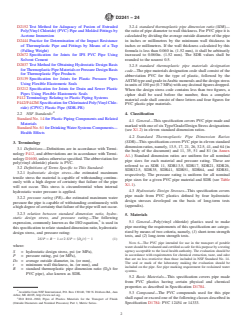
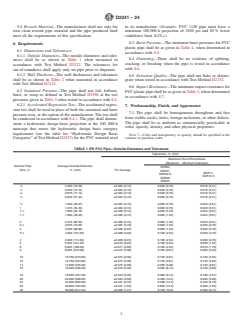
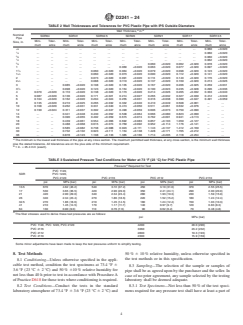
1.1 This specification covers poly(vinyl chloride) (PVC) pipe made in standard thermoplastic pipe dimension ratios and pressure rated for water (see appendix). Included are criteria for classifying PVC plastic pipe materials and PVC plastic pipe, a system of nomenclature for PVC plastic pipe, and requirements and test methods for materials, workmanship, dimensions, sustained pressure, burst pressure, flattening, and extrusion quality. Methods of marking are also given.
1.2 The products covered by this specification are intended for use with the distribution of pressurized liquids only, which are chemically compatible with the piping materials. Due to inherent hazards associated with testing components and systems with compressed air or other compressed gases, some manufacturers do not allow pneumatic testing of their products. Consult with specific product/component manufacturers for their specific testing procedures prior to pneumatic testing.
Note 1: Pressurized (compressed) air or other compressed gases contain large amounts of stored energy which present serious safety hazards should a system fail for any reason.
Note 2: This standard specifies dimensional, performance and test requirements for plumbing and fluid handling applications, but does not address venting of combustion gases.
1.3 The text of this specification references notes, footnotes, and appendixes which provide explanatory material. These notes and footnotes (excluding those in tables and figures) shall not be considered as requirements of the specification.
1.4 The values stated in inch-pound units are to be regarded as standard. The values given in parentheses are mathematical conversions to SI units that are provided for information only and are not considered standard.
1.5 The following safety hazards caveat pertains only to the test methods portion, Section 8, of this specification: This standard does not purport to address all of the safety concerns, if any, associated with its use. It is the responsibility of the user of this standard to establish appropriate safety, health, and environmental practices and determine the applicability of regulatory limitations prior to use. A specific precautionary statement is given in Note 9.
Note 3: CPVC plastic pipe (SDR-PR), which was formerly included in this specification, is now covered by Specification F442/F442M.
Note 4: The sustained and burst pressure test requirements, and the pressure ratings in the appendix, are calculated from stress values obtained from tests made on pipe 4 in. (100 mm) and smaller. However, tests conducted on pipe as large as 24 in. (600 mm) in diameter have shown these stress values to be valid for larger diameter PVC pipe.
Note 5: PVC pipe made to this specification is often belled for use as line pipe. For details of the solvent cement bell, see Specification D2672 and for details of belled elastomeric joints, see Specifications D3139 and D3212.
1.6 This international standard was developed in accordance with internationally recognized principles on standardization established in the Decision on Principles for the Development of International Standards, Guides and Recommendations issued by the World Trade Organization Technical Barrier...
- Status
- Published
- Publication Date
- 31-Mar-2024
- Technical Committee
- F17 - Plastic Piping Systems
- Drafting Committee
- F17.25 - Vinyl Based Pipe
Buy Documents
ASTM D2241-24 - Standard Specification for Poly(Vinyl Chloride) (PVC) Pressure-Rated Pipe (SDR Series)
REDLINE ASTM D2241-24 - Standard Specification for Poly(Vinyl Chloride) (PVC) Pressure-Rated Pipe (SDR Series)
Overview
ASTM D2241-24 is the international standard specification for Poly(Vinyl Chloride) (PVC) pressure-rated pipe, designed using the Standard Dimension Ratio (SDR) series. Developed by ASTM International, this standard sets the criteria for pipes made from PVC plastics that are pressure-rated for the distribution of water and other pressurized liquids chemically compatible with PVC. The standard details requirements for materials, dimensional properties, testing methods, product marking, and quality assurance, ensuring consistent, safe, and reliable PVC piping systems for varied water supply and fluid handling applications.
Key Topics
- Scope and Applicability: ASTM D2241-24 covers PVC pipes manufactured in standard thermoplastic pipe dimension ratios (SDR rating) and pressure-rated for water and similar liquids.
- Material Classification: The standard specifies two key criteria for PVC materials - short-term and long-term strength, ensuring durability and reliability in pressure service.
- Dimensional Requirements: It details specific wall thicknesses, outside diameter tolerances, out-of-roundness limits, and SDR designations for consistent product quality.
- Performance Testing: The standard mandates sustained pressure testing, burst pressure testing, flattening, extrusion quality, and impact resistance to verify pipe integrity under operational conditions.
- Marking and Identification: Requirements are established for product marking (ASTM designation, size, SDR, manufacturer, and more) for traceability and regulatory compliance.
- Safety Considerations: Guidance is provided on the hazards of pneumatic testing and the importance of proper procedures for user safety.
Applications
PVC pressure pipe produced in accordance with ASTM D2241-24 is extensively used in:
- Municipal and Rural Water Distribution: Providing safe, reliable transport of potable water under pressure.
- Irrigation and Agricultural Systems: Delivering water efficiently for crop irrigation and farm needs.
- Industrial and Commercial Fluid Handling: Handling a range of pressurized fluids, provided they are chemically compatible with PVC.
- Reclaimed Water Systems: Used for non-potable water networks, with special marking requirements for identification.
- Building and Construction Plumbing: Employed in piping systems for residential, commercial, and institutional buildings.
The pipes are suitable for use with solvent cement joints, elastomeric seals, or as belled line pipes, making them adaptable to a variety of installation scenarios.
Related Standards
Several other standards are referenced within ASTM D2241-24 to ensure full system compatibility and compliance:
- ASTM D1784: Specification for Rigid Poly(Vinyl Chloride) (PVC) and Chlorinated Poly(Vinyl Chloride) (CPVC) Compounds.
- ASTM D2672: Joints for IPS PVC Pipe Using Solvent Cement.
- ASTM D3139 / D3212: Joints for Plastic Pressure and Sewer Pipes Using Flexible Elastomeric Seals.
- ASTM D1598 / D1599: Test methods for Time-to-Failure and Resistance to Short-Time Hydraulic Pressure.
- NSF/ANSI 14 & NSF/ANSI 61: Standards addressing health effects and performance requirements for plastic piping in drinking water and related systems.
- ASTM F442/F442M: Specification for CPVC Plastic Pipe (SDR–PR series).
Practical Value
By adhering to ASTM D2241-24, manufacturers and users gain:
- Reliability: Standardized product performance through rigorous testing for pressure, impact, and quality.
- Interchangeability: Uniform sizing and SDR classifications enable compatibility across systems and suppliers.
- Regulatory Compliance: Accepted by regulatory bodies for water supply systems and infrastructure projects.
- Safety Assurance: Detailed marking, identification, and test protocols protect both users and installers.
- Widespread Applicability: PVC pressure-rated pipes are a trusted choice for cost-effective, long-life water conveyance solutions around the world.
For any project involving the distribution of pressurized water or fluids, specifying ASTM D2241-24 ensures compliance, safety, and peace of mind.
Relations
- Effective Date
- 01-Apr-2024
- Effective Date
- 01-Apr-2024
- Referred By
ASTM F1483-23 - Standard Specification for Oriented Poly(Vinyl Chloride), PVCO, Pressure Pipe - Effective Date
- 01-Apr-2024
- Effective Date
- 01-Apr-2024
- Effective Date
- 01-Apr-2024
- Referred By
ASTM D2672-20e1 - Standard Specification for Joints for IPS PVC Pipe Using Solvent Cement - Effective Date
- 01-Apr-2024
- Effective Date
- 01-Apr-2024
- Effective Date
- 01-Apr-2024
- Effective Date
- 01-Apr-2024
- Effective Date
- 01-Apr-2024
Buy Documents
ASTM D2241-24 - Standard Specification for Poly(Vinyl Chloride) (PVC) Pressure-Rated Pipe (SDR Series)
REDLINE ASTM D2241-24 - Standard Specification for Poly(Vinyl Chloride) (PVC) Pressure-Rated Pipe (SDR Series)
Get Certified
Connect with accredited certification bodies for this standard

Institut za varilstvo d.o.o. (Welding Institute)
Slovenia's leading welding institute since 1952. ISO 3834, EN 1090, pressure equipment certification, NDT personnel, welder qualification. Only IIW Au
Sponsored listings
Frequently Asked Questions
ASTM D2241-24 is a technical specification published by ASTM International. Its full title is "Standard Specification for Poly(Vinyl Chloride) (PVC) Pressure-Rated Pipe (SDR Series)". This standard covers: ABSTRACT This specification covers poly(vinyl chloride) (PVC) pipe made in standard thermoplastic pipe dimension ratios and pressure rated for water. Poly(vinyl chloride) plastics used to make pipe meeting the requirements of this specification are categorized in two criteria: short-term strength tests, and long-term strength tests. The products covered by this specification are intended for use with the distribution of pressurized liquids only, which are chemically compatible with the piping materials. The material shall conform to the required wall thickness, sustained pressure, burst pressure, flattening, extrusion quality, and impact resistance. It shall be subject to an accelerated regression test. SCOPE 1.1 This specification covers poly(vinyl chloride) (PVC) pipe made in standard thermoplastic pipe dimension ratios and pressure rated for water (see appendix). Included are criteria for classifying PVC plastic pipe materials and PVC plastic pipe, a system of nomenclature for PVC plastic pipe, and requirements and test methods for materials, workmanship, dimensions, sustained pressure, burst pressure, flattening, and extrusion quality. Methods of marking are also given. 1.2 The products covered by this specification are intended for use with the distribution of pressurized liquids only, which are chemically compatible with the piping materials. Due to inherent hazards associated with testing components and systems with compressed air or other compressed gases, some manufacturers do not allow pneumatic testing of their products. Consult with specific product/component manufacturers for their specific testing procedures prior to pneumatic testing. Note 1: Pressurized (compressed) air or other compressed gases contain large amounts of stored energy which present serious safety hazards should a system fail for any reason. Note 2: This standard specifies dimensional, performance and test requirements for plumbing and fluid handling applications, but does not address venting of combustion gases. 1.3 The text of this specification references notes, footnotes, and appendixes which provide explanatory material. These notes and footnotes (excluding those in tables and figures) shall not be considered as requirements of the specification. 1.4 The values stated in inch-pound units are to be regarded as standard. The values given in parentheses are mathematical conversions to SI units that are provided for information only and are not considered standard. 1.5 The following safety hazards caveat pertains only to the test methods portion, Section 8, of this specification: This standard does not purport to address all of the safety concerns, if any, associated with its use. It is the responsibility of the user of this standard to establish appropriate safety, health, and environmental practices and determine the applicability of regulatory limitations prior to use. A specific precautionary statement is given in Note 9. Note 3: CPVC plastic pipe (SDR-PR), which was formerly included in this specification, is now covered by Specification F442/F442M. Note 4: The sustained and burst pressure test requirements, and the pressure ratings in the appendix, are calculated from stress values obtained from tests made on pipe 4 in. (100 mm) and smaller. However, tests conducted on pipe as large as 24 in. (600 mm) in diameter have shown these stress values to be valid for larger diameter PVC pipe. Note 5: PVC pipe made to this specification is often belled for use as line pipe. For details of the solvent cement bell, see Specification D2672 and for details of belled elastomeric joints, see Specifications D3139 and D3212. 1.6 This international standard was developed in accordance with internationally recognized principles on standardization established in the Decision on Principles for the Development of International Standards, Guides and Recommendations issued by the World Trade Organization Technical Barrier...
ABSTRACT This specification covers poly(vinyl chloride) (PVC) pipe made in standard thermoplastic pipe dimension ratios and pressure rated for water. Poly(vinyl chloride) plastics used to make pipe meeting the requirements of this specification are categorized in two criteria: short-term strength tests, and long-term strength tests. The products covered by this specification are intended for use with the distribution of pressurized liquids only, which are chemically compatible with the piping materials. The material shall conform to the required wall thickness, sustained pressure, burst pressure, flattening, extrusion quality, and impact resistance. It shall be subject to an accelerated regression test. SCOPE 1.1 This specification covers poly(vinyl chloride) (PVC) pipe made in standard thermoplastic pipe dimension ratios and pressure rated for water (see appendix). Included are criteria for classifying PVC plastic pipe materials and PVC plastic pipe, a system of nomenclature for PVC plastic pipe, and requirements and test methods for materials, workmanship, dimensions, sustained pressure, burst pressure, flattening, and extrusion quality. Methods of marking are also given. 1.2 The products covered by this specification are intended for use with the distribution of pressurized liquids only, which are chemically compatible with the piping materials. Due to inherent hazards associated with testing components and systems with compressed air or other compressed gases, some manufacturers do not allow pneumatic testing of their products. Consult with specific product/component manufacturers for their specific testing procedures prior to pneumatic testing. Note 1: Pressurized (compressed) air or other compressed gases contain large amounts of stored energy which present serious safety hazards should a system fail for any reason. Note 2: This standard specifies dimensional, performance and test requirements for plumbing and fluid handling applications, but does not address venting of combustion gases. 1.3 The text of this specification references notes, footnotes, and appendixes which provide explanatory material. These notes and footnotes (excluding those in tables and figures) shall not be considered as requirements of the specification. 1.4 The values stated in inch-pound units are to be regarded as standard. The values given in parentheses are mathematical conversions to SI units that are provided for information only and are not considered standard. 1.5 The following safety hazards caveat pertains only to the test methods portion, Section 8, of this specification: This standard does not purport to address all of the safety concerns, if any, associated with its use. It is the responsibility of the user of this standard to establish appropriate safety, health, and environmental practices and determine the applicability of regulatory limitations prior to use. A specific precautionary statement is given in Note 9. Note 3: CPVC plastic pipe (SDR-PR), which was formerly included in this specification, is now covered by Specification F442/F442M. Note 4: The sustained and burst pressure test requirements, and the pressure ratings in the appendix, are calculated from stress values obtained from tests made on pipe 4 in. (100 mm) and smaller. However, tests conducted on pipe as large as 24 in. (600 mm) in diameter have shown these stress values to be valid for larger diameter PVC pipe. Note 5: PVC pipe made to this specification is often belled for use as line pipe. For details of the solvent cement bell, see Specification D2672 and for details of belled elastomeric joints, see Specifications D3139 and D3212. 1.6 This international standard was developed in accordance with internationally recognized principles on standardization established in the Decision on Principles for the Development of International Standards, Guides and Recommendations issued by the World Trade Organization Technical Barrier...
ASTM D2241-24 is classified under the following ICS (International Classification for Standards) categories: 23.040.20 - Plastics pipes. The ICS classification helps identify the subject area and facilitates finding related standards.
ASTM D2241-24 has the following relationships with other standards: It is inter standard links to ASTM D2241-20, ASTM F645-18b, ASTM F1483-23, ASTM D2855-20, ASTM F1674-18, ASTM D2672-20e1, ASTM F412-23, ASTM F442/F442M-23, ASTM F480-14(2022), ASTM F1970-23. Understanding these relationships helps ensure you are using the most current and applicable version of the standard.
ASTM D2241-24 is available in PDF format for immediate download after purchase. The document can be added to your cart and obtained through the secure checkout process. Digital delivery ensures instant access to the complete standard document.
Standards Content (Sample)
This international standard was developed in accordance with internationally recognized principles on standardization established in the Decision on Principles for the
Development of International Standards, Guides and Recommendations issued by the World Trade Organization Technical Barriers to Trade (TBT) Committee.
Designation: D2241 − 24 An American National Standard
Standard Specification for
Poly(Vinyl Chloride) (PVC) Pressure-Rated Pipe (SDR
Series)
This standard is issued under the fixed designation D2241; the number immediately following the designation indicates the year of
original adoption or, in the case of revision, the year of last revision. A number in parentheses indicates the year of last reapproval. A
superscript epsilon (´) indicates an editorial change since the last revision or reapproval.
1. Scope* environmental practices and determine the applicability of
regulatory limitations prior to use. A specific precautionary
1.1 This specification covers poly(vinyl chloride) (PVC)
statement is given in Note 9.
pipe made in standard thermoplastic pipe dimension ratios and
pressure rated for water (see appendix). Included are criteria
NOTE 3—CPVC plastic pipe (SDR-PR), which was formerly included
in this specification, is now covered by Specification F442/F442M.
for classifying PVC plastic pipe materials and PVC plastic
pipe, a system of nomenclature for PVC plastic pipe, and
NOTE 4—The sustained and burst pressure test requirements, and the
requirements and test methods for materials, workmanship,
pressure ratings in the appendix, are calculated from stress values obtained
dimensions, sustained pressure, burst pressure, flattening, and
from tests made on pipe 4 in. (100 mm) and smaller. However, tests
extrusion quality. Methods of marking are also given. conducted on pipe as large as 24 in. (600 mm) in diameter have shown
these stress values to be valid for larger diameter PVC pipe.
1.2 The products covered by this specification are intended
for use with the distribution of pressurized liquids only, which
NOTE 5—PVC pipe made to this specification is often belled for use as
are chemically compatible with the piping materials. Due to line pipe. For details of the solvent cement bell, see Specification D2672
and for details of belled elastomeric joints, see Specifications D3139 and
inherent hazards associated with testing components and sys-
D3212.
tems with compressed air or other compressed gases, some
1.6 This international standard was developed in accor-
manufacturers do not allow pneumatic testing of their products.
dance with internationally recognized principles on standard-
Consult with specific product/component manufacturers for
ization established in the Decision on Principles for the
their specific testing procedures prior to pneumatic testing.
Development of International Standards, Guides and Recom-
NOTE 1—Pressurized (compressed) air or other compressed gases
contain large amounts of stored energy which present serious safety
mendations issued by the World Trade Organization Technical
hazards should a system fail for any reason.
Barriers to Trade (TBT) Committee.
NOTE 2—This standard specifies dimensional, performance and test
requirements for plumbing and fluid handling applications, but does not
2. Referenced Documents
address venting of combustion gases.
2.1 ASTM Standards:
1.3 The text of this specification references notes, footnotes,
D618 Practice for Conditioning Plastics for Testing
and appendixes which provide explanatory material. These
D1598 Test Method for Time-to-Failure of Plastic Pipe
notes and footnotes (excluding those in tables and figures) shall
Under Constant Internal Pressure
not be considered as requirements of the specification.
D1599 Test Method for Resistance to Short-Time Hydraulic
1.4 The values stated in inch-pound units are to be regarded
Pressure of Plastic Pipe, Tubing, and Fittings
as standard. The values given in parentheses are mathematical
D1600 Terminology for Abbreviated Terms Relating to Plas-
conversions to SI units that are provided for information only
tics (Withdrawn 2024)
and are not considered standard.
D1784 Classification System and Basis for Specification for
1.5 The following safety hazards caveat pertains only to the
Rigid Poly(Vinyl Chloride) (PVC) Compounds and Chlo-
test methods portion, Section 8, of this specification: This
rinated Poly(Vinyl Chloride) (CPVC) Compounds
standard does not purport to address all of the safety concerns,
D2122 Test Method for Determining Dimensions of Ther-
if any, associated with its use. It is the responsibility of the user
moplastic Pipe and Fittings
of this standard to establish appropriate safety, health, and
1 2
This specification is under the jurisdiction of ASTM Committee F17 on Plastic For referenced ASTM standards, visit the ASTM website, www.astm.org, or
Piping Systemsand is the direct responsibility of Subcommittee F17.25 on Vinyl contact ASTM Customer Service at service@astm.org. For Annual Book of ASTM
Based Pipe. Standards volume information, refer to the standard’s Document Summary page on
Current edition approved April 1, 2024. Published April 2024. Originally the ASTM website.
approved in 1964. Last previous edition approved in 2020 as D2241 – 20. DOI: The last approved version of this historical standard is referenced on
10.1520/D2241-24. www.astm.org.
*A Summary of Changes section appears at the end of this standard
Copyright © ASTM International, 100 Barr Harbor Drive, PO Box C700, West Conshohocken, PA 19428-2959. United States
D2241 − 24
D2152 Test Method for Adequacy of Fusion of Extruded 3.2.4 standard thermoplastic pipe dimension ratio (SDR)—
Poly(Vinyl Chloride) (PVC) Pipe and Molded Fittings by the ratio of pipe diameter to wall thickness. For PVC pipe it is
Acetone Immersion calculated by dividing the average outside diameter of the pipe
D2444 Practice for Determination of the Impact Resistance in inches or millimetres by the minimum wall thickness in
of Thermoplastic Pipe and Fittings by Means of a Tup inches or millimetres. If the wall thickness calculated by this
(Falling Weight) formula is less than 0.060 in. (1.52 mm), it shall be arbitrarily
D2672 Specification for Joints for IPS PVC Pipe Using increased to 0.060in. (1.52 mm). The SDR values shall be
Solvent Cement rounded to the nearest 0.5.
D2837 Test Method for Obtaining Hydrostatic Design Basis
3.2.5 standard thermoplastic pipe materials designation
for Thermoplastic Pipe Materials or Pressure Design Basis
code—The pipe materials designation code shall consist of the
for Thermoplastic Pipe Products
abbreviation PVC for the type of plastic, followed by the
D3139 Specification for Joints for Plastic Pressure Pipes
ASTM type and grade in Arabic numerals and the design stress
Using Flexible Elastomeric Seals
in units of 100 psi (0.7 MPa) with any decimal figures dropped.
D3212 Specification for Joints for Drain and Sewer Plastic
When the design stress code contains less than two figures, a
Pipes Using Flexible Elastomeric Seals
cipher shall be used before the number, thus a complete
F412 Terminology Relating to Plastic Piping Systems
material code shall consist of three letters and four figures for
F442/F442M Specification for Chlorinated Poly(Vinyl Chlo-
PVC plastic pipe materials.
ride) (CPVC) Plastic Pipe (SDR–PR)
2.2 NSF Standards:
4. Classification
Standard No. 14 for Plastic Piping Components and Related
4.1 General—This specification covers PVC pipe made and
Materials
marked with one of six Type/Grade/Design Stress designations
Standard No. 61 for Drinking Water Systems Components—
(see X1.2) in eleven standard dimension ratios.
Health Effects
4.2 Standard Thermoplastic Pipe Dimension Ratios
(SDR)—This specification covers PVC pipe in eleven standard
3. Terminology
dimension ratios, namely, 13.5, 17, 21, 26, 32.5, 41, and 64 (in
3.1 Definitions—Definitions are in accordance with Termi-
the body of the document) and 11, 35, 51 and 81 (in Annex
nology F412, and abbreviations are in accordance with Termi-
A1.) Standard dimension ratios are uniform for all nominal
nology D1600, unless otherwise specified. The abbreviation for
pipe sizes for each material and pressure rating. These are
poly(vinyl chloride) plastic is PVC.
referred to as SDR 11, SDR13.5, SDR17, SDR21, SDR26,
3.2 Definitions of Terms Specific to This Standard:
SDR32.5, SDR35, SDR41, SDR51, SDR64, and SDR81,
3.2.1 hydrostatic design stress—the estimated maximum
respectively. The pressure rating is uniform for all nominal
tensile stress the material is capable of withstanding continu-
pipe sizes for a given PVC pipe material and SDR (see Table
ously with a high degree of certainty that failure of the pipe
X1.1).
will not occur. This stress is circumferential when internal
4.3 Hydrostatic Design Stresses—This specification covers
hydrostatic water pressure is applied.
pipe made from PVC plastics defined by four hydrostatic
3.2.2 pressure rating (PR)—the estimated maximum water
design stresses developed on the basis of long-term tests
pressure the pipe is capable of withstanding continuously with
(appendix).
a high degree of certainty that failure of the pipe will not occur.
3.2.3 relation between standard dimension ratio, hydro-
5. Materials
static design stress, and pressure rating—The following
5.1 General—Poly(vinyl chloride) plastics used to make
expression, commonly known as the ISO equation, is used in
pipe meeting the requirements of this specification are catego-
this specification to relate standard dimension ratio, hydrostatic
rized by means of two criteria, namely, (1) short-term strength
design stress, and pressure rating:
tests, and (2) long-term strength tests.
2S/P 5 R 2 1 or 2 S/P 5 D /t 2 1 (1)
~ !
NOTE 6—The PVC pipe intended for use in the transport of potable
where:
water should be evaluated and certified as safe for this purpose by a testing
agency acceptable to the local health authority. The evaluation should be
S = hydrostatic design stress, psi (or MPa),
in accordance with requirements for chemical extraction, taste, and odor
P = pressure rating, psi (or MPa),
that are no less restrictive than those included in NSF Standard No. 14.
D = average outside diameter, in. (or mm),
The seal or mark of the laboratory making the evaluation should be
t = minimum wall thickness, in. (or mm), and
included on the pipe. See pipe marking requirement for reclaimed water
R = standard thermoplastic pipe dimension ratio (D /t for
systems.
PVC pipe), also known as SDR.
5.2 Basic Materials—This specification covers pipe made
from PVC plastics having certain physical and chemical
properties as described in Specification D1784.
Available from NSF International, P.O. Box 130140, 789 N. Dixboro Rd., Ann
5.3 Compound—The PVC compounds used for this pipe
Arbor, MI 48105, http://www.nsf.org.
shall equal or exceed one of the following classes described in
ISO R161–1960, Pipes of Plastics Materials for the Transport of Fluids
(Outside Diameters and Nominal Pressures) Part 1, Metric Series. Specification D1784: PVC 12454 or 14333.
D2241 − 24
5.4 Rework Material—The manufacturer shall use only his in its manufacture. (Example: PVC 1120 pipe must have a
own clean rework pipe material and the pipe produced shall minimum 100 000-h projection of 3830 psi and 85 % lower
meet all the requirements of this specification. confidence limit (LCL).)
6.3 Burst Pressure—The minimum burst pressures for PVC
6. Requirements
plastic pipe shall be as given in Table 4, when determined in
6.1 Dimensions and Tolerances:
accordance with 8.5.
6.1.1 Outside Diameters—The outside diameters and toler-
6.4 Flattening—There shall be no evidence of splitting,
ances shall be as shown in Table 1 when measured in
cracking, or breaking when the pipe is tested in accordance
accordance with Test Method D2122. The tolerances for
with 8.6.
out-of-roundness shall apply only on pipe prior to shipment.
6.1.2 Wall Thickness—The wall thicknesses and tolerances
6.5 Extrusion Quality—The pipe shall not flake or disinte-
shall be as shown in Table 2 when measured in accordance
grate when tested in accordance with Test Method D2152.
with Test Method D2122.
6.6 Impact Resistance—The minimum impact resistance for
6.2 Sustained Pressure—The pipe shall not fail, balloon,
PVC plastic pipe shall be as given in Table 5, when determined
burst, or weep as defined in Test Method D1598 at the test
in accordance with 8.7.
pressures given in Table 3 when tested in accordance with 8.4.
6.2.1 Accelerated Regression Test—The accelerated regres-
7. Workmanship, Finish, and Appearance
sion test shall be used in place of both the sustained and burst
7.1 The pipe shall be homogeneous throughout and free
pressure tests, at the option of the manufacturer. The test shall
from visible cracks, holes, foreign inclusions, or other defects.
be conducted in accordance with 8.4.1. The pipe shall demon-
The pipe shall be as uniform as commercially practicable in
strate a hydrostatic design basis projection at the 100 000-h
color, opacity, density, and other physical properties.
intercept that meets the hydrostatic design basis category
requirement (see the table for “Hydrostatic Design Basis
NOTE 7—Color and transparency or opacity should be specified in the
Categories” of Test Method D2837) for the PVC material used contract or purchase order.
TABLE 1 IPS PVC Pipe—Outside Diameters and Tolerances
Tolerances, in. (mm)
Maximum Out-of-Roundness
(Maximum – Minimum Diameter)
Nominal Pipe Average Outside Diameter,
SDR64,
Size, in. in. (mm)
For Average
SDR41,
SDR17,
SDR32.5,
SDR13.5
SDR26,
SDR21
⁄8 0.405 (10.29) ±0.004 (0.10) 0.030 (0.76) 0.016 (0.41)
⁄4 0.540 (13.72) ±0.004 (0.10) 0.030 (0.76) 0.016 (0.41)
⁄8 0.675 (17.14) ±0.004 (0.10) 0.030 (0.76) 0.016 (0.41)
⁄2 0.840 (21.34) ±0.004 (0.10) 0.030 (0.76) 0.016 (0.41)
⁄4 1.050 (26.67) ±0.004 (0.10) 0.030 (0.76) 0.020 (0.51)
1 1.315 (33.40) ±0.005 (0.13) 0.030 (0.76) 0.020 (0.51)
1 ⁄4 1.660 (42.16) ±0.005 (0.13) 0.030 (0.76) 0.024 (0.61)
1 ⁄2 1.900 (48.26) ±0.006 (0.15) 0.060 (1.52) 0.024 (0.61)
2 2.375 (60.32) ±0.006 (0.15) 0.060 (1.52) 0.024 (0.61)
2 ⁄2 2.875 (73.02) ±0.007 (0.18) 0.060 (1.52) 0.030 (0.76)
3 3.500 (88.90) ±0.008 (0.20) 0.060 (1.52) 0.030 (0.76)
3 ⁄2 4.000 (101.60) ±0.008 (0.20) 0.100 (2.54) 0.030 (0.76)
4 4.500 (114.30) ±0.009 (0.23) 0.100 (2.54) 0.030 (0.76)
5 5.563 (141.30) ±0.010 (0.25) 0.100 (2.54) 0.060 (1.52)
6 6.625 (168.28) ±0.011 (0.28) 0.100 (2.54) 0.070 (1.78)
8 8.625 (219.08) ±0.015 (0.38) 0.150 (3.81) 0.090 (2.29)
10 10.750 (273.05) ±0.015 (0.38) 0.150 (3.81) 0.100 (2.54)
12 12.750 (323.85) ±0.015 (0.38) 0.150 (3.81) 0.120 (3.05)
14 14.000 (355.60) ±0.015 (0.38) 0.200 (5.08) 0.150 (3.81)
16 16.000 (406.40) ±0.019 (0.48) 0.320 (8.13) 0.160 (4.06)
18 18.000 (457.20) ±0.019 (0.48) 0.360 (9.14) 0.180 (4.57)
20 20.000 (508.00) ±0.023 (0.58) 0.400 (10.2) 0.200 (5.08)
24 24.000 (609.60) ±0.031 (0.79) 0.480 (12.2) 0.240 (6.10)
30 30.000 (762.00) ±0.041 (1.04) 0.600 (15.2) 0.300 (7.62)
36 36.000 (914.40) ±0.050 (1.27) 0.720 (18.3) 0.360 (9.14)
D2241 − 24
TABLE 2 Wall Thicknesses and Tolerances for PVC Plastic Pipe with IPS Outside Diameters
A B
Wall Thickness, in.
Nominal
SDR64 SDR41 SDR32.5 SDR26 SDR21 SDR17 SDR13.5
Pipe
Mini- Toler- Mini- Toler- Mini- Toler- Mini- Toler- Mini- Toler- Mini- Toler- Mini- Toler-
Size, in.
mum ance mum ance mum ance mum ance mum ance mum ance mum ance
⁄8 . . . . . . . . . . . . 0.060 +0.020
⁄4 . . . . . . . . . . . . 0.060 +0.020
⁄8 . . . . . . . . . . . . 0.060 +0.020
⁄2 . . . . . . . . . . . . 0.062 +0.020
⁄4 . . . . . . . . 0.060 +0.020 0.062 +0.020 0.078 +0.020
1 . . . . . . 0.060 +0.020 0.063 +0.020 0.077 +0.020 0.097 +0.020
1 ⁄4 . . . . 0.060 +0.020 0.064 +0.020 0.079 +0.020 0.098 +0.020 0.123 +0.020
1 ⁄2 . . . . 0.060 +0.020 0.073 +0.020 0.090 +0.020 0.112 +0.020 0.141 +0.020
2 . . . . 0.073 +0.020 0.091 +0.020 0.113 +0.020 0.140 +0.020 0.176 +0.020
2 ⁄2 . . . . 0.088 +0.020 0.110 +0.020 0.137 +0.020 0.169 +0.020 0.213 +0.026
3 . . 0.085 +0.020 0.108 +0.020 0.135 +0.020 0.167 +0.020 0.206 +0.025 0.259 +0.031
3 ⁄2 . . 0.098 +0.020 0.123 +0.020 0.154 +0.020 0.190 +0.023 0.235 +0.028 0.296 +0.036
4 0.070 +0.020 0.110 +0.020 0.138 +0.020 0.173 +0.020 0.214 +0.026 0.265 +0.032 0.333 +0.040
5 0.087 +0.020 0.136 +0.020 0.171 +0.021 0.214 +0.027 0.265 +0.032 0.327 +0.039 0.412 +0.049
6 0.104 +0.020 0.162 +0.020 0.204 +0.024 0.255 +0.031 0.316 +0.038 0.390 +0.047 0.491 +0.059
8 0.135 +0.020 0.210 +0.025 0.265 +0.032 0.332 +0.040 0.410 +0.049 0.508 +0.061 . .
10 0.168 +0.020 0.262 +0.031 0.331 +0.040 0.413 +0.050 0.511 +0.061 0.632 +0.076 . .
12 0.199 +0.024 0.311 +0.037 0.392 +0.047 0.490 +0.059 0.606 +0.073 0.750 +0.090 . .
14 . . 0.341 +0.048 0.430 +0.052 0.538 +0.064 0.666 +0.080 0.823 +0.099 . .
16 . . 0.390 +0.055 0.492 +0.059 0.615 +0.074 0.762 +0.091 0.941 +0.113 . .
18 . . 0.439 +0.061 0.554 +0.066 0.692 +0.083 0.857 +0.103 1.059 +0.127 . .
20 . . 0.488 +0.068 0.615 +0.074 0.769 +0.092 0.952 +0.114 1.176 +0.141 . .
24 . . 0.585 +0.082 0.738 +0.088 0.923 +0.111 1.143 +0.137 1.412 +0.169 . .
30 . . 0.732 +0.102 0.923 +0.111 1.154 +0.138 1.428 +0.171 1.765 +0.212 . .
36 . . 0.878 +0.123 1.108 +0.133 1.385 +0.166 1.714 +0.205 2.118 +0.254 . .
A
The minimum is the lowest wall thickness of the pipe at any cross section. The maximum permitted wall thickness, at any cross section, is the minimum wall thickness
plus the stated tolerance. All tolerances are on the plus side of the minimum requirement.
B
1 in. = 25.4 mm (exact).
TABLE 3 Sustained Pressure Test Conditions for Water at 73 °F (23 °C) for PVC Plastic Pipe
A
Pressure Required for Test
PVC 1120,
SDR PVC 1220,
PVC 2120 PVC 2116 PVC 2112 PVC 2110
psi MPa (bar) psi MPa (bar) psi MPa (bar) psi MPa (bar)
13.5 670 4.62 (46.2) 540 3.72 (37.2) 450 3.10 (31.0) 370 2.55 (25.5)
17 530 3.65 (36.5) 420 2.90 (29.0) 350 2.41 (24.1) 290 2.00 (20.0)
21 420 2.90 (29.0) 340 2.34 (23.4) 280 1.93 (19.3) 230 1.59 (15.9)
26 340 2.34 (23.4) 270 1.86 (18.6) 220 1.52 (15.2) 180 1.24 (12.4)
32.5 270 1.86 (18.6) 210 1.45 (14.5) 180 1.24 (12.4) 150 1.03 (10.3)
41 210 1.45 (14.5) 170 1.17 (11.7) 140 0.97 (9.7) 120 0.83 (8.3)
64 130 0.90 (9.0) 110 0.76 (7.6) 90 0.62 (6.2) 70 0.48 (4.8)
A
The fiber stresses used to derive these test pressures are as follows:
psi MPa (bar)
PVC 1120, PVC 1220, PVC 2120 4200 29.0 (290)
PVC 2116 3360 23.2 (232)
PVC 2112 2800 19.3 (193)
PVC 2110 2300 15.9 (159)
Some minor adjustments have been made to keep the test pressures uniform to simplify testing.
8. Test Methods 50 % 6 10 % relative humidity, unless otherwise specified in
the test methods or in this specification.
8.1 Conditioning—Unless otherwise specified in the appli-
cable test method, condition the test specimens at 73.4 °F 6
8.3 Sampling—The selection of the sample or samples of
3.6 °F (23 °C 6 2 °C) and 50 % 610 % relative humidity for
pipe shall be as agreed upon by the purchaser and the seller. In
not less than 40 h prior to test in accordance with Procedure A
case of no prior agreement, a
...
This document is not an ASTM standard and is intended only to provide the user of an ASTM standard an indication of what changes have been made to the previous version. Because
it may not be technically possible to adequately depict all changes accurately, ASTM recommends that users consult prior editions as appropriate. In all cases only the current version
of the standard as published by ASTM is to be considered the official document.
Designation: D2241 − 20 D2241 − 24 An American National Standard
Standard Specification for
Poly(Vinyl Chloride) (PVC) Pressure-Rated Pipe (SDR
Series)
This standard is issued under the fixed designation D2241; the number immediately following the designation indicates the year of
original adoption or, in the case of revision, the year of last revision. A number in parentheses indicates the year of last reapproval. A
superscript epsilon (´) indicates an editorial change since the last revision or reapproval.
1. Scope*
1.1 This specification covers poly(vinyl chloride) (PVC) pipe made in standard thermoplastic pipe dimension ratios and pressure
rated for water (see appendix). Included are criteria for classifying PVC plastic pipe materials and PVC plastic pipe, a system of
nomenclature for PVC plastic pipe, and requirements and test methods for materials, workmanship, dimensions, sustained pressure,
burst pressure, flattening, and extrusion quality. Methods of marking are also given.
1.2 The products covered by this specification are intended for use with the distribution of pressurized liquids only, which are
chemically compatible with the piping materials. Due to inherent hazards associated with testing components and systems with
compressed air or other compressed gases, some manufacturers do not allow pneumatic testing of their products. Consult with
specific product/component manufacturers for their specific testing procedures prior to pneumatic testing.
NOTE 1—Pressurized (compressed) air or other compressed gases contain large amounts of stored energy which present serious safety hazards should a
system fail for any reason.
NOTE 2—This standard specifies dimensional, performance and test requirements for plumbing and fluid handling applications, but does not address
venting of combustion gases.
1.3 The text of this specification references notes, footnotes, and appendixes which provide explanatory material. These notes and
footnotes (excluding those in tables and figures) shall not be considered as requirements of the specification.
1.4 The values stated in inch-pound units are to be regarded as standard. The values given in parentheses are mathematical
conversions to SI units that are provided for information only and are not considered standard.
1.5 The following safety hazards caveat pertains only to the test methods portion, Section 8, of this specification: This standard
does not purport to address all of the safety concerns, if any, associated with its use. It is the responsibility of the user of this
standard to establish appropriate safety, health, and environmental practices and determine the applicability of regulatory
limitations prior to use. A specific precautionary statement is given in Note 9.
NOTE 3—CPVC plastic pipe (SDR-PR), which was formerly included in this specification, is now covered by Specification F442/F442M.
NOTE 4—The sustained and burst pressure test requirements, and the pressure ratings in the appendix, are calculated from stress values obtained from
tests made on pipe 4 in. (100 mm) and smaller. However, tests conducted on pipe as large as 24 in. (600 mm) in diameter have shown these stress values
This specification is under the jurisdiction of ASTM Committee F17 on Plastic Piping Systemsand is the direct responsibility of Subcommittee F17.25 on Vinyl Based
Pipe.
Current edition approved Aug. 1, 2020April 1, 2024. Published August 2020April 2024. Originally approved in 1964. Last previous edition approved in 20152020 as
D2241 – 15.D2241 – 20. DOI: 10.1520/D2241-20.10.1520/D2241-24.
*A Summary of Changes section appears at the end of this standard
Copyright © ASTM International, 100 Barr Harbor Drive, PO Box C700, West Conshohocken, PA 19428-2959. United States
D2241 − 24
to be valid for larger diameter PVC pipe.
NOTE 5—PVC pipe made to this specification is often belled for use as line pipe. For details of the solvent cement bell, see Specification D2672 and for
details of belled elastomeric joints, see Specifications D3139 and D3212.
1.6 This international standard was developed in accordance with internationally recognized principles on standardization
established in the Decision on Principles for the Development of International Standards, Guides and Recommendations issued
by the World Trade Organization Technical Barriers to Trade (TBT) Committee.
2. Referenced Documents
2.1 ASTM Standards:
D618 Practice for Conditioning Plastics for Testing
D1598 Test Method for Time-to-Failure of Plastic Pipe Under Constant Internal Pressure
D1599 Test Method for Resistance to Short-Time Hydraulic Pressure of Plastic Pipe, Tubing, and Fittings
D1600 Terminology for Abbreviated Terms Relating to Plastics (Withdrawn 2024)
D1784 Classification System and Basis for Specification for Rigid Poly(Vinyl Chloride) (PVC) Compounds and Chlorinated
Poly(Vinyl Chloride) (CPVC) Compounds
D2122 Test Method for Determining Dimensions of Thermoplastic Pipe and Fittings
D2152 Test Method for Adequacy of Fusion of Extruded Poly(Vinyl Chloride) (PVC) Pipe and Molded Fittings by Acetone
Immersion
D2444 Practice for Determination of the Impact Resistance of Thermoplastic Pipe and Fittings by Means of a Tup (Falling
Weight)
D2672 Specification for Joints for IPS PVC Pipe Using Solvent Cement
D2837 Test Method for Obtaining Hydrostatic Design Basis for Thermoplastic Pipe Materials or Pressure Design Basis for
Thermoplastic Pipe Products
D3139 Specification for Joints for Plastic Pressure Pipes Using Flexible Elastomeric Seals
D3212 Specification for Joints for Drain and Sewer Plastic Pipes Using Flexible Elastomeric Seals
F412 Terminology Relating to Plastic Piping Systems
F442/F442M Specification for Chlorinated Poly(Vinyl Chloride) (CPVC) Plastic Pipe (SDR–PR)
2.2 NSF Standards:
Standard No. 14 for Plastic Piping Components and Related Materials
Standard No. 61 for Drinking Water Systems Components—Health Effects
3. Terminology
3.1 Definitions—Definitions are in accordance with Terminology F412, and abbreviations are in accordance with Terminology
D1600, unless otherwise specified. The abbreviation for poly(vinyl chloride) plastic is PVC.
3.2 Definitions of Terms Specific to This Standard:
3.2.1 hydrostatic design stress—the estimated maximum tensile stress the material is capable of withstanding continuously with
a high degree of certainty that failure of the pipe will not occur. This stress is circumferential when internal hydrostatic water
pressure is applied.
3.2.2 pressure rating (PR)—the estimated maximum water pressure the pipe is capable of withstanding continuously with a high
degree of certainty that failure of the pipe will not occur.
3.2.3 relation between standard dimension ratio, hydrostatic design stress, and pressure rating—The following expression,
commonly known as the ISO equation, is used in this specification to relate standard dimension ratio, hydrostatic design stress,
and pressure rating:
2S/P 5 R 2 1 or 2 S/P 5 ~D /t! 2 1 (1)
For referenced ASTM standards, visit the ASTM website, www.astm.org, or contact ASTM Customer Service at service@astm.org. For Annual Book of ASTM Standards
volume information, refer to the standard’s Document Summary page on the ASTM website.
The last approved version of this historical standard is referenced on www.astm.org.
Available from NSF International, P.O. Box 130140, 789 N. Dixboro Rd., Ann Arbor, MI 48113-0140,48105, http://www.nsf.org.
ISO R161–1960, Pipes of Plastics Materials for the Transport of Fluids (Outside Diameters and Nominal Pressures) Part 1, Metric Series.
D2241 − 24
where:
S = hydrostatic design stress, psi (or MPa),
P = pressure rating, psi (or MPa),
D = average outside diameter, in. (or mm),
t = minimum wall thickness, in. (or mm), and
R = standard thermoplastic pipe dimension ratio (D /t for PVC pipe), also known as SDR.
3.2.4 standard thermoplastic pipe dimension ratio (SDR)—the ratio of pipe diameter to wall thickness. For PVC pipe it is
calculated by dividing the average outside diameter of the pipe in inches or millimetres by the minimum wall thickness in inches
or millimetres. If the wall thickness calculated by this formula is less than 0.060 in. (1.52 mm), it shall be arbitrarily increased to
0.060in. (1.52 mm). The SDR values shall be rounded to the nearest 0.5.
3.2.5 standard thermoplastic pipe materials designation code—The pipe materials designation code shall consist of the
abbreviation PVC for the type of plastic, followed by the ASTM type and grade in Arabic numerals and the design stress in units
of 100 psi (0.7 MPa) with any decimal figures dropped. When the design stress code contains less than two figures, a cipher shall
be used before the number, thus a complete material code shall consist of three letters and four figures for PVC plastic pipe
materials.
4. Classification
4.1 General—This specification covers PVC pipe made and marked with one of six Type/Grade/Design Stress designations (see
X1.2) in eleven standard dimension ratios.
4.2 Standard Thermoplastic Pipe Dimension Ratios (SDR)—This specification covers PVC pipe in eleven standard dimension
ratios, namely, 13.5, 17, 21, 26, 32.5, 41, and 64 (in the body of the document) and 11, 35, 51 and 81 (in Annex A1.) Standard
dimension ratios are uniform for all nominal pipe sizes for each material and pressure rating. These are referred to as SDR 11,
SDR13.5, SDR17, SDR21, SDR26, SDR32.5, SDR35, SDR41, SDR51, SDR64, and SDR81, respectively. The pressure rating is
uniform for all nominal pipe sizes for a given PVC pipe material and SDR (see Table X1.1).
4.3 Hydrostatic Design Stresses—This specification covers pipe made from PVC plastics defined by four hydrostatic design
stresses developed on the basis of long-term tests (appendix).
5. Materials
5.1 General—Poly(vinyl chloride) plastics used to make pipe meeting the requirements of this specification are categorized by
means of two criteria, namely, (1) short-term strength tests, and (2) long-term strength tests.
NOTE 6—The PVC pipe intended for use in the transport of potable water should be evaluated and certified as safe for this purpose by a testing agency
acceptable to the local health authority. The evaluation should be in accordance with requirements for chemical extraction, taste, and odor that are no
less restrictive than those included in NSF Standard No. 14. The seal or mark of the laboratory making the evaluation should be included on the pipe.
See pipe marking requirement for reclaimed water systems.
5.2 Basic Materials—This specification covers pipe made from PVC plastics having certain physical and chemical properties as
described in Specification D1784.
5.3 Compound—The PVC compounds used for this pipe shall equal or exceed one of the following classes described in
Specification D1784: PVC 12454 or 14333.
5.4 Rework Material—The manufacturer shall use only his own clean rework pipe material and the pipe produced shall meet all
the requirements of this specification.
6. Requirements
6.1 Dimensions and Tolerances:
6.1.1 Outside Diameters—The outside diameters and tolerances shall be as shown in Table 1 when measured in accordance with
Test Method D2122. The tolerances for out-of-roundness shall apply only on pipe prior to shipment.
D2241 − 24
TABLE 1 IPS PVC Pipe—Outside Diameters and Tolerances
Tolerances, in. (mm)
Maximum Out-of-Roundness
(Maximum – Minimum Diameter)
Nominal Pipe Average Outside Diameter,
SDR64,
Size, in. in. (mm)
For Average
SDR41,
SDR17,
SDR32.5,
SDR13.5
SDR26,
SDR21
⁄8 0.405 (10.29) ±0.004 (0.10) 0.030 (0.76) 0.016 (0.41)
⁄4 0.540 (13.72) ±0.004 (0.10) 0.030 (0.76) 0.016 (0.41)
⁄8 0.675 (17.14) ±0.004 (0.10) 0.030 (0.76) 0.016 (0.41)
⁄2 0.840 (21.34) ±0.004 (0.10) 0.030 (0.76) 0.016 (0.41)
⁄4 1.050 (26.67) ±0.004 (0.10) 0.030 (0.76) 0.020 (0.51)
1 1.315 (33.40) ±0.005 (0.13) 0.030 (0.76) 0.020 (0.51)
1 ⁄4 1.660 (42.16) ±0.005 (0.13) 0.030 (0.76) 0.024 (0.61)
1 ⁄2 1.900 (48.26) ±0.006 (0.15) 0.060 (1.52) 0.024 (0.61)
2 2.375 (60.32) ±0.006 (0.15) 0.060 (1.52) 0.024 (0.61)
2 ⁄2 2.875 (73.02) ±0.007 (0.18) 0.060 (1.52) 0.030 (0.76)
3 3.500 (88.90) ±0.008 (0.20) 0.060 (1.52) 0.030 (0.76)
3 ⁄2 4.000 (101.60) ±0.008 (0.20) 0.100 (2.54) 0.030 (0.76)
4 4.500 (114.30) ±0.009 (0.23) 0.100 (2.54) 0.030 (0.76)
5 5.563 (141.30) ±0.010 (0.25) 0.100 (2.54) 0.060 (1.52)
6 6.625 (168.28) ±0.011 (0.28) 0.100 (2.54) 0.070 (1.78)
8 8.625 (219.08) ±0.015 (0.38) 0.150 (3.81) 0.090 (2.29)
10 10.750 (273.05) ±0.015 (0.38) 0.150 (3.81) 0.100 (2.54)
12 12.750 (323.85) ±0.015 (0.38) 0.150 (3.81) 0.120 (3.05)
14 14.000 (355.60) ±0.015 (0.38) 0.200 (5.08) 0.150 (3.81)
16 16.000 (406.40) ±0.019 (0.48) 0.320 (8.13) 0.160 (4.06)
18 18.000 (457.20) ±0.019 (0.48) 0.360 (9.14) 0.180 (4.57)
20 20.000 (508.00) ±0.023 (0.58) 0.400 (10.2) 0.200 (5.08)
24 24.000 (609.60) ±0.031 (0.79) 0.480 (12.2) 0.240 (6.10)
30 30.000 (762.00) ±0.041 (1.04) 0.600 (15.2) 0.300 (7.62)
36 36.000 (914.40) ±0.050 (1.27) 0.720 (18.3) 0.360 (9.14)
6.1.2 Wall Thickness—The wall thicknesses and tolerances shall be as shown in Table 2 when measured in accordance with Test
Method D2122.
6.2 Sustained Pressure—The pipe shall not fail, balloon, burst, or weep as defined in Test Method D1598 at the test pressures given
in Table 3 when tested in accordance with 8.4.
6.2.1 Accelerated Regression Test—The accelerated regression test shall be used in place of both the sustained and burst pressure
tests, at the option of the manufacturer. The test shall be conducted in accordance with 8.4.1. The pipe shall demonstrate a
hydrostatic design basis projection at the 100 000-h intercept that meets the hydrostatic design basis category requirement (see
the table for “Hydrostatic Design Basis Categories” of Test Method D2837) for the PVC material used in its manufacture.
(Example: PVC 1120 pipe must have a minimum 100 000-h100 000-h projection of 3830 psi and 85 % lower confidence limit
(LCL).)
6.3 Burst Pressure—The minimum burst pressures for PVC plastic pipe shall be as given in Table 4, when determined in
accordance with 8.5.
6.4 Flattening—There shall be no evidence of splitting, cracking, or breaking when the pipe is tested in accordance with 8.6.
6.5 Extrusion Quality—The pipe shall not flake or disintegrate when tested in accordance with Test Method D2152.
6.6 Impact Resistance—The minimum impact resistance for PVC plastic pipe shall be as given in Table 5, when determined in
accordance with 8.7.
D2241 − 24
TABLE 2 Wall Thicknesses and Tolerances for PVC Plastic Pipe with IPS Outside Diameters
A B
Wall Thickness, in.
Nominal
SDR64 SDR41 SDR32.5 SDR26 SDR21 SDR17 SDR13.5
Pipe
Mini- Toler- Mini- Toler- Mini- Toler- Mini- Toler- Mini- Toler- Mini- Toler- Mini- Toler-
Size, in.
mum ance mum ance mum ance mum ance mum ance mum ance mum ance
⁄8 . . . . . . . . . . . . 0.060 +0.020
⁄4 . . . . . . . . . . . . 0.060 +0.020
⁄8 . . . . . . . . . . . . 0.060 +0.020
⁄2 . . . . . . . . . . . . 0.062 +0.020
⁄4 . . . . . . . . 0.060 +0.020 0.062 +0.020 0.078 +0.020
1 . . . . . . 0.060 +0.020 0.063 +0.020 0.077 +0.020 0.097 +0.020
1 ⁄4 . . . . 0.060 +0.020 0.064 +0.020 0.079 +0.020 0.098 +0.020 0.123 +0.020
1 ⁄2 . . . . 0.060 +0.020 0.073 +0.020 0.090 +0.020 0.112 +0.020 0.141 +0.020
2 . . . . 0.073 +0.020 0.091 +0.020 0.113 +0.020 0.140 +0.020 0.176 +0.020
2 ⁄2 . . . . 0.088 +0.020 0.110 +0.020 0.137 +0.020 0.169 +0.020 0.213 +0.026
3 . . 0.085 +0.020 0.108 +0.020 0.135 +0.020 0.167 +0.020 0.206 +0.025 0.259 +0.031
3 ⁄2 . . 0.098 +0.020 0.123 +0.020 0.154 +0.020 0.190 +0.023 0.235 +0.028 0.296 +0.036
4 0.070 +0.020 0.110 +0.020 0.138 +0.020 0.173 +0.020 0.214 +0.026 0.265 +0.032 0.333 +0.040
5 0.087 +0.020 0.136 +0.020 0.171 +0.021 0.214 +0.027 0.265 +0.032 0.327 +0.039 0.412 +0.049
6 0.104 +0.020 0.162 +0.020 0.204 +0.024 0.255 +0.031 0.316 +0.038 0.390 +0.047 0.491 +0.059
8 0.135 +0.020 0.210 +0.025 0.265 +0.032 0.332 +0.040 0.410 +0.049 0.508 +0.061 . .
10 0.168 +0.020 0.262 +0.031 0.331 +0.040 0.413 +0.050 0.511 +0.061 0.632 +0.076 . .
12 0.199 +0.024 0.311 +0.037 0.392 +0.047 0.490 +0.059 0.606 +0.073 0.750 +0.090 . .
14 . . 0.341 +0.048 0.430 +0.052 0.538 +0.064 0.666 +0.080 0.823 +0.099 . .
16 . . 0.390 +0.055 0.492 +0.059 0.615 +0.074 0.762 +0.091 0.941 +0.113 . .
18 . . 0.439 +0.061 0.554 +0.066 0.692 +0.083 0.857 +0.103 1.059 +0.127 . .
20 . . 0.488 +0.068 0.615 +0.074 0.769 +0.092 0.952 +0.114 1.176 +0.141 . .
24 . . 0.585 +0.082 0.738 +0.088 0.923 +0.111 1.143 +0.137 1.412 +0.169 . .
30 . . 0.732 +0.102 0.923 +0.111 1.154 +0.138 1.428 +0.171 1.765 +0.212 . .
36 . . 0.878 +0.123 1.108 +0.133 1.385 +0.166 1.714 +0.205 2.118 +0.254 . .
A
The minimum is the lowest wall thickness of the pipe at any cross section. The maximum permitted wall thickness, at any cross section, is the minimum wall thickness
plus the stated tolerance. All tolerances are on the plus side of the minimum requirement.
B
1 in. = 25.4 mm (exact).
TABLE 3 Sustained Pressure Test Conditions for Water at 73°F (23°C)73 °F (23 °C) for PVC Plastic Pipe
A
Pressure Required for Test
PVC 1120,
SDR PVC 1220,
PVC 2120 PVC 2116 PVC 2112 PVC 2110
psi MPa (bar) psi MPa (bar) psi MPa (bar) psi MPa (bar)
13.5 670 4.62 (46.2) 540 3.72 (37.2) 450 3.10 (31.0) 370 2.55 (25.5)
17 530 3.65 (36.5) 420 2.90 (29.0) 350 2.41 (24.1) 290 2.00 (20.0)
21 420 2.90 (29.0) 340 2.34 (23.4) 280 1.93 (19.3) 230 1.59 (15.9)
26 340 2.34 (23.4) 270 1.86 (18.6) 220 1.52 (15.2) 180 1.24 (12.4)
32.5 270 1.86 (18.6) 210 1.45 (14.5) 180 1.24 (12.4) 150 1.03 (10.3)
41 210 1.45 (14.5) 170 1.17 (11.7) 140 0.97 (9.7) 120 0.83 (8.3)
64 130 0.90 (9.0) 110 0.76 (7.6) 90 0.62 (6.2) 70 0.48 (4.8)
A
The fiber stresses used to derive these test pressures are as follows:
psi MPa (bar)
PVC 1120, PVC 1220, PVC 2120 4200 29.0 (290)
PVC 2116 3360 23.2 (232)
PVC 2112 2800 19.3 (193)
PVC 2110 2300 15.9 (159)
Some minor adjustments have been made to keep the test pressures uniform to simplify testing.
7. Workmanship, Finish, and Appearance
7.1 The pipe shall be homogeneous throughout and free from visible cracks, holes, foreign inclusions, or other defects. The pipe
shall be as uniform as commercially practicable in color, opacity, density, and other physical properties.
NOTE 7—Color and transparency or opacity should be specified in the contract or purchase order.
8. Test Methods
8.1 Conditioning—Unless otherwise specified in the applicable test method, condition the test specimens at 73.473.4 °F 6 3.6 °F
D2241 − 24
TABLE 4 Burst Pressure Requirements for Water at 73°F
(23°C)73 °F (23 °C) for PVC Plastic Pipe
A
Minimum Burst Pressure
PVC 1120, PVC 2116,
SDR PVC 1220, PVC 2112,
PVC 2120 PVC 2110
psi MPa (bar) psi MPa (bar)
13.5 1000 6.89 (68.9) 800 5.52 (55.2)
17 800 5.52 (55.2) 630 4.34 (43.4)
21 630 4.34 (43.4) 500 3.45 (34.5)
26 500 3.45 (3
...