


ASTM D3930-08(2015)
(Specification)Standard Specification for Adhesives for Wood-Based Materials for Construction of Manufactured Homes
Standard Specification for Adhesives for Wood-Based Materials for Construction of Manufactured Homes
ABSTRACT
This specification provides the means to measure and evaluate the performance of adhesives for structural or semistructural bonding of wood-to-wood in manufactured homes. Wood as used in this specification includes lumber, plywood, particleboard, gypsum board, and all materials having woodbased surfaces at the bondline. The adhesives can be classified according to resistance to deformation: Group A or structural, and Group B or semistructural. Also, the adhesives may be designated into three types, according to their recommended use based on their resistance to water and water vapor: Type 1 for interior and exterior use, Type 2 for weather-protected interior use, and Type 3 for interior use only. Different tests shall be performed in order to determine the following properties of adhesives: shear strength, gap-filling ability, total deformation resistance, moisture and temperature limitation during fabrication, high-temperature resistance, low-temperature resistance, moisture resistance, aging, oxidation resistance, and mold resistance.
SCOPE
1.1 This specification provides the means to measure and evaluate the performance of adhesives for structural or semi-structural bonding of wood-to-wood in manufactured homes. Wood as used in this specification includes lumber, plywood, particleboard, gypsum board, and all materials having wood-based surfaces at the bondline. This specification does not cover other adhesives used in manufactured homes such as adhesives for carpet, floor tile, ceramic fixtures, plastic laminates, trim and millwork, and similar nonstructural applications.
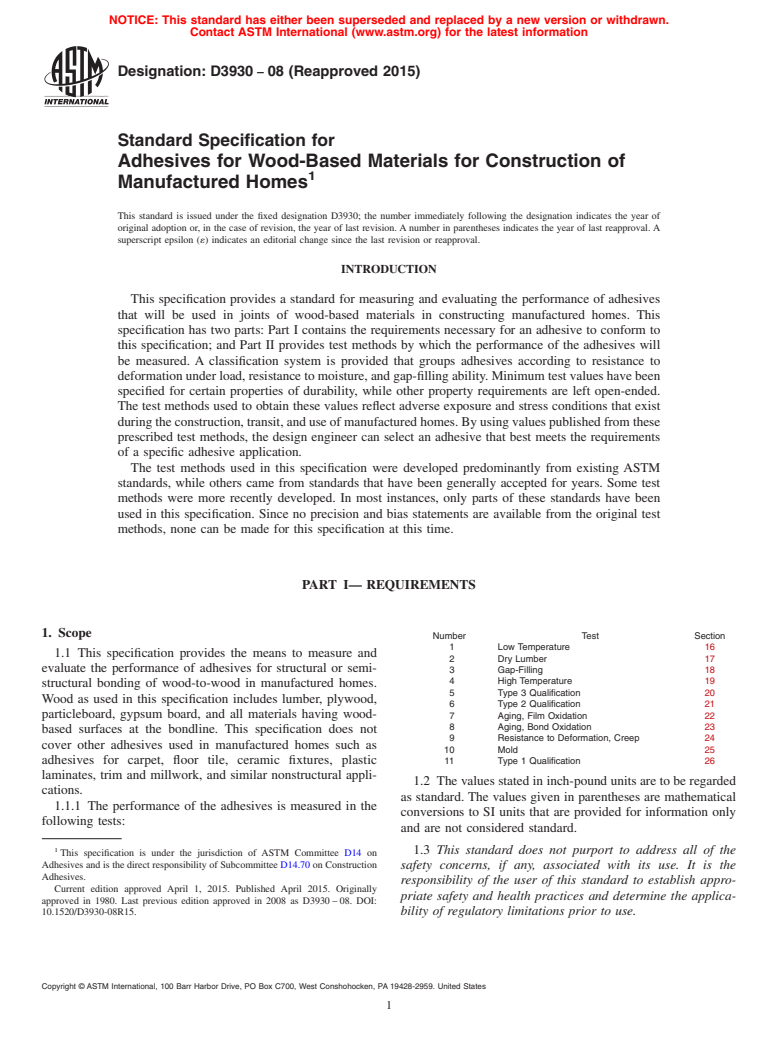
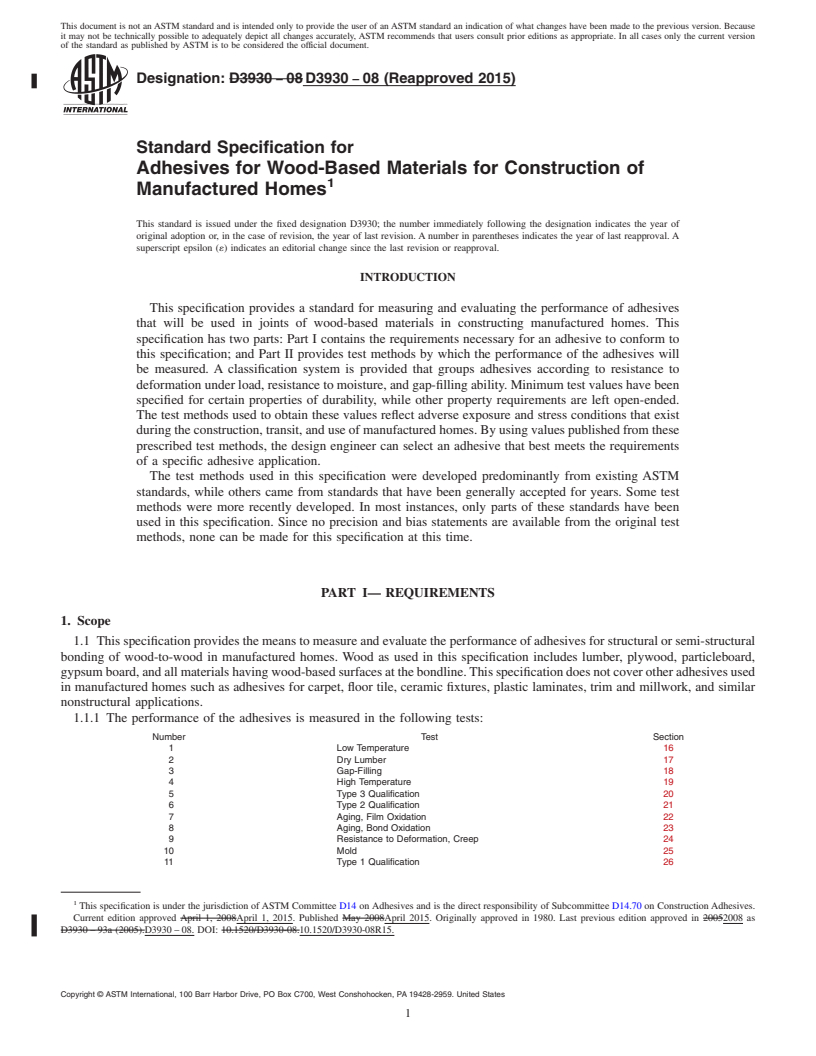
1.1.1 The performance of the adhesives is measured in the following tests:
Number
Test
Section
1
Low Temperature
16
2
Dry Lumber
17
3
Gap-Filling
18
4
High Temperature
19
5
Type 3 Qualification
20
6
Type 2 Qualification
21
7
Aging, Film Oxidation
22
8
Aging, Bond Oxidation
23
9
Resistance to Deformation, Creep
24
10
Mold
25
11
Type 1 Qualification
26
1.2 The values stated in inch-pound units are to be regarded as standard. The values given in parentheses are mathematical conversions to SI units that are provided for information only and are not considered standard.
1.3 This standard does not purport to address all of the safety concerns, if any, associated with its use. It is the responsibility of the user of this standard to establish appropriate safety and health practices and determine the applicability of regulatory limitations prior to use.
General Information
Buy Standard
Standards Content (Sample)
NOTICE: This standard has either been superseded and replaced by a new version or withdrawn.
Contact ASTM International (www.astm.org) for the latest information
Designation: D3930 − 08 (Reapproved 2015)
Standard Specification for
Adhesives for Wood-Based Materials for Construction of
Manufactured Homes
This standard is issued under the fixed designation D3930; the number immediately following the designation indicates the year of
original adoption or, in the case of revision, the year of last revision. A number in parentheses indicates the year of last reapproval. A
superscript epsilon (´) indicates an editorial change since the last revision or reapproval.
INTRODUCTION
This specification provides a standard for measuring and evaluating the performance of adhesives
that will be used in joints of wood-based materials in constructing manufactured homes. This
specification has two parts: Part I contains the requirements necessary for an adhesive to conform to
this specification; and Part II provides test methods by which the performance of the adhesives will
be measured. A classification system is provided that groups adhesives according to resistance to
deformation under load, resistance to moisture, and gap-filling ability. Minimum test values have been
specified for certain properties of durability, while other property requirements are left open-ended.
The test methods used to obtain these values reflect adverse exposure and stress conditions that exist
during the construction, transit, and use of manufactured homes. By using values published from these
prescribed test methods, the design engineer can select an adhesive that best meets the requirements
of a specific adhesive application.
The test methods used in this specification were developed predominantly from existing ASTM
standards, while others came from standards that have been generally accepted for years. Some test
methods were more recently developed. In most instances, only parts of these standards have been
used in this specification. Since no precision and bias statements are available from the original test
methods, none can be made for this specification at this time.
PART I— REQUIREMENTS
1. Scope
Number Test Section
1 Low Temperature 16
1.1 This specification provides the means to measure and
2 Dry Lumber 17
evaluate the performance of adhesives for structural or semi- 3 Gap-Filling 18
4 High Temperature 19
structural bonding of wood-to-wood in manufactured homes.
5 Type 3 Qualification 20
Wood as used in this specification includes lumber, plywood,
6 Type 2 Qualification 21
particleboard, gypsum board, and all materials having wood-
7 Aging, Film Oxidation 22
8 Aging, Bond Oxidation 23
based surfaces at the bondline. This specification does not
9 Resistance to Deformation, Creep 24
cover other adhesives used in manufactured homes such as
10 Mold 25
adhesives for carpet, floor tile, ceramic fixtures, plastic 11 Type 1 Qualification 26
laminates, trim and millwork, and similar nonstructural appli-
1.2 The values stated in inch-pound units are to be regarded
cations.
as standard. The values given in parentheses are mathematical
1.1.1 The performance of the adhesives is measured in the
conversions to SI units that are provided for information only
following tests:
and are not considered standard.
1.3 This standard does not purport to address all of the
This specification is under the jurisdiction of ASTM Committee D14 on
Adhesives and is the direct responsibility of Subcommittee D14.70 on Construction
safety concerns, if any, associated with its use. It is the
Adhesives.
responsibility of the user of this standard to establish appro-
Current edition approved April 1, 2015. Published April 2015. Originally
priate safety and health practices and determine the applica-
approved in 1980. Last previous edition approved in 2008 as D3930 – 08. DOI:
10.1520/D3930-08R15. bility of regulatory limitations prior to use.
Copyright © ASTM International, 100 Barr Harbor Drive, PO Box C700, West Conshohocken, PA 19428-2959. United States
D3930 − 08 (2015)
2. Referenced Documents or more in width or 40 body feet or more in length or when
2 erected on site, is 320 or more square feet and which is built on
2.1 ASTM Standards:
a permanent chassis and designed to be used as a dwelling with
A269 Specification for Seamless and Welded Austenitic
or without a permanent foundation when connected to the
Stainless Steel Tubing for General Service
required utilities, and includes the plumbing, heating, air-
A376/A376M Specification for Seamless Austenitic Steel
conditioning, and electrical systems contained therein. Calcu-
Pipe for High-Temperature Service
lations used to determine the number of square feet in a
D9 Terminology Relating to Wood and Wood-Based Prod-
structure will be based on the structure’s exterior dimensions
ucts
measured at the largest horizontal projections when erected on
D905 Test Method for Strength Properties of Adhesive
site. These dimensions will include all expandable rooms, bay
Bonds in Shear by Compression Loading
windows, cabinets, and other projections containing interior
D907 Terminology of Adhesives
space.
D1002 Test Method for Apparent Shear Strength of Single-
Lap-Joint Adhesively Bonded Metal Specimens by Ten- 3.2.2 semi-structural adhesive—an adhesive capable of
transferring required loads between adherends and which
sion Loading (Metal-to-Metal)
deforms a maximum of 0.050 in. (1.27 mm) under static load
D1165 Nomenclature of Commercial Hardwoods and Soft-
when tested in accordance with Test 9, Section 24.
woods
D2294 Test Method for Creep Properties of Adhesives in
3.2.3 structural adhesive—an adhesive capable of transfer-
Shear by Tension Loading (Metal-to-Metal)
ring required loads between adherends and which deforms a
D2339 Test Method for Strength Properties of Adhesives in
maximum of 0.006 in. (0.15 mm) under static load when tested
Two-Ply Wood Construction in Shear by Tension Loading
in accordance with Test 9, Section 24.
D3110 Specification for Adhesives Used in Laminate Joints
3.2.4 total deformation—the total dimensional change with
for Nonstructural Glued Lumber Products (Withdrawn
time of a material under constant load, and consisting of the
1996)
initial instantaneous elastic or rapid deformation and the slower
D3632 Test Method for Accelerated Aging of Adhesive
time dependent deformation or creep.
Joints by the Oxygen-Pressure Method
3.2.5 Type 1 adhesive—an adhesive that will retain its bond
D3931 Test Method for Determining Strength of Gap-Filling
integrity when the joint is repeatedly wetted and dried.
Adhesive Bonds in Shear by Compression Loading
3.2.6 Type 2 adhesive—an adhesive intended for use in
D4300 Test Methods for Ability of Adhesive Films to
Support or Resist the Growth of Fungi protected locations but that will maintain its bond integrity
E6 Terminology Relating to Methods of Mechanical Testing when the bond is subjected to occasional wetting.
E41 Terminology Relating To Conditioning
3.2.7 Type 3 adhesive—an adhesive intended for use in
interior locations, but that will maintain its bond integrity
3. Terminology
during conditions of high humidity.
3.1 Definitions:
NOTE 1—The following ASTM standards may be referred to for other
3.1.1 Many terms in this specification are defined in Termi-
terms used in this specification: D9, Terms Relating to Timber; D907,
nology D907.
Terms Relating to Adhesives; D1165, Nomenclature of Domestic Hard-
3.1.2 creep, n—in an adhesive, the time-dependent increase
woods and Softwoods; E6, Terms Relating to Methods of Mechanical
in strain resulting from a sustained stress.
Testing; and E41, Terms Relating to Conditioning.
3.1.3 gap-filling adhesive, n—an adhesive capable of form-
4. Classification
ing and maintaining a bond between surfaces that are not
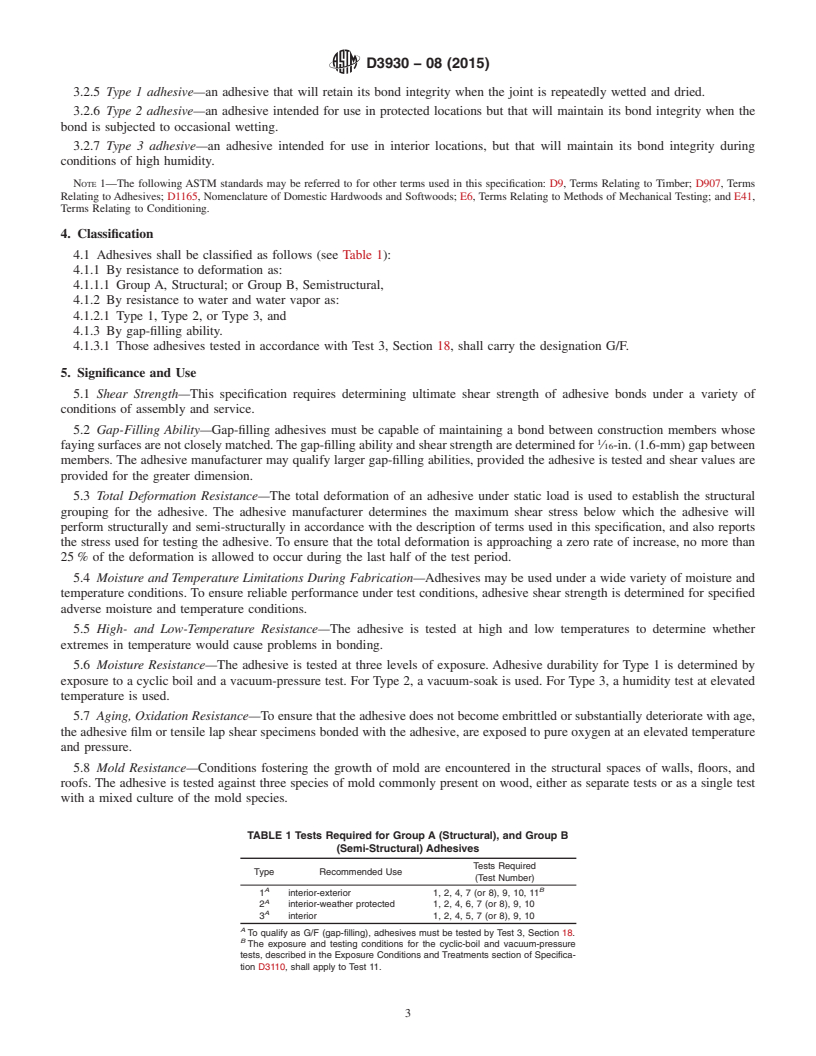
close-fitting. 4.1 Adhesives shall be classified as follows (see Table 1):
4.1.1 By resistance to deformation as:
3.1.3.1 Discussion—Close fitting is relative to a given
material and industry; for example, standards in construction 4.1.1.1 Group A, Structural; or Group B, Semistructural,
4.1.2 By resistance to water and water vapor as:
differ from standards in electronics. Some adhesives will bond
by bridging without completely filling the gap; others by filling 4.1.2.1 Type 1, Type 2, or Type 3, and
the gap completely. 4.1.3 By gap-filling ability.
3.2 Definitions of Terms Specific to This Standard:
3.2.1 manufactured home —a structure, transportable in
TABLE 1 Tests Required for Group A (Structural), and Group B
one or more sections which in the traveling mode is 8 body feet
(Semi-Structural) Adhesives
2 Tests Required
For referenced ASTM standards, visit the ASTM website, www.astm.org, or
Type Recommended Use
(Test Number)
contact ASTM Customer Service at service@astm.org. For Annual Book of ASTM
A B
1 interior-exterior 1, 2, 4, 7 (or 8), 9, 10, 11
Standards volume information, refer to the standard’s Document Summary page on
A
2 interior-weather protected 1, 2, 4, 6, 7 (or 8), 9, 10
the ASTM website.
A
3 interior 1, 2, 4, 5, 7 (or 8), 9, 10
The last approved version of this historical standard is referenced on
A
www.astm.org.
To qualify as G/F (gap-filling), adhesives must be tested by Test 3, Section 18.
B
This definition conforms to that of the U.S. Department of Housing and Urban
The exposure and testing conditions for the cyclic-boil and vacuum-pressure
Development (Manufactured Housing Construction and Safety Standards Act of
tests, described in the Exposure Conditions and Treatments section of Specifica-
1974 as amended in proposed rules in the Federal Register, Vol 48, No. 152, Aug. tion D3110, shall apply to Test 11.
7, 1981, pp. 40498 to 40500).
D3930 − 08 (2015)
4.1.3.1 Those adhesives tested in accordance with Test 3, 5.7 Aging, Oxidation Resistance—To ensure that the adhe-
Section 18, shall carry the designation G/F. sive does not become embrittled or substantially deteriorate
with age, the adhesive film or tensile lap shear specimens
5. Significance and Use
bonded with the adhesive, are exposed to pure oxygen at an
elevated temperature and pressure.
5.1 Shear Strength—This specification requires determining
ultimate shear strength of adhesive bonds under a variety of
5.8 Mold Resistance—Conditions fostering the growth of
conditions of assembly and service.
mold are encountered in the structural spaces of walls, floors,
and roofs. The adhesive is tested against three species of mold
5.2 Gap-Filling Ability—Gap-filling adhesives must be ca-
commonly present on wood, either as separate tests or as a
pable of maintaining a bond between construction members
single test with a mixed culture of the mold species.
whose faying surfaces are not closely matched. The gap-filling
ability and shear strength are determined for ⁄16-in. (1.6-mm)
6. Test Methods
gap between members. The adhesive manufacturer may qualify
larger gap-filling abilities, provided the adhesive is tested and
6.1 The tests required for compliance with this specification
shear values are provided for the greater dimension.
are given in Table 1.
5.3 Total Deformation Resistance—The total deformation of
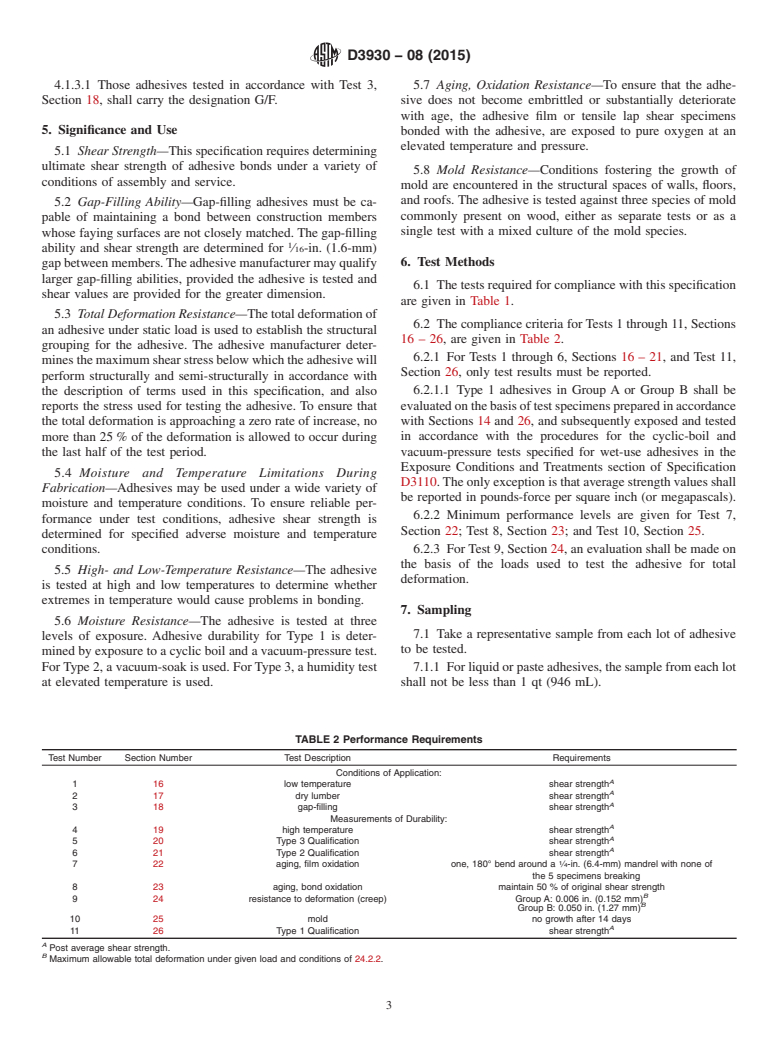
6.2 The compliance criteria for Tests 1 through 11, Sections
an adhesive under static load is used to establish the structural
16 – 26, are given in Table 2.
grouping for the adhesive. The adhesive manufacturer deter-
6.2.1 For Tests 1 through 6, Sections 16 – 21, and Test 11,
mines the maximum shear stress below which the adhesive will
Section 26, only test results must be reported.
perform structurally and semi-structurally in accordance with
6.2.1.1 Type 1 adhesives in Group A or Group B shall be
the description of terms used in this specification, and also
reports the stress used for testing the adhesive. To ensure that evaluated on the basis of test specimens prepared in accordance
with Sections 14 and 26, and subsequently exposed and tested
the total deformation is approaching a zero rate of increase, no
more than 25 % of the deformation is allowed to occur during in accordance with the procedures for the cyclic-boil and
vacuum-pressure tests specified for wet-use adhesives in the
the last half of the test period.
Exposure Conditions and Treatments section of Specification
5.4 Moisture and Temperature Limitations During
D3110. The only exception is that average strength values shall
Fabrication—Adhesives may be used under a wide variety of
be reported in pounds-force per square inch (or megapascals).
moisture and temperature conditions. To ensure reliable per-
6.2.2 Minimum performance levels are given for Test 7,
formance under test conditions, adhesive shear strength is
Section 22; Test 8, Section 23; and Test 10, Section 25.
determined for specified adverse moisture and temperature
conditions. 6.2.3 For Test 9, Section 24, an evaluation shall be made on
the basis of the loads used to test the adhesive for total
5.5 High- and Low-Temperature Resistance—The adhesive
deformation.
is tested at high and low temperatures to determine whether
extremes in temperature would cause problems in bonding.
7. Sampling
5.6 Moisture Resistance—The adhesive is tested at three
7.1 Take a representative sample from each lot of adhesive
levels of exposure. Adhesive durability for Type 1 is deter-
to be tested.
mined by exposure to a cyclic boil and a vacuum-pressure test.
For Type 2, a vacuum-soak is used. For Type 3, a humidity test 7.1.1 For liquid or paste adhesives, the sample from each lot
at elevated temperature is used. shall not be less than 1 qt (946 mL).
TABLE 2 Performance Requirements
Test Number Section Number Test Description Requirements
Conditions of Application:
A
1 16 low temperature shear strength
A
2 17 dry lumber shear strength
A
3 18 gap-filling shear strength
Measurements of Durability:
A
4 19 high temperature shear strength
A
5 20 Type 3 Qualification shear strength
A
6 21 Type 2 Qualification shear strength
7 22 aging, film oxidation one, 180° bend around a ⁄4-in. (6.4-mm) mandrel with none of
the 5 specimens breaking
8 23 aging, bond oxidation maintain 50 % of original shear strength
B
9 24 resistance to deformation (creep) Group A: 0.006 in. (0.152 mm)
B
Group B: 0.050 in. (1.27 mm)
10 25 mold no growth after 14 days
A
11 26 Type 1 Qualification shear strength
A
Post average shear strength.
B
Maximum allowable total deformation under given load and conditions of 24.2.2.
D3930 − 08 (2015)
TABLE 3 Summary of Shear Strength (lbf)
Repeatability Reproducibility
Repeatability Reproducibility
Average Δ
Standard Standard
Material, Adhesive Limit Limit
Deviation Deviation
sx¯d
(r) (R)
(Sr) (SR)
Plywood to Douglas Fir,
296 61 77 171 217
Adhesive A
Plywood to Douglas Fir,
567 86 258 242 723
Adhesive B
Plywood to Douglas Fir,
1367 262 446 735 1249
Adhesive C
TABLE
...
This document is not an ASTM standard and is intended only to provide the user of an ASTM standard an indication of what changes have been made to the previous version. Because
it may not be technically possible to adequately depict all changes accurately, ASTM recommends that users consult prior editions as appropriate. In all cases only the current version
of the standard as published by ASTM is to be considered the official document.
Designation: D3930 − 08 D3930 − 08 (Reapproved 2015)
Standard Specification for
Adhesives for Wood-Based Materials for Construction of
Manufactured Homes
This standard is issued under the fixed designation D3930; the number immediately following the designation indicates the year of
original adoption or, in the case of revision, the year of last revision. A number in parentheses indicates the year of last reapproval. A
superscript epsilon (´) indicates an editorial change since the last revision or reapproval.
INTRODUCTION
This specification provides a standard for measuring and evaluating the performance of adhesives
that will be used in joints of wood-based materials in constructing manufactured homes. This
specification has two parts: Part I contains the requirements necessary for an adhesive to conform to
this specification; and Part II provides test methods by which the performance of the adhesives will
be measured. A classification system is provided that groups adhesives according to resistance to
deformation under load, resistance to moisture, and gap-filling ability. Minimum test values have been
specified for certain properties of durability, while other property requirements are left open-ended.
The test methods used to obtain these values reflect adverse exposure and stress conditions that exist
during the construction, transit, and use of manufactured homes. By using values published from these
prescribed test methods, the design engineer can select an adhesive that best meets the requirements
of a specific adhesive application.
The test methods used in this specification were developed predominantly from existing ASTM
standards, while others came from standards that have been generally accepted for years. Some test
methods were more recently developed. In most instances, only parts of these standards have been
used in this specification. Since no precision and bias statements are available from the original test
methods, none can be made for this specification at this time.
PART I— REQUIREMENTS
1. Scope
1.1 This specification provides the means to measure and evaluate the performance of adhesives for structural or semi-structural
bonding of wood-to-wood in manufactured homes. Wood as used in this specification includes lumber, plywood, particleboard,
gypsum board, and all materials having wood-based surfaces at the bondline. This specification does not cover other adhesives used
in manufactured homes such as adhesives for carpet, floor tile, ceramic fixtures, plastic laminates, trim and millwork, and similar
nonstructural applications.
1.1.1 The performance of the adhesives is measured in the following tests:
Number Test Section
1 Low Temperature 16
2 Dry Lumber 17
3 Gap-Filling 18
4 High Temperature 19
5 Type 3 Qualification 20
6 Type 2 Qualification 21
7 Aging, Film Oxidation 22
8 Aging, Bond Oxidation 23
9 Resistance to Deformation, Creep 24
10 Mold 25
11 Type 1 Qualification 26
This specification is under the jurisdiction of ASTM Committee D14 on Adhesives and is the direct responsibility of Subcommittee D14.70 on Construction Adhesives.
Current edition approved April 1, 2008April 1, 2015. Published May 2008April 2015. Originally approved in 1980. Last previous edition approved in 20052008 as
D3930 – 93a (2005).D3930 – 08. DOI: 10.1520/D3930-08.10.1520/D3930-08R15.
Copyright © ASTM International, 100 Barr Harbor Drive, PO Box C700, West Conshohocken, PA 19428-2959. United States
D3930 − 08 (2015)
1.2 The values stated in inch-pound units are to be regarded as standard. The values given in parentheses are mathematical
conversions to SI units that are provided for information only and are not considered standard.
1.3 This standard does not purport to address all of the safety concerns, if any, associated with its use. It is the responsibility
of the user of this standard to establish appropriate safety and health practices and determine the applicability of regulatory
limitations prior to use.
2. Referenced Documents
2.1 ASTM Standards:
A269 Specification for Seamless and Welded Austenitic Stainless Steel Tubing for General Service
A376/A376M Specification for Seamless Austenitic Steel Pipe for High-Temperature Service
D9 Terminology Relating to Wood and Wood-Based Products
D905 Test Method for Strength Properties of Adhesive Bonds in Shear by Compression Loading
D907 Terminology of Adhesives
D1002 Test Method for Apparent Shear Strength of Single-Lap-Joint Adhesively Bonded Metal Specimens by Tension Loading
(Metal-to-Metal)
D1165 Nomenclature of Commercial Hardwoods and Softwoods
D2294 Test Method for Creep Properties of Adhesives in Shear by Tension Loading (Metal-to-Metal)
D2339 Test Method for Strength Properties of Adhesives in Two-Ply Wood Construction in Shear by Tension Loading
D3110 Specification for Adhesives Used in Laminate Joints for Nonstructural Glued Lumber Products (Withdrawn 1996)
D3632 Test Method for Accelerated Aging of Adhesive Joints by the Oxygen-Pressure Method
D3931 Test Method for Determining Strength of Gap-Filling Adhesive Bonds in Shear by Compression Loading
D4300 Test Methods for Ability of Adhesive Films to Support or Resist the Growth of Fungi
E6 Terminology Relating to Methods of Mechanical Testing
E41 Terminology Relating To Conditioning
3. Terminology
3.1 Definitions:
3.1.1 Many terms in this specification are defined in Terminology D907.
3.1.2 creep, n—in an adhesive, the time-dependent increase in strain resulting from a sustained stress.
3.1.3 gap-filling adhesive, n—an adhesive capable of forming and maintaining a bond between surfaces that are not close-fitting.
For referenced ASTM standards, visit the ASTM website, www.astm.org, or contact ASTM Customer Service at service@astm.org. For Annual Book of ASTM Standards
volume information, refer to the standard’sstandard’s Document Summary page on the ASTM website.
The last approved version of this historical standard is referenced on www.astm.org.
3.1.3.1 Discussion—
Close fitting is relative to a given material and industry; for example, standards in construction differ from standards in electronics.
Some adhesives will bond by bridging without completely filling the gap; others by filling the gap completely.
3.2 Definitions of Terms Specific to This Standard:
3.2.1 manufactured home —a structure, transportable in one or more sections which in the traveling mode is 8 body feet or more
in width or 40 body feet or more in length or when erected on site, is 320 or more square feet and which is built on a permanent
chassis and designed to be used as a dwelling with or without a permanent foundation when connected to the required utilities,
and includes the plumbing, heating, air-conditioning, and electrical systems contained therein. Calculations used to determine the
number of square feet in a structure will be based on the structure’s exterior dimensions measured at the largest horizontal
projections when erected on site. These dimensions will include all expandable rooms, bay windows, cabinets, and other
projections containing interior space.
3.2.2 semi-structural adhesive—an adhesive capable of transferring required loads between adherends and which deforms a
maximum of 0.050 in. (1.27 mm) under static load when tested in accordance with Test 9, Section 24.
3.2.3 structural adhesive—an adhesive capable of transferring required loads between adherends and which deforms a
maximum of 0.006 in. (0.15 mm) under static load when tested in accordance with Test 9, Section 24.
3.2.4 total deformation—the total dimensional change with time of a material under constant load, and consisting of the initial
instantaneous elastic or rapid deformation and the slower time dependent deformation or creep.
This definition conforms to that of the U.S. Department of Housing and Urban Development (Manufactured Housing Construction and Safety Standards Act of 1974
as amended in proposed rules in the Federal Register, Vol 48, No. 152, Aug. 7, 1981, pp. 40498 to 40500).
D3930 − 08 (2015)
3.2.5 Type 1 adhesive—an adhesive that will retain its bond integrity when the joint is repeatedly wetted and dried.
3.2.6 Type 2 adhesive—an adhesive intended for use in protected locations but that will maintain its bond integrity when the
bond is subjected to occasional wetting.
3.2.7 Type 3 adhesive—an adhesive intended for use in interior locations, but that will maintain its bond integrity during
conditions of high humidity.
NOTE 1—The following ASTM standards may be referred to for other terms used in this specification: D9, Terms Relating to Timber; D907, Terms
Relating to Adhesives; D1165, Nomenclature of Domestic Hardwoods and Softwoods; E6, Terms Relating to Methods of Mechanical Testing; and E41,
Terms Relating to Conditioning.
4. Classification
4.1 Adhesives shall be classified as follows (see Table 1):
4.1.1 By resistance to deformation as:
4.1.1.1 Group A, Structural; or Group B, Semistructural,
4.1.2 By resistance to water and water vapor as:
4.1.2.1 Type 1, Type 2, or Type 3, and
4.1.3 By gap-filling ability.
4.1.3.1 Those adhesives tested in accordance with Test 3, Section 18, shall carry the designation G/F.
5. Significance and Use
5.1 Shear Strength—This specification requires determining ultimate shear strength of adhesive bonds under a variety of
conditions of assembly and service.
5.2 Gap-Filling Ability—Gap-filling adhesives must be capable of maintaining a bond between construction members whose
faying surfaces are not closely matched. The gap-filling ability and shear strength are determined for ⁄16-in. (1.6-mm) gap between
members. The adhesive manufacturer may qualify larger gap-filling abilities, provided the adhesive is tested and shear values are
provided for the greater dimension.
5.3 Total Deformation Resistance—The total deformation of an adhesive under static load is used to establish the structural
grouping for the adhesive. The adhesive manufacturer determines the maximum shear stress below which the adhesive will
perform structurally and semi-structurally in accordance with the description of terms used in this specification, and also reports
the stress used for testing the adhesive. To ensure that the total deformation is approaching a zero rate of increase, no more than
25 % of the deformation is allowed to occur during the last half of the test period.
5.4 Moisture and Temperature Limitations During Fabrication—Adhesives may be used under a wide variety of moisture and
temperature conditions. To ensure reliable performance under test conditions, adhesive shear strength is determined for specified
adverse moisture and temperature conditions.
5.5 High- and Low-Temperature Resistance—The adhesive is tested at high and low temperatures to determine whether
extremes in temperature would cause problems in bonding.
5.6 Moisture Resistance—The adhesive is tested at three levels of exposure. Adhesive durability for Type 1 is determined by
exposure to a cyclic boil and a vacuum-pressure test. For Type 2, a vacuum-soak is used. For Type 3, a humidity test at elevated
temperature is used.
5.7 Aging, Oxidation Resistance—To ensure that the adhesive does not become embrittled or substantially deteriorate with age,
the adhesive film or tensile lap shear specimens bonded with the adhesive, are exposed to pure oxygen at an elevated temperature
and pressure.
5.8 Mold Resistance—Conditions fostering the growth of mold are encountered in the structural spaces of walls, floors, and
roofs. The adhesive is tested against three species of mold commonly present on wood, either as separate tests or as a single test
with a mixed culture of the mold species.
TABLE 1 Tests Required for Group A (Structural), and Group B
(Semi-Structural) Adhesives
Tests Required
Type Recommended Use
(Test Number)
A B
1 interior-exterior 1, 2, 4, 7 (or 8), 9, 10, 11
A
2 interior-weather protected 1, 2, 4, 6, 7 (or 8), 9, 10
A
3 interior 1, 2, 4, 5, 7 (or 8), 9, 10
A
To qualify as G/F (gap-filling), adhesives must be tested by Test 3, Section 18.
B
The exposure and testing conditions for the cyclic-boil and vacuum-pressure
tests, described in the Exposure Conditions and Treatments section of Specifica-
tion D3110, shall apply to Test 11.
D3930 − 08 (2015)
6. Test Methods
6.1 The tests required for compliance with this specification are given in Table 1.
6.2 The compliance criteria for Tests 1 through 11, Sections 16 – 26, are given in Table 2.
6.2.1 For Tests 1 through 6, Sections 16 – 21, and Test 11, Section 26, only test results must be reported.
6.2.1.1 Type 1 adhesives in Group A or Group B shall be evaluated on the basis of test specimens prepared in accordance with
Sections 14 and 26, and subsequently exposed and tested in accordance with the procedures for the cyclic-boil and
vacuum-pressure tests specified for wet-use adhesives in the Exposure Conditions and Treatments section of Specification D3110.
The only exception is that average strength values shall be reported in pounds-force per square inch (or megapascals).
6.2.2 Minimum performance levels are given for Test 7, Section 22; Test 8, Section 23; and Test 10, Section 25.
6.2.3 For Test 9, Section 24, an evaluation shall be made on the basis of the loads used to test the adhesive for total deformation.
7. Sampling
7.1 Take a representative sample from each lot of adhesive to be tested.
7.1.1 For liquid or paste adhesives, the sample from each lot shall not be less than 1 qt (946 mL).
7.1.2 For adhesives consisting of more than one part, take a sufficient sample of each part in order to prepare not less than 2
lb (908 g) of adhesive at the time of use.
7.1.3 For dry adhesives, the sample from each lot shall not be less than 2 lb (908 g).
7.2 Consult the adhesive manufacturer as to proper packing and handling of the sample.
8. Retest and Rejection
8.1 If the results of any initial test do not conform to the requirements prescribed in this specification, that test shall be repeated
on two additional sets of specimens from a new sample of the same lot of adhesive, each of which shall conform to the
requirements specified. If either of these two additional sets of specimens fail to meet the requirements, the lot or batch of material
shall be rejected.
9. Precision and Bias
9.1 Precision:
9.1.1 The precision of this test method is based on an interlaboratory study of Specification D3930 - 93a (2005), Test Number
4, High Tem
...
Questions, Comments and Discussion
Ask us and Technical Secretary will try to provide an answer. You can facilitate discussion about the standard in here.