

ASTM D6335-19
(Test Method)Standard Test Method for Determination of High Temperature Deposits by Thermo-Oxidation Engine Oil Simulation Test
General Information
- Abstract
SIGNIFICANCE AND USE
4.1 The test method is designed to predict the high temperature deposit forming tendencies of an engine oil subject to the added oxidizing stress of a turbocharger. This test method can be used to screen oil samples or as a quality assurance tool.
SCOPE
1.1 This test method covers the procedure to determine the amount of deposits formed by automotive engine oils utilizing the thermo-oxidation engine oil simulation test (TEOST2).3 An interlaboratory study (see Section 17) has determined it to be applicable over the range from 10 mg to 65 mg total deposits.
Note 1: Operational experience with the test method has shown the test method to be applicable to engine oils having deposits over the range from 2 mg to 180 mg total deposits.
1.2 The values stated in SI units are to be regarded as standard.
1.2.1 Milligrams (mg), grams (g), milliliters (mL), and liters are the units provided, because they are an industry accepted standard.
1.2.2 Exception—Pounds per square inch gauge (psig) is provided for information only in 6.2.
1.3 This standard does not purport to address all of the safety concerns, if any, associated with its use. It is the responsibility of the user of this standard to establish appropriate safety, health, and environmental practices and determine the applicability of regulatory limitations prior to use.
1.4 This international standard was developed in accordance with internationally recognized principles on standardization established in the Decision on Principles for the Development of International Standards, Guides and Recommendations issued by the World Trade Organization Technical Barriers to Trade (TBT) Committee.
- Status
- Published
- Publication Date
- 30-Nov-2019
- Technical Committee
- D02 - Petroleum Products, Liquid Fuels, and Lubricants
- Drafting Committee
- D02.09.0G - Oxidation Testing of Engine Oils
Buy Documents
ASTM D6335-19 - Standard Test Method for Determination of High Temperature Deposits by Thermo-Oxidation Engine Oil Simulation Test
REDLINE ASTM D6335-19 - Standard Test Method for Determination of High Temperature Deposits by Thermo-Oxidation Engine Oil Simulation Test
Overview
ASTM D6335-19, titled "Standard Test Method for Determination of High Temperature Deposits by Thermo-Oxidation Engine Oil Simulation Test," is an internationally recognized standard developed by ASTM International. This standard provides a method to evaluate the deposit-forming tendencies of automotive engine oils subjected to high-temperature, oxidizing conditions typical of those found in turbocharged engines. The test simulates severe engine conditions by accelerating oxidation and thermal degradation, generating data to help predict oil performance and resistance to deposit formation.
The test method primarily uses the Thermo-Oxidation Engine Oil Simulation Test (TEOST) to measure the amount of rod and filter deposits produced by engine oils. These deposits are critical indicators of oil stability and cleanliness, particularly in high-stress environments such as turbochargers.
Key Topics
- Purpose: Assessing an oil's potential to form high-temperature deposits under controlled oxidation and pyrolysis conditions.
- Test Procedure: Simulates turbocharger environments by circulating oil over a resistively heated rod, introducing air and nitrous oxide, and subjecting the oil to specific temperature cycles.
- Measurement: Quantifies total deposits in milligrams (mg), including both those formed on the test rod and captured by a multi-layer filter.
- Applicability: Suitable for automotive engine oils with deposit formation ranging operationally from 2 mg to 180 mg.
- Quality Assurance: Useful as a screening tool or for quality assurance in formulation and production of lubricants.
Applications
- Engine Oil Development: Enables formulators and manufacturers to compare the deposit control performance of various engine oils, facilitating optimization for modern engines, especially those with turbochargers.
- Quality Control: Implements a standardized, repeatable approach in manufacturing environments to ensure consistency and performance of engine oil batches.
- Specification Compliance: Assists stakeholders, including oil blenders and automakers, in verifying compliance with industry specifications where high-temperature deposit control is critical.
- Research and Development: Provides a reliable testing method for evaluating new additive technologies or base stock modifications.
- Troubleshooting and Field Support: Offers a tool for investigating engine oil-related field issues, such as turbocharger or piston ring deposition.
Related Standards
For comprehensive evaluation and consistent quality, several related ASTM standards and guidelines may be referenced alongside ASTM D6335-19:
- ASTM D6593: Standard Test Method for Evaluation of Automotive Engine Oils in the Sequence VG Spark-Ignition Engine
- ASTM D7583: Standard Test Method for Evaluation of Automotive Engine Oils in the Sequence IIIG, Spark-Ignition Engine
- ASTM D4310: Standard Test Method for Determination of the Sludging and Corrosion Tendencies of Inhibited Mineral Oils
- SAE J300: Engine Oil Viscosity Classification
- API and ILSAC Engine Oil Categories: Specifications regarding performance in deposit control and oxidation resistance
Practical Value
- Engine Protection: Reduces risk of deposit-related engine failures by ensuring engine oils meet rigorous deposit control standards.
- Extended Oil Life: Supports the production and use of oils capable of maintaining performance over extended drain intervals, even in demanding turbocharged applications.
- Regulatory Compliance: Aligns with internationally recognized principles, supporting global trade and acceptance of tested engine oils.
- Market Confidence: Provides end-users and manufacturers with transparent, quantitative data on high-temperature deposit control-an essential factor for modern engine longevity and efficiency.
Keywords: ASTM D6335-19, engine oil deposits, thermo-oxidation, TEOST, high temperature, turbocharger, oil simulation test, oxidation testing, lubricant quality control, automotive oil testing.
Relations
- Effective Date
- 01-Dec-2019
- Referred By
ASTM D4485-22e1 - Standard Specification for Performance of Active API Service Category Engine Oils - Effective Date
- 01-Dec-2019
- Effective Date
- 01-Dec-2019
Buy Documents
ASTM D6335-19 - Standard Test Method for Determination of High Temperature Deposits by Thermo-Oxidation Engine Oil Simulation Test
REDLINE ASTM D6335-19 - Standard Test Method for Determination of High Temperature Deposits by Thermo-Oxidation Engine Oil Simulation Test
Get Certified
Connect with accredited certification bodies for this standard

Element Materials Technology
Materials testing and product certification.

ABS Group Brazil
ABS Group certification services in Brazil.

ABS Quality Evaluations Inc.
American Bureau of Shipping quality certification.
Sponsored listings
Frequently Asked Questions
ASTM D6335-19 is a standard published by ASTM International. Its full title is "Standard Test Method for Determination of High Temperature Deposits by Thermo-Oxidation Engine Oil Simulation Test". This standard covers: SIGNIFICANCE AND USE 4.1 The test method is designed to predict the high temperature deposit forming tendencies of an engine oil subject to the added oxidizing stress of a turbocharger. This test method can be used to screen oil samples or as a quality assurance tool. SCOPE 1.1 This test method covers the procedure to determine the amount of deposits formed by automotive engine oils utilizing the thermo-oxidation engine oil simulation test (TEOST2).3 An interlaboratory study (see Section 17) has determined it to be applicable over the range from 10 mg to 65 mg total deposits. Note 1: Operational experience with the test method has shown the test method to be applicable to engine oils having deposits over the range from 2 mg to 180 mg total deposits. 1.2 The values stated in SI units are to be regarded as standard. 1.2.1 Milligrams (mg), grams (g), milliliters (mL), and liters are the units provided, because they are an industry accepted standard. 1.2.2 Exception—Pounds per square inch gauge (psig) is provided for information only in 6.2. 1.3 This standard does not purport to address all of the safety concerns, if any, associated with its use. It is the responsibility of the user of this standard to establish appropriate safety, health, and environmental practices and determine the applicability of regulatory limitations prior to use. 1.4 This international standard was developed in accordance with internationally recognized principles on standardization established in the Decision on Principles for the Development of International Standards, Guides and Recommendations issued by the World Trade Organization Technical Barriers to Trade (TBT) Committee.
SIGNIFICANCE AND USE 4.1 The test method is designed to predict the high temperature deposit forming tendencies of an engine oil subject to the added oxidizing stress of a turbocharger. This test method can be used to screen oil samples or as a quality assurance tool. SCOPE 1.1 This test method covers the procedure to determine the amount of deposits formed by automotive engine oils utilizing the thermo-oxidation engine oil simulation test (TEOST2).3 An interlaboratory study (see Section 17) has determined it to be applicable over the range from 10 mg to 65 mg total deposits. Note 1: Operational experience with the test method has shown the test method to be applicable to engine oils having deposits over the range from 2 mg to 180 mg total deposits. 1.2 The values stated in SI units are to be regarded as standard. 1.2.1 Milligrams (mg), grams (g), milliliters (mL), and liters are the units provided, because they are an industry accepted standard. 1.2.2 Exception—Pounds per square inch gauge (psig) is provided for information only in 6.2. 1.3 This standard does not purport to address all of the safety concerns, if any, associated with its use. It is the responsibility of the user of this standard to establish appropriate safety, health, and environmental practices and determine the applicability of regulatory limitations prior to use. 1.4 This international standard was developed in accordance with internationally recognized principles on standardization established in the Decision on Principles for the Development of International Standards, Guides and Recommendations issued by the World Trade Organization Technical Barriers to Trade (TBT) Committee.
ASTM D6335-19 is classified under the following ICS (International Classification for Standards) categories: 75.100 - Lubricants, industrial oils and related products. The ICS classification helps identify the subject area and facilitates finding related standards.
ASTM D6335-19 has the following relationships with other standards: It is inter standard links to ASTM D6335-18, ASTM D4485-22e1, ASTM D7097-19. Understanding these relationships helps ensure you are using the most current and applicable version of the standard.
ASTM D6335-19 is available in PDF format for immediate download after purchase. The document can be added to your cart and obtained through the secure checkout process. Digital delivery ensures instant access to the complete standard document.
Standards Content (Sample)
This international standard was developed in accordance with internationally recognized principles on standardization established in the Decision on Principles for the
Development of International Standards, Guides and Recommendations issued by the World Trade Organization Technical Barriers to Trade (TBT) Committee.
Designation: D6335 − 19
Standard Test Method for
Determination of High Temperature Deposits by Thermo-
Oxidation Engine Oil Simulation Test
This standard is issued under the fixed designation D6335; the number immediately following the designation indicates the year of
original adoption or, in the case of revision, the year of last revision.Anumber in parentheses indicates the year of last reapproval.A
superscript epsilon (´) indicates an editorial change since the last revision or reapproval.
1. Scope* 2.1.1 ceramic isolator, n—the fitting that compresses the
O-ring into the depositor rod casing and isolates the depositor
1.1 This test method covers the procedure to determine the
rod casing from the voltage applied to the depositor rod.
amount of deposits formed by automotive engine oils utilizing
2 3
2.1.2 depositor rod , n—a patented, specially made,
thethermo-oxidationengineoilsimulationtest(TEOST ). An
numbered, and registered steel rod (used once for each test) on
17) has determined it to be
interlaboratory study (see Section
whichthedepositsarecollected.Itisresistivelyheatedthrough
applicable over the range from 10mg to 65mg total deposits.
a series of twelve temperature cycles during the test to
NOTE 1—Operational experience with the test method has shown the
temperatures established and controlled by a thermocouple
test method to be applicable to engine oils having deposits over the range
inserted to a pre-determined depth in the hollow rod.
from 2mg to 180mg total deposits.
2.1.3 depositor rod casing, n—the sleeve that surrounds the
1.2 The values stated in SI units are to be regarded as
depositor rod and allows the flow of the test oil up and around
standard.
the outside of the rod at a flow rate such that every volume
1.2.1 Milligrams(mg),grams(g),milliliters(mL),andliters
element of the test oil is exposed to the same heating cycle.
are the units provided, because they are an industry accepted
2.1.4 drain tube, n—the tube connecting the upper outlet of
standard.
the depositor rod casing to the reaction chamber.
1.2.2 Exception—Pounds per square inch gauge (psig) is
provided for information only in 6.2.
2.1.5 end cap, n—the fitting to tighten the ceramic isolators
onto the O-rings at both ends of the depositor rod casing.
1.3 This standard does not purport to address all of the
safety concerns, if any, associated with its use. It is the 2.1.6 filter deposits, n—the mass in milligrams of the
responsibility of the user of this standard to establish appro-
deposits collected after test on a special multi-layer filter
priate safety, health, and environmental practices and deter- cartridge used once for each test.
mine the applicability of regulatory limitations prior to use.
2.1.7 pump, n—the gear pump that is used to control the
1.4 This international standard was developed in accor-
flow rate of the test oil through the depositor rod casing.
dance with internationally recognized principles on standard-
2.1.8 pump inlet tube, n—the tube connecting the reactor
ization established in the Decision on Principles for the
chamber to the pump.
Development of International Standards, Guides and Recom-
2.1.9 pump outlet tube, n—the tube connecting the pump to
mendations issued by the World Trade Organization Technical
the depositor rod casing.
Barriers to Trade (TBT) Committee.
2.1.10 reactor chamber, n—the heated reservoir that con-
2. Terminology tainsthebulk(approximately100mL)ofthe116mLoftestoil
sample circulated past the deposit rod during the test. The
2.1 Definitions of Terms Specific to This Standard:
reactor is equipped with a magnetic stir-bar to continuously
mix the chamber contents.
1 2.1.10.1 Discussion—In the reaction chamber, moist air and
This test method is under the jurisdiction of ASTM Committee D02 on
Petroleum Products, Liquid Fuels, and Lubricantsand is the direct responsibility of nitrous oxide are each bubbled at a controlled rate of
Subcommittee D02.09.0G on Oxidation Testing of Engine Oils.
3.5mL⁄min through a channel opening at the bottom of the
Current edition approved Dec. 1, 2019. Published January 2020. Originally
approved in 1998. Last previous edition approved in 2018 as D6335 – 18. DOI:
10.1520/D6335-19.
2 4
TEOST is a trademark of the Tannas Co. (Reg. 2001396), Tannas Company, The sole source of supply of the apparatus known to the committee at this time
4800 James Savage Rd., Midland, MI 48642. is Tannas Co., 4800 James Savage Rd., Midland, MI 48642. If you are aware of
The Development of Thermo-Oxidation Engine Oil Simulation Test (TEOST), alternative suppliers, please provide this information to ASTM International
Society of Automotive Engineers (SAE No. 932837), 400 Commonwealth Dr., Headquarters.Your comments will receive careful consideration at a meeting of the
Warrendale, PA 15096-0001. responsible technical committee, which you may attend.
*A Summary of Changes section appears at the end of this standard
Copyright © ASTM International, 100 Barr Harbor Drive, PO Box C700, West Conshohocken, PA 19428-2959. United States
D6335 − 19
FIG. 1 Thermo-oxidation Engine Oil Simulation Test (TEOST)
reaction chamber.This channel is also used to drain the test oil 200°Cto480°C.Whenthetwelve-cycleprogramiscomplete,
from the reaction chamber for filtration when the test is thedepositorrodisrinsedofoilresidueanddriedandthegross
completed. rod mass obtained. The remaining test oil sample, including
2.1.11 rod deposits, n—the mass, in milligrams, of the washing from the deposit rod, is flushed from the system and
deposits collected on the depositor rod. filtered through a tared filter. The mass of deposits on the rod
plus the mass of deposits on the filter is the total deposit mass.
2.1.12 rod O-rings, n—the O-rings that seal the outside of
the rod and the depositor rod casing to prevent sample leaks.
4. Significance and Use
2.1.13 side nut, n—the fitting creates a seal to prevent
4.1 Thetestmethodisdesignedtopredictthehightempera-
sampleleakingfromthefrontholesofthedepositorrodcasing.
ture deposit forming tendencies of an engine oil subject to the
2.1.14 thermocouple lock collar, n—afittingthattightenson
added oxidizing stress of a turbocharger. This test method can
the thermocouple to ensure the thermocouple is at the correct
be used to screen oil samples or as a quality assurance tool.
depth when placed inside the rod.
5. Apparatus
2.1.15 total deposits, n—the rod deposits plus the filter
deposits.
5.1 Thermo-oxidation engine oil simulation test (TEOST)
test instrument. See Fig. 1.
3. Summary of Test Method
5.2 Balance, capable of weighing to the nearest 0.1mg.
3.1 A116mLsample of the engine oil to be tested contain-
5.3 Vacuum Source, hand held, floor model, or house
ing 100mg⁄kg ferric naphthenate is put into the reaction
chamber and heated and stirred at a temperature of 100°C. vacuum.
Nitrousoxideandmoistairareinjectedfromabottomchannel
5.4 Magnetic stirrer and stir bars.
opening, each at a flow rate of 3.5mL⁄min. This catalyzed oil
5.5 Digital timer.
is pumped past a tared depositor rod that is resistively heated
through twelve, 9.5min temperature cycles that go from 5.6 Petroleum and temperature resistant O-rings.
D6335 − 19
6.3 Ferric Naphthenate—Six percent iron content in min-
eral spirits.
6.4 Cyclohexane, Heptane, or Other Alkane Hydrocarbon
Solvent of Equivalent Volatility—Reagent grade. (Warning—
Flammable.) Cyclohexane is the only allowed naphthenic
hydrocarbon. Do no use other naphthenic or any aromatic
hydrocarbons. Throughout the further description of the test,
the solvent selected is referred to as “hydrocarbon solvent.”
6.4.1 The volatility of the hydrocarbon solvent selected
should ensure timely evaporation from the deposits on the rod
and filter. In general, the higher the purity of the solvent, the
FIG. 2 Weighing Boat and Rod
more quickly the solvent should evaporate.
6.5 Low Deposit Reference Oil—CG-1 reference oil is a
petroleum oil capable of generating total deposits with a target
5.7 Ceramic isolators. inthe20mgto30mgrange.Thedeposittargetandacceptable
range of a specific lot is provided by the supplier of that lot.
5.8 Filtering Flask—1000mL.
6.6 Intermediate Deposit Reference Oil—T33C-1 reference
5.9 Graduated Filter Funnel—500mL with Luer lock fit-
oil is a petroleum oil capable of generating total deposits with
ting.
a target in the 50mg to 60mg range. The deposit target and
5.10 Graduated Cylinder—150mL.
acceptable range of a specific lot is provided by the supplier of
5.11 Beakers—Onesmall(forexample,25mL).Onebeaker that lot.
large enough to clean the depositor rod casing (for example, 4
6.7 Pump Calibration Fluid—TPC.
600mL).
5.12 Graduated Cylinder—10mL.
7. Calibration
5.13 Erlenmeyer Flask—50mL.
7.1 The TEOST instrument is calibrated by performing the
procedure described in Section 8.At that point, either a low or
5.14 Adjustable hex wrench.
intermediatedepositreferenceoilshallberun.Theresultsshall
5.15 Pipe Cleaners—3mm × 304.8mm.
be within the repeatability limits established by the supplier of
5.16 Steel Wool—4/0 (ultra fine).
the reference oils.
5.17 Brass Brush—0.22 caliber (5.588mm).
7.2 The calibration should be performed a minimum of
every six months, as recommended by the instrument manu-
5.18 Glass Syringe—100µL. (Optional—Acalibrated pipet
facturer.
can also be used with chemically inert disposable tips.)
5.19 One-piece disposable multi-layer cartridge filters. 7.3 If the repeatability is not within the established limits,
the instrument setup steps in Section 8 should be performed.
5.20 Flow Meters—capable of measuring 0mL⁄min to
Then the reference oil should be rerun.
10mL⁄min of gas.
5.21 Weighing Boat—light, circular or oblong open
8. Setup of the Test Instrument
container, preferably made of aluminum with a diameter or
8.1 Pump Speed Calibration—The pump speed should be
length of approximately 7cm to 10cm and notched in two
calibrated using the instructions found in the operations
diametrically opposed places to prevent the rod from rolling
manual. It is recommended that this calibration be done every
(seeFig.2)orasuitableweighingdevicecapableofpreventing
six months.
the rod from rolling and from losing any deposits.
8.2 Thermocouple Depth—The thermocouple depth setting
5.22 Wire Rod—a clean, thin (about 1mm diameter), some-
(distance from tip to locking collar) should be determined
what flexible, stainless steel wire rod (approximately 150mm
usingtheprocedureintheoperationsmanual.Thedepthsetting
in length) for dislodging any deposits adhering to the filter
should be checked daily and should be redetermined whenever
funnel walls into the filter cartridge.
a new thermocouple is installed.
6. Reagents and Materials
8.3 Thermocouple Calibration—The thermocouple shall be
calibratedeverysixmonthsorwhenreplaced.Thiscanbedone
6.1 Nitrous Oxide(N O)—Compressedgascylinder,99.6%
by placing the thermocouple into a liquid or sand bath while
purity or higher.
simultaneously measuring the temperature by a certified liquid
6.2 Moist Air—Hydrocarbon-free air regulated to 103.4kPa
ordigitalthermometer.Thetemperaturecontrollermaythenbe
(15psig) before entering the flow meter and then bubbled
offset to display the correct temperature.
through approximately 30mL of water in a small Erlenmeyer
flask before combining with the nitrous oxide and entering the 8.4 Flow Calibration—Ensure the proper operation of the
reaction chamber. flow meters by connecting a digital flow meter to the output.
D6335 − 19
TABLE 1 Temperature Program
10. Sample Preparation
Program Mode Value
10.1 Invert both the catalyst vial and the test sample
Set point 0 200 °C
container at least three times to ensure homogeneity of both
Time 1 1.15 min
Set point 1 200 °C
components prior to use. After thoroughly mixing the test
Time 2 1.00 min
sample, use a graduated cylinder to measure 116mL 61mL
Set point 2 480 °C
of the fluid and pour it into a large beaker until only drips are
Time 3 2.00 min
Set point 3 480 °C
coming from the graduated cylinder. After thoroughly mixing
Time 4 4.00 min
the catalyst, use a glass syringe or an optional calibrated pipet
Set point 4 200 °C
Time 5 1.15 min to add 193µL 6 1µL of the approximately 6% ferric
Set point 5 200 °C
naphthenate solution to the 116mL of test fluid. The resulting
Time 6 0 min
concentration of iron in the test fluid will be about 100mg⁄kg.
Cycles 12.00
10.2 Use a magnetic bar and stirrer to mix the oil and ferric
naphthenate for at least 5min but not more than 15min. Make
certain that a vortex is not created. Periodically move the
The flow for the air shall be 3.5mL⁄min 6 1mL⁄min and the
beakeraroundthestirrer(hencemovingthemagnetaroundthe
N O flow shall be 3.5mL⁄min 6 1mL⁄min.
2 bottom) to ensure the best possible stirring.
8.5 PID Settings—The PID settings on the temperature
10.3 After the stirring is completed, inspect the oil solution
controller MUST be set to the specified settings for a specific
byholdingituptoalighttomakesureitishomogenous.Ifnot,
controller. Consult the individual unit operations manual for
stir for 5min more.
further guidance.
11. Procedure
8.6 Power Adjustments—This procedure, used only for
instruments made prior to 1999, is for making power adjust-
11.1 When the reaction chamber is 100°C 6 5°C, pour the
ments and is given in the operations manual. It is recom-
test sample, along with the stirrer bar, into the reaction
mended that the power adjustments be made by a qualified
chamber. Using the speed dial on the right side of the
instrument technician.
instrument, turn on the stirrer. Older instruments have a stirrer
8.7 Verify that the temperature program shown in Table 1 is control versus a switch; this control must be set so that the
entered. When verifying the temperature program, always be stirrerisonbutavortexisnotformed.Thesampletemperature
sure NOT to select guaranteed or assured soak. should reach 100°C in approximately 15min.
11.2 Set the pump speed to 999, using the dial on the front
9. Assembly of Apparatus
panel of the instrument.Allow the pump to flush out 10mLof
9.1 Assemble the TEOST system by placing the reaction
fluid into the 10mLgraduated cylinder placed at the open end
chamberintheboltseatsontheTEOSTplatformwiththedrain
of the pump outlet tube. When flushing is complete, set the
and gas inlet tubing facing the right side of the instrument.
pump dial to 000 to stop the pump. Discard the 10mL of oil.
9.2 Connect the pump inlet tube to the outlet connection of
11.3 Use hydrocarbon solvent to rinse off an unused rod,
the reaction chamber and the inlet connection of the pump.
both on the outside and down the center. Clean each of the
Finger tighten the connections.
threesectionsoftherodlightlywith4/0steelwoolbystroking
(up and down action) each section 20 times while turning the
9.3 Connectthepumpoutlettubetotheoutletconnectionof
rod. Rinse the rod with acetone inside and out. Using a pipe
thepump,andplacea10mLgraduatedcylinderdirectlyunder
cleaner soaked in acetone, clean the interior of the rod. Repeat
the open end of the pump outlet tube.
the interior cleaning with a clean pipe cleaner through the rod
9.4 Place the lid containing the thermocouple on the reac-
in the opposite direction. Dry the rod with a vacuum or
tion chamber, making sure that the thermocouple is touching
blowing dry air while holding the rod between the thumb and
the bottom of the reaction chamber.
index finger. Make sure to dry the center of the rod as well.
9.5 Wrap the heating jacket around the reaction chamber
Handle the rod as little as possible to avoid adding mass from
and secure it with the provided straps. Connect the heating
oils on the skin and be sure not to set the rod down until after
jacket and the thermocouple to the labeled connections on the
a mass is take
...
This document is not an ASTM standard and is intended only to provide the user of an ASTM standard an indication of what changes have been made to the previous version. Because
it may not be technically possible to adequately depict all changes accurately, ASTM recommends that users consult prior editions as appropriate. In all cases only the current version
of the standard as published by ASTM is to be considered the official document.
Designation: D6335 − 18 D6335 − 19
Standard Test Method for
Determination of High Temperature Deposits by Thermo-
Oxidation Engine Oil Simulation Test
This standard is issued under the fixed designation D6335; the number immediately following the designation indicates the year of
original adoption or, in the case of revision, the year of last revision. A number in parentheses indicates the year of last reapproval. A
superscript epsilon (´) indicates an editorial change since the last revision or reapproval.
1. Scope*
1.1 This test method covers the procedure to determine the amount of deposits formed by automotive engine oils utilizing the
2 3
thermo-oxidation engine oil simulation test (TEOST ). An interlaboratory study (see Section 17) has determined it to be
applicable over the range from 10 mg to 65 mg total deposits.
NOTE 1—Operational experience with the test method has shown the test method to be applicable to engine oils having deposits over the range from
2 mg to 180 mg total deposits.
1.2 The values stated in SI units are to be regarded as standard.
1.2.1 Milligrams (mg), grams (g), milliliters (mL), and liters are the units provided, because they are an industry accepted
standard.
1.2.2 Exception—Pounds per square inch gauge (psig) is provided for information only in 6.2.
1.3 This standard does not purport to address all of the safety concerns, if any, associated with its use. It is the responsibility
of the user of this standard to establish appropriate safety, health, and environmental practices and determine the applicability of
regulatory limitations prior to use.
1.4 This international standard was developed in accordance with internationally recognized principles on standardization
established in the Decision on Principles for the Development of International Standards, Guides and Recommendations issued
by the World Trade Organization Technical Barriers to Trade (TBT) Committee.
2. Terminology
2.1 Definitions of Terms Specific to This Standard:
2.1.1 ceramic isolator, n—the fitting that compresses the O-ring into the depositor rod casing and isolates the depositor rod
casing from the voltage applied to the depositor rod.
2.1.2 depositor rod , n—a patented, specially made, numbered, and registered steel rod (used once for each test) on which the
deposits are collected. It is resistively heated through a series of twelve temperature cycles during the test to temperatures
established and controlled by a thermocouple inserted to a pre-determined depth in the hollow rod.
2.1.3 depositor rod casing, n—the sleeve that surrounds the depositor rod and allows the flow of the test oil up and around the
outside of the rod at a flow rate such that every volume element of the test oil is exposed to the same heating cycle.
2.1.4 drain tube, n—the tube connecting the upper outlet of the depositor rod casing to the reaction chamber.
2.1.5 end cap, n—the fitting to tighten the ceramic isolators onto the O-rings at both ends of the depositor rod casing.
2.1.6 filter deposits, n—the mass in milligrams of the deposits collected after test on a special multi-layer filter cartridge used
once for each test.
2.1.7 pump, n—the gear pump that is used to control the flow rate of the test oil through the depositor rod casing.
This test method is under the jurisdiction of ASTM Committee D02 on Petroleum Products, Liquid Fuels, and Lubricantsand is the direct responsibility of Subcommittee
D02.09.0G on Oxidation Testing of Engine Oils.
Current edition approved June 1, 2018Dec. 1, 2019. Published July 2018January 2020. Originally approved in 1998. Last previous edition approved in 20162018 as D6335
– 16.18. DOI: 10.1520/D6335-18.10.1520/D6335-19.
TEOST is a trademark of the Tannas Co. (Reg. 2001396), Tannas Company, 4800 James Savage Rd., Midland, MI 48642.
The Development of Thermo-Oxidation Engine Oil Simulation Test (TEOST), Society of Automotive Engineers (SAE No. 932837), 400 Commonwealth Dr., Warrendale,
PA 15096-0001.
The sole source of supply of the apparatus known to the committee at this time is Tannas Co., 4800 James Savage Rd., Midland, MI 48642. If you are aware of alternative
suppliers, please provide this information to ASTM International Headquarters. Your comments will receive careful consideration at a meeting of the responsible technical
committee, which you may attend.
*A Summary of Changes section appears at the end of this standard
Copyright © ASTM International, 100 Barr Harbor Drive, PO Box C700, West Conshohocken, PA 19428-2959. United States
D6335 − 19
2.1.8 pump inlet tube, n—the tube connecting the reactor chamber to the pump.
2.1.9 pump outlet tube, n—the tube connecting the pump to the depositor rod casing.
2.1.10 reactor chamber, n—the heated reservoir that contains the bulk (approximately 100 mL) of the 116 mL of test oil sample
circulated past the deposit rod during the test. The reactor is equipped with a magnetic stir-bar to continuously mix the chamber
contents.
2.1.10.1 Discussion—
In the reaction chamber, moist air and nitrous oxide are each bubbled at a controlled rate of 3.5 mL ⁄min through a channel opening
at the bottom of the reaction chamber. This channel is also used to drain the test oil from the reaction chamber for filtration when
the test is completed.
2.1.11 rod deposits, n—the mass, in milligrams, of the deposits collected on the depositor rod.
2.1.12 rod O-rings, n—the O-rings that seal the outside of the rod and the depositor rod casing to prevent sample leaks.
2.1.13 side nut, n—the fitting creates a seal to prevent sample leaking from the front holes of the depositor rod casing.
2.1.14 thermocouple lock collar, n—a fitting that tightens on the thermocouple to ensure the thermocouple is at the correct depth
when placed inside the rod.
2.1.15 total deposits, n—the rod deposits plus the filter deposits.
3. Summary of Test Method
3.1 A 116 mL sample of the engine oil to be tested containing 100 mg ⁄kg ferric naphthenate is put into the reaction chamber
and heated and stirred at a temperature of 100 °C. Nitrous oxide and moist air are injected from a bottom channel opening, each
at a flow rate of 3.5 mL ⁄min. This catalyzed oil is pumped past a tared depositor rod that is resistively heated through twelve,
9.5 min temperature cycles that go from 200 °C to 480 °C. When the twelve-cycle program is complete, the depositor rod is rinsed
of oil residue and dried and the gross rod mass obtained. The remaining test oil sample, including washing from the deposit rod,
is flushed from the system and filtered through a tared filter. The mass of deposits on the rod plus the mass of deposits on the filter
is the total deposit mass.
4. Significance and Use
4.1 The test method is designed to predict the high temperature deposit forming tendencies of an engine oil subject to the added
oxidizing stress of a turbocharger. This test method can be used to screen oil samples or as a quality assurance tool.
5. Apparatus
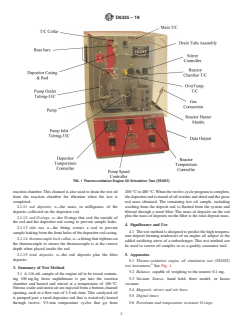
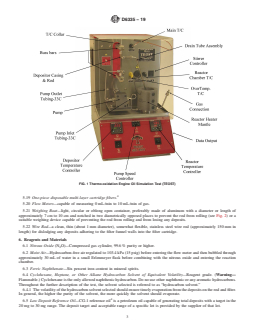
5.1 Thermo-oxidation engine oil simulation test (TEOST) test instrument. See Fig. 1.
5.2 Balance, capable of weighing to the nearest 0.1 mg.
5.3 Vacuum Source, hand held, floor model, or house vacuum.
5.4 Magnetic stirrer and stir bars.
5.5 Digital timer.
5.6 Petroleum and temperature resistant O-rings.
5.7 Ceramic isolators.
5.8 Filtering Flask—1000 mL.
5.9 Graduated Filter Funnel—500 mL with Luer lock fitting.
5.10 Graduated Cylinder—150 mL.
5.11 Beakers—One small (for example, 25 mL). One beaker large enough to clean the depositor rod casing (for example,
600 mL).
5.12 Graduated Cylinder—10 mL.
5.13 Erlenmeyer Flask—50 mL.
5.14 Adjustable hex wrench.
5.15 Pipe Cleaners—3 mm × 304.8 mm.
5.16 Steel Wool—4/0 (ultra fine).
5.17 Brass Brush—0.22 caliber (5.588 mm).
5.18 Glass Syringe—100 μL. (Optional—A calibrated pipet can also be used with chemically inert disposable tips.)
D6335 − 19
FIG. 1 Thermo-oxidation Engine Oil Simulation Test (TEOST)
5.19 One-piece disposable multi-layer cartridge filters.
5.20 Flow Meters—capable of measuring 0 mL ⁄min to 10 mL ⁄min of gas.
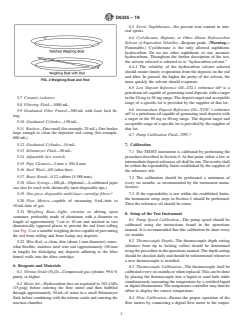
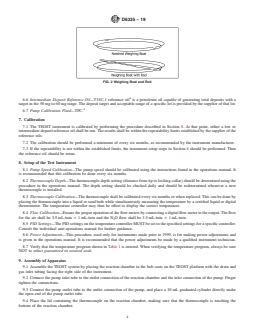
5.21 Weighing Boat—light, circular or oblong open container, preferably made of aluminum with a diameter or length of
approximately 7 cm to 10 cm and notched in two diametrically opposed places to prevent the rod from rolling (see Fig. 2) or a
suitable weighing device capable of preventing the rod from rolling and from losing any deposits.
5.22 Wire Rod—a clean, thin (about 1 mm diameter), somewhat flexible, stainless steel wire rod (approximately 150 mm in
length) for dislodging any deposits adhering to the filter funnel walls into the filter cartridge.
6. Reagents and Materials
6.1 Nitrous Oxide (N O)—Compressed gas cylinder, 99.6 % purity or higher.
6.2 Moist Air—Hydrocarbon-free air regulated to 103.4 kPa (15 psig) before entering the flow meter and then bubbled through
approximately 30 mL of water in a small Erlenmeyer flask before combining with the nitrous oxide and entering the reaction
chamber.
6.3 Ferric Naphthenate—Six percent iron content in mineral spirits.
6.4 Cyclohexane, Heptane, or Other Alkane Hydrocarbon Solvent of Equivalent Volatility—Reagent grade. (Warning—
Flammable.) Cyclohexane is the only allowed naphthenic hydrocarbon. Do no use other naphthenic or any aromatic hydrocarbons.
Throughout the further description of the test, the solvent selected is referred to as “hydrocarbon solvent.”
6.4.1 The volatility of the hydrocarbon solvent selected should ensure timely evaporation from the deposits on the rod and filter.
In general, the higher the purity of the solvent, the more quickly the solvent should evaporate.
6.5 Low Deposit Reference Oil—CG-1 reference oil is a petroleum oil capable of generating total deposits with a target in the
20 mg to 30 mg range. The deposit target and acceptable range of a specific lot is provided by the supplier of that lot.
D6335 − 19
FIG. 2 Weighing Boat and Rod
6.6 Intermediate Deposit Reference Oil—T33C-1 reference oil is a petroleum oil capable of generating total deposits with a
target in the 50 mg to 60 mg range. The deposit target and acceptable range of a specific lot is provided by the supplier of that lot.
6.7 Pump Calibration Fluid—TPC.
7. Calibration
7.1 The TEOST instrument is calibrated by performing the procedure described in Section 8. At that point, either a low or
intermediate deposit reference oil shall be run. The results shall be within the repeatability limits established by the supplier of the
reference oils.
7.2 The calibration should be performed a minimum of every six months, as recommended by the instrument manufacturer.
7.3 If the repeatability is not within the established limits, the instrument setup steps in Section 8 should be performed. Then
the reference oil should be rerun.
8. Setup of the Test Instrument
8.1 Pump Speed Calibration—The pump speed should be calibrated using the instructions found in the operations manual. It
is recommended that this calibration be done every six months.
8.2 Thermocouple Depth—The thermocouple depth setting (distance from tip to locking collar) should be determined using the
procedure in the operations manual. The depth setting should be checked daily and should be redetermined whenever a new
thermocouple is installed.
8.3 Thermocouple Calibration—The thermocouple shall be calibrated every six months or when replaced. This can be done by
placing the thermocouple into a liquid or sand bath while simultaneously measuring the temperature by a certified liquid or digital
thermometer. The temperature controller may then be offset to display the correct temperature.
8.4 Flow Calibration—Ensure the proper operation of the flow meters by connecting a digital flow meter to the output. The flow
for the air shall be 3.5 mL ⁄min 6 1 mL ⁄min and the N O flow shall be 3.5 mL ⁄min 6 1 mL ⁄min.
8.5 PID Settings—The PID settings on the temperature controller MUST be set to the specified settings for a specific controller.
Consult the individual unit operations manual for further guidance.
8.6 Power Adjustments—This procedure, used only for instruments made prior to 1999, is for making power adjustments and
is given in the operations manual. It is recommended that the power adjustments be made by a qualified instrument technician.
8.7 Verify that the temperature program shown in Table 1 is entered. When verifying the temperature program, always be sure
NOT to select guaranteed or assured soak.
9. Assembly of Apparatus
9.1 Assemble the TEOST system by placing the reaction chamber in the bolt seats on the TEOST platform with the drain and
gas inlet tubing facing the right side of the instrument.
9.2 Connect the pump inlet tube to the outlet connection of the reaction chamber and the inlet connection of the pump. Finger
tighten the connections.
9.3 Connect the pump outlet tube to the outlet connection of the pump, and place a 10 mL graduated cylinder directly under
the open end of the pump outlet tube.
9.4 Place the lid containing the thermocouple on the reaction chamber, making sure that the thermocouple is touching the
bottom of the reaction chamber.
D6335 − 19
TABLE 1 Temperature Program
Program Mode Value
Set point 0 200 °C
Time 1 1.15 min
Set point 1 200 °C
Time 2 1.00 min
Set point 2 480 °C
Time 3 2.00 min
Set point 3 480 °C
Time 4 4.00 min
Set point 4 200 °C
Time 5 1.15 min
Set point 5 200 °C
Time 6 0 min
Cycles 12.00
9.5 Wrap the heating jacket around the reaction chamber and secure it with the provided straps. Connect the heating jacket and
the thermocouple to the labeled connections on the back wall of the instrument. The connectors shall be inserted and twisted to
obtain a proper connection. Use the reactor temperature controller to set the temperature of the reaction chamber to 100 °C.
9.6 Connect the gas tubing to the reaction chamber, and set the flow meters for the moist air and N O to 3.5 mL ⁄min 6
1 mL ⁄min. These are allowed to flow to purge out the lines before the test begins.
NOTE 2—Be sure the valve on the reaction chamber is pointing up to allow the gases to enter into the chamber.
10. Sample Preparation
10.1 Invert both the catalyst vial and the test sample container at least three times to ensure homogeneity of both components
prior to use. After thoroughly mixing the test sample, use a graduated cylinder to measure 116 mL 6 1 mL of the fluid and pour
it into a large beaker until only drips are coming from the graduated cylinder. After thoroughly mixing the catalyst, use a glass
syringe or an optional calibrated pipet to add 193 μL 6 1 μL of the approximately 6 % ferric naphthenate solution to the 116 mL
of test fluid. The resulting concentration of iron in the test fluid will be about 100 mg ⁄kg.
10.2 Use a magnetic bar and stirrer to mix the oil and ferric naphthenate for at least 5 min but not more than 15 min. Make
certain that a vortex is not created. Periodically move the beaker around the stirrer (hence moving the magnet around the bottom)
to ensure the best possible stirring.
10.3 After the stirring is completed, inspect the oil solution by holding it up to a light to make sure it is homogenous. If not,
stir for 5 min more.
11. Procedure
11.1 When the reaction chamber is 100 °C 6 5 °C, pour the test sample, along with the stirrer bar, into the reaction chamber.
Using the speed dial on the right side of the instrument, turn on the stirrer. Older instruments have a stirrer control versus a switch;
this control must be set so that the stirrer is on but a vortex is not formed. The sample temperature should reach 100 °C in
approximately 15 min.
11.2 Set the pump speed to 999, using the dial on the front panel of the instrument. Allow the pump to flush out 10 mL of fluid
into the 10 mL graduated cylinder placed at the open end of the pump outlet tube. When flushing is complete, set the pump dial
to 000 to stop the pump. Discard the 10 mL of oil.
11.3 Use hydrocarbon solvent to rinse off an unused rod, both on the outside and down the center. Clean each of the three
sections of the rod lightly with 4/0 steel wool by stroking (up and down action) each section 20 times while turning the rod. Rinse
the rod with acetone inside and out
...