

ASTM E2175-01(2021)
(Practice)Standard Practice for Specifying the Geometry of Multiangle Spectrophotometers
General Information
- Abstract
SIGNIFICANCE AND USE
4.1 This practice is for the use of manufacturers and users of instruments to measure the appearance of gonioapparent materials, those writing standard specifications for such instruments, and others who wish to specify precisely the geometric conditions of multiangle spectrophotometry. A prominent example of industrial usage is the routine application of such measurements by material suppliers and automobile manufacturers to measure the colors of metallic paints and plastics.
SCOPE
1.1 This practice provides a way of specifying the angular and spatial conditions of measurement and angular selectivity of a method of measuring the spectral reflectance factors of opaque gonioapparent materials, for a small number of sets of geometric conditions.
1.2 Measurements to characterize the appearance of retroreflective materials are of such a special nature that they are treated in other ASTM documents and are not included in the scope of this standard.
1.3 This standard does not purport to address all of the safety concerns, if any, associated with its use. It is the responsibility of the user of this standard to establish appropriate safety, health, and environmental practices and determine the applicability of regulatory limitations prior to use.
1.4 This international standard was developed in accordance with internationally recognized principles on standardization established in the Decision on Principles for the Development of International Standards, Guides and Recommendations issued by the World Trade Organization Technical Barriers to Trade (TBT) Committee.
- Status
- Published
- Publication Date
- 30-Sep-2021
- Technical Committee
- E12 - Color and Appearance
- Drafting Committee
- E12.03 - Geometry
Overview
ASTM E2175-01(2021), Standard Practice for Specifying the Geometry of Multiangle Spectrophotometers, provides a structured approach for manufacturers, users, and specifiers to precisely define the angular and spatial measurement conditions of multiangle spectrophotometers. These instruments play a critical role in objectively quantifying the appearance of gonioapparent materials-materials whose optical appearance changes with angle, such as metallic paints, plastics, certain textiles, and materials containing pearlescent or interference pigments.
This standard highlights best practices for the geometric description and measurement setup of spectrophotometers used in industries like automotive manufacturing, material supply, and coatings, where accurate color and appearance evaluation is essential.
Key Topics
- Geometry Specification: The practice provides detailed guidelines for specifying the angular orientation (influx and efflux angles), spatial configuration, and angular selectivity of multiangle spectrophotometry measurements.
- Instrument Configurations: Defines four key geometric configurations for measurement:
- Uniplanar
- Annular
- Circumferential
- Diffuse
- Sampling Aperture: Details on selecting and defining the sampling aperture (either circular or rectangular) and its spatial position in the measurement setup for reproducibility and accuracy.
- Directional Illumination and Viewing: Differentiates between standard conical/pyramidal illumination versus diffuse setups, ensuring clear reporting and standardization.
- Angular Tolerances and Selectivity: Offers methods to specify and maintain tolerances for angular positions, uniformity of illumination, and measurement repeatability.
Applications
ASTM E2175 is widely applicable in contexts where the visual appearance of a material depends strongly on observation and illumination angles. Notable industry sectors include:
- Automotive Manufacturing: For routine measurement and quality control of metallic and pearlescent paints and finishes, ensuring consistent appearance under varying viewing angles.
- Material Suppliers and Coatings Producers: Enables suppliers to provide objective, standardized characterization data for metallic or specialty effect pigments to their customers.
- Plastic Manufacturing: Used for assessing colored and effect-laden plastics that show color shift with angle, important for consumer electronics, packaging, and decorative objects.
- Research and Development: Laboratories and institutions developing or testing new materials needing rigorous, comparable appearance data.
- Quality Assurance: Ensures that all stakeholders use consistent methods to measure and specify the visual characteristics of gonioapparent materials, reducing disputes and variability in results.
Related Standards
ASTM E2175 references and complements several other ASTM standards for appearance and color measurement:
- ASTM E284 – Terminology of Appearance
Supports standardized vocabulary for describing appearance attributes. - ASTM E308 – Practice for Computing the Colors of Objects by Using the CIE System
Provides guidance for colorimetric calculations. - ASTM E1164 – Practice for Obtaining Spectrometric Data for Object-Color Evaluation
Covers requirements for collecting accurate spectrometric data. - ASTM E1767 – Practice for Specifying the Geometries of Observation and Measurement to Characterize the Appearance of Materials
Gives broader guidance on specifying measurement geometries beyond multiangle spectrophotometry.
Note: The standard specifically excludes retroreflective materials from its scope, as their unique properties are addressed in other ASTM documentation.
Summary
ASTM E2175-01(2021) ensures user confidence in multiangle spectrophotometer measurement results by providing a clear, unified framework for specifying instrument geometry and tolerances. Its adoption supports accurate, repeatable appearance measurements for gonioapparent materials, benefiting industries focused on high-quality surface finishing and color consistency.
Keywords: multiangle spectrophotometry, geometry specification, gonioapparent materials, metallic paint measurement, color quality control, appearance standards, ASTM E2175, spectrophotometer configuration, material appearance, color measurement standards.
Relations
- Refers
ASTM E1164-23 - Standard Practice for Obtaining Spectrometric Data for Object-Color Evaluation - Effective Date
- 01-Nov-2023
- Effective Date
- 01-May-2017
- Effective Date
- 01-Apr-2015
- Effective Date
- 01-Nov-2013
- Effective Date
- 01-Jun-2013
- Effective Date
- 01-Jan-2013
- Refers
ASTM E1164-12 - Standard Practice for Obtaining Spectrometric Data for Object-Color Evaluation - Effective Date
- 01-Jul-2012
- Refers
ASTM E1164-12e1 - Standard Practice for Obtaining Spectrometric Data for Object-Color Evaluation - Effective Date
- 01-Jul-2012
- Effective Date
- 01-Jul-2012
- Effective Date
- 01-Jul-2012
- Effective Date
- 01-Nov-2011
- Effective Date
- 01-Jun-2009
- Refers
ASTM E1164-09a - Standard Practice for Obtaining Spectrometric Data for Object-Color Evaluation - Effective Date
- 01-Jun-2009
- Refers
ASTM E1164-09 - Standard Practice for Obtaining Spectrometric Data for Object-Color Evaluation - Effective Date
- 15-Feb-2009
- Effective Date
- 01-Jan-2009
Get Certified
Connect with accredited certification bodies for this standard

BSMI (Bureau of Standards, Metrology and Inspection)
Taiwan's standards and inspection authority.
Sponsored listings
Frequently Asked Questions
ASTM E2175-01(2021) is a standard published by ASTM International. Its full title is "Standard Practice for Specifying the Geometry of Multiangle Spectrophotometers". This standard covers: SIGNIFICANCE AND USE 4.1 This practice is for the use of manufacturers and users of instruments to measure the appearance of gonioapparent materials, those writing standard specifications for such instruments, and others who wish to specify precisely the geometric conditions of multiangle spectrophotometry. A prominent example of industrial usage is the routine application of such measurements by material suppliers and automobile manufacturers to measure the colors of metallic paints and plastics. SCOPE 1.1 This practice provides a way of specifying the angular and spatial conditions of measurement and angular selectivity of a method of measuring the spectral reflectance factors of opaque gonioapparent materials, for a small number of sets of geometric conditions. 1.2 Measurements to characterize the appearance of retroreflective materials are of such a special nature that they are treated in other ASTM documents and are not included in the scope of this standard. 1.3 This standard does not purport to address all of the safety concerns, if any, associated with its use. It is the responsibility of the user of this standard to establish appropriate safety, health, and environmental practices and determine the applicability of regulatory limitations prior to use. 1.4 This international standard was developed in accordance with internationally recognized principles on standardization established in the Decision on Principles for the Development of International Standards, Guides and Recommendations issued by the World Trade Organization Technical Barriers to Trade (TBT) Committee.
SIGNIFICANCE AND USE 4.1 This practice is for the use of manufacturers and users of instruments to measure the appearance of gonioapparent materials, those writing standard specifications for such instruments, and others who wish to specify precisely the geometric conditions of multiangle spectrophotometry. A prominent example of industrial usage is the routine application of such measurements by material suppliers and automobile manufacturers to measure the colors of metallic paints and plastics. SCOPE 1.1 This practice provides a way of specifying the angular and spatial conditions of measurement and angular selectivity of a method of measuring the spectral reflectance factors of opaque gonioapparent materials, for a small number of sets of geometric conditions. 1.2 Measurements to characterize the appearance of retroreflective materials are of such a special nature that they are treated in other ASTM documents and are not included in the scope of this standard. 1.3 This standard does not purport to address all of the safety concerns, if any, associated with its use. It is the responsibility of the user of this standard to establish appropriate safety, health, and environmental practices and determine the applicability of regulatory limitations prior to use. 1.4 This international standard was developed in accordance with internationally recognized principles on standardization established in the Decision on Principles for the Development of International Standards, Guides and Recommendations issued by the World Trade Organization Technical Barriers to Trade (TBT) Committee.
ASTM E2175-01(2021) is classified under the following ICS (International Classification for Standards) categories: 17.180.30 - Optical measuring instruments. The ICS classification helps identify the subject area and facilitates finding related standards.
ASTM E2175-01(2021) has the following relationships with other standards: It is inter standard links to ASTM E1164-23, ASTM E308-17, ASTM E308-15, ASTM E284-13b, ASTM E284-13a, ASTM E284-13, ASTM E1164-12, ASTM E1164-12e1, ASTM E308-12, ASTM E284-12, ASTM E1767-11, ASTM E284-09a, ASTM E1164-09a, ASTM E1164-09, ASTM E284-09. Understanding these relationships helps ensure you are using the most current and applicable version of the standard.
ASTM E2175-01(2021) is available in PDF format for immediate download after purchase. The document can be added to your cart and obtained through the secure checkout process. Digital delivery ensures instant access to the complete standard document.
Standards Content (Sample)
This international standard was developed in accordance with internationally recognized principles on standardization established in the Decision on Principles for the
Development of International Standards, Guides and Recommendations issued by the World Trade Organization Technical Barriers to Trade (TBT) Committee.
Designation:E2175 −01 (Reapproved 2021)
Standard Practice for
Specifying the Geometry of Multiangle Spectrophotometers
This standard is issued under the fixed designation E2175; the number immediately following the designation indicates the year of
original adoption or, in the case of revision, the year of last revision. A number in parentheses indicates the year of last reapproval. A
superscript epsilon (´) indicates an editorial change since the last revision or reapproval.
INTRODUCTION
The appearance of metallic coatings and plastics usually depends on the directions of illumination
and viewing, a phenomenon called “gonioappearance.” This phenomenon is also observed with other
materials, such as lustrous textiles and materials containing pearlescent or interference pigments. The
characteristic appearance of most such materials is accentuated by directional illumination, such as
that provided by the sun on a clear day or a small lamp at night. The variation in color, as a function
of geometry, is usually measured by spectrophotometry with several specified sets of geometric
conditions. Measurement of this kind, at a few selected angles, is called “multiangle
spectrophotometry,” as distinguished from measurement over a broad range of angles, which is called
“goniospectrophotometry.” Spectrophotometric aspects of these measurements, including spectral
resolution and linearity of photometric scales, are treated in other standards, including Practice E308
and Practice E1164. Practice E1767 provides practice for specifying the geometry of measurements.
Retroreflectors exhibit a special kind of gonioappearance, which is treated in otherASTM documents.
The present document provides standard practice for specifying influx and efflux angles, angular
selectivity, spatial distributions of illuminators and receivers, and angular aspects of standardizing the
photometric scale, that are peculiar to multiangle spectrophotometry. Directional illumination
emphasizes the gonioappearance of most materials, but when interference pigments are used, such as
those used in ink to mark paper currency, the effect is observed with diffuse illumination and varying
angles of viewing, so these materials are also measured with diffuse illumination.
1. Scope ization established in the Decision on Principles for the
Development of International Standards, Guides and Recom-
1.1 This practice provides a way of specifying the angular
mendations issued by the World Trade Organization Technical
and spatial conditions of measurement and angular selectivity
Barriers to Trade (TBT) Committee.
of a method of measuring the spectral reflectance factors of
opaque gonioapparent materials, for a small number of sets of
2. Referenced Documents
geometric conditions.
2.1 ASTM Standards:
1.2 Measurements to characterize the appearance of retrore-
E284 Terminology of Appearance
flective materials are of such a special nature that they are
E308 PracticeforComputingtheColorsofObjectsbyUsing
treated in other ASTM documents and are not included in the
the CIE System
scope of this standard.
E1164 PracticeforObtainingSpectrometricDataforObject-
1.3 This standard does not purport to address all of the Color Evaluation
safety concerns, if any, associated with its use. It is the E1767 Practice for Specifying the Geometries of Observa-
responsibility of the user of this standard to establish appro- tion and Measurement to Characterize the Appearance of
priate safety, health, and environmental practices and deter- Materials
mine the applicability of regulatory limitations prior to use.
3. Terminology
1.4 This international standard was developed in accor-
3.1 Fordefinitionsofappearancetermsusedinthispractice,
dance with internationally recognized principles on standard-
refer to Terminology E284.
This practice is under the jurisdiction of ASTM Committee E12 on Color and
Appearance and is the direct responsibility of Subcommittee E12.03 on Geometry. For referenced ASTM standards, visit the ASTM website, www.astm.org, or
Current edition approved Oct. 1, 2021. Published October 2021. Originally contact ASTM Customer Service at service@astm.org. For Annual Book of ASTM
approved in 2001. Last previous edition approved in 2013 as E2175 – 01 (2013). Standards volume information, refer to the standard’s Document Summary page on
DOI: 10.1520/E2175-01R21. the ASTM website.
Copyright © ASTM International, 100 Barr Harbor Drive, PO Box C700, West Conshohocken, PA 19428-2959. United States
E2175−01 (2021)
4. Significance and Use Angles subtended at the origin and measured from that normal
are called “anormal angles.” The specular direction is the
4.1 Thispracticeisfortheuseofmanufacturersandusersof
direction of the beam from a directional illuminator after
instruments to measure the appearance of gonioapparent
specular reflection by an ideal plane mirror at the sampling
materials, those writing standard specifications for such
aperture.Anglessubtendedattheoriginandmeasuredfromthe
instruments, and others who wish to specify precisely the
specular direction are called“ aspecular angles” and are posi-
geometric conditions of multiangle spectrophotometry. A
tive in sign when measured in the direction toward the normal.
prominent example of industrial usage is the routine applica-
The normal and the axis of a directional illuminator define a
tion of such measurements by material suppliers and automo-
plane, known as the “plane of incidence.” The specular
bile manufacturers to measure the colors of metallic paints and
direction necessarily lies in that plane.
plastics.
6.1.1 To facilitate simple and precise geometric specifica-
5. Components of Apparatus tion of the sampling aperture, it shall be either circular or
rectangular.
5.1 The apparatus shall consist of one or more illuminators
6.1.2 To facilitate simple and precise geometric specifica-
and one or more spectrometric receivers at fixed or adjustable
tion of directional influx or efflux distributions, they shall be
angles with respect to a reference plane, a means of positioning
either conical or pyramidal. For purposes of describing geom-
specimens in a reference plane, a means of indicating the area
etry by functional notation, a diffuse distribution may be
on the specimen to be measured, shielding to avoid stray light,
considered a conical distribution centered on the normal and
and a means of displaying spectral or colorimetric data and/or
having a half angle of 90 degrees.
communicating such data to a data-recorder or computer. (The
6.1.3 In a uniplanar configuration, a directional illuminator
terms “light,” “illuminator,” “illumination,” and “illuminance”
is used, the axes of the receivers lie in the plane of incidence,
are used here for simplicity, though the corresponding terms
and their positions are specified by aspecular angles. A
“radiant power,” “irradiator,” “irradiation,” and “irradiance”
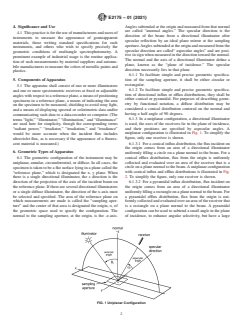
uniplanar configuration is illustrated in Fig. 1. To simplify the
would be more accurate when the incident flux includes
figure, only one receiver is shown.
ultraviolet flux, as is necessary if the appearance of a fluores-
cent material is measured.) 6.1.3.1 For a conical influx distribution, the flux incident on
the origin comes from an area of a directional illuminator
6. Geometric Types of Apparatus
uniformly filling a circle on a plane normal to the beam. For a
conical efflux distribution, flux from the origin is uniformly
6.1 The geometric configuration of the instrument may be
collected and evaluated over an area of the receiver that is a
uniplanar, annular, circumferential, or diffuse. In all cases, the
circle on a plane normal to the beam.Auniplanar configuration
specimen is taken to be a flat surface lying in a plane called the
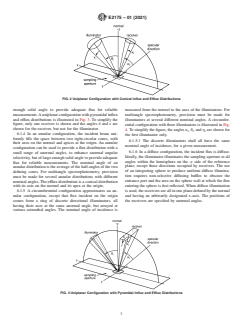
with conical influx and efflux distributions is illustrated in Fig.
“reference plane,” which is designated the x, y plane. When
2. To simplify the figure, only one receiver is shown.
there is a single directional illuminator, the x direction is the
direction of the projection of the axis of the incident beam on 6.1.3.2 For a pyramidal influx distribution, flux incident on
the reference plane. If there are several directional illuminators the origin comes from an area of a directional illuminator
or a single diffuse illuminator, the direction of the x-axis must uniformlyfillingarectangleonaplanenormaltothebeam.For
be selected and specified. The area of the reference plane on a pyramidal efflux distribution, flux from the origin is uni-
which measurements are made is called the “sampling aper- formly collected and evaluated over an area of the receiver that
ture” and the center of that area is designated the origin, o, of is a rectangle on a plane normal to the beam. A pyramidal
the geometric space used to specify the configuration. The configuration can be used to subtend a small angle in the plane
normal to the sampling aperture, at the origin, is the -z-axis. of incidence, to enhance angular selectivity, but have a large
FIG. 1 Uniplanar Configuration
E2175−01 (2021)
FIG. 2 Uniplanar Configuration with Conical Influx and Efflux Distributions
enough solid angle to provide adequate flux for reliable measured from the normal to the axes of the illuminators. For
measurements.Auniplanarconfigurationwithpyramidalinflux
multiangle spectrophotometry, provision must be made for
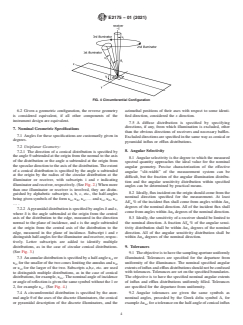
and efflux distributions is illustrated in Fig. 3. To simplify the
illuminators at several different nominal angles. A circumfer-
figure, only one receiver is shown and the angles δ and ε are
ential configuration with three illuminators is illustrated in Fig.
shown for the receiver, but not for the illuminator.
4. To simplify the figure, the angles κ, θ, and η are shown for
i i i
6.1.4 In an annular configuration, the incident beam uni-
the first illuminator only.
formly fills the space between two right-circular cones, with
6.1.5.1 The discrete illuminators shall all have the same
their axes on the normal and apices at the origin. An annular
nominal angle of incidence, for a given measurement.
configuration can be used to provide a flux distribution with a
6.1.6 In a diffuse configuration, the incident flux is diffuse.
small range of anormal angles, to enhance anormal angular
Ideally, the illuminator illuminates the sampling
...