

ASTM E2387-19
(Practice)Standard Practice for Goniometric Optical Scatter Measurements
General Information
- Abstract
SIGNIFICANCE AND USE
4.1 The angular distribution of scatter is a property of surfaces that may have direct consequences on an intermediate or final application of that surface. Scatter defines many visual appearance attributes of materials, and specification of the distribution and wavelength dependence is critical to the marketability of consumer products, such as automobiles, cosmetics, and electronics. Optically diffusive materials are used in information display applications to spread light from display elements to the viewer, and the performance of such displays relies on specification of the distribution of scatter. Stray-light reduction elements, such as baffles and walls, rely on absorbing coatings that have low diffuse reflectances. Scatter from mirrors, lenses, filters, windows, and other components can limit resolution and contrast in optical systems, such as telescopes, ring laser gyros, and microscopes.
4.2 The microstructure associated with a material affects the angular distribution of scatter, and specific properties can often be inferred from measurements of that scatter. For example, roughness, material inhomogeneity, and particles on smooth surfaces contribute to optical scatter, and optical scatter can be used to detect the presence of such defects.
4.3 The angular distribution of scattered light can be used to simulate or render the appearance of materials. Quality of rendering relies heavily upon accurate measurement of the light scattering properties of the materials being rendered.
SCOPE
1.1 This practice describes procedures for determining the amount and angular distribution of optical scatter from a surface. In particular it focuses on measurement of the bidirectional scattering distribution function (BSDF). BSDF is a convenient and well accepted means of expressing optical scatter levels for many purposes. It is often referred to as the bidirectional reflectance distribution function (BRDF) when considering reflective scatter or the bidirectional transmittance distribution function (BTDF) when considering transmissive scatter.
1.2 The BSDF is a fundamental description of the appearance of a sample, and many other appearance attributes (such as gloss, haze, and color) can be represented in terms of integrals of the BSDF over specific geometric and spectral conditions.
1.3 This practice also presents alternative ways of presenting angle-resolved optical scatter results, including directional reflectance factor, directional transmittance factor, and differential scattering function.
1.4 This practice applies to BSDF measurements on opaque, translucent, or transparent samples.
1.5 The wavelengths for which this practice applies include the ultraviolet, visible, and infrared regions. Difficulty in obtaining appropriate sources, detectors, and low scatter optics complicates its practical application at wavelengths less than about 0.2 µm (200 nm). Diffraction effects start to become important for wavelengths greater than 15 µm (15 000 nm), which complicate its practical application at longer wavelengths. Measurements pertaining to visual appearance are restricted to the visible wavelength region.
1.6 This practice does not apply to materials exhibiting significant fluorescence.
1.7 This practice applies to flat or curved samples of arbitrary shape. However, only a flat sample is addressed in the discussion and examples. It is the user’s responsibility to define an appropriate sample coordinate system to specify the measurement location on the sample surface and appropriate beam properties for samples that are not flat.
1.8 This practice does not provide a method for ascribing the measured BSDF to any scattering mechanism or source.
1.9 This practice does not provide a method to extrapolate data from one wavelength, scattering geometry, sample location, or polarization to any other wavelength, scattering geometry, sample location, or polarization. The user must ...
- Status
- Published
- Publication Date
- 31-Oct-2019
- Technical Committee
- E12 - Color and Appearance
- Drafting Committee
- E12.03 - Geometry



Overview
ASTM E2387-19: Standard Practice for Goniometric Optical Scatter Measurements provides comprehensive procedures for measuring the amount and angular distribution of optical scatter from a surface. This standard focuses on the bidirectional scattering distribution function (BSDF), a key parameter for quantifying how surfaces reflect and transmit light in various directions.
BSDF measurements are crucial for characterizing visual appearance attributes such as gloss, haze, and color, which directly impact the marketability and performance of materials and products in many industries. The standard outlines practical measurement methods for surfaces that are opaque, translucent, or transparent, and is applicable across ultraviolet (UV), visible, and infrared (IR) wavelengths.
Key Topics
- Goniometric Optical Scatter Measurement: Core methods for analyzing how surfaces scatter light at different angles using specialized instruments.
- BSDF, BRDF, and BTDF: Explanation and use of the Bidirectional Scattering Distribution Function, Reflectance Distribution Function, and Transmittance Distribution Function as standard descriptors of optical scatter.
- Measurement Geometry and Parameters: Detailed guidance on setting up sample and beam coordinate systems, as well as defining angles of incidence, scatter direction, and solid angle collection.
- Apparatus Configuration: Best practices for illuminators, sample holders, and receiver assemblies, including control of beam collimation, polarization, and detector calibration to ensure accurate measurements.
- Calibration and Normalization: Procedures to standardize and validate measurements, including relative and absolute calibration, and the use of reference samples to ensure consistency.
- Data Reporting and Interpretation: Recommendations for reporting measurement parameters and results, with an emphasis on understanding instrument signature and limiting factors like noise and speckle.
Applications
Goniometric optical scatter measurements as specified by ASTM E2387-19 are widely used in industries where surface appearance and optical performance are critical. Notable applications include:
- Consumer Products: Assessment of materials for automobiles, electronics, and cosmetics, where controlled visual appearance (gloss, haze, etc.) is essential for consumer acceptance.
- Display Technology: Evaluation of optically diffusive materials in screens and information displays, optimizing light distribution for visual clarity.
- Optical Systems: Measurement of scattering in optics such as mirrors, lenses, filters, and windows to control stray light and enhance image contrast in equipment like telescopes and microscopes.
- Material Quality Control: Detection of surface roughness, inhomogeneity, or contamination through scatter measurement, enabling quality assurance and defect identification.
- Rendering and Simulation: Collection of accurate scattering data for realistic rendering of material appearances in design, simulation, and computer graphics.
Related Standards
To ensure comprehensive and compatible measurements, ASTM E2387-19 references and relates to several other key standards:
- ASTM E284 - Terminology of Appearance
- ASTM E308 - Practice for Computing the Colors of Objects by Using the CIE System
- ASTM E1331 - Test Method for Reflectance Factor and Color by Spectrophotometry Using Hemispherical Geometry
- ISO 13696 - Optics and Optical Instruments-Test Methods for Radiation Scattered by Optical Components
- SEMI ME1392 - Practice Guide for Angle Resolved Optical Scatter Measurements on Specular and Diffuse Surfaces
Adhering to ASTM E2387-19 enables laboratories and manufacturers to achieve standardized, accurate measurement of optical scatter, supporting innovation and quality in products where light–surface interaction is fundamental.
Relations
- Effective Date
- 01-Nov-2019
- Effective Date
- 01-Nov-2023
- Effective Date
- 01-Nov-2019
- Effective Date
- 01-May-2017
- Effective Date
- 01-Jul-2015
- Effective Date
- 01-Apr-2015
- Effective Date
- 01-Nov-2013
- Effective Date
- 01-Jun-2013
- Effective Date
- 01-Jan-2013
- Effective Date
- 01-Jul-2012
- Effective Date
- 01-Jul-2012
- Effective Date
- 01-Dec-2009
- Effective Date
- 01-Jun-2009
- Effective Date
- 01-Jan-2009
- Effective Date
- 01-Dec-2008
Get Certified
Connect with accredited certification bodies for this standard

BSMI (Bureau of Standards, Metrology and Inspection)
Taiwan's standards and inspection authority.
Sponsored listings
Frequently Asked Questions
ASTM E2387-19 is a standard published by ASTM International. Its full title is "Standard Practice for Goniometric Optical Scatter Measurements". This standard covers: SIGNIFICANCE AND USE 4.1 The angular distribution of scatter is a property of surfaces that may have direct consequences on an intermediate or final application of that surface. Scatter defines many visual appearance attributes of materials, and specification of the distribution and wavelength dependence is critical to the marketability of consumer products, such as automobiles, cosmetics, and electronics. Optically diffusive materials are used in information display applications to spread light from display elements to the viewer, and the performance of such displays relies on specification of the distribution of scatter. Stray-light reduction elements, such as baffles and walls, rely on absorbing coatings that have low diffuse reflectances. Scatter from mirrors, lenses, filters, windows, and other components can limit resolution and contrast in optical systems, such as telescopes, ring laser gyros, and microscopes. 4.2 The microstructure associated with a material affects the angular distribution of scatter, and specific properties can often be inferred from measurements of that scatter. For example, roughness, material inhomogeneity, and particles on smooth surfaces contribute to optical scatter, and optical scatter can be used to detect the presence of such defects. 4.3 The angular distribution of scattered light can be used to simulate or render the appearance of materials. Quality of rendering relies heavily upon accurate measurement of the light scattering properties of the materials being rendered. SCOPE 1.1 This practice describes procedures for determining the amount and angular distribution of optical scatter from a surface. In particular it focuses on measurement of the bidirectional scattering distribution function (BSDF). BSDF is a convenient and well accepted means of expressing optical scatter levels for many purposes. It is often referred to as the bidirectional reflectance distribution function (BRDF) when considering reflective scatter or the bidirectional transmittance distribution function (BTDF) when considering transmissive scatter. 1.2 The BSDF is a fundamental description of the appearance of a sample, and many other appearance attributes (such as gloss, haze, and color) can be represented in terms of integrals of the BSDF over specific geometric and spectral conditions. 1.3 This practice also presents alternative ways of presenting angle-resolved optical scatter results, including directional reflectance factor, directional transmittance factor, and differential scattering function. 1.4 This practice applies to BSDF measurements on opaque, translucent, or transparent samples. 1.5 The wavelengths for which this practice applies include the ultraviolet, visible, and infrared regions. Difficulty in obtaining appropriate sources, detectors, and low scatter optics complicates its practical application at wavelengths less than about 0.2 µm (200 nm). Diffraction effects start to become important for wavelengths greater than 15 µm (15 000 nm), which complicate its practical application at longer wavelengths. Measurements pertaining to visual appearance are restricted to the visible wavelength region. 1.6 This practice does not apply to materials exhibiting significant fluorescence. 1.7 This practice applies to flat or curved samples of arbitrary shape. However, only a flat sample is addressed in the discussion and examples. It is the user’s responsibility to define an appropriate sample coordinate system to specify the measurement location on the sample surface and appropriate beam properties for samples that are not flat. 1.8 This practice does not provide a method for ascribing the measured BSDF to any scattering mechanism or source. 1.9 This practice does not provide a method to extrapolate data from one wavelength, scattering geometry, sample location, or polarization to any other wavelength, scattering geometry, sample location, or polarization. The user must ...
SIGNIFICANCE AND USE 4.1 The angular distribution of scatter is a property of surfaces that may have direct consequences on an intermediate or final application of that surface. Scatter defines many visual appearance attributes of materials, and specification of the distribution and wavelength dependence is critical to the marketability of consumer products, such as automobiles, cosmetics, and electronics. Optically diffusive materials are used in information display applications to spread light from display elements to the viewer, and the performance of such displays relies on specification of the distribution of scatter. Stray-light reduction elements, such as baffles and walls, rely on absorbing coatings that have low diffuse reflectances. Scatter from mirrors, lenses, filters, windows, and other components can limit resolution and contrast in optical systems, such as telescopes, ring laser gyros, and microscopes. 4.2 The microstructure associated with a material affects the angular distribution of scatter, and specific properties can often be inferred from measurements of that scatter. For example, roughness, material inhomogeneity, and particles on smooth surfaces contribute to optical scatter, and optical scatter can be used to detect the presence of such defects. 4.3 The angular distribution of scattered light can be used to simulate or render the appearance of materials. Quality of rendering relies heavily upon accurate measurement of the light scattering properties of the materials being rendered. SCOPE 1.1 This practice describes procedures for determining the amount and angular distribution of optical scatter from a surface. In particular it focuses on measurement of the bidirectional scattering distribution function (BSDF). BSDF is a convenient and well accepted means of expressing optical scatter levels for many purposes. It is often referred to as the bidirectional reflectance distribution function (BRDF) when considering reflective scatter or the bidirectional transmittance distribution function (BTDF) when considering transmissive scatter. 1.2 The BSDF is a fundamental description of the appearance of a sample, and many other appearance attributes (such as gloss, haze, and color) can be represented in terms of integrals of the BSDF over specific geometric and spectral conditions. 1.3 This practice also presents alternative ways of presenting angle-resolved optical scatter results, including directional reflectance factor, directional transmittance factor, and differential scattering function. 1.4 This practice applies to BSDF measurements on opaque, translucent, or transparent samples. 1.5 The wavelengths for which this practice applies include the ultraviolet, visible, and infrared regions. Difficulty in obtaining appropriate sources, detectors, and low scatter optics complicates its practical application at wavelengths less than about 0.2 µm (200 nm). Diffraction effects start to become important for wavelengths greater than 15 µm (15 000 nm), which complicate its practical application at longer wavelengths. Measurements pertaining to visual appearance are restricted to the visible wavelength region. 1.6 This practice does not apply to materials exhibiting significant fluorescence. 1.7 This practice applies to flat or curved samples of arbitrary shape. However, only a flat sample is addressed in the discussion and examples. It is the user’s responsibility to define an appropriate sample coordinate system to specify the measurement location on the sample surface and appropriate beam properties for samples that are not flat. 1.8 This practice does not provide a method for ascribing the measured BSDF to any scattering mechanism or source. 1.9 This practice does not provide a method to extrapolate data from one wavelength, scattering geometry, sample location, or polarization to any other wavelength, scattering geometry, sample location, or polarization. The user must ...
ASTM E2387-19 is classified under the following ICS (International Classification for Standards) categories: 17.180.30 - Optical measuring instruments. The ICS classification helps identify the subject area and facilitates finding related standards.
ASTM E2387-19 has the following relationships with other standards: It is inter standard links to ASTM E2387-05(2011), ASTM E1331-15(2023), ASTM E1331-15(2019), ASTM E308-17, ASTM E1331-15, ASTM E308-15, ASTM E284-13b, ASTM E284-13a, ASTM E284-13, ASTM E308-12, ASTM E284-12, ASTM E1331-09, ASTM E284-09a, ASTM E284-09, ASTM E308-08. Understanding these relationships helps ensure you are using the most current and applicable version of the standard.
ASTM E2387-19 is available in PDF format for immediate download after purchase. The document can be added to your cart and obtained through the secure checkout process. Digital delivery ensures instant access to the complete standard document.
Standards Content (Sample)
This international standard was developed in accordance with internationally recognized principles on standardization established in the Decision on Principles for the
Development of International Standards, Guides and Recommendations issued by the World Trade Organization Technical Barriers to Trade (TBT) Committee.
Designation: E2387 − 19
Standard Practice for
Goniometric Optical Scatter Measurements
This standard is issued under the fixed designation E2387; the number immediately following the designation indicates the year of
original adoption or, in the case of revision, the year of last revision.Anumber in parentheses indicates the year of last reapproval.A
superscript epsilon (´) indicates an editorial change since the last revision or reapproval.
1. Scope an appropriate sample coordinate system to specify the mea-
surement location on the sample surface and appropriate beam
1.1 This practice describes procedures for determining the
properties for samples that are not flat.
amount and angular distribution of optical scatter from a
surface. In particular it focuses on measurement of the bidi- 1.8 This practice does not provide a method for ascribing
rectional scattering distribution function (BSDF). BSDF is a the measured BSDF to any scattering mechanism or source.
convenient and well accepted means of expressing optical
1.9 This practice does not provide a method to extrapolate
scatter levels for many purposes. It is often referred to as the
data from one wavelength, scattering geometry, sample
bidirectional reflectance distribution function (BRDF) when
location, or polarization to any other wavelength, scattering
considering reflective scatter or the bidirectional transmittance
geometry,samplelocation,orpolarization.Theusermustmake
distribution function (BTDF) when considering transmissive
measurements at the wavelengths, scattering geometries,
scatter.
sample locations, and polarizations that are of interest to his or
1.2 The BSDF is a fundamental description of the appear- her application.
ance of a sample, and many other appearance attributes (such
1.10 Any parameter can be varied in a measurement se-
as gloss, haze, and color) can be represented in terms of
quence.Parametersthatremainconstantduringameasurement
integrals of the BSDF over specific geometric and spectral
sequence are reported as either header information in the
conditions.
tabulated data set or in an associated document.
1.3 This practice also presents alternative ways of present-
1.11 Theapparatusandmeasurementprocedurearegeneric,
ing angle-resolved optical scatter results, including directional
sothatspecificinstrumentsareneitherexcludednorimpliedin
reflectance factor, directional transmittance factor, and differ-
the use of this practice.
ential scattering function.
1.12 For measurements performed for the semiconductor
1.4 ThispracticeappliestoBSDFmeasurementsonopaque,
industry, the operator should consult Guide SEMI ME 1392.
translucent, or transparent samples.
1.13 This standard does not purport to address all of the
1.5 The wavelengths for which this practice applies include
safety concerns, if any, associated with its use. It is the
the ultraviolet, visible, and infrared regions. Difficulty in
responsibility of the user of this standard to establish appro-
obtainingappropriatesources,detectors,andlowscatteroptics
priate safety, health, and environmental practices and deter-
complicates its practical application at wavelengths less than
mine the applicability of regulatory limitations prior to use.
about 0.2 µm (200 nm). Diffraction effects start to become
1.14 This international standard was developed in accor-
important for wavelengths greater than 15 µm (15000 nm),
dance with internationally recognized principles on standard-
which complicate its practical application at longer wave-
ization established in the Decision on Principles for the
lengths. Measurements pertaining to visual appearance are
Development of International Standards, Guides and Recom-
restricted to the visible wavelength region.
mendations issued by the World Trade Organization Technical
Barriers to Trade (TBT) Committee.
1.6 This practice does not apply to materials exhibiting
significant fluorescence.
2. Referenced Documents
1.7 This practice applies to flat or curved samples of
2.1 ASTM Standards:
arbitraryshape.However,onlyaflatsampleisaddressedinthe
E284Terminology of Appearance
discussionandexamples.Itistheuser’sresponsibilitytodefine
E308PracticeforComputingtheColorsofObjectsbyUsing
the CIE System
This practice is under the jurisdiction ofASTM Committee E12 on Color and
Appearance and is the direct responsibility of Subcommittee E12.03 on Geometry. For referenced ASTM standards, visit the ASTM website, www.astm.org, or
Current edition approved Nov. 1, 2019. Published December 2019. Originally contact ASTM Customer Service at service@astm.org. For Annual Book of ASTM
approved in 2005. Last previous edition approved in 2011 as E2387–05 (2011). Standards volume information, refer to the standard’s Document Summary page on
DOI: 10.1520/E2387-19. the ASTM website.
Copyright © ASTM International, 100 Barr Harbor Drive, PO Box C700, West Conshohocken, PA 19428-2959. United States
E2387 − 19
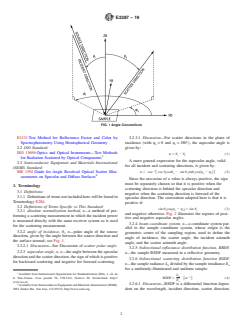
FIG. 1 Angle Conventions
E1331Test Method for Reflectance Factor and Color by 3.2.3.1 Discussion—For scatter directions in the plane of
Spectrophotometry Using Hemispherical Geometry incidence (with φ =0 and φ =180°), the aspecular angle is
s i
given by:
2.2 ISO Standard:
ISO 13696Optics and Optical Instruments—Test Methods
α 5θ 2θ (1)
i s
for Radiation Scattered by Optical Components
A more general expression for the aspecular angle, valid
2.3 Semiconductor Equipment and Materials International
for all incident and scattering directions, is given by:
(SEMI) Standard:
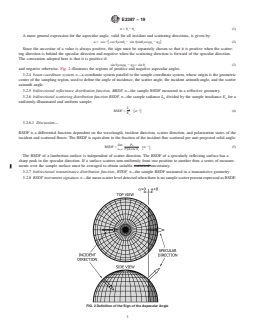
α 5 cos cosθ cosθ 2 sinθ sinθ cos φ 2φ (2)
ME 1392Guide for Angle Resolved Optical Scatter Mea- @ ~ !#
i s i s s i
surements on Specular and Diffuse Surfaces
Since the arccosine of a value is always positive, the sign
must be separately chosen so that it is positive when the
3. Terminology
scattering direction is behind the specular direction and
3.1 Definitions:
negative when the scattering direction is forward of the
3.1.1 Definitionsoftermsnotincludedherewillbefoundin
specular direction. The convention adopted here is that it is
Terminology E284.
positive if:
3.2 Definitions of Terms Specific to This Standard:
sinθ cos~φ 2φ !. sinθ (3)
s s i i
3.2.1 absolute normalization method, n—a method of per-
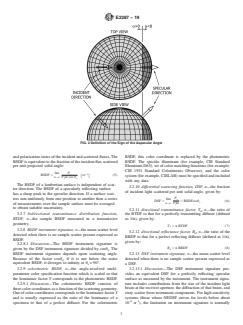
and negative otherwise. Fig. 2 illustrates the regions of posi-
forming a scattering measurement in which the incident power
tive and negative aspecular angles.
is measured directly with the same receiver system as is used
3.2.4 beam coordinate system, n—a coordinate system par-
for the scattering measurement.
allel to the sample coordinate system, whose origin is the
3.2.2 angle of incidence, θ,n—polar angle of the source
i
geometric center of the sampling region, used to define the
direction, given by the angle between the source direction and
angle of incidence, the scatter angle, the incident azimuth
the surface normal; see Fig. 1.
angle, and the scatter azimuth angle.
3.2.2.1 Discussion—See Discussion of scatter polar angle.
3.2.5 bidirectional reflectance distribution function, BRDF,
3.2.3 aspecular angle, α,n—the angle between the specular
n—the sample BSDF measured in a reflective geometry.
directionandthescatterdirection,thesignofwhichispositive
3.2.6 bidirectional scattering distribution function BSDF,
for backward scattering and negative for forward scattering.
n—the sample radiance L divided by the sample irradiance E
e e
for a uniformly-illuminated and uniform sample:
Available from International Organization for Standardization (ISO), 1, ch. de
L
e
la Voie-Creuse, Case postale 56, CH-1211, Geneva 20, Switzerland, http:// BSDF 5 @sr # (4)
E
e
www.iso.ch.
4 3.2.6.1 Discussion—BSDF is a differential function depen-
Available from Semiconductor Equipment and Materials International (SEMI),
3081 Zanker Rd., San Jose, CA 95134, http://www.semi.org. dent on the wavelength, incident direction, scatter direction,
E2387 − 19
FIG. 2 Definition of the Sign of the Aspecular Angle
andpolarizationstatesoftheincidentandscatteredfluxes.The BSDF, this color coordinate is replaced by the photometric
BSDFisequivalenttothefractionoftheincidentfluxscattered BSDF. The specific illuminant (for example, CIE Standard
per unit projected solid angle: Illuminant D65), set of color matching functions (for example,
CIE 1931 Standard Colorimetric Observer), and the color
P
lim s
BSDF 5 @sr # (5)
system(forexample,CIELAB)mustbespecifiedandincluded
Ω→0 PΩ cosθ
i s
with any data.
The BSDF of a lambertian surface is independent of scat-
3.2.10 differential scattering function, DSF, n—the fraction
ter direction. The BSDF of a specularly reflecting surface
of incident light scattered per unit solid angle, given by:
has a sharp peak in the specular direction. If a surface scat-
P
ters non-uniformly from one position to another then a series
lim s
DSF 5 5BSDFcosθ (6)
s
Ω→0 PΩ
of measurements over the sample surface must be averaged
i
to obtain suitable uncertainty.
3.2.11 directional transmittance factor, T,n—the ratio of
d
3.2.7 bidirectional transmittance distribution function, the BTDF to that for a perfectly transmitting diffuser (defined
BTDF, n—the sample BSDF measured in a transmissive as 1/π), given by:
geometry.
T 5π BTDF (7)
d
3.2.8 BSDF instrument signature, n—the mean scatter level
3.2.12 directional reflectance factor, R,n—the ratio of the
d
detected when there is no sample scatter present expressed as
BRDF to that for a perfect reflecting diffuser (defined as 1/π),
BSDF.
given by:
3.2.8.1 Discussion—The BSDF instrument signature is
R 5π BRDF (8)
d
given by the DSF instrument signature divided by cosθ . The
s
BSDF instrument signature depends upon scattering angle.
3.2.13 DSF instrument signature, n—the mean scatter level
Because of the factor cosθ , if it is not below the noise
detected when there is no sample scatter present expressed as
s
equivalent BSDF, it diverges to infinity at θ =90°.
a DSF.
s
3.2.9 colorimetric BSDF, n—the angle-resolved multi- 3.2.13.1 Discussion—The DSF instrument signature pro-
parameter color specification function which is scaled so that vides an equivalent DSF for a perfectly reflecting specular
the luminance factor Y corresponds to the photometric BSDF. surface as measured by the instrument. The instrument signa-
3.2.9.1 Discussion—The colorimetric BSDF consists of ture includes contributions from the size of the incident light
threecolorcoordinatesasafunctionofthescatteringgeometry. beam at the receiver aperture, the diffraction of that beam, and
Oneofcolorcoordinatescorrespondstotheluminancefactor Y stray scatter from instrument components. For high-sensitivity
and is usually expressed as the ratio of the luminance of a systems (those whose NEDSF strives for levels below about
-6 -1
specimen to that of a perfect diffuser. For the colorimetric 10 sr ), the limitation on instrument signature is normally
E2387 − 19
Rayleigh scatter from molecules within the volume of the NEDSF is given by the rms of the repeated measurements
incident light beam that is sampled by the receiver field of divided by the incident power. The NEDSF is inversely
view. The instrument signature can be measured by removing proportional to the collection solid angle.
thesampleandscanningthereceiverthroughtheincidentbeam
3.2.19 photometric BSDF, n—thesampleluminancedivided
in a transmission configuration. The signature can also be
by the sample illuminance for a uniformly-illuminated and
measured by scanning a reference sample, whose scatter is
uniform sample.
expected to be significantly lower than that of the specimen
3.2.20 plane of incidence, PLIN, n—the plane containing
being studied, in which case the signature is adjusted by
the sample normal and central ray of the incident flux.
dividing by the reference sample reflectance. It is necessary to
3.2.21 relative normalization method, n—a method for per-
furnish the instrument signature when reporting BSDF data so
that the user can decide at what scatter direction the measured forming a scattering measurement in which a diffusely reflect-
ing sample of known BRDF is used as a reference.
sample BSDF or DSF is lost in the signature. Preferably the
signature is at least a few decades below the sample data and
3.2.22 receiver, n—a system that generally contains
can be ignored. The DSF instrument signature depends upon
apertures, filters, focusing optics, and a detector element that
the receiver solid angle and the receiver field of view.
gathers the scatter flux over a known solid angle and provides
3.2.14 incident azimuth angle,φ,n—the angle from the XB a measured signal.
i
axis to the projection of the source direction onto the X-Y
3.2.23 receiver solid angle,Ω,n—thesolidanglesubtended
plane;whennotspecified,thisangleisassumedtobe180°;see
by the receiver aperture stop from the center of the sampling
Fig. 1.
aperture.
3.2.14.1 Discussion—See Discussion for scatter polar
3.2.24 sample coordinate system, n—a coordinate system
angle.
fixed to the sample and used to specify position on the sample
3.2.15 incident direction, n—the central ray of the incident
surface.
flux specified by θ and φ in the beam coordinate system,
i i
3.2.24.1 Discussion—The sample coordinate system (X, Y,
pointing from the illumination to the sample.
Z) is application and sample specific. The cartesian coordinate
3.2.15.1 Discussion—The incident direction is the opposite
system shown in Fig. 3 is recommended for flat samples. The
of the source direction.
origin is at the geometric center of the sample face with the Z
3.2.16 incident power, P,n—theradiantfluxincidentonthe axis normal to the sample. A fiducial mark must be shown at
i
sample. the periphery of the sample; it is most conveniently placed
3.2.16.1 Discussion—For relative BSDF measurements, the along either the X or Y axes. If the sample fiducial mark is not
an X axis mark, the intended value should be indicated on the
incident power is not measured directly. For absolute BSDF
measurements it is important to verify the linearity, and if sample.Theincidentandscatterdirectionsaremeasuredinthe
beam coordinate system (XB, YB, ZB). The Z and ZB axes are
necessary correct for any nonlinearity, of the detector system
over the range from the incident power level down to the always the local normal to the sample face.
scatter level which may be as many as 13 to 15 orders of
3.2.25 sample irradiance, E,n—theradiantfluxincidenton
e
magnitude lower. If the same detector is used to measure the
the sample surface per unit area.
incidentpowerandthescatteredflux,thenitisnotnecessaryto
3.2.25.1 Discussion—In practice, E is an average calcu-
e
correctforthedetectorresponsivity;otherwise,thesignalfrom
lated from the incident power, P, divided by the illuminated
i
each detector must be normalized by its responsivity. In all
area, A.Theincidentfluxshouldarrivefromasingledirection;
cases, the absolute power is not needed, so long as the unit of
however, the acceptable degree of collimation or amount of
power is the same as that used to measure the scattered power
convergence is application specific and should be reported.
P .
s
3.2.26 sample radiance, L,n—adifferentialquantitythatis
e
3.2.17 noise equivalent BSDF, NEBSDF, n—the root mean
the reflected radiant flux per unit projected solid angle per unit
square (rms) of the noise fluctuation expressed as equivalent
sample area.
BSDF.
3.2.26.1 Discussion—In practice, L is an average calcu-
e
3.2.17.1 Discussion—The noise equivalent BSDF is given
lated from the scattered power, P , collected by the projected
s
by the noise equivalent DSF divided by cosθ . Because of the
s
receiversolidangle,Ωcosθ ,fromtheilluminatedarea, A.The
s
factor cosθ , the NEBSDF depends upon scattering angle and
s
receiver aperture and distance from the sample determines Ω
diverges to infinity at θ =90°. The NEBSDF is inversely
s
and the angular resolution of the instrument.
proportional to the collection solid angle.
3.2.27 sampling aperture, n—the smaller of either the illu-
3.2.18 noise equivalent DSF, NEDSF, n—the root mean
minated area on the sample or the sample area within the
square (rms) of the noise fluctuation expressed as equivalent
receiver field-of-view.
DSF.
3.2.28 scatter, n—the radiant flux that has been redirected
3.2.18.1 Discussion—Measurement precision is limited by
over a range of angles by interaction with the sample.
the acceptable signal to noise ratio with respect to these
fluctuations. Unlike the NEBSDF, the NEDSF should be 3.2.29 scatter azimuth angle,φ,n—angle from the XB axis
s
independent of scattering geometry and is evaluated by re- totheprojectionofthescatterdirectionontothe X-Yplane;see
peated measurements with the source beam blocked. The Fig. 1.
E2387 − 19
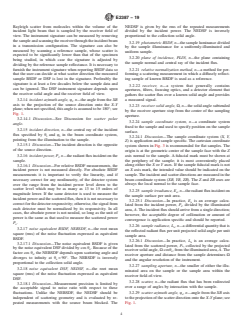
NOTE 1—The X, Y, and Z axes define the right-handed sample coordinate system centered at the geometric center of the sample face.
NOTE 2—The fiducial mark indicates the location of the positive X axis and can be on the edge or back of the sample.
NOTE 3—The XB, YB, and ZB axes define the right-handed beam coordinate system, are parallel to the X, Y, and Z axes, respectively, and are offset
from the sample coordinates by coordinates x and y along the X and Y axes, respectively.
FIG. 3 Relationship Between Sample and Beam Coordinate Systems
3.2.29.1 Discussion—See Discussion for scatter polar 4. Significance and Use
angle.
4.1 The angular distribution of scatter is a property of
3.2.30 scatter direction, n—the central ray of the collection
surfaces that may have direct consequences on an intermediate
solid angle of the scattered flux specified by θ and φ in the
or final application of that surface. Scatter defines many visual
s s
beam coordinate system.
appearance attributes of materials, and specification of the
distribution and wavelength dependence is critical to the
3.2.31 scatter plane, n—the plane containing the central
marketability of consumer products, such as automobiles,
rays of the incident flux and the scatter direction.
cosmetics, and electronics. Optically diffusive materials are
3.2.32 scatter polar angle, θ,n—polar angle between the
s
used in information display applications to spread light from
central ray of the scattered flux and the ZB axis; see Fig. 1.
display elements to the viewer, and the performance of such
3.2.32.1 Discussion—Thereissomeambiguityinthevalues
displays relies on specification of the distribution of scatter.
of polar and azimuthal angles that needs explaining. What
Stray-light reduction elements, such as baffles and walls, rely
really uniquely defines a direction are the values sin(θ)cos(φ)
on absorbing coatings that have low diffuse reflectances.
and sin(θ)sin(φ), which are the X and Y coordinates,
Scatter from mirrors, lenses, filters, windows, and other com-
respectively, of the projection of the direction, expressed as a
ponents can limit resolution and contrast in optical systems,
unit vector, onto the X-Y plane. Since sin(-θ)cos(φ+180°) =
such as telescopes, ring laser gyros, and microscopes.
sin(θ)cos(φ) and sin(-θ)sin(φ+180°) = sin(θ)sin(φ), the change
of variablesθ← −θ andφ←φ + 180° does not change the 4.2 Themicrostructureassociatedwithamaterialaffectsthe
direction.Inmanymeasurements,thescatterazimuthalangleis angulardistributionofscatter,andspecificpropertiescanoften
treated as fixed, while the scatter polar angle is allowed to be be inferred from measurements of that scatter. For example,
negative. roughness, material inhomogeneity, and particles on smooth
surfaces contribute to optical scatter, and optical scatter can be
3.2.33 source direction, n—the central ray of the incident
used to detect the presence of such defects.
flux specified by θ and φ in the beam coordinate system,
i i
pointing from the sample to the illumination.
4.3 Theangulardistributionofscatteredlightcanbeusedto
3.2.33.1 Discussion—Thesourcedirectionistheoppositeof
simulate or render the appearance of materials. Quality of
the incident direction.
rendering relies heavily upon accurate measurement of the
light scattering properties of the materials being rendered.
3.2.34 specular direction, n—the central ray of the reflected
flux that lies in the PLIN with θ =θ and φ =φ + 180°.
s i s i
5. Apparatus
3.2.35 specular normalization method, n—a method for
performing a scattering measurement in which the incident 5.1 Instruments designed to measure the angular distribu-
power is measured by measuring the light specularly reflected tion of scattered light consist of three basic elements: an
from a mirror of known reflectance. illuminator containing a directed source of optical radiation, a
E2387 − 19
means for positioning a sample, and a receiver to collect and 5.1.1.5 For measurements performed in the plane of
measurethescatteredlight.Thesecomponentsaredescribedin incidence, it is sometimes possible to obtain results equivalent
a general manner so as to not exclude any particular type of to those using unpolarized light by using either 45°-polarized
scatter instrument. The three components are connected in a incident light or circularly polarized incident light. However,
manner that allows for selection of an incident direction and since this practice is not valid under all conditions, it is the
the collection of flux in a scattered direction. However, not all responsibility of the user to determine if such practice is valid
instrumentsallowcontroloverallfourangles(θ,φ;θ ,φ ).For for the sample being studied.
i i s s
example,itiscommontohave(θ;θ )positioning,only.Dueto
5.1.1.6 Absorbing samples may be heated by the incident
i s
the wide variability of instrument designs and capabilities,
flux, which may change their scatter characteristics, mechani-
specific parameters, noted below, should be identified and
cally distort them, or burn them. Special care must be taken
reported with any result.
with high-power laser or infrared sources on absorbing
5.1.1 Illuminator, containing the source and associated op- samples.
ticstoproduceirradianceonthesample.Ifabroadbandsource
5.1.1.7 The source light may be modulated electronically or
or tunable laser is used, the bandwidth and wavelength
by a chopper wheel in order to enable synchronized phase-
selection technique should be specified. If a broad band source
sensitive lock-in detection of the scattered signal.
is used, its spectral power distribution should be reported. If a
5.1.1.8 The profile of the illuminated spot on the sample
laser source is used, the laser type and its center wavelength
should be reported in order to assess the spatial resolution of
should be reported.
the instrument. If the sample is under-illuminated, the size of
5.1.1.1 A source monitor may be used to correct for fluc- the illuminated spot must be smaller than the receiver field of
tuations in the source. It should be located as far downstream
view. Even if high spatial resolution is not needed by the user,
in the optical path as practicable, without contributing unrea- if the illumination spot is too small, then features in the data
sonably to system scatter, so as to capture all possible sources may be a result of variations or inhomogeneities in the
of fluctuations or drift. The source monitor should be suffi- specimen, rather than a measure of the average properties of
ciently insensitive to changes in beam properties, such as the material. For the case of coherent illumination, the size of
spatial mode or polarization, and not have any band sensitivi- theilluminatedspotwillhaveaneffectonthespecklestatistics.
ties that would yield undue sensitivities to wavelength.
5.1.1.9 For broad band sources, the spectral characteristics
5.1.1.2 The beam should be collimated or slightly converg- of the source may be very important. It may be necessary to
ing.Laser-basedinstrumentsoftenuseaconvergingbeamwith report the amount of light which is not contained within the
f-number greater than f/20 focused at the receiver in order to nominal bandwidth of the source.
achieve high angular resolution in the scatter direction for
5.1.2 Sample Holder—The sample holder should provide a
measurements near the specular beam or diffraction peaks. A
secure mount for the sample that does not introduce any warp,
converging beam focused at the sample location may be used
and allows the sample to be placed with its fiducial marks in a
if spatial resolution is important. If the convergence angle is
particular, known orientation with respect to the beam geom-
small, the uncertainty introduced by a non-unique angle of
etry. The rotation axes of the stages that achieve the (θ,φ;
i i
incidence is usually negligible. A collimated source may be
θ ,φ ) positioning must be relative to the sample front surface;
s s
used for systems that do not require high angular or sample
this can be accomplished by orienting the sample holder,
position resolution. It is the user’s responsibility to assure that
source, or receiver assemblies, or combination thereof. Some
anyspreadinθ doesnotcompromisetheresults.Thedegreeof
sample mounts incorporate linear positioning stages that allow
i
convergence of the incident beam generally has a direct
measurements at multiple spots on the specimen surface. The
influence on the instrument signature.
sample mount must be kept unobtrusive so that it does not
block the incident or scattered light, or contribute stray flux to
5.1.1.3 Good reduction of the instrument signature requires
the instrument signature.
careful baffling around the source assembly to limit off-axis
light. For laser sources, a spatial filter is often used as the last
5.1.2.1 Since the measurement needs to be done with
optical element before the final focusing or collimating ele-
respect to the front surface of the specimen, it is often
ment.Thefinalmirrororlenswhichdirectslighttothesample
necessary to provide manual positioning (Z-motion) to accom-
should have low scatter, since it contributes directly to small
modate different sample thicknesses, and to orient the sample
angle scatter in the instrument signature.
(tilt in two directions) with respect to the incident beam. It is
good practice to check that the incident beam stays on the
5.1.1.4 A means should be provided for controlling the
center of the sample when configured in a near grazing angle,
polarization state of the incident flux as this can impact the
andthatwhenthesourceisincidentinthenormaldirectionthat
measured BSDF. Orthogonal source polarization components
the sample reflects light back to the source.
(parallel, or p, and perpendicular, or s) are defined by the
direction of the electric field relative to the PLIN. If results for 5.1.3 Receiver Assembly—If the system design includes
unpolarized light are desired, then it is often best to perform degrees of freedom at the receiver for achieving the scatter
two measurements, using p and s polarized light, with the direction, then the receiver assembly should normally have
average being reported.Acomplete polarimetric description of provisions for rotating about an axis on the front face of the
the BSDF requires the Mueller matrix formalism; however, sampleinordertovaryθ .IfmeasurementsoutofthePLINare
s
Mueller matrix BSDF measurements are beyond the scope of required, the receiver assembly may also rotate out of the
this standard. PLIN.This capability may also be provided by pitch, yaw, and
E2387 − 19
roll of the sample, but it becomes more difficult to capture and (3)When the incident angle is large, the irradiated area
dump the specularly reflected beam. becomes elongated.The field-of-view must be large enough to
accommodate the largest angle of incidence that will be used
5.1.3.1 The Receiver Acceptance Aperture:
during a measurement.
(1)The acceptance aperture defines the receiver solid
(4)A recommended method for measuring the receiver
angle,Ω,whichisusedintheBSDFcalculationanddefinesthe
field of view is to locate a small moveable diffuse light source
angular resolution. There can be an exception to the require-
in the X-Y plane, while measuring the receiver signal in the Z
ment that Ω be well known if the relative normalization
direction.Thesignalshouldremainconstantoveranarealarger
method is used. In that case it is the user’s responsibility to
than the illuminated spot, keeping in mind that the illuminated
ensure that the system parameters remain constant between
spot elongates as the incident angle is increased. Choosing a
measurements. For many systems, where there are no optical
tolerance level T, the lengths of the field of view, l and
FOV,x
elements between the sample and the solid angle defining
l in the X and Y directions for which the signal remains
FOV,y
aperture, the receiver solid angle is given by:
within a fraction T of the maximum signal should be deter-
A
rec
mined. The values of l and l should be recorded
Ω> @sr# (9) FOV,x FOV,y
r
together with the tolerance level used. It is useful to perform
thesamemeasurementinothersample-receiverorientations,as
where A istheareaofthereceiveraperture,and risthe
rec
well, in order to verify that the field of view is always aligned
distance of that aperture from the illuminated region of the
on the center of the sample.
sample. The approximation in Eq 9 is valid to better than 1 %
(5)The receiver field of view is affected by the design of
when Ω is less than 0.04 sr.
the receiver as well as the uniformity of the detector element.
(2) For transparent or translucent samples, there can be a
Performing a measurement of the field of view profile ensures
range of distances r between the receiver and the scatterers.
that detector non-uniformities do not contribute to errors.
Therefore, one must include this variability in determining the
uncertainty of Ω. 5.1.3.3 The Receiver Detector:
(3)If the acceptance aperture is too small and a coherent
(1)The receiver detector (and any associated electronics)
source is used to irradiate the sample, speckle may cause should be linear over the entire signal range of the measure-
strong,unpredictablevariationsinthescatter.Ifspeckleeffects ment. The receiver and preamplifier must be calibrated to-
contribute unacceptably to the results, they can be reduced by gether over their useful operating range. A calibration curve
averaging over a large number of measurements at different showingrelativeopticalpowerversusmeasuredsignalmustbe
sample locations, or by moving or rotating the sample while obtained for each preamplifier gain setting. Operating regimes
the measurement is being performed. It is the user’s responsi- are selected for each gain setting to avoid saturating the
bility to ensure that BSDF features are not due to speckle. detector while remaining on a low gain setting. The source
(4)The user may wish to employ a variable aperture to monitorshouldalsobecalibratedinthesameway,althoughthe
trade sensitivity for angular resolution when measuring specu- dynamic range need not be very wide.
lar surfaces, since best angular resolution is needed near the (2)The receiver detector should have uniform sensitivity
specular direction where BSDF has a steep slope. Best sensi- over its area. If the detector is not uniform, an integrating
tivity is needed at larger angles where BSDF might approach sphere or other non-imaging optic can be used to ensure that
the NEBSDF. the sensitivity of the receiver is uniform over the receiver field
(5)If either the absolute normalization method or the of view.
specularnormalizationmethodisused,thenanapertureshould (3)If a broad band source is used in the measurement, the
be available which is larger than the size of the incident beam spectralsensitivityofthedetectormayaffectthemeasurement.
at that aperture. Otherwise, some of the incident light will not (4)The temporal response of the detector (and any associ-
be accounted for by the incident power measurement. ated electronics) should be significantly faster than the times-
cale of the measurement. If the source is modulated, the
5.1.3.2 The Receiver Field of View:
detector must be able to respond to the modulation.
(1)Thefieldofviewshallincludetheentireirradiatedarea,
(5)It may be necessary to use an optical bandpass filter on
A. The field of view of the receiver will determine if all of the
...
This document is not an ASTM standard and is intended only to provide the user of an ASTM standard an indication of what changes have been made to the previous version. Because
it may not be technically possible to adequately depict all changes accurately, ASTM recommends that users consult prior editions as appropriate. In all cases only the current version
of the standard as published by ASTM is to be considered the official document.
Designation: E2387 − 05 (Reapproved 2011) E2387 − 19
Standard Practice for
Goniometric Optical Scatter Measurements
This standard is issued under the fixed designation E2387; the number immediately following the designation indicates the year of
original adoption or, in the case of revision, the year of last revision. A number in parentheses indicates the year of last reapproval. A
superscript epsilon (´) indicates an editorial change since the last revision or reapproval.
1. Scope
1.1 This practice describes procedures for determining the amount and angular distribution of optical scatter from a surface. In
particular it focuses on measurement of the bidirectional scattering distribution function (BSDF). BSDF is a convenient and well
accepted means of expressing optical scatter levels for many purposes. It is often referred to as the bidirectional reflectance
distribution function (BRDF) when considering reflective scatter or the bidirectional transmittance distribution function (BTDF)
when considering transmissive scatter.
1.2 The BSDF is a fundamental description of the appearance of a sample, and many other appearance attributes (such as gloss,
haze, and color) can be represented in terms of integrals of the BSDF over specific geometric and spectral conditions.
1.3 This practice also presents alternative ways of presenting angle-resolved optical scatter results, including directional
reflectance factor, directional transmittance factor, and differential scattering function.
1.4 This practice applies to BSDF measurements on opaque, translucent, or transparent samples.
1.5 The wavelengths for which this practice applies include the ultraviolet, visible, and infrared regions. Difficulty in obtaining
appropriate sources, detectors, and low scatter optics complicates its practical application at wavelengths less than about 0.2 μm
(200 nm). Diffraction effects start to become important for wavelengths greater than 15 μm (15 000 nm), which complicate its
practical application at longer wavelengths. Measurements pertaining to visual appearance are restricted to the visible wavelength
region.
1.6 This practice does not apply to materials exhibiting significant fluorescence.
1.7 This practice applies to flat or curved samples of arbitrary shape. However, only a flat sample is addressed in the discussion
and examples. It is the user’s responsibility to define an appropriate sample coordinate system to specify the measurement location
on the sample surface and appropriate beam properties for samples that are not flat.
1.8 This practice does not provide a method for ascribing the measured BSDF to any scattering mechanism or source.
1.9 This practice does not provide a method to extrapolate data from one wavelength, scattering geometry, sample location, or
polarization to any other wavelength, scattering geometry, sample location, or polarization. The user must make measurements at
the wavelengths, scattering geometries, sample locations, and polarizations that are of interest to his or her application.
1.10 Any parameter can be varied in a measurement sequence. Parameters that remain constant during a measurement sequence
are reported as either header information in the tabulated data set or in an associated document.
1.11 The apparatus and measurement procedure are generic, so that specific instruments are neither excluded nor implied in the
use of this practice.
1.12 For measurements performed for the semiconductor industry, the operator should consult PracticeGuide SEMI ME 1392.
1.13 This standard does not purport to address all of the safety concerns, if any, associated with its use. It is the responsibility
of the user of this standard to establish appropriate safety safety, health, and healthenvironmental practices and determine the
applicability of regulatory limitations prior to use.
1.14 This international standard was developed in accordance with internationally recognized principles on standardization
established in the Decision on Principles for the Development of International Standards, Guides and Recommendations issued
by the World Trade Organization Technical Barriers to Trade (TBT) Committee.
This practice is under the jurisdiction of ASTM Committee E12 on Color and Appearance and is the direct responsibility of Subcommittee E12.03 on Geometry.
Current edition approved July 1, 2011Nov. 1, 2019. Published July 2011December 2019. Originally approved in 2005. Last previous edition approved in 20052011 as
E2387 – 05.E2387 – 05 (2011). DOI: 10.1520/E2387-05R11.10.1520/E2387-19.
Copyright © ASTM International, 100 Barr Harbor Drive, PO Box C700, West Conshohocken, PA 19428-2959. United States
E2387 − 19
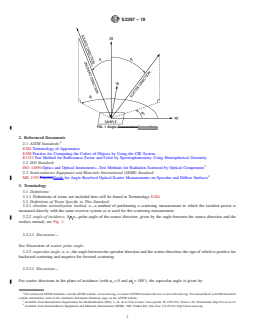
FIG. 1 Angle ConversionsConventions
2. Referenced Documents
2.1 ASTM Standards:
E284 Terminology of Appearance
E308 Practice for Computing the Colors of Objects by Using the CIE System
E1331 Test Method for Reflectance Factor and Color by Spectrophotometry Using Hemispherical Geometry
2.2 ISO Standard:
ISO 13696 Optics and Optical Instruments—Test Methods for Radiation Scattered by Optical Components
2.3 Semiconductor Equipment and Materials International (SEMI) Standard:
ME 1392 PracticeGuide for Angle Resolved Optical Scatter Measurements on Specular and Diffuse Surfaces
3. Terminology
3.1 Definitions:
3.1.1 Definitions of terms not included here will be found in Terminology E284.
3.2 Definitions of Terms Specific to This Standard:
3.2.1 absolute normalization method, n—a method of performing a scattering measurement in which the incident power is
measured directly with the same receiver system as is used for the scattering measurement.
3.2.2 angle of incidence, θ i,,n—polar angle of the source direction, given by the angle between the source direction and the
i
surface normal; see Fig. 1.
3.2.2.1 Discussion—
See Discussion of scatter polar angle.
3.2.3 aspecular angle, α, n—the angle between the specular direction and the scatter direction, the sign of which is positive for
backward scattering and negative for forward scattering.
3.2.3.1 Discussion—
For scatter directions in the plane of incidence (with φ = 0 and φi = 180°), the aspecular angle is given by:
s i
For referenced ASTM standards, visit the ASTM website, www.astm.org, or contact ASTM Customer Service at service@astm.org. For Annual Book of ASTM Standards
volume information, refer to the standard’s Document Summary page on the ASTM website.
Available from International Organization for Standardization (ISO), 1, ch. de la Voie-Creuse, Case postale 56, CH-1211, Geneva 20, Switzerland, http://www.iso.ch.
Available from Semiconductor Equipment and Materials International (SEMI), 3081 Zanker Rd., San Jose, CA 95134, http://www.semi.org.
E2387 − 19
α5 θ 2 θ (1)
i s
A more general expression for the aspecular angle, valid for all incident and scattering directions, is given by:
α5 cos cos θ cosθ 2 sin θ sinθ cos φ 2 φ (2)
@ ~ !#
i s i s s i
Since the arccosine of a value is always positive, the sign must be separately chosen so that it is positive when the scatter-
ing direction is behind the specular direction and negative when the scattering direction is forward of the specular direction.
The convention adopted here is that it is positive if:
sin θ cos~φ 2 φ!. sin θ (3)
s s i i
and negative otherwise. Fig. 2 illustrates the regions of positive and negative aspecular angles.
3.2.4 beam coordinate system, n—a coordinate system parallel to the sample coordinate system, whose origin is the geometric
center of the sampling region, used to define the angle of incidence, the scatter angle, the incident azimuth angle, and the scatter
azimuth angle.
3.2.5 bidirectional reflectance distribution function, BRDF, n—the sample BSDF measured in a reflective geometry.
3.2.6 bidirectional scattering distribution function BSDF, n—the sample radiance L divided by the sample irradiance E for a
e e
uniformly-illuminated and uniform sample:
L
e
BSDF 5 @sr # (4)
E
e
3.2.6.1 Discussion—
BSDF is a differential function dependent on the wavelength, incident direction, scatter direction, and polarization states of the
incident and scattered fluxes. The BSDF is equivalent to the fraction of the incident flux scattered per unit projected solid angle:
P
lim s
BSDF 5 sr (5)
@ #
Ω→0 P Ω cos θ
i s
The BSDF of a lambertian surface is independent of scatter direction. The BSDF of a specularly reflecting surface has a
sharp peak in the specular direction. If a surface scatters non-uniformly from one position to another then a series of measure-
ments over the sample surface must be averaged to obtain suitable statistical uncertainty.
3.2.7 bidirectional transmittance distribution function, BTDF, n—the sample BSDF measured in a transmissive geometry.
3.2.8 BSDF instrument signature, n—the mean scatter level detected when there is no sample scatter present expressed as BSDF.
FIG. 2 Definition of the Sign of the Aspecular Angle
E2387 − 19
3.2.8.1 Discussion—
The BSDF instrument signature is given by the DSF instrument signature divided by cosθ . The BSDF instrument signature
s
depends upon scattering angle. Because of the factor cosθ , if it is not below the noise equivalent BSDF, it diverges to infinity at
s
θ = 90°.
s
3.2.9 colorimetric BSDF, n—the angle-resolved multi-parameter color specification function which is scaled so that the
luminance factor Y corresponds to the photometric BSDF.
3.2.9.1 Discussion—
The colorimetric BSDF consists of three color coordinates as a function of the scattering geometry. One of color coordinates
corresponds to the luminance factor Y and is usually expressed as the ratio of the luminance of a specimen to that of a perfect
diffuser. For the colorimetric BSDF, this color coordinate is replaced by the photometric BSDF. The specific illuminant (for
example, CIE Standard Illuminant D65), set of color matching functions (for example, CIE 1931 Standard Colorimetric Observer),
and the color system (for example, CIELAB) must be specified and included with any data.
3.2.10 differential scattering function, DSF, n—the fraction of incident light scattered per unit solid angle, given by:
P
lim
s
DSF 5 5 BSDFcosθ (6)
s
Ω→0 P Ω
i
3.2.11 directional transmittance factor, T , n—the ratio of the BTDF to that for a perfectly transmitting diffuser (defined as 1/π),
d
given by:
T 5 π BTDF (7)
d
3.2.12 directional reflectance factor, R , n—the ratio of the BRDF to that for a perfect reflecting diffuser (defined as 1/π), given
d
by:
R 5 π BRDF (8)
d
3.2.13 DSF instrument signature, n—the mean scatter level detected when there is no sample scatter present expressed as a DSF.
3.2.13.1 Discussion—
The DSF instrument signature provides an equivalent DSF for a perfectly reflecting specular surface as measured by the
instrument. The instrument signature includes contributions from the size of the incident light beam at the receiver aperture, the
diffraction of that beam, and stray scatter from instrument components. For high-sensitivity systems (those whose NEDSF strives
-6 -1
for levels below about 10 sr ), the limitation on instrument signature is normally Rayleigh scatter from molecules within the
volume of the incident light beam that is sampled by the receiver field of view. The instrument signature can be measured by
removing the sample and scanning the receiver through the incident beam in a transmission configuration. The signature can also
be measured by scanning a reference sample, whose scatter is expected to be significantly lower than that of the specimen being
studied, in which case the signature is adjusted by dividing by the reference sample reflectance. It is necessary to furnish the
instrument signature when reporting BSDF data so that the user can decide at what scatter direction the measured sample BSDF
or DSF is lost in the signature. Preferably the signature is at least a few decades below the sample data and can be ignored. The
DSF instrument signature depends upon the receiver solid angle and the receiver field of view.
3.2.14 incident azimuth angle, φ , n—the angle from the XB axis to the projection of the source direction onto the X-Y plane;
i
when not specified, this angle is assumed to be 180°; see Fig. 1.
3.2.14.1 Discussion—
See Discussion for scatter polar angle.
3.2.15 incident direction, n—the central ray of the incident flux specified by θ and φ in the beam coordinate system, pointing
i i
from the illumination to the sample.
3.2.15.1 Discussion—
The incident direction is the opposite of the source direction.
3.2.16 incident power, P , n—the radiant flux incident on the sample.
i
3.2.16.1 Discussion—
E2387 − 19
For relative BSDF measurements, the incident power is not measured directly. For absolute BSDF measurements it is important
to verify the linearity, and if necessary correct for any nonlinearity, of the detector system over the range from the incident power
level down to the scatter level which may be as many as 13 to 15 orders of magnitude lower. If the same detector is used to measure
the incident power and the scattered flux, then it is not necessary to correct for the detector responsivity; otherwise, the signal from
each detector must be normalized by its responsivity. In all cases, the absolute power is not needed, so long as the unit of power
is the same as that used to measure the scattered power P .
s
3.2.17 noise equivalent BSDF, NEBSDF, n—the root mean square (rms) of the noise fluctuation expressed as equivalent BSDF.
3.2.17.1 Discussion—
The noise equivalent BSDF is given by the noise equivalent DSF divided by cos θ . Because of the factor cos θ , the NEBSDF
s s
depends upon scattering angle and diverges to infinity at θ = 90°. The NEBSDF is inversely proportional to the collection solid
s
angle.
3.2.18 noise equivalent DSF, NEDSF, n—the root mean square (rms) of the noise fluctuation expressed as equivalent DSF.
3.2.18.1 Discussion—
Measurement precision is limited by the acceptable signal to noise ratio with respect to these fluctuations. Unlike the NEBSDF,
the NEDSF should be independent of scattering geometry and is evaluated by repeated measurements with the source beam
blocked. The NEDSF is given by the rms of the repeated measurements divided by the incident power. The NEDSF is inversely
proportional to the collection solid angle.
3.2.19 photometric BSDF, n—the sample luminance divided by the sample illuminance for a uniformly-illuminated and uniform
sample.
3.2.20 plane of incidence, PLIN, n—the plane containing the sample normal and central ray of the incident flux.
3.2.21 relative normalization method, n—a method for performing a scattering measurement in which a diffusely reflecting
sample of known BRDF is used as a reference.
3.2.22 receiver, n—a system that generally contains apertures, filters, focusing optics, and a detector element that gathers the
scatter flux over a known solid angle and provides a measured signal.
3.2.23 receiver solid angle, Ω,n—the solid angle subtended by the receiver aperture stop from the center of the sampling
aperture.
3.2.24 sample coordinate system, n—a coordinate system fixed to the sample and used to specify position on the sample surface.
3.2.24.1 Discussion—
The sample coordinate system (X, Y, Z) is application and sample specific. The cartesian coordinate system shown in Fig. 3 is
recommended for flat samples. The origin is at the geometric center of the sample face with the Z axis normal to the sample. A
fiducial mark must be shown at the periphery of the sample; it is most conveniently placed along either the X or Y axes. If the
sample fiducial mark is not an X axis mark, the intended value should be indicated on the sample. The incident and scatter
directions are measured in the beam coordinate system (XB, YB, ZB). The Z and ZB axes are always the local normal to the sample
face.
3.2.25 sample irradiance, E , n—the radiant flux incident on the sample surface per unit area.
e
3.2.25.1 Discussion—
In practice, E is an average calculated from the incident power, P , divided by the illuminated area, A. The incident flux should
e i
arrive from a single direction; however, the acceptable degree of collimation or amount of convergence is application specific and
should be reported.
3.2.26 sample radiance, L , n—a differential quantity that is the reflected radiant flux per unit projected solid angle per unit
e
sample area.
3.2.26.1 Discussion—
E2387 − 19
NOTE 1—The X,Y, and Z axes define the right-handed sample coordinate system centered at the geometric center of the sample face.
NOTE 2—The fiducial mark indicates the location of the positive X axis and can be on the edge or back of the sample.
NOTE 3—The XB,YB, and ZB axes define the right-handed beam coordinate system, are parallel to the X,Y, and Z axes, respectively, and are offset from
the sample coordinates by coordinates x and y along the X and Y axes, respectively.
FIG. 3 Relationship Between Sample and Beam Coordinate Systems
In practice, L is an average calculated from the scattered power, P , collected by the projected receiver solid angle, Ω cosθ , from
e s s
the illuminated area, A. The receiver aperture and distance from the sample determines Ω and the angular resolution of the
instrument.
3.2.27 sampling aperture, n—the smaller of either the illuminated area on the sample or the sample area within the receiver
field-of-view.
3.2.28 scatter, n—the radiant flux that has been redirected over a range of angles by interaction with the sample.
3.2.29 scatter azimuth angle, φ , n—angle from the XB axis to the projection of the scatter direction onto the X-Y plane; see Fig.
s
1.
3.2.29.1 Discussion—
See Discussion for scatter polar angle.
3.2.30 scatter direction, n—the central ray of the collection solid angle of the scattered flux specified by θ and φ in the beam
s s
coordinate system.
3.2.31 scatter plane, n—the plane containing the central rays of the incident flux and the scatter direction.
3.2.32 scatter polar angle, θ , n—polar angle between the central ray of the scattered flux and the ZB axis; see Fig. 1.
s
3.2.32.1 Discussion—
There is some ambiguity in the values of polar and azimuthal angles that needs explaining. What really uniquely defines a direction
are the values sin(θ)cos(φ) and sin(θ)sin(φ), which are the X and Y coordinates, respectively, of the projection of the direction,
expressed as a unit vector, onto the X-Y plane. Since sin(-θ)cos(φ+180°) = sin(θ)cos(φ) and sin(-θ)sin(φ+180°) = sin(θ)sin(φ), the
change of variables θ ← −θ and φ ← φ + 180° does not change the direction. In many measurements, the scatter azimuthal angle
is treated as fixed, while the scatter polar angle is allowed to be negative.
3.2.33 source direction, n—the central ray of the incident flux specified by θ and φ in the beam coordinate system, pointing
i i
from the sample to the illumination.
3.2.33.1 Discussion—
The source direction is the opposite of the incident direction.
3.2.34 specular direction, n—the central ray of the reflected flux that lies in the PLIN with θ = θ and φ = φ + 180°.
s i s i
E2387 − 19
3.2.35 specular normalization method, n—a method for performing a scattering measurement in which the incident power is
measured by measuring the light specularly reflected from a mirror of known reflectance.
4. Significance and Use
4.1 The angular distribution of scatter is a property of surfaces that may have direct consequences on an intermediate or final
application of that surface. Scatter defines many visual appearance attributes of materials, and specification of the distribution and
wavelength dependence is critical to the marketability of consumer products, such as automobiles, cosmetics, and electronics.
Optically diffusive materials are used in information display applications to spread light from display elements to the viewer, and
the performance of such displays relies on specification of the distribution of scatter. Stray-light reduction elements, such as baffles
and walls, rely on absorbing coatings that have low diffuse reflectances. Scatter from mirrors, lenses, filters, windows, and other
components can limit resolution and contrast in optical systems, such as telescopes, ring laser gyros, and microscopes.
4.2 The microstructure associated with a material affects the angular distribution of scatter, and specific properties can often be
inferred from measurements of that scatter. For example, roughness, material inhomogeneity, and particles on smooth surfaces
contribute to optical scatter, and optical scatter can be used to detect the presence of such defects.
4.3 The angular distribution of scattered light can be used to simulate or render the appearance of materials. Quality of rendering
relies heavily upon accurate measurement of the light scattering properties of the materials being rendered.
5. Apparatus
5.1 Instruments designed to measure the angular distribution of scattered light consist of three basic elements: an illuminator
containing a directed source of optical radiation, a means for positioning a sample, and a receiver to collect and measure the
scattered light. These components are described in a general manner so as to not exclude any particular type of scatter instrument.
The three components are connected in a manner that allows for selection of an incident direction and the collection of flux in a
scattered direction. However, not all instruments allow control over all four angles (θ ,φ ; θ ,φ ). For example, it is common to have
i i s s
(θ ; θ ) positioning, only. Due to the wide variability of instrument designs and capabilities, specific parameters, noted below,
i s
should be identified and reported with any result.
5.1.1 Illuminator, containing the source and associated optics to produce irradiance on the sample. If a broad band source or
tunable laser is used, the bandwidth and wavelength selection technique should be specified. If a broad band source is used, its
spectral power distribution should be reported. If a laser source is used, the laser type and its center wavelength should be reported.
5.1.1.1 A source monitor may be used to correct for fluctuations in the source. It should be located as far downstream in the
optical path as practicable, without contributing unreasonably to system scatter, so as to capture all possible sources of fluctuations
or drift. The source monitor should be sufficiently insensitive to changes in beam properties, such as spatial mode or polarization,
and not have any band sensitivities that would yield undue sensitivities to wavelength.
5.1.1.2 The beam should be collimated or slightly converging. Laser-based instruments often use a converging beam with
f-number greater than f/20 focused at the receiver in order to achieve high angular resolution in the scatter direction for
measurements near the specular beam or diffraction peaks. A converging beam focused at the sample location may be used if spatial
resolution is important. If the convergence angle is small, the uncertainty introduced by a non-unique angle of incidence is usually
negligible. A collimated source may be used for systems that do not require high angular or sample position resolution. It is the
user’s responsibility to assure that any spread in θ does not compromise the results. The degree of convergence of the incident
i
beam generally has a direct influence on the instrument signature.
5.1.1.3 Good reduction of the instrument signature requires careful baffling around the source assembly to limit off-axis light.
For laser sources, a spatial filter is often used as the last optical element before the final focusing or collimating element. The final
mirror or lens which directs light to the sample should have low scatter, since it contributes directly to small angle scatter in the
instrument signature.
5.1.1.4 A means should be provided for controlling the polarization state of the incident flux as this can impact the measured
BSDF. Orthogonal source polarization components (parallel, or p, and perpendicular, or s) are defined by the direction of the
electric field relative to the PLIN. If results for unpolarized light are desired, then it is often best to perform two measurements,
using p and s polarized light, with the average being reported. A complete polarimetric description of the BSDF requires the
Mueller matrix formalism; however, Mueller matrix BSDF measurements are beyond the scope of this standard.
5.1.1.5 For measurements performed in the plane of incidence, it is sometimes possible to obtain results equivalent to those
using unpolarized light by using either 45°-polarized incident light or circularly polarized incident light. However, since this
practice is not valid under all conditions, it is the responsibility of the user to determine if such practice is valid for the sample
being studied.
5.1.1.6 Absorbing samples may be heated by the incident flux, which may change their scatter characteristics, mechanically
distort them, or burn them. Special care must be taken with high-power laser or infrared sources on absorbing samples.
5.1.1.7 The source light may be modulated electronically or by a chopper wheel in order to enable synchronized phase-sensitive
lock-in detection of the scattered signal.
5.1.1.8 The profile of the illuminated spot on the sample should be reported in order to assess the spatial resolution of the
instrument. If the sample is under-illuminated, the size of the illuminated spot must be smaller than the receiver field of view. Even
E2387 − 19
if high spatial resolution is not needed by the user, if the illumination spot is too small, then features in the data may be a result
of variations or inhomogeneities in the specimen, rather than a measure of the average properties of the material. For the case of
coherent illumination, the size of the illuminated spot will have an effect on the speckle statistics.
5.1.1.9 For broad band sources, the spectral characteristics of the source may be very important. It may be necessary to report
the amount of light which is not contained within the nominal bandwidth of the source.
5.1.2 Sample Holder—The sample holder should provide a secure mount for the sample that does not introduce any warp, and
allows the sample to be placed with its fiducial marks in a particular, known orientation with respect to the beam geometry. The
rotation axes of the stages that achieve the (θ ,φ ; θ ,φ ) positioning must be relative to the sample front surface; this can be
i i s s
accomplished by orienting the sample holder, source, or receiver assemblies, or combination thereof. Some sample mounts
incorporate linear positioning stages that allow measurements at multiple spots on the specimen surface. The sample mount must
be kept unobtrusive so that it does not block the incident or scattered light, or contribute stray flux to the instrument signature.
5.1.2.1 Since the measurement needs to be done with respect to the front surface of the specimen, it is often necessary to provide
manual positioning (Z-motion) to accommodate different sample thicknesses, and to orient the sample (tilt in two directions) with
respect to the incident beam. It is good practice to check that the incident beam stays on the center of the sample when configured
in a near grazing angle, and that when the source is incident in the normal direction that the sample reflects light back to the source.
5.1.3 Receiver Assembly—If the system design includes degrees of freedom at the receiver for achieving the scatter direction,
then the receiver assembly should normally have provisions for rotating about an axis on the front face of the sample in order to
vary θ . If measurements out of the PLIN are required, the receiver assembly may also rotate out of the PLIN. This capability may
s
also be provided by pitch, yaw, and roll of the sample, but it becomes more difficult to capture and dump the specularly reflected
beam.
5.1.3.1 The Receiver Acceptance Aperture:
(1) The acceptance aperture defines the receiver solid angle, Ω, which is used in the BSDF calculation and defines the angular
resolution. There can be an exception to the requirement that Ω be well known if the relative normalization method is used. In that
case it is the user’s responsibility to ensure that the system parameters remain constant between measurements. For many systems,
where there are no optical elements between the sample and the solid angle defining aperture, the receiver solid angle is given by:
A
rec
Ω> @sr# (9)
r
where A is the area of the receiver aperture, and r is the distance of that aperture from the illuminated region of the sample.
rec
The approximation in Eq 9 is valid to better than 1 % when Ω is less than 0.04 sr.
(2) For transparent or translucent samples, there can be a range of distances r between the receiver and the scatterers.
Therefore, one must include this variability in determining the uncertainty of Ω.
(3) If the acceptance aperture is too small and a coherent source is used to irradiate the sample, speckle may cause strong,
unpredictable variations in the scatter. If speckle effects contribute unacceptably to the results, they can be reduced by averaging
over a large number of measurements at different sample locations, or by moving or rotating the sample while the measurement
is being performed. It is the user’s responsibility to ensure that BSDF features are not due to speckle.
(4) The user may wish to employ a variable aperture to trade sensitivity for angular resolution when measuring specular
surfaces, since best angular resolution is needed near the specular direction where BSDF has a steep slope. Best sensitivity is
needed at larger angles where BSDF might approach the NEBSDF.
(5) If either the absolute normalization method or the specular normalization method is used, then an aperture should be
available which is larger than the size of the incident beam at that aperture. Otherwise, some of the incident light will not be
accounted for by the incident power measurement.
5.1.3.2 The Receiver Field of View:
(1) The field of view shall include the entire irradiated area, A. The field of view of the receiver will determine if all of the
light scattered by a specimen into the solid angle defined by the receiver is detected. If the field of view is smaller than the
illuminated spot on the specimen, or if it is misaligned with respect to the center of the illuminated spot on the sample, then not
all light will be collected, and an erroneous result will be obtained, which is not obvious to the operator. It is recommended that
the field of view at the sample plane be characterized.
(2) If the sample is diffusive or translucent, then some light will be radiated from locations away from the irradiated spot.
Therefore, the field-of-view must be larger than the illuminationradiating spot to assure that any diffusively scattered light is
captured by the receiver.
(3) When the incident angle is large, the irradiated area becomes elongated. The field-of-view must be large enough to
accommodate the largest angle of incidence that will be used during a measurement.
(4) A recommended method for measuring the receiver field of view is to locate a small moveable diffuse light source in the
X-Y plane, while measuring the receiver signal in the Z direction. The signal should remain constant over an area larger than the
illuminated spot, keeping in mind that the illuminated spot elongates as the incident angle is increased. Choosing a tolerance level
T, the lengths of the field of view, l and l in the X and Y directions for which the signal remains within a fraction T of
FOV,x FOV,y
the maximum signal should be determined. The values of l and l should be recorded together with the tolerance level
FOV,x FOV,y
E2387 − 19
used. It is useful to perform the same measurement in other sample-receiver orientations, as well, in order to verify that the field
of view is always aligned on the center of the sample.
(5) The receiver field of view is affected by the design of the receiver as well as the uniformity of the detector element.
Performing a measurement of the field of view profile ensures that detector non-uniformities do not contribute to the results.errors.
5.1.3.3 The Receiver Detector:
(1) The receiver detector (and any associated electronics) should be linear over the entire signal range of the measurement. The
receiver and preamplifier must be calibrated together over their useful operating range. A calibration curve showing relative optical
power versus measured signal must be obtained for each preamplifier gain setting. Operating regimes are selected for each gain
setting to avoid saturating the detector while remaining on a low gain setting. The source monitor should also be calibrated in the
same way, although the dynamic range need not be very wide.
(2) The receiver detect
...