

ASTM C939/C939M-22
(Test Method)Standard Test Method for Flow of Grout for Preplaced-Aggregate Concrete (Flow Cone Method)
General Information
- Abstract
SIGNIFICANCE AND USE
5.1 This test method is applicable to the determination of the fluidity of various fluid grout mixtures.
SCOPE
1.1 This test method covers a procedure, used both in the laboratory and in the field, for determining the time of efflux of a specified volume of fluid hydraulic cement grout through a standardized flow cone and used for preplaced-aggregate (PA) concrete; however, the test method may also be used for other fluid grouts.
1.2 It is for use with neat grout and with grouts containing fine aggregate all passing a 2.36 mm (No. 8) sieve.
1.3 This test method is intended for use with grout having an efflux time of 35 s or less.
1.4 When efflux time exceeds 35 s, flowability is better determined by flow table, found in Test Method C109/C109M, using 5 drops in 3 s.
1.5 The values stated in either SI units or inch-pound units are to be regarded separately as standard. The values stated in each system are not necessarily exact equivalents; therefore, to ensure conformance with the standard, each system shall be used independently of the other, and values from the two systems shall not be combined. Some values have only SI units because the inch-pound equivalents are not used in practice (Note 1).
Note 1: Sieve size is identified by its standard designation in Specification E11. The alternative designation given in parentheses is for information only and does not represent a different standard sieve size.
1.6 This standard does not purport to address all of the safety concerns, if any, associated with its use. It is the responsibility of the user of this standard to establish appropriate safety, health, and environmental practices and determine the applicability of regulatory limitations prior to use.
1.7 This international standard was developed in accordance with internationally recognized principles on standardization established in the Decision on Principles for the Development of International Standards, Guides and Recommendations issued by the World Trade Organization Technical Barriers to Trade (TBT) Committee.
- Status
- Published
- Publication Date
- 30-Sep-2022
- Technical Committee
- C09 - Concrete and Concrete Aggregates
- Drafting Committee
- C09.41 - Hydraulic Cement Grouts
Buy Documents


ASTM C939/C939M-22 - Standard Test Method for Flow of Grout for Preplaced-Aggregate Concrete (Flow Cone Method)

REDLINE ASTM C939/C939M-22 - Standard Test Method for Flow of Grout for Preplaced-Aggregate Concrete (Flow Cone Method)
Overview
ASTM C939/C939M-22 is the Standard Test Method for Flow of Grout for Preplaced-Aggregate Concrete (Flow Cone Method), developed by ASTM International. This standard provides a reliable laboratory and field procedure for assessing the fluidity and flow properties of hydraulic cement grout mixtures. The test method determines the efflux time of a specified volume of grout as it flows through a standardized flow cone, an important indicator of consistency, workability, and suitability for preplaced-aggregate (PA) concrete applications. It is widely used as a quality control tool to ensure grout mixes achieve optimal performance for embedding aggregates and filling voids.
Key Topics
- Scope and Applicability
- Suitable for both neat grouts and those containing fine aggregates that pass a 2.36 mm (No. 8) sieve.
- Primarily intended for grouts with an efflux time of 35 seconds or less.
- The test can be carried out in laboratories or in the field, enhancing its practical value for varied construction environments.
- Test Procedure
- Involves filling a standardized flow cone with grout, measuring the time required for a specified volume to exit.
- Ensures the consistency and quality of the grout by regular calibration of apparatus and methodical sampling.
- Reporting
- Requires detailed documentation, including sample identification, composition, efflux times, temperatures, and mixer type.
- Precision and Limitations
- Delivers high repeatability within a single laboratory, with tests typically differing by no more than 2.49 seconds.
- For mixes with higher efflux times, ASTM C109/C109M (flow table method) is recommended for better assessment.
- Safety and Compliance
- Users must implement safety, health, and environmental controls as required by local regulations and best practices.
- Internationally recognized principles of standardization are followed, aligned with World Trade Organization TBT principles.
Applications
The ASTM C939/C939M-22 flow cone method has widespread applications in the construction and civil engineering sectors:
- Preplaced-Aggregate Concrete Construction
Ensures grout used in embedding aggregates and filling spaces meets the fluidity requirements for full compaction and bonding. - Quality Control for Grout Mixtures
Facilitates consistency across production batches in both onsite and precast operations, helping to reduce defects and improve structural integrity. - Comparing and Qualifying Materials
Supports laboratories and construction managers in verifying the suitability of new or modified grout formulations. - Field Verification and Continual Monitoring
Allows for routine testing during grout placement to ensure ongoing compliance with project specifications. - Infrastructure and Repair Projects
Used in bridge, tunnel, and foundation repairs where effective infiltration and encapsulation of reinforcement or aggregate are critical.
Related Standards
The flow cone method references and interfaces with several other standards to ensure comprehensive testing and consistency in terminology and procedures:
- ASTM C109/C109M - Test Method for Compressive Strength of Hydraulic Cement Mortars
Used when grout efflux exceeds 35 seconds. - ASTM C125 - Terminology Relating to Concrete and Concrete Aggregates
Standardizes definitions used within this and related standards. - ASTM C219 - Terminology Relating to Hydraulic and Other Inorganic Cements
Provides further definitions to maintain clarity and uniformity. - ASTM C938 - Practice for Proportioning Grout Mixtures for Preplaced-Aggregate Concrete
Guides the preparation of grout samples for testing. - ASTM E11 - Specification for Woven Wire Test Sieve Cloth and Test Sieves
Governs sieve specifications for aggregate gradation checks.
Keywords: flow cone method, grout fluidity, preplaced-aggregate concrete, ASTM C939/C939M, grout testing, hydraulic cement grout, efflux time, construction quality control, laboratory and field testing.
Relations
- Effective Date
- 01-Apr-2024
- Effective Date
- 15-Dec-2023
- Effective Date
- 01-Aug-2020
- Effective Date
- 01-Apr-2020
- Effective Date
- 15-Dec-2019
- Effective Date
- 15-Nov-2019
- Effective Date
- 01-Jun-2019
- Refers
ASTM C938-19 - Standard Practice for Proportioning Grout Mixtures for Preplaced-Aggregate Concrete - Effective Date
- 01-May-2019
- Effective Date
- 01-Jan-2019
- Effective Date
- 01-Oct-2018
- Effective Date
- 01-Jul-2018
- Effective Date
- 01-Jan-2018
- Effective Date
- 15-Dec-2016
- Refers
ASTM C938-16 - Standard Practice for Proportioning Grout Mixtures for Preplaced-Aggregate Concrete - Effective Date
- 01-Feb-2016
- Effective Date
- 15-Dec-2015
Buy Documents
ASTM C939/C939M-22 - Standard Test Method for Flow of Grout for Preplaced-Aggregate Concrete (Flow Cone Method)
REDLINE ASTM C939/C939M-22 - Standard Test Method for Flow of Grout for Preplaced-Aggregate Concrete (Flow Cone Method)
Get Certified
Connect with accredited certification bodies for this standard

DIBt (Deutsches Institut für Bautechnik)
German Institute for Building Technology.
DIN CERTCO
DIN Group product certification.

Aboma Certification B.V.
Specialized in construction, metal, and transport sectors.
Sponsored listings
Frequently Asked Questions
ASTM C939/C939M-22 is a standard published by ASTM International. Its full title is "Standard Test Method for Flow of Grout for Preplaced-Aggregate Concrete (Flow Cone Method)". This standard covers: SIGNIFICANCE AND USE 5.1 This test method is applicable to the determination of the fluidity of various fluid grout mixtures. SCOPE 1.1 This test method covers a procedure, used both in the laboratory and in the field, for determining the time of efflux of a specified volume of fluid hydraulic cement grout through a standardized flow cone and used for preplaced-aggregate (PA) concrete; however, the test method may also be used for other fluid grouts. 1.2 It is for use with neat grout and with grouts containing fine aggregate all passing a 2.36 mm (No. 8) sieve. 1.3 This test method is intended for use with grout having an efflux time of 35 s or less. 1.4 When efflux time exceeds 35 s, flowability is better determined by flow table, found in Test Method C109/C109M, using 5 drops in 3 s. 1.5 The values stated in either SI units or inch-pound units are to be regarded separately as standard. The values stated in each system are not necessarily exact equivalents; therefore, to ensure conformance with the standard, each system shall be used independently of the other, and values from the two systems shall not be combined. Some values have only SI units because the inch-pound equivalents are not used in practice (Note 1). Note 1: Sieve size is identified by its standard designation in Specification E11. The alternative designation given in parentheses is for information only and does not represent a different standard sieve size. 1.6 This standard does not purport to address all of the safety concerns, if any, associated with its use. It is the responsibility of the user of this standard to establish appropriate safety, health, and environmental practices and determine the applicability of regulatory limitations prior to use. 1.7 This international standard was developed in accordance with internationally recognized principles on standardization established in the Decision on Principles for the Development of International Standards, Guides and Recommendations issued by the World Trade Organization Technical Barriers to Trade (TBT) Committee.
SIGNIFICANCE AND USE 5.1 This test method is applicable to the determination of the fluidity of various fluid grout mixtures. SCOPE 1.1 This test method covers a procedure, used both in the laboratory and in the field, for determining the time of efflux of a specified volume of fluid hydraulic cement grout through a standardized flow cone and used for preplaced-aggregate (PA) concrete; however, the test method may also be used for other fluid grouts. 1.2 It is for use with neat grout and with grouts containing fine aggregate all passing a 2.36 mm (No. 8) sieve. 1.3 This test method is intended for use with grout having an efflux time of 35 s or less. 1.4 When efflux time exceeds 35 s, flowability is better determined by flow table, found in Test Method C109/C109M, using 5 drops in 3 s. 1.5 The values stated in either SI units or inch-pound units are to be regarded separately as standard. The values stated in each system are not necessarily exact equivalents; therefore, to ensure conformance with the standard, each system shall be used independently of the other, and values from the two systems shall not be combined. Some values have only SI units because the inch-pound equivalents are not used in practice (Note 1). Note 1: Sieve size is identified by its standard designation in Specification E11. The alternative designation given in parentheses is for information only and does not represent a different standard sieve size. 1.6 This standard does not purport to address all of the safety concerns, if any, associated with its use. It is the responsibility of the user of this standard to establish appropriate safety, health, and environmental practices and determine the applicability of regulatory limitations prior to use. 1.7 This international standard was developed in accordance with internationally recognized principles on standardization established in the Decision on Principles for the Development of International Standards, Guides and Recommendations issued by the World Trade Organization Technical Barriers to Trade (TBT) Committee.
ASTM C939/C939M-22 is classified under the following ICS (International Classification for Standards) categories: 91.100.30 - Concrete and concrete products. The ICS classification helps identify the subject area and facilitates finding related standards.
ASTM C939/C939M-22 has the following relationships with other standards: It is inter standard links to ASTM C219-24, ASTM C109/C109M-23, ASTM C219-20a, ASTM C219-20, ASTM C125-19a, ASTM C219-19a, ASTM C219-19, ASTM C938-19, ASTM C125-19, ASTM C125-18b, ASTM C125-18a, ASTM C125-18, ASTM C125-16, ASTM C938-16, ASTM C125-15b. Understanding these relationships helps ensure you are using the most current and applicable version of the standard.
ASTM C939/C939M-22 is available in PDF format for immediate download after purchase. The document can be added to your cart and obtained through the secure checkout process. Digital delivery ensures instant access to the complete standard document.
Standards Content (Sample)
This international standard was developed in accordance with internationally recognized principles on standardization established in the Decision on Principles for the
Development of International Standards, Guides and Recommendations issued by the World Trade Organization Technical Barriers to Trade (TBT) Committee.
Designation: C939/C939M − 22
Standard Test Method for
Flow of Grout for Preplaced-Aggregate Concrete (Flow Cone
Method)
This standard is issued under the fixed designation C939/C939M; the number immediately following the designation indicates the year
of original adoption or, in the case of revision, the year of last revision. A number in parentheses indicates the year of last reapproval.
A superscript epsilon (´) indicates an editorial change since the last revision or reapproval.
This standard has been approved for use by agencies of the U.S. Department of Defense.
1. Scope* Development of International Standards, Guides and Recom-
mendations issued by the World Trade Organization Technical
1.1 This test method covers a procedure, used both in the
Barriers to Trade (TBT) Committee.
laboratory and in the field, for determining the time of efflux of
a specified volume of fluid hydraulic cement grout through a
2. Referenced Documents
standardized flow cone and used for preplaced-aggregate (PA)
2.1 ASTM Standards:
concrete; however, the test method may also be used for other
C109/C109M Test Method for Compressive Strength of
fluid grouts.
Hydraulic Cement Mortars (Using 2-in. or [50 mm] Cube
1.2 It is for use with neat grout and with grouts containing
Specimens)
fine aggregate all passing a 2.36 mm (No. 8) sieve.
C125 Terminology Relating to Concrete and Concrete Ag-
1.3 This test method is intended for use with grout having
gregates
an efflux time of 35 s or less.
C219 Terminology Relating to Hydraulic and Other Inor-
ganic Cements
1.4 When efflux time exceeds 35 s, flowability is better
C938 Practice for Proportioning Grout Mixtures for
determined by flow table, found in Test Method C109/C109M,
Preplaced-Aggregate Concrete
using 5 drops in 3 s.
E11 Specification for Woven Wire Test Sieve Cloth and Test
1.5 The values stated in either SI units or inch-pound units
Sieves
are to be regarded separately as standard. The values stated in
each system are not necessarily exact equivalents; therefore, to
3. Terminology
ensure conformance with the standard, each system shall be
3.1 Definitions:
used independently of the other, and values from the two
3.1.1 For definitions of terms used in this test method, refer
systems shall not be combined. Some values have only SI units
to Terminologies C125 and C219.
because the inch-pound equivalents are not used in practice
(Note 1).
4. Summary of Test Method
NOTE 1—Sieve size is identified by its standard designation in Speci-
fication E11. The alternative designation given in parentheses is for
4.1 The time of efflux of a specified volume of grout from a
information only and does not represent a different standard sieve size.
standardized flow cone is measured.
1.6 This standard does not purport to address all of the
safety concerns, if any, associated with its use. It is the
5. Significance and Use
responsibility of the user of this standard to establish appro-
5.1 This test method is applicable to the determination of
priate safety, health, and environmental practices and deter-
the fluidity of various fluid grout mixtures.
mine the applicability of regulatory limitations prior to use.
1.7 This international standard was developed in accor-
6. Interferences
dance with internationally recognized principles on standard-
6.1 The presence of solid particles retained on the 2.36 mm
ization established in the Decision on Principles for the
(No. 8) sieve or lumps of unmixed material in the grout may
cause the grout to flow unevenly through the discharge tube of
This test method is under the jurisdiction ofASTM Committe C09 on Concrete
and Concrete Aggregates and is the direct responsibility of Subcommittee C09.41
on Hydraulic Cement Grouts. For referenced ASTM standards, visit the ASTM website, www.astm.org, or
Current edition approved Oct. 1, 2022. Published November 2022. Originally contact ASTM Customer Service at service@astm.org. For Annual Book of ASTM
approved in 1981. Last previous edition approved in 2016 as C939 – 16a. DOI: Standards volume information, refer to the standard’s Document Summary page on
10.1520/C0939-22. the ASTM website.
*A Summary of Changes section appears at the end of this standard
Copyright © ASTM International, 100 Barr Harbor Drive, PO Box C700, West Conshohocken, PA 19428-2959. United States
C939/C939M − 22
the flow cone or stop the flow completely. Uneven flow will 8. Test Sample
result in slower transit of the grout, thereby indicating a false
8.1 The grout test sample shall be in excess of 1725 mLand
consistency.
shall be representative of the grout in the mixer.
8.2 When sampling and testing is being done for the
7. Apparatus
purpose of proportioning or comparing mixes or for qualifying
7.1 Flow Cone, with dimensions as shown in Fig. 1. The
materials, the temperature of the dry materials and mixing
discharge tube shall be stainless steel. The body can be
water shall be such that the temperature of the freshly mixed
stainless steel, cast aluminum, or other essentially non-
grout is 23.0 °C 6 2.0 °C [73.5 °F 6 3.5 °F], unless otherwise
corroding metal.
specified.
NOTE 2—Cones with high-density polyeth
...
This document is not an ASTM standard and is intended only to provide the user of an ASTM standard an indication of what changes have been made to the previous version. Because
it may not be technically possible to adequately depict all changes accurately, ASTM recommends that users consult prior editions as appropriate. In all cases only the current version
of the standard as published by ASTM is to be considered the official document.
Designation: C939/C939M − 16a C939/C939M − 22
Standard Test Method for
Flow of Grout for Preplaced-Aggregate Concrete (Flow Cone
Method)
This standard is issued under the fixed designation C939/C939M; the number immediately following the designation indicates the year
of original adoption or, in the case of revision, the year of last revision. A number in parentheses indicates the year of last reapproval.
A superscript epsilon (´) indicates an editorial change since the last revision or reapproval.
This standard has been approved for use by agencies of the U.S. Department of Defense.
1. Scope*
1.1 This test method covers a procedure, used both in the laboratory and in the field, for determining the time of efflux of a
specified volume of fluid hydraulic cement grout through a standardized flow cone and used for preplaced-aggregate (PA) concrete;
however, the test method may also be used for other fluid grouts.
1.2 It is for use with neat grout and with grouts containing fine aggregate all passing a 2.36-mm2.36 mm (No. 8) sieve.
1.3 This test method is intended for use with grout having an efflux time of 35 s or less.
1.4 When efflux time exceeds 35 s, flowability is better determined by flow table, found in Test Method C109/C109M, using 5
drops in 3 s.
1.5 The values stated in either SI units or inch-pound units are to be regarded separately as standard. The values stated in each
system mayare not benecessarily exact equivalents; therefore, to ensure conformance with the standard, each system shall be used
independently of the other. Combiningother, and values from the two systems may result in non-conformance with the standard.
shall not be combined. Some values have only SI units because the inch-pound equivalents are not used in practice (Note 1).
NOTE 1—Sieve size is identified by its standard designation in Specification E11. The alternative designation given in parentheses is for information only
and does not represent a different standard sieve size.
1.6 This standard does not purport to address all of the safety concerns, if any, associated with its use. It is the responsibility
of the user of this standard to establish appropriate safety safety, health, and healthenvironmental practices and determine the
applicability of regulatory limitations prior to use.
1.7 This international standard was developed in accordance with internationally recognized principles on standardization
established in the Decision on Principles for the Development of International Standards, Guides and Recommendations issued
by the World Trade Organization Technical Barriers to Trade (TBT) Committee.
2. Referenced Documents
2.1 ASTM Standards:
This test method is under the jurisdiction of ASTM Committe C09 on Concrete and Concrete Aggregates and is the direct responsibility of Subcommittee C09.41 on
Hydraulic Cement Grouts.
Current edition approved Aug. 1, 2016Oct. 1, 2022. Published October 2016November 2022. Originally approved in 1981. Last previous edition approved in 2016 as
C939 – 16.C939 – 16a. DOI: 10.1520/C0939-16A.10.1520/C0939-22.
For referenced ASTM standards, visit the ASTM website, www.astm.org, or contact ASTM Customer Service at service@astm.org. For Annual Book of ASTM Standards
volume information, refer to the standard’s Document Summary page on the ASTM website.
*A Summary of Changes section appears at the end of this standard
Copyright © ASTM International, 100 Barr Harbor Drive, PO Box C700, West Conshohocken, PA 19428-2959. United States
C939/C939M − 22
C109/C109M Test Method for Compressive Strength of Hydraulic Cement Mortars (Using 2-in. or [50 mm] Cube Specimens)
C125 Terminology Relating to Concrete and Concrete Aggregates
C219 Terminology Relating to Hydraulic and Other Inorganic Cements
C938 Practice for Proportioning Grout Mixtures for Preplaced-Aggregate Concrete
E11 Specification for Woven Wire Test Sieve Cloth and Test Sieves
3. Terminology
3.1 Definitions:
3.1.1 For definitions of terms used in this test method, refer to Terminologies C125 and C219.
4. Summary of Test Method
4.1 The time of efflux of a specified volume of grout from a standardized flow cone is measured.
5. Significance and Use
5.1 This test method is applicable to the determination of the fluidity of various fluid grout mixtures.
6. Interferences
6.1 The presence of solid particles retained on the 2.36-mm2.36 mm (No. 8) sieve or lumps of unmixed material in the grout may
cause the grout to flow unevenly through the discharge tube of the flow cone or stop the flow completely. Uneven flow will result
in slower transit of the grout, thereby indicating a false consistency.
7. Apparatus
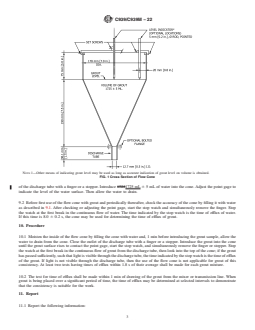
7.1 Flow Cone, with dimensions as shown in Fig. 1. The discharge tube shall be stainless steel. The body can be stainless steel,
cast aluminum, or other essentially non-corroding metal.
NOTE 2—Cones with high-density polyethylene bodies are acceptable for field use in situations where precision as described in this test method is not
required.
7.2 Receiving Container, capacity 2000 mL, minimum.
7.3 Ring Stand or other device, capable of supporting the flow cone in a vertical, steady position over the receiving container.
7.4 Level, carpenter’s or similar.
7.5 Stop Watch, least reading of not more than 0.2 s.
7.6 Grout Mixer, conforming to Practice C938 or as required by the specifier of the tests (See Note 3).
NOTE 3—The type of mixer used will impact the test results of a given grout mixture.
8. Test Sample
8.1 The grout test sample shall be in excess of 1725 mL and shall be representative of the gr
...