

ASTM D7140/D7140M-22
(Test Method)Standard Test Method to Measure Heat Transfer Through Textile Thermal Barrier Materials
General Information
- Abstract
SIGNIFICANCE AND USE
5.1 This test method measures the level of heat transfer through the thermal barrier textile material within a specific period of time.
5.2 This test method is used to evaluate thermal barriers and determine if they are able to withstand impingement by an open flame.
5.2.1 This test method is used to evaluate heat transfer when thermal barrier textile materials are used in conjunction with materials that demonstrate any of the following behaviors when exposed to high heat:
break open
charring
dripping
embrittlement
ignition
melting
shrinkage
5.3 This test method cannot be used in place of the full scale test method U.S. Consumer Product Safety Commission (CPSC) 16 CFR 1633.
Note 1: This test method is intended to be used to evaluate thermal barrier textile material, used as the thermal barrier component for mattresses that are tested to comply with 16 CFR 1633. Data obtained by using this method is intended to provide information as to whether it would be helpful to proceed with the full scale testing.
5.3.1 This test method can be used as part of a supplier quality assurance program.
5.4 This test method is not intended to be used in evaluating heat transfer of thermal barrier textile materials used in protective clothing.
5.5 This test method is not recommended for acceptance testing of commercial shipments, since information on interlaboratory precision is incomplete. In some cases the purchaser and the supplier shall agree to test a commercial shipment of one or more specific materials and establish their own interlaboratory precision and bias, and also agree on acceptability limits.
SCOPE
1.1 This test method covers the evaluation of heat transfer of textile materials which are used as thermal barriers when exposed to a calibrated convective and radiant energy heat source for 60 s.
1.1.1 This standard is used to determine if the heat transfer is sufficient to ignite flammable materials which are contiguous to the textile thermal barriers.
1.2 This standard is used as a means to differentiate textile materials.
1.3 This test method is not intended to measure the insulation properties of materials used in protective clothing.
1.4 The values stated in either SI units or inch-pound units are to be regarded separately as standard. The values stated in each system are not necessarily exact equivalents; therefore, to ensure conformance with the standard, each system shall be used independently of the other, and values from the two systems shall not be combined.
1.5 This standard is used to measure and describe the response of materials, products, or assemblies to heat and flame under controlled conditions, but does not by itself incorporate all factors required for fire hazard or fire risk assessment of the materials, products or assemblies under actual fire conditions.
1.6 This standard does not purport to address all of the safety concerns, if any, associated with its use. It is the responsibility of the user of this standard to establish appropriate safety, health and environmental practices and determine the applicability of regulatory limitations prior to use.
1.7 This international standard was developed in accordance with internationally recognized principles on standardization established in the Decision on Principles for the Development of International Standards, Guides and Recommendations issued by the World Trade Organization Technical Barriers to Trade (TBT) Committee.
- Status
- Published
- Publication Date
- 31-Jul-2022
- Technical Committee
- D13 - Textiles
- Drafting Committee
- D13.52 - Flammability
Buy Documents
ASTM D7140/D7140M-22 - Standard Test Method to Measure Heat Transfer Through Textile Thermal Barrier Materials
REDLINE ASTM D7140/D7140M-22 - Standard Test Method to Measure Heat Transfer Through Textile Thermal Barrier Materials
Overview
ASTM D7140/D7140M-22 is the internationally recognized standard test method for measuring heat transfer through textile thermal barrier materials. Published by ASTM International, this standard provides a laboratory-based procedure to determine how much heat passes through thermal barrier textiles over a specific period of exposure to calibrated convective and radiant energy sources.
The primary significance of this method lies in its ability to help differentiate and evaluate the performance of various textile materials used as thermal barriers-critical components in ensuring fire safety for products such as mattresses. By quantifying heat transfer, the method aids manufacturers, suppliers, and regulatory bodies in assessing whether a material can effectively limit ignition of adjacent flammable components when subjected to heat or open flame.
Key Topics
Heat Transfer Measurement
This test method precisely quantifies the rate at which heat is transferred through a textile thermal barrier during a 60-second exposure to controlled radiant and convective heat, allowing for comparative evaluation of different materials.Thermal Barrier Performance Evaluation
It assesses the ability of textile barriers to withstand exposure to fire, highlighting physical behaviors such as:- Break open
- Charring
- Dripping
- Embrittlement
- Ignition
- Melting
- Shrinkage
Material Differentiation
The method serves to distinguish between different textile materials based on their response to heat and flame exposure, providing important data before full-scale fire testing.Limitations
This standard is not intended for testing materials used in protective clothing nor should it replace full-scale tests such as those specified in 16 CFR 1633 or California TB603 for mattress safety.
Applications
Mattress Fire Barrier Testing
ASTM D7140/D7140M-22 is specifically intended for laboratory pre-screening of textile thermal barrier materials used as components of mattresses subject to flammability regulations like 16 CFR 1633. The results can inform whether further, full-scale flammability testing is warranted.Quality Assurance Programs
Manufacturers and suppliers can integrate this method into quality control processes to assess and document the performance consistency of thermal barrier textiles.Research and Development
Product developers in the textile and mattress industries utilize heat transfer data to innovate and enhance the fire resistance of new materials.Supplier-Purchaser Agreements
With mutual agreement, this method may be applied to assess commercial shipments of specified textile products, though it is not generally recommended for routine acceptance testing due to current limitations in established interlaboratory precision.
Related Standards
ASTM D123 - Terminology Relating to Textiles
Provides standard definitions for terms used in this and other textile standards.ASTM D4391 - Terminology Relating to the Burning Behavior of Textiles
Offers critical vocabulary for describing flammability and heat transfer behaviors.16 CFR 1633 - Standard for the Flammability of Mattress Sets
U.S. federal regulation requiring full-scale fire testing of mattresses; ASTM D7140/D7140M-22 may be used as a preliminary screen for materials used in such products.California Technical Bulletin 603 (TB603)
State-level test method for the fire safety of mattress and box spring sets, technically similar to 16 CFR 1633.
Practical Value
By using the ASTM D7140/D7140M-22 standard, organizations can:
- Screen materials efficiently for fire barrier suitability prior to engaging in more costly full-scale testing.
- Gather reliable, reproducible heat transfer data under standardized conditions.
- Enhance fire safety throughout the product life cycle, reducing risk and supporting regulatory compliance.
- Support supplier quality assurance programs through documented, consistent material performance evaluations.
For manufacturers, regulatory agencies, and researchers in the textile and bedding industries, adhering to ASTM D7140/D7140M-22 is crucial for fire safety in end-use products, especially in the context of rigorous flammability regulations.
Relations
- Effective Date
- 01-May-2018
- Effective Date
- 01-Mar-2017
- Effective Date
- 15-Feb-2016
- Effective Date
- 15-Feb-2016
- Effective Date
- 15-Sep-2015
- Effective Date
- 01-Sep-2015
- Effective Date
- 01-Apr-2015
- Effective Date
- 15-Jun-2013
- Effective Date
- 15-Jun-2013
- Effective Date
- 15-May-2013
- Effective Date
- 01-Jan-2013
- Effective Date
- 01-Jan-2013
- Effective Date
- 01-Jan-2013
- Effective Date
- 01-Feb-2012
- Effective Date
- 01-Feb-2012
Buy Documents
ASTM D7140/D7140M-22 - Standard Test Method to Measure Heat Transfer Through Textile Thermal Barrier Materials
REDLINE ASTM D7140/D7140M-22 - Standard Test Method to Measure Heat Transfer Through Textile Thermal Barrier Materials
Get Certified
Connect with accredited certification bodies for this standard

Control Union Certifications
Global certification for agriculture and sustainability.

Hohenstein Institut
Textile testing and certification.

Bureau Veritas Bangladesh
Bureau Veritas certification services in Bangladesh.
Sponsored listings
Frequently Asked Questions
ASTM D7140/D7140M-22 is a standard published by ASTM International. Its full title is "Standard Test Method to Measure Heat Transfer Through Textile Thermal Barrier Materials". This standard covers: SIGNIFICANCE AND USE 5.1 This test method measures the level of heat transfer through the thermal barrier textile material within a specific period of time. 5.2 This test method is used to evaluate thermal barriers and determine if they are able to withstand impingement by an open flame. 5.2.1 This test method is used to evaluate heat transfer when thermal barrier textile materials are used in conjunction with materials that demonstrate any of the following behaviors when exposed to high heat: break open charring dripping embrittlement ignition melting shrinkage 5.3 This test method cannot be used in place of the full scale test method U.S. Consumer Product Safety Commission (CPSC) 16 CFR 1633. Note 1: This test method is intended to be used to evaluate thermal barrier textile material, used as the thermal barrier component for mattresses that are tested to comply with 16 CFR 1633. Data obtained by using this method is intended to provide information as to whether it would be helpful to proceed with the full scale testing. 5.3.1 This test method can be used as part of a supplier quality assurance program. 5.4 This test method is not intended to be used in evaluating heat transfer of thermal barrier textile materials used in protective clothing. 5.5 This test method is not recommended for acceptance testing of commercial shipments, since information on interlaboratory precision is incomplete. In some cases the purchaser and the supplier shall agree to test a commercial shipment of one or more specific materials and establish their own interlaboratory precision and bias, and also agree on acceptability limits. SCOPE 1.1 This test method covers the evaluation of heat transfer of textile materials which are used as thermal barriers when exposed to a calibrated convective and radiant energy heat source for 60 s. 1.1.1 This standard is used to determine if the heat transfer is sufficient to ignite flammable materials which are contiguous to the textile thermal barriers. 1.2 This standard is used as a means to differentiate textile materials. 1.3 This test method is not intended to measure the insulation properties of materials used in protective clothing. 1.4 The values stated in either SI units or inch-pound units are to be regarded separately as standard. The values stated in each system are not necessarily exact equivalents; therefore, to ensure conformance with the standard, each system shall be used independently of the other, and values from the two systems shall not be combined. 1.5 This standard is used to measure and describe the response of materials, products, or assemblies to heat and flame under controlled conditions, but does not by itself incorporate all factors required for fire hazard or fire risk assessment of the materials, products or assemblies under actual fire conditions. 1.6 This standard does not purport to address all of the safety concerns, if any, associated with its use. It is the responsibility of the user of this standard to establish appropriate safety, health and environmental practices and determine the applicability of regulatory limitations prior to use. 1.7 This international standard was developed in accordance with internationally recognized principles on standardization established in the Decision on Principles for the Development of International Standards, Guides and Recommendations issued by the World Trade Organization Technical Barriers to Trade (TBT) Committee.
SIGNIFICANCE AND USE 5.1 This test method measures the level of heat transfer through the thermal barrier textile material within a specific period of time. 5.2 This test method is used to evaluate thermal barriers and determine if they are able to withstand impingement by an open flame. 5.2.1 This test method is used to evaluate heat transfer when thermal barrier textile materials are used in conjunction with materials that demonstrate any of the following behaviors when exposed to high heat: break open charring dripping embrittlement ignition melting shrinkage 5.3 This test method cannot be used in place of the full scale test method U.S. Consumer Product Safety Commission (CPSC) 16 CFR 1633. Note 1: This test method is intended to be used to evaluate thermal barrier textile material, used as the thermal barrier component for mattresses that are tested to comply with 16 CFR 1633. Data obtained by using this method is intended to provide information as to whether it would be helpful to proceed with the full scale testing. 5.3.1 This test method can be used as part of a supplier quality assurance program. 5.4 This test method is not intended to be used in evaluating heat transfer of thermal barrier textile materials used in protective clothing. 5.5 This test method is not recommended for acceptance testing of commercial shipments, since information on interlaboratory precision is incomplete. In some cases the purchaser and the supplier shall agree to test a commercial shipment of one or more specific materials and establish their own interlaboratory precision and bias, and also agree on acceptability limits. SCOPE 1.1 This test method covers the evaluation of heat transfer of textile materials which are used as thermal barriers when exposed to a calibrated convective and radiant energy heat source for 60 s. 1.1.1 This standard is used to determine if the heat transfer is sufficient to ignite flammable materials which are contiguous to the textile thermal barriers. 1.2 This standard is used as a means to differentiate textile materials. 1.3 This test method is not intended to measure the insulation properties of materials used in protective clothing. 1.4 The values stated in either SI units or inch-pound units are to be regarded separately as standard. The values stated in each system are not necessarily exact equivalents; therefore, to ensure conformance with the standard, each system shall be used independently of the other, and values from the two systems shall not be combined. 1.5 This standard is used to measure and describe the response of materials, products, or assemblies to heat and flame under controlled conditions, but does not by itself incorporate all factors required for fire hazard or fire risk assessment of the materials, products or assemblies under actual fire conditions. 1.6 This standard does not purport to address all of the safety concerns, if any, associated with its use. It is the responsibility of the user of this standard to establish appropriate safety, health and environmental practices and determine the applicability of regulatory limitations prior to use. 1.7 This international standard was developed in accordance with internationally recognized principles on standardization established in the Decision on Principles for the Development of International Standards, Guides and Recommendations issued by the World Trade Organization Technical Barriers to Trade (TBT) Committee.
ASTM D7140/D7140M-22 is classified under the following ICS (International Classification for Standards) categories: 59.080.30 - Textile fabrics. The ICS classification helps identify the subject area and facilitates finding related standards.
ASTM D7140/D7140M-22 has the following relationships with other standards: It is inter standard links to ASTM D4391-18, ASTM D123-17, ASTM D4391-16e1, ASTM D4391-16, ASTM D123-15b, ASTM D123-15a, ASTM D123-15, ASTM D123-13a, ASTM D123-13ae1, ASTM D123-13, ASTM D4391-93a(2013), ASTM D4391-93a(2013)e2, ASTM D4391-93A(2013)e1, ASTM D123-12e1, ASTM D123-12. Understanding these relationships helps ensure you are using the most current and applicable version of the standard.
ASTM D7140/D7140M-22 is available in PDF format for immediate download after purchase. The document can be added to your cart and obtained through the secure checkout process. Digital delivery ensures instant access to the complete standard document.
Standards Content (Sample)
This international standard was developed in accordance with internationally recognized principles on standardization established in the Decision on Principles for the
Development of International Standards, Guides and Recommendations issued by the World Trade Organization Technical Barriers to Trade (TBT) Committee.
Designation: D7140/D7140M − 22
Standard Test Method to
Measure Heat Transfer Through Textile Thermal Barrier
Materials
This standard is issued under the fixed designation D7140/D7140M; the number immediately following the designation indicates the
year of original adoption or, in the case of revision, the year of last revision. A number in parentheses indicates the year of last
reapproval. A superscript epsilon (´) indicates an editorial change since the last revision or reapproval.
1. Scope 2. Referenced Documents
2.1 ASTM Standards:
1.1 This test method covers the evaluation of heat transfer
D123 Terminology Relating to Textiles
of textile materials which are used as thermal barriers when
D4391 Terminology Relating to The Burning Behavior of
exposed to a calibrated convective and radiant energy heat
Textiles
source for 60 s.
1.1.1 This standard is used to determine if the heat transfer
2.2 Other Standards:
is sufficient to ignite flammable materials which are contiguous
Code of Federal Regulations – Title 16 – Consumer Product
to the textile thermal barriers.
Safety Commission Part 1633, Standard for the Flamma-
bility of Mattress Sets
1.2 This standard is used as a means to differentiate textile
materials.
3. Terminology
1.3 This test method is not intended to measure the insula-
3.1 The following terms are relevant to this standard: break
tion properties of materials used in protective clothing.
open, charring, dripping, embrittlement, exposure energy to
1.4 The values stated in either SI units or inch-pound units
thermal end point, heat flux, ignition, melting, shrinkage.
are to be regarded separately as standard. The values stated in
3.1.1 For all terminology relating to D13.52, Flammability,
each system are not necessarily exact equivalents; therefore, to
refer to Terminology D4391.
ensure conformance with the standard, each system shall be
3.2 For all terminology related to Textiles see Terminology
used independently of the other, and values from the two
D123.
systems shall not be combined.
1.5 This standard is used to measure and describe the
4. Summary of Test Method
responseofmaterials,products,orassembliestoheatandflame
4.1 A textile thermal barrier that is used to prevent transfer
under controlled conditions, but does not by itself incorporate
of heat to flammable materials which are contiguous to this
all factors required for fire hazard or fire risk assessment of the
barrier are exposed to a controlled radiant and convective heat
materials, products or assemblies under actual fire conditions.
source for 60 s.
1.6 This standard does not purport to address all of the
4.2 The heat transfer is measured using a data collection
safety concerns, if any, associated with its use. It is the
system.
responsibility of the user of this standard to establish appro-
priate safety, health and environmental practices and deter-
4.3 Performance of thermal barrier textile material is deter-
mine the applicability of regulatory limitations prior to use. mined by the amount of heat transferred through the specimen.
1.7 This international standard was developed in accor-
dance with internationally recognized principles on standard- 5. Significance and Use
ization established in the Decision on Principles for the
5.1 This test method measures the level of heat transfer
Development of International Standards, Guides and Recom-
through the thermal barrier textile material within a specific
mendations issued by the World Trade Organization Technical
period of time.
Barriers to Trade (TBT) Committee.
For referenced ASTM standards, visit the ASTM website, www.astm.org, or
This standard is under the jurisdiction of ASTM Committee D13 on Textiles contact ASTM Customer Service at service@astm.org. For Annual Book of ASTM
and is the direct responsibility of Subcommittee D13.52 on Flammability. Standards volume information, refer to the standard’s Document Summary page on
Current edition approved Aug. 1, 2022. Published August 2022. Originally the ASTM website.
approved in 2005. Last previous edition approved in 2017 as D7140 – 13(2017). Available from U.S. Consumer Product Safety Commission (CPSC), 4330 East
DOI: 10.1520/D7140_D7140M-22. West Hwy., Bethesda, MD 20814, http://www.cpsc.gov.
Copyright © ASTM International, 100 Barr Harbor Drive, PO Box C700, West Conshohocken, PA 19428-2959. United States
D7140/D7140M − 22
5.2 This test method is used to evaluate thermal barriers and 6.2 Liquid propane or natural gas with appropriate reducer
determine if they are able to withstand impingement by an and valving arrangement.
open flame.
6.3 A gas rotometer with range to give flow equivalent to 2
5.2.1 This test method is used to evaluate heat transfer when 3
L [0.007 ft ]/min. air at standard conditions.
thermal barrier textile materials are used in conjunction with
6.4 Meeker or Fisher burner with 38 mm [1.5 in.] diameter
materials that demonstrate any of the following behaviors
top and with orifice size of 1.2 mm [3/64 in.] for natural gas.
when exposed to high heat:
Propane requires a special orifice.
break open
charring
6.5 Copper calorimeter mounted in an insulating block and
dripping
constructed as shown in Fig. 2.
embrittlement
6.5.1 Calorimeter is painted black using a high temperature
ignition
flat black stove pipe primer.
melting
6.6 Dimensions for two (2) mounting plates are Length 152
shrinkage
mm [6 in.], Width 152 mm [6 in.], each with a 76 mm [3 in.]
5.3 This test method cannot be used in place of the full scale
by 76 mm [3 in.] hole in center. Each plate thickness is 3 mm
test method U.S. Consumer Product Safety Commission
[1/8 in.]. See Fig. 3. The bottom plate which faces the flame
(CPSC) 16 CFR 1633.
mustbemadeofsteel.Thetopplatemustalsobemadeofsteel.
NOTE 1—This test method is intended to be used to evaluate thermal
6.7 A recording system to monitor and record the output
barrier textile material, used as the thermal barrier component for
from the copper calorimeter. The system shall be either an
mattresses that are tested to comply with 16 CFR 1633. Data obtained by
automated digital system or strip chart recorder.
using this method is intended to provide information as to whether it
would be helpful to proceed with the full scale testing. 6.7.1 An automated digital data collection system capable
of measuring at least 150 °C [300 °F] or 10 mV and sufficient
5.3.1 This test method can be used as part of a supplier
sensitivity to read sensor response to 1 °C [2 ° F] or 60.05 mV
quality assurance program.
with a scanning rate to read exposure time to 60.01 s.
5.4 This test method is not intended to be used in evaluating
6.7.2 A strip chart recorder with full scale deflection of at
heat transfer of thermal barrier textile materials used in
least 150 °C [300 °F] or 10 mV and sufficient sensitivity and
protective clothing.
scale divisions to read sensor response to 1 °C [2 °F] or 60.05
5.5 This test method is not recommended for acceptance
mV.Achart speed to read exposure time to 60.01 s is required.
testing of commercial shipments, since information on inter-
6.8 Specimen Holder, see Fig. 3.Three complete assemblies
laboratory precision is incomplete. In some cases the purchaser
are desirable.
and the supplier shall agree to test a commercial shipment of
6.9 Laboratory standard ring support and clamp are used to
one or more specific materials and establish their own inter-
hold specimen holder assembly and position the burner.
laboratory precision and bias, and also agree on acceptability
limits.
7. Hazards
6. Apparatus
7.1 Perform the test in a hood or ventilated area to carry
6.1 Arrange components as shown in Fig. 1. combustion products away. If air currents disturb the flame,
6.1.1 Details of the calorimeter construction are shown in shield the apparatus or turn off the hood while running the test,
Fig. 2. thenturnthehoodonafterthetesttoclearfumes.Exercisecare
FIG. 1 Test Apparatus
D7140/D7140M − 22
FIG. 2 Calorimeter Placement
in handling the burner with the open flame. Maintain adequate shipment of one style of fabric as the lot. A lot may constitute
separation between flame and combustible materials. part of a single customer order.
7.2 The specimen holder and calorimeter assembly can
NOTE 3—An adequate specification or other agreement between the
become heated during prolonged testing. Use protective gloves purchaserandsupplierrequirestakingintoaccountthevariabilitybetween
rolls or pieces of fabric and between specimens from a swatch from a roll
when handling these hot objects.
or piece of fabric to provide a sampling plan with a meaningful producer’s
NOTE 2—Some test specimens are hazardous when exposed to direct
risk, consumer’s risk, acceptable quality level, and limiting quality level.
flames. Use care when the ignited specimen releases combustible gases.
8.2 Laboratory Sample—Take a swatch extending the width
Remove the burner using gloves and allow the sample to burn out, or
of the fabric and approximately1m[1yd] along the machine
smother it with a plate.
direction from each roll or piece in the lot sample. For rolls of
7.3 Shut off the gas supply at the cylinder and allow flame
fabric, take a sample that will exclude fabric from the outer
to burn the gas from the lines when testing is completed.
wrap of the roll or the inner wrap around the core of the roll of
fabric.
8. Sampling and Test Specimen Preparation
8.1 Lot Sample—Randomly select the number of rolls or 8.3 Test Specimens—Cut and identify five test specimens
pieces of fabric directed in an applicable material specification from e
...
This document is not an ASTM standard and is intended only to provide the user of an ASTM standard an indication of what changes have been made to the previous version. Because
it may not be technically possible to adequately depict all changes accurately, ASTM recommends that users consult prior editions as appropriate. In all cases only the current version
of the standard as published by ASTM is to be considered the official document.
Designation: D7140/D7140M − 13 (Reapproved 2017) D7140/D7140M − 22
Standard Test Method to
Measure Heat Transfer Through Textile Thermal Barrier
Materials
This standard is issued under the fixed designation D7140/D7140M; the number immediately following the designation indicates the
year of original adoption or, in the case of revision, the year of last revision. A number in parentheses indicates the year of last
reapproval. A superscript epsilon (´) indicates an editorial change since the last revision or reapproval.
1. Scope
1.1 This test method covers the evaluation of heat transfer of textile materials which are used as thermal barriers when exposed
to a calibrated convective and radiant energy heat source for 60 s.
1.1.1 This standard is used to determine if the heat transfer is sufficient to ignite flammable materials which are contiguous to the
textile thermal barriers.
1.2 This standard is used as a means to differentiate textile materials.
1.3 This test method is not intended to measure the insulation properties of materials used in protective clothing.
1.4 The values stated in either SI units or inch-pound units are to be regarded separately as standard. The values stated in each
system are not necessarily exact equivalents; therefore, to ensure conformance with the standard, each system shall be used
independently of the other, and values from the two systems shall not be combined.
1.5 This standard is used to measure and describe the response of materials, products, or assemblies to heat and flame under
controlled conditions, but does not by itself incorporate all factors required for fire hazard or fire risk assessment of the materials,
products or assemblies under actual fire conditions.
1.6 This standard does not purport to address all of the safety concerns, if any, associated with its use. It is the responsibility
of the user of this standard to establish appropriate safety, health and environmental practices and determine the applicability of
regulatory limitations prior to use.
1.7 This international standard was developed in accordance with internationally recognized principles on standardization
established in the Decision on Principles for the Development of International Standards, Guides and Recommendations issued
by the World Trade Organization Technical Barriers to Trade (TBT) Committee.
2. Referenced Documents
2.1 ASTM Standards:
D123 Terminology Relating to Textiles
D4391 Terminology Relating to The Burning Behavior of Textiles
This standard is under the jurisdiction of ASTM Committee D13 on Textiles and is the direct responsibility of Subcommittee D13.52 on Flammability.
Current edition approved July 15, 2017Aug. 1, 2022. Published August 2017August 2022. Originally approved in 2005. Last previous edition approved in 20132017 as
D7140 – 13.D7140 – 13(2017). DOI: 10.1520/D7140_D7140M-13R17.10.1520/D7140_D7140M-22.
For referenced ASTM standards, visit the ASTM website, www.astm.org, or contact ASTM Customer Service at service@astm.org. For Annual Book of ASTM Standards
volume information, refer to the standard’s Document Summary page on the ASTM website.
Copyright © ASTM International, 100 Barr Harbor Drive, PO Box C700, West Conshohocken, PA 19428-2959. United States
D7140/D7140M − 22
2.2 Other Standards:
State of California, Technical Bulletin 603 Requirements and Test Procedures for Resistance of a Mattress/Boxspring Set to a
Large Open Flame, January, 2004
Code of Federal Regulations – Title 16 – Consumer Product Safety Commission Part 1633, Standard for the Flammability of
Mattress Sets
3. Terminology
3.1 The following terms are relevant to this standard: break open, charring, dripping, embrittlement, exposure energy to thermal
end point, heat flux, ignition, melting, shrinkage.
3.1.1 For all terminology relating to D13.52, Flammability, refer to Terminology D4391.
3.2 For all terminology related to Textiles see Terminology D123.
4. Summary of Test Method
4.1 A textile thermal barrier that is used to prevent transfer of heat to flammable materials which are contiguous to this barrier
are exposed to a controlled radiant and convective heat source for 60 s.
4.2 The heat transfer is measured using a data collection system.
4.3 Performance of thermal barrier textile material is determined by the amount of heat transferred through the specimen.
5. Significance and Use
5.1 This test method measures the level of heat transfer through the thermal barrier textile material within a specific period of time.
5.2 This test method is used to evaluate thermal barriers and determine if they are able to withstand impingement by an open
flame.
5.2.1 This test method is used to evaluate heat transfer when thermal barrier textile materials are used in conjunction with
materials that demonstrate any of the following behaviors when exposed to high heat:
break open
charring
dripping
embrittlement
ignition
melting
shrinkage
5.3 This test method cannot be used in place of the full scale test method TB603 or U.S. Consumer Product Safety Commission
(CPSC) 16 CFR 1633.
NOTE 1—This test method is intended to be used to evaluate thermal barrier textile material, used as the thermal barrier component for mattresses that
are tested to comply with California Technical Bulletin 603 (TB603) or with 16 CFR 1633, two standards which are technically identical. 16 CFR 1633.
Data obtained by using this method is intended to provide information as to whether it would be helpful to proceed with the full scale testing.
5.3.1 This test method can be used as part of a supplier quality assurance program.
5.4 This test method is not intended to be used in evaluating heat transfer of thermal barrier textile materials used in protective
clothing.
Available from the State of California.
Available from U.S. Consumer Product Safety Commission (CPSC), 4330 East West Hwy., Bethesda, MD 20814, http://www.cpsc.gov.
D7140/D7140M − 22
5.5 This test method is not recommended for acceptance testing of commercial shipments, since information on interlaboratory
precision is incomplete. In some cases the purchaser and the supplier shall agree to test a commercial shipment of one or more
specific materials and establish their own interlaboratory precision and bias, and also agree on acceptability limits.
6. Apparatus
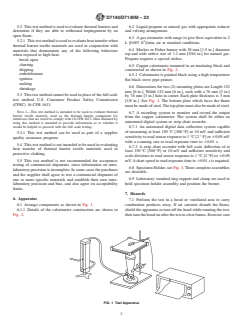
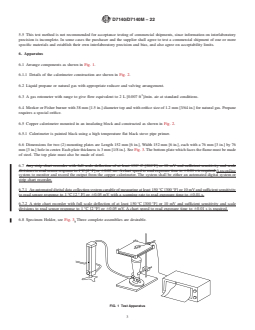
6.1 Arrange components as shown in Fig. 1.
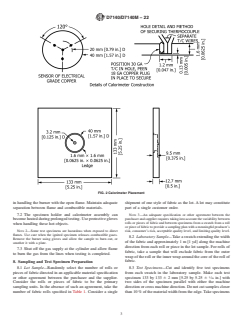
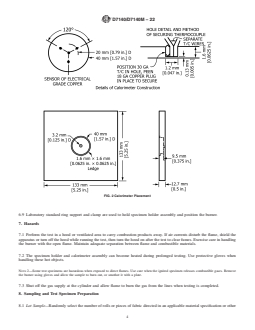
6.1.1 Details of the calorimeter construction are shown in Fig. 2.
6.2 Liquid propane or natural gas with appropriate reducer and valving arrangement.
6.3 A gas rotometer with range to give flow equivalent to 2 L [0.007 ft ]/min. air at standard conditions.
6.4 Meeker or Fisher burner with 38 mm [1.5 in.] diameter top and with orifice size of 1.2 mm [3/64 in.] for natural gas. Propane
requires a special orifice.
6.5 Copper calorimeter mounted in an insulating block and constructed as shown in Fig. 2.
6.5.1 Calorimeter is painted black using a high temperature flat black stove pipe primer.
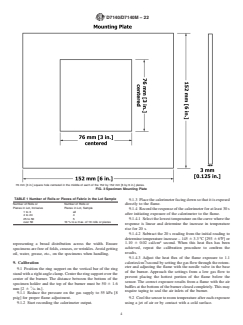
6.6 Dimensions for two (2) mounting plates are Length 152 mm [6 in.], Width 152 mm [6 in.], each with a 76 mm [3 in.] by 76
mm [3 in.] hole in center. Each plate thickness is 3 mm [1/8 in.]. See Fig. 3. The bottom plate which faces the flame must be made
of steel. The top plate must also be made of steel.
6.7 Any strip chart recorder with full scale deflection of at least 150° C [300°F] or 10 mV and sufficient sensitivity and scale
divisions to read sensor response to 1°C [2° F] or 60.05 mv. A chart speed to read exposure time to 60.01 s is required.A recording
system to monitor and record the output from the copper calorimeter. The system shall be either an automated digital system or
strip chart recorder.
6.7.1 An automated digital data collection system capable of measuring at least 150 °C [300 °F] or 10 mV and sufficient sensitivity
to read sensor response to 1 °C [2 ° F] or 60.05 mV with a scanning rate to read exposure time to 60.01 s.
6.7.2 A strip chart recorder with full scale deflection of at least 150 °C [300 °F] or 10 mV and sufficient sensitivity and scale
divisions to read sensor response to 1 °C [2 °F] or 60.05 mV. A chart speed to read exposure time to 60.01 s is required.
6.8 Specimen Holder, see Fig. 3. Three complete assemblies are desirable.
FIG. 1 Test Apparatus
D7140/D7140M − 22
FIG. 2 Calorimeter Placement
6.9 Laboratory standard ring support and clamp are used to hold specimen holder assembly and position the burner.
7. Hazards
7.1 Perform the test in a hood or ventilated area to carry combustion products away. If air currents disturb the flame, shield the
apparatus or turn off the hood while running the test, then turn the hood on after the test to clear fumes. Exercise care in handling
the burner with the open flame. Maintain adequate separation between flame and combustible materials.
7.2 The specimen holder and calorimeter assembly can become heated during prolonged testing. Use protective gloves when
handling these hot objects.
NOTE 2—Some test specimens are hazardous when exposed to direct flames. Use care when the ignited specimen releases combustible gases. Remove
the burner using gloves and allow the sample to burn out, or smother it with a plate.
7.3 Shut off the gas supply at the cylinder and allow flame to burn the gas from the lines when testing is completed.
8. Sampling and Test Specimen Preparation
8.1 Lot Sample—Randomly select the number of rolls or pieces of fabric directed in an applicable material specification or other
D7140/D7140M − 22
76 mm [3 in.] square hole centered in the middle of each of the 152 by 152 mm [6 by 6 in.] plates.
FIG. 3 Specimen Mounting Plate
agreement between the purchaser and the supplier. Consider the rolls or pieces of fabric to be the primary sampling units. In the
absence of such an agreement, take the number of fabric rolls specified in Table 1. Consider a single shipment of one style of fabric
as the lot. A lot may constitute part of
...