


ASTM C494/C494M-19e1
(Specification)Standard Specification for Chemical Admixtures for Concrete
Standard Specification for Chemical Admixtures for Concrete
ABSTRACT
This specification covers the materials and the test methods for use in chemical admixtures to be added to hydraulic-cement concrete mixtures in the field. The seven types of admixtures are indicated as follows: Type A—water reducing; Type B—retarding; Type C—accelerating; Type D—water reducing and retarding; Type E—water reducing and accelerating; Type F—water reducing, high range; and Type G—water reducing, high range, and retarding. The materials used in the concrete mixtures shall include Type I or Type II cement, pozzolan, fine and coarse aggregates, and air-entraining admixture. Samples of freshly mixed concrete from at least three separate batches for each condition of concrete shall be tested in accordance with the slump, air content, time of setting, and water content tests. Physical properties retesting shall consist of uniformity and equivalence tests using infrared analysis which is intended to compare qualitatively the composition of different samples, residue by oven drying which shall be either a forced circulation type or one with provision for free access of air, and specific gravity determination using hydrometers. Test specimens of the hardened concrete shall be prepared in accordance to compressive strength, flexural strength, resistance to freezing and thawing, and length change.
SCOPE
1.1 This specification covers materials for use as chemical admixtures to be added to hydraulic-cement concrete mixtures for the purpose or purposes indicated for the eight types as follows:
1.1.1 Type A—Water-reducing admixtures,
1.1.2 Type B—Retarding admixtures,
1.1.3 Type C—Accelerating admixtures,
1.1.4 Type D—Water-reducing and retarding admixtures,
1.1.5 Type E—Water-reducing and accelerating admixtures,
1.1.6 Type F—Water-reducing, high range admixtures,
1.1.7 Type G—Water-reducing, high range, and retarding admixtures, and
1.1.8 Type S—Specific performance admixtures.
1.2 Unless specified otherwise by the purchaser, test specimens for qualifying an admixture shall be made using concreting materials as described in 11.1 – 11.3.
Note 1: As discussed in Appendix X2, it is recommended that, whenever practicable, supplementary tests be made by the purchaser using the cement, pozzolan, aggregates, air-entraining admixture, and the mixture proportions, batching sequence, and other physical conditions proposed for the specific work because the specific effects produced by chemical admixtures may vary with the properties and proportions of the other ingredients of the concrete. For example, Types F and G admixtures may exhibit much higher water reduction in concrete mixtures having higher cement contents than that listed in 12.1.1.
Note 2: The purchaser should verify that the admixture supplied for use in the work is equivalent in composition to the admixture subjected to test under this specification (see Section 6, Uniformity and Equivalence).
Note 3: Admixtures that contain sufficient amounts of chloride may accelerate corrosion of steel reinforcement. Compliance with the requirements of this specification does not constitute assurance of acceptability of the admixture for use in reinforced concrete.
1.3 This specification provides for three levels of testing.
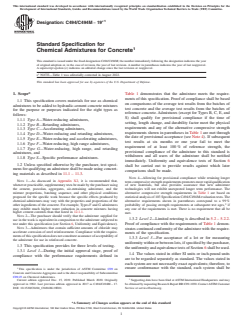
1.3.1 Level 1—During the initial approval stage, proof of compliance with the performance requirements defined in Table 1 demonstrates that the admixture meets the requirements of this specification. Proof of compliance shall be based on comparisons of the average test results from the batches of test concrete and the average test results from the batches of reference concrete. Admixtures (except for Types B, C, E, and S) shall qualify for provisional compliance if the time of setting, length change, and durability factor meet the physical requirements and any of the alternative compressive strength requirements shown in parentheses in Table 1 are met through the date of provisional acceptance (see Note...
General Information
- Status
- Published
- Publication Date
- 14-Dec-2019
- Technical Committee
- C09 - Concrete and Concrete Aggregates
- Drafting Committee
- C09.23 - Chemical Admixtures
Relations
- Effective Date
- 01-Jan-2024
- Refers
ASTM C39/C39M-23 - Standard Test Method for Compressive Strength of Cylindrical Concrete Specimens - Effective Date
- 01-Dec-2023
- Effective Date
- 15-Dec-2019
- Effective Date
- 01-Nov-2019
- Effective Date
- 01-May-2019
- Effective Date
- 01-Apr-2019
- Effective Date
- 01-Jan-2019
- Effective Date
- 01-Oct-2018
- Effective Date
- 01-Jul-2018
- Effective Date
- 01-Jan-2018
- Effective Date
- 15-Aug-2017
- Refers
ASTM C39/C39M-17b - Standard Test Method for Compressive Strength of Cylindrical Concrete Specimens - Effective Date
- 01-Aug-2017
- Effective Date
- 15-Dec-2016
- Effective Date
- 01-Dec-2016
- Refers
ASTM C39/C39M-16b - Standard Test Method for Compressive Strength of Cylindrical Concrete Specimens - Effective Date
- 01-Aug-2016
Overview
ASTM C494/C494M-19e1, published by ASTM International, is the internationally recognized standard specification for chemical admixtures used in hydraulic-cement concrete. This standard outlines requirements for the composition, performance, testing, and acceptance of chemical admixtures to ensure their quality and suitability for different concrete applications. The specification defines several types of admixtures, each with unique characteristics, including water-reducing, retarding, accelerating, high-range water-reducing, and specialized performance admixtures.
By following ASTM C494/C494M-19e1, suppliers, producers, and purchasers ensure chemical admixtures are consistent, safe, and effective for enhancing concrete properties across a wide range of construction projects.
Key Topics
Admixture Types:
The specification covers eight distinct types:- Type A: Water-reducing
- Type B: Retarding
- Type C: Accelerating
- Type D: Water-reducing and retarding
- Type E: Water-reducing and accelerating
- Type F: Water-reducing, high range
- Type G: Water-reducing, high range, and retarding
- Type S: Specific performance admixtures
Materials and Mix Design:
Chemical admixtures are added to concrete containing Type I or Type II cement, pozzolans, aggregates, and optional air-entraining admixtures. The specification encourages supplementary testing with project-specific materials to ensure desired results.Testing and Performance Evaluation:
The standard mandates rigorous testing, including:- Slump, air content, setting time, and water content in fresh concrete
- Compressive and flexural strength, resistance to freezing and thawing, and length change in hardened concrete
- Uniformity and equivalence assessments through infrared analysis, residue by oven drying, and specific gravity measurements
Quality Assurance:
Admixtures must be consistently uniform and equivalent to previously tested samples. Packaging, marking, storage, and clear specification of admixture types and performance characteristics are required for traceability and compliance.
Applications
Ready-Mix and Precast Concrete:
ASTM C494/C494M-19e1 serves as a critical reference for concrete producers and construction companies when selecting and verifying chemical admixtures, whether for large-scale infrastructure or precast elements.Construction Projects with Specialized Requirements:
Different admixture types are chosen to meet specific construction needs:- Water-reducing admixtures (Type A, F, G) to improve workability and reduce water content for high-strength concrete
- Accelerators (Type C, E) for fast-track projects requiring early strength gain
- Retarders (Type B, D, G) suitable in hot climates or complex placements to control setting time
- Specific performance admixtures (Type S) designed to address shrinkage, mitigate alkali-silica reaction, or enhance durability
Quality Control Laboratories:
The standard guides laboratories in carrying out robust procedures for concrete mix evaluations, using multiple batches and control samples to confirm admixture performance.
Related Standards
- ASTM C260/C260M: Specification for Air-Entraining Admixtures for Concrete
- ASTM C150/C150M: Specification for Portland Cement
- ASTM C33/C33M: Specification for Concrete Aggregates
- ASTM C39/C39M: Test Method for Compressive Strength of Cylindrical Concrete Specimens
- ASTM C78/C78M: Test Method for Flexural Strength of Concrete
- ASTM C666/C666M: Test Method for Resistance of Concrete to Rapid Freezing and Thawing
- ASTM C403/C403M: Test Method for Time of Setting of Concrete Mixtures by Penetration Resistance
- ACI 211.1: Standard Practice for Selecting Proportions for Normal, Heavyweight, and Mass Concrete
Practical Value
Adhering to ASTM C494/C494M-19e1 ensures that chemical admixtures for concrete are thoroughly evaluated for quality, performance, and consistency. Meeting the requirements of this standard helps prevent construction issues related to inconsistent setting, low strength, or poor durability, which are vital for safe, long-lasting concrete structures. The standard also facilitates international trade and acceptance of admixtures by providing recognized benchmarking for performance and testing protocols.
By referencing ASTM C494/C494M-19e1, stakeholders throughout the concrete supply chain can confidently specify, use, and verify the effectiveness of chemical admixtures to optimize project outcomes.
Keywords: ASTM C494, chemical admixtures, concrete admixture specification, water-reducing admixtures, retarding admixtures, accelerating admixtures, high-range water reducers, concrete quality standards, admixture testing.
Get Certified
Connect with accredited certification bodies for this standard

ICC Evaluation Service
Building products evaluation and certification.

QAI Laboratories
Building and construction product testing and certification.

Aboma Certification B.V.
Specialized in construction, metal, and transport sectors.
Sponsored listings
Frequently Asked Questions
ASTM C494/C494M-19e1 is a technical specification published by ASTM International. Its full title is "Standard Specification for Chemical Admixtures for Concrete". This standard covers: ABSTRACT This specification covers the materials and the test methods for use in chemical admixtures to be added to hydraulic-cement concrete mixtures in the field. The seven types of admixtures are indicated as follows: Type A—water reducing; Type B—retarding; Type C—accelerating; Type D—water reducing and retarding; Type E—water reducing and accelerating; Type F—water reducing, high range; and Type G—water reducing, high range, and retarding. The materials used in the concrete mixtures shall include Type I or Type II cement, pozzolan, fine and coarse aggregates, and air-entraining admixture. Samples of freshly mixed concrete from at least three separate batches for each condition of concrete shall be tested in accordance with the slump, air content, time of setting, and water content tests. Physical properties retesting shall consist of uniformity and equivalence tests using infrared analysis which is intended to compare qualitatively the composition of different samples, residue by oven drying which shall be either a forced circulation type or one with provision for free access of air, and specific gravity determination using hydrometers. Test specimens of the hardened concrete shall be prepared in accordance to compressive strength, flexural strength, resistance to freezing and thawing, and length change. SCOPE 1.1 This specification covers materials for use as chemical admixtures to be added to hydraulic-cement concrete mixtures for the purpose or purposes indicated for the eight types as follows: 1.1.1 Type A—Water-reducing admixtures, 1.1.2 Type B—Retarding admixtures, 1.1.3 Type C—Accelerating admixtures, 1.1.4 Type D—Water-reducing and retarding admixtures, 1.1.5 Type E—Water-reducing and accelerating admixtures, 1.1.6 Type F—Water-reducing, high range admixtures, 1.1.7 Type G—Water-reducing, high range, and retarding admixtures, and 1.1.8 Type S—Specific performance admixtures. 1.2 Unless specified otherwise by the purchaser, test specimens for qualifying an admixture shall be made using concreting materials as described in 11.1 – 11.3. Note 1: As discussed in Appendix X2, it is recommended that, whenever practicable, supplementary tests be made by the purchaser using the cement, pozzolan, aggregates, air-entraining admixture, and the mixture proportions, batching sequence, and other physical conditions proposed for the specific work because the specific effects produced by chemical admixtures may vary with the properties and proportions of the other ingredients of the concrete. For example, Types F and G admixtures may exhibit much higher water reduction in concrete mixtures having higher cement contents than that listed in 12.1.1. Note 2: The purchaser should verify that the admixture supplied for use in the work is equivalent in composition to the admixture subjected to test under this specification (see Section 6, Uniformity and Equivalence). Note 3: Admixtures that contain sufficient amounts of chloride may accelerate corrosion of steel reinforcement. Compliance with the requirements of this specification does not constitute assurance of acceptability of the admixture for use in reinforced concrete. 1.3 This specification provides for three levels of testing. 1.3.1 Level 1—During the initial approval stage, proof of compliance with the performance requirements defined in Table 1 demonstrates that the admixture meets the requirements of this specification. Proof of compliance shall be based on comparisons of the average test results from the batches of test concrete and the average test results from the batches of reference concrete. Admixtures (except for Types B, C, E, and S) shall qualify for provisional compliance if the time of setting, length change, and durability factor meet the physical requirements and any of the alternative compressive strength requirements shown in parentheses in Table 1 are met through the date of provisional acceptance (see Note...
ABSTRACT This specification covers the materials and the test methods for use in chemical admixtures to be added to hydraulic-cement concrete mixtures in the field. The seven types of admixtures are indicated as follows: Type A—water reducing; Type B—retarding; Type C—accelerating; Type D—water reducing and retarding; Type E—water reducing and accelerating; Type F—water reducing, high range; and Type G—water reducing, high range, and retarding. The materials used in the concrete mixtures shall include Type I or Type II cement, pozzolan, fine and coarse aggregates, and air-entraining admixture. Samples of freshly mixed concrete from at least three separate batches for each condition of concrete shall be tested in accordance with the slump, air content, time of setting, and water content tests. Physical properties retesting shall consist of uniformity and equivalence tests using infrared analysis which is intended to compare qualitatively the composition of different samples, residue by oven drying which shall be either a forced circulation type or one with provision for free access of air, and specific gravity determination using hydrometers. Test specimens of the hardened concrete shall be prepared in accordance to compressive strength, flexural strength, resistance to freezing and thawing, and length change. SCOPE 1.1 This specification covers materials for use as chemical admixtures to be added to hydraulic-cement concrete mixtures for the purpose or purposes indicated for the eight types as follows: 1.1.1 Type A—Water-reducing admixtures, 1.1.2 Type B—Retarding admixtures, 1.1.3 Type C—Accelerating admixtures, 1.1.4 Type D—Water-reducing and retarding admixtures, 1.1.5 Type E—Water-reducing and accelerating admixtures, 1.1.6 Type F—Water-reducing, high range admixtures, 1.1.7 Type G—Water-reducing, high range, and retarding admixtures, and 1.1.8 Type S—Specific performance admixtures. 1.2 Unless specified otherwise by the purchaser, test specimens for qualifying an admixture shall be made using concreting materials as described in 11.1 – 11.3. Note 1: As discussed in Appendix X2, it is recommended that, whenever practicable, supplementary tests be made by the purchaser using the cement, pozzolan, aggregates, air-entraining admixture, and the mixture proportions, batching sequence, and other physical conditions proposed for the specific work because the specific effects produced by chemical admixtures may vary with the properties and proportions of the other ingredients of the concrete. For example, Types F and G admixtures may exhibit much higher water reduction in concrete mixtures having higher cement contents than that listed in 12.1.1. Note 2: The purchaser should verify that the admixture supplied for use in the work is equivalent in composition to the admixture subjected to test under this specification (see Section 6, Uniformity and Equivalence). Note 3: Admixtures that contain sufficient amounts of chloride may accelerate corrosion of steel reinforcement. Compliance with the requirements of this specification does not constitute assurance of acceptability of the admixture for use in reinforced concrete. 1.3 This specification provides for three levels of testing. 1.3.1 Level 1—During the initial approval stage, proof of compliance with the performance requirements defined in Table 1 demonstrates that the admixture meets the requirements of this specification. Proof of compliance shall be based on comparisons of the average test results from the batches of test concrete and the average test results from the batches of reference concrete. Admixtures (except for Types B, C, E, and S) shall qualify for provisional compliance if the time of setting, length change, and durability factor meet the physical requirements and any of the alternative compressive strength requirements shown in parentheses in Table 1 are met through the date of provisional acceptance (see Note...
ASTM C494/C494M-19e1 is classified under the following ICS (International Classification for Standards) categories: 91.100.30 - Concrete and concrete products. The ICS classification helps identify the subject area and facilitates finding related standards.
ASTM C494/C494M-19e1 has the following relationships with other standards: It is inter standard links to ASTM C231/C231M-24, ASTM C39/C39M-23, ASTM C125-19a, ASTM D75/D75M-19, ASTM E100-19, ASTM C150/C150M-19, ASTM C125-19, ASTM C125-18b, ASTM C125-18a, ASTM C125-18, ASTM C157/C157M-17, ASTM C39/C39M-17b, ASTM C125-16, ASTM C78/C78M-15b, ASTM C39/C39M-16b. Understanding these relationships helps ensure you are using the most current and applicable version of the standard.
ASTM C494/C494M-19e1 is available in PDF format for immediate download after purchase. The document can be added to your cart and obtained through the secure checkout process. Digital delivery ensures instant access to the complete standard document.
Standards Content (Sample)
This international standard was developed in accordance with internationally recognized principles on standardization established in the Decision on Principles for the
Development of International Standards, Guides and Recommendations issued by the World Trade Organization Technical Barriers to Trade (TBT) Committee.
´1
Designation:C494/C494M −19
Standard Specification for
Chemical Admixtures for Concrete
This standard is issued under the fixed designation C494/C494M; the number immediately following the designation indicates the year
of original adoption or, in the case of revision, the year of last revision.Anumber in parentheses indicates the year of last reapproval.
A superscript epsilon (´) indicates an editorial change since the last revision or reapproval.
ε NOTE—Table 1 was editorially corrected in August 2022.
This standard has been approved for use by agencies of the U.S. Department of Defense.
1. Scope* Table 1 demonstrates that the admixture meets the require-
ments of this specification. Proof of compliance shall be based
1.1 This specification covers materials for use as chemical
on comparisons of the average test results from the batches of
admixtures to be added to hydraulic-cement concrete mixtures
test concrete and the average test results from the batches of
for the purpose or purposes indicated for the eight types as
reference concrete.Admixtures (except for Types B, C, E, and
follows:
S) shall qualify for provisional compliance if the time of
1.1.1 Type A—Water-reducing admixtures,
setting, length change, and durability factor meet the physical
1.1.2 Type B—Retarding admixtures,
requirements and any of the alternative compressive strength
1.1.3 Type C—Accelerating admixtures,
requirements shown in parentheses in Table 1 are met through
1.1.4 Type D—Water-reducing and retarding admixtures,
the date of provisional acceptance (see Note 4). If subsequent
1.1.5 Type E—Water-reducing and accelerating admixtures,
test results at six months or one year fail to meet the
1.1.6 Type F—Water-reducing, high range admixtures,
requirement of at least 100% of reference strength, the
1.1.7 Type G—Water-reducing, high range, and retarding
provisional compliance of the admixture to this standard is
admixtures, and
withdrawn and all users of the admixture shall be notified
1.1.8 Type S—Specific performance admixtures.
immediately. Uniformity and equivalence tests of Section 6
1.2 Unless specified otherwise by the purchaser, test speci-
shall be carried out to provide results against which later
mens for qualifying an admixture shall be made using concret-
comparisons shall be made.
ing materials as described in 11.1 – 11.3.
NOTE 4—Allowing for provisional compliance while retaining longer
NOTE 1—As discussed in Appendix X2, it is recommended that,
termcompressivestrengthrequirementspromotesmorerapidqualification
wheneverpracticable,supplementarytestsbemadebythepurchaserusing
of new materials, but also provides assurance that new admixture
the cement, pozzolan, aggregates, air-entraining admixture, and the
technologies will not exhibit unexpected longer term performance. The
mixture proportions, batching sequence, and other physical conditions
alternative compressive strength requirements in Table 1 are based on
proposed for the specific work because the specific effects produced by
statisticalanalysisof103SpecificationC494/C494Mevaluationtests.The
chemical admixtures may vary with the properties and proportions of the
alternative requirements shown in parentheses correspond to a 99%
other ingredients of the concrete. For example,Types F and G admixtures
probability of passing strength requirements at subsequent test ages, if
may exhibit much higher water reduction in concrete mixtures having
any one of the requirements is met. There is no requirement that all be
higher cement contents than that listed in 12.1.1.
met.
NOTE 2—The purchaser should verify that the admixture supplied for
1.3.2 Level 2—Limited retesting is described in 5.2 – 5.2.2.
useintheworkisequivalentincompositiontotheadmixturesubjectedto
Proof of compliance with the requirements of Table 1 demon-
test under this specification (see Section 6, Uniformity and Equivalence).
NOTE 3—Admixtures that contain sufficient amounts of chloride may
stratescontinuedconformityoftheadmixturewiththerequire-
accelerate corrosion of steel reinforcement. Compliance with the require-
ments of the specification.
mentsofthisspecificationdoesnotconstituteassuranceofacceptabilityof
1.3.3 Level 3—For acceptance of a lot or for measuring
the admixture for use in reinforced concrete.
uniformitywithinorbetweenlots,ifspecifiedbythepurchaser,
1.3 This specification provides for three levels of testing.
theuniformityandequivalencetestsofSection6shallbeused.
1.3.1 Level 1—During the initial approval stage, proof of
1.4 The values stated in either SI units or inch-pound units
compliance with the performance requirements defined in
are to be regarded separately as standard. The values stated in
eachsystemarenotnecessarilyexactequivalents;therefore,to
ensure conformance with the standard, each system shall be
This specification is under the jurisdiction of ASTM Committee C09 on
Concrete and ConcreteAggregates and is the direct responsibility of Subcommittee
C09.23 on Chemical Admixtures.
Current edition approved Dec. 15, 2019. Published March 2020. Originally Supporting data have been filed atASTM International Headquarters and may
approved in 1962. Last previous edition approved in 2017 as C494/C494M–17. beobtainedbyrequestingResearchReportRR:C09-1030.ContactASTMCustomer
DOI: 10.1520/C0494_C0494M-19E01. Service at service@astm.org.
*A Summary of Changes section appears at the end of this standard
Copyright © ASTM International, 100 Barr Harbor Drive, PO Box C700, West Conshohocken, PA 19428-2959. United States
´1
C494/C494M−19
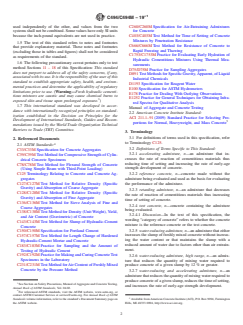
used independently of the other, and values from the two C260/C260MSpecification for Air-Entraining Admixtures
systemsshallnotbecombined.SomevalueshaveonlySIunits for Concrete
because the inch-pound equivalents are not used in practice. C403/C403MTest Method for Time of Setting of Concrete
Mixtures by Penetration Resistance
1.5 The text of this standard refers to notes and footnotes
C666/C666MTest Method for Resistance of Concrete to
that provide explanatory material. These notes and footnotes
Rapid Freezing and Thawing
(excluding those in tables and figures) shall not be considered
C1753/C1753MPractice for Evaluating Early Hydration of
as requirements of the standard.
Hydraulic Cementitious Mixtures Using Thermal Mea-
1.6 The following precautionary caveat pertains only to test
surements
method Sections11–18 of this Specification: This standard
D75/D75MPractice for Sampling Aggregates
does not purport to address all of the safety concerns, if any,
D891TestMethodsforSpecificGravity,Apparent,ofLiquid
associated with its use. It is the responsibility of the user of this
Industrial Chemicals
standard to establish appropriate safety, health, and environ-
D1193Specification for Reagent Water
mental practices and determine the applicability of regulatory
E100Specification for ASTM Hydrometers
limitations prior to use. (Warning—Fresh hydraulic cementi-
E178Practice for Dealing With Outlying Observations
tious mixtures are caustic and may cause chemical burns to
E1252Practice for General Techniques for Obtaining Infra-
exposed skin and tissue upon prolonged exposure. )
red Spectra for Qualitative Analysis
1.7 This international standard was developed in accor-
Manual of Aggregate and Concrete Testing
dance with internationally recognized principles on standard-
2.2 American Concrete Institute Standard:
ization established in the Decision on Principles for the
ACI 211.1–91(2009) Standard Practice for Selecting Pro-
Development of International Standards, Guides and Recom-
portions for Normal, Heavyweight, and Mass Concrete
mendations issued by the World Trade Organization Technical
Barriers to Trade (TBT) Committee.
3. Terminology
3.1 For definitions of terms used in this specification, refer
2. Referenced Documents
to Terminology C125.
2.1 ASTM Standards:
3.2 Definitions of Terms Specific to This Standard:
C33/C33MSpecification for Concrete Aggregates
3.2.1 accelerating admixture, n—an admixture that in-
C39/C39MTest Method for Compressive Strength of Cylin-
creases the rate of reaction of cementitious materials thus
drical Concrete Specimens
reducing time of setting and increasing the rate of early-age
C78/C78MTest Method for Flexural Strength of Concrete
strength development of concrete.
(Using Simple Beam with Third-Point Loading)
C125Terminology Relating to Concrete and Concrete Ag- 3.2.2 reference concrete, n—concrete made without the
gregates
admixture being evaluated and used as the basis for evaluating
C127/C127MTest Method for Relative Density (Specific the performance of the admixture.
Gravity) and Absorption of Coarse Aggregate
3.2.3 retarding admixture, n—an admixture that decreases
C128/C128MTest Method for Relative Density (Specific
the rate of reaction of cementitious materials thus increasing
Gravity) and Absorption of Fine Aggregate
time of setting of concrete.
C136/C136MTest Method for Sieve Analysis of Fine and
3.2.4 test concrete, n—concrete containing the admixture
Coarse Aggregates
being evaluated.
C138/C138MTestMethodforDensity(UnitWeight),Yield,
3.2.4.1 Discussion—In the text of this specification, the
and Air Content (Gravimetric) of Concrete
wording “category of concrete” refers to whether the concrete
C143/C143MTest Method for Slump of Hydraulic-Cement
mixture is the reference concrete or the test concrete.
Concrete
3.2.5 water-reducing admixture, n—anadmixturethateither
C150/C150MSpecification for Portland Cement
increases the slump of freshly mixed concrete without increas-
C157/C157MTest Method for Length Change of Hardened
ing the water content or that maintains the slump with a
Hydraulic-Cement Mortar and Concrete
reduced amount of water due to factors other than air entrain-
C183/C183MPractice for Sampling and the Amount of
ment.
Testing of Hydraulic Cement
C192/C192MPracticeforMakingandCuringConcreteTest
3.2.6 water-reducing admixture, high range, n—an admix-
Specimens in the Laboratory
ture that reduces the quantity of mixing water required to
C231/C231MTestMethodforAirContentofFreshlyMixed
produce concrete of a given slump by 12% or greater.
Concrete by the Pressure Method
3.2.7 water-reducing and accelerating admixture, n—an
admixturethatreducesthequantityofmixingwaterrequiredto
produceconcreteofagivenslump,reducesthetimeofsetting,
See Section on Safety Precautions, Manual ofAggregate and ConcreteTesting,
and increases the rate of early-age strength development.
Annual Book of ASTM Standards, Vol. 04.02.
For referenced ASTM standards, visit the ASTM website, www.astm.org, or
contact ASTM Customer Service at service@astm.org. For Annual Book of ASTM
Standards volume information, refer to the standard’s Document Summary page on AvailablefromAmericanConcreteInstitute(ACI),P.O.Box9094,Farmington
the ASTM website. Hills, MI 48333-9094, http://www.aci-int.org.
´1
C494/C494M−19
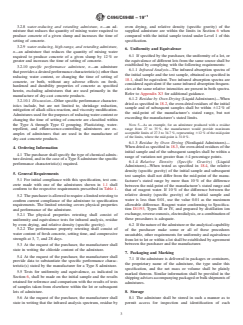
3.2.8 water-reducing and retarding admixture, n—an ad- oven drying, and relative density (specific gravity) of the
mixture that reduces the quantity of mixing water required to supplied admixture are within the limits in Section 6 when
produce concrete of a given slump and increases the time of compared with the initial sample tested under Level 1 of this
setting of concrete. specification.
3.2.9 water-reducing, high-range, and retarding admixture,
6. Uniformity and Equivalence
n—an admixture that reduces the quantity of mixing water
6.1 If specified by the purchaser, the uniformity of a lot, or
required to produce concrete of a given slump by 12% or
the equivalence of different lots from the same source shall be
greater and increases the time of setting of concrete.
established by complying with the following requirements:
3.2.10 specific performance admixture, n—an admixture
6.1.1 Infrared Analysis—The infrared absorption spectra of
thatprovidesadesiredperformancecharacteristic(s)otherthan
the initial sample and the test sample, obtained as specified in
reducing water content, or changing the time of setting of
18.1, shall be equivalent. Two infrared absorption spectra are
concrete, or both, without any adverse effects on fresh,
considered equivalent if the same infrared absorption frequen-
hardened and durability properties of concrete as specified
cies at the same relative intensities are present in both spectra.
herein, excluding admixtures that are used primarily in the
Refer to Appendix X3 for additional guidance.
manufacture of dry-cast concrete products.
6.1.2 Residue by Oven Drying (LiquidAdmixtures)—When
3.2.10.1 Discussion—Other specific performance character-
dried as specified in 18.2, the oven-dried residues of the initial
istics include, but are not limited to, shrinkage reduction,
sample and of subsequent samples shall be within 612% of
mitigation of alkali-silica reaction, and viscosity modification.
the mid-point of the manufacturer’s stated range, but not
Admixtures used for the purposes of reducing water content or
exceeding the manufacturer’s stated limits.
changing the time of setting of concrete are classified within
the Type A through Type G grouping. Plasticizing, water- NOTE 5—As an example, for an admixture produced with a residue
range from 27 to 35%, the manufacturer would provide maximum
repellent, and efflorescence-controlling admixtures are ex-
acceptable limits of 27.3 to 34.7%, representing 612% of the mid-point
amples of admixtures that are used in the manufacture of
of the limits, where the mid-point is 31.0%.
dry-cast concrete products.
6.1.3 Residue by Oven Drying (Nonliquid Admixtures)—
When dried as specified in 18.3, the oven-dried residues of the
4. Ordering Information
initial sample and of the subsequent samples shall be within a
4.1 Thepurchasershallspecifythetypeofchemicaladmix-
range of variation not greater than 64 percentage points.
ture desired, and in the case of aType S admixture the specific
6.1.4 Relative Density (Specific Gravity) (Liquid
performance characteristic(s) required.
Admixtures)—When tested as specified in 18.4, the relative
density (specific gravity) of the initial sample and subsequent
5. General Requirements
test samples shall not differ from the mid-point of the manu-
5.1 For initial compliance with this specification, test con-
facturer’s stated range by more than 10% of the difference
crete made with one of the admixtures shown in 1.1 shall
between the mid-point of the manufacturer’s stated range and
conform to the respective requirements prescribed in Table 1.
that of reagent water. If 10% of the difference between the
relative density (specific gravity) of the initial sample and
5.2 Thepurchaserisallowedtorequirealimitedretestingto
water is less than 0.01, use the value 0.01 as the maximum
confirm current compliance of the admixture to specification
allowable difference. Reagent water conforming to Specifica-
requirements. The limited retesting covers physical properties
tion D1193, Types III or IV, and prepared by distillation ion
and performance of the admixture.
exchange,reverseosmosis,electrodialysis,oracombinationof
5.2.1 The physical properties retesting shall consist of
these procedures is adequate.
uniformity and equivalence tests for infrared analysis, residue
by oven drying, and relative density (specific gravity).
6.2 Ifthenatureoftheadmixtureortheanalyticalcapability
5.2.2 The performance property retesting shall consist of
of the purchaser make some or all of these procedures
water content of fresh concrete, setting time, and compressive
unsuitable, other requirements for uniformity and equivalence
strength at 3, 7, and 28 days.
fromlottolotorwithinalotshallbeestablishedbyagreement
between the purchaser and the manufacturer.
5.3 At the request of the purchaser, the manufacturer shall
state in writing the chloride content of the admixture.
7. Packaging and Marking
5.4 At the request of the purchaser, the manufacturer shall
7.1 If the admixture is delivered in packages or containers,
provide data to substantiate the specific performance charac-
the proprietary name of the admixture, the type under this
teristic(s) stated by the manufacturer for a Type S admixture.
specification, and the net mass or volume shall be plainly
5.5 Tests for uniformity and equivalence, as indicated in
marked thereon. Similar information shall be provided in the
Section 6, shall be made on the initial sample and the results
shippingadvicesaccompanyingpackagedorbulkshipmentsof
retained for reference and comparison with the results of tests
admixtures.
of samples taken from elsewhere within the lot or subsequent
lots of admixture. 8. Storage
5.6 At the request of the purchaser, the manufacturer shall 8.1 The admixture shall be stored in such a manner as to
state in writing that the infrared analysis spectrum, residue by permit access for inspection and identification of each
´1
C494/C494M−19
A, B
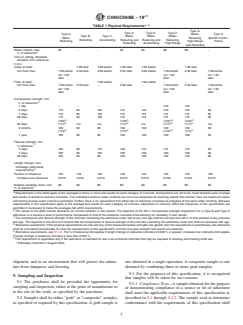
TABLE 1 Physical Requirements
Type G,
Type D, Type E, Type F,
Type A, Water- Type S
Type B, Type C, Water- Water- Water-
Water- Reducing, Specific Perfor-
Retarding Accelerating Reducing and Reducing and Reducing,
Reducing High-Range mance
Retarding Accelerating High-Range
and Retarding
Water content, max, 95 . . 95 95 88 88 .
A
% of reference
Time of setting, allowable
deviation from reference,
h:min:
Initial: at least . 1:00 later 1:00 earlier 1:00 later 1:00 earlier . 1:00 later
not more than 1:00 earlier 3:30 later 3:30 earlier 3:30 later 3:30 earlier 1:00 earlier 3:30 later 1:00 earlier
nor 1:30 nor 1:30 nor 1:30
later later later
Final: at least . . 1:00 earlier . 1:00 earlier . .
not more than 1:00 earlier 3:30 later . 3:30 later . 1:00 earlier 3:30 later 1:00 earlier
nor 1:30 nor 1:30 nor 1:30
later later later
Compressive strength, min,
C
% of reference:
1 day . . . . . 140 125 .
3 days 110 90 125 110 125 125 125 90
7 days 110 90 100 110 110 115 115 90
28 days 110 90 100 110 110 110 110 90
D D D† D
(120) (120) (120) (120)
D D D† D
90 days (117) n/a n/a (117) n/a (117) (117) n/a
6 months 100 90 90 100 100 100 100 90
D D D† D
(113) (113) (113) (113)
1 year 100 90 90 100 100 100 100 90
Flexural strength, min,
C
% reference:
3 days 100 90 110 100 110 110 110 90
7 days 100 90 100 100 100 100 100 90
28 days 100 90 90 100 100 100 100 90
Length change, max
shrinkage (alternative
E
requirements):
Percent of reference 135 135 135 135 135 135 135 135
Increase over reference 0.010 0.010 0.010 0.010 0.010 0.010 0.010 0.010
Relative durability factor, min 80 80 80 80 80 80 80 80
F
% of reference
A
Requirements in this table apply to the averages of three or more test results for each category of concrete. Comparisons are not to be made between pairsofsingle
test results of reference and test concretes. The indicated maximum water contents are not to be interpreted as requiring exactly that amount; they are maximum values
and testing at lower water content is permitted. Further, there is no requirement that either test or reference concretes be prepared at the same water contents. Because
requirements in this specification apply to the average test results for each category of concrete, adjustment of mixtures within the tolerances of this specification are
permitted if necessary to make the averages fall within requirements.
B
The values in the table include allowance for normal variation in test results. The objective of the 90 % compressive strength requirement for a Type B and Type S
admixture is to require a level of performance comparable to that of the reference concrete while allowing for variability in test results.
C
The compressive and flexural strength of the concrete containing the admixture under test at any test age shall be not less than 90 % of that attained at any previous
test age. The objective of this limit is to require that the compressive or flexural strength of the concrete containing the admixture under test shall not decrease with age.
D
Alternative requirement. If the physical requirements are met and any of the measured relative strengths are greater than the requirement in parentheses, the admixture
shall be considered provisionally to meet the requirements of this specification until the one-year strength test results are obtained.
E
Alternative requirements, see 17.1.4. The % of reference limit applies if length change of reference concrete is 0.030 % or greater; increase over reference limit applies
if length change of reference concrete is less than 0.030 %.
F
This requirement is applicable only if the admixture is intended for use in air-entrained concrete that may be exposed to freezing and thawing while wet.
†
Editorially corrected in August 2022.
shipment, and in an environment that will protect the admix- one obtained in a single operation.Acomposite sample is one
ture from dampness and freezing. obtained by combining three or more grab samples.
9.3 For the purposes of this specification, it is recognized
9. Sampling and Inspection
that samples will be taken for two reasons:
9.1 The purchaser shall be provided the opportunity for
9.3.1 Compliance Tests—Asample obtained for the purpose
sampling and inspection, either at the point of manufacture or
of demonstrating compliance of a source or lot of admixture
at the site of the work, as specified by the purchaser.
shall meet the applicable requirements of this specification as
9.2 Samples shall be either “grab” or “composite” samples, described in 5.1 through 5.2.2. The sample used to determine
as specified or required by this specification.Agrab sample is conformance with the requirements of this specification shall
´1
C494/C494M−19
be a composite of grab samples taken from multiple locations the purchaser and the purchaser has the right to reject the
suchthatthecompositesamplewillberepresentativeofthelot. admixture if it fails to conform to any of the applicable
9.3.2 Uniformity and Equivalence Tests—If specified by the requirements of this specification.
purchaser, samples taken for the purpose of evaluating the
10.4 Packagesorcontainersvaryingmorethan5%fromthe
uniformity of a single lot, or equivalence of different lots from
specified mass or volume are allowed to be rejected. If the
one source shall be tested as provided in Section 6. Such
averagemassorvolumeof50packagestakenatrandomisless
samples shall be composite samples from individual lots if
than that specified, the entire shipment is allowed to be
different lots from the same source are being compared. If the
rejected.
uniformityofasinglelotisbeingevaluated,grabsamplesshall
10.5 If the admixture is to be used in non-air-entrained
be used.
concrete, the purchaser has the right to reject the admixture if
9.4 Liquid Admixtures—Liquid admixtures shall be agitated
the test concrete containing it has an air content greater than
to a homogeneous condition before sampling. Grab samples
3.5%. If the admixture is to be used in air-entrained concrete,
taken for compliance or uniformity testing shall represent a
the purchaser has the right to reject the admixture if the test
unit shipment or a single production lot. Each grab sample
concrete containing it has an air content greater than 7.0%.
shall have a volume of at least 0.5L[1 pt].At least three grab
samples shall be taken. Composite samples shall be prepared
TEST METHODS
bymixingtheselectedgrabsamplesandsamplingtheresultant
NOTE 6—These tests are based on arbitrary stipulations that make
homogeneous mixture to provide at least 4L [1gal] for
possiblehighlystandardizedtestinginthelaboratoryandarenotintended
compliance tests. Grab samples shall be taken from different
to simulate actual job conditions. Refer to Appendix X1 for a discussion
locations distributed throughout the quantity to be represented. oftherequiredtestingprogramandhowtestresultsareevaluated.Testing
personnel should be certified to perform the required tests.
9.4.1 Admixtures in bulk storage tanks shall be sampled
equally from the upper, intermediate, and lower levels by
11. Materials
means of drain cocks in the sides of the tanks or a weighted
sampling bottle fitted with a stopper that can be removed after
11.1 Cement—The cement used in any series of tests shall
the bottle is lowered to the desired depth. be a Type I or Type II cement conforming to Specification
9.4.2 Samples shall be stored in airtight containers that are
C150/C150M,orablendoftwoormorecements.Eachcement
resistant to attack by the admixture. of the blend shall conform to the requirements of eitherType I
or Type II of Specification C150/C150M. If the air content of
9.5 Non-liquid Admixtures—Grab samples taken for com-
the reference concrete made without an air-entraining
pliance or uniformity testing shall represent not more than
admixture, tested as prescribed in 14.3, is more than 3.5%,
2Mg [2 tons] of admixture and each grab sample shall be at
selectadifferentcement,orblend,sothattheaircontentofthe
least 1kg [2 lb]. At least four grab samples shall be taken.
reference concrete does not exceed 3.5%.
Composite samples shall be prepared by mixing the grab
samples selected and the resultant homogeneous mixture 11.2 Aggregates—The fine and coarse aggregates used in
sampled to provide at least 2.5kg [5 lb] for the composite
any series of tests shall come from single lots of materials that
sample. Grab samples shall be taken from different locations
conform to the requirements of Specification C33/C33M,
distributed throughout the quantity to be represented.
except that the grading of the aggregates shall conform to the
9.5.1 Samples of packaged admixtures shall be obtained by
requirements in 11.2.2 and 11.2.3:
meansofatubesamplerasdescribedinPracticeC183/C183M.
11.2.1 Physical Properties—Determine the relative density
9.5.2 Samples shall be stored in moisture-proof, airtight
and absorption of the coarse aggregate in accordance withTest
containers.
Method C127/C127M and of the fine aggregate in accordance
with Test Method C128/C128M.
9.6 Samples shall be mixed to a homogeneous condition
11.2.2 Fine Aggregate Grading—Determinethegradingand
before testing. If recommended by the manufacturer, the entire
fineness modulus of the fine aggregate in accordance withTest
sample of a non-liquid admixture shall be dissolved in water
Method C136/C136M. The grading shall conform to the
before testing.
following requirements:
10. Rejection
Sieve Mass Percent
Passing
10.1 Forinitialcompliancetesting,thepurchaserisallowed
4.75 mm (No. 4) 100
to reject the admixture if it fails to meet any of the applicable 1.18 mm (No. 16) 65 to 75
300 µm (No. 50) 12 to 20
requirements for this specification.
150 µm (No. 100) 2 to 5
10.2 For limited retesting, the purchaser has the right to
11.2.3 Coarse Aggregate Grading—The coarse aggregate
reject the admixture if it fails to meet any of the requirements
shallmeettherequirementsforsizenumber57ofSpecification
of the Uniformity and Equivalence Section and of the appli-
C33/C33M. Use accepted practices in loading and delivery to
cable parts of Table 1.
avoid segregation.
10.3 An admixture stored at the point of manufacture, for 11.2.4 Preparation of Coarse Aggregate—Coarse aggregate
morethansixmonthsbeforeshipment,oranadmixtureinlocal from the same lot shall be used for each batch of reference
storageinthehandsofavendorformorethansixmonths,after concrete and each batch of test concrete. The quantity of
completionoftests,shallberetestedbeforeuseifrequestedby concreteforLevelItestingincludesatleastthreebatchesofthe
´1
C494/C494M−19
reference concrete and at least three batches of each test of total aggregate, or both, while maintaining the yield and
concrete being evaluated. If reference concrete and companion slump in the required ranges.
test concrete batches are made the same day, it is permitted to
12.2 Adding Admixture to Test Concrete—ExceptforaType
use the same reference concrete to evaluate more than one test
S admixture, add the admixture in the manner recommended
concrete. The quantity of coarse aggregate for one set of tests
by the manufacturer and in the amount necessary to comply
shall be sufficient to make all batches of concrete and provide
withtheapplicablerequirementsofthespecificationsforwater
a sample for performing a sieve analysis.
reductionortimeofsetting,orboth.Ifdesiredbythepersonor
11.2.4.1 Obtain tared containers, one for each batch of
agency for whom the tests are being performed, the admixture
concretetobemadeandoneforthesieveanalysissample.One
is allowed to be added in an amount such as to produce a
or more spare containers are recommended in case a concrete
specifictimeofsettingoftheconcretemixturewithinthelimits
batchhastobediscarded.Preparecoarseaggregateforasetas
of the applicable provisions of this specification. A Type S
follows: Fill tared containers so that each batch will contain
admixture shall be tested at a dosage within the range recom-
similar particle grading. Accomplish this by taking scoopfuls
mended by the manufacturer for field use.
from the stockpile and placing them successively into each
12.2.1 Non-Air-Entrained Concrete—If the admixture is to
container until all containers have their required mass. See the
betestedforuseonlyinnon-air-entrainedconcrete,theaverage
Appendix of Practice D75/D75M, Sampling from Stockpiles,
aircontentsofthetestconcreteandthereferenceconcreteshall
and the Manual of Aggregate and Concrete Testing for guid-
not exceed 3.5%, and the difference between the average air
ance on procedures to mitigate segregation.
contents of the two categories shall not exceed 1.0 percentage
11.2.5 Verification of Grading—Test the coarse aggregate
point. If necessary, the air-entraining admixture shall be added
samples representing each set in accordance with Test Method
to the reference concrete to obtain an air content within 1
C136/C136M. Discard any set for which the sample does not
percentage point of the test concrete. Tests for resistance to
comply with size 57 requirements of Specification C33/C33M.
cyclic freezing and thawing shall not be made.
12.2.2 Air-Entrained Concrete—If the admixture is to be
NOTE 7—The results required for demonstrating compliance under this
specification depend on the uniformity of the aggregate samples prepared
tested for use in air-entrained concrete that will be exposed to
and used.
freezingandthawingwhilewet,theaircontentofthereference
11.3 Air-Entraining Admixture—The air-entraining admix- concreteandtestconcreteshallbe6.0 61.0%.Thedifference
ture used in the concrete mixtures specified in Section 12 shall between the average air content from the batches of the
conform to Specification C260/C260M. referenceconcreteandtheaverageaircontentfromthebatches
of the test concrete shall not exceed 0.5percentage points.Air
11.4 Preparation and Batching—Prepare and weigh all
contents of individual pairs of batches of test and reference
materials in accordance with Practice C192/C192M.
concretesarenotrequiredtofallwithinthe0.5%requirement.
Tests for resistance to cyclic freezing and thawing shall be
12. Proportioning of Concrete Mixtures
conducted in accordance with Test Method C666/C666M,
12.1 Proportions—Concrete shall be proportioned using
Procedure A.
ACI 211.1 to conform to the requirements described in 12.1.1
– 12.1.4. After evaluation of the trial mixtures, aggregate
13. Mixing
proportions shall be adjusted as needed to obtain workable,
13.1 Machine mix the concrete in accordance with Practice
cohesive mixtures with the correct yield to obtain the required
C192/C192M.
cement contents.
14. Tests and Properties of Freshly Mixed Concrete
12.1.1 The cement content of each batch, based on actual
3 3
yield, shall be 307 6 3 kg/m [517 6 5 lb/yd ]. The average
14.1 Samples of freshly mixed concrete from at least three
cement content of the batches of test concrete shall be within
separatebatchesforeachcategoryofconcreteshallbetestedin
3 3
3kg/m [5lb/yd ]oftheaveragecementcontentofthebatches
accordance with the methods described in 14.2 – 14.5.
of reference concrete.
14.2 Slump—Test Method C143/C143M.
12.1.2 Forthefirsttrialmixture,refertothetableonvolume
of coarse aggregate per unit volume of concrete in ACI 211.1 14.3 Air Content—Test Method C231/C231M.
for guidance on the amount of coarse aggregate to use, given a
14.4 Density of Fresh Concrete—Test Method C138/
nominal maximum size of 25.0mm [1in.] and the fineness
C138M.
modulus of the fine aggregate being used.
14.5 Time of Setting—Test Method C403/C403M, except
12.1.3 For the non-air-entrained mixtures, the air content
that the temperature of each of the ingredients of the concrete
used in calculating the proportions shall be 1.5 %. For the
mixtures, just before mixing, and the temperature at which the
air-entrained mixtures, the air content used for this purpose
time-of-settingspecimensarestoredduringthetestperiodshall
shall be 5.5%.
be 23.0 6 2.0 °C [73.5 6 3.5 °F]. Compare the average of the
12.1.4 Adjust the water content to obtain a slump of 90 6
resultsfromthespecimensofthetestconcretewiththeaverage
1 1
15 mm [3 ⁄2 6 ⁄2 in.].The workability of the concrete mixture
of the results from the specimens of the reference concrete.
shall be suitable for consolidation by hand rodding and the
concrete mixture shall have the minimum water content 14.6 Water Content:
possible. Achieve these conditions by final adjustments in the 14.6.1 Report the water-cement ratio of the concrete, com-
proportionoffineaggregatetototalaggregateorintheamount puted to the nearest 0.001, as follows: Determine the net mass
´1
C494/C494M−19
ofwaterinthebatchasthemassofwaterinthebatchinexcess E178 to establish if a test result is a statistical outlier. It is
of that present as absorbed water in the aggregates. Determine permitted to substitute outliers with test results from replace-
thewater-cementratiobydividingthenetmassofwaterbythe
ment specimens. The test result reported for each category of
mass of cement in the batch.
concrete and test age shall be the average of the individual test
14.6.2 Calculate the volume of concrete in the batch by
determinationsofthespecimenstested.Ifonespecimenorone
dividing the total mass of the materials in the batch by the
test determination is discarded without replacement, it shall be
density measured in accordance with Test Method C138/
the average of the remaining test determinations. If more than
3 3
C138M. Record the volume to the nearest 0.001 m [0.1 ft ].
one specimen representing a given test at a given age is found
3 3
14.6.3 Calculatethewatercontent,inunitsofkg/m [lb/ft ],
faulty either before or after testing and replacement specimens
ofeachbatchbydividingthenetmassofwaterinthebatchby
are not available, the test results shall be disregarded and the
thevolumeofthebatch.Calculatetherelativewatercontentof
test shall be repeated.
the test concrete as a percentage of the water content of the
referenceconcretebydividingtheaveragewatercontentofthe NOTE 9—Examples of faulty specimens include specimens with evi-
dence of incomplete consolidation, specimens damaged during mold
batchesofthetestconcretebytheaveragewatercontentofthe
removal, or defective placement of gage studs in length change prisms.
batches of the reference concrete and multiplying the quotient
by 100%.
16. Test Specimens of Hardened Concrete
15. Preparation of Test Specimens
16.1 Number of Specimens—Make at least three batches for
15.1 AsrequiredbySection16,makespecimensfortestsof
each category of concrete to be compared. For each batch,
hardened concrete, representing each test and test age from at
makeatleasttwotestspecimensforfreezingandthawingtests
leastthreeseparatebatchesforeachcategoryofconcrete.Table
and at least one test specimen for each other type of test and
2 shows the minimum number of specimens to be made from
test age indicated in Table 2. The number of test ages for
three batches of each category (see Note 8). Make at least one
compressive strength includes test ages for demonstrating
specimen for each test and test age from each batch of
provisional compliance.
concrete, except make at least two specimens for the freezing
and thawing test from each batch of concrete. The preparation 16.2 Types of Specimens—Specimens shall be prepared in
ofallspecimenscanbecompletedinone,two,orthreedaysof accordance with the following:
mixing, provided the same number of batches of test concrete
16.2.1 Compressive Strength—Make and cure 150 by
and reference concrete are made on the same day.
300mm [6 by 12 in.] or 100 by 200 mm [4 by 8 in.] cylinders
in accordance with Practice C192/C192M.
NOTE 8—More than the minimum number of specimens should be
prepared for tests of hardened concrete to provide replacements for
16.2.2 Flexural Strength—Make and cure beams with a
specimensthatmaybefoundtobefaultyornotconsolidatedproperly(see
cross-section of 75 by 75 mm [3 by 3 in.] in accordance with
15.2).
Practice C192/C192M.
15.2 Examination of Specimens—Visually examine all
16.2.3 Resistance to Freezing and Thawing—Prisms shall
specimens after removal from their molds. If any specimen is
be made and cured in accordance with the applicable require-
found to be faulty, it shall be discarded (see Note 9). In
ments of Practice C192/C192M. Prism dimensions shall be as
addition, measure and record the mass of each type of
required by Test Method C666/C666M. The air content of the
specimen.Noteanyspecimenthatappearstohavealowmass,
mixtures shall be as specified in 12.2.2.
which may indicate inadequate consolidation. Visually exam-
16.2.4 Length Change—Make and cure test specimens in
ine specimens after testing and note any unexpected condi-
tions. If test results for such noted specimens are statistical accordance with Test Method C157/C157M. The moist-curing
outliers, discard the results for those specimens. Use Practice period, including the period in the molds, shall be 14 days.
TABLE 2 Minimum Number of Specimens
Number of Categories of Batches for Each
Test Number of Test Ages Number of Specimens, min
Concrete Category of Concrete
A
Water content 1 2 3
A
Slump 1 2 3
A
Air content 1 2 3
B
Time of setting 23 6
Compressive strength
Types B, C, E, and S 5 2 3 30
C
Types A and D 6 23 36
C
Types F and G 7 23 42
Flexural strength 3 2 3 18
D
Freezing and thawing 1 2 3 12
Length change 1 2 3 6
A
Determined on each batch of concrete mixed.
B
See 14.5.
C
Includes test ages for demonstrating provisional compliance.
D
Two specimens per batch. For other tests of hardened concrete, one specimen per test age for each batch.
´1
C494/C494M−19
17. Tests on Hardened Concrete drying of specimens from the test concrete shall be not more
than 0.010 percentage units greater than that of the reference
17.1 Test specimens of hardened concrete (see Table 1)in
concrete.
accordance with the following methods:
NOTE 10—Because the specific effects produced by chemical admix-
17.1.1 Compressive Strength—Test Method C39/C39M.
turesmayvarywiththepropertiesoftheotheringredientsoftheconcrete,
Test specimens at ages of 1 (Types F and G only), 3, 7, and 28
results of length change tests using aggregates of such a nature that the
days, 6 months, and 1 year. Test specimens at 90 days if
length change on drying is low may not accurately indicate relative
performance to be expected with other aggregates having properties such
compliance to the alternative requirement for provisional
as to produce concrete of high length change on drying.
compliance is desired. For each test age, calculate the com-
pressive strength of the test concrete as a percentage of the
18. Uniformity and Equivalence Tests
compressive strength of the reference concrete as follows:
18.1 Infrared Analysis—This test procedure is intended to
17.1.1.1 Divide the average compressive strength of the
comparequalitativelythecompositionofdifferentsamplesand
specimens made from the test concrete batches at a given test
results should not be interpreted quantitatively (see Note 11).
age by the average compressive strength of the specimens
Performtheinfraredanalysisinaccordancewith18.1.1,18.1.2,
made from the reference concrete batches at the same test age
and18.1.3,whichprovidesaspecificprocedurefortheinfrared
and multiply the quotient by 100%.
analysis of admixtures (see Note 12), or alternately by one of
17.1.1.2 If the results of the tests are required in a period of themethodsdescribedinPracticeE1252.Ifoneofthemethods
from Practice E1252 is used to verify lot-to-lot uniformity,
time that will not permit curing of specimens to ages of six
monthsandoneyear,thetestsatthoseagesarepermittedtobe agreement shall be reached between the purchaser and the
manufacturer on the specific method to be used to conduct the
waived.
infrared analysis.
17.1.2 Flexural Strength—Test Method C78/C78M. Test
specimens at ages 3, 7, and 28 days. Calculate the flexural
NOTE 11—Refer to Appendix X3 for guidance on infrared analysis.
strength of the test concrete as a percentage of the flexural
18.1.1 Liquid Admixtures—Determine the dissolved solids
strength of the reference concrete as follows:
concentration by oven drying in accordance with 18.2 and
17.1.2.1 Divide the average flexural strength of the speci-
dilute an aliquot of the liquid admixture sample with distilled
mens made from the test concrete at a given test age by the
water to yield a dissolved solids concentration of about
average flexural strength of the specimens made from the
0.015g⁄mL, for example, a 5-mL aliquot diluted to 200 mL.
reference concrete at the same test age, and multiply the
Pipet5mLofthedilutedsolutionandaddittoapetridishwith
quotient by 100%.
2.5 g of potassium bromide of a grade suitable for use in
infrared analysis and 5mL of distilled water. Stir and mix to
17.1.3 Resistance to Freezing and Thawing—Comparison
dissolve. Place in a drying oven (18.2.1.1) and dry for 17 6
tests of the test concrete and of the reference concrete shall be
⁄4hat105 6 3 °C [221 6 5°F]. Cool and transfer the dried
made concurrently using Procedure A of Test Method C666/
residuetoamortarandgrindtoafinepowder.Workquicklyto
C666M. Place specimens under test at the age of 14 days.
avoid moisture pick-up. Weigh 0.1 g of the powder and 0.4 g
Calculatetheaveragedurabilityfactorsofthespecimensforall
of potassium bromide of a grade suitable for use in infrared
batches of each category of concrete. Calculate the relative
analysis. Mix in an electric amalgamator for 30 s using
durabilityfactorbydividingtheaveragedurabilityfactorofthe
stainless steel capsule and balls. Proceed in accordance with
test concrete by the average durability factor of the reference
18.1.3.
concrete and multiplying the quotient by 100%.
18.1.2 Non-liquid Admixtures—Grind 10 g to a fine powder
17.1.4 Length Change—Test specimens shall consist of
with mortar and pestle. Transfer the sample to a petri dish,
molded prisms made and tested in accordance with Test
place in a drying oven (18.2.1.1) and dry for 17 6 ⁄4 h at 105
Method C157/C157M except that the moist curing period,
63°C[221 65°F].Weigh0.004to0.006gofthedrypowder
including the period in the molds, shall be 14 days.Then store
and0.995gofpotassiumbromideofagradesuitableforusein
the specimens in air under conditions specified in the section
infraredanalysis.Mixinanelectricamalgamatorfor30susing
onAirStorageofTestMethodC157/C157Mforaperiodof14
stainless steel capsule and balls. Proceed in accordance with
days, at which time determine the length change of each
18.1.3.
specimen. Consider the drying shrinkage to be the length
18.1.3 To prepare a disk for infrared analysis, weigh 0.300
change during the drying period, based on an initial measure-
g of the mixture prepared in 18.1.1 or 18.1.2 and transfer into
ment at the time of removal of the specimen from the mold,
a suitable die. If an evacuable die is used, apply vacuum for
and express it as percent to the nearest 0.001% based on the
2min before pressing. Maintain the vacuum and press for
specimen gage length. If the average length change of the
3min with suitable force to produce a disk about 1 mm thick.
specimens from the reference concrete after 14 days of drying
Remove the disk from the die, insert into the infrared spectro-
is 0.030% or greater, the average length change on drying of
photometer and obtain the infrared absorption spectrum.
the specimens from the test concrete, expressed as percent of
NOTE 12—It is important that the same procedures be used on all
the length change of the reference concret
...
Questions, Comments and Discussion
Ask us and Technical Secretary will try to provide an answer. You can facilitate discussion about the standard in here.
Loading comments...