

ASTM D5528/D5528M-21
(Test Method)Standard Test Method for Mode I Interlaminar Fracture Toughness of Unidirectional Fiber-Reinforced Polymer Matrix Composites
General Information
- Abstract
SIGNIFICANCE AND USE
5.1 Susceptibility to delamination is one of the major design concerns for many advanced laminated composite structures. Knowledge of a laminated composite material's resistance to interlaminar fracture is useful for product development and material selection. Furthermore, a measurement of the mode I interlaminar fracture toughness that is independent of specimen geometry or method of force introduction is useful for establishing design allowables used in damage tolerance analyses of composite structures. Knowledge of both the non-precracked and precracked toughness allows the appropriate value to be used for the application of interest.
5.2 This test method can serve the following purposes:
5.2.1 To establish quantitatively the effect of fiber surface treatment, local variations in fiber volume fraction, and processing and environmental variables on GIc of a particular composite material;
5.2.2 To compare quantitatively the relative values of GIc for composite materials with different constituents;
5.2.3 To compare quantitatively the values of GIc obtained from different batches of a specific composite material, for example, to use as a material screening criterion or to develop a design allowable; and
5.2.4 To develop delamination failure criteria for composite damage tolerance and durability analyses.
SCOPE
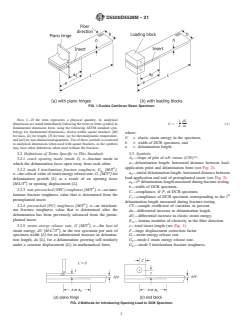
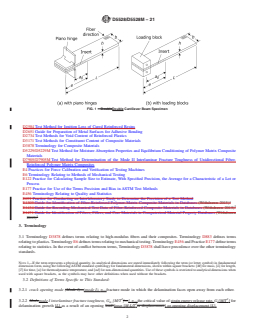
1.1 This test method describes the determination of the opening mode-I interlaminar fracture toughness, GIc, of unidirectional fiber-reinforced polymer matrix composite laminates using the double cantilever beam (DCB) specimen (Fig. 1).
FIG. 1 Double Cantilever Beam Specimen
1.2 This test method is limited to use with composites consisting of unidirectional carbon-fiber and glass-fiber-reinforced laminates with brittle or tough single-phase polymer matrices. This limited scope reflects the experience gained in round-robin testing. This test method may prove useful for other types and classes of composite materials; however, certain interferences have been noted (see 6.6).
1.3 Units—The values stated in either SI units or inch-pound units are to be regarded separately as standard. The values stated in each system are not necessarily exact equivalents; therefore, to ensure conformance with the standard, each system shall be used independently of the other, and values from the two systems shall not be combined.
1.3.1 Within the text, the inch-pound units are shown in brackets.
1.4 This standard may involve hazardous materials, operations, and equipment.
1.5 This standard does not purport to address all of the safety concerns, if any, associated with its use. It is the responsibility of the user of this standard to establish appropriate safety, health, and environmental practices and determine the applicability of regulatory limitations prior to use.
1.6 This international standard was developed in accordance with internationally recognized principles on standardization established in the Decision on Principles for the Development of International Standards, Guides and Recommendations issued by the World Trade Organization Technical Barriers to Trade (TBT) Committee.
- Status
- Published
- Publication Date
- 14-Nov-2021
- Technical Committee
- D30 - Composite Materials
- Drafting Committee
- D30.06 - Interlaminar Properties
Buy Documents
ASTM D5528/D5528M-21 - Standard Test Method for Mode I Interlaminar Fracture Toughness of Unidirectional Fiber-Reinforced Polymer Matrix Composites
REDLINE ASTM D5528/D5528M-21 - Standard Test Method for Mode I Interlaminar Fracture Toughness of Unidirectional Fiber-Reinforced Polymer Matrix Composites
Overview
ASTM D5528/D5528M-21: Standard Test Method for Mode I Interlaminar Fracture Toughness of Unidirectional Fiber-Reinforced Polymer Matrix Composites is an internationally recognized standard developed by ASTM. This test method is essential for evaluating the Mode I interlaminar fracture toughness (GIc) of unidirectional fiber-reinforced polymer matrix composites, mainly those reinforced with carbon or glass fibers and containing brittle or tough single-phase polymer matrices.
The key value measured, Mode I interlaminar fracture toughness, provides fundamental data on a material’s resistance to delamination-a critical failure mode in advanced laminated composite structures. Using the double cantilever beam (DCB) test specimen, this method delivers standardized results independent of specimen geometry and force introduction, supporting both material selection and design allowables for damage-tolerant structures.
Key Topics
- Delamination Resistance: Quantifies a composite's resistance to interlaminar crack growth, crucial for structural integrity and reliability.
- Material Selection and Quality Control: Enables direct comparison of GIc values among batches, constituent variations, and under different environmental or processing conditions.
- Test Specimen: Focuses on unidirectional laminate composites using the DCB geometry, pre-implanted with a non-adhesive insert for controlled crack initiation.
- Standardized Procedures: Specifies test setup, specimen preparation, dimensional requirements, force and displacement measurement, and result calculation, ensuring repeatability and international consistency.
- Applicability: Developed for unidirectional carbon and glass fiber composites but may give useful insights into other systems, recognizing potential interferences with other laminate architectures or multi-phase matrices.
Applications
ASTM D5528/D5528M-21 is widely used by:
- Aerospace and Automotive Industries: For qualifying new materials, comparing suppliers, and certifying composite structures for airframes, body panels, and other critical components.
- Research and Development: To study the influence of fiber surface treatments, resin systems, and environmental aging on fracture toughness.
- Quality Assurance: Screening materials by batch to maintain consistent mechanical performance and compliance with design specifications.
- Design and Safety Engineering: Providing input for damage tolerance and durability analysis, especially when establishing structural integrity requirements and failure criteria.
- Material Database Development: Supplying standardized fracture toughness data for engineers and designers.
The results help inform decisions about:
- Damage tolerance approaches
- Suitability of new composite formulations or surface treatments
- Selection between competing suppliers or lots
- Ensuring long-term performance under expected operational environments
Related Standards
ASTM D5528/D5528M-21 references and complements several other ASTM standards crucial for composite materials testing, including:
- ASTM D7905/D7905M: Test Method for Mode II Interlaminar Fracture Toughness of Unidirectional Fiber-Reinforced Composites
- ASTM D792: Test Methods for Density and Specific Gravity of Plastics
- ASTM D2584: Ignition Loss of Cured Reinforced Resins
- ASTM D2734: Void Content of Reinforced Plastics
- ASTM D3171: Constituent Content of Composite Materials
- ASTM D5229/D5229M: Moisture Absorption Properties and Equilibrium Conditioning of Polymer Matrix Composite Materials
- ASTM E4: Practices for Force Calibration and Verification of Testing Machines
Using ASTM D5528/D5528M-21 in conjunction with these standards ensures a robust and comprehensive mechanical characterization of fiber-reinforced composite laminates.
Keywords: ASTM D5528, Mode I interlaminar fracture toughness, GIc, unidirectional composites, double cantilever beam test, polymer matrix composites, delamination, quality control, composite material testing.
Relations
- Effective Date
- 01-Feb-2024
- Effective Date
- 01-Nov-2023
- Effective Date
- 01-Oct-2023
- Effective Date
- 01-Apr-2022
- Effective Date
- 01-Mar-2020
- Effective Date
- 01-Jan-2020
- Effective Date
- 15-Oct-2019
- Effective Date
- 01-Aug-2019
- Effective Date
- 15-Apr-2019
- Effective Date
- 15-Apr-2019
- Effective Date
- 15-Mar-2019
- Effective Date
- 15-Mar-2019
- Effective Date
- 01-Feb-2019
- Effective Date
- 01-Dec-2018
- Effective Date
- 01-Nov-2018
Buy Documents
ASTM D5528/D5528M-21 - Standard Test Method for Mode I Interlaminar Fracture Toughness of Unidirectional Fiber-Reinforced Polymer Matrix Composites
REDLINE ASTM D5528/D5528M-21 - Standard Test Method for Mode I Interlaminar Fracture Toughness of Unidirectional Fiber-Reinforced Polymer Matrix Composites
Get Certified
Connect with accredited certification bodies for this standard

DIN CERTCO
DIN Group product certification.

Smithers Quality Assessments
US management systems and product certification.
Sponsored listings
Frequently Asked Questions
ASTM D5528/D5528M-21 is a standard published by ASTM International. Its full title is "Standard Test Method for Mode I Interlaminar Fracture Toughness of Unidirectional Fiber-Reinforced Polymer Matrix Composites". This standard covers: SIGNIFICANCE AND USE 5.1 Susceptibility to delamination is one of the major design concerns for many advanced laminated composite structures. Knowledge of a laminated composite material's resistance to interlaminar fracture is useful for product development and material selection. Furthermore, a measurement of the mode I interlaminar fracture toughness that is independent of specimen geometry or method of force introduction is useful for establishing design allowables used in damage tolerance analyses of composite structures. Knowledge of both the non-precracked and precracked toughness allows the appropriate value to be used for the application of interest. 5.2 This test method can serve the following purposes: 5.2.1 To establish quantitatively the effect of fiber surface treatment, local variations in fiber volume fraction, and processing and environmental variables on GIc of a particular composite material; 5.2.2 To compare quantitatively the relative values of GIc for composite materials with different constituents; 5.2.3 To compare quantitatively the values of GIc obtained from different batches of a specific composite material, for example, to use as a material screening criterion or to develop a design allowable; and 5.2.4 To develop delamination failure criteria for composite damage tolerance and durability analyses. SCOPE 1.1 This test method describes the determination of the opening mode-I interlaminar fracture toughness, GIc, of unidirectional fiber-reinforced polymer matrix composite laminates using the double cantilever beam (DCB) specimen (Fig. 1). FIG. 1 Double Cantilever Beam Specimen 1.2 This test method is limited to use with composites consisting of unidirectional carbon-fiber and glass-fiber-reinforced laminates with brittle or tough single-phase polymer matrices. This limited scope reflects the experience gained in round-robin testing. This test method may prove useful for other types and classes of composite materials; however, certain interferences have been noted (see 6.6). 1.3 Units—The values stated in either SI units or inch-pound units are to be regarded separately as standard. The values stated in each system are not necessarily exact equivalents; therefore, to ensure conformance with the standard, each system shall be used independently of the other, and values from the two systems shall not be combined. 1.3.1 Within the text, the inch-pound units are shown in brackets. 1.4 This standard may involve hazardous materials, operations, and equipment. 1.5 This standard does not purport to address all of the safety concerns, if any, associated with its use. It is the responsibility of the user of this standard to establish appropriate safety, health, and environmental practices and determine the applicability of regulatory limitations prior to use. 1.6 This international standard was developed in accordance with internationally recognized principles on standardization established in the Decision on Principles for the Development of International Standards, Guides and Recommendations issued by the World Trade Organization Technical Barriers to Trade (TBT) Committee.
SIGNIFICANCE AND USE 5.1 Susceptibility to delamination is one of the major design concerns for many advanced laminated composite structures. Knowledge of a laminated composite material's resistance to interlaminar fracture is useful for product development and material selection. Furthermore, a measurement of the mode I interlaminar fracture toughness that is independent of specimen geometry or method of force introduction is useful for establishing design allowables used in damage tolerance analyses of composite structures. Knowledge of both the non-precracked and precracked toughness allows the appropriate value to be used for the application of interest. 5.2 This test method can serve the following purposes: 5.2.1 To establish quantitatively the effect of fiber surface treatment, local variations in fiber volume fraction, and processing and environmental variables on GIc of a particular composite material; 5.2.2 To compare quantitatively the relative values of GIc for composite materials with different constituents; 5.2.3 To compare quantitatively the values of GIc obtained from different batches of a specific composite material, for example, to use as a material screening criterion or to develop a design allowable; and 5.2.4 To develop delamination failure criteria for composite damage tolerance and durability analyses. SCOPE 1.1 This test method describes the determination of the opening mode-I interlaminar fracture toughness, GIc, of unidirectional fiber-reinforced polymer matrix composite laminates using the double cantilever beam (DCB) specimen (Fig. 1). FIG. 1 Double Cantilever Beam Specimen 1.2 This test method is limited to use with composites consisting of unidirectional carbon-fiber and glass-fiber-reinforced laminates with brittle or tough single-phase polymer matrices. This limited scope reflects the experience gained in round-robin testing. This test method may prove useful for other types and classes of composite materials; however, certain interferences have been noted (see 6.6). 1.3 Units—The values stated in either SI units or inch-pound units are to be regarded separately as standard. The values stated in each system are not necessarily exact equivalents; therefore, to ensure conformance with the standard, each system shall be used independently of the other, and values from the two systems shall not be combined. 1.3.1 Within the text, the inch-pound units are shown in brackets. 1.4 This standard may involve hazardous materials, operations, and equipment. 1.5 This standard does not purport to address all of the safety concerns, if any, associated with its use. It is the responsibility of the user of this standard to establish appropriate safety, health, and environmental practices and determine the applicability of regulatory limitations prior to use. 1.6 This international standard was developed in accordance with internationally recognized principles on standardization established in the Decision on Principles for the Development of International Standards, Guides and Recommendations issued by the World Trade Organization Technical Barriers to Trade (TBT) Committee.
ASTM D5528/D5528M-21 is classified under the following ICS (International Classification for Standards) categories: 83.120 - Reinforced plastics. The ICS classification helps identify the subject area and facilitates finding related standards.
ASTM D5528/D5528M-21 has the following relationships with other standards: It is inter standard links to ASTM D883-24, ASTM D883-23, ASTM D2734-23, ASTM E456-13a(2022)e1, ASTM D5229/D5229M-20, ASTM D883-20, ASTM D3878-19a, ASTM D883-19c, ASTM D3878-19, ASTM D883-19a, ASTM D7905/D7905M-19, ASTM D7905/D7905M-19e1, ASTM D883-19, ASTM D883-18a, ASTM D883-18. Understanding these relationships helps ensure you are using the most current and applicable version of the standard.
ASTM D5528/D5528M-21 is available in PDF format for immediate download after purchase. The document can be added to your cart and obtained through the secure checkout process. Digital delivery ensures instant access to the complete standard document.
Standards Content (Sample)
This international standard was developed in accordance with internationally recognized principles on standardization established in the Decision on Principles for the
Development of International Standards, Guides and Recommendations issued by the World Trade Organization Technical Barriers to Trade (TBT) Committee.
Designation: D5528/D5528M − 21
Standard Test Method for
Mode I Interlaminar Fracture Toughness of Unidirectional
Fiber-Reinforced Polymer Matrix Composites
This standard is issued under the fixed designation D5528/D5528M; the number immediately following the designation indicates the
year of original adoption or, in the case of revision, the year of last revision. A number in parentheses indicates the year of last
reapproval. A superscript epsilon (´) indicates an editorial change since the last revision or reapproval.
1. Scope 2. Referenced Documents
2.1 ASTM Standards:
1.1 This test method describes the determination of the
D792Test Methods for Density and Specific Gravity (Rela-
opening mode-I interlaminar fracture toughness, G , of unidi-
Ic
tive Density) of Plastics by Displacement
rectional fiber-reinforced polymer matrix composite laminates
D883Terminology Relating to Plastics
using the double cantilever beam (DCB) specimen (Fig. 1).
D2584Test Method for Ignition Loss of Cured Reinforced
1.2 This test method is limited to use with composites
Resins
consisting of unidirectional carbon-fiber and glass-fiber-
D2651GuideforPreparationofMetalSurfacesforAdhesive
reinforcedlaminateswithbrittleortoughsingle-phasepolymer
Bonding
matrices. This limited scope reflects the experience gained in
D2734TestMethodsforVoidContentofReinforcedPlastics
round-robin testing. This test method may prove useful for
D3171Test Methods for Constituent Content of Composite
other types and classes of composite materials; however,
Materials
certain interferences have been noted (see 6.6).
D3878Terminology for Composite Materials
D5229/D5229MTestMethodforMoistureAbsorptionProp-
1.3 Units—The values stated in either SI units or inch-
erties and Equilibrium Conditioning of Polymer Matrix
pound units are to be regarded separately as standard. The
Composite Materials
values stated in each system are not necessarily exact equiva-
D7905/D7905M Test Method for Determination of the
lents; therefore, to ensure conformance with the standard, each
Mode II Interlaminar Fracture Toughness of Unidirec-
system shall be used independently of the other, and values
tional Fiber-Reinforced Polymer Matrix Composites
from the two systems shall not be combined.
E4Practices for Force Calibration and Verification of Test-
1.3.1 Within the text, the inch-pound units are shown in
ing Machines
brackets.
E6Terminology Relating to Methods of Mechanical Testing
1.4 This standard may involve hazardous materials,
E122PracticeforCalculatingSampleSizetoEstimate,With
operations, and equipment.
Specified Precision, the Average for a Characteristic of a
Lot or Process
1.5 This standard does not purport to address all of the
E177Practice for Use of the Terms Precision and Bias in
safety concerns, if any, associated with its use. It is the
ASTM Test Methods
responsibility of the user of this standard to establish appro-
E456Terminology Relating to Quality and Statistics
priate safety, health, and environmental practices and deter-
mine the applicability of regulatory limitations prior to use.
3. Terminology
1.6 This international standard was developed in accor-
dance with internationally recognized principles on standard- 3.1 Terminology D3878 defines terms relating to high-
ization established in the Decision on Principles for the modulus fibers and their composites. Terminology D883 de-
Development of International Standards, Guides and Recom- fines terms relating to plastics. Terminology E6 defines terms
mendations issued by the World Trade Organization Technical relating to mechanical testing. Terminology E456 and Practice
Barriers to Trade (TBT) Committee. E177 define terms relating to statistics. In the event of conflict
between terms, Terminology D3878 shall have precedence
over the other terminology standards.
This test method is under the jurisdiction of ASTM Committee D30 on
Composite Materials and is the direct responsibility of Subcommittee D30.06 on
Interlaminar Properties. For referenced ASTM standards, visit the ASTM website, www.astm.org, or
Current edition approved Nov. 15, 2021. Published January 2022. Originally contact ASTM Customer Service at service@astm.org. For Annual Book of ASTM
approved in 1994. Last previous edition approved in 2013 as D5528–13. DOI: Standards volume information, refer to the standard’s Document Summary page on
10.1520/D5528_D5528M-21. the ASTM website.
Copyright © ASTM International, 100 Barr Harbor Drive, PO Box C700, West Conshohocken, PA 19428-2959. United States
D5528/D5528M − 21
FIG. 1 Double Cantilever Beam Specimen
NOTE 1—If the term represents a physical quantity, its analytical 1 dU
G52 (1)
dimensionsarestatedimmediatelyfollowingtheterm(orlettersymbol)in
b da
fundamental dimension form, using the following ASTM standard sym-
bology for fundamental dimensions, shown within square brackets: [M]
where:
for mass, [L] for length, [T] for time, [u] for thermodynamic temperature,
U = elastic strain energy in the specimen,
and[nd]fornon-dimensionalquantities.Useofthesesymbolsisrestricted
b = width of DCB specimen, and
to analytical dimensions when used with square brackets, as the symbols
a = delamination length.
may have other definitions when used without the brackets.
3.3 Symbols:
3.2 Definitions of Terms Specific to This Standard:
1/3
A —slope of plot of a/b versus (C/N) .
3.2.1 crack opening mode (mode I), n—fracture mode in
which the delamination faces open away from each other. a—delamination length: horizontal distance between load-
2 application point and delamination front (see Fig. 2).
3.2.2 mode I interlaminar fracture toughness, G [M/T ],
Ic
a —initial delamination length: horizontal distance between
n—thecriticalvalueofstrainenergyreleaserate, G, [M/T ]for
load-application and end of preimplanted insert (see Fig. 2).
delamination growth [L] as a result of an opening force
th
a—i delaminationlengthmeasuredduringfracturetesting.
I
[M·L/T ] or opening displacement [L].
b—width of DCB specimen.
3.2.3 non-precracked (NPC) toughness [M/T ], n—an inter-
C—compliance, δ/ P, of DCB specimen.
laminar fracture toughness value that is determined from the
th
C—compliance of DCB specimen corresponding to the i
i
preimplanted insert.
delamination length measured during fracture testing.
3.2.4 precracked (PC) toughness [M/T ], n—an interlami-
CV—sample coefficient of variation, in percent.
nar fracture toughness value that is determined after the
da—differential increase in delamination length.
delamination has been previously advanced from the preim-
dU—differential increase in elastic strain energy.
planted insert.
E —lamina modulus of elasticity in the fiber direction.
3.2.5 strain energy release rate, G [M/T ], n—the loss of e—total insert length (see Fig. 1).
2 2
F—large displacement correction factor.
strain energy, dU [M·L /T ], in the test specimen per unit of
specimen width [L] for an infinitesimal increase in delamina- G—strain energy release rate.
tion length, da [L], for a delamination growing self-similarly G—mode I strain energy release rate.
I
under a constant displacement [L]; in mathematical form, G —mode I interlaminar fracture toughness.
Ic
FIG. 2 Methods for Introducing Opening Load to DCB Specimen
D5528/D5528M − 21
est
G —estimated value of mode I fracture toughness. interlaminar fracture is useful for product development and
Ic
h—thickness of DCB specimen. material selection. Furthermore, a measurement of the mode I
L—length of DCB specimen. interlaminarfracturetoughnessthatisindependentofspecimen
L'—horizontal distance from the center of loading-block pin geometry or method of force introduction is useful for estab-
hole to edge of the loading block. lishingdesignallowablesusedindamagetoleranceanalysesof
m—slope of plot of log(C/N) versus log(a). composite structures. Knowledge of both the non-precracked
N—large displacement and loading block correction factor. and precracked toughness allows the appropriate value to be
n—number of specimens tested. used for the application of interest.
P—applied load.
5.2 This test method can serve the following purposes:
P —critical force for mode I fracture.
c
5.2.1 To establish quantitatively the effect of fiber surface
P —maximum applied force during DCB test.
max
treatment, local variations in fiber volume fraction, and pro-
P —applied force at which the specimen compliance has
5%
cessing and environmental variables on G of a particular
Ic
increased by 5%.
composite material;
r —correlation coefficient of linear fit of log(C/N) versus
5.2.2 To compare quantitatively the relative values of G
Ic
log(a).
for composite materials with different constituents;
S —sample standard deviation.
n-1
5.2.3 To compare quantitatively the values of G obtained
Ic
t—vertical distance from the center of the pin hole to the
from different batches of a specific composite material, for
midplane of the specimen arm.
example, to use as a material screening criterion or to develop
U—elastic strain energy in the specimen.
a design allowable; and
V—fiber volume fraction, in percent.
f
5.2.4 To develop delamination failure criteria for composite
x¯—sample mean (average).
damage tolerance and durability analyses.
x—measured or derived property.
i
δ—load point displacement.
6. Interferences
δ —critical load point displacement for mode I fracture.
c
6.1 Linear elastic behavior is assumed in the calculation of
δ —load point displacement containing the initial nonlin-
NL
G used in this method.This assumption is valid when the zone
earity associated with fixture.
of damage or nonlinear deformation at the delamination front,
∆—effective delamination extension to correct for rotation
or both, is small relative to the smallest specimen dimension,
of DCB arms at delamination front.
which is the thickness for the DCB specimen.
∆ —incremental change in log(a).
x
∆ —incremental change in log(C/N).
y
4. Summary of Test Method
4.1 The DCB specimen shown in Fig. 1 consists of a
rectangular, uniform thickness, unidirectional laminated com-
positespecimencontainingapreimplantednon-adhesiveinsert
on the midplane that serves as a delamination initiator. Open-
ingforcesareappliedtotheDCBspecimenbymeansofhinges
(Fig.1a)orloadingblocks(Fig.1b)bondedtothedelaminated
end of the specimen. The arms of the DCB specimen are
opened by controlling either the opening displacement or the
verticalcrossheadmovement,whiletheforceanddelamination
length are recorded.
4.2 A record of the applied force versus opening displace-
ment is recorded on an X-Y recorder, or equivalent real-time
plotting device or stored digitally and postprocessed. Instanta-
neous delamination front locations are marked on the chart at
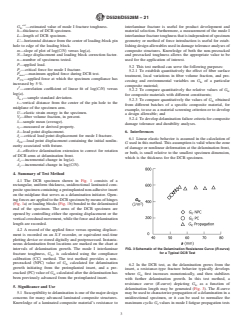
intervals of delamination growth. The mode I interlaminar FIG. 3 Schematic of the Delamination Resistance Curve (R-curve)
for a Typical DCB Test
fracture toughness, G , is calculated using the compliance
Ic
calibration (CC) method. The test method provides a non-
precracked (NPC) value of G calculated for delamination
Ic 6.2 In the DCB test, as the delamination grows from the
growth initiating from the preimplanted insert, and a pre-
insert, a resistance-type fracture behavior typically develops
cracked(PC)valueof G calculatedafterthedelaminationhas
Ic where G first increases monotonically, and then stabilizes
Ic
been previously advanced from the preimplanted insert.
with further delamination growth. In this test method, a
resistance curve (R-curve) depicting G as a function of
Ic
5. Significance and Use
delamination length may be generated (Fig. 3). The R-curve
5.1 Susceptibilitytodelaminationisoneofthemajordesign may be used to characterize propagation of a delamination in a
concerns for many advanced laminated composite structures. unidirectional specimen, or it can be used to normalize the
Knowledge of a laminated composite material’s resistance to maximum cyclic G values in mode I fatigue propagation tests
I
D5528/D5528M − 21
(1). The principal reason for the observed resistance to 6.6.4 Composites with significant strength or toughness
delamination is the development of fiber bridging (2-4). Fiber through the laminate thickness, such as composites with metal
bridging is considered to be an artifact of the DCB test. matrices or 3D fiber reinforcement, may experience failures of
Therefore, the generic significance of G propagation values the beam arms rather than the intended interlaminar failures.
Ic
calculated after growth from the implanted insert is
7. Apparatus
questionable, and an initiation value of G measured from the
Ic
implantedinsertispreferred.Becauseofthesignificanceofthe
7.1 Testing Machine—A properly calibrated test machine
initiation point, the insert must be properly implanted and
shall be used that can be operated in a displacement control
inspected (8.3).
mode with a constant displacement rate in the range from 0.5
to5.0mm/min[0.02to0.20in./min].Thetestingmachineshall
6.3 The NPC value of G is determined based on the
Ic
conform to the requirements of Practices E4. The testing
force-displacement data measured at the point at which the
machine shall be equipped with grips to hold the loading
specimen compliance has increased by 5% or the force has
hinges, or clevises to hold the loading blocks, that are bonded
reached a maximum value (see 11.8.1). Physical evidence
to the specimen.
suggests that the NPC value of G determined based on these
Ic
force definitions corresponds to the onset of delamination
7.2 Force Indicator—The testing machine force-sensing
growthhavingoccurredacrosstheentirewidthofthespecimen
device shall be capable of indicating the total force carried by
(5).
the test specimen. This device shall be essentially free from
inertia lag at the specified rate of testing and shall indicate the
6.4 After initiation, delamination growth may proceed in
force with an accuracy over the force range(s) of interest of
one of two ways: (1) by a slow stable extension or (2)a
within 61% of the indicated value.
run-arrest extension in which the delamination front jumps
ahead abruptly. A run-arrest extension from the insert may be 7.3 Opening Displacement Indicator—The opening dis-
an indication of a problem with the insert. For example, the placement may be estimated as the crosshead separation,
insert may not be completely disbonded from the laminate, or provided the deformation of the testing machine, with the
may be too thick, resulting in a large neat resin pocket, or may specimen grips attached, is less than 2% of the opening
contain a tear or fold. displacement of the test specimen at peak load. If not, then the
opening displacement shall be obtained from a properly
6.5 The toughness values obtained by this test method for
calibrated external gauge or transducer attached to the speci-
delamination growth at 0°/0° interfaces may not be represen-
men at the point of force application. The displacement
tative of the toughness corresponding to delamination growth
indicator shall indicate the load-point crack opening displace-
at interfaces with different relative ply orientations.
ment with an accuracy of within 61% of the indicated value
6.6 Application to Other Materials, Layups, and Architec-
once the delamination occurs.
tures:
7.4 Force Versus Opening Displacement Record—During
6.6.1 Toughnessvaluesmeasuredonunidirectionalcompos-
thetest,forceversusopeningdisplacementatthepointofforce
iteswithmultiple-phasematricesmayvarydependinguponthe
application shall be documented digitally and post-processed.
tendency for the delamination to wander between various
7.5 Optical Microscope—A travelling optical microscope
matrix phases. Brittle matrix composites with tough adhesive
with a magnification no greater than 70×, or equivalent
interleaves between plies may be particularly sensitive to this
magnifying devices, shall be positioned on one side of the
phenomenon resulting in two apparent interlaminar fracture
specimen to observe the delamination front as it extends along
toughness values: one associated with a cohesion-type failure
one edge of the specimen during the test. This device shall be
within the interleaf and one associated with an adhesion-type
capableofpinpointingthedelaminationfrontwithanaccuracy
failure between the tough polymer film and the more brittle
of at least 60.5mm [60.02in.]. Other methods, such as crack
composite matrix.
length gauges bonded to a specimen edge, may be used to
6.6.2 Non-unidirectional DCB configurations may experi-
monitor delamination length, provided their accuracy is as
ence considerable amount of fiber bridging (4, 6) and branch-
accurate as the optical microscope so that delamination length
ing of the delamination away from the midplane through
may be measured to the accuracy specified above.
matrix cracks in off-axis plies. If the delamination branches
away from the midplane, a pure mode I fracture may not be
7.6 Micrometers and Calipers—A micrometer witha4to
achieved as a result of the structural coupling that may exist in
8mm[0.16to0.32in.]nominaldiameterballinterfaceoraflat
the asymmetric sublaminates formed as the delamination
anvil interface shall be used to measure the specimen thick-
grows.
ness. A ball interface is recommended for thickness measure-
6.6.3 Woven composites may yield significantly greater
ments when at least one surface is irregular (for example, a
scatter and unique R-curves associated with varying toughness
coarse peel ply surface, which is neither smooth nor flat). A
within and away from interlaminar resin pockets as the
micrometer or caliper with a flat anvil interface shall be used
delamination grows.
for measuring length, width, and other machined surface
dimensions. The use of alternative measurement devices is
permitted if specified (or agreed to) by the test requestor and
reported by the testing laboratory. The accuracy of the instru-
Theboldfacenumbersinparenthesesrefertothelistofreferencesattheendof
this test method. ment(s) shall be suitable for reading to within 1% of the
D5528/D5528M − 21
specimen dimensions. For typical specimen geometries, an 8.4.1 Specimens shall be at least 140mm [5.5in.] long and
instrument with an accuracy of 60.0025mm [60.0001in.] is nominally from 20 to 25mm [0.8 to 1.0in.] wide, inclusive.
adequateforthicknessmeasurements,whileaninstrumentwith
8.4.2 Panelsshallbemanufactured,andspecimenscutfrom
an accuracy of 60.025mm [60.001in.] is adequate for thepanels,suchthatthetotalinsertlength, e,is76mm[3.0in.]
measurement of length, width, and other machined surface
(see Fig. 1). This distance corresponds to an initial delamina-
dimensions. tion length plus the extra length required to bond the hinges or
load blocks. The end of the insert should be accurately located
7.7 Conditioning Chamber—When conditioning materials
and marked on the panel before cutting specimens.
at non-laboratory environments, a temperature-/vapor-level
controlledenvironmentalconditioningchamberisrequiredthat
8.5 The laminate thickness shall typically be between 3 and
shall be capable of maintaining the required temperature to
5 mm [0.12 and 0.2 in.]. The initial delamination length, a ,
within 63°C[65°F] and the required relative humidity level
measured from the load-application point to the end of the
to within 63%. Chamber conditions shall be monitored either
insert, shall typically be 50 mm [2.0 in.].Alternative laminate
on an automated continuous basis or on a manual basis at
thicknessesandinitialdelaminationlengthsmaybechosenthat
regular intervals.
are consistent with the discussions given as follows; however,
very low values of a /h are not recommended. For low values
7.8 Environmental Test Chamber—An environmental test
of a /h (<10), the data reduction procedures given in Section
chamber is required for test environments other than ambient 0
13 may not be accurate.
testing laboratory conditions.This chamber shall be capable of
8.5.1 For certain composite systems (for example, those
maintaining the test specimen and fixture at the required test
with a low-flexural modulus or a high interlaminar fracture
environment during the mechanical test. The test temperature
toughness),itmaybenecessarytoincreasethenumberofplies
shall be maintained within 63°C [65°F] of the required
(increasethelaminatethickness)ordecreasetheinitialdelami-
temperature, and the relative humidity level shall be main-
nation length to avoid large displacement of the specimen
tained to within 63% of the required humidity level.
arms. This displacement is deemed large when the ratio of
8. Sampling and Test Specimens
criticalload-pointopeningdisplacementatdelaminationonset,
δ ,tothedelaminationlength, a,isgreaterthan0.4.Toprevent
c
8.1 Sampling—Test at least five specimens per test condi-
this from occurring, the specimen thickness and initial delami-
tionunlessvalidresultscanbegainedthroughtheuseoffewer
nation length, a , shall be designed to satisfy the following
specimens, such as the case of a designed experiment. For
criteria (7):
statisticallysignificantdata,theproceduresoutlinedinPractice
E122 should be consulted. The method of sampling shall be 3
h E
a # 0.042Π(2)
reported.
0 est
G
Ic
8.2 Test laminates must contain an even number of plies, est 2 1⁄3
G a
Ic 0
h$ 8.28 (3)
S D
and shall be unidirectional, with delamination growth occur-
E
ring in the 0° (zero degree) direction (see Fig. 1).
where:
8.3 A non-adhesive insert shall be implanted at the mid-
a = initial delamination length,
plane of the laminate during layup to form an initiation site for
h = thickness of DCB specimen,
the delamination (see Fig. 1). The insert thickness shall be no
E = lamina modulus of elasticity in the fiber direction,
greater than 13 µm [0.0005in.]. A polymer film is recom-
and
mended for the insert to avoid problems with folding or est
G = estimated value of mode I fracture toughness.
Ic
crimping at the cut end of the insert. For epoxy matrix
8.6 If specific gravity, density, reinforcement volume, or
composites cured at or below 177°C [350°F], an insert made
voidvolumearetobereported,thenobtainthesesamplesfrom
of polytetrafluoroethylene (PTFE) is recommended. For com-
the same panels being tested. Specific gravity and density may
posites with polyimide, bismaleimide, or thermoplastic matri-
be evaluated by means of Test Method D792. Volume percent
ces that are manufactured at relatively high temperatures, that
of the constituents may be evaluated by one of the matrix
is, greater than 177°C [350°F], a thin polyimide insert is
digestion procedures of Test Method D3171 or, for certain
recommended. If a polyimide insert is used, the insert shall be
reinforcement materials such as glass and ceramics, by the
painted or sprayed with a mold release agent before it is
matrix burn-off technique of Test Method D2584. The void
inserted in the laminate. Caution should be used, as mold
contentequationsofTestMethodD2734areapplicabletoboth
release agents containing silicone may contaminate the lami-
Test Method D2584 and the matrix digestion procedures.
nate by migration through the individual layers. It is often
helpful to coat the insert at least once and then bake the insert
8.7 Force Introduction:
before placing it on the composite. This will help to prevent
8.7.1 The piano hinges or loading blocks shall be at least as
silicone migration within the composite. For materials outside
wide as the specimen, between 20 to 25mm [0.8 to 1.0in.].
the scope of this test method, different film materials may be
8.7.2 Piano Hinges—A pair of piano hinge tabs shall be
required.Undercertainprescribedcircumstances(see13.2),an
bonded to the end of each specimen as shown in Fig. 1a. The
alternate wedge precracking procedure may be used. Guide-
hinge tabs shall be made of metal and shall be capable of
lines for generating a wedge precrack are given in Annex A3.
sustaining the applied force without incurring damage or
8.4 Specimen Dimensions: excessive deformation.The maximum force anticipated during
D5528/D5528M − 21
a DCB test of a material with a known modulus, E , and 10.2 The pre-test specimen conditioning process, to include
est
estimated value of G , may be determined by (7). specifiedenvironmentalexposurelevelsandresultingmoisture
Ic
content, shall be reported with the test data.
3 est
b h E G
11 Ic
P 5 Π. (4)
max
NOTE 2—The term “moisture,” as used in Test Method D5229/
a 96
D5229M, includes not only the vapor of a liquid and its condensate, but
the liquid itself in large quantities, as for immersion.
8.7.3 Loading Blocks—The distance from the loading block
pintothecenterlineofthetopspecimenarm(distance tinFig.
10.3 If no explicit conditioning process is performed, the
2b) shall be as small as possible to minimize errors as a result
specimen conditioning process shall be reported as “uncondi-
of the applied moment arm. These effects will be reduced
tioned” and the moisture content as “unknown.”
sufficiently (7) by choosing a distance, t, such that
11. Procedure
h 0.0434h E
t# 10.01Π1a (5)
est
4 G 11.1 Specimen Preparation:
Ic
11.1.1 Following final specimen machining, but before
8.7.4 The bonding surfaces of the loading blocks or hinges
conditioning and testing, measure the width and thickness of
and the specimen shall be properly prepared before bonding to
each specimen to the nearest 0.05mm [0.002in.] at the
ensure force transfer without debonding of the tabs from the
midpoint and at 50 mm [2in.] from either end. The individual
specimen during the test. If debonding occurs, the specimen
and average values of the three width measurements and three
should not be reused if there is physical evidence that a
thickness measurements shall be recorded. The variation in
delamination initiated when the bond failed or if an increased
specimen width among all measurements shall not exceed 0.5
compliance is observed upon reloading.
mm[0.02in.],andthevariationinspecimenthicknessshallnot
8.7.4.1 Surface Preparations of the Specimen—Thebonding
exceed5%ofthemeanvalue.Measureandrecordthevertical
surfaceofthespecimenmaybelightlygritblastedorscrubbed
distance from the center of the pin hole to the midplane of the
with sandpaper, then wiped clean with a volatile solvent, such
specimen arm, t, as defined in Fig. 2. If loading blocks are
as acetone or isopropyl alcohol, to remove any contamination.
used, measure and record the horizontal distance from the
8.7.4.2 Surface Preparation of the Loading Hinge Tabs or
center of loading-block pin hole to edge of the loading block,
Blocks—Theloadinghingetabsorblocksmaybecleanedasin
L’, as defined in Fig. 2.
8.7.4.1. If this procedure results in a bond failure between the
NOTE 3—The test requester may request that additional measurements
specimen and the tabs, it may be necessary to apply a more
be performed after the machined specimens have gone through any
sophisticated surface preparation procedure based on degreas-
conditioning or environmental exposure.
ingandchemicaletching.ConsultGuideD2651forthesurface
11.1.2 Co
...
This document is not an ASTM standard and is intended only to provide the user of an ASTM standard an indication of what changes have been made to the previous version. Because
it may not be technically possible to adequately depict all changes accurately, ASTM recommends that users consult prior editions as appropriate. In all cases only the current version
of the standard as published by ASTM is to be considered the official document.
Designation: D5528 − 13 D5528/D5528M − 21
Standard Test Method for
Mode I Interlaminar Fracture Toughness of Unidirectional
Fiber-Reinforced Polymer Matrix Composites
This standard is issued under the fixed designation D5528;D5528/D5528M; the number immediately following the designation indicates
the year of original adoption or, in the case of revision, the year of last revision. A number in parentheses indicates the year of last
reapproval. A superscript epsilon (´) indicates an editorial change since the last revision or reapproval.
1. Scope
1.1 This test method describes the determination of the opening Mode I mode-I interlaminar fracture toughness, G , of
Ic
continuousunidirectional fiber-reinforced polymer matrix composite materialslaminates using the double cantilever beam (DCB)
specimen (Fig. 1).
1.2 This test method is limited to use with composites consisting of unidirectional carbon fiber and glass fiber tape carbon-fiber
and glass-fiber-reinforced laminates with brittle andor tough single-phase polymer matrices. This limited scope reflects the
experience gained in round-robin testing. This test method may prove useful for other types and classes of composite materials;
however, certain interferences have been noted (see 6.56.6).
1.3 Units—The values stated in either SI units or inch-pound units are to be regarded separately as the standard. The values
givenstated in parentheses are for information only. each system are not necessarily exact equivalents; therefore, to ensure
conformance with the standard, each system shall be used independently of the other, and values from the two systems shall not
be combined.
1.3.1 Within the text, the inch-pound units are shown in brackets.
1.4 This standard may involve hazardous materials, operations, and equipment.
1.5 This standard does not purport to address all of the safety concerns, if any, associated with its use. It is the responsibility
of the user of this standard to establish appropriate safety safety, health, and healthenvironmental practices and determine the
applicability of regulatory limitations prior to use.
1.6 This international standard was developed in accordance with internationally recognized principles on standardization
established in the Decision on Principles for the Development of International Standards, Guides and Recommendations issued
by the World Trade Organization Technical Barriers to Trade (TBT) Committee.
2. Referenced Documents
2.1 ASTM Standards:
D792 Test Methods for Density and Specific Gravity (Relative Density) of Plastics by Displacement
D883 Terminology Relating to Plastics
This test method is under the jurisdiction of ASTM Committee D30 on Composite Materials and is the direct responsibility of Subcommittee D30.06 on Interlaminar
Properties.
Current edition approved Oct. 1, 2013Nov. 15, 2021. Published November 2013January 2022. Originally approved in 1994. Last previous edition approved in 20092013
ε3
as D5528 – 01D5528 – 13.(2007) . DOI: 10.1520/D5528-13.10.1520/D5528_D5528M-21.
For referenced ASTM standards, visit the ASTM website, www.astm.org, or contact ASTM Customer Service at service@astm.org. For Annual Book of ASTM Standards
volume information, refer to the standard’s Document Summary page on the ASTM website.
Copyright © ASTM International, 100 Barr Harbor Drive, PO Box C700, West Conshohocken, PA 19428-2959. United States
D5528/D5528M − 21
FIG. 1 DoubleDouble Cantilever Beam Specimen
D2584 Test Method for Ignition Loss of Cured Reinforced Resins
D2651 Guide for Preparation of Metal Surfaces for Adhesive Bonding
D2734 Test Methods for Void Content of Reinforced Plastics
D3171 Test Methods for Constituent Content of Composite Materials
D3878 Terminology for Composite Materials
D5229/D5229M Test Method for Moisture Absorption Properties and Equilibrium Conditioning of Polymer Matrix Composite
Materials
D7905/D7905M Test Method for Determination of the Mode II Interlaminar Fracture Toughness of Unidirectional Fiber-
Reinforced Polymer Matrix Composites
E4 Practices for Force Calibration and Verification of Testing Machines
E6 Terminology Relating to Methods of Mechanical Testing
E122 Practice for Calculating Sample Size to Estimate, With Specified Precision, the Average for a Characteristic of a Lot or
Process
E177 Practice for Use of the Terms Precision and Bias in ASTM Test Methods
E456 Terminology Relating to Quality and Statistics
E691 Practice for Conducting an Interlaboratory Study to Determine the Precision of a Test Method
E1309 Guide for Identification of Fiber-Reinforced Polymer-Matrix Composite Materials in Databases (Withdrawn 2015)
E1434 Guide for Recording Mechanical Test Data of Fiber-Reinforced Composite Materials in Databases (Withdrawn 2015)
E1471 Guide for Identification of Fibers, Fillers, and Core Materials in Computerized Material Property Databases (Withdrawn
2015)
3. Terminology
3.1 Terminology D3878 defines terms relating to high-modulus fibers and their composites. Terminology D883 defines terms
relating to plastics. Terminology E6 defines terms relating to mechanical testing. Terminology E456 and Practice E177 define terms
relating to statistics. In the event of conflict between terms, Terminology D3878 shall have precedence over the other terminology
standards.
NOTE 1—If the term represents a physical quantity, its analytical dimensions are stated immediately following the term (or letter symbol) in fundamental
dimension form, using the following ASTM standard symbology for fundamental dimensions, shown within square brackets: [M] for mass, [L] for length,
[T] for time, [u] for thermodynamic temperature, and [nd] for non-dimensional quantities. Use of these symbols is restricted to analytical dimensions when
used with square brackets, as the symbols may have other definitions when used without the brackets.
3.2 Definitions of Terms Specific to This Standard:
3.2.1 crack opening mode (Mode I)—(mode I), n—fracture mode in which the delamination faces open away from each other.
2 2
3.2.2 Modemode I interlaminar fracture toughness, G [M/T ]—], n—the critical value of strain energy release rate, G,[M/T ] for
Ic
delamination growth [L] as a result of an opening load force [M·L/T or displacement.] or opening displacement [L].
D5528/D5528M − 21
3.2.3 non-precracked (NPC) toughness [M/T ], n—an interlaminar fracture toughness value that is determined from the
preimplanted insert.
3.2.4 precracked (PC) toughness [M/T ], n—an interlaminar fracture toughness value that is determined after the delamination has
been previously advanced from the preimplanted insert.
2 2 2
3.2.5 strain energy release rate, G [M/T ]—], n—the loss of strain energy, dU,dU [M·L /T ], in the test specimen per unit of
specimen width [L] for an infinitesimal increase in delamination length, da,da [L], for a delamination growing self-similarly under
a constant displacement. Indisplacement [L]; in mathematical form,
1 dU
G 52 (1)
b da
where:
U = total elastic energy in the test specimen,
U = elastic strain energy in the specimen,
b = specimen width, and
b = width of DCB specimen, and
a = delamination length.
3.3 Symbols:
1/3
A = slope —slope of plot of a/b versus (CC/N) .
a = delamination length.—delamination length: horizontal distance between load-application point and delamination front (see
Fig. 2).
a = initial delamination length.—initial delamination length: horizontal distance between load-application and end of
preimplanted insert (see Fig. 2).
th
a —i delamination length measured during fracture testing.
I
b = width —width of DCB specimen.
C = compliance, —compliance, δ/ P, of DCB specimen.
th
C —compliance of DCB specimen corresponding to the i delamination length measured during fracture testing.
i
CV = —sample coefficient of variation, %.in percent.
da = differential —differential increase in delamination length.
dU = differential —differential increase in elastic strain energy.
E = —lamina modulus of elasticity in the fiber direction.
Ee = modulus of—total insert length (see Fig. 1elasticity in the fiber direction measured in flexure.).
1f
F = large —large displacement correction factor.
G—strain energy release rate.
G =—mode I strain energy release rate.
I
G = opening Mode —mode I interlaminar fracture toughness.
Ic
est
G —estimated value of mode I fracture toughness.
Ic
h = thickness —thickness of DCB specimen.
L = length —length of DCB specimen.
FIG. 4 Modified Beam Theory
FIG. 5 Compliance Calibration
FIG. 6 Modified Compliance Calibration
(a) piano hinge (b) end block
FIG. A1.12 MethodsMethods for Introducing Opening Load to DCB Specimen
D5528/D5528M − 21
L' = half width of —horizontal distance from the center of loading-block pin hole to edge of the loading block.
m = number of plies in DCB—slope of plot of log(C/N specimen.) versus log(a).
N =loading —large displacement and loading block correction factor.
NL = point at which the load versus opening displacement curve becomes nonlinear.
n = slope of plot of Log C versus Log a.—number of specimens tested.
P = applied —applied load.
P —critical force for mode I fracture.
c
P = maximum applied load—maximum applied force during DCB test.
max
SDP = standard deviation.—applied force at which the specimen compliance has increased by 5 %.
5%
r —correlation coefficient of linear fit of log(C/N) versus log(a).
S —sample standard deviation.
n-1
t = —vertical distance from loading block pin to center line of topthe center of the pin hole to the midplane of the specimen
arm.
U = strain energy.—elastic strain energy in the specimen.
VIS = point at which delamination is observed visually on specimen edge.
V = fiber —fiber volume fraction, %.in percent.
f
x¯—sample mean (average).
x —measured or derived property.
i
δ—load point displacement.
δ = —critical load point deflection.displacement for mode I fracture.
c
δ —load point displacement containing the initial nonlinearity associated with fixture.
NL
Δ = effective —effective delamination extension to correct for rotation of DCB arms at delamination front.
Δ = incremental —incremental change in Log log(a.a).
x
Δ = incremental —incremental change in Log log(C.C/N).
y
4. Summary of Test Method
4.1 The DCB specimen shown in Fig. 1 consists of a rectangular, uniform thickness, unidirectional laminated composite specimen
containing a nonadhesive preimplanted non-adhesive insert on the midplane that serves as a delamination initiator. Opening forces
are applied to the DCB specimen by means of hinges (Fig. 1aa)) or loading blocks (Fig. 1bb)) bonded to one the delaminated end
of the specimen. The endsarms of the DCB specimen are opened by controlling either the opening displacement or the vertical
crosshead movement, while the loadforce and delamination length are recorded.
4.2 A record of the applied loadforce versus opening displacement is recorded on an X-Y recorder, or equivalent real-time plotting
device or stored digitally and postprocessed. Instantaneous delamination front locations are marked on the chart at intervals of
delamination growth. The Modemode I interlaminar fracture toughness, G , is calculated using a modified beam theory or
Ic
compliance calibration method.the compliance calibration (CC) method. The test method provides a non-precracked (NPC) value
of G calculated for delamination growth initiating from the preimplanted insert, and a precracked (PC) value of G calculated
Ic Ic
after the delamination has been previously advanced from the preimplanted insert.
5. Significance and Use
5.1 Susceptibility to delamination is one of the major weaknesses of design concerns for many advanced laminated composite
structures. Knowledge of a laminated composite material’s resistance to interlaminar fracture is useful for product development
and material selection. Furthermore, a measurement of the Modemode I interlaminar fracture toughness, toughness that is
independent of specimen geometry or method of load introduction,force introduction is useful for establishing design allowables
used in damage tolerance analyses of composite structures made from these materials.structures. Knowledge of both the
non-precracked and precracked toughness allows the appropriate value to be used for the application of interest.
5.2 This test method can serve the following purposes:
5.2.1 To establish quantitatively the effect of fiber surface treatment, local variations in fiber volume fraction, and processing and
environmental variables on G of a particular composite material.material;
Ic
5.2.2 To compare quantitatively the relative values of G for composite materials with different constituents.constituents;
Ic
5.2.3 To compare quantitatively the values of G obtained from different batches of a specific composite material, for example,
Ic
to use as a material screening criterion or to develop a design allowable.allowable; and
D5528/D5528M − 21
5.2.4 To develop delamination failure criteria for composite damage tolerance and durability analyses.
6. Interferences
6.1 Linear elastic behavior is assumed in the calculation of G used in this test method. This assumption is valid when the zone
of damage or nonlinear deformation at the delamination front, or both, is small relative to the smallest specimen dimension, which
is typically the specimen thickness for the DCB test.specimen.
FIG. 23 Delamination Schematic of the Delamination Resistance Curve (RCurve) from -curve) for a Typical DCB Test
6.2 In the DCB test, as the delamination grows from the insert, a resistance-type fracture behavior typically develops where the
calculated G first increases monotonically, and then stabilizes with further delamination growth. In this test method, a resistance
Ic
curve (R curve) -curve) depicting G as a function of delamination length willmay be generated to(Fig. 3 characterize). The theR
Ic
initiation and -curve may be used to characterize propagation of a delamination in a unidirectional specimen specimen, or it can
be used to normalize the maximum cyclic G values in mode I fatigue propagation tests (Fig. 21). The principal reason for the
I
observed resistance to delamination is the development of fiber bridging ((1-2-34).). This fiber bridging mechanism results from
growing the delamination between two 0° unidirectional plies. Because most delaminations that form in multiply laminated
composite structures occur between plies of dissimilar orientation, fiber bridging does not occur. Hence, fiber bridging Fiber
bridging is considered to be an artifact of the DCB test on unidirectional materials. test. Therefore, the generic significance of G
Ic
propagation values calculated beyond the end of the after growth from the implanted insert is questionable, and an initiation value
of G measured from the implanted insert is preferred. Because of the significance of the initiation point, the insert must be
Ic
properly implanted and inspected (8.3).
6.3 Three definitions for an initiation The NPC value of G have been evaluated during round-robin testing (4). These include
Ic
G values determined using the load and deflection measured (1) at the point of deviation from linearity in the load-displacement
Ic
curve (NL), (2) at the point at which delamination is visually observed on the edge (VIS) measured with a microscope as specified
in is determined based on the force-displacement data measured 7.5, and (3) at the point at which the specimen compliance has
increased by 5 % or the loadforce has reached a maximum value (5 %⁄max) (see Section 1111.8.1). The NLPhysical evidence
Gsuggests value, which is typically the lowest of the three that the NPC value of G initiation values, is recommended for
Ic Ic
generating delamination failure criteria in durability and damage tolerance analyses of laminated composite structures (determined
based on these force definitions corresponds 5.2.4). Recommendations for obtaining the NL point are given in Annex A2. All three
initiation values can be used for the other purposes cited in the scope (5.2.1 and 5.2.2). However, physical evidence indicates that
the initiation value corresponding to the onset of nonlinearity (NL) in the load versus opening displacement plot corresponds to
The last approved version of this historical standard is referenced on www.astm.org.
The boldface numbers in parentheses refer to the list of references at the end of this test method.
D5528/D5528M − 21
the physical onset of delamination from the insert in the interior delamination growth having occurred across the entire width of
the specimen width ((5). In round-robin testing of AS4/PEEK thermoplastic matrix composites, NL G values were 20 % lower
Ic
than VIS and 5 %⁄max values (4).
6.4 Delamination After initiation, delamination growth may proceed in one of two ways: (1)(1) by a slow stable extension or (2)(2)
a run-arrest extension in which the delamination front jumps ahead abruptly. Only the first type of growth is of interest in this test
method. An unstable jump A run-arrest extension from the insert may be an indication of a problem with the insert. For example,
the insert may not be completely disbonded from the laminate, or may be too thick, resulting in a large neat resin pocket, or may
contain a tear or fold. Furthermore, rapid delamination growth may introduce dynamic effects in both the test specimen and in the
fracture morphology. Treatment and interpretation of these effects is beyond the scope of this test method. However, because crack
jumping has been observed in at least one material in which the guidelines for inserts (see 8.3) were not violated, the specimens
are unloaded after the first increment of delamination growth and reloaded to continue the test. This procedure induces a natural
Mode I precrack in the DCB specimen. The first propagation G value is referred to as the Mode I precrack G .
Ic Ic
6.5 The toughness values obtained by this test method for delamination growth at 0°/0° interfaces may not be representative of
the toughness corresponding to delamination growth at interfaces with different relative ply orientations.
6.6 Application to Other Materials, Layups, and Architectures:
6.6.1 Toughness values measured on unidirectional composites with multiple-phase matrices may vary depending upon the
tendency for the delamination to wander between various matrix phases. Brittle matrix composites with tough adhesive interleaves
between plies may be particularly sensitive to this phenomenon resulting in two apparent interlaminar fracture toughness values:
one associated with a cohesive-typecohesion-type failure within the interleaf and one associated with an adhesive-typeadhesion-
type failure between the tough polymer film and the more brittle composite matrix.
6.6.2 NonunidirectionalNon-unidirectional DCB configurations may experience considerable amount of fiber bridging (4, 6) and
branching of the delamination away from the midplane through matrix cracks in off-axis plies. If the delamination branches away
from the midplane, a pure Modemode I fracture may not be achieved as a result of the structural coupling that may exist in the
asymmetric sublaminates formed as the delamination grows. In addition, nonunidirectional specimens may experience significant
anticlastic bending effects that result in nonuniform delamination growth along the specimen width, particularly affecting the
observed initiation values.
6.6.3 Woven composites may yield significantly greater scatter and unique R-curves associated with varying toughness within and
away from interlaminar resin pockets as the delamination grows.
6.6.4 Woven composites may yield significantly greater scatter and unique R curves associated with varying toughness within and
away from interlaminar resin pockets as the delamination grows. Composites with significant strength or toughness through the
laminate thickness, such as composites with metal matrices or 3D fiber reinforcement, may experience failures of the beam arms
rather than the intended interlaminar failures.
7. Apparatus
7.1 Testing Machine—A properly calibrated test machine shall be used that can be operated in a displacement control mode with
a constant displacement rate in the range from 0.5 to 5.0 mm/min (0.02[0.02 to 0.20 in./min).in./min]. The testing machine shall
conform to the requirements of Practices E4. The testing machine shall be equipped with grips to hold the loading hinges, or
pinsclevises to hold the loading blocks, that are bonded to the specimen.
7.2 LoadForce Indicator—The testing machine load-sensingforce-sensing device shall be capable of indicating the total loadforce
carried by the test specimen. This device shall be essentially free from inertia lag at the specified rate of testing and shall indicate
the loadforce with an accuracy over the loadforce range(s) of interest of within 61 % of the indicated value.
7.3 Opening Displacement Indicator—The opening displacement may be estimated as the crosshead separation, provided the
deformation of the testing machine, with the specimen grips attached, is less than 2 % of the opening displacement of the test
specimen. specimen at peak load. If not, then the opening displacement shall be obtained from a properly calibrated external
gagegauge or transducer attached to the specimen. specimen at the point of force application. The displacement indicator shall
indicate the load-point crack opening displacement with an accuracy of within 61 % of the indicated value once the delamination
occurs.
D5528/D5528M − 21
7.4 LoadForce Versus Opening Displacement Record—AnDuring X-Y plotter, or similar device, shall be used to make a
permanent record during the test of load the test, force versus opening displacement at the point of load application. Alternatively,
the data may be storedforce application shall be documented digitally and post-processed.
7.5 Optical Microscope—A travelling optical microscope with a magnification no greater than 70×, or an equivalent magnifying
device,devices, shall be positioned on one side of the specimen to observe the delamination front as it extends along one edge of
the specimen during the test. This device shall be capable of pinpointing the delamination front with an accuracy of at least 60.5
mm (60.02 in.). A mirror may be used to determine visually any discrepancy in delamination onset from one side of the specimen
to the other. 60.5 mm [60.02 in.]. Other methods, such as crack length gagesgauges bonded to a specimen edge, may be used to
monitor delamination length, provided their accuracy is as goodaccurate as the optical microscope so that delamination length may
be measured to the accuracy specified above.
7.6 Micrometers and Calipers—The micrometer(s) shall use a suitable size A micrometer with a 4 to 8 mm [0.16 to 0.32 in.]
nominal diameter ball interface on irregular surfaces such as the bag side of a laminate and or a flat anvil interface shall be used
to measure the specimen thickness. A ball interface is recommended for thickness measurements when at least one surface is
irregular (for example, a coarse peel ply surface, which is neither smooth nor flat). A micrometer or caliper with a flat anvil
interface on machined edges or very smooth tooled surfaces. The shall be used for measuring length, width, and other machined
surface dimensions. The use of alternative measurement devices is permitted if specified (or agreed to) by the test requestor and
reported by the testing laboratory. The accuracy of the instrumentsinstrument(s) shall be suitable for reading to within 1 % of the
sample width and thickness. specimen dimensions. For typical specimen geometries, an instrument with an accuracy of 62.5 μm
(0.0001 in.) is desirable60.0025 mm [60.0001 in.] is adequate for thickness measurement,measurements, while an instrument
with an accuracy of 625 mm (0.001 in.) is desirable for width measurement.60.025 mm [60.001 in.] is adequate for measurement
of length, width, and other machined surface dimensions.
7.7 Conditioning Chamber—When conditioning materials at non-laboratory environments, a temperature-/vapor-level controlled
environmental conditioning chamber is required that shall be capable of maintaining the required temperature to within 63 °C
[65 °F] and the required relative humidity level to within 63 %. Chamber conditions shall be monitored either on an automated
continuous basis or on a manual basis at regular intervals.
7.8 Environmental Test Chamber—An environmental test chamber is required for test environments other than ambient testing
laboratory conditions. This chamber shall be capable of maintaining the test specimen and fixture at the required test environment
during the mechanical test. The test temperature shall be maintained within 63 °C [65 °F] of the required temperature, and the
relative humidity level shall be maintained to within 63 % of the required humidity level.
8. Sampling and Test Specimens
8.1 Sampling—Test at least five specimens per test condition unless valid results can be gained through the use of fewer specimens,
such as the case of a designed experiment. For statistically significant data, the procedures outlined in Practice E122 should be
consulted. The method of sampling shall be reported.
8.2 Test laminates must contain an even number of plies, and shall be unidirectional, with delamination growth occurring in the
0° direction.(zero degree) direction (see Fig. 1).
8.3 A nonadhesivenon-adhesive insert shall be insertedimplanted at the midplane of the laminate during layup to form an initiation
site for the delamination (see Fig. 1). The filminsert thickness shall be no greater than 13 μm (0.0005 in.). Specimens should not
be precracked before testing. By not precracking, an initiation value free of fiber bridging may be obtained and included in the
[0.0005 in.]. R curve. A polymer film is recommended for the insert to avoid problems with folding or crimping at the cut end of
the insert, as was observed for aluminum foil inserts during round-robin testing insert. (4).For epoxy matrix composites cured at
relatively low temperatures, 177°C (350°F) or less, a thin film or below 177 °C [350 °F], an insert made of polytetrafluoroethylene
(PTFE) is recommended. For composites with polyimide, bismaleimide, or thermoplastic matrices that are manufactured at
relatively high temperatures, that is, greater than 177°C (350°F),177 °C [350 °F], a thin polyimide film is recommended. For
materials outside the scope of this test method, different film materials may be required. insert is recommended. If a polyimide
filminsert is used, the filminsert shall be painted or sprayed with a mold release agent before it is inserted in the laminate.
(CautionWarning—Mold should be used, as mold release agents containing silicone may contaminate the laminate by migration
through the individual layers. It is often helpful to coat the filminsert at least once and then bake the filminsert before placing the
D5528/D5528M − 21
film it on the composite. This will help to prevent silicone migration within the composite. Although precracking is not
recommended, under For materials outside the scope of this test method, different film materials may be required. Under certain
prescribed circumstances (see 11.7.713.2)), an alternate wedge precracking procedure may be used. Guidelines for generating a
wedge precrack are given in Annex A3.).
8.4 Specimen Dimensions:
8.4.1 Specimens shall be at least 125 mm (5.0 in.) 140 mm [5.5 in.] long and nominally from 20 to 25 mm (0.8 to 1.0 in.) 25 mm
[0.8 to 1.0 in.] wide, inclusive.
NOTE 2—Round-robin testing on narrow and wide specimens yielded similar results, indicating that the DCB specimen width is not a critical parameter.
8.4.2 Panels shall be manufactured, and specimens cut from the panels, such that the total insert length, e, is approximately 63
mm (2.5 in.) 76 mm [3.0 in.] (see Fig. 1). This distance corresponds to an initial delamination length of approximately 50 mm (2.0
in.) plus the extra length required to bond the hinges or load blocks. The end of the insert should be accurately located and marked
on the panel before cutting specimens.
8.5 The laminate thickness shall normallytypically be between 3 and 5 mm (0.12[0.12 and 0.2 in.). The variation in thickness for
any given specimen shall not exceed 0.1 mm (0.004 in.). The in.]. The initial delamination length, a , measured from the load
lineload-application point to the end of the insert, shall normallytypically be 50 mm (2.0 in.). However, alternative [2.0 in.].
Alternative laminate thicknesses and initial delamination lengths may be chosen that are consistent with the discussions given as
follows. However, if load blocks are used to introduce the load, follows; however, very low values of a/ha /h are not recommended.
For smalllow values of a/ha /h (<10), the data reduction procedures given in Section 13 may not be accurate.
8.5.1 For materials with certain composite systems (for example, those with a low-flexural modulus or a high interlaminar fracture
toughness,toughness), it may be necessary to increase the number of plies, that is, increase plies (increase the laminate
thicknessthickness) or decrease the initial delamination length to avoid large deflectionsdisplacement of the specimen arms. The
This displacement is deemed large when the ratio of critical load-point opening displacement at delamination onset, δ , to the
c
delamination length, a, is greater than 0.4. To prevent this from occurring, the specimen thickness and initial delamination length,
a , shall be designed to satisfy the following criteria (67):
h E
a # 0.042Π(2)
G
Ic
h E
a # 0.042Π(2)
est
G
Ic
2 1⁄3
G a
Ic 0
h $ 8.28 (3)
S D
E
est 2 1⁄3
G a
Ic 0
h $ 8.28 (3)
S D
E
where:
a = initial delamination length,
h = specimen thickness, and
h = thickness of DCB specimen,
E = lamina modulus of elasticity in the fiber direction.
E = lamina modulus of elasticity in the fiber direction, and
est
G = estimated value of mode I fracture toughness.
Ic
However, if the ratio of the opening displacement at delamination onset, δ, to the delamination length, a, is greater than 0.4, the
large deflection corrections in Annex A1 must be incorporated in the data reduction. If these corrections are needed for any
delamination length, they should be applied for all delamination lengths.
8.6 It is recommended that void content and fiber volume be reported. Void content may be determined using the equations of Test
MethodsIf specific gravity, density, reinforcement volume, or void volume are to be reported, then obtain these samples from the
same panels being tested. Specific gravity and density may be evaluated by means of Test Method D2734D792. The fiber volume
fraction may be determined using a digestion per test in accordance withVolume percent of the constituents may be evaluated by
D5528/D5528M − 21
one of the matrix digestion procedures of Test Method D3171 or, for certain reinforcement materials such as glass and ceramics,
by the matrix burn-off technique of Test Method D2584. The void content equations of Test Method D2734 are applicable to both
Test Method D2584 and the matrix digestion procedures.
8.7 Sampling—Test at least five specimens per test condition unless valid results can be gained through the use of fewer specimens,
such as the case of a designed experiment. For statistically significant data, the procedures outlined in Practice E122 should be
consulted. The method of sampling shall be reported.
8.7 LoadForce Introduction:
8.7.1 The piano hinges or loading blocks shall be at least as wide as the specimen (20 to 25 mm).specimen, between 20 to 25 mm
[0.8 to 1.0 in.].
8.7.2 Piano Hinges—A pair of piano hinge tabs shall be bonded to the end of each specimen as shown in Fig. 1a. The hinge tabs
shall be made of metal and shall be capable of sustaining the applied loadforce without incurring damage. damage or excessive
deformation. The maximum loadforce anticipated during a DCB test of a material with a known modulus, E , and
est
anticipatedestimated value of G , may be estimateddetermined by ((67).).
Ic
b h E G
11 Ic
P 5 Π(4)
max
a 96
3 est
b h E G
11 Ic
P 5 . (4)
Œ
max
a 96
8.7.3 Loading Blocks—The distance from the loading block pin to the center line of the top specimen arm (distance t in Annex
A1Fig. 2)b) shall be as small as possible to minimize errors as a result of the applied moment arm. These effects will be reduced
sufficiently (67) by choosing a distance, t, such that
h 0.0434h E
t # 10.01 1a (5)
Œ
4 G
Ic
h 0.0434h E
t # 10.01Π1a (5)
est 0
4 G
Ic
If this criteria cannot be met, then the corrections for loading block effects in Annex A1 should be used to reduce the data.
8.7.4 The bonding surfaces of the loading blocks or hinges and the specimen shall be properly cleanedprepared before bonding
to ensure loadforce transfer without debonding of the tabs from the specimen during the test. If debonding occurs, the specimen
should not be reused if there is physical evidence that a delamination initiated when the bond failed or if an increased compliance
is observed upon reloading.
8.7.4.1 Surface Preparations of the Specimen—The bonding surface of the specimen may be lightly grit blasted or scrubbed with
sandpaper, then wiped clean with a volatile solvent, such as acetone or methylethylketone (MEK),isopropyl alcohol, to remove any
contamination.
8.7.4.2 Surface Preparation of the Loading Hinge Tabs or Blocks—The loading hinge tabs or blocks may be cleaned as in
8.8.4.18.7.4.1. If this procedure results in a bond failure between the specimen and the tabs, it may be necessary to apply a more
sophisticated cleaning surface preparation procedure based on degreasing and chemical etching. Consult Guide D2651 for the
surface preparation procedure that is most appropriate for the particular metal used for the hinges.
8.7.5 Bonding of the hinges to the specimen shall be performed immediately after surface preparation. The material recommended
for bonding is a room temperature cure adhesive. However, in some cases, a superglue, such as cyanoacrylate, has been found to
be sufficient. The adhesive may benefit from a postcure if the specimens are dried after the tabs are mounted. Glass beads may
need to be added to some adhesives, or other forms of bondline control may be needed to maintainproduce a uniform bond
thickness. The loading tabs shall be aligned parallel with the specimen, and with each other, and held in position with clamps while
the adhesive cures.
8.8 Labeling—Label the plate specimens so that they will be distinct from each other and traceable back to the raw material, and
will neither influence the test nor be affected by it.
D5528/D5528M − 21
9. Calibration
9.1 The accuracy of all measuring equipment shall have certified calibrations that are current at the time of use of the equipment.
10. Conditioning
10.1 Standard Conditioning Procedure—Condition in accordance with Procedure C of The recommended pre-test condition is
effective moisture equilibrium at a specific relative humidity as established by Test Method D5229/D5229M unless a different
environment is specified as part of the experiment. Store and test specimens at standard laboratory atmosphere of 23 6 3°C (73
6 5°F) and 50 6 10 % relative humidity.; however, if the test requestor does not explicitly specify a pre-test conditioning
environment, no conditioning is required and the test specimens may be tested as prepared.
10.2 Drying—If interlaminar fracture toughness data are desired for laminates in a dry condition, use Procedure D of Test
MethodThe pre-test specimen conditioning process, to include specified environmental exposure levels and resulting moisture
content, shall be reported with D5229/D5229M. the test data.
NOTE 2—The term “moisture,” as used in Test Method D5229/D5229M, includes not only the vapor of a liquid and its condensate, but the liquid itself
in large quantities, as for immersion.
10.3 If no explicit conditioning process is performed, the specimen conditioning process shall be reported as “unconditioned” and
the moisture content as “unknown.”
11. Procedure
11.1 Measure the width and thickness of each specimen to the nearest 0.05 mm (0.002 in.) at the midpoint and at 25 mm (1 in.)
from either end. The variation in thickness along the length of the specimen shall not exceed 0.1 mm (0.004 in.). The average
values of the width and thickness measurements shall be recorded.
11.1 Coat both edges of the specimen just ahead of the insert with a thin layer of water-based typewriter correction fluid, or
equivalent, to aid in visual detection of delamination onset. Mark the first 5 mm (0.2 in.) from the insert on either edge with thin
vertical lines every 1 mm (0.04 in.). Mark the remaining 20 mm (0.8 in.) with thin vertical lines every 5 mm (0.2 in.). The
delamination length is the sum of the distance from the loading line to the end of the insert (measured in the undeformed state)
plus the increment of growth determined from the tick marks.Specimen Preparation:
11.1.1 Following final specimen machining, but before conditioning and testing, measure the width and thickness of each
specimen to the nearest 0.05 mm [0.002 in.] at the midpoint and at 50 mm [2 in.] from either end. The individual and average
values of the three width measurements and three thickness measurements shall be recorded. The variation in specimen width
among all measurements shall not exceed 0.5 mm [0.02 in.], and the variation in specimen thickness shall not exceed 5 % of the
mean value. Measure and record the vertical distance from the center of the pin hole to the midplane of the specimen arm, t, as
defined in Fig. 2. If loading blocks are used, measure and record the horizontal distance from the center of loading-block pin hole
to edge of the loading block, L’, as defined in Fig. 2.
NOTE 3—The test requester may request that additional measurements be performed after the machined specimens have gone through any conditioning
or environmental exposure.
11.1.2 Coat both long edges of the specimen with a thin layer of water-based typewriter correction fluid, or equivalent, to aid in
visual detection of delamination growth. Once the coating is dry, mark the location of the insert tip with thin vertical lines on both
edges. The vertical lines shall be made with a mechanical pencil containing a 0.5 mm [0.002 in.] diameter lead or smaller. Measure
and record the initial delamination length, a , with an accuracy of at least 60.5 mm [0.02 in.]. The initial delamination length is
the distance from the load-application point to the end of the insert. Mark the first 10 mm [0.4 in.] from the insert tip with thin
vertical lines every 1 mm [0.04 in.] on both edges. Mark the additional 20 mm [0.8 in.] length with thin vertical lines every 2 mm
[0.2 in.] on both edges.
11.3 Mount the load blocks or hinges on the specimen in the grips of the loading machine, making sure that the specimen is aligned
and centered.
D5528/D5528M − 21
11.2 As load is applied, measure the delamination length, Mount the a, on one side of the specimen. The initial delamination
length, a , is the distance from the load line to the end of the insert. Do not try to locate the end of the insert by opening the
specimen. If it is difficult to see the end of the insert on the specimen edge, or to locate the end of the insert from the original mark
on the panel, try the following: (1) rub the edge of the specimen in the local area near the insert with a soft lead pencil and (2)
polish the edge of the specimen. If none of the above methods are suitable, mark graduations on the specimen edge from the center
of the loading pin. When the specimen is loaded, the length of the initial delamination may be determined from these graduation
marks. When the delamination grows from the insert, take the first reading at the next whole 1-mm mark. Then, take readings for
the next four 1-mm increments of delamination growth and subsequent 5-mm increments as specified above.specimen in the
loading machine, making sure that the specimen’s width is centered relative to the load line.
11.3 The Prior to loading, the end of the specimen opposite the grips should be supported before loading, as shown schematically
in hinges/loading-blocks may be supported to keep the specimen horizontal. Fig. 3. The supported end maywill rise off the support
as the load is applied. For laminates that are excessively long, the specimen may need to be supported during loading.force is
applied.
11.4 Set anthe optical microscope (see 7.5), or an equivalent magnifying device, in a position to observe the motion of the
delamination front as it grows along one edge. edge of the specimen. This device shall be capable of pinpointing the delamination
front with an accuracy of at least 60.5 mm (60.02 in.).60.5 mm [60.02 in.].
11.5 Initial Loading:
11.5.1 Load the specimen at a constant crosshead rate between 1 and 55 mm mm/min.⁄min [0.04 and 0.20 in. ⁄min].
11.7.2 Record the load and the displacement values, continuously if possible. Record the position of the delamination with an
accuracy of at least 60.5 mm.
11.5.2 During loading, record the point on the load-displacement curve, or the load-displacement data values, at which the visual
onset of delamination movement was observed on the edge of the specimen (VIS,The force and displacement data are to be
recorded continuously or at frequent and regular intervals during the initial and reloading cycles; a sampling rate of 5 Hz or greater
and a target minimum of 500 data points Fig. 3).per loading cycle are recommended.
NOTE 4—If the start of delamination growth is difficult to observe, a change of illumination conditions or a crosshead speed from the lower end of the
range is recommended.
FIG. 34 Load Displacement TraceExample Force-Displacement Curves from DCB TestTests
D5528/D5528M − 21
11.5.3 The loading shall be stopped after an increment of delamination crack growth of 3 to 5 mm. initial delamination growth
is between 3 to 5 mm [0.12 to 0.20 in.]. If unstable delamination growth from the insert is observed, note in the report and it shall
be noted in the test report. If the unstable delamination growth is less than 3 mm [0.12 in], loading shall be continued until the
delamination length growth is increased by between 3 to 5 mm beyond the arrest point. [0.12 to 0.20 in.] beyond the insert. If the
unstable delamination growth is greater than 5 mm [0.20 in], the loading shall be stopped. Note in the test report if the initial
delamination length increment is outside the range of 3 to 5 mm.5 mm [0.12 to 0.20 in.].
11.7.5 Unload the specimen at a constant crosshead rate of up to 25 mm/min.
11.5.4 After unloading, mark the Unload the specimen at a constant crosshead rate of up to 25 mm ⁄min [1 in. ⁄min], while
continuously recording the force and displacement. Pause the unloading at approximately 50 % of the maximum force reached
during initial loading. Using the optical microscope, or an equivalent device, measure the delamination length and record it as the
first propagation delamination length, a . Mark the position of the tip of the precrack on both edges of the specimen. Note in the
test report if the position on the two edges differs by more than 2 mm and if the specimen is removed from the fixture for this
procedure.mm. Continue to unload the specimen until the applied opening force returns to zero (ensuring displacement reading is
not zeroed at any stage of the test).
NOTE 4—Mismatch between the two positions greater than 2 mm2 mm [0.08 in.] may be an indication of asymmetrical loading.fixture misalignment
resulting in asymmetrical loading. If the resulting PC G value determined based on a (see 11.8) is an outlier relative to all other PC G values from
Ic 1 Ic
the same batch, a replacement specimen shall be tested.
11.7.7 If the insert was properly implanted and inspected (see 8.3), but
...