

ASTM D6691-24
(Test Method)Standard Test Method for Determining Aerobic Biodegradation of Plastic Materials in the Marine Environment by a Defined Microbial Consortium or Natural Sea Water Inoculum
General Information
- Abstract
SIGNIFICANCE AND USE
5.1 The use of plastics aboard ships is on the rise and the use of the sea as a trash dumping site is no longer a possibility; consequently, the disposal of plastic materials while at sea remains a major issue. It is possible that biodegradable plastics will help to allay public concern by allowing for the safe disposal of plastic materials at sea. This test method has been developed to assess the rate and degree of aerobic biodegradation of plastics exposed to marine microorganisms. Aerobic biodegradation is determined by measuring the amount of biogas (carbon dioxide) produced during such an exposure.
5.2 It is acceptable to use the degree and rate of aerobic biodegradability of a plastic under the conditions of this test method to estimate the persistence of that plastic in biologically active marine environments, for example, seashore and open-ocean. However, it shall be recognized that predicting long-term environmental fate and effects from the results of short-term exposure to a simulated marine environment is difficult. Thus, caution shall be exercised when extrapolating the results obtained from this or any other controlled-environment test to disposal in the natural environment.
SCOPE
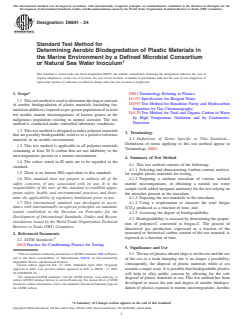
1.1 This test method is used to determine the degree and rate of aerobic biodegradation of plastic materials (including formulation additives) exposed to pre-grown population of at least ten aerobic marine microorganisms of known genera or the indigenous population existing in natural seawater. The test method is conducted under controlled laboratory conditions.
1.2 This test method is designed to index polymer materials that are possibly biodegradable, relative to a positive reference material, in an aerobic environment.
1.3 This test method is applicable to all polymer materials containing at least 20 % carbon that are not inhibitory to the microorganisms present in a marine environment.
1.4 The values stated in SI units are to be regarded as the standard.
1.5 There is no known ISO equivalent to this standard.
1.6 This standard does not purport to address all of the safety concerns, if any, associated with its use. It is the responsibility of the user of this standard to establish appropriate safety, health, and environmental practices and determine the applicability of regulatory limitations prior to use.
1.7 This international standard was developed in accordance with internationally recognized principles on standardization established in the Decision on Principles for the Development of International Standards, Guides and Recommendations issued by the World Trade Organization Technical Barriers to Trade (TBT) Committee.
- Status
- Published
- Publication Date
- 14-Feb-2024
- Technical Committee
- D20 - Plastics
- Drafting Committee
- D20.96 - Environmentally Degradable Plastics and Biobased Products
Buy Documents
ASTM D6691-24 - Standard Test Method for Determining Aerobic Biodegradation of Plastic Materials in the Marine Environment by a Defined Microbial Consortium or Natural Sea Water Inoculum
REDLINE ASTM D6691-24 - Standard Test Method for Determining Aerobic Biodegradation of Plastic Materials in the Marine Environment by a Defined Microbial Consortium or Natural Sea Water Inoculum
Overview
ASTM D6691-24 is the Standard Test Method for Determining Aerobic Biodegradation of Plastic Materials in the Marine Environment by a Defined Microbial Consortium or Natural Sea Water Inoculum, issued by ASTM International. This standard supports efforts to address the environmental challenges posed by plastics in marine environments. With the increased use of plastics on ships and restrictions on ocean-based waste disposal, ASTM D6691-24 provides a robust, laboratory-based method to evaluate how plastics biodegrade aerobically when exposed to marine microorganisms.
The method measures the rate and extent of biodegradation by quantifying carbon dioxide produced as plastics are broken down, offering valuable data on potential biodegradability and persistence of plastics in marine settings such as seashores and open oceans. This test gives stakeholders a standardized way to assess new materials marketed as “biodegradable” in marine environments.
Key Topics
Aerobic Biodegradation Testing
The standard details procedures for exposing plastic materials to either a consortium of pre-grown marine microorganisms or indigenous populations in natural sea water under controlled laboratory conditions.Carbon Dioxide Measurement
Biodegradation is determined by tracking the amount of CO₂ generated as plastics decompose, using sensitive respirometric equipment.Material Applicability
ASTM D6691-24 applies to all polymer materials with at least 20% carbon content that are not toxic to marine microorganisms. Testing can accommodate powders, films, fragments, or formed articles.Reference Materials and Comparisons
A positive control (such as cellulose or chitin) must be included to ensure the microbial inoculum is active. Results are measured relative to these reference materials.Interpretation and Limitations
While the test gives insight into potential marine biodegradability, users are cautioned against over-extrapolation of laboratory results to long-term real-world environmental fate.Safety and Good Laboratory Practice
The standard emphasizes proper handling of microorganisms, safe chemical use, and adherence to health and environmental regulations.
Applications
ASTM D6691-24 is a critical tool for:
Biodegradable Plastics Assessment
Manufacturers use this standard to verify claims of marine biodegradability for plastic materials, facilitating environmentally conscious product development.Comparative Material Testing
Researchers and quality assurance professionals compare different polymers or blends for their biodegradation rates in marine environments.Regulatory and Environmental Compliance
The test method assists regulatory bodies and eco-labeling programs in evaluating and certifying biodegradable materials intended for marine use.Reducing Marine Plastic Pollution
By enabling rigorous, standardized testing, ASTM D6691-24 helps industries develop materials that may reduce the persistence of plastic waste in oceans.
Related Standards
- ASTM D883 - Terminology Relating to Plastics
- ASTM D618 - Practice for Conditioning Plastics for Testing
- ASTM D1193 - Specification for Reagent Water
- ASTM D4129 - Test Method for Total and Organic Carbon in Water by High Temperature Oxidation and by Coulometric Detection
- ASTM D2593 - Test Method for Butadiene Purity and Hydrocarbon Impurities by Gas Chromatography
Note: There is currently no ISO equivalent to ASTM D6691-24.
By adhering to ASTM D6691-24, stakeholders gain reliable, reproducible data for materials science, marine protection, and sustainability initiatives, promoting responsible use of plastics in environments where their impact is most critical.
Relations
- Effective Date
- 15-Feb-2024
- Effective Date
- 15-Feb-2024
Buy Documents
ASTM D6691-24 - Standard Test Method for Determining Aerobic Biodegradation of Plastic Materials in the Marine Environment by a Defined Microbial Consortium or Natural Sea Water Inoculum
REDLINE ASTM D6691-24 - Standard Test Method for Determining Aerobic Biodegradation of Plastic Materials in the Marine Environment by a Defined Microbial Consortium or Natural Sea Water Inoculum
Get Certified
Connect with accredited certification bodies for this standard

CIS Institut d.o.o.
Personal Protective Equipment (PPE) certification body. Notified Body NB-2890 for EU Regulation 2016/425 PPE.

Kiwa BDA Testing
Building and construction product certification.
Kmetijski inštitut Slovenije
Agricultural Institute of Slovenia. Soil testing, plant health, agricultural product analysis.
Sponsored listings
Frequently Asked Questions
ASTM D6691-24 is a standard published by ASTM International. Its full title is "Standard Test Method for Determining Aerobic Biodegradation of Plastic Materials in the Marine Environment by a Defined Microbial Consortium or Natural Sea Water Inoculum". This standard covers: SIGNIFICANCE AND USE 5.1 The use of plastics aboard ships is on the rise and the use of the sea as a trash dumping site is no longer a possibility; consequently, the disposal of plastic materials while at sea remains a major issue. It is possible that biodegradable plastics will help to allay public concern by allowing for the safe disposal of plastic materials at sea. This test method has been developed to assess the rate and degree of aerobic biodegradation of plastics exposed to marine microorganisms. Aerobic biodegradation is determined by measuring the amount of biogas (carbon dioxide) produced during such an exposure. 5.2 It is acceptable to use the degree and rate of aerobic biodegradability of a plastic under the conditions of this test method to estimate the persistence of that plastic in biologically active marine environments, for example, seashore and open-ocean. However, it shall be recognized that predicting long-term environmental fate and effects from the results of short-term exposure to a simulated marine environment is difficult. Thus, caution shall be exercised when extrapolating the results obtained from this or any other controlled-environment test to disposal in the natural environment. SCOPE 1.1 This test method is used to determine the degree and rate of aerobic biodegradation of plastic materials (including formulation additives) exposed to pre-grown population of at least ten aerobic marine microorganisms of known genera or the indigenous population existing in natural seawater. The test method is conducted under controlled laboratory conditions. 1.2 This test method is designed to index polymer materials that are possibly biodegradable, relative to a positive reference material, in an aerobic environment. 1.3 This test method is applicable to all polymer materials containing at least 20 % carbon that are not inhibitory to the microorganisms present in a marine environment. 1.4 The values stated in SI units are to be regarded as the standard. 1.5 There is no known ISO equivalent to this standard. 1.6 This standard does not purport to address all of the safety concerns, if any, associated with its use. It is the responsibility of the user of this standard to establish appropriate safety, health, and environmental practices and determine the applicability of regulatory limitations prior to use. 1.7 This international standard was developed in accordance with internationally recognized principles on standardization established in the Decision on Principles for the Development of International Standards, Guides and Recommendations issued by the World Trade Organization Technical Barriers to Trade (TBT) Committee.
SIGNIFICANCE AND USE 5.1 The use of plastics aboard ships is on the rise and the use of the sea as a trash dumping site is no longer a possibility; consequently, the disposal of plastic materials while at sea remains a major issue. It is possible that biodegradable plastics will help to allay public concern by allowing for the safe disposal of plastic materials at sea. This test method has been developed to assess the rate and degree of aerobic biodegradation of plastics exposed to marine microorganisms. Aerobic biodegradation is determined by measuring the amount of biogas (carbon dioxide) produced during such an exposure. 5.2 It is acceptable to use the degree and rate of aerobic biodegradability of a plastic under the conditions of this test method to estimate the persistence of that plastic in biologically active marine environments, for example, seashore and open-ocean. However, it shall be recognized that predicting long-term environmental fate and effects from the results of short-term exposure to a simulated marine environment is difficult. Thus, caution shall be exercised when extrapolating the results obtained from this or any other controlled-environment test to disposal in the natural environment. SCOPE 1.1 This test method is used to determine the degree and rate of aerobic biodegradation of plastic materials (including formulation additives) exposed to pre-grown population of at least ten aerobic marine microorganisms of known genera or the indigenous population existing in natural seawater. The test method is conducted under controlled laboratory conditions. 1.2 This test method is designed to index polymer materials that are possibly biodegradable, relative to a positive reference material, in an aerobic environment. 1.3 This test method is applicable to all polymer materials containing at least 20 % carbon that are not inhibitory to the microorganisms present in a marine environment. 1.4 The values stated in SI units are to be regarded as the standard. 1.5 There is no known ISO equivalent to this standard. 1.6 This standard does not purport to address all of the safety concerns, if any, associated with its use. It is the responsibility of the user of this standard to establish appropriate safety, health, and environmental practices and determine the applicability of regulatory limitations prior to use. 1.7 This international standard was developed in accordance with internationally recognized principles on standardization established in the Decision on Principles for the Development of International Standards, Guides and Recommendations issued by the World Trade Organization Technical Barriers to Trade (TBT) Committee.
ASTM D6691-24 is classified under the following ICS (International Classification for Standards) categories: 13.030.99 - Other standards related to wastes. The ICS classification helps identify the subject area and facilitates finding related standards.
ASTM D6691-24 has the following relationships with other standards: It is inter standard links to ASTM D6691-17, ASTM D7473/D7473M-21. Understanding these relationships helps ensure you are using the most current and applicable version of the standard.
ASTM D6691-24 is available in PDF format for immediate download after purchase. The document can be added to your cart and obtained through the secure checkout process. Digital delivery ensures instant access to the complete standard document.
Standards Content (Sample)
This international standard was developed in accordance with internationally recognized principles on standardization established in the Decision on Principles for the
Development of International Standards, Guides and Recommendations issued by the World Trade Organization Technical Barriers to Trade (TBT) Committee.
Designation: D6691 − 24
Standard Test Method for
Determining Aerobic Biodegradation of Plastic Materials in
the Marine Environment by a Defined Microbial Consortium
or Natural Sea Water Inoculum
This standard is issued under the fixed designation D6691; the number immediately following the designation indicates the year of
original adoption or, in the case of revision, the year of last revision. A number in parentheses indicates the year of last reapproval. A
superscript epsilon (´) indicates an editorial change since the last revision or reapproval.
1. Scope* D883 Terminology Relating to Plastics
D1193 Specification for Reagent Water
1.1 This test method is used to determine the degree and rate
D2593 Test Method for Butadiene Purity and Hydrocarbon
of aerobic biodegradation of plastic materials (including for-
Impurities by Gas Chromatography
mulation additives) exposed to pre-grown population of at least
D4129 Test Method for Total and Organic Carbon in Water
ten aerobic marine microorganisms of known genera or the
by High Temperature Oxidation and by Coulometric
indigenous population existing in natural seawater. The test
Detection
method is conducted under controlled laboratory conditions.
1.2 This test method is designed to index polymer materials
3. Terminology
that are possibly biodegradable, relative to a positive reference
3.1 Definitions of Terms Specific to This Standard—
material, in an aerobic environment.
Definitions of terms applying to this test method appear in
1.3 This test method is applicable to all polymer materials
Terminology D883.
containing at least 20 % carbon that are not inhibitory to the
microorganisms present in a marine environment.
4. Summary of Test Method
1.4 The values stated in SI units are to be regarded as the
4.1 This test method consists of the following:
standard.
4.1.1 Selecting and characterizing (carbon content, molecu-
1.5 There is no known ISO equivalent to this standard.
lar weight) plastic materials for testing,
1.6 This standard does not purport to address all of the
4.1.2 Preparing a uniform inoculum of various isolated
safety concerns, if any, associated with its use. It is the marine microorganisms, or obtaining a natural sea water
responsibility of the user of this standard to establish appro-
sample (with added inorganic nutrients) for the test relying on
priate safety, health, and environmental practices and deter-
the microbes present as the inoculum.
mine the applicability of regulatory limitations prior to use.
4.1.3 Exposing the test materials to the inoculum,
1.7 This international standard was developed in accor-
4.1.4 Using a respirometer to measure the total biogas
dance with internationally recognized principles on standard-
(CO ) produced as a function of time, and
ization established in the Decision on Principles for the
4.1.5 Assessing the degree of biodegradability.
Development of International Standards, Guides and Recom-
4.2 Biodegradability is assessed by determining the propor-
mendations issued by the World Trade Organization Technical
tion of polymer-C converted to biogas-C. The percent of
Barriers to Trade (TBT) Committee.
theoretical gas production, expressed as a fraction of the
measured or theoretical carbon content of the test material, is
2. Referenced Documents
2 reported as a function of time.
2.1 ASTM Standards:
D618 Practice for Conditioning Plastics for Testing
5. Significance and Use
This test method is under the jurisdiction of ASTM Committee D20 on Plastics
5.1 The use of plastics aboard ships is on the rise and the use
and is the direct responsibility of Subcommittee D20.96 on Environmentally
of the sea as a trash dumping site is no longer a possibility;
Degradable Plastics and Biobased Products.
consequently, the disposal of plastic materials while at sea
Current edition approved Feb. 15, 2024. Published April 2024. Originally
remains a major issue. It is possible that biodegradable plastics
approved in 2001. Last previous edition approved in 2017 as D6691 - 17. DOI:
10.1520/D6691-24.
will help to allay public concern by allowing for the safe
For referenced ASTM standards, visit the ASTM website, www.astm.org, or
disposal of plastic materials at sea. This test method has been
contact ASTM Customer Service at service@astm.org. For Annual Book of ASTM
developed to assess the rate and degree of aerobic biodegra-
Standards volume information, refer to the standard’s Document Summary page on
the ASTM website. dation of plastics exposed to marine microorganisms. Aerobic
*A Summary of Changes section appears at the end of this standard
Copyright © ASTM International, 100 Barr Harbor Drive, PO Box C700, West Conshohocken, PA 19428-2959. United States
D6691 − 24
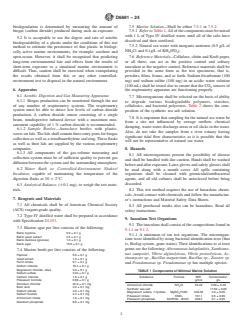
biodegradation is determined by measuring the amount of 7.5 Marine Solution—Shall be either 7.5.1 or 7.5.2.
biogas (carbon dioxide) produced during such an exposure. 7.5.1 Refer to Table 1. All of the components must be mixed
with 1 L of Type IV distilled water, until all of the salts have
5.2 It is acceptable to use the degree and rate of aerobic
dissolved and then sterilized.
biodegradability of a plastic under the conditions of this test
7.5.2 Natural sea water with inorganic nutrients (0.5 g/L of
method to estimate the persistence of that plastic in biologi-
NH Cl and 0.1g/L of KH (PO ).
4 2 4
cally active marine environments, for example, seashore and
open-ocean. However, it shall be recognized that predicting 7.6 Reference Materials—Cellulose, chitin and Kraft paper,
long-term environmental fate and effects from the results of or all three, can act as the positive control and solitary
short-term exposure to a simulated marine environment is inoculum as the negative control. Reference materials shall be
difficult. Thus, caution shall be exercised when extrapolating provided in the same form as the test specimens, that is,
the results obtained from this or any other controlled- powders, films, foams, and so forth. Sodium bicarbonate (100
environment test to disposal in the natural environment. mg) and sodium sulfite (100 mg) in an acidic water solution
(100 mL) shall be tested also to ensure that the CO sensors of
6. Apparatus
the respirometry apparatus are functioning properly.
6.1 Aerobic Digestion and Gas Measuring Apparatus:
7.7 Microorganisms shall be selected on the basis of ability
6.1.1 Biogas production can be monitored through the use
to degrade various biodegradable polymers, starches,
of any number of respirometry systems. The respirometry
cellulosics, and bacterial polyesters. Table 2 shows the com-
system must be able to detect low levels of carbon dioxide
position of the synthetic sea salt solution.
production. A carbon dioxide sensor consisting of a single
7.8 It is important that sampling for the natural sea water be
beam, nondispersive infrared device with a maximum mea-
from a site not influenced by sewage outflow, chemical
surement capability of 1 % carbon dioxide is recommended.
dumping, waste water discharge areas or oil slicks in the water.
6.1.2 Sample Bottles—Autoclave bottles with plastic,
Also, do not take the samples from a river estuary having
screw-on lids. The lids shall contain three entry ports for biogas
significant tidal flow characteristics as it is possible that this
collection as well as a tetrafluorethylene seal ring. These flasks
will not be representative of natural sea water.
as well as their lids are supplied by the various respirometry
companies.
8. Hazards
6.1.3 All components of the gas-volume measuring and
8.1 All microorganisms present the possibility of disease
collection system must be of sufficient quality to prevent gas
and shall be handled with due caution. Hands shall be washed
diffusion between the system and the surrounding atmosphere.
before and after exposure. Latex gloves and safety glasses shall
6.2 Water Bath or Controlled-Environment Shaker/
be used along with a mouth cover. All spills containing
Incubator, capable of maintaining the temperature of the organisms shall be cleaned with germicidal/antibacterial
digestion flasks at 30 6 2°C.
agents, and all old cultures shall be autoclaved before being
discarded.
6.3 Analytical Balance, (60.1 mg), to weigh the test mate-
rials.
8.2 This test method requires the use of hazardous chemi-
cals. Avoid contact with chemicals and follow the manufactur-
7. Reagents and Materials
er’s instructions and Material Safety Data Sheets.
7.1 All chemicals shall be of American Chemical Society
8.3 All purchased media also can be hazardous. Read all
(ACS) reagent-grade quality.
safety instructions.
7.2 Type IV distilled water shall be prepared in accordance
9. Inoculum Test Organisms
with Specification D1193.
9.1 The inoculum shall consist of the compositions found in
7.3 Marine agar per litre consists of the following:
9.1.1 or 9.1.2.
Bacto tryptone 5.0 ± 0.1 g
9.1.1 A minimum of ten test organisms. The microorgan-
Bacto yeast extract 2.5 ± 0.1 g
isms were identified by using bacterial identification tests (that
Bacto dextrose (glucose) 1.0 ± 0.1 g
Bacto agar 15.0 ± 0.1 g is, Biolog system, gram stains). Their identifications to at least
genus are the following: Alteromonas haloplanktis, Xanthomo-
7.4 Marine broth per litre consists of the following:
nas campestri, Vibrio alginolyticus, Vibrio proteolyticus, Ac-
Peptone 5.0 ± 0.1 g
tinomycete sp., Bacillus megaterium, Bacillus sp., Zooster sp.
Yeast extract 1.0 ± 0.1 g
Ferric citrate 0.1 ± 0.1 g
and Pseudomonas sp. Pseudomonas sp has multiple species.
Sodium chloride 19.4 ± 0.1 g
Magnesium chloride, dried 5.9 ± 0.1 g
TABLE 1 Components of Minimal Marine Solution
Sodium sulfate 3.24 ± 0.1 g
Calcium chloride 1.8 ± 0.1 g Substance Formula MW, Concentration,
Potassium bromide 0.08 ± 0.1 g g/mol g/L
Strontium chloride 34.0 ± 0.1 mg
Ammonium chloride NH Cl 53.49 2.00 ± 0.05
Boric acid 4.0 ± 0.1 mg
Synthetic sea salt . . . . . . 17.50 ± 0.05
Sodium silicate 4.0 ± 0.1 mg
Magnesium sulfate, 7-hydrate MgSO 7H2O 246.48 2.0 ± 0.05
Sodium fluoride 2.4 ± 0.1 mg
Potassium nitrate KNO 101.1 0.5 ± 0.05
Ammonium nitrate 1.6 ± 0.1 mg
Potassium phosphate K2HPO4 · 3H2O 228.2 0.1 ± 0.05
Disodium phosphate 8.0 ± 0.1 mg
D6691 − 24
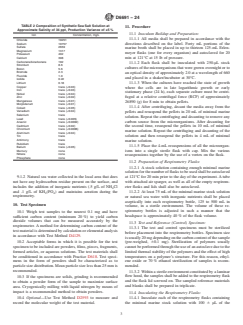
TABLE 2 Composition of Synthetic Sea Salt Solution at
11. Procedure
Approximate Salinity of 34 ppt, Production Variance of ±5 %
11.1 Inoculum Buildup and Preparation:
Ion Concentration, mg/L
11.1.1 All media shall be prepared in accordance with the
Chloride 19251
Sodium 10757 directions described on the label. Forty mL portions of the
Sulfate 2659
marine broth shall be placed in u
...
This document is not an ASTM standard and is intended only to provide the user of an ASTM standard an indication of what changes have been made to the previous version. Because
it may not be technically possible to adequately depict all changes accurately, ASTM recommends that users consult prior editions as appropriate. In all cases only the current version
of the standard as published by ASTM is to be considered the official document.
Designation: D6691 − 17 D6691 − 24
Standard Test Method for
Determining Aerobic Biodegradation of Plastic Materials in
the Marine Environment by a Defined Microbial Consortium
or Natural Sea Water Inoculum
This standard is issued under the fixed designation D6691; the number immediately following the designation indicates the year of
original adoption or, in the case of revision, the year of last revision. A number in parentheses indicates the year of last reapproval. A
superscript epsilon (´) indicates an editorial change since the last revision or reapproval.
1. Scope*
1.1 This test method is used to determine the degree and rate of aerobic biodegradation of plastic materials (including formulation
additives) exposed to pre-grown population of at least ten aerobic marine microorganisms of known genera or the indigenous
population existing in natural seawater. The test method is conducted under controlled laboratory conditions.
1.2 This test method is designed to index polymer materials that are possibly biodegradable, relative to a positive reference
material, in an aerobic environment.
1.3 This test method is applicable to all polymer materials containing at least 20 % carbon that are not inhibitory to the
microorganisms present in a marine environment.
1.4 The values stated in SI units are to be regarded as the standard.
1.5 There is no known ISO equivalent to this standard.
1.6 This standard does not purport to address all of the safety concerns, if any, associated with its use. It is the responsibility
of the user of this standard to establish appropriate safety, health, and environmental practices and determine the applicability of
regulatory limitations prior to use.
1.7 This international standard was developed in accordance with internationally recognized principles on standardization
established in the Decision on Principles for the Development of International Standards, Guides and Recommendations issued
by the World Trade Organization Technical Barriers to Trade (TBT) Committee.
2. Referenced Documents
2.1 ASTM Standards:
D618 Practice for Conditioning Plastics for Testing
D883 Terminology Relating to Plastics
D1193 Specification for Reagent Water
D2593 Test Method for Butadiene Purity and Hydrocarbon Impurities by Gas Chromatography
This test method is under the jurisdiction of ASTM Committee D20 on Plastics and is the direct responsibility of Subcommittee D20.96 on Environmentally Degradable
Plastics and Biobased Products.
Current edition approved Dec. 1, 2017Feb. 15, 2024. Published January 2018April 2024. Originally approved in 2001. Last previous edition approved in 20092017 as
D6691 - 09.D6691 - 17. DOI: 10.1520/D6691-17.10.1520/D6691-24.
For referenced ASTM standards, visit the ASTM website, www.astm.org, or contact ASTM Customer Service at service@astm.org. For Annual Book of ASTM Standards
volume information, refer to the standard’s Document Summary page on the ASTM website.
*A Summary of Changes section appears at the end of this standard
Copyright © ASTM International, 100 Barr Harbor Drive, PO Box C700, West Conshohocken, PA 19428-2959. United States
D6691 − 24
D4129 Test Method for Total and Organic Carbon in Water by High Temperature Oxidation and by Coulometric Detection
3. Terminology
3.1 Definitions of Terms Specific to This Standard—Definitions of terms applying to this test method appear in Terminology D883.
4. Summary of Test Method
4.1 This test method consists of the following:
4.1.1 Selecting and characterizing (carbon content, molecular weight) plastic materials for testing,
4.1.2 Preparing a uniform inoculum of various isolated marine microorganisms, or obtaining a natural sea water sample (with
added inorganic nutrients) for the test relying on the microbes present as the inoculum.
4.1.3 Exposing the test materials to the inoculum,
4.1.4 Using a respirometer to measure the total biogas (CO ) produced as a function of time, and
4.1.5 Assessing the degree of biodegradability.
4.2 Biodegradability is assessed by determining the proportion of polymer-C converted to biogas-C. The percent of theoretical gas
production, expressed as a fraction of the measured or theoretical carbon content of the test material, is reported as a function of
time.
5. Significance and Use
5.1 The use of plastics aboard ships is on the rise and the use of the sea as a trash dumping site is no longer a possibility;
consequently, the disposal of plastic materials while at sea remains a major issue. It is possible that biodegradable plastics will help
to allay public concern by allowing for the safe disposal of plastic materials at sea. This test method has been developed to assess
the rate and degree of aerobic biodegradation of plastics exposed to marine microorganisms. Aerobic biodegradation is determined
by measuring the amount of biogas (carbon dioxide) produced during such an exposure.
5.2 It is acceptable to use the degree and rate of aerobic biodegradability of a plastic under the conditions of this test method to
estimate the persistence of that plastic in biologically active marine environments, for example, seashore and open-ocean.
However, it shall be recognized that predicting long-term environmental fate and effects from the results of short-term exposure
to a simulated marine environment is difficult. Thus, caution shall be exercised when extrapolating the results obtained from this
or any other controlled-environment test to disposal in the natural environment.
6. Apparatus
6.1 Aerobic Digestion and Gas Measuring Apparatus:
6.1.1 Biogas production can be monitored through the use of any number of respirometry systems. The respirometry system must
be able to detect low levels of carbon dioxide production. A carbon dioxide sensor consisting of a single beam, nondispersive
infrared device with a maximum measurement capability of 1 % carbon dioxide is recommended.
6.1.2 Sample Bottles—125-mL autoclave Autoclave bottles with plastic, screw-on lids. The lids shall contain three entry ports for
biogas collection as well as a tetrafluorethylene seal ring. These flasks as well as their lids are supplied by the various respirometry
companies.
6.1.3 All components of the gas-volume measuring and collection system must be of sufficient quality to prevent gas diffusion
between the system and the surrounding atmosphere.
6.2 Water Bath or Controlled-Environment Shaker/Incubator, capable of maintaining the temperature of the digestion flasks at 30
6 2°C.
D6691 − 24
6.3 Analytical Balance, (60.1 mg), to weigh the test materials.
7. Reagents and Materials
7.1 All chemicals shall be of American Chemical Society (ACS) reagent-grade quality.
7.2 Type IV distilled water shall be prepared in accordance with Specification D1193.
7.3 Marine agar per litre consists of the following:
Bacto tryptone 5.0 ± 0.1 g
Bacto yeast extract 2.5 ± 0.1 g
Bacto dextrose (glucose) 1.0 ± 0.1 g
Bacto agar 15.0 ± 0.1 g
7.4 Marine broth per litre consists of the following:
Peptone 5.0 ± 0.1 g
Yeast extract 1.0 ± 0.1 g
Ferric citrate 0.1 ± 0.1 g
Sodium chloride 19.4 ± 0.1 g
Magnesium chloride, dried 5.9 ± 0.1 g
Sodium sulfate 3.24 ± 0.1 g
Calcium chloride 1.8 ± 0.1 g
Potassium bromide 0.08 ± 0.1 g
Strontium chloride 34.0 ± 0.1 mg
Boric acid 4.0 ± 0.1 mg
Sodium silicate 4.0 ± 0.1 mg
Sodium fluoride 2.4 ± 0.1 mg
Ammonium nitrate 1.6 ± 0.1 mg
Disodium phosphate 8.0 ± 0.1 mg
7.5 Marine Solution—Shall be either 7.5.1 or 7.5.2.
7.5.1 Refer to Table 1. All of the components must be mixed with 1 L of Type IV distilled water, until all of the salts have dissolved
and then sterilized.
7.5.2 Natural sea water with inorganic nutrients (0.5 g/L of NH Cl and 0.1g/L of KH (PO ).
4 2 4
7.6 Reference Materials—Cellulose, chitin and Kraft paper, or all three, can act as the positive control and solitary inoculum as
the negative control. Reference materials shall be provided in the same form as the test specimens, that is, powders, films, foams,
and so forth. Sodium bicarbonate (100 mg) and sodium sulfite (100 mg) in an acidic water solution (100 mL) shall be tested also
to ensure that the CO sensors of the respirometry apparatus are functioning properly.
7.7 Microorganisms shall be selected on the basis of ability to degrade various biodegradable polymers, starches, cellulosics, and
bacterial polyesters. Table 2 shows the composition of the synthetic sea salt solution.
7.8 It is important that sampling for the natural sea water be from a site not influenced by sewage outflow, chemical dumping,
TABLE 1 Components of Minimal Marine Solution
Substance Formula MW, Concentration,
g/mol g/L
Ammonium chloride NH Cl 53.49 2.00 ± 0.05
Synthetic sea salt . . . . . . 17.50 ± 0.05
Magnesium sulfate, 7-hydrate MgSO 7H2O 246.48 2.0 ± 0.05
Potassium nitrate KNO 101.1 0.5 ± 0.05
Potassium phosphate K2HPO4 · 3H2O 228.2 0.1 ± 0.05
D6691 − 24
TABLE 2 Composition of Synthetic Sea Salt Solution at
Approximate Salinity of 34 ppt, Production Variance of ±5 %
Ion Concentration, mg/L
Chloride 19251
Sodium 10757
Sulfate 2659
Magnesium 1317
Potassium 402
Calcium 398
Carbonate/bicarbonate 192
Strontium 8.6
Boron 5.6
Bromide 2.3
Fluoride 1.0
Iodide 0.22
Lithium 0.18
Copper trace (<0.03)
Iron trace (<0.03)
Nickel trace (<0.04)
Zinc trace (<0.02)
Manganese trace (<0.01)
Molybdenum trace (<0.01)
Cobalt trace (<0.05)
Vanadium trace (<0.04)
Selenium trace
Lead trace (<0.005)
Arsenic trace (<0.0002)
Cadmium trace (<0.02)
Chromium trace (<0.0006)
Aluminum trace (<0.04)
Tin trace
Antimony trace
Rubidium trace
Barium trace (<0.05)
Mercury none
Nitrate none
Phosphate none
waste water discharge areas or oil slicks in the water. Also, do not take the samples from a river estuary having significant tidal
flow characteristics as it is possible that this will not be representative of natural sea water.
8. Hazards
8.1 All microorganisms present the possibility of disease and shall be handled with due caution. Hands shall be washed before
and after exposure. Latex gloves and safety glasses shall be used along with a mouth cover. All spills containing organisms shall
be cleaned with germicidal/antibacterial agents, and all old cultures shall be autoclaved before being discarded.
8.2 This test method requires the use of hazardous chemicals. Avoid contact with chemicals and follow the manufacturer’s
instructions and Material Safety Data Sheets.
8.3 All purchased media also can be hazardous. Read all safety instructions.
9. Inoculum Test Organisms
9.1 The inoculum shall consist of the compositions found in 9.1.1 or 9.1.2.
9.1.1 A minimum of ten test organisms. The microorganisms
...