

ASTM B834-22
(Specification)Standard Specification for Pressure Consolidated Powder Nickel Alloy Pipe Flanges, Fittings, Valves, and Parts
General Information
- Abstract
ABSTRACT
This specification tackles standards for pressure consolidated powder metallurgy iron-nickel-chromium-molybdenum and nickel-chromium-molybdenum-columbium pipe flanges, fittings, valves, and parts intended for general corrosion or heat-resisting service. Compacts shall be manufactured by placing a single powder blend into a can, evacuating the can, and sealing it. The can material shall then be selected to ensure that it has no deleterious effect on the final product. The specimen shall be heated and placed under sufficient pressure for a sufficient period of time to ensure that the final consolidated part is fully dense. The powder shall be produced by vacuum melting followed by gas atomization. The heats shall be thoroughly mixed to ensure homogeneity when powder from more than one heat is used to make a blend. The material shall have the chemical compositions of carbon, manganese, silicon, phosphorus, sulfur, chromium, molybdenum, nickel, iron, cobalt, columbium, aluminum, titanium, nitrogen, and copper. Hydrostatic test shall be conducted and the specimen must show no leaks. The density test shall be performed using sample suspended from a scale and weighed in air and water using Archimede’s principle. Check Analysis shall be wholly the responsibility of the purchaser. The parts of the specimen shall be uniform in quality and condition, and shall be free from injurious imperfections.
SCOPE
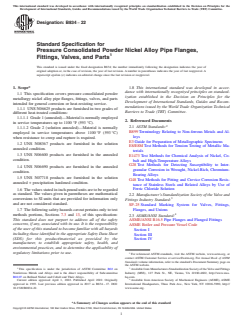
1.1 This specification covers pressure consolidated powder metallurgy nickel alloy pipe flanges, fittings, valves, and parts intended for general corrosion or heat-resisting service.
1.1.1 UNS N06625 products are furnished in two grades of different heat-treated conditions:
1.1.1.1 Grade 1 (annealed)—Material is normally employed in service temperatures up to 1100 °F (593 °C).
1.1.1.2 Grade 2 (solution annealed)—Material is normally employed in service temperatures above 1100 °F (593 °C) when resistance to creep and rupture is required.
1.2 UNS N08367 products are furnished in the solution annealed condition.
1.3 UNS N06600 products are furnished in the annealed condition.
1.4 UNS N06690 products are furnished in the annealed condition.
1.5 UNS N07718 products are furnished in the solution annealed + precipitation hardened condition.
1.6 The values stated in inch-pound units are to be regarded as standard. The values given in parentheses are mathematical conversions to SI units that are provided for information only and are not considered standard.
1.7 The following safety hazards caveat pertains only to test methods portions, Sections 7.3 and 13, of this specification: This standard does not purport to address all of the safety concerns, if any, associated with its use. It is the responsibility of the user of this standard to become familiar with all hazards including those identified in the appropriate Safety Data Sheet (SDS) for this product/material as provided by the manufacturer, to establish appropriate safety, health, and environmental practices, and to determine the applicability of regulatory limitations prior to use.
1.8 This international standard was developed in accordance with internationally recognized principles on standardization established in the Decision on Principles for the Development of International Standards, Guides and Recommendations issued by the World Trade Organization Technical Barriers to Trade (TBT) Committee.
- Status
- Published
- Publication Date
- 31-Mar-2022
- Technical Committee
- B02 - Nonferrous Metals and Alloys
- Drafting Committee
- B02.07 - Refined Nickel and Cobalt and Their Alloys
Buy Documents
ASTM B834-22 - Standard Specification for Pressure Consolidated Powder Nickel Alloy Pipe Flanges, Fittings, Valves, and Parts
REDLINE ASTM B834-22 - Standard Specification for Pressure Consolidated Powder Nickel Alloy Pipe Flanges, Fittings, Valves, and Parts
Overview
ASTM B834-22 is the standard specification developed by ASTM International for pressure consolidated powder metallurgy nickel alloy pipe flanges, fittings, valves, and parts. This standard focuses on iron-nickel-chromium-molybdenum and nickel-chromium-molybdenum-columbium alloys processed from powder metallurgy techniques. These products are primarily used in applications requiring enhanced general corrosion or heat resistance, commonly found across the chemical processing, petrochemical, energy, and high-temperature service industries. The specification details requirements for material composition, manufacturing process, mechanical properties, and testing procedures to ensure reliability and consistency.
Key Topics
Material Grades and Conditions
- UNS N06625: Provided in Grade 1 (annealed) for service up to 1100 °F (593 °C) and Grade 2 (solution annealed) for higher temperatures requiring creep and rupture resistance.
- UNS N08367: Supplied in the solution annealed condition.
- UNS N06600 and N06690: Furnished in annealed conditions suitable for their respective service applications.
- UNS N07718: Delivered in solution annealed and precipitation hardened condition for high strength and temperature resistance.
Powder Metallurgy Consolidation Process
- Powder produced by vacuum melting and gas atomization.
- Compacts formed by placing powder blends into cans, which are then evacuated, sealed, heated, and pressed to full density.
- Careful blending of powders from different heats to ensure homogeneity.
Chemical Composition and Mechanical Testing
- Compositions include elements like carbon, manganese, chromium, molybdenum, nickel, iron, cobalt, columbium, aluminum, titanium, nitrogen, and copper.
- Mandatory mechanical property checks for tensile strength, yield strength, elongation, and density using established ASTM test methods.
Quality and Inspection
- Hydrostatic and density tests to ensure structural integrity-no leaks and fully dense parts as required.
- Uniform appearance, free from injurious imperfections.
- Identification marks on each part for traceability per industry standards.
Applications
Parts conforming to ASTM B834-22 are critical in industries that require components to withstand aggressive corrosion and significant thermal stress. Main application sectors include:
- Chemical and Petrochemical Processing: Use in pipe flanges, fittings, and valves in corrosive media and high-temperature environments.
- Power Generation: Components in heat exchangers, boilers, and piping systems exposed to high pressure and temperature.
- Oil and Gas: Equipment requiring high mechanical strength and corrosion resistance, including offshore platforms and refineries.
- Industrial Manufacturing: General-purpose high-performance piping systems where reliability and longevity are essential.
By establishing clear requirements for processing, composition, and performance, ASTM B834-22 helps industry professionals select the appropriate nickel alloy parts for demanding service conditions.
Related Standards
This standard is closely linked with a set of other important documents and standards, including:
- ASTM B899 - Terminology Relating to Non-ferrous Metals and Alloys
- ASTM E8/E8M - Test Methods for Tension Testing of Metallic Materials
- ASTM E1473 - Test Methods for Chemical Analysis of Nickel, Cobalt and High-Temperature Alloys
- ASTM G28 / G48 - Test Methods for Corrosion Resistance
- ASME/ANSI B16.5 - Pipe Flanges and Flanged Fittings
- ASME Boiler and Pressure Vessel Code - Various sections for design and inspection
- MSS SP-25 - Standard Marking System for Valves, Fittings, Flanges, and Unions
Adhering to ASTM B834-22 ensures compatibility, safety, and high performance of nickel alloy components in challenging industrial environments.
Relations
- Effective Date
- 01-Jan-2024
- Effective Date
- 01-Oct-2016
- Effective Date
- 15-Jul-2016
- Effective Date
- 01-Oct-2015
- Effective Date
- 01-Feb-2015
- Effective Date
- 01-Oct-2014
- Effective Date
- 01-Jun-2013
- Effective Date
- 01-Feb-2013
- Effective Date
- 01-Dec-2011
- Effective Date
- 01-Sep-2011
- Effective Date
- 01-Oct-2009
- Effective Date
- 01-Oct-2009
- Effective Date
- 01-May-2008
- Effective Date
- 01-Jul-2007
- Effective Date
- 01-Jul-2007
Buy Documents
ASTM B834-22 - Standard Specification for Pressure Consolidated Powder Nickel Alloy Pipe Flanges, Fittings, Valves, and Parts
REDLINE ASTM B834-22 - Standard Specification for Pressure Consolidated Powder Nickel Alloy Pipe Flanges, Fittings, Valves, and Parts
Get Certified
Connect with accredited certification bodies for this standard

Institut za varilstvo d.o.o. (Welding Institute)
Slovenia's leading welding institute since 1952. ISO 3834, EN 1090, pressure equipment certification, NDT personnel, welder qualification. Only IIW Au
Sponsored listings
Frequently Asked Questions
ASTM B834-22 is a technical specification published by ASTM International. Its full title is "Standard Specification for Pressure Consolidated Powder Nickel Alloy Pipe Flanges, Fittings, Valves, and Parts". This standard covers: ABSTRACT This specification tackles standards for pressure consolidated powder metallurgy iron-nickel-chromium-molybdenum and nickel-chromium-molybdenum-columbium pipe flanges, fittings, valves, and parts intended for general corrosion or heat-resisting service. Compacts shall be manufactured by placing a single powder blend into a can, evacuating the can, and sealing it. The can material shall then be selected to ensure that it has no deleterious effect on the final product. The specimen shall be heated and placed under sufficient pressure for a sufficient period of time to ensure that the final consolidated part is fully dense. The powder shall be produced by vacuum melting followed by gas atomization. The heats shall be thoroughly mixed to ensure homogeneity when powder from more than one heat is used to make a blend. The material shall have the chemical compositions of carbon, manganese, silicon, phosphorus, sulfur, chromium, molybdenum, nickel, iron, cobalt, columbium, aluminum, titanium, nitrogen, and copper. Hydrostatic test shall be conducted and the specimen must show no leaks. The density test shall be performed using sample suspended from a scale and weighed in air and water using Archimede’s principle. Check Analysis shall be wholly the responsibility of the purchaser. The parts of the specimen shall be uniform in quality and condition, and shall be free from injurious imperfections. SCOPE 1.1 This specification covers pressure consolidated powder metallurgy nickel alloy pipe flanges, fittings, valves, and parts intended for general corrosion or heat-resisting service. 1.1.1 UNS N06625 products are furnished in two grades of different heat-treated conditions: 1.1.1.1 Grade 1 (annealed)—Material is normally employed in service temperatures up to 1100 °F (593 °C). 1.1.1.2 Grade 2 (solution annealed)—Material is normally employed in service temperatures above 1100 °F (593 °C) when resistance to creep and rupture is required. 1.2 UNS N08367 products are furnished in the solution annealed condition. 1.3 UNS N06600 products are furnished in the annealed condition. 1.4 UNS N06690 products are furnished in the annealed condition. 1.5 UNS N07718 products are furnished in the solution annealed + precipitation hardened condition. 1.6 The values stated in inch-pound units are to be regarded as standard. The values given in parentheses are mathematical conversions to SI units that are provided for information only and are not considered standard. 1.7 The following safety hazards caveat pertains only to test methods portions, Sections 7.3 and 13, of this specification: This standard does not purport to address all of the safety concerns, if any, associated with its use. It is the responsibility of the user of this standard to become familiar with all hazards including those identified in the appropriate Safety Data Sheet (SDS) for this product/material as provided by the manufacturer, to establish appropriate safety, health, and environmental practices, and to determine the applicability of regulatory limitations prior to use. 1.8 This international standard was developed in accordance with internationally recognized principles on standardization established in the Decision on Principles for the Development of International Standards, Guides and Recommendations issued by the World Trade Organization Technical Barriers to Trade (TBT) Committee.
ABSTRACT This specification tackles standards for pressure consolidated powder metallurgy iron-nickel-chromium-molybdenum and nickel-chromium-molybdenum-columbium pipe flanges, fittings, valves, and parts intended for general corrosion or heat-resisting service. Compacts shall be manufactured by placing a single powder blend into a can, evacuating the can, and sealing it. The can material shall then be selected to ensure that it has no deleterious effect on the final product. The specimen shall be heated and placed under sufficient pressure for a sufficient period of time to ensure that the final consolidated part is fully dense. The powder shall be produced by vacuum melting followed by gas atomization. The heats shall be thoroughly mixed to ensure homogeneity when powder from more than one heat is used to make a blend. The material shall have the chemical compositions of carbon, manganese, silicon, phosphorus, sulfur, chromium, molybdenum, nickel, iron, cobalt, columbium, aluminum, titanium, nitrogen, and copper. Hydrostatic test shall be conducted and the specimen must show no leaks. The density test shall be performed using sample suspended from a scale and weighed in air and water using Archimede’s principle. Check Analysis shall be wholly the responsibility of the purchaser. The parts of the specimen shall be uniform in quality and condition, and shall be free from injurious imperfections. SCOPE 1.1 This specification covers pressure consolidated powder metallurgy nickel alloy pipe flanges, fittings, valves, and parts intended for general corrosion or heat-resisting service. 1.1.1 UNS N06625 products are furnished in two grades of different heat-treated conditions: 1.1.1.1 Grade 1 (annealed)—Material is normally employed in service temperatures up to 1100 °F (593 °C). 1.1.1.2 Grade 2 (solution annealed)—Material is normally employed in service temperatures above 1100 °F (593 °C) when resistance to creep and rupture is required. 1.2 UNS N08367 products are furnished in the solution annealed condition. 1.3 UNS N06600 products are furnished in the annealed condition. 1.4 UNS N06690 products are furnished in the annealed condition. 1.5 UNS N07718 products are furnished in the solution annealed + precipitation hardened condition. 1.6 The values stated in inch-pound units are to be regarded as standard. The values given in parentheses are mathematical conversions to SI units that are provided for information only and are not considered standard. 1.7 The following safety hazards caveat pertains only to test methods portions, Sections 7.3 and 13, of this specification: This standard does not purport to address all of the safety concerns, if any, associated with its use. It is the responsibility of the user of this standard to become familiar with all hazards including those identified in the appropriate Safety Data Sheet (SDS) for this product/material as provided by the manufacturer, to establish appropriate safety, health, and environmental practices, and to determine the applicability of regulatory limitations prior to use. 1.8 This international standard was developed in accordance with internationally recognized principles on standardization established in the Decision on Principles for the Development of International Standards, Guides and Recommendations issued by the World Trade Organization Technical Barriers to Trade (TBT) Committee.
ASTM B834-22 is classified under the following ICS (International Classification for Standards) categories: 23.040.15 - Non-ferrous metal pipes. The ICS classification helps identify the subject area and facilitates finding related standards.
ASTM B834-22 has the following relationships with other standards: It is inter standard links to ASTM E8/E8M-24, ASTM B899-16, ASTM E8/E8M-16, ASTM B899-15, ASTM E8/E8M-15, ASTM B899-14, ASTM E8/E8M-13, ASTM B899-13, ASTM E8/E8M-11, ASTM G48-11, ASTM B899-09, ASTM B899-09e1, ASTM G28-02(2008), ASTM E3-01(2007)e1, ASTM E3-01(2007). Understanding these relationships helps ensure you are using the most current and applicable version of the standard.
ASTM B834-22 is available in PDF format for immediate download after purchase. The document can be added to your cart and obtained through the secure checkout process. Digital delivery ensures instant access to the complete standard document.
Standards Content (Sample)
This international standard was developed in accordance with internationally recognized principles on standardization established in the Decision on Principles for the
Development of International Standards, Guides and Recommendations issued by the World Trade Organization Technical Barriers to Trade (TBT) Committee.
Designation:B834 −22
Standard Specification for
Pressure Consolidated Powder Nickel Alloy Pipe Flanges,
Fittings, Valves, and Parts
This standard is issued under the fixed designation B834; the number immediately following the designation indicates the year of
original adoption or, in the case of revision, the year of last revision.Anumber in parentheses indicates the year of last reapproval.A
superscript epsilon (´) indicates an editorial change since the last revision or reapproval.
1. Scope* 1.8 This international standard was developed in accor-
dance with internationally recognized principles on standard-
1.1 This specification covers pressure consolidated powder
ization established in the Decision on Principles for the
metallurgy nickel alloy pipe flanges, fittings, valves, and parts
Development of International Standards, Guides and Recom-
intended for general corrosion or heat-resisting service.
mendations issued by the World Trade Organization Technical
1.1.1 UNS N06625 products are furnished in two grades of
Barriers to Trade (TBT) Committee.
different heat-treated conditions:
1.1.1.1 Grade1(annealed)—Materialisnormallyemployed
2. Referenced Documents
in service temperatures up to 1100°F (593°C).
2.1 ASTM Standards:
1.1.1.2 Grade 2 (solution annealed)—Material is normally
B899Terminology Relating to Non-ferrous Metals and Al-
employed in service temperatures above 1100°F (593°C)
loys
when resistance to creep and rupture is required.
E3Guide for Preparation of Metallographic Specimens
1.2 UNS N08367 products are furnished in the solution
E8/E8MTest Methods for Tension Testing of Metallic Ma-
annealed condition.
terials
1.3 UNS N06600 products are furnished in the annealed
E1473Test Methods for Chemical Analysis of Nickel, Co-
condition.
balt and High-Temperature Alloys
G28Test Methods for Detecting Susceptibility to Inter-
1.4 UNS N06690 products are furnished in the annealed
granular Corrosion in Wrought, Nickel-Rich, Chromium-
condition.
Bearing Alloys
1.5 UNS N07718 products are furnished in the solution
G48Test Methods for Pitting and Crevice Corrosion Resis-
annealed + precipitation hardened condition.
tance of Stainless Steels and Related Alloys by Use of
Ferric Chloride Solution
1.6 Thevaluesstatedininch-poundunitsaretoberegarded
as standard. The values given in parentheses are mathematical
2.2 Manufacturer’s Standardization Society of the Valve and
conversions to SI units that are provided for information only
Fittings Industry Standard:
and are not considered standard.
SP-25 Standard Marking System for Valves, Fittings,
Flanges, and Unions
1.7 Thefollowingsafetyhazardscaveatpertainsonlytotest
methods portions, Sections 7.3 and 13, of this specification:
2.3 ASME/ANSI Standard:
This standard does not purport to address all of the safety
ASME/ANSI B16.5Pipe Flanges and Flanged Fittings
concerns, if any, associated with its use. It is the responsibility
ASME Boiler and Pressure Vessel Code
of the user of this standard to become familiar with all hazards
Section I
including those identified in the appropriate Safety Data Sheet
Section III
(SDS) for this product/material as provided by the
Section IV
manufacturer, to establish appropriate safety, health, and
environmental practices, and to determine the applicability of
regulatory limitations prior to use.
For referenced ASTM standards, visit the ASTM website, www.astm.org, or
contact ASTM Customer Service at service@astm.org. For Annual Book of ASTM
Standards volume information, refer to the standard’s Document Summary page on
the ASTM website.
1 3
This specification is under the jurisdiction of ASTM Committee B02 on AvailablefromManufacturersStandardizationSocietyoftheValveandFittings
Nonferrous Metals and Alloys and is the direct responsibility of Subcommittee Industry (MSS), 127 Park St., NE, Vienna, VA 22180-4602, http://www.mss-
B02.07 on Refined Nickel and Cobalt and Their Alloys. hq.com.
Current edition approved April 1, 2022. Published April 2022. Originally Available from American Society of Mechanical Engineers (ASME), ASME
approved in 1993. Last previous edition approved in 2017 as B834–17. DOI: International Headquarters, Three Park Ave., New York, NY 10016-5990, http://
10.1520/B0834-22. www.asme.org.
*A Summary of Changes section appears at the end of this standard
Copyright © ASTM International, 100 Barr Harbor Drive, PO Box C700, West Conshohocken, PA 19428-2959. United States
B834−22
Section VIII 5.1.4 Powder shall be protected during storage to prevent
Section XII the detrimental pick-up of oxygen and other contaminants.
ASME B31.1Power Piping
5.2 Heat Treatment:
ASME B31.3Process Piping
5.2.1 Alloy N06625 shall be supplied in either:
5.2.1.1 Grade 1—The annealed condition. At the option of
3. Terminology
theproducer,theannealmaybeaseparateoperationfollowing
3.1 Definitions of Terms:
consolidation or may be part of the consolidation process. In
3.1.1 ThetermsanddefinitionsofTerminologyB899apply.
either case, the temperature shall be 1600 °F (871 °C)
minimum, or
4. Ordering Information
5.2.1.2 Grade 2—The solution annealed condition. At the
4.1 Orders for material under this specification should
option of the producer, the anneal may be a separate operation
include the following information:
following consolidation or may be part of the consolidation
4.1.1 Quantity (weight or number of pieces),
process. In either case, the temperature shall be 2000°F
4.1.2 Name of material or UNS number,
(1093°C) minimum.
4.1.3 Grade (UNS N06625)—See 1.1.1, 5.2.1, and Table 3,
5.2.2 Alloy N08367 shall be supplied in the solution an-
4.1.3.1 If neither grade of UNS N06625 is specified, Grade
nealed condition.
1 (annealed) will be supplied.
5.2.2.1 The heat treatment shall consist of heating to a
4.1.4 ASTM designation and year of issue,
minimum temperature of 2025°F and quenching in water or
4.1.5 Inspection (14.1),
rapidly cooling by other means.
4.1.6 Whether rough part or finish machined (7.2.2),
5.2.3 Alloy N06600 shall be supplied in the annealed
4.1.7 Certification—State if certification is required (16.1),
condition. The temperature shall be 1750 °F (954 °C)
4.1.8 Supplementary requirements, when applicable, and
minimum, A.C. or faster.
4.1.9 If possible, the intended end use.
5.2.4 Alloy N06690 shall be supplied in the annealed
condition. The temperature shall be 1950 °F (1066 °C)
5. Materials and Manufacture
minimum, with a minimum holding time of 30 min. The
5.1 Manufacturing Practice:
material shall be water quenched.
5.1.1 Compacts shall be manufactured by placing a single
5.2.5 Alloy N07718 shall be supplied in the solution +
powderblendintoacan,evacuatingthecan,andsealingit.The
precipitation hardened condition. The recommended solution
can material shall be selected to ensure that it has no deleteri-
temperature is 1700 to 1850°F (924 to 1010°C) hold ⁄2 h
ous effect on the final product. The entire assembly shall be
minimum, cool at rate equivalent to air cool or faster. The
heated and placed under sufficient pressure for a sufficient
precipitation hardening treatment is 1325 6 25°F (718 6
period of time to ensure that the final consolidated part is fully
14°C). Hold at temperature for 8 h, furnace cool to 1150 6
dense. The compact may represent one part or a number of
25°F (621 6 14°C), hold until total precipitation heat
parts may be machined from it.
treatment time has reached 18 h, and air cool.
5.1.2 The powder shall be produced by vacuum melting
followed by gas atomization.
6. Chemical Composition
5.1.3 When powder from more than one heat is used to
make a blend, the heats shall be thoroughly mixed to ensure 6.1 The material shall conform to the requirements for
homogeneity. chemical composition prescribed in Table 1.
TABLE 1 Chemical Requirements
Composition,%
Element
UNS N06625 UNS N08367 UNS N06600 UNS N06690 UNS N07718
Carbon, max 0.10 0.030 0.15 0.05 0.08
Manganese, max 0.50 2.00 1.0 0.5 0.35
Silicon, max 0.50 1.00 0.5 0.5 0.35
Phosphorus, max 0.015 0.040 . . 0.015
Sulfur, max 0.015 0.030 0.015 0.015 0.015
Chromium 20.00 to 23.00 20.00 to 22.00 14.0 to 17.0 27.0 to 31.0 17.0 to 21.0
Molybdenum 8.00 to 10.00 6.00 to 7.00 . . 2.80 to 3.30
A
Nickel 58.0 min 23.50 to 25.50 72.0 min 58.0 min 50.0 to 55.0
A A
Iron 5.00 max remainder 6.0 to 10.0 7.0 to 11.0 remainder
Cobalt 1.00 max . . . 1.0 max
C B
Niobium 3.15 to 4.15 . . . 4.75 to 5.50
Aluminum 0.50 max . . . 0.20 to 0.80
Titanium 0.40 max . . . 0.65 to 1.15
Nitrogen . 0.18 to 0.25 . . .
Copper . 0.75 max 0.5 max 0.5 max 0.30 max
A
Element shall be determined arithmetically by difference.
B
Niobium + tantalum.
C
The terms niobium (Nb) and columbium (Cb) are alternate names for the same element.
B834−22
TABLE 2 Product Analysis Tolerance
Tolerance, Over the Maximum Limit or Under the
Minimum Limit, %
Element
UNS N06625 UNS N08367 UNS N06600 UNS N06690 UNS N07718
Carbon, max 0.01 0.005 0.01 0.01 0.01
Manganese, max 0.03 0.04 0.03 0.03 0.03
Silicon, max 0.03 0.05 0.03 0.03 0.03
Phosphorus, max 0.005 0.005 . . 0.005
Sulfur, max 0.003 0.005 0.003 0.003 0.003
Chromium 0.25 0.25 0.25 0.30 0.25
Molybdenum 0.15 0.15 . . 0.10
Nickel 0.35 0.25 0.45 0.35 0.35
Iron 0.07 . 0.10 0.15 .
Cobalt 0.03 . . . 0.03
A
Niobium 0.15 . . . 0.20
Aluminum 0.05 . . . 0.10
Titanium 0.03 . . . 0.05
Nitrogen . 0.01 . . .
Copper . 0.04 0.03 0.03 0.03
A
The terms niobium (Nb) and columbium (Cb) are alternate names for the same element.
TABLE 3 Mechanical Property Requirements
Elongation,
Alloy Condition Tensile Strength Yield Strength
min%
ksi MPa ksi MPA
N06600 Annealed 85 585 35 240 30
N06625 Grade 1 (annealed) 120 827 60 414 30
N06625 Grade 2 (solution annealed) 110 758 50 345 30
N06690 Annealed 85 585 35 240 30
N07718 Solution annealed + 185 1275 150 1034 12
precipitation hardened
N08367 Solution annealed 95 655 45 310 30
6.2 If a product (check) analysis is performed by the 7.3 Density—The density shall be determined for one
purchaser, the material shall conform to the product (check) sample from each production lot. The sample shall be sus-
analysis variations prescribed in Table 2. pended from a scale and weighed in air and water using
Archimede’s principle. The equipment used shall have accu-
racysufficientforthetest.Themeasuredva
...
This document is not an ASTM standard and is intended only to provide the user of an ASTM standard an indication of what changes have been made to the previous version. Because
it may not be technically possible to adequately depict all changes accurately, ASTM recommends that users consult prior editions as appropriate. In all cases only the current version
of the standard as published by ASTM is to be considered the official document.
Designation: B834 − 17 B834 − 22
Standard Specification for
Pressure Consolidated Powder Metallurgy Iron-Nickel-
Chromium-Molybdenum (UNS N08367), Nickel-Chromium-
Molybdenum-Columbium (Nb) (UNS N06625), Nickel-
Chromium-Iron Alloys (UNS N06600 and N06690), and
Nickel-Chromium-Iron-Columbium-Molybdenum (UNS
N07718) Nickel Alloy Pipe Flanges, Fittings, Valves, and
Parts
This standard is issued under the fixed designation B834; the number immediately following the designation indicates the year of
original adoption or, in the case of revision, the year of last revision. A number in parentheses indicates the year of last reapproval. A
superscript epsilon (´) indicates an editorial change since the last revision or reapproval.
1. Scope*
1.1 This specification covers pressure consolidated powder metallurgy iron-nickel-chromium-molybdenum (UNS N08367) and
nickel-chromium-molybdenumcolumbium (Nb) (UNS N06625), nickel-chromium-iron alloys (UNS N06600 and N06690), and
nickel-chromium-iron-columbium (Nb)-molybdenum (UNS N07718) nickel alloy pipe flanges, fittings, valves, and parts intended
for general corrosion or heat-resisting service.
1.1.1 UNS N06625 products are furnished in two grades of different heat-treated conditions:
1.1.1.1 Grade 1 (annealed)—Material is normally employed in service temperatures up to 1100°F (593°C).1100 °F (593 °C).
1.1.1.2 Grade 2 (solution annealed)—Material is normally employed in service temperatures above 1100°F (593°C)1100 °F
(593 °C) when resistance to creep and rupture is required.
1.2 UNS N08367 products are furnished in the solution annealed condition.
1.3 UNS N06600 products are furnished in the annealed condition.
1.4 UNS N06690 products are furnished in the annealed condition.
1.5 UNS N07718 products are furnished in the solution annealed + precipitation hardened condition.
1.6 The values stated in inch-pound units are to be regarded as standard. The values given in parentheses are mathematical
conversions to SI units that are provided for information only and are not considered standard.
This specification is under the jurisdiction of ASTM Committee B02 on Nonferrous Metals and Alloys and is the direct responsibility of Subcommittee B02.07 on Refined
Nickel and Cobalt and Their Alloys.
Current edition approved Nov. 1, 2017April 1, 2022. Published November 2017April 2022. Originally approved in 1993. Last previous edition approved in 20152017 as
B834 – 15.B834 – 17. DOI: 10.1520/B0834-17.10.1520/B0834-22.
*A Summary of Changes section appears at the end of this standard
Copyright © ASTM International, 100 Barr Harbor Drive, PO Box C700, West Conshohocken, PA 19428-2959. United States
B834 − 22
1.7 The following safety hazards caveat pertains only to test methods portions, Sections 7.3 and 13, of this specification: This
standard does not purport to address all of the safety concerns, if any, associated with its use. It is the responsibility of the user
of this standard to become familiar with all hazards including those identified in the appropriate Safety Data Sheet (SDS) for this
product/material as provided by the manufacturer, to establish appropriate safety, health, and environmental practices, and to
determine the applicability of regulatory limitations prior to use.
1.8 This international standard was developed in accordance with internationally recognized principles on standardization
established in the Decision on Principles for the Development of International Standards, Guides and Recommendations issued
by the World Trade Organization Technical Barriers to Trade (TBT) Committee.
2. Referenced Documents
2.1 ASTM Standards:
B899 Terminology Relating to Non-ferrous Metals and Alloys
E3 Guide for Preparation of Metallographic Specimens
E8/E8M Test Methods for Tension Testing of Metallic Materials
E29 Practice for Using Significant Digits in Test Data to Determine Conformance with Specifications
E1473 Test Methods for Chemical Analysis of Nickel, Cobalt and High-Temperature Alloys
G28 Test Methods for Detecting Susceptibility to Intergranular Corrosion in Wrought, Nickel-Rich, Chromium-Bearing Alloys
G48 Test Methods for Pitting and Crevice Corrosion Resistance of Stainless Steels and Related Alloys by Use of Ferric Chloride
Solution
2.2 Manufacturer’s Standardization Society of the Valve and Fittings Industry Standard:
SP-25 Standard Marking System for Valves, Fittings, Flanges, and Unions
2.3 ASME/ANSI Standard:
ASME/ANSI B16.5 Pipe Flanges and Flanged Fittings
ASME Boiler and Pressure Vessel Code
Section I
Section III
Section IV
Section VIII
Section XII
ASME B31.1 Power Piping
ASME B31.3 Process Piping
3. Terminology
3.1 Definitions of Terms Specific to This Standard:
3.1.1 can, n—the container used to encapsulate the powder during the pressure consolidation process; it is removed from the final
part.
3.1.2 compact, n—the consolidated powder from one can; it may be used to make one or more parts.
3.1.3 fill pin, n—the part of the compact in the spout used to fill the can; it is not usually integral to the part produced.
3.1.4 part, n—a single item coming from a compact, either prior to or after machining.
3.1.5 powder blend, n—a homogeneous mixture of powder from one or more heats; it is limited to the amount that can be mixed
in the same blender at one time.
3.1.6 rough part, n—the part prior to final machining.
3.1 Definitions of Terms:
For referenced ASTM standards, visit the ASTM website, www.astm.org, or contact ASTM Customer Service at service@astm.org. For Annual Book of ASTM Standards
volume information, refer to the standard’s Document Summary page on the ASTM website.
Available from Manufacturers Standardization Society of the Valve and Fittings Industry (MSS), 127 Park St., NE, Vienna, VA 22180-4602, http://www.mss-hq.com.
Available from American Society of Mechanical Engineers (ASME), ASME International Headquarters, Three Park Ave., New York, NY 10016-5990, http://
www.asme.org.
B834 − 22
3.1.1 The terms and definitions of Terminology B899 apply.
4. Ordering Information
4.1 Orders for material under this specification should include the following information:
4.1.1 Quantity (weight or number of pieces),
4.1.2 Name of material or UNS number,
4.1.3 ConditionGrade (UNS N06625),N06625)—See 1.1.1, 5.2.1, and Table 3,
4.1.3.1 If neither grade of UNS N06625 is specified, Grade 1 (annealed) will be supplied.
4.1.4 ASTM designation and year of issue,
4.1.5 Inspection (14.1),
4.1.6 Whether rough part or finish machined (7.2.2),
4.1.7 Certification—State if certification is required (16.1),
4.1.8 Supplementary requirements, when applicable, and
4.1.9 If possible, the intended end use.
5. Materials and Manufacture
5.1 Manufacturing Practice:
5.1.1 Compacts shall be manufactured by placing a single powder blend into a can, evacuating the can, and sealing it. The can
material shall be selected to ensure that it has no deleterious effect on the final product. The entire assembly shall be heated and
placed under sufficient pressure for a sufficient period of time to ensure that the final consolidated part is fully dense. The compact
may represent one part or a number of parts may be machined from it.
5.1.2 The powder shall be produced by vacuum melting followed by gas atomization.
5.1.3 When powder from more than one heat is used to make a blend, the heats shall be thoroughly mixed to ensure homogeneity.
5.1.4 Powder shall be protected during storage to prevent the detrimental pick-up of oxygen and other contaminants.
5.2 Heat Treatment:
5.2.1 Alloy N06625 shall be supplied in either:
5.2.1.1 Grade 1: 1—The annealed condition. At the option of the producer, the anneal may be a separate operation following
consolidation or may be part of the consolidation process. In either case, the temperature shall be 1600°F (871°C)1600 °F (871 °C)
minimum, or
5.2.1.2 Grade 2: 2—The solution annealed condition. At the option of the producer, the anneal may be a separate operation
following consolidation or may be part of the consolidation process. In either case, the temperature shall be 2000°F
(1093°C)2000 °F (1093 °C) minimum.
5.2.2 Alloy N08367 shall be supplied in the solution annealed condition.
5.2.2.1 The heat treatment shall consist of heating to a minimum temperature of 2025°F2025 °F and quenching in water or rapidly
cooling by other means.
B834 − 22
5.2.3 Alloy N06600 shall be supplied in the annealed condition. The temperature shall be 1750°F (954°C)1750 °F (954 °C)
minimum, A.C. or faster.
5.2.4 Alloy N06690 shall be supplied in the annealed condition. The temperature shall be 1950°F (1066°C)1950 °F (1066 °C)
minimum, with a minimum holding time of 30 min. The material shall be water quenched.
5.2.5 Alloy N07718 shall be supplied in the solution + precipitation hardened condition. The recommended solution temperature
is 1700 to 1850°F1850 °F (924 to 1010°C)1010 °C) hold ⁄2 h minimum, cool at rate equivalent to air cool or faster. The
precipitation hardening treatment is 1325 6 25°F25 °F (718 6 14°C).14 °C). Hold at temperature for 8 h, furnace cool to 1150
6 25°F25 °F (621 6 14°C),14 °C), hold until total precipitation heat treatment time has reached 18 h, and air cool.
6. Chemical Composition
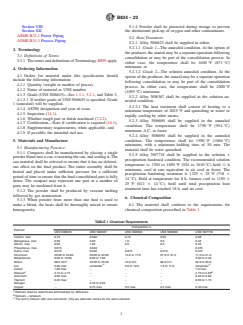
6.1 The material shall conform to the requirements for chemical composition prescribed in Table 1.
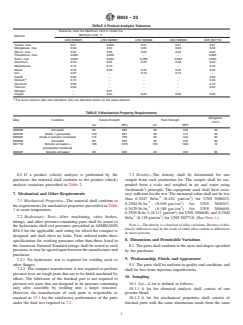
6.2 If a product (check) analysis is performed by the purchaser, the material shall conform to the product (check) analysis
variations prescribed in Table 2.
7. Mechanical and Other Requirements
7.1 Mechanical Properties—The material shall conform to the requirements for mechanical properties prescribed in Table 3 at
room temperature.
7.2 Hydrostatic Tests—After machining, valve bodies, fittings, and other pressure-containing parts shall be tested to the hydrostatic
shell-test pressures prescribed in ASME/ANSI B16.5 for the applicable steel rating for which the compact is designed, and shall
show no leaks. Parts ordered under these specifications for working pressures other than those listed in the American National
Standard ratings shall be tested to such pressures as may be agreed upon between the manufacturer and purchaser.
7.2.1 No hydrostatic test is required for welding neck or other flanges.
7.2.2 The compact manufacturer is not required to perform pressure tests on rough parts that are to be finish machined by others.
The fabricator of the finished part is not required to pressure test parts that are designed to be pressure containing only after
assembly by welding into a larger structure. However, the manufacturer of such parts is responsible as required in 15.1 for the
satisfactory performance of the parts under the final test required in 7.2.
TABLE 1 Chemical Requirements
Composition,%
Element
UNS N06625 UNS N08367 UNS N06600 UNS N06690 UNS N07718
Carbon, max 0.10 0.030 0.15 0.05 0.08
Manganese, max 0.50 2.00 1.0 0.5 0.35
Silicon, max 0.50 1.00 0.5 0.5 0.35
Phosphorus, max 0.015 0.040 . . 0.015
Sulfur, max 0.015 0.030 0.015 0.015 0.015
Chromium 20.00 to 23.00 20.00 to 22.00 14.0 to 17.0 27.0 to 31.0 17.0 to 21.0
Molybdenum 8.00 to 10.00 6.00 to 7.00 . . 2.80 to 3.30
A
Nickel 58.0 min 23.50 to 25.50 72.0 min 58.0 min 50.0 to 55.0
A A
Iron 5.00 max remainder 6.0 to 10.0 7.0 to 11.0 remainder
Cobalt (when specified) 1.00 max . . . 1.0 max
Cobalt 1.00 max . . . 1.0 max
B
Columbium (Nb) 3.15 to 4.15 . . . 4.75 to 5.50
C B
Niobium 3.15 to 4.15 . . . 4.75 to 5.50
Aluminum 0.50 max . . . 0.20 to 0.80
Titanium 0.40 max . . . 0.65 to 1.15
Nitrogen . 0.18 to 0.25 . . .
Copper . 0.75 max 0.5 max 0.5 max 0.30 max
A
Element shall
...